Can you park in Boston after a snowstorm? How graphics, journalism and old-school Nintendo can lead to a fun time.

If you are pretty much anywhere above the Mason-Dixon Line this week, you are buried in snow. (If you are in Florida or somewhere else in which 55 degrees is considered an “arctic chill,” kindly keep your thoughts to yourself.) Between school closings, massive plows and the fairly frequent multi-vehicle crashes on the highway because SOME IDIOTS don’t know how to FRICKIN’ DRIVE… (sorry)…,  it become pretty obvious why many of us consider “snow” a true four-letter word.

However, guest blogger, founder of the LGBTQ+ Experiment and graphics guru Pat Garvin found a way to make snow emergencies fun for readers of the Boston Globe. A few years back, Garvin built an old-school Nintendo-style game for the Globe’s website that allows users to “hustle” for a street parking spot during a snow emergency.


GarvinSnow

A screen shot of Pat’s fantastic game.

“For years, I had wanted to make some sort of game for BostonGlobe.com,” Garvin said. “I renewed my interest after some Globe colleagues and I checked out an arcade bar that had recently opened. As we played these vintage 1980s games with their unmistakable look and feel, I got the idea that I wanted to make something that recreated that feel with that same quick visual shorthand that comes from those blocky visuals. What it would be, I don’t know.”

Garvin noticed something interesting about Boston: The way in which people deal with parking in a snow emergency.

“I went to work the next day and found inspiration from a pending snowstorm,” he said. “Boston is unlike anywhere else I have lived in that many in the city use household objects to save parking spaces after a snowstorm. They can — and will — use anything: a lawn chair, a traffic cone, old tables, etc. People take the practice with a religious seriousness, and people who take parking spots that had a space saver have returned to their car to find nasty notes and in come cases, their cars vandalized. I decided to make a game allowing users to hunt for parking spots after a snowstorm, knowing they might risk the chance that if they take a spot that has been saved with a space saver, they might get their tires slashed or their window broken.”

Garvin used the names of his colleagues as inspiration for the buildings (a music critic was the namesake of a record store while a movie house was named for a movie critic.) as he used Java Script and jQuery to create the game. The purpose, he said, was to have fun and yet focus on something truly associated with Boston.

“Projects that allow me to mimic a style that I know readers and users will recognize is fun because it gives me both structure to follow and creative license to convey something in a different way,” he said. “The hidden jokes in the background are fun because they will reward the people who pay attention to detail. This is not a traditional project per se, as there are no maps, charts, or information graphics. There are few words here other than the intro and kill screens. But this project is informed by the same news judgment that would inspire a react story or a features story.”

The game borders on the ridiculously impossible, which pretty much sums up how hard it is to get a space on the streets of Boston after a snowstorm. Every time a blizzard whips up some chaos out there, Garvin’s work becomes a welcome distraction for the folks in that area.

“A lot of the stories and interviews I had seen about parking space savers was from the perspective of Bostonians who felt a right to a spot because they had shoveled the spot and felt a sense of ownership,” he said. “The reasoning and justification seemed to begin and end there. But if you have to drive through the streets and need to park, what then? What if you’re a working parent and you need to drop your child off with a relative? Or what if you are a medical professional coming to visit a diabetic patient in his home? By taking the shovelers out of the game and focusing only on the cars and the spots, I hope I got people to think about space savers from a slightly different angle.”

Think you have what it takes to get a spot? Click here to play the Globe’s snowstorm parking game.

What Super Bowl? The New Orleans Times-Picayune and knowing your audience

While the rest of the football universe spent Monday morning either celebrating New England’s sixth Super Bowl win or complaining about it, the folks in New Orleans woke up to a newspaper front that captured the city’s mood perfectly:

tpblank

If you aren’t a football fan, or aren’t from the NoLa area, you probably didn’t hear about the NFC championship game that sent the Los Angeles Rams to the Super Bowl and sent the New Orleans Saints home for the year. During the Saints final drive in the fourth quarter, with the score tied 20-20, the referees blew a pass-interference call that would have essentially won the gain for New Orleans. However, instead of getting a first down and a chance to run out the clock before a game-winning field goal, the Saints had a 4th-and-10 situation, so they kicked a field goal.

The Rams tied the game in regulation and went on to win 26-23 in overtime.

Still steaming two weeks later, the staff of the paper decided not to cover The Big Game and instead protest its existence with this cover. How good of an idea this was seemed to be directly related to your connection to the area.

A journalism education Facebook group I’m on posted this image and asked if this was a colossal waste of space, and the majority of folks initially thought it was:

This is almost an ethics issue. My reaction to this front is that it cheapens the front page. Think of all of the important content that could have been there.
NOLA has stewed over this for two weeks.

<SNIP>

Blowing up the front may have jumped the shark.

<SNIP>

Yeah, this was petty and shouldn’t have been done. Write an editorial about it. Sports really isn’t that important, and I’m a sports fan.

<SNIP>

What a waste of space and opportunity! I’m sorry if you are a football fan–I’m not–but N.O. needs to get over it! … there is so much more important news than the silly Super Bowl, blown call or not. Jeepers.

My two cents on the matter was that I probably wouldn’t have done this because I’m usually a wuss when it comes to going way out on a limb, but that I did like it for two reasons:

  1. Audience centricity: These folks know their readership, particularly in the print-distribution area, pretty well, so if they have the vibe that this is what people are thinking and feeling, they probably hit a home run with their audience. Meeting your audience where they are and touching on what they think is important tends to work well, and a local paper, which the TP is, should know what matters most to the readers.
  2. Fail big: Even if this was a disaster-bacle and the readers ended up hating it, at least the paper failed big. It’s easy to try to hedge your bets against really screwing up by doing something minor, but it takes guts to go for it, which the paper did here.

To see if I was right about this, I put out a call to my friends and colleagues in the area and it turns out, the people down there loved this thing:

This is a great case of a newsroom knowing its audience. The city partied yesterday to celebrate the season and collectively mourn what coulda shoulda been. The Times-Pic covered it all on its digital platforms yesterday, so I think the front page was a great way to show the city’s sentiment, while still having coverage inside the paper. And people did not watch the big game. The numbers prove it: locally, the game got a 26.2 rating, compared to 55 last year.

<SNIP>

It’s real, and it’s going over brilliantly.

<SNIP>

Local reaction to Super Bowl and the blown call ranges from genuine outrage to dipshittery.

This reaction from the folks in the area reinforces the idea of audience centricity and the importance of knowing your audience. When it came down to it, the paper took a huge risk, but it ended up becoming the talk of the town and beyond. National media covered the paper’s front page live on air and on the web. The Washington Post featured all of the outrage, including the parade the fans had to grouse about the Big Game’s lack of value to them.

Even more, the paper clearly made an impact where it mattered most: Sales.

“The paper sold out at shops & paper machines,” a good friend told me.

When was the last time the paper could say that?

That’s not how anything works: How journalism students can find inspiration in the failures of others

Given the week we had in terms of news, social media, angst and more, I figured we could all use a bit of humor…

When you find yourself struggling with your journalism work and wondering if there will be a job for you at the end of this whole endeavor, cheer up and realize that being even marginally good at writing, reporting and thinking will put you ahead of some of these people.

Graphical Gaffes

You might remember a few years back when Rep. Jason Chaffetz, R-Utah, used this chart as part of a hearing on Planned Parenthood, in an attempt to show a spike in abortion provision and a drop in cancer screens at the organization’s clinics:

Planned Parenthood

You might also recall that it led to some serious derision by people who understand how graphics are supposed to work. The larger numbers are lower than the smaller numbers in 2013, the lines go in an uninterrupted pattern of incline or decline (something that rarely happens with data) and no data points exist other than the first and last years. Politifact also noted that the chart has no Y axis and one journalist took it a step further, stating, “This is not how charts work!”

Here in the great state of Wisconsin, our outgoing governor, Scott Walker, decided to one-up Chaffetz with a graphic intent on explaining how a lame-duck legislative session didn’t really undermine his successor, Tony Evers. Walker, a Republican, provided a Venn Diagram (a term I’m using loosely here) to show that even though he signed off on legislation that shifted power away from Evers, a Democrat, and back to the Republican-led legislature, his powers and Evers’  powers were essentially the same.

This did not go well:

VennWalker

For those of you unfamiliar with how Venn diagrams are supposed to work, consider this simple one:

Venn

In other words, the overlap is where things are similar, with the differences being on the outside. I have no idea what Walker’s chart shows, other than this isn’t how charts are supposed to work.


Support, not repeat:

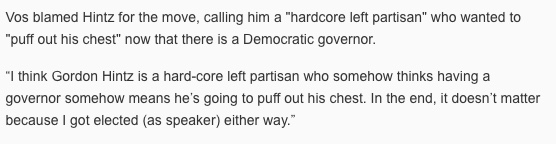
When you put together a paraphrase-quote pairing, the goal is to have a strong paraphrase that establishes who will be speaking and the topic upon which that person will speak. The quote should add value and perhaps even some “spice” to the piece. What you shouldn’t do is give your readers the sense they are living in “Groundhog Day” like this one:

VosQuote

I’m not sure if I should be more worried that the partial quotes are EXACTLY the same as they are in the full quote below, or if the reporter went with “hardcore” and “hard-core” in subsequent paragraphs. I am a freak for hyphenation…


It’s a lead, not an allegory.

Leads are meant to have as much good information packed into them as possible. That said, we tend to think of 25 to 35 words as the range for one of these things. Another tip I often offer is to take a normal human breath and read it aloud. If you feel tight at the end of it, or you run out of breath entirely, you probably need to trim it or cut it.

Try that with this lead and you’ll likely need some smelling salts or CPR:

BOSTON — Celtics guard Kyrie Irving said that in the wake of his outbursts at coach Brad Stevens and forward Gordon Hayward on the court at the end of Saturday’s loss at the Orlando Magic, and pointed criticisms of Boston’s young players afterward, he called LeBron James and apologized for the way he handled criticism from James when the two were teammates in Cleveland.

Not counting the dateline, you’re looking at 63 words or more than double the low end of a solid lead. It wouldn’t take much to get this thing down to that range, particularly if the writer didn’t feel it necessary to outline Irving’s transgressions in granular detail right up top.

Remember, tell people what happened, but don’t overload their brains in doing it.


Wait for it… Keep waiting…

Some stories are so horrifying, it’s hard to get everything into the lead. Not to say that journalists don’t try:

WAUSAU – The Wausau baby sitter charged with killing a 2-month-old boy in her care tried to hide the infant’s death from his mother and then went swimming at a Wausau hotel with her boyfriend and son, police say.

There’s a lot to freak out about here when it comes to the arrest of Marissa Tietsort, (this all happened in Wausau, in case you didn’t get that from the three mentions of it up there) but if you keep reading you’ll find out a few other things that are problematic that get stuck a little too low, like this one in the fifth paragraph:

Tietsort has been in jail since October on a $250,000 cash bond in a separate child abuse case.

Or this, which is about two sentences from the bottom of the nearly 1,000-word story:

In 2010, Tietsort’s boyfriend filed for temporary restraining orders after he told investigators she was abusing their two sons. Records show social services workers have removed four of Tietsort’s children from her care and were unaware that she had given birth to her fifth child.

Annnd this, which is the second-to-last sentence in the whole piece:

Tietsort is now in the Marathon County Jail and pregnant with her sixth child.

I’m thinking this could be information worth knowing a little bit earlier in the story…

It feels kind of like this:


Speaking of placement…

Sometimes stories and images have issues when they are put too close to one another. This is the case in which a criminal investigation and nice feature photo led to a question about what’s in your sandwich:

DeadCats

I’m still not going vegan, but this set up does give me pause.


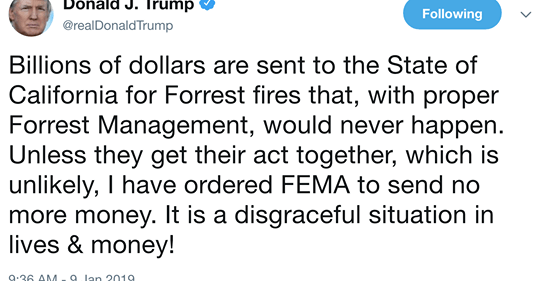
My name is Forrest… Forrest Management

Typos can really do you in, even if you are the president.

TrumpForrest

(The tweet was later corrected. That doesn’t make me feel any better. Neither did his “hamberders” tweet. I don’t care which political party you support. I support spelling and editing.)


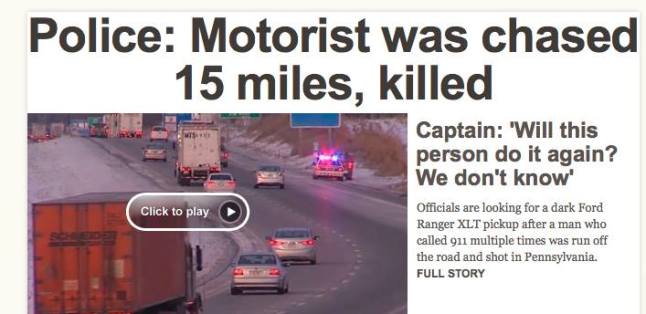
Good Head + Good Deck – Common Sense = Bad Example

Zombie Motorist

Unless we are fearful of a zombie driver, I think it’s safe to say this guy isn’t going to do this again, Captain Whoeveryouare.


Be “Marshmallow Alert:” Four more things that will prevent your first media-writing class from sucking

(EDITOR’S NOTE: Since many places start up again on Jan. 7, here’s a post to help start up the new year. We will return to our regular posting schedule next week. -VFF)

A year or two ago, I tried to be inspirational for new students who were entering their first media-writing course with a post on the “Four things to know to keep your first media writing class from sucking.” As you can tell by the headline, inspiration isn’t my forte.

Still, with the start of the new year, new semester and new set of classes for many of you, feel free to flip back to the previous version and then enjoy these Filak-isms to help add some merriment (and some thinking points) to your first couple days :

Be “Marshmallow Alert” in Class: I have always taught in small labs because writing, reporting and editing courses were set up that way wherever I worked. I also had the benefit of classrooms where I could see everything students were doing on their monitors and phones. Thus, when I noticed people were screwing around, I could call them out by name (another benefit of small classes) and they would re-engage pretty easily.

That didn’t mean some students didn’t try to engage every electric device they owned short of a curling iron and a Dr. Scott’s Electric Corset to avoid paying attention to me, but I did my best. (My “best” somehow included ripping the power cable out of the back of an iMac and once texting a young lady’s boyfriend three poop emojis and a snowflake after snatching her phone in mid-text.)

However, when I ended up having to teach a mini-pit class with 50 or so students, I wasn’t able to apply that same level of personal call outs and electronic monitoring, so I went a little old school in my solution. I built a marshmallow gun out of PVC piping and loaded ‘er up for each class. When I saw someone dinking around after a couple  warnings, I fired off a round or two in that person’s general direction. That really freaked them out.

By the time that class was done, I was a regular Annie Oakley. It was almost sad that they became so attentive that they didn’t even want to challenge my accuracy any more. That said, the class started participating a lot more and started doing a bit better on graded stuff.

The point is, don’t just vaguely pay attention in class. Pay attention as if a momentary distraction could get you drilled with a tiny white pellet of sugar and then mocked by a room filled with your peers.

Don’t just be alert. Be “Marshmallow Alert.”


Use the “Buffet vs. Cost” Theory:

Question: Why is it that so many people eat to the point of exploding while at a buffet?
Answer: “I PAID X DOLLARS FOR THIS! I’M GETTING MY MONEY’S WORTH!”

Apparently, stomach pains, bloating and that constant regurge of generic-soft-serve-vanilla-with-Gummy-Bears taste are all part of getting one’s “money’s worth” out of  a buffet. If this were a sit-down restaurant, these people wouldn’t eat half that much (except for my kid, who would eat the entire bread basket and hide crackers in her socks), but at a buffet, hey, let’s go for death!

When it comes to your education, particularly a writing course in your area of study, you are paying a ridiculous amount of money, or at least a lot more than what the Golden Corral will charge you on “Shrimp Night.” With that in mind, it’s baffling to me that students skip classes, drift off in class and refuse to answer any questions. That’s like going to the Coral (or your own regional buffet of choice) and saying, “Let me pay double for this, but all I want is one of those sprigs of parsley and a cracker, please.”

To heck with that. Gorge yourself.

Ask questions in class, be that annoying kid who always has an anecdote for every example the professor has, visit office hours to go over your graded work to find areas of improvement, color-tab the crap out of your AP style book and more. Get your money’s worth out of this, especially since you’ll actually benefit from the stuff you learn in the writing class. (This is in no way meant to disparage that “Quest Class” on Ancient Babylonian Calf Roping you are forced to take in your Gen Ed program, but trust me when I tell you that media writing is a skill employers will heavily value.)


Embrace Your Inner 4-year-old: Anyone who has spent more than 35 seconds in the presence of a 4-year-old knows the only question any of them seems to ask is “Why?” It eventually gets to the point that you want to hand the kid a fork and tell him/her to go play with the toaster. The thing is, though, they really want to understand stuff that they don’t understand. They don’t get why they can’t stay up past 8 p.m., watch another cartoon or give the hamster a bath in the toilet. They have this sense that those are all logical propositions and they really feel like the adults should have to justify the “No” answer to those requests.

When it comes to your media writing class, embrace your inner 4-year-old, but do it in the right way and at the right time. Students have no problem asking “WHY?” when it comes to things like “Why is my grade so low if I turned in almost everything?” or “Why do we have to take the midterm when it’s so nice outside?” (Two questions I’ve actually heard.) However, when it comes to things that are more about learning and improving and less about point deductions and the one sunny day a year we get in Wisconsin, I have found students are quieter than a church mouse on Sunday.

Take advantage of the opportunity to ask questions about your work. Don’t ask questions about the grade, because, as we explained in the previous edition of this list, your grade will not haunt you for the rest of your life. However, if you don’t understand why you can’t write a news story in chronological order or why it pays to have at least one or two of the W’s (and maybe even the H) in your lead, you’re going to be in trouble.

Talk to your professor whenever you get work back and you don’t understand what made something wrong. Don’t focus on the points or the grade, but rather on the underlying rationale behind the negative outcomes and you’ll be able to improve moving forward.


Now is the Time to Care: I know this is cheating because I pulled it from the last list, but it bears repeating. I can’t remember a semester like the one I just had where students treated the final grades I filed as the start of a bargaining session. (It literally felt like something out of contract negotiation: “Dr. Filak, I see you have proposed a D for me here. What I’d like to do is counter with a B- and see where we can find some common ground…”) The time to care about this stuff is now, so look at what it is that you can do to keep yourself on the right side of the best outcomes possible.

I’ve told this to students before and it’s the best bit of advice I can possibly give you for any class:

Instead of saying, “I need this class (to graduate, to move on in the major or whatever)!” to your professor after you screwed up your work and you have no hope of getting out alive, say “I need this class (to graduate, to move on in the major or whatever)!” to yourself every day from the beginning of the semester and act accordingly.

Have a great semester and knock ’em dead.

The “Bessy” Awards: For achievements in student excuses, wild tales and general chutzpah

Around this time of year, student stress is high, as is the bar for what counts as an excuse for missing class, failing a test or other less-than-pleasant educational outcomes. Students have, for years and years, broken out the sagas of dead grandmothers and grandfathers as a way of getting out of classes and turning in homework late, even though that exact same grandparent died three times this year already.

However, faculty can attest to the fact that excuses rooted in deaths and dental emergencies rarely pass muster. To get a second look or a “I guess I could let you slide…” from a professor, it takes dedication to your story, a heavy dose of weirdness and some good old-fashioned chutzpah. Therefore, we here at the Dynamics of Media, in conjunction with the Hivemind, have decided to honor the students who put forth serious effort in their tales of woe with our “Best BS Excuses in Education” Awards, known now and forever as “The BESSYs.”

BESSY

Without further ado, let’s get into it:

IN THE CATEGORY OF STRANGE-BUT-TRUE

In all fairness, I have skipped a more than a few classes and come late for a few others. The best excuse was a true one: I was worried about making it to class during a freak snow storm, so I took my motor scooter from my off-campus apartment. When some idiot in a giant Buick hit the brakes for no apparent reason, I couldn’t stop quickly enough on the slushy streets of Madison and I slid directly under the rear of his car and wedged my head between his muffler and the pavement.

Fortunately for me, I was wearing a helmet. Fortunately for him, I was too worried about being late to call the cops, so I just yanked my scooter out of there and drove around him.

I will never forget the look on my TA’s face when he saw me, coated in slush, with a giant rip through my coat and a huge burn mark on of my helmet. As I yanked off the helmet to assess the damage, he just looked at me and said, “I don’t even want to know.”

As much as we’d like to blame all of weird excuses on today’s Millennials and their damned hippity-hoppity music, folks from previous generations weighed in with their best strange-but-true moments:

Well, I was a half-hour late to the final of (NAME’S) Law of Mass Communications because a pack of wild dogs wouldn’t let me out of my house at (ADDRESS), in 1972. I asked her years later and she remembered it, and remembered having to explain it to her as I walked in way late.

Occasionally, the truth bomb includes collateral damage that leads to throwing a family member under the bus:

A variation on the dog ate my homework: my grandmother has dementia and she threw my laptop into a trash compactor and destroyed all my work.

That said, the winner of the “I Don’t Even Want to Know” BESSY Award goes to this story:

My best one was real: New Jersey student couldn’t come to class for a week due to a court order that she not leave the state for a week (and she forwarded it).


IN THE CATEGORY OF “YEP, YOU GOT ME!”

Sometimes, it’s not so much the fact the student skipped, it’s that they got caught in the lie. My favorite story remains listed among the Five Conversations Journalism Professors have in Hell:

Perhaps my favorite one was years ago when I had a student tell me she spent six hours in the ER with a kidney infection and that she was way too sick to attend my 3 p.m. class. I explained I understood and that these kinds of things happen.

Later that night, my wife and I were at the local journalism bar and guess who walked in? Yep. The student.

She saw me, got a freaked-out look on her face and practically dove into the party room next to the entrance.

The conversation that followed the next class period was epic:

Her: Hi, I was wondering if I missed anything in class…
Me: Well, it’s been said that the appearance of impropriety is worse than impropriety itself, which is what I thought about when I saw you walk into the Heidelberg the other night, four hours after skipping my class.
Her: Oh! I can explain that!
Me: I’d love to hear it.
Her: Well, it was my friend’s birthday and I was feeling much better at that point so I just stopped by for a drink.
Me: With a kidney infection?
Her: Oh, yeah! I have my doctor’s note for you. Let me get that!
Me: (feeling aneurysm building in my brain, fueled by her complete lack of self-awareness) Um… That’s OK… Let’s just start class.

The desire to dodge and not get caught isn’t unique to this student. One former student fessed up to this moment:

When I worked in sports at (college-based media outlet), my dad qualified for an amateur golf tournament in Orlando and my family wanted us all to go, but it was last minute. I told the editor my grandma had died even though she hadn’t. The tournament was to be broadcast on ESPN, so I spent all week dodging cameras (I worked in sports, remember). Not an original story, but I thought it had a nice twist with the cameras.

However the winner for the “How Did You Know?…Oh…” BESSY Award goes to the cliche double whammy listed here:

A student needed to miss a week before Spring Break because her grandmother died. She forgot we were friends on Facebook and started posting photos of herself on the beach.


IN THE CATEGORY OF OVERSHARING EXCUSES:

Oversharing has been one of those things students tended to do for reasons past my understanding. Professors have shared more than a few stories of students who discussed the nuanced details of their vomiting, disclosed extremely personal medical problems or generally told us stuff we just DID NOT want to hear.

Case in point: A student in our newsroom once told a TA that nobody should steal her chair because her “genital warts are really flaring up.” The same student once noted that she had just broken up with her boyfriend, and despite his attempts at an amicable parting, she “wasn’t going to keep (expletive) him as a friend.”

I still feel the need to wash my ears out with bleach after hearing that…

A colleague at an Iowa institution shared a similar “bleachable” moment that turned out to be not as bad as it initially sounded:

Once got an email from a student informing me he wouldn’t be in class that morning because he “shit the bed.” At first I was like 😳 trying to get that image out of my head. Then I decided to google it and it turns out it’s slang for “really messed up.”

However, the Oversharing  BESSY Award, sponsored by the TMI Corp,, goes to the student in this story:

My Japanese colleague once completely freaked when a student told him she couldn’t come to class because of “anal bleeding.”

Also in this “Oh, dear Lord, that’s so gross…” division, we have a second category.

The “I Believe You Because I’m Too Disgusted To Check Up On You” BESSY winner  is a tie between these two students:

I had one who said he got sprayed by a skunk!

And

“I got my hair caught in a low-hanging fly trap.”


IN THE CATEGORY OF “HONESTY IS (USUALLY) THE BEST POLICY:”

It’s the simplest answers that merit the most respect from this professor:

Art students usually just tell the truth….”I overslept”.


That said, the winner for Best Blinding and Burning Flash of the Obvious goes to the student who once noted:

Seeing my family is more important than a 2:30 p.m. bio class the Wednesday before Thanksgiving. Sorry.

OK. Ouch. At least is wasn’t in the kid’s major…


IN THE CATEGORY OF SINGULARLY LAME ACHIEVEMENT:

The “I’m Not As Cool As You Think” BESSY goes to a broadcast graduate with disdain for the weather:

I interned for the radio play-by-play guys for the Badgers my senior year. I was supposed to go to Mardi Gras with some friends so they knew I was going to miss a game or two, but I decided at the last minute not to go, but didn’t tell the radio guys. There was a basketball game the day after I was supposed to get back, but it was freezing so I didn’t want to walk all the way to the field house, so I told them I was too partied out from Mardi Gras and had to skip that game.


The “But I Was Just Thinking of Your Feelings, Professor” Award goes to two of my former students who told me this:

I always assumed that you would have rather (Yahoo 1), (Yahoo 2) and myself come up with a bullshit excuse to miss class rather than show up in the state we would show up in on Thursday mornings.

Yahoo 1 then chimed in to support this statement:

Fair point! We typically had double the beers in our system than we did hours of sleep by the time 8 a.m. rolled around

(It should be pointed out that Yahoo 1 is about to become a father for the first time. I weep for the future of humanity.)


IN THE CATEGORY OF “I’M KIND OF A BIG DEAL“

Occasionally, name dropping or explaining you were doing something much cooler works out for you, as it did for this current professor who once showed up late for one of his courses:

I was very late to class once and the art prof looked pretty disturbed. I told her I had a good excuse–I was photographing the governor. She believed me but acted as if that was not a good excuse for an art class.

However, the Best Humblebrag Award goes to this student from a wealthy private school:

A student told her professor that she  “could not come to class because she was hosting a private trunk show for Isaac Mizrahi.“


And finally, the Best Excuse Ever Award goes to the student who inspired the professor to note “I shit you not” after sharing this excuse with us:

“Pimp C died so I will be missing class all week.”


Thanks to all the nominees and the audience. Hope to see you next year.

A moment of laughter during a rough week.

The last several days have been just DAMNED depressing and with the hope that I’ll hear from student journalists who have done some amazing work on recent tragic events, I imagine the blog won’t be getting much peppier over the next few days.

With that in mind, I decided to take a break from “Dr. Vinnie’s Circus of Human Misery and Catastrophe” to provide a little comic relief.

Enjoy:


I love my Browns, but damn:

DogPound

This showed up in my memories feed from about three years ago… And we really aren’t much better at most things, so I imagine we could pull this off again. Also, it was only THREE PANELS OF FABRIC! How hard is it to get the “DAW” before “G POUND” anyway?


76 Whatevers Led The Big Parade…

InstrumentScrewUp

I know that not every caption is a Pulitzer-Prize winner, but come on. Even a non-musical person like me knows this is a xylophone.


Dan Quayle to Register Three Please:

Potatoe

The former vice president of the United States once famously misspelled “potato” during a spelling bee appearance at a grade school. Apparently, he’s now working at the Piggly Wiggly in Omro.


And finally…

“Police found the man with a cheeseburger protruding from the wound…”


CheesburgerStabbing

Consider that worthy of deeper study and have a great day!

The “Junk Drawer:” Some things just go without saying (but journalists end up writing them down anyway)

As we noted in an earlier post, the Junk Drawer is usually full of stuff that didn’t fit anywhere else but you still need. Today’s edition of the JD gives you a look at some moments of writing that kind of left me shaking my head or pondering my own sense of sanity. Consider some of these items:


From the “Sometimes The Lead Just Writes Itself” Department:

You can overwrite a lead when you try to put too much of your own polish on it or you try to oversell it. Fortunately, some stories just walk up and say, “Here’s your lead” like this one did:

BRISTOL, Tenn. – A man who police say was run over with a lawn mower while trying to kill his son with a chain saw has had to have his leg amputated.

I figured this was going to be the best lead of the week when it came to this concept. I was clearly wrong, thanks to a head’s up from Steven Chappell.

Dennis Hof, the flamboyant pimp, reality television star and Republican nominee who was expected to win a seat in the Nevada Assembly next month, was found dead at his Nye County, Nev., brothel Tuesday morning by a male porn star, authorities said.


In other “junk drawer” news…

I’d call this a “safe bet” statement from the sheriff:

A Wisconsin teenager who has been missing since her parents were found dead in their home isn’t a runaway and investigators believe she’s in danger, a sheriff said Tuesday.


File this under the “Because I SAID SO” arguments you will some day make to your kids:

Vote No


Question for the group: At what point is something too ridiculous to be news?

Answer: When you can write this headline and the word “witch” doesn’t make it into the first three paragraphs.

‘It is a scary time,’ Trump backer Amy Kremer tells MSNBC. Witches ‘are placing a hex on Brett Kavanaugh.’

Although I take no political stands on this blog, it is worth mentioning that the Republicans started the “witch” thing first:


In “Are we not doing ‘phrasing’ anymore?” news:

This Facebook post clearly needs context and emergency punctuation:

Legal


Don’t hide in the gray areas, judge. Tell us how you really feel:

Judge to man found guilty of killing 4-year-old girl: “You should die in a locked closet”


And he’s probably not going to be “Johnny Sheen,” “Johnny Chaplin” or “Johnny Brown” either…

“Obviously I’m not going to change, I’m not the type of player that’s going to be ‘Johnny Hustle,’ and run down the line and slide to first base and … you know, whatever can happen. That’s just not my personality, that’s not my cup of tea, that’s not who I am.

I think he meant “Charlie Hustle” (a Pete Rose reference) or at least I hope so…

And finally… When it comes to giving great advice, leave it to your law-enforcement officials:

“If someone is beating you with a metal rod, you have every right to defend yourself,” Sheriff Grady Judd offered. “But if that person hits you and runs away, call 911. Don’t try to run him down with your truck. It’s not only nuts, it’s illegal. It’s attempted murder.”


4 tips to avoid having Mike Rotch and Seymour Butts as sources in your story

The traditional “person on the street” interview has given way to the “tweet on the information superhighway” when it comes to getting a public perspective on big news. Journalists used to head out to a bustling area of town to talk to random citizens about issues ranging from who would win the World Series to what the upcoming year would bring:

I remember having to do a few of these things for localizations or reaction stories on things like the arrest of a person suspected of murder to the fans thoughts on Green Bay winning the Super Bowl. I can honestly think of nothing more pointless than trying to get drunken Packer fans on State Street in Madison, Wisconsin, to tell me something about their emotional state after winning The Big Game. The only person who had it worse than I did was Rick Blum. This poor guy from Channel 3 was standing on top of his van trying to go live at 10, as drunks pelted him with snowballs and chanted, “RICK BLUM SUCKS!” over and over again.

Interviewing the general public on any topic can be dicey, but it can get worse when you find out you are the victim of a horrible practical joke, as was the case in 2001 when the New York Post’s Neil Graves interviewed a local real estate developer:

HeywoodJablome

If you don’t get the joke, Google Mr. Jablome or ask the closest pervert you know. Making this worse, I found this article again just last night and his quote is STILL THERE. Either the Post doesn’t get it or someone on the copy desk SWEARS he knows the guy.

It could always be worse, as this KTVO-TV morning team in Kirksville, Missouri, came to realize during a simple “Happy Birthday, Viewers!” segment that went horribly, horribly wrong:


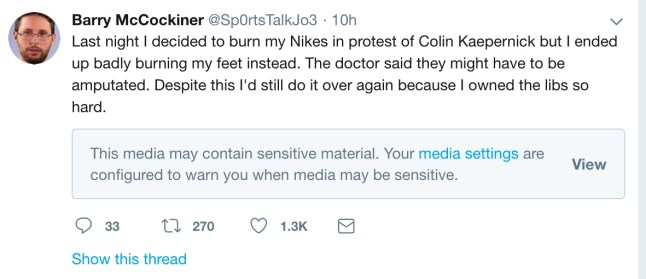
The reason I bring this stuff up was because the descendants of Heywood Jablome and Dixie Normous showed up in KTVU-TV’s coverage of the Nike/Colin Kaepernick discussion. Check out the source for the quote at the bottom:

Barry

Honestly, I missed it the first time, but fortunately, I have plenty of well-trained former students out there, such as Alex Nemec, who basically had to walk me through this with four text messages until I saw it. (If you’re still missing it, read it aloud and also realize anything with the word “cock” in it has a really good chance of being dirty.)

I could spend all day looking up the various media outlets that got stung by quoting “Mike Rotch” or “Seymour Butts,” (and if the afternoon gets slow, I probably will), but the point here is to help you figure out how to protect yourself from these kinds of twerps. Consider the following advice:

  • Watch “The Simpsons.” Or at least this compilation. If Bart Simpson called Moe’s Tavern looking for your source, it’s probably a good idea to go interview someone else for that scintillating, “Do you like sweet corn?” quote at the county fair.


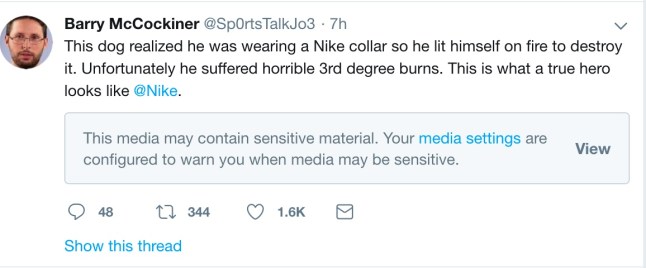
  • Go a few tweets deep: If you feel the best way to weave in that “man of the people” vibe into your writing is to find people on Twitter who you don’t know but are blathering on about your topic, look at a few tweets. “Barry” has a few interesting tweets on his timeline on a variety of topics. If I posted the ones here related to his quote about how Kaepernick’s Nike ad is affecting his marriage, I’m sure half the SAGE marketing team would have heart attacks. (Let’s just say he noted that his marriage was harmed when he caught his wife being unfaithful to him with a man wearing only Nike socks.) Here are a few tamer tweets he posted:

BurnNikes

DogNike

He also has a wonderful diatribe about how he has been constantly on heroin… Long story short: Is this REALLY a source you would want to represent anything you’ve written? If you are going to use a Twitter user, try to find someone who a) you recognize, b) has something important to say and c) doesn’t look like a loon in everything he or she is saying

  • Trust, but verify: The Russian proverb works wonders here, as not every double entendre of a name is a prankster. The Cleveland Indians once had a pitching coach named Dick Pole. I’m not kidding. Here is a doubly unfortunate card of his when he pitched for a minor league team in Portland:

DickPole

I knew a weird guy who used to show up at baseball card shows with a binder full of cards like this called his “Book of Dicks,” containing cards of Dick Allen, Dick Pole, Pete La Cock, Woody Held and others. The point is, those are real names, so it’s not always an attempt to punk you if you get a weird name.

However, it’s up to you to go take a look around and see if there is any supporting evidence that guys like Barry McCockiner exist. One of the downsides of Twitter is that you are limited to what people tell you about themselves, so it’s a little more difficult to verify the source. In the case of Mr. Jablome, a check of area real estate developers could have limited the embarrassment. In either case, you obviously can’t “card” a source to verify his or her name, (although some jokesters have gone to great lengths to prove their identity) but you can do some Googling and social media checks to see how likely it is that Jack Mehoff is a real person.

  • Ask for help: As we noted in earlier posts, it pays to have a person in your organization with a demented mind. The old saying of “it takes a thief to catch a thief” rings true in this type of work as well. You should read the name aloud, have others do the same and then eventually hit up Jimmy The Crime Guy or whoever in your organization has the ability to turn anything into a dirty joke. If Jimmy can’t figure it out, you’re probably safe.

“Definitely Doable:” Either hire or fire a pervert and other headline advice for the rest of us.

Whenever someone screws up a headline in the worst of all ways, it doesn’t take long before people I know are shining the Bat Signal in my direction:

Shecky

The headline in question is a little easier to see here:

Doable

The story about a young woman winning the Miss Kansas Outstanding Teen carried the double entendre headline “Definitely Doable,” which includes a term that is that at the heart of this classic SNL skit. When I initially saw the headline, I told the person who asked me about it that this was likely a case of one of two things:

  1. The phrase was in the story somewhere and it made sense there, but out of context, it’s truly horrifying.
  2. Someone in the newsroom did the “I’d do her” joke, wrote the headline as a spoof and said, “We’ll change that before it presses” and never did.

Turns out, it was the first issue, as the story (which has a more appropriate headline on its web version) included this quote:

“It was really hard for me to be away from my family for a week because we are have always been so close, but it was good for me coming here,” she said. “This week taught me that this is definitely doable.“

There are about 93 problems with all this, including that this young woman will be the “definitely doable girl” for a long time, but here’s the worst one: This isn’t the first time the Pratt Tribune has landed in the headlines for a headline. This classic was the Tribune’s as well:

Handjob

We talked about this when it happened, along with a series of other headlines that went awry, and provided some advice to the Trib and other folks who want to avoid these problems. The best advice I can give them after this screw up is to find out what went wrong and do one of two things:

  1. If the same person keeps writing these headlines, fire the pervert before he or she (OK, if I had to put money on it, it’s a he) gets you into even bigger trouble.
  2. If it truly is a situation where nobody really saw either of these headlines as being potentially sexual, hire a pervert to read everything you write and have him or her (probably a him) try to turn anything you type into something dirty.

For the rest of us, here are a couple other headline helpers beyond what we covered last time:

  • Create better headline specs: One of the reasons I’m sure “Definitely Doable” ended up in the paper was because the space left for the headline didn’t give the writer a lot of options. One basic rule we used to have at a paper I worked on was, “If you cut the hole, you need to know how to fill it.” In other words, you can’t give someone a one-column head space for a story about California kindergarten rules under then-Gov. Arnold Schwarzenegger, unless you can suggest a decent headline for that space.
  • Do a headline throw-down: When you get into a jam with a headline, get away from the computer and do a throw-down session that will give you a fighting chance of coming up with something decent. Create a list of potential nouns, verbs and objects that could tell the story, based on what you read. List everything you can think about and empty your head. If you have some colleagues around, get those folks involved as well. This will provide you with a potential word bank for the headline and a chance to see how certain words might fit that space. If you find a pairing or an NVO structure you like, see if it fits. If it doesn’t, try swapping longer words for shorter ones on your list. Get close and see if some minor tracking or a small reduction in point size would help.
  • Consider a deck: This headline probably wouldn’t have been helped by a deck but other versions might have. If you don’t have the width for a good noun-verb-object headline, see if you have a punchy word or phrase that could be explained well with a deck head, conversation deck, c-deck or whatever else people are calling that secondary headline these days. If you don’t have to win the day with a single headline, you can make the deck head carry the load for you.

And, it goes without saying, think like a 12-year-old boy before you publish something. If that kid can turn your head into a “head” joke, get rid of it. You could always ask for different headline space or simply ask someone else to give it a try. When all is said and done, that headline should be “definitely doable.”


When life gives you lemons, turn them into marketing gold: Country Time and its “Legal Ade” campaign

If you want to see a perfect example of how to use a stupid situation into a great marketing opportunity, look no further than what Country Time Lemonade is doing this summer.

Stories have emerged throughout the country of over-zealous officials slapping fines on little kids for the crime of running a lemonade stand without a business permit. The argument, somehow, is that trying to peddle the semi-warm watery grave of several gnats for a quarter a cup requires city or state sanctions. Although many have ridiculed these ham-handed approaches to justice, Country Time took it up a notch.

According to Ad Week, Country Time is fighting fire with fire by offering its “Legal Ade” services to the kids who find themselves at the wrong end of the long arm of the law. The program offers to pay the legal fees arising from their entrepreneurship. The company set aside about $60,000 for this program, which is peanuts for the Kraft-owned brand. The free media and attention has got to be worth exponentially more, with major news outlets running glowing stories about this campaign.

If you go back through the marketing chapter in the media writing book, you can see a few reasons why this works and how you can emulate this approach in your writing:

  • Simplicity: The message is an easy one for people to grasp. Kids are getting screwed and we’re standing up for them. This doesn’t go deep into the weeds on how or why or whatever about the law. Instead, it shows sad kids and how the company is giving them a big bat to play ball against the chuckleheads who have hit them with fines.
  • Tone: The whole idea of fining 4-year-olds for running a lemonade stand in their front yard is ridiculous. It smacks of being officious and arrogant, and has the feeling like these governmental agents have so little power in life they have to lord over children. The Country Time campaign plays right back at that vibe with a faux-serious tone: “OK, you think you have the law on your side? Check out our legal dream team that’s gonna make you wish you were never born!” It’s a fantastic approach to take that makes people laugh while still supporting the main assertion: Kids are getting screwed and we’re standing up for them.
  • Strategic relevance: The idea here is to make the creative aspects of the campaign relevant to the product itself. This is a lemonade company standing up for little kids who have lemonade stands. Had kids been getting shafted for running rummage sales or bake sales, this “Legal Ade” campaign wouldn’t work as well. However, this is like Briar Rabbit in the briar patch. The components go together perfectly.

This is a great example of how creativity and circumstance can really propel a brand into the public consciousness. If you see an opportunity to serve your clients when a situation like this emerges, go for it.

“Forget the mistake. Remember the lesson.” A few thoughts on how to deal with corrections.

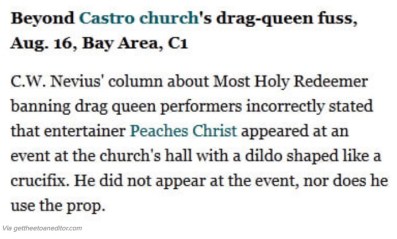
Of all the things you will write over the course of your career, nothing feels worse than writing a correction. Essentially, corrections tell the world, “Hey, remember that thing I told you yesterday that I was so proud I managed to find out and share with everyone? Yeah, I screwed up…” Corrections run the gamut from the amusing ones, like this correction on a drag queen’s presence at an event as well as her act:

PeachesChrist

…to the geeky ones like this look at a quote from “The Simpsons:”

Simpsons

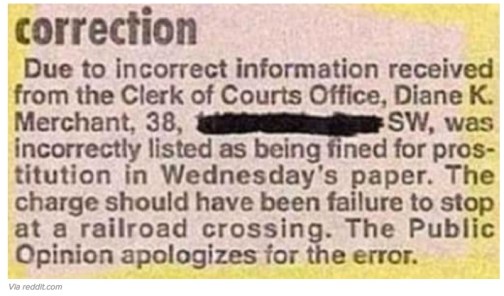
…to the downright embarrassing:

Hooker
(It might just be what the kids are calling it these days… “Hey, you gonna go home or should we um… y’know… fail to stop at a railroad crossing…”)

Perhaps there is nothing worse than having to correct a correction, which happened at one of the papers where I worked. We misspelled the name of the Carrerra soccer club, first by using only one “R” in one of the double-R pairings and then we screwed up the correction by using only one “R” in the other one. When we asked the managing editor if we should run another correction, he told us, “No, you’ve done quite enough damage already.”

Corrections can be painful but they’re worth doing. My worst one involved a guy we thought was dead but turned out not to be, even though he was still teetering on death’s door. The question became: “OK, so we said this guy died yesterday, but he didn’t. What happens if he dies now? How do we write that correction?” Eeesh. The guy lived past press time, so we were at least saved the pain of trying to work through that one, but it still stung.

One of my other problems with corrections (and I’ve been told I’m not alone on this), is the issue of “correction contagion” in my work. I had a handful of corrections at each stop I made as a journalist, but they tended to “bunch up” on me. Thus, after I made my first error and fixed it, I’d be so myopic about not making THAT mistake again, I would make four other stupid mistakes. Fortunately, I had great editors who saved me most of the time, but when they couldn’t hold back my wave of stupidity properly, I ended up with another correction or two in short order.

So, how do you deal with the corrections as a writer? To figure out how to write a solid correction, give the book a read. As for how to mentally deal with this blow to your ego and skill set, that’s a bit tougher.

I found a good piece of advice on one of those chatty billboards outside of an area business or church or something as I was driving around recently:

“Forget the mistake. Remember the lesson.”

In other words, don’t obsess about the stupid thing you did, but rather how you came to make that stupid mistake in the first place. Was it a case of thinking you knew something so you failed to check on it? Was it something where you forgot to check back on an evolving situation? Was it time where you didn’t have a lot of time to recheck a fact? Was it that you didn’t stop and think before completing your work? Whatever the underlying factors were for that error, consider those to be the lessons to take with you so you can avoid making that mistake again.

Then, let the mistake go or just let it serve as a reminder of the lesson.