Every house I’ve ever lived in had a “junk drawer” in the kitchen where we kept everything that didn’t really have a place. Batteries, bottle openers, matches, a deck of cards and more were in the junk drawer. Today’s post is kind of a “junk drawer” of sorts, with a lot of little things worth noticing that don’t really have a place or merit a full post.
Consider the following leads, tweets and other bits of information:
For the audience with an interest in 19th century French linguistics:
Stephon Clark was in his grandmother’s backyard, trying to get into the house Sunday night when two Sacramento police officers loosed a fusillade of 20 bullets, killing him, Clark’s family told ABC News.
A fusillade, a term with roots in 19th-century French, is “a series of shots fired or missiles thrown all at the same time or in quick succession.” I have a Ph.D. in a communication-related field and I have spent the majority of my professional journalism life covering crime, but never once have I thought to use the word “fusillade.” This is one of those cases where you want to check the author’s desk for a “Expand Your Vocabulary” page-a-day calendars and destroy it.
The Department of Redundancies Department:
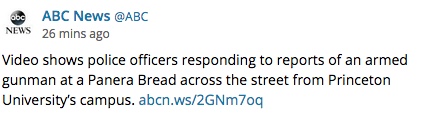
Here’s an example of how you don’t need a lot of space to screw something up:
Armed gunman? As opposed to what? An unarmed gunman? Unless you literally have a man with no arms packing an Uzi in his mouth, you need not distinguish between an armed gunman and an unarmed (or armless) gunman.
Grammar counts:
It took me two reads to realize what was wrong with this, but when I did, it came back to an old nun barking something about adjectives and verbs at me:
The author of this tweet uses the adjective “burnt” to describe the structure, which means the video would simply show the presence of a crispy statue. The author meant “burned” which is the action of someone setting fire to the item and letting the fire consume it.
Point/Counterpoint rides again:
I guess I would expect nothing less than disagreement with the premise that “straws are evil” from a person whose job it is to support the straw-manufacturing-and-distribution industry.
My worst nightmare in reverse:
I always fear that somewhere in one of my books, I’ll misspell “public” and add to the laundry list of “pubic libraries,” “pubic schools” and “pubic meetings” that have dotted the news landscape over the years. In reading the Omro Herald (*Omro, Wisconsin’s Finest News Source) this week, I ran across a formal outline of a new “anti-sexting” law the city had passed, and noticed this:
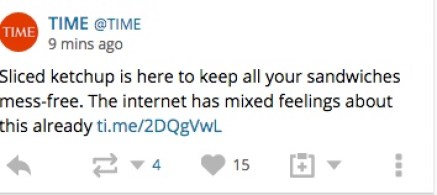
“The internet” has spoken:
Of all the dumb things we’ve been doing lately in media, saying “the internet” has something to say about whatever it is we’re talking about has to be one of the worst. The whole idea behind getting attributions is to allow us to show the readers who thinks what and why. When we just grab 83 tweets and call it a set of “mixed feelings,” we’d be just as informative if we asked my imaginary cat, Pop Pop, what he thinks about it. If you want reactions, go ask people who are informed for them. If you want to use tweets as a reaction, figure out WHO these people are and WHY your readers should put stock in their opinions. The internet isn’t a source, but the people you find using it might be.
It’s on the internet! It has to be true:
A student found this while doing a search for a research paper he was doing and saved it for me. It just reinforces my theory that “Wiki-Anything” isn’t a source.
Growing up as a Catholic kid, who spent way more time near nuns than is now recommended by the FDA, I found the concept of hell horrifying. Conceptually speaking, it was a place of fire, brimstone and evil where you went after you had sinned without repenting, angered God through evil acts or accidentally ate a Slim Jim on a Friday during Lent.
Later in life, I asked a priest who was a little more “new school” about the faith for his views on eternal damnation. He told me it was probably more of never-ending sorrow and sadness than the torture outlined by those who grew up before the Vatican II era. It was a a longing and pain for better things and regret over what we should have been. In other words, hell is more individualized and accounts for what we did and who we were.
If hell hits somewhere in that “sweet spot” between those points, I’m sure I know exactly what I’ll be getting myself into if I’m not a decent human being. Since I’ve invested most of my life in teaching and journalism, I know that hell will involve reliving certain conversations I’ve had with students over the past 20 years that continue to sap my will to go on.
So without further ado, I bring you the five conversations journalism professors have in hell and how you can help us avoid them while we’re still alive:
CONVERSATION 1: SO WE NEEDED THE BOOK?
Look, I get it. Textbooks are expensive. In fact, the entire premise of this blog is that textbooks cost too much, change too often and usually have the lifespan of a mayfly. That said, we assign them for a reason: They actually contain stuff you’ll need to know. This is particularly true for books like the AP style guide. Here was an actual conversation I had with a student half way through the semester:
Student: How much are these books?
Me: What do you mean?
Student: This AP book, how much does it cost?
Me: About $20-25. Why?
Student: It must not have been listed on the criteria for the class. I think I’ll go buy it though.
OK, let’s pretend that I hadn’t mentioned it about 10,002 times already and that I didn’t include it as a required book in the syllabus and that I didn’t mention this as a MUST HAVE for the class (as in, “If you are broke, don’t buy the textbook, but buy the AP book.) AND that it wasn’t stocked at the book store.
Every other student in that class had the book. What, they were clairvoyant and just figured I wanted them to have it?
Making things weirder, a student in the very next section of that class, sitting in that very same seat asked the EXACT SAME QUESTION about the AP book, swearing he had no idea that this thing would be important. I think I need to call in some sort of holistic medicine person to burn sage on that chair or something…
Still, this pales in comparison to the year I told the students in WEEK 12 that they should bring their AP style guides to class, only to have one student reach into his backpack and whip his out. “GOT IT!” he said, proudly displaying the book he was supposed to have read by that point in time.
It was still shrink wrapped.
HOW TO PREVENT THIS: Buy the books and read them. If you are REALLY broke (as in, stacking pennies for Ramen broke) and you CAN’T afford them, talk to the professor and see what is absolutely essential and what you might be able to dodge. However, do this somewhere before the midterm.
CONVERSATION 2: I LOOKED EVERYWHERE!
The constant yelling of old people (read: me) about “damned kids these days” come from the fact that we often wonder how hard students really tried before giving up all hope and saying, “Just give me the answer.”
Case in point, here was a conversation I had about a midterm question in which students were asked to rewrite a lead on one of four stories. Each story included a specific time peg, so I told students to use the day specified in the story (e.g. The game happened Saturday, so use “Saturday” as your “when” element.) when they wrote their lead. About an hour into the test, here was the conversation:
Student: I know you said that there is a time element we need to use with each of these stories, but I honestly can’t find one in this story I’m using.
Me: OK, pull it up and let me see. (he does)
Student: I looked through this whole thing and there’s no time element.
Me: Really?
Him: Yes, I can’t find it anywhere.
Me: Read the first sentence out loud for me.
(Silence)
Him: Oh.
Yep. Right there in the lead was that elusive time element he sought. I suppose I was lucky the student didn’t have trouble finding his pants before showing up in class…
HOW TO PREVENT THIS: Don’t give up so easily on figuring things out. There is something to be said for figuring stuff out on your own. Print it out or magnify the text or whatever you need that will help you consume the content. Also, if you really CAN’T find the content, when you ask, do so in a way that doesn’t immediately insinuate your professor is an idiot who failed to include the content.
Trust me, this is a great fear of many instructors and there are days we can’t remember what we ate for lunch, so screwing up a test is always a possibility. We then panic when you are “so sure” that whatever it is you’re looking for isn’t actually there. Finding out that, no, it actually is present and, no, we don’t have early onset dementia, is both a relief and a moment of “What the hell is wrong with kids these days?”
CONVERSATION 3: I KNOW YOU SAID X, BUT…
Rules are put in place to assure fairness, standardize procedures and give everyone guidance on how to proceed with a test, an assignment or a project. If you want to curdle a professor’s soul, explain to him or her that, yes, you understand rules exist for all those reasons, but the rules really only apply to other people.
Student: I know you said we can’t interview relatives for this assignment, but I was wondering if I could interview my mom.
Me: OK, what does your mom have to do with (the story topic)?
Her: Well, she’s a parent of a college student…
Me: But that’s really not what the story is about and even if it was, there are like 14,000 students on this campus, many of whom have parents. Does she have some special insights that none of the others would have had?
Her: Um… I don’t understand what the problem is. Why can’t I just interview my mom?
Me: Again, she has nothing to do with the story and I need you to get out of your comfort zone and interview people that you don’t know. It’s a skill you’re going to need as a reporter.
Her: So that’s a no?
Me: Yes. That’s a no.
HOW TO PREVENT THIS: Start by assuming that the rules, however arcane, have a reason behind them. Envision that “Karate Kid” moment where Daniel realizes that he hasn’t just been an indentured servant, but rather has been learning karate:
Also, realize that we WILL give people special dispensation for certain things, but it has to be germane to what we’re doing and provide a rare glimpse into something no one else could provide. If you’re doing a story on what it’s like to be an NFL referee and your uncle is an NFL referee, we might think, “That would actually work.” However, if you’re doing a story on how bad parking is on campus and you want to interview your best friend because he owns a car, think twice before asking on that one.
Nothing sounds worse to a professor than a student essentially saying, “Look, I know you told me what to do here, but you have to understand that rules don’t really apply to me because I want to do it my way and obviously that’ll be better for me, so can you just rubber stamp my demands? Thanks!”
CONVERSATION 4: HEY, DID I MISS ANYTHING?
Professors have a ton of stuff to do and most of them feel like they’re not doing it well enough to make anyone happy. The ability to focus well enough to deliver a two-hour lecture on something you will need to know to succeed in the class is the Educational Dream of the Millennium.
When you blow it off, fail to take notes or get way too into a SnapChat battle with your roommates during lecture, it can be irritating to us. When you then ask us to “fill you in” on what you “missed,” We tend to have this reaction:
Actual email:
I was just wondering what exactly the group interview project is again and what needs to be turned into you by Friday! I don’t quite remember everything you said at the end of class yesterday so if you could remind me that would be great.
At least that guy showed up, unlike the student who blew off class, skipped an assignment she knew about and then sent this:
Sorry, I was not able to attend class today. What did I miss? When is the interview paper due?
Perhaps my favorite one was years ago when I had a student tell me she spent six hours in the ER with a kidney infection and that she was way too sick to attend my 3 p.m. class. I explained I understood and that these kinds of things happen.
Later that night, my wife and I were at the local journalism bar and guess who walked in? Yep. The student.
She saw me, got a freaked-out look on her face and practically dove into the party room next to the entrance.
The conversation that followed the next class period was epic:
Her: Hi, I was wondering if I missed anything in class…
Me: Well, it’s been said that the appearance of impropriety is worse than impropriety itself, which is what I thought about when I saw you walk into the Heidelberg the other night, four hours after skipping my class.
Her: Oh! I can explain that!
Me: I’d love to hear it.
Her: Well, it was my friend’s birthday and I was feeling much better at that point so I just stopped by for a drink.
Me: With a kidney infection?
Her: Oh, yeah! I have my doctor’s note for you. Let me get that!
Me: (feeling aneurysm building in my brain, fueled by her complete lack of self-awareness) Um… That’s OK… Let’s just start class.
HOW TO PREVENT THIS: Go to class. If you don’t go to class, get notes from somebody before asking us to rebuild a lecture for you. If you went to class and forgot to write something down, ask a classmate. If you are going to class, writing stuff down and still failing to remember major things, seek help immediately.
CONVERSATION 5:
Me: Hello? Anyone out there?
Voice: Welcome to hell. I am Lucifer, the fallen one, evil incarnate, the lord of the underworld. Do you know who you sinned against to land you here?
Me: Do you mean, “Do I know against WHOM I sinned to land here?”
Voice: Oh great. Another journalism professor. Y’all are down the hall, third door on the left.
Back in August, we spoke with Patrick Finley, the Chicago Bears beat reporter for the Sun-Times, who was tasked with covering the team’s training camp. During certain parts of the practices, the media was not allowed to take pictures or capture video, even though the general public could do all of that and more, thus frustrating Finley and his colleagues.
“I wish I could say I planned it out, but it made my giggle the first day I drew one, so I kept doing one a day,” Finley said. “I knew it was silly, but also subversive. Also, that’s the way I draw; I didn’t make it look toddler-ish on purpose.”
Twitter exploded with fans sharing his drawings, WGN did a piece on him and he gained more than a bit of notoriety among his peers.
Just last week, Finley’s art skills came to the rescue once again. While covering the NFL combine, rules prevented journalists from photographing or recording certain portions of the event. Behold:
With more than 240 retweets and 800 likes, that tweet blew away anything else he posted that week on Twitter.
A month or two back, Finley talked a bit more about this “artistic phenomenon” for the upcoming second edition of “Dynamics of Media Writing.” He said he didn’t really understand why people loved his artwork but he enjoyed the fact that they did.
“It taught me that Twitter appreciates something unique, no matter how absolutely silly it might be,” Finley said. “I don’t pretend to grasp exactly why it went viral — It was intended to be a gentle mocking of a training camp policy where fans could take pictures but media members couldn’t’ — but I imagine it reached beyond my typical football fan followers. My experience with the sketches was a fun one, though Bears PR staffers finally got annoyed by it by the end of camp, I think. It’s still weird that some people know me as the guy who sketches stuff, when I’d rather them know me for the job I do.”
During the publication of “Dynamics of News Reporting and Writing,” I frequently told the people at SAGE to avoid using color, images or whatever else because, “It’s not worth it to waste money on me.”
The only time I begged them to waste money was for a photo of a giant talking squirrel that was insulting a coal baron.
Comedian John Oliver spent part of a “Last Week Tonight” episode talking about the coal industry. During much of that, he mocked coal magnate Bob Murray, saying he looked like “a geriatric Dr. Evil” and stated that Murray placed his miners in unsafe conditions. He also made fun of Murray for once supposedly saying a talking squirrel once told him he should start owning coal mines. The episode concluded with a costumed staffer called Mr. Nutterbutter the Squirrel presenting Murray with a novelty check for three acorns and 18 cents.
While doing all of this, Oliver even called out Murray’s litigious nature, explaining that he knew Murray was likely to sue him, but he stood behind everything he said. Murray, who has sued numerous media outlets before for unflattering coverage, took the bait and sued Oliver for defamation, false light and more.
(Perhaps the greatest filing in the history of our legal system came in the form of an amicus brief from the West Virginia ACLU, which includes the amazing heading of “Anyone Can Legally Say, ‘Eat Shit, Bob!'” Feel free to read about it here.)
This is not the first time someone has tried to bully a media professional through the use of the court system. Washington football owner Dan Snyder sued the Washington City Paper after it published “The Cranky Redskins Fans Guide to Dan Snyder” in 2010. Snyder’s legal team first approached the paper’s parent company with what amounted to a “cease and desist” letter. In it, the attorney made such “legally compelling” statements as these:
Can you imagine how you would react if your wife was battling breast cancer and her public role as the National Football League’s national spokesperson on breast cancer awareness was demeaned as a mere public relations ploy to “sell” the “transformation” of her husband’s public image?
Your paper’ s latest diatribe comes on the heels of more individual columns concerning Mr. Snyder than any other news outlet in the city has written about any single businessman in Washington, perhaps ever.
Mr. Snyder has more than sufficient means to protect his reputation and defend himself and his wife against your paper’s concerted attempt at character assassination. We presume that defending such litigation would not be a rational strategy for an investment fund such as yours. Indeed, the cost of litigation would presumably quickly outstrip the asset value of the Washington City Paper.
In case you need a rough translation here, the letter basically says, “You are being really mean, you do it a lot and we have a lot of money we can use to sue you.”
The point of explaining all of this, other than to highlight two pieces of content that irritated extremely rich people who tried to sue the media into silence, is to outline the key legal aspects of what it actually takes to libel or defame someone. Also, it is an opportunity to explain how to deal with people who get angry and scream, “I’m going to sue you!”
Whether you are reporting on a serious matter or using a 7-foot-tall talking squirrel to take on a coal mine owner, here are some tips as to how best to deal with people who threaten to sue you:
Remain calm: Just like when you are in the field, a panicking reporter is a useless reporter in this situation. You need to realize that the threat of a lawsuit is just that: A threat. It is highly unlikely that the person will sue you at all, let alone sue you successfully. However, you should take every call or email like this seriously and keep your wits about you while you do.
Determine the problem: Just because someone doesn’t like something, it doesn’t necessarily follow that they have grounds for legal action. The key thing is to determine what has upset this person so you can figure out your best course of action. For example, if a caller says something in the story is wrong, you can determine if there is a factual error or if the person just disagrees with a source in your story. This will help you see if you need to run a correction or if you need to explain how reporters gather information from sources. (In the case of Bob Murray, it was less about factual inaccuracies and more about “OMG MEEEEN!!!” As the courts have repeatedly demonstrated, that’s not enough to win a suit, especially when the plaintiff is a public figure.)
Don’t make a promise you can’t keep: When a person is yelling at you on the phone about how you screwed something up, the “fight or flight” instinct can kick in pretty quickly. You might feel like the best way to get out of the situation is “flight,” where you apologize profusely for everything and assure the person everything will be fixed right away. This can lead you to make promises you can’t keep, such as changing a story, pulling something off the Web or something else to make this person back off. In other cases, you might go into “fight” mode, where you push back at the caller with some anger of your own. This can further enrage the person and lead to even worse consequences if your publication eventually has to correct an error or apologize for a story. You probably won’t be the final arbiter of how your publication will deal with these situations, so don’t promise action when it’s not yours to promise. The only thing you should promise is that you will do your best to look into this and inform your superiors.
Get contact information: You will almost certainly need to do a bit of digging before you can solve any problem. Even if the problem isn’t yours to solve, you want to make sure you have the contact information from the person who raised the issue. With email, this is easy enough, as you can forward the complaint to the reporter involved in the story (if it’s not you) or to your editor and the person’s email address is right there. In the case of a phone call, make sure you get the person’s name and number so you or someone else at your office can get back to them as needed.
Provide resolution: Either you or your editor should provide the person with some form of resolution to the issue. During this process, you need to explain what you found, what you decided to do and how you will proceed. If the person is still upset, you should have options for him or her to pursue the issue further. At that point, it might even be a lawsuit, but you have done your best to resolve the issue.
Filak-ism: A random observation, borrowed idea from a movie/song/TV show/book, odd concept or weird phrase that has been warped in the mind of Dr. Vince Filak for broader application within journalism situations.
Today’s post marks the 150th blog entry since July 1. In recognition of this… um… achievement (?) I figured I’d celebrate with a few famous Filak-isms meant to help your writing. Hope I don’t break anybody’s brain with these…
Here we go:
“It’s an attribution. It’s not the front pocket on your suitcase.”
The idea behind an attribution it to tell people who said something in a direct or indirect quote. That’s the whole reason for its existence. However, for some reason, people try to do more stuff with it and make their copy almost unreadable:
The attribution isn’t supposed to be like that front pocket on your suitcase, where you cram all the crap you forgot you needed to pack in your bag. In each of the cases above, you could probably write an entire paragraph of paraphrase out of what these folks stuffed into the attribution. Doing so would have made the content more readable and less cumbersome.
“Says who?”
Journalists rely on sources to tell the reader things that are important. When opinions show up, they need to be attributed to a source. This is especially true when the opinion is something this weird:
OK, it’s a review, so you get a bit of an “opinion pass,” but where did you get the “golf courses just scream great food” thing? Country club? Sure. The Par-3 muni track out near the lakefront? Yeah, you’re not even getting any Grey Poupon to put on your luke-warm wieners out there.
“Honey? I unexpectedly severed one of my blood-carrying vessels! Could you transport me to a nearby medical facility?”
I have two passions in life that can lead to a lot of unintended medical bills: I refinish and restore old furniture and I repair and restore my beloved 1968 Mustang Coupe. In the course of both of these hobbies, I have on various occasions, caught my hand in a running fan, dumped brake cleaner in my eyes, set fire to upper arm, cumulatively swallowed a quart or two of coolant, sanded off the top of my thumb, punched a hole in my index finger and cut my hand so deep my wife could see my thumb’s tendon.
And that’s all I can remember. That might have something to do with me smashing my head into a few things.
In all of those experiences, never once did I rely on jargon to express myself:
If you find yourself using words you would never actually use in real life, consider rephrasing your work so that you don’t sound like a person perceived to be lacking intelligence, or someone who acts in a self-defeating or significantly counterproductive way. (AKA an idiot)
“Congratulations. You just drafted a punter with the first pick in the draft.”
The idea of a good lead is to have information that is most important at the top of the story. The 5W’s and 1H give you some direction and the FOCII elements provide you with a good lens through which to view the who, what, when, where, why and how.
That said, the order of the elements in the lead matters as well.
I’ve explained to students before that you should look at your lead like it’s the first round of an NFL or NBA draft: The best players should be in that round and the best of the best should be at the front of the round while lesser great players are found near the end.
When you decide to lead with the “when” aspect of the story in the lead, you’re essentially wasting that first pick:
On Monday morning, paramedics from the Joliet Fire Department responded to a single-vehicle crash on the Des Plaines river bridge on I-80 eastbound and a four-car crash at I-80 westbound near Larkin Avenue.
If the most important thing you want to tell your readers in the most important sentence you are writing is a time element, you really need to go back through your story and rethink your whole approach.
“Take a normal human breath, not a ‘The Titanic is going under and I need to survive’ breath.”
A good way to determine if a sentence is too long or too involved is to take a breath and read it out loud. If you start feeling a tightness in your chest by the time you finish, it probably needs a trim. If you run out of air, you definitely need to go back through the sentence and do some serious cutting.
The point is to keep the sentences short, not to test the tensile strength of your lung tissue, like these sentences do:
These sentences are 50 and 43 words, respectively and unless you have the lung capacity of a blue whale (or the student I had one year who swam distance for our university), you aren’t getting through them on one breath. That doesn’t mean take a bigger breath. That means go back and cut these down.
“Really? Did you check with every guy in Burundi?”
Burundi is a relatively small, landlocked African country of about 10 million people. I think I learned about it one night when my daughter, Zoe, was an infant and I had both a need to get up with her every two hours and a really lousy cable package. Not much on at 4 a.m., let me tell ya…
In any case, I think back to this place whenever I get sentences like this:
Really? NOBODY thought any of these things? How do we know that none of these things was even an inkling in the mind of a visionary, a dream sequence on “Dallas” or the imagination of an autistic boy that kept us riveted for about six seasons of “St. Elsewhere?” Better yet, did you survey the entire nation of Burundi to make sure nobody thought about whatever it is you’re telling me with absolute certainty that nobody thought about?
Every time you think about using an absolute term (nobody, everybody, all, none), think about Burundi and reconsider it.
As the semester draws to a close, students have two equally important things to deal with: Finals and course evaluations. When it comes to finals, most students probably feel like this:
Perfectly normal response, when everything is due all at the same time, every final test or project is worth 80 percent of your grade and every professor thinks his/her final should take precedence over everything else.
And then there are course evaluations: The one moment in time where, behind a cloak of anonymity, students have the ability to grade their instructors. It’s easy enough to imagine you wanting your “Jules Winfield” moment:
I’ve had my share of evaluations over 20 years of teaching college journalism students, so I’ve seen quite a range of commentary over the years. The one that always stuck with me was the student who filled in the whole row of “Strongly Disagree” bubbles on the ScanTron sheet with what appeared to be a frenzied scrawl of a demented clown.
On the back, where students were asked to list three things they liked about me or the class, three things they disliked about me or the class and three things they’d like to see the class do in the future, he (I assume it was a guy) wrote one thing in giant letters:
“YOU SUCK!!! YOUR AN ASSHOLE!!!”
It is that succinct and yet nonspecific response that led me to today’s post about course evaluations. Some students view it as an opportunity to “get back” at a professor while others use them to lavish praise with exclamation points and emojis to boot. Some students hope their comments will “fix” a class while others see them as never having an effect on how the professor operates.
The truth, as it is with most things, sits in the middle somewhere, as some professors will take every word to heart and others will use your criticism to light the yule log in their hearth. However, consider these thoughts when you fill out your course evals:
Numbers are fine but comments matter more: Some schools just give you numerical scales to rate a professor, so you don’t have much leeway here. However, if you are lucky enough to have an evaluation form that allows you to make comments, do so.
If one student gives me a “3” on “The material made sense to me” and another student gives me a “4,” that doesn’t tell me anything. However, if both of those students wrote that a particular assignment, reading or whatever didn’t make sense or was confusing, I’m going to take another look at that thing. If you apply the “Filak-ism” of how grades don’t matter but what you learn does to your evaluations, you’ll see that one good comment matters more than all the 3s, 4s and 5s you can shake a stick at.
Tell me WHY: OK, I suck. Got it. Why do I suck? What specifically makes me suck? Just like you don’t like getting a paper back with no comments on it and a “D” grade, professors don’t like getting vague statements. I can say with absolute certainty that I have changed assignments, class structure and even my teaching based on “why” answers.
Case in point: In one class a student wrote that he/she thought I was playing favorites by giving the students who worked with me at the newspaper special treatment. The student mentioned that I never called out a newsroom kid for texting during class, but I publicly admonished another student for texting. The student also said I called on the newspaper kids first when we were doing discussions. I hadn’t realized what I was doing, but the student saw it and it made me think twice about how I was conducting myself in the classroom and I altered my behavior. Had the student simply said, “You suck,” I never would have known why he/she felt that way.
Don’t undercut your own arguments: I might suck and I might be the other thing that person said about me, but when the student used the wrong form of “your” in proclaiming that edict, he (or she) really had me laughing more than anything else. Lousy grammar and spelling (especially in critiquing a journalism professor) will really diminish the impact of your words. So will statements like, “I quit going to lecture after the third week, but I didn’t feel I really learned anything from this course.” If you want to make me sit up and notice, write it in a way I’ll accept it: Use complete sentences, give me specific examples and don’t make mistakes in your writing.
Sunshine and lollipops are nice, but they don’t help either: Having one’s ego stroked is a great feeling. The more exclamation points used in the sentence “Dr. Filak is the best professor ever!!!!!!!,” the more joyous my day will be. That said, once I get past having sunshine blown up my keester, I’m left with little else that matters. Most of your journalism professors have thick skins, so telling them negative stuff will not have them at home drinking vodka and listening to Chaka Khan. However, feeding us sunshine and lollipops doesn’t help, either. Tell us WHAT you liked or wanted us to keep. In some cases, it’s something simple like “I loved that you told jokes to keep the class laughing.” In other cases, it’ll be about content: “I never had to learn about X before, but your approach made it easier.” You should feel free to tell us what to keep and what to get rid of.
It’s not personal: Our program assistant and I were chatting about various comments we’ve seen over the years on evaluations. She said when she worked for a different department on campus, she had to type up all the comments on course evals, regardless of content and without changing typos and so forth. Aside from the grammar errors that made her feel like she died a little inside, she said some of them were revoltingly personal. One involved the student’s supposition that the faculty members mother had mated with a goat. Another was for a female professor and commented about how “hot” she was.
I used to get comments on how I dressed (One student noted that I dressed like a homeless guy. Another once noted: “What’s 12 inches long and hangs from an asshole? Filak’s tie.”) Someone mentioned on an eval that I was going bald. True? Yeah, even probably the tie thing, which is why I don’t wear them any more (well that and I feel more comfortable dressing like a homeless elf). Fair? Not a chance.
It’s inappropriate to comment on the physicality of people unless it in some way diminishes your ability to understand the material. If a professor was too quiet, it’s fair to ask for that person to speak up. It’s not decent to note that the faculty member was “so ugly it made it hard for me to concentrate.” As they say in every “Godfather” movie: It’s not personal. So don’t make it that way.
Think about the converse happening to you. If you got a paper back and the professor wrote, “I’d like to give you an A on this, but I could never give that high of a grade to a Chicago Bears fan, so here’s your C,” you’d be rightly upset. If a faculty member told you, “Keep wearing clothes like that and you’ll never get a decent grade” or commented on how “hot” you are, there is no way you would tolerate it. (And by the way, if any of those things do happen, especially the sexual harassment, tell an administrator immediately. There’s no place for that stuff anywhere.)
Don’t wait until evals: If you are sitting in week 5 with a lousy grade, no idea what the professor is talking about and a general sense that this class is essentially going to turn your life into a Dumpster fire, don’t wait until evaluations come around two months later to make mention of it. Talk to your professor about concerns when you have them to see if you can rectify a few of the problems you are having. See if you can find some common ground in making the class work better for you.
If we can fix things before they become irreversible problems, we’re so much happier for it. I can’t speak for everyone, but I know I don’t get a Christmas bonus or a free set of steak knives for every student I fail, so I have no motive to avoid helping you. Tell me sooner rather than later and we’ll both be better off.
The holiday season brings a lot of things to a lot of people, including family, gifts, joy and faith. Unfortunately for journalists, it also brings a ton of horrible, well-worn phrases that sap your readers’ will to live.
I tapped into the hivemind of jaded journos who were nice enough to come up with their least favorite holiday cliches. Avoid these like you avoid the kid in class with a cough, runny nose and pink-eye:
Turkey Day: The event is called Thanksgiving, so give thanks for journalists who don’t use this cliche. In fact, it took almost 300 years for turkey to become a staple of this event, so you might as well call it “Venison Thursday,” if you’re trying to be accurate.
T-Day: Regardless of if you are “turkey perplexed” or not, you’re compounding the problem with the above cliche with simple laziness. That, and you’re really going to create some panic among distracted news viewers in the military.
On the naughty list:The toys “on the naughty list” in this story“all have some type of hazard that could send a child to the hospital. The majority pose a choking hazard but parents should be aware of strangulation, burns, eye injuries, and more.” Including a cliche diminishes the seriousness of this a bit. Also, don’t use this with crime stories around the holidays: The first person to find a story that says Senate candidate Roy Moore, Harvey Weinstein, Louis C.K. or Kevin Spacey landed “on the naughty list,” please send it to me immediately for evisceration.
“Christmas starts earlier every year…” :Easter, maybe. Christmas, no. It’s the same time every year. Check your calendar and stop this.
War on Christmas: Be a conscientious objector in this cliched battle, please.
“… found coal in their stockings”: Apply the logic of “on the naughty list” here and you get the right idea. The story on the Air Force getting coal for Christmas after tweeting that Santa wasn’t real could have done without the cliche. Then again, maybe we’d all be better off if the Air Force was right, given the picture included with the story.
Making a list, checking it twice: A all-knowing fat man has a list of people who are naughty and nice and will dole out rewards and punishments accordingly. Sounds cute when it’s Santa, but less so when an editorial is using this to talk about Steve Bannon. Let’s be careful out there…
Grinch: There is probably an inverse relationship between the number of people who try to use this cliche and those who actually get it right. Let’s let John Oliver explain:
The true meaning of…: Nothing says, “I understand and want to engage with my readers” like lecturing them on “the true meaning” of something, whether that is Christmas or a VAD.
Wishing you all the best in this season of cliche…
I got home from the College Media 2017 convention way too early on Sunday morning to find this waiting for me from a former student:
I feel like you need to teach this cautionary tale to your students:
As far as an awkward headline goes, it’s not the first to take what should be a pretty benign news story and turn it into a horrifying sex joke. Here’s one I’ve been using for years:
(Doesn’t she look excited? Or like she literally witnessed it?)
The unfortunate nature of writing (particularly when other people can read or misinterpret it) leads to some of the more difficult gaffes of our time. In some cases, even something as simple as a space can turn a line from an austere 1800s play into a really disturbing dick joke:
(His poor wife…)
The takeaway from this shouldn’t just be that it’s fun to bathe in the misery of other people. It should be that you need to be careful in some very specific ways to avoid becoming a cautionary tale:
Always check your dictionary and style guide: In a lot of cases, words mean the opposite of what you intend them to mean. A column a student wrote about the death of his grandfather noted that the man is “now apart of us all.” I’m pretty sure he meant “a part” which means a portion as opposed to “apart” which means separated from. “Firsthand evidence” is collected from specific sources directly involved in an event while “first hand evidence” is probably what the bloody glove was in the original O.J. Simpson trial.
I know I have problem with “affect/effect” and “less than/fewer than” so I look those up. Learn what you don’t know and always look the stuff up.
Ask for help: If you don’t know something, ask. This is where the benefit of working as part of a collective comes into play. In many cases, you can save your keester if you ask someone else in the office. (Of course, it helps if that person cares about giving you the best possible answer.) “Hey, I’m writing this story and I think I’m using the wrong word! HELP ME!” isn’t an admission of weakness. In most cases, it’ll make you stronger in the long run.
Think like a 12-year-old boy: In every office in which I have worked, there is at least one person (OK, probably 20) that thinks like a 12-year-old boy and can turn almost anything into a dirty joke. (Truth be told, I’ve developed my own inner 12-year-old along the way as well.) Someone is serving cake and you yell, “Hey, Tom, can I get a piece of that.” The 12-year-old boy laughs. “He’s asking time for a piece… heh…” Someone can’t put something away on the top shelf, so you say, “Bill, you having trouble getting it up there?” The 12-year-old boy laughs. “Hey, everybody, Jim knows that Bill’s having trouble getting it up!”
As annoying as this person is, you need this guy (or gal) to read over your stuff for inadvertent sex jokes. Words like pull, yank, pound, rim, push, bang, head, hand, foot and so forth are just begging for this guy to start snickering, so let him figure it out before your readership does. Roaring laughter in the newsroom is much, much better than a public beating.
I’m spending the end of this week at the annual national college media convention in Dallas, Texas, where I’m finding a few immutable truths about travel, student media and how we all function as journalists. In hopes of having a happy weekend, consider a few random thoughts and observations about this wonderful experience:
No matter where you are going, the cheapest flights are always at the most ungodly hours. Our flight out forced us to leave Oshkosh at 3:15 a.m. and our flight back will force us to be picked up by a shuttle at 3:15 a.m. This means we constantly face the conundrum of “Should I try to get some sleep or should I just stay awake?” Ask my managing editor, who manged to oversleep through three alarms he “swore” he set on the day we were slated to leave.
Your best friend in a convention town: 7-11. I paid $4.89 for a 12 pack of Diet Coke as opposed to the $3 per can the hotel was charging.
Barbacoa is awesome. Just don’t ask what it is.
The greatest joy in my life is critiquing newspapers (OK, and websites, magazines and any other student press product). It is absolutely fantastic to sit down with students and find out ways you can help them to improve what they’re doing or to reassure them that they are doing awesome work.
If you want to win something in a silent auction, you need to be there at the end and snipe. I’d apologize to the people I did this to at the SPLC book auction, but the money goes to a good cause, so the more the merrier.
A necessary plug for SAGE: The publisher of my book is cooler than I had any right to expect. They overnighted a bound, proof copy of the Reporting text as well as an additional copy of the Media Writing book for free so that they could be given to the SPLC book auction. That took work and they never thought twice. (Congrats to Steve Listopad of Henderson State University who now owns my book before I do. Tell me if it’s worth it…)
Bring an extra $25 for overweight fees on your luggage, especially if you’re taking home copies of the tons of student newspapers available at the paper exchange or if you’re really good at that whole “book sniping” thing.
Don’t text your adviser and ask, “If I bought a beer, would you put it in your checked luggage?”
As much as I tell my students, “It’s great if you win an award, but it’s not a bad thing if you don’t,” I’m as anxious as they are before awards are given out. A small part of me wants to get a convention coordinator drunk on a mix of tequila and sodium pentathol tonight…
One of the hardest things to do is figure out what sessions to attend. There are so many going on at the same time that are all good. You almost have to have several people there to do a “divide and conquer” approach.
We are all dealing with the same stuff, even if we don’t know it. (Part I) One of the things that I am always grateful for when it comes to these kinds of conventions is that it allows students from all over the place to realize that we’re all dealing with the same general levels of excitement, apathy, dysfunction and amazement. Every staff has one a-hole, one person who is “doing everything,” one person who SAYS they’re “doing everything” but isn’t doing anything, one person who is “too good for this place,” one person who is scared and one person who is wondering what they got themselves into. Bonus points are also available for people who have at least two random relationships going on or breaking up in the newsroom that leads to more drama than an episode of “Real Housewives” on meth.
Hats. People in Texas are reeeeeeally into their hats.
We are all dealing with the same stuff, even if we don’t know it. (Part II) The sense that we can do something great, want to do something fun, that we have found our family and that we can’t imagine what we’d be doing if we weren’t doing this is pretty much universal. And maybe that’s the best thing.
Writing detail-oriented pieces, such as profiles or other bits of narrative journalism, requires detail-oriented reporting. In many cases, students struggle with this because they have learned to rely on only a few sense: They hear sources speak and they see the activity going on around them. When those students have to create a deeper or more nuanced “word picture,” they often lack the feel in their reporting and the nuance in their vocabulary to make it work.
To help students better attend to other senses and find better descriptors, I developed two labs: Smell it and Feel it. Today, my feature writing class did the Feel It lab and I captured key moments of it. I also recorded some explanation as to how to go about doing this if you want to give it a try in one of your classes.
The basic idea is to find a way to isolate the sense of touch from the other senses and then force the students to describe the tactile nature of what they were experiencing. I do this with what has lovingly been deemed “The Box of Doom.” Here’s a simple walk through:
Each year, I pick various things for the holes. I try to make them varied in texture, ranging from dry and gritty to wet and sloppy. I usually shop for groceries shortly before the lab, so I look for stuff that’s got an interesting tactile nature (as well as stuff that’s cheap and on sale). I have used peach pie filling, mincemeat, applesauce, sugar, sand, salt, baby formula, powdered milk and a dozen other things to make the holes change from year to year. I also like to mix them up so that the students don’t tip each other off from year to year. The one year a kid was told to go for Hole 3 because it wasn’t bad, he got a surprise: I changed the order around.
To make the process fair, I have three holes and 15 students, so there are only five slots per hole. This means that every “hole” will have five students who are all working independently and then collaboratively to come up with what they felt when they put their hand in the hole. Here’s how it works, with a few edits. I made sure to include at least two students experiencing each hole:
Once the students get done cleaning up, they need to come up with a list of 10-15 descriptive words that capture their experience. I allow a few short descriptive phrases, but I try to keep them at single words when possible to have them better focus on the specific sensation:
Once they have their own lists, they meet up with the other folks who had the same hole and they try to come up with a list of 20-25 words upon which they agree. They will need to compile that list for everyone else to see:
The students then list all their words on the board under their hole:
After we get all the words on the board, I reveal what was in each hole and we go through the list of the words and determine how well those words align with the material that was in the hole.
Once the students are done with this, I have them write up about a 1/2 page to a full page that includes those words as part of their description of the tactile experience. This is the outcome element I use to assess the entirety of the process. If you want to try it, feel free to include the write up as graded, or a check-off item or something else.
As always, I learn something from every experience like this. Today’s lessons include:
Never buy generic dog food.
Watch out for things in which the smell will create a big problem. That dog food was atrocious.
Hope this was as enjoyable for you as it was for me and my students. If there’s one thing they always say they remember, it’s the “Feel It” Lab.
Next week, I’m hoping to have a few interviews with student journalists from Texas who have been diligently covering Hurricane Harvey and its aftermath. In the mean time, enjoy this legendary memo from the Miami Herald’s Martin Merzer. It echoes two of the things we noted in the book about covering crime and disasters:
Be calm. A panicking reporter is a useless reporter.
Be safe. A dead reporter isn’t much better than a panicking reporter.
You might never cover a hurricane, but you will cover a disaster or a crime, so allow the mortician’s humor to buoy you as you understand the core values here: Preparation, safety, innovation and audience service.