

Jim VandeHei came to his alma mater, the University of Wisconsin-Oshkosh, this weekend to help celebrate the department of journalism’s 50th anniversary. A co-founder of Axios and Politico, VandeHei could easily make the cut as one of the department’s most famous graduates and probably even one of the university’s top ten most successful grads.
(My money for the top UWO grad, however, is Craig Culver, the namesake of the custard-driven restaurant chain. Food fame will always trump political or media fame.)
VandeHei gave several speeches over the course of the weekend, focusing on everything from his time at UWO to the issue of fake news. The latter topic became a post on his company’s website and a featured point for Axios’ Mike Allen when he put out his “Axios AM: Mike’s Big 6” column:
VandeHei offered four fairly provocative ideas — one each for politicians, social media, reporters and individuals. Here’s the gist, adapted for Axios …
- Politicians: Stop using the term “fake news.” The worst thing for a country is having people believe lies, or trust nothing. One day soon, something bad will happen, and it will take faith in information to fix it. You erode trust at our collective peril.
- Media: News organizations should ban their reporters from doing anything on social media — especially Twitter — beyond sharing stories. Snark, jokes and blatant opinion are showing your hand, and it always seems to be the left one. This makes it impossible to win back the skeptics.
- Social media companies: Radically self-regulate, or allow government regulation to stanch, the flow of disinformation or made-up news. Maybe it takes a new FCC of social media to force the same standards as expected from TV stations and newspapers. One thing is for sure: The current self-policing isn’t cutting it.
- You: We all want to fault others, but each of us is very much to blame. Quit sharing stories without even reading them. Quit tweeting your every outrage. Quit clicking on garbage. Spend a few minutes to verify the trustworthiness of what you read.
Be smart … Remember: If your Facebook feed is filled with garbage, it means you were reading garbage in the first place. The algorithm simply gives you more of what you crave.
P.S. The Axios social media policy, which applies to all our colleagues, prohibits the sharing of political views or derogatory snark online: “Don’t say anything on the internet that you wouldn’t publish under your byline or say on TV.”
Before we dig into the guts of this, a couple key things are worth noting:
- VandeHei gave at least three speeches/panel presentations that day and I was at most of them. This is one part of a larger discussion and it’s also boiled down a lot more, based on Axios’ “Smart Brevity” approach. Keep in this in mind when we get to the deeper discussion.
- The audience for most of these presentations was students at UWO and recent graduates from UWO. Faculty (like me) and other folks (less-recent alumni, spouses of visitors etc.) were listening as well, but the this was mostly targeted at journalism students who were either really green or relatively green.
- Full disclosure: I fanboyed out in meeting VandeHei, as I did with several other people there. I wanted to meet him and thank him for his generosity and assistance in supporting the student newspaper, the Advance-Titan, when we were in the middle of a $50,000 challenge grant to pay off a five-figure debt the paper sustained over the years. I admire the fact this guy built not one, but two successful media organizations in a time in which media itself is taking a beating and it seems like nobody is making money in journalism. It doesn’t mean I’m a shill for this guy or that I can’t think for myself on any of the points he made.
- I was these events as a faculty member who was trying to help keep things running smoothly, not as an impartial media member, determined to write on this. I also geeked out meeting Cliff Christl, the longtime Green Bay Packers reporter and Packer historian. Same deal with getting to see Paige Bonanno of ABC Disney and others. Photos of me are floating around out there with these people.
Given that most of the media world couldn’t find Oshkosh with a map and a compass, it never dawned on me that anyone would hear anything about VandeHei’s speech, let alone take umbrage with his comments.
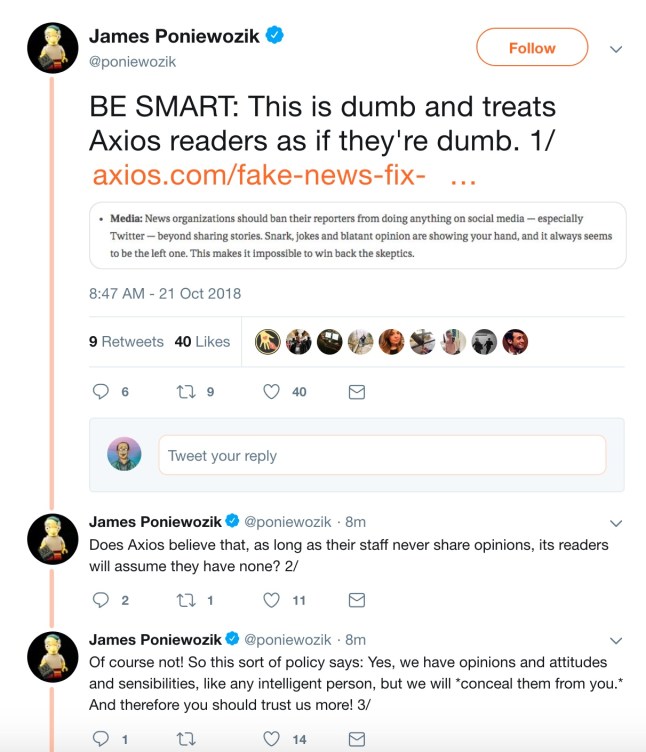
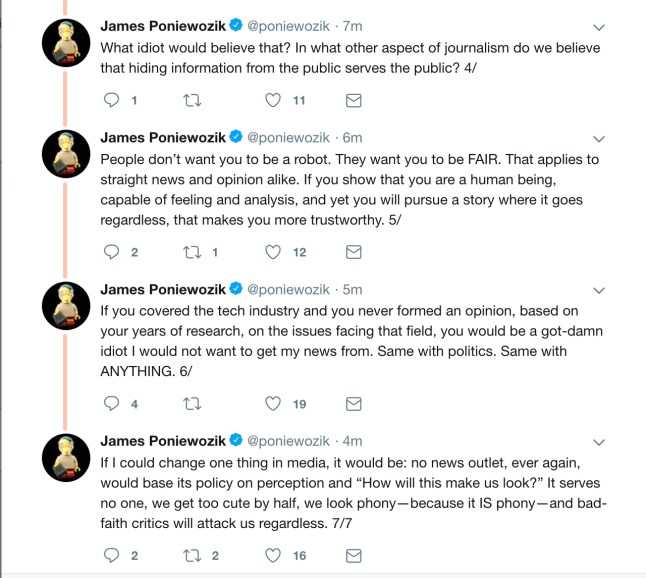


(In case you don’t know who he is, James Poniewozik is the TV critic for the New York Times, a job he has held since 2015. Prior to that, he spent 16 years as a TV and media critic at Time. He has a degree in English from the University of Michigan and has studied creative writing at NYU.)
Poniewozik wasn’t the only critic of VandeHei’s position, but he was among the most prominent and he captured the majority of what I saw out there in terms of disagreement. Rather than trying to sort through all of Twitter, it seemed most germane to analyze this issue based on these seven tweets and try to incorporate additional information where I can.
Consider these four key thoughts:
Freak out if you want, but not on Poniewozik’s point:
I’m really stunned that the thing that didn’t REALLY freak people out was Vandehei’s third point: “Radically self-regulate, or allow government regulation to stanch, the flow of disinformation or made-up news. Maybe it takes a new FCC of social media to force the same standards as expected from TV stations and newspapers.”
The question of “Who decides?” will always be a concern when it comes to the regulation of speech or press. We live in a world in which First Amendment “goes too far” according to at least a quarter of the country, should be undercut by the “opening of libel laws” and the concept of what is “made-up news” seems to be in the eye of the politician.
A media person like VandeHei expressing an opinion on how to fight fake news (keep in mind, that’s the narrow window through which VandeHei is talking about these issues) is interesting. A fellow media person like Poniewozik arguing his opinion against VandeHei’s opinion is interesting, although starting to border on the “media talks about media” inside baseball I hate. The rest of the internet choosing sides on this is what the internet does until someone starts talking about “libtards” or someone else drags Trump and the Russians into it, at which point most of us go back to looking for cute micro-pig videos. I can take or leave that.
However, the last thing I would want at this point in time is some sort of “agency” to essentially engage in prior review and/or prior restraint either actively (through censorship) or passively (through policy that limits specific content). Of everything VandeHei said Friday, that was the one thing that really had the feeling of a truly awful idea. That said…
Absolutism is dumb…:
One of the easier ways to get in trouble as a writer is through absolutism. Whenever I read that something has “never” happened or that “everyone” thinks something or “it always” works that way, my internal BS detector kicks into high gear. Sure, there are a few firsts, lasts and onlies out there in a variety of fields, which is why Oddity is one of the five interest elements we espouse in the book. However, the odds of something being declared an absolute and something actually being an absolute are similar to the odds of winning the lottery.
Therefore, I’m not a huge fan of the line regarding the banning of reporters from doing anything on social media other than promoting stories. For my money, the P.S. at the bottom of the post espouses a much saner version of a social media policy: “Don’t say anything on the internet that you wouldn’t publish under your byline or say on TV.” This is a policy that places responsibility on the journalists and it also provides a much smarter way to look at this topic.
I can’t tell you how many times I practically broke out in hives when someone at one of the student media outlets I advised would say, “Oh, that photo/story/graphic is way too bloody/inaccurate/naked to run in the paper! Just stick it on the website…” The mentality seemed to be that journalistic standards of quality only applied to the dead-tree publications (and the over-the-airwaves broadcasts), but the web was this fun, scrappy kind of place where you could drop F-bombs and innuendo all day.
Media outlets that want people to take them seriously should establish more of a platform-neutral set of standards for content as opposed to thinking something you wouldn’t say on one platform is completely legitimate on another. Either way, a lock-down mentality of “never, never, never” is a bad idea and likely to lead to more harm than good.
…But uninformed ranting is dumber:
I love Axios’ concept of “Smart Brevity,” but it can lead to rabbit-hole criticism like Poniewozik’s tweets on the topic of tweeting an opinion. The whole post involved the idea of how to combat fake news, which got lost immediately upon conversion to Tweet-fighting. The line “Snark, jokes and blatant opinion are showing your hand, and it always seems to be the left one. This makes it impossible to win back the skeptics” becomes the flashpoint of the argument where Poniewozik equates VandeHei’s line to the concept of never publicly stating any opinion.
He then pushes the point, noting that never publicly stating an opinion is either a heinous form of concealment that treats the readers in a negative way or the inability of the journalists to form an opinion and thus idiocy on the part of the writers. Thus we get idiots, phonies and so forth.
Let’s unpack this a bit:
- Vandehei made it clear in his presentations that he stringently opposes news journalists using social media to express opinions that taint the readers’ ability to trust them.
An example he used related to a city council meeting in which a reporter stated that some proposal was about to be debated and that people should stay tuned to his live tweets to figure out if two reps were going to screw people over (or words to that effect). In other words, if you are expecting a story based on the facts about some local content and the reporter is already calling a couple people involved chuckleheads, how can you trust that reporter on anything else he or she writes?
- Journalists have ALWAYS developed, maintained and expressed opinions on the people they cover. I thought some sources I knew were honest while others I wouldn’t trust any farther than I could throw a cheesecake in a swimming pool. Some people were complete jerkwads while others bordered on handsy in their desperate need for my adulation. I had opinions on all of them.
However, there’s a difference between going to the bar after work and telling your coworkers what a dipstick a county commissioner was during an interview and publicly issuing a “ready-to-go-viral” tirade about that person.
I have often told students that the duty to report is not the same as the duty to publish. A similar view on social media might be valuable: The duty to form an opinion is not the same as the duty to share it with the whole world in 280 characters or less.
- Many differences exist among the positions of having an opinion, expressing an opinion, not developing any opinionated thought and the “snark, jokes and blatant opinion” elements outlined in the Axios post.
Consider this spectrum of items you can use in expression:Fact (an indisputable element): Jim VandeHei spoke Friday at the University of Wisconsin Oshkosh about fake news.
Personal opinion (statement made to indicate personal belief): I think James Poniewozik raised interesting points, but was off base in his criticism of Jim VandeHei’s speech.
Blatant opinion (A personal belief stated as fact): “This is dumb and treats Axios readers as if they are dumb.” OR “People don’t want you to be a robot. They want you to be FAIR.”
Jokes (in this case, I’m guessing attempts at humor in an attempt to degrade or undermine an opposing source or the source’s position): Q: How do you get a University of Michigan graduate off your porch? A: You pay for the pizza. OR Q: How many TV critics does it take to change a light bulb? A: None, they just sit in the dark and write a scathing column about how illumination devices used to be so much better.
Snark (probably closest to sarcasm or other biting comments intended on undercutting a position without relying on the joke format): James, if I need an analysis of “Cop Rock” or a creatively written haiku, I’ll give you a call. Otherwise, I’ll probably rely on the guy who actually has a journalism degree and runs a news organization to come up with some standards for the news media.There are levels to this and if I had to make a policy for pairing news journalists and social media, it would be a lot closer to the “stick to the facts for the most part, occasionally use the personal opinion when you can support it with facts and don’t do jokes, snark or blatant opinions.” But that’s my personal opinion.
- Multiple people spoke on this topic and several of them agreed with VandeHei’s underlying premise: News journalists now are saying stuff on social media that would be way out of bounds in their traditional publications and that needs to stop. One of those people was Paul Anger, another UWO grad, who retired in 2015 as the editor and publisher of the Detroit Free-Press. I’m not sure if he held to Axios’ absolutism policy regarding social media, but it was clear that his previous publications had specific standards and those included how people should act on social media. It’s not just VandeHei, although in being out front and at a major national political outlet, he’s going to get the most attention.
Consider the Audience
I frequently write about why it is important to understand your audience in crafting your message. To understand VandeHei’s statements, it’s important to keep that concept in mind.
Not to belabor the point, but he was speaking to students, student journalists and recent journalism grads (for the most part). As someone who often speaks to these students, I can tell you three immutable truths:
- It is becoming increasingly difficult for them to distinguish between fact and opinion when they see it in the media and when they write for the media.
- They don’t always see that they’re playing with live ammunition when they post things on social media.
- They are still learning how to work as journalists.
If this were a speech or panel at an SPJ or NAB or some other professional conference, the tone, nuance and depth might have differed here. Sure, the policy at Axios is still going to be the same, but there might be some additional discussion that merited digging into the gray areas. That’s not the case here as I had students in that audience who are still trying to figure out how to write a lead (or lede if you prefer).
Folks like Jim VandeHei and James Poniewozik have earned the fungus on their shower shoes, so maybe expressing opinions or using social media as they see fit makes sense for them. My students? Not so much, so slapping a few safety devices on these tools is probably a good idea. When they get to the stage of becoming experts on topics and they have opinions that are supported, well-reasoned and likely to benefit readers, it’s the perfect time for them to take to Twitter and share them. However, until that point, it’s probably best to hammer home the idea of playing it safe.
Also, being a professional media practitioner, or simply being educated, doesn’t mean you’re not going to fall on your keys on social media. Or, as Tweet 6 would note, come across as a “got-damn idiot.”