Cleveland Plain Dealer honcho Chris Quinn writes off criticism of his AI passion project as “uninformed outrage,” while still being wrong about almost everything, including college journalism programs

An early photo of Chris Quinn reacting to criticism of his views on AI, journalism schools and journalism professors. 


THE LEAD: Chris Quinn, the VP of content for the Cleveland Plain Dealer, must have a really tired arm from patting himself on the back, or whatever else he does for self-congratulations, as he’s back with another column about the awesomeness of his staff’s use of AI:

The first wave of responses was from regular readers, and most were positive. Several thanked me for showing how we use AI to expand our offerings while maintaining quality.

I suspect I receive little negative feedback about AI now because I’ve written about it so often. I know the anxieties it causes. That’s why I explain how we use it, assure you we are not replacing jobs and promise that humans stand behind everything we publish.

As for anything that might challenge his assumptions, well, Quinn doesn’t have time for that crap:

(A) cranky journalist in another state took offense and on Monday ranted on social media about my practices being the ruination of journalism. Much bombast by others followed.

Or, so I’m told. I didn’t read any of it. I have no time for uninformed outrage on social media channels.

(EDITOR’S NOTE: I was not the “cranky journalist” Quinn spoke of, clearly, because my “bombast” and “uniformed outrage” was published Thursday. Just want to clear that up.)

In the end, Quinn gave all of his supporters a good pat on the head before trying to shame anyone who wasn’t fully on his side:

For those who wrote to say they understand and admire what we’re doing, many thanks. To those who wrote to criticize it, I suggest you look to history to understand that the only path forward is adaptation.

Or, keep stomping your feet until you don’t have a leg to stand on.

CATCHING UP: Quinn wrote an extensive column last week, praising the use of AI as a tool that allowed his staffers to do more reporting and zero writing in some under-covered enclaves of the paper’s circulation area.

In doing so, he decided to take several potshots at colleges, college professors and college students, saying they were doing everyone on Earth a massive disservice by decrying the value of AI, or outright ignoring it.

This led to at least some of the backlash against him, including the piece I wrote here that made what I consider to be three clear, well-reasoned and well-supported arguments:

  • Quinn is wrong about journalism programs not teaching AI or telling students that AI is the devil.
  • AI is a tool that still has a lot of kinks to work out, and it has proven to need some extensive oversight in its current form.
  • The content the PD is producing from its “Report it all, let AI write it up” leaves something to be desired in terms of quality.

In his most recent missive, Quinn didn’t deal with almost any of these criticisms, but then again, I really didn’t expect him to. In reading through his 14 previous letters on AI, I’ve found kind of a pattern in his views on AI. Two broader underlying premises really underscore why I’d love to play poker against this guy:

The Law of the Instrument: The concept has been around for generations, but it’s often attributed to Abraham Maslow, and it basically states that if the only tool you have is a hammer, you treat everything like it’s a nail.

Quinn has so bought into the premise that everything can be done with a strong set of reporters and an AI grist mill, that it’s clear all stories are getting done this way on those beats. The underlying problem is that not all stories can be done well this way.

Quinn mentions things like people wanting to know the score of the Browns game or the outcome of a vote from some board in Lorain. These stories are great for AI to just crank out.

OK, fine, but what about that story of the teacher who donated bone marrow? Or obituaries? Or other stories in which details matter and storytelling can make a difference? These things get ground up and spit out in a bland way that really undermines the quality of the work the reporters have done.

Quinn isn’t alone in this, as I remember having an argument with a broadcast professor during the “convergence phase” of journalism. I noted that some stories were better done in print or online while other stories were better done in broadcast. He argued anything I could do for a newspaper, he could do just as easily for broadcast.

I mentioned things like budget stories that needed mathematical depth and lacked a lot of visuals for video. He told me how he would take video of people typing on keyboards or how he would throw a copy of the budget on the table and film that.

The underlying point in both cases is the same: Yes, you CAN do a story this way but it doesn’t follow it’s the BEST way to do that story.

Often Wrong, Never In Doubt: I heard this phrase in a documentary on financial investors, where a short-seller explained that certain people are very good to bet against because they lock in on an idea and refuse to be dissuaded, regardless of the reality surrounding them.

When they are wrong, but overly confident, they’ll pour vast sums of time and money into risky things that end up going wrong, thus benefiting the people who clearly saw the inherent flaws in those things. Quinn fits this to a T.

In reading through all of his letters to the public, never once did he demonstrate one iota of caution. It was, “This is the greatest thing since sliced bread, so you better get on board.” I seem to remember that same pitch being used to market Theranos, cryptocurrency and MLMs.

Even when I’m really certain on something, I’m always open to the option that I might not be right. If Chris Quinn brought me to the PD, showed me all the great stuff he’s doing, demonstrated how they’d backstopped AI to prevent any catastrophic failures and presented data on how great this was serving his readers, I’d be happy to give this whole experiment another look. I believe paranoia is my best friend, so I’m looking out for risks and willing to say I’m wrong.

Quinn’s most recent letter just drips with hubris, belittling anyone out there who hasn’t fallen in line while ignoring the issues a bunch of us have raised here (particularly those about how crappy J-school is). It’s telling that after a letter in which he basically said professors suck and J-schools suck, he added this tidbit to the end of his latest missive:

Note: I mentioned a student last week who withdrew from job consideration because of our use of AI. Some readers concluded the student attends Syracuse University. That’s not the case. Actually, Syracuse’s Newhouse School of journalism, a valued partner for us, teaches about AI in journalism. Leila Atassi, one of our editors, will be on the Syracuse campus in a few days to help coach students in how we use AI.

That’s exceptionally tone deaf for two key reasons:

  • You spent an entire column telling everyone that college journalism programs ignore or hate on AI and then without an ounce of irony, mention how great Syracuse is and that they’re doing some awesome AI stuff.
  • You crapped all over journalism degrees and how they’re worthless, yet you’re dispatching Leila Atassi to Syracuse to teach these kids. I wonder what her background is… Oh… Yeah…
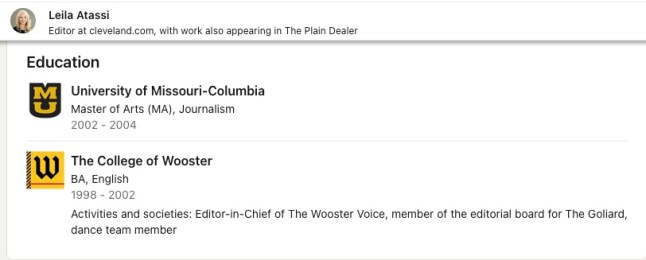
And, I’d like to say I believe in Leila and her abilities, if for no other reason, than she went to a hell of a good journalism school for her master’s (and she was actually one of my students for a while.)

In any case, while Chris Quinn thinks I’ll be here stomping my feet until I don’t have a leg to stand on, I’ll actually be watching to see what happens as the PD’s Icarus keeps flying higher and higher on his AI wings.

Life 101 (Part II): Everything you wished you’d known before you graduated but nobody told you

What Am I Doing With My Life?

Monday’s post looked at the Life 101 issue of looking for and getting your first career job out of college. If you missed it, you can see it here.

Today’s post takes a look at things that go beyond the job hunt that recent grads told me they wished someone had told them before they graduated.


WELCOME TO WHEREVER YOU ARE:

I got a note from a former student who asked me about how to deal with “bad things.” She had recently graduated and was about nine months into her first career job. She was living in another state, in a small town in which she had never heard of prior to taking a job she loved.

After a few false starts of me guessing at what she meant, I picked up on a thread in her responses and asked, “Wait a minute. Are you feeling lonely?”

Bingo.

She had been actively involved in clubs, sports and other stuff while building an immaculate GPA at UWO. She was always on the go and always known wherever she went. Now, she was in a completely new place where she knew no one and she didn’t know how she was supposed to feel.

I had fewer friends, fewer interests and fewer people who knew/liked me when I made my first big move, but I felt similar pangs of anxiety. After my dad helped me move in, he spent the night before saying goodbye and leaving the next morning.

After he left, it dawned on me: Nobody here knows me at all.

(Side note thought: I could die in this apartment and nobody would notice until eventually I missed a rent payment or someone caught a whiff of decomp.)

I went from running constantly from 8 a.m. to 3 a.m. every day to working a nine-hour-a-day job and going home to… what? I took a lot of walks, bought groceries at normal times of day and generally looked for a place to fit in. It wasn’t easy, and apparently that was something others faced as well, given some responses I got from my former students:

It takes AWHILE to transition from being a college student to a working adult. Give yourself time and grace when going through this transition and don’t doubt your worth. You’ve got this.


Envision your life outside of work when considering a job – If you’re outdoorsy, does it have great trails? If you dig X, does it have X? The city has to pass the vibe check, or you’ll depend too much on work to bring you all your happiness.

Others noted that life got a little weird for them, living somewhere new, knowing nobody around them and generally losing that entire support structure of friends and family they’d taken for granted.

Friends and family are still there for you, just in a different way. It’s also an opportunity to spread your wings. Think about when you landed on campus four (or five or six) years earlier and how you didn’t know a damned thing about anything. It’s like that again, which sucks. That said, you survived and thrived in that once before, so the precedent is there for you to succeed.


WELCOME TO ROOKIE BALL

One of the hardest transitions people often make is from being the big cheese to the lowest of Limburger.  It hit me hard when I took my first pro gig.

At the student newspaper, I didn’t get much editing. People generally said, “You’re great!” or at the very least, they had bigger problems to fix, so I kind of skated by with the assumption that whatever I was doing was fine.

When I got to the Major Leagues, I got a rude awakening. A lot of my copy was getting hacked and slashed. My source material was being questioned. My use of quotes was second-guessed. My overall ability to do a good job was under constant scrutiny.

At the time, I needed help, guidance and support, but I had a boss who had either no interest or no capability to provide those things:

(This editor can’t be bargained with. She can’t be reasoned with… And she won’t stop until you realize you suck!)

I eventually gained my sea legs, but I never forgot what it felt like to get my ears boxed in on a daily basis. Apparently, neither did some of the folks who responded to my post:


Imposter syndrome is real and it is awful.


Nobody knows what they’re doing… They’ve just been working through it longer than you have. Hang in there.


Being the newest person means everyone else has a leg up in some way… Be ready to work weekends and holidays.


You have to know what the rules are first before you break them.


It’s tempting when you’re new to think folks with more experience have everything figured out. The truth is everyone is making it up as they go along on most things.


In kind of pairing these previous two thoughts, something else a student mentioned resonated with me when it came to being the new kid: You’re often the youngest kid by a stretch.

The student who got me thinking about this issue told me she had this weird age gap thing. She was too old to connect with the people she covered (high school athletes) and yet too young to really connect with the people she spent time with (colleagues and the athletes’ parents). It felt like there was nobody her age to connect with.

For the majority of my career life, I was always the youngest person in the room. I was 21 when I got my first gig in a pro newsroom, 22 when I got my first teaching gig, 24 when I got my first professor/editor gig, 28 when I got my first tenure-track gig and so on…

Those early years were awkward, in that I often had nothing in common with my coworkers. The people at newsroom parties  were talking about kids and soccer games and 401K accounts. Conversely,  I was like, “Hey, uh… is that beer over there free for, like, anyone to take?” I was told rather bluntly that if I was caught “associating” with students, my boss would hide strap my ass to a pine rail and ship me out of town.

It wasn’t the easiest of situations in those early years, but it was even harder because I had nobody to talk to who was going through the same thing. Maybe that’s why still tell my students my door is always open, even after they graduate.

I know it sucks to be the rookie.


KEEPING UP WITH THE JONESES

Of all the advice the hivemind chipped in with, this insight needs to be screamed from the top of every mountain:

Try not to compare yourself to your friends who have seemingly better jobs. Instead of resenting the job you have, see what you can do to make it better – to make yourself better at it so you can easily move onto the next position.

During my doctoral program, I researched in the area of Social Comparison Theory, which examines the way in which people try to figure out how they stack up in a particular area of life by looking at other similar people in their area. I also watched it  play out on a daily basis there as I taught kids at the journalism school.

It was a constant game of keeping up with the Joneses. If Bobby got a front-page article, Suzie needed to get the top article on the front page. If Jane wrote 40 stories in a semester, Carl needed to  write 45.

It got even worse when they went after internship and employment opportunities. If Marco got an internship at a 75,000 circulation daily, Maria had to get an internship at a 100,000 circulation paper. If Nellie got a gig at a top 50 market TV station, Willie had to get one in a top 20 market.

I watched this transpire long after I left, with former students chasing each other up the golden ladder for no real reason other than to prove some level of superiority. I saw students leave perfectly good jobs to take on jobs that didn’t fit them because one of their peers had moved up a rank or got a gig at a larger publication.

In one case, a great student left a job where he was perfectly suited and wonderfully gifted as an editor in a smaller publication to chase other jobs that made no sense. He eventually ended up doing night cops at a paper in Kentucky, working for a mentally unbalanced night editor and feeling miserable.  When I asked why he took the job,  he cited two reasons:

  1. The paper’s circulation was huge, comparatively speaking to his previous job.
  2. One of his former cohorts had gotten a gig at some place “better” than where he was.

This made no sense unless you understand the competitive nature of the school, the kids and the field. I eventually got him to see that “better” is in the eye of the beholder.

I have friends that make more money than I do, but I wouldn’t trade positions with them under threat of death. I have friends with classier titles and bigger offices, but they also have more problems, or at least the types of problems I hate dealing with. I have friends who do a lot of things that, on paper, sound like they’re living a much “better” life than I am. However, I get a lot of stuff that can’t be measured on a spreadsheet and I’m relatively happy with a great portion of my life.

Every day is not an Academy-Award-winning performance,  but it’s what I found works for me. I figured out that chasing someone else’s dream or trying to prove superiority by making myself miserable in my career made no sense.

A few other folks who chimed in on this topic made similar statements, saying they wished someone had told them to just worry about themselves and not chase the dreams of others. They finally figured out that comparing themselves to their former classmates made no sense and it made them miserable.

Once they settled in and just enjoyed being themselves, they found happiness.


THE FINAL ADVICE LIGHTNING ROUND:

Some of the best bits of advice didn’t really fall into a perfect category but it was so worth keeping, I figured this would be a good way to do it. So here comes the lightning round of advice:


Ask questions, ask for feedback, ask for what you need to succeed in a position and know that they hired you for a reason. And if that still isn’t working out, find something else that you love to do.


Know your worth and celebrate your accomplishments, achievements, and recognize the significance of your contributions. Don’t downplay them.


It’s very rare that in reality something is as high stakes as it can feel in the moment. After a fuck-up that felt career-ending for me but in retrospect did not matter in the slightest in the big picture, my boss told me “we’re not curing cancer.” And that’s stayed with me – very little is life or death, at the end of the day.


Your career is not your identity. It’s a reflection of you but it does not define you.

Well, that might not be everything, but I hope it’s a start.

If you have any other questions, comments or concerns, feel free to hit me up on the contact page.

Otherwise, have a great summer and best of luck in all you do.

Vince

(a.k.a. The Doctor of Paper)

Life 101 (Part I): Everything you wished you’d known before you graduated but nobody told you

life depressing funny college - 8102692096

(It’s not really that bad. You just need a few hacks here and there to soften the situation.)

A student showed up in my office a few weeks back with a big smile on her face and the peptic energy that only comes from wanting to tell someone else the best news in the world.

“Dr. Filak! I got a job!” she said, a mix of glee, elation and relief pouring out of her as she explained what she did and how this worked and where she was going to be employed.

I listened and congratulated her multiple times before I asked the inevitable question: “You don’t have to tell me if you don’t want to, but what was the offer?”

She proudly told me how much she was making, which was a decent amount. She wouldn’t have to steal Splenda packets from local diners or live on Ramen for every meal, that’s for sure.

When I asked how the negotiation for that amount went, she said, “Oh. They just gave me the salary they were going to pay me. I asked my parents if that was good money and they said it was, so I took it.”

She noticed the look on my face. “Oh no!” she said. “Did I do bad?”

“No,” I said. “But you could have done better…”

I then explained the whole process of salary negotiations to her and she realized something nobody at this institution had ever taught her: Salaries ARE negotiable. So are so many other things.

If universities are good at training students to develop skills that will help them get their first career jobs and put them on the path to a fully adult life, they absolutely suck at helping students make the transition from college to that life. I know this from my own experience, as well as that of colleagues and former students, so I thought a good wrap up for the semester would be one final lesson for the group: Life 101.

I asked the hivemind of folks I trust through various social media outlets and connections to tell me one thing they wished they’d known before they left school that they found out the hard way once they got into the “real world.”

Today’s post is the first of two that look at issues beyond graduation, focusing mainly on getting a job and the reality of that first job.

Tomorrow’s post will look at the life issues you face once you get out and become “a grown up” that you probably won’t see coming.

I hope this helps:

THE JOB SEARCH

There are few things more anxiety-provoking and terrifying than looking for a first career job out of college. You have put in the time and energy to pass the classes. You got the grades they said were going to propel you forward. You got involved in every activity someone said would “look great on a resume” and you worked at student media, internships and part-time gigs to fatten up your experience.

You put yourself out there and… crickets…

As a college student, I feared my parents’ basement. I constantly heard of students who did “all the right things” but ended up living back with their parents in a basement because they couldn’t get a job. I mentioned that to several students and several currently employed former students and the vibe was the same:

“I was scared to death that I’d done all this work and I’d be living back home in the basement. I never had a problem with my family, but I damned sure didn’t want to be back there as ‘that kid.'”

“I knew I could go home. I just didn’t want to. I wanted to be a grownup.”

I have said this before and the people who have experienced it have told me I am dead on with this analogy. Those who haven’t tell me I’m crazy. Then, they experience this and they convert to my way of thinking:

Your first job search is a lot like a bad dating experience: You are ready to go, so you put yourself out there. People are ignoring you and it feels awkward. You don’t know what’s wrong with you, so you get really worried.

Then, someone shows an interest and you have that kind of, “Cool. We should hang out. Let’s exchange info” moment and you get really excited. You start imagining how nice it’ll be and your mind takes you on flights of fancy regarding this relationship.

Then, you don’t hear from them for a while and you start wondering what you did wrong and why they aren’t calling. You start questioning everything you’ve done to this point. You wonder if you should reach out, but you don’t want to look needy.

Eventually, you’ll start to get angry with the, “OK, screw you. I don’t need you thing.” You give up, only to hear from that person shortly after that, with the person giving you a true and great reason why it took so long to reach out and that they really want to see you in a day or two, so let’s set this up…

And then you’re like, “OHMERGERD! I LOVE YOU SO MUCH RIGHT NOW!” but you play it cool and the cycle begins again…

As I’ve told more than a few sobbing students over the years, “It’s not you. You are good. The right people just haven’t figured that out yet. It’ll happen. Trust me.”

(In completing the analogy, that’s what my mother used to try to tell me each time I got dumped in high school… She wasn’t wrong, but the situation still sucked.)


THE JOB OFFER:

The first career job offer is something most people never forget, and I certainly remember getting my job offer from Mizzou.

Well, I remember most of it.

At one point when I was being offered the job and told about what this involved, I think I passed out on the phone. Blood was pounding in my ears, my chest felt like it was going to explode with joy like a frickin’ Care Bear and I couldn’t believe how lucky I was.

giphy-downsized.gif?cid=549b592d5ab2ba3b6270323273a5dcae

When the first offer came, I took it. No questions asked. I was so happy to be getting that job.

About two years later, my boss called me into his office and told me, “I need to let you know something. I totally screwed you.”

He explained that when he hired me, he gave me the lowest lowball offer he could, figuring I’d negotiate my way up to something more reasonable. When I didn’t, he was over a barrel. He couldn’t just give me more money, but he also knew I didn’t know any better.

(To be fair, he then told me he was getting me connected with the grad program so I could go after a Ph.D. It was a fair trade in the long run.)

He was a good guy and it never occurred to me that he had lowballed me. He then gave me the best advice I share on a regular basis, “Never take the first offer. Always negotiate for your worth.”

Of all the things people mentioned in their responses to me, salary negotiations were the most important:

“Journalism is not a ‘calling.’ It’s a business. Negotiate your pay. Don’t work for less than you’re worth. Think 5-10 years down the road.”


“Don’t count on the editor who hires you to have your economic interests at heart. You should be prepared to negotiate for the pay you need to live, and expect them to expect you to negotiate because it may be a LONG TIME before you have as much leverage to get yourself more money than when you have the initial job offer.”


“Know your worth and don’t settle just to get hired and have a job. A LOT of companies are hiring, so test the waters and see where you feel valued.”


“Agreed with everybody who said negotiate your starting salary. Do some research of similar roles in the area and don’t just take the first offer that comes because you’re scared/excited just to get one, which is what I did.”

In addition to negotiating salaries, people noted that they wished they’d negotiated for extra vacation time, an earlier start for health insurance, improved hours/requirements and other bennies that they thought were just written in stone.

Another person noted this “look forward” in life as crucial:

Take whatever 401k match is offered, even if you can’t contribute anything else right away.


WELCOME TO THE FIRST DAY OF THE REST OF YOUR LIFE (OR NOT)

When I went to my college orientation session about 30 years ago, the people there told us that we would likely change jobs about six or seven times in our lifetime. At that point, they meant that we would likely climb the corporate ladder, maybe switching companies within our field, but essentially staying put.

According to recent data, Millennials will change CAREERS almost six times in their lives. People now tend to stay with an employer for an average of three or four years, even with opportunities for advancement. This shifts the entire paradigm of how to look at your first job. Here are some thoughts from the hivemind:

“Paying your dues” is an outdated concept. Don’t let your parents, employers or friends convince you otherwise.


The quality of the job and the people you work with are far more important than the location.


Having a different approach to teaching and research is a GOOD thing!… Students need to know there’s many paths towards your goals in life. Do what works for you.


You don’t have to stay in the first job you get after college forever. It’s okay to change your mind or realize it’s not something you enjoy.


(I wish someone taught me how to deal with) not starting exactly in the position you want and how to be content with the growth process. Your degree does not always land you your dream job immediately.

This last point leads us to the unfortunate truth associated with taking that first job…


YOUR JOB MIGHT SUCK

As much as the dream job might be just a dream, it doesn’t mean suffering and pain should be your daily life at work. Everything from toxic workplace environments and weird bosses to feeling lost and becoming undervalued can make that first job you were so excited about feel like an abusive relationship.

I’ve worked for bosses that I would step in front of a bus for, because they were so helpful, supportive and just entirely amazing. I have also worked for bosses I wouldn’t feel bad about nudging into path of oncoming freeway traffic.

The folks who chimed in on this had similar experiences:

Your boss makes all the difference for how well you do in your first few jobs. Take your first job based on how well you vibe with the boss.


I once told my son that if he ever has a job where the manager/supervisor/head honcho etc, comes over and parks his butt on your desk, smiles and says, “we’re all like family here”…….Leave.


Also that just because things aren’t perfect, it isn’t necessarily your fault:


Your first job isn’t your only job. Sometimes it legitimately sucks and that’s OK. It’s not an indictment on you or your work.


Always work toward aligning what you want to do with what your job/career actually is, while still getting your current job’s work done of course. But always keep working toward doing what you want to do, even if your first job out of school isn’t your dream job (it won’t be).

The one caveat I’ll offer here is the one based on my own sense of paranoia: There’s nothing wrong with leaving a job because it’s not what you want or need. That said, have your next move already to go upon your decision to quit.

I equate it to the old “Tarzan” movies when he’s swinging from vine to vine across the jungle. Don’t let go of one vine until you have the other in hand.

TOMORROW: Life, or something like it, after college.


“Our job is to speak truth to power, and that’s what I’m going to do:” Award-winning sports reporter Ryan Wood discusses his in-depth examination of the NFL concussion settlement’s impact on former players

Ryan Wood, a Green Bay Packers beat reporter for the USA TODAY NETWORK-Wisconsin, covers the day-in, day-out elements of NFL football in the league’s smallest outpost. 

He worked the sports beat at the DeKalb (Illinois) Daily Chronicle, where he covered Northern Illinois University athletics. He also covered the athletic programs at the University of South Carolina and Auburn University before taking on his current job covering the Packers. He has earned multiple awards for his reporting on the team as well as his coverage of the retirement and hall-of-fame moments of players.

Sports journalism requires heavy reliance on quick-hit social media posts and deadline-pounding stories from games, something Wood has perfected over his time in Green Bay. What he thought might be another quick-hit story turned into one of the longest ones of his life: an 18-month reporting journey into the NFL’s concussion settlement with former players and how the league was dodging many players’ claims. His reporting took him from former players and league offices to lawyers and concussion experts to fully understand what was happening with this settlement.

Wood was nice enough to submit to an email interview to give us an inside look at how the story started, what he dealt with throughout the process of building it and some tips on how student journalists can do some quality investigative journalism on their own.


You mentioned when you shared this on social media that you thought this might be a quick story, but it quickly evolved into something that took 18 months of your life. How did you find this story and how did it evolve to the piece that you published?

“The story found me more than I found it. Seems the best stories tend to do that. I was on the phone with an NFL agent at the end of April, just after the 2020 draft, when the Packers selected Jordan Love in the first round. A story like this was the furthest thing from my mind, but then I got an email forwarded from my editor. It was just a tip that Jim Capuzzi, the son of then-88-year-old former Packers player Camillo Capuzzi, was having difficulties with the NFL’s concussion settlement.
“My first reaction was that there must be something this family was missing. I certainly did not expect it to become a story, much less one that would engulf 5,500 words and 18 months of my attention. I would simply send an email and get an answer, I thought. I emailed Carl Francis, communications director for the NFL’s player association. This seemed like an issue the NFLPA would be interesting in helping solve.
“When I did not hear back, that was my first sign there was something more here.”
The thing that I noticed was the number of former players who spoke at length with you about their personal issues, their struggles after they retired and their battles with the NFL. How did you get these people to agree to work with you and what did you do to establish trust with them, especially after they had all of those rough experiences in life? 
“In reporting, the most important ingredient for cooperation is one word: motivation. A source must be motivated to help. What’s in it for them?
“These former players obviously had a great deal of motivation. They felt like the NFL and claims administrator BrownGreer was not paying money they were owed. The more I spoke with former players and their families, though, the more I came to realize the thing they wanted almost as much as the financial assistance is to be listened to.
“Many of these retired players feel like they’re living in the dark. They’ve gone from adulation, from playing inside stadiums packed with tens of thousands of fans, like modern gladiators, to the obscurity of retirement. Most of them are dealing with significant health issues, sometimes health issues they don’t even understand, and the realities of their situation are unknown to the public. I think they trusted me to tell their stories because I was genuine. The same thing with lead attorney Christopher Seeger giving me 20 minutes on the record.
“I approached this story from a genuine interest in understanding and being fair to every side, and I think that goes a long way when people feel like they’re not being listened to.”
The NFL is a key player in this and yet they didn’t seem all that interested in participating. What steps did you take in trying to get an official league response and how did the league treat your requests? Also, have you received any blow back from anyone attached to the NFL after the piece ran?  
“It took a lot of persistence to get a league response. I first emailed NFL spokesperson Brian McCarthy on a Tuesday, 13 days before my deadline, and gave him one week to respond. (I needed a few days to factor in for story revisions after the response.) I called the next day and left a voicemail. I didn’t get a response to the email or call, so I sent McCarthy another email on the ensuing Monday. That email consisted of key reporting details included in the story on how the NFL/claims administrator was treating claims. That email was followed by an immediate phone call, which McCarthy answered.
“We discussed the story while he read the email, and he said he’d do what he could do given legal restraints. McCarthy sent me a statement of several paragraphs the next day, meeting the deadline I had given him. I included the key proponents of that statement in the story.
“I have not received any blow back from the league. I think the reason is because the story fairly presents their side. The interest of fairness is why I sent the followup email. I wanted the NFL to have a chance to respond to the reporting in this story before it was published, not after. That email, I think, was the key to getting a response.”
We’ve had a lot of chatter about how sports reporters and political reporters and others at the highest levels have to “play the game” to get scoops or to avoid being ostracized.  Did you ever consider the ramifications of going after a piece like this or worry about how it might impact your day-to-day work with the Packers or the NFL?  Did you think, “This might get me into some trouble and it might not be worth it” for your career?
“That thought never crossed my mind during the entire 18 months. I’m not really wired that way, for one. Our job is to speak truth to power, and that’s what I’m going to do.
“But the biggest reason is because I know I have firm backing from my employer. I’m blessed to work at a newspaper committed to doing journalism at the highest level. So I never had to be concerned about backlash.
“A thought that did occur to me early on was that this story was entirely about the NFL, and not the Packers. This issue went above any team to the league level. So I also didn’t have to worry about any blow back from the Packers, who I work with on a daily basis. Not that it would have changed how I reported the story in any way.”
Were there any key moments in the reporting process where you started to see a bigger piece develop? Anything that made you start to realize how big this was and why the story mattered?
“After I did not get a response from the NFLPA, I spoke to lawyers. I got a referral to one lawyer, who gave me referrals to a handful of other lawyers, and the web started to grow.
“What makes this story special is that it falls on a rare cultural cross section of sports, legal and medicine. That’s a lot of factors to weave into one story. I knew the sports, but I needed to understand all the intricacies of from legal and medical perspectives. I knew nothing about the concussion settlement when I started reporting the story, so that was the first step.
“To become an expert, learn from the experts. It was basically like going to school. Those initial conversations were lengthy, at least an hour. I think my longest phone call was more than three hours. What the attorneys were telling me made it clear there was a big story here.
“As for why the story mattered, it was very simple. People needed help and weren’t getting it. Every now and then, we get the privilege and obligation as journalists to help people who can’t find it anywhere else. It’s what makes journalism a service. Those opportunities make this job quite rewarding.”
What advice do you have for student journalists and journalism students who might want to go after a bigger piece like this? Are there any things you found that were really helpful or things you would caution them against?
“Don’t eat the elephant in one bite. A project like this can feel impossible at the onset. You’ve got to start somewhere. A phone call. Another phone call. Just keep going.
“No story in my career has stressed the value of patience more than this one. Reporting a story 18 months can be very rewarding at the end, but it’s exhausting to reach that point. There were moments I had doubts whether the story would ever be published. I constantly questioned whether it would be worth the time investment. So I think it starts there, at the emotional level.
“In terms of reporting, it almost works the opposite. Cast the widest net possible, and narrow it from there. I wanted to speak to everybody: players, family members, lawyers, physicians. Every conversation ended with the same question: Who else do you know that would be good for me to speak with? That’s a critical question for reporters taking on a project like this. The people you’re speaking with sometimes know better than you who else to talk to.”
Anything else you want to say? Anything I missed?
“I’d be remiss if I didn’t emphasize the necessity of working with a great editor. The industry has devalued editors over the past decade, but this story more than any in my career emphasized the important role they serve to quality journalism.
“There’s no chance this story would have gotten off the ground without the work of my editors. I was fortunate to work with two superb editors over these 18 months. It started with my sports editor, Robert Zizzo. He helped me believe in the story, keep patience when the reporting took longer than I wanted, and was important to one of the most crucial elements, crafting a narrative through the reporting.
“It moved to the desk of Milwaukee Journal Sentinel investigative editor Sam Roe midway through. With Sam, I rewired the story. The analogy we used was keeping the structure of a house, but removing all the appliances, furniture and floors, and then refurbishing it. A major revision to the story was for it to be told through the perspective of players. Initial versions were too heavily reliant on reporting from lawyers. I think the final copy personalizes the story, helping make a dense topic digestible.”

“Suicide grief is unlike any other.”

EDITOR’S NOTE: I try to keep the blog focused on stuff to do with the books, journalism, student media and more, following that 70-20-10 rule of blogging, with only 10 percent being some form of personal or promotional thing. In most cases when I do, I ask you to feel free to skip the post

But not this time.

Please read this. It’s probably more important than anything else I’ve posted.

–VFF


His name was Tyler and he was a teenage boy. He and my daughter Zoe dated for a bit before deciding they’d just be good friends.

They were in the same classes, talked about the same things, had the same fears, pondered the same concerns.

Saturday morning, he messaged Zoe a picture of himself smiling.

She messaged him back, explaining she was rushing off to work after oversleeping.

“Good luck,” he wrote back. She later was told that was the last thing anyone would hear from him.

Later that day, he died by suicide.

Shock became grief. Grief became pain. Pain became regret. All of this washed over my kid. As a parent, I was at a total loss. All any parent wants to do is take away whatever is hurting our kids. I couldn’t do that.

What I could do was what I’ve always done as a journalist and educator: If I didn’t know something, I went looking for people who might.

Courtesy of Nicole Bogdas

Nicole Bogdas is a former journalism student of mine who has worked as a Crisis Intervention Specialist, answering calls for Lifeline, for four years. She has her master’s of social work from the University of Missouri-St. Louis.

She also understands suicide prevention and the importance of speaking publicly about mental health issues in a distinctive way. When she wrote a newspaper article about a decade ago that detailed her own struggles, I found it to be one of the most courageous things I’ve ever seen.

I never knew she dealt with these issues, something that seems like an unfortunate par for the course in our society. I thought about last week’s post about the mental and emotional health issues students are facing these days as they try to navigate school, student media and life in general. I know that for every Claire Hao who is willing and able to say something, there are so many more people living on the edge of the worst of things, teetering into the point of no return.

I asked Nicole to write something for the blog today, not even knowing what to ask for. All I knew was that I was feeling hopelessly lost in all this and someone way smarter than I am needed to say something to help someone in some way. Seeing what this situation has done to our daughter is just devastating to Amy and I. I don’t imagine we are alone in this, nor can I imagine how much harder this is on Tyler’s family or the families of other people who have died in this way.

Below is Nicole’s post on this topic. At the end of it is contact information for several services that could save someone’s life. Please take the time to read her words. I hope they help you or someone you know.

I’ll be back next week, hopefully with more weird journalism and educational lessons to share.


Read the following word and think about how it makes you feel: Suicide.

It’s a scary thing to think about. It’s a scary thing to talk about. But there were more than double the amount of suicides than homicides in 2019, according to the Centers for Disease Control. It is also the second leading cause of death for people between the ages of 10 and 34.

You’ve read the word. Now say it out loud: Suicide.

How does that make you feel? Was it harder? It’s harder for a lot of people, but saying the word normalizes the word. Not the behavior, just the word. In fact, many suicidal people are relieved to hear the word as it brings the subject out into the open; the person suffering no longer has to do so in silence. So, get used to saying the word.

Another phrase to consider is “committed suicide.” It’s probably unconscious to most people, but that words implies a crime is happening; it creates shame. It’s why we need to use the word with people we care about. Use suicided, took their own life or died by suicide instead.

(For more on language and journalism related to suicide, visit Reporting on Suicide)

Changing your language is only one way help reduce the stigma surrounding suicidal ideation and mental health in general. Looking out for the warning signs of suicidality and starting a conversation with the person you are concerned about can be scary, but it’s also courageous. How do you know if someone is struggling?

Here are just a few of the behaviors that might be exhibited by someone who is having thoughts of suicide:

Withdrawing from loved ones and isolating. This is due both because many people who are suicidal feel like a burden on their loved ones. It also has to do with the aforementioned stigma, and relates directly back to the need use straightforward language.

Making preparations. This takes many forms. The most common is writing a suicide note. Don’t let that fool you, many “notes” are electronic now. Giving away possessions is another warning sign. Texts to friends, comments on various social media platforms. In adults, this could look like taking out a life insurance policy or drawing up a will. People having trouble sleeping and experiencing an increase in anxiety can also trigger or indicate thoughts of suicide.

Losing interest in things they once loved. Any significant shift in behavior or mood should be considered a red flag. You might ask yourself, “What if these changes are attention-seeking?” Or “Teens are so dramatic anyway!” Here is where you change language again, but also reframe the situation to better understand why those behaviors are happening.

Attention-seeking implies there is something wrong with the person who’s changed. You might begin to think they’re high maintenance. Or perhaps you feel like your child is just going through a phase. Forget attention-seeking. These people are SUPPORT-seeking. But there’s that pesky word no one wants to say again: Suicide.

Say it now. Say it to anyone you care about that you think is struggling.

Talking is a good start, what happens next?  Do what is called “removing access to lethal means.” What does that look like? Lock up your guns or give them to someone not in the home. If you do nothing else remove your firearms. The majority of suicides that result in death involve a gun. Men are more likely to attempt this way. Parents, kids are wily. You might think you’re the only one with the code to the gun safe, but are you sure? Securing ammunition and firearms in separate locked boxes is another step you can take.

Lock up all the medications. This is the most common way to attempt and most often used by women. Sharp objects, ropes and belts should also be removed.

How do you get your friend or family member help? If the risk is imminent, call the police. Ask for a CIT-trained officer. That stands for Crisis Intervention Team, and they are trained to respond to behavioral-health related calls. If you are in a different jurisdiction than the person at risk, you’ll have to look up and call their police non-emergency number as dialing 911 will only connect you to your police department.

Most counties have what are called Mobile Crisis Units. They provide medical care, safety and some kind of mental health care worker like a counselor. MCUs can do many things and it varies by jurisdiction. Usually they will talk to the person in crisis and work with everyone to assess the next best steps.

Mental heath urgent care centers are becoming more common. Some places will hold people for 24-hour stabilization. Some let you see a psychiatrist or a therapist upon arrival. If you do not have access to this, or the threat is imminent, but the person is safe with you, take them to the hospital. Just the regular emergency room. At that point there will be stabilization and discussion of whether inpatient care would be beneficial for your friend.

What will happen if they are admitted? Every hospital is different. In general, they will be stripped of all belongings that will be secured safely during their stay. The unit will most likely be locked. They will be assigned a psychiatrist and a social worker. The floor is probably staffed by nurses. There will be mental health programming via individual and group therapy throughout the day. Your loved one will have access to a phone.

If the crisis is not immediate, do what you can to help your loved one set up appointments or get connected to local services. You can do this by calling their insurance company or, for free and low-cost options, visit FindHelp.org. Do what you can to walk them through this process, they are likely exhausted and possibly could be having trouble with cognition.

What might be even harder to say than “suicide” is “my loved one died by suicide.” Suicide grief is unlike any other. When people age, we expect death. When people are in an accident, it’s just that: an accident. When people die by suicide it is not an accident and those left behind often shoulder a lot of self-imposed blame. You wonder if you could have done more. You wonder why they didn’t reach out to you.

But suicide is NEVER your fault.

And now you know what to watch for and how to start a conversation.

If you have more questions or need support in any way, you can call Lifeline: The National Suicide Prevention Hotline at 1-800-273-8255. You do not have to be suicidal to call. You should also make sure your loved one has the number saved in their phone. Soon, you will only need to dial three numbers to be connected.

Throwback Thursday: Remembering that first journalism class: “I was scared out of my mind.”

With school starting up for most of us in the next few weeks, it’s looking a lot like another year of masks, rule changes, hybrid courses and other things. We’ve spent a lot of time building contingencies on top of contingencies, only to find that some last-minute administrative change has us going back to the drawing board.

What actually stopped me from having a full-on panic attack about the classes I’m still rewriting or the protocols I’m going to be following was a post someone made on an educators’ Facebook group. It went into how, despite the fact we’re all “totally normal” now, our students (and likely our colleagues) are still damaged and wounded by the past 18 months and counting. One person said he can’t remember seeing so many students just bursting into tears as he has this opening week.

In one case, it was because the zipper on her backpack got stuck and she couldn’t fix it. Something tells me, he noted, that wasn’t why she was crying, but the precipitating factor that finally unleashed her torrent of tears.

I went back to this post because journalism classes in general can be a traumatic experience, even when not accompanied by a pandemic (and a broken backpack) so I’d like to start the year thinking about how to keep the education and reducing the trauma. Also, since the people who ponied up for this are all professionals, I like reminding myself and my fellow educators that we weren’t always perfect at this. Or, as Johnny Sain was known to remark about Old Timers’ Day: “The older these guys get, the better they used to be.”

Enjoy and have a great start to your semester.

Remembering that first journalism class: “I was scared out of my mind.”

I was recently on a panel that discussed student media and self-censorship. Most, if not all, of the people on the panel were former journalists and several people in the audience had made the transition to the field to the classroom. One theme that came up repeatedly was the way in which students “these days” didn’t have SOMETHING about them. It might be drive, it might be curiosity or it might be a skill. In any case, many of the people who spoke recalled that when THEY were students at THAT age, THEY had whatever it was that the students today seemed to lack in their estimation.

Me? I remember my first journalism class where I thought I knew everything. After working on one assignment, I thought I should go back home and work on that mechanic’s apprenticeship at the gas station.

The instructor was a former journalist, who was working on his Ph.D. He always graded in green because he said green was an affirming color. Well, he affirmed the crap out of me in that first assignment. The paper looked like a shamrock patch had thrown up on it. Arrows and lines were zigging and zagging all over the place like John Madden getting overly excited while using a telestrator. I figured I’d never make it in this business.

A few years later, I had a job at a good local paper, I had been publishing stories frequently and I was given the opportunity to teach that same “first journalism class” that the green-pen instructor taught many years earlier. When he found out I was teaching it, he called me to his office and handed me a file folder with one piece of paper in it: It was my first assignment, still green as a St. Patrick’s Day parade in Chicago.

As I read through all that tortured prose, I remember telling him, “Wow. I sucked.”

“No, you didn’t,” he said. “You were just new at this. When you go to teach your class, remember that in most cases, these students are going to be even worse than you were back then. You need to be patient with them and help them be patient with themselves.”

I thought about that moment after the panel. Maybe those folks were really great journalists since birth. Or, maybe the “Johnny Sain Axiom” on Old Timer’s Day applied here: “The older these guys get, the better they used to be.”

To get a better perspective on this, I asked the hivemind what the folks there could recall about their first journalism class, as in the first time they had to sit down and write for a course. The answers made me feel a little better about my initial experience and I hope they will give you a sense of hope as you start your semester:

This is from an award-winning journalist and professor who spent more than a decade at the Dallas Morning News. She covered the 1995 Oklahoma City Bombing and the 1993 federal raid on the Branch Davidian complex in Waco, Texas:

The class was full of typewriters. A grizzled old reporter from The Boston Globe taught it. He made us write an obituary on the first day. I got a C. I was scared out of my mind.

Here’s an ode to people who marched to the beat of their own drum from a former Wall Street Journal editor who now works for an Ivy League university as a social sciences writer:

My first journalism instructor in college was a longtime news editor at big metro papers. Along with lots of practical stuff, he taught me that desk editors — and particularly the good ones — tend to march to the beat of their own drummer. He was never on time to class — ever. He told jokes no on else got. He waxed on about obscure figures from his past jobs. But when the lead started flying, he was the guy you wanted in your foxhole. He taught me to appreciate all the weird, talented people newspapers attract.

A longtime photo journalist and college journalism professor had this take away: If your experience with your first journalism course isn’t perfect, don’t give up right away. Take another course or two before you decide that maybe truck-driving school is right for you:

My undergraduate writing Journalism professor was very intimidating. An older guy who had lots of real life experience. I can’t say as I enjoyed the class, but I made it through and went on to be a photojournalist for many years.

As the movie “Bull Durham” teaches us, in the major leagues, everyone can hit a fastball, so you’ll need to work a little harder to be “the best” (It also helps to have a curve ball.)

A former PR professional in the medical field who now teaches all forms of writing noted that her first experience in a journalism class made that concept clear quite quickly:

The professor asked everyone who was “one of the best writers” at their high school to raise their hand. Lots of hands went up. He asked us to look around. “You have competition, now. And not all of you can still be the best. Get used to it.” It was true – I’ve used that line in my classes as well.

The first writing class can be scary as hell for some people and a piece of cake for others. (One member of the hivemind told me that his class was a piece of cake as he was “ the college paper’s editor before I took J101. Doing the work before taking the class made the class pretty easy.” Score one more for getting involved in student media.)

You aren’t going to be the same writer going out of that class as you are coming in. Give yourself a chance to develop and work with the instructor to improve each time you try something. The more you practice, the better you will get.

One last story: One of the toughest women I ever taught was about to graduate and head off to a prestigious job at a top-flight newspaper. She was dogged, determined and relentless in her reporting. She was a disciplined writer and a demanding editor at the student newspaper. For some reason, the students were reminiscing about their first class in journalism and this woman spoke up:

“You know, you scared the shit out of me that first day,” she told me.

“Me? What did I do?”

“I really don’t remember exactly, but I remember just being freaked out of my mind,” she said. “I went home and cried for like two hours. I thought I’d never make it and I thought about changing my major.”

Go figure.

Reviewing the “foul-mouthed cheerleader” Supreme Court decision with a legal eagle

About a week or so ago, the Supreme Court ruled 8-1 in the case of Mahanoy v. B.L., supporting the free expression rights of students who were operating outside of the schoolhouse gates and on their own time. We took a look at this decision at the time on the blog, picking through the outcomes of the case, but here’s a brief recap:

Brandy Levy was a cheerleader in 2017, when she dropped several F-bombs on Snapchat after failing to make the varsity squad. Although her social media post was done on a Saturday, at a local convenience store and caused no major school disruption, officials at Mahanoy’s high school penalized her by banning her from cheer activities for a year. When Levy and her parents were unable to get the school to reconsider this situation, they sued over the abridgment of free speech.

As with most major court decisions, a lot of the important content is in the nuances of the decision and what precedents the case can set for future situations. To help untangle what happened and what this case means, legal eagle Daxton “Chip” Stewart was nice enough to grant the blog an interview on this topic. Stewart is a full professor at Texas Christian University, where he teaches courses in media law. He has a Ph.D. in journalism from Mizzou and a JD from the University of Texas School of Law. He has also written “Social Media and the Law” and co-authored “The Law of Public Communication.”

Below is an edited transcript of the interview conducted a few days after the decision came down:

Before the ruling came out, what were you generally expecting the court to say in this case? In other words, did this ruling surprise you or was is something you saw coming?

“I want to say I saw this decision coming… I had a conversation about this a few days before I said, ‘Probably what the court is going do is extend Tinker to off campus speech in certain circumstances and that’s exactly what they did. So in a way I sort of saw that coming but I had a lot of fear and justified fear. Some of this was when the third circuit decision came out last summer, it was a great decision and I was gleeful about it.

“I’m working on a new edition of the social media law book and I thought, ‘This is great.’ We finally have a federal court of appeals saying off campus speech has First Amendment protection from administrator supervision and extra-curricular speech or extra-curricular activities are an extension of curricular activities so if you discipline somebody for doing something regarding extra-curricular activities like suspending them from the football team or the dance team, that’s a violation of the First Amendment. We didn’t have a decision say that clearly at this level before. So I loved that third circuit decision…

“So my fear was the Supreme Court doesn’t take up decisions to say, ‘Good job, Third Circuit! We agree.’ They take up decisions because they think there was some kind of error that needs to be resolved. So I was very worried that they were going to come in and strike down the Third Circuit opinion and basically do what they did in Morse versus Frederick, which is hedge or decide against the students. So going in my fear was the Supreme Court hadn’t ruled in favor of a student in 50 years. It was Tinker and then basically a lot of curbing and limiting Tinker… Case after case after case, it was someone saying, ‘Let’s extend Tinker here!’ and the court saying, ‘Nope.’

“So in that context with 50 years without a good pro-student, free-speech case, I was worried they’d go down that path again. And they didn’t and that surprised me.”


Aside from the ruling itself, did the 8-1 majority decision surprise you at all? It seems like most decisions are coming across as 5-4’s these days, so to have that number of justices on one side of a free-speech case… Was that surprising to you when you saw it?

“A little bit, yeah. I thought at least it would be 7-2 and the two being Alito and Thomas. We knew Thomas wasn’t going to agree. Thomas famously continues to say Tinker was wrongly decided… So my concern was that it was going to be a majority of Alito and Thomas, where they bring along the three Trump appointees to constitute a 5-4 majority…

That the eight could come together and agree that this kind of speech is protected was a very good thing to see. A little bit surprising, but a very good thing.


What’s your general sense of what this ruling says for free expression, particularly as it pertains to high school and maybe even college students? What are some key things people should be aware of when it comes to this ruling, either positive or negative in relation to free expression?

“Two things, really. One is explicit, one is implicit. The explicit is that the Tinker test is going to extend to off campus speech not during school activities. We saw in Morse versus Frederick, the ‘Bong Hits 4 Jesus’ case, that the SC said in that one, ‘Yes, this speech was off campus, it was an Olympic torch relay, but it was a school-sponsored activity, so the Tinker test applies here.’ The court had not gone so far as to say, ‘We’re going to extend it not only to off campus but also off campus, non-school activities.’

“In this case, it was a girl writing on Snapchat at the Cocoa Hut, a convenience store. So the Supreme Court says, ‘Yes, the First Amendment even applies there… Students still have free speech, First Amendment protections not just inside the school house gates but also off campus in their free time, in their non-school time, even if it might have on-campus implications.’ So the First Amendment extends out into the real world, 24-7 when it comes to schools disciplining student speech. That’s a great outcome.

“A better outcome might have been that schools have no authority to discipline students over external speech and that was kind of the coalition that Breyer built for his balancing test was to say, ‘OK, school administrators do have some rights to sanction off-campus, non-school speech if it’s going to have an influence on campus, like starting on campus disruption.’ They mention harassment and dangerous violence. All things considered, it’s a pretty good outcome.

“So that’s your explicit one: The Supreme Court saying, ‘We’re going to extend Tinker, off-campus, 24/7. School administrators, if they want to discipline students for what happens on non-school time, they have to pass the Tinker substantial disruption test.’ That’s a good outcome.

“As for the implicit one, it goes back to the Third Circuit decision, which says extra-curricular activities have value and can create an avenue for appeal for students who have been disciplines by those extra curricular activities.

“So, in this case, we’re talking about a student on the cheer squad or who didn’t make the cheer squad or whatever it was being punished. In the past we did not have a good decision in which the court said, ‘That’s protected by the First Amendment.’ You can’t just kick someone out of school for speech but you can take them off the dance team or the football squad because that’s not school.

“So the implicit one here is that even the cheer squad, having been suspended from the cheer squad… You have a right to sue for that. It’s valuable There’s a First Amendment harm. That’s where this is the only way this decision works is to recognize that extracurricular activities at schools are valuable and that you and sue if you lose the privilege to be on a team due to speech. That’s really, really valuable.”


Do you think this will at all deter schools from trying to clamp down on unpopular expression? Or will it continue to be business as usual for administrators and educators who want to suppress free speech?

“I do worry about that. You have what the law says, what the Supreme Court says and then you have what actually happens in practice. The cheer squad is going to have a policy,  A football coach is going to have those rules and if you don’t like those rules, you’re going to have to be willing to go to court and sue over those rules. They’re still the boss and they don’t care about judges and courts. There is very little for them to lose due to qualified immunity where they say, ‘I thought I was doing the right thing.’ So, the law for public officials have that right.

“Practically, you’re still going to have basically speech codes and behavior codes that clearly restrict free speech rights. There are going to be dress codes, behavior codes and social media codes and people are going to be disciplined for them. It’s just going to be easier for them to sue and win now because it’s clear in every court in the country now. That’s great, but you’re still going to have to be willing to take on the expense of suing your school and hoping that four or five years later, you get a good decision.”

Usually when a court makes a free speech or free press ruling on a high school level, some college administrators think, “Hey, we can do that too!” and vice versa. Do you see this decision having any impact on colleges?

“What I expect and what I hope is that we already have a sliding scale where little kids have the least rights, college kids have the most rights. I sort of expect that whatever restrictions a HS can place on kids, it’s going to be hard for a college to do that.

“The thing in this case is that it uses Loco Parentis, which is asking how much room do we give the administrators in high school to act as parents to oversee the kids. I loved the line that said, ‘We highly doubt that BL’s parents gave the school the right to act in Loco Parentis at the Cocoa Hut.’ Private time, the school isn’t acting as a parent when she’s off campus. Well, once you’re adult, once you’re in college, you don’t have loco parentis because you’re adult. I don’t think this case will work in a college situation because you won’t have the loco parentis issue.”


If there were any big take away you think you would want people to have that we hadn’t discussed to this point, what would it be? What’s crucial that goes beyond the basics?

“When Breyer says why this is important, he uses that “Schools are the nurseries of democracy line.’ Breyer says that we need to understand that public schools are where students learn how to be good democratic citizens, good participants in a democracy. We need these places to educate people about the value of free speech. Free speech is necessary in these environments to build good citizens of our democracy and that includes speech we don’t like in some cases.

“This is something that a lot of free speech organizations and advocates like SPLC and FIRE have been pushing for years: If we have our high schools be places where administrators can act like petty tyrants when it comes to free speech, then the lesson students get is that it’s OK to be a tyrant over speech and they carry that into their college years and their adult lives. What they learn is that it’s OK to sanction speech you disagree with or don’t like…

“This is what petty tyrants do. They silence speech they don’t like. When it starts with principals and teachers telling students, “We’ve got the power and we can silence speech we don’t like,” students get that message and they live that out. That’s a real problem… We should be teaching our students to tolerate speech they disagree with, not punishing them for saying things we disagree with. And we should be leading by example.”

Transitioning Careers from News To Public Relations, Part I

(Editor’s Note: This is part of a series that looks at journalism folks who have transitioned from jobs on the news side of the field to public relations and marketing over the course of their careers. I promised the folks anonymity before I got their answers, so they could be honest and also because I didn’t know how many folks I would get. Turns out, we have a lot of people who made the move for a lot of reasons, so I’ll do my best to keep the sources clear for you as we discuss their experiences. -VFF)

I got a text from a former student recently that helped launch this series:

Hey Vince,

I am currently applying for a communications and marketing manager position at the school district I currently cover. Would you be willing to write a letter of recommendation for me?

This guy was probably the best reporter I’ve taught in the past 10 years, simply by the dint of being a persistent little cuss. He would dig into stuff that nobody else had the patience to go get. He wouldn’t stop poking people who had records, refused to comment or otherwise dodged him until he could get the story that needed to be told. He also tended to be the person who other people told stories that often began with, “You didn’t hear this from me, but…”

The idea that he was considering a move from news into the public relations and marketing portion of the field told me two things that I pretty much already knew: The skills we teach in our journalism-based writing courses need to transfer among the disciplines of the field and that reporters were actively looking to get out of the crumbling mess that is news.

Public relations is a booming field, as there are approximately six practitioners for every one news reporter, according to a recent study. That number is up from a 2-to-1 ratio just 20 years ago. As newspapers continue to “shed” jobs (a term that should be replaced with “axe murder jobs for the sake of corporate greed,” but I digress…) and public relations continues to grow, I have no doubt that more news journalists will be taking their talents to PR.

Thus, I wanted to know what people who had made that transition saw and thought as they decided to make it and how they think we are doing to prepare them for life beyond college in a rapidly changing field.

What follows is a series of thoughts, comments and suggestions from an array of people who were nice enough to share their experiences. They come from various universities, work in different states and serve a mix of roles in the field.

Let’s start by looking at what they’re doing and how/why they made the move.

The continued downward spiral of few good newsroom opportunities, organizations cutting jobs and the general degrading of news jobs was a common theme for a number of people who made a quick switch to the other side of the field.  A California-based marketing manager for a tech company said she made the switch from news to social media promotional work after years of job fatigue:

“To be blunt, I left journalism because I got exhausted with the low pay and yearly layoffs that often felt like the Hunger Games.

“In the year before I left, the company I was working for did an extensive reorganization where everyone in the newsroom had to reapply for ‘new’ jobs, complete with resumes and interviews with editors from other papers in the chain. Of course, there were fewer positions on the other side of the re-org. The process took 6 months and was so psychologically exhausting that it felt like a type of PTSD. And I was one one of the “lucky” ones to get a job that was basically the same as the one I had. I can think of at least one person at that paper who got a job they didn’t apply for (and probably didn’t really want).

“Marketing was the easiest field to transition to. I was the social media and engagement editor for my paper, so I was able to land a social media manager job without much hassle.”

For many people, the move wasn’t a hard break, but rather a series of small moves that had them using their skills in different ways.

A marketing manager for a manufacturing company in Wisconsin has worked as a marketing professional for the past 15 years at various institutions. Prior to that, she spent the 10 years after her college graduation as a news journalist:

“My move to the PR/Marketing side of things occurred somewhat naturally through my various places of employment. I went from writing hard news stories at newspapers to writing news stories in magazines and newsletters for non-profit organizations and then for corporate jobs.

“As the industry morphed into the digital thing it is today, the shift was made somewhat naturally as society and our culture became more interested in short stories than long stories. Ultimately, the storytelling part of my training has remained constant through my career, no matter what kind of story I was telling or for what kind of media.”

A VP at a major financial institution, who serves as a content strategist, also noted the gradual movement over time from news to marketing:

“It was sort of a gradual transition driven partially by necessity. I started out as a newspaper reporter (2003), and then over a 5-year period, I went from news to B2B magazine publishing (2005), then custom publishing (2007), which morphed into content marketing (2008ish).

“Over time, I became more of an agency person than a journalist. I got out of news initially because I was a magazine major and really wanted to break into magazine publishing. When I moved to the custom publisher in 2007, the company primarily created magazines for brands, so that was my entry into agency-land. That also happened to be when social media became ‘a thing,’ so the whole industry changed, and the company I was with adapted as needed along with it.

“By the time I left in 2014, it was a full-on marketing agency and I was a content strategist more so than an editor or writer.”


In some cases, the small moves were less linear, as was the case for a PR professional who works for a firm that represents professional organizations, like law firms and management consultants, in the realm of thought leadership:

“I got out of newspapering right before the economy crashed in 2008 — and when I wanted to get back in, there were fewer good opportunities (I faced some geographic constraints, too). I actually did sales/tech stuff for a few years and then some freelance writing and editing. I decided writing and editing was more for me, so I signed on with the PR firm to do that kind of work.”

Many people mentioned the issue of needing a job but being limited to a certain geographic area, such as this former broadcast journalist who also taught college courses and advised student media:

“So I was a broadcast news producer before grad school. Then taught for years and ended up making a move to DC due to my husband’s work, and PR jobs here are everywhere. I am a director at a large consulting firm serving government clients.”

The same thing rang true for a former copy editor and writer for major media outlets, who shifted to PR after more than a decade in news:

“I made the move to PR because my commute was untenable and neither my job nor my family was going to move. I looked at good employers within a reasonable distance of my house and started applying.

“Much to my own surprise, I haven’t missed journalism for a moment since I left nearly nine years ago. I don’t even miss election night pizza.”

Next time: The pros discuss the things their education did (or didn’t do) for them in terms of preparing them for life beyond the newsroom.

“It gave me a purpose and quite literally saved my life a few times.” Why Student Media Matters

The Board of Trustees at Doane University approved of President Jacque Carter’s suggested cuts and mergers during its Monday meeting, meaning that Doane Student Media is on a downward spiral to financial insolvency. Editor in chief Meaghan Stout has been covering the situation since the cuts were first announced, which is a lot like being asked to serve as a pall bearer for your own funeral.

According to former Doane student media adviser David Swartzlander, the cuts don’t go into effect until July 1, which gives Stout and others about nine months to raise unholy hell about them, something we’ve asked you all to do throughout the week.

If you’re thinking, “None of this makes any sense. She’s graduating in a month, so she’s done with this place. And why are you dedicating so much time and energy blathering on about student media cuts at a university the size of your high school? You don’t have a horse in this race….,” well, I get it.

From the outside, this looks pathologically stupid.

If you’ve ever spent any time in student media, this makes all the sense in the world.

I asked people I know who have gone in myriad directions after their educational careers came to a close if they ever worked in student media and, if so, why it mattered to them. One of the best journalists I’ve ever been lucky enough to work with, a wordsmith and a storyteller unlike any other, didn’t disappoint:

My high school had no paper. I started one, called “The Cardinal Chirps.” There was news, sports and jokes on four mimeographed pages. (Smelled great!) It may have lasted three issues. The jokes were filler and I learned that not everyone has the same sense of humor. Don’t print jokes. Working at that paper was a revelation. I could find something that didn’t make sense – a section of the lockers were inexplicably located in a dark room with one narrow door – and write about it. It wasn’t safe for those who had their lockers in there. The principal and school board took note and changed it. No had ever brought it to their attention. The learning was true: You can’t fix something if you don’t know it is broken.

I expected a few responses from a few other people, but not much.

I was stunned when I got dozens, like this one from a journalism professor with a background in news:

I graduated from a small rural high school that didn’t even have a school paper. My interest in news grew from my mom’s obsessive consumption of newspapers (we subscribed to two and sometimes three), news magazines (I think we got four), news talk radio (on constantly), morning/noon/evening local and national TV news, public affairs shows on PBS and all the Sunday morning news talk shows, and my own growing awareness that there were other places in the world far from Tonganoxie, Kansas, that I dreamed of seeing someday. It seemed wise to understand what was going on in them before going. And before going, I had to have money. I understood from my good friend that one could be paid actual money for fixing errors in news writing by being something called a copy editor. The University Daily Kansan and my professors with newsroom experience showed me how to be that.

Another higher-ed friend who works as a student media adviser had a similar life experience:

Working in college media was the step for me that solidified how I could attain my dream to work as a professional journalist. Before my college media experience, the concept was very abstract. Moving from dreaming to doing via my student newspaper made it real for me. I am forever grateful to those who gave me the opportunity and helped me see I could do it.

Folks who took the path out of news and into corporate communications, consulting and other similar fields found that student media benefited them as well:

I wanted to write books before I signed up for journalism class in high school on kind of a whim. In that class, I found that I had a knack for journalistic writing, most likely from reading the local paper and my dad’s influence as a TV journalist. Taking that class and continuing that path led me to attend J-School at MU and altered my career path. It also gave me an understanding of and appreciation for the importance of LOCAL journalism.

These responses made sense: Student media was like an internship and a training center for going on to do great and mighty things in the field itself. However, I also saw how the people who went into fields that had nothing to do with news or PR still found amazing value in student media:

I draw from my experience at the DN almost every day. I’ve worked for two law firms and a dental office since college. I’m comfortable asking questions, I’ve learned how to build relationships and I have a better understanding of how government works. The most important thing I have learned is that no matter how much effort you put toward your day, something could change and you need to be ready to shift your priorities and maybe undo all you’ve just done.
My boss at SAGE, who puts up with an awful lot from me, apparently found her muse through student media as well:
Basically shaped my entire college experience. Learned the basic responsibilities, ethical implications, and work ethic of a journalist. Being on the paper motivated me to write about things I was interested in, when I already had to write so much for school…Also I got to interview some really interesting people!
The one common thread, I saw overall, however, was that student media was more than a thing people did. It was who they were. The newsroom wasn’t like a classroom where they HAD to go. It was a place that gave them something special and they WANTED to be there:
It was my happy place. The place where I always knew what I was doing, and why. The place where everything just made sense. Why else would someone finish a shift, go home, get their books and go back to the newsroom to study. Because that’s where I was always focused.
And…

It was my home away from home. And it allowed me to experiment with what I wanted to do.
And…

Genuinely don’t know where to start. The friends, the experiences, now I’m working in media. Joined junior year of high school and haven’t looked back since. It gave me a purpose and quite literally saved my life a few times. I could go on and on.
And so many other people did as well, sharing stories of life-long friendships that developed thanks to pressure-packed deadlines, no sleep and a sense of belonging they never found before or since. At the risk of becoming hyperbolic, student media provides people with something that borders on magical, a familial bond forged in a way that never truly seems to break.

I understand why Meaghan Stout is fighting like hell, against all common sense, for her student media family, because 25 years ago, I was her.

I remember sitting in my journalism adviser’s office six weeks after our student newspaper closed under the weight of $137,700 in debt. My adviser was also my teaching assistant for Media Law, a course I was essentially flunking because I had poured all of my time into fixing the Daily Cardinal.

“You need to quit the paper,” she told me. “You’re going to fail.”

In retrospect, I think she meant the law class, but that’s not how I heard it.

I then listened as she told me how when she was in college, her student newspaper was moving from a weekly to a daily and how she was pressured to put the paper first and everything else second. Instead, she stuck with her classwork and got her degree. Besides, she explained, even if I managed to fix the problems, the paper was likely to shrivel up and die after I left, so what was the point?

In the abstract, she was right. Take care of yourself. Get the grades. Besides, there was another student newspaper on campus I could work for, so what made this Quixotic journey so important? I couldn’t explain it, but even if I could, I doubt she would have understood.

So, I let her finish, told her I’d think about it and then I went back down to the newsroom and kept working on fixing the paper. By the next semester, we’d pulled it back from the brink of collapse and started printing again.

It’s still running to this day.

For me, my student media experience wasn’t about the articles I wrote or the editorial positions I held or the arguments we had. (We often joked that we were a family in the newsroom, in that we drank a lot and hurt each other…)

It wasn’t that, without that paper, there’s no way I would have gotten this far in life, and I’d probably have had a heck of a career as a fairly decent auto mechanic. It also wasn’t the life experiences it gave me either, although without the paper my kid would likely have different godparents and I would have been deprived of the opportunity to return the favor.

I still can’t adequately explain what it is that makes student media matter so much, whether it’s the paper I worked for, the papers I advised or the papers I never ever knew of before a crisis threatened them.

What I can say is that I love reading the articles the students write, as I wonder how much blood, sweat and tears went into just getting that inverted-pyramid piece to hold together. I love seeing those 20-somethings I knew through my media conference presentations or newsroom visits doing great and mighty things as reporters, editors, copy editors and more. I love it even more when I see them finding joy in life outside of the field, moving into politics, social work or psychology.

I treasure the photos I see of engagements and weddings that bloomed from seeds planted on a production night. The houses they buy, the babies they have, the lives they develop… Somehow, it all comes back to that moment they found someone else who had the weird sense of humor that grew from spending too much time in a windowless bunker that smelled of old newsprint and burnt coffee.

In all my time at all these institutions of higher learning, I’ve yet to come across another student organization or activity that even came close to what student media does, both for the campus and for its practitioners. This is something people like Jacque Carter don’t understand, because to them, it’s a pain in the ass that costs money and points out things they don’t want pointed out.

To us, it’s life.

P.S. – I passed law with a C that semester. Even if I hadn’t, I wouldn’t have changed a thing.

“I’ve got to go. I’m being arrested.” (or every time a law enforcement officer violates the rights of the media, a journalist gets their wings)

The joke around the student newsrooms I used to advise was whenever someone called in and said, “I need help,” we would respond with, “The newsroom doesn’t pay bail money…”

So it was kind of a shock when I got this photo from Alex Crowe, a radio journalist who has contributed to the blog on several occasions:

Courtesy of Alex Crowe

With it, he wrote, “Good morning, Vince! Got my journalism wings yesterday.”

Crowe was in Milwaukee, covering a protest over the shooting death of 17-year-old Alvin Cole. Wauwatosa police officer Joseph Mensah killed Cole in February 2020, and on Oct. 7, the Milwaukee County District Attorney John Chisolm announced there would be no charges filed in this case. Mensah had shot and killed two other people over the past five years in the line of duty and had been cleared in both cases.

“I was sent to the Milwaukee County Safety Building to interview protesters and gather pictures and video of the scene while people waited for a decision to be announced,” Crowe said in an email interview. “I witnessed a crowd that was mostly peaceful but became agitated as time went on. The Cole family and their lawyer were inside the Milwaukee County Safety Building for about two hours, and during that time the crowd began to grow and some people became increasingly aggravated as they awaited what they felt would be an unjust outcome.

“Finally, when the Cole family and their lawyer came outside, some protesters shoved a member of the media and pushed his camera off its tripod and onto the concrete. While the family’s lawyer was speaking, several protesters were shouting obscenities forcing some stations to cut the live coverage. Once the lawyer and family members were done speaking, the protesters began to march towards the interstate where several members of the Milwaukee County Sheriff’s Office were waiting to try and prevent people from marching onto the highway.”

(Video courtesy of Alex Crowe)

Crowe followed the protesters to the highway ramp, where protesters were walking around the squad cars meant to limit access to freeway. Some clashed with officers and were subsequently tossed onto the hoods of squad cars. As Crowe and other media representatives took photos and video of these encounters, deputies from the Milwaukee County Sheriff’s Department demanded that they stop following the crowd up the ramp and cease recording.

“There were simply too many people to arrest all at once,” Crowe said. “The protesters kept moving onto the highway. This had happened to me once before, during the protests after the death of George Floyd. During that experience, officers allowed protesters and media onto the highway, calmly stopped traffic and directed protesters and media members off at the next exit. This time, however, as protesters continued onto the interstate, a member of the Milwaukee County Sheriff’s Office turned towards myself and several other media members and ordered us off.”

One officer targeted Crowe, coming up behind him and placing him in handcuffs.

“I was on the phone with my boss when it happened and said ‘I’ve got to go. I’m being arrested,'” Crowe said. “Apparently my boss already knew that, because he was watching a live TV feed of the whole event back in the newsroom. I was able to remain calm because I knew that even if I were to be arrested and brought somewhere, they couldn’t charge me with anything and I would eventually be let go.”

The officer told Crowe to hang up the phone, before he confiscated Crowe’s recording equipment and patted him down for weapons.

“As we were walking, I explained that I was simply doing my job and that he had let the protesters go while targeting me,” Crowe said. “He told me he was sick of the media ‘thinking they can do whatever they want.’ It was at this time that another officer within the Milwaukee County Sheriff’s Office came over to us and asked which organization I was with. I told him and he ordered the other deputy to take me towards the back of the bank of squad cars, where no other protesters or media members were being held.

“He further instructed the officer holding me to uncuff me, give me my equipment back and let me go without any charges. The first officer begrudgingly did as he was told and let me go… I still don’t know why that single officer decided to go after me and insisted on bringing me away in handcuffs when he knew I was a member of the media.”

Once he was released, Crowe said he collected himself a bit and then went back to work, covering the protest.

“I called my boss to let him know that I was OK, then ran back to the highway area but this time on the other side of the fence, so I wasn’t on the road, I was in the grass on the other side of the highway,” Crowe said. “I found a place where about 20 officers were waiting on bikes to ride onto the highway if needed. I pulled out my equipment and started getting right back to work like nothing had happened.”

As far as advice for student journalists who might find themselves in similar situations, Crowe said knowing he was in the right and keeping his wits about him made a huge difference.

“I’m sure if I had made a big scene, the officers would have brought me downtown just for fun,” he said. “I just tried to remain calm and continually explained that I was a member of the media, that I had equipment in their hands that proved why I was there and that they could call my boss right away and get the whole thing straightened out. I just remained calm because I knew that eventually they would realize that I wasn’t lying and that they would be in a lot of trouble if they went through with processing and arresting a member of the media who was following every order given by officers on the scene. I would just tell students to remain calm and keep explaining who you are and who you’re with.”

4 journalism-based rules Washington and Cleveland need to follow in renaming their teams

The Washington NFL Football Team announced earlier this month that it would engage in a name change, after decades of protests from people who found the moniker “Redskins” racist. All it took was a demand from a multi-million-dollar sponsor, and suddenly, the team was all about doing the right thing.

Shortly there after, the Cleveland Major League Baseball Team announced it would be looking into whether “Indians” should still be part of the sporting zeitgeist. About two years earlier, the team mostly retired its long-time mascot Chief Wahoo from its merchandise and apparel.

(As a long-time and long-suffering Cleveland fan of multiple sports, I have to say one was well overdue. It’s been tough to wear baseball gear supporting the team I have loved since I was 10 in this day and age. That said, and this isn’t a defense, but it likely used to be a hell of a lot worse when they had this logo.)

Meanwhile, the Atlanta Braves have decided that tradition is too strong for a team that has called at least two other cities home and features the mascot “Chief Noc-A-Homa” as well as the “chant and tomahawk chop” routine to consider making a change. Must be a lot of money in those foam tomahawks…

I guess, as Meatloaf once opined, “Two Out of Three Ain’t Bad.” That said, while trying to fix one stupid thing, there is always the risk of creating other stupid things. Bad nickname choices can lead to awkward double meaning, stupid logos and some very difficult editorial decisions for writers.

With all of this in mind, here are the four journalism-based requests for Washington and Cleveland as they begin their quest for better nomenclature:

DODGE GRAMMAR PROBLEMS: The first thing we need to make clear is that the name has to be plural, and I mean VISIBLY plural with an “S” on the end of whatever the teams pick. (Sorry, no Mice or Moose.)

Some of the dumbest grammar arguments come out of singular team names like the Colorado Avalanche, the Minnesota Wild, the Miami Heat or the Orlando Magic. As a team grammatically operates as a gender-neutral single entity, the singular team names get the same treatment. That means when the Bucks play the Heat, the pronouns would be “They play it.” Of course, it’s grammatically correct and yet it makes absolutely no sense at all.

Unless the players can form into one entity like Voltron or use a single collective consciousness like the Borg, you MUST use a pluralized name for the sake of all of us.

Also, no names that can be read as a verb. We don’t need another Thunder or Jazz to make for some really bad headlines like “Bucks deal Thunder third-straight loss.” A bad headline break in that can make them sound like Zeus tossing bolts around.

Another verb-based moment of stupidity would be “Raptors play Jazz tonight,” which would look something like this, I’m sure:


AVOID HEADLINE HEADACHES: Journalists have to think about how things will look in the big type, so please keep in mind that certain words don’t work all that well. Case in point is the old San Diego team from the American Basketball Association:

Conquist

It was a lousy team, (and the term has its own awkward past) but it did have a really cool logo. The problem was trying to squeeze “CONQUISTADORS” into any kind of head specs. When the designer gave you a one-column headline for a game between these guys and the Dallas Chaparrals, it was a safe bet that he thought you were having an affair with his wife.

To solve that brain-bending problem, journalists started referring to the team as “The Q’s” which made about as much sense as anything else in the ABA.

THINK LIKE A 12-YEAR-OLD BOY: A team name like the “Lumberjacks” can seem like a great idea at the time, but it definitely puts headline writers in a pickle, as we noted above. Those scribes trying to fit 10 pounds of stuff in a 5-pound bag can end up making things worse if they fail to have a dirty mind:

JacksOff

Do I dare ask about the “position changes?”

Before you get too far into the idea of what the next name should be for either of these franchises, have an intern in the PR department Google every potential euphemism for male and female genitalia as well as doing a deep dive into every possible corner of the internet for references for disturbing sex acts.

That means, despite the city’s proud history of shipbuilding, you do not want to go with the “Cleveland Steamers.”

Also, consider every possible noun and verb you plan to use as part of a social media campaign or every potential permutation of your name when placed into a hashtag.  (I can imagine the Oakland A’s doing a promotion where plating a certain number of runs could lead to free meal or something. The result would be the #asscorefour hashtag, which sounds like one of many sequels to a porn film.)

RESEARCH THE HELL OUT OF IT BEFORE YOU DECIDE:  Anything you pick should go through the standard vetting process for copyright, fan engagement and such, no doubt. However, if you get only one good swing at this name change thing, you better dig a lot deeper to ensure you aren’t accidentally stepping on a racial, sexist or homophobic landmine.

Here’s what I mean: A Texas PR firm that specialized in food and drink was looking for a fun and engaging name back in 2012. The two women, who are white, came up with what they saw as a quirky, on-point moniker, so they did a quick Google search to see if anyone else had used it. Turned out, it was the title of a Billie Holiday song from the 1930s, but they figured it was so far afield, it wouldn’t be a problem, so they went with it.

The name? “Strange Fruit.”

A bit more than a quick search might have helped this PR firm avoid two years of bad PR. The song is about the lynching of African Americans and the lyrics aren’t opaque on that point. The women eventually rebranded as “Perennial PR,” but even that had problems when they failed to grab social media accounts by that name. Someone else did and had a lot of fun at their expense.

That means you start looking for everything that ever was when it comes to any name you want to pick. You think something like the “Washington Potomacs” seems cool and safe, make sure you’re not ticking off people with a sense of Negro League Baseball history. Pretty sure you don’t want to name them the “Washington Marshals,” as law-enforcement names aren’t really getting much love these days, plus it could seem to be a minor nod to former owner George Preston Marshall (yes, the spelling is different), who didn’t have an open mind on issues of race.

And for the love of God, avoid the “Washington Woodsmen.” No, I didn’t know this was a thing. Yes, I looked through the entire Urban Dictionary’s “W” section, which is something Dan Snyder’s people should do as well.

No, you don’t want to know what it means.