Adjusting expectations, avoiding tech overload and teaching effectively online in the wake of COVID-19: Advice from an eLearning expert

Maksl1_web_400x400

Adam Maksl

When the “move everything online” chaos created by the coronavirus hit college campuses in Indiana, Adam Maksl became one of the most popular people around.

Maksl, an associate professor of journalism and media at Indiana University Southeast, is currently serving as a Faculty fellow for eLearning Design & Innovation in IU’s Learning Technologies division (a unit within its IT organization, University Information Technology Services).

“I work with a group of highly talented instructional designers and technologists focusing on digital teaching, especially in online classes,” he said in an email interview this week. “My job is essentially to try to work with faculty across IU’s seven campuses and help them think more innovatively about how they teach with technology, especially in online classes.”

As both an expert in online course development and someone who has been working nonstop to help folks keep teaching in this unprecedented time, Maksl has been helping to develop key best practices for educators. He’s also trying to prevent instructors from burning out or trying to do too much.

He was nice enough to answer some questions that might help you as you continue to make the move to an online-only classroom:

Q: You teach online courses, including media law, so you have some experience in this area. What are some of the things you build into the online version that help you minimize any problems that might occur without the face-to-face component and what are some things you do that accentuate the value of online learning?

A: “I’ve designed and taught six journalism courses fully online at IU Southeast (Intro to Mass Comm; Reporting, Writing & Editing; Communications Law; Media Career Planning; Social Media Strategies; and Data Storytelling & Visualization) and another two when I was a Ph.D. student at Mizzou (a mass comm theory seminar and a grad reporting class). I’m currently teaching Communications Law online. Three of those IU Southeast courses have received certification from Quality Matters, an organization that helps universities establish quality-control guidelines and reviews courses for adherence to those guidelines.

“When people talk about online teaching and learning, they generally mean asynchronous teaching and learning, where instructors and students are not online at the same time and interaction among students, the content, and instructors does not take place in real-time. Though I’ve taught many classes synchronously in person, most of my online experience is asynchronous. What most instructors are talking about in response to COVID-19 is replicating synchronous face-to-face classes by conducting them over distance using tools like Zoom.

“That’s an important distinction, because the value of most online learning often is in the asynchronous nature of most of it. For most learners, the biggest value of online learning is not the ability to take classes from far-away universities (despite the fact that “online” and “distance” education are sometimes used interchangeably, most online learners enroll in colleges within 50 miles of their homes). Rather, it is the ability for students to “time-shift,” placing their school work where it fits in their busy schedules, between work, family life, and other modern challenges.

“The reason I mention all of this is because I think many face-to-face faculty might be inclined to use tools like Zoom to simply try to plan synchronous class sessions in their rapid move online. On one hand, it might seem most natural because; after all, they are used to teaching synchronously. It’s also, perhaps, the lightest lift when they’re only given a few days to make the transition. However, we need to realize that in all the stress, the technological inequities, and other challenges students may face in this environment, allowing for flexibility and time-shifting is perhaps even more important now.

“Perhaps the most important piece of advice for teaching online, especially in asynchronous environments, is that faculty need to be explicit about what their expectations are of students. In journalism, we often talk about the importance of the words we use because “perception is reality” and that we have limited opportunities to make our words clear to our audiences. We should adopt that mentality for our teaching online. We should also try to anticipate what students’ questions or concerns might be and address those ahead of time, because in an asynchronous online environment we can’t adapt to non-verbal queues like we can in a face-to-face environment.

“Try also to use your learning management system (e.g., Canvas, Blackboard, D2L, etc.) consistently and clearly. Practice what we know from publication and media design and development, and make sure the navigation in your course makes sense. You want your students — who are already stressed because of the broader COVID-19 crisis and probably have lower cognitive load — to devote their time and energy to your course content and not trying to figure out how your course is structured. That’s actually good advice in the future, too.

Q: You mentioned to me that when the virus hit and people started to need to go online down by you, you and your folks got extremely busy. That makes sense. What were some of the biggest concerns faculty members had in regard to moving everything online and what kinds of things could you provide to help them out?

A: “I think early on, the concerns were about technology – how do I use this tool to transition what I’m doing in the face-to-face environment online. What we tried first to do is get them to realize in this environment, they might have to adjust their expectations for students (and themselves). Not to lower them, but to adjust them. We also wanted to encourage faculty to be flexible in their plans and how they implement them.

“For example, some people were concerned about attendance – how do I take attendance in a Zoom call, for instance. We tried to encourage faculty to think about other ways to address engagement, rather than simply attending, since the factors to do so could be impacted by so many things, like tech, living situations, health, which are variable in this kind of environment.

“We also suggested to faculty that if they had a tool they’ve used before to do something, keep using that tool even if we were showing them something else. This is not the time to learn a whole new system or to add bells and whistles to a class if the new tool is not absolutely necessary.

“IU has had a website for years called keepteaching.iu.edu, and in the last couple weeks, we’ve added a lot of resources to it (I’ve helped a little, but this is the work of many other folks so I can’t take any credit for anything on here). There is a list of specific strategies that align with the primary functions of a class (getting material to students, delivering lectures, assessing work, etc.), which provide good strategies.”

Q: What would be kind of your strategy for faculty who are trying to move things online? In other words, I’ve been hearing random platitudes like “Work smarter, not harder” or “Just be flexible.” What kinds of concrete pieces of advice can you offer to people as they move all of this over in a short amount of time?

A: “Sometimes there’s some truth in the platitudes (maybe not the “work smart, not harder” one). But flexibility is key. So is being clear and explicit with students about your goals and expectations.

“There are tech solutions to some of the problems we’re facing, but before we get to tech solutions, it’s important for a faculty member to understand the principles by which they are making the change. In my own class, which is fully online this semester already, I lightened the load a little for students (with their input), and I was clear about why I was doing that. I think in a period of social isolation and social distancing, we need to be even more connected to our students than we might have been before. That connection and interaction can go a long way.

“As for specific tips and tricks.

  • Be clear about your expectations and communicate them (thinking of your students as a journalistic audience)
  • Avoid synchronous solutions (and if you use them, make sure to provide opportunities for students not able to attend those meetings to participate, such as by viewing recorded videos or reading a transcript).
  • Avoid tech overload (especially with many ed tech companies seem to be falling over themselves to try to get people to sign up for their services). Keep it simple, for your own sake and as well as for your students’.
  • Keep in mind that this kind of emergency situation has the potential to exacerbate existing inequalities, especially those relating to technology access, so really do be flexible. Try to design your course to build that flexibility in without having to require students who are less privileged to keep asking for accommodations.
  • Try to develop assessments that don’t rely on proctoring, especially live proctoring. There are both tech limitations (such as the fact that some students may not have the necessary devices) and logistical ones (such as the fact that there are simply a finite number of human proctors in the world). Maybe create open-book tests or assessments that measure application of course concepts and not simple recall of facts.

Q: What would be the one big thing you’d want to tell professors, teachers and other instructors in terms of dealing with this move to online? What’s the best advice you can give them?

A: “If I were to have to boil it down to one thing, especially for journalism and media faculty who are likely to read your blog, it would be that faculty should try to frame what they’re doing in the move online to what they teach students to do in their classes. The skills journalism and media programs teach are highly applicable to online teaching, so recognizing those compatible skills may give journalism and media faculty more confidence in their ability to rapidly move online.”
Women Journalists Don’t Sleep With Sources, No Matter What The “Richard Jewell” Movie Tells You.

While every other source on earth seemed to be screaming about what was or wasn’t in the new movie about the 1996 Olympic Park Bombing, Tracy Everbach did the thing all good journalists should:

She went to the source and saw things for herself.

Everbach, a professor of journalism at the University of North Texas, got an early, first-hand look at the movie, “Richard Jewell,” which recounts the way in which Jewell, a security guard at the Olympics, went from hero to bombing suspect overnight. One of the key points of contention in the film is the portrayal of Kathy Scruggs, the Atlanta Journal-Constitution reporter who broke the story about Jewell being a suspect. In the film, Scruggs is shown agreeing to trade sex for the news tip from an FBI agent.

The AJC demanded that the movie’s producers put some sort of disclaimer at the front of the film, as no one associated with the publication can locate any indication that this ever took place. Even more, it reinforces a harmful stereotype that the only way female journalists can get anywhere  in the field is by sleeping their way to their scoops.

Everbach’s review does what so many others haven’t: It helped me see what ACTUALLY HAPPENED in the film so I can see what it is that people are upset about. It not only lays out exactly the exchange in question, but also adds context on the actual bomber, Eric Robert Rudolph.

Rather than say anything more, I’m going to get out of her way and let you read it for yourself.

Journalism-ese that needs to die: A look at cliches, euphemisms and other dumb things we write

Journalism is a field that combines storytelling and word-smithing for the benefit of an engaged audience. It’s as simple and complicated as that. Within those stories, however, we tend to find that certain stupid phrases, euphemism, cliches and other awkward terminology tend to crop up in our copy.

After a headline managed to touch on two of my least-favorite euphemisms (“Diverse group” and “civic-minded citizens), I asked the hivemind to give me some of the worst our field has to offer in this regard. It didn’t take long for them to take me up on this:

I had a knock-down with an editor once about a phrase – “combed through the ashes” – he (they!) inserted in a lede. (“Combed through the debris” is disaster-coverage ubiquitous, too.) We always looked for a “pool of blood” in one competitor’s copy. The rumor was it was inserted into a strangling story once. Apocryphal. Also, I used to collect “ship of state” quotes from politicians. Reagan had quite a few.

Whenever I hear about “combing through” something, I go back to this scene:

In any case, here’s the list of what we came up with, why it’s bad form to use these things and how to say what you want without resorting to these terms:


Euphemistic language: My complaint against “diverse group” includes several beefs, starting with the idea that it’s exceptionally vague. What is “diverse” to one person isn’t necessarily “diverse” to someone else. The last time we all probably agreed on what accounted for a diverse group was while watching the cantina scene from “Star Wars:”

The primary problem is that the writer wants to say something like, “Look! It’s a group of people not totally comprised of rich, straight, white guys!” without actually saying exactly that. Usually describing a group gets you off the hook when it comes to vague descriptors, but that becomes a problem here, too. (Nobody is going to want to look like Archie Bunker describing a “balanced ticket” in politics.)

The solution comes in a few basic parts. First, figure out to what degree this descriptor adds something to the overall telling of the story in the most basic sense. In other words, why is it important to tell the readers that a group is “diverse?” What does the diversity aspect add to the telling of the story, especially at the point of using the descriptor? Second, if you figure this idea does matter, get more specific: HOW is the group diverse? Age? Race? Gender? Politics? Socio-economic status? Then, lay that out specifically and make it clear why that matters. A quote from the folks who put the group together might help here.

A journalism educator hated the term “inner-city” for similar veiled-language reasons, and a former journalist also took issue with “wide array of backgrounds.” In short, if you’re unsure what you’re saying, don’t say it. If you know what you want to say but you worry you’re going to sound like a dink if you say it directly, rethink what you’re trying to say and why you want to say it.


Poli Sci lingo:  The concern about “civic-minded citizens” goes along with “concerned citizens,” “taxpayers,” “interested parties” and other similar euphemisms for “people.”

(The “taxpayer” thing always bugged me after a friend of Amy’s had an interesting take on our lives. Amy had just taken a job at the U and her friend said, “It must be nice that you guys don’t have to pay taxes anymore.” Amy was stunned and asked what she meant. “Well, you and Vince both work for the government now, so you don’t have to pay taxes.” Um… No… Amy tried to explain how that wasn’t true, but the woman continued with “Oh, no, I know how this works! We’re the taxpayers and you’re the ‘takers!'” Good grief…)

I’m sure there is a better way of saying “people” without actually saying it, but this isn’t an Athenian democracy in which people in togas are making proclamations from the floor of a marble-lined acropolis. It’s a group of people in flannel who are trying to save the spotted owl or folks who think they pay too much already in taxes. Let’s not write them into a Shakespearean play.

Others had trouble with “traded barbs” as a euphemism for politicians who use the media to make fun of each other. (Unless, literally, they’re playing with Barbie dolls and they agree to exchange them. That might be the closest we get to a “traded barbs” moment. I would also pay to see that on C-SPAN.) For one former journalist, the phrase “ignited a firestorm of controversy” had her “up in arms.” As she put it:

NOTHING IGNITES A FIRESTORM OF CONTROVERSY. Somebody says something and some other people get pissed off, say who, say what, say why.

A journalism educator had similar problems with “doubled down” as a phrase used to describe when someone says something stupid and then reinforces his/her stupidity with further stupidity. The term actually comes from the game Blackjack, where a player can double a bet for a single card down with the hopes of attaining a nearly perfect hand.

I would be OK with the use of this term if we applied it accurately: Person says something stupid and “doubles down” on it. We provide that person with one, and only one, chance to make the winning point. When that doesn’t happen, we get to take all the money and ignore that person until next time.


Cop Talk: People aren’t “transported to a nearby medical facility” unless they’re in “Star Trek:

Speaking of medical problems, one of our hive had problems with “fatal injuries,” as she noted “you can’t be hurt when you’re dead.” (I had similar issues in thinking about when people report on thing like airplane crashes: “The crash left 83 people injured and 12 dead.” Do the dead count as injured as well, only, well, fatally injured? Or do the injured have to survive to be counted as injured?)

The police are always looking for a “person of interest,” which sounds like the worst way to describe yourself on Tinder.

In situations involving guns, a friend mentioned “assault weapon” as being a loaded (pardon the pun) term meant to vilify certain guns. It was like saying, “Big scary-looking gun thing!” I felt the same way about “assault rifle,” “the suspect is armed and dangerous,” “dangerous weapon” and other similar lines of thought. I can’t imagine non-dangerous weapons (“He attacked me with a Nerf knife!”) or armed and not-so-dangerous people who just robbed a store (“He was so friendly, I almost forgot he had a gun and was robbing me.”)

SPEED ROUND:

A parent’s worst nightmare: Worst means top-of-the-mark and singular, so unless you have something that applies to all parents and we can all agree on it, you can’t be right with this cliche. (Even if parents mostly agreed, there’s always that one idiot who would be able to say, “Actually, what would be WORSE would be…” like raising children is a game of “Would You Rather?”)

Completely destroyed: Destroyed means completely, so if it’s destroyed, it’s game over. Other redundancies include “extremely unique,” “armed gunman,” “deadly fatal accident” and “disappointing Cleveland Browns season.”

Packed courtroom: How much human density is required to move from just having a full gallery to a packed courtroom? Is there like a sweaty quotient or a “dude is leaning on me” vibe to help us distinguish these items? Unless you have everyone in the courtroom with a suitcase and plane tickets to Cabo, we can skip this one.

The White Stuff: A former journalist and current PR practitioner hates this one when it comes to snow. Trust me, there are more of these and none of them are any good.


The Underwear Thief Theory of Lead Writing: When you either know too much or not enough about a Catholic school principal who was arrested at a strip club

I often joke that having spent my professional life on a crime desk meant that most of my leads essentially wrote themselves. Fire leads were basic: Fire damages house. Crime leads were basic: Guy robs store, Gal steals car and so forth.

When we got weird crimes, however, there was a difficult moment in trying to determine how much information to put into the lead while also trying to avoid putting too much information in there. It was also a game of, “What, exactly, do we care most about?”

The exercise that typifies this for my students is the one lovingly dubbed “The Underwear Thief Lead.” A story I pulled out of the Oshkosh Northwestern years ago told the tale of a guy who was arrested on suspicion of breaking into women’s homes with a ladder and stealing their underwear. Here is the original lead:

An Oshkosh man ac­cused of stealing women’s undergarments and sending them threatening letters told police he considered himself a sexual predator and ad­mitted he was close to committing more serious crimes — – including rape and murder but that his    religious  beliefs pre­vented  him   from following through.

The lead is nearly 50 words. It has a misplaced modifier that makes it sound like he was sending threatening letters to people’s underpants (Dear Victoria Secret Size 8, I will find you and stretch out your waistband…). He considered himself a sexual predator? Well, I consider myself the starting center for the Cleveland Cavaliers, so let’s see how that goes… Also, what kind of religious beliefs can make you think it’s OK to break into homes, steal underwear, threaten women and so forth? (It also doesn’t help that the headline, “Thief thought of Rape, Murder,” essentially convicts him of multiple crimes before the courts get a shot at him.)

The story goes on for about a mile and a half before we ever get a “when” element, at which point in time we find out we’re hearing about this now because the guy was in court that day. If convicted, he’s facing more than 60 years in prison. There were all sorts of other “tidbits” in there, and if you’re interested, you can read the story here. 

The point of the exercise is about more than writing a lead better than what is listed above. The students need to be able to justify what they put in and what they left out. They can’t include everything, so they have to make choices. Here are some of the best discussions we’ve had over the years:

  • Age: Some students don’t see it as being important to note “A 43-year-old Oshkosh man” as it’s not a big deal. Others said it helped clarify this wasn’t a stupid frat prank, as at 43, this guy was like the creepy dude at the college bar who reeks of Polo and wants you to come to the parking lot and check out his Iroc-Z.
  • Penalty: Some want to list the EXACT number of years (62.5) while others say cutting it to a general area (more than 60) is fine. Also, should we include the fine ($125,000) or not? For some, it’s a lot of money so it matters. Others said if they had to choose between 62 years in the joint and paying $125K, they’d hock a kidney to pay the fine.
  • Lead type: Some people want to lead with the name (Christopher J. Sullivan) while others want to do an interesting action lead (delay the name). The question is how many people were likely to know him versus how many people were likely to read on after hearing about the underwear thing?
  • Level of creepy: The story goes into excruciating detail about decapitated Barbie dolls, threats to boil off people’s skin and more. How much of that can make the lead and what shouldn’t comes into play here.

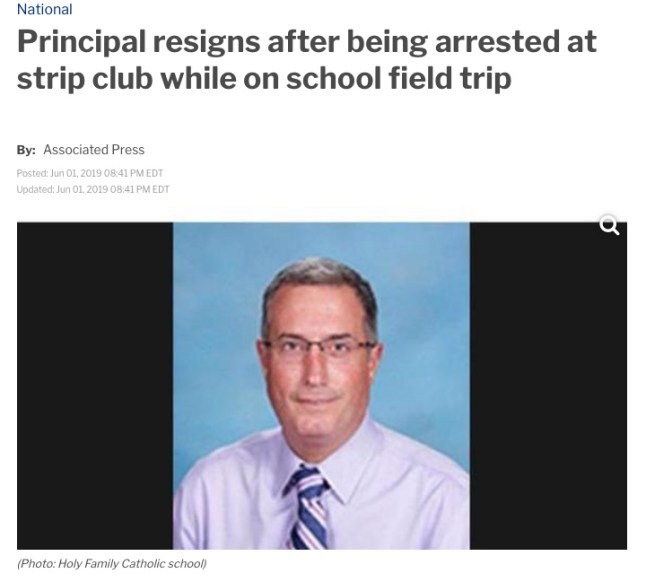
This theory of trying to balance and choose came to mind today after a story about a Louisiana principal of a Catholic school resigned for a truly spectacular reason:

StripPrincipal

When it comes to the lead on this, you have an Associated Press approach that cuts to the chase:

A Louisiana Catholic school principal was arrested at a Washington, D.C. strip club after refusing to pay his bill.

It’s 19 words and right to the point. However, it’s really missing some of the nuances.

First, the guy hit the strip club while on a SCHOOL FIELD TRIP. I remember my mother freaking out when her school and my school ended up having a trip to the circus when I was in second or third grade and she saw our teacher smoking a cigarette and drinking a beer behind the big top. I can only imagine what parents at this school were thinking.

Second, the guy was drunk at 2:20 a.m., outside the club, refusing to move out of the roadway. And, again, remember this is a FIELD TRIP for a CATHOLIC SCHOOL.

Third, he had a history of problems, including the mismanagement of Hurricane Katrina donations to a previous school. Still, he was a reserve officer in a local police department.

Still, the AP might not have wanted to use all the information that was in The Advocate, the local paper for this educational leader. Here’s the lead from that paper, where the writer clearly decided to go a different way:

Michael Comeau, the principal at Holy Family Catholic school in Port Allen and an educator who previously received the prestigious $25,000 Milken award, has resigned after his arrest early Friday at a Washington D.C. strip club while on a school field trip to the nation’s capital.

This is a case of throwing the kitchen sink into the lead, as it’s 46 words. The author names the person up front, relying on his presumed local fame to drive the interest. (I asked a friend who reads this paper and he said this guy isn’t a known entity, so there’s that…)

The part about him being an award-winning educator makes the lead (and about a half-dozen paragraphs throughout the story for some reason). It also updates the story to explain he resigned after the arrest, pushing up the newer stuff that AP didn’t use.

Neither of these leads hits the nail on the head, as I’m guessing more people would care about the action than the person, making the second lead a bit weaker in the approach. I’m also sure more people want to know about the field trip and the resignation than the arrest. However, WHY he was arrested (whatever the strip club/booze equivalent of “dine and dash” is) would be worth knowing up front. (There’s something in another story about his use of a service dog at the strip club, which just screams for a follow up…)

If you’re looking for a fun and yet somewhat disturbing exercise, use all the information in these two stories to determine what would make for a good 25-35 word lead for a broad audience.

“Your resume is not about you:” Insights from a journalism hiring manager on how to succeed in applying for internships and jobs

Tim Stephens has spent more than a quarter of a century at various media companies, including the South Florida Sun-Sentinel, the Orlando Sentinel and CBSSports.com, where he helped recruit, hire and develop talent.

“I placed a high premium on being connected in the industry and knowing what other outlets were developing track records in terms of producing quality journalists who could fit into our fast-paced, evolving newsroom culture,” he said. “Your organization will only be as good as the people working for it, and I didn’t want to miss on hires. I wanted a pipeline of talent.”

Stephens said that no matter who he hired or how long they worked for his organization, he was always looking to put the best people in the best positions when he hired someone.

“I was never afraid of losing talent…” he said. “I wanted ambitious, high-achieving performers to have opportunities to move up in their careers. Every time I lost an employee to a larger organization or an expanded role, I took it as an opportunity to find the next high achiever.”

A few years back, Stephens and I were at a convention where we talked about a massive disconnect between college-age applicants and places that hired them for internships and jobs. His insights shaped how I work with students as they build their application packages, resumes and cover letters

Last week,  I asked him some questions via email so that he could share some additional thoughts about how hiring works, what he looks for as a hiring manager and other things that might help you get where you want to go in this field.


What is/was life like as a person responsible for hiring interns and employees? What goes on behind the scenes that students or newly minted graduates don’t know about between the time they send in an application and the time a person gets hired?

I planned for openings months before I had them. Part of that was because I was accustomed to large organizations making occasional raids on our staff, and part of that was because of the shrinking nature of the newsroom made it extremely important to make strong hires when you had an opportunity to do so.

I had my eye on candidates who were often 2 or 3 moves away from a position on our staff. I talked to hiring managers at other companies all the time, picking their brains for potential candidates. I referred people who impressed me to hiring managers who had openings when I didn’t, with a special eye for matching those talents to newsrooms where their best attributes would be developed.

Bottom line is that it’s a small industry and you are rarely more than two or three people removed from knowing someone who knows someone.


One of the things you mentioned to me a long time ago was that students don’t really understand the point of their resume from a hiring-manager’s perspective. What are the problematic things students or new job seekers do in terms of creating documents or applying and how can they fix that to improve their odds of impressing an employer?

Your resume is not about you. It’s about ME, the hiring manager. If I move your resume through the stack, I am attaching my reputation to yours. I am being judged in large part by my hires. Don’t ever forget that. When I am looking at a resume, cover letter and portfolio, I am not looking at what you’ve done. Frankly, I don’t care.

What I care about is how what you have done translates into what you will DO if I hire you. Big difference. I have always tried to encourage job hopefuls to try to view the search from the perspective of the person doing the hiring.

First, you have to find out who that is. Be a reporter and do some digging. What is this person’s track record? What attributes do they value? Who previously held the job I am going for? Do your homework and help me project you into the job rather than simply to view you as an applicant.


If you had any key advice for students or one thing you would want to tell them about this whole process, what would it be?

Network. Always be professional — always. You never know who someone knows … or who they will become in this industry. And last, when you get an interview, try to flip that conversation toward how you’ll do the job you’re applying for, and you will take a big step toward landing it. You want me leaving that conversation feeling like you’re already part of the team.


Is there anything you think I missed or anything else you’d like to add?

Where you start in your career isn’t as important as who you are starting with. Do your homework on the hiring managers and the person or people who will supervise you.

Who has a track record of investing in and developing talent? Who has a track record of sending people on to bigger and better things? Who gives young journalists prime opportunities to shine when they earn them? Will you get feedback? Will you have a strong cast around you who will support your development? The most prestigious media company isn’t necessarily the best opportunity to advance.

“Count to Five:” Why Clarence Thomas’ interest in relitigating Times v. Sullivan isn’t going anywhere fast

The editor of the Democrat-Reporter in Linden, Alabama published an editorial in which he called on the Ku Klux Klan begin night rides against “Democrats in the Republican Party and Democrats (who) are plotting to raise taxes in Alabama.”  This became the biggest freakout moment of the day Tuesday for journalists, journalism professors and anyone with a vested interest in media, until Supreme Court Justice Clarence Thomas pulled a “Hold my beer” moment.

Thomas, writing for himself only in a concurring opinion, stated that Supreme Court should reexamine the 1964 decision in New York Times v. Sullivan, in which the court held that a public figure had to prove actual malice in order to win a libel suit:

He said the decision had no basis in the Constitution as it was understood by the people who drafted and ratified it.

“New York Times and the court’s decisions extending it were policy-driven decisions masquerading as constitutional law,” Justice Thomas wrote.

Thomas’ writing involved the court’s decision to reject an appeal from Kathrine McKee, one of the women who accused Bill Cosby of sexual assault. She claimed she had been libeled because Cosby’s lawyer called her dishonest. As a public figure, the court held that Sullivan applied and thus she had to show actual malice had occurred.  (Sullivan is one of the most important free-press decisions ever issued by the court as it makes it much harder for public figures to use libel laws as a sword instead of a shield. For a good synopsis of the facts on Sullivan, you can go here. If you want to read the whole decision, you can go here.)

About six seconds after news of Thomas’ statements on Sullivan emerged, journalism folk in all of my social media feeds began mildly to seriously panicking over what this could mean. My first two thoughts were:

  1. Clarence Thomas? The last time I thought about him at all was when I got excited to see Wendell Pierce playing him in an HBO film about the Anita Hill controversy. (To be fair, Pierce probably played Thomas better than Thomas plays himself.)
  2. This guy is shit-talking the Warren Court on a 9-0 decision? That’s like me calling out LeBron James based on basketball talent. Also, although unanimous decisions are the norm on the Roberts Court, it’s hard to imagine it running the table on a decision as crucial as Sullivan.

To get something like this rolling, Thomas would need to find four other justices to see the law the way he does in this area, which is a tall order. Still, the idea that something this important could be undone by someone this unimportant bothered me, so I asked media-law expert Daxton “Chip” Stewart to give me a sense how worrisome this bit of news is.

“First thought, it’s nothing to freak out about because Thomas has always been like this,” Stewart said via email. “(Former Justice Antonin) Scalia famously hated Times v. Sullivan, but he knew he couldn’t get a majority to go along with him, so he gave up trying to kill it. Thomas isn’t so shy. Remember, he wrote a separate concurring opinion in the Bong Hits 4 Jesus case to say that Tinker was wrongly decided and students have no free speech rights. The guy is no friend to the First Amendment rights that the Court has recognized over the past century.”

Stewart said even though no one sided with Thomas in his decision, the question of what this means going forward will depend on how the rest of the judicial system reacts.

“The most important thing about this Thomas opinion is that nobody else joined it,” he said. “He’s out on a limb. The potential problem is that it opens up a window for other aggrieved anti-media judges to think that maybe overturning Sullivan is in the realm of possibility or at least legitimate legal discussion. They’re already doing the same thing in Roe v. Wade — appellate court judges boldly rejecting it as precedent, saying it was wrongly decided and it’s time for the Supreme Court to overturn it. That flies in the face of the entire notion of stare decisis.

Thomas is also floating a trial balloon to see if any of the new appointees think this is an idea worth pursuing. The Times pointed out in its coverage today that both justices Brett Kavanaugh and Neil Gorsuch haven’t stridently opposed the Sullivan ruling, with Gorsuch saying during his confirmation hearing that he relied on Sullivan during one of his prior rulings.

Stewart said it is possible that both men could lean more toward President Donald Trump’s idea of “opening up the libel laws” and thus shift their stance on this issue. He also noted that Justice Samuel Alito is a “wild card,” but that Chief Justice John Roberts “cares too much about SCOTUS legitimacy and precedent to burn it on something as small (to him) as press freedom.”

“So the big risk would be if another Trump appointee were to come on in the seat of one of the liberal/moderate wing of the court (Ginsburg, Kagan, Breyer, Sotomayor) and join up an anti-media bloc of Thomas, Gorsuch, Kavanaugh, and maybe Alito,” he said. “Then there’s five votes to undo Justice (William) Brennan’s historic opinion in Sullivan.

“And as Brennan famously said, the most important thing for a justice to be able to do is to count to five.”


A quick look at the history and value of the Associated Press (and an interview with a pro, to boot!)

A good number of my students hear “AP” and immediately think of the giant style guide that they have to buy for each class. However, the Associated Press is a lot more than that, owning an impressive history of doing quality journalism around the globe.

A story released today by the Columbia Journalism Review takes a look at some recent rough times the AP has had in terms of operating its foreign bureaus, a topic that might or might not be of interest to you. However, I would strongly suggest reading it anyway, as it contains a really nice, clear history of the creation and development of the organization itself.

In addition, I’ve posted a “Tips from a Pro” interview with AP editor Janelle Cogan that we featured in the “Dynamics of News Reporting and Writing.” It’s a good look at how strong, clear journalism should be valued above all else.

Here’s Janelle:

As the acting enterprise editor for the South Region of the Associated Press, Janelle Cogan sees a lot of quality news features, watchdog pieces and enterprise stories each day. Even with those longer stories and broader topics, she said the basics of journalism remain at the core of her approach to content.

“Journalists need to ask and answer the basic questions,” she said. “When you’re writing and reporting a story, don’t assume your audience knows the context or background of the subject matter – it’s such a big part of your job to provide that. Give scope, give context.”

Cogan has held a number of positions at the AP, including desk editor, weekend supervisor and a morning supervisor before she took on the enterprise role. In this position, she works on stories that come from 13 states and Washington, D.C. Before joining the AP, she worked as a copy desk chief, an assistant city editor, a features editor and a designer. In all of her time in media, she said the biggest changes have been to the volume of news that organizations have created as well as the speed at which it is delivered.

“No one is waiting for tomorrow’s paper to see the results of the game, the election, the fire, the shooting,” she said. “So the way we report and write that news has changed, too. We have to provide quick, understandable, digestible bites of news. When we have the latest numbers/report/development, we need to get it out there. So we write in a way that puts that info at the very top of the story. Especially as a story develops, we probably aren’t writing in a terribly flowery or “writerly” way. We are writing crisp, clear, basic sentences. We are authoritative. We are transparent.”

To keep the writing focused, Cogan said she pushes writers to “show, don’t tell” a story, eliminate clichés and remove jargon. She said she pushes her writers cut superfluous words and to tell her the story in a clear and concise way.

“It’s better to be straight with them – conversational, even,” she said. “How would you tell me this story if we were chatting over coffee or a beer? That may just be the best way to start your story. A pet peeve of mine as an editor: When you pitched me this story, we were probably both excited about the idea – when you turn in a draft, if that excitement and that initial nugget is gone, you need to go back.”


ONE LAST THING: If you could tell the students reading this book anything you think is important, what would it be?

“Don’t be afraid to take risks and get out of your comfort zone; you must try new things and expand your skills and horizon! In terms of being a journalist, this means: You aren’t *just* a writer. You aren’t *just* a photographer. You aren’t *just* a VJ. You’re a journalist. The format will change, and you should try all you can: write, take photos and video on your iPhone, create and post interesting tweets, produce an interactive, edit your colleagues’ work. It’s all important.”

Throwback Thursday: Earning the fungus on your shower shoes

One of my favorite early posts involves a Filak-ism I grabbed from the baseball movie “Bull Durham,” where Kevin Costner is explaining to Tim Robbins that things are different in the majors than they are for him now in the minor leagues.The line about “earning the fungus on your shower shoes” is a good one to remember. It’s also important to remember that just because you earned the right to do something, it doesn’t necessarily mean that you SHOULD do that thing.The reason more seasoned writers get the leeway they do in terms of breaking with style, writing in something other than third person, skipping the occasional attribution and other things that will cause your grade to suffer is because they can rationalize their choices appropriately.

When an editor asks, “Why did you do this?” the experienced writer comes up with a pretty explanation for that decision. When I ask “Why did you do this?” to my beginning students, they tend to stare at me like a dog trying to do a calculus equation.

If you have a “why” answer and it’s a good one, you’re half way to earning the fungus on your shower shoes. To understand more about this, enjoy the original post below…

The 1988 movie “Bull Durham” features Tim Robbins as an up-and-coming phenom pitcher and Kevin Costner as a weathered, veteran catcher on a minor-league baseball team. Costner has been brought to this tiny outpost in Durham, North Carolina to teach Robbins how to become a major leaguer. This involves more than which pitches to throw or how to control his fastball. Life lessons are peppered throughout the movie, including this bit of wisdom:

In other words, when you make it to the pros, you can do things that you can’t do when you’re still learning the craft. Once you figure out how everything should work according to the rules, then you can start breaking them if you have a reason to do so.

The same thing is true when it comes to writing for various media outlets. One of the biggest complaints beginning writers have is that they have to attribute everything, write in the inverted pyramid, use descriptors sparingly and stick to a bunch of really strict rules. Meanwhile, when they read ESPN, the New York Times, Buzzfeed or a dozen other publications, they see everyone out there breaking the rules. In some cases, the writers shouldn’t be breaking those rules and thus they end up in trouble for not nailing things down, attributing and telling the story in a more formal manner.

However, when writers do break rules and it works, it is because they know what the rules are. In the Dynamics of News Reporting and Writing book, award-winning journalist Tony Rehagen makes this point clearly:

Another aspect of writing like this is to understand that rules exist for the benefit of the writers, he said. Even though he knows he has more freedom as a writer, he said he doesn’t believe in breaking rules for the sake of doing so.

“Well, first of all, you sort of have to earn the right to break a rule,” he said. “If you want to lead with a quote, it had better be a damn good quote. If you want to bury the nut or (gasp) not have a nut graf at all, you had better have complete command of your story and have structured the hell out of it. That takes skill that even veterans don’t possess on every piece.”

To break a rule, you have to know what the rule is, have a reason for breaking it and break it in a way that improves your overall story. That’s something excellent writers like Rehagen earn over years of improving on success and learning from failure.

Start with the basics and master them before you start looking for other ways to do things.

You have to earn the fungus on your shower shoes.


“I slept with a baseball bat under my bed:” Journalists share stories of being threatened and attacked.

Rage against “the media” is a common form of expression among people who have the same difficulty in differentiating between “fake news” and “factual stuff they don’t like” as they do “their ass” and “a hole in the ground.”

One of the things that many people forget is that “the media” is actually full of real people who go to work every day. Moms and dads. Sons and daughters. Friends, loved ones and more.

For these people, and those people who care about them, hatred of the media is not an abstract concept. The anger they face is palpable. The threats they receive cause fear. As we noted a while back, we all feel the pain when a journalist is attacked or a newsroom is the site of a shooting.

And all of this takes its toll.

Lori Bentley Law, a broadcast journalist at KNBC, wrote a piece that Poynter featured, titled, “Taking the Leap: Why I’m leaving TV news after 24 years.” Of all the things she mentioned, this one stuck with me:

I’m a happy, positive, optimistic person. I don’t want to be immersed in sadness every day. I don’t ever again want a cute little girl in pigtails to look up at me and say, “We hate you.” I don’t want to hear “Fake News” shouted at me anymore. Or to be flipped off while driving my news van. Or worse yet, to have the passenger in the vehicle pacing me hang their naked butt out the window and defecate. Yes. That happened.

(Law posted her original piece and made her decision even before CNN received a pipe bomb, one of at least a dozen explosive devices sent through the mail to people and organizations throughout the country. Then people like this emerged:)

Bomber
(Yet one more moment where I think, “What the hell is wrong with people?”)


I often tell my students stories of how I had been called a “vulture” and a “scumbag” and worse. I remember one person who told me, “Your mother didn’t raise you right!” Another one, for some reason, told me that he was “gonna get my cousin and we’ll be over to take care of this.” I forget why he was so upset, and I still have no idea why the guy was getting his cousin, but I doubt his relative was a conflict counselor.

The other screaming fits kind of blur into a mess of random anger. Occasionally, I was fearful when I went to shootings or other things and people would tell me to “get the (expletive) out” of their neighborhood. However, most of the time, I was covering late-night crime, so the presence of the police tended to make me feel a bit safer.

In this age of the media being dubbed “the enemy of the American people,” I wondered how bad things are now or what others had faced during their time in the field. I asked the hivemind for any recollections they had of incidents involving angry people, threats or worse.

These are their stories:

The local crank is a constant job hazard for journalists. Between the conspiracy theories related to the clues in the crossword  and the allegations of biased coverage of the local dog show, some people have a lot of issues to work through. One former student encountered a particularly virulent crank with some serious issues:

At a small-town newspaper in Ohio we had a guy who would get mad about articles we wrote, photocopy pages of our newspaper, write profanity on the copies then mail them to us…

My boss actually got a restraining order against the guy because he was stalking her. He liked to slowly drive past her house and glare at her and her family. Following some court hearings and visits by the police, the letters stopped coming, but he’d still curse at me when he saw me covering an event. When I knew he was around I sometimes would have a recorder ready to go so I could record him if he ever threatened me.

This went on for about seven-and-a-half years, beginning in 2010, until the guy died earlier this year.

That same guy also sent an email to our web editor once requesting a full body photo of a high school volleyball player, which was pretty creepy. He loved going to high school sporting events, especially high school girls games.

According to my boss, a teenage girl from another school also had a restraining order against the guy. He apparently printed photos of the girl, action shots from sports and senior portraits, and mailed them to her, requesting she autograph them and send them back to him.


Aside from the generally creepy people, journalists tend to take the most abuse from people who feel they’ve been unfair. A media instructor who covered local politics shared the kind of story people have seen an unfortunate amount lately:

I was threatened by a political candidate a few years ago while working at our local paper. I called him to get his reaction to losing the election, and one of his supporters answered the phone pretending to be the winning opponent. It was obnoxious. I told one of our editors what had happened, and he took to Twitter. The losing candidate called me the next day threatening me (I took it as a physical threat) and promising to exclude me from any news tips he might have — and he had a lot, he claimed.


In some cases, it’s not even the topic of a story who gets angry with the media. A general assignment and sports reporter once came face to face with the family members of a man convicted of a crime:

Closest call came when friends of a defendant charged with killing his friend in a drunk driving crash recognized me one night while I was out with friends watching a band … started with stares, then to whispers and pointing, then to getting in my face to confront me … luckily, had more friends than they did so the issue was quickly calmed down.


A good friend of mine who broke the news of a “Spotlight” -like molestation scandal in the Chicagoland area found herself targeted by the leaders of her own faith:

Torrents of abuse while covering the Catholic Church sex scandal, including being screamed at by a nun (who was basing her rage on being lied to by her bishop, who she probably couldn’t yell at, so) and the now-deceased Cardinal Archbishop of Chicago once shouted at me that a story was unfair in front of an entire congregation.

She also found herself threatened physically for criticizing another “holy man” in the paper:

Our newsroom in Elgin got shot at (we never knew if it was deliberate or just that we worked in a gang territory in dispute). I wrote something semi-critical of Saint Ronald Reagan after he died and a guy called my editor and threatened to kick HIS ass once he was done with mine.


Being blamed for the problems of others is common in the media. I remember once telling a woman on the phone who called to scream at me about a story, “Ma’am, it’s not my fault your son was involved in a shoot out at a Taco Bell Drive Thru.”

Usually, it’s just someone screaming on the phone about a DUI report or something, but for a former student of mine, the “blame game” was much worse:

I covered the lengthy trial of a dermatologist who was accused by about 16 women of abusing his position to sexually assault them. It was already going to be a high-profile case because he was a doctor, one of the most sacred positions of trust. Every time I’ve covered a courts story involving a physician there’s been hordes of satisfied patients who come out of the woodwork to blame the messenger (me, or the media in general) — I’m assuming because that’s easier than acknowledging you put complete trust in someone who is flawed.

Anyway, this trial went to a whole other level of crazy after the doctor alleged he was being unfairly targeted because he previously had a one-night-stand with the female district attorney (she adamantly denied it), and that she was trying to put him behind bars only because she was a spurned ex-lover. The trial, unsurprisingly with so many accusers, didn’t go his way. And on the last day his adult son walked out onto the freeway and stepped in front of a semi-truck to commit suicide…

In a newsletter to the hundreds of patients still supporting him, which he forwarded to other media outlets, he singled me out as causing his son to commit suicide. The case ended up lingering over more than a year as he appealed, and he repeated the accusation over and over again over that time.

It would have bothered me if it wasn’t so batshit crazy. But then again that was nearly 10 years ago and I’m still thinking about it, so maybe he did deliver a few blows to my reporter psyche.


A publisher of a Midwestern paper, who also teaches courses in journalism, said she received blame after covering a football coach and his abuse of players:

I was working as a sports editor at a small market newspaper in the early 2000s. I had to be escorted to and from the office by law enforcement for almost a month after a coach threatened my life following stories I wrote about him assaulting players in the locker room after a tough loss. I was outside the locker room and heard it happening and got it on tape and many of his players came forward and went on record. He was fired and of course, it was all my fault.

That journalist also received some sexist and violent threats more recently:

Last year, I had the mayor of the town I own the newspaper in call my husband and scream at him to “manage his bitch of a wife.” I published a story with his quotes about how the city was knowingly dumping raw sewage into a local creek. Later… our farm (was) vandalized.


People can clearly get angry when you report things they don’t want you to cover. A good friend said he once found himself almost being a punching bag for an angry young man whose house had caught fire:

One time in the early to mid-2000s, I was covering a house fire, and the teenage/young adult son of a man presumed to be inside got right in my face and threatened to beat the daylights out of me (pretty sure that’s not the phrasing he used) because I had no business being there. Turns out the dad was fine, and I’m sure the kid was upset because he thought his dad was dead, but I really felt like I was a millisecond away from taking a right cross to the head.


And that wasn’t even the scariest situation in which he found himself:

There was a period of time when I slept with a baseball bat under my bed, and I remember that was directly connected to some kind of threat I received while on the cop beat — but I really don’t remember exactly what it was. Kind of funny that this sort of thing happens regularly enough that I can’t even recall why I was sleeping with a defensive weapon nearby …


Of all the stories shared among the hivemind, this one was the most terrifying. A journalist recalled an incident that happened to him as a student editor at his college newspaper. A reporter began looking into what he thought was a fairly pedestrian story about a professor. The professor didn’t like the story idea and posted a screed on a website, which led to the whole story blowing up on a national level:

A fan of the professor’s work (unaffiliated with the university as far as I can tell) started sending death threats via Twitter and Facebook to me, some of which was wildly anti-Semitic.

I frankly didn’t know about them until after Public Safety contacted me to warn me about the posts. After months of online harassment and my multiple meetings by phone or in person with law enforcement, he showed up on campus one day looking for me.

He even found and entered the school newspaper office, but luckily I was in class across campus at the time. Public Safety at the school detained him, interrogated him and told him to never return.

I’ve never heard from him since.


NYT TV critic James Poniewozik bashes Axios CEO Jim VandeHei for his view on social media usage (and four things that explain why that’s beside the point.)

Jim VandeHei came to his alma mater, the University of Wisconsin-Oshkosh, this weekend to help celebrate the department of journalism’s 50th anniversary. A co-founder of Axios and Politico, VandeHei could easily make the cut as one of the department’s most famous graduates and probably even one of the university’s top ten most successful grads.

(My money for the top UWO grad, however, is Craig Culver, the namesake of the custard-driven restaurant chain. Food fame will always trump political or media fame.)

VandeHei gave several speeches over the course of the weekend, focusing on everything from his time at UWO to the issue of fake news. The latter topic became a post on his company’s website and a featured point for Axios’ Mike Allen when he put out his “Axios AM: Mike’s Big 6” column:

VandeHei offered four fairly provocative ideas — one each for politicians, social media, reporters and individuals. Here’s the gist, adapted for Axios …

  • Politicians: Stop using the term “fake news.” The worst thing for a country is having people believe lies, or trust nothing. One day soon, something bad will happen, and it will take faith in information to fix it. You erode trust at our collective peril.
  • Media: News organizations should ban their reporters from doing anything on social media — especially Twitter — beyond sharing stories. Snark, jokes and blatant opinion are showing your hand, and it always seems to be the left one. This makes it impossible to win back the skeptics.
  • Social media companies: Radically self-regulate, or allow government regulation to stanch, the flow of disinformation or made-up news. Maybe it takes a new FCC of social media to force the same standards as expected from TV stations and newspapers. One thing is for sure: The current self-policing isn’t cutting it.
  • You: We all want to fault others, but each of us is very much to blame. Quit sharing stories without even reading them. Quit tweeting your every outrage. Quit clicking on garbage. Spend a few minutes to verify the trustworthiness of what you read.

Be smart … Remember: If your Facebook feed is filled with garbage, it means you were reading garbage in the first place. The algorithm simply gives you more of what you crave.

P.S. The Axios social media policy, which applies to all our colleagues, prohibits the sharing of political views or derogatory snark online: “Don’t say anything on the internet that you wouldn’t publish under your byline or say on TV.”

Before we dig into the guts of this, a couple key things are worth noting:

  • VandeHei gave at least three speeches/panel presentations that day and I was at most of them. This is one part of a larger discussion and it’s also boiled down a lot more, based on Axios’ “Smart Brevity” approach. Keep in this in mind when we get to the deeper discussion.
  • The audience for most of these presentations was students at UWO and recent graduates from UWO. Faculty (like me) and other folks (less-recent alumni, spouses of visitors etc.) were listening as well, but the this was mostly targeted at journalism students who were either really green or relatively green.
  • Full disclosure: I fanboyed out in meeting VandeHei, as I did with several other people there. I wanted to meet him and thank him for his generosity and assistance in supporting the student newspaper, the Advance-Titan, when we were in the middle of a $50,000 challenge grant to pay off a five-figure debt the paper sustained over the years. I admire the fact this guy built not one, but two successful media organizations in a time in which media itself is taking a beating and it seems like nobody is making money in journalism. It doesn’t mean I’m a shill for this guy or that I can’t think for myself on any of the points he made.
  • I was these events as a faculty member who was trying to help keep things running smoothly, not as an impartial media member, determined to write on this. I also geeked out meeting Cliff Christl, the longtime Green Bay Packers reporter and Packer historian. Same deal with getting to see Paige Bonanno of ABC Disney and others. Photos of me are floating around out there with these people.

Given that most of the media world couldn’t find Oshkosh with a map and a compass, it never dawned on me that anyone would hear anything about VandeHei’s speech, let alone take umbrage with his comments.

Shows what I know:

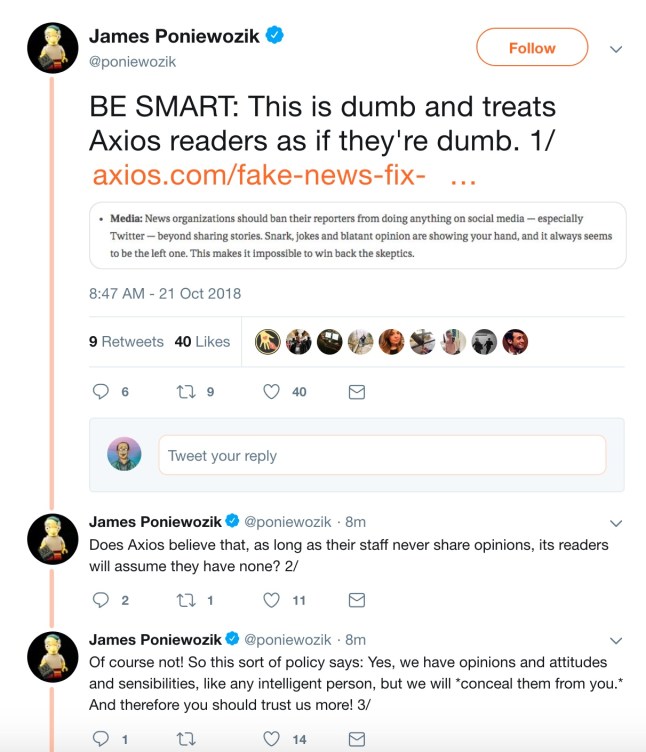
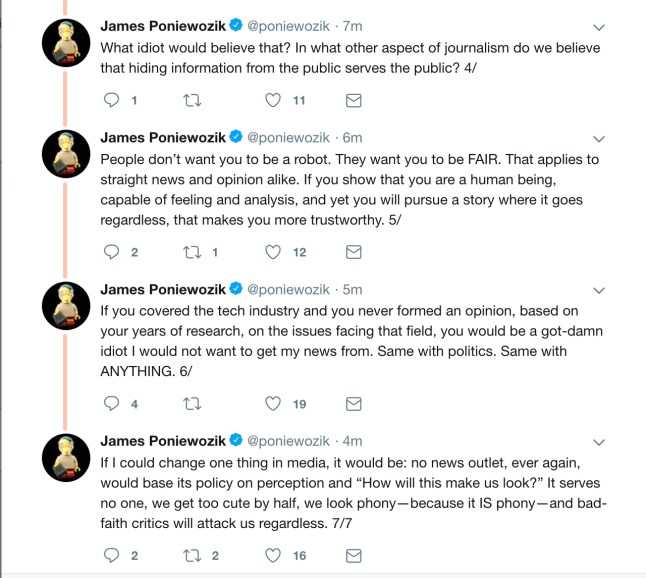
PoniTweet1PoniTweet2

(In case you don’t know who he is, James Poniewozik is the TV critic for the New York Times, a job he has held since 2015. Prior to that, he spent 16 years as a TV and media critic at Time. He has a degree in English from the University of Michigan and has studied creative writing at NYU.)

Poniewozik wasn’t the only critic of VandeHei’s position, but he was among the most prominent and he captured the majority of what I saw out there in terms of disagreement. Rather than trying to sort through all of Twitter, it seemed most germane to analyze this issue based on these seven tweets and try to incorporate additional information where I can.

Consider these four key thoughts:


Freak out if you want, but not on Poniewozik’s point:

I’m really stunned that the thing that didn’t REALLY freak people out was Vandehei’s third point: “Radically self-regulate, or allow government regulation to stanch, the flow of disinformation or made-up news. Maybe it takes a new FCC of social media to force the same standards as expected from TV stations and newspapers.”

The question of “Who decides?” will always be a concern when it comes to the regulation of speech or press. We live in a world in which First Amendment “goes too far” according to at least a quarter of the country, should be undercut by the “opening of libel laws” and the concept of what is “made-up news” seems to be in the eye of the politician.

A media person like VandeHei expressing an opinion on how to fight fake news (keep in mind, that’s the narrow window through which VandeHei is talking about these issues) is interesting. A fellow media person like Poniewozik arguing his opinion against VandeHei’s opinion is interesting, although starting to border on the “media talks about media” inside baseball I hate. The rest of the internet choosing sides on this is what the internet does until someone starts talking about “libtards” or someone else drags Trump and the Russians into it, at which point most of us go back to looking for cute micro-pig videos. I can take or leave that.

However, the last thing I would want at this point in time is some sort of “agency” to essentially engage in prior review and/or prior restraint either actively (through censorship) or passively (through policy that limits specific content). Of everything VandeHei said Friday, that was the one thing that really had the feeling of a truly awful idea. That said…


Absolutism is dumb…:

One of the easier ways to get in trouble as a writer is through absolutism. Whenever I read that something has “never” happened or that “everyone” thinks something or “it always” works that way, my internal BS detector kicks into high gear. Sure, there are a few firsts, lasts and onlies out there in a variety of fields, which is why Oddity is one of the five interest elements we espouse in the book. However, the odds of something being declared an absolute and something actually being an absolute are similar to the odds of winning the lottery.

Therefore, I’m not a huge fan of the line regarding the banning of reporters from doing anything on social media other than promoting stories. For my money, the P.S. at the bottom of the post espouses a much saner version of a social media policy: “Don’t say anything on the internet that you wouldn’t publish under your byline or say on TV.” This is a policy that places responsibility on the journalists and it also provides a much smarter way to look at this topic.

I can’t tell you how many times I practically broke out in hives when someone at one of the student media outlets I advised would say, “Oh, that photo/story/graphic is way too bloody/inaccurate/naked to run in the paper! Just stick it on the website…” The mentality seemed to be that journalistic standards of quality only applied to the dead-tree publications (and the over-the-airwaves broadcasts), but the web was this fun, scrappy kind of place where you could drop F-bombs and innuendo all day.

Media outlets that want people to take them seriously should establish more of a platform-neutral set of standards for content as opposed to thinking something you wouldn’t say on one platform is completely legitimate on another. Either way, a lock-down mentality of “never, never, never” is a bad idea and likely to lead to more harm than good.


…But uninformed ranting is dumber:

I love Axios’ concept of “Smart Brevity,” but it can lead to rabbit-hole criticism like Poniewozik’s tweets on the topic of tweeting an opinion. The whole post involved the idea of how to combat fake news, which got lost immediately upon conversion to Tweet-fighting. The line “Snark, jokes and blatant opinion are showing your hand, and it always seems to be the left one. This makes it impossible to win back the skeptics” becomes the flashpoint of the argument where Poniewozik equates VandeHei’s line to the concept of never publicly stating any opinion.

He then pushes the point, noting that never publicly stating an opinion is either a heinous form of concealment that treats the readers in a negative way or the inability of the journalists to form an opinion and thus idiocy on the part of the writers. Thus we get idiots, phonies and so forth.

Let’s unpack this a bit:

  •  Vandehei made it clear in his presentations that he stringently opposes news journalists using social media to express opinions that taint the readers’ ability to trust them.
    An example he used related to a city council meeting in which a reporter stated that some proposal was about to be debated and that people should stay tuned to his live tweets to figure out if two reps were going to screw people over (or words to that effect). In other words, if you are expecting a story based on the facts about some local content and the reporter is already calling a couple people involved chuckleheads, how can you trust that reporter on anything else he or she writes?


  • Journalists have ALWAYS developed, maintained and expressed opinions on the people they cover. I thought some sources I knew were honest while others I wouldn’t trust any farther than I could throw a cheesecake in a swimming pool. Some people were complete jerkwads while others bordered on handsy in their desperate need for my adulation. I had opinions on all of them.
    However, there’s a difference between going to the bar after work and telling your coworkers what a dipstick a county commissioner was during an interview and publicly issuing a “ready-to-go-viral” tirade about that person.
    I have often told students that the duty to report is not the same as the duty to publish. A similar view on social media might be valuable: The duty to form an opinion is not the same as the duty to share it with the whole world in 280 characters or less.


  • Many differences exist among the positions of having an opinion, expressing an opinion, not developing any opinionated thought and the “snark, jokes and blatant opinion” elements outlined in the Axios post.
    Consider this spectrum of items you can use in expression:

    Fact (an indisputable element): Jim VandeHei spoke Friday at the University of Wisconsin Oshkosh about fake news.

    Personal opinion (statement made to indicate personal belief): I think James Poniewozik raised interesting points, but was off base in his criticism of Jim VandeHei’s speech.

    Blatant opinion (A personal belief stated as fact): “This is dumb and treats Axios readers as if they are dumb.” OR “People don’t want you to be a robot. They want you to be FAIR.”

    Jokes (in this case, I’m guessing attempts at humor in an attempt to degrade or undermine an opposing source or the source’s position): Q: How do you get a University of Michigan graduate off your porch?  A: You pay for the pizza. OR Q: How many TV critics does it take to change a light bulb?  A: None, they just sit in the dark and write a scathing column about how illumination devices used to be so much better.

    Snark (probably closest to sarcasm or other biting comments intended on undercutting a position without relying on the joke format): James, if I need an analysis of “Cop Rock” or a creatively written haiku, I’ll give you a call. Otherwise, I’ll probably rely on the guy who actually has a journalism degree and runs a news organization to come up with some standards for the news media.

    There are levels to this and if I had to make a policy for pairing news journalists and social media, it would be a lot closer to the “stick to the facts for the most part, occasionally use the personal opinion when you can support it with facts and don’t do jokes, snark or blatant opinions.” But that’s my personal opinion.


  • Multiple people spoke on this topic and several of them agreed with VandeHei’s underlying premise: News journalists now are saying stuff on social media that would be way out of bounds in their traditional publications and that needs to stop. One of those people was Paul Anger, another UWO grad, who retired in 2015 as the editor and publisher of the Detroit Free-Press.  I’m not sure if he held to Axios’ absolutism policy regarding social media, but it was clear that his previous publications had specific standards and those included how people should act on social media. It’s not just VandeHei, although in being out front and at a major national political outlet, he’s going to get the most attention.


Consider the Audience

I frequently write about why it is important to understand your audience in crafting your message. To understand VandeHei’s statements, it’s important to keep that concept in mind.

Not to belabor the point, but he was speaking to students, student journalists and recent journalism grads (for the most part). As someone who often speaks to these students, I can tell you three immutable truths:

  1. It is becoming increasingly difficult for them to distinguish between fact and opinion when they see it in the media and when they write for the media.
  2. They don’t always see that they’re playing with live ammunition when they post things on social media.
  3. They are still learning how to work as journalists.

If this were a speech or panel at an SPJ or NAB or some other professional conference, the tone, nuance and depth might have differed here. Sure, the policy at Axios is still going to be the same, but there might be some additional discussion that merited digging into the gray areas. That’s not the case here as I had students in that audience who are still trying to figure out how to write a lead (or lede if you prefer).

Folks like Jim VandeHei and James Poniewozik have earned the fungus on their shower shoes, so maybe expressing opinions or using social media as they see fit makes sense for them. My students? Not so much, so slapping a few safety devices on these tools is probably a good idea. When they get to the stage of becoming experts on topics and they have opinions that are supported, well-reasoned and likely to benefit readers, it’s the perfect time for them to take to Twitter and share them. However, until that point, it’s probably best to hammer home the idea of playing it safe.

Also, being a professional media practitioner, or simply being educated, doesn’t mean you’re not going to fall on your keys on social media. Or, as Tweet 6 would note, come across as a “got-damn idiot.”

Journalism and Video Games: How Gieson Cacho turned his two passions into a career path

/METROGieson Cacho is living the dream, according to several students in every class I teach.

The journalist at the Bay Area Newspaper Group has worked there as a copy editor, designer and video editor. He has interned at the Ft. Myers News Press and spent time at the San Jose Mercury News and the Long Beach Press Telegram. He lives in California and has access to some of the best stuff the West Coast has to offer.

And the biggest thing of all: He writes video game reviews.

(You can find some of his more recent reviews here: Spider-Man, Shadow of the Tomb Raider and Assassin’s Creed Odyssey.)

“I didn’t really get into it until I was at the Contra Costa Times in 2006,” Cacho said. “We used to run a video game column from this guy over in Las Vegas and I thought I could a write a better column. I talked to the Features editor about it and she told me to write a few prototypes and I started writing a weekly column regularly. My argument is that a lot of the tech companies and video game companies and studios such as EA, Bandai Namco, Crystal Dynamics, 2K Games are based in the Bay Area. Our paper not writing about it is like the LA Times not covering Hollywood.”

Cacho said he works the video desk at his current job, but the organization gives him time to work on his video game gig. If all goes well, he will have the game he is working on done early enough to have his review done before Wednesday, which is his deadline each week. He has to complete his work a week ahead of the game’s release, he said.

“The busy season for video games is August to December,” Cacho said. “It’s pretty much wall-to-wall events and releases. I get about three to four hours of sleep each night. This is on top of my regular video editing work. Things wind down in January or February.”

Although each game has its own positive and negative aspects, Cacho said he works through the games and the reviews with a consistent approach.

“My philosophy behind video games writing is try to convey why a video game is a good or the deeper meaning behind its creation,” he said. “That often comes to talk to developers or trying to see how the level design and narrative work together to create a compelling experience.”

Cacho said his journalism degree helped him learn how to convey that type of information to his readers.

“Journalism creates a good foundation for writing because it’s about translating that gameplay experience into something most people can understand,” he said. “Video gaming is so young that there’s still a gap between casual and hard-core gamers and part my role as a core gamer who write in a mainstream publication is that I should try to reach as broad an audience as possible. Also, learning how to write concisely helps a lot and because there’s not a lot of print space for 2,000-word essays on why so and so is great.”

Journalism school also helped him develop a strong ethical compass that allowed him to work in a field in which expensive hardware and software are often given away for free, he said.

“The one thing that going to J-school teaches you that is just as important is how to handle ethically precarious positions,” he said. “It hammers home what is right and what is wrong when you go to events and they’re handing out paid trips and pricey swag. You understand why you have to decline some offers that PR folks and publishers put out. I usually don’t solicit games unless I’m going to review them, and you never sell code or anything else.”

The one question I had to ask Cacho was the one students always ask me: “I love video games and I love writing, so how can I get a job as a video game reviewer?”

“Yeah, just because you love games, that’s not enough to make it in the business,” he said. “A lot of it is contacts and who you know. My advice is to never work for free. Be more outgoing and friendly to other writers and outlets. The cool thing is that I get to play a lot of games early the bad thing is that I spend most of my free time writing about it.”

In addition, with more and more people trying to find a way to monetize their love of games through blog or YouTube reviews, Cacho said he finds himself in the difficult position of competing with this new layer of gaming critics.

“The thing that has changed the most is the way streaming and video altered the relationship between publishers and media,” he said. “It used to be video game companies and press and now there’s a third category of ‘influencers’ who have just as much weight as critics. As a journalist, what makes you different from influencers is that you should have a higher standard than people who talk on livestreams. I guess it’s the difference between someone who’s a beat reporter, writing about a baseball team, and the talking head on ESPN shouting hot takes about said baseball team.”

So any advice for the students who still want to take a shot at this type of work?

“Don’t write for free and if you do, don’t do it for too long,” Cacho said. “People get stuck just giving away their work and never getting anywhere. I’ve seen a lot of people burn out quick and leave.”