5 simple things Bob Woodward does in his interviewing that you can do, too

Few hard and fast rules exist in journalism, but one I would bet the house on is this: If Bob Woodward says something works, it probably does.

Woodward first came to national prominence in 1972 when he and fellow Washington Post reporter Carl Bernstein dug deep into the Watergate scandal. Historians and journalists largely attribute much of President Richard Nixon’s downfall to the reporting of Woodward and Bernstein.

(Here’s a neat fact: Woodward only had about two years of professional journalism experience when he caught this story of a lifetime, working first at the Montgomery Sentinel before getting a job at the Post in 1971.)

In 40-plus years that followed, Woodward became the consummate political reporter, digging into daily work and writing books that profiled presidents. He was the standard for all other reporters, even as his name became less of a cultural touchstone for younger generations.

Woodward is back in the news these days for his book, “Fear,” which looks at the presidency of Donald Trump. As Post releases excerpts of it, Woodward is making the talk-show rounds to talk about his book and his experiences writing it. Last night, he sat down with Stephen Colbert on “The Late Show,” to talk about what he found and how he found it.


Normally, these interviews between authors and talk-show hosts center on humorous anecdotes, some vapid chatter and a hard plug for the book. Woodward, however, gave all of us a beautiful look at how he goes about his job, especially when it comes to conducting interviews. Within his conversation with Colbert, Woodward provided beginning journalists with at least five solid interviewing tips that anyone can use:

Conduct deep research on your interviewee: One of the tenets outlined in both textbooks is to research your subject before you interview him or her. The idea of entering an interview without a full grasp of who the person is and what that person might have to say should scare the heck out of you as an interviewer. Woodward explains that he researches his subjects so well that he can even surprise them with information he found:

“Let’s say your an assistant secretary of defense and I come to interview you… and I say, ‘Oh, you wrote this article in 1986,’ and you’re going to think, ‘Oh, only my mother read that article!’ … You don’t just Google them.”

His point was that the more you know, the more you feel like you are ready to do the job and the more your source will respect you. If you walk in looking like a kid who lost his mom at Walmart, you’re not going to get very far.


Enter the lion’s den: One of the biggest mistakes young journalists make in conducting interviews is to avoid contact with the sources. Text interviews, email interviews and phone interviews have replaced the face-to-face encounter. Woodward talked about how he would go to his sources’ homes and knock on their door, even when he felt uneasy about the potential outcome:

“I remember going to one general’s house, and he opened the door. We didn’t have an appointment. I was afraid I might get shot and he looked at me and said, ‘Are you still doing this (expletive)?’

Woodward hits on three key things there:

  1. He went to conduct a face-to-face interview. Eventually the general let Woodward in and they talked, but if he had called or emailed the general, he could have much more easily ignored Woodward. If you are present, it’s hard to ignore you.
  2. He went into the lion’s den. Many beginning journalists will attempt to meet a source at a neutral location, such as a coffee shop or a restaurant. Even worse, the writer might ask the source to come to the newsroom. If you are willing to go where the source is, you show strength and conviction. You also put the source in a familiar environment where he or she will feel more comfortable and thus will be more likely to be open to speaking.
  3. He was afraid. Bob Woodward is 75 years old, has written 19 books, covered every president from Richard Nixon to Donald Trump, was instrumental in bringing down Nixon’s White House, contributed to two Pulitzer-winning journalistic efforts and won nearly every conceivable journalism award available. Still, he was afraid when he went knocked on the general’s door. He didn’t hide it or bluster past it in the Colbert interview. He was honest. Fear (the emotion, not the book) happens, and if it can happen to a journalist like this, it’s perfectly acceptable that it would happen to a college-age, cub reporter. You need to do what he did: Accept the fear and push past it to get the story you want.


Silence is golden: I always tell students that silence is a vacuum and nature abhors a vacuum. When both the interviewer and the subject are silent, it gets awkward and there exists a desperate need to break that silence. You need to use silence to your advantage in an interview by staying quiet once a source completes an answer or offers only a little information at first.

The longer the quiet lingers, the more likely your source is going to want to jump in and add something. I never knew what Woodward explained was the source of this “silence as a tool” approach to interviewing:

“In the CIA they teach people let the silence suck out the truth, so just be quiet and people want to talk.”

If you can feel confident enough to let the silence do the heavy lifting for you, the source will usually come around a bit and give you a little more than you got at first.


Explain why the source matters: Woodward explains his ability to get people to talk comes from his ability to help them understand why they matter to him. In many cases, sources will view themselves as inconsequential or having “nothing really to say.” Thus, they turn down interviews, seeing no benefit in putting themselves in a position where they can see nothing good coming from talking to the journalist. Woodward noted that he never tells people that he’s going to write the story anyway, so they might as well talk. Instead, he tries to show how he’s taking them seriously and how they matter to his work.

As a writer, you will run into sources who feel like they are way too important to waste time talking to you. On the other hand, you will run into people who think they have nothing to contribute. Neither extreme is true, so a big part of trying to get sources to talk to you is to have them see why you chose them for an interview and what it is you think they can contribute to the bigger picture.


Get documents and support: The sheer volume of people who have lied to Bob Woodward throughout his career must be large enough to populate the state of New Jersey at this point. In addition, I’m guessing more than a few people remembered things inaccurately or got confused while sharing information with him. To that extent, the ability to find documents and notes matters a great deal to him and it should matter to you as a writer:

“What you want to do is say do you have any documents or notes… and they say no, no and about the third visit, they say, ‘Oh yeah maybe I have something upstairs,’ and then they come down with three boxes of documents. And documents and notes make it authentic.”

People have an uncanny ability to shift reality while documents codify what really happened. If you can get notes people took at the time or documents that support their memories, you can write a much better piece. In addition, you can use that data to question other sources later from a much stronger position.

Woodward also noted that he often has to go back multiple times to get the goods from people who might have been initially reticent to share things. Although he said daily reporters often can’t do the “ninth interview” with a source, nothing says that reporters can’t go back at least one more time. A “no” now might become a “sure, why not?” later.
Grave digger, cheese maker, bartender and amazing writer: Thoughts, insights and tips from George Hesselberg

George Hesselberg always fascinated me.

Hess, as he was affectionately known around the Wisconsin State Journal newsroom, retired from the State Journal in 2017 after 40 years at the paper, but his employment experience went far beyond that of the traditional ink-stained wretch.

According to his own recounting, he “worked as grave digger, night watchman at the Norwegian telephone company, bartender, translator at the Norwegian State Department, sign painter, stage hand, cheese maker, tin roofer.” Also, he spent his grade-school years working for the Bangor (Wisconsin) Independent, a weekly newspaper writing up the 4-H club meetings and the high school baseball games.

Hesselberg was a prolific writer and storyteller, the kind of journalist you always want to imitate for the simple reason that it would be impossible to do so.

His desk sat next to one of the few tiny windows in the newsroom, stuffed in an area away from the prying eyes of editors. His hours appeared to me to be random and his stories always called to me first when it was time to proof the first edition on night desk. The mug shot that accompanied his columns stared back at me with a confident, yet impish, smile that said to the readers, “Can you believe this?”

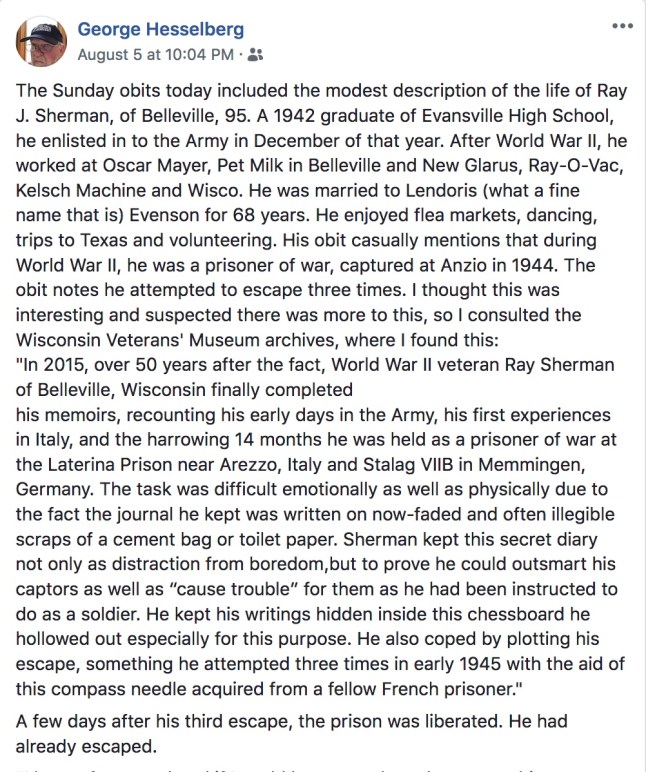
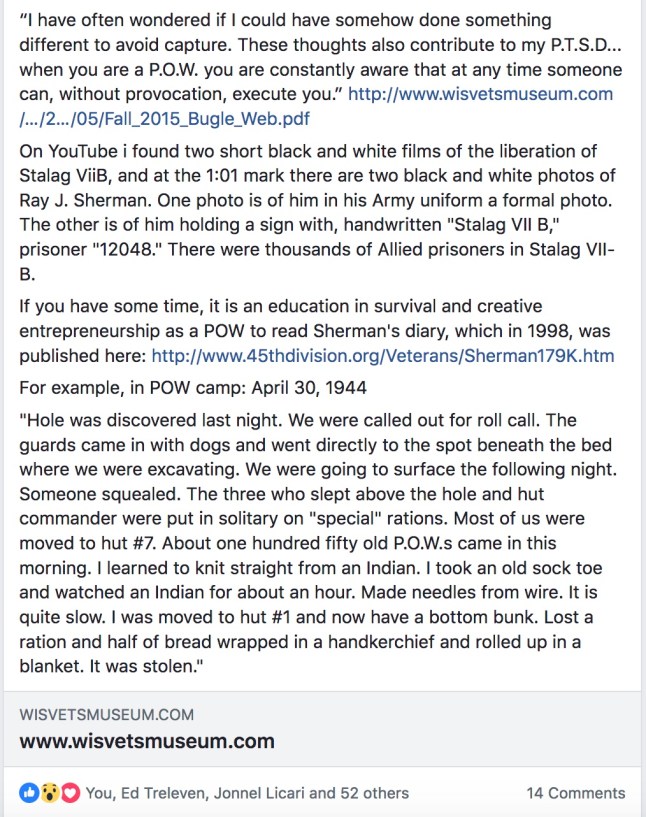
Even in retirement, Hesselberg continues to find those “Can you believe this?” stories that other people tend to miss. Case in point, in perusing the Sunday obituaries this week, he ran across a story of a 95-year-old man whose time in the military during World War II received only a passing mention. Hess dug in and posted his findings to Facebook:

Hess1Hess2

Hesselberg explained in an email how he developed the skill of finding these kinds of stories that would otherwise have remained hidden.

“There has to be more to this,” he wrote. “What am I missing here? Does anyone else have any interest in this and why? Will this help someone figure out what happened? Then go after the details… I think I developed this to survive while on the cop beat. There were several police reporters in Madison when I started and the competition was keen. I looked for something nobody else had… I read the fine print, always. I read the legal ads, I read the obits.

Hesselberg also wrote the obits, and he did so in a way that typified what I tell students: Your story should help readers learn about someone in death that they wished they’d known about in life.

“Imagine trying to tell a reader why he or she should care about what you are writing,” he said. “Go to Facebook and search ‘Hesselberg obituaries’ I have been posting my favorites over the years. Note the majority are about ordinary people, not captains of industry. A favorite is one I wrote after riding along with the coroner to a death call and finding a suicide. Newspapers don’t write about suicides, but this one has some good elements for a young reporter to notice. There are lots of interesting details, including the very last line.”

HessObit.jpeg

SIDE NOTE: My favorite obit was probably the one Hess wrote for himself and placed into his own clip file in the newspaper’s morgue. Hesselberg’s detail-oriented piece included his cause of death (stabbed in the back by management) and the way he was interred (his body was found in Lake Wingra, tied to a typewriter).

A knack for locating details and a penchant for critical thinking helped Hesselberg find stories where no one else would even think to look.

“When something doesn’t make sense, it is a story,” he said. “I try to find out something that nobody else knows, about any topic, from a cop brief to a series on cemetery plot swindles. (called ‘reloads’)”

Hesselberg’s ability to write for his readers endeared generations of Madisonians to him, as he not only found those “nobody else knows” stories, but he told them in a way that connected with his audience. (“There is a fine line that should not be crossed between telling a story and lecturing the reader,” he wrote.) The State Journal’s reach spanned the state’s capital city and towns of fewer than 1,000 people, which provided him a cornucopia of people with myriad interests.

I have to remind myself that not all readers are alike,” he said. “This is one reason I liked journalism on a daily newspaper: It was filled with all manner of news written in all styles about all subjects. I try not to assume I know what a reader already knows, and that makes a reporter write simply.”

In that same vein, the big question for Hesselberg had to do with helping my readers: How can students who are just starting their career tap into their own potential like you did and tell stories that engage readers? Or, put another way, what can students do to “make it” in this field? Just like his life and his writing, his answers included a wide spectrum of insightful ideas. Enjoy:

  • “Trite, but: Ask one more question of one more person. Doesn’t cost anything to ask, ever.”
  • “I wish I could remember the name of the editor who, when I rushed in to write on deadline and was trying to convey my enthusiasm on a topic, merely said: ‘Surprise me.'”
  • (As managing editor Cliff Behnke said,) “Get the name of the dog.”
  • “Go to the scene whenever possible. Even if it is after you had to write a breaking story. You never know what you might find.”
  • “A young reporter who asks for help in understanding an issue is going to be a good reporter.”
  • “Just because something has been done one way for 30 years does not mean it should be done that way now. Find a different way. (Editor Chris) Drosner made an unwittingly brilliant move in 2010 and told me to write the Jimmy the Groundhog story, which became my favorite three-paragraph bylined story ever.”
  • “There is no cheat sheet. Also, since you asked:  Don’t wait, learn a second language and study a third.”
  • “An editor is a necessary evil.”
  • “Be nice.”

Finish the Game: Why Emily Bloch is my hero (and should be yours, too)

In your collegiate career, professors like me tell you that you should work hard, play by the rules and seek a job that makes you happy. We tell you that the job is your reward for all of the things you endured during your four (or five or six) years in college, eking out an existence with food-service jobs and low-paying (or non-paying) internships. It’s why you spent all your collegiate life locked in that windowless basement that smells like feet and shattered dreams known as the student newspaper office instead of partying with friends.

Emily Bloch did all that. She worked for the student newspaper at Florida Atlantic University, ascending to the rank of editor in chief. She attended national media conventions, where I met her through her adviser, Michael Koretzky. She freelanced for Teen Vogue, blogged for Sunfest and contributed to the Miami New Times. In February 2017, she got her dream job: Community reporter for the South Florida Sun-Sentinel, an amazing publication that Tronc purchased in late May.

And last week, Tronc “restructured” her out of a job.

That’s right. The media giant fired her. As journalist and author Jeff Pearlman noted in his blog, “Tronc has kicked Emily to the curb—a multi-million dollar company saving (and this is pure guesswork) $35,000 a year and directly hurting its coverage.”

So, knowing that she got cut and that there was nothing she could do to change that, Bloch did something I doubt I would have had the strength to do: Her job.

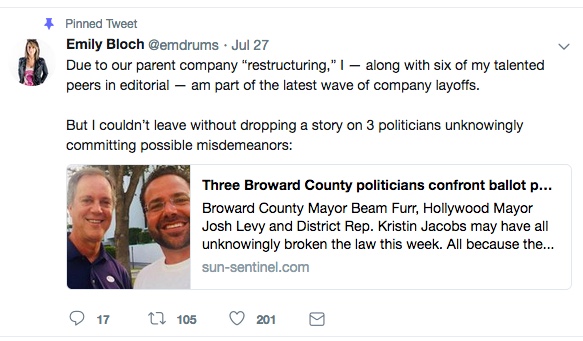
EmPinned

I was told I was laid off BEFORE I started working on that politician story,” Bloch told me in a text message.

The story made the front page of the Sun-Sentinel, and it also went viral when Bloch tweeted the ironic juxtaposition of the newspaper and her severance papers:

EmSeverence

This is why Emily Bloch is my hero, and she should be yours, too. At that age, (hell, even at this age) I don’t know exactly what I would do if I lost a job I always wanted, just because some chucklehead in a suit wanted to nudge a profit-margin up for some stockholders. However, my best guess would be that I would have one of the following reactions:

  • Weep like an overwrought 12-year-old girl if the break up of my favorite boy band occurred on the same day my dog died
  • Launch into a social media rage that would make this clip of Nicholas Cage look calm and well-adjusted by comparison
  • Drink the state of Wisconsin dry while listening to every song by The Cure

Going out and breaking a major story for a publication that told me I lacked value to them wouldn’t even be in the ballpark of what I’d consider doing. Bloch typifies exactly what I try to tell students about the importance of finishing what you start, regardless of odds or obstacles against you, even if it feels like a lost cause. I fell in love with the phrase “Finish the game” as an exemplar of that concept (if you excuse the dated references):

This all sounds great in concept, but I don’t know how easy it is to do in practice. Once the applause from Twitter dies down, she still has to pay rent and buy food. It’s also a hell of a bruise to a person’s psyche to know that you can be trucking along at your job and then it’s like a mob hit: Bang. You’re gone.  What happens next?

“A lot of it’s up in the air but honestly I think I’m more excited than scared,” Bloch said. “To make ends meet, I’m bulking up on freelance. It’s actually ridiculous. Gearing up at my usual places, upping the hustle just a little, I’ll basically break even with my salary. Not sure if that a compliment to me or a diss to my wage.” 

She said she wants to stay in Florida and stay in news at some level. (Koretzky wrote to some folks who know Bloch and said that after her story went viral, two smaller Florida newspapers reached out to her and offered some employment.) By deciding to “finish the game,” she became a shining example of what’s good in journalists and “kids these days.” It also showcased her abilities and strength, two characteristics that are likely to open a lot of doors for her in this next stage of her career.

It’s OK to feel like you got stabbed in the heart if something like this happens. It’s what you do after that happens that will make the difference in life. Bloch said she felt bummed at first, but decided that she would pick herself up off the ground and “begin to hustle.” Her story on the politicians was the result.

“I think there’s a real lesson in there,” she added. “If you’re in this field, it’s likely not because of a tantalizing salary. It’s because you give a shit.”


A look at the coverage of a murder-suicide and “he-was-such-a-good-boy” syndrome

I got a note this weekend from Adam Silverman, a former editor at the Burlington (Vermont) Free-Press and one of the “pros” in the Media Writing book. Silverman, who now serves as the public information officer for the Vermont State Police, pointed me to a local paper’s coverage of a domestic violence incident that turned deadly:

I think you’d be interested in this from a journalism perspective — maybe something for a class or blog (a case study in what NOT to do).

The first story reads like a standard crime piece, outlining the death of two people, the identities of the dead and the police officers’ takes on what happened and what will happen next. As a professor and former crime journalist, a few things make me cringe (passive voice first person with the “Asked if…” thing; the repetition of certain phrases to the point of distraction; a couple giant run-on sentences etc.) but it was a functional piece.

Silverman’s concern, however, came in the follow-up story, which began like this:

BARRE — Counselors were on “standby” at Spaulding High School and the state Department of Public Safety was in mourning a day after a popular lacrosse coach allegedly shot and killed his estranged girlfriend at her Barre apartment and then turned the gun on himself.

As a matter of disclosure, Silverman works for the same organization that employed Courtney Gaboriault, the “estranged girlfriend” mentioned in the lead of that story.

“This was a tragedy that hit close to home in the Department of Public Safety. Courtney was a colleague and friend to many,” he wrote in an email. “The dismissive nature of the TA’s story angered and upset many people within the DPS family, including our commissioner and the head of the Vermont State Police. We could not let this go without calling out the TA publicly.”

Even with that level of attachment, he does a good job of logically unpacking a lot of his concerns with the whole story, which you can find on this Twitter thread. Here are my issues with the piece that in some cases mirror and other cases diverge from Silverman’s take:

  • The word “allegedly” always gives me hives, but here it’s doubly dumb. The police say in the third paragraph that this is a no-doubt-about-it murder suicide, so using “allegedly” to cast a doubt makes it seem like we’re going to end up in an episode of CSI, where the truth is hidden somewhere.
  • The references to the two people who died in this incident, Luke LaCroix and Courtney Gaboriault, are markedly different. LaCroix, who police said shot Gaboriault and then himself, is touted as “a popular lacrosse coach” at Spaulding High School, while Gaboriault is referred to as “his estranged girlfriend.” In other words, “Locally liked good guy and this person he used to date involved in murder-suicide.” Ouch.
  • As Silverman points out, LaCroix gets several laudatory mentions in the story (“coached boys lacrosse and substitute taught at Spaulding” and “his adoptive father, David, serves on the School Board” and “He was a three-sport standout” and “Well-known and generally well-liked in the greater Barre area…”) before Gaboriault is even named. All we learn about her is that she worked for the DPS for about five years. No idea if she was “well-known or generally liked” in any city or town’s “greater area.”
  • This line: “Though LaCroix and Gaboriault were together for several years, friends and family members said she ended their increasingly troubled relationship and he did not take it well.” The use of “increasingly troubled relationship” really doesn’t explain exactly what was going on here or who was the instigator or recipient of the “troubling.” The vague language doesn’t paint a picture here that helps the readers clearly see the situation and kind of glosses over who might have been doing what to whom.
  • He did not “take it well?” Eeesh…
  • I don’t have the chops to fully unpack this from a feminist perspective, but even I can see that pretty much every mention of Gaboriault has her as some sort of referential object associated with LaCroix. The story calls Gaboriault “his estranged girlfriend” in the lead, “his former girlfriend” a few paragraphs later and near the end of the article it mentions that “LaCroix met Gaboriault” when they attended college. I’m sure I’m missing more of this, but those stuck out to my untrained eye, so that’s not nothing.
  • References to the death of LaCroix often come in passive voice or lack acknowledgement of action. The line “LaCroix is now dead and so is his former girlfriend, Courtney Gaboriault” makes it sound like something happened to them as opposed to LaCroix initiating the action that cost both people their lives. The same is true with the press-release quote the author used from the school district: “The district and the school community is deeply saddened by the death of Luke LaCroix,” she said. “We sent his family our heartfelt condolences (and) we will cooperate with the authorities in any way we can assist.”

In an ombudsman piece for the Times Argus, Rob Mitchell took a look at the coverage after multiple readers complained about its tone and approach. If you want to spend a buck for a day pass  on the site, you can find the whole thing here. Below are a few excerpts and some thoughts that might be generally helpful:

Mitchell first acknowledges the lack of balance in how LaCroix and Gaboriault were treated in the follow-up story, with many more details and plaudits used in his description. He also explains how reporting works in a solid, albeit a little passive fashion: An event happens, we put something out, the next day happens, we follow it up with whatever we can get as fact emerge etc. In trying to find sources, Mitchell argues, reporter David Delcore was trying to find “warning signs” from people who knew LaCroix, only to find that people just really liked him:

“What Delcore found is that the community around him was having trouble equating the lacrosse coach with the man who committed a heinous act of murder. This is the reasoning behind including so much detail about the murderer. It was not Delcore’s choice to paint a picture of him as a “good guy” – that was the story the community told.”

I refer to this as “He-was-such-a-good-boy” syndrome, a condition that emerges when someone the interview subject knows gets caught up in something horrible, usually something of their own making. I’ve dealt with this on a number of occasions as a reporter, an editor, a media adviser and even as someone watching the news with non-journalists who ask, “What the hell are they talking about?”

I remember the mother of a college football player who took part in a shoot out at the drive-thru window of a Taco Bell screaming at me over the phone for writing this in a way that made her son “look bad.” I also remember having to explain to students that nobody is ever going to look at someone just after they died and say, “Bastard still owed me five bucks…” EVERYONE is a good person or is well liked or was THE LAST person on EARTH who would ever do whatever horrible thing it is they were accused of doing.

Not to parallel these situations, but consider these articles on convicted and executed serial killers Ted Bundy and John Wayne Gacy:

BundyGacy2Gacy

And more to the point, Bundy’s mother thought he was a wonderful and innocent child all the way until her dying day. Very rarely do you get an honest assessment like this one in the wake of someone’s death.

Mitchell also tries to explain the thinking of the publication in regard to its focus on LaCroix and his “well-known and generally well-liked” status within the community:

There is extensive debate within the journalism community about how to approach this. How much weight do we give to reporting about perpetrators of horrific crimes? What purpose does reporting on the motives, the lives or the personalities of killers serve? In this case, the reporting serves to show that domestic abusers are not alien to our communities – they are among us, often unrecognizable as abusers to people other than their victims or a close circle of friends and families. Part of our role as journalists should be to educate the community on how to identify these signs, and the steps to intervene.

Consider the passive voice: “there is extensive debate…” This phraseology exemplifies the art of the dodge. The same can be said of the use of the rhetorical questions that follow, giving the reader a sense that there is so much confusion and discussion that any answer will likely be wrong. In addition, the line about how “the reporting serves to show that domestic abusers are not alien to our communities” makes it sound like the article really dug in on this whole line of thought.

Pardon me, but that’s crap on both accounts.

First, there isn’t “extensive debate” out there on how to cover these things. The debate on how to cover domestic violence ended somewhere around the time that airlines outlawed smoking on planes. The goal of any first-day crime story is to explain the 5W’s and 1H to the best of the writer’s ability. The goal of a second-day story that becomes focused on domestic violence is to use experts as an overarching network of explanatory elements with friends, families and authorities who are aware of the case providing specific anecdotes that fill in the broad strokes of the theory.

Second, this story does nothing in the way of covering domestic violence as it relates to this situation. The only people mentioning domestic violence are the police who speak of it as an epidemic and whoever decided to list the contact info for the domestic-violence hotline. I’m uncertain as to where the police press release gets the “domestic violence” angle on this relationship, but the release speaks of it as if this were the unfortunate conclusion of a long-term violent relationship. No one else in here mentions anything having to do with this specific relationship fitting the pattern of one steeped in domestic violence. (This is not to say this wasn’t the case or that the shooting itself was not a case of domestic violence, but nowhere in the story does the writer draw a line between the broader issue and this specific relationship.)

The closing of the piece offers an apology and a look forward, with a promise that the paper will strive to do better. I believe Mitchell on this account, given that I doubt he or anyone else at the paper foresaw the backlash on this story. I also believe that this story wasn’t an intentional hatchet job, but rather more of a lazy story, powered by sources who had a stake in protecting the reputation of someone they knew.

The key take aways for you here are simple, if not difficult:

  • Seek balance: In cases like these, two people died and two people had families and friends who will miss them and who will deal with heartache and pain. Don’t paint one side well and the other poorly simply because you don’t have as much “good stuff” for Person A as you do for Person B.


  • If it’s not ready, hold it: Nobody likes being last on a story, but running a half-baked piece out there to show you got there first won’t do a lot of good. In a case like this, it does a lot of harm. If you don’t have the full piece, wait until you do or until you and your editors are comfortable that you have given everyone a fair chance to present information. Then go for it.


  • Consult an expert: Some stories are outside of the traditional understanding of reporters, in that they require nuance or the reporter isn’t an expert on the given topic. Stories involving sexual assault, domestic violence and other crimes in this vein often require some clarity from pros. Even if the topic isn’t crime, if you feel you don’t know enough about an area or topic that has sensitive issues or nuance beyond your understanding, contact someone who knows this and let that person guide you or help you help your readers more fully understand.


  • Fess up: The best thing about this is that the paper stepped up and spoke back to the readers who spoke out on this topic. Mitchell seemed to do a little too much of the “Don’t hate the player. Hate the game” thing for my taste, giving the writer and editors a pass. However, he did say the paper acknowledged the position of the readers and the paper did apologize while making offers to improve its efforts in the future. That’s something not every paper would do, but it something you should aspire to as writers. When something goes wrong and you had a hand in it, fess up and be forthcoming.

Spotlight fellow (and a “pro” from the reporting book) Jaimi Dowdell honored for her “Secrets in the Sky” series

Jaimi Dowdell, one of the pros in the “Dynamics of News Reporting and Writing” book, won the TRACE prize this year for her investigative work on the shoddy nature of the FAA’s registration of pilots and planes in the U.S.:

WASHINGTON, June 5, 2018 /PRNewswire/ — The TRACE Foundation, a non-profit organization that supports projects that encourage greater commercial transparency, last night announced the winners of the 2018 TRACE Prize for Investigative Reporting at an award ceremony at The Newseum in Washington, D.C.

Kelly Carr and Jaimi Dowdell, freelance reporters writing for The Boston Globe, were awarded for their investigation “Secrets in the Sky“, which details the failures of the Federal Aviation Administration’s registration of U.S. planes and pilots. The judges said: “They started with a tiny strand of a story about a fatal private plane crash in Venezuela. By the end, these freelance reporters had traveled far and wide to produce a mesmerizing tale about a gaping regulatory hole in aircraft registration procedures that has allowed drug dealers, corrupt politicians, and potential terrorists to secretly register private planes in the United States and operate them with little risk of scrutiny. It’s terrifying and beautifully written.”

Dowdell and co-author Kelly Carr were part of the “Spotlight Project” when they wrote this two-part series. The project came together in the wake of the movie “Spotlight,” which chronicled the Boston Globe’s work to expose the child sexual abuse scandal associated with clergy in the arch diocese.

In addition to offering her perspective on life as an investigative journalist, Dowdell also talked to us about the ways in which you can tell if going after “The Big Story” is worth your time. (You can read that post here. Links to the series are there as well.)

She also took time out to do a one-on-one interview for the blog about how students can succeed in publishing tough stories.

Congrats to Jaimi and Kelly and thanks for taking part in this book!

Changing jobs, changing fields and how to “be realistic about your skills and how far they can take you.” (Catching up with Jonathan Foerster)

In working on the second edition of the Dynamics of Media Writing book, I had the chance to catch up with a few folks who had been nice enough to do the “View from a Pro” segments. Things change quickly in this field, and I found that several of them had engaged in the mantra of this book: Transferable skills.

One such person is Jonathan Foerster, who now serves as the director of community affairs at Humane Society Naples, leading the fundraising, marketing/communications, events and volunteer efforts for the organization. When we last spoke, he was the communications director for Artis—Naples, a performing and visual arts organization in Southwest Florida. Foerster spent more than a decade as a news journalist, working for magazines (Gulfshore Life) and newspapers (Naples Daily News and Scranton Times-Tribune). Today, he reflects on the changes he’s seen over his career and things learned in college that he still uses today.

Of all the jobs you transitioned to, which one was the “sharpest turn” so to speak? In other words, was it this one or was it the one where you moved from the newspaper to your first marketing/PR gig? What was it about that job that made that turn so tough and how did you handle it?

“There have been three steep transitions in my career. First going from newspapers to magazines, but that was because I went from a mostly reporting and section planning role into a managerial role. There is nothing in journalism school that really teaches you how to be a good manager or leader. Being a teaching assistant at The Missourian was close to that, but it’s still different when actual jobs are at stake.

“Second, the transition from media to nonprofits. There were two big challenges there: adjusting to the pace of the real, non-media world and in knowing that your job now is always to put the organization in the best light, not necessarily the most correct light. Media has been speeding up to a breakneck pace in the Twitter age, even monthly magazines move quickly. The rest of the world does not move at that pace. Although that seems like an easy thing to deal with (better to wind down than ramp up) it takes a while for your metabolism to adjust to the new reality. It was also difficult to go from talking directly about a thing (either positively or negatively) and then switch to always finding the most positive light. I never had lie, but there were plenty of times where not telling the whole story was the order of the day. I think that was a tough thing for me at first, especially while I was trying to build trust with my new colleagues who had very different work experiences.

“Finally, this most recent change comes with revenue expectations and serious budgets. That’s another thing they never teach you in journalism school. There really should be more required course work for any college student in entrepreneurship and business acumen. It would have made my reporting life easier, because I would have known from the jump how to read a county budget or a nonprofit’s 990. Luckily, I’ve had patient bosses and great teachers along the way who gave me enough responsibility to feel ownership of things but with some training wheels for those first few spins around the block.”

One of the funniest things about talking to you now is that I just finished proofing the second edition of the media writing book, which goes to press this month and you’re in there at your old job. It also speaks volumes about the point I’m trying to make in the book: Transferable skills are crucial in this area of work. What media skills are crucial, regardless of the area of the field you worked in? In other words, what are things that some people dismiss as “Oh that’s only for newspaper people” that you rely on heavily in your various roles in your various jobs?

“There are tons of skills you learn in reporting and writing classes that are transferable to many other fields. First just the general soft skills you learn in terms of how to get information from people, how to read body language and how to know when to press forward and when to hold back. Those are things that reporting stories (even just for a class) teaches you in spades.

“But the most important thing is storytelling. This is something people in other educational disciplines don’t do as well at. Whether I was writing a Facebook post or a radio ad, the story is what actually sells your organization or product. In my limited (six weeks and counting) experience in the fundraising world, storytelling is still the most important skill.

“You have to convince people to buy what you are selling, whether that’s a mission statement or a tangible product. People need to relate on an emotional level to what you are talking about and learning how to tell a compelling story is the easiest way to make that happen.”


If Jon now could talk to Jon back (in his college days), what would you tell that version of yourself in regard to the skills that matter, the things that are important in the field and the general sense of how to get somewhere good in this wonderful world we call media?

“The best advice I could have given myself is to have a niche and to learn everything you can about it. The people in media who are the most successful today are rarely generalists unless they are incredibly skilled storytellers and reporters. It’s just so hard to have the time to immerse yourself in a new subject each time out so that you can be competent to write about it well.

“That’s why sports writers always seem more advanced as younger reporters. They know their subject matter inside and out, so they can look for the small things that really make a story sing. If you are worried about just keeping up, you will never see the nuances. It’s tough, though, because most young news reporters are given generalized beats. I would have double majored in something like economics or environmental sciences if I could do it over again, just to give myself an edge.

“I would also say not to have a set idea of your career trajectory so that you are willing to take the chances needed to get yourself into good situations. I graduated about 15 years ago, and I knew plenty of people who thought they would be copy editors or page designers for their entire careers. Sadly, especially for folks like me that need the second set of eyes on everything, those positions are pretty rare now. But none of us saw that coming. Not even the most prescient media thinker in 2002 would have imagined a world without a big copy desk at metro papers.”


Anything else you want to say or anything else you think I’ve missed?

“Be realistic about your skills and how far they can take you. Don’t give up on your dreams, but know that even the very best have limitations. It took me almost 10 years to admit to myself that I wasn’t going to ever write like Gary Smith or David Grann. No matter how hard I worked, there were going to be things that came naturally to some people that I would never be able to achieve.

“But I’m pretty damn good at generating new ideas (be it beat stories, front of book magazine sections or marketing campaigns). So, I learned to harness those gifts. When I worked for an arts organization, I asked our CEO how she got into arts administration. She was a musician by training. But in one of her first orchestras, someone took her aside and said, ‘the world has plenty of gifted violinists, but not enough people to run the organizations.’

“So, she started learning about the behind the scenes part of the business. By 35, she was running at $30 million a year arts organization.”

Picasso at the NFL Combine: Patrick Finley and his drawings are back in the news

Back in August, we spoke with Patrick Finley, the Chicago Bears beat reporter for the Sun-Times, who was tasked with covering the team’s training camp. During certain parts of the practices, the media was not allowed to take pictures or capture video, even though the general public could do all of that and more, thus frustrating Finley and his colleagues.

Finley decided to “work around” the problem by creating artists renderings of the players and the actions in camp. The only problem? He can’t draw.

“I wish I could say I planned it out, but it made my giggle the first day I drew one, so I kept doing one a day,” Finley said. “I knew it was silly, but also subversive. Also, that’s the way I draw; I didn’t make it look toddler-ish on purpose.”

Twitter exploded with fans sharing his drawings, WGN did a piece on him and he gained more than a bit of notoriety among his peers.

Just last week, Finley’s art skills came to the rescue once again. While covering the NFL combine, rules prevented journalists from photographing or recording certain portions of the event. Behold:

FinleyDrawing1

With more than 240 retweets and 800 likes, that tweet blew away anything else he posted that week on Twitter.

A month or two back, Finley talked a bit more about this “artistic phenomenon” for the upcoming second edition of “Dynamics of Media Writing.” He said he didn’t really understand why people loved his artwork but he enjoyed the fact that they did.

“It taught me that Twitter appreciates something unique, no matter how absolutely silly it might be,” Finley said. “I don’t pretend to grasp exactly why it went viral — It was intended to be a gentle mocking of a training camp policy where fans could take pictures but media members couldn’t’ — but I imagine it reached beyond my typical football fan followers. My experience with the sketches was a fun one, though Bears PR staffers finally got annoyed by it by the end of camp, I think. It’s still weird that some people know me as the guy who sketches stuff, when I’d rather them know me for the job I do.”

“Nobody works anything big alone:” Reflections on breaking-news coverage, fear of failure and how to tell an important story.

Two school shootings made the news last week, one in western Kentucky and another in Italy, Texas. In both cases, people died, suspects were arrested and the communities were sent into a state of shock. Although they were among the most publicized public shootings, other attacks like a double-homicide in Denver, the shooting deaths of two adults and a toddler in Atlanta and the killing of a Wake Forest student in North Carolina happen on a daily basis in the United States.

These random spasms of violence have become common enough that it isn’t farfetched to believe that most journalists will end up covering something like this at one time or another. These big stories that rock a local community require courage, grace, dignity and strength on the part of news journalists. They also are something you can’t “practice” in your classes so that you can get better at them.

I often tell students that I can tell them how to cover a speech or a meeting and we can practice it for weeks and weeks to make them great at it. That said, crime and disaster news isn’t like this. I can give you all the press releases I have on fires, floods, shootings and more, but that won’t really get you ready for this. I can also set up mock press conferences with police and fire officials, but that doesn’t do it either. Until you’ve been on the scene of an incident where stuff is flying all over the place or people are bleeding or the police are rushing in every direction, you won’t know how you will react.

sansone.profileTo help give you a better sense of how journalists end up handling this kind of story, I asked Allison Hantschel,who worked for 10 years in newspapers covering everything from crime to religion, for her recollections on one of her first big, breaking-news stories.

Hantschel was pulled into a story in which gang tensions erupted into a triple homicide, and she was there to help the team at the Elgin Courier-News cover the story as it continued to unfold:

The Elgin Courier-News was my first job out of college. At the time, Elgin was an economically depressed river town that was experiencing a lot of gang violence. The city had been pushing back hard on gang crime for a couple of years by the time I got there, so things were really tense.

One morning by the time I got to the office there had already been one murder and most of the office was out covering that. When the police scanner started going nuts I was the only one left in the office.  One of our photogs, who was a breaking news hero, grabbed me basically by the collar and we ran for his car.

The scene was really chaotic. It was outside some small apartment buildings and the cops had barely cordoned off the area when we arrived. The ambulance wasn’t even there yet and the mother of one of the victims was screaming and pulling at the cops trying to get back into the building.

I don’t remember where he parked. I know I moved around a lot, and eventually got herded behind some kind of fence once enough authorities showed up to care about where reporters were.

They weren’t sure where the shooters were, how many, how many victims, etc. One of the perpetrators, turned out later, was still wandering around the scene. Somebody stuffed one of the murder weapons in a stuffed animal and smuggled it out. I suppose if I’d been thinking about it I’d have been nervous for my own safety but I was more concerned about not messing up the story by missing something.

Hantschel’s recollections of being a new reporter and scared of screwing up the story resonate with many journalists who find themselves on the scene of a big story. In most cases, you can’t prepare for this and you also have no way of knowing instinctively if you are “doing it right. That’s why experience matters:

I hadn’t done much cop/crime coverage at this point and I thought there was some kind of magic to it or something, so one night I asked one of our copy editors, Ted Schnell, what I should do if I got sent to cover a crime scene.

His advice is something I STILL tell younger journalists I mentor: “Go to the scene and write down everything you see and hear. Everything. Every sight, every sound, every smell. Put the reader in the moment.” Your job is to be there for the reader who can’t, and it’s all relevant. So I watched and I wrote everything down.

The “what” is seems logical in terms of what to get, but the “how” to get it can often feel difficult or awkward. Hantschel’s advice is to understand that reporting requires you to put the audience’s needs first and then to get the information as best as you can:

It sounds harsh to non-reporters but you’re not a person when you’re working. You don’t get into yelling fights with people but you do ask questions that sound monstrous in some other context. You accept a no if you’re given one but you ask because you might get a yes.

You don’t have to believe everything you hear. You don’t have to put everything you hear in a story. But you do have to ask and you have to listen respectfully. Then go back to your car or the office and figure out what’s useful for your story.

We got grief for humanizing victims that were criminals. But criminals are people, not monsters, and their whole lives are relevant. It’s important to know how someone can seem nice, can seem normal, and be completely different under their skin….

It wasn’t hard to stay safe in that moment because the scene was contained within a building, plus mostly I was too dumb to think about any danger beyond the danger of screwing up the story.

Calm was the easiest part. All your focus has to be external. Be a person later, on your own time. You’re not important in that moment, the story is.

As is often the case, the “kill the messenger” drumbeat took hold of the area in the wake of the reporting. Hantschel said her paper took a lot of grief for contributing to the town’s “image problem.” The newspaper, however, refused to be bullied:

I’ll never forget the response from our editorial page editor. “This town doesn’t have an image problem, it has a corpse problem.” Chris Bailey should have won a Pulitzer for those editorials. They were brave and fierce.

Of all the things she experienced in that moment and everything else she did in journalism, Hantschel said was the sense of connection to the other people in her newsroom that helped her the most.

The newsroom will save you every time. Bounce ideas off other reporters. Ask them to read your stuff before you send it to the desk. Let them make sick inappropriate jokes to talk you down from hard stories. Let them tell you when you need to go home and get some sleep. They’re your friends, yes, but let them be your critics as well.

And dear God, demand to be edited. If your editor skims things and says they’re fine, get another editor to really read you before you publish and question everything. It’ll drive you insane at the time but it’ll save you from corrections or online dragging.

Nobody works anything big alone.


Journalism education, first impressions and the importance of working hard for what you want: The Doctor of Paper on the Edupunx podcast

One of the greatest joys of being a professor is having students come back to see you, years later, once they have found their joy and passion.

Even if their first impression of you was, “Man, this guy’s a dick.”

Katy Hamm, who graduated from UWO with a degree in journalism, came back to Wisconsin for a holiday visit along with her partner, Craig Bidiman. Katy now works as the Coordinator of Student Activities at Lesley University in Cambridge, Massachusetts. Craig serves as the Health Education and Wellness Promotion Specialist at the University of Massachusetts Boston. They both have a passion for education, college media and a ton of other things related to student life at the college level.

One of their projects is the eduPUNX podcast, which covers a wide array of issues such as sexual assault prevention, educational opportunities and even grad-school blues. On the day after Christmas, they were nice enough to sit down with me and do a podcast about the current state of media, journalism education and how I got involved in this field to begin with. It was a blast and it’s punctuated by some of Craig’s musical choices, which made it even better. They just released the podcast this week, so I wanted to share it with you all. In doing it and listening to it, I learned a few things:

  • I can actually go almost an hour and a half without (really) cussing if I know I’m likely to be recorded. I think I need someone to follow me around with a microphone.
  • I’m not as negative about media as I thought I would be in all this. I think it has a lot to do with having both of them with me and how we kind of fed off of each other’s positive vibes. It’s good to be surrounded by good people.
  • Wisconsin is an objectively frigid place. It was -2 on the day we recorded this with a -25 windchill. Katy and I had to explain to Craig the concept of it being “too cold to snow.” Craig, who spent time in Oregon and now lives in Boston and is an almost fanatical runner, refused to run in weather this cold. He also now knows what it’s like to have your butt freeze.
  • I still hate the sound of my own voice. I feel bad for students who have to listen to me. Or maybe it’s just the “your voice always sounds funny to you” thing.
  • Katy’s first impression of me was not a positive one. The opening of the podcast will tell you that. I’m glad the impression didn’t stick, as she was a heck of a great student, a wonderful person and a top-notch member of the educational community.

You can catch my chat with them here, or you can subscribe to the podcast through iTunes as well. If my voice doesn’t annoy you, give me some feedback if you’d like to have me add podcasts to this site on any topic of interest.


If the president said it, why can’t I? A look at cussing in the media.

The issue of when certain words can and should be used in the media came back into play this week, after news broke about President Donald Trump and his position on immigration. According to multiple reports, he used the term “shithole” to describe several countries, thus upsetting people from those countries, shocking many politicians who were in the room and sending the media into another “should we or shouldn’t we” debate on language.

To say the past year or so has been a long, strange journey for language wranglers would clearly be an understatement. We had the “Billy Bush Bus Tape” incident, which had people wondering how to explain what Trump said could be “grabbed.” We had the questions about how exactly to refer to the allegations outlined in “the Russia dossier,” especially as they related to the act the hookers were said to have performed. We had the “Scaramucci meltdown” in which he offered a profanity-laced tirade to a reporter. And now we have countries that fail to measure up to the standards of Norway.

(Side Note 1: I actually asked if the term should be one word or a compound modifier. That was my key concern. You would not believe the level of grammar the hivemind went to in discussing this. Yes, your professors and your profession are both weird…)

(Side Note 2: I asked a former student who is now a bigwig with AP if she could give us some thoughts today on this in the wake of the “hole-like nature” attributed to these countries. It turned out, she was going on vacation for her birthday, so I let that go. We both, sadly, agreed this likely wouldn’t be the last time we’d be discussing some word that we’re not allowed to say in print, broadcast or anywhere short of a biker bar, so I could hit her up for some help next time.)

So how do you know if you should or shouldn’t be using the term, an explanation of the term or just some Q-Bert like exclamation? The hivemind dug into this earlier in the year with the Scaramucci thing, so feel free to click here and take a read to see what some of the “best practices” are for dealing with some of the “worst behavior” out there.

The Art and Craft of Freelancing (Part III)

EDITOR’S NOTE: This is the last piece of a multi-part series on freelance journalism. The idea for these posts came from an instructor who was adopting the News Reporting and Writing and said she would love to see a section or discussion on freelancing in there somewhere. When my editor mentioned this to me, I promised I’d work on it for the blog.

Part one, along with a good introduction to three freelancers who were nice enough to help me understand their business (Charles Choi, Tony Rehagen and Nick White) is here. Part two can be found here.

Do you have a “I wish your book had included X” element? Contact me and I’ll see what I can do to make it happen.

Why Freelance?

The idea of walking the red carpet with celebrities, traveling to exotic places and cutting your own path through journalism can be an alluring idea when compared to pounding out cops briefs at the Beaver County Tidbit. The idea of sweating out paychecks, trying to track your own expenses and hounding people for work can also seem daunting when compared to the steady work of a staff job.

What is it that makes freelance an appealing option? I asked the three folks what they thought about the best and the worst elements of freelancing and their answers are below:


THE GOOD STUFF

Freedom tops the list: Of the best aspects discussed in freelancing, all three folks noted that freedom to do whatever they wanted when they wanted was the biggest plus (“The benefits are freedom, which is far and away the best one,” Nick White said.)

“I get a great deal of freedom over my time. I don’t have to commute to work, I don’t have to change into work clothes, I get to watch TV when I work, I can go on vacations when I want… and the fact that I can use my phone as a modem means that I can work in a mobile manner if I want,” Charles Choi said.

It’s not just the freedom to do the jobs, but also the freedom of being able to say “no” to certain things and to live beyond the 9-to-5 grind.

“I have a flexible schedule that enables me to spend time with my family,” Tony Rehagen said. “No boring administrative meetings or HR seminars. For the most part, in addition to a few money gigs, I do what I want for whom I want, on my terms. And best of all, from a professional standpoint, I get to work with a host of different editors, many of whom can help me get better in a multitude of ways.”


Variety is the spice of life: As Rehagen noted earlier, he has a wide array of curiosities and he can dig into them all as a freelancer. He also gets to work with multiple editors, which helps him develop his skill set.

“From a professional standpoint, I get to work with a host of different editors, many of whom can help me get better in a multitude of ways,” he said.

Even within a niche, Choi said, you can get a variety of experiences and avoid things you don’t like.

“I get to write many different stories for many different clients,” he said. “I like that variety. And while I almost never turn down work, if I think a story would be boring or a pain in the butt, I get to turn it down. If I dislike an editor, I hopefully have other avenues I can turn to.”

Choi noted he has gone on assignments in multiple fields, visited all seven continents and gotten some incredible life experiences while writing science stories. The variety of the work keeps him engaged, he said, and allows him to enjoy his work and his life.


THE NOT-SO-GOOD STUFF:

Unsteady cash flow: The freedom you receive comes at the price of not being tied to a steady paycheck. Unlike a staff job, you can turn down a job if don’t like the editor or the idea. However, that staff job means you get paid no matter how much you write or don’t write in a given pay period. This was the number one thing the freelancers noted as a drawback to their jobs.

“There are of course drawbacks to freelance life,” Choi said. “First and most obviously, you do not get paid if you do not work. You have to constantly hunt for good new story ideas and pitch them before your competition. Not everyone is good at such enterprise reporting, and it can be exhausting, and even if you are good at such enterprise reporting, sometimes there are no story ideas to be had. Freelancers often go through feast and famine stages, and learn to write as many stories as they can so they have money to cover slow periods.”


Accounting 101: If you ever sat through a business course and thought, “Why do I need this? I’m going into journalism!” well, here’s your answer. As a freelancer, you are essentially your own business. You have to keep track of income and expenses, document certain things for tax purposes, pay your own insurance and more.

“The drawbacks are there’s no guaranteed salary or income, no medical benefits, and you have to become much more than a journalist,” Rehagen said. “You have to be your own business. That means accountant, agent and IT person. Some days are spent entirely chasing down invoices and paychecks. But the benefits, in my opinion, are more than worth it.”

If you think keeping an eye on your bills now can be worrisome or perplexing, it gets far more detailed and complex as a freelancer, Choi said.

“First, I make more money than I think I would as a staffer,” he said. “This is offset by how I had to cover business expenses such as health insurance, but as of this writing, many expenses were tax-deductible, and many were expenses I’d have to pay anyhow (e.g. Internet access), so I get to use these business expenses to lower what I pay in taxes. As a freelancer, you quickly learn to keep receipts for everything, to itemize your expenses, and usually to hire a good accountant to help you save money on your taxes. Hiring an accountant for your taxes is in itself a tax-deductible expense.”

With recent changes to the tax code and the variable nature of freelance work, the ability to be detail-oriented in a numerically driven area can be a bit concerning and is one thing to keep in mind when planning life as a freelancer.


Isolation and fear: As an entrepreneur and a single-employee business, you are your entire workforce. Even though every journalist writes with an editor, regardless of if the journalist is a freelancer or a staffer, freelancers are on an island of their own making. This can be great for people who don’t like dealing with the daily grind of meetings and annoying colleagues, but it can also limit your contact with other like-minded people to help you get better at your job.

“Staffers may get more chances at mentorship and at cultivating their stories and their careers,” Choi said. “It was very lonely for me as a freelancer sometimes, although joining journalist associations and kvetching with other journalists helped ease that loneliness.”

White said one of the drawbacks he found is the fear that being a “good freelancer” can become more of a curse than a blessing when it comes to how managers in the field see him.

“Another drawback possibility is that if you freelance exclusively for too long, say maybe five years or more, companies will begin to view you exclusively as a freelancer, and not a qualified candidate for a regular job, should you want to switch to that path, and thus are treated to likewise peripheral status,” he said.

Even more, he said, some outlets tend to treat freelancers unfairly and use them to generate ideas for staffers rather than paying for the freelancers to do the work.

“Unfortunately, some editors are unethical, take your idea for free, and cut you out of the equation,” he said. “It can be heartbreaking for a creative person to have ideas stolen, particularly when the leverage is endemically on the side of the editors and publications. Creative property can be extremely easy to steal and is essentially vulnerable to the goodwill of the outlet.”


Final advice

Given all the pros and cons associated with the field, I asked the three folks to give me the “if you had any advice, what would it be” answer for you all who might want to get into the field of freelancing. Here is what they wanted you to know:


Nick White: “The freelance life primarily can be marked by a lot of uncertainty. It is like being given the keys to your own business except there are a finite number of high level buyers. So, it is about walking a tightrope to carve out a regularity scheme that is financially sustainable. It may not float on its own in the long term, but it can be worth taking a chance on to buy freedom while you leverage the flexibility to do other big projects, like books or even just a regular day job.”


Charles Choi: “I would tell a new graduate that freelance life could be a lot of work and could present challenges, but that it could pay more than a staff job, offer an extraordinary amount of freedom and comfort, and could offer prestigious bylines. I would say that it was not for the faint of heart and required a lot of individual initiative, but that it could make you the kind of journalist that could succeed well in both staff and freelance life.”


Tony Rehagen: “First I would caution that as a 22-year-old, the field would be exceedingly more difficult than the job I now have. First and foremost, they wouldn’t have had the time to establish the reputation, clips, and most importantly the connections I rely upon every day to make my living. And honestly, it’s hard to get better as a freelancer because you’re not working closely with many, if any, of these editors. My real growth came from the mentorship of staff-job bosses and colleagues with whom I worked day in/day out. Second, most of them wouldn’t be married—which isn’t necessarily a deal-breaker, but, personally, as a father of two, I wouldn’t be able to do this if my wife didn’t have a corporate job with good health insurance. A stupid reality of living and working in this country that is going to get much more difficult before it gets easier. Just something to think about.


“But if you do take the plunge—Godspeed. And find a good accountant to do your taxes.”