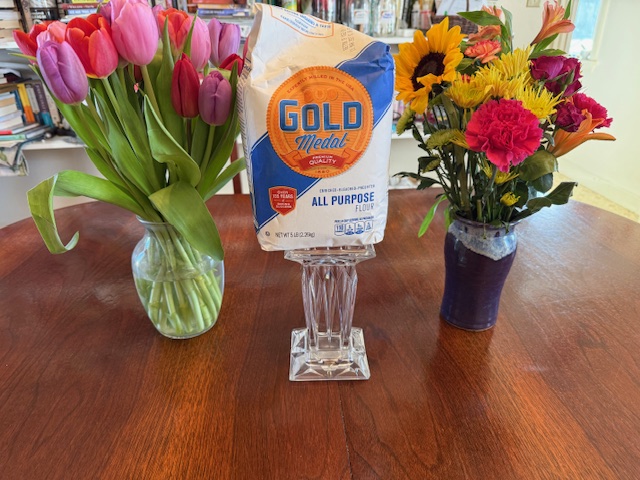
When it comes to quotes, consider the difference between how you buy flowers and how you buy flour. Also, imagine them sitting in a nice vase…
In media writing courses, we talk about quotes being the spice that zips up the story or the sparkly diamond that draws the attention of the reader. However, not all quotes actually do this, because simply slapping quotation marks around a pedestrian set of words doesn’t get the job done.
PR practitioners tend to write press releases that have at least one block quote in them, with some releases being nothing but one giant “statement from X Person” quote. News writers tend to build the bodies of their stories with at least a few paraphrase-quote pairings that are meant to give readers varying views of a topic and a wide array of people a chance to speak. In a lot of cases, those quotes are either relatively pointless or they offer little in the way of quality.
How is it that so many people are proud, happy and thrilled to be there in EVERY PRESS RELEASE, ALL OF THE TIME, even when the writer can craft the quote for the person being quoted? How is it that reporters who get to interview sources also manage to come back with such “meh” quotes from sources who really SHOULD be so proud, happy and thrilled that they can’t shut up about their subject?
Here are the reasons why:
People are afraid to do anything different, lest they offend someone:The phrase, “It is better to remain silent at the risk of being thought a fool, than to talk and remove all doubt of it,” is usually where most people want to be when the chips are down.
To that end, it’s a lot easier to do a bland, mediocre quote than to state something important with your name attached to it. Interview subjects with experience tend to lapse into cliches to avoid really upsetting people, while the press release quotes also tend to play to the middle of boring to avoid controversy.
Writers aren’t as creative as they need to be:One of the things that differentiates PR from news is the concept of quoting sources. If there’s one area where I’ve seen people have the MOST difficulty in making the shift, it’s here.
News requires you to go out, find someone and get something out of their mouth in a word-for-word format. PR in many cases allows for practitioners to write up something on behalf of the client and then just get a “sign off” on it.
Even though you CAN do this, it doesn’t always follow that you SHOULD, primarily for the reason we’re noting here: You don’t know enough about your source, the topic or the non-data stuff to really come up with that whiz-bang quote that will make the difference here.
The same thing can be true of news writers, who don’t put enough time into their research to ask questions that probe or engage the source. If you ask a generic question, you tend to get a generic answer.
Writers aren’t pushing for quality: I can’t tell you how many times I was told to “get a quote” for a story. It was basically like this scene from “The Paper” where Michael Keaton just wants “something:”
I say this as a fellow sinner who often was on the hook for getting a quote, any quote I could from any source, just so that we could say we quoted someone. However, it seems like “get a quote” is a general resting pulse for how we do business.
With those things in mind, here are a few ideas on how to get better stuff:
Don’t shop for flour. Shop for flowers:In the middle of pierogi season at our house, Amy often sends me out for supplies, the most common of which was flour. The direction was simple: “Go to the store and get a bag of flour.” I dutifully comply by driving to the closest place I could and grabbing a five or 10 pound bag off the shelf that resembled the bag she had just emptied.
When I got sent into the field as a journalist, I often felt that was how I was supposed to get quotes. It was like “Go to the store and get a bag of flour.” OK, if that’s all I’m doing, all I care about is going there, picking something off the shelf and coming home.
That’s part of the problem with quotes: You don’t just want something off the shelf.
Instead of shopping for flour, think about shopping for flowers for someone you love. Think about what it is that makes that bouquet special, beautiful and different for them. Think about how you want the reaction to be when they see it. Think about doing more than grabbing whatever is convenient.
Research better beforehand to ask better questions: As we’ve said here repeatedly, the key to everything good we do in journalism is in the preparation. The more work we do at the front end of the process, the better things will be at the back end of the process.
One of the reasons PR quotes are so “meh” is that practitioners don’t dig into the topic or the organization to find things that make it special. When all we have to work off of is a baseline understanding of the concept, which usually comes from a buzzword-laden mission statement, we’re operating in Generic-ville.
The benefit of doing the research before crafting that quote is to make it feel genuine and informed. In adding special touches based on detailed information you found, you not only have a better chance of making your source sound good, but you also have a much better chance of drawing a reporter’s attention.
In the case of reporters and practitioners who rely on interviewing, the research ahead of time can help you shape more pointed and engaging questions that will elicit stronger responses. When you ask that, “So what can you tell me about X?” question, the source will lapse into their “greatest hits album” answer, with all the generic info and cliches. If you can ask something that shows you’ve invested time and energy in the question, you’re likely to get that source to be more engaged.
Change the source’s perspective: Most of the time, the sources we interview either play to us as media practitioners or play to a perceived audience of peers. Those quotes tend to be more jargon laden or otherwise disengaged, and they usually don’t do much for an actual audience that will eventually read their quotes.
Put the source in a different state of mind, based on your full understanding of who you see as the readership. Try asking a question like, “So how would you explain this to a worker on the assembly line?” or “What would you say to a parent in the school district about X?” or even “Could you explain this to me like you are talking to a child?”
In shifting the perspective of the source in terms of understanding the audience, you can get them to shuffle the deck a bit and deal you a better hand. I’m a particular fan of the “child” quote when I’m talking to a source who is clearly exceptionally well-versed on their subject, to the point of assuming everyone else knows as much as they do.
I also like the idea of thinking about who else might be a source in my story to shape the questions. For example, if I’m talking to a product seller, I like to ask them to shift focus to being a product consumer. If they’re a superintendent, I like to get them to shift to think like a parent, a teacher, a custodian or a kid.
In getting them to move, they tend to get out of the rut where cliches live and give me something different.
I hope the computer-based journalism helpers Chris Quinn is putting his faith in work better than the Cleveland Plain Dealer website. I tried to buy a subscription to view his diatribe about journalism schools and AI, only to have a spinning wheel of death show up for about a day or so…
By removing writing from reporters’ workloads, we’ve effectively freed up an extra workday for them each week. They’re spending it on the street — doing in-person interviews, meeting sources for coffee. That’s where real stories emerge, and they’re returning with more ideas than we can handle.
<SNIP>
Journalism programs are decades behind. Many graduating students have unrealistic expectations. They imagine themselves as long-form magazine storytellers, chasing a romanticized version of journalism that largely never existed.
That’s what they’re taught.
DISSECTION TIME, PART I: Let’s look at both Quinn’s arguments as well as take some time to disprove them, starting with his view of students and journalism programs:
The Strawman Student:Quinn’s piece begins with an exemplar of how students suck these days, especially because we teach them poorly at every journalism school in the country:
A college student withdrew from consideration for a reporting role in our newsroom this week because of how we use artificial intelligence.
It reminded me again how college journalism programs are failing to prepare students for the workforce.
I don’t have a reason to doubt Quinn that this kid exists, but I also have no reason to trust him. I’d like to see the withdrawal letter/email/voicemail the kid sent and I’d probably also like to talk to the kid.
See, Chris, sometimes people tell you stuff that isn’t true, like “I really wish I could make it to your party” or “The break up isn’t about you, it’s about me” or “It happens to a lot of guys and it’s not a big deal.”
Maybe this kid didn’t want to work for someone who saw their role in the newsroom as feeding grist into a mill for a robot overlord. Maybe they actually enjoyed writing, so giving up the part of the job they like wasn’t worth it to them. Maybe, and I say this as a huge fan of the sports teams, they didn’t want to move to Cleveland.
Could be a lot of things, but blaming it solely on your AI policy helps you nicely set up your argument that journalism schools suck.
The Incorrect Overgeneralizations:The bigger problem here is the leap from this one kid not liking something to all journalism programs failing all of the kids out there all of the time. Even if we pretend that this one alleged kid was so allegedly horrified at the Plain Dealer’s amazing-as-hell AI set up that they had to pull out immediately, it doesn’t follow that all kids in all schools are taught to hate AI. This is called negative social stereotyping.
Even if that feels like a bit of hyperbole, let’s at least agree that not every kid who comes out of a program is the exact same in terms of quality, maturity and expectations.
Also, I think we can agree that not every journalism program is created equal, so while the kids at University A might be using smudge pots to ward off the evil spirits used to power AI, kids at University B might be getting some good data journalism help, transcription services and other goodies, courtesy of AI.
Then again, maybe we can’t agree, given this generalization:
Like many students we’ve spoken with in the past year, this one had been told repeatedly by professors that AI is bad. We heard the same thing at the National Association of Black Journalists convention in Cleveland in August. Student after student said it.
Chris, did you bother to dig a bit deeper on this, because there are a few nuances that merit consideration. First, who were these professors? Were they in journalism or were they in departments where they’ve gotten used to grading 500-word essays that AI can now crank out in 18 seconds, thus putting the fear of God into these people?
I’m also curious, given your disdain for journalism programs, where did the amazing Hannah Drown and Molly Walsh garner their educational pedigree that mixed the poli sci, business and non-profit knowledge you desperately want kids to have?
Oh… Yeah…
Given their background, I’m wondering how Hannah and Molly feel about this proud declaration you made:
Fortunately for those of us who know exactly what skills we need in applicants, AI has altered the landscape so dramatically that we don’t need journalism school grads.
We don’t need any damned JOURNALISM GRADUATES… Except, of course, the two we hired to do this work that we’re so proud of…
The Erroneous View of J-Schools: I’d like to know how many journalism programs Quinn visited in the past five years. A five-year span would cover the time frame where artificial intelligence would have become relevant enough for schools to start embracing a relatively stable set of AI tools.
I’d put the over/under at about three schools, and I’d advise people to take the under.
There are likely colleges that are shunning AI, but clearly many more are embracing specific aspects of these tools.
Stanford, UCLA, Atlantic International University, Florida and Columbia are just a few of the other schools that have Journalism-based AI courses on the books, and those are just the ones I found on through a cursory search. That’s not even counting all the programs (ours here included) that have infused AI into the current courses we have, so we can demonstrate the value of the tools while we teach caution as well.
(NOTE: If your school or your class does some AI stuff, feel free to pipe up in the comments section. I bet we could really make a run at the record for most comments on the blog.)
What we have here is a collection of facts, supported by links to additional information. I’d like to think that’s a bit stronger case than Chris Quinn’s “Old Man Yells at Cloud” approach to generalizing about what’s wrong with journalism schools today.
The “Road Less Traveled” Advice:Quinn’s ignorant view on J-school is problematically compounded by his educational suggestions for kids who want to enter his glorious newsroom:
If you’re a student considering journalism, I’d skip that degree. Study political science. Learn technology. Understand how government, businesses and nonprofits work. Take communications law and ethics as electives. Skip much of the rest.
Got it. Just like you did back in the day! Right, Chris? Oh… Wait…
I don’t know if he’s going to be on College of Media and Communication Dean David Boardman’s Christmas card list this year, but I’d love to see Boardman’s reaction to this column…
Aside from the “do as I say, not as I did” thing, if I wanted to tank a kid’s future, I’d pretty much tell that kid to do exactly what Quinn is saying here.
Technology changes so rapidly that whatever the kid learned in freshman year would likely be obsolete by graduation. You can learn tools, but it’s important to know the broader ways in which they should be applied to further your skills and connect with your audience. For example, in my day, we didn’t major in Quark XPress. We majored in design, used the tool in conjunction with our broader understanding of the field and then adapted to technology changes.
In addition, there’s a reason the phrase “Why try? Go Poli Sci” is still heard in the halls of many academic institutions. It’s also much more likely to be in the “paper law” as opposed to the “trial law” end of the spectrum. I’m not saying a certificate, minor or even double major in this is field is bad, particularly if you want to take your media skills into the political realm. However, you’re not making it to a newsroom solely on a steady diet of Politics and Genocide or Western European Politics courses.
I’d also like to know where Quinn thinks students are getting their interviewing skills, their social media experience or their general reporting knowledge in this newly formed major he’s promoting here.
Being forced to meet people takes effort, particularly based on how today’s generation of students has grown up in a digital-first, post-pandemic, borderline-anthropophobic world. Research suggests that nearly 45 percent of Gen Z men have never asked someone out on a date in person, so if Quinn is assuming this fresh crop of potential folks can do this without some reporting courses (still a thing) or other forced socialization, I’ve got some unfortunate news for him.
DISSECTION TIME, PART II: With that out of the way, let’s pick apart Quinn’s views on artificial intelligence and the glorious way in which it has drastically improved his newsroom:
AI! It’s FANTASTIC! (Usually): Quinn has gone all-in on AI, which is always dangerous when it comes to a new technology. Actually, it’s usually dangerous in any situation, given that most new ideas suffer a lot of growing pains before they eventually become valuable, but so much less so than what was expected.
Still, he’s a fan:
Artificial intelligence is not bad for newsrooms. It’s the future of them. It already allows us to be faster, more thorough and more comprehensible. It frees time for what matters most: gathering facts and developing stories to serve you.
Anyone entering this field should be immersing themselves in AI.
I’ll buy faster, but I’m not entirely sold on the other descriptors here, given what we’ve seen AI mess up already. Dare I say Quinn is “chasing a romanticized version” of this technological marvel.
Words, Words, Words…:Quinn seems to take an almost perverse level of pride in how much content his staff members can grab and how none of them has to do any actual writing any more:
By removing writing from reporters’ workloads, we’ve effectively freed up an extra workday for them each week. They’re spending it on the street — doing in-person interviews, meeting sources for coffee. That’s where real stories emerge, and they’re returning with more ideas than we can handle.
I get that it’s important to do deeper reporting, spend more time with sources and connect with the communities journalists cover. However, the question becomes, “How much of all that good will and strong effort is wasted if you just toss everything in an AI blender and then watch the content move along like you’re “Laverne and Shirley” at the Shotz Brewery?”
Plus, and maybe Quinn doesn’t give a damn, but I’ve found that when I invest a lot in the reporting, I tend to care about the story I want to tell. That usually leads to some stronger, more engaging pieces based on well-crafted writing.
Being a writer isn’t a negative, particularly if you want to write for the benefit of an audience that is interested in what you have to say. I think I’m qualified to say that, given everything I sit down to write has me thinking, “Who would want to read this and what would they want to know?”
I’m not sure if AI has gotten to that point yet, but I know good writers have.
Quantity over Quality:I forget what movie it was in, but there was a scene in which prisoners were told, “We’ve got good news and bad news. The bad news is that all we have for your dinner tonight is horse manure.” When someone asks, “So what’s the good news?” the official replied, “There’s plenty of it.”
Which brings us back to the Plain Dealer’s Bin of AI Content…
A quick look at the list of stories Hannah Drown put together recently provides some sense of the quantity. Each day she appears to be on the job, a handful or more stories with her byline show up. She’s got coverage of events at the Lorain County Junior Vocational School, a UAW strike in the area, a pop-up shop at the Lorain Community College, a school lockout in Elyria and more. The volume is there.
The quality, however, leaves something to be desired.
These are mostly stories that could have easily come from a press release rewrite, featuring a “Hey, come check out this new thing” approach. These lack depth and nuance, not to mention any level of critical thought. The stories have overly long sentences, generally lack flow and are as dry as a popcorn fart.
For all the bragging Quinn does about reporters getting a chance to sit with sources, meet for coffee and chat these people up, most of the content comes straight from documents, not people. A look through more than a dozen of these pieces revealed virtually no direct quotes or specific references to interviews with these salt-of-the-earth individuals.
For example, a story about a school teacher who donated bone marrow to a complete stranger half a world away would seem to be exactly the kind of piece that would engage readers through amazing storytelling. Instead, we get this lead:
LORAIN, Ohio — Valentine’s Day usually arrives with candy hearts and roses, but this year, one of the clearest acts of love connected to the holiday came without flowers at all.
We get no direct information from the teacher about the experience, nothing from the folks at the National Marrow Donor Program talking about the value of the program and nothing from people who have had their lives saved through some of these selfless acts.
The story has zero quotes in it and reads like a “how-to manual” for getting on the bone marrow registry and donating it to someone. Boring doesn’t begin to cover it.
I’m not entirely sure I can blame Drown for this, as it is her job to just shovel content into the front end of the pipeline. It’s also not stated to what degree AI did any work on this (or any other) piece in her clip file, which I’d consider a bit of an ethical concern.
What I can say is that if my name were on these things, I’d want the writing to be a lot better than it is. As we’ve noted before, AI essentially creates an average of EVERYTHING it takes in, regardless of quality, and this definitely feels like “C” writing.
What goes unsaid in Quinn’s magnum opus is that people now have an abundance of media outlets at their disposal that provide vast sums of content. Journalists have to grab people by the eyeballs and hang onto them in a way that distinguishes their work from the noise.
This is where quality writing and keen storytelling come into play and where the generic “held a meeting” leads that AI can churn out will fail.
(FINAL NOTE: I’m sure Quinn would be horrified at the amount of time I spent writing this piece, given his “crank ‘er out” philosophy. I’m fine with it, though, because I believe dedication to one’s craft matters a lot, even if the point is just to tell someone they’re full of crap.)
One of the first things I tell student media practitioners whenever a major event hits is not to just be part of the noise. If you have something unique to say in a way that matters to your specific audience, do so. If not, you are just as likely to be subtracting from the sum of human knowledge as you are in adding to it.
The death of Alex Pretti on the frozen streets of Minnesota brings out in me so many more thoughts and emotions than I can honestly and fairly express right now, so I’m doing my best to follow the credo I outlined above. Please know it doesn’t mean I am not feeling what so many others have already said, written, shown or expressed.
What comes below are the bits and bites of my thoughts as a journalism professor, former media adviser and citizen of these United States that might be helpful to you in your classrooms and student newsrooms today as you discuss the killing and the coverage:
JOURNALISTS (OF ALL KIND) ARE MY HEROES: They say that journalism is the first draft of history, and the work these folks in Minnesota are doing is absolutely incredible, given the great personal risk people are apparently faced with at this point and time.
The television coverage has been both deep and restrained in terms of saying only what is known, but also not sugarcoating things. That this is so well done is doubly impressive given that it’s happening on a weekend.
When most media outlets hit the “weekend shift,” you end up with a lineup of a recent grad anchoring the desk, providing whatever the regular staff canned up on Friday along with a lite-brite on some Saturday Festival. Add that to an intern holding down the wire desk, some rando doing the weather and an overly excited 14-year-old doing sports, and it’s a recipe for disaster if something really big happens. The networks out there managed to “scramble the bombers” and get everyone doing big work in difficult circumstances and trying times.
On the front lines has been Jana Shortal, an accomplished broadcast journalist with several decades on the job. She not only covered the scene, but then returned to the studio having been pepper-sprayed (or whatever the hell they’re using) while trying to comply with officers’ commands:
(SIDE NOTE: The woman in the middle is Lauren Leamanczyk, who is featured as one of the media pros in the “Dynamics of News Reporting and Writing” textbook. She’s also one of my former students, which is another mind-boggling part of this whole thing for me.)
Above all else, the citizen journalists, who would likely count Pretti as one of their own, put their lives on the line to gather the videos that have showcased exactly what happened during this situations and others like it.
DON’T BE AFRAID TO POKE A SOURCE: Just because a source is saying something, it doesn’t follow that they are making sense or answering a question. Far too often, we fall into the “get a quote” mode when it comes to doing our work, like we’re checking off a chore or picking up a dozen eggs at the grocery store. This is where the concept of active listening comes into play. If you are merely focused on getting the information from the source, and not really listening to that information in real time, you aren’t going to get what your audience needs.
In this case, Bash was respectful and focused. She admitted missteps in her own language while still pushing Bovino to actually answer a question. Literally, any question:
She did make points that a) what Bovino was saying was not what she was seeing, b) she might not have been privy to the same type/volume of evidence Bovino had as a law-enforcement officer and c) she would be willing to accept Bovino’s statements if he could provide proof they were accurate.
This is the essence of journalism: Report, question, verify, disseminate.
CHECK YOUR SOURCES: In listening to the press conferences and press appearances of Bovino and U.S. Secretary of Homeland Security Kristi Noem, it is clear they have a common approach and shared vision of what happened in this shooting. That doesn’t mean they should be quoted with impunity.
In the case of Bovino, his version of ICE and DHS situations has repeatedly been called into question by those who were present at certain events. In one case, a federal judge in a civil suit found that Bovino’s statements related to ICE actions in Chicago were “evasive” and “not credible,” adding Bovino was “outright lying” about his actions. In regard his comments regarding the Pretti situation, Bovino stated the presence of federal officers was related to a “violent, illegal alien” in the area, something that Minnesota’s Department of Corrections has strongly disputed.
Saying a politician has lied is kind of a “Dog Bites Man” story, but in the case of both of these situations, it’s a bit more. If it’s any indication, Minnesota’s Department of Corrections felt these folks were so wrong so often, the DOC launched a website for the “combating of DHS misinformation.”
This is also a perfect point to remind everyone why “said” is my best friend. I don’t know what these two people think, believe or know about this situation, nor would I feel comfortable stating the things they have said as unattributed facts. However, putting out there that Noem or Bovino “said” certain things and letting my audience compare that to their own reality is exactly why I cherish attributions with “said” on them.
DEALING WITH LANGUAGE CHOICES: The way in which people are trying to frame this situation comes down a lot to the language choices we’re seeing out there. This is also why parroting a source (in non-quote format) is a bad idea.
Bovino referred to Pretti as the “suspect” in the situation, a term that implies someone sought for a crime and isn’t usually used to refer to someone shot multiple times on the ground by law enforcement officials. When Bash referred to Pretti as a “victim,” Bovino attempted to invert that term to apply to the border patrol officers, who he deemed “victims” of whatever he thought Pretti was doing.
Language coming out of the administration has included the term “illegal” and “alien” to refer to the individual the officers sought that day, which, again, paints a picture different from terms like “migrants” or “immigrants.”
Whatever terms you choose to use in situations like this, you’re going to be shaping how people look at a situation, so you want to both follow AP style when applicable and also make sure you are remaining neutral
Beyond that, you want to make sure your terms are correct. For example, I’ve read stories that refer to the federal law enforcement officers as “ICE” and “Border Patrol.” Officers in these groups are both housed under the U.S. Department of Homeland Security, but the terms that describe them are not interchangeable. A good primer on who does what and how they differ can be found here.
A number of opinion pieces, social media posts and so forth have referred to the shooting death of Pretti with a variety of terms, including “assassination,” “execution” and “murder.” Each of these terms is defined specifically, both in law and in journalistic style, so no matter how you feel about what happened, you need to take care in using these terms.
Here’s AP’s version of what’s what:
If we consider AP style our rule book, we need to follow the rules, even when we don’t like them.
Finally with language, there is something to be said about how people say things so that something can be factually accurate while also being deliberately misleading. Here’s an example of a statement from Noem’s press conference:
“An individual approached U.S. Border Patrol officers with a 9mm semi-automatic handgun.”
There are two facts in that sentence that are accurate, at least to a reasonable degree:
Pretti, the “individual,” approached a scene with U.S. Border Patrol officers at it.
Pretti was armed with a 9mm semi-automatic handgun.
However, putting them together in this way could lead a reasonable person to think that Pretti approached a group of officers with his gun present in a way that threatened the officers. Noem later used the term “brandished” the gun, although every attempt to get Bovino to provide proof of such a thing led to a dead end.
The point here is why we don’t a) take things people say at face value without proving them for ourselves and b) don’t extrapolate beyond what people tell us. I often tell students that if a police officer says something like “alcohol was believed to be a factor in the crash” or “the driver was operating while under the influence,” you don’t want to say the person was a “drunk driver” as those are two different things. The driver might not have been legally drunk or the driver might have been baked out of their mind on weed.
NOBODY KNOWS NOTHING: I keep going back to that saying because I remember how reporting on crimes and disasters was always a random lottery of “will I have to write a correction tomorrow?” moments. As much effort as journalists put into getting things right, nobody really has any idea of what we will find out as this continues to unfold. It also doesn’t help now that anyone with a phone and an internet connection can say anything they want with absolute certainty, regardless of its veracity, and we all get to hear it.
“Nobody knows nothing” has always been true, as new witnesses could emerge, more video could show up, interviews with the agents have yet to be completed and more. Hell, we’re still trying to figure out if Babe Ruth really called his shot in the World Series almost 100 years later, so I have no doubt that things are going to evolve here.
I also have no doubt that various groups involved in any situation have their own motives for releasing or withholding information from the public. To that end, a lot of what we learn will be based less on the totality of information, but rather the totality of AVAILABLE information.
This is why we need reporters, not stenographers, in the media today. Good journalists will always find a way to pry loose a fact, debunk a statement filled with “bovine excrement” or get a source to finally explain what’s what. When they do, we all tend to be better for it.
When Sage had me start this blog eight years ago to promote my reporting book, I did so under two strict conditions:
I had total control over the content. They couldn’t demand, require or censor anything I decided to post here.
This was not going to be a “rah-rah site” that just pimped out my books or blindly praised the company that published them.
With those two things in mind, I decided to dedicate the 1000th post of this blog to the company that changed my life 12 years ago and that has my loyalty for as long as they’re willing to have it. Please consider this an honest, heart-felt endorsement.
My bookshelf the day I got my very first copy of my very first book for Sage. At the time, I couldn’t believe I had three titles with my name on them, and one with my name only on it.
I can still see the strange confluence of events that happened at an AEJMC convention in Washington, D.C. that really altered the trajectory of my life and led me down a path that has made me ridiculously happy as a teacher, a writer and a colleague.
I was a few years into what seemed to be a terrible professional decision to come home to Wisconsin and teach at the University of Wisconsin Oshkosh. I had given up a job where people loved me, I had a sparse teaching load and I advised one of the best college newspapers in the country for a position that required me to give up rank, take a pay cut and work with at least one “colleague” who had publicly expressed disdain for my hiring.
(Another colleague told me that in the meeting where my hiring was announce, at a pay level that was a 25 percent cut from where I was coming, mind you, this individual stated, “For that kind of money, we could have gotten someone good.” Eeesh.)
The biggest problem I was facing was teaching basic media writing to students across a wide array of disciplines, including advertising, public relations, print-style news, broadcast, interactive web management and more. My background in news was seen as a bias and the books I could offer as texts basically crapped all over everything that wasn’t a newspaper reporting job. Thus, I set out to find a text that would make for a more equitable discussion of media while still imbuing students with the core elements of media writing that most news-writing texts professed.
Matt Byrnie, who was an acquisitions editor staffing the Sage booth at AEJ that year, asked me to sketch out a concept for a book like the one I needed and then meet with him later in the conference. Despite having my name on two books already at that point in time, I had no idea what to do here. That said, in the middle of an interminable panel session, I found a bit of hotel stationary and started scratching out a few concepts. The idea wasn’t necessarily WHAT needed to be taught, but rather HOW to approach this concept.
The rough sketch of what I pitched to Matt Byrnie still hangs in front of me every day in the office. It reminds me of what I promised I’d do and how important it felt to do it well at that point.
After our meeting, Matt seemed enthused, but I’d been there before with people in publishing: At first they’re all excited and then they ghost you like you owe them money. Still, I reached out to Matt and pitched the book. He not only agreed to do this one, but he also had me pitch a second book at that point as well.
He hung in there with me as I fumbled about the process of meeting the needs of his production team while I tried to stick as close as I could to the “rules of the road” I built on that bit of scratch paper. He was enthusiastic and supportive, kind and decent. He made me feel like what I was doing mattered, not just because it could sell X units for a corporate overlord, but because he thought it could add value to the field.
If it had all started and stopped with Matt showing faith in me, I would be fine with Sage, but not nearly as loyal as I am. Shortly before “Dynamics of Media Writing” launched, Matt reached out to me and told me he had been promoted and that my book would now be in the hands of some Terri person I’d never met. I lost my mind, thinking, “Here we go again. I’m totally screwed.”
Instead, Terri turned out to be every bit the partner Matt was. So was the person who followed her when she left the field, and so was the next person after that person got promoted. And on and on it went. Each editor I worked with from Janae to Lily to Anna to Charles and more gave me the sense that I was the most important thing in the world at that moment and that they’d do anything to help me get where I thought my work should go.
They encouraged me to try new things like the blog, guesting on podcasts, doing videos and more. They also provided financial support to keep the lights on at the blog, professional support to make sure the podcasts didn’t sound stupid and strong editors to make my videos look a lot less like a guy filming a hostage video in Saw’s kill room.
The person who bought the shirts for her team was Staci Wittek, probably the best person I’ve ever had the privilege of working with at any level, anywhere. Staci’s official title is Senior Product Specialist, Communication and Media Studies at SAGE Publications, but that doesn’t come close to what she has done for me (and I’m sure many others) who have books under her watchful marketing eye.
She’s had me do videos for her reps to explain the book, reach out to potential leads on behalf of reps, build additional resources for people who need them and more. She’s also so willing to do pretty much any ridiculous promotional idea that comes rolling out of the junk drawer that is my brain.
Without Staci, none of my books would have succeeded because she put so much work, energy and faith into what I’ve built. She’s the difference-maker, like Michael Jordan was with the Bulls.
The reps for Sage stop by my office for a chat every time they’re on campus. It’s always, “What can I do for you, Vince?” not “Here’s how you need to help me sell your stuff.” We laugh about various things, share stories and get to know each other. It really does have that family vibe, a rarity in a day and age where corporate culture and survival of the fittest seem to rule the roost.
Every time I part company with someone from Sage, I always say the same thing: “Thanks for everything, and if you ever need anything, just tell me what it is and you’ll get it.” It’s the same thing I say to my students, my colleagues and everyone else who matters to me in life.
And by the way, here’s that same bookshelf, 10 years later…
The books in Chinese and Arabic are two translations of one of my textbooks. You have to take my word for it, as I had to take someone else’s word for it. If you read either language, and it turns out they’re actually “Mein Kampf” or something, please tell me so I can fix this…
Thanks for everything, Sage folks. I look forward to the next great adventure.
While driving home from Milwaukee this weekend, I could see a haze of smoke in the distance that just kept getting bigger the closer I got to the house. I first spotted it about 20 miles south of where I exit I-41 and about 30 miles to the east of the farm.
Smoke like this isn’t rare out by us, as farmers and land owners will often burn brush piles the size of a Winnebago, but this seemed like it might be something more than an average Sunday burn after the Packers game.
When I pulled up to the intersection about three-tenths of a mile from my house, the road was blocked with barricades and squad cars. I managed to weasel my way past the blockade and pull into my drive way, all along wondering, “What in the hell is going on out here?”
A quick check on social media filled me in a bit:
On Facebook and Instagram (at least), a number of people were posting bits of information about what they saw or what they heard:
Even after reading all of the posts I could get my hands on and scouring the local media for more than what the local EMS folks put out, I found myself thinking about the pros and cons of how we get information these days. According to a 2025 study by the Reuters Institute, 54% of Americans get their news from social media today, pushing it past all forms of traditional legacy media. The discussion of partisanship, limited focus and the waning of traditional media power on the national or global level are assessed in this thing, which is great for the big picture.
That said, most of the time, we are likely more concerned with what’s going on around us, which falls to a lot of local media outlets or people around you with internet access. With that in mind, here are a few ways in which that can be a good thing or a bad thing on the local level like what I was dealing with Sunday:
THE PROS:
TONS OF INFORMATION: To be fair to the local social media folks, I got far more, volumewise, out of their work than I ever would have received from TV, radio or a newspaper. The videos, the photos and even the mapping gave me a lot to consume:
I also heard from people who were actively being evacuated from their homes in real time:
These are just a few screen shots of the hundreds of messages that were being shared at this time. Granted, a lot of stuff was repetitive, but I could pick up little nuggets here and there with a careful read of these forums.
CONTINUAL COVERAGE: The local media did the quick check in, put out some information and moved on. The local folks were a lot more interested in keeping an eye on things. At one point, a news outlet noted that everything was under control, but the social media folks (and my own eyeballs) pushed back on that. It seemed as though the wind (which we get a lot of out in our area) had stoked some of the fire in a part of the marsh that wasn’t fully extinguished, and things kicked up again.
By relying on the info from the fire folks, neighborly chatter and nosy folks like me who were willing to ask a cop at a cross street a thing or two, we all kept up to date on how risky things were and what was really going on. Those bits of info were continuing to be posted and shared on social media, as were some updates on when Highway 21 reopened, if the fire had moved any farther south and if additional fire folks were being called to the scene.
When I was a reporter, I found that I did a lot of “hit-and-run” journalism, in that I saw the disaster, wrote about the disaster and moved on from the disaster in a relatively short period of time. That’s kind of the nature of trying to cover everything in a large geographic area. These folks were more concerned about a specific disaster in a specific area and they could dedicate more resources to keeping people up to date.
MINOR NEWS FOR MOST, MAJOR CONCERNS FOR SOME: Social media has the ability to help niche audiences in the ways that traditional media never could. In the case of this fire, that came to the forefront in a few key ways.
For starters, as a lot of people were being driven from their homes and farms, some folks had concerns related to what to do with their pets. A local business up the road from us posted on this topic to help people who were in need:
Other folks felt it important to recognize the people doing the work to keep their homes safe:
These and a lot of other somewhat tangential issues were addressed on the social media platforms that were providing coverage on the fire. From a news-outlet perspective, a lot of these would be somewhat minor concerns, as they don’t impact the entirety of the circulation area or media market. However, to the people who were in the middle of all of this, keeping animals safe and finding ways to help each other in a time of crisis was the No. 1 priority.
This is really where social media, with its niche-level connections, really shines.
CONS:
SAYS WHO? One of the things I’ve found myself scrawling on news stories a lot these days is, “Says who?” My students know that this means they failed to attribute important content that is not a “water is wet” kind of fact to a particular source.
In this case, I found that some issues really didn’t matter to me in terms of who was posting. The videos and photos were relatively similar, so I was pretty sure that they all weren’t the work of AI trying to blame some political policy for a wildfire. In addition, I could triangulate some issues, using multiple platforms to get a handle on the situation.
For example, I knew where Highway 21 was closed by me, I had a couple maps from social media that represented where the fire had spread and I used my map app to look for specific areas where traffic was either light, heavy or prohibited.
However, when I saw this post, I found myself really wondering about source credibility:
My concerns on resharing this on social media (with the guy’s name attached) or believing what he had to say were as follows:
He’s essentially stating on social media that he started this fire. I don’t know if what he did was criminal, in that it sounds like an accidental ignition, but there might be rules about using ATVs in that area or during certain time periods. In making this public, he could not only open himself up to some legal issues, but also let some potentially irate folks know who he is, thus leading to some possible online harassment or worse.
I have no way of knowing if he is telling the truth. In journalism, we tell you that, “If your mother says she loves you, go check it out.” I did some minor sleuthing on this guy’s social media and didn’t find any terrible red flags that he was a bot or a troll, but that’s conjecture, not facts. Given my experiences with people who liked to insert themselves into dramatic police events, I’m erring on the side of caution. (One day, I’m going to write a post about “Whacko Wayne,” but until, then you can feel free to trust me as much as you normally do…)
I have no way of knowing if this guy is who he says he is. This might be someone using this guy’s account to make a statement or it might be some troll deciding it would be hilarious to mess with people. As we found out during the Las Vegas shooting, some people are completely fine using a tragedy for “the likes.”
There are a dozen other things I am paranoid about here, as I am someone who was held to account for what appeared under my byline. In the case of social media, this kind of paranoia is unlikely to exist.
Which brings us to another big concern…
UNTRAINED, UNREADY AND UNAFRAID: The concept of the Dunning-Krueger Effect has become exceptionally popular in the past decade or so. The broader theoretical and sociological aspects of it are often beyond what most of us consider discussion-worthy, but the long and short of it is that people who have a little experience in an issue are irrationally overconfident in what they are doing:
It took me a lot of time and a lot of disasters to become good at covering things like this fire, and even now, I’m not entirely sure I have it nailed down perfectly. That said, the people on social media have access to the same kinds of broad-based communication tools as I would have back in the day, and are completely untrained as to what kinds of things they can/can’t or should/shouldn’t say for legal, professional or ethical reasons.
They’re also completely fine in sharing information without thinking twice about those things, because they were never trained in the way we train media students, who then become media professionals. For example, I don’t know if the guy who said he started the fire actually did it, nor do I know how much consideration he gave to “outing” himself. However, a media professional with experience in this area would have considered those things and had discussions with other professionals before putting that information into the public sphere.
Beyond this issue, I find a lot of accusations on social media that have me breaking out into hives, not because of the accused’s alleged actions, but because of the legal hell-scape that can befall the accuser if things aren’t dead-on accurate. I keep hearing Cliff Behnke’s voice in my head as I see this stuff and imagine what he’d do to me if I just kind of spit-balled things like these people seem to be doing in some cases.
If you don’t know what the risks are when you do something, you tend to be unafraid of those risks. That doesn’t mean those risks aren’t real and can’t hurt you. That’s why we train students to be aware and prepared for these things.
In the end, I’m sure I missed a few more negatives and positives, but the bigger issue is that this kind of approach to locally newsworthy events is likely to continue to slide more toward the social media end and away from the legacy media. I’m not sure what can be done to prepare folks for this or to help them stay out of trouble, but I’d love to hear your thoughts on this.
The Washington football franchise seems to have the worst luck with the worst injuries for its best quarterbacks. On Sunday night, Jayden Daniels became the latest casualty in the “gruesome” category when a Seahawk defender fell on his left arm and bent it back about 90 degrees the wrong way.
It was clear he was in significant pain at first, but it was unclear why, as it seemed to me that it might be a leg injury, given how he fell and how his lower body was posed. Only after a replay did the arm issue become apparent, with an official report calling it a dislocated elbow.
However, that wasn’t the only replay we saw. It seemed like they kept playing it over and over, to the point I woke up the dog when I instinctively screamed, “For the love of God! STOP SHOWING THIS!”
This brought me back to thinking about another similar injury and a post about the ethics of showing stuff like this on TV. However, I’m wondering about the relevance of this kind of discussion these days.
As I’ve frequently told my students, not everyone in the media game plays by the same basic set of rules anymore. The democratization of content collection and dissemination has really changed the way in which we deal with things like this as professionals and as viewers.
(I remember using a textbook that showed two photos of Dwyer that we were to debate using for a newspaper’s front page: One with Dwyer holding the gun in both hands, the other with the barrel of the revolver in his mouth. That still messes with me…)
Flash forward almost 40 years and the moment Charlie Kirk was killed, dozens of videos popped up with the entirety of his final moments. Some people added slow motion, while others did zooms. Some even had some sort of sound track of sorts on there. I’m not linking to any of them, but I’m sure you can find them if you want.
That might be the bigger concern: Even as some came down, more went up. The reason was both the cash-grabbing click-baiting end of the deal, along with the basic prurient interests that many people apparently had for seeing a man literally die in front of us.
Thus, the chicken-or-the-egg thing: Is it that we now have more access to more content that allows us to see things, so we go see them? Or is it that we always wanted to see these things and we now have people who are more capable of providing them?
In either case, this throwback post might help spark a discussion or two about how we handle things as professional media folk and what that might mean going forward.
Breaking Dak: The ethics of broadcasting injuries in sports
TRIGGER WARNING: There are some graphic videos here of traumatic injuries. Watch at your own discretion. -VFF
Prescott was scrambling for a first down when his body went one way and a sizeable portion of his lower leg went the other way.
(Here is the video if you want to see it. If you don’t want to watch this, I don’t blame you. My wife, Amy, a nurse who loves to talk about brain surgery over dinner and is an avid watcher of “Doctor Pimple Popper,” was really disturbed when she saw this.)
Tony Romo, who was in the booth doing color commentary for CBS, immediately realized something was horrible, proclaiming, “Oh no… Oh NO!” As a former QB, Romo has been on the turf for Dallas a few times with severe injuries. However, he seemed to almost want to magically wish this one away by saying, “You almost gotta hope it’s a cramp right there…” After about three replays, he knew that wasn’t the case.
As fascinating as this was, much like other things that are odd, chaotic and disturbing, I found myself watching it a few times and yet hating that I could see what had happened.
When it comes to gruesome sports injuries, the question for journalists is, “What is enough coverage?” The answer seems to vary from situation to situation and announcer to announcer.
As blood began hitting the ice, the announcers immediately implored the camera operator to stop showing the injury. Malarchuk actually skated off the ice after he received assistance from Pizzutelli and that was the only other shot of him. No replays, no slow-motion blood gushing. After that, the camera stayed in a distance shot of the ice until everything was cleaned up and play was ready to resume.
I remember watching this game on TV and the announcers kept showing it over and over and over again, going in slow motion to show each frame worth of knee distortion. Each time they did it, it was accompanied by an announcer saying, “Oh… You hate to see that” or “You might not want to watch this…” And yet, they kept showing it.
Perhaps the most famous Monday Night Football injury involved Washington Football quarterback Joe Theismann, who saw his career end on the field. Linebacker Lawrence Taylor, who made a career out of having no regard for his own body or that of quarterbacks, snapped Theismann’s leg in half. Immediately, Taylor popped up and started waving for the trainer as he held his head in his hands in disbelief.
As the officials tried to figure out what to do about this mangled man, ABC kept looking for the best possible angle to figure out what had happened, finally finding a reverse angle that will never leave your head if you see it once. To its credit, once ABC got there, the station didn’t show it again.
So, the question remains, “How much is too much?”
There might be an official code that outlines this, but I’m having difficulty finding one. Thus, what you see below is kind of a patchwork of various codes that could provide some guidance:
Journalism provides enormous benefits to self-governing societies. In the process,it can create inconvenience, discomfort and even distress. Minimizing harm, particularly to vulnerable individuals, should be a consideration in every editorial and ethical decision.
The Football Writers Association of America, which deals more with college sports coverage, lists of elements within its code of ethics to deal with issues happening on the field. Under “Minimize Harm,” it notes the following elements:
Show compassion for those who may be affected adversely by news coverage. Use special sensitivity with children or inexperienced sources or subjects.
Be sensitive when seeking or using photographs of those affected by tragedy or grief.
Recognize that gathering and reporting information may cause harm or discomfort. Pursuit of the news is not a license for arrogance.
(For reasons past my understanding, I can’t find the code of ethics for the pro version of these folks. Maybe it’s buried in the “members only” section.)
In contrast, the Society of Professional Journalists, digs into the ethics of the field at length in its code. Along with the minimize harm stuff that was in the other codes, here was an interesting add:
Obviously “pandering” and “lurid” are in the eye of the beholder, but it does provide the “If your friends all jumped off a bridge, would you?” line of logic on this one.I always go back to the line I remember hearing at the State Journal, where we employed “The Breakfast Test.” If someone were picking up our paper and reading it over breakfast, would the images (or in some cases EXTREMELY vivid writing) make that person puke in their Cheerios?
And, yet, again, this is variable in a lot of ways. Papers up by us have no problem running photos of people who have “cleaned” deer and pose next to the gutted, skinned carcasses hanging from trees. The hunting community is used to that. For a lot of other folks, that’s going to be a breakfast showstopper.
In any case, the unfortunate answer to the question, “How much is too much?” when it comes this kind of coverage is like most ethical or “taste” situations: It depends.
The audience you serve, the expectations they have, the previous things you’ve shown them with or without problem and more come into this. However, even if you don’t have a concrete answer, it helps to discuss this to find ways to understand what to do when you find yourself in a situation like this. The more you can gain collective knowledge in advance, the better prepared you will be to make your choice.
On this date in 1960, the Pittsburgh Pirates defeated the New York Yankees in Game 7 of the World Series on Bill Mazeroski’s ninth-inning walk-off home run.
To fully understand the gravity of the moment for many people living in that time, it’s instructive to listen to sports journalist Beano Cook’s assessment of the situation:
“If you grew up in Pittsburgh, the way I did, you remember where you were when heard F.D.R. died, when you heard about Pearl Harbor, when you heard the war ended and where you were when Mazeroski hit the homer.”
I’m sure not every human being on Earth had that kind of reaction to it, especially Yankees fans who considered World Series domination to be their birthright, but it does speak to the larger sense of how we once had a sense of shared moments in time.
During my life time, there have been a few of those “where were you” moments that stick in my head to this day. I remember being on the floor of my parents’ living room on that yellow shag carpeting in front of the old Admiral-brand TV we had when the Miracle on Ice occurred.
I remember being in the Doctoral Pit in Columbia, Missouri with several other former journos-turned-Ph.D.-students huddled around an old tube-style TV as we watched the towers collapse on Sept. 11, 2001. (I also remember having to go to a multi-variate statistics class, taught by an international grad student who had no idea what was going on. To this day, I still can’t figure out binomials.)
In today’s era of quick-hit social media, in which algorithms feed us more of what we want to see and isolate us from a wide array of viewpoints, I don’t know if shared cultural moments are possible for this generation, but the litmus test might be the shooting death of Charlie Kirk.
As much as it seems like EVERYONE around me has an opinion on Kirk, his death and everything that’s wrong with the world today that led to it, I am still running into students who know nothing about any of this.
And I’m teaching in a media-based field where knowing what’s going on around you is kind of important.
Rather than going down the rabbit hole of whose values are better or what people don’t see thanks to self-feeding loops of social media destruction, I think it’s more important to realize that horse is out of the barn. What matters now is how we deal with it as journalists, give that most of our job is providing content to people in a way that’s relevant, useful and interesting to them.
Here are a few things to realize about the people out there consuming our content and how we need to serve it up differently for them:
NEVER ASSUME THEY KNOW ANYTHING: This seems a bit blunt and harsh, but we don’t all see the same news at 10 p.m. or read the same newspaper on the train ride into the city anymore. Just because people exist on X, Facebook, SnapChat, TikTok or Chorp, it doesn’t follow that they know anything we’re trying to talk about either.
Everything is individualized, so while my feed might be filled with calm, rational discussions about social policies in higher ed, the person right next to me might be learning that Bad Bunny’s Super Bowl appearance is part of a plot to explode the brains of ICE agents with a sound ray that will also turn undocumented migrants trans.
What this essentially means is that we have to start from a position of less than zero to explain situations to our readers if we want them to get anything out of anything we are trying to tell them.
I used to tell students that 1-4 sentences of background was usually enough to catch people up on topics of interest. As much as that number might need to increase exponentially, it also needs to be counterbalanced against the minuscule attention span people have, so it’s going to be a fine line to walk.
This leads to the second point…
WRITE IT LIKE YOU’D WANT TO READ IT: The goal of most standard media writing is to get to the point immediately. The problem is that most people don’t write for others the way they want content sent to them in the realm of social media. That creates a massive disconnect we need to fix.
I did a study a few years back involving student journalists who were responsible for running social media for the media outlet. I asked them to rate a bunch of uses and gratifications they have for social media they received. In other words, what do you like that you get and how you get it from social media? I then asked them to outline the approach they took to sending social media to other people as a source from their media outlet.
The results? Almost zero overlap between what they considered “best practices” for social media they consume and the way they themselves provide it to other people. In most cases, they liked writing really long and involved stuff but they hated reading it. They also liked things to be quick and direct, but felt it necessary to avoid being that direct in their own work.
This kind of media consumption limits our ability to do the more strenuous mental work that non-social-media use requires. It also impacts our ability to create memories, so writing giant diatribes with six interweaving plot lines isn’t going to help the readers in any meaningful way. So, if we want to get across to the people, we need to build it in a way they’ll best understand it.
SELF-INTEREST IS OUR ONLY SALVATION: If we have but one thing in common anymore, it is literally the interest we have in why something matters to us personally. If that’s all we have to go on, we’re going to need to saddle up that horse and ride it to death.
To be fair, some larger moments over the past 20 years only stick in my brain because I had a personal connection to them. The 2007 shooting at Virginia Tech mattered a great deal to me because I knew the media advisers at that papers and I had spoken to some student journalists from there at one point. I remember refreshing my email every 0.5 seconds, hoping for a response from a friend to tell me she was OK.
The Las Vegas shooting fell into a similar vein, in that my aunt and uncle were in Vegas at that point. I remember trying to teach a class and keeping an eye on text messages from my mom to tell me if my family members were safe.
And again, I’m PAID to be aware of larger issues that get a ton of media coverage, so if I’m falling down on this, I can’t imagine what it’s like to people who are learning nothing other than what TikTok feeds them.
At one place I worked, we used to require the students to finish the sentence “This matters because…” before they were allowed to start writing their stories. Bringing something like this back for all media writers, with a more direct version like “This matters to YOU, my reader, because…” might help us better focus our attention on the “how” and “why” elements of what we’re covering as we target the demographic, psychographic and geographic needs of our specific audience members.
We often have to remind students that they’re not writing for themselves, but rather the audience. Now, we might not only need to double down on that, but also make sure they have a full sense of who is out there and and a laser-like focus on making it relevant to them.
One of my favorite stories about source credibility came from Jim Bouton’s classic book, “Ball Four.”
Bouton is explaining a situation where a first baseman is coming in to catch a pop fly, yelling “I GOT IT!” repeatedly. Instead of getting out of the way, the pitcher comes flying in and runs the guy over, which lets the ball drop and the batter reach safely.
Bouton then yells to the irate first baseman from the dugout, “(The pitcher) had to consider the source!”
The point, obviously, is that the value of a message is almost directly in proportion to the quality of the source. This is something we need to keep in mind when picking out our subjects for interviews.
Here are four simple things to consider when deciding whom you should interview when you are picking sources for a story:
DOES THIS SOURCE ACTUALLY KNOW ANYTHING?: This might seem like the dumbest start to a post like this, but if the sources in “localization” and “reaction” stories are any indication, this bears consideration. These kinds of stories are among the least popular ones for reporters who absolutely hate having to interact with an increasingly ignorant general population.
It also doesn’t help that we tend to find ourselves asking these people to give us their innermost thoughts on everything from the deployment of U.S. troops on U.S. soil to the decreasing size and quality of funnel cakes at county fairs. The “just do this and get it over with” attitude can really take over.
This can get even worse as we get lazier and do the “Let’s see what the 14 loudest idiots on social media had to say about this topic” and just do screen shots of their Twitter posts before we call it a day.
That said, it’s important to push back on this instinct and really try to figure out if the source actually can add something to the sum of human knowledge. You don’t need to give them a 20-question exam to see if they have an expansive knowledge of presidential powers vis a vis the Posse Comitatus Act, but at the very least see if they ate a funnel cake before letting them complain about it.
KNOW WHY YOU ARE PICKING A SOURCE: Journalism is often learned by sharing among the collective knowledge within an organization. That can be good in some cases, as older reporters can help younger ones learn from the mistakes of yesteryear. In other cases, it’s bad because you find yourself with a narrowing perspective on how things should work.
This is often true when it comes to picking subjects to interview. When I didn’t know who would help me by providing important information and quotes, I’d often ask the folks around me, “Who’s a good source for this?” The names I got back became the sources and then they became part of my stories. The problem with this is that I never once thought about WHY this person was a good source.
Often the “best” sources were the ones most willing to talk, the easiest to reach or who generally “played ball” with the newspaper. These folks often liked seeing their names in the paper and they made it simple for us to get our job done. It was a symbiotic relationship, but maybe not a good one. In retrospect, I often wonder if I was just taking the path of least resistance and not helping my readers as much as I should have.
When picking a source, ask yourself why that source is a good pick. If someone suggests a source, ask that person why the source is good in that person’s mind. If the source meets your needs and avoids problematic concerns, you should be in good shape. If the answer is, “They always get back to us right away,” think a bit more about that choice.
AVOID “POTSHOT PAULIES” IN YOUR WORK: You need to think about if the source is actually giving you anything other than a self-serving chunk of content that doesn’t really do much for you or your readers. Instead, they decide to take a potshot at a topic of their choosing and you let them get away with it.
I pulled this quote a long time ago during an election cycle and it seems to be emblematic of what I’ve seen in so many political stories:
So, in other words, the person didn’t really answer a question, didn’t give you any real information and you decided the best way to deal with that was to give them the opportunity to use you as a megaphone for their own point of view on a random topic of their choice?
I wish I could get away with that stuff in my job:
Filak refused to comment on the allegations he was selling grades for money, but instead leveled a criticism of his choosing.
“People are worried that the McRib won’t be available all year round,” he said. “This is disastrous for all people on planet Earth and this is where the focus of all humankind should be right now, dammit!”
If the person isn’t giving you anything of value to your readers, don’t give them a chance to use you to do whatever they want.
ARE THEY ALL SIZZLE, NO STEAK?: We often talk about people who are “good quotes” with the idea that they’re verbose and they usually give us more than the boring cliches that seem to populate most content. We like the turns of phrases they made and the way in which they approach the content.
We had a chancellor one year who was just gifted at weaving prose together into a tapestry of verbiage that would make Aristotle and Shakespeare look like Beavis and Butthead in terms of communication. However, when we would actually look at what was said, we realized there was absolutely no information in the quotes themselves. They sounded great at the time and they had big, important-sounding words in them, but at the end of the day, it was just a whole lotta nothing.
Part of that is our fault for not actively listening and holding people to account for their words. Another part is that we keep going to the same people and expecting different results. If the quotes aren’t doing more than looking fancy and yet signifying nothing, consider another source.
When this post originally ran, the comments went one of two ways:
Thank you for this, because every student I have thinks they should write like this and I’ve yet to be able to disabuse them of this notion.
Your criticism lacks merit because your standards make it impossible to write a magazine-style feature. If you had your way, everything would just be paraphrase-quote, paraphrase-quote with a news lead on top.
The first view is fine, but I’d argue a great deal with the second one. There are plenty of amazing profiles, features and longer pieces that are fantastic reads without devolving into the self-important mess that is discussed below.
(I’ve got others if you think I just like this one because of the sports angle, including one on a fallen city council member, a photo editor who makes ugly people stunning and beautiful people perfect and a reality TV star who is trapped in a tabloid spiral of her own making.)
Since it’s been a couple years, I wanted to bring this back to see if the mood in the field has changed about it, my critique or what profiles should be in the age of AI. Let me know what you think in the comments below:
A Lack of Flo: A look at what can go wrong with an over-the-top approach to profile writing
Read the following opening to a story and see if you can identify what it will be about without relying on an internet search:
One needn’t eat Tostitos Hint of Lime Flavored Triangles to survive; advertising’s object is to muddle this truth. Of course, Hint of Lime Flavored Triangles have the advantage of being food, which humans do need to survive. Many commodities necessitated by modern life lack this selling point. Insurance, for example, is not only inedible but intangible. It is a resource that customers hope never to need, a product that functions somewhat like a tax on fear. The average person cannot identify which qualities, if any, distinguish one company’s insurance from another’s. For these reasons and more, selling insurance is tricksy business.
Once you give up, or cheat, click this link and prepare to be amazed.
Aside from the headline that mentions the topic, it takes more than 270 words (or approximately double what you’ve read to this point) to get a mention of Flo, the insurance lady for Progressive, and her alter ego, Stephanie Courtney.
In chatting online with several journalists and journalism instructors, I found a variety of opinions on the piece and the style of the writer, Caity Weaver. Terms like “quirky” and “brilliant” came up, along with others such as “obnoxious” and “painful.” To give the writer and the piece the benefit of the doubt, I waded through this 4,600-word tome twice. In the end, I ended up agreeing with the second set of descriptors, but also found myself considering terms others hadn’t, such as “well-reported” and “solidly sourced.”
I learned a lot about Courtney/Flo in the piece and it really did a lot of things that good profiles should do: Inform and engage; provide depth and context; rely on various sources. It also did some of the traditionally bad things we’ve discussed here before: rely on first person; get too into the weeds on certain things; write for yourself, not your audience.
However, here are a couple areas in which this profile reached new heights/depths of god-awfulness that had me reaffirming my general hatred in this “self-important-author” genre:
OBSERVATION GONE WEIRD: One of the crucial things we talk about in profile writing is the element of observation, with the goal of painting word pictures in minds of the readers. In this regard, details matter, although I wondered about this level of detailed analysis:
Since appearing in the first Flo spot in January 2008, Courtney has never been absent from American TV, rematerializing incessantly in the same sugar-white apron and hoar-frost-white polo shirt and cocaine-white trousers that constitute the character’s unvarying wardrobe.
I am the first to admit that I’m not a clothes horse and that I have trouble telling black from blue. That said, I’d love to know how the author manages to distinguish “sugar-white” from “hoar-frost-white” from “cocaine-white” when describing Flo’s outfit. (My best guesses include that she was paid by the compound modifier or had massively consumed one of those elements before writing this monstrosity.)
Then there was this exchange about a purse that wasn’t:
Her purse immediately caught my eye: It appeared to be an emerald green handbag version of the $388 “bubble clutch” made by Cult Gaia, the trendy label whose fanciful purses double as objets d’art. Courtney handed it to me while rattling off tips for extending the shelf life of fresh eggs. It was a plastic carrying case for eggs, it turned out — eggs she had brought me from her six backyard hens. “Did you think it was a purse?” she asked merrily.
I’m trying to figure out what this was trying to tell me. My best guesses are:
The writer wanted to weave in a product placement of some kind, in hopes of getting influencer swag.
The writer sucks at fashion spotting as much as I do, in that she mistook an egg container for a $400 handbag.
The author clearly has the ability to observe and describe, but tends to use it in some of the strangest circumstances and for some completely unhelpful reasons. Like every other tool in your toolbox, if you’re going to use it, do it for a good reason (read: in some way that helps your readers).
FORCING A THREAD: The use of a narrative thread is something that can be extremely effective when it’s done well and done with a purpose. If you are writing about a forest ranger, for example, spending a day with the forest ranger in the woods, doing whatever it is that forest rangers do, can create a vivid set of experiences that provide a great thread.
The problem with this piece is that it lacks that kind of opportunity and is still trying to force a thread into the story. In this case, as with many cases, it’s a meal (or a coffee, or a drink) that serves as a thread, even as there’s no real reason for it.
This is how we get a chunk of the story like this:
In the absent glow of the patio’s still-dormant fire pit, Courtney and I considered the dinner menu, which included a small quantity of caviar costing a sum of American dollars ominously, discreetly, vaguely, alarmingly, irresistibly and euphemistically specified as “market price.” Hours earlier, my supervisor had told me pre-emptively — and demonically — that I was not to order and expense the market-price caviar. Somehow, Courtney learned of this act of oppression, probably when I brought it up to her immediately upon being seated for dinner. To this, Courtney said, “I love caviar,” and added that my boss “can’t tell [her] what [she] can have,” because she doesn’t “answer to” him, “goddamn it.” She charged the caviar to her own personal credit card and encouraged me to eat it with her — even as I explained (weakly, for one second) that this is not allowed (lock me up!).
Short version: I nuance-begged for caviar from a source and got it.
For reasons past my understanding, she then feels the need to add another 150-word chunk to explain what she did and why she did it and why it’s not an ethical violation:
Subsequently pinning down the exact hows and whys of my consuming a profile subject’s forbidden caviar took either several lively discussions with my supervisor (my guess) or about “1.5 hours” of “company time” (his calculation). In his opinion, this act could be seen as at odds with my employer’s policy precluding reporters from accepting favors and gifts from their subjects — the worry being that I might feel obligated to repay Courtney for caviar by describing her favorably in this article. Let me be clear: If the kind of person who purchases caviar and offers to share it with a dining companion who has been tyrannically deprived of it sounds like someone you would not like, you would hate Stephanie Courtney. In any event, to bring this interaction into line with company policy, we later reimbursed her for the full price of the caviar ($85 plus tip), so now she is, technically, indebted to me.
The author returns to the meal and such at frequent intervals, rarely with insight or depth that would aid in telling the story about Courtney or what her life has been like. It’s not a strong narrative thread and, at best, reads like someone who is describing a meal in an effort to expense it.
MEGA-DEEP-THOUGHTS CONCLUSION: The goal of a good closing is to bring a sense of finality to a piece that offers people a chance to reflect on what they have learned. Most writers struggle with this at some point in time, as it’s not easy to create a sense of closure without either forcing the issue or sounding trite.
A lot of students I’ve had who don’t know what to do use the “essay” closure where they try to sum up the entirety of the piece in. In other cases, they do a “One to Grow On” conclusion, where they try to create some sort of morality play that gives people a learning experience like these PSAs from the 1980s.
As God as my witness, I have no idea what the hell this conclusion was trying to do:
What sane person would not make the most extreme version of this trade — tabling any and all creative aspirations, possibly forever, in exchange for free prosciutto; testing well with the general market, the Black and the Hispanic communities; delighted co-workers and employers; more than four million likes on Facebook; and, though tempered with the constant threat of being rendered obsolete by unseen corporate machinations, the peace of having “enough”? Do we deny ourselves the pleasure of happiness by conceiving of it as something necessarily total, connoting maximum satisfaction in every arena? For anyone with any agency over his or her life, existence takes the form of perpetual bartering. Perhaps we waive the freedom of endless, aimless travel for the safety of returning to a home. Perhaps willingly capping our creative potential secures access to a reliable paycheck. Forfeiting one thing for the promise of something else later is a sophisticated human idea. Our understanding of this concept enables us to sell one another insurance.
I’m not sure if our earlier “guessing game” would have been easier or harder if we used this chunk of info as a “Can you tell what the story was about?” prompt. Either way, I’m still baffled by it as a closing or even a chunk of content.
I could make about 823 random observations about the entirety of this story, but if I had to boil it down to a couple basic thoughts, I’d go with this:
I think Weaver did a hell of a lot of good reporting here, which speaks volumes about her as a journalist. The things I got to learn in here really did engage and inform me about the subject of the piece and I’m better for having found them. I would have enjoyed them more if I didn’t have to play a game of “Where’s Waldo?” among all the rest of the stuff that was in here to find them.
This piece is basically Patient Zero for what happens when someone decides that their “voice” is a crucial element of a story and has somehow convinced themselves that readers are better served by their “unique flair.” A student once chastised me for editing out “the juice I’m bringing to this piece.” Save the juice for the grocery store and get the hell out of the story’s way.
I have often found that writers who go this direction of massively overwriting do so because they have convinced themselves of their own grandeur or because they lack confidence in their own abilities and thus bury the readers in verbiage as a dodge. Not sure which one is happening here, but the results are the same.
I’ve often equated this kind of writing to a “Big Mac vs. Filet Mignon” comparative. The steak is an amazing slab of meat, so all it needs is a little salt rub or something and it’s great. The meat on a Big Mac is grey disk of sadness times two, so that’s why McDonald’s slathers on pickles, lettuce, onions, special sauce and even an extra slice of bread to make it functionally decent. The more crap you have to pour onto something, the worse the underlying thing usually is.
A piece of this nature requires a lot of a reporter, but also a lot out of a reader. (This was tagged as a “21 minute read” and it took all of that and more.) When a reader is asked to invest significant time into reading a story, the writer should do everything possible to maximize value and minimize waste. If you read the whole Flo story, ask yourself if you feel this was true of the piece.
And finally, if you think this blog post is long, realize it’s less than half the length of Weaver’s piece on Flo.
As I’ve explained to students over the years in terms of covering crises from a news perspective, I can give you a lot of examples and advice, but there isn’t a step-by-step set of instructions that will cover every situation. Furthermore, you don’t know how you’re going to feel as you’re getting ready to share this information, whether its about a corporate scandal or a major loss of life. However, here are some guiding principles as you try to do the best you can with what you have:
Be quick: One of the most critical factors in crisis communication is timing. The widely accepted rule of thumb is the “15-20-60-90” timeline: within 15 minutes, an organization must acknowledge the crisis. It should share preliminary facts by 20 minutes. By 60 minutes, more detailed information should be shared, and within 90 minutes, the organization should be ready for a press conference or further media engagement. Everything after that is variable based on the situation.
Be accurate: You are the head of the river and the source of everything that flows down stream in terms of information. This means you need to be cleaner than a cat’s mouth when it comes to the information you put into the media ecosphere. Check every fact like you’re disarming a bomb. Verify anything you aren’t sure of. If you don’t know, tell the people that you don’t know and that you will go get that information for them as soon as you can. “No Comment” isn’t the answer, but “I don’t know” will work once or twice during a breaking situation.
Be consistent: In most cases, people will say to have one spokesperson and speak with one voice. That can work in some cases, particularly in the case of things like simple press conferences after disasters. However, in a lot of cases you are trying to put information into the field in a variety of ways, including social media, standard press releases, press conferences and more.
To that end, the goal is consistency across all platforms. If you are running everything, that can be easier than if you have 12 people involved in keeping 12 platforms up and rolling. The best way to keep a message consistent is to minimize the number of messengers and make sure they all are working from the same page each time they release information. Otherwise, the media outlets will go forum shopping.
Be clear: During a crisis, messages must be simple and direct. Avoid jargon and ensure everyone quickly understands all communication, regardless of familiarity with the situation. This is especially important when dealing with diverse audiences.
When doing internal crisis management, focus on how the crisis will impact the various aspects of the enterprise and use the language that best explains the “what” “so what” and “now what” to these people. This is where using shared vocabulary that isn’t common to the public is fine, as it will be more helpful to them than trying to “dumb it down.”
For external crisis management, think about how you would say it to your mom, your best friend or someone else who would want to know what you have to say. Don’t bury them in jargon that would only make sense to people in your field or organization.
Be human: The best public relations acknowledges the human side of the situation, particularly if there is some sort of significant loss for people. That could be the loss of jobs, the loss of property or even the loss of life.
Expressions of concern and sympathy need to happen and they need to be GENUINE. The generic “thoughts and prayers” line is almost as bad as “no comment” in the PR toolbox, so think about what you can say (check with the lawyers if need be) and then say it in a way that makes people think you actually care.
Be current: The 15-20-60-90 rule is a great starter, but it only gets you ahead of the game for a little while. Whether things work out well for you or not depends on if you STAY ahead of the game. That means being current with what is happening and getting it out to the people who need to know before anyone else does.
The reason why leaks happen is because a) people who know stuff think they’re more important than the organization and b) reporters get antsy and look for ways to get stuff faster. (Think about the people who pass you on a two-lane road.) If you are constantly updating people with the best and most current info, you become the main source of information and you control the narrative.
Be aware: As much as you need to be putting information out into the media ecosphere, you need to be on top of what everyone out there is saying about you and the situation. This means keeping an eye on mainstream media reports, social media posts and even idle chatter around an ongoing event.
Rumors gain traction when they are allowed to fester unchecked. So do conspiracy theories and the “I heard from a crucial source that…” people. You need to quash that stuff and the best way to do it is to make sure you know it is going on.
I’m going to skip past the empty lead, the two-sentences-that-should-be-one structure and the lack of anything resembling news (if everyone is doing it and it’s not a secret, rarely is it news). I’m wondering what it means to be “excessed.” (A word so stupid, every time I type it, I get the squiggly red line under it.)
Using a partial quote, particularly to showcase an odd turn of phrase, can be valuable. (The mayor calls his opponent a “rump-runt” or a coach calls a compound fracture of a fibula a “teeny tiny break.”) It can also be valuable in calling out the use of a stupid term (“excessed” would likely fit), so the reporter can shed more light on the term in a clear and complete way later.
That didn’t happen here, despite continued use of “excessed,” in quotes and paraphrase. (If I took “excessed” in the “Read this Article Drinking Game,” I’d be hammered after about six paragraphs.
This term is like a number of euphemisms that do nothing to inform readers but instead try to soften the blow of something really bad. A few years back, corporate-speak had journalists using the term “rightsize” or “rightsizing” as a way to explain how a company was cutting jobs and laying off employees. The shift away from “downsize” (which sounds sad because it includes the word “down” in there) was meant to make the actions seem more reasonable.
When faced with something like this, here are a few helpful tips:
AVOID IF POSSIBLE: Just because someone uses a term in their world, it doesn’t follow the rest of us should in ours. It’s the same reason we shouldn’t say someone was “transported to a nearby medical facility” when they are taken to a hospital or say an officer “performed a de-escalation through kinetic application” when a cop smacks someone to get them to stop doing something. Parroting a source because we are a) lazy or b) uninformed is not doing the job. Telling people what happened is.
USE ONCE, DEFINE QUICKLY, MOVE ON: If you have to use a term that is likely unfamiliar to your readers, don’t rely on it constantly. Say it once early in the piece and make sure you define it then and there in a way your readers will understand. Then, use a more common term that relates to the concept throughout the piece, like “the bill” or “the group” or “the process.” That will explain what’s going on without numbing your readers through the repetitive use of something like “excessed.”
ASK THE SOURCE TO TRANSLATE: Sources will likely want to use their preferred terms because a) they are comfortable with those terms and b) those terms are likely advantageous to their position on an issue. “We rightsized the operation to improve productivity” sounds a lot better than “We fired a bunch of people to improve our profits.” Same deal when a law-enforcement agency “neutralized a threat” or “depopulated an area.” Those phrases sound a lot better than, “We shot a guy to death” or “We killed everyone in a two-block radius.”
Have the source put that into English for you and don’t let them use euphemisms to define other euphemisms. If reporters are going to be held to a “what happened?” standard of clarity and simplicity, we need to hold the sources to that standard as well. If they can’t define it for you in a relatively meaningful way, ask them to go through the process associated with that term and clarify it for you. (“So, these people were excessed… What’s the first step in that process? … Do people who get “excessed” lose their right to the job they had? … Can you show me in a contract the explanation and application of this term? …)
Don’t let the sources Jedi mind trick you into thinking that something is normal simply because they use a made-up term repeatedly. If necessary, ask them to explain it to you like you are a child. When they can’t or won’t, that says volumes more than what the term itself is trying to convey.
(And for the love of God, don’t write a lead like this one, no matter what else is going on. The first two or three sentences really should have been “excessed.”)