Still Stuck on Flo: When profile writing focuses more on the writer than the subject (A Throwback Post)

When this post originally ran, the comments went one of two ways:

  1. Thank you for this, because every student I have thinks they should write like this and I’ve yet to be able to disabuse them of this notion.
  2. Your criticism lacks merit because your standards make it impossible to write a magazine-style feature. If you had your way, everything would just be paraphrase-quote, paraphrase-quote with a news lead on top.

The first view is fine, but I’d argue a great deal with the second one. There are plenty of amazing profiles, features and longer pieces that are fantastic reads without devolving into the self-important mess that is discussed below.

As an example, here’s one I frequently use in the feature-writing class that is lengthy, detailed and well sourced all without mentioning Tostito’s Hint of Lime Flavored Triangles, having a reporter beg for caviar or using a “That’s One To Grow On” conclusion.

(I’ve got others if you think I just like this one because of the sports angle, including one on a fallen city council member, a photo editor who makes ugly people stunning and beautiful people perfect and a reality TV star who is trapped in a tabloid spiral of her own making.)

Since it’s been a couple years, I wanted to bring this back to see if the mood in the field has changed about it, my critique or what profiles should be in the age of AI. Let me know what you think in the comments below:


A Lack of Flo: A look at what can go wrong with an over-the-top approach to profile writing

Read the following opening to a story and see if you can identify what it will be about without relying on an internet search:

One needn’t eat Tostitos Hint of Lime Flavored Triangles to survive; advertising’s object is to muddle this truth. Of course, Hint of Lime Flavored Triangles have the advantage of being food, which humans do need to survive. Many commodities necessitated by modern life lack this selling point. Insurance, for example, is not only inedible but intangible. It is a resource that customers hope never to need, a product that functions somewhat like a tax on fear. The average person cannot identify which qualities, if any, distinguish one company’s insurance from another’s. For these reasons and more, selling insurance is tricksy business.

Once you give up, or cheat, click this link and prepare to be amazed.

Aside from the headline that mentions the topic, it takes more than 270 words (or approximately double what you’ve read to this point) to get a mention of Flo, the insurance lady for Progressive, and her alter ego, Stephanie Courtney.

In chatting online with several journalists and journalism instructors, I found a variety of opinions on the piece and the style of the writer, Caity Weaver. Terms like “quirky” and “brilliant” came up, along with others such as  “obnoxious” and “painful.” To give the writer and the piece the benefit of the doubt, I waded through this 4,600-word tome twice. In the end, I ended up agreeing with the second set of descriptors, but also found myself considering terms others hadn’t, such as “well-reported” and “solidly sourced.”

I learned a lot about Courtney/Flo in the piece and it really did a lot of things that good profiles should do: Inform and engage; provide depth and context; rely on various sources. It also did some of the traditionally bad things we’ve discussed here before: rely on first person; get too into the weeds on certain things; write for yourself, not your audience.

However, here are a couple areas in which this profile reached new heights/depths of god-awfulness that had me reaffirming my general hatred in this “self-important-author” genre:


OBSERVATION GONE WEIRD: One of the crucial things we talk about in profile writing is the element of observation, with the goal of painting word pictures in minds of the readers. In this regard, details matter, although I wondered about this level of detailed analysis:

Since appearing in the first Flo spot in January 2008, Courtney has never been absent from American TV, rematerializing incessantly in the same sugar-white apron and hoar-frost-white polo shirt and cocaine-white trousers that constitute the character’s unvarying wardrobe.

I am the first to admit that I’m not a clothes horse and that I have trouble telling black from blue. That said, I’d love to know how the author manages to distinguish “sugar-white” from “hoar-frost-white” from “cocaine-white” when describing Flo’s outfit. (My best guesses include that she was paid by the compound modifier or had massively consumed one of those elements before writing this monstrosity.)

Then there was this exchange about a purse that wasn’t:

Her purse immediately caught my eye: It appeared to be an emerald green handbag version of the $388 “bubble clutch” made by Cult Gaia, the trendy label whose fanciful purses double as objets d’art. Courtney handed it to me while rattling off tips for extending the shelf life of fresh eggs. It was a plastic carrying case for eggs, it turned out — eggs she had brought me from her six backyard hens. “Did you think it was a purse?” she asked merrily.

I’m trying to figure out what this was trying to tell me. My best guesses are:

  1. The writer wanted to weave in a product placement of some kind, in hopes of getting influencer swag.
  2. The writer sucks at fashion spotting as much as I do, in that she mistook an egg container for a $400 handbag.

The author clearly has the ability to observe and describe, but tends to use it in some of the strangest circumstances and for some completely unhelpful reasons. Like every other tool in your toolbox, if you’re going to use it, do it for a good reason (read: in some way that helps your readers).


FORCING A THREAD: The use of a narrative thread is something that can be extremely effective when it’s done well and done with a purpose. If you are writing about a forest ranger, for example, spending a day with the forest ranger in the woods, doing whatever it is that forest rangers do, can create a vivid set of experiences that provide a great thread.

The problem with this piece is that it lacks that kind of opportunity and is still trying to force a thread into the story. In this case, as with many cases, it’s a meal (or a coffee, or a drink) that serves as a thread, even as there’s no real reason for it.

This is how we get a chunk of the story like this:

In the absent glow of the patio’s still-dormant fire pit, Courtney and I considered the dinner menu, which included a small quantity of caviar costing a sum of American dollars ominously, discreetly, vaguely, alarmingly, irresistibly and euphemistically specified as “market price.” Hours earlier, my supervisor had told me pre-emptively — and demonically — that I was not to order and expense the market-price caviar. Somehow, Courtney learned of this act of oppression, probably when I brought it up to her immediately upon being seated for dinner. To this, Courtney said, “I love caviar,” and added that my boss “can’t tell [her] what [she] can have,” because she doesn’t “answer to” him, “goddamn it.” She charged the caviar to her own personal credit card and encouraged me to eat it with her — even as I explained (weakly, for one second) that this is not allowed (lock me up!).

Short version: I nuance-begged for caviar from a source and got it.

For reasons past my understanding, she then feels the need to add another 150-word chunk to explain what she did and why she did it and why it’s not an ethical violation:

Subsequently pinning down the exact hows and whys of my consuming a profile subject’s forbidden caviar took either several lively discussions with my supervisor (my guess) or about “1.5 hours” of “company time” (his calculation). In his opinion, this act could be seen as at odds with my employer’s policy precluding reporters from accepting favors and gifts from their subjects — the worry being that I might feel obligated to repay Courtney for caviar by describing her favorably in this article. Let me be clear: If the kind of person who purchases caviar and offers to share it with a dining companion who has been tyrannically deprived of it sounds like someone you would not like, you would hate Stephanie Courtney. In any event, to bring this interaction into line with company policy, we later reimbursed her for the full price of the caviar ($85 plus tip), so now she is, technically, indebted to me.

The author returns to the meal and such at frequent intervals, rarely with insight or depth that would aid in telling the story about Courtney or what her life has been like. It’s not a strong narrative thread and, at best, reads like someone who is describing a meal in an effort to expense it.


MEGA-DEEP-THOUGHTS CONCLUSION: The goal of a good closing is to bring a sense of finality to a piece that offers people a chance to reflect on what they have learned. Most writers struggle with this at some point in  time, as it’s not easy to create a sense of closure without either forcing the issue or sounding trite.

A  lot of students I’ve had who don’t know what to do use the “essay” closure where they try to sum up  the entirety of the piece in. In other cases, they do a “One to Grow On” conclusion, where they try to create some sort of morality  play that gives people a learning experience like these PSAs from the 1980s.

As God as my witness, I have no idea what the hell this conclusion was trying to do:

What sane person would not make the most extreme version of this trade — tabling any and all creative aspirations, possibly forever, in exchange for free prosciutto; testing well with the general market, the Black and the Hispanic communities; delighted co-workers and employers; more than four million likes on Facebook; and, though tempered with the constant threat of being rendered obsolete by unseen corporate machinations, the peace of having “enough”? Do we deny ourselves the pleasure of happiness by conceiving of it as something necessarily total, connoting maximum satisfaction in every arena? For anyone with any agency over his or her life, existence takes the form of perpetual bartering. Perhaps we waive the freedom of endless, aimless travel for the safety of returning to a home. Perhaps willingly capping our creative potential secures access to a reliable paycheck. Forfeiting one thing for the promise of something else later is a sophisticated human idea. Our understanding of this concept enables us to sell one another insurance.

I’m not sure if our earlier “guessing game” would have been easier or harder if we used this chunk of info as a “Can you tell what the story was about?” prompt. Either way, I’m still baffled by it as a closing or even a chunk of content.

I could make about 823 random observations about the entirety of this story, but if I had to boil it down to a couple basic thoughts, I’d go with this:

  • I think Weaver did a hell of a lot of good reporting here, which speaks volumes about her as a journalist. The things I got to learn in here really did engage and inform me about the subject of the piece and I’m better for having found them.  I would have enjoyed them more if I didn’t have to play a game of “Where’s Waldo?” among all the rest of the stuff that was in here to find them.


  • This piece is basically Patient Zero for what happens when someone decides that their “voice” is a crucial element of a story and has somehow convinced themselves that readers are better served by their “unique flair.” A student once chastised me for editing out “the juice I’m bringing to this piece.” Save the juice for the grocery store and get the hell out of the story’s way.


  • I have often found that writers who go this direction of massively overwriting do so because they have convinced themselves of their own grandeur or because they lack confidence in their own abilities and thus bury the readers in verbiage as a dodge. Not sure which one is happening here, but the results are the same.


  • I’ve often equated this kind of writing to a “Big Mac vs. Filet Mignon” comparative. The steak is an amazing slab of meat, so all it needs is a little salt rub or something and it’s great. The meat on a Big Mac is grey disk of sadness times two, so that’s why McDonald’s slathers on pickles, lettuce, onions, special sauce and even an extra slice of bread to make it functionally decent. The more crap you have to pour onto something, the worse the underlying thing usually is.


  • A piece of this nature requires a lot of a reporter, but also a lot out of a reader. (This was tagged as a “21 minute read” and it took all of that and more.) When a  reader is asked to invest significant time into reading a story, the writer should do everything possible to maximize value and minimize waste. If you read the whole Flo story, ask yourself if you feel this was true of the piece.


  • And finally, if you think this blog post is long, realize it’s less than half the length of Weaver’s piece on Flo.

6 Key Practices for PR Students Who Want to do Crisis Communication

(Crisis communication takes deft skills and clear messaging that require you to do a bit more than this… )

In teaching a course on public relations case studies this semester, I’ve learned that there seems to be a constant stream of situations that need strong crisis communication. The assassination of Charlie Kirk, the censorship of Jimmy Kimmel, the “don’t take Tylenol” proclamation and the LDS church shooting/arson are just a few of the situations where people were essentially going about their daily lives and are suddenly thrust into crisis communication mode.

In some cases, people do exceptionally well handling a moment that needs a deft touch and clear explanations. Other times, we see what can happen when the person at the podium doesn’t exude those traits.

As I’ve explained to students over the years in terms of covering crises from a news perspective, I can give you a lot of examples and advice, but there isn’t a step-by-step set of instructions that will cover every situation. Furthermore, you don’t know how you’re going to feel as you’re getting ready to share this information, whether its about a corporate scandal or a major loss of life. However, here are some guiding principles as you try to do the best you can with what you have:

Be quick: One of the most critical factors in crisis communication is timing. The widely accepted rule of thumb is the “15-20-60-90” timeline: within 15 minutes, an organization must acknowledge the crisis. It should share preliminary facts by 20 minutes. By 60 minutes, more detailed information should be shared, and within 90 minutes, the organization should be ready for a press conference or further media engagement. Everything after that is variable based on the situation.

Be accurate: You are the head of the river and the source of everything that flows down stream in terms of information. This means you need to be cleaner than a cat’s mouth when it comes to the information you put into the media ecosphere. Check every fact like you’re disarming a bomb. Verify anything you aren’t sure of. If you don’t know, tell the people that you don’t know and that you will go get that information for them as soon as you can. “No Comment” isn’t the answer, but “I don’t know” will work once or twice during a breaking situation.

Be consistent: In most cases, people will say to have one spokesperson and speak with one voice. That can work in some cases, particularly in the case of things like simple press conferences after disasters. However, in a lot of cases you are trying to put information into the field in a variety of ways, including social media, standard press releases, press conferences and more.

To that end, the goal is consistency across all platforms. If you are running everything, that can be easier than if you have 12 people involved in keeping 12 platforms up and rolling. The best way to keep a message consistent is to minimize the number of messengers and make sure they all are working from the same page each time they release information. Otherwise, the media outlets will go forum shopping.

Be clear: During a crisis, messages must be simple and direct. Avoid jargon and ensure everyone quickly understands all communication, regardless of familiarity with the situation. This is especially important when dealing with diverse audiences.

When doing internal crisis management, focus on how the crisis will impact the various aspects of the enterprise and use the language that best explains the “what” “so what” and “now what” to these people. This is where using shared vocabulary that isn’t common to the public is fine, as it will be more helpful to them than trying to “dumb it down.”

For external crisis management, think about how you would say it to your mom, your best friend or someone else who would want to know what you have to say. Don’t bury them in jargon that would only make sense to people in your field or organization.

Be human: The best public relations acknowledges the human side of the situation, particularly if there is some sort of significant loss for people. That could be the loss of jobs, the loss of property or even the loss of life.

Expressions of concern and sympathy need to happen and they need to be GENUINE. The generic “thoughts and prayers” line is almost as bad as “no comment” in the PR toolbox, so think about what you can say (check with the lawyers if need be) and then say it in a way that makes people think you actually care.

Be current: The 15-20-60-90 rule is a great starter, but it only gets you ahead of the game for a little while. Whether things work out well for you or not depends on if you STAY ahead of the game. That means being current with what is happening and getting it out to the people who need to know before anyone else does.

The reason why leaks happen is because a) people who know stuff think they’re more important than the organization and b) reporters get antsy and look for ways to get stuff faster. (Think about the people who pass you on a two-lane road.) If you are constantly updating people with the best and most current info, you become the main source of information and you control the narrative.

Be aware: As much as you need to be putting information out into the media ecosphere, you need to be on top of what everyone out there is saying about you and the situation. This means keeping an eye on mainstream media reports, social media posts and even idle chatter around an ongoing event.

Rumors gain traction when they are allowed to fester unchecked. So do conspiracy theories and the “I heard from a crucial source that…” people. You need to quash that stuff and the best way to do it is to make sure you know it is going on.

Just because a source uses a term, it doesn’t mean you should

(I wonder how many transponsters were excessed in this latest round of rightsizing…)

The job of reporters is to take information from sources, distill it into something that makes sense to an audience and convey it effectively. The opening to this story went 1-for-3 with two strikeouts:

I’m going to skip past the empty lead, the two-sentences-that-should-be-one structure and the lack of anything resembling news (if everyone is doing it and it’s not a secret, rarely is it news). I’m wondering what it means to be “excessed.” (A word so stupid, every time I type it, I get the squiggly red line under it.)

Using a partial quote, particularly to showcase an odd turn of phrase, can be valuable. (The mayor calls his opponent a “rump-runt” or a coach calls a compound fracture of a fibula a “teeny tiny break.”) It can also be valuable in calling out the use of a stupid term (“excessed” would likely fit), so the reporter can shed more light on the term in a clear and complete way later.

That didn’t happen here, despite continued use of “excessed,” in quotes and paraphrase. (If I took “excessed” in the “Read this Article Drinking Game,” I’d be hammered after about six paragraphs.

This term is like a number of euphemisms that do nothing to inform readers but instead try to soften the blow of something really bad. A few years back, corporate-speak had journalists using the term “rightsize” or “rightsizing” as a way to explain how a company was cutting jobs and laying off employees. The shift away from “downsize” (which sounds sad because it includes the word “down” in there) was meant to make the actions seem more reasonable.

When faced with something like this, here are a few helpful tips:

AVOID IF POSSIBLE: Just because someone uses a term in their world, it doesn’t follow the rest of us should in ours. It’s the same reason we shouldn’t say someone was “transported to a nearby medical facility” when they are taken to a hospital or say an officer “performed a de-escalation through kinetic application” when a cop smacks someone to get them to stop doing something. Parroting a source because we are a) lazy or b) uninformed is not doing the job. Telling people what happened is.

USE ONCE, DEFINE QUICKLY, MOVE ON: If you have to use a term that is likely unfamiliar to your readers, don’t rely on it constantly. Say it once early in the piece and make sure you define it then and there in a way your readers will understand. Then, use a more common term that relates to the concept throughout the piece, like “the bill” or “the group” or “the process.” That will explain what’s going on without numbing your readers through the repetitive use of something like “excessed.”

ASK THE SOURCE TO TRANSLATE: Sources will likely want to use their preferred terms because a) they are comfortable with those terms and b) those terms are likely advantageous to their position on an issue. “We rightsized the operation to improve productivity” sounds a lot better than “We fired a bunch of people to improve our profits.” Same deal when a law-enforcement agency “neutralized a threat” or “depopulated an area.” Those phrases sound a lot better than, “We shot a guy to death” or “We killed everyone in a two-block radius.”

Have the source put that into English for you and don’t let them use euphemisms to define other euphemisms. If reporters are going to be held to a “what happened?” standard of clarity and simplicity, we need to hold the sources to that standard as well. If they can’t define it for you in a relatively meaningful way, ask them to go through the process associated with that term and clarify it for you. (“So, these people were excessed… What’s the first step in that process? … Do people who get “excessed” lose their right to the job they had? … Can you show me in a contract the explanation and application of this term? …)

Don’t let the sources Jedi mind trick you into thinking that something is normal simply because they use a made-up term repeatedly. If necessary, ask them to explain it to you like you are a child. When they can’t or won’t, that says volumes more than what the term itself is trying to convey.

(And for the love of God, don’t write a lead like this one, no matter what else is going on. The first two or three sentences really should have been “excessed.”)

The “No Comment” Culture and its impact on society

Screenshot

THE LEAD: Ghosting someone may be awkwardly bad form in dating relationships, but it’s a significantly bigger problem when sources do it to journalists. Jim Malewitz of Wisconsin Watch provided some solid examples of why “no comment” can harm the very folks politicians and other public officials are meant to serve:

It’s hard to address homelessness — or any complex challenge — if we don’t even know where leaders stand.

Unfortunately, independent journalists are growing accustomed to being ignored. In a trend spanning multiple levels of government and political parties, public officials are increasingly avoiding answering inconvenient questions about matters of public concern. They’re sending generic statements instead of agreeing to interviews that are more likely to yield clarity. That’s if they respond at all.

<SNIP>

Such tactics are less harmful to journalists than they are to constituents. We ask questions on behalf of the public — not to satisfy our own curiosities. Ignoring us is ignoring the public.

THE “NO COMMENT” CULTURE: The popular quote (often attributed to everyone from Abraham Lincoln to Mark Twain) about keeping your mouth shut does have some merit: “It is better to remain silent and thought a fool than to speak and remove all doubt.” It’s also a lot more dangerous these to say anything that might be construed as… well… anything, thanks to the rage machine that is social media.

Off-the-cuff comments can lead to significant public shaming, as was the case when a press aide for the White House dismissed John McCain’s opposition to a nominee by saying, “It doesn’t matter. He’s dying anyway.” 

When people make public comments as part of longer interviews, it turns out that a lot of the public will, gosh, hold them to those comments. When he was a candidate for governor of Wisconsin, Scott Walker stated that he planned to create 250,000 new jobs in his first term. When people who can do math and understand money figured out this was impossible, Walker tried to back off by saying he was more generally talking about improving work opportunities and making Wisconsin a better place to be for employers. Still, that 250K number hung on him like a millstone.

Public relations practitioners, spokespeople and other “handlers” have done significant work to help people who actually need to say something offer blanket statements through press releases or social media accounts while not really answering any questions or opening them up to public scrutiny. All of this has created kind of a “no comment zone” even when people do offer comments.

DOCTOR OF PAPER FLASHBACK: Perhaps one of my favorite stories ever written here in Oshkosh was one a student of mine cobbled together using almost nothing but “no comment” comments. When a professor was escorted out of a classroom on the first day and then replaced by a long-term sub, students wondered why. Administrators and various other officials figured if they just pulled an “ostrich move” they could prevent the story from getting out. They were wrong.

PLEA TO PR PEOPLE: If you want the media to take your clients seriously, put some actual time into coming up with some sort of statement that doesn’t look like you downed four Monster Energy drinks and started typing buzzwords.

Think about what you can say (in short, what you know), what you can’t say (what you don’t know or are legally prohibited from saying) and what you want to say (things you can say that you prefer to have the public understand). Then, filter that through the concept of audience-centricity: What would the people this journalist is trying to serve want to know from us that we can tell them and that is (at least) mutually beneficial.

Make those statements less of the “we’re proud, happy and thrilled” variety, as people tend to think you’re hiding something. Make them more of a “here’s something of value that matters to you as best as we can tell it to you.”

PLEA TO NEWS PEOPLE: I’ve been out of the game for a while, but I seem to remember a time where we wrote stories based on talking to people with our mouths. I know that it’s easier to wait for everyone to “issue a statement” and then dig through some people’s social media posts for “reactions” and build something out of that.

The question I have, however, is: how does that actually help the audience?

In most cases those statements (see the PR thing above) are as boring as bug turds and as polished as a gem. They give you nothing other than to say you got a statement. (I’d also plead for journalists to not let political hacks pontificate as part of their quotes, taking shots across the aisle, but that’s another plea for another time.)

If these people aren’t talking to you, try listing off all of the stuff that literally tells the readers, “Smith’s statement did not answer X, Y and Z, or P, D and Q.” I understand shame is no longer a real concept these days, but let’s give it the college try.

PLEA TO OFFICIAL SOURCES: Don’t be wussies.

(Regular people who are thrust into the media realm through no fault of their own are exempt from this criticism, as they are inexperienced in working with the media and often dealing with something serious. Those folks deserve our respect and our patience.)

If you are in the public eye and serving the public trust, answering to the public you serve is part of the gig. Yes, using your own social media is part of that, but journalists are meant to serve as a conduit between you and the public that needs to know stuff.

How can we trust you to be operating in our best interest if you run and hide under the bed every time a media operative who is not predisposed to kissing your ass shows up to ask you to justify your actions? If you can’t handle the heat of an impertinent questions, how can we trust you to handle the budget, the school board, state law or federal actions? If you feel you aren’t good at working with the media, OK, but then go learn how to do it.

I’ll be much better for everyone involved if you participate in the process.


I lost, but it doesn’t suck, and that’s thanks to you all


It can be ridiculously hard not to be a hypocrite some days.

I spent the previous weekend at the Missouri College Media Conference, where among other things, I presented the evening’s keynote address. Because the speech was just before the awards were presented, I decided to keep it short and focus on the topic at hand.

I told the students there something I’ve told every student in every newsroom I ever advised that I honestly believe to be true when it comes to awards:

“Awards are great things, and you should be proud to win one. However, they aren’t the end-all and be-all of life. When you win something, you should be honored, but don’t let it get to your head. When you don’t win something, you should NOT let it make you feel inferior, as you have more than plenty to offer now and in the future.”

The minute I said it, I realized I had essentially jinxed myself. My new textbook, “Exploring Mass Communication,” had been nominated for the Textbook & Academic Authors Association’s “Most Promising Textbook” back in late October and the winners were set to be announced any day now.

Sure enough, the results came out shortly after I got home and I didn’t make the cut.

After I checked the list a couple times to be sure, I emailed my friends at Sage and told them I was sorry I let them down. They spent time and money putting together an extensive application for this thing, not to mention about five years of their lives helping me build this opus, so I felt they deserved this award more than I did.

The answers came back pretty quickly and identically: We don’t know what the hell was wrong with the judges, but we think we have a winner here. The response to the book has been overwhelmingly positive and adoptions are beyond our most optimistic expectations. We’ll take that over a plaque.

That made me feel better, as did thinking about the award itself. I didn’t know the TAA existed six months ago, so being really upset about not winning something from them seems pretty stupid. It also helped that this was one of those “best newbie” awards that often feels like a kiss of death. In scrolling back through my mind, I thought of all the “Rookie of the Year” award winners (Joe Charboneau comes to mind) and “Best New Artist” Grammy winners (A Taste of Honey comes to mind) who became part of that one-hit wonder crowd.

Awards ARE great and winning IS great, but I was right that they don’t mean what people think they mean. Hell, the Starland Vocal Band won two Grammy awards more than a decade before the Rolling Stones even got nominated for one. If you asked me whose career I’d want, you better believe I’d want to be with Mick and the Boys as opposed to Taffy Nivert.

The thing that really made me OK with all of this was my boss, who put a different spin on things when he told me, “You need external validation more than any human being I’ve ever met.” In other words, it wasn’t the award that mattered. It was someone telling me I did something right.

Which is where you all come in and why I’m writing this post today.

Steve is one of the best friends I could ever ask for. He’s put up with me for far longer than the AMA’s recommended lifetime allowance…

The one goal I have in everything I do is to try to make life a little better for the person who is interacting with me. I want a student to learn something. I want an advisee to get through the program more smoothly. I want people who attend my sessions at conferences to feel like they didn’t waste their time. If you’re reading this blog, I never want you to say, “Well that’s 20 minutes of my life I’m never getting back.”

The same is true for my books. I don’t write them to supercharge my ego or to win an award. I write them for other people. I hope that they can help instructors reach kids and help kids learn something that matters in a way that doesn’t feel arduous. The best external validation I get is knowing that people trust me to help them help their students. That validation is much better than any award I could ever receive, and it shows up when I least expect it.

Case in point, a few student media advisers were on a listserv, discussing which media-writing text would be good for their classes. “Dynamics of Media Writing” came up three times. That was amazing to me. I also got a few messages after MCMC from people asking if they could get a desk copy of my “Dynamics of News Reporting and Writing” text, as they wanted to adopt it in the fall because they heard good things.

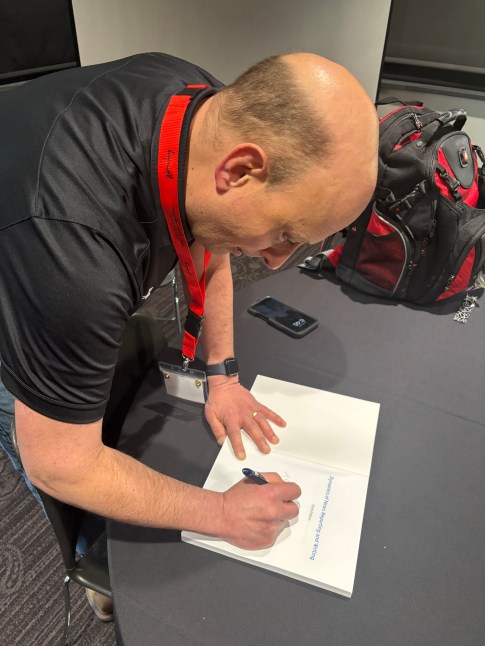
Even the kids, who I have been told a jillion times hate textbooks and never use them, have been amazingly kind to me over the years. For example, I brought a bunch of swag to the MCMC, including “Filak Furlough Tour” T-shirts and a “trophy bat” for the organization to give away.  At the end of the MCMC, the students on the board got copies of my reporting book as a thank you, when one of the kids came up to me and asked if I would sign the book.

“You don’t want me to sign that,” I explained. “If you keep it shrink-wrapped, the bookstore will pay you a chunk of change for it.”

She gave me a “why the hell would I do that?” look and then peeled off the wrapping. I ended up signing all three of the books that day.

Actual proof that someone wanted my autograph on something other than a check or a grade-change form.

When I got back and told the story to my reporting class, one young lady told me, “I read your book. I still think it’s the best textbook because I could understand things from it. It felt really… human.”

In the age of AI, I’ll take the hell out of that.

Perhaps this is the longest way I can think of to say thank you for everything you do for me in the “external validation” department. My goal with each edition of the book and each blog post is to make sure I earn it.

If there’s anything you need, please let me know.

Vince (a.k.a. The Doctor of Paper)


When the marketing pitch is juuussst a bit outside (A throwback post)

In spite of what the optics suggest, my goal in life is not to write a book for every possible subject I might ever teach. In fact, I’m often on the look out for a good book for certain courses, including blogging, principles of advertising and feature writing (the one I have been using is discontinued).

So, when a company pitches an email at me about a book I’ve requested (usually through an online form or as a “standing order” in case they find something), I’m all ears. That said, here’s an email I got this morning that isn’t going to cut the muster:

Here are a couple reasons why this pitch isn’t going to work:

  1. I’m not teaching a convergent media class any time soon, nor have I taught a class in a while that might fit this bill for this book.
  2. I didn’t actually request this book, or access to it.
  3. Most importantly, if I wanted to peruse the book for any reason, I wouldn’t need a special code for this, as it’s my book.

Look! It’s got my name on the cover and everything!

I understand that publishers are in need of reaching out to sell stuff, and I’m glad that my other publisher (Focal) is doing something to try to connect people with this book. However, it does make me question their overall approach when they a) couldn’t bother to eliminate the author from the sales database and b) approach the selling like those scam texts that are “just providing you with information that you requested on this exciting opportunity!”

So, for the last Throwback Thursday before Spring Break, here’s a look back at another time where the pitch a publisher threw was juuuuuuusssssst a bit outside….


So… No, then? (or why it’s important to research your readers before you pitch to them)

I understand this blog tends to skew more toward news than some folks might appreciate, given that my entire pitch for the “Dynamics of Media Writing” is that ALL disciplines of media (news, PR, Ad, marketing etc.) can get something of value out of it. The skew is due to trying to cover both the media-writing text and the news reporting and writing text in one spot. It also also comes from the idea that a lot of things people perceive as “news” things are actually valuable for all media, including skills like interviewing, research, inverted-pyramid writing and so forth. Finally, it seems that news folks tend to make more public mistakes than do some of the other disciplines, so I get more content there. (If you want me to hit on more topics in the PR/Ad/Marketing stuff, feel free to pitch me some thoughts. I’d love to do it.)

That said, occasionally there is a specific foul up in a specific part of the field that bears some analysis. Consider that when you look at this email I got the other day. I redacted the identifiers as best I could:

Dear Professor Filak,

​Greetings from (COMPANY NAME)! ​I hope this finds you well. In the coming months, (AUTHOR NAMES) will begin to revise the twelfth edition of their introductory journalism text, (REPORTING BOOK NAME). ​This text strives to give students the knowledge and skills they need to master the nuts and bolts of news stories, as well as guidance for landing a job in an evolving journalism industry.
Right now we are seeking instructors to review the twelfth edition of (REPORTING BOOK NAME) ​a​nd provide feedback. This input is invaluable to us, ​as it ​giv​es​ us a greater sense of how to best address both instructor and student needs. ​If you are currently teaching the introductory news reporting and writing course or will be teaching the course soon, would you be interested in offering your feedback?
If you would like to review, please respond to this email and let me know if you will need a copy of the printed text. You should plan to submit your comments via TextReviews by 2/6/18. In return for your help, we would like to offer you (MONEY).
At your earliest convenience, kindly respond to this e-mail to let me know if you are available and interested in participating. ​Again, please let me know if you will need a copy of (REPORTING BOOK NAME)
I’m always happy to help people and I’m not averse to making a buck by pretending to know what I’m talking about, but this felt both awkward and ridiculous. One of the things both “Dynamics” books push a lot is the idea of making sure you know what you’re talking about before you ask a question. The books also push the idea of researching your audience members so you know how best to approach them. Either the person writing this email didn’t do that or just didn’t care.
Here’s how I know that: It’s called “Google.”
Had this person done even a basic search on me she would have learned several things:
  • I am teaching the courses they associate with this book. I teach nothing but these courses, as you can find on the UWO journalism department website. The line of “If you are currently teaching the introductory news reporting and writing course or will be teaching the course soon…” tells me I’m on a list somewhere and this is a form email at best.
  • I wrote several books, including one that is likely to be some form of competition for this book. (I’m not saying it will be as good or better or anything, but my title includes words like “news,” “reporting” and “writing,” so it’s a pretty safe bet we’re vying for the same students.) This was literally one of the top five items on the first page of my Google search. She also sent her message the same day I got this alert from Amazon:NumberOne
    (I have no idea how Amazon quantifies “#1 New Release in Journalism” but I’ll take it.)

    The point is, it wasn’t a secret, so it appeared that she didn’t look me up and was like the guy at the bar telling me, “Hey, see that babe over there? I’m totally going to score with her!” and I’m like, “Uh, dude, that’s my wife…”
    On the other hand, maybe she did look me up, found the book and asked anyway, which is like the even-worse guy at the bar who’s saying, “Hey man, your wife is pretty hot. Any chance you can give me some tips on how to score with her?”

Thinking about all of that for a moment, I did the polite thing and emailed back, explaining how I felt this would be a conflict of interest (it is), and that any advice I gave her would be likely be somewhat problematic as the author of a competing book (it is).  I also noted that I know the book she is pitching well (I do) and I know the authors well (I do), so this would also be a bit awkward for me (it really is). Here was her email back to me, which again made me think she wasn’t actually reading this:

Hi Professor Filak,

Thanks so much for letting me know. We will certainly keep you in mind for future projects!

So, again, the point of the blog isn’t to beat people up for doing things poorly but rather to offer advice on how to do things better. Here are a few basic tips:

  • Research first, then write: You don’t have to do an Ancestry.com profile on every person to whom you market or with whom you engage in outreach, but it’s not hard to Google someone. Most people put more social-media stalking effort into learning about the “new kid” at school than this person put into finding out about me. In marketing, you often have access to proprietary data as well, so you can find out if this person had any previous engagement with your organization. In my case, I used that book for more than a decade and still keep up with it, so that might have been something she could have found.
  • Personalize when possible: If you are sending out 100,000 requests for something like a survey and you are expecting a 10 percent response, you will not have the ability to personalize all of the information on everyone’s card or email. That makes sense. However, when you are microtargeting a group of people with a specific set of skills or interests and that group isn’t going to overwhelm a data center, work on personalizing your content. That line about “If you are currently teaching the introductory news reporting and writing course or will be teaching the course soon…” could have easily been tweaked to say something like, “I see you have taught writing and reporting courses at UW-Oshkosh…” and it wouldn’t have taken much. Making these minor tweaks shows that you have done your research. Engaging in some personalized communication shows your readers you care enough to see them as individuals as opposed to a wad of names on a spreadsheet.
  • Try not to screw up, but if you do, don’t ignore it: The one thing that stuck with me when I got that response email from her was that I didn’t think she figured out what she was actually asking me or why it was weird. I had that feeling that if I had written her back and said, “I’m sorry I can’t do this because I’ve just been placed in an intergalactic prison for the rest of my life for murdering a flock of Tribbles with a phaser I set to ‘kill’ instead of ‘stun,’” I would have gotten the exact same email back. The whole exchange really reminded me of this scene:
 The thing that is important to realize is that you are going into a field that has two important and scary things going for it:
  1. It’s small enough that you’re really about two degrees of separation from everyone else, so people know other people.
  2. People in the field love to talk.

If you end up screwing up because you didn’t do the first two things suggested above, don’t compound the problem.

I have no idea if I’ll ever get approached by this publisher to review anything, but I know I will always carry with me the memory of this interaction. Had it been a great interaction, that would have been good for the publisher. Unfortunately, that wasn’t the case.

Time flies when you’re not scavenging for toilet paper: The Fifth Anniversary of COVID

It’s hard for me to wrap my head around the idea that it was just five years ago that the entire world was turned upside down. In some ways, it seems so much longer and in others, it feels like just yesterday that we were all washing our mail, rationing Clorox wipes and storming grocery stores like it was the Invasion of Normandy in search of toilet paper.

The Milwaukee Journal-Sentinel published the first “COVID at Five Years” story I’ve seen, although I’m sure there will be more if journalists can find the time and discipline not to chase every “We’re gonna buy Nova Scotia and turn it into a car wash” brain twitch coming out of the White House. In looking back, the MJS hit on some things that COVID ushered into our social conscious:

Beyond the grim health toll, the cultural impact has been substantial. We learned about PPEs and contact tracing. We mark time as “before COVID” and “after COVID.” We use phrases like “jumping on a Zoom call,” talk about “the new normal,” and ask about “curbside pickup.”

More than anything, we felt and discussed isolation. Talk to bartenders or baristas, psychologists or scientists, and it’s as if a larger-than-typical chunk of our population lost, or in the case of young people never developed, the ability to have what once were normal social interactions.

The effects of social isolation on mental health “didn’t have boundaries,” said Dr. Pam Wilson, vice president of medical affairs at Sixteenth Street Community Health Center. “They affected everyone.”

(As I wrote this, the BBC sent along its look at the outbreak, so now I’m up to two articles.)

What people remember is likely a function of where they were living, what stage in life they were at and how directly this virus impacted them personally. I tend to remember some of the dumbest things possible, even as my wife was a nurse and putting herself at risk to make sure people could receive heath care.

I remember sending an email to the guy who ran our monthly baseball card shows right about this time of the month, asking if he had planned to cancel, as things were starting to get weird up here. His initial response was, “Nah, this is all overblown. See you in a couple weeks.”

I didn’t see him again for more than two years.

I also remember watching every university around me starting to close and shift to online learning. My reporting class was getting edgy, as they had a 24-hour Midterm From Hell about to begin. One kid asked me two days before we were about to start it, “What if they shut the university down before this happens?”

“Look, folks, we’re behind people, but I tend to think that if they were going to shut us down, they would have done it by now,” I said.

After class, I opened my email to find the, “We’re going into hibernation, run for the hills” email that got us into distance learning for the year or two.

The rest was a blur of random weirdness, although I have to admit we got really lucky that Amy put us in for monthly toilet paper deliveries about a year earlier and apparently we don’t use as much as Amazon liked to send each month. Before COVID, I was grousing about having to store cases of TP. During COVID, I felt borderline opulent in using the bathroom.

I remember putting together “care packages” for my parents, who would drive up and visit from the other end of the driveway. Extra toilet paper, Clorox wipes, books of puzzles and anything else I could find. I also remember that about two months earlier, my dad and I bought a sports card collection of more than 3 million cards. (No, that’s not a typo. It filled the back of a U-Haul.)

I would pull out boxes of cards and put them with the care package so Dad could keep himself busy by sorting and pricing cards during the pandemic. Given his general twitchiness, I imagine that keeping him plied with cards might have saved his marriage, or even kept my mother from burying him in a shallow grave in the backyard.

The point of this recall is not just to mark time, but also to look for opportunities to do some good reporting now. The obvious stories are things like, “What was it like for us five years ago?”  or “What did we do then that now seems ridiculous?” (Washing the mail comes to mind…)

However, there are now ways to dig into issues like long COVID, digital isolation (why have a meeting when you can have a Zoom?), mental health impacts, changes to education (a snow day apparently is no longer a snow day thanks to distance learning) and other similar changes.

It might also be worth asking what we learned overall from this kind of thing? Whenever I used to hear people talking about majoring in “supply-chain management,” I thought it meant they needed a major and they planned to work for their dad’s company. Now? I know how important that is. Same thing with people who worked in labs and planned for the zombie apocalypse. I have a lot better understanding of why I should care about washing my hands and not licking door knobs.

The point is, now would be a good time to take a retrospective look at what happened and what we now know about life on the other side of the pandemic.

It might even help us avoid another one.

Firefighters fight fire: 3 tips for avoiding the obvious and getting value out of your lead (A Throwback Post)

During the “syllabus day” for my introductory media writing course, I tell the students something they find ridiculously funny, until they realize that it’s true:

“The first graded writing you will do for me will be one sentence long and it will take you three class periods to do it.”

The looks on their faces tend to say, “Does he think we’re mentally defective?” and “This guy has no clue as to how good I am at writing.”

Then, we start the process of drafting leads, reviewing leads, editing leads and reworking leads. Bam: One lecture period, two labs = three class periods. Even then, a lot of them tell me that they’re not really sure they got it right.

“This is a lot harder than I thought,” more than a few kids have noted after we’re done.

This week, we’re working on leads, so I thought I’d bring back a good helper post that might make things easier on your kids when they’re trying to come up with that one perfect sentence that drives home the point of the piece.

At the very least, I hope it will help them avoid telling the readers something pathologically obvious.


Firefighters fight fire: 3 tips for avoiding the obvious and getting value out of your lead

The lead of any story is the most difficult sentence to craft. It requires a lot from you as a writer: clarity, accuracy, strength, interest and focus. The standard format of the summary lead requires a 5W’s and 1H approach, and that approach can work if you view it through the prism of the interest elements outlined in the books: Fame, oddity, conflict, immediacy and impact. If you don’t, you tend to build sentences that fail to provide your readers with value.

Here’s an example of how this works:

In a class exercise, I have my students review a press release from the Boone County fire department and use the material in it to write a four-paragraph (four sentences) inverted-pyramid brief. The lead should focus on what matters most and then the next paragraph should have the second most-important stuff and the third should have the next most important stuff and so forth.

Consider these opening sentences:

Boone County Firefighters responded to a reported structure fire just before 6:00 p.m. yesterday evening.

A structure fire was reported to the Boone County Firefighters just before 6:00 pm yesterday evening in Sturgeon.

Boone County Firefighters extinguished an electrical fire at a Sturgeon home Monday evening.

In each case, the focus is on the firefighters doing something, which is great if you’re promoting the fire department, but otherwise, their work doesn’t matter. Firefighters fight fire. That’s their job. What makes this story unique or valuable is what the fire did to the home:

A fire outbreak causes a $50,000 damage to a house in Sturgeon 6 p.m. on Monday.

An electrical fire caused $50,000 worth of damage to a Sturgeon family’s home Sunday night, at 520 S. Ogden.

A fire in northern Boone County severely damaged a home and required fire units to remain on the scene for over four hours on Sunday.

In these leads, you can see the fire’s impact more clearly. The focal point of the lead sentence shifts, which means the rest of the piece will cover the bigger issue of what happened to the house.

With that in mind, here are three tips to help you keep your eye on the prize while writing your lead:

Focus on the noun-verb-object “Holy Trinity” of the sentence: We use a simple sentence diagram to help the student “fill in the blanks” when it comes to the core of the sentence. If you look at the NVO basics in the first three examples, this is what you get:

  • Firefighters respond to fire
  • (Someone) reports fire
  • Firefighters extinguish fire

That’s not what you are shooting for in a lead. In the second batch, you can see more of what should be at the core of the lead:

  • Fire causes damage
  • Fire caused damage
  • Fire damaged home

Obviously, these could be spruced up a bit, but for a first pass, they work fairly well. At the very least, the focus on what matters more than those first three did.

Determine what your audience values: I like fire briefs for beginning students because fires lack nuance. The fire causes damage and that’s about it, unlike crime coverage that could require legal nuance or governmental stories that can become muddled in process. As a writing topic, fire gives the writer a clear path to the answer of, “What would my audience want to know first?”

The “Boone County firefighters responded…” lead isn’t all that rare in my beginning writing classes because a) it’s the first thing on the press release, so students gravitate toward it and b) it’s the opening of the chronological sequence of events. Almost every story we read or write, prior to becoming journalists, fits a chronological pattern.

To help break students of the chronology habit, I ask this question: “If you went home after class today and your roommate said, ‘Hey, your mom called. There was a fire at your house,’ what would be the first thing you would want to know?”

The answers are simple:

  • Is everyone OK?
  • How bad was the fire?
  • What happened/How did it start?

I then ask the student, “OK, so now imagine your roommate starts with, ‘Well, the Boone County firefighters responded…” That’s when the light goes on: You don’t want to hear about the firefighters fighting fire. You want to know if mom (and probably your stuff) survived the blaze.

Other stories lack this straightforward approach, but the principle remains. Don’t tell your student newspaper’s audience that the Board of Trustees held a meeting to discuss tuition increases. Tell the readers if tuition went up or not and if so, by how much. Don’t tell the local sports fans that their team played a game against a division rival last night. Tell them who won and what the score was.

If you place value on giving your readers value, the lead will dramatically improve.


Build outward from the core and shed things that don’t matter: If you build a core that has value and gives your readers some of the W’s and/or the H, you should be able to add layers to that core to augment and improve it. With a “fire causes damage” start, you could add answers to a few simple questions:

  • How bad was the fire? (It destroyed half the house)
  • How much damage was there? ($50,000)
  • Was anyone hurt or killed? (One guy suffered minor injuries)
  • What started it? (An electrical malfunction)
  • Where did it start? (A storage room near a freezer)

Not everything in here will make the cut, but that’s OK. You can write a lead by adding the key layers you think matter, answering the above questions in a way that gives the readers value.

You might use the $50,000 figure or the half the house answer, but probably not both in the lead. They essentially say the same thing for the moment: This was a big honkin’ fire. You might focus on the injuries, but you might decide against that since the injuries weren’t severe. Then again, you might think people in a small town would like to know if their neighbors are OK.

It’s easy to weave in the “electrical” part without too much trouble, so that’s probably going to make the cut. You might also include a “where” and a “when,” but maybe not the exact time and the exact location. In other words, “Sunday night in Sturgeon” would be better than “at 6 p.m. at a three-bedroom home at 520 S. Ogden in the town of Sturgeon.”

Once you build the lead, go back through and start trimming out things that might not need to be there. (Spoiler alert: references to firefighters doing anything probably shouldn’t remain in the lead.) This is where you might debate the issue of injuries versus damage or a broader “where” as opposed to the specific address. Most of what you’re trying to do here is play “king of the mountain” with your content. If it’s not good enough to be in the lead, knock it down the hill into the second or third paragraph.

Time to freshen up your book shelves: Updates on “Dynamics of News Reporting and Writing,” “Exploring Mass Communication,” and “Dynamics of Media Writing” textbooks

Fresh off the press, I got my stack of the third edition of “Dynamics of News Reporting and Writing.” Never in my wildest dreams did I imagine I’d be lucky enough to get this far.

(NOTE: I’m still on break for a bit, but I needed to break the seal on the blog because a) some of you are already back at the classroom grind and b) I promised Sage I’d let people know what’s up with the textbooks I’m doing. I’ll probably pick up again after a week or so, or whenever the pinball machine I’m working on really ticks me off… — VFF)

THANK YOU FOR MAKING THIS NECESSARY: I got home last night to find a heavy box on the porch from Sage. Inside were my author copies of the third edition of “Dynamics of News Reporting and Writing,” which pressed over the holiday break.

I wanted to take a moment to thank all of you out there for, as Yogi Berra once put it, making this edition necessary. Somewhere along the way, you all made a choice to give me and this book a chance, and for that, I’ll be forever grateful. I know it’s not easy changing books for a class, adopting a new textbook or assigning any textbook in today’s “Textbooks are the overpriced devil, man…” world.

My goal in every textbook is to practice what I preach: Focus on audience-centricity. I want you and your students to get a ton out of these books and I want to make sure I never lose sight of who is out there and what you want/need out of me.

(The second goal is to adhere to my Polish-Catholic roots of feeding you as much as humanly possible. Whether it’s pierogi or information, we’re going to stuff you to the gills. Thus, the book updates and the blog: If you need ANYTHING I didn’t cover, tell me and it’s going up on the blog.)

WHY YOU SHOULD CARE ABOUT THIS EDITION: Well, for starters, the cover is wicked cool… OK, maybe I’m the only one who cares about that. Let’s look into this a bit:

  • Artificial intelligence: This is the 800-pound gorilla in the room these days when it comes to anything having to do with content creation. Chapter 2 has been completely revamped to deal with how best to think about AI, what it’s good for in terms of media and why we aren’t ready to let RoboCop 2 take the keyboards out of our hands. In addition, more on AI and critically thinking about it are infused in the remainder of the chapters. We do more than a broad overview, instead focusing on how the tools can benefit you in the field and what you need to watch out for.
  • Audience Centricity: Not only has Chapter 1 gotten a refresh, but the rest of the book has gotten some additional elements that will help you figure out how best to use media tools to reach your audience, whatever that audience may be. Now, more than ever, we see shifts in what social media platforms can do, how news outlets provide content and who pays attention to our work. To make sure we’re all doing the best we can, we need to know who we’re trying to serve, what they want from us and how they prefer to receive it. Chapter 1 gives you the goods on the first part of that sentence, while the remaining chapters focus on the latter two parts.
  • Thoughts from a Pro: We have some of our tried-and-true pros back to offer their thoughts on what you need to know and why you need it, as well as some fresh faces with some new ideas. In addition, each pro gives us a few thoughts they have on AI as it relates to their work and the field as a whole. That should be helpful in demonstrating how significant (or maybe insignificant) AI is in various parts of the field, along with suggestions from professionals as to how best to use it.
  • Legal Wranglings: The law has been changing quite a bit (and apparently will continue to change in the upcoming few years), so keeping media operations on the right side of the law continues to be an ongoing challenge. With fresh examples and updates to legal outcomes, we give you a look at where things tend to stand in regard to reporting and writing as of this publication. (And I’m sure by the time I’m done writing this post, TikTok will be dead, brought back, challenged again and killed again like Jason Voorhees, so that’s why we have the blog…)
  • More goodies: As always, Sage is a treasure trove of add-ons and extra stuff for every book I do. The folks there have tons of lecture stuff, PowerPoints, test banks, exercises and more at the ready beyond what I’ve put into the book and the blog.

If you are interested in getting access to the new edition (digital, print or otherwise), along with all the extra stuff Sage has added, feel free to hit me up through the contact page or go directly to Staci Wittek at: staci.wittek@sagepub.com

She is truly the best person I’ve ever worked with in terms of sales and marketing and generally being awesome at book stuff.

But wait, there’s more…

TIME TO GET (MEDIA) LIT(ERATE): Back in August, “Exploring Mass Communication” hit the market, once again proving I either have too much time on my hands or I’m too stupid to say no to a project. In any case, this intro-level textbook turned into what I would like to say is the best book I’ve done to date.

I get the best mail from Sage…

This book is GREAT for any introduction to mass media/mass com class, but it’s even BETTER if you’re trying to teach media literacy to a nation of freshmen and sophomores. I didn’t realize that until someone told me, “Hey, why did you tell me you wrote a media-literacy text?” Turns out, it’s become popular in all sorts of classes for a number of reasons:

  • It’s cheaper than the other leading brand:  In going through 128 reviews Sage sent me, I realized that the only thing all 128 reviewers agreed on was that price was a factor. I asked Sage if I could just write whatever I wanted if we re-titled the book: “Filak’s Five Dollar Book of Mass Com Stuff.” The answer was a hard “no,” but we did get the print edition to come in below other books like it. Even BETTER, the rental costs for digital copies are less than one-third of the cost of the print edition (especially if you go through Sage reps) and then there’s an even BETTER version of this….
  • The Vantage Advantage: “Nobody reads textbooks,” is what I keep hearing from instructors, who are actually desperate to get students to read the stuff in the book. Sage has built an entire digital system called Vantage that can plug into your Learning Management System (BlackBoard, Canvas, D2L or whatever people are calling it) so you can assign kids stuff digitally, track their efforts and generally oversee the class like the guy in “Sliver.” In addition, you can toggle how you want to spot-check the kids on their reading. There are quiz questions attached to various sections of the readings and other analytics that help you help them to learn. Even better? It’s cheaper than a print book. By a lot.
  • The “Crazy Vinnie Guarantee” is Still in Effect: If you missed it when the book launched, here’s a look back at the insane things I’ll do  to help you either make the book work for you or to get you set up to use someone else’s book. Seriously. I’ll make someone else’s book better if you want.

If you’re interested in giving this book a look, feel free to hit me up through the contact page or go directly to Staci Wittek at: staci.wittek@sagepub.com

And one last item…

MEDIA WRITING UPDATE: Just before my former editor Terri left Sage, she told me that if my books worked out as well as she knew they would, I’d be writing a book a year for her for the rest of my life. If she’s as prescient about everything as she was in making that statement, I’d like to follow her around at an off-track-betting parlor some day…

This leads us to the upcoming edition of “Dynamics of Media Writing.” The “OG” book in the “Dynamics” series is in process as we speak. The goal is to have it to a copy editor by February, proofs done by April and out the door by August of this year. As is the case with the Reporting book, there will be AI additions, new pros and a ton of extra stuff. I’ll keep you posted as we go.

Thanks again for all of this. Without you all, these books would be dead after one edition and serving as a coffee coaster in the grad-student lounge.

Vince (a.k.a. The Doctor of Paper)

The Universities of Wisconsin System is trying to steal faculty’s copyright rights to educational material. Please help fight this stupid power grab.

(The system says, “We would never look to diminish your rights or take your hard-earned work away from you.” What the system actually does is more accurately depicted in the scene above.)

THE SHORT, SHORT VERSION: The Universities of Wisconsin System is trying to rewrite its copyright policy and assign itself the rights to the educational work and scholarly materials faculty create. If this goes through, faculty who have spent years building and improving their courses could get the shaft and I have no idea if I’ll be able to share stuff that I’ve always shared with you.

If you think this is as stupid as I do, please email system President Jay Rothman at president@wisconsin.edu and tell him not to let this policy pass.


THE LONGER, MORE NUANCED VERSION: Here’s a deep dive on the way the system is trying to recreate its copyright policy in a way that disenfranchises its faculty:

THE LEAD: The Universities of Wisconsin has decided to rewrite its rules involving intellectual property, giving the system total ownership over pretty much everything faculty create:

The UW System is proposing a new copyright policy that professors say would eliminate faculty ownership of instructional materials. The revisions are stoking alarm among professors statewide who say such a move would cheapen higher education into a mass-produced commodity.

“This policy change is nothing less than a drastic redefinition of the employment contract, one that represents a massive seizing of our intellectual property on a grand scale,” professors from nine of the 13 UW campuses wrote in a recent letter to UW System President Jay Rothman. “It would allow any UW campuses to fire any employee and nonetheless continue teaching their courses in perpetuity with no obligation to continue paying the employee for their work.”

Aside from owning faculty syllabi, lecture notes and exam materials, UW would also have ownership rights over the scholarship faculty create:

A draft of the new policy, obtained by the Milwaukee Journal Sentinel, would eliminate existing copyright language and replace it with the assertion that UW System holds ownership of both “institutional work” and “scholarly work.”

<SNIP>

“Scholarly work” includes most of what professors produce, such as lecture notes, course materials, journal articles and books. The UW System transfers copyright ownership to the author, as is customary in higher education, but notes that it “reserves” the right to use the works for purposes “consistent with its educational mission and academic norms.”


DOCTOR OF PAPER HOT TAKE: Given that I’ve got about a dozen textbooks in the field, I edit a journal that needs scholarly work to keep it running, I spent seven years crafting hundreds of blog posts and that I’ve built a ton of courses over my nearly 30 years of teaching, this was basically my calm, metered reaction:

beaker from the muppet show is screaming with the words time to freakout above him

I’ve already sent a copy of the proposal to Sage for its team of lawyers to go over, so I’m hopeful that I receive an answer along the lines of, “Calm down… Have a Diet Coke… This isn’t going to destroy what you’ve spent decades creating…”

In the meantime, let’s lay out how stupid and problematic this is:

The quality of your courses depend on the people you’re pissing off:  We essentially went through this in my media-writing class today and a collection of sophomores and juniors understood it, so I’m hoping it might make sense to the Board of Regents.

I proposed the following scenario to one kid in the class: Let’s say you turned in a really good story as an assignment for this class. In fact, I thought it was so good, I took your name off of it, put my name on it and submitted it to the local paper. The paper then paid me $50 for the story.

I then asked the kid, “So, given that every time you turn in something good, I’m going to take it, put my name on it and make money from it, how likely are you to put forth your best effort in this class?”

The kid said, “There’s no way I’m going to do anything good for you anymore.”

Right. So, let’s play that out here: If every time I work REALLY hard on making good stuff for my class, the U is just going to claim it as its own, why would I bother to do anything more than the bare minimum to make my class work?

I guess you could make the argument that pride in our work and a desire to make things better for our students could inspire us to do great things, even in the face of a naked power grab by the system, but if you’re going to treat us like mercenaries, we’re going to behave that way.

This will stifle innovation, limit interest in developing new courses and create a general sense of animosity among faculty. It will also likely inspire professors to find new ways to hide stuff from the administration folks, as one person on social media suggested to me:

This stuff isn’t a product, but rather a process: Inherent to the system’s argument is the basic premise of work product: You built this stuff while you were employed by us and required to do so. Therefore, since we paid you for this, the stuff is ours.

That works in the private sector, where we’re tasked with specific outcomes and granted special provisions to create this kind of work product. For example, I know that when I worked at the Wisconsin State Journal, I wrote a lot of articles that the paper published. Implicit in my employment agreement was the premise that I was acting on behalf of the paper, writing things that the paper tasked me to write and publishing those things in a copyrighted publication. They own that stuff and I’m cool with that. I don’t think I’m ever going to want to republish a weather story I wrote in 1996, and if I did something cool I wanted to show my students, that’s acceptable use.

However, when it comes to my media-writing class, I didn’t get hired to write lecture notes and syllabi for that class. In fact, what I wrote was a tweaked version of something I’d been working on for decades. I’d drafted some of this conceptual stuff when I was working at UW-Madison, improved upon it when I was at Mizzou, reconfigured it at Ball State and then adapted it here. This isn’t like you hired me to bake a cake for your birthday. This is a tree I’ve been growing and tending for years and years.


The material might not be UW’s to steal: Even if you don’t buy the argument above, the instructors might not own the material they’re using in the first place.

Textbook publishers aren’t just sending out desk copies of a dead-tree books and telling fledgling professors, “Vaya con Dios.” They actually build a ton of back-end stuff into the educational packages they provide these days, which includes a lot of the stuff the system is trying to get its grubby little paws on.

I know for my books at Sage, we have sample syllabi, PowerPoint slides for lectures, notes for instructors, exercises and test banks crammed with questions. I might even be forgetting some of the stuff we provide.

(Shameless Plug: Sage really is amazing when it comes to this kind of stuff. If you ever need a book, check these folks out first, especially if you need some help with the shaping and molding of the entire class experience.)

These things are available to instructors because Sage built them to go along with the authors’ textbooks. The professors can use them as they are, add stuff, cut stuff or otherwise tweak what they receive. That said, it’s not theirs to sell or give away. Sage holds the copyright for this stuff and I imagine Sage and the other book publishers who pour a ton of time and resources into building these things would be more than a bit peeved if the UW System tried to claim it as its own.


The Coy and Vance Duke Theory of Education: When I was a kid, I loved “The Dukes of Hazzard” television show, which ran every Friday for about seven or eight years. The show involved two cousins, Bo and Luke Duke, getting into scrapes with the corrupt law enforcement of Hazzard County and doing amazing car chases in their 1969 Dodge Charger. Along with patriarch Uncle Jesse Duke and the lovely cousin Daisy Duke, the boys were “makin’ their way, the only way they know how,” to quote the theme song.

It was a simple show that drew a good audience and it seemed to work well. However, around the fifth season, John Schneider and Tom Wopat (who played Bo and Luke, respectively) got into a contract dispute with the studio over salaries. Rather than pay them and move on with life, the studio had the idea in its head that the car (the General Lee) was actually the star of the show, so it didn’t matter who was driving it and that they didn’t need these two pretty boys at all.

Enter new cousins: Coy and Vance Duke.

If ever there was a knock-off of a brand name, this was it. Like the original Duke Boys, one was blonde, one was brunette. They essentially wore the same wardrobe, had the same catch phrases and did the same insane driving stuff. That said, the ratings took a dump and after one season, Bo and Luke “returned from driving the NASCAR circuit” and Coy and Vance ended up fading from memory.

What the universities are doing here is essentially the same kind of thing. They figure, “Well, hell, if we have the notes, the syllabus and the PowerPoint slides, we don’t really need the professor who created them at the front of the room.” These folks assume that once we decide to leave, retire or whatever, they can just plug in an adjunct at a fraction of the cost and things will run like a Swiss watch.  And that’s not just me being paranoid, as other folks see it as well:

I pretty much know my notes aren’t going to be helpful to other people as I wrote them based on a lot of my experiences in the field. Notes like (BUS FIRE STORY GOES HERE) or (EXPLAIN DRUG DEALER SHOT THING) probably won’t work for a random Coy or Vance they bring in to teach my class after they decide they don’t need me anymore.


HERE’S WHY YOU SHOULD CARE (AND WHAT YOU CAN DO ABOUT IT): One of the biggest reasons I’m worried about this is because it impacts what I can do with my materials. That’s also the main reason why I think you should care about it, too.

I never took this job to get rich and I certainly don’t like the idea of coming across like Daffy Duck when he found the treasure room:

However, when I know stuff is mine to do with as I please, that tends to benefit a lot of other people as well. Whenever someone shoots me an email and says, “Hey, how do you organize your class?” I’m always happy to give them a copy of my syllabus. When someone needs an assignment I’ve built, I’m glad to share it with them or on the blog.

When we went into COVID lock down, I basically dumped everything I ever did that I thought would help people into the Corona Hotline section of the blog for free. All those goodies remain there to this day, so feel free to help yourself.

If this policy passes, I might not be as free to offer that kind of generosity any more, and that would really tick me off.

So, here’s how you can help me remain capable of helping you. The university system has extended comments on this until Dec. 13. If you are part of the UW system, you can use this link for sure to register your thoughts. (Not sure if it works for those of you elsewhere.)

If you can’t use that link, here is another option:

This is Jay Rothman, the president of the Universities of Wisconsin system. Feel free to call him at the number above or email him at president@wisconsin.edu and tell him to leave the copyright in the hands of the professors, instructors and students.

I appreciate the help and I’m sure my colleagues throughout the system do as well.


X-odus: A look at how and why people are fleeing the former Twitter platform and how Bluesky and Threads are gaining ground

New home, same sarcasm! Come join me at Bluesky.

THE LEAD: Social media users and microbloggers found their tipping point when it came to the way in which X (formerly Twitter) was turning into a hell-scape. In the wake of the election, millions of users have shut down their X accounts and moved to one of several other sites that offered relatively the same services as X, but without the trolling and content manipulation.

One of the sites seeing a massive influx of users was Bluesky, a Twitter clone that was developed in part by former Twitter master Jack Dorsey:

Bluesky, a fledgling social media platform, reported Thursday that 1 million users had signed up in a single day. Some frustrated X users appear to have flocked to the newer network in recent weeks.

Bluesky, which began as an internal project by then-Twitter CEO Jack Dorsey in 2019, was invitation-only until it opened to the public in February. Since 2021, it has been an independent company with Jay Graber as its CEO.

It currently has about 18 million users. Graber posted Friday that the platform is growing by 10,000 users every 10 to 15 minutes.

While Bluesky remains small compared to established online spaces, it has emerged as an alternative for those looking for a different mood and less influenced by X owner Elon Musk, a close ally of President-elect Donald Trump.

BACKGROUND: Alternatives like Bluesky, Threads, Mastodon and others have existed on the fringes of microblogging sites for several years, but never managed to gain traction. Twitter/X had the benefit of being one of the earliest sites of this nature, which meant that most people interested in this form of social media had developed significant followings there.

Data on how many people use X on a daily basis varies, but current figures place the general usage between 300 million and 500 million users overall. Thus, while Bluesky seems to be booming at this point, 19 million users is still just a drop in the bucket compared to Elon’s Army. It’s not even a drop in the bucket compared to Threads, which stated it has about 275 million users.

It’s unclear as to how many users have left X since the election of Donald Trump, with whom X owner Elon Musk has aligned himself. While the argument that X has become too toxic and conspiratorial is an oft-stated reason for leaving, the massive exodus also tended to coincide with Musk’s update to the service agreement:

A new terms of service document, which took effect on Nov. 15, allows Musk to use tweets, photos and videos — even from private accounts — to train Grok, the platform’s AI bot.

“You agree that this license includes the right for us to (i) analyze text and other information you provide … for use with and training of our machine learning and artificial intelligence models, whether generative or another type,” the terms say under the section about users’ rights.

They also stipulate that users’ content may be modified or adapted for other media.

Users will not be paid for their content, which could end up in the hands of other companies, organizations or individuals.

The company will not monitor posts for truthfulness.

“You may be exposed to Content that might be offensive, harmful, inaccurate or otherwise inappropriate, or in some cases, postings that have been mislabeled or are otherwise deceptive,” the terms say. “All Content is the sole responsibility of the person who originated such Content.”

Yeah… It’s kind of like this:


 SHAMELESS PLUG TIME:  I shut down my X account, so come follow me at Bluesky.

If you are moved/moving to Bluesky, post your addy down in the comments or send it to me via the Contact Page and I’ll build us a starter kit.

DOCTOR OF PAPER HOT TAKE:Social media has always been a shifting landscape in which almost anything can (and usually does) happen. Over the past 15-20 years, there have been very few platforms that have remained a standard bearer for this form of communication. Facebook, LinkedIn, Instagram and Twitter were kind of the Fab Four in that regard.

Loyalty has been a big part of why these remained constants, although the owners of these sites have been accused of anti-competitive practices that basically kill the competition before it can grow legs. In other cases, the competing efforts fell flat because they lacked the infrastructure, vision or audience to keep up with the Joneses.

I’ve been watching social media for years, in large part because I’ve been writing books that have chapters on it and I hate looking dated or stupid. When I first had to write the draft of the “Dynamics of Media Writing,” the folks at Sage had me write the social media chapter first as part of the “pitch” they wanted to send to potential adopters.

I protested, arguing that it would be old and dated by the time it went to press, but they said they needed it as an example of what made the book current and fresh, so I did it.

From the first draft of that chapter until the day we published, I ended up rewriting the chapter completely FOUR TIMES. That didn’t count the last-second adjustments to things like Twitter moving from 140 characters to 280 characters and the death of a random platform or two.

What makes this particular situation so depressing is that Elon Musk doesn’t give a damn about this situation, or at least he’s doing a great job of pretending he doesn’t.

When advertisers were jumping ship in late 2023, Musk told them in a very public interview to “go fuck yourself.” If that’s what he had to say to people who were paying him millions, I doubt he’s worried about me and my 630 followers on X.

That said, this is exactly how social media is supposed to operate, based on its underlying paradigm: Platforms that cater to the audience interests and needs tend to thrive, while those that decide to do it “their way” regardless of what the audience wants tend to dry up and blow away.

If ever there was an example of how NOT to keep an eye on audience centricity, X is probably it.

EXERCISE TIME: Take a look back at the graveyard of social media platforms that no longer exist and see how, when and why they tended to go belly up. In analyzing those examples, how do you see some of these newly popular sites doing in terms of thriving or dying? What other opportunities might exist in the wake of the X exodus?