The first wave of responses was from regular readers, and most were positive. Several thanked me for showing how we use AI to expand our offerings while maintaining quality.
I suspect I receive little negative feedback about AI now because I’ve written about it so often. I know the anxieties it causes. That’s why I explain how we use it, assure you we are not replacing jobs and promise that humans stand behind everything we publish.
As for anything that might challenge his assumptions, well, Quinn doesn’t have time for that crap:
(A) cranky journalist in another state took offense and on Monday ranted on social media about my practices being the ruination of journalism. Much bombast by others followed.
Or, so I’m told. I didn’t read any of it. I have no time for uninformed outrage on social media channels.
(EDITOR’S NOTE: I was not the “cranky journalist” Quinn spoke of, clearly, because my “bombast” and “uniformed outrage” was published Thursday. Just want to clear that up.)
In the end, Quinn gave all of his supporters a good pat on the head before trying to shame anyone who wasn’t fully on his side:
For those who wrote to say they understand and admire what we’re doing, many thanks. To those who wrote to criticize it, I suggest you look to history to understand that the only path forward is adaptation.
Or, keep stomping your feet until you don’t have a leg to stand on.
CATCHING UP: Quinn wrote an extensive column last week, praising the use of AI as a tool that allowed his staffers to do more reporting and zero writing in some under-covered enclaves of the paper’s circulation area.
In doing so, he decided to take several potshots at colleges, college professors and college students, saying they were doing everyone on Earth a massive disservice by decrying the value of AI, or outright ignoring it.
This led to at least some of the backlash against him, including the piece I wrote here that made what I consider to be three clear, well-reasoned and well-supported arguments:
Quinn is wrong about journalism programs not teaching AI or telling students that AI is the devil.
AI is a tool that still has a lot of kinks to work out, and it has proven to need some extensive oversight in its current form.
The content the PD is producing from its “Report it all, let AI write it up” leaves something to be desired in terms of quality.
In his most recent missive, Quinn didn’t deal with almost any of these criticisms, but then again, I really didn’t expect him to. In reading through his 14 previous letters on AI, I’ve found kind of a pattern in his views on AI. Two broader underlying premises really underscore why I’d love to play poker against this guy:
The Law of the Instrument:The concept has been around for generations, but it’s often attributed to Abraham Maslow, and it basically states that if the only tool you have is a hammer, you treat everything like it’s a nail.
Quinn has so bought into the premise that everything can be done with a strong set of reporters and an AI grist mill, that it’s clear all stories are getting done this way on those beats. The underlying problem is that not all stories can be done well this way.
Quinn mentions things like people wanting to know the score of the Browns game or the outcome of a vote from some board in Lorain. These stories are great for AI to just crank out.
OK, fine, but what about that story of the teacher who donated bone marrow? Or obituaries? Or other stories in which details matter and storytelling can make a difference? These things get ground up and spit out in a bland way that really undermines the quality of the work the reporters have done.
Quinn isn’t alone in this, as I remember having an argument with a broadcast professor during the “convergence phase” of journalism. I noted that some stories were better done in print or online while other stories were better done in broadcast. He argued anything I could do for a newspaper, he could do just as easily for broadcast.
I mentioned things like budget stories that needed mathematical depth and lacked a lot of visuals for video. He told me how he would take video of people typing on keyboards or how he would throw a copy of the budget on the table and film that.
The underlying point in both cases is the same: Yes, you CAN do a story this way but it doesn’t follow it’s the BEST way to do that story.
Often Wrong, Never In Doubt: I heard this phrase in a documentary on financial investors, where a short-seller explained that certain people are very good to bet against because they lock in on an idea and refuse to be dissuaded, regardless of the reality surrounding them.
When they are wrong, but overly confident, they’ll pour vast sums of time and money into risky things that end up going wrong, thus benefiting the people who clearly saw the inherent flaws in those things. Quinn fits this to a T.
Even when I’m really certain on something, I’m always open to the option that I might not be right. If Chris Quinn brought me to the PD, showed me all the great stuff he’s doing, demonstrated how they’d backstopped AI to prevent any catastrophic failures and presented data on how great this was serving his readers, I’d be happy to give this whole experiment another look. I believe paranoia is my best friend, so I’m looking out for risks and willing to say I’m wrong.
Quinn’s most recent letter just drips with hubris, belittling anyone out there who hasn’t fallen in line while ignoring the issues a bunch of us have raised here (particularly those about how crappy J-school is). It’s telling that after a letter in which he basically said professors suck and J-schools suck, he added this tidbit to the end of his latest missive:
Note: I mentioned a student last week who withdrew from job consideration because of our use of AI. Some readers concluded the student attends Syracuse University. That’s not the case. Actually, Syracuse’s Newhouse School of journalism, a valued partner for us, teaches about AI in journalism. Leila Atassi, one of our editors, will be on the Syracuse campus in a few days to help coach students in how we use AI.
That’s exceptionally tone deaf for two key reasons:
You spent an entire column telling everyone that college journalism programs ignore or hate on AI and then without an ounce of irony, mention how great Syracuse is and that they’re doing some awesome AI stuff.
You crapped all over journalism degrees and how they’re worthless, yet you’re dispatching Leila Atassi to Syracuse to teach these kids. I wonder what her background is… Oh… Yeah…
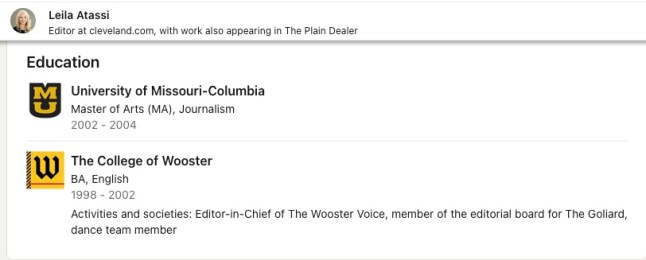
And, I’d like to say I believe in Leila and her abilities, if for no other reason, than she went to a hell of a good journalism school for her master’s (and she was actually one of my students for a while.)
In any case, while Chris Quinn thinks I’ll be here stomping my feet until I don’t have a leg to stand on, I’ll actually be watching to see what happens as the PD’s Icarus keeps flying higher and higher on his AI wings.
I hope the computer-based journalism helpers Chris Quinn is putting his faith in work better than the Cleveland Plain Dealer website. I tried to buy a subscription to view his diatribe about journalism schools and AI, only to have a spinning wheel of death show up for about a day or so…
By removing writing from reporters’ workloads, we’ve effectively freed up an extra workday for them each week. They’re spending it on the street — doing in-person interviews, meeting sources for coffee. That’s where real stories emerge, and they’re returning with more ideas than we can handle.
<SNIP>
Journalism programs are decades behind. Many graduating students have unrealistic expectations. They imagine themselves as long-form magazine storytellers, chasing a romanticized version of journalism that largely never existed.
That’s what they’re taught.
DISSECTION TIME, PART I: Let’s look at both Quinn’s arguments as well as take some time to disprove them, starting with his view of students and journalism programs:
The Strawman Student:Quinn’s piece begins with an exemplar of how students suck these days, especially because we teach them poorly at every journalism school in the country:
A college student withdrew from consideration for a reporting role in our newsroom this week because of how we use artificial intelligence.
It reminded me again how college journalism programs are failing to prepare students for the workforce.
I don’t have a reason to doubt Quinn that this kid exists, but I also have no reason to trust him. I’d like to see the withdrawal letter/email/voicemail the kid sent and I’d probably also like to talk to the kid.
See, Chris, sometimes people tell you stuff that isn’t true, like “I really wish I could make it to your party” or “The break up isn’t about you, it’s about me” or “It happens to a lot of guys and it’s not a big deal.”
Maybe this kid didn’t want to work for someone who saw their role in the newsroom as feeding grist into a mill for a robot overlord. Maybe they actually enjoyed writing, so giving up the part of the job they like wasn’t worth it to them. Maybe, and I say this as a huge fan of the sports teams, they didn’t want to move to Cleveland.
Could be a lot of things, but blaming it solely on your AI policy helps you nicely set up your argument that journalism schools suck.
The Incorrect Overgeneralizations:The bigger problem here is the leap from this one kid not liking something to all journalism programs failing all of the kids out there all of the time. Even if we pretend that this one alleged kid was so allegedly horrified at the Plain Dealer’s amazing-as-hell AI set up that they had to pull out immediately, it doesn’t follow that all kids in all schools are taught to hate AI. This is called negative social stereotyping.
Even if that feels like a bit of hyperbole, let’s at least agree that not every kid who comes out of a program is the exact same in terms of quality, maturity and expectations.
Also, I think we can agree that not every journalism program is created equal, so while the kids at University A might be using smudge pots to ward off the evil spirits used to power AI, kids at University B might be getting some good data journalism help, transcription services and other goodies, courtesy of AI.
Then again, maybe we can’t agree, given this generalization:
Like many students we’ve spoken with in the past year, this one had been told repeatedly by professors that AI is bad. We heard the same thing at the National Association of Black Journalists convention in Cleveland in August. Student after student said it.
Chris, did you bother to dig a bit deeper on this, because there are a few nuances that merit consideration. First, who were these professors? Were they in journalism or were they in departments where they’ve gotten used to grading 500-word essays that AI can now crank out in 18 seconds, thus putting the fear of God into these people?
I’m also curious, given your disdain for journalism programs, where did the amazing Hannah Drown and Molly Walsh garner their educational pedigree that mixed the poli sci, business and non-profit knowledge you desperately want kids to have?
Oh… Yeah…
Given their background, I’m wondering how Hannah and Molly feel about this proud declaration you made:
Fortunately for those of us who know exactly what skills we need in applicants, AI has altered the landscape so dramatically that we don’t need journalism school grads.
We don’t need any damned JOURNALISM GRADUATES… Except, of course, the two we hired to do this work that we’re so proud of…
The Erroneous View of J-Schools: I’d like to know how many journalism programs Quinn visited in the past five years. A five-year span would cover the time frame where artificial intelligence would have become relevant enough for schools to start embracing a relatively stable set of AI tools.
I’d put the over/under at about three schools, and I’d advise people to take the under.
There are likely colleges that are shunning AI, but clearly many more are embracing specific aspects of these tools.
Stanford, UCLA, Atlantic International University, Florida and Columbia are just a few of the other schools that have Journalism-based AI courses on the books, and those are just the ones I found on through a cursory search. That’s not even counting all the programs (ours here included) that have infused AI into the current courses we have, so we can demonstrate the value of the tools while we teach caution as well.
(NOTE: If your school or your class does some AI stuff, feel free to pipe up in the comments section. I bet we could really make a run at the record for most comments on the blog.)
What we have here is a collection of facts, supported by links to additional information. I’d like to think that’s a bit stronger case than Chris Quinn’s “Old Man Yells at Cloud” approach to generalizing about what’s wrong with journalism schools today.
The “Road Less Traveled” Advice:Quinn’s ignorant view on J-school is problematically compounded by his educational suggestions for kids who want to enter his glorious newsroom:
If you’re a student considering journalism, I’d skip that degree. Study political science. Learn technology. Understand how government, businesses and nonprofits work. Take communications law and ethics as electives. Skip much of the rest.
Got it. Just like you did back in the day! Right, Chris? Oh… Wait…
I don’t know if he’s going to be on College of Media and Communication Dean David Boardman’s Christmas card list this year, but I’d love to see Boardman’s reaction to this column…
Aside from the “do as I say, not as I did” thing, if I wanted to tank a kid’s future, I’d pretty much tell that kid to do exactly what Quinn is saying here.
Technology changes so rapidly that whatever the kid learned in freshman year would likely be obsolete by graduation. You can learn tools, but it’s important to know the broader ways in which they should be applied to further your skills and connect with your audience. For example, in my day, we didn’t major in Quark XPress. We majored in design, used the tool in conjunction with our broader understanding of the field and then adapted to technology changes.
In addition, there’s a reason the phrase “Why try? Go Poli Sci” is still heard in the halls of many academic institutions. It’s also much more likely to be in the “paper law” as opposed to the “trial law” end of the spectrum. I’m not saying a certificate, minor or even double major in this is field is bad, particularly if you want to take your media skills into the political realm. However, you’re not making it to a newsroom solely on a steady diet of Politics and Genocide or Western European Politics courses.
I’d also like to know where Quinn thinks students are getting their interviewing skills, their social media experience or their general reporting knowledge in this newly formed major he’s promoting here.
Being forced to meet people takes effort, particularly based on how today’s generation of students has grown up in a digital-first, post-pandemic, borderline-anthropophobic world. Research suggests that nearly 45 percent of Gen Z men have never asked someone out on a date in person, so if Quinn is assuming this fresh crop of potential folks can do this without some reporting courses (still a thing) or other forced socialization, I’ve got some unfortunate news for him.
DISSECTION TIME, PART II: With that out of the way, let’s pick apart Quinn’s views on artificial intelligence and the glorious way in which it has drastically improved his newsroom:
AI! It’s FANTASTIC! (Usually): Quinn has gone all-in on AI, which is always dangerous when it comes to a new technology. Actually, it’s usually dangerous in any situation, given that most new ideas suffer a lot of growing pains before they eventually become valuable, but so much less so than what was expected.
Still, he’s a fan:
Artificial intelligence is not bad for newsrooms. It’s the future of them. It already allows us to be faster, more thorough and more comprehensible. It frees time for what matters most: gathering facts and developing stories to serve you.
Anyone entering this field should be immersing themselves in AI.
I’ll buy faster, but I’m not entirely sold on the other descriptors here, given what we’ve seen AI mess up already. Dare I say Quinn is “chasing a romanticized version” of this technological marvel.
Words, Words, Words…:Quinn seems to take an almost perverse level of pride in how much content his staff members can grab and how none of them has to do any actual writing any more:
By removing writing from reporters’ workloads, we’ve effectively freed up an extra workday for them each week. They’re spending it on the street — doing in-person interviews, meeting sources for coffee. That’s where real stories emerge, and they’re returning with more ideas than we can handle.
I get that it’s important to do deeper reporting, spend more time with sources and connect with the communities journalists cover. However, the question becomes, “How much of all that good will and strong effort is wasted if you just toss everything in an AI blender and then watch the content move along like you’re “Laverne and Shirley” at the Shotz Brewery?”
Plus, and maybe Quinn doesn’t give a damn, but I’ve found that when I invest a lot in the reporting, I tend to care about the story I want to tell. That usually leads to some stronger, more engaging pieces based on well-crafted writing.
Being a writer isn’t a negative, particularly if you want to write for the benefit of an audience that is interested in what you have to say. I think I’m qualified to say that, given everything I sit down to write has me thinking, “Who would want to read this and what would they want to know?”
I’m not sure if AI has gotten to that point yet, but I know good writers have.
Quantity over Quality:I forget what movie it was in, but there was a scene in which prisoners were told, “We’ve got good news and bad news. The bad news is that all we have for your dinner tonight is horse manure.” When someone asks, “So what’s the good news?” the official replied, “There’s plenty of it.”
Which brings us back to the Plain Dealer’s Bin of AI Content…
A quick look at the list of stories Hannah Drown put together recently provides some sense of the quantity. Each day she appears to be on the job, a handful or more stories with her byline show up. She’s got coverage of events at the Lorain County Junior Vocational School, a UAW strike in the area, a pop-up shop at the Lorain Community College, a school lockout in Elyria and more. The volume is there.
The quality, however, leaves something to be desired.
These are mostly stories that could have easily come from a press release rewrite, featuring a “Hey, come check out this new thing” approach. These lack depth and nuance, not to mention any level of critical thought. The stories have overly long sentences, generally lack flow and are as dry as a popcorn fart.
For all the bragging Quinn does about reporters getting a chance to sit with sources, meet for coffee and chat these people up, most of the content comes straight from documents, not people. A look through more than a dozen of these pieces revealed virtually no direct quotes or specific references to interviews with these salt-of-the-earth individuals.
For example, a story about a school teacher who donated bone marrow to a complete stranger half a world away would seem to be exactly the kind of piece that would engage readers through amazing storytelling. Instead, we get this lead:
LORAIN, Ohio — Valentine’s Day usually arrives with candy hearts and roses, but this year, one of the clearest acts of love connected to the holiday came without flowers at all.
We get no direct information from the teacher about the experience, nothing from the folks at the National Marrow Donor Program talking about the value of the program and nothing from people who have had their lives saved through some of these selfless acts.
The story has zero quotes in it and reads like a “how-to manual” for getting on the bone marrow registry and donating it to someone. Boring doesn’t begin to cover it.
I’m not entirely sure I can blame Drown for this, as it is her job to just shovel content into the front end of the pipeline. It’s also not stated to what degree AI did any work on this (or any other) piece in her clip file, which I’d consider a bit of an ethical concern.
What I can say is that if my name were on these things, I’d want the writing to be a lot better than it is. As we’ve noted before, AI essentially creates an average of EVERYTHING it takes in, regardless of quality, and this definitely feels like “C” writing.
What goes unsaid in Quinn’s magnum opus is that people now have an abundance of media outlets at their disposal that provide vast sums of content. Journalists have to grab people by the eyeballs and hang onto them in a way that distinguishes their work from the noise.
This is where quality writing and keen storytelling come into play and where the generic “held a meeting” leads that AI can churn out will fail.
(FINAL NOTE: I’m sure Quinn would be horrified at the amount of time I spent writing this piece, given his “crank ‘er out” philosophy. I’m fine with it, though, because I believe dedication to one’s craft matters a lot, even if the point is just to tell someone they’re full of crap.)
The opening of the story about “your children” and “your” experience watching one of them die from the measles.
DISCUSSION STARTER: This is a good opportunity to have students read the story, “This is How a Child Dies of Measles,” before digging into this post to see how they feel about the approach, particularly if they are unaware of the truth of the story.
(The story is behind a paywall, so you might need to get creative to gain full access to it. Some school libraries have it on file, while some of you might have your own subscription. Maybe it’s even worth it to pay the $1 for six months thing and then cancel after the class. Just a head’s up in case you hadn’t planned for this.)
We did this a couple times over the years in my features classes, where they read the standard “almost journalism” stories of “Hack Heaven,” “Jimmy’s World” and “A Rape on Campus.”
Once they read through it and you make the reveal, a discussion about their thoughts, their concerns and maybe their willingness to do or not do something like this could be good. Then, if they want to pick through the blog post and argue with me, that could be fun, too.
When I initially read Bruenig’s story, I was stunned: An Atlantic staff writer’s unvaccinated child had died of measles in the 2020s, and now she was writing about it? At the end of Bruenig’s piece, though, there’s an editor’s note: “This story is based on extensive reporting and interviews with physicians, including those who have cared directly for patients with measles.” That was the point when I sent a gift link to my mom group: “as far as I can tell this piece is fiction. What do we think about this choice? I am very conflicted!!!” My conflict stemmed from my concern that, though the piece was heavily researched, it was not a true story.
THE BACKGROUND: The story is written in second person and provides excruciatingly detailed information about everything from the way in which the illness can be passed among children, to the scene-setting elements of propping a kid up on a couch to watch “Bluey.”
Each paragraph provides the reader with a more and more desperate sense of inevitability in terms of “your” children suffering from to something we thought we had eradicated.
Given your son’s fever, runny nose, and evident discomfort, you feel a grim sense of resignation when his measles test comes back positive. You are, however, alarmed when you discover there’s nothing his doctors can do about it. Had he been seen by a doctor within 72 hours of his first exposure, they could have given him a prophylactic dose of the MMR vaccine to protect him from infection. But it’s too late for that now.
(SIDE NOTE: Few writing approaches are more jarring and risky than the use of second person. That’s true when it comes to simple things like, “UWO is hosting a blood drive and you should donate,” but even more so with big, complicated stories.
I love Jay McInerney’s work from soup to nuts, but his novel “Bright Lights, Big City” is a massively painful read for me because “you” are the main character and “you” are doing stuff that, quite frankly, I can’t really imagine “me” doing, not the least of which is referring to a woman as “the sexual equivalent of fast food.”)
The finality of the piece is like one of those “Friday the 13th” movies: Just when you think this is all over, the terrifying specter rises again to finish off its victim:
For roughly eight years, you will believe that your family made it through this crisis without suffering a tragedy…
As the neurologist examines the results, she will note the presence of Radermecker complexes: periodic spikes in electrical activity that correlate with the muscle spasms that have become disruptive. She will order a test of his cerebrospinal fluid to confirm what she suspects: The measles never really left your son. Instead, the virus mutated and spread through the synapses between his brain cells, steadily damaging brain tissue long after he seemed to recover.
You will be sitting down in an exam room when the neurologist delivers the diagnosis of subacute sclerosing panencephalitis, a rare measles complication that leads to irreversible degeneration of the brain. There are treatments but no cure, the neurologist will tell you. She tells you that your son will continue to lose brain function as time passes, resulting in seizures, severe dementia, and, in a matter of two or three years, death.
After all that, you get kind of a semi-disclaimer that doesn’t exactly disabuse of you of the notion that this is real:
This story is based on extensive reporting and interviews with physicians, including those who have cared directly for patients with measles.
THE AUTHOR EXPLAINS: In a Q and A with the folks from the Nieman Lab, Bruenig walks through her approach to the topic and her decisions that led to the piece. She then makes kind of a sweeping statement about the greater good she feels she is doing with this fact-based fiction:
Owen: Where do you expect this piece to be shared and who do you expect to read it? Do you think people who choose not to vaccinate their kids will read it, and if so, how will they come across it? Have you heard any reactions from readers so far?
Bruenig: I have heard from several readers, one of whom had a heartbreaking experience with measles involving a family friend who died of the virus. People have been generally very encouraging! I have no doubt that there are a lot of people out there who are unhappy with the story or reject its premises, and they are entitled to their interpretations. I get it.
But my job is to report the truth about the world — and I use all kinds of literary, and narrative devices to do that. I do it because telling the truth is important in its own right, whether or not anyone finds it persuasive.
A FEW OF THE 932 REASONS THIS APPROACH WAS A BAD IDEA: First, let me say, I’m a huge fan of vaccines. Got all of mine, my kid got all of hers, my wife is a nurse who gets shot up like a dart board every year… This isn’t about the ethics or efficacy of vaccines, but rather the ethics and efficacy of this kind of journalism.
First Problem – Deception: Journalism is about fact-based reporting, which this piece has, but it’s also about providing information to the audience in an honest and trustworthy fashion. When we deceive the public, even if it’s for a good cause, we destroy the credibility we need to survive.
Bruenig says she’s reporting “the truth about the world,” which to me sounds both self-aggrandizing and disingenuous. She did rely on the facts as they related to the illness and she did draw from experts to understand how the illness works. However, and it bears repeating, WHAT SHE WROTE ABSOLUTELY DID NOT HAPPEN TO A KID IN THIS WAY.
This reminds me of when politicians would tell stories about “regular folk” who brought up dire concerns or who were traumatized by something specific. When journalists couldn’t find that “regular Joe Farmer” who lost everything thanks to a terrible government plan or that “regular Jane Business Owner” who had to give up her life savings to keep her staff paid, the politicians would always backtrack it and say it was an “amalgamation” of the stories they’d heard over the years.
In other words, they were lying, but hey… it’s the bigger picture that counts!
Then there’s this weird thing Chuck Schumer did, creating a fictional family based on the types of people he felt he represented:
I mean, yes, those kinds of people exist, and yes, those kinds of concerns are real, but again, you can’t just Frankenstein a bunch of pieces of people together and call it good.
Also, the supposed “disclaimer” doesn’t come right out and say, “This didn’t happen to one kid, but rather is a collection of all of the terrible stuff that can happen to an unvaccinated kid.” It’s almost like the author is trying to avoid accusations of writing fiction while doing as little as possible to make it clear that this literally did not happen.
When we are deceptive, we end up doing more harm than good. As I made the point in an earlier post, when my students read stories like “Jimmy’s World” and “A Rape on Campus,” they were angry, hurt, scared and otherwise emotionally wrought. When it came to light that Jimmy didn’t happen and that the attack on Jackie did not happen, they were really, really ticked off. They also felt less likely to trust the pieces they would read in the future.
As much as I prefer “non-denominational skepticism,” I definitely don’t want to prod it along with some borderline fraud.
Second Problem – Hyperbole:This comes back to the whole amalgamation of potential impacts issue, and how piling it all on to this one hypothetical kid is really overkill.
A number of the things she lists as symptoms of measles happen in many cases, ranging from the spots and fever to the cough and pain. However, when we get to the areas of pneumonia, we’re down to about 6 percent of all cases that end up here. Even more, the degenerative brain disorder that flares up years later happens to about 1 in 1,000 measles victims. In justifying the conclusion where “this is how your kid eventually dies,” Bruenig said:
I wanted to highlight this complication specifically because I sense that there’s widespread belief among anti-vax parents that since most healthy children will survive a measles infection, there are no important long-term consequences. But that’s simply not the case. Measles can seriously damage the body, and in rare and tragic cases, can result in death many years after the symptoms pass.
OK, but that’s a massive outlier for this disease and, again, that’s on top of the 83 other things that could or couldn’t happen that you saddled “your child” with in this story.
It would be like me stating, “I laid in the hospital, facing the grim specter of death. As the pain shot from my gallbladder, time ticked away in the day, each moment a chance I might die. Surgery, hours away, I pondered what would happen when my light was extinguished by an organ I’d long forgotten I had.”
Well, yes, I was in the hospital and yes, that gallbladder hurt like hellfire. And yes, if a person’s gallbladder ruptures, there is a chance the person goes septic and dies. However, that’s somewhere between 2 and 11 percent of all cases. I could make the argument that it was for the larger good that I painted this hyperbolic picture, hoping people will take gallbladder attacks seriously. However, I think most people would just say I was being a drama queen.
Third Problem – Laziness:I wholeheartedly believe in telling stories in journalism for the greater good of society. I also know there are an unfortunate number of children who have died after contracting measles. Telling a story about these deaths might inspire people to vaccinate, to change their minds about the severity of the illness or otherwise impact a broader discussion on the topic.
So, don’t be lazy. Go find an ACTUAL story of a measles death that happened to a REAL kid and tell that story.
Here’s one that even involves that rare illness that killed Bruenig’s hypothetical child:
That’s not to say you need to tell the story in this kind of staid news format. You can do more of the narrative work, using the parental recall, photos, medical records and expert interviews to paint a more vivid picture.
Strong interviews with the parents of a child can give you that emotional angst of anxiety, fear and despair. Spending time looking at photos can give you the “favorite blanket” and “watching Bluey” details that paint a picture in the readers’ minds. The experts can walk you through the files so you can describe in detail how each cough wracked the child with pain or how the fever created a mix of burning and chills that couldn’t be sated.
This takes a ton of work. You have to find a case where a kid died, you have to find parents willing to talk, you have to find experts who understand what happened to the kid and you have to spend time gathering granular-level elements through observation. Doing this also puts the reporter at risk of some significant emotional trauma, as they relive the death of a child in such a gut-wrenching way.
So, I can kind of see how it’s more appealing to just go to a handful of experts who can give you the clinical stuff and then just whip together a “Hypothetical ‘You’ Mom” character to tug at the emotional heartstrings of the readers, without fully acknowledging that’s what you did.
However, if you want the reward of the tough story, you really have to take the risks associated with the tough story. Doing it this way only codifies the certainty of people who don’t already believe you and undercuts your standing with people who do.
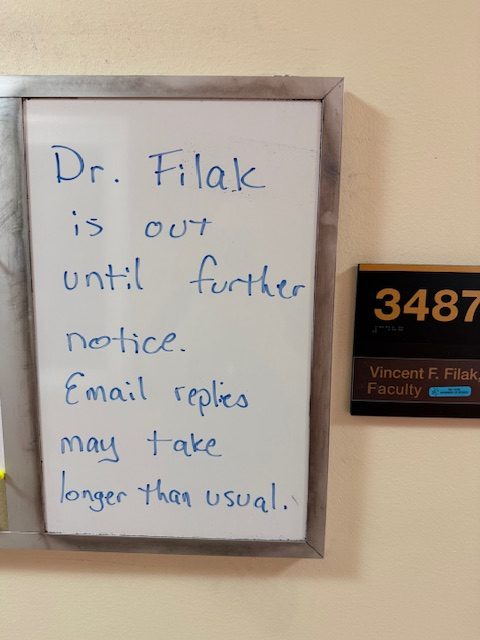
My boss was nice enough to let people know I’d be out for a bit, but this is a little vague… Not like THAT’S gonna lead to speculation…
At the start of every semester, I try to come back with a “X number of things I’ve learned” or a “X years of teaching have taught me” kind of post. It was ruminating (I swear) when my second gallbladder attack in four days hit me badly enough to head to the ER at midnight the day before school started.
Although everything went well, I found myself living out little moments that had me shifting into “analogy mode” as I saw parallels between where I was (the hospital) and where I wanted to be (a journalism classroom). So, as I continue to mend and catch up with the 82,324 things that have landed on my desk while I was gone, I thought a simple slow-walk post of advice would be a good start to what has already been a shaky semester.
(Also, to be fair, I’m still on meds, somewhat hazy and worried I’d somehow come in hot on a topic like Bad Bunny or something that would end up getting me fired without me entirely knowing why.)
So, here are a couple of the maxims that ring true in journalism that kind of came home to me throughout my hospital stay and recovery:
ACCURACY ABOVE ALL ELSE: We’ve been having a lot of conversations like this around the house:
Me: Who called?
Zoe: She didn’t leave her name on the voicemail.
Me: Can I listen to it?
Zoe: She was just like “Hi, this is mumble mumble and I’m with…
Me: So she did leave a name, but you just didn’t understand it? Is it possible that maybe if I listened to it, I could figure it out?
Zoe: Well, I guess…
As much as I expect that out of my kid, I didn’t think I should expect it from a healthcare provider.
Case in point: Upon leaving the hospital, the discharge nurse is going through all the stuff I should or should do, eat or drink. She tells me to avoid fried food and fatty food like bacon. Due to the lack of the gallbladder, these things are likely to create severe gastric distress in the early stages of my recovery.
OK, got it. Most of my diet goes on the shelf.
The other night, Amy made this amazing chicken and potato thing that was part of our “healthy eating” resolution for the year. About 20 minutes after I ate it, I’m in stomach-cramp hell for about two hours. Turns out, she used olive oil on the stuff, which has the same basic effect as those other two things, even though the nurse didn’t mention it and we all usually seem to think olive oil baking is good and deep-fried drumsticks are bad.
I often think about the way in which we ask questions of people in journalism and how we get “almost” answers, or how sources provide information that’s direct but not entirely accurate. From now on, I plan to start interrogating sources like the entirety of my GI tract depends on it.
VOCABULARY MATTERS: We always talk about picking the right word, the proper descriptor or the exact phrase to help the audience understand things accurately. In news stories, it’s relatively important. In the medical field, it means a hell of a lot more.
In trying to explain what he found when he dug into my gut, the surgeon referred to the gallbladder as “angry,” “wicked” and “gnarly.” Those descriptors sound more like the tappers at a South Boston pub than a description of a human organ.
In addition, he explained that something had happened causing my gallbladder to grow a “rind” over the top of it and encase it tightly against my liver. What created said rind and what the rind was composed of, he would not venture a guess. Apparently, I just have a brie-like defense mechanism against gallstones or something.
I didn’t need the whole medical textbook explanation, but it did dawn on me that I felt like I was interviewing Nuke LaLoosh in “Bull Durham” for a bit here:
When it comes to telling people things, keep your audience in mind and use strong, clear vocabulary that helps the folks out there understand exactly what is going on and why they should care.
CONNECTIONS CUT BOTH WAYS: We talk a lot in reporting about the importance of having strong connections with good sources. Those kinds of relationships can give you an edge when it comes to a big scoop, a key interview or a sense of confidence on a topic.
They can also be a problem if sources try to ask you for things you can’t provide or they assume you won’t write about things they don’t like. I always tell students, “It’s great having the mayor feeding you tips, right up until the point his kid gets busted for a DUI and he wants you to keep it out of the paper.”
In terms of connections at the hospital, I was not only being treated at the same hospital where Amy had worked for several years, but I was actually on her old unit. This led to some significant comfort for me in terms of knowing (relatively speaking) who some of these folks are. It was also great because they had nothing but praise for Amy and wanted to know how she was doing at her new job and so forth. I also knew I had a rock-star surgeon because Amy had worked with this guy’s post-op patients over the years, so she knew him and his work.
The “cuts both ways” part really was more of my own making, in that I was groggy and gimpy most of the time, with that “gown” barely doing much of anything. As a massive social hermit, I don’t even like to be in the house when Amy has friends over, so you can imagine how I’d feel about needing their help to wander semi-bare-assed to the bathroom several times a day.
(The closest parallel I can offer is this one time when my parents and I went to a restaurant during the summer and it turned out one of my mother’s teaching colleagues was there waiting tables. She ended up as our server, which felt awkward as hell when I needed to flag her down for another Diet Coke or ask about desert. And at least I was fully clothed there…)
The nurses and staffers were totally professional, even when I managed to set off the bed alarm that Amy used to tell me would tick off the staff to no end. They were also patient with me as my body seemed to be re-calibrating all functions at the same time for no real reason. And it wasn’t like I would be flailing naked down the halls if Amy DIDN’T know these people. Still, it was a combination of comfort and clumsy.
And finally…
TRANSPARENCY IS THE BEST VIRTUE: My buddy, Pritch, used to tell me that in PR transparency is everything, even if what is happening is something you’d rather hide. Abiding by that rule, the first chance I got, I told everyone in my classes what had happened, what the doctors were saying and when we might be able to get back together.
Some kids who knew me but weren’t in the classes I’m teaching got the message on the whiteboard outside my office and kind of freaked out. My boss explained he didn’t want to disclose my health issues without my permission, which is great. However, I know how the minds of journalists work and I could only imagine what it was these people thought had happened to me.
I’ve told Amy this many a’ time: When I die, put the cause of death in the obituary, no matter what. If I died when I broke my neck falling off the couch trying to complete the “bite your own toenails TikTok challenge,” tell people that. It may appear stupid and demeaning, but if I cared enough about it to die doing it, well… there you go. Besides, whatever I did, the speculation of what I might have done will be far worse, I guarantee.
I understand that some folks might be more demure or more guarded than that, which I get, but the less you tell people, the larger the space for the rumor mill to operate. It’s a good rule for PR folks putting out messages and it’s a good thing to remind sources of when they try to get weaselly.
In reading through the articles and posts related to Saturday’s shooting death of Alex Pretti in Minnesota, I forgot the most basic rule associated with the internet:
“Don’t read the comments.”
However, in digging into the comments and hopping amongst media bubbles, I found a few trends in terms of people who usually support the Second Amendment and the right to carry and how they squared the circle involving Pretti’s death:
Pretti was threatening the officers with a gun, and the officers had the right to defend themselves.
Pretti put himself in harm’s way as a purposeful instigator, thus leading to his untimely death.
Pretti had the right to carry and the right to record their actions, BUT when he chose to interfere with law enforcement, he forced the officers’ hand in terms of use of force.
(There are tons of other claims, including one weird-as-hell, AI-photo with Pretti wearing a female body suit made of tattoos and a set of curled horns, but this trio is among the most common.)
If you are asking the question right now of, “How in the hell can people believe this stuff, when we can all see the DAMNED VIDEO?” I have an answer that starts with some research I did about 20 years ago that reflected this dichotomy perfectly.
A few of the front pages that I still have from these two shooting deaths. I was the adviser for the Ball State Daily News in the early 2000s.
THE HISTORY: During my first year at Ball State University as the student media adviser for the Daily News, the campus had a number of students who died in some shocking ways. The two at the heart of this discussion are Michael McKinney and Karl Harford.
In November 2003, McKinney was 21-year-old student at BSU. He spent a Saturday night drinking with friends at some near-campus bars and had planned to stay at one of those friends’ homes, rather than driving home that night.
In his inebriated state, he went to the wrong home and banged on the back door to get let in. The home owner called 9-1-1 to report this person trying to force their way into her home and Ball State police officer Robert Duplain responded. Duplain was 24 years old and had been on the force for 7 months. He had not yet attended the Indiana Law Enforcement Academy when this incident occurred.
Duplain entered the fenced backyard of the home through the only access point and confronted McKinney, who attempted to flee. Duplain shot several times, hitting McKinney with four rounds and killing him.
Subsequent investigations found no wrong-doing on the part of Duplain, who returned to the force briefly before resigning.
Less than six months after that shooting, on March 6, 2004, 20-year-old Ball State student Karl Harford was found shot to death in his car, which was abandoned on the city’s east side.
Police investigations determined that Harford was at a campus party when he offered three individuals a ride home. Experts later stated that Harford had a blood alcohol content of 0.16, which would be twice the legal limit for driving and would have likely impaired his judgment. One of the men had a gun, which he used to force Harford to drive to an abandoned building. The three men forced Harford to his knees, robbed him of $2 and shot him to death. The trio then stuffed his body into the backseat of the car and fled.
Police eventually arrested Brandon Patterson, 18, Damien Blaine Sanders, 21, and a 14-year-old juvenile in connection with the killings. Patterson and Sanders had previous interactions with law enforcement that involved incidents of car theft and gun possession. Patterson pleaded guilty to a “robbery resulting in severe bodily injury” charge and was sentenced to 45 years in prison. Sanders pleaded guilty to robbery and murder and received 85 years. The 14-year-old was held for 15 months in a juvenile facility and subsequently released.
THE RESPONSES: The Daily News covered both shootings extensively and the online coverage drew readership that was disproportionately large in comparison to all other stories the paper had posted at that time. In addition, the comment sections under the stories for these pieces were extremely active.
Many of the responses to the McKinney story had people offering sympathy to Duplain as well as McKinney. People were saying things like, “Rest in Peace, Mikey,” but also things like, “I feel bad for that officer who has to live with this for the rest of his life.” Others noted how this was a “senseless tragedy.”
What I remember most, however, was the way in which a good number of posters were trying to hang some, if not all, of the blame on McKinney. People had commented that he was “way too drunk” and that “he put himself in that situation.” Some people speculated that he had something in his hand that could have been mistaken as a gun. Others noted that he “rushed” at Duplain, leaving the officer no choice but to fire his weapon.
Things kept getting uglier as time went on, with people saying negative things about McKinney and even how he was raised. I still remember one post that McKinney’s sister, Rosie, put on one of the stories, begging people to just stop this, as her parents were seeing all of these negative statements. The posters then turned on her.
In the case of Harford, the commenting was much more cut and dried. Harford was the victim and “those cold-blooded murderers should pay.” Rarely did any of the comments deviate from this pattern and the few that did were quickly shouted down by other posters.
THE STUDY: In all honesty, these shootings devastated the Ball State community, and I know my heart just bled for these families who lost these children. As is the case with most things, when I am in a state of difficulty, I tend to dig into the topic and do some writing (thanatology researchers call this “instrumental grieving), so I looked into doing a study. My buddy Pritch and I decided to look at why it was people reacted so differently to these killings via their online media posts.
Sufficient to say, the statistical data bore out the general vibe we sensed: People in the Harford postings were much more dichotomous in where they placed sympathy (Harford, his family, his friends) and where they placed blame (Patterson, Sanders and the 14-year-old). Meanwhile, the sympathy and blame were much more spread in the case of the the McKinney posters who were much more willing to blame McKinney for his own demise while also feeling sympathy for Duplain.
The Harford situation fit a stereotypical news-as-script pattern to a T: White kid, trying to do a good thing, meets with criminal black element that is his undoing. Police find the evil-doers who are subsequently punished.
The McKinney situation doesn’t do that. McKinney was a white kid who got shot by a white cop. Nobody was arrested and nobody eventually was punished for it.
For the people reading this story, there was suddenly a cognitive disconnect: Good white people don’t get killed by white cops for no reason. Also, deaths like this need some form of resolution, in which blame and punishment are effectively assigned. This situation didn’t fit into the expected patterns of action, so people desperately sought SOMETHING the rationalize why this happened.
(NOTE: We couldn’t code for race, but a number of people did mention their own race in posts and it was almost entirely a white audience. We did see that amplification of both the racial element between the situations as well as finding it easier to sympathize with Duplain as as well. We had a whole section on that, but any academic will tell you, a lot gets cut on the way to publication, thanks to anonymous reviewers.)
When something terrible happens and it doesn’t fit the patterns pre-established in people’s minds, they need to make sense of it and that usually means they bend reality to fit their assumptions:
O’Sullivan and Durso (1984) found that when information being processed ran counter to the established understanding of how a situation was supposed to unfold, individuals did not alter their perception of what should be happening. Instead, they attempted to cognitively reposition the new information to make it congruent with the prior script.
Goleman’s (1985) work also shows that when individuals are faced with an anxiety-provoking alteration to their standard scripts, they actively seek ways to block information or rationalize it in a manner that allows them to return to their comfort zone.
In short, people aren’t going to change their minds when something like this happens. They’re going to change reality to fit what they believe.
BACK TO PRETTI: In bringing this around full circle, a lot more of what people who want to rationalize Pretti’s death are saying starts to make sense. In this world view at least a few of these things are held as fact:
Law enforcement officers are the “good guys.”
People have a legal right to safely carry guns, as per the Second Amendment.
White people and U.S. citizens = good, Non-white and non-citizens = bad
So, when you have a white, citizen who is legally carrying a fire arm that gets killed by law enforcement officials, now what? The thinking has to start shifting the reality.
Just like McKinney, Pretti must have done something wrong to provoke the shooting.
Just like McKinney, Pretti shouldn’t have been there in the first place, so it’s really on him.
Just like Duplain, these officers clearly had to act defensively because they had a reasonable fear of what this individual might do.
The more I read the Pretti coverage, the more I found myself finding parallels to what happened with McKinney.
In both cases, stories trying to find “more dirt” on the victim hit the press: A recent story on Pretti said he had previously scuffled with the feds, leading to a broken rib. (DHS says it has no record of this.) A story after McKinney’s death said he had previous encounters with police, including one leading to a charge being filed against him. (That turned out to be a ticket he received for trying to steal a STOP sign for his room.)
In both cases, the families were pleading with people to stop smearing their kids. The NY Times presented this piece quoting those who knew Pretti, while I remember what Rosie McKinney went through in regard to the postings about her brother.
In both cases, the official narrative painted the shooters as having absolutely no choice but to respond in the way they did.
Even more, as evidence continues/continued to come out in cases like these, people continue to find ways to bend the reality to fit their narrative. For example, a preliminary DHS investigation did not state that Pretti “brandished” his weapon, directly conflicting with DHS Secretary Kristi Noem’s original statements. However, that hasn’t stopped people from pressing the point in comment sections that Pretti put himself in harm’s way or that the officers had no choice but to shoot.
This is why no matter which side of the issue continues to gain ground, there will still be people with a strong attachment to seeing things the way that best fits their prior beliefs. Expecting something different is to expect human nature to change.
One of the first things I tell student media practitioners whenever a major event hits is not to just be part of the noise. If you have something unique to say in a way that matters to your specific audience, do so. If not, you are just as likely to be subtracting from the sum of human knowledge as you are in adding to it.
The death of Alex Pretti on the frozen streets of Minnesota brings out in me so many more thoughts and emotions than I can honestly and fairly express right now, so I’m doing my best to follow the credo I outlined above. Please know it doesn’t mean I am not feeling what so many others have already said, written, shown or expressed.
What comes below are the bits and bites of my thoughts as a journalism professor, former media adviser and citizen of these United States that might be helpful to you in your classrooms and student newsrooms today as you discuss the killing and the coverage:
JOURNALISTS (OF ALL KIND) ARE MY HEROES: They say that journalism is the first draft of history, and the work these folks in Minnesota are doing is absolutely incredible, given the great personal risk people are apparently faced with at this point and time.
The television coverage has been both deep and restrained in terms of saying only what is known, but also not sugarcoating things. That this is so well done is doubly impressive given that it’s happening on a weekend.
When most media outlets hit the “weekend shift,” you end up with a lineup of a recent grad anchoring the desk, providing whatever the regular staff canned up on Friday along with a lite-brite on some Saturday Festival. Add that to an intern holding down the wire desk, some rando doing the weather and an overly excited 14-year-old doing sports, and it’s a recipe for disaster if something really big happens. The networks out there managed to “scramble the bombers” and get everyone doing big work in difficult circumstances and trying times.
On the front lines has been Jana Shortal, an accomplished broadcast journalist with several decades on the job. She not only covered the scene, but then returned to the studio having been pepper-sprayed (or whatever the hell they’re using) while trying to comply with officers’ commands:
(SIDE NOTE: The woman in the middle is Lauren Leamanczyk, who is featured as one of the media pros in the “Dynamics of News Reporting and Writing” textbook. She’s also one of my former students, which is another mind-boggling part of this whole thing for me.)
Above all else, the citizen journalists, who would likely count Pretti as one of their own, put their lives on the line to gather the videos that have showcased exactly what happened during this situations and others like it.
DON’T BE AFRAID TO POKE A SOURCE: Just because a source is saying something, it doesn’t follow that they are making sense or answering a question. Far too often, we fall into the “get a quote” mode when it comes to doing our work, like we’re checking off a chore or picking up a dozen eggs at the grocery store. This is where the concept of active listening comes into play. If you are merely focused on getting the information from the source, and not really listening to that information in real time, you aren’t going to get what your audience needs.
In this case, Bash was respectful and focused. She admitted missteps in her own language while still pushing Bovino to actually answer a question. Literally, any question:
She did make points that a) what Bovino was saying was not what she was seeing, b) she might not have been privy to the same type/volume of evidence Bovino had as a law-enforcement officer and c) she would be willing to accept Bovino’s statements if he could provide proof they were accurate.
This is the essence of journalism: Report, question, verify, disseminate.
CHECK YOUR SOURCES: In listening to the press conferences and press appearances of Bovino and U.S. Secretary of Homeland Security Kristi Noem, it is clear they have a common approach and shared vision of what happened in this shooting. That doesn’t mean they should be quoted with impunity.
In the case of Bovino, his version of ICE and DHS situations has repeatedly been called into question by those who were present at certain events. In one case, a federal judge in a civil suit found that Bovino’s statements related to ICE actions in Chicago were “evasive” and “not credible,” adding Bovino was “outright lying” about his actions. In regard his comments regarding the Pretti situation, Bovino stated the presence of federal officers was related to a “violent, illegal alien” in the area, something that Minnesota’s Department of Corrections has strongly disputed.
Saying a politician has lied is kind of a “Dog Bites Man” story, but in the case of both of these situations, it’s a bit more. If it’s any indication, Minnesota’s Department of Corrections felt these folks were so wrong so often, the DOC launched a website for the “combating of DHS misinformation.”
This is also a perfect point to remind everyone why “said” is my best friend. I don’t know what these two people think, believe or know about this situation, nor would I feel comfortable stating the things they have said as unattributed facts. However, putting out there that Noem or Bovino “said” certain things and letting my audience compare that to their own reality is exactly why I cherish attributions with “said” on them.
DEALING WITH LANGUAGE CHOICES: The way in which people are trying to frame this situation comes down a lot to the language choices we’re seeing out there. This is also why parroting a source (in non-quote format) is a bad idea.
Bovino referred to Pretti as the “suspect” in the situation, a term that implies someone sought for a crime and isn’t usually used to refer to someone shot multiple times on the ground by law enforcement officials. When Bash referred to Pretti as a “victim,” Bovino attempted to invert that term to apply to the border patrol officers, who he deemed “victims” of whatever he thought Pretti was doing.
Language coming out of the administration has included the term “illegal” and “alien” to refer to the individual the officers sought that day, which, again, paints a picture different from terms like “migrants” or “immigrants.”
Whatever terms you choose to use in situations like this, you’re going to be shaping how people look at a situation, so you want to both follow AP style when applicable and also make sure you are remaining neutral
Beyond that, you want to make sure your terms are correct. For example, I’ve read stories that refer to the federal law enforcement officers as “ICE” and “Border Patrol.” Officers in these groups are both housed under the U.S. Department of Homeland Security, but the terms that describe them are not interchangeable. A good primer on who does what and how they differ can be found here.
A number of opinion pieces, social media posts and so forth have referred to the shooting death of Pretti with a variety of terms, including “assassination,” “execution” and “murder.” Each of these terms is defined specifically, both in law and in journalistic style, so no matter how you feel about what happened, you need to take care in using these terms.
Here’s AP’s version of what’s what:
If we consider AP style our rule book, we need to follow the rules, even when we don’t like them.
Finally with language, there is something to be said about how people say things so that something can be factually accurate while also being deliberately misleading. Here’s an example of a statement from Noem’s press conference:
“An individual approached U.S. Border Patrol officers with a 9mm semi-automatic handgun.”
There are two facts in that sentence that are accurate, at least to a reasonable degree:
Pretti, the “individual,” approached a scene with U.S. Border Patrol officers at it.
Pretti was armed with a 9mm semi-automatic handgun.
However, putting them together in this way could lead a reasonable person to think that Pretti approached a group of officers with his gun present in a way that threatened the officers. Noem later used the term “brandished” the gun, although every attempt to get Bovino to provide proof of such a thing led to a dead end.
The point here is why we don’t a) take things people say at face value without proving them for ourselves and b) don’t extrapolate beyond what people tell us. I often tell students that if a police officer says something like “alcohol was believed to be a factor in the crash” or “the driver was operating while under the influence,” you don’t want to say the person was a “drunk driver” as those are two different things. The driver might not have been legally drunk or the driver might have been baked out of their mind on weed.
NOBODY KNOWS NOTHING: I keep going back to that saying because I remember how reporting on crimes and disasters was always a random lottery of “will I have to write a correction tomorrow?” moments. As much effort as journalists put into getting things right, nobody really has any idea of what we will find out as this continues to unfold. It also doesn’t help now that anyone with a phone and an internet connection can say anything they want with absolute certainty, regardless of its veracity, and we all get to hear it.
“Nobody knows nothing” has always been true, as new witnesses could emerge, more video could show up, interviews with the agents have yet to be completed and more. Hell, we’re still trying to figure out if Babe Ruth really called his shot in the World Series almost 100 years later, so I have no doubt that things are going to evolve here.
I also have no doubt that various groups involved in any situation have their own motives for releasing or withholding information from the public. To that end, a lot of what we learn will be based less on the totality of information, but rather the totality of AVAILABLE information.
This is why we need reporters, not stenographers, in the media today. Good journalists will always find a way to pry loose a fact, debunk a statement filled with “bovine excrement” or get a source to finally explain what’s what. When they do, we all tend to be better for it.
I have no idea who said it first, but I always attribute my first exposure to the journalism maxim in the headline to the legendary George Hesselberg from the Wisconsin State Journal. It’s become one of those things like, “If your mother says she loves you, go check it out,” where we all heard it from somewhere and it relates to a larger truth about our field. (Poynter’s Roy Peter Clark even wanted to name his book, “Get the Name of the Dog,” so trust me, if you haven’t heard it before, it’s out there.)
It popped up in my mind a couple times this week, particularly after Indiana won the national championship on Monday and a reporter asked coach Curt Cignetti about his reference to cracking open a cold one in celebration:
Aside from giving a massive platform to Upland Brewery in Bloomington, Indiana, and earning himself a lifetime supply of suds to boot, Cignetti helped fill in a detail that would likely make for a great story or 500 the next day.
Despite my father’s theory that the difference between a good beer and a bad beer is three of them, the brands of beer can convey a lot about the person drinking them and how they perceive themselves.
Consider this scene from the original “The Fast and The Furious:”
(SIDE NOTE: I’m working on a “Snide Guide to Beer Choice” that falls along the line of the “Bitter Personal Analysis of Your Font Choices” that we did a few years back. We’ll see if it gets there…)
Another reason I thought of that maxim came when I saw this press release from the local fire department:
The lack of a name for the dog isn’t the only problem with this release, as it’s got a number of holes that leave me scratching my head:
How bad is it? We can argue what “heavy” means and what it doesn’t, but I always have trouble when I’m faced with a comparative term instead of a concrete one. Think about it like this: The word “tall” is comparative. Are you tall at 6-foot-1? Well, if you’re in a kindergarten class, you’re a giant. If you’re on an NBA team, you’re a point guard at best.
This is where details matter: If you told me the house was uninhabitable due to that damage, I’d be closer to understanding how heavy it was. If you told me how much damage was done via a financial estimate (The fire caused $150,000 damage.), I’d be closer as well. If you told me the house and its contents were a total loss, I’d be OK as well. However, we lack details to fully understand this.
What else can you tell me about the house?I’ve got a two-story wood-framed dwelling, but that’s it. We tend to measure houses based on size (square footage) or rooms (a four-bedroom, two-bath home). That gives us a size of scope. It’s also important to understand if this was packed among a dozen other homes or by itself.
The occupants: The first time we hear about them, we hear they weren’t home when this happened. Then, we find out that they apparently were given shelter at Jeff’s on Rugby, which is a local eating establishment. What I don’t know is how many there are, who they are or when they showed up. I also don’t know what’s going to happen to them next.
I understand that not all of this would have likely made any press release from the fire folks, but it is information I would expect to see in a story of any kind on this topic, as these are the details people likely want to know.
To that end, here are a few tips:
Get as many details as you can, sort them out later: I always assumed that a good editor was going to put me through the paces on what I had and what I didn’t have while they read my story. I remember at least one case where Hess himself asked me if I knew the names of the parents of a kid who had passed. I didn’t, and I really should have, so I had to go back out and get them somehow.
In another case, I had someone ask a coroner what was the caliber of the gun used to kill someone on campus. While that might seem prurient or pointless, I wanted to know because some guns make bigger noises than others when fired and supposedly “nobody heard anything” while this incident was taking place.
For all the times we ask really stupid questions like, “Your husband just died in a giant pork processing machine… How do you feel about that?” the least we can do is ask for details that might lead us to better storytelling later.
Put yourself in the shoes of the reader: One of the best exercises we do each year is a fire brief, in which we have the class members each write a short piece off of a fire department press release similar to this one. They almost all read exactly like this release.
Then, I’ll ask one of the kids in the class, “Let’s say you go home after class and your roommate says, ‘Hey, your mom was trying to reach you. There was a fire at your house.'” What would you most want to know FIRST?
The answers become obvious:
Is anyone dead or hurt?
How bad was the fire?
What the heck happened?
Then, we go back to the releases and start reading them aloud and they realize they either didn’t include ANY of that stuff or they put it in the wrong spots.
One of the best ways to get journalism done well is to think of the people for whom you are doing it. Start with their needs and interests and work backwards into your reporting.
EXERCISE TIME: Go pull a press release or a story and look for places where you think key details are missing. It could be “How many kids were in the class that won the award?” or “What made it harder to de-ice the roads this time?” It could even be, “So was it a Diet Coke or a Diet Pepsi?” See what’s not there and make a case for reasons you would want those details.
While driving home from Milwaukee this weekend, I could see a haze of smoke in the distance that just kept getting bigger the closer I got to the house. I first spotted it about 20 miles south of where I exit I-41 and about 30 miles to the east of the farm.
Smoke like this isn’t rare out by us, as farmers and land owners will often burn brush piles the size of a Winnebago, but this seemed like it might be something more than an average Sunday burn after the Packers game.
When I pulled up to the intersection about three-tenths of a mile from my house, the road was blocked with barricades and squad cars. I managed to weasel my way past the blockade and pull into my drive way, all along wondering, “What in the hell is going on out here?”
A quick check on social media filled me in a bit:
On Facebook and Instagram (at least), a number of people were posting bits of information about what they saw or what they heard:
Even after reading all of the posts I could get my hands on and scouring the local media for more than what the local EMS folks put out, I found myself thinking about the pros and cons of how we get information these days. According to a 2025 study by the Reuters Institute, 54% of Americans get their news from social media today, pushing it past all forms of traditional legacy media. The discussion of partisanship, limited focus and the waning of traditional media power on the national or global level are assessed in this thing, which is great for the big picture.
That said, most of the time, we are likely more concerned with what’s going on around us, which falls to a lot of local media outlets or people around you with internet access. With that in mind, here are a few ways in which that can be a good thing or a bad thing on the local level like what I was dealing with Sunday:
THE PROS:
TONS OF INFORMATION: To be fair to the local social media folks, I got far more, volumewise, out of their work than I ever would have received from TV, radio or a newspaper. The videos, the photos and even the mapping gave me a lot to consume:
I also heard from people who were actively being evacuated from their homes in real time:
These are just a few screen shots of the hundreds of messages that were being shared at this time. Granted, a lot of stuff was repetitive, but I could pick up little nuggets here and there with a careful read of these forums.
CONTINUAL COVERAGE: The local media did the quick check in, put out some information and moved on. The local folks were a lot more interested in keeping an eye on things. At one point, a news outlet noted that everything was under control, but the social media folks (and my own eyeballs) pushed back on that. It seemed as though the wind (which we get a lot of out in our area) had stoked some of the fire in a part of the marsh that wasn’t fully extinguished, and things kicked up again.
By relying on the info from the fire folks, neighborly chatter and nosy folks like me who were willing to ask a cop at a cross street a thing or two, we all kept up to date on how risky things were and what was really going on. Those bits of info were continuing to be posted and shared on social media, as were some updates on when Highway 21 reopened, if the fire had moved any farther south and if additional fire folks were being called to the scene.
When I was a reporter, I found that I did a lot of “hit-and-run” journalism, in that I saw the disaster, wrote about the disaster and moved on from the disaster in a relatively short period of time. That’s kind of the nature of trying to cover everything in a large geographic area. These folks were more concerned about a specific disaster in a specific area and they could dedicate more resources to keeping people up to date.
MINOR NEWS FOR MOST, MAJOR CONCERNS FOR SOME: Social media has the ability to help niche audiences in the ways that traditional media never could. In the case of this fire, that came to the forefront in a few key ways.
For starters, as a lot of people were being driven from their homes and farms, some folks had concerns related to what to do with their pets. A local business up the road from us posted on this topic to help people who were in need:
Other folks felt it important to recognize the people doing the work to keep their homes safe:
These and a lot of other somewhat tangential issues were addressed on the social media platforms that were providing coverage on the fire. From a news-outlet perspective, a lot of these would be somewhat minor concerns, as they don’t impact the entirety of the circulation area or media market. However, to the people who were in the middle of all of this, keeping animals safe and finding ways to help each other in a time of crisis was the No. 1 priority.
This is really where social media, with its niche-level connections, really shines.
CONS:
SAYS WHO? One of the things I’ve found myself scrawling on news stories a lot these days is, “Says who?” My students know that this means they failed to attribute important content that is not a “water is wet” kind of fact to a particular source.
In this case, I found that some issues really didn’t matter to me in terms of who was posting. The videos and photos were relatively similar, so I was pretty sure that they all weren’t the work of AI trying to blame some political policy for a wildfire. In addition, I could triangulate some issues, using multiple platforms to get a handle on the situation.
For example, I knew where Highway 21 was closed by me, I had a couple maps from social media that represented where the fire had spread and I used my map app to look for specific areas where traffic was either light, heavy or prohibited.
However, when I saw this post, I found myself really wondering about source credibility:
My concerns on resharing this on social media (with the guy’s name attached) or believing what he had to say were as follows:
He’s essentially stating on social media that he started this fire. I don’t know if what he did was criminal, in that it sounds like an accidental ignition, but there might be rules about using ATVs in that area or during certain time periods. In making this public, he could not only open himself up to some legal issues, but also let some potentially irate folks know who he is, thus leading to some possible online harassment or worse.
I have no way of knowing if he is telling the truth. In journalism, we tell you that, “If your mother says she loves you, go check it out.” I did some minor sleuthing on this guy’s social media and didn’t find any terrible red flags that he was a bot or a troll, but that’s conjecture, not facts. Given my experiences with people who liked to insert themselves into dramatic police events, I’m erring on the side of caution. (One day, I’m going to write a post about “Whacko Wayne,” but until, then you can feel free to trust me as much as you normally do…)
I have no way of knowing if this guy is who he says he is. This might be someone using this guy’s account to make a statement or it might be some troll deciding it would be hilarious to mess with people. As we found out during the Las Vegas shooting, some people are completely fine using a tragedy for “the likes.”
There are a dozen other things I am paranoid about here, as I am someone who was held to account for what appeared under my byline. In the case of social media, this kind of paranoia is unlikely to exist.
Which brings us to another big concern…
UNTRAINED, UNREADY AND UNAFRAID: The concept of the Dunning-Krueger Effect has become exceptionally popular in the past decade or so. The broader theoretical and sociological aspects of it are often beyond what most of us consider discussion-worthy, but the long and short of it is that people who have a little experience in an issue are irrationally overconfident in what they are doing:
It took me a lot of time and a lot of disasters to become good at covering things like this fire, and even now, I’m not entirely sure I have it nailed down perfectly. That said, the people on social media have access to the same kinds of broad-based communication tools as I would have back in the day, and are completely untrained as to what kinds of things they can/can’t or should/shouldn’t say for legal, professional or ethical reasons.
They’re also completely fine in sharing information without thinking twice about those things, because they were never trained in the way we train media students, who then become media professionals. For example, I don’t know if the guy who said he started the fire actually did it, nor do I know how much consideration he gave to “outing” himself. However, a media professional with experience in this area would have considered those things and had discussions with other professionals before putting that information into the public sphere.
Beyond this issue, I find a lot of accusations on social media that have me breaking out into hives, not because of the accused’s alleged actions, but because of the legal hell-scape that can befall the accuser if things aren’t dead-on accurate. I keep hearing Cliff Behnke’s voice in my head as I see this stuff and imagine what he’d do to me if I just kind of spit-balled things like these people seem to be doing in some cases.
If you don’t know what the risks are when you do something, you tend to be unafraid of those risks. That doesn’t mean those risks aren’t real and can’t hurt you. That’s why we train students to be aware and prepared for these things.
In the end, I’m sure I missed a few more negatives and positives, but the bigger issue is that this kind of approach to locally newsworthy events is likely to continue to slide more toward the social media end and away from the legacy media. I’m not sure what can be done to prepare folks for this or to help them stay out of trouble, but I’d love to hear your thoughts on this.
(I’ve done a number of dumb things with tools. This one, thankfully, has never occurred to me.)
On a relatively frequent basis, I find myself with a new cut, ding, gash, burn or other similar wound as a result of my hobbies. I nearly clipped the top of my thumb off with a Dremel, put a nice slice through the back of my calf with a carpet cutter and slammed my hand onto a piece of sheet metal so hard, Amy could see the tendon that manipulates my thumb.
I’m not alone in my quest for inadvertent body modification, as two of my uncles managed to saw off their thumbs while reaching across table saws. One got his reattached, while the other ended up being only able to count to 9.5 for the rest of his life.
These and other similar moments remind me of something my father told me that his father told him about needing to respect the tools of our trades: The tool doesn’t know it’s hurting you.
In other words, a sander is going to sand when you power it up, regardless of if it’s sanding off a layer of wood or a layer of your fingers. The drill is going to drill a hole through something, whether it’s helping you remove a spot weld on a piece of sheet metal or giving your hand the look of stigmata. And saws are going to cut, and they won’t really know the difference between a tree limb or one of your limbs.
That’s why you always have to understand the purpose of the tool, treat the tool with respect and protect yourself from the harm that the tool can do to you, because it really doesn’t have any skin in the game, unless it’s cutting through yours.
In teaching media writing, I’ve often made the analogy that every skill we cover is another tool that the students get to put in their toolbox. The more tools they have and the better they practice with them, the stronger their work output will become. In covering AI this week, I reinforced that concept with the the analogy outlined above: AI is a tool, neither good nor bad, and you need to understand what it does or doesn’t do before you start playing around with it.
To that end, here are a few suggestions I gave to the students regarding the proper use of AI that I hope might help your folks as well:
USE THE TOOL AS INTENDED: I’ve had a number of bad breaks along the way when it came to trying to use a tool in a way other than it was intended. I’ve broken countless drill bits when I used them on material that was too strong for their composition or tried to widen a hole by rocking the drill around. Neither of these moves were very bright, as I knew better.
That said, I’ve also used tools without thinking twice about how they were actually supposed to be used. For example, it took me a while to figure out why the glass kept breaking in some cabinets I’d refinished before I understood the point of using push-points instead of epoxy.
When someone develops a tool, that tool usually has a specific intended use. When you try to outstrip that purpose or make the tool operate in a way it was never intended to operate, bad things can happen. This is why it’s important to understand what each AI tool is intended to do.
When you are building content for consumption as a media professional, AI tools can be great things, but you have to understand what each one does and doesn’t do, lest you find yourself doing more harm than good.
USE THE TOOL, DON’T RELY ON THE TOOL: My great-grandfather was a carpenter and he actually built the house he lived in for the majority of his life. The ability to do this boggles my mind, as I can’t cut on a straight line worth a damn.
The even more incredible thing is that he did it in the early 1920s without the benefit of power saws, battery-powered drills or air-driven nail guns.
If he had those items, I’m quite certain he could have done the job even faster, but he was still skilled without them, making his work less about reliance on a tool.
As with most technological advances, AI can make things easier on us when we want to get things done. People who have mastered tasks like writing, photography, graphic development and more can now do things faster and better thanks to AI, but that’s mainly due to applying their underlying skills to these new tools
The folks who have mastered these tasks without AI are concerned about what will happen to people who CAN’T function without the AI doing the work for them. These are reasonable concerns, in that it’s never a good thing to become completely dependent on a tool of any kind, lest that tool become unavailable or in some other way problematic.
The best thing you can do in learning media skills is to use AI as one of your many tools, but not let it do the work for you. You need to pair your human nature with those tools to create things that go beyond whatever AI can spit out.
Learn the way in which you can make the tool work for you, and then apply it appropriately.
DO DIFFERENT WORK, NOT LESS OF IT: One of the most tedious tasks for me as a reporter was transcribing recorded notes. It seemed to take forever to get through a small section of an interview and I found myself having to go back repeatedly to get the quotes exactly right. When I learned of true transcription AI, like Otter.ai and others, I found myself falling in love.
The technology was great, it did a reasonably decent job and it took away a task that wasn’t really at the core of what my job entailed. That didn’t mean, however, that I saved myself from doing any work related to this task.
On more than a few occasions, the translation wasn’t perfect. Fortunately, I was able to play the recording again as I watched the text, so I could make changes to the quotes. In other cases, the quotes didn’t pan out as well as I thought, because they weren’t as pure as they likely would have been if I’d have been scrawling text and guessing at a few words. Thus, I had to find better quotes to fit the bill, knowing as I did what was and wasn’t entirely accurate. Although the net benefit was heavily in my favor, it wasn’t a 100-0 sum game.
AI tools do some forms of work for you, which is great, but it doesn’t absolve you of all responsibility. In many cases, it just shifts the work you have to do to something else. Think about moving from being a reporter to an editor in a student newsroom: You are no longer out there gathering facts or bugging people for interviews. Instead, you are asking questions of the reporter, poking holes in the story and generally making sure the reporter is sure.
Take the same approach to AI when you are employing a tool: Check the transcript carefully to be sure it wrote what someone actually said. Check each fact the same way you would if Johnny or Janie Freshman wrote it in their first story for the paper. Scour the material for holes based on your own understanding of the concept, rather than accepting the AI version as gospel.
There are obviously more things you can do to keep yourself on the right side of AI, but like the application of most tools, practice will improve performance and care will limit unintended consequences.
And probably save your credibility from needing a bandage or two.
The company’s suit against Giuliani was based on statements the onetime presidential hopeful made on social media, on conservative news outlets and during legislative hearings in which he claimed the company conspired to flip votes to Biden.
Dominion’s lawsuit was among a series of legal and financial setbacks for Giuliani stemming from his role in spreading election conspiracy theories.
If the “meet-in-the-middle settlement principle” holds true, Giuliani might be on the hook for about $650 million, although he’s already financially crunched due to the loss he sustained for maligning two Georgia poll workers. He’s been trying to declare bankruptcy, but a federal judge tossed that out in 2024, so I’m sure the creditors will continue to circle.
A SHORT, BASIC LEGAL PRIMER ON DEFAMATION: When we cover defamation in the writing and reporting classes, we tend to keep things pretty simple. Obviously, the law is rarely as clean cut as what we’re describing below, but it does at least give you a basic look at what these things tend to require.
We usually start with what we call the “minimum basic requirements” for a viable lawsuit. In other words, you have to prove these basic things just to get on the dance floor, so to speak:
Identification: Can I figure out the person/group/company that is being subjected to this potentially defamatory action?This can be naming someone (“Mayor Bill Smith of Springfield stole money from the Veterans Affairs account.”) or through identification that is obvious to a reasonable individual (“The principal of Smithville Elementary in Smithville, Ohio, who shall remain nameless, has installed illegal video cameras in the girls locker room.”).
Publication:Has the information been sent to someone other than the person who claims to be defamed?Defamation can extend across all media. People usually think about “publication” as being something disseminated via a newspaper or magazine, but that’s not the case. Sharing information through almost any channel or platform can fit this standard. I used to say that you could libel someone on a gum wrapper if you put your mind to it. That’s not that far afield from the truth, in that defamation suits have been put forth over broadcast reports, press releases, advertising and social media posts.
Defamation: Does the statement associate the person with illegal affairs or other nasty business? In most cases, we see issues of criminality here, but it doesn’t mean that this is the only way you can cover this base. Accusing people of being associated with a “loathsome disease” also fits here. So not only could you be in trouble for stating, “Johnny Smith shot a man in Reno, just to watch him die,” you could also be in trouble for saying “Johnny Smith is the reason for the chlamydia outbreak in the Delta Delta Delta house.”
Harm:Did the statements cause damage to the person/group/whatever claiming defamation?I remember once a situation in which a group of little… student government people was trying to get me fired as the adviser of the student newspaper. One of them took to the steps of the library wearing a sandwich board sign that essentially said I helped the paper steal about $74,000 from the university. The funniest thing about it was that he ended up misspelling my name on the sign, thus leading the newsroom kids of that era to refer to me as “Dr. Vinie Filk.”
I was basically blowing it off, but I asked one of my legal eagle buddies, if, just for fun, I decided to sue this kid, what were my chances of winning?
For starters, the guy told me, you’d probably need to prove that you are Dr. Vinie Filk. After we laughed at that, he hit me with the real issue: What’s the actual harm that’s come to you in this situation?
His point was that I couldn’t point to a specific negative thing that happened based on this kid doing this demonstration, other than that the kid was annoying the crap out of me. Had I lost my job, lost a promotion, gotten removed as adviser or a number of other things that were directly related to this kid’s actions, I could show harm.
As it stood, I basically was fine, so that’s how that cookie would crumble in court.
DOMINION GOES 4-FOR-4 AND THEN SOME: In the case of Rudy and Dominion, we can check all four boxes: The company was identified repeatedly in Giuliani’s statements, he was doing it on a boatload of platforms that went out to millions of people and he accused a voting company of rigging an election, something both illegal and “loathsome.”
Harm was easy to prove as well, given they could show actual losses related to statements made about how this company was a fraud. In the Fox suit, they stated easily a $600 million loss based on this nonsense, and that doesn’t count all the pain and suffering the Dominion workforce sustained when people who were all in a lather over this went after them.
ALL OFFENSE, NO DEFENSE: When a suit gets this far, we usually see one of two key defenses applied:
The statements, while clearly not nice, are actually true.
The statements were merely an opinion, so not subject to a suit of this kind.
Other defenses can apply here (The one former Trump lawyer Sidney Powell tried regarding hyperbole is an amazing example of chutzpah…) but for the most part, we’re looking at these two. The truth defense was shot to hell really early in all the Dominion suits, as no one could actually PROVE that the voting company was doing anything nefarious. The opinion defense we dealt with in the previous post on this topic, but it bears repeating here.
Opinions are statements that can neither be proven true or false. For example, “Dr. Filak is a lousy professor” fits the opinion because we can’t define what “lousy” means in any legal fashion. However, “Dr. Filak takes money for grades” is a statement we can prove to be true or false. In the Dominion case, it was clear these statements were meant to be taken as fact and stated as such, despite their falsity.
THE “ONE TO GROW ON” LESSON OF THE DAY: When these things happen, they should serve as a reminder to pretty much everyone who puts content into the public sphere that there are inherent risks in doing so. Over the past decade or so, we’ve gotten more and more comfortable with more and more people saying more and more outlandish stuff in the media and essentially getting away with it.
However, when someone actually decides that what is being said is a bridge too far and sues, what you might have thought of as “provocative” or “entertaining” might end up looking “coyote ugly” in the harsh light of the courts.
As I’ve explained to students over the years in terms of covering crises from a news perspective, I can give you a lot of examples and advice, but there isn’t a step-by-step set of instructions that will cover every situation. Furthermore, you don’t know how you’re going to feel as you’re getting ready to share this information, whether its about a corporate scandal or a major loss of life. However, here are some guiding principles as you try to do the best you can with what you have:
Be quick: One of the most critical factors in crisis communication is timing. The widely accepted rule of thumb is the “15-20-60-90” timeline: within 15 minutes, an organization must acknowledge the crisis. It should share preliminary facts by 20 minutes. By 60 minutes, more detailed information should be shared, and within 90 minutes, the organization should be ready for a press conference or further media engagement. Everything after that is variable based on the situation.
Be accurate: You are the head of the river and the source of everything that flows down stream in terms of information. This means you need to be cleaner than a cat’s mouth when it comes to the information you put into the media ecosphere. Check every fact like you’re disarming a bomb. Verify anything you aren’t sure of. If you don’t know, tell the people that you don’t know and that you will go get that information for them as soon as you can. “No Comment” isn’t the answer, but “I don’t know” will work once or twice during a breaking situation.
Be consistent: In most cases, people will say to have one spokesperson and speak with one voice. That can work in some cases, particularly in the case of things like simple press conferences after disasters. However, in a lot of cases you are trying to put information into the field in a variety of ways, including social media, standard press releases, press conferences and more.
To that end, the goal is consistency across all platforms. If you are running everything, that can be easier than if you have 12 people involved in keeping 12 platforms up and rolling. The best way to keep a message consistent is to minimize the number of messengers and make sure they all are working from the same page each time they release information. Otherwise, the media outlets will go forum shopping.
Be clear: During a crisis, messages must be simple and direct. Avoid jargon and ensure everyone quickly understands all communication, regardless of familiarity with the situation. This is especially important when dealing with diverse audiences.
When doing internal crisis management, focus on how the crisis will impact the various aspects of the enterprise and use the language that best explains the “what” “so what” and “now what” to these people. This is where using shared vocabulary that isn’t common to the public is fine, as it will be more helpful to them than trying to “dumb it down.”
For external crisis management, think about how you would say it to your mom, your best friend or someone else who would want to know what you have to say. Don’t bury them in jargon that would only make sense to people in your field or organization.
Be human: The best public relations acknowledges the human side of the situation, particularly if there is some sort of significant loss for people. That could be the loss of jobs, the loss of property or even the loss of life.
Expressions of concern and sympathy need to happen and they need to be GENUINE. The generic “thoughts and prayers” line is almost as bad as “no comment” in the PR toolbox, so think about what you can say (check with the lawyers if need be) and then say it in a way that makes people think you actually care.
Be current: The 15-20-60-90 rule is a great starter, but it only gets you ahead of the game for a little while. Whether things work out well for you or not depends on if you STAY ahead of the game. That means being current with what is happening and getting it out to the people who need to know before anyone else does.
The reason why leaks happen is because a) people who know stuff think they’re more important than the organization and b) reporters get antsy and look for ways to get stuff faster. (Think about the people who pass you on a two-lane road.) If you are constantly updating people with the best and most current info, you become the main source of information and you control the narrative.
Be aware: As much as you need to be putting information out into the media ecosphere, you need to be on top of what everyone out there is saying about you and the situation. This means keeping an eye on mainstream media reports, social media posts and even idle chatter around an ongoing event.
Rumors gain traction when they are allowed to fester unchecked. So do conspiracy theories and the “I heard from a crucial source that…” people. You need to quash that stuff and the best way to do it is to make sure you know it is going on.