

Sports journalism thrives on record-setting performances, amazing finishes and moments when the impossible occurs. As the NCAA men’s Division I tournament began last week, one “unbreakable” record appeared safe: No 16 seed in that tournament had ever defeated a 1 seed in the tournament. In 135 chances, the 16 seed was 0-135.
The Retrievers of the University of Maryland Baltimore County ended that streak on Friday, defeating the top-ranked team in the tournament, the Virginia Cavaliers, by 20 points. People poured on to social media to relish the moment and celebrate the “David” who just took down “Goliath.” However, in calling the Retrievers the “first 16 seed to ever defeat a 1 seed,” people were factually inaccurate.
The women’s team at Harvard came to the NCAA tournament in 1998 as a 16 seed and defeated the number one team from Stanford, 71-67. Thus, the Retrievers were the first men to accomplish this task and yet not the first team to pull it off.
This leads to three simple lessons to take forward:
- Don’t assume only men play: In a number of sports, men and women participate and women have the edge when it comes to records. For example, the person with the most open-era singles wins at Wimbledon isn’t Roger Federer with eight, but rather Martina Navratilova with nine. The person with the most goals in Olympic soccer history is Cristiane, a player for the Brazilian women’s national team. If you think something is a first, a last or an only, make sure to check both sides of the gender ledger before calling it a one-of-a-kind event.
- Don’t assume your level of competition is the only level out there: Sports have multiple divisions at the collegiate level (D-I, D-II and D-III), so just because a D-I team hasn’t pulled something off, don’t assume no one else ever has. When an NFL record is broken, keep in mind it isn’t the only “pro” league to ever exist, so if you are making a statement about all professional football history, make sure to check back on things like the WFL and the USFL. Or, just stick to calling it an NFL record.
- Don’t assume that because “everybody said” something that “everybody is right: Watching the “first-ever 16 seed” (a redundancy that was almost as bad as the error itself) story fly around the internet had people piling on until someone decided to set the record straight:
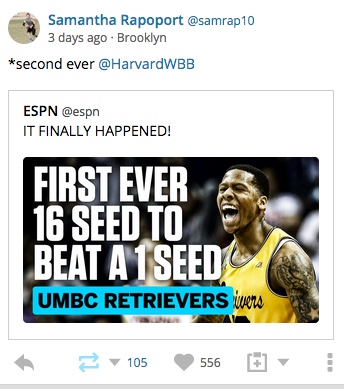

This leads to the main point of this post and the bigger overall lesson: Say ONLY what you KNOW for SURE. Don’t get caught up in the hype or assume something has NEVER happened just because you don’t know that it happened before or because “everyone knows” that something hasn’t happened. Instead, write what you can prove: No 16-seeded men’s team in this history of the NCAA D-I tournament had beaten a 1 seed in 135 attempts before UMBC defeated Virginia.
Your readers will still enjoy your work, the outcome is still impressive and you will have the benefit of being accurate.