“It’s not a riot. It’s a large, prolonged disturbance.” Working through fact-checks and BS-checks (A Throwback Post)

When it comes to fact checking and BS detecting, I often tell students about a story I wrote involving the Mifflin Street Block Party about 30 years ago. The party got way out of hand late at night, with students setting bonfires in the middle of the street and even burning a car. When firefighters arrived to extinguish the blazes, the party participants repelled them with bottles, rocks, cans and anything else they could throw.

With the fire truck damaged and the firefighters outnumbered, the police eventually went in with riot gear and battled for control of the scene, as the party folks chanted, “F— THE PIGS!” at the top of their lungs.

The next day, I’m talking to the public information officer from Madison PD and I ask if, since it was the first time they donned riot gear since the Vietnam War, if they called out a 10-33, Riot In Progress.

“Don’t you dare call this a riot,” he told me.

I then explained I’d seen what had happened and the carnage that was left behind, so if it’s not a riot, what was it?

“It was a large, prolonged disturbance,” he told me before hanging up.

We are apparently entering another period of Jedi Mind Trick 101, in which people in power are telling the media, “Don’t call this a war. It’s not a war.” Therefore, I thought it might be a good time to pull this post the fact-checking exercise along with it out for another run.


Journalism 101: Facts matter, so don’t feel bad about forcing people to get them right

Screenshot

THE LEAD: In a blinding flash of the obvious, the Washington Post reported that politicians don’t like being told they’re wrong about things via a journalistic fact check. In other “water is wet” news, Donald Trump and his campaign seem particularly outraged by the temerity of journalists who actually researched topics and can prove he’s full of beans from time to time:

Trump nearly backed out of an August interview with a group of Black journalists after learning they planned to fact-check his claims. The following month, he and his allies repeatedly complained about the fact-checking that occurred during his debate with Vice President Kamala Harris, berating journalists and news executives in the middle of the televised debate.

And this month, Trump declined to sit down for an interview with CBS’s “60 Minutes” because he objected to the show’s practice of fact-checking, according to the show.

<SNIP>

The moves are the latest example of Trump’s long-held resistance to being called to account for his falsehoods, which have formed the bedrock of his political message for years. Just in recent weeks, for example, Trump has seized on fabricated tales of migrants eating pets and Venezuelan gangs overtaking cities in pushing his anti-immigration message as he seeks a second term in office.

THE BACKGROUND: The joke I always go back to is the familiar one of, “How can you tell when a politician is lying? Their lips are moving.” The idea that politicians fabricate situations is not a new one. Nixon’s “I am not a crook,” Clinton’s “I did not have sexual relations…” and Mark Sanford’s “hiking on the Appalachian trail” are some of the more infamous ones, as they intended to cover over embarrassing personal failings and limit political fall out.

Even more, politicians invent people they saw, they met and they heard, all in the service of some anecdote about salt-of-the-earth farmers getting the shaft, military leaders praising their brilliance or other similar moments of self-aggrandizing puffery. And of course there is the myth-making that surrounds some politicians, like George Washington’s cherry tree or Reagan’s trickle-down economics…

As far as this election is going, Tim Walz was fact-checked on his claims about his service, his presence in China during the Tiananmen Square protests and his family’s use of IVF services, each of which resulted in some disparities. Kamala Harris is also ringing up a few “false” ratings from Politifact on some of her claims regarding illegal drugs and her own previous political efforts.

Still, most of this is piddly stuff compared to what Trump does on a daily basis, both in terms of frequency and intensity. If Walz’s “carried weapons of war” statement is a leak in the truth boat, Trump is continually bashing the Titanic into the iceberg and flooding every compartment.

WHY DO WE CARE AS JOURNALISTS: Despite what the former president of the United States things, facts have a definition:  things that are known or proved to be true. The job of a journalist is to get the facts and report them, so that people can make informed decisions on important things in their lives. If you strip away everything else from journalism, that’s the beating heart at its core.

Telling journalists you will only talk to them if they promise not to fact check you is like telling me, “You can come to our party, but only if you promise to not be a bald, middle-aged white guy.” It’s what I am, so that’s going to be a bit hard to square that circle.

People rely on facts to have a shared understanding of reality, so that society can function. It’s why when we bring a shirt to the check out kid and that shirt is priced $19.99 plus tax, we understand it’s probably going to cost about $21 or $22, give or take your part of the country. If the kid says, “That price is fake news. You owe me $150 and can’t leave until you do,” that breaks the whole “shared understanding of reality” thing.

For years, journalists have been telling people, “You’re entitled to your own opinion, but not your own facts.” Somewhere along the way (I blame the internet), it actually became, “Pick your own facts and then be outraged when someone disagrees with you.”

EXERCISE TIME: Pick out a TikTok on any hot topic that’s going on today (politics, Diddy trial etc.) and write down whatever statements these people are declaring to be facts. Then, go fact check them against

How to harness self-interest in service of improving story structure (A Throwback Post)

One of the hardest things to get my students to do is to work in the inverted pyramid. I don’t think I’m alone in this, given a) most of the stories they’ve read over the years are chronological instead of driven by descending order of importance and b) most of them tend to write expansive term papers for other classes, in which the focus is predetermined and being lengthy is rewarded.

To get them better focused, I often leverage the concept of self-interest: “Instead of thinking about what you, the writer, wants to tell me, the reader, consider thinking about what you would want to know most if you were reading this and then write it in a way that would best meet those needs.”

Sometimes, like this week, we have to go even more basic than that, which brings me to this week’s throwback post about our fire brief exercise. It’s amazing how quickly their viewpoint shifts when I have them thinking about their home being on fire instead of writing about a fire that happened elsewhere. I hope this will help you help your students find focus as well.


The Self-Interest Gap: Learning how to care less about what you want to write and more about what the audience wants to know

Self-interest is perhaps the one commonality humans share these days and it can be summed up in a simple question: “What’s in it for me?”

When you are on the “receiver” end of the process, it’s something we understand very easily. We know almost instinctively what is of value to us and what we care about right away. That said, when we put on the “sender” hat, we tend to focus more on what we want to tell people, forgetting that those people have their own set of interests we should be focused on.

Case in point, I asked the students to write a brief based on a press release about a fire. Here are the opening lines of a few of those briefs:

  • Firefighters responded to an engulfed single-story house shortly after 6 p.m. Sunday…
  • Boone County Firefighters responded to a call of a Sturgeon house fire…
  • Sunday evening, Boone County Firefighters responded to a call at 6pm on an electrical house fire…
  • A structure fire occurred at 520 S. Ogden in Sturgeon on the evening of Sunday…
  • Boone County Firefighters responded to a home engulfed in black smoke…

What we learn essentially in these things is either:

  1. Firefighters responded to a fire.
  2. A fire occurred somewhere.

If you were on the “receiver” end of the information, how much of this stuff would you care about? Of course the firefighters responded to the fire. That’s what they do. Also, fires occur everywhere from giant farm fields to the burn barrel in my yard. However, as a “sender” we tend to ignore that until we are forced to switch perspectives.

In thinking about this issue, I posed a question to the students meant to tap into that idea of self-interest: “Let’s say you get home after class and your roommate says, ‘Hey, your mom was trying to reach you. There was a fire at your house…’ What would be the first thing you would want to know?

Answers came quickly and easily:

  1. Is everyone OK?
  2. How bad was the fire?
  3. What happened out there?

In this case, a good response might be:

“The fire destroyed the house, but nobody got hurt.”

That’s the core of a good lead, with a strong focus on what matters most (big ticket item) and what people cared about most (answer to the first two sentences). When it’s your mom or your house, you have specific interests that a good source of information will attend to. If you can take that perspective and play on the audience’s self-interest, you can have a much sharper focus when it comes to telling the story directly and clearly.

Cleveland Plain Dealer honcho Chris Quinn writes off criticism of his AI passion project as “uninformed outrage,” while still being wrong about almost everything, including college journalism programs

An early photo of Chris Quinn reacting to criticism of his views on AI, journalism schools and journalism professors. 


THE LEAD: Chris Quinn, the VP of content for the Cleveland Plain Dealer, must have a really tired arm from patting himself on the back, or whatever else he does for self-congratulations, as he’s back with another column about the awesomeness of his staff’s use of AI:

The first wave of responses was from regular readers, and most were positive. Several thanked me for showing how we use AI to expand our offerings while maintaining quality.

I suspect I receive little negative feedback about AI now because I’ve written about it so often. I know the anxieties it causes. That’s why I explain how we use it, assure you we are not replacing jobs and promise that humans stand behind everything we publish.

As for anything that might challenge his assumptions, well, Quinn doesn’t have time for that crap:

(A) cranky journalist in another state took offense and on Monday ranted on social media about my practices being the ruination of journalism. Much bombast by others followed.

Or, so I’m told. I didn’t read any of it. I have no time for uninformed outrage on social media channels.

(EDITOR’S NOTE: I was not the “cranky journalist” Quinn spoke of, clearly, because my “bombast” and “uniformed outrage” was published Thursday. Just want to clear that up.)

In the end, Quinn gave all of his supporters a good pat on the head before trying to shame anyone who wasn’t fully on his side:

For those who wrote to say they understand and admire what we’re doing, many thanks. To those who wrote to criticize it, I suggest you look to history to understand that the only path forward is adaptation.

Or, keep stomping your feet until you don’t have a leg to stand on.

CATCHING UP: Quinn wrote an extensive column last week, praising the use of AI as a tool that allowed his staffers to do more reporting and zero writing in some under-covered enclaves of the paper’s circulation area.

In doing so, he decided to take several potshots at colleges, college professors and college students, saying they were doing everyone on Earth a massive disservice by decrying the value of AI, or outright ignoring it.

This led to at least some of the backlash against him, including the piece I wrote here that made what I consider to be three clear, well-reasoned and well-supported arguments:

  • Quinn is wrong about journalism programs not teaching AI or telling students that AI is the devil.
  • AI is a tool that still has a lot of kinks to work out, and it has proven to need some extensive oversight in its current form.
  • The content the PD is producing from its “Report it all, let AI write it up” leaves something to be desired in terms of quality.

In his most recent missive, Quinn didn’t deal with almost any of these criticisms, but then again, I really didn’t expect him to. In reading through his 14 previous letters on AI, I’ve found kind of a pattern in his views on AI. Two broader underlying premises really underscore why I’d love to play poker against this guy:

The Law of the Instrument: The concept has been around for generations, but it’s often attributed to Abraham Maslow, and it basically states that if the only tool you have is a hammer, you treat everything like it’s a nail.

Quinn has so bought into the premise that everything can be done with a strong set of reporters and an AI grist mill, that it’s clear all stories are getting done this way on those beats. The underlying problem is that not all stories can be done well this way.

Quinn mentions things like people wanting to know the score of the Browns game or the outcome of a vote from some board in Lorain. These stories are great for AI to just crank out.

OK, fine, but what about that story of the teacher who donated bone marrow? Or obituaries? Or other stories in which details matter and storytelling can make a difference? These things get ground up and spit out in a bland way that really undermines the quality of the work the reporters have done.

Quinn isn’t alone in this, as I remember having an argument with a broadcast professor during the “convergence phase” of journalism. I noted that some stories were better done in print or online while other stories were better done in broadcast. He argued anything I could do for a newspaper, he could do just as easily for broadcast.

I mentioned things like budget stories that needed mathematical depth and lacked a lot of visuals for video. He told me how he would take video of people typing on keyboards or how he would throw a copy of the budget on the table and film that.

The underlying point in both cases is the same: Yes, you CAN do a story this way but it doesn’t follow it’s the BEST way to do that story.

Often Wrong, Never In Doubt: I heard this phrase in a documentary on financial investors, where a short-seller explained that certain people are very good to bet against because they lock in on an idea and refuse to be dissuaded, regardless of the reality surrounding them.

When they are wrong, but overly confident, they’ll pour vast sums of time and money into risky things that end up going wrong, thus benefiting the people who clearly saw the inherent flaws in those things. Quinn fits this to a T.

In reading through all of his letters to the public, never once did he demonstrate one iota of caution. It was, “This is the greatest thing since sliced bread, so you better get on board.” I seem to remember that same pitch being used to market Theranos, cryptocurrency and MLMs.

Even when I’m really certain on something, I’m always open to the option that I might not be right. If Chris Quinn brought me to the PD, showed me all the great stuff he’s doing, demonstrated how they’d backstopped AI to prevent any catastrophic failures and presented data on how great this was serving his readers, I’d be happy to give this whole experiment another look. I believe paranoia is my best friend, so I’m looking out for risks and willing to say I’m wrong.

Quinn’s most recent letter just drips with hubris, belittling anyone out there who hasn’t fallen in line while ignoring the issues a bunch of us have raised here (particularly those about how crappy J-school is). It’s telling that after a letter in which he basically said professors suck and J-schools suck, he added this tidbit to the end of his latest missive:

Note: I mentioned a student last week who withdrew from job consideration because of our use of AI. Some readers concluded the student attends Syracuse University. That’s not the case. Actually, Syracuse’s Newhouse School of journalism, a valued partner for us, teaches about AI in journalism. Leila Atassi, one of our editors, will be on the Syracuse campus in a few days to help coach students in how we use AI.

That’s exceptionally tone deaf for two key reasons:

  • You spent an entire column telling everyone that college journalism programs ignore or hate on AI and then without an ounce of irony, mention how great Syracuse is and that they’re doing some awesome AI stuff.
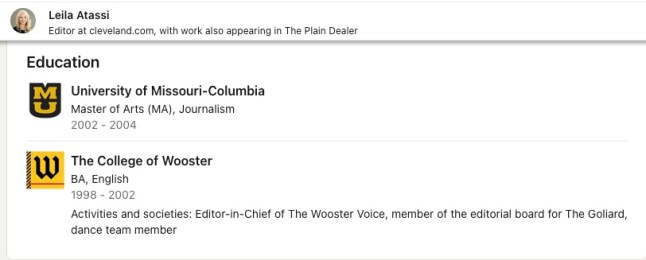
  • You crapped all over journalism degrees and how they’re worthless, yet you’re dispatching Leila Atassi to Syracuse to teach these kids. I wonder what her background is… Oh… Yeah…

And, I’d like to say I believe in Leila and her abilities, if for no other reason, than she went to a hell of a good journalism school for her master’s (and she was actually one of my students for a while.)

In any case, while Chris Quinn thinks I’ll be here stomping my feet until I don’t have a leg to stand on, I’ll actually be watching to see what happens as the PD’s Icarus keeps flying higher and higher on his AI wings.

“He put himself in that situation:” The reason why people can justify the shooting death of Alex Pretti

In reading through the articles and posts related to Saturday’s shooting death of Alex Pretti in Minnesota, I forgot the most basic rule associated with the internet:

“Don’t read the comments.”

However, in digging into the comments and hopping amongst media bubbles, I found a few trends in terms of people who usually support the Second Amendment and the right to carry and how they squared the circle involving Pretti’s death:

  • Pretti was threatening the officers with a gun, and the officers had the right to defend themselves.
  • Pretti put himself in harm’s way as a purposeful instigator, thus leading to his untimely death.
  • Pretti had the right to carry and the right to record their actions, BUT when he chose to interfere with law enforcement, he forced the officers’ hand in terms of use of force.

(There are tons of other claims, including one weird-as-hell, AI-photo with Pretti wearing a female body suit made of tattoos and a set of curled horns, but this trio is among the most common.)

If you are asking the question right now of, “How in the hell can people believe this stuff, when we can all see the DAMNED VIDEO?” I have an answer that starts with some research I did about 20 years ago that reflected this dichotomy perfectly.

A few of the front pages that I still have from these two shooting deaths. I was the adviser for the Ball State Daily News in the early 2000s.

THE HISTORY: During my first year at Ball State University as the student media adviser for the Daily News, the campus had a number of students who died in some shocking ways. The two at the heart of this discussion are Michael McKinney and Karl Harford.

In November 2003, McKinney was  21-year-old student at BSU. He spent a Saturday night drinking with friends at some near-campus bars and had planned to stay at one of those friends’ homes, rather than driving home that night.

In his inebriated state, he went to the wrong home and banged on the back door to get let in. The home owner called 9-1-1 to report this person trying to force their way into her home and Ball State police officer Robert Duplain responded. Duplain was 24 years old and had been on the force for 7 months. He had not yet attended the Indiana Law Enforcement Academy when this incident occurred.

Duplain entered the fenced backyard of the home through the only access point and confronted McKinney, who attempted to flee. Duplain shot several times, hitting McKinney with four rounds and killing him.

Subsequent investigations found no wrong-doing on the part of Duplain, who returned to the force briefly before resigning.

Less than six months after that shooting, on March 6, 2004, 20-year-old Ball State student Karl Harford was found shot to death in his car, which was abandoned on the city’s east side.

Police investigations determined that Harford was at a campus party when he offered three individuals a ride home. Experts later stated that Harford had a blood alcohol content of 0.16, which would be twice the legal limit for driving and would have likely impaired his judgment. One of the men had a gun, which he used to force Harford to drive to an abandoned building. The three men forced Harford to his knees, robbed him of $2 and shot him to death. The trio then stuffed his body into the backseat of the car and fled.

Police eventually arrested Brandon Patterson, 18, Damien Blaine Sanders, 21, and a 14-year-old juvenile in connection with the killings. Patterson and Sanders had previous interactions with law enforcement that involved incidents of car theft and gun possession. Patterson pleaded guilty to a “robbery resulting in severe bodily injury” charge and was sentenced to 45 years in prison. Sanders pleaded guilty to robbery and murder and received 85 years. The 14-year-old was held for 15 months in a juvenile facility and subsequently released.

THE RESPONSES: The Daily News covered both shootings extensively and the online coverage drew readership that was disproportionately large in comparison to all other stories the paper had posted at that time. In addition, the comment sections under the stories for these pieces were extremely active.

Many of the responses to the McKinney story had people offering sympathy to Duplain as well as McKinney. People were saying things like, “Rest in Peace, Mikey,” but also things like, “I feel bad for that officer who has to live with this for the rest of his life.” Others noted how this was a “senseless tragedy.”

What I remember most, however, was the way in which a good number of posters were trying to hang some, if not all, of the blame on McKinney. People had commented that he was “way too drunk” and that “he put himself in that situation.” Some people speculated that he had something in his hand that could have been mistaken as a gun. Others noted that he “rushed” at Duplain, leaving the officer no choice but to fire his weapon.

Things kept getting uglier as time went on, with people saying negative things about McKinney and even how he was raised. I still remember one post that McKinney’s sister, Rosie, put on one of the stories, begging people to just stop this, as her parents were seeing all of these negative statements. The posters then turned on her.

In the case of Harford, the commenting was much more cut and dried. Harford was the victim and “those cold-blooded murderers should pay.” Rarely did any of the comments deviate from this pattern and the few that did were quickly shouted down by other posters.

THE STUDY: In all honesty, these shootings devastated the Ball State community, and I know my heart just bled for these families who lost these children. As is the case with most things, when I am in a state of difficulty, I tend to dig into the topic and do some writing (thanatology researchers call this “instrumental grieving), so I looked into doing a study. My buddy Pritch and I decided to look at why it was people reacted so differently to these killings via their online media posts.

I won’t bore you with the details of the study, but if you want to download it and read it, you can grab it here.

Sufficient to say, the statistical data bore out the general vibe we sensed: People in the Harford postings were much more dichotomous in where they placed sympathy (Harford, his family, his friends) and where they placed blame (Patterson, Sanders and the 14-year-old). Meanwhile, the sympathy and blame were much more spread in the case of the the McKinney posters who were much more willing to blame McKinney for his own demise while also feeling sympathy for Duplain.

The “why” came to us from two areas of research: Human cognitive processing and the way in which news stories (especially crime stories) tend to follow “scripts.”

The Harford situation fit a stereotypical news-as-script pattern to a T: White kid, trying to do a good thing, meets with criminal black element that is his undoing. Police find the evil-doers who are subsequently punished.

The McKinney situation doesn’t do that. McKinney was a white kid who got shot by a white cop. Nobody was arrested and nobody eventually was punished for it.

For the people reading this story, there was suddenly a cognitive disconnect: Good white people don’t get killed by white cops for no reason. Also, deaths like this need some form of resolution, in which blame and punishment are effectively assigned. This situation didn’t fit into the expected patterns of action, so people desperately sought SOMETHING the rationalize why this happened.

(NOTE: We couldn’t code for race, but a number of people did mention their own race in posts and it was almost entirely a white audience. We did see that amplification of  both the racial element between the situations as well as finding it easier to sympathize with Duplain as as well. We had a whole section on that, but any academic will tell you, a lot gets cut on the way to publication, thanks to anonymous reviewers.)

When something terrible happens and it doesn’t fit the patterns pre-established in people’s minds, they need to make sense of it and that usually means they bend reality to fit their assumptions:

O’Sullivan and Durso (1984) found that when information being processed ran counter to the established understanding of how a situation was supposed to unfold, individuals did not alter their perception of what should be happening. Instead, they attempted to cognitively reposition the new information to make it congruent with the prior script.

Goleman’s (1985) work also shows that when individuals are faced with an anxiety-provoking alteration to their standard scripts, they actively seek ways to block information or rationalize it in a manner that allows them to return to their comfort zone.

In short, people aren’t going to change their minds when something like this happens. They’re going to change reality to fit what they believe.

BACK TO PRETTI: In bringing this around full circle, a lot more of what people who want to rationalize Pretti’s death are saying starts to make sense. In this world view at least a few of these things are held as fact:

  • Law enforcement officers are the “good guys.”
  • People have a legal right to safely carry guns, as per the Second Amendment.
  • White people and U.S. citizens = good, Non-white and non-citizens = bad

So, when you have a white, citizen who is legally carrying a fire arm that gets killed by law enforcement officials, now what? The thinking has to start shifting the reality.

Just like McKinney, Pretti must have done something wrong to provoke the shooting.

Just like McKinney, Pretti shouldn’t have been there in the first place, so it’s really on him.

Just like Duplain, these officers clearly had to act defensively because they had a reasonable fear of what this individual might do.

The more I read the Pretti coverage, the more I found myself finding parallels to what happened with McKinney.

  • In both cases, stories trying to find “more dirt” on the victim hit the press: A recent story on Pretti said he had previously scuffled with the feds, leading to a broken rib. (DHS says it has no record of this.) A story after McKinney’s death said he had previous encounters with police, including one leading to a charge being filed against him. (That turned out to be a ticket he received for trying to steal a STOP sign for his room.)
  • In both cases, the families were pleading with people to stop smearing their kids. The NY Times presented this piece quoting those who knew Pretti, while I remember what Rosie McKinney went through in regard to the postings about her brother.
  • In both cases, the official narrative painted the shooters as having absolutely no choice but to respond in the way they did.

Even more, as evidence continues/continued to come out in cases like these, people continue to find ways to bend the reality to fit their narrative. For example, a preliminary DHS investigation did not state that Pretti “brandished” his weapon, directly conflicting with DHS Secretary Kristi Noem’s original statements. However, that hasn’t stopped people from pressing the point in comment sections that Pretti put himself in harm’s way or that the officers had no choice but to shoot.

Then, there are people like this guy at NewsMax who are stretching reality a little more.

This is why no matter which side of the issue continues to gain ground, there will still be people with a strong attachment to seeing things the way that best fits their prior beliefs. Expecting something different is to expect human nature to change.

Consider the Source: Four Key Things to Keep In Mind When Deciding Whom to Interview

… but I’m gonna quote you anyway!

One of my favorite stories about source credibility came from Jim Bouton’s classic book, “Ball Four.”

Bouton is explaining a situation where a first baseman is coming in to catch a pop fly, yelling “I GOT IT!” repeatedly. Instead of getting out of the way, the pitcher comes flying in and runs the guy over, which lets the ball drop and the batter reach safely.

Bouton then yells to the irate first baseman from the dugout, “(The pitcher) had to consider the source!”

The point, obviously, is that the value of a message is almost directly in proportion to the quality of the source. This is something we need to keep in mind when picking out our subjects for interviews.

Here are four simple things to consider when deciding whom you should interview when you are picking sources for a story:

DOES THIS SOURCE ACTUALLY KNOW ANYTHING?: This might seem like the dumbest start to a post like this, but if the sources in “localization” and “reaction” stories are any indication, this bears consideration. These kinds of stories are among the least popular ones for reporters who absolutely hate having to interact with an increasingly ignorant general population.

It also doesn’t help that we tend to find ourselves asking these people to give us their innermost thoughts on everything from the deployment of U.S. troops on U.S. soil to the decreasing size and quality of funnel cakes at county fairs. The “just do this and get it over with” attitude can really take over.

This can get even worse as we get lazier and do the “Let’s see what the 14 loudest idiots on social media had to say about this topic” and just do screen shots of their Twitter posts before we call it a day.

That said, it’s important to push back on this instinct and really try to figure out if the source actually can add something to the sum of human knowledge. You don’t need to give them a 20-question exam to see if they have an expansive knowledge of presidential powers vis a vis the Posse Comitatus Act, but at the very least see if they ate a funnel cake before letting them complain about it.

KNOW WHY YOU ARE PICKING A SOURCE: Journalism is often learned by sharing among the collective knowledge within an organization. That can be good in some cases, as older reporters can help younger ones learn from the mistakes of yesteryear. In other cases, it’s bad because you find yourself with a narrowing perspective on how things should work.

This is often true when it comes to picking subjects to interview. When I didn’t know who would help me by providing important information and quotes, I’d often ask the folks around me, “Who’s a good source for this?” The names I got back became the sources and then they became part of my stories. The problem with this is that I never once thought about WHY this person was a good source.

Often the “best” sources were the ones most willing to talk, the easiest to reach or who generally “played ball” with the newspaper. These folks often liked seeing their names in the paper and they made it simple for us to get our job done. It was a symbiotic relationship, but maybe not a good one. In retrospect, I often wonder if I was just taking the path of least resistance and not helping my readers as much as I should have.

When picking a source, ask yourself why that source is a good pick. If someone suggests a source, ask that person why the source is good in that person’s mind. If the source meets your needs and avoids problematic concerns, you should be in good shape. If the answer is, “They always get back to us right away,” think a bit more about that choice.

AVOID “POTSHOT PAULIES” IN YOUR WORK:  You need to think about if the source is actually giving you anything other than a self-serving chunk of content that doesn’t really do much for you or your readers. Instead, they decide to take a potshot at a topic of their choosing and you let them get away with it.

I pulled this quote a long time ago during an election cycle and it seems to be emblematic of what I’ve seen in so many political stories:

So, in other words, the person didn’t really answer a question, didn’t give you any real information and you decided the best way to deal with that was to give them the opportunity to use you as a megaphone for their own point of view on a random topic of their choice?

I wish I could get away with that stuff in my job:

Filak refused to comment on the allegations he was selling grades for money, but instead leveled a criticism of his choosing.

“People are worried that the McRib won’t be available all year round,” he said. “This is disastrous for all people on planet Earth and this is where the focus of all humankind should be right now, dammit!” 

If the person isn’t giving you anything of value to your readers, don’t give them a chance to use you to do whatever they want.

ARE THEY ALL SIZZLE, NO STEAK?: We often talk about people who are “good quotes” with the idea that they’re verbose and they usually give us more than the boring cliches that seem to populate most content. We like the turns of phrases they made and the way in which they approach the content.

We had a chancellor one year who was just gifted at weaving prose together into a tapestry of verbiage that would make Aristotle and Shakespeare look like Beavis and Butthead in terms of communication. However, when we would actually look at what was said, we realized there was absolutely no information in the quotes themselves. They sounded great at the time and they had big, important-sounding words in them, but at the end of the day, it was just a whole lotta nothing.

Part of that is our fault for not actively listening and holding people to account for their words. Another part is that we keep going to the same people and expecting different results. If the quotes aren’t doing more than looking fancy and yet signifying nothing, consider another source.

The Ethics and The Collateral Damage of Outing ‘Phillies Karen’


THE LEAD: A viral moment during the Marlins/Phillies game on Friday has turned the lives of several women upside down, as internet “sleuths” have tried to “out” an enraged and entitled fan.

THE BACKGROUND: When Harrison Bader’s home run reached the outfield stands, several fans grabbed for it, including Drew Feltwell who retrieved it for his son, Lincoln. The female fan who lost out on the chase confronted Feltwell and demanded the family give up “her ball.”

After several moments of being berated, Feltwell turned the ball over to the woman who has been dubbed “Phillies Karen.”

Feltwell appeared shaken by the confrontation, the video shows. After a brief interaction, he plucks the ball out of his son’s mitt and hands it to the woman in the Phillies jersey.

He said he made the decision because he did not want to do something he’d regret in front of his kids.

“There was kind of a fork in the road, like, I’m gonna go one direction and then probably regret,” Feltwell said. “Or go this direction and do something in front of my kids that, you know, like a teaching moment.”

In probably two of the best PR moves in recent memory, the Marlins organization dispatched a staffer with a swag bag for Logan, who was there to celebrate his birthday, while the Phillies arranged for Logan to meet Bader, who gave the boy an autographed bat.


THE FALL OUT: The woman in the video has yet to be identified, despite the fact more people recorded her than recorded the finale of “M*A*S*H*.” In addition, her photo has been shared around the internet, both as kind of digital “wanted” posters and some pretty amusing memes:

My favorite is this reference to “Field of Dreams.”

What’s less amusing is what has happened to the women who apparently bear a passing resemblance to this woman and have caught hell for it.

“Ok everyone,” Cheryl Richardson-Wagner posted on Facebook Saturday. “I’m NOT the crazy Philly Mom (but I sure would love to be as thin as she is and move as fast)… and I’m a Red Sox fan!”

Richardson-Wagner has been roasted online as the heartless Phillies fan caught on viral video throwing a stadium-sized tantrum at LoanDepot Park in Miami, bullying dad Drew Fellwell into turning over a home run ball he gave to his young son, Lincoln.

Also…

The other name suggested was Leslie-Ann Kravitz’s, with claims circulating that she was the woman in the clip and had been fired from her job at the Hammonton school district in New Jersey. Here’s the truth of what happened.

Is Leslie-Ann Kravitz the ‘Phillies Karen’?

The claim that Leslie-Ann Kravitz is the ‘Phillies Karen’ came from several anonymous social media handles. It was circulated on X without any substantiating proof. HT.com cannot verify these claims.

Accusing someone of doing something that the public hates a person for isn’t made any better when toss a vague, bold-type caveat in there. That said, it’s at least better than what these people did, flat out saying it actually was Kravitz.


DOCTOR OF PAPER HOT TAKE: Not to be too curmudgeonly here, but today’s “citizen vigilantes” apparently aren’t as good at ruining the “right” person’s life as they once were. In 2003, it only took about 8 hours for Steve Bartman to be the most hated man in Chicago Cubs’ fandom.

Setting that aside, the question of when is it OK to name someone involved in a public act like this requires more than rushing to social media so you can yell, “FIRST!” Traditional media outlets would often debate the merits of naming someone in this situation, the confidence the journalists have in their reporting and the potential fallout of naming someone, even if the identification is accurate.

Not everyone receives that level of ethical training, as the dissemination of content no longer rests in the hands of the venerable “Fourth Estate.” That said, even legacy media have rushed out stories or identifications for fear of being late on the deal, even if the reporting is shaky or the impacts can devastate people. Of the interest elements we preach in the FOCII mnemonic, apparently “Immediacy” seems to be the dominant one.

Being first is one of those things that can kick the adrenaline into high gear for journalists, and I say that as a former “scoop junkie.” The idea of breaking a story and getting your info out to the public first can feel better than a first kiss.

However, I’ve also been on the back end of a few of situations where reporting missteps taken while running down glory road had me an inch away from being fired. Had I been more cautious and less interested in being first, I probably could have avoided more than a few of those situations.

In looking at a situation like this, I’d argue that we should remind ourselves of the most cautious journalist adage I’ve ever heard: “The duty to report is not the same as the duty to publish.”

In short, it’s better that 1,000 guilty Karens should go unshamed than one innocent Karen become an internet meme.

DISCUSSION STARTER: As a reporter, how far would you go to identify this person? When would you feel comfortable publishing a name? What benefit do you see in publicly naming this person, and what do you think would force you to reconsider naming her?


Goodnight, Cliff Behnke. There will never be another one like you.

I bogarted this photo of Cliff from the obit. I’d argue “fair use,” but I probably wouldn’t argue it with Cliff.


Cliff Behnke, the former managing editor of the Wisconsin State Journal and generational journalist, died Sunday in Madison at the age of 80.

The irony of this piece is that it’s impossible to explain Cliff without resorting to cliches, a writing failure the man himself disdained.

Cliff despised lazy writing and wasn’t above telling writers how much redundancies, passive voice and unneeded descriptors displeased him. However, if there is one thing anyone who worked under him knew he hated most, it was cliches, so much so that the concept led his obituary this week:


Spring never sprung under Cliff Behnke’s watch.

“White stuff” didn’t fall in winter, and no reporter ever dared refer to Thanksgiving as “Turkey Day.”

Behnke was a stickler for detail and standards during his four-decade career at the Wisconsin State Journal.

(I managed to pull off a minor miracle once in a weather story when I used the phrase “a white, wintery mix” and Cliff never said a word.)

The cliches really did tell the tale of Cliff, as everyone in Barry Adams’ fantastic obituary seemed to use one now that Cliff could no longer stop them.

He was an “old-school editor,” in that he prized big-picture accuracy, clarity and value while simultaneously picking at the details that would rob a piece of any of those things. He was “no nonsense” in that staffers knew him to be serious and direct, focused and fair as he kept the newsroom moving forward. He was a “newspaperman in the best sense,” spending far more time in his college newsroom than his classes and helping to shepherd the state’s official newspaper throughout the salad days of print journalism.

In reading Cliff’s obituary, one fact discombobulated me: His age. I was in my early 20s during the three years I spent working the night desk at the State Journal. That would have put Cliff in his early 50s back then, which is where I find myself now. I can’t square those numbers, given that I have neither the skills, the seriousness or the stature that Cliff had at this age, never mind how he terrified staffers in a way that is almost impossible to explain.

I feared Cliff, as did a number of the folks quoted in Adams’ piece, but not in the cliche way usually associated with “old school” editors. He never yelled at me, nor did he have a large physical presence that had me afraid of violence. He didn’t break out a string of colorful curse words when dressing me down.

(Cliff was always on the lookout for stray curses making it into the paper. I remember him calling out a sports story that contained a quote like, “We played a hell of a game.” Cliff’s restrictions on cussing in print would make a 1950s all-girls boarding school look like a biker bar. It took at least three phone calls for us to run a quote in one of my stories about a riot with the quote “F— the pigs!” in it. And, yes, that was WITH the dashes.)

Listening to Cliff’s assessment of my screw ups was like watching a ninja throwing razor blades at me. It was just slice, slice, slice until I fell into 1,000 pieces. It could be about something big or about something small, but I still remember (and refer to) a number of them.

In one case, it was a redundancy. I was writing a photo caption about a model train railroad show when I felt the presence of Cliff lurking behind me. He began simply enough:

“Can you imagine if there were 88 model railroad layouts that were EXACTLY the same?” he asked.

“Huh?” I replied, unsure as to if I was having an out-of-body experience because Cliff was talking to me.

“Do you think it would be possible for a group of people to build 88 IDENTICAL model railroad layouts?” he said in that calm, metered voice of his.

“Uh… No?”

“Right. So why are you telling me that there are 88 DIFFERENT model railroad layouts in this cutline? Of course they’re different. That’s redundant.”

He then disappeared almost as quickly as he showed up and I still haven’t forgotten that lesson.

I also never forgot the time I should have been fired for screwing up a brief, in which I reported that a guy was dead when he wasn’t.

It wasn’t bad enough that I screwed it up, but then the local radio stations did their “rip and read” journalism on the air, letting EVERYONE know the guy was dead when he wasn’t. Our competing paper also used to love to crib our stories and then claim they had an “unnamed source” that confirmed the info, so those folks also amplified the story. It turns out everyone was wrong because I was wrong.

The man’s wife was getting condolence calls from people who saw or heard the “news” and she freaked out that the news people knew about his death before she did. After a complete clustermess of a situation, I got called into Cliff’s office for what I assumed would be the end of my journalism career.

After slowly and calmly walking me through every stupid thing I had done and every way a reasonably competent biped could have avoided that stupidity, he told me that the woman wasn’t going to sue us, but she had several demands. Aside from a correction for the paper, I had to write a letter apologizing to the man’s children for screwing up and then I had to hand-deliver it to his wife and talk to her for as long as she wanted.

“You need to go to the hospital at 10 a.m.,” Cliff said. “You will not justify your mistake. You will not discuss your feelings. If anything comes out of your mouth other than, ‘Yes, ma’am,’ ‘No, ma’am’ or “I’m sorry, ma’am.’ You are gone. Do you have any questions?”

I was both young and stupid enough to have one: “Yeah. Why don’t you just fire me now instead?”

His response was perfectly Cliff: “I honestly don’t know, so get out of my office before I figure it out.”

What he taught me that day was responsibility for my actions, the importance of paranoia-level accuracy and that I needed to tough out this painful lesson if I was ever going to be much of anything in this world. As another editor explained to me when I said I should just quit, “How are you ever going to teach a student to do something tough if you won’t do it yourself?”

I didn’t work for Cliff as long as many other people did, nor did I spend much time in contact with him during my time at the paper. In reading some of the online tributes to him, he was both everything his obit said and so much more. He was generous with his time to Daily Cardinal kids, serving on the board and kindly mentoring staffers as they gained their legs in journalism. He was a giving person to friends and family who knew him less as a mythological editor and more as a human being.

What I can say is that there will never be another editor like Cliff, as the confluence of events that made him could not exist today. Nobody is going to spend four decades in journalism anymore, least of all in one state or at one publication. That means we won’t have someone like Cliff who can capture the culture and soul of the audience the media outlet serves. It also means no one will have a firm grasp on all the details that add clarity to local stories, such as if Devil’s Lake gets an apostrophe or where the East Side stops and Downtown starts. He was like Google in a shirt and tie.

Accuracy, the driving force behind Cliff’s work at the State Journal, now seems to be as antiquated as the term “newspaperman,” with people caring more about being first, getting views and making sure “their side” is winning. In the days of newspapers, mistakes were permanent and you couldn’t undo your failures. That fact helped Cliff drive the rest of us to obsess over being right. As much as I still obsess, I know that if someone finds a mistake in this thing, two quick clicks and it’s like the error never happened. As nice as it is to be able to erase public errors, it does make for some lazy journalism.

Above all else, I do wonder how this generation would take to Cliff’s brand of leadership, as to cause fear these days is hate crime and to criticize is a soul-crushing micro-aggression. I wonder how Cliff would work with people who have been known to bring a parent with them on a job interview. Not every 22-year-old who rolls off the college assembly line these days is the stereotype of an entitled snowflake, but I’ve seen a significant crop of emotional hemophiliacs who complain about everything from making deadlines to not getting enough praise for things they’re just supposed to do. The amazing thing about working for Cliff was that we knew he was reserved with his praise and generous with his critiques. That’s why his praise really meant something, unlike the vast sums of participation trophies that line the bookshelves of “kids these days.”

What I do know is that if anyone could have found a way to make all of this work well and get the best out of people in this current environment, it would have been Cliff. He just wouldn’t quit until he did.


Just tell me what happened: The difference between writing for yourself and your audience

Packers announcer Ray Scott was known for his exceptional brevity in calling the game, telling you just what you needed to know and not making the call about him or his ego. We need more media folk like Ray Scott.


When it comes to perfect writing for media, I tend to love the Associated Press and its approach to sports. Here’s a look at a game I cared about:

KANSAS CITY, Mo. — — No. 9 hitter Brayan Rocchio drove in four runs and the Cleveland Guardians beat Kansas City 7-1 Tuesday night, extending the Royals’ losing streak to a season-high seven.

Kansas City was held to two runs or fewer for the fifth straight game and managed just four hits. The Royals’ losing streak is its longest since a 10-game skid from June 5-16 last year.

Since tying Cleveland for the AL Central lead on Aug. 27, the Royals (76-65) have dropped 5 1/2 games behind the Guardians (80-59), who have won five of six. Kansas City maintained a 4 1/2-game lead for the final AL wild card.

The lead is both simple and yet multi-faceted: I know who won (Guardians), when they won (Tuesday night), how they won (7-1), the crucial reason why the won (Brayan Rocchio drove in four runs) and the overall impact of the event (Royals lost seven in a row, which isn’t great if you’re making a run at the playoffs).

The second paragraph covers the losing streak and its historical sense of perspective. The third tells me what the impact on the playoffs is (Guardians up 5.5 games thanks to a winning streak; Royals still in the mix with a 4.5 lead for the last wildcard.)

Here’s a look at how MLB.com went after the same story:

KANSAS CITY — Tanner Bibee has proven time and time again he can pitch in the biggest moments — it’s why he’d be Cleveland’s ace for this postseason. Tuesday was no different.

The Royals loaded the bases with nobody out in the sixth trailing by two runs, but the Guardians stuck with the 25-year-old right hander to get out of the jam in this crucial AL Central matchup — and he did just that.

The lead drops me in the middle of a weird, unattributed moment. Who says he’s “proven time and time again” how great he is? He’s 11-6, which is fine, but we’re not talking Dennis McLain or Bob Gibson in 1968. We also get a weird em-dash thing, followed by an empty phrase used by poor writers: “X was no different.” (If it’s all the same, why are we writing about it? If it’s different, you don’t have to tell me that, as oddity is an interest element.)

The second paragraph again relies on weird punctuation and another empty phrase: “He did just that.”

Then there’s the third paragraph, which has the feeling of a sugared up 4-year-old telling me about his day:

Bibee kept Cleveland’s lead, allowing just one run to come home on a sac fly, to squash Kansas City’s best scoring chance of the game and lead the Guardians to a 7-1 win on Tuesday at Kauffman Stadium. Cleveland, now just a half-game behind Baltimore for the best record in the American League, moved to 4 1/2 games over Minnesota, which lost to the Rays on Tuesday, and 5 1/2 games over the Royals for first place in the division.

You get 80 words (38 and 42 word sentences) of everything you’d want to know in a pile. The second sentence has TEN prepositions, which makes it read like we’re singing this.

This isn’t to pick on anyone or say that one way of doing this is always right and the other is always wrong. In the comparative, you can see a few things that will improve your writing overall:

WRITE FOR THE AUDIENCE, NOT FOR YOURSELF: One of the things that most writers have difficulty with is considering the needs of the audience over their own interest in writing. Sometimes, it’s because we fall in love with the sound of our own voice, while in other cases, we forget that the audience doesn’t know what we know.

In the case of a ballgame, it’s pretty easy to blow off the score or the “where/when” stuff because you just experienced it. You know where you are, what time you were there and who won. That’s great for you, but your readers are still in the dark on the thing they most want to know. I know that when I go online to grab info about games, the first thing I’m thinking is, “I hope the Guardians won.” I’m definitely not thinking, “I wonder what gimmicky approach the writer is going to take this time.”

Think about it this way: If you didn’t know anything about the game, and you only had 20 seconds to live, what would you hope someone would tell you about it before you die.


NOUN-VERB-OBJECT IS YOUR HOLY TRINITY: As is the case with most overwritten sentences, we lack for a strong noun-verb-object core at its center. Each sentence should have a basic premise that starts with “Who did what to whom/what?” If we can nail that down, we end up in great shape. If not, we end up building our sentences on a foundation of sand rather than concrete.

Look at the lead of the first sentence and you see two sets of almost perfect NVO constructions:

  • Rocchio drove in runs
  • Guardians beat Kansas City

Now look at the lead of the second sentence and try to find that same NVO core. Go ahead… I’ll wait… (finishes laundry, grocery shopping, resurfacing the driveway…) Got it yet? OK… I’ll check back tomorrow.

If you can’t nail down the main assertion of a sentence in an NVO core, you probably have both structural and focal problems.


SHOW, DON’T TELL: In the case of the first chunk of text, I get a lot of clarity because the writer SHOWS me how things happened (Rocchio drove in four runs, Royals drop in the standings due to seven-game losing streak).

In the case of the second chunk of text, I get a lot more TELLING (vague telling at that) in terms of what’s going on with the pitcher. I have no idea how he got out of that bases-loaded jam or how many runs scored while the writer is waxing poetic in the second paragraph. I also have no idea what makes Bibee that “go-to guy.” Instead I get punch-phrases like “he did just that” and “Tuesday was no different.”

If you find yourself resorting to cliches, empty phrases or other “Boom Goes the Dynamite” moments, step away from the keyboard and let your adrenal gland relax a bit. Then, show me what’s going on without telling me.


A look back at threats and violence against journalists we know in the wake of the Robert Telles verdict. (A Throwback Post)

Jeff German’s page remains on the Las Vegas Review-Journal’s website more than two years after he was killed. A jury convicted Robert Telles of stabbing German to death over stories Telles found critical of him.

A former Las Vegas official was convicted Wednesday of murdering a journalist who wrote accurate stories about the official’s bad acts while in office.

Robert Telles, an administrator at the Clark County Public Administrator’s office, lost his bid to retain his position in 2022, due in part to Jeff German’s stories of Telles’ inappropriate acts while in office. Telles stalked German at his home and stabbed the 69-year-old man to death, the jury concluded:

The prosecution has indicated it won’t pursue the death penalty. The jury, which said it found the murder to be “willful, deliberate and premeditated,” is set to hear further evidence before deciding on a sentence. Telles could get life in prison without parole, life with the possibility of parole after 20 years, or 50 years in prison with a chance at parole after 20 years. The use of a deadly weapon may also add to the sentence.

“He took the life of an individual who was simply doing his job,” prosecutor Christopher Hamner said at closing arguments.

District Attorney Steve Wolfson said the verdict sent a message that attacks against members of the media won’t be tolerated.

In reading this story, I recalled a post we did more than five years ago where the hivemind folks recalled some of their scariest moments on the job. Threats, violence and intimidation were part of what they tolerated to do nothing but tell their audiences relevant and valuable information. Here’s a look back at what these folks endured and what we still face as journalists today:


“I slept with a baseball bat under my bed:” Journalists share stories of being threatened and attacked.

Rage against “the media” is a common form of expression among people who have the same difficulty in differentiating between “fake news” and “factual stuff they don’t like” as they do “their ass” and “a hole in the ground.”

One of the things that many people forget is that “the media” is actually full of real people who go to work every day. Moms and dads. Sons and daughters. Friends, loved ones and more.

For these people, and those people who care about them, hatred of the media is not an abstract concept. The anger they face is palpable. The threats they receive cause fear. As we noted a while back, we all feel the pain when a journalist is attacked or a newsroom is the site of a shooting.

And all of this takes its toll.

Lori Bentley Law, a broadcast journalist at KNBC, wrote a piece that Poynter featured, titled, “Taking the Leap: Why I’m leaving TV news after 24 years.” Of all the things she mentioned, this one stuck with me:

I’m a happy, positive, optimistic person. I don’t want to be immersed in sadness every day. I don’t ever again want a cute little girl in pigtails to look up at me and say, “We hate you.” I don’t want to hear “Fake News” shouted at me anymore. Or to be flipped off while driving my news van. Or worse yet, to have the passenger in the vehicle pacing me hang their naked butt out the window and defecate. Yes. That happened.

(Law posted her original piece and made her decision even before CNN received a pipe bomb, one of at least a dozen explosive devices sent through the mail to people and organizations throughout the country. Then people like this emerged:)

Bomber
(Yet one more moment where I think, “What the hell is wrong with people?”)


I often tell my students stories of how I had been called a “vulture” and a “scumbag” and worse. I remember one person who told me, “Your mother didn’t raise you right!” Another one, for some reason, told me that he was “gonna get my cousin and we’ll be over to take care of this.” I forget why he was so upset, and I still have no idea why the guy was getting his cousin, but I doubt his relative was a conflict counselor.

The other screaming fits kind of blur into a mess of random anger. Occasionally, I was fearful when I went to shootings or other things and people would tell me to “get the (expletive) out” of their neighborhood. However, most of the time, I was covering late-night crime, so the presence of the police tended to make me feel a bit safer.

In this age of the media being dubbed “the enemy of the American people,” I wondered how bad things are now or what others had faced during their time in the field. I asked the hivemind for any recollections they had of incidents involving angry people, threats or worse.

These are their stories:

The local crank is a constant job hazard for journalists. Between the conspiracy theories related to the clues in the crossword  and the allegations of biased coverage of the local dog show, some people have a lot of issues to work through. One former student encountered a particularly virulent crank with some serious issues:

At a small-town newspaper in Ohio we had a guy who would get mad about articles we wrote, photocopy pages of our newspaper, write profanity on the copies then mail them to us…

My boss actually got a restraining order against the guy because he was stalking her. He liked to slowly drive past her house and glare at her and her family. Following some court hearings and visits by the police, the letters stopped coming, but he’d still curse at me when he saw me covering an event. When I knew he was around I sometimes would have a recorder ready to go so I could record him if he ever threatened me.

This went on for about seven-and-a-half years, beginning in 2010, until the guy died earlier this year.

That same guy also sent an email to our web editor once requesting a full body photo of a high school volleyball player, which was pretty creepy. He loved going to high school sporting events, especially high school girls games.

According to my boss, a teenage girl from another school also had a restraining order against the guy. He apparently printed photos of the girl, action shots from sports and senior portraits, and mailed them to her, requesting she autograph them and send them back to him.


Aside from the generally creepy people, journalists tend to take the most abuse from people who feel they’ve been unfair. A media instructor who covered local politics shared the kind of story people have seen an unfortunate amount lately:

I was threatened by a political candidate a few years ago while working at our local paper. I called him to get his reaction to losing the election, and one of his supporters answered the phone pretending to be the winning opponent. It was obnoxious. I told one of our editors what had happened, and he took to Twitter. The losing candidate called me the next day threatening me (I took it as a physical threat) and promising to exclude me from any news tips he might have — and he had a lot, he claimed.


In some cases, it’s not even the topic of a story who gets angry with the media. A general assignment and sports reporter once came face to face with the family members of a man convicted of a crime:

Closest call came when friends of a defendant charged with killing his friend in a drunk driving crash recognized me one night while I was out with friends watching a band … started with stares, then to whispers and pointing, then to getting in my face to confront me … luckily, had more friends than they did so the issue was quickly calmed down.


A good friend of mine who broke the news of a “Spotlight” -like molestation scandal in the Chicagoland area found herself targeted by the leaders of her own faith:

Torrents of abuse while covering the Catholic Church sex scandal, including being screamed at by a nun (who was basing her rage on being lied to by her bishop, who she probably couldn’t yell at, so) and the now-deceased Cardinal Archbishop of Chicago once shouted at me that a story was unfair in front of an entire congregation.

She also found herself threatened physically for criticizing another “holy man” in the paper:

Our newsroom in Elgin got shot at (we never knew if it was deliberate or just that we worked in a gang territory in dispute). I wrote something semi-critical of Saint Ronald Reagan after he died and a guy called my editor and threatened to kick HIS ass once he was done with mine.


Being blamed for the problems of others is common in the media. I remember once telling a woman on the phone who called to scream at me about a story, “Ma’am, it’s not my fault your son was involved in a shoot out at a Taco Bell Drive Thru.”

Usually, it’s just someone screaming on the phone about a DUI report or something, but for a former student of mine, the “blame game” was much worse:

I covered the lengthy trial of a dermatologist who was accused by about 16 women of abusing his position to sexually assault them. It was already going to be a high-profile case because he was a doctor, one of the most sacred positions of trust. Every time I’ve covered a courts story involving a physician there’s been hordes of satisfied patients who come out of the woodwork to blame the messenger (me, or the media in general) — I’m assuming because that’s easier than acknowledging you put complete trust in someone who is flawed.

Anyway, this trial went to a whole other level of crazy after the doctor alleged he was being unfairly targeted because he previously had a one-night-stand with the female district attorney (she adamantly denied it), and that she was trying to put him behind bars only because she was a spurned ex-lover. The trial, unsurprisingly with so many accusers, didn’t go his way. And on the last day his adult son walked out onto the freeway and stepped in front of a semi-truck to commit suicide…

In a newsletter to the hundreds of patients still supporting him, which he forwarded to other media outlets, he singled me out as causing his son to commit suicide. The case ended up lingering over more than a year as he appealed, and he repeated the accusation over and over again over that time.

It would have bothered me if it wasn’t so batshit crazy. But then again that was nearly 10 years ago and I’m still thinking about it, so maybe he did deliver a few blows to my reporter psyche.


A publisher of a Midwestern paper, who also teaches courses in journalism, said she received blame after covering a football coach and his abuse of players:

I was working as a sports editor at a small market newspaper in the early 2000s. I had to be escorted to and from the office by law enforcement for almost a month after a coach threatened my life following stories I wrote about him assaulting players in the locker room after a tough loss. I was outside the locker room and heard it happening and got it on tape and many of his players came forward and went on record. He was fired and of course, it was all my fault.

That journalist also received some sexist and violent threats more recently:

Last year, I had the mayor of the town I own the newspaper in call my husband and scream at him to “manage his bitch of a wife.” I published a story with his quotes about how the city was knowingly dumping raw sewage into a local creek. Later… our farm (was) vandalized.


People can clearly get angry when you report things they don’t want you to cover. A good friend said he once found himself almost being a punching bag for an angry young man whose house had caught fire:

One time in the early to mid-2000s, I was covering a house fire, and the teenage/young adult son of a man presumed to be inside got right in my face and threatened to beat the daylights out of me (pretty sure that’s not the phrasing he used) because I had no business being there. Turns out the dad was fine, and I’m sure the kid was upset because he thought his dad was dead, but I really felt like I was a millisecond away from taking a right cross to the head.


And that wasn’t even the scariest situation in which he found himself:

There was a period of time when I slept with a baseball bat under my bed, and I remember that was directly connected to some kind of threat I received while on the cop beat — but I really don’t remember exactly what it was. Kind of funny that this sort of thing happens regularly enough that I can’t even recall why I was sleeping with a defensive weapon nearby …


Of all the stories shared among the hivemind, this one was the most terrifying. A journalist recalled an incident that happened to him as a student editor at his college newspaper. A reporter began looking into what he thought was a fairly pedestrian story about a professor. The professor didn’t like the story idea and posted a screed on a website, which led to the whole story blowing up on a national level:

A fan of the professor’s work (unaffiliated with the university as far as I can tell) started sending death threats via Twitter and Facebook to me, some of which was wildly anti-Semitic.

I frankly didn’t know about them until after Public Safety contacted me to warn me about the posts. After months of online harassment and my multiple meetings by phone or in person with law enforcement, he showed up on campus one day looking for me.

He even found and entered the school newspaper office, but luckily I was in class across campus at the time. Public Safety at the school detained him, interrogated him and told him to never return.

I’ve never heard from him since.

Four potential story ideas for student journalists heading back to school

QUICK REMINDER: I’m trying to gather information for folks about what students use AI for and what would make them avoid using it to cheat in class. If you are interested in helping out by reaching out to your students, here’s the link to the survey again:

https://forms.gle/WH9nzpHNT2XbMX5KA

Now, on with the show…

With the start of the semester, it can be a bit tough to get back into the swing of things in terms of coming up with some good fodder for the student media outlets out there. Here are four things that came to mind as I was trying (and failing) to come up with something more profound to launch the blog this year:

COVID COMEBACK: According to the Centers for Disease Control, COVID is making a big comeback, with several new variants getting into the act. When we first faced this mess back in 2020, we were isolating like it was a zombie apocalypse and washing our mail before opening it. Today, it’s treated less like the start of the apocalypse and more as a potential annoyance.

That said, what are the policies your school is rolling out for this? Is COVID now covered under traditional illness policies your school has? Is it still a “get out of class for a week” card? What alerts have the schools enacted regarding shared on-campus housing, dealing with workers who have diminished immune systems and more? Your school’s approach might be nothing and it should be something, or it might be a whole lot more than it needs to be.

FAFSA FAILURES: The Free Application for Federal Student Aid, better known as FAFSA, hit more than a few snags this year thanks to an “improvement” to the online application system. What that meant was hotly debated in the spring and the summer, but now we should be able to see what the actual impact is.

A recent national survey found that the freshmen classes are smaller than expected, with fewer overall financial aid applications  and less diversity in their populations. The individual impact obviously varies from school to school, so it would be a good idea to pull the FAFSA data for your school for the past five years and see where things sit today. Anecdotes will also help if you can find people who took an unintended gap year due to these problems or people who otherwise monitor the enrollment situation at your school.

HOT HOT HOT: Regardless of where you live, late August and early September are ungodly hot, compared to other times of the year. It’s also the time in which students are expected to move back to campus, leading to potential health and housing issues.

A number of news outlets in Minnesota, Wisconsin and other normally not that hot states have done the “it’s hot as hell but they’re moving kids into the dorms” stories, so there’s always a good follow up on that kind of thing. It’d be interesting to see about any medical calls (Hey, dads aren’t going to let some BS heat index stop them from hauling a freezer up 15 flights of stairs…) during the move in as well as any follow up about lack of A/C in student housing. It’s also probably not a bad thing to check on off-campus housing with landlords not keeping the air on or otherwise making the places inhabitable.

HOUSING HELL: The cost of housing in the country has become a focal point of everything from news articles to the presidential campaigns. In many cases, the focus tends to be on single-dwelling homes and hedge-fund maneuvers to corner the market on rental units in big cities. That said, every campus has its own challenges when it comes to housing space and getting students put into it.

I remember a few old stories about the dorms (residence halls, excuse me…) being booked beyond capacity, forcing some students to live in shared spaces until at least a few kids dropped out of school or got kicked out for trying to grow weed on the roof of the com building. Then there is this story out of Madison, Wisconsin that says the housing available to students is well outside their price range. (Paywall. Sorry. But Kim is a great reporter and pretty much the sole reason I’m shelling out whatever I’m shelling out to keep a subscription to the State Journal these days.)

What’s the situation out by you? Do they need to build more residence halls or have Silicon Valley billionaires bought every scrap of land around Northeast West South-Central University to corner the housing market? Also, what kind of living situations are people dealing with these days due to these pricing situations? (I’m always amazed when a student tells me they’re sharing a four-bedroom, one bath home with seven other people. I have no idea how that works…)

Hope this helps! Have a great start to the semester!

Vince (a.k.a. The Doctor of Paper)

4 questions to ask yourself before you interview someone else

Of all the topics that students request help with throughout their journalism journey, the most common one is learning how to interview sources well. Whether it’s in my intro class or my senior capstone-style courses, whenever I ask, “What do you want to get out of this class?” the answer is usually, “I really suck at interviewing… How can I get better at this?”

Repeatedly doing the task is always one good way of improving yourself whenever you feel deficient in  an area. However, interviewing can cause problems for other people while you learn. It’s  like expecting people to stand against a wall while you learn the art of knife-throwing: Until you get good at it, this is really going to hurt.

I often experience a few painful interviews throughout the term, because first-year students in one of our intro classes are required to comb the building for a professor to interview and I usually make the mistake of keeping my door open. They become enamored with the bobbleheads and then, BAM, I’m explaining what life as a professor is like to some kid who looks as scared as a fawn trapped in a semi’s headlights.

A lot of what goes wrong in those interviews is covered  in the textbook, in that the students don’t actively listen or really plan things out very well. To them, I’m just a slab of meat with a mouth that can satisfy their need to accomplish a task. However, a more senior student requested a specific interview with me for a departmental blog post, only to make the same kinds of mistakes these newbies made.

With that in mind, here are four questions a newer journalist can ask themselves prior to requesting an interview that might make their lives (and the lives of their subjects) a little better:

Have you done enough preparation before requesting the interview?

The worst experiences I’ve had as a journalist were the ones where I didn’t feel prepared. In some cases, I was able to get a bit of a pass, given that I covered a lot of breaking news. Thus, there’s no real way to prepare for a random shooting or a house fire that got way out of hand. However, there have been plenty of times where I would need to profile someone or do a news feature on a topic and I kind of half-assed the prep work, only to come face-to-face with a source who wasn’t all that thrilled with me.

The results felt like an awkward blind date, only there was no waitress to bring enough alcohol to improve the situation.

Before you decide, “I’m gonna interview this person,” consider how much you actually KNOW about that person and what it is that will improve the overall vibe and informative nature of the interview. Read up on the person, the topic and the newsworthiness of both before you send an email or make a call to get that person. The better handle you have on the source, the better you can approach them effectively and get everything off on the right foot.


How important is this person to the story you want to tell?

I have found a strange inverse relationship between how important a person actually is to a story and how important they think they are to it. In many cases, I’ve gotten the, “Oh, no… You don’t really need to talk to me about this…” response from people who are vital to a piece and brilliant beyond reproach. I have also had people get into a huff that their bland comment, which added nothing to the sum of human knowledge, didn’t get published because, “Do you know who I AM?”

The value of the source can vary greatly depending on the story you intend to write. In the case of a “Everyone had a great day at the fair” story, if you’ve seen one person eating a funnel cake, you’ve seen them all. Thus, when a source rebuffs your request for an interview, it’s not the end of the world. Feel free to hunt elsewhere.

Conversely, if that person is supposed to be the star of a major profile piece or news story, you need to come loaded for bear. You need to be able to explain to that person why they matter, what makes the story worth telling and how important their participation is in this piece.

It also matters in your overall approach. I’m not saying you should treat sources poorly if they are a dime a dozen for the story, but you do need to be exceedingly careful with wary sources who can make or break a story or reticent individuals who are playing it a bit close to the vest. This is the perfect time to practice those persuasive skills you learned in your public speaking or public relations courses.


Have you practiced?

It sounds almost childlike to practice your interview, either with someone else or by yourself, but you can save yourself a lot of aggravation if you put in a few practice rounds before the big event.

Reading the questions aloud can help you figure out if they actually make sense when you verbalize them. Some things sound great in your head, but lose traction when they hit the paper. Even more, this is where you can figure out if you accidentally slipped in a loaded question or you failed to ask the question you intended to ask.

It never hurts to ask someone to work with you, especially if you’re new at this kind of process. When you ask a question and it strikes an unfortunate nerve with your practice partner, you realize you might need to rewrite that question or rethink the concept.

For example, there are 1,001 ways to ask how a person is coping with the loss of a loved one, and just as many ways of screwing up the ask. Asking “Now that your husband is dead, where do you see yourself going from here,” is probably not going to get the response you had hoped for, unless you really wanted a widow to punch you in the head.

Practice also helps you improve the interview’s flow, prevents you from having to look at your notes as often and makes it feel more like a conversation than an interrogation.


Have you considered what this will be like from the source’s perspective?

We talk a lot about audience-centricity in the “Dynamics” textbooks because the goal of journalism is to work for the audience. With that in mind, think about the “audience” of this interview: the person on the other end of the questions.

When you request an interview, what you are essentially saying is that you want someone to do you a favor. You want that person to stop whatever else it is they’re doing, set aside a block of time for you, allow you to poke at them with a series of inquiries that will likely benefit you more than it will benefit them and then leave them in a mild to moderate panic over what it is you’ll do with what you’ve learned. It’s also an even-money bet they’ll worry you’ll screw stuff up and they’ll have to spend the next several days/weeks/months undoing the damage your stupidity has done to them.

Sounds like a big bag of fun for your interview subject, doesn’t it?

With that in mind, you should probably spend some time putting yourself into the shoes of your interview subject. What can you do to make the process easier on them? What can you do to help them feel like you’re not wasting their time? How can  you structure the interview to make the process work more smoothly?

This also plays into the earlier elements as well. How would you feel if someone asked you for a favor and you graciously granted it, only to have that person show up late? Or look unprepared? Or just sit there like, “Well? Just gimme something quick so I can get out of here!”

As difficult as all of this can be on you as a newer journalist, it can be exponentially harder and uglier for the people who have to deal with the back end of your growing pains.  Do whatever you can to take that person’s perspective into account before you decide to make the interview request.


Verified by ExactMetrics