“I never wanted to make it about me:” Columnist Robert Feder’s reflections upon retirement and what his 40+ years in the field can teach you going forward

One of the best columnists I ever had the pleasure of working with, George Hesselberg, recently posted this item on social media about Chicago-area columnist Robert Feder’s retirement. Feder’s bio is extensive, but simply put, he covered radio and entertainment issues in the Windy City for more than 40 years, during a time of much upheaval in the area and in the profession.

Feder’s reflections on his work, approach, life and more have a ton of value for you as a beginning journalist, even if you never read one of his columns or don’t aspire to be a columnist. In his discussion, two key things hit me as being vital to being good at the job:

FOCUS ON THE NEEDS OF THE READERS: Feder talked at length about his duty to the beat, how he felt obligated to do the best job possible and how he wanted to earn the trust of the readers every time he wrote something. The one part that really drove that home was this chunk:

Readers and subscribers reached out constantly with questions, and they expected answers: “Why did WFMT go off the air for 10 minutes last night?” “When is that weekend weather person going to be back?” “Why did that radio station play the same song twice last night?” Believe me, I don’t carry all that information around in my head — and the answer was probably never going to be a news item for me — but trying to be helpful to individual readers was a big part of the responsibility that I felt.

Feder wanted to make sure he could answer those questions for the readers in a clear and immediate fashion. Despite having been the gray eminence of media columnists, he didn’t see these questions as beneath his attention. It’s not, “Look, dweeb, I’m trying to do a multi-source story here on the Federal regulations halting a multi-million dollar media merger. Who gives a crap that WBZR played “Hooked on A Feeling” by Blue Swede twice in a row?” He seemed to approach it more like, “Someone has a question in my area of expertise. I owe it to that person to answer it.”

This also attaches itself to another key point about audience-centricity: If the audience you serve is interested in something, it’s not a “nothing” story. I remember a lot of expose-style stories my students wrote at my various media adviser stops throughout my career, but the one story that really sticks out to me still was the time the student newspaper at Ball State wrote about something simple: Water cups.

Since the start of the newsroom’s collective memory, the food court below the office would allow anyone to come in and grab a plastic cup of ice water for free. Then, one day, when we dispatched a kid to get a tray’s worth of water for the room, the kid came back and said, “They charged me a dime a cup!” When a staffer called the food service people, the answer was, “Well, it’s always been that way,” which it hadn’t, and then another person up the food chain said, “Well, it’s just what we need to do,” without explaining how, when or why this decision was made.

A story in the paper got a lot of students to rail against this in person and online. Less than a week after we ran the story, water was once again free.

Did the story solve the conflict in the Middle East? No.

Did it cure cancer? No.

Did it matter to the readers? Yes, and that’s the goal of all good journalism.

Whether it’s quick blurb on how a squirrel’s decision to snack on a high-voltage line knocked a station off the air last night or when the weatherperson on channel 3 will return, if people want to know something, give it to them.

DECIDE WHO YOU WANT TO BE: Feder had a number of potential role models when he started, but it ended up kind of coming down to two columnists he discusses below:

Deeb was famous for his take-no-prisoners style. And it was enormously entertaining to read if he wasn’t writing about you. But every time you burn a bridge, you lose the opportunity for that person or that organization to trust you.

So you have to decide: Is it better to write something that makes you the center of attention? Or is it better to focus on the story? I never wanted to make it about me. I just wanted to get the goods and have the people trust me.

In that way, Kupcinet was much more my role model. It was never as important where Kup got his information as was the fact that it was coming from him. When Kup said something was happening, you believed it because you knew that he knew everybody. And I think taking that approach had a lot to do with the longevity of my career.

I would likely argue that in the end, he probably became his own version of Kup, blending those ideas of being an authority without being a jackass with his own personality and sense of how best to meet the needs of the audience. Many parts of a journalism career are formed over time, through experiences and based on reactions we receive from peers, colleagues and audience members. It’s less about being poured into a mold and coming out fully formed and more like being a statue chiseled out of marble.

In any case, it’s important to figure out how you want to approach your career and how you want to operate in it. A lot of people I know tell me that they find someone who was influential in a positive way and emulate that person. I tried to do that with Steve Lorenzo, my first journalism teacher, only to have him tell me not to do that. After that moment, I started working on the opposite side of the situation: I found experiences that were unnecessarily painful, editors who were completely terrible and other similar bad outcomes guided me to what I DIDN’T want to replicate. In many cases I’d think, “What would (NAME OF TERRIBLE EDITOR) do here?” and then I’d do the exact opposite.

In any case, the trick here is to make sure that you are being true to who you are and not trying to play a character to fit the parameters established by another individual. Be you and do it to the best of your ability. That’s what Feder did and it led to a hell of a career.


Throwback Thursday: Ruth Shalit Barrett might not know facts or ethics, but she knows chutzpah

After being called out for fabricating multiple parts of a story in The Atlantic, Ruth Shalit Barrett did the only logical thing she could think of: She sued the publication for defamation:

The Atlantic, in a nearly 1,000-word editor’s note, said that its fact-checking department had gone through the piece and spoken with more than 40 sources, but that Ms. Barrett had misled the fact checkers and lied to the editors.

“It is impossible for us to vouch for the accuracy of this article,” the note said.

In the lawsuit, Ms. Barrett also accused The Atlantic of misrepresenting her background and destroying her journalistic career through what it publicly said about her.

Ms. Barrett was a rising star in political journalism in the 1990s, when she was in her 20s and wrote under her maiden name Ruth Shalit. She was accused of plagiarism in 1994 and 1995 over several passages and sentences in some of her work that resembled the work of other journalists. She left her job at The New Republic in 1999, and has had few articles published in the last 20 years.

The Atlantic said in the editor’s note that it had originally used the byline “Ruth S. Barrett” at Ms. Barrett’s request “but in the interest of transparency, we should have included the name that she used as her byline in the 1990s.” The note said that Ms. Barrett had been assigned the story because “more than two decades separated her from her journalistic malpractice at The New Republic” but that editors regretted the decision.

No words. My words have failed me.


For Throwback Thursday, here’s a look at the original piece we did on the blog when the story about her story broke back in 2020:

Four common threads associated with journalism malfeasance: A look at Ruth Shalit Barrett’s fraudulent story for The Atlantic

There’s a pretty good reason why people constantly scream that the media is full of “fake news” get traction on their arguments:

Two weeks after publishing a long, juicy and instantly viral story about the world of competitive niche sports, and the wealthy parents who push their children to play them, the Atlantic on late Friday appended a nearly 800-word editor’s note informing readers that it was “deceived” by the story’s author, Ruth Shalit Barrett.

By Sunday evening, the magazine had gone further, announcing that it had retracted the story altogether. “We cannot attest to the trustworthiness and credibility of the author,” an expanded editor’s note said, “and therefore we cannot attest to the veracity of the article.”

This wasn’t the author’s first scrape with journalistic malpractice. In the 1990s, she worked at The New Republic where she was fired for plagiarism and taking liberties with her copy. As she noted for this story, written shortly after her dismissal, she was there alongside fellow journalism pariah Stephen Glass, who fabricated multiple stories and faked large portions of others:

“Steve Glass was boring, a boring fabulist, the Milli Vanilli of journalism. There were all these sorts of pieces written about how he was this brilliant, misunderstood genius who was hemmed in by the literature of fact. I think that’s wrong, that the appeal of his pieces was that they were supposedly full of all this great reporting. If you go back and read these pieces knowing that it was all made up, they don’t seem fun anymore,” she says.

“When people started writing pieces about Steve Glass, it all sort of got thinned out….It was ‘Steve Glass, fabulist’ and ‘Ruth Shalit, plagiarist.’ The rest of who I was and what I had done got dumped. And that was a drag, because if you stand back, there are good pieces with solid reporting, and that are true, by the way. To equate that body of work to the work of another writer whose entire oeuvre turned out to be this tissue of lies, that seems to be a large leap,” she says.

Leaping forward to her current situation, The Atlantic went to cringe-inducingly painful lengths to lay out the sins of the author and the magazine’s role in letting it see the light of day. In an editor’s note that retracted the piece, The Atlantic noted the following problems with the story:

  • The main character was given the name of “Sloane,” Barrett said, to protect the anonymity of this stay-at-home mother with three daughters and a son. It turned out to be the source’s middle name, which made it easy for people to identify her. In addition, the woman didn’t actually have a son.
  • In the deeper dig, “Sloane” explained that Barrett suggested the invention of the fictional son, and then told her to lie about his existence when contacted by The Atlantic’s fact checkers. At first, Barrett denied knowing about this before fessing up later.
  • The wounds that “Sloane’s” daughter sustained during a fencing competition were false or extremely exaggerated. In one case, Barrett described a piercing throat wound that struck the jugular vein and nearly hit the carotid artery as “a Fourth of July massacre.” The wound didn’t even draw blood, as noted by witnesses who posted on social media. A second wound was described as a deep thigh gash, which it was not, the correction notes.
  • A family involved in lacrosse was identified as living in the wrong city in Connecticut.
  • A statement that some families had built Olympic-sized ice rinks in their backyards had to be corrected to merely state that private ice rinks were constructed. (Olympic rinks measure 200 feet by 100 feet, which approaches nearly a half acre of space.)

As these falsehoods and errors began to crop up, the folks at The Atlantic acted like trauma surgeons in a disaster: They kept tying off bleeders and trying to keep the patient alive. The editor’s note lists two dates in which the magazine added corrective information to the story, before making the decision to finally pull it. (A PDF of the article is still available on the magazine’s website.)

Simply put, they didn’t know how deep the rot really was, but they knew the author had purposefully lied to them:

Our fact-checking department thoroughly checked this piece, speaking with more than 40 sources and independently corroborating information. But we now know that the author misled our fact-checkers, lied to our editors, and is accused of inducing at least one source to lie to our fact-checking department. We believe that these actions fatally undermined the effectiveness of the fact-checking process. It is impossible for us to vouch for the accuracy of this article. This is what necessitates a full retraction. We apologize to our readers.

We have talked at length about a number of these situations, such as journalist Mike Ward’s use of fabricated “real people” across multiple stories,

Historically, there is always the “Jimmy” story that Janet Cooke wrote, in which she told the tale of an 8-year-old heroin addict who turned out to be a fabrication. There is Jayson Blair, who fabricated sources, lied about information he supposedly got from sources and plagiarized the work of other journalists. The New York Times ran a correction of around 7,000 words, in an attempt to fix all of the problems Blair caused and restore some of the paper’s credibility.

Heck, Barrett’s former colleague at The New Republic, Stephen Glass, fabricated content to the point he was portrayed by Darth Vader in a movie.

If you’re looking for a lesson here, the “no duh” one would be not to do this kind of stupid crap, as it is likely to lead to your demise as a journalist while cratering the credibility of every media outlet you ever touched.

If you’re looking for a more oblique lesson, it’s that journalists (and journalism educators, for that matter) are trained to be skeptical pit bulls. We dig into stuff and if we find out you lied, we will burn you so badly you will wish you had died as a child. The Barrett piece started to lose air once outside publications, like Erik Wemple’s blog, began picking at it.

Beyond those two things, consider a few basic observations I’ve come up with about the Barrett situation and some of the previous cheating scandals:

It’s rarely a one-time thing: In the movie version of “Shattered Glass,” New Republic editor Chuck Lane is faced with one piece of copy that he knows is false. The whole story of Ian Restil, a teenage computer hacker, is on the radar of Forbes Digital Tool and reporter Adam Pennenberg. Pennenberg has poked enough holes into this thing to make Lane suspicious and his interactions with Glass confirm it.

The scene that sticks out to me is when Lane finally suspends Glass and is walking past the wall of past issues of TNR. He pauses and you can almost hear the gerbil in his brain hopping onto the treadmill.

He pulls down each issue, flips to the Glass piece in it and starts to read. One by one, he hits something that just doesn’t jibe with reality. He suddenly figures out that this guy has been doing this forever. In the end, 27 of the 41 stories Glass wrote were either partially or entirely fabricated, the movie notes in its epilogue.

This tracks with what you see in the Blair story, where he had been making stuff up and stealing from people for years. His college newspaper, The Diamondback, had issues with him and a retrospective on his tenure at the paper noted people at the time were concerned with his content.

In Barrett’s case, the problems existed decades apart, but they fit this mold.

It’s usually for unimportant crap: My buddy Fred Vultee, a long-time copy editor and now professor at Wayne State University, used to say that you can drown just as easily in two inches of water as you can in the Atlantic Ocean. His point was that the big stories aren’t the only places where disasters occur, but we can screw up just as badly in some of the tiny bits of copy we write as a matter of course.

I find this analogy is pretty applicable here as well, because in most of the cases involving plagiarism or fabrication didn’t do great and mighty things in a journalism sense. In most cases, these fabrications involved some really stupid and tiny things, especially compared to the risk of damage associated with them.

Mike Ward’s actions fit this to a T. He used official sources and their real quotes for the meat and potatoes of his pieces. However, he made up “regular people” and their thoughts out of whole cloth to provide that “spice” in the story. As I mentioned at the time, I get that it’s not a lot of fun to go find those “salt-of-the-earth, real people” at the Waffle House and ask them what they think of a pandemic or something. However, it’s part of the job and if you can’t do it, the very least you should do is avoid faking it.

Glass did “color” pieces, something that’s pretty clear if you review his list of articles. He said he claimed to be a biting expert after Mike Tyson bit Evander Holyfield and he got a radio station to put him on a talk show where he took calls for almost an hour. He said he spent time hanging out with drunk and stoned young Republican turks at the CPAC convention, who sought a “real heifer” of a girl to sexually assault. (“Bad acne would be a plus,” his source was quoted as saying.) He claimed to spend time with bond traders who had to pee in specially made urinals to keep them trading instead of heading to the bathroom. On and on these tales went, each more fantastical than the previous one.

None of it was true, but even more, none of it was necessary. It wasn’t like he was Gary Webb, tracking allegations of a CIA-fueled crack epidemic. He wasn’t trying to get information on the Son of Sam by posing as a bereavement counselor and interviewing a victim’s family. If there had been a kid named Ian Restil who hacked a company named Jukt Micronics, would it have been crucial for everyone to know it? Not really.

A rare exception to this was Blair’s work on the D.C. Sniper case, where he wrote various false claims, including an allegation that authorities found a grape stem at the scene of one of the attacks with shooter Lee Boyd Malvo’s DNA on it.

Overall, however cost-benefit analysis these people took seemed to be all out of whack when it came to what they were doing and what would be added to the sum of human knowledge. What it seemed to do, based on what they’ve said over the years, is fed their egos in some prurient way, which they put above their responsibility to their readers.

Fellow journalists generally have a “Spidey sense” about these folks before the situation blows up:  There are moments in which people around the fraudulent journalists get a “feeling” that something isn’t right. In Blair’s case, there were warning signals all over hell and creation. A group of alumni from The Diamondback sent a letter to the J-school at Maryland after things blew up, outlining all the red flags they saw years earlier. Journalist Seth Mnookin’s book, “Hard News,” outlines the various editors at the New York Times who had huge concerns with Blair before he started “breaking” sniper stories.

The New Republic got complaints about Glass and his stories, noting errors or flat-out falsehoods. As he continued to deepen his fraud, he told a “60 Minutes” interviewer that he got fewer complaints because he was telling entirely fictional stories and that fake people don’t phone the boss.

In Barrett’s case, The Atlantic knew full well that she had a shady past, but the folks who hired her for this piece kind of squinted their way past this, noting her indiscretions were decades earlier and that people can change. Instead, they saw her kick up her malfeasance a notch from plagiarism to flat-out fraud.

Listening to that internal voice that says, “Something’s not right here…” isn’t easy for a number of reasons. First, it’s tough for a lot of journalists to imagine that one of our own would do something like this. It’s antithetical to who we are and what our profession espouses, so thinking this could happen is really hard to swallow.

Second, we are used to hearing crap like this from all sorts of people. Sources who said something might end up getting in trouble once the comment is published, so they call up and claim they never said it. When other reporters complain about the “star” reporter, it can come across like sour grapes. Thus, grousing that this guy or that gal is cutting corners or not fact checking or being a dink can be easily dismissed.

Finally, we can talk ourselves out of this “feeling” pretty easily for a number of reasons. In some cases, it’s because everyone is moving at warp speed covering the news, so we just figure it was a glitch or a “one-off” moment. In other cases, we realize that we’re about to accuse someone of something pretty egregious, so we better be damned sure. In most of these cases, these journalists exploited those weaknesses and continue to do their worst.

The dirt never washes off: Not every faker becomes a household name, but those who have done it and gotten caught tend to find their actions essentially ruin their lives. Outside of a couple interviews on a TV talk show and Mike Sager’s piece in CJR, Cooke has been actively out of communication for decades. Pieces often talk ABOUT her, but rarely, if ever, does anyone manage to talk with her. What could have been an incredible journalism career turned to dust.

Glass spent years going through law school, graduating in 2000 from Georgetown, but is unable to practice law, due to his problems as a journalist. He was able to get work with multiple law firms, but he is not an attorney.

Blair’s career was like a bottle rocket, streaking up through the sky quickly and exploding just as suddenly. In speaking with students at Maryland in 2016, he essentially admitted he harmed himself and the profession to the degree he knows he’d never be able to work in the field again.

Barrett got what all three of those folks, and many others, I would imagine, desperately want: A second chance. She took it and blew it. The “how” is easy to understand.

The “why?” Not so much.


How to cover a shooting or other chaotic event as a beginning journalist

After I ran Thursday’s post on the mass-shooting event in Michigan, a fellow journalism educator posted a note and a request:

I want to get your Dynamics of News Reporting and Writing to read your thoughts on covering shootings.
I teach near Philadelphia, the City if Brotherly Love, that surpassed an annual record of 500 people shot and killed—in 11 months. I am very sad a Temple University student returning from Thanksgiving weekend was shot twice in the chest in broad daylight by a 19-year-old who was trying to carjack him.
Whether shootings are individual or en masse, we must be sensitive to victims and families while seeking answers to curb the killings.
As I’ve said before, if someone asks for something, I will gladly blog about it, so here we go…
I teach crime reporting and breaking news as part of my junior-level reporting class, but I always include a caveat up front:

Reporting on things like shootings, hurricanes, car crashes and other sorts of mayhem doesn’t really lend itself to a lot of guidelines. I can tell you what I’ve done or what I’ve seen, but at the end of the day, how you react to something is entirely your own doing. While we can read press releases and talk about crime, you never know how you’ll react once you’re on the scene of something.

Until you’ve seen a man get pulled out of a thresher or stood 3 feet from a shooting victim’s dead body, you really don’t know how it will impact you in the short term or the long term.

That said, experience has been a pretty good teacher for me, as a crime reporter, a criminal justice editor and a student media adviser, so here is my best advice on how to work a shooting or other chaotic event for the first time.

We’ll look at what to do (or not do) during your reporting phase, your writing phase and your “afterward” phase.

REPORTING PHASE:

PRIMARY REPORTING ADVICE:

Here are two key pieces of advice when it comes to covering these types of events:

Stay Calm: Things can be blowing up all around you or you might never have seen that much blood before in your life. You may be fighting the urge to throw up. Whatever it is, you need to keep your head about you.

A panicking reporter is a useless reporter. You need to take a deep breath and focus on the task at hand.

Stay Safe: Police and fire rescue folks are trying to do their job. You are trying to do your job. Sometimes, those efforts conflict with each other. Regardless of how important you feel you are, you need to realize that their needs trump your needs at the scene of a shooting or other similar event. In many cases, they put up special tape to keep you out of harm’s way. In other cases, they tell you where to stand or where not to stand.

You need to understand that the shooter might still be out there, which can be dangerous or deadly for you or other people. Even if the shooter is dead or captured, police are likely still in a state of high tension, looking for other shooters or dangerous devices. You wandering around where you’re not supposed to be can create serious problems for them and you might be mistakenly viewed as a danger to them or others.  Adrenaline and watching too many “journalism movies” can make us feel emboldened to break the rules to get a major scoop.

Don’t.

Even when the authorities aren’t there to tell you what to do, you need to make sure you use common sense. Don’t stand up against a burning building to do your stand up. Don’t drive into a flood zone and then expect people to bail you out.

Whatever is going on around you, you need to make sure you’re safe and sound. A dead reporter isn’t much more useful than a panicking one.

OTHER REPORTING ADVICE

Use official sources when possible: When we talk about privilege in law, what we are talking about is the right to quote official sources, who are acting in their official capacity, without fear. This generally applies to judges rendering verdicts, congress-folks making proclamations from the floor and probably the pope. In some cases, it also applies to law-enforcement officials and fire folks who are working the scene of what’s going on. Relying on those folks can keep you out of trouble if facts turn out to be less than accurate.

(The law can get squishy here, so it’s always wise to check the rules.)

Even if the law itself isn’t providing you with a shield, interviewing these folks can be better than relying on witnesses or participants when it comes to the big-picture items. Regular folks get rattled when a shooting occurs or a car slams into a wall in front of them. They’re pumping adrenaline and freaking out, so their version of reality isn’t as solid as a crime scene investigator who has seen all this before. Even more, officials tend to have more of the entire picture in hand before they speak, which is beneficial to you as you try to make sense of this.

(Again, this doesn’t mean you won’t get screwed over by the officials at some level, especially if they’re hiding something. However, you can REALLY get screwed over if a regular citizen decides to accuse someone of murder on live air. Yes, that actually happened…)

Engage in empathy during interviews with those involved: Trying to interview someone who is the victim of a shooting, a bystander/would-be victim of a shooting or those who are essentially collateral damage (family, friends etc. of a victim) is a ridiculously difficult proposition.

It can feel ugly and vulture-esque to bother people who just went through a chaotic and traumatic event. In some cases, a reporter’s desire to get the story can get them to push sources for information and exacerbate the trauma. Some publications have lousy editors who lean on reporters to dig into the situation with grace and dignity of frisking a dead body for valuables.

I have had a number of interviews in which I’ve had to approach a family member or friend of someone who just died or was injured in a terrible way. In one case, it was the family of a 13-year-old boy who was accidentally shot by his best friend. In another case, it was the mother of a 17-year-old girl who died after slamming her car into a tree while drunken driving. The first family wanted nothing to do with me; the second talked to me at length. Neither was a pleasant experience.

Empathy and caution go a long way to making this less painful for everyone involved. I tell my students that we’re like waiters at a fancy cocktail party who walk around with hors d’oeuvres on a tray: We offer people something and if they don’t want it, we walk away quickly and politely.

The best example of how to think about this came from Kelly Furnas, a professor of journalism, who was advising student media at Virginia Tech during the 2007 campus shooting. More than 30 people died during an attack in which a student opened fire on campus. Furnas and his staff at the Collegiate Times had to not only cover the story, but eventually write obituaries for each of the fallen.

A quote he gave me years ago still sticks with me:

“The students I talked to were terrified of the fact that they would need to call these families and I said, ‘You don’t assume that these families don’t want to talk.’ That’s a very important thing to these families to tell the story of their son’s or daughter’s lives. That’s a very important thing. A lot of people not only want to do it, but expect to do it.”

He said the students were told to do their best and just give people a chance to speak. If they were outraged by the reporter’s questions, the reporter was to apologize and walk away.

In the end, however, very few people rejected the request for an interview, he said.

Don’t bail out on your duty to report because you are afraid of what people might say. Give them the chance to say no before you do it for them.


WRITING PHASE

Primary Writing Advice

The duty to report is not the same as the duty to publish: When you are working against the clock, trying to break news and pushing back against competitors and social media folks, it can feel like the weight of the world is on you to get SOMETHING out there.

In the olden days, as in before everyone could be online in 3 seconds after they saw something, we could hang on for a bit before having to produce content for public consumption. Broadcasters got the 5, 6 and 10 p.m. newscasts to inform folks. Print journalists could wait until press time to get the best version of reality, or update things between editions.

Today, you are live 24-7, so it can feel like you’re always under pressure to convert whatever you gathered into something for the public.

In the case of chaos, you need to balance that urge against your journalistic training to be accurate above all else. Fast and wrong isn’t doing anyone any good.

If you don’t have something you feel is accurate, supported and clear, don’t pump it out there and figure you’ll fix it later. You can always publish something later. Once you toss something out there, you can never really get it back.


Additional Writing Advice

Play it straight: You are likely living through an emotionally turbulent situation, one unlike anything you’ve faced to this point in your career. Your emotions can run the gamut of fear and anxiety to the sense that you’re about to write the Greatest Piece of Journalism Ever ™ so it’s time to shine.

There’s a reason we teach you the Driver’s Ed Rules of Journalism, namely so that when faced with something completely out of the ordinary, you can rely on your training to do things right. This is one of those times, so don’t overdo anything.

Tell the people what happened and why they care in the most direct way possible. It’s what good pros do:

A 15-year-old opened fire at his Michigan high school Tuesday, killing at least three people and wounding eight others, authorities said, in what appears to be the deadliest episode of on-campus violence in more than 18 months.

Don’t start slathering on adverbs. Don’t hype it with opinions. Don’t turn this into a narrative lead that shifts the focus toward “dig my writing” and away from what happened.

Tell people what happened in the most direct and clear way possible, based on what you can prove.

Speaking of which…


Stick to the facts: In the film “And the Band Played On,” researchers at the CDC are trying to pinpoint the cause of a strange malady that is killing primarily gay men. Their quest to identify the AIDS virus as well as its cause and spread had the virus  hunters relying on a simple mantra: “What do we think? What do we know? What can we prove?” Unless they could hit the “prove” stage, they refused to state something publicly with certainty.

This approach is a good one for anyone covering chaos, especially something that continues to unfold, like an active shooter situation.

If you can stick to the facts and the material provided to you from reliable sources, you can keep your readers informed and avoid spreading misinformation. If you don’t know how many people were shot, don’t guess. Don’t rely on terms like “arguably” to cover over your limited knowledge, saying things like “This is arguably the worst shooting in U.S. history.”

Say only what you can prove at the time, and that also means taking care with how you are stating something.

For example, police can say something like, “The shooter is no longer a threat.”

OK, does that mean he’s been captured? He was killed? He ran out of bullets? Also are we sure the shooter is a “he?” (Make sure in the reporting phase to check these things, as well as other details before publishing.)

Good work on the front end and sticking to what you know on the back end can lead to simple statements like: “Police Chief John Smith said the shooter, a 15-year-old male student at the school, is ‘no longer a threat.'”


Attribute everything you can: One of the key things you should note in the Washington Post lead was the attribution. Even though “authorities said” is vague, the rest of the story was able to fill in specifically who those authorities are and why we should trust them.

I always try to make the point that attributions are like anchor points when you’re climbing a rock formation: You might not need all of them, but it’s better to have them and not need them than need them and not have them. I also note that I’ve never met anyone who has been fired or sued for over-attributing, but more than a few people have ended up on the short end of the stick for under attributing.

When you are writing a story like this, it’s important to look at each statement you type and ask, “Says who?” If the answer is a specific person, include that in the attribution (County Coroner Jill Smith, Police Chief Doug Jones, Superintendent Raul Allegre etc.). If the information is more general, as in you got the same story from multiple people or documents, make that clear as well (Several police officers said the hallway was littered with spent shell casings from an AR-15; Court documents state Principal Helen Carter repeatedly filed reports with the district on this issue; An email chain between the boy’s parents and teachers show that while school officials were worried about his behavior, the parents said ‘Guns are part of his life, so back off.'”)

If you DON’T have a specific source or collective source, where did you get this stuff and how sure are you that it’s right? That’s where people usually screw up, because they assume they know more than they do and they fail to look it up or find a source worthy of attribution.

If you can’t find a source worthy of an attribution, wait until you can before you publish it.


Have someone else read it before it goes out: After you read and reread and reread something again, you can find yourself blind to your work. You also probably cut and pasted a half-dozen things in a half-dozen spots and then undid at least half of that. By the time you think you’re done, you lack any sense of what is actually in there and what you SWEAR you wrote instead.

A fresh set of eyes are a godsend in this kind of situation.

An editor or a colleague who hasn’t read this before will give you a good chance of catching things like if you swapped the name of a victim and the shooter or if you skipped a first reference to a source. It’s something worth doing because you want to make sure you’re right.

My personal stupid thing was that I always got the day wrong for every story I did. For reasons past my understanding, I always wrote that something happened Monday. Didn’t matter what day, week, month or year something happened, I always made it a Monday.

I caught a lot of those on second or third reads, but it was usually up to my editor or a colleague to ask, “Are you sure this happened on Monday?”

Again, you can’t beat a fresh set of eyes.


AFTERWARD PHASE

Never assume you’re done reporting: The thing about chaos is that it doesn’t operate on a schedule. It doesn’t show up as expected or finish up neatly at the end of an hour, like a TV crime drama. You have to make sure you’re frequently checking in to see what’s going on and if you’re still telling people the most accurate and up-to-date information.

Whatever was right as rain at 9 a.m. is completely wrong at 2 p.m.

The arrest that happened last night turned out to be a case of mistaken identity the next morning.

An early body count ends up being much larger or smaller than once was thought.

Assumptions become facts or become worthless as police continue to investigate.

I remember once following up on a story for a fellow reporter who had filed and gone home after her shift was done. The story was about a toddler clinging to life after falling into a creek. The whole story was about hope and prayer and this boy’s will to live. She was a great reporter and a great writer and this was one of those amazing stories she always told.

My job was “just to make sure” if something changed, so about 10:30 p.m., I called the hospital to get an update that might or might not make the paper.

The PR person was kind of half talking to me and half talking to someone nearby when I heard her say, “So… We can tell him then?”

The kid died five minutes earlier when they took him off life support.

I asked about four really bad questions, that ended up having this woman shouting at me something like, “Everything possible was done to save this child’s life!” (which sounds a lot better in print without the anger in her voice). As she’s talking/yelling, I wrote “KID DIED” on a legal pad and held it up for my editor who was across the room.

He saw it and came rushing over as I finished the interview.

“Oh shit,” he told me. “You have four minutes to rewrite the story.”

Long story short, it got done and we got it subbed in for the first edition of the paper. I didn’t get a byline, but I got a hell of an experience and a valuable lesson: Chaos doesn’t operate on your schedule. Make sure you’re constantly checking in.

Engage in self-care activities: One of the easiest things to forget when you’re in the middle of a chaotic event is that you are human and that things do affect you. The job allows you a kind of shield against feeling things or coming to grips with what you’re witnessing at the time.

Don’t kid yourself. You’re taking a beating, whether you know it or not, and you need to heal yourself a bit.

The truth is, you will see things that will gag a maggot, horrors that will haunt you for years and truly inexplicable acts that have you asking “Why?” more times than a 4-year-old after ingesting a pound of sugar. Those things DO leave a scar, whether you want them to or not. They’re there, whether  you realize it or not.

You will need to do some serious self-care activities to keep from sustaining serious damage.

This can be simple decompression things like clearing your mind or coming to grips with things you’ve seen or written. It can be talking through your feelings and emotions with colleagues or looking for things that can help you reset your mind and body.

These things can also include therapy or professional help. Acknowledging and coping with what your work has done to you does not make you weak or soft.

It makes you a human being who wants to take care of their own needs before they can take care of their audience’s.


Stories with holes: It’s not really journalism if you leave me with more questions than answers

10 Cities With the Big Bad Pothole Problems | Firestone Complete Auto Care

If your story looks like this, you’ve got problems.

Sunday morning had me facing my own level of mortality when my dad flashed the obituary section of the paper in front of me and asked, “Did you know this guy?”

Sure enough, I did.

Peter and I had gone to high school together and even been on the debate team at the same time. He was a year ahead of me and was wicked smart. He tutored me in geometry, a Herculean task to say the least, and he was the school’s valedictorian the year he graduated.

He went off to two Ivy League schools, earning a law degree and spending much of his career in patent law out on the West Coast. He died far too young, at age 47, which left me with the question I’m sure most people would have asked:

“How did he die?”

Despite my best googling and research skills, I couldn’t figure this out. I asked a couple people we held in common over the years, only to have them asking the same question I had. I even emailed his law firm and they didn’t have anything to tell me.

Which leads us to the point of this piece: Journalistic content shouldn’t have your readers asking crucial questions when they are done with the story. When I teach editing, I refer to stories that have this problem as having holes. The job of reporters and editors is to make sure the holes get filled or discussed before a story is published.

In the case of obituaries, we’ve discussed this before and explaining that they’re more for the living than the dead, so we need to make sure they serve as a complete telling of the person’s life. It should be clear that the story of the person’s life is the most important portion of the story, but it also remains the case that the only reason we’re telling it now is because the person has died.

(Side note: When I worked at a newspaper a long time ago, the local style guide dictated that an obituary written on anyone under the age of 70 included the cause of death whenever possible, as most people would be curious of what caused this person’s too-soon demise. I found an older edition of the style guide, which required the COD for those older than 60. Several of us surmised that our boss changed it when he got older, as he didn’t want to be in the “acceptable to be dead” demographic.)

(Second side note: I have told Amy that when I die, however I die, she needs to include the cause of death in my obituary. I don’t care if I died breaking my neck by falling off the couch trying to kiss my own butt as part of a TikTok challenge. If it mattered enough for me to die while doing it, tell people. I don’t need folks speculating…)

In the case of larger investigative stories, holes can unintentionally undermine the credibility of sources. When something is missing and readers have questions, they can become suspicious of the entire story.

Case in point: The Kansas City Star dropped a bombshell story of a former KU football player who stated that several of his former teammates harassed and threatened him and his family. The allegations included a teammate loosening the lug nuts of one of his car’s tires, teammates bursting into his apartment to threaten his family and the athletic department trying to buy his silence to the tune of $50,000.

The story mentions four players, but never names them.

I spent half the story wondering who these former KU football players were.

I spent the other half of the story why, if these allegations were credible, the paper didn’t name these dudes who attacked and threatened this kid.

Neither question got answered in the text, leading me to wonder more about the kid making the allegations and the author of the piece than anything else.

Filling in holes like this can allow the readers to make up their own minds about the credibility of sources, the seriousness of a situation and a dozen other things. However, when they are left hanging, they can’t exercise proper judgment.

I recall reading a story more than a dozen years ago about a small-town beef between a mayor and a city administrator over something the mayor had said. The administrator called it something like “the most offensive slur I have ever heard” while the mayor said it was something like “just a plain-folks saying that was being misinterpreted.”

I read the whole story, waiting to see what was said. The writer didn’t include it, didn’t clue me in on what it might be (a racial slur, a demeaning phrase describing people with disabilities, a sexist remark) and also didn’t tell me why that wasn’t included.

The fact I remember this, while I can’t remember what I had for lunch yesterday, clearly demonstrates that holes can stick with a reader for quite some time.

Here are a few things you can do to find and fill holes that will have your readers thanking you:

CONVERSE WITH THE READER AS YOU WRITE: Journalism has long had a tradition of filling in 5W’s and 1H or checking off news values and considering the job done. Those elements still have value, but we really should be spending more time focusing on the needs of the audience.

After all, when those tenets were crafted, journalists usually knew their audiences intimately and the number of sources of information were far more limited than they are now. Audience-centricity was baked into the process back then and people couldn’t just hop on the internet and find answers to their questions elsewhere.

A good way to make sure that you’re working for the audience is to imagine a conversation with the readers when you are writing. You tell them the most important thing you can and then follow the thread of how you imagine that conversation will go:

You: Hey, your mom called. There was a fire at your house around 2 a.m.

Reader: OH NO! Is everyone OK?

You: No one got hurt because the smoke detector woke them up and they got out right away.

Reader: How bad was the fire?

You: The house is a total loss. Firefighters say more than $200,000 in damage.

Reader: How did this happen?

You: The water heater in the basement got a short circuit and started some oily rags on fire…

When you’re done going through the process, see if what you’ve written does what it needs to or if there are holes. Also, you can review the ordering of your content to see if it follows the pattern of what you think they’ll want to know first. This helps you avoid starting the story with “The Berlin Fire Department, assisted by volunteer firefighters from the town of Aurora, responded to a report of a fire at 111 S. Main St. around 2 a.m. Sunday…”

IF YOU GIVE THE READERS DIRECTIONS, MAKE SURE THEY CAN FOLLOW THEM: A number of stories will tell people to do something or avoid something or respond to something. These stories become problematic when people aren’t told how to do these things.

Back when the illness we were all freaking out about was the Swine Flu (H1N1), a local daycare had an outbreak and had to shut down. The people at the daycare told parents to watch their kids carefully for symptoms of the illness. In fact, the story on the outbreak mentioned this important activity at least three times in six paragraphs.

The problem? The story never said what the symptoms were, so that wasn’t really helpful at all.

A similar story I remember reading was back when Zoe was about 4 and she really had an interest in Santa. The local paper reported that breakfast with Santa, which was in danger of being cancelled, had been green-lit, thanks to a generous donor. The whole story talked about how kids were going to have breakfast with Santa and that it was so great we didn’t lose breakfast with Santa and how important breakfast with Santa was.

The story never once mentioned when and where the event was taking place. Did the writer expect parents to wander the streets of Omro, looking for a fat guy in a red suit?

In the digital age, we can, obviously, look up things like H1N1 symptoms or local events on a city website, but that’s not the point. If we’re supposed to inform readers about important things, we need to go all the way. Saying, “Well, they can look it up” is akin to listing Chicken Kiev on the menu at a nice restaurant, and then serving patrons bunch of raw ingredients and a recipe card.

IF YOU CAN’T (OR WON’T) FILL THE HOLE, ACKNOWLEDGE IT: Not all holes in stories come from poor writing and reporting. In some cases, information isn’t available. In other cases, a publication decides to err on the side of caution while reporting. Even more, the publication might have a policy that prohibits the publication of certain content.

In those cases, you’re going to leave a hole. When you do, explain what’s going on so your readers can follow along:

“At the family’s request, the name of the MegaJackpot winner will not be released.”

“The cause of death has not been determined, the medical examiner stated.”

“In accordance with the Daily Tattler’s policies, stories do not name assault victims and instead provide a first-name-only pseudonym.”

Explaining WHY the paper wasn’t naming names could have been really helpful Kansas City Star story:

“Due to the lack of supporting legal documents/At the request of the paper’s legal team/Because we believed the kid enough to run the story, but not enough to risk a libel suit, The Kansas City Star is not naming the four players accused of harassing Caperton Humphrey…”

At that point, I could figure out if this was a case of “The lawyers won’t let us, even though we have the goods” or a case of “This story’s hanging by a thread anyway, so let’s not make it collapse.” Knowing which way the wind is blowing on this story would not only satisfy my own curiosity, but it would also make me feel more or less willing to share it on my social media.

In the end, make sure you’re giving the readers the most complete picture possible, even if that means explaining why that picture is incomplete.

Throwback Thursday: A shout-out for gender-equity and making sure you’re sure after Baylor’s NCAA men’s basketball title

A lot of hoops-la (sorry, I had to) was made of the Baylor Bears winning the NCAA men’s basketball title this week. The men’s team had never won a title before and was at least seven decades removed from its last championship game.

However, when writers started talking about it, they did so in a way that wasn’t entirely accurate:

Baylor routs Gonzaga as Bears win first national title, end Zags’ perfect season

‘Make a movie out of it’: Go behind the scenes of Baylor’s first national championship celebration

They did it! Baylor Bears dominate Gonzaga to capture first NCAA basketball championship

The problem? Baylor actually had three previous national championships in basketball… all of them on the women’s side.

Some publications did make the distinction for the readers, but more than a few did not.

So with that in mind, we throw back back to another “first” that wasn’t from three years ago to give people a few helpful hints on reporting sports achievements of this type.


3 lessons beginning sports writers should learn from the 16-seeded UMBC Retrievers win over No. 1 Virginia

Sports journalism thrives on record-setting performances, amazing finishes and moments when the impossible occurs. As the NCAA men’s Division I tournament began last week, one “unbreakable” record appeared safe: No 16 seed in that tournament had ever defeated a 1 seed in the tournament. In 135 chances, the 16 seed was 0-135.

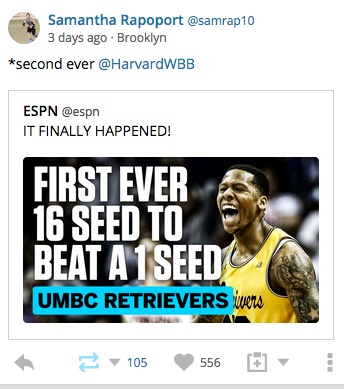
The Retrievers of the University of Maryland Baltimore County ended that streak on Friday, defeating the top-ranked team in the tournament, the Virginia Cavaliers, by 20 points. People poured on to social media to relish the moment and celebrate the “David” who just took down “Goliath.” However, in calling the Retrievers the “first 16 seed to ever defeat a 1 seed,” people were factually inaccurate.

The women’s team at Harvard came to the NCAA tournament in 1998 as a 16 seed and defeated the number one team from Stanford, 71-67. Thus, the Retrievers were the first men to accomplish this task and yet not the first team to pull it off.

This leads to three simple lessons to take forward:

  • Don’t assume only men play: In a number of sports, men and women participate and women have the edge when it comes to records. For example, the person with the most open-era singles wins at Wimbledon isn’t Roger Federer with eight, but rather Martina Navratilova with nine. The person with the most goals in Olympic soccer history is Cristiane, a player for the Brazilian women’s national team. If you think something is a first, a last or an only, make sure to check both sides of the gender ledger before calling it a one-of-a-kind event.


  • Don’t assume  your level of competition is the only level out there: Sports have multiple divisions at the collegiate level (D-I, D-II and D-III), so just because a D-I team hasn’t pulled something off, don’t assume no one else ever has. When an NFL record is broken, keep in mind it isn’t the only “pro” league to ever exist, so if you are making a statement about all professional football history, make sure to check back on things like the WFL and the USFL. Or, just stick to calling it an NFL record.


  • Don’t assume that because “everybody said” something that “everybody is right: Watching the “first-ever 16 seed” (a redundancy that was almost as bad as the error itself) story fly around the internet had people piling on until someone decided to set the record straight:Harvard2


This leads to the main point of this post and the bigger overall lesson: Say ONLY what you KNOW for SURE. Don’t get caught up in the hype or assume something has NEVER happened just because you don’t know that it happened before or because “everyone knows” that something hasn’t happened. Instead, write what you can prove: No 16-seeded men’s team in this history of the NCAA D-I tournament had beaten a 1 seed in 135 attempts before UMBC defeated Virginia.

Your readers will still enjoy your work, the outcome is still impressive and you will have the benefit of being accurate.

THROWBACK THURSDAY: Tips for Self-Editing: Find the Hole, Fill the Hole

I asked a colleague in PR what she would like to see in our editing class if I were to start it over from scratch and try to incorporate the needs of all our sequences into it. It took her no time to answer:

“Teach them how to self-edit,” she said. “They need to look at their copy and realize what’s wrong with it.”

Much of that would be covered with grammar and style, but here’s a key thing that often gets left twisting in the wind: Story holes.

Here’s a throwback post that explains holes, outlines why they happen and explains how to fill them. This can benefit your readers in a lot of ways.

Tips for Self-Editing: Find the Hole, Fill the Hole

As the finishing touches take place on the next book in the “Dynamics” series (Dynamics of Media Editing), I thought it would be a good to give you a peek at a key area of writing and editing that often goes overlooked: Holes.

The idea of a hole is simple: It is the absence of something that should be there to make an item complete. A hole in a shirt, a hole in the yard or a hole in your story all fit that same basic premise. The goal of good writers is to fill in the holes that exist to keep your readers fully engaged and fully informed.

Or as we might say elsewhere, “Don’t leave me hanging, bro…”

Here’s a clip from the editing book so you can get a better sense of how this all works and how to fix it:

Filling holes

A hole in copy is when a writer raises an issue that interests a reader but doesn’t provide enough information to satisfy that interest. Editors develop an intuitive sense over time as to where holes exist and what is required to fill them. Here are some simple examples of holes and how to fill them:


A question with no answer: Writers often spend enough time working in a specific area of interest that they start to understand things that go beyond what readers will intuitively know. It can be jargon, historical references or “inside baseball” issues, and in most cases, the writer will assume that others know these items as well. A hole can develop in a story when a gap emerges between what the writer knows and what the readers do. Here’s an example:

Francisco Smart took over as San Antonio’s mayor six months ago, completing the end of his predecessor’s term.

This situation raises several questions including:

  • Who was the predecessor?
  • Why was he/she unable to complete the term?

You can easily fill in the hole with a simple edit:

Francisco Smart, who is completing Carol Jafkey’s term as San Antonio’s mayor, took on his current role six months ago when Jafkey moved to Arizona.

This might raise additional questions, such as “Why did Jafkey move to Arizona?” That said, you have plugged the bigger holes and you can address the additional questions later.

Any time you see a statement that has you asking a question that the writer hasn’t answered later in the story, you need to acknowledge the presence of a hole and find way to fill it.


An accusation with no response: News traditionally requires balance, but that’s not just an ideal associated with newspapers. Unless you want people to see you as a slanted source of information, you need to look for fairness when you are editing. In some cases, a source will fire a shot across the bow and accuse someone else of something nefarious. The first question you should ask is if that accusation needs to be in your piece in the first place or if it’s just a cheap shot that lacks value. If it merits inclusion, see what truth there is to that accusation or afford the accused an opportunity to respond so you don’t end up with a hole like this:


Paul Lazlo has filed suit six times against Rich Wood, accusing his neighbor of running an illegal gambling ring in his basement.


The accusation is pretty serious, so make sure you don’t just let it linger:

Paul Lazlo has filed suit six times against Rich Wood, accusing his neighbor of running an illegal gambling ring in his basement. In each of those cases, the court has dismissed the case as being without merit.

OR

Paul Lazlo has filed suit six times against Rich Wood, accusing his neighbor of running an illegal gambling ring in his basement. Wood testified in court each time that this was nothing more than a friendly poker game that Lazlo detested because he was not invited to participate.

The goal is to make sure that you don’t leave the door open on an accusation when you can easily close it and give your readers a more complete version of the truth.


An “oddity” with no context: Oddity is an interest element that writers often emphasize in their work to give readers a sense of how special an outcome or issue is. However, when a writer fails to provide context for that information, the readers often feel lost or don’t have a full appreciation of this rarity. Here’s an example:

Mel Purvis of the Cincinnati Reds pitched an opening day no-hitter, marking only the second time in major league history that a pitcher accomplished this feat.


A couple questions are left unanswered here:

  • Who did it first?
  • When did he do it?

Mel Purvis of the Cincinnati Reds threw an opening day no-hitter, marking only the second time since 1940 that a pitcher accomplished that feat.

Or

Cincinnati’s Mel Purvis joined Bob Feller of the Cleveland Indians as the only pitchers to throw opening-day no-hitters in major league history.

However, to plug both holes, you need to reconsider the approach a bit:

Cincinnati’s Mel Purvis became the second player in the last 78 years to throw an opening-day no-hitter, joining Cleveland’s Bob Feller who first accomplished the feat in 1940.

That plugs both holes and helps the readers understand the rarity of the feat.

Any time you have an oddity, you run the risk of having a hole in the story. Make sure you edit to provide context and meaning to help your readers more fully understand the magnitude of what you want them to know.

Accuracy vs. Honesty: A look at the New York Times correction on “Women for Trump”

The difference between  honesty (or truthfulness, if you’d rather) and accuracy can come down to the answers to this question:

“Do you know what time it is?”

Answer A: “It’s 7:30 a.m.”

Answer B: “Yes.”

The first answer is more honest and helpful while the second is simply accurate. This scenario is one that lawyers in TV shows use to explain how defendants should testify to keep themselves out of trouble: Answer the question, but volunteer nothing more. This kind of demarcation in the answers led to a correction on a New York Times story about “Women who still back Trump” late last week:

(h/t Diego Aparicio for the correction and the info.)

You can skip past the bottom two points, as they’re clearly just dumb mistakes that should not have gotten past a rookie reporter for the Beaverton Shopper-Ledger, let alone a political reporter for the country’s “paper of record.” The first two concerns have led to questions regarding the way in which the Times approached its story.

Dan Froomkin of Salon noted that this wasn’t the first time the Times had quoted Republican movers and shakers as just regular folks in one of its stories. Froomkin’s position is that this approach wasn’t accidental:

The New York Times has been caught, once again, passing off Republican operatives as “regular” Republican voters in an article intended to show how effectively Donald Trump is maintaining his support.

It raises serious questions about whether Times editors and reporters, rather than actually trying to determine how voters feel, are setting out to find people to mouth the words they need for predetermined story lines that, not coincidentally, echo the Trump campaign’s propaganda.

In the latest case, an article posted on Wednesday headlined “Around Atlanta, Many White Suburbanites Are Sticking With Trump” by Times national reporter Elaina Plott initially misidentified two of the four allegedly run-of-the-mill voters who supported the article’s thesis: That Trump’s unfounded fear-mongering along the lines that “ANTIFA THUGS WILL RUIN THE SUBURBS!” is working.

The problem with that thesis is that there ARE actually women who support Donald Trump’s run for the presidency. And to be fair to Elaina Plott, she DID actually find a few that apparently weren’t running the Republican Party of Greater Atlanta or whatever, like this woman:

Mr. Biden has said that he has no desire to defund the police, and Amanda Newman acknowledges that. But Ms. Newman, 51, who lives in the suburbs and works at a law firm in midtown Atlanta, also thinks Mr. Biden’s personal views are irrelevant — that a vote for Mr. Biden is in fact a vote for his running mate, Senator Kamala Harris, as well as for progressives in the Democratic Party like Representative Alexandria Ocasio-Cortez who have pushed for policies like the Green New Deal. “I don’t think Joe Biden has an opinion until somebody tells him what it is,” she said.

Ms. Newman said she’s been put off by Mr. Trump at multiple moments in the past four years, calling him at times “unpresidential” and comparing him to “a 2-year-old pitching a fit in a candy store.” But she said she feared how “radical” and “crazy” the Democrats had become.

And this one…

“It’s been very unnerving,” said Lori Mullee, 54, referring not to police brutality or Mr. Arbery’s death but the “riots in my backyard.” Ms. Mullee, a University of Georgia graduate, works in marketing and lives in Stone Mountain, a small city in the Atlanta suburbs that in August was essentially put on lockdown as white supremacist groups and far-left counterprotesters clashed at the city’s Confederate monument.

Ms. Mullee said she used to exercise in the state park surrounding the monument, but no longer feels comfortable doing so. (As for the monument itself, she said she did not support efforts to “take down history.”) She is voting for Mr. Trump in part, she said, because she feels the left has stoked division in cities like hers and beyond.

Also, if you take a look at any Trump rally, you do see women, as well as a spectrum of people from other groups that you wouldn’t necessarily consider the hard-core, stereotypical angry, straight, white male Trump supporter. A story that looked into why these folks are supporting this guy would seem to be in the wheelhouse of a political reporter for a major media outlet.

In short, if I had to put money on what happened here, I’d be more on the “We screwed up” end of this as opposed to the “nefarious plot to parrot deeply entrenched Republicans to further their agenda” end of it.

In acknowledging biases, I suppose it would be important to acknowledge my own: I’ve had to cover random weird-ass events that required me to go find “regular people” who were willing to talk to me. That part of the job absolutely sucked, as people who were at Fourth of July parades or county fairs seemed to view me as a KGB operative or worse. As we mentioned in previous posts, some reporters have even faked the “real people” to get out of the drudgery of this part of the job.

Me? I would try to find the people who looked like the most obvious candidates to talk and get what I could get out of them. For example, I once covered the final day of operation for the Lake Delton dog-racing track. I needed to find people who worked there and bet on dogs for this “color” piece. The workers were easy, as I knew a couple people in advance from a previous story, who helped me find others as well.

In terms of “regular people,” I started looking around and found the journalistic equivalent of fast food. This guy was a mountain of a man, probably at least 6-foot-5 with a barrel-shaped body. He had on a really loud shirt and a hat that said something about dog racing. He also wore a license plate on a string around his neck. The plate read: “I BET K9S.”

He was talking to people making bets, roaring with laughter and drinking a beer. That might have been the easiest “real person” interview I ever conducted.

Did I think he might be an investor in the dog track or somehow tied to a larger representative collective that might undermine his credibility as a regular guy? No.

Did I consider that he was a white man, likely straight, and might not be representative of a broader spectrum of potential sources? No.

Did I ask the guy a dozen questions about himself like I was doing an “OK Cupid” profile on him to make sure I hadn’t missed any entangling alliances he might have? No.

I was just grateful to have a human source that said something quote-worthy.

Granted, this was in the time before everyone had the internet and we had a cottage industry of people digging into the work of other people for sport. However, I would be willing to bet I’m not alone in the, “OK, thank God I got that done” vein of journalism that likely exists still today.

I suppose it’s also worth mentioning that I’ve use the “B” answer a few times to keep conversations friendly. A lot of my neighbors in various stops were quite conservative and didn’t think highly of commie, liberal, pinko professors who were in their ivory towers at whatever university was in town. When we moved into a given neighborhood, they’d often see me working on my car or doing yard work and stop by to say hello.

When they asked me what I did, I’d respond with, “I work at the U.”

It was accurate, but the truth was, I had hoped they assumed I was a janitor or something. If they got to know me and liked me, I figured the topic would come up in a future conversation and my “professoring” would be unveiled.

In the end, there are limits to what you can do as a journalist when it comes to this stuff. Your hope always is that people will be honest and truthful. It would have been great if the person had said, “I’m involved in politics in XYZ ways,” so the reporter had a fuller version of reality. However, she wasn’t lying to the reporter when she said she was an interior decorator or a graduate from the University of Georgia, so she was accurate.

I’m sure I could turn this into a cautionary tale on how to avoid this problem in the first place, but it seems to be like trying to take out a fly with a rocket launcher. I would wager that, at best, there are three things I could tell you that you probably already know if you’ve read the blog and/or stayed alive during any journalism writing class:

The other two stupid mistakes we skipped past earlier would indicate that the reporter was sloppy, so… y’know… don’t be sloppy in your reporting.

The fact other people were able to figure out who these people were in about six seconds on Google tells us… Do a quick Google search of sources before putting them in your story… I guess?

The correction set the record straight, so when you do screw up, make sure you own it. So there’s that…


Throwback Thursday: How to report and write a quality obituary

President Trump said in a recent press briefing that somewhere between 100,000 and a quarter-million people will likely die in the U.S. of COVID-19 before everything is said and done.

Given that grim prognosis, especially considering the source, today’s “Throwback Thursday” post takes a look at the issues surrounding obituary writing. These stories can be among the best and worst pieces you will write as a journalist.

The goal with an obit, as is the goal with any story, is to provide an accurate picture of the subject of the story. This can lead to some wonderful tales and some dark places.

Hope this helps in navigating both.

Obituary Writing: Telling truths, not tales, in a reverent recounting of a life

In a discussion among student media advisers, one person noted that obituaries are probably the second-hardest things journalists have to do frequently. (The hardest? Interviewing family members about dead kids.) When a person dies, media outlets often serve as both town criers and official record keepers. They tell us who this person was, what made him or her important and what kind of life this person led. This is a difficult proposition, especially given that people have many facets and the public face of an individual isn’t always how those who knew the person best see him or her. Couple these concerns with the shock and grief the person’s loved ones and friends have experienced in the wake of the death and this has all the makings of a rough journalistic experience.

The New York Times experienced this earlier in the week when it published an obituary on Thomas Monson, the president of the Mormon Church. The Times produced a news obituary that focused on multiple facets of Monson and his affect on the church. This included references to his work to expand the reach and the population of its missionary forces as well as his unwillingness to ordain women and acknowledge same-sex marriages. The obituary drew criticism from many inside the church, leading the obituary editor to defend the choices the paper made in how it covered Monson. (For a sense of comparison, here is the official obituary/notification of death that the church itself wrote for Monson.)

You will likely find yourself writing an obituary at some point in time if you go into a news-related field.  Some of my favorite stories have been obituaries, including one I did on a professor who was stricken by polio shortly after he was married in the 1950s. I interviewed his wife, who was so generous with her recollections that I was really upset when we had to cut the hell out of the piece to make it fit the space we had for it. Still, she loved it and sent me a card thanking me for my time.

Some of my most painful stories have also been obituaries. The one that comes to mind is one I wrote about a 4-year-old boy who died of complications from AIDS. His mother, his father and one of his siblings also had AIDS at a time in which the illness brought you an almost immediate death sentence and status as a societal pariah. I spoke to the mother on the phone multiple times that night, including once around my deadline when she called me sobbing. Word about the 4-year-old’s death had become public knowledge and thus she was told that her older son, who did not have AIDS, would not be allowed to return to his daycare school. Other things, including some really bad choices by my editor, made for a truly horrific overall situation in which the woman called me up after the piece I co-wrote ran and told me what a miserable human being I was. She told me the boy’s father was so distraught by what we published that he would not leave the house to mourn his own son and that she held me responsible for that. Like I said, these things can be painful.

No matter the situation, there are some things you need to keep in mind when you are writing obituaries:

  • Don’t dodge the tough stuff: Your job as a journalist is to provide an objective, fair and balanced recounting of a person’s life. The Times’ editor makes a good point in noting that the paper’s job is to recount the person’s life, not to pay tribute or to serve as a eulogist. This means that you have to tell the story, however pleasant or unpleasant that might be. One of my favorite moments of honesty came from hockey legend Gordie Howe who was recalling the tight-fisted, cheap-as-heck former owner of the Detroit Red Wings:

    “I was a pallbearer for Jack,” says Howe. “We were all in the limousine, on the way to the cemetery, and everyone was saying something nice, toasting him. Then finally one of the pallbearers said, `I played for him, and he was a miserable sonofabitch. Now he’s … a dead, miserable sonofabitch.’”

    It’s not your fault if the person got arrested for something or treated people poorly. If these things are in the public record and they are a large part of how someone was known, you can’t just dodge them because you feel weird. Check out the Times’ obituary on Richard Nixon and you’ll notice that Watergate makes the headline and the lead. As much as that was likely unpleasant for the people who were closest to Nixon, it was a central point of his life and needed to be discussed. In short, don’t smooth off the rough edges because you are worried about how other people might feel. Tell the truth and let the chips fall where they may.


  • Avoid euphemisms: This goes back to the first point about being a journalist. You don’t want to soften the language or use euphemisms. People don’t “pass on” or “expire.” NFL quarterbacks pass and magazine subscriptions expire. People die. Also, unless you can prove it, don’t tell your readers that the person is “among the angels” or “resting in the arms of Jesus.” (Both of these euphemisms ended up in obituaries I edited at one point or another. They obviously didn’t make it to publication.) Say what you know for sure: The person died.


  • Double down on accuracy efforts: People who are reading obituaries about loved ones and friends are already on edge, so the last thing you want to do is tick them off by screwing up an obituary. I don’t know if this was just a matter of newspaper lore or if it was a real thing, but I was told more than once at a paper where I worked that there were only two things that would get us to “stop the presses:” 1) we printed the wrong lottery numbers and 2) we screwed up an obituary.
    True or not, the point was clear to me: Don’t screw up an obituary.
    Go back through your piece before you put it out for public consumption and check proper nouns for spelling and accuracy. Do the math yourself when it comes to the age (date of birth subtracted from date of death) and review each fact you possess to make sure you are sure about each one. If you need to make an extra call or something to verify information, do it. It’s better to be slightly annoying than wrong.


  • Accuracy cuts both ways: As much as you need to be accurate for the sake of the family, you also need to be accurate for the sake of the public record. This means verifying key information in the obituary before publishing it. The person who died might told family and friends about winning a medal during World War II or graduating at the top of her class at Harvard Law School. These could be accurate pieces of information or they could be tall tales meant to impress people. Before you publish things that could be factually inaccurate, you need to be sure you feel confident in your sourcing.
    Common sense dictates that you shouldn’t be shaking the family down for evidence on certain things (“OK, you say she liked to knit. Now, how do we KNOW she REALLY liked knitting? Do you have some sort of support for that?”) but you should try to verify fact-based elements with as many people as possible or check the information against publicly available information. Don’t get snowed by legends and myths. Publish only what you know for sure.


  • Don’t take things personally: Calling family, friends and colleagues of someone who just died can be really awkward and difficult for you as a reporter. Interviews with these people can be hard on them as well as hard on you. I found that when I did obituaries, I got one of three responses from people that I contacted:
    1. The source told me, “I’m sorry, but I really just can’t talk about this right now.” At that point, I apologized for intruding upon the person’s grief and left that person alone.
    2. The source is a fount of information and wanted to tell me EVERYTHING about the dead person. I found that for some of them, it was cathartic to share and eulogize and commemorate. It was like I was a new person in their circle of grief and they wanted to make sure I knew exactly why the person who died was someone worth knowing.
    3. The source was like a wounded animal and I made the mistake of sticking my hand where it didn’t belong. I have been called a vulture, a scumbag and other words I’ve been asked to avoid posting on this blog. One person even told me, “Your mother didn’t raise you right” because I had the audacity to make this phone call. I apologized profusely and once I hung up, I needed a couple minutes to shake it off. I knew it wasn’t my fault but it wasn’t easy either.

Your goal in an obituary is always to be respectful and decent while still retaining your journalistic sensibilities. It’s a fine line to walk, but if you do an obituary well, you will tell an interesting story about someone who had an impact on the world in some way. I like to think a story about this person who died should be good enough to make people wish they’d known that person while he or she was alive.

CNN settles with Covington Catholic Kid over “racist confrontation” that turned out not to be

While we were on break, a story we covered last year got an interesting update. CNN settled a lawsuit out of court with Covington Catholic High School student Nick Sandman, regarding its coverage of his interaction with a Native American drummer on the steps of the Lincoln Memorial last year.

Sandmann sought $275 million from CNN over its coverage of the confrontation he and his classmates had with an elderly Native American man while visiting Washington, D.C., on a school trip in January of last year. The amount of the settlement was not made public during a hearing at the federal courthouse in Covington on Tuesday, according to a local Fox affiliate.

In case you forgot, Sandman was in D.C. as part of the “March for Life” rally to protest the legal state of abortions. While outside the Lincoln Memorial, he and other Covington Catholic students appeared to be in some sort of row with another group that was shouting at them. Nathan Phillips, an activist there as part of the Indigenous Peoples March, stepped between the groups and drummed as part of an attempt to diffuse the situation.

(Or at least that’s the best version of a synopsis that I can provide, given that it seemed every media outlet wanted to have its own angle on this thing.)

Video of Sandman and Phillips standing nearly nose to nose went viral, as it seemed everyone with a Twitter account and an an internet connection studied each frame like it was the Zapruder film. To some Sandman was “smirking” or “mocking” or in some other way demeaning/threatening Phillips. To others, Sandman was just standing there, looking like an awkward high school kid.

At the time this happened, we wrote about it here and here.

One of the key problems associated with the situation for me was that general folks on social media, and media professionals as well, saw this incident as a way to represent a “larger truth” about everything from white privilege to toxic masculinity.

Each time, I poked back saying, “Yes, you are right that those things exist and they are bad, but how do you KNOW it was THESE KIDS who did what you are accusing them of doing?” Each time, I got the, “You don’t understand and you’re wrong” answer.

Well, on at least one point, I turned out to be particularly prescient:

So in other words, “What I just stated as a fact doesn’t really have to be a fact if it represents the broader truth I want to call attention to.” My friend noted that this isn’t really a problem:

I also saw in more than one video that those students were wearing MAGA hats mocking that Native man. They may or may not be the same boys who were harassing women, but it fits as a pattern of behavior in the same area on the same day with the same type of attire. Sometimes we can look outside and say it’s raining without having the National Weather Service confirm it.

My concern, however, is that the original post explicitly stated these are COVINGTON STUDENTS. Whether they are or not doesn’t make the “rape” kid’s words any more or less offensive, but if you state something as a fact, it damned well needs to be one. That’s doubly true if you’re a journalist and/or if legal action could come into play.

I doubt the rain would sue for defamation if you called it “drizzle” or the National Weather Service would sue if you didn’t get verify that this wasn’t “mixed precipitation.” However, I could easily see a kid’s parents or a school file suit if you’re wrong on this one.

And although a settlement doesn’t mean anyone necessarily admitted guilt, it does mean the defendants were worried enough about their position to cry “Uncle.”

Why we need local news publications and enough reporters to cover things

A cop shot a kid at a high school about five minutes away from my office after the kid stabbed the cop. While rumors were flying everywhere, the local newspaper was relying on quotes a media outlet 100 miles away grabbed from Facebook posts.

Via the Oshkosh Northwestern:

Senior Dakota Meisel told the Milwaukee Journal Sentinel in a Facebook message the lockdown was announced around 9:10 a.m. at the beginning of the school’s second period.

“I heard people yelling and running, and I heard a bang but not sure what the bang was,” he said.

Meisel said a teacher came into the classroom looking nervous and told the students to get away from the windows and get into lockdown mode just before the lockdown was announced. Meisel said the students were scared.

“We all got into the part of the room, closed all the doors, turned off the lights, and sat in the back of the class room quiet and we contacted parents and siblings, and waited until told what to do,” he said.

This should clearly illustrate why we are all in trouble if Gannett and Gatehouse and whatever other hedge fund chuckleheads continue to buy every newspaper they can get their little cloven hooves on and strip them out for parts.

Your right to know things is limited in large measure by the number of people who are paid a living wage to go out and find things out that you want to know. When you don’t have strong, active, engaged journalists with boots on the ground in your area, even if you still have a newspaper that supposedly serves you, this is what you get:

Josh, an Oshkosh West senior, told the Journal Sentinel he heard the gunshots.

“I was walking in the hall, and a teacher shoved me into a classroom, and we started barricading the doors, and we all huddled in the corner, and there were gunshots,” he said.

Chloe, an Oshkosh West sophomore, told the Journal Sentinel she first heard people yelling in a hallway.

“My teacher ran in the hallway to try and see what was going on. After she heard the people yelling and people were running through the hall, she shut all the doors and turned the lights off. After that an announcement came on that we were going into a lockdown.”

OK, how in the hell is the MILWAUKEE Journal Sentinel getting these quotes from people who aren’t even in the same AREA CODE as that newspaper while the OSHKOSH Northwestern isn’t? Even more, it dawned on me that I’m reading a newspaper that is quoting ANOTHER newspaper, that is quoting sources who only gave their first names to whatever journalist they somehow reached.

How is it that we’ve gone from “If your mother says she loves you, check it out” to this?


Also, I’m trying to imagine how my old managing editors, Cliff Behnke and George Kennedy, would react if I did this instead of hauling my ass down to the scene and digging out everything I could before I published a word.

I’m guessing it would be like this:

(NOTE: To be fair to the Northwestern staff, the story continued to grow and improve throughout the day. To also be fair, TV stations from GREEN BAY, about an hour away, were kicking the paper’s ass throughout the day on this story. To be even more fair, my kid had more information on this situation at the end of the day than the Northwestern did and she doesn’t even GO to that school… Good grief.)

The larger point isn’t that things were better in the olden days where we could smoke in the newsroom and people wore press passes in their hat bands. The point is that we have several serious problems that become clear when we have something exploding in an area that used to have strong local media and now are operating like the outpost in “Dances With Wolves.”

LIMITED RESOURCES: When you see these mergers and buyouts and other things taking place at various media outlets, they are often couched in terms of “shedding” jobs or “rightsizing” an organization. The idea is that with fewer people come fewer salaries, which means more profit for whoever owns the publication.

That sounds great, in theory, until you realize that this undermines the primary value of the newspaper: People who can get crucial information for a paying audience.

When you have a staff of five photographers and cut it down to one, you now lack the ability to photograph multiple things at multiple locations. When you “thin the herd” of reporters so that one journalist is covering multiple beats, you lose the opportunity to develop connections (more on that later) and to have the reporter fully immerse himself or herself in an important single area of information.

Even more, you find that by doing more with less, you burn the reporters to a crisp and thus limit their effectiveness in these kinds of situations. To do this job right, you need to pay for people to do it well and build a staff that is robust enough to cover an area effectively.

LIMITED EXPERIENCE: Various publications I know have recently undergone “buyouts” and “golden handshakes” for reporters who are older or nearing retirement. The idea is often, “Hey, I can buy three fresh-out-of-J-school kids for the cost of this old dude who has been taking up breathable air in this newsroom for the past 30 years!”

True, but you also get what you pay for.

Veteran reporters earn their keep because they have experience and knowledge. They know where to go to get the information that people most want to know first. They know what makes for a smart move and what makes for a dumb one, in most cases, because they’ve made both of them a dozen times and seen the results.

This is why certain reporters in various fields always seem to get the story before anyone else does: They are “the person” to whom everyone goes when they want to get something covered.

These experienced journalists know where the bodies are buried. They have a bank roll of favors built up from years of interactions that they can call in when they need to. They also have created trusting relationships with people who are more willing to tell them something than they are to tell anyone else about it.

This leads to the most important point…

LIMITED CONNECTIONS: It’s not who you are. It’s who you know.

The more time you spend some place and the more time you spend interacting with people who matter in some way to you, the more likely you are to develop important connections and relationships. This is true in every aspect of life.

My folks have lived in the same general area for their entire lives and that shows when it comes to getting things done. When I needed a truck to get moved out of my dorm one year and I forgot to get a U-Haul, my dad “had a guy” who helped out. When I wanted to buy a classic Mustang, but wasn’t sure if the car was up to par, Dad “had a guy” who ran a garage and put the car through the paces. Mom and Dad knew so many people in that area, that they always had a guy or a gal who knew something I needed to know. To say they are connected to the area would be a massive understatement.

Journalists who spend enough time on a beat or with an organization develop relationships with sources in key places, too. These connections can make or break a reporter and also make the difference between getting a story and not getting a story. In some cases, a source will call a reporter when something important like the incident at Oshkosh West happens and tip off the reporter about the situation. This only happens after years of trust-building interactions between the source and the reporter.

People I worked with had folks at schools, courts, police stations, government buildings and more who were able to give them the inside story when they needed something. (I wasn’t a veteran reporter in any stretch of the definition, but after covering enough late-night disasters, I got to know the deputy coroners and the secretary at the police station well enough to get a little help here and there.)

The point is, without these kinds of connections, reporters have about as much luck in finding crucial information quickly as a lost 4-year-old has of finding his mom at Wal-Mart during Black Friday. It’s a random lottery of luck at best and that doesn’t cut it for an audience that can find other sources for information.


THROWBACK THURSDAY: If your mother says she loves you, go check it out…

Mom’s birthday is coming up soon, so in honor of the woman who brought me into this world (and managed to resist every urge to take me out of it when I screwed up), here’s the journalism post on our most revered verification rule: If your mother says she loves you, go check it out.

Love you, Mom. (Just ask Dad for verification…)


If your mother says she loves you, go check it out…


Iphonetext

The adage in journalism regarding verification is: “If your mother says she loves you, go check it out.” The idea is that you need to make sure things are right before you publish them. You also want to verify the source of the information before you get yourself into trouble.

This issue popped up again this week after former White House Communications Director Anthony Scaramucci had exchanged several emails with a person he thought to be former Chief of Staff Reince Prebus. It turns out, the messages came from a prankster, who baited Scaramucci into an “email battle:”

“At no stage have you acted in a way that’s even remotely classy, yet you believe that’s the standard by which everyone should behave towards you?” read the email to Scaramucci from a “mail.com” account.

Scaramucci, apparently unaware the email was a hoax, responded with indignation.

“You know what you did. We all do. Even today. But rest assured we were prepared. A Man would apologize,” Scaramucci wrote.

The prankster, now aware that he had deceived the beleaguered Scaramucci, went in for the kill.

“I can’t believe you are questioning my ethics! The so called ‘Mooch’, who can’t even manage his first week in the White House without leaving upset in his wake,” the fake Priebus wrote. “I have nothing to apologize for.”

Scaramucci shot back with a veiled threat to destroy Priebus Shakespearean-style.

“Read Shakespeare. Particularly Othello. You are right there. My family is fine by the way and will thrive. I know what you did. No more replies from me,” the actual Scaramucci.

“Othello” is a tragedy in which the main character is tricked into killing his wife Desdemona after his confidante convinces him that she has been unfaithful.

As the article points out, Scaramucci isn’t the first person to be suckered by a prank. Other members of the government had been similarly duped via email. In terms of prank calls, Wisconsin Gov. Scott Walker found himself once speaking with a person pretending to be billionaire David Koch, discussing ways to attack protesters and destroy liberals.   (The prankster told his side of the story on Politico.)

News journalists have also been caught short when it comes to making sure they’re sure about the sources and information they receive. In 2013, KTVU-TV in San Francisco had what it thought was a big scoop on the Asiana Flight 214 crash: The names of the captain and crew. However, the information turned out to be not only a hoax, but an intentionally racist set of names:

Three people were fired and a fourth resigned for health reasons in the wake of this error. In digging into this, it turned out that the NTSB found the source of the names to be a “summer intern” who thought this would be funny. In its own investigation, the station found that nobody asked the source at the NTSB for his name or title. The station issued an apology, as did the NTSB.

It’s easy to laugh at these incidents or to marvel at how dumb somebody was to buy into this stuff. However, we used to say around my house, “There, but by the grace of God, go I.” In other words, you could be next.

So here are three simple tips to help you avoid these problems:

  1. Verify, verify, verify: If something sounds too good to be true, it usually is. Look up information on various sites, ask a source for other people who can augment/confirm the information and make sure you feel confident in your content before you publish.
  2. If you aren’t sure, back away: It is always better to be late on something than it is to be wrong. It’s also better to let a random email or a text go without a response than to get sucked in and pay the price later. Some of these are easy, like when a Nigerian Prince promises you untold riches if you would just transfer your bank account number to him. Some are harder: When’s the last time you made sure it was your friend texting you about a “crazy night” and not his mom or dad doing some snooping? We just assume we know the actual source. That can be dangerous, so back off if you’re not sure.
  3. Kick it around the room: One of the best reasons why newsrooms, PR offices and ad agencies exist is to gather collective knowledge in one place. Sure, with technology now, it’s easy for everyone to work “off site” but keeping people in a single physical spot can make it easier to have someone look over your shoulder and see if something you just got “smells right.” Take advantage of other people around you and don’t go at it alone.