Sandmann sought $275 million from CNN over its coverage of the confrontation he and his classmates had with an elderly Native American man while visiting Washington, D.C., on a school trip in January of last year. The amount of the settlement was not made public during a hearing at the federal courthouse in Covington on Tuesday, according to a local Fox affiliate.
In case you forgot, Sandman was in D.C. as part of the “March for Life” rally to protest the legal state of abortions. While outside the Lincoln Memorial, he and other Covington Catholic students appeared to be in some sort of row with another group that was shouting at them. Nathan Phillips, an activist there as part of the Indigenous Peoples March, stepped between the groups and drummed as part of an attempt to diffuse the situation.
(Or at least that’s the best version of a synopsis that I can provide, given that it seemed every media outlet wanted to have its own angle on this thing.)
Video of Sandman and Phillips standing nearly nose to nose went viral, as it seemed everyone with a Twitter account and an an internet connection studied each frame like it was the Zapruder film. To some Sandman was “smirking” or “mocking” or in some other way demeaning/threatening Phillips. To others, Sandman was just standing there, looking like an awkward high school kid.
At the time this happened, we wrote about it here and here.
One of the key problems associated with the situation for me was that general folks on social media, and media professionals as well, saw this incident as a way to represent a “larger truth” about everything from white privilege to toxic masculinity.
Each time, I poked back saying, “Yes, you are right that those things exist and they are bad, but how do you KNOW it was THESE KIDS who did what you are accusing them of doing?” Each time, I got the, “You don’t understand and you’re wrong” answer.
Well, on at least one point, I turned out to be particularly prescient:
So in other words, “What I just stated as a fact doesn’t really have to be a fact if it represents the broader truth I want to call attention to.” My friend noted that this isn’t really a problem:
I also saw in more than one video that those students were wearing MAGA hats mocking that Native man. They may or may not be the same boys who were harassing women, but it fits as a pattern of behavior in the same area on the same day with the same type of attire. Sometimes we can look outside and say it’s raining without having the National Weather Service confirm it.
My concern, however, is that the original post explicitly stated these are COVINGTON STUDENTS. Whether they are or not doesn’t make the “rape” kid’s words any more or less offensive, but if you state something as a fact, it damned well needs to be one. That’s doubly true if you’re a journalist and/or if legal action could come into play.
I doubt the rain would sue for defamation if you called it “drizzle” or the National Weather Service would sue if you didn’t get verify that this wasn’t “mixed precipitation.” However, I could easily see a kid’s parents or a school file suit if you’re wrong on this one.
And although a settlement doesn’t mean anyone necessarily admitted guilt, it does mean the defendants were worried enough about their position to cry “Uncle.”
A cop shot a kid at a high school about five minutes away from my office after the kid stabbed the cop. While rumors were flying everywhere, the local newspaper was relying on quotes a media outlet 100 miles away grabbed from Facebook posts.
Via the Oshkosh Northwestern:
Senior Dakota Meisel told the Milwaukee Journal Sentinel in a Facebook message the lockdown was announced around 9:10 a.m. at the beginning of the school’s second period.
“I heard people yelling and running, and I heard a bang but not sure what the bang was,” he said.
Meisel said a teacher came into the classroom looking nervous and told the students to get away from the windows and get into lockdown mode just before the lockdown was announced. Meisel said the students were scared.
“We all got into the part of the room, closed all the doors, turned off the lights, and sat in the back of the class room quiet and we contacted parents and siblings, and waited until told what to do,” he said.
This should clearly illustrate why we are all in trouble if Gannett and Gatehouse and whatever other hedge fund chuckleheads continue to buy every newspaper they can get their little cloven hooves on and strip them out for parts.
Your right to know things is limited in large measure by the number of people who are paid a living wage to go out and find things out that you want to know. When you don’t have strong, active, engaged journalists with boots on the ground in your area, even if you still have a newspaper that supposedly serves you, this is what you get:
Josh, an Oshkosh West senior, told the Journal Sentinel he heard the gunshots.
“I was walking in the hall, and a teacher shoved me into a classroom, and we started barricading the doors, and we all huddled in the corner, and there were gunshots,” he said.
Chloe, an Oshkosh West sophomore, told the Journal Sentinel she first heard people yelling in a hallway.
“My teacher ran in the hallway to try and see what was going on. After she heard the people yelling and people were running through the hall, she shut all the doors and turned the lights off. After that an announcement came on that we were going into a lockdown.”
OK, how in the hell is the MILWAUKEE Journal Sentinel getting these quotes from people who aren’t even in the same AREA CODE as that newspaper while the OSHKOSH Northwestern isn’t? Even more, it dawned on me that I’m reading a newspaper that is quoting ANOTHER newspaper, that is quoting sources who only gave their first names to whatever journalist they somehow reached.
How is it that we’ve gone from “If your mother says she loves you, check it out” to this?
Also, I’m trying to imagine how my old managing editors, Cliff Behnke and George Kennedy, would react if I did this instead of hauling my ass down to the scene and digging out everything I could before I published a word.
I’m guessing it would be like this:
(NOTE: To be fair to the Northwestern staff, the story continued to grow and improve throughout the day. To also be fair, TV stations from GREEN BAY, about an hour away, were kicking the paper’s ass throughout the day on this story. To be even more fair, my kid had more information on this situation at the end of the day than the Northwestern did and she doesn’t even GO to that school… Good grief.)
The larger point isn’t that things were better in the olden days where we could smoke in the newsroom and people wore press passes in their hat bands. The point is that we have several serious problems that become clear when we have something exploding in an area that used to have strong local media and now are operating like the outpost in “Dances With Wolves.”
LIMITED RESOURCES: When you see these mergers and buyouts and other things taking place at various media outlets, they are often couched in terms of “shedding” jobs or “rightsizing” an organization. The idea is that with fewer people come fewer salaries, which means more profit for whoever owns the publication.
That sounds great, in theory, until you realize that this undermines the primary value of the newspaper: People who can get crucial information for a paying audience.
When you have a staff of five photographers and cut it down to one, you now lack the ability to photograph multiple things at multiple locations. When you “thin the herd” of reporters so that one journalist is covering multiple beats, you lose the opportunity to develop connections (more on that later) and to have the reporter fully immerse himself or herself in an important single area of information.
Even more, you find that by doing more with less, you burn the reporters to a crisp and thus limit their effectiveness in these kinds of situations. To do this job right, you need to pay for people to do it well and build a staff that is robust enough to cover an area effectively.
LIMITED EXPERIENCE: Various publications I know have recently undergone “buyouts” and “golden handshakes” for reporters who are older or nearing retirement. The idea is often, “Hey, I can buy three fresh-out-of-J-school kids for the cost of this old dude who has been taking up breathable air in this newsroom for the past 30 years!”
True, but you also get what you pay for.
Veteran reporters earn their keep because they have experience and knowledge. They know where to go to get the information that people most want to know first. They know what makes for a smart move and what makes for a dumb one, in most cases, because they’ve made both of them a dozen times and seen the results.
This is why certain reporters in various fields always seem to get the story before anyone else does: They are “the person” to whom everyone goes when they want to get something covered.
These experienced journalists know where the bodies are buried. They have a bank roll of favors built up from years of interactions that they can call in when they need to. They also have created trusting relationships with people who are more willing to tell them something than they are to tell anyone else about it.
This leads to the most important point…
LIMITED CONNECTIONS: It’s not who you are. It’s who you know.
The more time you spend some place and the more time you spend interacting with people who matter in some way to you, the more likely you are to develop important connections and relationships. This is true in every aspect of life.
My folks have lived in the same general area for their entire lives and that shows when it comes to getting things done. When I needed a truck to get moved out of my dorm one year and I forgot to get a U-Haul, my dad “had a guy” who helped out. When I wanted to buy a classic Mustang, but wasn’t sure if the car was up to par, Dad “had a guy” who ran a garage and put the car through the paces. Mom and Dad knew so many people in that area, that they always had a guy or a gal who knew something I needed to know. To say they are connected to the area would be a massive understatement.
Journalists who spend enough time on a beat or with an organization develop relationships with sources in key places, too. These connections can make or break a reporter and also make the difference between getting a story and not getting a story. In some cases, a source will call a reporter when something important like the incident at Oshkosh West happens and tip off the reporter about the situation. This only happens after years of trust-building interactions between the source and the reporter.
People I worked with had folks at schools, courts, police stations, government buildings and more who were able to give them the inside story when they needed something. (I wasn’t a veteran reporter in any stretch of the definition, but after covering enough late-night disasters, I got to know the deputy coroners and the secretary at the police station well enough to get a little help here and there.)
The point is, without these kinds of connections, reporters have about as much luck in finding crucial information quickly as a lost 4-year-old has of finding his mom at Wal-Mart during Black Friday. It’s a random lottery of luck at best and that doesn’t cut it for an audience that can find other sources for information.
Mom’s birthday is coming up soon, so in honor of the woman who brought me into this world (and managed to resist every urge to take me out of it when I screwed up), here’s the journalism post on our most revered verification rule: If your mother says she loves you, go check it out.
Love you, Mom. (Just ask Dad for verification…)
If your mother says she loves you, go check it out…
The adage in journalism regarding verification is: “If your mother says she loves you, go check it out.” The idea is that you need to make sure things are right before you publish them. You also want to verify the source of the information before you get yourself into trouble.
“At no stage have you acted in a way that’s even remotely classy, yet you believe that’s the standard by which everyone should behave towards you?” read the email to Scaramucci from a “mail.com” account.
Scaramucci, apparently unaware the email was a hoax, responded with indignation.
“You know what you did. We all do. Even today. But rest assured we were prepared. A Man would apologize,” Scaramucci wrote.
The prankster, now aware that he had deceived the beleaguered Scaramucci, went in for the kill.
“I can’t believe you are questioning my ethics! The so called ‘Mooch’, who can’t even manage his first week in the White House without leaving upset in his wake,” the fake Priebus wrote. “I have nothing to apologize for.”
Scaramucci shot back with a veiled threat to destroy Priebus Shakespearean-style.
“Read Shakespeare. Particularly Othello. You are right there. My family is fine by the way and will thrive. I know what you did. No more replies from me,” the actual Scaramucci.
“Othello” is a tragedy in which the main character is tricked into killing his wife Desdemona after his confidante convinces him that she has been unfaithful.
As the article points out, Scaramucci isn’t the first person to be suckered by a prank. Other members of the government had been similarly duped via email. In terms of prank calls, Wisconsin Gov. Scott Walker found himself once speaking with a person pretending to be billionaire David Koch, discussing ways to attack protesters and destroy liberals. (The prankster told his side of the story on Politico.)
News journalists have also been caught short when it comes to making sure they’re sure about the sources and information they receive. In 2013, KTVU-TV in San Francisco had what it thought was a big scoop on the Asiana Flight 214 crash: The names of the captain and crew. However, the information turned out to be not only a hoax, but an intentionally racist set of names:
It’s easy to laugh at these incidents or to marvel at how dumb somebody was to buy into this stuff. However, we used to say around my house, “There, but by the grace of God, go I.” In other words, you could be next.
So here are three simple tips to help you avoid these problems:
Verify, verify, verify: If something sounds too good to be true, it usually is. Look up information on various sites, ask a source for other people who can augment/confirm the information and make sure you feel confident in your content before you publish.
If you aren’t sure, back away: It is always better to be late on something than it is to be wrong. It’s also better to let a random email or a text go without a response than to get sucked in and pay the price later. Some of these are easy, like when a Nigerian Prince promises you untold riches if you would just transfer your bank account number to him. Some are harder: When’s the last time you made sure it was your friend texting you about a “crazy night” and not his mom or dad doing some snooping? We just assume we know the actual source. That can be dangerous, so back off if you’re not sure.
Kick it around the room: One of the best reasons why newsrooms, PR offices and ad agencies exist is to gather collective knowledge in one place. Sure, with technology now, it’s easy for everyone to work “off site” but keeping people in a single physical spot can make it easier to have someone look over your shoulder and see if something you just got “smells right.” Take advantage of other people around you and don’t go at it alone.
Richard G. Lugar, who represented Indiana in the Senate for 36 years and whose mastery of foreign affairs made him one of only a handful of senators in modern history to exercise substantial influence on the nation’s international relations, died on Sunday in Annandale, Va. He was 87.
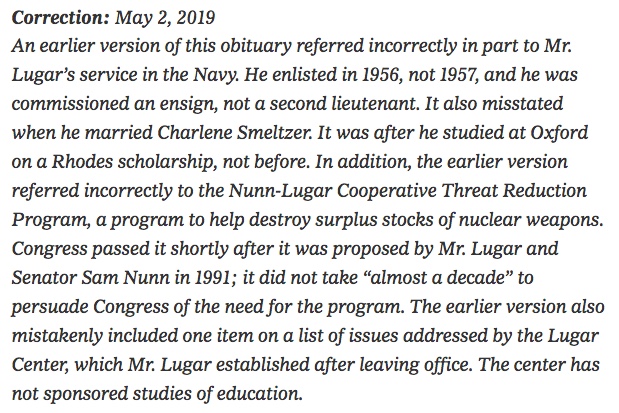
And yet, that paled in comparison to the 144-word mea culpa the paper had to write once the folks there realized they massively botched the piece:
I imagined this to be the conversation at the New York Times last week around the obituary desk:
If you look at the mistakes in there, you can see that a lot of this came down to fact checking. People can argue about nuance, such as if someone “resigned” or merely “left a job,” but the date something happened is one of those things we can all figure out if we try really, really hard.
With that in mind, let’s look back at a few of the points we made when the times ran its mega-fail obit of John McCain and see how they still apply here:
Assume everything is wrong. Fact check accordingly: This one still works wonders here, especially up at the top of this thing. The date he entered the service, his rank and the date of his marriage are all fact-based items that could easily have been checked against a dozen sources or digital documents. As noted in the McCain piece, when a person takes on a particularly important level of distinction in the world, newspapers like the NYT will usually start an obituary file for that person, so this thing has been on hand for a while.
That said, who knows who actually wrote that first draft of it or to when it was last reviewed? You shouldn’t grab something out of an old file and figure, “Well someone wrote it so it must be right” any more than you would grab an unmarked pill bottle out of a stranger’s medicine cabinet and figure, “Well, I’m sure a couple of these will probably help my headache.” As much as we venerate the “golden era” of the press, which consisted of a lot of typewriters clicking, lead-type machines and the concept of smoking indoors, those folks were people, just like us. They could have screwed up, just as easily as we can.
How you state something matters: When I taught sports writing, I provided students with statements to prove true or false and two of my favorites were:
“In the Open Era, which runs from 1968 to present, the person holding the most Wimbledon singles titles is Roger Federer with eight wins.”
“The team with the most NFL championships is the Pittsburgh Steelers, winners of six Super Bowls.”
The first one is something half of the students get wrong because they look up Federer, see he won eight singles titles, see no one above him on the list of winners for men and say it’s true. However, the word “person” isn’t synonymous with “men.” The athlete (or person) with the most is Martina Navratilova, who won nine singles titles. The second one is wrong because the Green Bay Packers won 13 NFL titles (most of them in the pre-Super Bowl era), so even thought Steelers have more Super Bowls, the Packers have more titles.
The line in the obituary for Lugar that got some criticism falls along these lines. Lugar pushing for something didn’t mean it encountered heavy resistance. That’s probably at least part of the problem associated with the Cooperative Threat Reduction Program correction, although I’m not entirely sure how they missed by more than a decade.
Beware of “-est” statements: The obit’s correction didn’t have any of these errors, which was the case with McCain’s, but that might have just been a fortunate bounce, given the use of “-est” statements:
His greatest legacy, though, remains his work toward reducing the threat of nuclear arms.
Security was upgraded at nuclear weapons sites, at a time when the greatest fear was that a terror group would take advantage of the chaos in Russia or in one of the former Soviet states and buy or steal a weapon.
Friends said that this was Mr. Lugar’s most significant exposure to geopolitical thinking, and probably the single greatest source of his fascination with foreign policy.
In these statements, the writer’s good luck had him attempting to quantify things that could not be accurately quantified, such as a “greatest” fear” or “greatest source.” People can quibble with those. In the case of the McCain obit, calling the fire on the Forrestal the “deadliest” incident could be measured (and proven wrong, as it was).
As a word of warning, you need to make sure that you have something nailed down perfectly before you issue an “-est” statement. The “deadliest” attack. The “longest” game. The “greatest” comeback. Those things need to be quantified and verified. Any time you see an “-est” in a story you are editing or you include one in a story you are writing, make absolutely sure you are correct.
Ask for help: One of the many benefits of newsrooms is the presence of other people who know stuff. You might worry that asking for help or having someone look over your should could make you look stupid or weak. However, what’s a worse crime: Looking dumb in a newsroom (and spoiler alert- you won’t look like that when you ask for help) or looking dumb in the general public? If you don’t know something, ask. It really works.
Student media adviser and blogging guru Kenna Griffin sent this out on Twitter today and it got me thinking about our rights and responsibilities regarding fairness to sources:
Her blog post, which you can read in its entirety here, touches on a lot of good issues in regard to fairness, transparency, accuracy and the importance of the story. She also makes some good points about how things have changed in the digital age versus the newspaper’s “hard” deadline.
I often found that the hard deadline was a double-edged sword: I got more time to wait for someone to call me back because I didn’t have to send the story to press until 1 a.m.. That said, it also meant that if I caught a late-breaking story and only had until 1 a.m. to get it out the door, some people weren’t going to be around for comment, thus leaving me with a weaker piece.
Digital deadlines mean you can send stuff to your readers whenever you want, which is great when you have content worth sending. However, I know from personal experience, that when I’m waiting for a quote from someone and I have the ability to just hit “publish” and move on, I get really twitchy. Patience is a virtue, but not one with which I have been endowed…
Griffin lists some key thoughts about the best practices for deciding when to wait and when to pull the trigger. Here are a couple others that I’d add, especially for those of you working in a digital field:
Will waiting longer likely lead to a comment? In some cases, you have worked with a source and that source is usually pretty good about getting back to you, so the wait makes sense. In other cases, you are more likely to find a unicorn playing bass in a punk band than you are to get a quote back from a source from which you requested an interview. If you think time is likely to lead to success, hold on to the piece. If not, publish it as soon as it’s as good as it’s going to get.
Is this a case of “ostrich syndrome” on the part of the source? The legend involving ostriches is that when they become afraid, they stick their head in the sand, thus not seeing the danger, but clearly being no safer than they were before they did it. It’s not true, but it does provide us with a good jumping off point for how sources can be delusional regarding their interactions with reporters.
A number of times, a source has tried to dodge a reporter’s call with the idea that if they can avoid saying anything about the topic, the reporter won’t be able to run the story. In those cases, I tended to tell people to run the story anyway, with an explanation that we tried to give this person a chance to say something. Just like any other form of bad behavior, you shouldn’t reward sources who try to kill stories by dodging you.
How permanent is your choice? This is a tough issue that tends to lend itself more toward student media outlets. When a publication comes out once per week, an unanswered claim or a one-sided story can become codified in the minds of readers before another source gets a chance to say something. Even more, if it the last paper of semester or school year, that decision not to hold a story for a comment can seem almost vindictive. However, if you run your media on a digital platform and you can update at a moment’s notice, the choice seems a lot less painful. When it came to the Oshkosh North Star situation, I felt pretty solid about publishing whatever it was I had in hand, even if I was still hoping for another quote or comment. I knew that if something popped up, I could tweak what I had. If I worked at a newspaper and it was going out this week only, on actual paper and I would never get another chance at it, I’d probably feel a lot more anxious about my choice to publish.
One last thing about the “no comment” issue: People who tell you “no comment” and then continue to talk are, in fact, commenting, so feel free to use whatever they tell you. It’s not your fault they can’t shut up. When people don’t comment, we used to joke about how to translate the way in which the “no comment” was listed in the story:
“Smith declined to comment:” This essentially means you got a hold of the person, the person was decent to you and told you something along the lines of, “Look, I really can’t say anything or my boss/my manager/my spouse will kill me.” You feel bad for the source and you kind of understand.
“Repeated attempts to reach Smith on his mobile phone, home phone, congressional email account, two fundraising dinners and his house in Yonkers were unsuccessful.” That weasel is dodging us…
“Smith’s whereabouts are unknown at this time and the Journal was unable to find him.” This guy might be dead.
According to reports, the youths were in attendance for the March for Life, a pro-life action occurring at the same time as the Indigenous People’s March. According to organizers of the Indigenous Peoples March present for the exchange, Phillips was aggressively surrounded by more than 30 counter-protesters.
The Indigenous Peoples March in Washington on Friday coincided with the March for Life, which drew thousands of anti-abortion protesters, including a group from Covington Catholic High School in Park Hills.
Videos circulating online show a youth staring at and standing extremely close to Nathan Phillips, a 64-year-old Native American man singing and playing a drum.
Other students, some wearing Covington clothing and many wearing “Make America Great Again” hats and sweatshirts, surrounded them, chanting, laughing and jeering.
They were Catholic high school students who came to Washington on a field trip to rally at the March for Life.
He was a Native American veteran of the Vietnam War who was there to raise awareness at the Indigenous Peoples March.
They intersected on Friday in an unsettling encounter outside the Lincoln Memorial — a throng of cheering and jeering high school boys, predominantly white and wearing “Make America Great Again” gear, surrounding a Native American elder.
The episode was being investigated and the students could face punishment, up to and including expulsion, their school said in a statement on Saturday afternoon.
In video footage that was shared widely on social media, one boy, wearing the red hat that has become a signature of President Trump, stood directly in front of the elder, who stared impassively ahead while playing a ceremonial drum.
What also followed was the news media starting to reconfigure its position a day later, as you can see in this add to the top of the NYT’s original news story:
Interviews and additional video footage have offered a fuller picture of what happened in this encounter, including the context that the Native American man approached the students amid broader tensions outside the Lincoln Memorial. Read the latest article here.
A fuller and more complicated picture emerged on Sunday of the videotaped encounter between a Native American man and a throng of high school boys wearing “Make America Great Again” gear outside the Lincoln Memorial in Washington.
Interviews and additional video footage suggest that an explosive convergence of race, religion and ideological beliefs — against a national backdrop of political tension — set the stage for the viral moment. Early video excerpts from the encounter obscured the larger context, inflaming outrage.
Other media outlets also did something between a backpedal and a retraction, now seeking “nuance” or “a broader understanding” for the incident. Nick Sandmann, the student who is now infamous for his face-to-face encounter with Omaha elder Nathan Phillips, issued a lengthy statement to media outlets on Sunday, in which he states that he was not mocking or insulting Phillips. A longer video from another vantage point includes the interactions between the students and a third group, which had made hate-filled and racist comments toward the students.
As news consumers, the degree to which you believe any particular position taken by any of the groups or individuals in terms of who did what to whom is entirely up to you. That said, as student journalists, there are three learning moments you can take from the media coverage of this event:
Fast is good, accurate is better
The speed at which this whole story hit mainstream media makes the adrenaline shot in “Pulp Fiction” look measured and nuanced by comparison. The NY Times, the Washington Post and other venerable outlets seemed to run from pillar to post, looking for reaction from everyone who ever touched a keyboard or attended Catholic school.
As that happened, everyone tangentially attached to this, from the school’s administration to the mayor of a city that doesn’t actually contain that school, issued statements condemning the unholy hell out of the students as quickly as possible. People tried to identify as many of the students as possible online. Each outlet appeared to try to add something “extra” to the story, relying on tidbits of varying value.
The problem? A lot of stuff wasn’t accurate. For example, a publication quickly identified the wrong student as being involved in the face-to-face moment, only to have the Lexington Herald Leader issue a correction for the internet at large. In addition, an internet troll claiming to be Nick Sandmann’s mother made disparaging comments via the @gauchoguacamole Twitter account about Native Americans and smallpox, which led to more confusion. Twitter also suspended an account that purported to be from a California teacher, but was not, that made “deliberate attempts to manipulate the public conversation on Twitter by using misleading account information.”
Who was “legit” and who was trying to just mess with people? Nobody seemed to know, but a lot of it managed to leak into varying media outlets on the web. Even more, the Times and others tried to excuse themselves from their roles in this disaster-bacle by stating “a fuller and more complicated picture emerged.” (Saying something “emerged” is a nice way of absolving yourself of something and roughly translates to, “Hey, we didn’t find everything necessary to understand the whole story, but now that everything is a toxic waste dump out there, let’s slow up and take another shot at this.”)
That’s a pretty good policy for people in general and journalists in particular: Don’t write something if you don’t know it to be accurate. It’s easy to figure, “Hell, the information is out there so it MUST be true enough to use for my piece,” but that’s not how journalism works. Your job is to find out what actually happened, write as much of it as you possibly can in a coherent and accurate way and, when you’re sure your work is ready to undergo the crucible of public scrutiny, publish it.
If you can do all that quickly, fine. If not, slow down and get it right first.
The duty to report is not the same as the duty to publish
One of the big debates online was if the students in the video, particularly Sandmann, should be identified. Some media outlets chose not to do this, while others seemed to treat this as sport:
One particularly long Twitter thread outlines the way in which the author got information on Sandmann and then chose not to “out” him by name. The rambling (and somewhat sanctimonious) nature of this thread aside, the author does bring to bear a bigger issue: Just because you get the information, it doesn’t necessarily follow that you should publish it.
Each time you write a story, you are actively engaging with the material in a way that leads to a particular “frame.” You provide your readers with certain information and discard other information that may not see the light of day anywhere else. In many cases, these choices are easy or run very little risk.
However, in cases like these, you can find yourself battling different instincts. You want to add something to a story, but you don’t want to hurt someone. You want to shine a light on something important, but you aren’t sure about the quality of a source. You feel pressure to “get the story out” but you don’t know if you have adequately considered all the ramifications of your actions.
Those thoughts, and others like them, are all completely normal and do not make you a bad journalist. In fact, they make you a pretty good human being.
This doesn’t mean you should be a wimp when it comes to your reporting, nor does it mean you should go all Vic Mackey from “The Shield” on people. Report to the best of your ability and ask whatever questions you need to get as much information as you can. However, before you put anything before the public, review what you have and decide how important you think it is. Then, make choices about what gets published and what doesn’t. Just because you got the information doesn’t mean you should publish it. That’s what we call editorial discretion.
Objectivity is still an admirable goal
This is a truly odd time to be a journalist. The term “fake news” gets tossed around a lot. The public seems to have less trust in us than at any other point in recent history. Media outlets (and I use that term loosely) do not always abide by the same ethical and professional norms you learned in your Intro to Mass Media class. “Everyone” is an expert and yet “nobody” knows what they’re talking about. The idea of “gathering information from all sides” seems quaint to some and almost villainous to others. To say, “I’m not sure yet” or “We need to hear from everyone” will sound to some people like you’re an apologist, a coward or a hypocrite.
Don’t worry about all that. Stick to the basic tenets of journalism and you’ll be fine.
Objectivity is like perfection: You will never truly attain it. However, as Vince Lombardi once noted, it’s important to relentlessly pursue it, because you’ll get something pretty good along the way: Excellence. It can seem pointless to hold back a name if “everyone” is publishing it or to “balance” a story when the truth seems so clear.
That said, journalists are paid to be fact-finders and skeptics. The job is to be nosy, find the facts and give them to your readers and viewers. They may not like it and they may not entirely believe you because “other people” have said more or have woven in stronger bits of unsubstantiated content. However, when you turn out to be right more often than not and the other sources implode, thanks to their own hubris, people will come around.
The goal here is not to pick sides and fight for only the people on it. You need to figure out what happened and report the content. In a standard news article, you should stick to the facts, gather as many of them as you can and present them to your readers in the most direct way possible. Then, THEY can decide for THEMSELVES if the kid was smirking or trying to defuse a situation or if the noises the students were making were in the furtherance of school pride or blatant racism.
Accuracy is key in everything we do, and that includes the proper use of terminology to describe crimes, accusations and other dicey topics. I groused about this a long while ago when I noted that the use of “allegedly” makes me twitchy.
As a night-cops reporter, and later a cops editor, I found myself parsing the language a lot, arguing with people who wanted to “simplify” headlines or sentence construction. As I grew into those roles, I realized that big differences exist between certain terms and that I’d rather have ugly sentences than wrong ones. If I’m a grump about this, it’s nice to know that I’m not alone. Here’s Mark Memmott at NPR on the topic of legal terms:
There were several Web summaries posted over the weekend that flatly said Jamal Khashoggi was murdered. We should not be doing that in any stories, online or on air. NPR agrees with the AP that:
“Homicide is a legal term for slaying or killing.
“Murder is malicious, premeditated homicide. …
“A homicide should not be described as murder unless a person has been convicted of that charge.”
This kind of thing always takes me back to a great scene in the movie, “And The Band Played On,” which describes the Centers for Disease Control and its staff’s attempts in the early 1980s to understand how AIDS behaved and spread. Each time they would gather to analyze some data or discuss some infection patterns, they had to remind each other to stick to the facts, using a simple phrase: “What do we think, what do we know and what can we prove?” In other words, they thought they understood how the illness was transmitted, they knew about how certain people contracted it, but until they could prove something concrete, they had to work harder to nail things down.
Based on the facts available, we know Jamal Khashoggi is dead, as multiple agencies have confirmed this and provided evidence to that effect. We think Khashoggi was murdered, given that multiple accounts of this indicate that the attack on him was planned at least 12 days in advance of the incident. That said, until this is proven in a court of law, we cannot PROVE a charge of murder on any of the individuals involved. For now, we can say he is dead, someone killed him or that there is an investigation into a homicide. It may seem like splitting hairs, but that’s why we have AP as a rule book to help us out.
Memmott also goes into a discussion about the phrase “arrested for” in describing an individual and a crime:
Compare these headlines and you’ll see why “for” is a problem:
– “Former USA Gymnastics President Arrested For Tampering With Nassar Evidence.”
– “Former USA Gymnastics President Arrested, Accused Of Tampering With Nassar Evidence.
And these:
– “House Intern Arrested For Reportedly Doxing Senator During Kavanaugh Hearing.”
– “House Intern Arrested, Charged With Doxing Senator During Kavanaugh Hearing.”
His point, which I thoroughly support and frequently make, is that saying someone is “arrested for” something means we know they did it and they have been convicted at some point. It conveys guilt when something isn’t proven, much in the same way “allegedly” or “alleged” do.
Think about it this way: Your professor sees you messing around with your phone during a test and assumes you are cheating, thus he kicks you out of class. It turns out you just got a text from your mom that your dad was in a serious accident and is being rushed to the hospital. Thus, you were understandably worried and trying to find out more information.
In this scenario, you are an “alleged cheater,” in that “allegedly” means you are said to have been a cheater by someone (in this case the professor). It would be even worse if the professor announced that he kicked you out of class “for cheating on the exam.” Clearly in this scenario, you haven’t cheated, but either use of verbiage doesn’t make you look all that great.
In applying the “Band” approach, your professor thought you were cheating, he knew you were messing with your phone during a test, but he couldn’t prove you used your phone to cheat (and he would turn out to be wrong once he tried).
This is why attributions (see the “said” post from the other day) matter and it’s a much better way to go: “Beth cheated on the exam, professor Bill Jones said.” or “Professor Bill Jones accused Beth of cheating on the exam.” Both cases demonstrate the “innocent until proven guilty” mantra we espouse around here. The attributions keep you on the side of accuracy and prevent you from getting into trouble if something turns out to be not what it seemed.
The “What do we think, what do we know, what can we prove” approach goes a long way in helping journalists remain accurate, so give it a chance the next time you find yourself digging around in some murky territory.
Question: How much does any one of those events impact readers in your area? Answer: Somewhere between “very little” and “not at all.”
When it comes to how you should fashion your news judgment, stick to the idea of audience centricity and look for local pieces that will matter just as much, if not more, to people in the area. This isn’t to say ABC cancelling “Roseanne” isn’t important, but it is to say you’re probably better off letting someone else carry the water on that one as you go out and do some digging into local matters.
The Oconto Falls School Board continues to explore a parcel of land that is going up for sale near the high school and elementary school as a possible site for a future middle school.
Superintendent Dean Hess told the board at its May 14 meeting that the property is across County Road I from the high school and elementary school complex.
“Recently, I was contacted by counsel for the Gauthier family to let me know that they would be working with a third-party representative and also a Realtor to offer that land, make it available, and the school district would be one of the parties that they would be contacting specifically for that potential purchase,” Hess said.
The board first learned about the property’s availability a few months ago. Although a decision is at least five years away, the aging Washington Middle School will need to be extensively renovated or replaced, and the proximity to the existing schools makes the property attractive for a new school.
It’s not exactly the most earth-shattering writing, and the issue of the money, the need for a public vote and other goodies are tucked way down in the story. Still, it’s an important topic for an area like this and it’s likely to have local folks talking.
VULCAN — For six decades, visitors from all over the world have taken a train ride 2,600 feet underground to experience part of the region’s heritage.
The Iron Mountain Iron Mine this year is celebrating the 60th anniversary of the first walking tour at the popular tourism attraction in Dickinson County.
Karen Secinaro, who is starting her fifth year as manager, couldn’t be prouder of the business started in 1956 by both her father, Eugene Carollo, who will be 90 this year, and her late uncle, Albert Carollo.
“It’s wonderful. It’s been an honor managing the family-owned business for the last four years. We have lots planned for our 60th year,” Secinaro said.
The family angle needed to be explored more in this write up, but I couldn’t pass up a mining story with the dateline of “Vulcan.”
One of the biggest things locally owned, locally based media outlets used to have going for them was that sense of knowing what really mattered in a community. It could be school boards and farm land or it could be tornado shelter regulations and hunting season. Even more, they were intrigued at the local level when things happened that had people talking. Unfortunately, a lot of that eroded with mergers, conglomeration and the proliferation of 24/7 talking head TV. Your job is to find things that matter to the folks around you who read your coverage and watch your local news and report on them.
I often joke that one of the best Easters I ever had was the time I celebrated Passover.
It was one of my first years living alone in Missouri when my friend Adam asked if I’d be interested in coming over for Passover Seder, a traditional meal with family and friends often held on the first night of Passover.
I spent half the night asking two basic questions: “What does X thing we’re doing now mean?” and “Is there meat in this?” (The Seder took place on Good Friday, so I had that no-meat thing happening as a Catholic kid.) Adam, Lee and all the folks who had done this before were more than happy to help me figure things out. My only regret is that they let me eat too much matzoh, which felt like it was expanding in my stomach and making me want to die.
This week marks the end of Passover for this year, so in honor of the timing of this event, I thought I’d roll out some of the worst media errors tied to misunderstanding, misinterpreting or just just screwing up things associated with Judaism and a couple basic rules to prevent making these mistakes in the first place.
If it doesn’t make sense, ask again
A lot of people will have trouble capturing quotes from sources who use terms that are unfamiliar to them. This is why it’s always important to ask the person to either repeat the quote or clarify it. If you don’t know something for sure or it’s not making sense, don’t use the quote. That will help you avoid a correction like this one:
The term “sitting shiva” refers to a week-long period of mourning in the Jewish faith. Close relatives of a person who died stay at home and greet family and friends. According to Forward.com, the New York Times similarly screwed up a shiva-related item in its coverage of “JSwipe,” an app for Jewish singles that is akin to Tinder. (The paper also misused another Jewish term, yentas.) If the reporter didn’t know that was what the sheriff was referring to, that might be fine. However, I have no idea who thought people would “sit and shiver.”
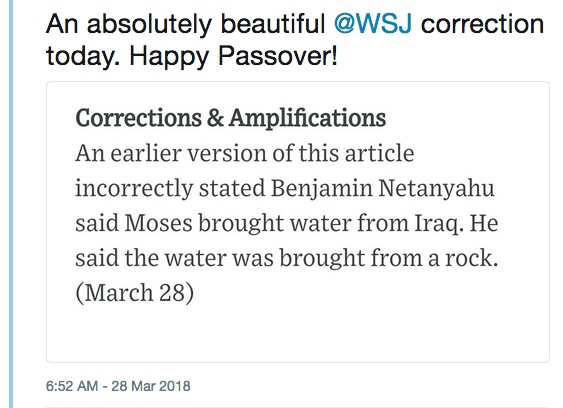
The Wall Street Journal made a similar gaffe in quoting someone, who was discussing a story from the Old Testament:
The story at issue came from the Book of Numbers, in which the Israelites had become angry with Moses for bringing them out of Egypt to a place with no food or water. God instructed Moses to strike a rock with his staff and when Moses did, water flowed from it. (I’m paraphrasing a bit here.) However, the Journal reporter referenced a country that didn’t get any version of that name until the third century (at the earliest) and wasn’t modernly defined until the 20th century. Even if it had been around, it’s unclear why the reporter thought Moses decided to undertake a 500-mile irrigation plan.
Basic rule: If you’re not sure, ask again. If it still makes no sense, don’t use it.
“Like a Christmas tree to celebrate Easter”
Just because something is associated with a group, it doesn’t necessarily follow that you can just slap it on anything you’re doing about that group and call it good. One of my friends pointed me to this photo that was used in a tweet by a political organization in Canada to wish people a “Happy Passover:”
As news reports on the issue pointed out, the two people here are making challah, a braided egg-bread that is eaten on almost every Jewish holiday. The problem? Passover is one of those outside of the “almost every” holiday list, as leavened items are banned. It took several hours for this tweet and image to come down, as the one person who had access to the group’s social media account couldn’t be reached.
A fellow educator pointed out a similar problem when it comes to the use of menorah photos in ads or with news stories:
(This is like) using the wrong menorah for Chanukah on the promo. There are two kinds of menorahs: the Chanukah one has 9 candles and the weekly one has 7.
Basic rule: Not all symbols are created equal, so don’t try to “spruce up” your coverage of something based on a limited understanding of the topic. It’s akin to having someone who doesn’t understand Christianity say, “Happy Easter! I brought you a pine tree!”
Look it up
The initial title for this post involved the word “putz.” I looked it up and found out that, although the colloquial version of this word roughly translates to dummy, twerp or idiot, it literally means “penis.” I then moved on to shmuck (or schmuck in some cases), only to find that this word, too, literally means “penis.” In short, I learned two things:
My knowledge of Jewish insults isn’t as great as I thought it was.
It seems most of the insults I knew had something to do with male genitalia.
The point is that I looked these things up before assuming I knew what it meant so I didn’t embarrass myself when I misused the word. I also found that there are multiple spellings and some difficult pronunciations to some words. (The Jewish-English Lexicon was a real lifesaver.)
This revelation could be helpful for people who are in broadcast and might not be able to sound out the words they want to use:
Chutzpah refers to things like nerve, gall and shamelessness. I would argue it takes some serious chutzpah to try to fake your way through a pronunciation on live TV.
Or to just “guess” at a word because it sounds close, as Wisconsin Gov. Scott Walker did in a letter to a Jewish constituent. Walker signed off the letter with the line, “Thank you again and Molotov!”
Walker was trying to come up with “mazel tov,” a term that means “congratulations” or “good fortune.”
On the other hand, Molotov is generally used as a shortened reference to a “Molotov cocktail,” which is a bottle-and-wick fire bomb:
Basic rule: The dictionary never hurt anyone, so don’t be afraid to use it.
In picking through these various levels of disaster-bacles, I hit up a bunch of people I know who have a better overall understanding of the faith, the traditions and more to see what they thought when they saw this. Adam, who ended up being the best man at my wedding years later, chipped in to the conversation with some good advice that I thought would bring this post full circle:
To me this just gets back to fact-checking 101. If you don’t understand a court hearing you went to, ask a veteran lawyer or judge or even a reporting colleague to explain what just happened. Don’t understand a Jewish ritual? Same deal. Ask a rabbi, or somebody at your local campus Hillel, or a Jewish colleague, etc.
When I covered Roman Catholic services or other news events, I double- and triple-checked every dang detail, even the ones I thought I was pretty sure about. And nobody with the diocese, or my Catholic colleagues, minded that I asked and asked and asked again. They were happy I was trying to be accurate.
In my view, there’s no more or less of an excuse for screwing up a Jewish fact as any other fact.
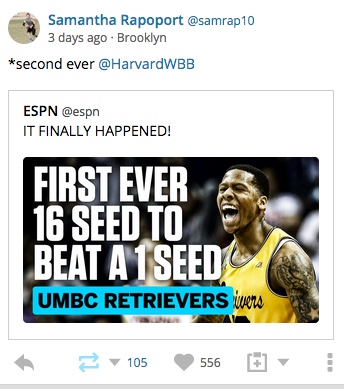
Sports journalism thrives on record-setting performances, amazing finishes and moments when the impossible occurs. As the NCAA men’s Division I tournament began last week, one “unbreakable” record appeared safe: No 16 seed in that tournament had ever defeated a 1 seed in the tournament. In 135 chances, the 16 seed was 0-135.
This leads to three simple lessons to take forward:
Don’t assume only men play: In a number of sports, men and women participate and women have the edge when it comes to records. For example, the person with the most open-era singles wins at Wimbledon isn’t Roger Federer with eight, but rather Martina Navratilova with nine. The person with the most goals in Olympic soccer history is Cristiane, a player for the Brazilian women’s national team. If you think something is a first, a last or an only, make sure to check both sides of the gender ledger before calling it a one-of-a-kind event.
Don’t assume your level of competition is the only level out there: Sports have multiple divisions at the collegiate level (D-I, D-II and D-III), so just because a D-I team hasn’t pulled something off, don’t assume no one else ever has. When an NFL record is broken, keep in mind it isn’t the only “pro” league to ever exist, so if you are making a statement about all professional football history, make sure to check back on things like the WFL and the USFL. Or, just stick to calling it an NFL record.
Don’t assume that because “everybody said” something that “everybody is right: Watching the “first-ever 16 seed” (a redundancy that was almost as bad as the error itself) story fly around the internet had people piling on until someone decided to set the record straight:
This leads to the main point of this post and the bigger overall lesson: Say ONLY what you KNOW for SURE. Don’t get caught up in the hype or assume something has NEVER happened just because you don’t know that it happened before or because “everyone knows” that something hasn’t happened. Instead, write what you can prove: No 16-seeded men’s team in this history of the NCAA D-I tournament had beaten a 1 seed in 135 attempts before UMBC defeated Virginia.
Your readers will still enjoy your work, the outcome is still impressive and you will have the benefit of being accurate.
When I took an editing job at the Missourian, the city’s a.m. paper, we’d send someone running down the street around 2 p.m. to a newspaper box that contained still-moist editions of the Tribune. When the reporter would return with the paper, we’d tear the thing into sections, looking for stories that we had that were absent from the paper or something “they” got that “we” didn’t.
When the internet became more prevalent, the Tribune would post all of its stories online just before we had our news budget meeting. Our newsroom would be filled with reporters at computers, clicking the “refresh” button on their web browsers, trying to get the first look at what the Trib had. More often than not, we were on the short end of the stick and we had to scramble to catch up.
Working for the Missourian presented a unique challenge. The University of Missouri owned the paper and staffed it with professional-practice faculty as editors and students at the J-school as reporters, photographers and other staffers. The Tribune, on the other hand, was a professional, family-owned publication.
Reporters there had years of experience under their belts, along with an extensive set of relationships with sources throughout the area. Our staffers had trouble figuring out how to transfer a phone call.
Making things worse, sources on certain beats actively undermined some of our student reporters. It was infuriating to have a reporter catch a rare tip, work on it for days and then get a “no comment” or some other denial from a source, only to have the source turn around and give the story to a Tribune staffer. It was a sick feeling to read “your story” on the front page of the Trib with the writer slathering “told the Columbia Daily Tribune” attributions all over it.
As much as I really, really hated getting our butts handed to us on a semi-regular basis, it really helped me drive the reporters working for me on the crime beat to hustle like crazy. Living with the Tribune was like being a little brother: Your older sibling kicked your keester over and over and over again at EVERYTHING you both did. But, when you managed to pull off a win, it was like a Christmas miracle, a first kiss and hitting a game-winning home run all at once.
I know that the media environment is much more diverse these days when it comes to social media, citizen journalists and news-driven websites. Turf battles over a city or town by two monolithic traditional news operations doesn’t happen anymore and there’s something good to be said about a more diverse set of niche voices gaining volume.
However, the competition that existed between the two papers in that town helped shape and grow some of the best journalists I’ve ever been lucky enough to know. The Missourian reporters knew nothing would be easy, nothing would be handed to them and they had to hustle just to tie that damned Tribune every, single day.
I don’t know if it’s possible to replicate that kind of environment any more and I think in many ways, news consumers are the worse for it.