This is a photo of me at a high school journalism workshop, apparently trying to explain something that I hope isn’t what it looks like I’m trying to explain. If I can handle this photo of me existing, Pete Hegseth can handle whatever the hell photos they’re taking of him these days.
THE LEAD: The folks in the government are getting grumpy about the way the media is treating them to the point of threatening and banning outlets and coverage they don’t like.
The chair of the US Federal Communications Commission (FCC) has threatened to revoke broadcasters’ licences after US President Donald Trump criticised their coverage of the US-Israel war with Iran.
Brendan Carr told the BBC’s US partner CBS News that broadcasters’ licences were not a “property right” and warned they can be revoked if stations did not serve the public interest.
Carr’s threat came after he accused broadcasters of “running hoaxes and news distortions”, saying they can still “correct course” before their licence renewals.
Some Democratic lawmakers called Carr’s comments unconstitutional. The FCC issues licences to individual broadcast stations, but does not license TV networks.
In a “hold my beer” moment, Secretary of Defense Pete Hegseth went one step further, barring photo journalists from his Pentagon briefings for not making him look pretty enough:
The Defense Department has barred press photographers from briefings on the ongoing U.S.-Israeli military conflict with Iran after they published photos of Defense Secretary Pete Hegseth that his staff deemed “unflattering,” according to two people familiar with the decision who spoke on the condition of anonymity out of fear of retaliation.
I FEEL PETTY, OH SO PETTY: The media and the government have long had an adversarial relationship, with many political figures badmouthing and blaming on the fourth estate for whatever ails them. We’ve had politicians literally beating up reporters as well, with one “bodyslamming” a journalist in Montana, and yet still winning the election anyway.
This isn’t the standard fare of one saber-rattling chucklehead with limited power and an unlimited ego. This is the head of the FCC basically issuing a mob threat, which Democrats immediately rebuked him for making. Even Republicans who generally view the media as somewhere between a swamp rat and the crud that grows on your teeth when you forget to brush for two days are not having it:
Sen. Ron Johnson (R-Wis.) on Sunday rebuked Federal Communications Commission (FCC) Chair Brendan Carr’s threats to revoke broadcasters’ licenses over TV networks’ news coverage.
“I am a big supporter of the First Amendment,” Johnson said on Fox News’s “The Sunday Briefing.” “I do not like the heavy-handed government, no matter who is wielding it. … I would rather the federal government stay out of the private sector as much as possible.”
“The federal government’s role is to protect our freedoms — protect our constitutional rights,” the Wisconsin Republican added.
Johnson is my senator and I can’t remember the last time I fully agreed with him on anything, so to have us both on the same page might be as rare as seeing Jesus riding a unicorn. (You’re welcome…) Johnson’s essential position of, “I might not like what you are saying, but I’ll fight to the death for your right to say it,” is good to see, given that too few people tend to think about how life might look if the shoe were on the other foot.
The backlash against Hegseth isn’t as loud or strong, but the underlying concern of controlling the media shouldn’t be any less alarming. As much as his staff is now backtracking and claiming there’s a “space and fairness” issue driving this, I tend to believe the first report a little more for obvious reasons.
DOCTOR OF PAPER HOT TAKE: Let’s start with Hegseth because it’s easier. I’m a guy who has had his picture taken at a number of podium-based events and I swear to God, I never look good. I either look like I’m gesturing in hope of winning a game of Charades or my mouth is in some sort of position that looks like I’m eating rotten food or about to spit on someone. I’m also old and bald with bad neck hair, so that’s not helping anything either.
So, from that perspective, I can honestly say: Grow up, dude.
You were once on TV and you considered yourself a journalist, so it’s not like you don’t get the idea of how freedom of expression works. I can pretty much imagine the general outrage you’d put forth if a Democratic administration had tried to crack down on whatever you were doing on Fox News. For you to punk slap the media over a couple photographs you didn’t like when this photo of you exists seems a bit stupid:
As for Brendan Carr, his lack of understanding and his use of threats makes more sense. Carr got a bachelor’s in government before getting a law degree. He was a private practice attorney before being brought into the governmental machine in 2012. He never worked in the media, nor is his expertise in that field.
Carr reminds me of a number of school district attorneys and college counsel-folk I’ve dealt with over the years when school media got censored. They had this vibe like, “I’m a lawyer, thus I know everything and I’m way smarter than anyone else in the room.”
I remember one case in which I had to keep correcting a school lawyer about cases he claimed supported his position. Finally, I outlined several reasons he was wrong before turning to the superintendent and saying, “Ma’am, with all due respect, you’re getting terrible legal advice and likely overpaying for it.”
When governmental people come from the business or legal world, they fail to understand that they don’t have as much free reign as they used to. Being “in charge” back there meant they had unfettered power over anyone or anything within their fiefdom. In the government, we have rules and laws that constrain people from acting on their stupidest instincts.
When it comes to quotes, consider the difference between how you buy flowers and how you buy flour. Also, imagine them sitting in a nice vase…
In media writing courses, we talk about quotes being the spice that zips up the story or the sparkly diamond that draws the attention of the reader. However, not all quotes actually do this, because simply slapping quotation marks around a pedestrian set of words doesn’t get the job done.
PR practitioners tend to write press releases that have at least one block quote in them, with some releases being nothing but one giant “statement from X Person” quote. News writers tend to build the bodies of their stories with at least a few paraphrase-quote pairings that are meant to give readers varying views of a topic and a wide array of people a chance to speak. In a lot of cases, those quotes are either relatively pointless or they offer little in the way of quality.
How is it that so many people are proud, happy and thrilled to be there in EVERY PRESS RELEASE, ALL OF THE TIME, even when the writer can craft the quote for the person being quoted? How is it that reporters who get to interview sources also manage to come back with such “meh” quotes from sources who really SHOULD be so proud, happy and thrilled that they can’t shut up about their subject?
Here are the reasons why:
People are afraid to do anything different, lest they offend someone:The phrase, “It is better to remain silent at the risk of being thought a fool, than to talk and remove all doubt of it,” is usually where most people want to be when the chips are down.
To that end, it’s a lot easier to do a bland, mediocre quote than to state something important with your name attached to it. Interview subjects with experience tend to lapse into cliches to avoid really upsetting people, while the press release quotes also tend to play to the middle of boring to avoid controversy.
Writers aren’t as creative as they need to be:One of the things that differentiates PR from news is the concept of quoting sources. If there’s one area where I’ve seen people have the MOST difficulty in making the shift, it’s here.
News requires you to go out, find someone and get something out of their mouth in a word-for-word format. PR in many cases allows for practitioners to write up something on behalf of the client and then just get a “sign off” on it.
Even though you CAN do this, it doesn’t always follow that you SHOULD, primarily for the reason we’re noting here: You don’t know enough about your source, the topic or the non-data stuff to really come up with that whiz-bang quote that will make the difference here.
The same thing can be true of news writers, who don’t put enough time into their research to ask questions that probe or engage the source. If you ask a generic question, you tend to get a generic answer.
Writers aren’t pushing for quality: I can’t tell you how many times I was told to “get a quote” for a story. It was basically like this scene from “The Paper” where Michael Keaton just wants “something:”
I say this as a fellow sinner who often was on the hook for getting a quote, any quote I could from any source, just so that we could say we quoted someone. However, it seems like “get a quote” is a general resting pulse for how we do business.
With those things in mind, here are a few ideas on how to get better stuff:
Don’t shop for flour. Shop for flowers:In the middle of pierogi season at our house, Amy often sends me out for supplies, the most common of which was flour. The direction was simple: “Go to the store and get a bag of flour.” I dutifully comply by driving to the closest place I could and grabbing a five or 10 pound bag off the shelf that resembled the bag she had just emptied.
When I got sent into the field as a journalist, I often felt that was how I was supposed to get quotes. It was like “Go to the store and get a bag of flour.” OK, if that’s all I’m doing, all I care about is going there, picking something off the shelf and coming home.
That’s part of the problem with quotes: You don’t just want something off the shelf.
Instead of shopping for flour, think about shopping for flowers for someone you love. Think about what it is that makes that bouquet special, beautiful and different for them. Think about how you want the reaction to be when they see it. Think about doing more than grabbing whatever is convenient.
Research better beforehand to ask better questions: As we’ve said here repeatedly, the key to everything good we do in journalism is in the preparation. The more work we do at the front end of the process, the better things will be at the back end of the process.
One of the reasons PR quotes are so “meh” is that practitioners don’t dig into the topic or the organization to find things that make it special. When all we have to work off of is a baseline understanding of the concept, which usually comes from a buzzword-laden mission statement, we’re operating in Generic-ville.
The benefit of doing the research before crafting that quote is to make it feel genuine and informed. In adding special touches based on detailed information you found, you not only have a better chance of making your source sound good, but you also have a much better chance of drawing a reporter’s attention.
In the case of reporters and practitioners who rely on interviewing, the research ahead of time can help you shape more pointed and engaging questions that will elicit stronger responses. When you ask that, “So what can you tell me about X?” question, the source will lapse into their “greatest hits album” answer, with all the generic info and cliches. If you can ask something that shows you’ve invested time and energy in the question, you’re likely to get that source to be more engaged.
Change the source’s perspective: Most of the time, the sources we interview either play to us as media practitioners or play to a perceived audience of peers. Those quotes tend to be more jargon laden or otherwise disengaged, and they usually don’t do much for an actual audience that will eventually read their quotes.
Put the source in a different state of mind, based on your full understanding of who you see as the readership. Try asking a question like, “So how would you explain this to a worker on the assembly line?” or “What would you say to a parent in the school district about X?” or even “Could you explain this to me like you are talking to a child?”
In shifting the perspective of the source in terms of understanding the audience, you can get them to shuffle the deck a bit and deal you a better hand. I’m a particular fan of the “child” quote when I’m talking to a source who is clearly exceptionally well-versed on their subject, to the point of assuming everyone else knows as much as they do.
I also like the idea of thinking about who else might be a source in my story to shape the questions. For example, if I’m talking to a product seller, I like to ask them to shift focus to being a product consumer. If they’re a superintendent, I like to get them to shift to think like a parent, a teacher, a custodian or a kid.
In getting them to move, they tend to get out of the rut where cliches live and give me something different.
When it comes to fact checking and BS detecting, I often tell students about a story I wrote involving the Mifflin Street Block Party about 30 years ago. The party got way out of hand late at night, with students setting bonfires in the middle of the street and even burning a car. When firefighters arrived to extinguish the blazes, the party participants repelled them with bottles, rocks, cans and anything else they could throw.
With the fire truck damaged and the firefighters outnumbered, the police eventually went in with riot gear and battled for control of the scene, as the party folks chanted, “F— THE PIGS!” at the top of their lungs.
The next day, I’m talking to the public information officer from Madison PD and I ask if, since it was the first time they donned riot gear since the Vietnam War, if they called out a 10-33, Riot In Progress.
“Don’t you dare call this a riot,” he told me.
I then explained I’d seen what had happened and the carnage that was left behind, so if it’s not a riot, what was it?
“It was a large, prolonged disturbance,” he told me before hanging up.
We are apparently entering another period of Jedi Mind Trick 101, in which people in power are telling the media, “Don’t call this a war. It’s not a war.” Therefore, I thought it might be a good time to pull this post the fact-checking exercise along with it out for another run.
Journalism 101: Facts matter, so don’t feel bad about forcing people to get them right
Trump nearly backed out of an August interview with a group of Black journalists after learning they planned to fact-check his claims. The following month, he and his allies repeatedly complained about the fact-checking that occurred during his debate with Vice President Kamala Harris, berating journalists and news executives in the middle of the televised debate.
And this month, Trump declined to sit down for an interview with CBS’s “60 Minutes” because he objected to the show’s practice of fact-checking, according to the show.
<SNIP>
The moves are the latest example of Trump’s long-held resistance to being called to account for his falsehoods, which have formed the bedrock of his political message for years. Just in recent weeks, for example, Trump has seized on fabricated tales of migrants eating pets and Venezuelan gangs overtaking cities in pushing his anti-immigration message as he seeks a second term in office.
THE BACKGROUND: The joke I always go back to is the familiar one of, “How can you tell when a politician is lying? Their lips are moving.” The idea that politicians fabricate situations is not a new one. Nixon’s “I am not a crook,” Clinton’s “I did not have sexual relations…” and Mark Sanford’s “hiking on the Appalachian trail” are some of the more infamous ones, as they intended to cover over embarrassing personal failings and limit political fall out.
Even more, politicians invent people they saw, they met and they heard, all in the service of some anecdote about salt-of-the-earth farmers getting the shaft, military leaders praising their brilliance or other similar moments of self-aggrandizing puffery. And of course there is the myth-making that surrounds some politicians, like George Washington’s cherry tree or Reagan’s trickle-down economics…
As far as this election is going, Tim Walz was fact-checked on his claims about his service, his presence in China during the Tiananmen Square protests and his family’s use of IVF services, each of which resulted in some disparities. Kamala Harris is also ringing up a few “false” ratings from Politifact on some of her claims regarding illegal drugs and her own previous political efforts.
Still, most of this is piddly stuff compared to what Trump does on a daily basis, both in terms of frequency and intensity. If Walz’s “carried weapons of war” statement is a leak in the truth boat, Trump is continually bashing the Titanic into the iceberg and flooding every compartment.
WHY DO WE CARE AS JOURNALISTS: Despite what the former president of the United States things, facts have a definition: things that are known or proved to be true. The job of a journalist is to get the facts and report them, so that people can make informed decisions on important things in their lives. If you strip away everything else from journalism, that’s the beating heart at its core.
Telling journalists you will only talk to them if they promise not to fact check you is like telling me, “You can come to our party, but only if you promise to not be a bald, middle-aged white guy.” It’s what I am, so that’s going to be a bit hard to square that circle.
People rely on facts to have a shared understanding of reality, so that society can function. It’s why when we bring a shirt to the check out kid and that shirt is priced $19.99 plus tax, we understand it’s probably going to cost about $21 or $22, give or take your part of the country. If the kid says, “That price is fake news. You owe me $150 and can’t leave until you do,” that breaks the whole “shared understanding of reality” thing.
For years, journalists have been telling people, “You’re entitled to your own opinion, but not your own facts.” Somewhere along the way (I blame the internet), it actually became, “Pick your own facts and then be outraged when someone disagrees with you.”
EXERCISE TIME: Pick out a TikTok on any hot topic that’s going on today (politics, Diddy trial etc.) and write down whatever statements these people are declaring to be facts. Then, go fact check them against
In the middle of the week during the middle of the semester, it’s a bit of a drag for students and professors. With that in mind, here are a few things that might amuse you all, spark some discussions or generally make it feel like the weekend isn’t so far away:
FLORIDA’S VERSION OF “WHO WORE IT BETTER?”
You know you’re a journalist when the first question you have after reading this headline isn’t, “What the hell was wrong with this woman?” but rather “How did the manatee get into a bikini?”
In the world of misplaced modifiers, I think this one is the gold standard.
O’Donnell later apologized for his posts and took them down, but there are still copies of this floating all over the internet. It’s also not great optics, given Minnesota House of Representatives Speaker Emerita Melissa Hortman and her husband Mark Hortman were killed in July, in an attack deemed politically motivated.
This serves as one more reminder that stupidity is bad, but amplifying it on social media is worse.
GLAD WE GOT THAT NAILED DOWN: Stories based on opinions, particularly those that can’t be supported or refuted, don’t usually do much for me, but I have to admit this one grabbed me:
The former star of “Growing Pains” and long-time evangelist for Christianity has done a lot for publicizing his faith and reaching out to others to help them find Jesus. That said, I’m wondering where he got the inside scoop on the existence of hell.
I’m also going to argue that if he doesn’t believe in “eternal conscious torment,” he never had a nun for a teacher like I did. Sr. Mary Kenneth still haunts me in my dreams some times…
Speaking of living rent-free in someone’s head…
EVERY TIME A STUDENT REMEMBERS SOMETHING YOU TEACH THEM, AN ANGEL GETS ITS WINGS: I teach a lot of 8 a.m. required classes for sophomores, so I’m never exactly sure how much the students learn from me or how much they think about what I’ve taught them.
That’s why when a student not only remembers what I taught them, but also reaches out to say that they found an example of it in the wild, it just warms my grinchy little heart:
Hi professor, I saw this on Facebook and just thought it was so coincidental that we worked on a draft lead about a case just like this I thought I’d share with you. I think they wrote this terribly:
I’d have to agree with the kid, given that we don’t find out about a dead body until halfway through the piece. I’m also somewhat disturbed by the phrase “a working fire.” As opposed to what? An unemployed fire?
And finally…
SUITABLE FOR FRAMING: Some students wait until week 12 of a 14-week term to start trying to act right in class. At that point, they realize they’re totally screwed, as the math won’t allow them to pass, so they beg for extra credit.
I usually post this on my door right about the time I get that first request:
In 2021, a unit of healthcare giant Johnson & Johnson announced “a leap forward”: It had added artificial intelligence to a medical device used to treat chronic sinusitis, an inflammation of the sinuses. Acclarent said the software for its TruDi Navigation System would now use a machine-learning algorithm to assist ear, nose and throat specialists in surgeries.
The device had already been on the market for about three years. Until then, the U.S. Food and Drug Administration had received unconfirmed reports of seven instances in which the device malfunctioned and another report of a patient injury. Since AI was added to the device, the FDA has received unconfirmed reports of at least 100 malfunctions and adverse events.
At least 10 people were injured between late 2021 and November 2025, according to the reports. Most allegedly involved errors in which the TruDi Navigation System misinformed surgeons about the location of their instruments while they were using them inside patients’ heads during operations.
Cerebrospinal fluid reportedly leaked from one patient’s nose. In another reported case, a surgeon mistakenly punctured the base of a patient’s skull. In two other cases, patients each allegedly suffered strokes after a major artery was accidentally injured.
Among the names listed in the byline of this story is Jaimi Dowdell, one of the pros from the “Dynamics” textbooks and a frequent friend of the blog.
Dowdell is a deputy editor of the data team at Reuters, a team she’s been part of for about eight years. In 2021, she received a Pulitzer Prize for Explanatory Reporting for the team’s look at qualified immunity. Prior to her time at Reuters, she worked for the St. Louis Dispatch and Investigative Reporters and Editors.
As this story was making the rounds, Dowdell was nice enough to share some insights about the story itself and her approach to investigative journalism. Below is a transcript of an email interview, edited for length and to make my questions sound less like they came from a goober:
We have talked over the years about how every story, big or small, has kind of an ideation point. What was it that had you all looking into the issue of AI and medical issues that led to this big story? (and how long did it take you to get it done?)
“I love this question because I think it’s fascinating how stories start. Rarely do we say, “I’m going to do a story about X” and it works out.
“This story began with a conversation with one of my colleagues. He had spent the past six months looking into issues surrounding artificial intelligence and he was interested in how patients were using AI chatbots to self diagnose. His idea of AI in the medical world got me thinking that AI must be impacting medicine in more ways.
“I had worked with the U.S. Food and Drug Administration’s database that tracks malfunctions and adverse events involving medical devices and knew that could be a resource. I then discovered the FDA had a list of AI-enabled medical devices. I started exploring the data and it wasn’t long before we felt like we had a story. We moved quickly from there. The entire process from reporting to editing and production took six months or less.”
What were some of the bigger “road blocks” you hit along the way and what made them problematic? How did you work around them or how did the inability to get past them impact the story?
We didn’t have many major roadblocks for this story. One of the challenges, though, was the technical aspect to the topic.
My colleagues and I spent a lot of time talking to people about the technology that goes into AI-enabled medical devices. I think we really had to understand that before we could write about it.
About ten years ago (damn, I got old fast…), when we were talking about your “Secrets in the Sky” series with the Boston Globe, you were telling me how there is a point where you have to figure out if the story is really there/worth it? You also mentioned that as a reporter you almost have to have a kind of “obsession” in getting the work done. Was that the case here for you and the team or was it something different this time?
“One of the best parts of my job is the time I’m given to explore topics. It’s a luxury that not many journalists have and I don’t take it for granted. During that exploration period, I often follow many leads and attempt to run down curiosities and questions. Then there’s that point we’ve talked about where you had to decide whether there is a story and it is worth it. For this story, that moment came quickly.
“Over the years I’ve learned that if you don’t have to work too hard to find examples that illustrate the trend or concept you’ve uncovered, there’s a good chance there is a story. There have been times when I’ve worked on ideas where it seems almost impossible to find more than one example. Does that mean it isn’t a story? Not necessarily, but it does indicate there may be a better use of your time.
“That wasn’t the case here. The growth we found in AI-enabled medical devices was the first indication there was a story. From there, it wasn’t too difficult to find examples of devices where potential issues had been flagged. Then, because all of this involves public health, it seemed an important and worthy topic in which to invest.
“And yes, there was an obsession. There’s almost always an obsession! I think that’s another indicator on whether the story is good or not. If I’m not ruminating about a story while exercising or waking up in the middle of the night with an idea, I might not have a great story. Is it healthy? Probably not. Each time I do a story like this, I think, ‘next time I won’t get so sucked in.’ But it always happens. I can’t speak for my colleagues on this story, but based on how often we spoke at all hours of the day, the obsession was there for them too.”
A lot of student journalists find a passion for doing bigger projects, but often find it to be frustrating because of a lack of resources or a lack of time. This might be especially true for those trying to meet work expectations of grinding out X number of pieces a month for student media or making class deadlines set by unreasonable professors. What kind of advice do you have for student or beginning journalists who want to try doing some of the deeper stories like the ones you do?
“The demands of unreasonable professors and the churn of student media is likely not that different from the professional world. There is a lot of news and there are a lot of demands on journalists these days. I didn’t start out getting to spend so much time on stories and neither did most of the journalists who do this type of work. But it can be done. I was able to dig deeper on stories even as a student and there are ways to get to do this type of work. Here are some suggestions:
Don’t wait for permission.Too often, I see student or beginning journalists look to professors or editors to give them an assignment to dig deeper. If you wait, it’ll never happen.
Be curious.Many of my stories started out because I just wanted to know something. Turn your own curiosities into a question or a hypothesis that reporting can help you answer and test. Do not think, “I’m going to do a story on this.” Instead, just work on being curious and looking for answers. The stories will reveal themselves to you in time.
Start small.Instead of trying to do a big story right off the bat, include investigative elements into your regular work. For example, look for data that can help enrich a daily story. Start looking for source documents as you report. These small victories can lead to big stories down the road.
Don’t be afraid of hard work. This type of journalism can be tedious and frustrating. If you’re feeling like it’s too hard, you might be doing it right.
If you could tell a student journalism kid anything about anything that you think would be helpful to them these days, what would it be? What would you like them to know?
“I’d say that none of us ever feels like we really have things figured out.
“I remember when I was in college, I looked forward to the days when I would know exactly what I wanted to do with my life. Guess what? It turns out we always feel a bit uncertain and we’re all basically kids.
“So get out there and embrace feeling uncomfortable. Whether you end up in journalism or something else, the growth, I’ve found, is often in the discomfort.”
The University may record a class or access existing classroom recordings without the permission or knowledge of the instructor being recorded for the following purposes:
To gather evidence in connection with an investigation into alleged violations of University policy, when authorized in writing by the Provost and the Chief Human Resources Officer; and
For any other lawful purpose, when authorized in writing by the Provost and the Office of University Counsel, who will consult with the Chair of the Faculty.
BACKGROUND: The university had run into several issues related to recordings of professors over the years, only to figure out it really had no policy in place to deal with such things.
When called to account for this surreptitious move, the U fell back on the “well, we’re a one-party consent state” thing, which is true but a bit wobbly at best.
A FEW BASIC OBSERVATIONS: I found myself thinking about a couple aspects of the policy that either people haven’t considered very well or they just hope they won’t have to deal with in the future. Consider the following:
Rules for student recordings:I’m not sure exactly how this came into play, but the document makes it against UNC law for students to record in the classroom, except under specific circumstances:
Students may not record classes, including online classes, without express advance permission from the instructor teaching the class they wish to record. Students approved for recording as a University Compliance Office (UCO) accommodation to address a disability, pregnancy, or religious accommodation must notify instructors of their approved accommodation by sending an accommodation notification plan in advance of any recording. The approved accommodation plan must indicate the means by which the recording will be accomplished and any other details pertaining to the recording or its use.
Well, for starters, how are you going to monitor that, given students carry about 97 digital devices on them at any point in time? I guess if I’m in my computer lab at UWO with 20-some kids, maybe I might notice a kid’s phone set to record, but most likely not. In a UNC pit class, though? Not a chance in hell.
Add that to the lack of a specific “or else what” in this policy and I’m thinking this thing is going to be relatively toothless when it comes to enforcement. I’m not an expert on university policy or UNC’s policies in particular, but I don’t see a “If you do X, you will suffer Y” in this document. The document also doesn’t say, “See POLICY X for punishments” so I’m left to wonder if the kids will record anyway depending on how strict the policy and problematic the punishment.
Martyrs to the cause:Most of the kerfuffle I’ve seen in relation to classroom recordings getting out into the world is related to students trying to “expose” professorial bias. We’ve covered a few of these here, and there are dozens more cases elsewhere in which a student records a professor doing or saying something that upsets a large group of the perpetually offended. Once that match of outrage hits the kerosene of social media, the professor’s goose is cooked.
With that in mind (and the previous point in mind as well), I somehow doubt this kind of thing will stop. Even more, I imagine that a kid who “exposes” a professor via an illicit recording at UNC will now be hailed as a martyr to the cause if any punishment befalls that kid.
(“Let’s all remember the brave sacrifice of Jimmy, who recorded Professor Jones misgendering a piece of wicker in Underwater Basketweaving 385. That ‘stern talking to’ he got from the dean will haunt him always…”)
We have a world in which social media rules, “gotcha fame” is aspirational and people are way too full of themselves around the academic world. Recordings are going to happen.
To Chill or Not To Chill: I’ve studied the concept of the Willingness to Self-Censor for a number of years and found that many people have an innate sense of how willing they are to speak out or shut up when faced with controversy. Certain topics tend to spark this more in all people, but many topics spark it in specific people. In short, there are a lot of reasons why people will hold their tongues and it’s not always because they don’t have something to say.
Conversely, I’ve dealt with academics all my adult life and I found that many of them apparently have some sort of condition that makes them think everyone should hear what they have to say about everything, regardless of the circumstances.
Michael Palm, president of UNC’s chapter of the American Association of University Professors and associate professor in the UNC Department of Communication, said faculty members are aware they may be monitored by the University or even outside groups.
“My sense is that most faculty, at this point, just assume they’re being watched,” Palm said.
<SNIP>
“I think it is unquestionable that there has been a chilling effect on campus and that many more faculty now than at any other time that I’ve been a faculty member — and I’ve been at UNC for 18 years — are self-censoring out of fear for what might happen if the wrong people disapprove of the content in their classes,” Palm said.
If I’m being honest, there are days I have a “come at me, bro” vibe going on when it comes to my classroom. If you think I’ve said something stupid, childish, offensive or whatever… well… take a number, I guess. Then there are other days where, if I think about all the potential ways something like this could screw me, you couldn’t pull a needle out of my keester with a tow truck.
What I foresee here is that the students are going to lose a lot, thanks to this policy. The professors who really SHOULD be curbed a bit in regard to their histrionics and side-rambles will be the ones thinking, “Well, that’s for other people…” The folks who are more like academic prairie dogs, popping their little heads out of their holes juuuuuusssst enough to see if the coast is clear, will stay under ground for fear of getting whacked.
The first wave of responses was from regular readers, and most were positive. Several thanked me for showing how we use AI to expand our offerings while maintaining quality.
I suspect I receive little negative feedback about AI now because I’ve written about it so often. I know the anxieties it causes. That’s why I explain how we use it, assure you we are not replacing jobs and promise that humans stand behind everything we publish.
As for anything that might challenge his assumptions, well, Quinn doesn’t have time for that crap:
(A) cranky journalist in another state took offense and on Monday ranted on social media about my practices being the ruination of journalism. Much bombast by others followed.
Or, so I’m told. I didn’t read any of it. I have no time for uninformed outrage on social media channels.
(EDITOR’S NOTE: I was not the “cranky journalist” Quinn spoke of, clearly, because my “bombast” and “uniformed outrage” was published Thursday. Just want to clear that up.)
In the end, Quinn gave all of his supporters a good pat on the head before trying to shame anyone who wasn’t fully on his side:
For those who wrote to say they understand and admire what we’re doing, many thanks. To those who wrote to criticize it, I suggest you look to history to understand that the only path forward is adaptation.
Or, keep stomping your feet until you don’t have a leg to stand on.
CATCHING UP: Quinn wrote an extensive column last week, praising the use of AI as a tool that allowed his staffers to do more reporting and zero writing in some under-covered enclaves of the paper’s circulation area.
In doing so, he decided to take several potshots at colleges, college professors and college students, saying they were doing everyone on Earth a massive disservice by decrying the value of AI, or outright ignoring it.
This led to at least some of the backlash against him, including the piece I wrote here that made what I consider to be three clear, well-reasoned and well-supported arguments:
Quinn is wrong about journalism programs not teaching AI or telling students that AI is the devil.
AI is a tool that still has a lot of kinks to work out, and it has proven to need some extensive oversight in its current form.
The content the PD is producing from its “Report it all, let AI write it up” leaves something to be desired in terms of quality.
In his most recent missive, Quinn didn’t deal with almost any of these criticisms, but then again, I really didn’t expect him to. In reading through his 14 previous letters on AI, I’ve found kind of a pattern in his views on AI. Two broader underlying premises really underscore why I’d love to play poker against this guy:
The Law of the Instrument:The concept has been around for generations, but it’s often attributed to Abraham Maslow, and it basically states that if the only tool you have is a hammer, you treat everything like it’s a nail.
Quinn has so bought into the premise that everything can be done with a strong set of reporters and an AI grist mill, that it’s clear all stories are getting done this way on those beats. The underlying problem is that not all stories can be done well this way.
Quinn mentions things like people wanting to know the score of the Browns game or the outcome of a vote from some board in Lorain. These stories are great for AI to just crank out.
OK, fine, but what about that story of the teacher who donated bone marrow? Or obituaries? Or other stories in which details matter and storytelling can make a difference? These things get ground up and spit out in a bland way that really undermines the quality of the work the reporters have done.
Quinn isn’t alone in this, as I remember having an argument with a broadcast professor during the “convergence phase” of journalism. I noted that some stories were better done in print or online while other stories were better done in broadcast. He argued anything I could do for a newspaper, he could do just as easily for broadcast.
I mentioned things like budget stories that needed mathematical depth and lacked a lot of visuals for video. He told me how he would take video of people typing on keyboards or how he would throw a copy of the budget on the table and film that.
The underlying point in both cases is the same: Yes, you CAN do a story this way but it doesn’t follow it’s the BEST way to do that story.
Often Wrong, Never In Doubt: I heard this phrase in a documentary on financial investors, where a short-seller explained that certain people are very good to bet against because they lock in on an idea and refuse to be dissuaded, regardless of the reality surrounding them.
When they are wrong, but overly confident, they’ll pour vast sums of time and money into risky things that end up going wrong, thus benefiting the people who clearly saw the inherent flaws in those things. Quinn fits this to a T.
Even when I’m really certain on something, I’m always open to the option that I might not be right. If Chris Quinn brought me to the PD, showed me all the great stuff he’s doing, demonstrated how they’d backstopped AI to prevent any catastrophic failures and presented data on how great this was serving his readers, I’d be happy to give this whole experiment another look. I believe paranoia is my best friend, so I’m looking out for risks and willing to say I’m wrong.
Quinn’s most recent letter just drips with hubris, belittling anyone out there who hasn’t fallen in line while ignoring the issues a bunch of us have raised here (particularly those about how crappy J-school is). It’s telling that after a letter in which he basically said professors suck and J-schools suck, he added this tidbit to the end of his latest missive:
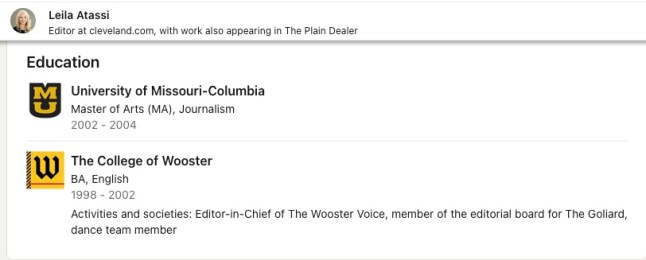
Note: I mentioned a student last week who withdrew from job consideration because of our use of AI. Some readers concluded the student attends Syracuse University. That’s not the case. Actually, Syracuse’s Newhouse School of journalism, a valued partner for us, teaches about AI in journalism. Leila Atassi, one of our editors, will be on the Syracuse campus in a few days to help coach students in how we use AI.
That’s exceptionally tone deaf for two key reasons:
You spent an entire column telling everyone that college journalism programs ignore or hate on AI and then without an ounce of irony, mention how great Syracuse is and that they’re doing some awesome AI stuff.
You crapped all over journalism degrees and how they’re worthless, yet you’re dispatching Leila Atassi to Syracuse to teach these kids. I wonder what her background is… Oh… Yeah…
And, I’d like to say I believe in Leila and her abilities, if for no other reason, than she went to a hell of a good journalism school for her master’s (and she was actually one of my students for a while.)
In any case, while Chris Quinn thinks I’ll be here stomping my feet until I don’t have a leg to stand on, I’ll actually be watching to see what happens as the PD’s Icarus keeps flying higher and higher on his AI wings.
I hope the computer-based journalism helpers Chris Quinn is putting his faith in work better than the Cleveland Plain Dealer website. I tried to buy a subscription to view his diatribe about journalism schools and AI, only to have a spinning wheel of death show up for about a day or so…
By removing writing from reporters’ workloads, we’ve effectively freed up an extra workday for them each week. They’re spending it on the street — doing in-person interviews, meeting sources for coffee. That’s where real stories emerge, and they’re returning with more ideas than we can handle.
<SNIP>
Journalism programs are decades behind. Many graduating students have unrealistic expectations. They imagine themselves as long-form magazine storytellers, chasing a romanticized version of journalism that largely never existed.
That’s what they’re taught.
DISSECTION TIME, PART I: Let’s look at both Quinn’s arguments as well as take some time to disprove them, starting with his view of students and journalism programs:
The Strawman Student:Quinn’s piece begins with an exemplar of how students suck these days, especially because we teach them poorly at every journalism school in the country:
A college student withdrew from consideration for a reporting role in our newsroom this week because of how we use artificial intelligence.
It reminded me again how college journalism programs are failing to prepare students for the workforce.
I don’t have a reason to doubt Quinn that this kid exists, but I also have no reason to trust him. I’d like to see the withdrawal letter/email/voicemail the kid sent and I’d probably also like to talk to the kid.
See, Chris, sometimes people tell you stuff that isn’t true, like “I really wish I could make it to your party” or “The break up isn’t about you, it’s about me” or “It happens to a lot of guys and it’s not a big deal.”
Maybe this kid didn’t want to work for someone who saw their role in the newsroom as feeding grist into a mill for a robot overlord. Maybe they actually enjoyed writing, so giving up the part of the job they like wasn’t worth it to them. Maybe, and I say this as a huge fan of the sports teams, they didn’t want to move to Cleveland.
Could be a lot of things, but blaming it solely on your AI policy helps you nicely set up your argument that journalism schools suck.
The Incorrect Overgeneralizations:The bigger problem here is the leap from this one kid not liking something to all journalism programs failing all of the kids out there all of the time. Even if we pretend that this one alleged kid was so allegedly horrified at the Plain Dealer’s amazing-as-hell AI set up that they had to pull out immediately, it doesn’t follow that all kids in all schools are taught to hate AI. This is called negative social stereotyping.
Even if that feels like a bit of hyperbole, let’s at least agree that not every kid who comes out of a program is the exact same in terms of quality, maturity and expectations.
Also, I think we can agree that not every journalism program is created equal, so while the kids at University A might be using smudge pots to ward off the evil spirits used to power AI, kids at University B might be getting some good data journalism help, transcription services and other goodies, courtesy of AI.
Then again, maybe we can’t agree, given this generalization:
Like many students we’ve spoken with in the past year, this one had been told repeatedly by professors that AI is bad. We heard the same thing at the National Association of Black Journalists convention in Cleveland in August. Student after student said it.
Chris, did you bother to dig a bit deeper on this, because there are a few nuances that merit consideration. First, who were these professors? Were they in journalism or were they in departments where they’ve gotten used to grading 500-word essays that AI can now crank out in 18 seconds, thus putting the fear of God into these people?
I’m also curious, given your disdain for journalism programs, where did the amazing Hannah Drown and Molly Walsh garner their educational pedigree that mixed the poli sci, business and non-profit knowledge you desperately want kids to have?
Oh… Yeah…
Given their background, I’m wondering how Hannah and Molly feel about this proud declaration you made:
Fortunately for those of us who know exactly what skills we need in applicants, AI has altered the landscape so dramatically that we don’t need journalism school grads.
We don’t need any damned JOURNALISM GRADUATES… Except, of course, the two we hired to do this work that we’re so proud of…
The Erroneous View of J-Schools: I’d like to know how many journalism programs Quinn visited in the past five years. A five-year span would cover the time frame where artificial intelligence would have become relevant enough for schools to start embracing a relatively stable set of AI tools.
I’d put the over/under at about three schools, and I’d advise people to take the under.
There are likely colleges that are shunning AI, but clearly many more are embracing specific aspects of these tools.
Stanford, UCLA, Atlantic International University, Florida and Columbia are just a few of the other schools that have Journalism-based AI courses on the books, and those are just the ones I found on through a cursory search. That’s not even counting all the programs (ours here included) that have infused AI into the current courses we have, so we can demonstrate the value of the tools while we teach caution as well.
(NOTE: If your school or your class does some AI stuff, feel free to pipe up in the comments section. I bet we could really make a run at the record for most comments on the blog.)
What we have here is a collection of facts, supported by links to additional information. I’d like to think that’s a bit stronger case than Chris Quinn’s “Old Man Yells at Cloud” approach to generalizing about what’s wrong with journalism schools today.
The “Road Less Traveled” Advice:Quinn’s ignorant view on J-school is problematically compounded by his educational suggestions for kids who want to enter his glorious newsroom:
If you’re a student considering journalism, I’d skip that degree. Study political science. Learn technology. Understand how government, businesses and nonprofits work. Take communications law and ethics as electives. Skip much of the rest.
Got it. Just like you did back in the day! Right, Chris? Oh… Wait…
I don’t know if he’s going to be on College of Media and Communication Dean David Boardman’s Christmas card list this year, but I’d love to see Boardman’s reaction to this column…
Aside from the “do as I say, not as I did” thing, if I wanted to tank a kid’s future, I’d pretty much tell that kid to do exactly what Quinn is saying here.
Technology changes so rapidly that whatever the kid learned in freshman year would likely be obsolete by graduation. You can learn tools, but it’s important to know the broader ways in which they should be applied to further your skills and connect with your audience. For example, in my day, we didn’t major in Quark XPress. We majored in design, used the tool in conjunction with our broader understanding of the field and then adapted to technology changes.
In addition, there’s a reason the phrase “Why try? Go Poli Sci” is still heard in the halls of many academic institutions. It’s also much more likely to be in the “paper law” as opposed to the “trial law” end of the spectrum. I’m not saying a certificate, minor or even double major in this is field is bad, particularly if you want to take your media skills into the political realm. However, you’re not making it to a newsroom solely on a steady diet of Politics and Genocide or Western European Politics courses.
I’d also like to know where Quinn thinks students are getting their interviewing skills, their social media experience or their general reporting knowledge in this newly formed major he’s promoting here.
Being forced to meet people takes effort, particularly based on how today’s generation of students has grown up in a digital-first, post-pandemic, borderline-anthropophobic world. Research suggests that nearly 45 percent of Gen Z men have never asked someone out on a date in person, so if Quinn is assuming this fresh crop of potential folks can do this without some reporting courses (still a thing) or other forced socialization, I’ve got some unfortunate news for him.
DISSECTION TIME, PART II: With that out of the way, let’s pick apart Quinn’s views on artificial intelligence and the glorious way in which it has drastically improved his newsroom:
AI! It’s FANTASTIC! (Usually): Quinn has gone all-in on AI, which is always dangerous when it comes to a new technology. Actually, it’s usually dangerous in any situation, given that most new ideas suffer a lot of growing pains before they eventually become valuable, but so much less so than what was expected.
Still, he’s a fan:
Artificial intelligence is not bad for newsrooms. It’s the future of them. It already allows us to be faster, more thorough and more comprehensible. It frees time for what matters most: gathering facts and developing stories to serve you.
Anyone entering this field should be immersing themselves in AI.
I’ll buy faster, but I’m not entirely sold on the other descriptors here, given what we’ve seen AI mess up already. Dare I say Quinn is “chasing a romanticized version” of this technological marvel.
Words, Words, Words…:Quinn seems to take an almost perverse level of pride in how much content his staff members can grab and how none of them has to do any actual writing any more:
By removing writing from reporters’ workloads, we’ve effectively freed up an extra workday for them each week. They’re spending it on the street — doing in-person interviews, meeting sources for coffee. That’s where real stories emerge, and they’re returning with more ideas than we can handle.
I get that it’s important to do deeper reporting, spend more time with sources and connect with the communities journalists cover. However, the question becomes, “How much of all that good will and strong effort is wasted if you just toss everything in an AI blender and then watch the content move along like you’re “Laverne and Shirley” at the Shotz Brewery?”
Plus, and maybe Quinn doesn’t give a damn, but I’ve found that when I invest a lot in the reporting, I tend to care about the story I want to tell. That usually leads to some stronger, more engaging pieces based on well-crafted writing.
Being a writer isn’t a negative, particularly if you want to write for the benefit of an audience that is interested in what you have to say. I think I’m qualified to say that, given everything I sit down to write has me thinking, “Who would want to read this and what would they want to know?”
I’m not sure if AI has gotten to that point yet, but I know good writers have.
Quantity over Quality:I forget what movie it was in, but there was a scene in which prisoners were told, “We’ve got good news and bad news. The bad news is that all we have for your dinner tonight is horse manure.” When someone asks, “So what’s the good news?” the official replied, “There’s plenty of it.”
Which brings us back to the Plain Dealer’s Bin of AI Content…
A quick look at the list of stories Hannah Drown put together recently provides some sense of the quantity. Each day she appears to be on the job, a handful or more stories with her byline show up. She’s got coverage of events at the Lorain County Junior Vocational School, a UAW strike in the area, a pop-up shop at the Lorain Community College, a school lockout in Elyria and more. The volume is there.
The quality, however, leaves something to be desired.
These are mostly stories that could have easily come from a press release rewrite, featuring a “Hey, come check out this new thing” approach. These lack depth and nuance, not to mention any level of critical thought. The stories have overly long sentences, generally lack flow and are as dry as a popcorn fart.
For all the bragging Quinn does about reporters getting a chance to sit with sources, meet for coffee and chat these people up, most of the content comes straight from documents, not people. A look through more than a dozen of these pieces revealed virtually no direct quotes or specific references to interviews with these salt-of-the-earth individuals.
For example, a story about a school teacher who donated bone marrow to a complete stranger half a world away would seem to be exactly the kind of piece that would engage readers through amazing storytelling. Instead, we get this lead:
LORAIN, Ohio — Valentine’s Day usually arrives with candy hearts and roses, but this year, one of the clearest acts of love connected to the holiday came without flowers at all.
We get no direct information from the teacher about the experience, nothing from the folks at the National Marrow Donor Program talking about the value of the program and nothing from people who have had their lives saved through some of these selfless acts.
The story has zero quotes in it and reads like a “how-to manual” for getting on the bone marrow registry and donating it to someone. Boring doesn’t begin to cover it.
I’m not entirely sure I can blame Drown for this, as it is her job to just shovel content into the front end of the pipeline. It’s also not stated to what degree AI did any work on this (or any other) piece in her clip file, which I’d consider a bit of an ethical concern.
What I can say is that if my name were on these things, I’d want the writing to be a lot better than it is. As we’ve noted before, AI essentially creates an average of EVERYTHING it takes in, regardless of quality, and this definitely feels like “C” writing.
What goes unsaid in Quinn’s magnum opus is that people now have an abundance of media outlets at their disposal that provide vast sums of content. Journalists have to grab people by the eyeballs and hang onto them in a way that distinguishes their work from the noise.
This is where quality writing and keen storytelling come into play and where the generic “held a meeting” leads that AI can churn out will fail.
(FINAL NOTE: I’m sure Quinn would be horrified at the amount of time I spent writing this piece, given his “crank ‘er out” philosophy. I’m fine with it, though, because I believe dedication to one’s craft matters a lot, even if the point is just to tell someone they’re full of crap.)
The opening of the story about “your children” and “your” experience watching one of them die from the measles.
DISCUSSION STARTER: This is a good opportunity to have students read the story, “This is How a Child Dies of Measles,” before digging into this post to see how they feel about the approach, particularly if they are unaware of the truth of the story.
(The story is behind a paywall, so you might need to get creative to gain full access to it. Some school libraries have it on file, while some of you might have your own subscription. Maybe it’s even worth it to pay the $1 for six months thing and then cancel after the class. Just a head’s up in case you hadn’t planned for this.)
We did this a couple times over the years in my features classes, where they read the standard “almost journalism” stories of “Hack Heaven,” “Jimmy’s World” and “A Rape on Campus.”
Once they read through it and you make the reveal, a discussion about their thoughts, their concerns and maybe their willingness to do or not do something like this could be good. Then, if they want to pick through the blog post and argue with me, that could be fun, too.
When I initially read Bruenig’s story, I was stunned: An Atlantic staff writer’s unvaccinated child had died of measles in the 2020s, and now she was writing about it? At the end of Bruenig’s piece, though, there’s an editor’s note: “This story is based on extensive reporting and interviews with physicians, including those who have cared directly for patients with measles.” That was the point when I sent a gift link to my mom group: “as far as I can tell this piece is fiction. What do we think about this choice? I am very conflicted!!!” My conflict stemmed from my concern that, though the piece was heavily researched, it was not a true story.
THE BACKGROUND: The story is written in second person and provides excruciatingly detailed information about everything from the way in which the illness can be passed among children, to the scene-setting elements of propping a kid up on a couch to watch “Bluey.”
Each paragraph provides the reader with a more and more desperate sense of inevitability in terms of “your” children suffering from to something we thought we had eradicated.
Given your son’s fever, runny nose, and evident discomfort, you feel a grim sense of resignation when his measles test comes back positive. You are, however, alarmed when you discover there’s nothing his doctors can do about it. Had he been seen by a doctor within 72 hours of his first exposure, they could have given him a prophylactic dose of the MMR vaccine to protect him from infection. But it’s too late for that now.
(SIDE NOTE: Few writing approaches are more jarring and risky than the use of second person. That’s true when it comes to simple things like, “UWO is hosting a blood drive and you should donate,” but even more so with big, complicated stories.
I love Jay McInerney’s work from soup to nuts, but his novel “Bright Lights, Big City” is a massively painful read for me because “you” are the main character and “you” are doing stuff that, quite frankly, I can’t really imagine “me” doing, not the least of which is referring to a woman as “the sexual equivalent of fast food.”)
The finality of the piece is like one of those “Friday the 13th” movies: Just when you think this is all over, the terrifying specter rises again to finish off its victim:
For roughly eight years, you will believe that your family made it through this crisis without suffering a tragedy…
As the neurologist examines the results, she will note the presence of Radermecker complexes: periodic spikes in electrical activity that correlate with the muscle spasms that have become disruptive. She will order a test of his cerebrospinal fluid to confirm what she suspects: The measles never really left your son. Instead, the virus mutated and spread through the synapses between his brain cells, steadily damaging brain tissue long after he seemed to recover.
You will be sitting down in an exam room when the neurologist delivers the diagnosis of subacute sclerosing panencephalitis, a rare measles complication that leads to irreversible degeneration of the brain. There are treatments but no cure, the neurologist will tell you. She tells you that your son will continue to lose brain function as time passes, resulting in seizures, severe dementia, and, in a matter of two or three years, death.
After all that, you get kind of a semi-disclaimer that doesn’t exactly disabuse of you of the notion that this is real:
This story is based on extensive reporting and interviews with physicians, including those who have cared directly for patients with measles.
THE AUTHOR EXPLAINS: In a Q and A with the folks from the Nieman Lab, Bruenig walks through her approach to the topic and her decisions that led to the piece. She then makes kind of a sweeping statement about the greater good she feels she is doing with this fact-based fiction:
Owen: Where do you expect this piece to be shared and who do you expect to read it? Do you think people who choose not to vaccinate their kids will read it, and if so, how will they come across it? Have you heard any reactions from readers so far?
Bruenig: I have heard from several readers, one of whom had a heartbreaking experience with measles involving a family friend who died of the virus. People have been generally very encouraging! I have no doubt that there are a lot of people out there who are unhappy with the story or reject its premises, and they are entitled to their interpretations. I get it.
But my job is to report the truth about the world — and I use all kinds of literary, and narrative devices to do that. I do it because telling the truth is important in its own right, whether or not anyone finds it persuasive.
A FEW OF THE 932 REASONS THIS APPROACH WAS A BAD IDEA: First, let me say, I’m a huge fan of vaccines. Got all of mine, my kid got all of hers, my wife is a nurse who gets shot up like a dart board every year… This isn’t about the ethics or efficacy of vaccines, but rather the ethics and efficacy of this kind of journalism.
First Problem – Deception: Journalism is about fact-based reporting, which this piece has, but it’s also about providing information to the audience in an honest and trustworthy fashion. When we deceive the public, even if it’s for a good cause, we destroy the credibility we need to survive.
Bruenig says she’s reporting “the truth about the world,” which to me sounds both self-aggrandizing and disingenuous. She did rely on the facts as they related to the illness and she did draw from experts to understand how the illness works. However, and it bears repeating, WHAT SHE WROTE ABSOLUTELY DID NOT HAPPEN TO A KID IN THIS WAY.
This reminds me of when politicians would tell stories about “regular folk” who brought up dire concerns or who were traumatized by something specific. When journalists couldn’t find that “regular Joe Farmer” who lost everything thanks to a terrible government plan or that “regular Jane Business Owner” who had to give up her life savings to keep her staff paid, the politicians would always backtrack it and say it was an “amalgamation” of the stories they’d heard over the years.
In other words, they were lying, but hey… it’s the bigger picture that counts!
Then there’s this weird thing Chuck Schumer did, creating a fictional family based on the types of people he felt he represented:
I mean, yes, those kinds of people exist, and yes, those kinds of concerns are real, but again, you can’t just Frankenstein a bunch of pieces of people together and call it good.
Also, the supposed “disclaimer” doesn’t come right out and say, “This didn’t happen to one kid, but rather is a collection of all of the terrible stuff that can happen to an unvaccinated kid.” It’s almost like the author is trying to avoid accusations of writing fiction while doing as little as possible to make it clear that this literally did not happen.
When we are deceptive, we end up doing more harm than good. As I made the point in an earlier post, when my students read stories like “Jimmy’s World” and “A Rape on Campus,” they were angry, hurt, scared and otherwise emotionally wrought. When it came to light that Jimmy didn’t happen and that the attack on Jackie did not happen, they were really, really ticked off. They also felt less likely to trust the pieces they would read in the future.
As much as I prefer “non-denominational skepticism,” I definitely don’t want to prod it along with some borderline fraud.
Second Problem – Hyperbole:This comes back to the whole amalgamation of potential impacts issue, and how piling it all on to this one hypothetical kid is really overkill.
A number of the things she lists as symptoms of measles happen in many cases, ranging from the spots and fever to the cough and pain. However, when we get to the areas of pneumonia, we’re down to about 6 percent of all cases that end up here. Even more, the degenerative brain disorder that flares up years later happens to about 1 in 1,000 measles victims. In justifying the conclusion where “this is how your kid eventually dies,” Bruenig said:
I wanted to highlight this complication specifically because I sense that there’s widespread belief among anti-vax parents that since most healthy children will survive a measles infection, there are no important long-term consequences. But that’s simply not the case. Measles can seriously damage the body, and in rare and tragic cases, can result in death many years after the symptoms pass.
OK, but that’s a massive outlier for this disease and, again, that’s on top of the 83 other things that could or couldn’t happen that you saddled “your child” with in this story.
It would be like me stating, “I laid in the hospital, facing the grim specter of death. As the pain shot from my gallbladder, time ticked away in the day, each moment a chance I might die. Surgery, hours away, I pondered what would happen when my light was extinguished by an organ I’d long forgotten I had.”
Well, yes, I was in the hospital and yes, that gallbladder hurt like hellfire. And yes, if a person’s gallbladder ruptures, there is a chance the person goes septic and dies. However, that’s somewhere between 2 and 11 percent of all cases. I could make the argument that it was for the larger good that I painted this hyperbolic picture, hoping people will take gallbladder attacks seriously. However, I think most people would just say I was being a drama queen.
Third Problem – Laziness:I wholeheartedly believe in telling stories in journalism for the greater good of society. I also know there are an unfortunate number of children who have died after contracting measles. Telling a story about these deaths might inspire people to vaccinate, to change their minds about the severity of the illness or otherwise impact a broader discussion on the topic.
So, don’t be lazy. Go find an ACTUAL story of a measles death that happened to a REAL kid and tell that story.
Here’s one that even involves that rare illness that killed Bruenig’s hypothetical child:
That’s not to say you need to tell the story in this kind of staid news format. You can do more of the narrative work, using the parental recall, photos, medical records and expert interviews to paint a more vivid picture.
Strong interviews with the parents of a child can give you that emotional angst of anxiety, fear and despair. Spending time looking at photos can give you the “favorite blanket” and “watching Bluey” details that paint a picture in the readers’ minds. The experts can walk you through the files so you can describe in detail how each cough wracked the child with pain or how the fever created a mix of burning and chills that couldn’t be sated.
This takes a ton of work. You have to find a case where a kid died, you have to find parents willing to talk, you have to find experts who understand what happened to the kid and you have to spend time gathering granular-level elements through observation. Doing this also puts the reporter at risk of some significant emotional trauma, as they relive the death of a child in such a gut-wrenching way.
So, I can kind of see how it’s more appealing to just go to a handful of experts who can give you the clinical stuff and then just whip together a “Hypothetical ‘You’ Mom” character to tug at the emotional heartstrings of the readers, without fully acknowledging that’s what you did.
However, if you want the reward of the tough story, you really have to take the risks associated with the tough story. Doing it this way only codifies the certainty of people who don’t already believe you and undercuts your standing with people who do.
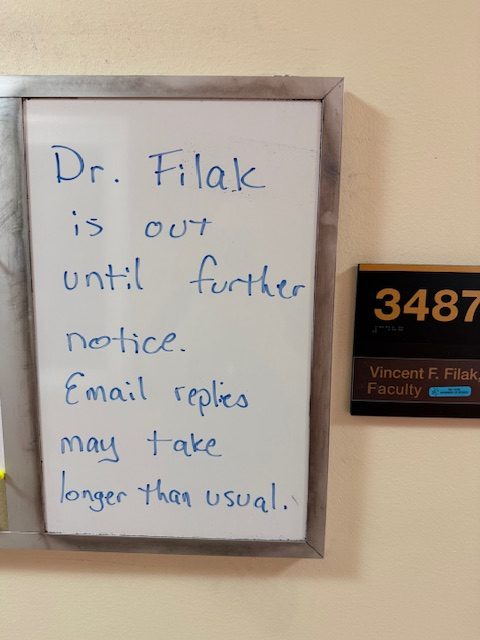
My boss was nice enough to let people know I’d be out for a bit, but this is a little vague… Not like THAT’S gonna lead to speculation…
At the start of every semester, I try to come back with a “X number of things I’ve learned” or a “X years of teaching have taught me” kind of post. It was ruminating (I swear) when my second gallbladder attack in four days hit me badly enough to head to the ER at midnight the day before school started.
Although everything went well, I found myself living out little moments that had me shifting into “analogy mode” as I saw parallels between where I was (the hospital) and where I wanted to be (a journalism classroom). So, as I continue to mend and catch up with the 82,324 things that have landed on my desk while I was gone, I thought a simple slow-walk post of advice would be a good start to what has already been a shaky semester.
(Also, to be fair, I’m still on meds, somewhat hazy and worried I’d somehow come in hot on a topic like Bad Bunny or something that would end up getting me fired without me entirely knowing why.)
So, here are a couple of the maxims that ring true in journalism that kind of came home to me throughout my hospital stay and recovery:
ACCURACY ABOVE ALL ELSE: We’ve been having a lot of conversations like this around the house:
Me: Who called?
Zoe: She didn’t leave her name on the voicemail.
Me: Can I listen to it?
Zoe: She was just like “Hi, this is mumble mumble and I’m with…
Me: So she did leave a name, but you just didn’t understand it? Is it possible that maybe if I listened to it, I could figure it out?
Zoe: Well, I guess…
As much as I expect that out of my kid, I didn’t think I should expect it from a healthcare provider.
Case in point: Upon leaving the hospital, the discharge nurse is going through all the stuff I should or should do, eat or drink. She tells me to avoid fried food and fatty food like bacon. Due to the lack of the gallbladder, these things are likely to create severe gastric distress in the early stages of my recovery.
OK, got it. Most of my diet goes on the shelf.
The other night, Amy made this amazing chicken and potato thing that was part of our “healthy eating” resolution for the year. About 20 minutes after I ate it, I’m in stomach-cramp hell for about two hours. Turns out, she used olive oil on the stuff, which has the same basic effect as those other two things, even though the nurse didn’t mention it and we all usually seem to think olive oil baking is good and deep-fried drumsticks are bad.
I often think about the way in which we ask questions of people in journalism and how we get “almost” answers, or how sources provide information that’s direct but not entirely accurate. From now on, I plan to start interrogating sources like the entirety of my GI tract depends on it.
VOCABULARY MATTERS: We always talk about picking the right word, the proper descriptor or the exact phrase to help the audience understand things accurately. In news stories, it’s relatively important. In the medical field, it means a hell of a lot more.
In trying to explain what he found when he dug into my gut, the surgeon referred to the gallbladder as “angry,” “wicked” and “gnarly.” Those descriptors sound more like the tappers at a South Boston pub than a description of a human organ.
In addition, he explained that something had happened causing my gallbladder to grow a “rind” over the top of it and encase it tightly against my liver. What created said rind and what the rind was composed of, he would not venture a guess. Apparently, I just have a brie-like defense mechanism against gallstones or something.
I didn’t need the whole medical textbook explanation, but it did dawn on me that I felt like I was interviewing Nuke LaLoosh in “Bull Durham” for a bit here:
When it comes to telling people things, keep your audience in mind and use strong, clear vocabulary that helps the folks out there understand exactly what is going on and why they should care.
CONNECTIONS CUT BOTH WAYS: We talk a lot in reporting about the importance of having strong connections with good sources. Those kinds of relationships can give you an edge when it comes to a big scoop, a key interview or a sense of confidence on a topic.
They can also be a problem if sources try to ask you for things you can’t provide or they assume you won’t write about things they don’t like. I always tell students, “It’s great having the mayor feeding you tips, right up until the point his kid gets busted for a DUI and he wants you to keep it out of the paper.”
In terms of connections at the hospital, I was not only being treated at the same hospital where Amy had worked for several years, but I was actually on her old unit. This led to some significant comfort for me in terms of knowing (relatively speaking) who some of these folks are. It was also great because they had nothing but praise for Amy and wanted to know how she was doing at her new job and so forth. I also knew I had a rock-star surgeon because Amy had worked with this guy’s post-op patients over the years, so she knew him and his work.
The “cuts both ways” part really was more of my own making, in that I was groggy and gimpy most of the time, with that “gown” barely doing much of anything. As a massive social hermit, I don’t even like to be in the house when Amy has friends over, so you can imagine how I’d feel about needing their help to wander semi-bare-assed to the bathroom several times a day.
(The closest parallel I can offer is this one time when my parents and I went to a restaurant during the summer and it turned out one of my mother’s teaching colleagues was there waiting tables. She ended up as our server, which felt awkward as hell when I needed to flag her down for another Diet Coke or ask about desert. And at least I was fully clothed there…)
The nurses and staffers were totally professional, even when I managed to set off the bed alarm that Amy used to tell me would tick off the staff to no end. They were also patient with me as my body seemed to be re-calibrating all functions at the same time for no real reason. And it wasn’t like I would be flailing naked down the halls if Amy DIDN’T know these people. Still, it was a combination of comfort and clumsy.
And finally…
TRANSPARENCY IS THE BEST VIRTUE: My buddy, Pritch, used to tell me that in PR transparency is everything, even if what is happening is something you’d rather hide. Abiding by that rule, the first chance I got, I told everyone in my classes what had happened, what the doctors were saying and when we might be able to get back together.
Some kids who knew me but weren’t in the classes I’m teaching got the message on the whiteboard outside my office and kind of freaked out. My boss explained he didn’t want to disclose my health issues without my permission, which is great. However, I know how the minds of journalists work and I could only imagine what it was these people thought had happened to me.
I’ve told Amy this many a’ time: When I die, put the cause of death in the obituary, no matter what. If I died when I broke my neck falling off the couch trying to complete the “bite your own toenails TikTok challenge,” tell people that. It may appear stupid and demeaning, but if I cared enough about it to die doing it, well… there you go. Besides, whatever I did, the speculation of what I might have done will be far worse, I guarantee.
I understand that some folks might be more demure or more guarded than that, which I get, but the less you tell people, the larger the space for the rumor mill to operate. It’s a good rule for PR folks putting out messages and it’s a good thing to remind sources of when they try to get weaselly.
I’m writing today from a hospital bed, the result of an emergency gallbladder surgery. This is the first time I’ve been able to function at any level for the past few days.
It started apparently Thursday, when I was bloated and in excruciating pain in my stomach. I got sick and it got better so I thought it was food poisoning. I had the chills and shakes for the next day or so and then that pain hit again.
I’m no wuss, so when I told Amy around midnight that some had to drive me to the hospital, it was clear this wasn’t something simple. The doc told me today that this thing was so messed up, he couldn’t see the arteries he needed to clamp around it.
Sufficient to say I’m on the mend and relatively feeling better. I will hopefully be sent home in a day or so and maybe back to work in a week or so. I figure the blog will come back on line around that time as well, given it’s taken me about an hour to type this much functionality.
Not looking for sympathy or pity, but rather just wanted to let you all know why the blog will be quiet for a bit


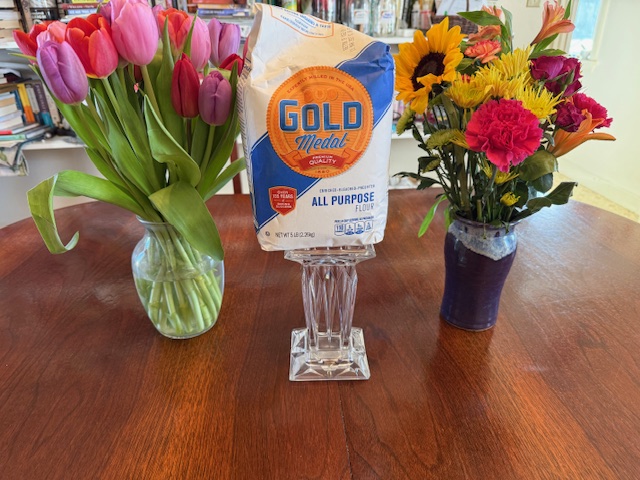


 Among the names listed in the byline of this story is Jaimi Dowdell, one of the pros from the “Dynamics” textbooks and