“I am a brother.” 3 tips on how to avoid a racially tone-deaf social media disaster like the one from the University of Missouri

Watching my alma maters compete for supremacy in an arena of national attention is usually fun for me, but not this month:

UW-Madison: We built a homecoming video where we cut out all the video involving people of color who agreed to be filmed for it. No way anyone could screw up a situation like this worse than we did.

University of Missouri: Hold my beer.

(CNN)The University of Missouri Athletic Department is apologizing for a tweet it says was meant to celebrate diversity but was instead criticized as insensitive.

The tweet posted Wednesday included graphics of three student athletes and a staff member. Two are black and two are white.

The graphics featuring the white athletes highlighted their career ambitions. Gymnast Chelsey Christensen’s said, “I am a future doctor.” Swimmer CJ Kovac’s said, “I am a future corporate financer.”
Staff member Chad Jones-Hicks’ post said, “I value equality.” Track and field athlete Arielle Mack’s said “I am an African American Woman.”
The post was criticized on social media for defining Mack and Jones-Hicks by their race instead of their goals and accomplishments.
The athletic department deleted the tweet Wednesday night and apologized.

Yes, it really was that bad…

MizzouRace2

In other words, “Look at all the cool stuff we get to do as white people!” and “Look! We’re black!” aren’t exactly interchangeable concepts.

And when you think it can’t get any worse…

MizzouBrother

I kept thinking, “This one has to be an internet spoof version, right? Nobody thinks, ‘Hey let’s call the black guy ‘a brother’ and see what we can get away with…'”

Nope, it’s real, leading me to ask the same question this person asked on Twitter:

AfroTweet

(Hell, you could have run this past Breckin Meyer’s character in “Go” and HE would have caught it…)

The athletic department tweeted out an apology for its actions, which led more people to complain about how tone deaf THAT was as well.

This kind of “someone does something horrible they didn’t see coming, particularly in regard to race” has become kind of a repeating theme on the blog. Although we talked about ways to avoid this kind of thing when we discussed the “Coolest Monkey in the Jungle” sweatshirt issue, consider these key points again:

Paranoia is your BEST friend: A great line about one of the greatest hockey coaches guides my actions in journalism quite a bit. After his team had won a national championship, a friend found him emotionally drained sitting quietly away from the celebration. The writer remarked, “They had succeeded. He had avoided failure.” Maybe that seems sad, but that approach keeps your keester out of a lot of trouble.

As we noted the last time we covered this: Murphy’s Law includes the famous line about “whatever can go wrong, will go wrong” so it’s always best to plan for the worst. When you find yourself putting together ANYTHING that will be disseminated to the general public, you want to engage in some active paranoia. Read every word as if it might have a double meaning or if a misspelling might lead to an awkward moment (e.g. “Bill Smith, a pubic librarian, reads…”).

Look at every image you have to see if anything could be misconstrued in a negative way or would cast aspersions on an individual or group. Go through every potential stereotype you can think of in your head and see if something looks like it might be playing into that stereotype (e.g., Is a blond woman shown to be less intelligent? Did you put a person of color into a “monkey” sweatshirt?). Approach your work in this way and you will not always succeed, but you can avoid a lot of failure.

Ask for help: As we noted during the sweatshirt debacle, diversity is not a buzzword. The goal of having a wide array of perspectives and a diverse collection of people with different experiences is to allow a fuller examination of bigger issues.

Even if your newsroom, your PR firm or your ad agency doesn’t have a cornucopia of diversity, you can still avoid dumb mistakes by asking for help. Call a friend who knows the topic better than you. Ask a source who is involved in the topic for a quick read. Talk to an expert on the issue with whom you worked on an earlier project. You probably know someone out there who has a connection to almost any topic if you think about it hard enough.

To be fair, I’m usually the person seeking help in this regard because I’m your garden-variety straight, white male, but what I have found is that most people are happy to help if you are honest, humble and forthright. The earnest gesture of, “I don’t understand X but I really don’t want to screw it up,” tends work when you approach people from varied backgrounds. I have asked all sorts of questions when it came to faith, race, gender, LGBTQ issues and more using that approach and I can’t ever remember being yelled at or shamed.

(I do remember once going to see the Kevin Smith movie “Dogma” with a group of friends, none of whom were Catholic. At about a dozen points in the movie, one of them would ask a question about something that just happened and I’d give a quick answer with a promise to explain more later. About halfway through the movie, my friend, Adam, leaned over to me and whispered, “Now you know what it’s like for me, being the only Jew in the newsroom, when we’re covering Passover.” Point taken.)

Know where the landmines are: This one is a direct pull from the sweatshirt post, but it bears repeating. I still ascribe to the Fred Vultee Theory of Drowning, which states you should treat EVERY piece of copy like it could come back to kill you. That said, the level of extreme care should jump up a few notches from the caution I employ in fixing the garbage disposal and the caution I would employ in disarming a nuclear warhead.

Some things just have much lower margins for error, have far higher consequences and are far more likely to kill you. In terms of the United States, gender, race and sexual orientation are the issues that lead to a lot of “Oh, crap, how did we write THAT?” apologies than many other topics. If you know that going in, you can game up a little bit more than normal when you start working on something in that area. It’s a lot like driving through Rosendale: I always try to adhere to the speed limit, give or take 5 mph. However, when I hit the Rosendale city limits, I’m ALWAYS driving 27 in a 30 because I know what I’m getting into.

In the end, you might not avoid every problem, but you’ll do a lot better in avoiding the really stupid ones.


Throwback Thursday: A look back at the Las Vegas shooting and the troll who made it worse

It’s hard to believe this was only two years ago, but a lot has happened since then. One thing that remains constant is the way in which some people use social media for their own weird purposes. Some are harmless, or even occasionally helpful, as you might have noticed with the “Venmo for Beer” guy at the Iowa/Iowa State game last month. Still, those folks are outweighed by the trolls who use other people’s misery to find joy in their own sad little lives.

Here’s the throwback post: A look at what a troll did in the wake of the Las Vegas shooting and what you can learn from what this chucklehead did:

—

3 things journalism folk should learn from a troll during the Las Vegas shooting

Many people awoke Monday to the news that a gunman had killed 50 people and injured 400 more in Las Vegas. Stephen Paddock, a 64-year-old man from Mesquite, Nevada who police have named as the shooter, was killed on the 32nd floor of the Mandalay Bay Hotel after the attack.

Police said he fired repeatedly from the hotel onto a country western music festival happening across the street along the Las Vegas Strip. Witnesses said the shooting was relentless and police have no motive for the attack at this time.

For some people, it was a time to question who we are as a nation. For others, it was frantic search for loved ones and a time to mourn those they knew who died or who cling to life.

For still others, it was time to be an a-hole.

A Twitter user posting under the name “Jack Sins” posted that he was desperately seeking his father, who was missing after the attack:

JackSins

It turns out that this was a fraud. The profile photo was the same one used elsewhere to pull the same stunt during the Manchester attack. In addition, it’s an internet meme. The “lost dad?” He’s porn star Johnny Sins.

Mashable reached out to this user to find out why he would use a horrific shooting to do something like this. His answer is almost more repugnant than his actions:

Mashable reached out to the troll to ask why he’s spreading misinformation during such a critical time.

“I think you know why,” he replied. “For the retweets :)”

He also said he’d probably do it again.

The point of the post isn’t to shame this guy, as that’s got to be impossible, but rather to provide a learning moment for journalism students who are starting off in the field and might be inclined to rely on social media for information. Consider these three takeaways from this situations:

  1. If your mother says she love you, go check it out: Part of the thing that separates journalism folk from some other media users is a dedication to separating fact from fiction and providing accurate information. Early reports in the wake of a chaotic event are almost always inaccurate at some level, so journalists always have to proceed with caution. Even in this case, media reports note erroneous reports about additional shooters at other properties along the strip. Some of those are based on honest errors while others are simply rumors that spread. Your job is to go out there and figure out what is right and what isn’t before publishing it. That’s especially true of things you see from sources you don’t know, which leads to point two…
  2. Sources matter: One of the big things we push in J-school is the use of official sources acting in an official capacity for a couple reasons: a) It protects you in case of information being erroneous or potentially libelous, thanks to the issue of privilege; b) Official sources have names and titles you can verify and they also tend to be much more conservative with what they say because they know they will be held to account for it. However, in cases like this, it’s not possible to ignore the human angle and simply churn out police-report-level data. This is why interviewing people who survived, people who escaped and other similar “real people.” The biggest thing you should do is verify your sources before you publish them. The people at the scene have a somewhat easier time doing this, as many reports noted people covered in blood or hunkering near injured friends. It’s hard to fake that, even if they wanted to. However, social media users can be sending information from anywhere and can do so with impunity.
    To that end, you really need to fact check the heck out of your sources when you can’t do a face-to-face interview. Look at how long the source has been on that platform, how many followers they have, what other posts/tweets they have made and what other topics they have covered. Treat this vetting the way you would any other “anonymous tip” that comes to you from a source you don’t know. Unless you are sure, don’t repost it. It’s your reputation and the reputation of your news organization on the line.
  3. People can be a-holes: If you read the interview between this troll and Mashable, it’s a pretty safe bet your thoughts will be somewhere along the lines of, “What the hell is wrong with this guy?” Most people have gotten some level of internet hoax or email blast where a king in Naganaworkhere has a squillion dollars in gold that he wants to give you, once you send him your bank account numbers and we know that’s crap. It’s also a pretty easy thing to explain: Somebody wants to dupe rubes out of their money.
    When it comes to something like this, the question of “Why?” is less obvious. The retweets aren’t going to be all that helpful in a lot of ways. Sure, there are ways to monetize heavily trafficked social media accounts, but beyond that’s going to be a one-hit wonder at best.
    As much as many people want to believe in the best in people and help people in a time of crisis, there are some folks out there who just want to screw with you for no good reason. As an individual, that can feel like a sting when you realize you contributed to the spreading of false information on a “gotcha” prank. As a journalist, there are far larger impacts. It never feels good to question people in the time of crisis, but if you remember that not everyone has the best of intentions, you can reasonably and tactfully apply a healthy level of skepticism to claims like this.

The Junk Drawer: Dead sources who refuse to talk, the use of dead kids as a marketing campaign and other mistakes to avoid

As we noted in an earlier post, the Junk Drawer is usually full of stuff that didn’t fit anywhere else but you still need, so let’s enjoy a few of the more awkward moments sent in by the hivemind and other friends out there:

DEAD MEN TELL NO TALES: When you’re doing breaking news live, you often find yourself on an adrenaline high and you also try to tell people all the important stuff you did to get them as much information as possible. In the case of KTLA’s Sara Welch, she went above and beyond to get as much information as she could regarding a fatal crash:

I have no idea whom Welch was trying to reach, but I’m guessing she really wasn’t shaking down a dead guy for answers. Then again, this approach sometimes works in the movies: (Probably NSFW)


Speaking of shaking down the dead…

MASS SHOOTINGS AREN’T MARKETING OPPORTUNITIES: Certain names or terms are so indelibly linked with horrible things (Nazis, Jeffrey Dahmer, Virginia Tech shooting) that they are essentially the third rail of marketing: You just don’t step on them if you want to make it out of here alive. We have mentioned a few marketing failures in this regard, such as the “coolest monkey in the jungle” sweatshirt and the “pillows and skirt by Auschwitz” fashion movement. However, the folks at Bstroy decided to up the “what the hell is wrong with you?” fashion movement by creating hoodies with the names of school shooting sites on them. Naturally, they were laced with bullet holes:

BstroyFAIL

Look, I have a hard enough time understanding why my kid (and seemingly everyone else in her demographic group) wants clothes with holes in them, but I’m pretty sure nobody with an inkling of human empathy or at least one-third of a brain thought this was a good idea.

As the internet freaked out on the “edgy company,” the owners issued a statement that violated “Filak’s First Rule of Holes:”

“Sometimes life can be painfully ironic,” the statement reads. “Like the irony of dying violently in a place you considered to be a safe, controlled environment, like school. We are reminded all the time of life’s fragility, shortness, and unpredictability yet we are also reminded of its infinite potential.”

Mmmhmm… Speaking of bad ideas poorly executed…

WORD CHOICE MATTERS: Case in point, the questioning of a ship captain whose boat exploded into flames:

69511389_10156200929926191_4240205174485811200_n

I like my captain grilled medium-rare, with a little pink… Speaking of conception:

DID THE KID SHANK SOMEONE AT HIS BIRTH?: Misplaced modifiers end up causing all sorts of problem, as does awkward structure and horrible punctuation. These things all deserve attention, even if you’re “just on Twitter.”

DeadSonInJail

The first two times I read this, it sounded like an infant was found dead in his jail cell and all I kept thinking was, “How the hell did a 6-month-old kid end up in jail? Did he hold the delivery room hostage or something?” Eventually, I read it the right way, but honestly, this is an easy clarification.

Two commas solve this problem:

A XX-year-old man, awaiting trial for the death of his 6-month-old son, was found dead in his jail cell, authorities say.

Remember, Twitter did this really nice thing for us in doubling the number of characters we can use to explain things. (Personally, I still don’t like the 280-character limit, as I explained in the “Fat Pants Theory,” but I’m getting used to it.) That said, you should feel free to write in complete sentences and maybe include a little more punctuation as needed.

Have a good start to your week!

Vince

(a.k.a. The Doctor of Paper)


Why NYT’s Theodore Kim ticked off a squillion journalism folks with his list of Amazing Journalism Schools and why you shouldn’t care about it at all

Theodore Kim, the director of fellowships and internships at the NYT, recently posted what he called a “super unscientific opinion on which U.S. schools churn out the most consistently productive candidates.” This list came in several tweets and tiers:

Best (no order): Columbia, Northwestern, UC Berkeley, Yale

Honorable Mentions Tier 1 (no order): Missouri, Harvard, Florida, USC, Duke, Stanford

Honorable Mentions, Tier 2 (no order): Howard, Texas, Maryland, UPenn, Cornell, UNC, Syracuse, Illinois, Arizona State, Colorado State, Florida A&M, NYU, Miami of Ohio, Western Kentucky, UC San Diego

I also forgot to mention the Newmark School (formerly CUNY), which is definitely in the mix…

Kim’s list set off the kind of social media rage usually only seen at a New England Patriots’ fan site when someone notes that Eli Manning beat Tom Brady twice in the Super Bowl and is thus a superior quarterback.

Most of the responses kind of fell into two basic areas: Outrage that the respondent’s school wasn’t included on the list/was listed too low or that the list itself read like a rich kid’s guide to picking out schools. Katy Culver, an assistant professor at UW-Madison and a Teachapalooza instructor, took a different angle, examining this as an ethics issue, noting in part:

Journalism needs to do far more to diversify the people who produce it if it’s going to have any fighting chance at representing us accurately and in the rich contexts in which we live. Bias in favor of students at elite schools only compounds the lack of diversity.

Others pushed back at this in an even more pointed way: If you’re the guy picking interns and you lay out a list like this, it really comes across like you have a bias toward Schools A, B and C and maybe against those X, Y and Z Colleges. To his credit, Kim didn’t claim he was hacked by the Russians or that someone spiked his Diet Coke or something when he wrote the original list:

KimOwned

While you decide whether it’s worth it or not to scour Kim’s list in search of your school, consider a few thoughts:

  • Lists Like This Are Just Stupid: Look, I get it. Lists can seem like a fun idea and they often get a lot of traction. This is why Jonah Peretti and the Buzzfeed crew have enough money to buy half of the planet at this point. It’s also why we can waste half of our day arguing about who was a greater “clutch” quarterback or which “Star Wars” movie was the best/worst. In the end, however, these things lack value and come from no serious vantage point. If you want the best look at how stupid this is, consider a classic clip from “The Newsroom:
  • Your Degree Doesn’t Make You: In going down the rabbit hole that was Kim’s tweets and the backlash that followed, I found support for the argument I’ve been making for years now: It doesn’t matter where you go to school. If you want something badly enough and you work hard enough, you’ll get something great out of your time as a journalists.One of the things that came up when I left Mizzou and went to Ball State was the students at my new university wanted to know if they were as good as those at my old university. “Do we measure up to the Mizzou kids?” one newsroom student asked me. The answer I gave him was the same that I give the kids at UWO, who ask if they’re as good as the kids at Ball State:

    The degree from one of these places is shiny. It looks good and it can open some doors. However, the dumbest kid I ever taught at (Aspiration School X) isn’t automatically better than the smartest kid I ever taught at (Downtrodden School Y). Those Lord Almighty Schools of Journalism Brilliance and Deity don’t hand you a brain when you graduate that has all the answers in it. In fact, I find that a lot of students who rely on the idea that graduating from one of those Holy Grail Universities to solve all their problems tend to do horribly once they graduate.

    Maybe this is a better example of how this doesn’t matter at all. Check out this photo of two dudes from the same state who graduated from college at about the same time:

    JVHandMe.jpg

    The guy on the left is me. I grew up in the largest city in Wisconsin, attended the flagship university in the state and got a journalism degree from the oldest journalism program in the country. I also got a master’s from there and a Ph.D. from Mizzou, which will argue with anyone that it is the greatest J-school in the country. I worked on a night desk at the Wisconsin State Journal and eventually went into teaching.

    The guy on the right went to UW-Oshkosh, occasionally derisively called “UW-Zero,” and got a degree in poli sci and journalism. (UWO is in nobody’s top anything and its so far off Kim’s list that he probably couldn’t find it with a search light and a posse.) This guy worked as a sports writer at the Oshkosh Northwestern for a while and could have stayed in his hometown forever.

    Instead, he scored a job working at the Washington Post. That’s impressive but what’s even more impressive is that Jim VandeHei quit the Post and co-founded two of the most important political journalism organizations in the past 50 years: Politico and Axios.

    Axios, his current gig, has a readership in the millions while I’m writing a blog with literally tens of readers (and I’d like to thank you all for getting me up to that number). He drew in millions of dollars of investment capital for the Axios launch and it is so successful, Axios has a video news program on HBO as well. I bogart video clips from YouTube that feature programs that once ran on HBO.

    The point is, if you looked at both of us on paper in the mid-1990s, you’d never guess who would go on which path and the degree of success the guy from a “branch school” would have achieved. And I know he’s not the only success story like that out there. And you might be the next one.


  • There Are Always Folks Like This. Your Job Is To Prove Them Wrong: The thing that bugged me the most about Kim’s list wasn’t that he published it or that he ranked certain schools in certain ways. What bugged me was that this wasn’t the first time I’d see this kind of attitude and I know it won’t be the last. Here’s a story I shared with some friends after this broke:
    I had a student who was an editor for me at UWO. Smart kid, decent grades, hell of a good student media practitioner. I took her with me to a college journalism convention where a variety of people were doing internship recruiting. She had an interest in PROGRAM X, and I happened to know the recruiter, so I asked how she did in the meet and greet etc.
    She’s fine, he explained, but she’s not going to get in. When I asked why, he said, “We don’t take people from branch schools.” He then elaborated that they only really take people from ELITE SCHOOL X (one of those listed on Kim’s top of the pops), ELITE SCHOOL Y (a good tier one on Kim’s list) and people from GEOGRAPHIC AREA X. His rationale was that the kids there were just “better” (although he couldn’t quantify that for me) or if the kid was a disaster, they could say, “How could we know? The kid went to X or Y!” (the geographic area was because they could get kids there and ship them out for bus fare, basically.)

    The silver lining was that I told my student to apply anyway, she did, she got in and she got a hell of a good scholarship, a hell of a good internship and a hell of good media life out of it. The reason? It was her sole goal to prove this person wrong and show she was just as good as anyone else.

    I know I tend to get a little too “rah rah” on this blog some times, but it’s only because I see so many students on a weekly basis who feel they can’t succeed. It’s like the world is filled with better, smarter, faster and richer kids than them and it’s only by a miracle on par with the loaves and fishes that they managed to get this far.  The truth is, gumption, grit and a general sense that you CAN do it often separates those folks who get where they want to go from those who don’t.

    The best form of revenge for being told that you aren’t of the proper ilk is to go out and find a way to have an amazing fulfilling life. It also feels pretty good to flat-out crush these folks at their own game and become awesome.


NYT TV critic James Poniewozik bashes Axios CEO Jim VandeHei for his view on social media usage (and four things that explain why that’s beside the point.)

Jim VandeHei came to his alma mater, the University of Wisconsin-Oshkosh, this weekend to help celebrate the department of journalism’s 50th anniversary. A co-founder of Axios and Politico, VandeHei could easily make the cut as one of the department’s most famous graduates and probably even one of the university’s top ten most successful grads.

(My money for the top UWO grad, however, is Craig Culver, the namesake of the custard-driven restaurant chain. Food fame will always trump political or media fame.)

VandeHei gave several speeches over the course of the weekend, focusing on everything from his time at UWO to the issue of fake news. The latter topic became a post on his company’s website and a featured point for Axios’ Mike Allen when he put out his “Axios AM: Mike’s Big 6” column:

VandeHei offered four fairly provocative ideas — one each for politicians, social media, reporters and individuals. Here’s the gist, adapted for Axios …

  • Politicians: Stop using the term “fake news.” The worst thing for a country is having people believe lies, or trust nothing. One day soon, something bad will happen, and it will take faith in information to fix it. You erode trust at our collective peril.
  • Media: News organizations should ban their reporters from doing anything on social media — especially Twitter — beyond sharing stories. Snark, jokes and blatant opinion are showing your hand, and it always seems to be the left one. This makes it impossible to win back the skeptics.
  • Social media companies: Radically self-regulate, or allow government regulation to stanch, the flow of disinformation or made-up news. Maybe it takes a new FCC of social media to force the same standards as expected from TV stations and newspapers. One thing is for sure: The current self-policing isn’t cutting it.
  • You: We all want to fault others, but each of us is very much to blame. Quit sharing stories without even reading them. Quit tweeting your every outrage. Quit clicking on garbage. Spend a few minutes to verify the trustworthiness of what you read.

Be smart … Remember: If your Facebook feed is filled with garbage, it means you were reading garbage in the first place. The algorithm simply gives you more of what you crave.

P.S. The Axios social media policy, which applies to all our colleagues, prohibits the sharing of political views or derogatory snark online: “Don’t say anything on the internet that you wouldn’t publish under your byline or say on TV.”

Before we dig into the guts of this, a couple key things are worth noting:

  • VandeHei gave at least three speeches/panel presentations that day and I was at most of them. This is one part of a larger discussion and it’s also boiled down a lot more, based on Axios’ “Smart Brevity” approach. Keep in this in mind when we get to the deeper discussion.
  • The audience for most of these presentations was students at UWO and recent graduates from UWO. Faculty (like me) and other folks (less-recent alumni, spouses of visitors etc.) were listening as well, but the this was mostly targeted at journalism students who were either really green or relatively green.
  • Full disclosure: I fanboyed out in meeting VandeHei, as I did with several other people there. I wanted to meet him and thank him for his generosity and assistance in supporting the student newspaper, the Advance-Titan, when we were in the middle of a $50,000 challenge grant to pay off a five-figure debt the paper sustained over the years. I admire the fact this guy built not one, but two successful media organizations in a time in which media itself is taking a beating and it seems like nobody is making money in journalism. It doesn’t mean I’m a shill for this guy or that I can’t think for myself on any of the points he made.
  • I was these events as a faculty member who was trying to help keep things running smoothly, not as an impartial media member, determined to write on this. I also geeked out meeting Cliff Christl, the longtime Green Bay Packers reporter and Packer historian. Same deal with getting to see Paige Bonanno of ABC Disney and others. Photos of me are floating around out there with these people.

Given that most of the media world couldn’t find Oshkosh with a map and a compass, it never dawned on me that anyone would hear anything about VandeHei’s speech, let alone take umbrage with his comments.

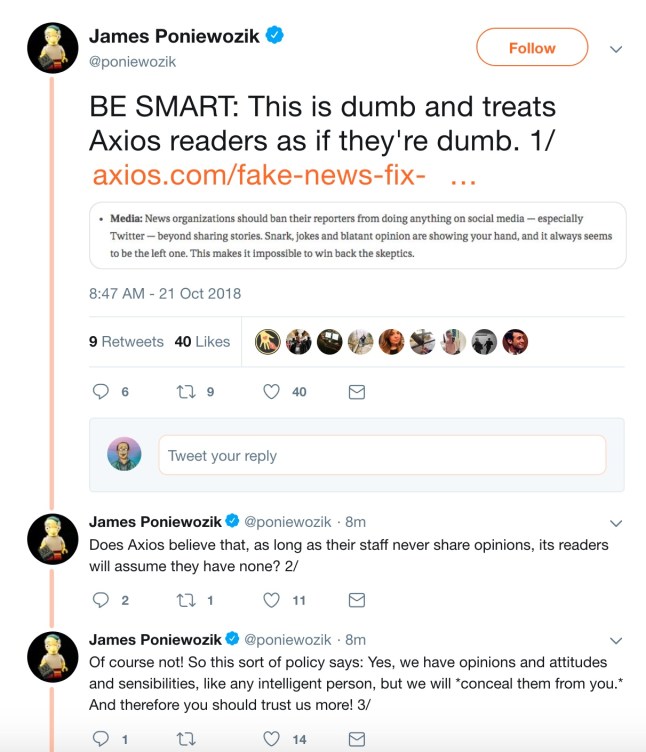
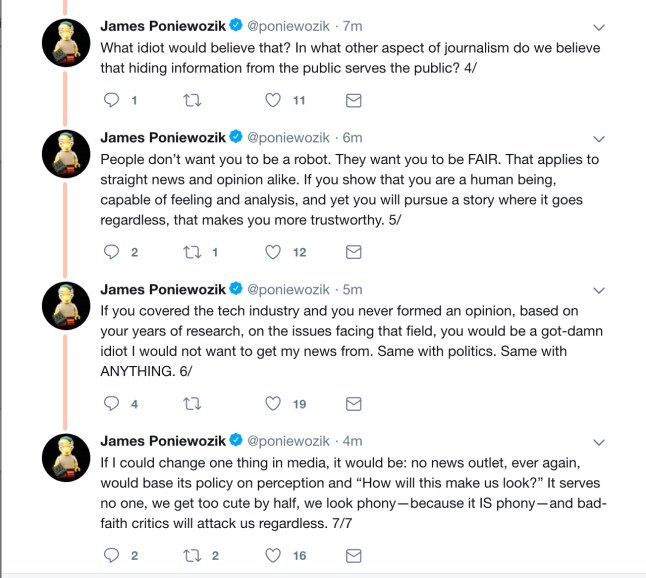
Shows what I know:

PoniTweet1PoniTweet2

(In case you don’t know who he is, James Poniewozik is the TV critic for the New York Times, a job he has held since 2015. Prior to that, he spent 16 years as a TV and media critic at Time. He has a degree in English from the University of Michigan and has studied creative writing at NYU.)

Poniewozik wasn’t the only critic of VandeHei’s position, but he was among the most prominent and he captured the majority of what I saw out there in terms of disagreement. Rather than trying to sort through all of Twitter, it seemed most germane to analyze this issue based on these seven tweets and try to incorporate additional information where I can.

Consider these four key thoughts:


Freak out if you want, but not on Poniewozik’s point:

I’m really stunned that the thing that didn’t REALLY freak people out was Vandehei’s third point: “Radically self-regulate, or allow government regulation to stanch, the flow of disinformation or made-up news. Maybe it takes a new FCC of social media to force the same standards as expected from TV stations and newspapers.”

The question of “Who decides?” will always be a concern when it comes to the regulation of speech or press. We live in a world in which First Amendment “goes too far” according to at least a quarter of the country, should be undercut by the “opening of libel laws” and the concept of what is “made-up news” seems to be in the eye of the politician.

A media person like VandeHei expressing an opinion on how to fight fake news (keep in mind, that’s the narrow window through which VandeHei is talking about these issues) is interesting. A fellow media person like Poniewozik arguing his opinion against VandeHei’s opinion is interesting, although starting to border on the “media talks about media” inside baseball I hate. The rest of the internet choosing sides on this is what the internet does until someone starts talking about “libtards” or someone else drags Trump and the Russians into it, at which point most of us go back to looking for cute micro-pig videos. I can take or leave that.

However, the last thing I would want at this point in time is some sort of “agency” to essentially engage in prior review and/or prior restraint either actively (through censorship) or passively (through policy that limits specific content). Of everything VandeHei said Friday, that was the one thing that really had the feeling of a truly awful idea. That said…


Absolutism is dumb…:

One of the easier ways to get in trouble as a writer is through absolutism. Whenever I read that something has “never” happened or that “everyone” thinks something or “it always” works that way, my internal BS detector kicks into high gear. Sure, there are a few firsts, lasts and onlies out there in a variety of fields, which is why Oddity is one of the five interest elements we espouse in the book. However, the odds of something being declared an absolute and something actually being an absolute are similar to the odds of winning the lottery.

Therefore, I’m not a huge fan of the line regarding the banning of reporters from doing anything on social media other than promoting stories. For my money, the P.S. at the bottom of the post espouses a much saner version of a social media policy: “Don’t say anything on the internet that you wouldn’t publish under your byline or say on TV.” This is a policy that places responsibility on the journalists and it also provides a much smarter way to look at this topic.

I can’t tell you how many times I practically broke out in hives when someone at one of the student media outlets I advised would say, “Oh, that photo/story/graphic is way too bloody/inaccurate/naked to run in the paper! Just stick it on the website…” The mentality seemed to be that journalistic standards of quality only applied to the dead-tree publications (and the over-the-airwaves broadcasts), but the web was this fun, scrappy kind of place where you could drop F-bombs and innuendo all day.

Media outlets that want people to take them seriously should establish more of a platform-neutral set of standards for content as opposed to thinking something you wouldn’t say on one platform is completely legitimate on another. Either way, a lock-down mentality of “never, never, never” is a bad idea and likely to lead to more harm than good.


…But uninformed ranting is dumber:

I love Axios’ concept of “Smart Brevity,” but it can lead to rabbit-hole criticism like Poniewozik’s tweets on the topic of tweeting an opinion. The whole post involved the idea of how to combat fake news, which got lost immediately upon conversion to Tweet-fighting. The line “Snark, jokes and blatant opinion are showing your hand, and it always seems to be the left one. This makes it impossible to win back the skeptics” becomes the flashpoint of the argument where Poniewozik equates VandeHei’s line to the concept of never publicly stating any opinion.

He then pushes the point, noting that never publicly stating an opinion is either a heinous form of concealment that treats the readers in a negative way or the inability of the journalists to form an opinion and thus idiocy on the part of the writers. Thus we get idiots, phonies and so forth.

Let’s unpack this a bit:

  •  Vandehei made it clear in his presentations that he stringently opposes news journalists using social media to express opinions that taint the readers’ ability to trust them.
    An example he used related to a city council meeting in which a reporter stated that some proposal was about to be debated and that people should stay tuned to his live tweets to figure out if two reps were going to screw people over (or words to that effect). In other words, if you are expecting a story based on the facts about some local content and the reporter is already calling a couple people involved chuckleheads, how can you trust that reporter on anything else he or she writes?


  • Journalists have ALWAYS developed, maintained and expressed opinions on the people they cover. I thought some sources I knew were honest while others I wouldn’t trust any farther than I could throw a cheesecake in a swimming pool. Some people were complete jerkwads while others bordered on handsy in their desperate need for my adulation. I had opinions on all of them.
    However, there’s a difference between going to the bar after work and telling your coworkers what a dipstick a county commissioner was during an interview and publicly issuing a “ready-to-go-viral” tirade about that person.
    I have often told students that the duty to report is not the same as the duty to publish. A similar view on social media might be valuable: The duty to form an opinion is not the same as the duty to share it with the whole world in 280 characters or less.


  • Many differences exist among the positions of having an opinion, expressing an opinion, not developing any opinionated thought and the “snark, jokes and blatant opinion” elements outlined in the Axios post.
    Consider this spectrum of items you can use in expression:

    Fact (an indisputable element): Jim VandeHei spoke Friday at the University of Wisconsin Oshkosh about fake news.

    Personal opinion (statement made to indicate personal belief): I think James Poniewozik raised interesting points, but was off base in his criticism of Jim VandeHei’s speech.

    Blatant opinion (A personal belief stated as fact): “This is dumb and treats Axios readers as if they are dumb.” OR “People don’t want you to be a robot. They want you to be FAIR.”

    Jokes (in this case, I’m guessing attempts at humor in an attempt to degrade or undermine an opposing source or the source’s position): Q: How do you get a University of Michigan graduate off your porch?  A: You pay for the pizza. OR Q: How many TV critics does it take to change a light bulb?  A: None, they just sit in the dark and write a scathing column about how illumination devices used to be so much better.

    Snark (probably closest to sarcasm or other biting comments intended on undercutting a position without relying on the joke format): James, if I need an analysis of “Cop Rock” or a creatively written haiku, I’ll give you a call. Otherwise, I’ll probably rely on the guy who actually has a journalism degree and runs a news organization to come up with some standards for the news media.

    There are levels to this and if I had to make a policy for pairing news journalists and social media, it would be a lot closer to the “stick to the facts for the most part, occasionally use the personal opinion when you can support it with facts and don’t do jokes, snark or blatant opinions.” But that’s my personal opinion.


  • Multiple people spoke on this topic and several of them agreed with VandeHei’s underlying premise: News journalists now are saying stuff on social media that would be way out of bounds in their traditional publications and that needs to stop. One of those people was Paul Anger, another UWO grad, who retired in 2015 as the editor and publisher of the Detroit Free-Press.  I’m not sure if he held to Axios’ absolutism policy regarding social media, but it was clear that his previous publications had specific standards and those included how people should act on social media. It’s not just VandeHei, although in being out front and at a major national political outlet, he’s going to get the most attention.


Consider the Audience

I frequently write about why it is important to understand your audience in crafting your message. To understand VandeHei’s statements, it’s important to keep that concept in mind.

Not to belabor the point, but he was speaking to students, student journalists and recent journalism grads (for the most part). As someone who often speaks to these students, I can tell you three immutable truths:

  1. It is becoming increasingly difficult for them to distinguish between fact and opinion when they see it in the media and when they write for the media.
  2. They don’t always see that they’re playing with live ammunition when they post things on social media.
  3. They are still learning how to work as journalists.

If this were a speech or panel at an SPJ or NAB or some other professional conference, the tone, nuance and depth might have differed here. Sure, the policy at Axios is still going to be the same, but there might be some additional discussion that merited digging into the gray areas. That’s not the case here as I had students in that audience who are still trying to figure out how to write a lead (or lede if you prefer).

Folks like Jim VandeHei and James Poniewozik have earned the fungus on their shower shoes, so maybe expressing opinions or using social media as they see fit makes sense for them. My students? Not so much, so slapping a few safety devices on these tools is probably a good idea. When they get to the stage of becoming experts on topics and they have opinions that are supported, well-reasoned and likely to benefit readers, it’s the perfect time for them to take to Twitter and share them. However, until that point, it’s probably best to hammer home the idea of playing it safe.

Also, being a professional media practitioner, or simply being educated, doesn’t mean you’re not going to fall on your keys on social media. Or, as Tweet 6 would note, come across as a “got-damn idiot.”

Answers to 4 Key Questions About the Legal Issues Associated with an Anonymous Sexual-Assault-Accusation Website

After yesterday’s post on the “Make Them Scared UW” website, several questions rolled in that make for some interesting follow ups.

The site, constructed by some University of Washington students, allows for the anonymous posting of names students say engaged in sexual assault and harassment, as well any other information associated with the incident or incidents. According to The Daily at the University of Washington, 41 names were published as of Monday.

In the FAQ section, the administrators explain, “Make Them Scared is a communal rape list. It is intended to be an online hub for anyone who wants to expose the names of their attackers and harassers, and to fill a gap left by inadequate treatment of these cases by formal institutions.”

In addition, the administrators state:

Q: Why are you called “Make them Scared”?

A: This admittedly ominous-sounding name alludes to the injustice of women having to live their life in fear of sexual assault and harassment, while perpetrators can easily live their lives free of any fear of being caught or held accountable for their actions. Our goal is just that: to make perpetrators afraid that if they commit or have committed an act of sexual assault or harassment, they will be held accountable for their actions.

Rather than rehash all the information on libel, my personal paranoia about anonymous allegations of any kind and the issue of sexual misconduct of any stripe, we’re going to talk about four key questions that came up in the wake of yesterday’s post:


WHAT ARE THE RISKS TO THE PEOPLE POSTING CONTENT ON THIS SITE?

Several people asked this question and much of the post yesterday touches on this in regard to the potential for libel. The individuals who post statements like “PERSON X from SCHOOL Y raped me” are making statements of fact, not opinion. An opinion statement like “I wouldn’t think anyone would want to be alone in a parked car with PERSON X from SCHOOL Y” or “PERSON X from SCHOOL Y isn’t someone I would feel safe around” would have fewer risks. The statement of fact (as in, “I’m declaring this to have actually occurred.”) opens the poster up to a potential libel claim.

The most crucial issue here is whether a claim can be proven to be demonstrably false. The other items noted in the SPLC’s libel checklist will likely be checked through posting a rape declaration on this site: Publication (check), identification (check), harm (probably going to be a check) and fault (probably a negligence standard, as these appear to be private figures and that’s easier to prove). The issue of “crying rape” has been discussed in the previous post (To be clear: I believe victims and false allegations are extremely rare), but with an anonymous set up, it is possible that a “prank” allegation could get through at some level or that the verbiage the person uses in describing their attack could be legally insufficient.

In short, a lot can happen here, so potential ramifications aren’t clear cut.


CAN WEBSITES REALLY BE SUED FOR WHAT OTHER PEOPLE WRITE ON THEM?

I got this question from a student media adviser and it’s a good one:

The (blog post) doesn’t note – and correct me if I’m wrong about this – that
the owner of a site that allows people to post comments can’t be sued for
those comments, even if they monitor posts. That’s the law as I understand
it and as our attorney explained it to us. Newspapers, of course, want to
be ethical and responsible, but if a libelous comment slips by and gets
posted under a story, the newspaper/publisher/owner of the site can’t be
sued.

Correct?

Courts have sought ways to hold harmless owners of websites when people post content on them that might be in some way defamatory or otherwise illegal. One example of this is the Online Copyright Infringement Liability Limitation Act, in which lawmakers struck a balance between protecting copyright and indemnifying websites against harm. OCILLA provides a process for all parties involved to work through issues associated with illegally posted material. For example, if person posts a photo that belongs to someone else, the actual owner can reach out to the publication and work to have that content removed without the risk of the publication being sued for copyright violations.

A more germane law in this case is Section 230 of the Communications Decency Act states that Internet providers and other media platforms are not liable for content posted to their site by people who are not directly connected with the organization. This is what the adviser was asking about in relation to the “Make Them Scared UW” site.

Congress provided Section 230 as a shield for providers who wanted to monitor discussion forums and remove offensive content. While the earliest court cases involved Internet service providers, such as America Online (AOL), courts have broadly applied the protections under this section. They have immunized social networking sites like Facebook and sales sites such as Amazon.com for comments users made on their sites. Site operators run a risk of losing that immunity if they actively encourage people to post illegal material. Beyond that exception, however, the courts have generally favored publishers.

This basically means that if someone were to go on your student newspaper’s website and post under your story about the university president winning an award that “Sophomore Bill Smith murdered three people and got away with it,” you could get rid of the comment without fear. In addition, Bill Smith would be unlikely to win a lawsuit against you based solely on that random person’s comment.

Broadly speaking, the presence of an open forum in which people can post potentially libelous content will not lead the owner of that forum to fall victim to a libel suit. Thus, the adviser is right about what his lawyer told his newspaper staff. Stuff that random schmoes post on their newspaper’s website that has the potential to libel people is a beef between the poster and the person being posted about.

However, there is a distinction that’s important to understand between the issue the adviser noted about his newspaper’s liability regarding comments and the “Make Them Scared UW” site, which is where question came in…


DOES THIS LAW ACTUALLY PROTECT THIS WEBSITE?

Section 230 was meant to protect internet “providers,” which was initially associated with places that sold you internet access and then spread to open social media platforms like Facebook and Twitter. This is why Mark Zuckerberg doesn’t worry about going broke every time that guy in your dorm gets drunk and starts writing horribly defamatory stuff about the girl who just dumped him.

The dorm dude is in trouble but Mark is fine, and the reason he is fine comes down to the fact he isn’t serving as a publisher. Simply speaking, Mark Zuckerberg doesn’t solicit specific content from you or assign you content to post. He doesn’t vet the material and make editorial choices about what will be published and what can’t be seen publicly. He doesn’t get involved in the day-to-day choices of what gets produced on his site and what doesn’t.

The “Make Them Scared UW” site runs on a wiki, but one in which content is submitted to the people who run it. Those people make choices about what is published and what isn’t. They vet the content and serve in other editorial capacities, it would seem, based on how the information is gathered. It uses a website form to have people submit content directly to the administrators for examination. It also explains the process of how a name gets added to the list:

Q: What will happen after I submit a name?
A: One of our site’s moderators will review your submission, verify your contact information, and after receiving your confirmation, publish the information you provided us (minus any personally identifying info) on the list page on our site. The information you provide us will not be used for any other purposes. Whether or not a submitter wants to also report to academic or legal institutions is their choice, not ours.

Based on this process, I asked media law expert Chip Stewart for his thoughts on if this fell under Section 230 or if the site ran some serious risks:

I think gathering info in this format, then reviewing it, then pushing it to a wiki is an act of publishing — they’re not just an “interactive computer service” at this point. This isn’t comments section or a chat room or a forum in which the ISP is a bystander… This is bad. I don’t see Sec. 230 stretching to protect something like the anonymous sexual assault website.

Stewart said this felt akin to a court case involving the Roommates.com site, where drop-down menus prompted users to provide information that actually violated federal housing laws. The court ruled that this kind of prompt structure, which mirrors the approach “Make Them Scared UW” uses, made the website more of a publisher than a distributor.

In short, the court could go either way, but this is a risky approach.


AREN’T THE POSTERS AND THE ADMINISTRATION ANONYMOUS? EVEN IF SOMEONE COULD PROVE LIBEL, HOW ARE YOU GOING TO CATCH THE PEOPLE ASSOCIATED WITH THE SITE?

People leave digital footprints everywhere they go, whether they know about them or not. In most cases, the companies that manage and maintain that data will keep it safe and push back against anyone in the public asking for unmasking of this information. However, court orders change the game, Stewart said:

The ISP (Internet Service Provider) will roll over on its (the website’s) creators upon subpoena.

Twitter says as much in its guidelines for use, noting it will comply with subpoenas for private information. Blogger, which appears to be the hosting site for the “Make Them Scared UW” blog, has already gone through this in a high-profile case involving a fashion model and an anonymous blog. The blogger was unmasked and later threatened to sue Google for violating her privacy, but experts said the case held little chance of success:

Jeffrey Toobin, CNN’s senior legal analyst, said Google was complying with a court order and that disclosing Port’s name cannot be viewed as violating her rights.

“Google never promises anyone absolute anonymity,” Toobin said. “There are all sorts of circumstances when Google cooperates with law enforcement.”

Google itself also made it clear that your desire to be anonymous isn’t going to be the company’s concern in many cases:

In response to CNN’s request for an interview, Google issued a statement:

“Google does comply with valid legal processes, such as court orders and subpoenas, and these same processes apply to all law-abiding companies. At the same time, we have a legal team whose job is to scrutinize these requests and make sure they meet not only the letter but the spirit of the law.”

This makes it highly likely that if an individual on that list were to feel strongly enough about filing a libel suit and make a strong enough case in doing so, a subpoena would be enough to break through the anonymity shell surrounding the site and its posters.

Can you spot the deceptive post? The NYT gives you a pop quiz on Facebook fakers.

Spotting fake stories, parody Twitter accounts and other similar landmines out there can be tough. In previous posts, we gave you a look at a fake news quiz and some examples of Twitter trolls that led to some awkward media moments. To help you with deceptive social media posts, consider this great interactive graphic from the New York Times that will help you test your BS detector.

The Times developed this piece that both gives you the posts to examine and then explains why you were right or wrong. In addition, the authors outline the history of the people behind the posts and what has happened to them.

Click here and give it a try.

4 tips to avoid having Mike Rotch and Seymour Butts as sources in your story

The traditional “person on the street” interview has given way to the “tweet on the information superhighway” when it comes to getting a public perspective on big news. Journalists used to head out to a bustling area of town to talk to random citizens about issues ranging from who would win the World Series to what the upcoming year would bring:

I remember having to do a few of these things for localizations or reaction stories on things like the arrest of a person suspected of murder to the fans thoughts on Green Bay winning the Super Bowl. I can honestly think of nothing more pointless than trying to get drunken Packer fans on State Street in Madison, Wisconsin, to tell me something about their emotional state after winning The Big Game. The only person who had it worse than I did was Rick Blum. This poor guy from Channel 3 was standing on top of his van trying to go live at 10, as drunks pelted him with snowballs and chanted, “RICK BLUM SUCKS!” over and over again.

Interviewing the general public on any topic can be dicey, but it can get worse when you find out you are the victim of a horrible practical joke, as was the case in 2001 when the New York Post’s Neil Graves interviewed a local real estate developer:

HeywoodJablome

If you don’t get the joke, Google Mr. Jablome or ask the closest pervert you know. Making this worse, I found this article again just last night and his quote is STILL THERE. Either the Post doesn’t get it or someone on the copy desk SWEARS he knows the guy.

It could always be worse, as this KTVO-TV morning team in Kirksville, Missouri, came to realize during a simple “Happy Birthday, Viewers!” segment that went horribly, horribly wrong:


The reason I bring this stuff up was because the descendants of Heywood Jablome and Dixie Normous showed up in KTVU-TV’s coverage of the Nike/Colin Kaepernick discussion. Check out the source for the quote at the bottom:

Barry

Honestly, I missed it the first time, but fortunately, I have plenty of well-trained former students out there, such as Alex Nemec, who basically had to walk me through this with four text messages until I saw it. (If you’re still missing it, read it aloud and also realize anything with the word “cock” in it has a really good chance of being dirty.)

I could spend all day looking up the various media outlets that got stung by quoting “Mike Rotch” or “Seymour Butts,” (and if the afternoon gets slow, I probably will), but the point here is to help you figure out how to protect yourself from these kinds of twerps. Consider the following advice:

  • Watch “The Simpsons.” Or at least this compilation. If Bart Simpson called Moe’s Tavern looking for your source, it’s probably a good idea to go interview someone else for that scintillating, “Do you like sweet corn?” quote at the county fair.


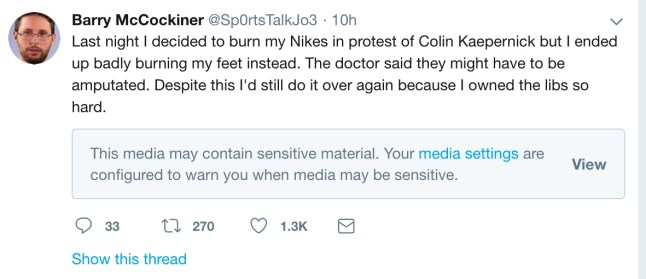
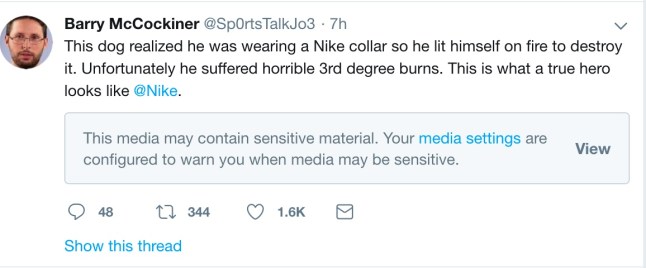
  • Go a few tweets deep: If you feel the best way to weave in that “man of the people” vibe into your writing is to find people on Twitter who you don’t know but are blathering on about your topic, look at a few tweets. “Barry” has a few interesting tweets on his timeline on a variety of topics. If I posted the ones here related to his quote about how Kaepernick’s Nike ad is affecting his marriage, I’m sure half the SAGE marketing team would have heart attacks. (Let’s just say he noted that his marriage was harmed when he caught his wife being unfaithful to him with a man wearing only Nike socks.) Here are a few tamer tweets he posted:

BurnNikes

DogNike

He also has a wonderful diatribe about how he has been constantly on heroin… Long story short: Is this REALLY a source you would want to represent anything you’ve written? If you are going to use a Twitter user, try to find someone who a) you recognize, b) has something important to say and c) doesn’t look like a loon in everything he or she is saying

  • Trust, but verify: The Russian proverb works wonders here, as not every double entendre of a name is a prankster. The Cleveland Indians once had a pitching coach named Dick Pole. I’m not kidding. Here is a doubly unfortunate card of his when he pitched for a minor league team in Portland:

DickPole

I knew a weird guy who used to show up at baseball card shows with a binder full of cards like this called his “Book of Dicks,” containing cards of Dick Allen, Dick Pole, Pete La Cock, Woody Held and others. The point is, those are real names, so it’s not always an attempt to punk you if you get a weird name.

However, it’s up to you to go take a look around and see if there is any supporting evidence that guys like Barry McCockiner exist. One of the downsides of Twitter is that you are limited to what people tell you about themselves, so it’s a little more difficult to verify the source. In the case of Mr. Jablome, a check of area real estate developers could have limited the embarrassment. In either case, you obviously can’t “card” a source to verify his or her name, (although some jokesters have gone to great lengths to prove their identity) but you can do some Googling and social media checks to see how likely it is that Jack Mehoff is a real person.

  • Ask for help: As we noted in earlier posts, it pays to have a person in your organization with a demented mind. The old saying of “it takes a thief to catch a thief” rings true in this type of work as well. You should read the name aloud, have others do the same and then eventually hit up Jimmy The Crime Guy or whoever in your organization has the ability to turn anything into a dirty joke. If Jimmy can’t figure it out, you’re probably safe.

Finish the Game: Why Emily Bloch is my hero (and should be yours, too)

In your collegiate career, professors like me tell you that you should work hard, play by the rules and seek a job that makes you happy. We tell you that the job is your reward for all of the things you endured during your four (or five or six) years in college, eking out an existence with food-service jobs and low-paying (or non-paying) internships. It’s why you spent all your collegiate life locked in that windowless basement that smells like feet and shattered dreams known as the student newspaper office instead of partying with friends.

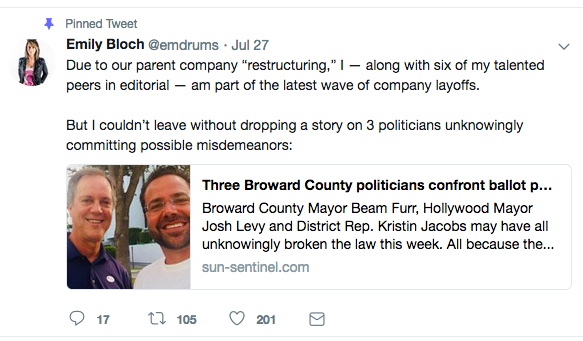
Emily Bloch did all that. She worked for the student newspaper at Florida Atlantic University, ascending to the rank of editor in chief. She attended national media conventions, where I met her through her adviser, Michael Koretzky. She freelanced for Teen Vogue, blogged for Sunfest and contributed to the Miami New Times. In February 2017, she got her dream job: Community reporter for the South Florida Sun-Sentinel, an amazing publication that Tronc purchased in late May.

And last week, Tronc “restructured” her out of a job.

That’s right. The media giant fired her. As journalist and author Jeff Pearlman noted in his blog, “Tronc has kicked Emily to the curb—a multi-million dollar company saving (and this is pure guesswork) $35,000 a year and directly hurting its coverage.”

So, knowing that she got cut and that there was nothing she could do to change that, Bloch did something I doubt I would have had the strength to do: Her job.

EmPinned

“I was told I was laid off BEFORE I started working on that politician story,” Bloch told me in a text message.

The story made the front page of the Sun-Sentinel, and it also went viral when Bloch tweeted the ironic juxtaposition of the newspaper and her severance papers:

EmSeverence

This is why Emily Bloch is my hero, and she should be yours, too. At that age, (hell, even at this age) I don’t know exactly what I would do if I lost a job I always wanted, just because some chucklehead in a suit wanted to nudge a profit-margin up for some stockholders. However, my best guess would be that I would have one of the following reactions:

  • Weep like an overwrought 12-year-old girl if the break up of my favorite boy band occurred on the same day my dog died
  • Launch into a social media rage that would make this clip of Nicholas Cage look calm and well-adjusted by comparison
  • Drink the state of Wisconsin dry while listening to every song by The Cure

Going out and breaking a major story for a publication that told me I lacked value to them wouldn’t even be in the ballpark of what I’d consider doing. Bloch typifies exactly what I try to tell students about the importance of finishing what you start, regardless of odds or obstacles against you, even if it feels like a lost cause. I fell in love with the phrase “Finish the game” as an exemplar of that concept (if you excuse the dated references):

This all sounds great in concept, but I don’t know how easy it is to do in practice. Once the applause from Twitter dies down, she still has to pay rent and buy food. It’s also a hell of a bruise to a person’s psyche to know that you can be trucking along at your job and then it’s like a mob hit: Bang. You’re gone.  What happens next?

“A lot of it’s up in the air but honestly I think I’m more excited than scared,” Bloch said. “To make ends meet, I’m bulking up on freelance. It’s actually ridiculous. Gearing up at my usual places, upping the hustle just a little, I’ll basically break even with my salary. Not sure if that a compliment to me or a diss to my wage.” 

She said she wants to stay in Florida and stay in news at some level. (Koretzky wrote to some folks who know Bloch and said that after her story went viral, two smaller Florida newspapers reached out to her and offered some employment.) By deciding to “finish the game,” she became a shining example of what’s good in journalists and “kids these days.” It also showcased her abilities and strength, two characteristics that are likely to open a lot of doors for her in this next stage of her career.

It’s OK to feel like you got stabbed in the heart if something like this happens. It’s what you do after that happens that will make the difference in life. Bloch said she felt bummed at first, but decided that she would pick herself up off the ground and “begin to hustle.” Her story on the politicians was the result.

“I think there’s a real lesson in there,” she added. “If you’re in this field, it’s likely not because of a tantalizing salary. It’s because you give a shit.”


Four things students can learn from a college newspaper’s coverage of a racist text (Covering a “triggerish” catastrophe, Part II)

Yesterday’s post looked at the George-Anne’s coverage of a racist exchange between two potential roommates at Georgia Southern University. Editor-in-chief Matthew Enfinger outlined the paper’s reasoning behind publishing certain aspects of the story while omitting other details, such as the screenshots of the text and the actual word itself.

Enfinger said that the paper’s story was successful for several reasons, not the least of which was the amount of people who contributed to the piece.

“I would have to say one of the lessons learned from this experience is that dividing (the) labor on this article really helped our paper be one of the first media outlets to have a story out,” he said in an email over the weekend. “One person could’ve (done) the story but dividing the work load really allowed our newspaper to make fast and accurate reporting all while working together as a team.”

The collaborative process also helped Enfinger decide what approach the paper would take on the story. Over the years in journalism, I often noted that the head editor was the person with access to “the big red button.” In other words, it was that person’s decision in the end, but it always helped to have other perspectives in the discussion prior to pressing the button.

“I would like to give a very big thank you to my staff, particularly McClain Baxely and Tandra Smith for really stepping up and working with me on this article,” Enfinger said. “Their dedication and drive to telling this important story really showed in the quality of the work. I’m forever grateful to them. I would also like to thank our advisor David Simpson of taking my hundreds of questions and using his years of experience in journalism to walk us through this story but still gave us the control over the article.”

I asked Enfinger if he had any particular takeaways or lessons he learned as part of this process and he came up with four great ones that should help you if you ever run into a big story with a lot of potential landmines. He had some great suggestions, so here’s Matthew:

There are so many things I’d like to share with students about this experience:

  1. If your community is showing concerns about a specific issue or topic, start looking into it and report on it. A past editor at The George-Anne, Corey Leonard, use to describe covering news like playing football. “If it hits you in the hands you’ve got to catch it.” This story hit out staff in the hands and we caught it. I believe there isn’t a bigger way to fail in journalism than not looking and reporting on topics that your community is concerned about and/or constantly talking about.


  1. Don’t write these stories alone. I worked closely with our Enterprise/Features Managing Editor Tandra Smith and Sports Editor McClain Baxely in working on this piece. Each of us had different tasks that allowed us to report fast but also be a good check system. If one of us were stuck at one point all three of us talked through it. At The George-Anne we have a rule that everyone reports breaking news. Working as a team not only helps you be among the first but to be right as well.


  1. Being right is always better than being first. Fact check. Fact check. Fact check. Especially in situations like this be sure to be very accurate with your attributions and your facts.
  2. Watch your bias. In journalism we work to be as unbiased as possible. For example. I do not tolerate the use of any racial profanity. It makes me sick to my stomach. However, in this article all we had was social media posts that showed the racial slur being used but we could not prove who said it. My staff and I had to make sure that this piece wasn’t a piece calling for punishment of the students but instead report the fact and reactions. Another way to stay unbiased as possible is to reach out to both parties involved and allow each a chance to speak out. In this case only “the receiver replied.”


To continue following the George-Anne’s work on this and many other stories, visit the publication’s website here.

Covering a “triggerish” catastrophe: Georgia Southern University’s student newspaper reports a local story of racism that went viral (Part I)

While scrolling through Twitter, Matthew Enfinger found his university, Georgia Southern, had become a hot topic for all the wrong reasons. The senior writing and linguistics major, who serves as the editor-in-chief for the school’s newspaper, located tweets and screenshots about texts between two women who were to become roommates in the fall.

After the basic pleasantries of “getting to know you” texts were over, the white student apparently thought she had switched over to text another friend and wrote that her new African-American roommate didn’t “look too n****rish.” (EDITOR’S NOTE: She used the full word. I will not.)  Upon realizing she texted that to her new roommate, the white student blamed auto-correct, saying she meant “triggerish” as in “nothing that triggered a red flag.”

After he  heard from staffer Tandra Smith that this topic was trending on Facebook as well, Enfinger knew his paper, the George-Anne, had a big story on its hands. (Read the paper’s story here.) He also knew this story would echo far beyond his campus, so his crew had to make some serious choices about what to publish and what to avoid. Several of those choices could have ramifications for the students involved, other students on campus and the paper itself.

“One of the first things our staff did was reach out to both of the students,” Enfinger said in an email over the weekend. “While we were waiting for responses our original article did include the names of both the students involved in the situation, student reaction quotes and information that we had based off of social media posts. However, we received a response from ‘the receiver’ telling us she would like both their names to remain anonymous.”

The decision of whether to include names of people involved in any kind of incident often comes down to several factors: Do you have the names at your disposal? Are you sure you have the right names? How will this affect the people you name or the people you don’t? Other publications, such as the Atlanta Journal-Constitution, chose to name the sender.

Enfinger said two key things played a role in the staff’s decision to remove the names.

“We left both of the names out to respect that student’s wish and also we had no real way of proving that her roommate was the one who actually sent those messages,” he said. “All we had was just social media posts and we wanted to remain as unbiased to the situation and report only the facts that we were presented with.”

The paper also had to decide whether to post the screenshots of the text exchange, which were available online, that showcased the racial slur and the student’s apology. Enfinger said he and his staff discussed this issue thoroughly with the publication’s adviser, David Simpson, before deciding not to use the shots.

“We had no real way of proving these were not fabricated,” he said. “What if this turned out to be false? What if someone (else) typed that message? We had no clue and couldn’t defend it with facts. I’m not saying other media sources were entirely wrong for posting the screenshots. Looking back on it now I’m sure there was a way to use the screenshots and attribute the posts to the social media user but we were more focused on showing the student population reaction, the university’s reaction and the facts we had at hand.”

Finally, the paper had to decide if it should publish the full “N-word” or not. Some publications have a policy of simply referring to “the N-word” while others will write the whole word in each instance in which it is required. In this case, it was a derivation of the word itself, so it isn’t as clear cut. However, Enfinger said after discussing it with Simpson, he made the decision not to publish the word.

“I ultimately made the choice of not using the racial slur for many reasons,” Enfinger said. “One, I think using the full word shouldn’t ever be used even in reporting. There are many alternatives to describing was was said. We used asterisk to block out most of the word (so) our audience could understand what was said. I personally felt uncomfortable with the thought of typing out the word. Two, this wasn’t our main reason for not using the racial slur but it definitely encouraged our thought process of not using the word, but A.P. Style states that even the term ‘N-word’ should not be used unless under extreme circumstances.”

The reaction to the publication’s story was swift and loud, he said. The African-American community on campus reacted to the story and pushed the university to pay attention to this issue. The school issued a press release regarding the text exchange, affirming the school’s position against racism. Other media outlets followed the paper’s coverage, including some major, national publications, which Enfinger said was good to see.

“I would also like to thank The Washington Post, Buzz Feed and any other big media outlets that quoted our original article,” he said. “Student journalists put their hearts into their newsroom and having big outlets like The Washington Post quote us showed us our work is really valued and respected.”

(Tomorrow: What Enfinger said he and his crew learned from this and the four big lessons others can glean from the George-Anne’s experience with this story.)