SLAPPing around a grocery clerk: A prominent Georgia family decided to sue a service-industry worker for saying accurate things about them on social media

If there’s one thing I hate, it’s a bully.

Saying that, however, could have some pretty costly consequences if the Cagle family of Pickens County, Georgia has its way.

The Cagles have filed a suit against Rayven Goolsby, a grocery clerk, for criticizing them on social media for their presence at the Jan. 6 Capitol insurrection and other statements they made on Facebook about various political and social concerns.

Goolsby’s remarks focused on Kathryn and Thelma Cagle for their alleged “central roles” in organizing busloads of attendees through the “Women for America First” tour; they also touched on William Cagle, husband of Thelma and father to Kathryn, calling him a homophobic “loser.”

Goolsby’s remarks, made in various community Facebook groups, were in reference to William Cagle musing on Facebook when the county was mulling separate bathrooms for transgender people that he did “not appreciate his tax dollars being spent on supporting indecency and a couple of FREAKS that can’t make up their mind where to take a leak.”

(Goolsby’s lawyer Andrew) Fleischman said the defamation suit against Goolsby is a way of making it expensive to criticize the Cagles — “even if the criticism is true.”

“We shouldn’t be afraid that criticizing an important person in our community could cost us thousands of dollars,” Fleischman told The Washington Post. He argued that Goolsby has truth and public interest on her side.

One of the primary things we emphasize in journalism is that if you present information that is factually accurate, you are safe from harm when it comes to libel suits and other claims of defamation. What we really mean is that you’re not going to lose a suit if you write that your governor stole $6 million from the state to build a replica of Graceland in his backyard, if you can prove that this actually happened.

That said, getting sued itself can be a painful process that will costs you time and money, while subjecting you to a great deal of anxiety and aggravation. The only real saving grace of being sued as a staff reporter is that you are working for an organization that has lawyers and managers who will take on the brunt of the costs and work with you.

As an individual operating on a social media platform, you take on the role of “publisher” without having all those helping hands and financial backstops to make life a little less terrible. That said, what we have here is pretty clearly a case of a strategic lawsuit against public participation, or a SLAPP case, as anti-slapp.org explains:

These damaging suits chill free speech and healthy debate by targeting those who communicate with their government or speak out on issues of public interest.

SLAPPs are used to silence and harass critics by forcing them to spend money to defend these baseless suits. SLAPP filers don’t go to court to seek justice. Rather, SLAPPS are intended to intimidate those who disagree with them or their activities by draining the target’s financial resources.

SLAPPs are effective because even a meritless lawsuit can take years and many thousands of dollars to defend. To end or prevent a SLAPP, those who speak out on issues of public interest frequently agree to muzzle themselves, apologize, or “correct” statements.

We’ve talked about SLAPPs before on the blog, including the one that comedian John Oliver faced involving a coal magnate and a giant talking squirrel. To prevent this kind of thing, 30 states and Washington, D.C. have anti-SLAPP laws, which can force plaintiffs to prove they’re not using the courts as a cudgel to shut people up.

According to anti-SLAPP.org, Georgia actually has a pretty good anti-SLAPP law on its books, which states that if a person is found to have engaged in a SLAPP suit, the case will be dismissed and that person is on the hook for legal fees and costs incurred by the person they “SLAPPed.”

In other words, if you have a great deal of money and plan to use it to sue someone into silence, it might end up costing you some additional cash in a way you hadn’t planned on.

5 things I learned rewriting a textbook that might be helpful to your writing students

As Yogi Berra said on a day celebrating his career, I want to thank you all for making this necessary. Enough people found the “Dynamics of News Reporting and Writing” worth buying that SAGE thought it was worth updating. The second edition is coming out in January, and it’s got some neat new features like a whole section on freelancing and some great help from additional pros.

My only real regret is that I’m losing my favorite cover of all time. That thing was beautiful. Still, this one is pretty cool and doesn’t have that polyester 1970s, this-won’t-age-well vibe of some other books:

I learned a lot writing the book initially, like how to fit 10 pounds of stuff into a 5-pound bag, what the phrase “implied agreement on ancillaries” meant and that I still can’t figure out the “affect/effect” distinction. In basically rewriting it, I discovered some different things that might be valuable to students who have to read this thing when it comes out. Here are five things I picked up in the rewrite:

Keeping up with social media is impossible: One of the things I remember most about the first edition of the book was that we were literally on the press (and I do mean LITERALLY) when Twitter decided to up its character count from 140 to 280. After a mild panic (read: complete and total mental breakdown), I begged and pleaded enough to get SAGE to pull the book back and let me rework some stuff. If you read the chapter, you might notice that some of the sentences sound like they were translated from English to Sanskrit to German and then back to English. That’s what happens when you’re trying to exchange content in a character-for-character basis.

That was the fourth critical revision of the social media chapter in less than two years since I wrote that draft. The reason for all those changes was twofold: 1) SAGE wanted to showcase that the book HAD a social media chapter, so the editor at the time asked me to write it first. That allowed SAGE to put it out as part of a review package to see if anyone would be interested in ever using this book in a classroom before SAGE invested any time or money into me writing it. 2) Social media changes platforms and approaches as much as Taylor Swift changes boyfriends.

Here is a list of stuff that no longer exists (or is on life support) that made the cut for the first version of the original social media chapter:

  • YikYak
  • Storify
  • Vine
  • Periscope
  • Ping
  • Google Buzz
  • Meerkat
  • Digg

(I brought up YikYak to students in my writing class last week, and you’d have thought I asked them, “Are you old enough to remember the assassination of Abraham Lincoln?”)

This, of course, doesn’t count the changes on various platforms, like Twitter’s shift to more characters and visual options and Instagram’s movement to more text-based storytelling. Trying to be “up-to-date” on a book you update every three years is like trying to catch yesterday’s rainstorm.

However, what I did learn in looking back at this graveyard of social media is that the approaches I took in the book as to how best to employ social media still holds. In addition, elements of these dead-stick platforms continue to have value in new incarnations. (Vine begat TikTok in a way, while Storify’s approach to storytelling is now everywhere, even though the platform itself is dead.)

You can always count on the consistency of people’s stupidity: One of the big risks when it comes to including timely examples is that they’ll go stale. The other is that you’ll never find another example of that “one thing” so you’ll have to rewrite a ton of content and change your position entirely on a topic.

These risks are overstated when it comes to journalism textbooks, primarily because people continue to do dumb things in ways that mirror the dumb things people did in previous eras.

Case in point, the issue of “Twibel,” also known as libeling someone on Twitter, took on particular significance in the mid-2010s, as courts were deciding what was or wasn’t legal. Singer/actress/person-I’d-least-like-to-run-into-in-a-dark-alley Courtney Love was at the center of a crucial case that brought this issue to a head and demonstrated that, yes, people can sue you for stupid things you say on Twitter.

Love won, and the appeals court upheld her victory, so that made the first edition, but I was worried about finding a decent update. Fortunately, Love not only repeated some of social media misbehavior, but billionaire Elon Musk put himself in the middle of a similar situation when he referred to a cave explorer as a “pedo guy” during a social media post. The lawsuit’s resolution timed up nicely with the new edition…

Sex scandals, criminal actions, stupid behavior and other forms of entropy will always come around again, much in the way the sun will always rise in the east and set in the west. If nothing else, that should be helpful to those of you wondering why you’re learning the legalese associated with covering crime as part of your reporting education.

Grammar still makes no sense: As part of the writing process, the book goes through a copy editor who picks everything apart to make sure I don’t sound like an idiot. Jim Kelly (not the hall-of-fame quarterback, but he’s a hall-of-famer in my book, anyway) is the guy who always gets my books and he’s been a lifesaver every time. What’s funny, though, is that since we’ve been working together, we find that we’re going back and forth on things that there should be rules for, but there apparently aren’t.

Jim’s a grammar guru, so he’ll pick at something in a paragraph that needs a comma or something, and I’ll pretty much go along with him. Occasionally, though, I’ll look back at what we did in the previous edition and ask, “Wait, we went the other way last time. I’m fine with whatever, but what’s the rule?” Jim and I then spend about five emails trying to figure out why we did what we did the last time and why it is that we are trying to do something different this time. In the end, it kind of comes down to, “Hell… I don’t know either…”

A lot of what we do together, he can explain to me in perfect and simple ways that help me remember it. (He’s gotten the closest of anyone ever to helping me figure out “affect/effect.” When I screw it up, I feel like I’m failing him… Catholic guilt, I know…) However, even people who take on grammar, style and punctuation as a career can occasionally become befuddled.

I don’t know if that makes you feel better or worse.

Nothing you write will ever be perfect: I get a goodly amount of notes from folks when I post on the blog, most of which let me know when I spelled something wrong, a link is dead, a word is missing or I did something else that looks like a random mishap. I’m always grateful for that, because everyone needs an editor (or 12) and basically on the blog, it’s just me.

With books, it’s a completely different story. I have multiple editors, copy editors, query specialists, production specialists and more. Here’s a simple walk through of a chapter from draft to book:

  • I write a draft.
  • It goes to my editor, who sends it back to me with notes.
  • I rewrite the chapter.
  • It goes to my editor, who sends it back to me with notes.
  • I finish rewriting the chapter.
  • It goes back to my editor, who edits it and sends it to the copy editor.
  • The copy editor sends it to me with notes and suggestions.
  • I edit it and send it back to the copy editor with changes and questions.
  • The copy editor sends it back to me with answers so I can make additional changes.
  • I make the changes and send it back to the copy editor.
  • The copy editor moves it to production, which edits it some more and lays it out.
  • I then get a first proof set, where I try to fix anything else I missed the first 12 times.
  • I send it back to production, which fixes the issues and sends it back to me with additional queries.
  • I answer the queries and check the fixes before sending it back to production.
  • They send any final queries and suggestions on a final proof set.
  • I answer the queries, do a pencil edit on the entire book and send it back.
  • It gets published as is, presuming Twitter doesn’t try to screw me over again.

Now, realize that even after ALL THAT, mistakes still get through and none of us has any idea how the hell that happened. Case in point, a professor in New Mexico offered his students extra credit if they could find any errors in the text and then email them to me. At least one person did and it was a stupid typo (theie instead of their) and I went back about six generations into the edits and have no idea where we screwed that up.

No matter what we do or how hard we work, nothing is ever perfect, so enjoy whatever level of “pretty good” you can get based on the amount of time you have to work and the general expectations of the people for whom you work.

“Done” matters the most: Steve Lorenzo, the first journalism instructor I ever had in college, used to yell at me when I was dinking around with something in lab, trying to get five more minutes out of him before I had to send the final version of whatever I was writing.

“Journalism is never done,” he’d say. “It’s just due.”

He was right about that and he was right about basically everything else in life as well. I could torture myself for hours and hours about making a mistake or missing something important or puttering around with commas and nothing would ever get done. Instead, you put the bat on the ball, make the damned deadline and good stuff will happen.

Fear of failure can paralyze the hell out of anyone. So can the desire to be perfect to the detriment of the “it’s as good as it’s gonna get.” I also find that if I persist and just getting something out of my head and on to the screen, I can always improve it later. The harder I work at just moving forward toward a goal, the more likely it is I’ll make the goal with room to spare.

In typing that, I realized there’s some truth in something I told my kid recently:

“You will never be the smartest, the fastest, the strongest or the whatever -est out there. There will always be someone smarter, faster, stronger or whatever, so you have to kind of get over that. What makes the difference and what will help you succeed more than anyone else is your work ethic and your level of commitment to getting the job done.

“Just outwork the bastards. Good stuff will happen when you do.”

Corona Hotline Update: More grammar and writing exercises for journalism professors as we “pause for the cause”

“Corona Hotline… No, I don’t know what a two-week pause is supposed to do in this pandemic either, professor…”

For those of you who weren’t with us last year when everything shut down and everyone was scrambling for assignments, exercises and general help, we established the “Corona Hotline” page as kind of a stockpile of stuff that I had built and folks were willing to share. You should feel free to click here to peruse it. All the stuff is freebie and I hope it helps.

For those of you who know all about it and are suddenly going on a “two-week pause,” (at least they didn’t call it an “inflection point”) and you need some additional help, I’ve added a few things to the page today:

  • Two lectures on blogging that I do. The topics are audience-centricity in terms of finding out whose out there and how to serve them as well as a deep look at the concept of “Why you?” in terms of what you should figure out before you pick a blogging topic to see if you can deliver value.
  • A blog-building exercise: It’s not tech stuff (if you want that, I can point you in a few directions), but rather kind of a pre-launch assignment that has the student analyze what’s out there in the area in which they wish to blog, determine what kinds of things they can put into their blog effectively and more. Think of it as kind of a “pitch” like they would have to make to a company if they wanted to start up a blog for those folks.
  • Grammar exercises:
    • Antecedent-pronoun selection
    • Who vs. Whom selection
    • Active vs. passive voice (I’ve had this for years, thanks to the late, great Patty Atwater)
    • A “medley” exercise that mixes all sorts of stuff in grammar.

You can get all that on the page as well. It’s up at the top. Hope it helps.

May the odds be ever in your favor, even when they’re not.

Vince (a.k.a. The Doctor of Paper)

Everything you need to know about media writing you can learn from crappy Facebook ads

When students begin my Writing For The Media class, they often feel defeated right off the bat. Our first assignment of any substance is to rewrite a lead and I tell them right off the bat that it will take us about three or four one-hour class periods to analyze professional writers’ leads, write them, analyze their efforts and rewrite them to any level of decency.

Four hours to write one sentence? They look at me like I’m demented.

Then, after it takes four hours and they STILL feel like they have no idea if it’s exactly right or not, more than a few of them tell me a simple truism: “This is way harder than I thought!”

Unfortunately, they often follow it up with this: “Maybe I’m just not meant to be a writer…”

The truth about writing is that nobody is “meant to be a writer.” It’s a skill that takes a long time to develop and even more practice to hone. Even the best writers fall on their keys occasionally, so it’s also a humbling skill that can seem to turn against you and cripple you like a bad back.

I tell the students, “Don’t worry. It’ll get better. We’ll get there together, I promise.”

Those that stick with the class often find that to be true. Then, they start realizing how horrible a lot of the writing around them is and feel really good about how far they’ve come.

If you’re looking for a good place to get that basic ego boost, you should look no further than Facebook’s Marketplace. Even the most mediocre of writing students can feel like Hemingway after cruising through a few ads there.

The advertisements I’m talking about aren’t those that promise “Hot young singles in your area want to talk to you!” Or “One simple trick will enhance your manhood.” Or “Grow back all your hair with this safe, natural supplement.” (Or as I like to call these things, the “Fisher-Price My First Midlife Crisis Kit.”)

I’m talking about ads that regular people in your area post to try to sell everything from used deodorant (it’s out there) to used vehicles. It is here where tortured prose goes to be tortured some more.

For those of you looking for writing lessons in places beyond the textbook or the news sites, send your students to this Valley of Duh and they can learn some valuable writing lessons like these:

VERB TENSE MATTERS: In my writing class, we talk about the verb of the sentence as being like the engine of a vehicle. A strong and powerful verb can really make that sentence fly. A weak verb requires you to prop it up with a dozen adverbs and other descriptors, the way you would have to turbocharge a Yugo.

The tense of that verb can also mean the difference between a great sentence and a horrible correction.

Here’s a fun example: We are looking for a “beater” truck to help us around the Ponderosa these days. The idea is that between Amy’s need to haul mulch and the requirement that we haul our own trash to the dump down the road, we want something with an open bed that can accomplish dirty tasks. It can look like someone set fire to it and put it out with a set of golf clubs, but it needs to start easy, run reliably and stop when we push the brakes.

In flipping through Facebook ads, we found a 1978 Ford F-250 that looked good. The ad noted that it wasn’t much to look at but it “starts and runs great.” So, we drove about an hour up the road to see it.

The first clue things were wrong was that it was in a storage shed behind a bunch of other crap the guy and his kid were frantically moving out of the way. The second clue? Under the hood of the car, the carburetor (which is vitally important to starting and running) was being held open with a screwdriver. When it came time to start the truck, the kid got behind the wheel and the seller began pouring gasoline directly into the engine.

Even then, it didn’t start. It didn’t even make a sound, as the battery was dead, too.

“I thought you said this starts and runs,” I said.

“It did when I put it away last spring,” he replied.

You don’t have to be an expert in much of anything to know that a lot can change in 15 months. If you look back at your Facebook memories from last year at this time, something tells me that you’ll notice more than a few differences between then and now. Hell, 15 months ago, the only reference to a “coronavirus” was probably how you described the morning after a rough Cinco de Mayo party.

After a few more attempts to start it, I told the guy that I was leaving.

Thus, “starts and runs” should have been “started and ran a while ago.”

FACT CHECK THE HELL OUT OF STUFF: As the above example demonstrates, not everything you see in these ads is factually accurate. I suppose I could give the guy a pass on the starting and running as it actually did at one point. (I mean the Enterprise didn’t beam that truck into the storage unit.)

I’m a little less forgiving about things that clearly aren’t true.

We went to see a 1964 Ford 100 that seemed to fit the bill. When I got there, everything was what I wanted: sturdy truck bed, good tires, strong brakes and more. The problem? The truck was listed as having an automatic transmission, something that wasn’t true.

(In case you are unaware, if you have THREE large pedals along the floor of the driver’s side of the car and you need to step on the one on the far left frequently as you shift a stick near your right hand as you drive along, this is a MANUAL transmission. It’s also known as a “stick shift” because you are shifting it manually, with that little stick.

If you have TWO large pedals along the floor of the driver’s side and you need to apply the brake only ONCE as you shift your car to the “D” spot on the gear shift, wherever it is located, and the car does the rest of the gear shifting for you, this is called an AUTOMATIC transmission. It means the car “automatically” shifts for you as you go faster and faster and faster.)

Truth be told, I can’t drive a stick shift. Well… That’s not entirely accurate. If you got mauled by a bear and I had to get you to the hospital to save your life and the only car available was your stick-shift car, I could get you there. You would live, but we’d be holding a funeral for your clutch and gearbox.

This guy was not alone in listing his vehicle with the wrong transmission. I saw FOUR of these online that listed the trucks as being “automatic” when I could see pictures of both the shifter and the clutch in the ad. When I asked a couple people about the inconsistencies, they said, “Oh… Yeah… then I guess it is a stick…”

Good grief.

When it comes to your own writing, fact check the hell out of stuff before you publish it. If you aren’t sure about nuances like the difference between a bacteria and a virus, look both of them up and make sure you’re right. If you don’t know what a word means, look it up before you toss it in there because you’re pretty sure about it.

And, if you don’t know the difference between an automatic and a stick shift… Well, you probably didn’t read this post carefully enough. Go back and take another look.

CONSISTENCY AND CLARITY COUNT: When it comes to your writing, you want people to feel informed and grounded in the topic. Being consistent in your writing helps with this. When you get contradictory information in a piece of writing, it can be more than a little jarring. Case in point:

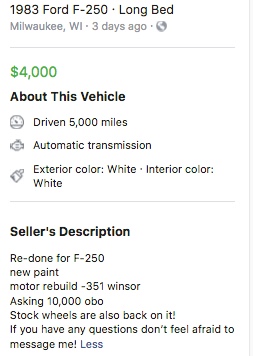
Ford4000

In reading the opening, I’m looking at a $4,000 truck. When I get to the body of ad, it’s $10,000 (or best offer, which I’m guessing won’t be at the $4,000 level).

Another ad showed a truck with a plow for $2,000. The body of the ad noted, “Don’t low ball me by offering $4K for both the plow and the truck.” I wasn’t sure how offering twice what you asked for something would be a “low ball,” so I asked the guy.

“The truck is $2,000 but it doesn’t come with the plow. That’s at least another $5,000.”

So, maybe mention that?

Another oddity of inconsistency comes from a seller who notes “Truck runs, drives and stops as it should. Will need to be trailered.”

OK, wait… If this thing is road-worthy, running, driving AND stopping as it should, WHY do I need to tow it out of there?

In the field of professional advertising, what these folks are doing would be called “bait-and-switch,” where a business offers one thing and then quickly switches it out for a more expensive item or inferior product. I wouldn’t accuse these folks of this tactic, as I think they’re just bad at communicating what they want.

Still, if you’re trying to reach an audience, this can be annoying for your readers.

EVERYTHING CAN USE AN EDIT:

“needs rear main seal eventually ,leeks new brakes”

(I’m guessing it either leaks from the rear main seal or the guy is using giant scallions to stop his truck.)

“needs new breaks and break lines”

(What do we need to break on it?)

“Has manuel transmission”

(I wonder who Manuel is, but if he can run the stick-shift for me, I’m interested…)

“I have a 1966 ford Ltd for sale starts, runs, drives ,surface rust only I have two separate interior for it everything works as it should blinkers, whipers, windows everything works price is negotiable please feel free to contact me with offers and for more information”

(Located on just above and slightly to the right of the space bar is the period key. Try using it once or twice. Or more.)

“2WD, 4SP, 350 CI, Need brks, batt. U haul, 2500 obo No LBall.”

(This is either a text message in code or a ransom note crafted by someone with limited access to magazine covers.)

I’m hopeful these bits and bites of information can help you as you look to work on your writing.

And, yes, we’re still looking for a truck.


4 journalism-based rules Washington and Cleveland need to follow in renaming their teams

The Washington NFL Football Team announced earlier this month that it would engage in a name change, after decades of protests from people who found the moniker “Redskins” racist. All it took was a demand from a multi-million-dollar sponsor, and suddenly, the team was all about doing the right thing.

Shortly there after, the Cleveland Major League Baseball Team announced it would be looking into whether “Indians” should still be part of the sporting zeitgeist. About two years earlier, the team mostly retired its long-time mascot Chief Wahoo from its merchandise and apparel.

(As a long-time and long-suffering Cleveland fan of multiple sports, I have to say one was well overdue. It’s been tough to wear baseball gear supporting the team I have loved since I was 10 in this day and age. That said, and this isn’t a defense, but it likely used to be a hell of a lot worse when they had this logo.)

Meanwhile, the Atlanta Braves have decided that tradition is too strong for a team that has called at least two other cities home and features the mascot “Chief Noc-A-Homa” as well as the “chant and tomahawk chop” routine to consider making a change. Must be a lot of money in those foam tomahawks…

I guess, as Meatloaf once opined, “Two Out of Three Ain’t Bad.” That said, while trying to fix one stupid thing, there is always the risk of creating other stupid things. Bad nickname choices can lead to awkward double meaning, stupid logos and some very difficult editorial decisions for writers.

With all of this in mind, here are the four journalism-based requests for Washington and Cleveland as they begin their quest for better nomenclature:

DODGE GRAMMAR PROBLEMS: The first thing we need to make clear is that the name has to be plural, and I mean VISIBLY plural with an “S” on the end of whatever the teams pick. (Sorry, no Mice or Moose.)

Some of the dumbest grammar arguments come out of singular team names like the Colorado Avalanche, the Minnesota Wild, the Miami Heat or the Orlando Magic. As a team grammatically operates as a gender-neutral single entity, the singular team names get the same treatment. That means when the Bucks play the Heat, the pronouns would be “They play it.” Of course, it’s grammatically correct and yet it makes absolutely no sense at all.

Unless the players can form into one entity like Voltron or use a single collective consciousness like the Borg, you MUST use a pluralized name for the sake of all of us.

Also, no names that can be read as a verb. We don’t need another Thunder or Jazz to make for some really bad headlines like “Bucks deal Thunder third-straight loss.” A bad headline break in that can make them sound like Zeus tossing bolts around.

Another verb-based moment of stupidity would be “Raptors play Jazz tonight,” which would look something like this, I’m sure:


AVOID HEADLINE HEADACHES: Journalists have to think about how things will look in the big type, so please keep in mind that certain words don’t work all that well. Case in point is the old San Diego team from the American Basketball Association:

Conquist

It was a lousy team, (and the term has its own awkward past) but it did have a really cool logo. The problem was trying to squeeze “CONQUISTADORS” into any kind of head specs. When the designer gave you a one-column headline for a game between these guys and the Dallas Chaparrals, it was a safe bet that he thought you were having an affair with his wife.

To solve that brain-bending problem, journalists started referring to the team as “The Q’s” which made about as much sense as anything else in the ABA.

THINK LIKE A 12-YEAR-OLD BOY: A team name like the “Lumberjacks” can seem like a great idea at the time, but it definitely puts headline writers in a pickle, as we noted above. Those scribes trying to fit 10 pounds of stuff in a 5-pound bag can end up making things worse if they fail to have a dirty mind:

JacksOff

Do I dare ask about the “position changes?”

Before you get too far into the idea of what the next name should be for either of these franchises, have an intern in the PR department Google every potential euphemism for male and female genitalia as well as doing a deep dive into every possible corner of the internet for references for disturbing sex acts.

That means, despite the city’s proud history of shipbuilding, you do not want to go with the “Cleveland Steamers.”

Also, consider every possible noun and verb you plan to use as part of a social media campaign or every potential permutation of your name when placed into a hashtag.  (I can imagine the Oakland A’s doing a promotion where plating a certain number of runs could lead to free meal or something. The result would be the #asscorefour hashtag, which sounds like one of many sequels to a porn film.)

RESEARCH THE HELL OUT OF IT BEFORE YOU DECIDE:  Anything you pick should go through the standard vetting process for copyright, fan engagement and such, no doubt. However, if you get only one good swing at this name change thing, you better dig a lot deeper to ensure you aren’t accidentally stepping on a racial, sexist or homophobic landmine.

Here’s what I mean: A Texas PR firm that specialized in food and drink was looking for a fun and engaging name back in 2012. The two women, who are white, came up with what they saw as a quirky, on-point moniker, so they did a quick Google search to see if anyone else had used it. Turned out, it was the title of a Billie Holiday song from the 1930s, but they figured it was so far afield, it wouldn’t be a problem, so they went with it.

The name? “Strange Fruit.”

A bit more than a quick search might have helped this PR firm avoid two years of bad PR. The song is about the lynching of African Americans and the lyrics aren’t opaque on that point. The women eventually rebranded as “Perennial PR,” but even that had problems when they failed to grab social media accounts by that name. Someone else did and had a lot of fun at their expense.

That means you start looking for everything that ever was when it comes to any name you want to pick. You think something like the “Washington Potomacs” seems cool and safe, make sure you’re not ticking off people with a sense of Negro League Baseball history. Pretty sure you don’t want to name them the “Washington Marshals,” as law-enforcement names aren’t really getting much love these days, plus it could seem to be a minor nod to former owner George Preston Marshall (yes, the spelling is different), who didn’t have an open mind on issues of race.

And for the love of God, avoid the “Washington Woodsmen.” No, I didn’t know this was a thing. Yes, I looked through the entire Urban Dictionary’s “W” section, which is something Dan Snyder’s people should do as well.

No, you don’t want to know what it means.


Nursing, Social Media Experience and “Knowing I belonged:” How Emily Reise landed a digital marketing job during a pandemic

EmilyMugWith graduation drawing close, college students across the country are panicking even more than usual as they try to get a job in the middle of a pandemic. Even professionals with years of field experience are concerned about moving jobs or finding a career path as the coronavirus has made it difficult to find opportunities or stability.

Emily Reise a public relations and social media professional managed to navigate this new landscape amazingly well, landing her current position as a digital marketing coordinator for Nurses PRN in Appleton, Wisconsin about a month ago.

Reise majored in public relations and minored in environmental studies at UW-Oshkosh, all while undertaking four internships in her field. Upon graduation, she headed to St. Paul, Minnesota to work as a social media coordinator for Midwest Sign. After a year and a half, she was looking for a chance to come back home to the Fox River Valley, and found Nurses PRN.

According to its website, Nurses PRN is a staffing agency that connects clients and nurses “driven by the simple idea that better nursing care leads to better patient care.” The company notes that it has 500 active employees and fills approximately 6,000 shifts monthly for its clients.

Reise was nice enough to answer a few questions about what she learned as a student that she still uses and what she does in her new job:


You landed at Nurses PRN right in the middle of a pandemic and you are responsible for digital marketing content. I guess two questions that come off of that statement are a) What does your job normally entail? and b) What is life like dealing with this job now in the middle of this insanity?

“A normal day would consist of me taking leads from Facebook ads and ‘gifting’ them to recruiters in the company depending on the area they are staffing and the type of nurse they need. I am the main social media guru, so I make the content calendar, come up with content, strategize social media campaigns and monitor comments and messages. I also have my hands in email marketing, events, managing job boards, and helping edit and write website copy.

“Landing a job in the middle of a pandemic, especially in the nursing field, is chaotic to say the least! Everything is abnormal and changing which demands a ton of agility when approaching ads and job boards. Certain jobs are streaming in because of layoffs and furloughs that normally we never had an excess of. This floods the ads and gives us tons of leads we may need or not need depending on facility need. This forces me to jump in and start making decisions whether to shut off ads, make new ones, or edit the creative or copy. There is no ‘normal’ right now and no directions on how to adjust social media ads for nurses when there is a global pandemic.”


How did you land a job during this time of absolute uncertainty, given all the cuts to everything and how it seems like the economy is going to hell in a speedboat? What was it that drew you to this company and what was it that got them to find you as the perfect fit?

“I was looking for a new opportunity back home in the Fox Valley since I was living in the Twin Cities. I chose a day in March and interviewed with five different companies. Nurses PRN was the first company I interviewed with. By the end of the interview I remember telling them, ‘I am at a 10, I want this job- hire me today!” (They didn’t hire me that day.)

“I knew I belonged there because of how laid back and enthusiastic the marketing team was about their jobs. I clicked instantly with them. I found out later they were looking for an upbeat person who wasn’t afraid to express new ideas. Luckily, I can talk to a brick wall… I felt I connected well and after working for many companies, I now know that company culture and the people I work with is the most important factor for me.

“I got the job the next week and had to finish my current job. Two weeks after I put in my two weeks, though, the COVID-19 pandemic was heightened and I was worried they would move my start date back. Instead, they shipped a laptop, work phone, and training manuals right to my house so I could start remotely. Even though it’s not perfect, I’m so thankful to have a job during these uncertain times and working for a company who takes risks and cares enough to let me start on time.”


In your career to date, what are some of the most important things you learned in college in terms of being prepared to do this work? In other words, what “tools” were the most important things that college put into your “toolbox” for your career?

“Learning to write for blogs, website copy, and press releases has proved to be invaluable in my career. At my previous job, I wrote around 49 blogs in the year of 2019 alone. Now I mostly edit other people’s written work but taking Writing for the Media taught me to always comb through everything with an eye for detail.

(I still remember the day I got my assignment back from you and I went and cried in your office because I got an F since I spelled the lady’s last name in the story with an “a” instead of an “e.” You called that a major error and said I will always remember to double check details like that and never changed the grade. WELL, YOU WERE RIGHT! I STILL TELL PEOPLE ABOUT IT!)”


Right about now, a ton of students are looking for jobs and there is always that fear of “Oh, dear Lord, what happens when I can’t get a job?” As someone who graduated not that long ago (and who I know had some of those jitters at certain times), what kinds of advice can you give the kids who are graduating and worried about what will be out there for them, especially given our current situation?

“One of the biggest chunks of advice I can give grads, especially during the pandemic, is to be open minded. I thought I was going to be working for a sustainability company doing public relations. Now I’m working for a nurse staffing company as a marketer.

“I realized that the largest factors in finding a job you love isn’t just about the industry you are in, but the work you are doing, the people you work with, and the overall company culture. Don’t be too picky, if you think you would like the job duties, apply for it!”


Cheap  (and kind of self-serving) question: If Emily “now” could go back in time and talk to the Emily who was just starting her degree (with a “Writing for the Media” class), what would you tell her?

“I would say, ‘You’re right, you won’t be a journalist, but you will use these skills every single day in your career.’ Writing is something all employers crave in marketing and PR employees.

“I had to do multiple tests during interview processes to prove to the employers I knew how to write a press release or blog. I write for the media daily whether that be for social media, website copy, press releases, or blogs.

“Also, Filak was right. You will always remember spelling that damn person’s last name wrong.”

Copyright goes wrong for photographer, thanks to Instagram’s terms of service

Copyright law has never been a simple thing, but in the pre-digital era, it was often easier to determine who owns what. In the days of darkrooms and contact sheets, photographers were able to develop negatives, make prints and track the physical movements of their work.

However, thanks to digital copies, social media and the “sharing” of content, it can often be difficult for some people to figure out what is and what is not a fair use of something, let alone who has the rights to do what with a photo, a graphic or a piece of video.

Things got more complicated in some ways this week, thanks to a court ruling on the use of embedded content: (h/t Kelli Bloomquist for the head’s up on this)

A court ruled yesterday that Mashable can embed a professional photographer’s photo without breaking copyright law, thanks to Instagram’s terms of service. The New York district court determined that Stephanie Sinclair offered a “valid sublicense” to use the photograph when she posted it publicly on Instagram.

The case stems from a 2016 Mashable post on female photographers, which included Sinclair and embedded an image from her Instagram feed. Mashable had previously failed to license the image directly, and Sinclair sued parent company Ziff Davis for using Instagram embedding as a workaround.

A large part of this ruling came down to the user agreement associated with Instagram:

“Here, [Sinclair] granted Instagram the right to sublicense the Photograph, and Instagram validly exercised that right by granting Mashable a sublicense to display the Photograph,” rules Wood.

Wood comes to this conclusion by discussing how Sinclair agreed to Instagram’s Terms of Use when creating her account. Those terms granted to Instagram “a non-exclusive, fully paid and royalty-free, transferable, sub-licensable, worldwide license to the Content.”

Wood writes that because Sinclair “uploaded the Photograph to Instagram and designated it as ‘public,’ she agreed to allow Mashable, as Instagram’s sublicensee, to embed the Photograph in its website.”

In other words, you agreed to let us do certain things with your stuff, so you can’t complain when we do it. Sinclair argued that it’s an unfair choice photographers must make: They either give up some rights to their work or avoid being on one of the most dominant visual-sharing platforms.

The degree to which this will be the start of something bigger remains to be seen, but it does add yet one more wrinkle to the question of who owns what and how much trouble you can get in by engaging in which online activities.

Blogging 101: 3 basic rules you need to understand before you think about starting a blog

A student with the school’s PRSSA chapter came to me a few weeks back with a somewhat dangerous request:

“Can you come to one of our meetings and do a session on blogging? Our members really need to know how to do this.”

The danger in the request comes in two parts:

  1. Asking someone who runs a blog to lecture on blogging is like asking a new grandparent if they have pictures of their grandchild. You’re not getting out of there for a long while and you probably will regret asking somewhere around Day 4 of the experience.
  2. The decision to start a blog requires more than feeling like you need to do it. Blogs are like the critters from “Gremlins:” At first they feel cute and cuddly and fun, but in a short amount of time, stuff goes south and you find yourself in the middle of an overwhelming mass of insanity.

The student persisted, arguing that the folks who are graduating these days tend to find that blogging is a required part of many jobs, even though the people doing the hiring can’t properly articulate what should be blogged or why. It’s become like “having a website” was back in the mid-1990s: Media companies just kind of decided that they needed them and that they’d figure out the rest later.

To help the students figure out what works and what doesn’t in terms of blogging, I built a few basic rules for each step of the process. Today, we’re going to look at those rules that should help you figure out if you really should be blogging at all:


RULE 1: It’s not about you.

Starting a blog because you want to write about something is like becoming a restaurant chef because you like to eat. The point of the job isn’t to give you a cheaper version of group therapy or to help you share your feelings with people. The point of a blog is to find an audience that has an interest in something you know about and a need for information that you possess.

What you know about your audience will largely determine how successful you are at drawing traffic to your blog. You need to know who is out there, what interests they have and how you can engage them, either digitally or inter-personally. This is particularly important if you are working for an organization that requires you to blog for it. Your personal stories won’t go far and the readers won’t give a damn about you.

To make this work, you need to learn who is out there that is reading the blog, what they need and how you can get it to them.

There are three things you need to examine to understand your audience: Demographics, psychographics and geographics. The type of blog you have will determine to what degree each of these elements is more or less crucial to your success. However, unless you have a sense of who is out there, you’ll never know if you can be of help to them.

In marketing, we talk about the idea of a “buyer persona” while in news we talk about a “typical reader.” All we’re really trying to get across is that a certain type of person is going to be using your stuff, so you have to know who they are, what they want and how best to reach them.

For example, if you are doing a blog on fashion, you need to know who will be reading it. Are they younger people who wear a lot of leggings and ripped jeans or are they senior citizens who want to get out of the 1970s and its polyester phase? Are they New York jet setters or small-town kids who don’t want to wear  overalls every day? Do they have gobs of money or are they shopping on a budget? Even more, things like how label-conscious they are, the degree to which they have a solid self-image and how often they like to shop will all play into this.

Regardless of what you choose to do, you need to make it about them. Not you.


Rule #2: Get narrow and get focused

Blogs can’t be about everything. They have to be about something. If you decide that you’re going to “blog about things that I notice,” you have managed to violate both rule 1 and rule 2 in one fell swoop. Writing a “personality” blog would only work if you are someone like Kendall Jenner, and even then it wouldn’t work because if you were Kendall Jenner, you’d need to learn how to write first.

We don’t live in a “mass media” world any more, so you have to find something specific that will draw readers and give them something they can’t get elsewhere. (Or, at the very least, they can only get a few other places, but you give it to them in a better way) That means you need to locate a niche that badly needs something you have to offer and then fill it.

Let’s look at how best to narrow this down:

  • Stage 1: I want to write a sports blog. (WAAAY TOO BROAD)
  • Stage 2: I want to write a blog that looks at college athletes. (STILL TOO BROAD)
  • Stage 3: I want to write a blog that looks at college athletes and issues of mental health. (Probably workable)

Each cut, you see us getting closer to a niche. In this case, you have something that not a lot of people are talking about (mental health and athletics) so you have a lot of potential blogging options. You could look at star athletes and the mental pressures of success. You could look at athletes who graduate  but won’t go on to a pro game and how they deal with that. You could look at athletes coming back from injuries and their fears and concerns about this. Sources can include sports psychologists, former athletes, coaches, mental health experts and more. No matter what’s going on, you have the ability to sharpen the focus by going more narrow.


Rule #3: You need to be able to answer this question: “Why you?”

For my money, the greatest line ever delivered in the history of professional sports came from Indianapolis Colts GM Bill Tobin after the first round of the 1994 NFL Draft. A draft analyst had criticized his picks on ESPN, which was covering the event. After hearing this over and over, Tobin went on live TV and asked:

“Who in the hell is Mel Kiper anyway? Here’s a guy that criticizes everybody, whoever they take. He’s got the answers to who you should take and who you shouldn’t take. And my knowledge of him: he’s never ever put on a jock strap, he’s never been a coach, he’s never been a scout, he’s been an administrator and all of a sudden he’s an expert.”


His point is one you need to consider when you decide on your blogging topic: Who the hell are you and why should anyone listen to you about this topic?

If you are going to be successful at blogging, whether it’s as a news blog, a promotional blog, an opinion blog or anything else, you have to be able to explain to your readers (or better yet just show them) what it is that makes you a credible and valuable resource on the topic at hand. This is where research REALLY comes in, especially if you are working for an organization or corporation.

For example, let’s say you are blogging for a travel agency that specializes in European travel. There might be a big gap in the area of food blogging for people with gluten allergies who travel in Europe. The questions of “Where is the best quality of gluten-free pasta?” or “Which restaurants use separate prep stations for gluten-free meals?” and others need to be answered. You have an audience that really wants to know this stuff, as for some folks, it’s a matter of life and death. You can draw traffic from other similar gluten-free blogs that exist like Chronically Gluten Free and A Celiac’s Dream, as people often post a need for these answers on those sites.

However, if you don’t travel through Europe, or you have no background in these allergies or if you never eat, who the hell are you to talk about this stuff? If you can’t be an expert based on your experiences, you better be an expert based on research, interviewing experts and doing more than just spitballing about the topic based on what you once heard at a PF Chang’s.

You have to be able to demonstrate to the readers that you have an expertise in this topic and showcase that expertise in pretty much everything you do. Imagine your doctor starting off your surgery by saying, “I’ve never done this before, but let’s give it a shot…” Not exactly awe inspiring.

If you can’t demonstrate good solid reasons why you should do the blog, don’t do the blog. If you don’t have a choice, you need to gear up and game up through research and checking in with experts. You need to make yourself into the expert.

The “High School Principal at a Porn Store” Theory: Why the public vs. private tweeting debate for journalists doesn’t matter

Tom Jones at the Poynter Institute asked the question that journalists have wrestled with since their profession became the social purview of the world at large:

One of the more complicated issues newsrooms are dealing with these days is employee conduct on social media, especially Twitter.

Here’s what I mean: A reporter tweets something controversial about the news. Is that reporter expressing his or her own opinion? Or are they representing the company they work for?

This issue became an issue again when the Washington Post suspended reporter Felicia Sonmez for tweeting about the 2003 rape allegation against Kobe Bryant within minutes of Bryant’s death breaking as news. The paper eventually determined that Sonmez didn’t break any of its rules with her tweet, even though editor Marty Baron disseminated a memo that urged caution and restraint for Post staff in the future.

As Jones pointed out in his piece, this isn’t a new thing for media folks. Veteran sports journalist Jemele Hill found herself in the middle of a social-media controversy back in 2017when she called the president a “white supremacist” on Twitter and got tagged with a two-week suspension from ESPN. She left the network in 2018 and joined The Atlantic, noting it was a place “where discomfort is OK.” Back in 2013, PR practitioner Justine Sacco found that a single tweet could destroy a person’s life in less than a day. Even after more than a year, Sacco was unable to live down her tweet. It took several more years for her to eventually recover from that single moment.

(This isn’t even just a “media professional thing” in terms of social media leading to concerns in other parts of life. Ask Roseanne Barr, umpire Rob Drakecomedian Gilbert Gottfried, Elon Musk or any one of a dozen other folks about how social media posts led to ramifications in other parts of their lives.)

Journalists traditionally believe in several key tenets that make life difficult when it comes to this idea of public vs. private person in social media communication:

  • They value openness, which means they don’t want to be silent on a topic that matters to them, hide information or allow themselves to be censored.
  • They value the sharing of information with interested audience members.
  • They believe in being involved in stuff, so when something is happening, they feel the need to chime in.
  • They like to produce content, and in most “traditional media” formats, they don’t get (or have to listen to) audience feedback.

Take all of this together and you’ll realize that it’s not all that hard to see why journalists end up on social media a great deal and why it is they have trouble with their employers after a tweet goes bad.

The rules that dictate what they can or can’t they do versus what should or shouldn’t they do is kind of a random mishmash of media company norms, HR memos and a desire to stop audiences from freaking out. Jones notes:

Baron wrote that with social media, the Post should remember this: “(1) The reputation of The Post must prevail over any one individual’s desire for expression. (2) We should always exercise care and restraint.”

In other words, it feels as if Baron is telling reporters to use their heads, to be smart, to watch their tone, to not say anything that might cause an issue.

Makes sense … until you realize that what one person considers a valid take might be inappropriate to someone else. After all, isn’t that what just happened at the Post?

Sort of, but not really.

Here is why Baron’s memo, Jones’ reaction and social media policies in general fall short in splitting the baby between allowing journalists to interact with the audience and a desire to prevent chaos and dystopia from reigning supreme in the Twitterverse:

You Can’t Entirely Know Your Audience: Great reporters used to know their audiences like the backs of their hands. Jimmy Breslin, Mike Royko and their ilk prided themselves in knowing “their readers” and being great at delivering things to them that mattered. Folks like that existed in many publications, I’m sure. (George Hesselberg and Pat “Snoop” Simms, both formerly of the Wisconsin State Journal,  are two folks I got to know who had that finger on the pulse of the readers as they wrote their stories and columns.)

Many reporters, however, relied less on the audience needs and more on the news values or interest elements associated with journalism education to drive their approach to content. Even more, the idea that we would stoop to going through “market research” to figure out how we should cover certain things or what we should cover was an affront to some folks that saw this as an impingement on their freedom of the press.

Today, we have more data than ever to help us figure out  where our clicks come from. (The Dynamics of Writing would like to give a shout out to whatever the heck “Han dot nl” is, as for some reason, it’s driving a ton of traffic to the site from the Netherlands.) We know which posts draw the most clicks, the most likes and the most shares.

That said, we still don’t know our actual audience and here’s why: Once the content is out of our hands, we have no say over what happens to it. What we think is OK for “our audience” doesn’t matter in some cases, because other readers out there can still access it and will still freak out over it.

Case in point: I generally curse in every day life, knowing that most of the people around me are used to it. When I started this blog, I was asked by SAGE to eliminate “unnecessary curse words,” as some of the people who buy the book and read the blog go to far more conservative universities, religious colleges and places that generally have more couth than I do. I tamped that down (as best I could) and stuck with only “necessary cursing” to meet the needs of my audience.

That said, I have no idea at all why people in the Netherlands are consistently reading this blog. For all I know, I might end up having the gendarmes after me (or pikemen or whatever…) for violating some sort of social concerns I don’t know about. I’m glad these readers are here, don’t get me wrong, but I never started this blog with the idea of rocking the Dutch market. They aren’t my intended audience, but it’s not like I can do much to stop them from showing up or seeing stuff.

The larger point is this: If you send something out that you believe to be relatively appropriate to people you think are going to be reading it, you have no way of preventing it from going to a completely different group of people and having everything go to hell in a speedboat.

The “High School Principal at a Porn Store” Theory of Private vs. Public: Journalists like to argue that their social media feeds are their individual, private personas as opposed to a public representation of their work as media practitioners.

In a vacuum, I get that, as there should be a separation between job-related life and life-related life for all of us. It gets a little dicier when you consider that in both their job and their social media lives, reporters are essentially doing similar things (sharing content) in similar ways (social media, typing stuff etc.). Still, we don’t give up all of our rights to be regular people just because we cover the news.

The bigger problem is that human beings don’t operate in a vacuum of life and we can’t always build an unbreakable firewall in our brains like this. We can’t “unsee” things or discount them based on the spheres in which they happen. This leads me to the theory outlined above.

Let’s say you’re driving down a fairly empty stretch of interstate late Saturday night and you blow a tire. You pull over to the only business with a well-lit parking lot: A giant “adult book store” or porn palace or whatever you want to call it. As you’re sitting there, waiting for Triple-A to come and fix your car, you see the principal of your old high school exiting the building. He’s carrying a giant duffel bag full of pornographic DVDs and an inflatable “partner” doll dressed like a Catholic school girl. He doesn’t see you, he gets in his car and he drives away.

Theoretically, you should be able to compartmentalize this: He’s a private citizen, during his off hours, doing nothing illegal, so what’s the big deal? You should put this away as one more interaction with him and ignore it as it relates to his work with the school and your interactions with him when you were in school.

In a practical sense, however, all you can think is, “EEEEEEEWWWW!!! PRINCIPAL JONES! MY EYES! MY EYES!

Everything you thought about this guy is now cast in a completely different light. You start rethinking every comment he ever made about anyone in a different way. You also probably start washing your hands like Lady MacBeth with OCD, remembering the number of “high fives” you got from him as you walked down the hallways between classes.

Again, nothing illegal happened. Hell, you don’t even know if anything horribly sketchy will happen, as this could be part of a giant prank or a lost bet. However, that’s not going to make you feel any better about the situation.

Just because we pretend that a wall exists between the public and the private spheres for the benefit of trying to justify our choices to other people, it doesn’t necessarily follow that everyone will graciously make that same distinction once they see what you put out there. People decide how they want to see us based on what they see of us. Claiming something is personal or not part of our career or whatever doesn’t absolve us of the perceptual damage that exists in the minds of others.

A Case of the Man Keeping Us Down: The more journalists feel forces beyond their control are suppressing them, the more likely they are to push back on something. It’s a response learned from years of having people they report on saying, “You don’t need to know that” or “You aren’t going to get that.” It’s also probably hardwired into our genetics at some level, just like being nosy.

Policies like this one that seems to say, “We’re watching you” can lead journalists to feel that need to push back against it, even if they aren’t entirely interested in engaging in the behavior the policy dictates. In other words, even if I’m not a journalist on Twitter who feels it necessary to tweet about whatever is coming into my mind, the minute you try to stop me from doing so is the minute I’m going to be upset about it.

It also doesn’t help that the policies are fluid and lack a sense of  “X actions = Y consequences.” Do I think that the timing of Sonmez’s tweet was particularly brilliant? No. Do I think the consequences were a bit much? Yes. Can I find a clear path through Barron’s memo or the WaPo policy that tells me who was right? Not a chance.

In some ways, this kind of reminds me of the old-school version of Catholic confession, in that it was never clear how the priest knew EXACTLY how many “Hail Marys” or “Our Fathers” were necessary to demonstrate proper atonement for each specific sin. It seemed like a mixture of how upset the priest was, how penitent the confessor was and how much time was left before mass started.

When my job (or my eternal soul) is on the line, I guess I’d like a little more clarity on how the rules apply and how I should know that I’ve got things nailed down appropriately.

Just like anyone else, journalists are going to be judged on their statements in a public setting and like a whole lot of folks, we tend to think our opinion needs to be shared with a lot of people in a public way. Since social media allows EVERYONE to play, it can be difficult to tell people who share opinions and write publicly that they can’t play or that they have to follow different rules.

Like most other things we’re all grappling with in this field, things are more likely to be messy than easy as we figure out what we SHOULD do after we bump into a lot of things we probably SHOULDN’T do.


Playing with live ammo: Social media and the umpire who threatened a “CIVAL WAR”

When we discuss law in my intro writing class, I always ask a simple question, “How many of you are on social media?” Every hand goes up. I then ask how many are on specific platforms (Twitter, SnapChat, Facebook, Instagram etc.) and the students respond with similar levels of engagement. When I ask what they do on those platforms, the answers vary: talk to friends, pass along information, “talk shit” (as one student put it), complain about classes and more.

That’s when I hit them with this: “You are all publishers. All the things we’re going to talk about today apply to you, including some scary things like libel and copyright infringement.”

To further emphasize the point, I go back to a Filak-ism I used a lot in the newsroom: “Every time you post something, you’re playing with live ammo. You need to be careful out there.”

I thought about that message when I saw this story about a major league umpire who took to Twitter and expressed a few thoughts on impeachment:

UmpWar

In case you missed it, a public figure just threatened to buy a gun and start a violent, armed conflict if Congress continued with a legal proceeding against the president. He didn’t do it at a bar over a couple beers. He didn’t do it in the umpires room after the game while surrounded by five other folks bitching about life. He did it on a social media platform where the message was published, and reshared hundreds and thousands of times.

Rob Drake, the umpire who issued the tweet, deleted it shortly after the “fit hit the shan” and then deactivated his account. He also issued an apology that sounds like someone else wrote it for him (and not just because all the words were spelled right). Major League Baseball is investigating Drake’s social media presence, but regardless of what it decides, Drake learned that social media can be a lot more scary than the gun he was yammering about on it.


“I am a brother.” 3 tips on how to avoid a racially tone-deaf social media disaster like the one from the University of Missouri

Watching my alma maters compete for supremacy in an arena of national attention is usually fun for me, but not this month:

UW-Madison: We built a homecoming video where we cut out all the video involving people of color who agreed to be filmed for it. No way anyone could screw up a situation like this worse than we did.

University of Missouri: Hold my beer.

(CNN)The University of Missouri Athletic Department is apologizing for a tweet it says was meant to celebrate diversity but was instead criticized as insensitive.

The tweet posted Wednesday included graphics of three student athletes and a staff member. Two are black and two are white.

The graphics featuring the white athletes highlighted their career ambitions. Gymnast Chelsey Christensen’s said, “I am a future doctor.” Swimmer CJ Kovac’s said, “I am a future corporate financer.”
Staff member Chad Jones-Hicks’ post said, “I value equality.” Track and field athlete Arielle Mack’s said “I am an African American Woman.”
The post was criticized on social media for defining Mack and Jones-Hicks by their race instead of their goals and accomplishments.
The athletic department deleted the tweet Wednesday night and apologized.

Yes, it really was that bad…

MizzouRace2

In other words, “Look at all the cool stuff we get to do as white people!” and “Look! We’re black!” aren’t exactly interchangeable concepts.

And when you think it can’t get any worse…

MizzouBrother

I kept thinking, “This one has to be an internet spoof version, right? Nobody thinks, ‘Hey let’s call the black guy ‘a brother’ and see what we can get away with…'”

Nope, it’s real, leading me to ask the same question this person asked on Twitter:

AfroTweet

(Hell, you could have run this past Breckin Meyer’s character in “Go” and HE would have caught it…)

The athletic department tweeted out an apology for its actions, which led more people to complain about how tone deaf THAT was as well.

This kind of “someone does something horrible they didn’t see coming, particularly in regard to race” has become kind of a repeating theme on the blog. Although we talked about ways to avoid this kind of thing when we discussed the “Coolest Monkey in the Jungle” sweatshirt issue, consider these key points again:

Paranoia is your BEST friend: A great line about one of the greatest hockey coaches guides my actions in journalism quite a bit. After his team had won a national championship, a friend found him emotionally drained sitting quietly away from the celebration. The writer remarked, “They had succeeded. He had avoided failure.” Maybe that seems sad, but that approach keeps your keester out of a lot of trouble.

As we noted the last time we covered this: Murphy’s Law includes the famous line about “whatever can go wrong, will go wrong” so it’s always best to plan for the worst. When you find yourself putting together ANYTHING that will be disseminated to the general public, you want to engage in some active paranoia. Read every word as if it might have a double meaning or if a misspelling might lead to an awkward moment (e.g. “Bill Smith, a pubic librarian, reads…”).

Look at every image you have to see if anything could be misconstrued in a negative way or would cast aspersions on an individual or group. Go through every potential stereotype you can think of in your head and see if something looks like it might be playing into that stereotype (e.g., Is a blond woman shown to be less intelligent? Did you put a person of color into a “monkey” sweatshirt?). Approach your work in this way and you will not always succeed, but you can avoid a lot of failure.

Ask for help: As we noted during the sweatshirt debacle, diversity is not a buzzword. The goal of having a wide array of perspectives and a diverse collection of people with different experiences is to allow a fuller examination of bigger issues.

Even if your newsroom, your PR firm or your ad agency doesn’t have a cornucopia of diversity, you can still avoid dumb mistakes by asking for help. Call a friend who knows the topic better than you. Ask a source who is involved in the topic for a quick read. Talk to an expert on the issue with whom you worked on an earlier project. You probably know someone out there who has a connection to almost any topic if you think about it hard enough.

To be fair, I’m usually the person seeking help in this regard because I’m your garden-variety straight, white male, but what I have found is that most people are happy to help if you are honest, humble and forthright. The earnest gesture of, “I don’t understand X but I really don’t want to screw it up,” tends work when you approach people from varied backgrounds. I have asked all sorts of questions when it came to faith, race, gender, LGBTQ issues and more using that approach and I can’t ever remember being yelled at or shamed.

(I do remember once going to see the Kevin Smith movie “Dogma” with a group of friends, none of whom were Catholic. At about a dozen points in the movie, one of them would ask a question about something that just happened and I’d give a quick answer with a promise to explain more later. About halfway through the movie, my friend, Adam, leaned over to me and whispered, “Now you know what it’s like for me, being the only Jew in the newsroom, when we’re covering Passover.” Point taken.)

Know where the landmines are: This one is a direct pull from the sweatshirt post, but it bears repeating. I still ascribe to the Fred Vultee Theory of Drowning, which states you should treat EVERY piece of copy like it could come back to kill you. That said, the level of extreme care should jump up a few notches from the caution I employ in fixing the garbage disposal and the caution I would employ in disarming a nuclear warhead.

Some things just have much lower margins for error, have far higher consequences and are far more likely to kill you. In terms of the United States, gender, race and sexual orientation are the issues that lead to a lot of “Oh, crap, how did we write THAT?” apologies than many other topics. If you know that going in, you can game up a little bit more than normal when you start working on something in that area. It’s a lot like driving through Rosendale: I always try to adhere to the speed limit, give or take 5 mph. However, when I hit the Rosendale city limits, I’m ALWAYS driving 27 in a 30 because I know what I’m getting into.

In the end, you might not avoid every problem, but you’ll do a lot better in avoiding the really stupid ones.