Over the past several years, the Associated Press has made a number of changes that left style geeks in a panic. The decision to go with “%” instead of “percent” made no sense as a key change. The rule that told us how to quote emojishad us wondering if we’d officially slipped into hell. The biggest disaster, however, was its flip-flop-a-thon on compound modifiers and hyphenation, which had a few of us asking if “dumb-ass idea” was still hyphenated.
This time around, AP looked at a bigger issue and made a good call. The folks there announced Friday that it would be shifting to the use of a capital “B” in the word “Black,” in reference to issues of race. John Daniszewski, the vice president of standards, noted in his blog post that this decision came after two years of research and discussions on the topic:
These changes align with long-standing capitalization of other racial and ethnic identifiers such as Latino, Asian American and Native American. Our discussions on style and language consider many points, including the need to be inclusive and respectful in our storytelling and the evolution of language. We believe this change serves those ends.
For the last year, the National Association of Black Journalists(NABJ) has been integrating the capitalization of the word “Black” into its communications.
However, it is equally important that the word is capitalized in news coverage and reporting about Black people, Black communities, Black culture, Black institutions, etc.
NABJ’s Board of Directors has adopted this approach, as well as many of our members, and recommends that it be used across the industry.
As is usually the case, AP made dozens of other changes as well for the upcoming style edition, so it’s probably worth it to update your subscription and mutter to yourself, “Don’t these people have anything better to do?” However, in the case of “Black,” AP did the right thing for a good reason and reflected the needs and interests of journalists and readers.
I swear that there used to be hand sanitizer in this thing…
Welcome to this edition of the junk drawer. As we have outlined in previous junk drawer posts, this is a random collection of stuff that is important but didn’t fit anywhere else, much like that drawer in the kitchen of most of our homes. Hope you find value in it:
A “Wiry” Winner
A few months ago, we talked about gender bias in writing when Judge Jill Karofsky, a candidate for Wisconsin’s Supreme Court, was described in a profile as “a wiry marathon runner who has completed two Iron Man competitions” and was also a state doubles champion in 1982.
Given how hotly contested things were out here, we had a lot of local writers banging away on their “hot takes” on the topic. We also had national attention on us. One of the frequent mistakes I saw was involving an unfortunate homophone.
This is an example of “people working the polls.”
This is an example of “people working the poles.”
Know the difference before a friend asks you to be a worker of one of these things. Coincidentally, one of our good friends was a “poll worker” who was sent a kit to help run her polling place. It contained a bottle of vodka, with the word “hand sanitizer” written on a label that had been pasted over the vodka brand. Apparently, that was the best they could do to deal with the coronavirus out here…
Speaking of the coronavirus situation…
Editing matters, coronavirus edition:
A former student of mine sent this to me. It was posted on the door of her apartment complex. Her note? “I’m glad you taught me to read things carefully.”
Speaking of “that’s not quite what I meant…”
A student turned in her writing assignment on the coronavirus with the following quote:
“We were nervous in the sense that we were very cautious and did not want to touch anything or expose ourselves to others unnecessarily,” she said.
I know what she meant, but I really needed a laugh at that point, especially in terms of the “expose ourselves to other unnecessarily” element.
And, finally, speaking of needing a laugh…
Are we just not doing “phrasing” anymore?
I told this story for years and it bordered on the apocryphal, because it seemed too ridiculous to believe.
We got a call over the scanner of an armed robbery at the Olde Un Theater, our local porn store. Jeff Barnes was one of the best reporters I ever had in terms of jumping all over a story and he was on it. (He convinced the local county fire protection folks to give him a volunteer pager so he could be out to the scene faster than other reporters. He also once covered a forest fire and the tires on his truck almost melted when the path of the fire switched.)
As he was running out the door, I half-teasing yelled, “Don’t forget. If you want a byline story on this, you need two sources…” I knew full well he’d get the cops and that was it, given that a) we rarely got a second source on breaking news like this and b) who the hell was he going to interview at a porn store?
Sure enough, Jeff came back with a story that had two sources. He manged to find a guy who admitted he was in the porn palace, was willing to give his name and gave us a line about the guy yelling at him that he needed to hit the floor or the guy was “going to blow your (expletive) head off.”
Jeff then asked the cop about this and got the cops to repeat for him a sanitized version of the “blow their heads off” line, which we then used in the story and the headline.
After a while, nobody really believed that story, except me and my buddy Steve, who was on the copy desk that night. However, I mentioned it on Facebook about a year or so ago, someone found Jeff Barnes and Barnes confirmed it. Better yet, he found the clip in his old portfolio and sent it to me.
It’s the most glorious time of the year around here, as the snow is melting, or at least melting to the point where we can see over the snowbanks while backing out of the driveway. Classes are in a groove and students are figuring out that they actually CAN write if they put their minds to it.
Best of all? We are so much closer to getting baseball back into our daily lives.
To celebrate this wonderful part of the year, here’s an AP style quiz that uses baseball stuff to get you in game shape for the upcoming season.
You don’t need to start an account to play, but if you do, it’ll allow you to be ranked overall. Accuracy counts most, but speed matters, so go get ’em.
Forty years ago today, the United States Hockey team won the gold medal at the Lake Placid Olympics, defeating Finland 4-2 in a game that almost no one remembers. That’s because two days earlier, the U.S. beat the Soviet Union, in an upset that became known as “the Miracle on Ice.”
Herb Brooks, who coached the University of Minnesota hockey team to three NCAA championships, built a team of 20 skaters from the college and minor-league ranks to compete against the best the world could provide. The Soviet Union built its team of professionals, men trained to play the game since boyhood and then placed on the Red Army team, where they honed those skills throughout the year.
The Soviets were in line to win their fifth consecutive Olympic gold medal in 1980, having not only destroyed whatever amateur competition the world could provide, but having crushed the NHL in a series of exhibition contests over the years. (The glorious exception being the 1972 Summit Series and a 1976 beating the Philadelphia Flyers put on them.) They cruised into the medal round, expecting to win easily.
The U.S. eked its way into the medal round, having tied Sweden in the opening game of the tournament and then defeating Norway, West Germany, Romania and Czechoslovakia. The semi-final game against the Russians took place on Friday at 5 p.m., despite U.S. attempts to get the game moved to prime time for TV.
Despite being out-shot 39-16 and never leading throughout the first 50 minutes of the game, the U.S. ended up taking a lead with exactly 10 minutes to play in the third period. Mike Eruzione’s shot on Vladimir Myshkin found the back of the net and the U.S. had a 4-3 advantage. Despite pelting goalie Jim Craig with a barrage of shots over the next 10 minutes, the Russians couldn’t solve him.
In honor of this monumental event, which I could spend a few hundred thousand words yammering on and on about, I put together this AP style quiz based on the Miracle on Ice team and its Olympic run.
Click here to try it out. You don’t need an account to play, but if you have one, it will track your score for an overall ranking. Challenge your professor to play and post a screen shot of your victory to claim bragging rights.
Professors are always looking for exercises to help their students learn important lessons. After my introductory media writing class had a few “issues” with properly attributing quotes, I decided to put together this handy little word search. Feel free to steal it and use it:
As we noted in an earlier post, the Junk Drawer is usually full of stuff that didn’t fit anywhere else but you still need, so let’s enjoy a few of the more awkward moments sent in by the hivemind and other friends out there:
A DATE LEAD THAT WORKS:
One of the rules I’ve emphasized to writers about leads is to not start them with a time element, like, “On Monday, the Board of Regents raised tuition 35 percent…” The point I try to make is that if the most important thing you want to tell me in the most important sentence of your story is WHEN something happened, you probably don’t have much of a story to tell.
On Monday, the journalists at the freewheeling website Deadspin were instructed by its owners to stick to sports. On Tuesday, the site’s interim editor in chief, Barry Petchesky, was fired for refusing to obey that order. On Wednesday many longtime staff members quit in protest, hurling Deadspin into chaos.
It’s a multi-sentence lead in which every sentence starts with a time element. Here are a few reasons why it works:
The writer establishes a pattern of cadence, relying on the repetition of the time element to keep the attention of the readers.
The rapid-fire series of events that occurred in a 72-hour period lends itself to pressing the issue of time in the lead.
The writer doesn’t overdo it. The old “rule of threes” applies well here, in that things that occur in threes tend to keep our attention and are “mentally pleasant” for audience members. Had this gone on for a few more sentences, the technique would have failed.
As we have noted about all the rules of the game: Once you know them well enough, and you earn the fungus on your shower shoes, you can break them if you do so for the right reason. Go ahead and try something different, but if it doesn’t work, feel free to go back to an inverted pyramid style lead.
HOW MANY KILOS FOR A QUARTERBACK?
A friend sent me this headline, noting the word choice and the bad head break:
For those of you tea-totalers out there, “blow” is an oft-used euphemism for cocaine. Even given the liberal reputation of the West Coasters, I don’t think this is what they meant.
You need to watch those word choices for headlines. In this case, it was a web head, so there was no good reason not to write out a deeper and clearer headline. In print, occasionally, the space allocated to the headline gets you into trouble:
I’ve worried about my mortgage from time to time, but I’m not sure I’d take a bullet in exchange for saving some cash. It sounds like how the rich people work in “The Purge” or something.
I HAVE A QUESTION…
How long do I get to rent this shirt for $3? How many bedrooms does it have?
PUNCTUATION MATTERS:
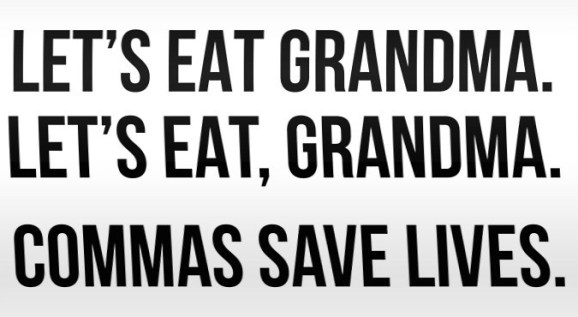
We already know that commas save lives…
And we know that they can keep you away from promiscuous buccaneers…
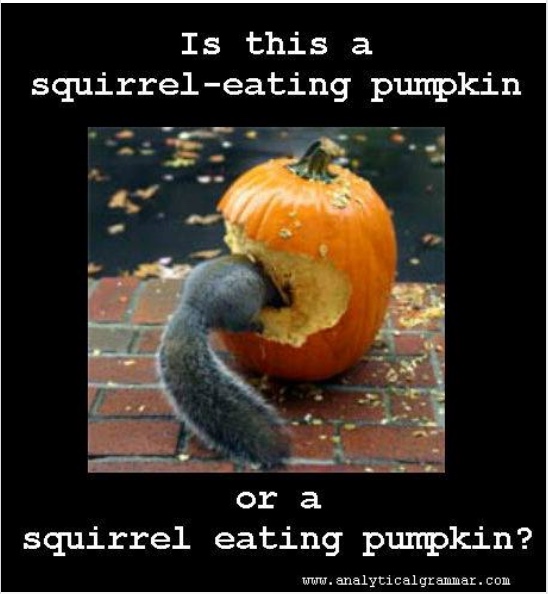
But a friend sent me a conundrum of hyphenation necessary to distinguish zombie-apocalypse gourds from vegan tree-rodents:
I’m really hoping it’s the former. I can see the movie posters already…
It’s hard to think about it being Halloween, when you have this scene happening outside your house at 7 a.m.:
The plows had already gone through once and it took me 20 minutes to find my window scraper. That said, since the calendar says it’s Oct. 31, here’s an AP style quiz based on a Halloween theme.
You don’t have to establish an account to play. It’s 10 questions and you will be judged on speed and accuracy.
Take a screen shot of your score and post it everywhere! Challenge a professor (who likely wants this break more than you do) and earn bragging rights for the year.
It’s been a while since we rolled out a new one of these, so here’s your chance to score some points and impress your professors.
The Associated Press style book is the bible (not Bible) of media writers. It helps provide consistency, structure and clarity for writers in news, PR, advertising and more. (Broadcasters have their own style for on-air scripts, but they still need AP style for filing text-based web stories.)
Think you have a handle on AP? Here’s a quiz based on some fall themes.
You don’t have to create an account to play, but if you want to, it will rank you.
Post a screenshot of your score here and brag to your friends. Challenge a professor so you can have bragging rights all year.
As much as I’d like to think I had an impact, I’m not delusional enough to think anyone of journalistic import reads this blog. I’m guessing in this case, the quantity of complaints and freak outs had them reconsider their ideas on “first-quarter touchdown” and other hyphenations.
“Thanks to input from our users, we are reversing our decision to delete the hyphen from ‘first-quarter touchdown’ and ‘third-quarter earnings,’” AP Stylebook Editor Paula Froke told Poynter in an email. “We agree that, for instance, ‘first-half run’ should be hyphenated. So to conform, we are returning the hyphen to the ‘-quarter’ phrases.”
In a March Stylebook update, Froke said, the AP noted the difference between commonly recognized noun phrases and compound modifiers in phrases. Her example: “Chocolate chip cookie” doesn’t need a hyphen. “French-speaking people” does.
“To correct one misperception: The updates we announced in March did not call for fewer hyphens or no hyphens in compound modifiers,” Froke said.
I could argue with that last point, but the bigger issue is that AP did the smart thing: It listened to its readers and users and made a point of acknowledging their concerns. The AP approach is the perfect example of how to understand one’s audience’s needs and to meet them, as opposed to arrogantly refusing on the grounds of being “in charge.”
If you read this blog at all, you know I have an almost pathological love of hyphens. It’s because I believe they clarify intent, especially in the case of compound modifiers.
I like to joke that I prefer to have a “smoking-hot car…”
…as opposed to a “smoking, hot car.”
In its most recent update, however, the Associated Press reworked its rules/guidance/thoughts on hyphens when it comes to “commonly known phrases:”
Journalism professors, editors and everyone else who picks at language took this news calmly and simply as always:
Let’s parse AP’s language on this one:
No hyphen is needed if the modifier is commonly recognized as one phrase, and if the meaning is clear and unambiguous without the hyphen. Examples include third grade teacher, chocolate chip cookie, early morning traffic, special effects embellishment, climate change report, public land management, first quarter touchdown, real estate transaction.
The first problem with this is that “commonly recognized” creates a lot of trouble, as what is common for some people isn’t that common for others. Sure we could quibble about people who don’t like sports not knowing if it’s “first-quarter touchdown” or “first quarter touchdown” (as if you could score a quarter of a touchdown), but that’s the easy stuff.
Consider the style on issues of transgender individuals:
Sex reassignment or gender confirmation: The treatments, surgeries and other medical procedures used by transgender people to match their sex to their gender. The preferred term over gender reassignment; do not use the outdated term sex change. Sex reassignment or gender confirmation surgery is not necessary for people to transition their gender. Balducci considered having sex reassignment surgery during his transition.
The example doesn’t hyphenate “sex-reassignment surgery,” a term that AP just added in June of 2019, so I’m not sure how this fits with the “commonly recognized” element. Also, given the need for things to be “clear and unambiguous,” I’d imagine it should be more helpful if the hyphen were there to clarify that we are reassigning sex (or confirming gender) in the surgery.
The rules on “public land management” had me perplexed as well, in that public land management could be land management completed in an open, public fashion via governmental agencies while public-land management could be the management and care of only public lands.
We no longer have “third-grade students,” but we still have “a first-hour class” they must attend. Also, we still have “9-year-olds,” but they’re now in a “third grade classroom.”
Every year, I provide my students with an AP-style worksheet (or is it AP style worksheet?) that has a number of the key rules they need to know. I’ve already had to go back through and change all the percent items because of a change that freaked us all out in March. Before I started messing around with “one-bedroom apartment” or “four-door sedan,” I figured I’d ask the editor for clarification. The “Ask the Editor” folks at AP were nice enough to respond with this:
We don’t have new rules on hyphenation, contrary to what you may see on Twitter. One-bedroom apartment and four-door sedan are correct; we use hyphens in compound modifiers. We continue not to hyphenate terms commonly recognized as a single phrase. We use high school student, not high-school student; real estate agent, not real-estate agent; climate change report; not climate-change report. We change our style on two terms to conform to that guidance: first grade student (similar to high school student) and first quarter touchdown (the lack of hyphen wouldn’t cause anyone to think there’s such a thing as a quarter touchdown).
So, I spent about 20 minutes trying to think about how I could NOT misinterpret “first grade student” but I COULD misinterpret “four-door sedan,” based on hyphenation issues. I was left without a good answer.
The way that I’ve always explained style to students and why they need to learn it comes down to a few things, none of which are helped here with AP’s approach here:
Consistency: The goal of adhering to a specific style is so that everyone who is using a term, a form of punctuation or an approach to writing does so in the same way as everyone else in that field. Sure, there are breaks from the norms here and there, but a lot of those come once we know the rules and consciously decide to go a different way for a good reason. For example, here’s the start of the entry on last names:
In general, use only last names on second reference. When it is necessary to distinguish between two people who use the same last name, generally use the first and last name on subsequent references.
OK, but when you write a feature story about a family that has run a diner for three generations, the last thing you want is a sentence like this:
“Suzy Smith said she talked to Mary Smith about asking their brother, Johnny Smith, to get on board with the restructuring plan, in spite of what Jane Smith and Carl Smith, Suzy Smith’s cousins, wanted to do with the restaurant.”
One of my favorite feature stories a student wrote for me was about a family farm and every time I read it, even 10 years later, I wince at the first name/last name references to everyone. She did it because AP told her to and she feared losing points in the class. Had she asked, I would have told her to break the rule.
Consistency helps us when we move from job to job or from one area of the field to the other. Sure, organizations will implement local style when it comes to certain things, but AP serves as the benchmark for consistency that allows us to avoid looking like idiots when we leave one place and go somewhere else. It also helps to make sure we’re all on the same page when we are looking at a particular way of doing things.
Clarity: I remember talking to a friend of mine in college who was taking Japanese to fulfill a foreign-language requirement (or is it foreign language requirement now?) and I asked him how he was surviving it. (I had always heard Japanese was a really tough language to learn.) He told me English was harder because it has all sorts of rules that have all sorts of exceptions to them, making it almost impossible to be right. Japanese wasn’t a breeze, but at least the rules were relatively clear and standard, he told me.
Think about all the rules English has the require kids to sing songs to help remember them, like, “i before e, except after c, unless it’s an “eh” like in “neighbor” or “weigh.” No wonder my kid uses text lingo and can’t spell to save her life…
AP presents these stylistics as guidelines and ideals, but they also essentially serve as rules for how we do things. That’s why we, as academics, force the students to read the book and abide by it. When the rules are clear, we all tend to follow them or understand why we are penalized when we fail to do so.
Think about it like a posted speed limit: When the sign says “Speed Limit: 55 mph,” we all understand that’s about how fast the state wants us to drive on that road and most of us tend to drive around that fast. When the police officer pulls you over for going 125 mph in that 55 mph zone (or is it 55-mph zone?), there’s at least a sense of “OK, I understand. I’m going to jail.”
Idaho code 49-654 (1) reads: no person shall drive a vehicle at a speed in excess of the maximum limits: 35 miles per hour in any residential, business or urban district, unless otherwise posted; 65 miles per hour on state highways, unless otherwise posted in accordance with section 49-201(4), Idaho Code, and provided that this speed may be increased to 70 miles per hour if the department completes an engineering and traffic study on the state highway and concludes that the increase is in the public interest and the transportation board concurs with such conclusion; 55 miles per hour in other locations, unless otherwise posted, up to a maximum of 70 miles per hour.
Well, that’s not helpful to me if I’m on a rural road where a farm truck pulling hay is going 25 mph while Parnelli Jones is flying up my keester at 80. I’m not certain if the police would let me get away with, “Yes, officer, I know I was going 70, but I swear I thought this road had a traffic and engineering study that concluded it was in my best interest that this not be an unposted 55 zone!”
If you are in charge of making the rules, try not to turn the situation into a game of “Bamboozled.” Come up with some clear thoughts, stick to them and make life easy on those of us who have to deal with them. (Or, more to the point, easy on those of us who have to teach other people how to deal with them.)
Improvement: It’s a simple rule that I tend to follow, but change is supposed to make things better. If you change something and it becomes worse, that’s a bad thing. If you change things just for the sake of change, that’s dumber than change that makes things worse.
Case in point: My parents bought a really nice luxury SUV with a set of third-row seats. (I’m guessing it’s not third row seats, as I’m guessing a “row seat” might be something crew folks use…) The problem? To use the area in the back for storage, you had to fold up and remove the seats, each of which weighed about 70 pounds. You then had to store the seats in a garage or basement until you needed them again.
I found this to be colossally stupid, because my smaller, crappier SUV had stow-and-go seats, which meant they just flattened out and things were fine. When the next version of this luxury SUV came along, the engineers figured out that having people who could afford luxury drag a set of seats into a garage wasn’t exactly “on-brand.” The newer edition had electric stow-and-go seats. It was change that created improvement.
To its credit, AP has made numerous changes over the years that have improved things. Issues pertaining to race, gender and sexual orientation have shifted over time, and AP has demonstrated its willingness to hear from people affected by those issues and craft the style entries accordingly. It has helped with everything from how to spell foreign leaders’ names to how the internet differs from the World Wide Web (and when to capitalized each of them…). Those changes definitely improved things. Even simple things, like spelling out all the state names instead of dealing with rules over which ones got abbreviated and which didn’t or when to use AP abbreviations and when to use postal abbreviations did make things better.
When they started putzing with punctuation, it made less sense. The hyphens and the percent changes didn’t make sense. For the sake of peace with honor, I could buy the percent sign situation, if forced to do so. However, compound modifiers seem to be pretty simple in general: If the adjectives can’t independently modify the noun, you connect them with a hyphen. AP’s reliance on the “commonly recognized” exception seems like less of an improvement and more of a “We’re just tired of hearing about this, so do what the hell you want” response.
Maybe that is oversimplification that makes me a smart ass, who doesn’t understand the field as well as those who run the AP.
As we noted in an earlier post, the Junk Drawer is usually full of stuff that didn’t fit anywhere else but you still need, so let’s enjoy a few of the more awkward moments sent in by the hivemind and other friends out there:
I’M GOING TO AUBURN!
Either they meant the SEC (Southeastern Conference) Tournament, or they’re going to start a hell of a recruiting war with Alabama. I’m pretty sure the University of Southern California Trojans and the University of South Carolina Gamecocks plan to take part in next year’s tournament.
IN OTHER ODD FETISH NEWS…
Either this is a horribly misplaced modifier or this husband is a porn channel vigilante. “One man stands for the murder of porn channels… Joe Don Baker stars in, ‘The Porninator.'”
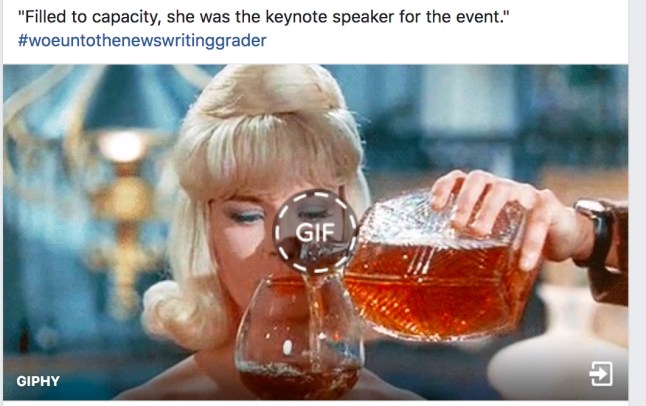
A friend passed this along from a grading session:
To be fair, I’m sure I’ve done some of my best work while filled to capacity… Another friend followed up with this gem:
My favorite example to illustrate the point is “Ugly or not, the team will take the victory.”
Speaking of ugly…
YOU MIGHT WANT TO FIRE YOUR MARKETING DEPARTMENT:
I get that people want some sort of cute, kitschy vibe for their group, but this is what can happen when you don’t really think this through:
(A special note of thanks to the person who used the very last erg of her battery to send this to me. I don’t think my phone is capable of getting that low without giving me a “Really? You don’t know what a charger looks like?” look.)
“His arrangement will be Tuesday in circuit court.”
It will likely include several roses, some peonies and 8-to-10 for breaking and entering…
Speaking criminal intent…
WHY IS THE TRUTH ALWAYS STRANGER THAN FICTION?
Question: How do Russians train whales to harass specific ships? The bigger question: How do you become an “expert” in whales that have been trained by Russians to harass ships?