Big McLarge Huge (Or how to improve the descriptive power in your writing)

(The headline is both a great description that lacks value and also a total excuse for me to include this clip from MST3K’s “Space Mutiny” where the actors mock actor David Ryder with multiple nicknames.)

Descriptions are often crucial in journalism, as your writing will be the only way in which your readers will experience something important. The ability to describe something well can help put the audience right next to you as you outline the excitement of a sporting event, the beauty of a sunset or the tension of a crime scene.

To improve description, we need to look for words that are both universally understood and yet specific in their purpose. We also need to avoid words that are vague, ill-defined or otherwise problematic. Here are a few places where we often fail and ways in which we can improve our efforts:

DESCRIPTORS THAT LACK COMPARISON: One of the easiest ways to describe one thing is to relate it to something familiar to the readers. That’s why metaphors and similes often work well in all forms of writing. Describing the face of an embarrassed person as being “red as a clown’s nose” or the torso of a stout person as “barrel-chested” work because we’re familiar with those items.

(Perhaps my favorite descriptor was a hyperbolic one in which Detroit Piston Rick Mahorn was said to be “the size of your average freeway overpass.”)

The descriptors that don’t work are the ones where we need some form of comparative and it’s not there. To make that point, I’ll ask a student who has used one of these comparatives how tall they are. It often goes like this:

Me: How tall are you?
Student: 5-foot-11
Me: Are you tall?
Student: Not really.
Me: Well, in a K-4 class, you’re a giant.
Student: OK, I guess I’m tall.
Me: But on an NBA basketball team?
Student: Yeah, I’m kind of short.

The point is with out a sense of comparison, I have no way of using the descriptor “tall” in a meaningful way. The same is true of “short” or “thin” or “fat” or “average” whatever else falls into that area.

Instead, find words that are more succinct or spend a few extra words to describe the person, place or thing in more detail.

DESCRIPTORS THAT ARE VAGUE: Specifics are often key to description, as this comparison shows:

VAGUE: “He needed to kill four zombies and he had a few bullets left.”
SPECIFIC: “He needed to kill four zombies and he had three bullets left.”

The vague one offers hope. The specific one says this guy is lunch.

Words like “many” or “some” or “few” lack value as do words like “enough” because they lack a concrete meaning for the people who are trying to understand what you want them to see. To improve this, find ways of using context, specific numbers or other similar means to give the readers a better sense of the situation.

VAGUE: Frank had a lot of bobbleheads.
SPECIFIC: Frank had 1,218 bobbleheads.

VAGUE: Jill had many friends attend her speech.
SPECIFIC: Jill’s friends packed the auditorium to hear her speak.

VAGUE: Jim didn’t have enough money.
SPECIFIC: Jim didn’t have the money to pay both his electric bill and his water bill this month.

Perhaps the greatest (or most pointless) word we use often is “very.” Grammarian Don Ranly was fond of telling students that if they wanted to use the word “very,” they should substitute the word “damn,” as it had exactly the same level of meaning:

“Bill was very lucky the fall didn’t kill him.”
“Bill was damn lucky the fall didn’t kill him.”

“Rashawn was very hungry before dinner.”
“Rashawn was damn hungry before dinner.”

DESCRIPTORS OF OPINION: As noted in previous posts, author Stephen King noted that “The road to hell is paved with adverbs.” I’m not sure about that, but it is true that adverbs and other similar opinionated descriptors can do more harm than good in some situations.

Adverbs often convey the writer’s assessment of a situation, something that readers  or sources might not necessarily agree with. Consider the following:

“He  sustained only minor injuries, including a broken arm.”
“Fortunately, the firefighters limited the spread of the fire to half of the home.”
“The team clearly outperformed its opponent.”

In each case, I’m sure there could be an argument brewing from folks reading this stuff. A broken arm doesn’t seem like an “only” level of an injury. (I remember reading that, in sports lingo, a minor injury is one that happens to someone else.)

Even though the firefighters limited the fire, I doubt people feel fortunate about watching half their stuff go up in flames.

Finally, it’s unclear how clear that performance was or how it was defined. It could be by the score, the level of effort or some other such thing. Even more, maybe fans of the opponent would argue, “No, they just got lucky.”

A good way to fix this is to go hunting for those -ly words in your copy during your first edit. See if those words adequately augment what you’re trying to describe or if they just add conjecture or cause other problems.

Throwback Thursday- Writing 101: We’re still not using the right damned words…

I had to go back and find this post after I had a student note in a report that something “cone sided” with something else. Immediately, the j-nerds were off and running with their “all intensive purposes,” “youth in Asia,” “acid tape” and more.

With that in mind, here’s a look back at using the right damned words again…

Writing 101: We’re still not using the right damned words…

Journalism is about using the right word in the right way all of the time, a task we fail at far too often as we saw with last week’s “Throwback Thursday” post on using the right damned word. When this post first ran, some editors chimed in with a few of their favorite errors, but not much else happened.

This time, the post hit the academic circuit, where instructors of all kinds found themselves sharing the “greatest hits album” of errors as well, proving once again that it’s not just journalism where wordplay can turn ugly.

(One reader chastised me, noting that “learning disabilities make it hard for some people to recognize their errors,” and that I should think twice about posting such a list. I have taught hundreds of students with diagnosed and undiagnosed learning disabilities over my decades in higher ed. I’ve also worked closely with the various offices that serve these students so I could assist my pupils and recognize signs that students may need this kind of assistance. I can assure you that I would never make fun of a student, or the student’s work, in such a case. I can also assure you that what we’re talking about here sure as hell ain’t that.)

So, with that out of the way and with all of this in mind, here’s an expanded list of word failures educators seem to be seeing more of these days:


ethnic: Related to large groups of people classed according to common racial, national, tribal, religious, linguistic or cultural origin or background. “Leaders of ethnic communities met Thursday to discuss bias complaints against community police officers.”

ethic: A set of moral principles, especially ones relating to or affirming a specified group, field, or form of conduct. “People admired Stan for his strong work ethic.”


barely: By a small amount; almost not. “After that final exam, I barely passed statistics.”

barley: A hardy cereal plant that is used in various cooked dishes. “Ethel added barley to her beef soup to make it thicker and more delicious.”


(Speaking of cereal, the “c” version of this is meant to denote certain grains used in food or breakfast foods made, in part, from those grains. The “s” version, as in “serial,” means in an order or a pattern, like the sequential numbers on money or the specific way certain people kill. Thus, if you hear read the phrase “cereal killer,” it’s time to watch out for that damned leprechaun on your Lucky Charms box.)


insight: The ability to understand or comprehend something at a higher level than others can. “Because she studied royal protocol for years, YaVonda had a keen insight as to how to behave when she met the queen.”

incite: An attempt to get others to act in a violent or lawless fashion. “If Bobby goes down to that peaceful protest, he will incite the crowd to riot.”


Spainders: Not a damned word.

Spaniards: People from Spain.

Spaniels: A dog breed with long silky hair.


Coulda/Woulda/Shoulda: What your mother tells you after you screwed up.

Could of/Would of/Should of: Not damned word couplings.

Could have/Would have/Should have: What you could have, would have or should have written in your paper instead of the previous two sets of words.


highschool: Not a damned word, unless there’s a drug euphemism I can’t locate online. “Jimmy had trouble rolling a joint, but after Susie took him to highschool, he was a master of the Zig Zags.”

high school: Where kids in the U.S. go from ages 14-18 (or more) to learn stuff. “If I had paid attention in high school, I probably wouldn’t be making all these word-choice errors.”


trial: A court hearing in which people are found to be guilty or not guilty on charges brought against them. “Liam was found not guilty after his recent murder trial.”

trail: A path or roadway you hike on. “The cowboys agreed that after the cattle drive, they’d meet at the end of the Chisholm trail to camp for the night.”


manor: A place people live. “Batman’s Batcave was hidden under the stately Wayne Manor.”

manner: A way of being. “Jim’s off-putting manner made the women in his office feel awkward when they were near him.”


saleing: Despite what your marketing professor is trying to make happen, it’s not a damned word:

selling: What people are actually doing when other people are actively buying stuff the marketing people are promoting. “These Melon Patch Dolls are selling like hot cakes this holiday season!”

sailing: A boating activity that takes me away to where I’ve always heard it could be… Just a dream and the wind to carry me…


Weeknd: Something that used to not be a damned word until Abel Makkonen Tesfaye came along and created some truly bangin’ music.

weekend: The time at the end of the week, in which some people who aren’t teachers or professors, get to relax and enjoy themselves. “I can’t wait for the weekend to get here so I can sleep late.”

weakened: Something that has deteriorated in some way from its previous position of strength. “Luis is worried about COVID-19 because he has a weakened immune system.”

(Side note: If anyone tells you they have a “weekend immune system,” they either a) have word-choice issues, b) need to spend Monday through Friday in a plastic bubble or c) are making some reference about their partying prowess like, “Don’t worry, bro… I can handle as much tequila as you can sling my way due to my weekend immune system!”)


thrown: Tossed, pitched or otherwise hurled. “The ball was thrown to the plate, but the runner was safe at home.”

throne: The thing kings and queens get to sit on. “The throne in Buckingham Palace is not as ornate as I would have imagined it to be.”

(Side note: “Game of Thrones” would be a lot different if it were “Game of Throwns.”)


customer: Person buying something. “The customer is always right, even if they’re being a total knob about it…”

costumer: A person or company that makes fanciful outfits for actors and actresses. “Janine spent five years on Broadway as a costumer for a prominent theater group.”


porpoise: An aquatic mammal that looks like a dolphin but is actually a small-toothed member of the whale family. “I wanted to go to Sea World so I could look at a porpoise.”

purpose: A reason for being. “I believe my purpose in life is to embarrass my kid in front of any boy, girl or creature she chooses to date.”


peak: The top level of an occurrence, or the highest elevation of a mountain. “Lamont ate four sandwiches before the race, so there’s no way he’ll reach peak performance.” OR “Alaina climbed to the peak of Mount Everest.”

peek: A quick glimpse of something. “I just needed to take a peek inside my kid’s room to realize the place was a disaster area.”

pique: Heighten or stimulate. “The package that came for her roommate served to pique Marlena’s curiosity.”


bizarre: Weird, strange, unexpected, abnormal. “When the superintendent jumped on the table and began to cluck like a chicken, the school board meeting took a bizarre turn.”

bazaar: A place in which goods are sold or traded, traditionally linked to Middle Eastern cultures. “To make money for his family, Abdul sold trinkets to tourists at the bazaar.”


ballot: A thing you use to cast a vote. “On her ballot, Maria selected ‘None of the Above’ for mayor.”

ballad: A slow, folksy song of a narrative nature. “Johnny Cash sang ‘The Ballad of Ira Hayes,’ on his ‘Bitter Tears’ album.”


Flamingo: A tall wading bird that is often pink. “I saw a flamingo while vacationing in Florida.”

Flamenco: A form of song and dance traditionally associated with cultures in southern Spain. “There are more than 50 types of Flamenco that experts have distinguished within the art form.”

Although I would like to say that there is no such thing as a “flamingo dance,”  it turns out that in one instance, it is the case. Enjoy:

The Junk Drawer: The “Bad At Your Job” edition

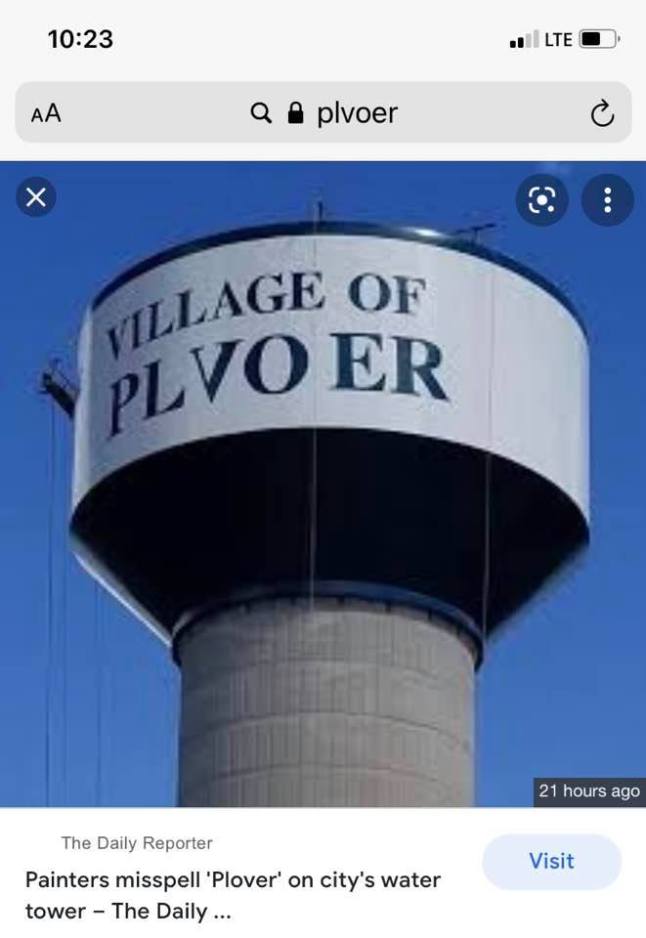
(Allegedly, we’ve got enough paint in here to fix the Plover water tower.)


Welcome to this edition of the junk drawer. As we have outlined in previous junk drawer posts, this is a random collection of stuff that is important but didn’t fit anywhere else, much like that drawer in the kitchen of most of our homes.

Here’s a look at some screw-ups, stories and updates:


WHERE IS BILL GATES AND HIS SQUIGGLY RED LINE WHEN YOU NEED THEM?

I often rely on spell check to bail me out of a “how is that spelled?” situation. That said, people can’t always rely on a spellcheck function to save them, as the folks in Plover, Wisconsin found out recently:

As painters scrambled to fix the error, some folks, like those at RayGun T-shirts had some fun with this:

In other news…

THE MILWAUKEE JOURNAL-SENTINEL HAS LEARNED BASIC MATH

Some things are kind of patently obvious, but when you say them in sports with conviction (or a big honkin’ headline) they seem almost profound. To wit, in advance of Game 5 of the NBA finals, my hometown paper made this bold proclamation:

Let’s review how the NBA finals and basic math work:

  • The Phoenix Suns have the home-court advantage in the best-of-seven series, meaning four games will be played in Phoenix and three will be played in Milwaukee.
  • To win a best-of-seven series, a team needs to win four games out of the seven available.
  • If only three games are played in Milwaukee, the Bucks will obviously need to win at least one game in Phoenix.

This reminds me of the time I heard a coach say something along the lines of, “Most of our best come-from-behind wins happened when the other team was ahead.”

And, the Bucks did win one in Phoenix and won the championship, so I guess the headline wasn’t wrong, just dumb…

In other “Bucks-related news…”


IT’S A LEAD, NOT A CLOWN CAR

(If you’ve got this vibe happening in your lead, you might want to rework it…)

I get that not every lead can be 25-35 words, simply covering the 5W’s and 1H, but there needs to be some sort of limit to how much stuff a writer tries to cram into a single sentence. Here’s a look at a lead written shortly after the “Bucks in Six” victory on Tuesday night:

MILWAUKEE — In the immediate aftermath of a legendary performance to close out the 2021 NBA Finals and win a championship for the first time in his career, Milwaukee Bucks superstar Giannis Antetokounmpo declared that he signed his five-year, supermax contract extension prior to the season because “there was a job that had to be finished,” and that staying in Milwaukee meant doing it the “hard way.”

That’s 67 words, which is almost twice the “legal max” for a decent news lead. The problem with this lead isn’t just that it’s too long, but also that it’s a rambling word salad that abuses every element of writing we teach:

  • Lousy word choice: “Aftermath” means “the consequences or aftereffects of a significant unpleasant event.” If this was this wonderful and legendary thing, it shouldn’t have aftermath for Giannis. It should have aftermath for the Suns.
  • Adjective-palooza: “Immediate aftermath” and “legendary performance” go without saying, but there’s also “his five-year, supermax contract extension.” You could chop upwards of five words out of here and still have the same meaning.
  • “Partial Quotes” that “don’t help:” Read both of those partial quotes and tell me exactly why they are in quote marks. Save partial quotes for things that merit them like odd phrases or dangerous terms: (During his post-game interview, forward Bob Smith called referee Jim Xfer a “racist, cracker punk” for calling a foul on him in the game’s closing seconds, adding, there was no way Xfer would make “that bulls–t call on a bench-warming white boy.”)
  • Drowning the noun-verb-object: When students have difficulty figuring out what a sentence is trying to convey, I tell them to do a simple sentence diagram so they can locate the noun and verb (and possibly the object). Once they find those, they can build around them judiciously. Here, the author drowns the sentence core in all sorts of slop that doesn’t help people understand the point of the story. The simpler and more plain the sentence core, the better off you are. Let this cheesy PSA from the 1980s be your guide:

And finally, speaking of leads that need a hug…


ALLEGEDLY, ALLEGATIONS ARE ALLEGED

When it comes to words to avoid, put “allegedly” at the top of the list. As we’ve detailed here before, this offers you no legal protection, hides the source of the allegations and often leads to misplaced modifiers.

I get the journalists are often trying to couch their statements or cover their keesters, but the use of allegedly here makes even less sense than it usually would:

A vehicle allegedly struck a 6-year-old girl who was riding a bike on the 2100 block of High Ridge Trail in Fitchburg between 7:30 and 8 p.m. Sunday evening.

A few reasons why this is dumb:

  • If “allegedly” is meant to keep us safe as writers (which it doesn’t do, but let’s just say it does for the sake of the argument), exactly what are we worried about getting sued for here? Are we worried that an unnamed vehicle will sue? The girl’s parents? The bike? Allegedly used in association with a direct accusation at least would make sense (“Sen. Jane Jones allegedly stole money from her campaign fund.”) but here?
  • If “allegedly” is trying to cover us as writers in case the thing we said happened didn’t happen (which again… yeah… I know… broken record here…), what are we trying to say in the lead? That we don’t believe the girl? (“Mommy! I got hit by a car while riding my bike!” “Honey, is that really true or were you doing street BMX again?”)
  • If we are really worried about couching things in the lead, why was this the headline: 6-year-old riding bike struck by vehicle in Fitchburg

When it comes to “allegedly,” we’ll let Lou Redwood of “Semi Pro” have the final say here:

Thanks for reading. See you next week.

Vince (a.k.a. The Doctor of Paper)

Exercise time: Kin ewe spell batter then Donald Trump’s legal teem?

In the “Dynamics of Media Writing” book, one of the best pieces of advice comes from Kate Morgan, the director of communications in the division of student affairs at the University of Notre Dame:

“There isn’t a job I can think of that doesn’t involve writing in some capacity. Take emails. If a vendor emails me a quote with spelling and grammatical errors, my level of faith in his ability to adequately meet my needs diminishes significantly. Perhaps this makes me a snob, but that’s not my problem. I’m not going to lower my expectations just because someone else is too lazy to write a complete sentence. Given my level of experience in this industry thus far, I’m almost positive I’m not the only one who feels this way.”

Although I haven’t checked in with Kate since former President Donald Trump’s legal team filed its response to the article of impeachment levied against him, I’m guessing she probably would have fired this group of knuckleheads after Tuesday’s disaster:

The defense team for former President Donald Trump’s impending impeachment trial was widely mocked Tuesday for issuing a response to the House of Representatives’ article of impeachment that contained both spelling and—according to critics—legal mistakes.

One spelling error that sparked a flurry of comments on Twitter came in the very beginning of Trump’s response, which is addressed to the “The Honorable, the Members of the Unites States Senate.”

Trump’s legal teams (plural) over the years have often had trouble with spelling. In one case, former attorney Sidney Powell misspelled the word “district” twice as well as the word “superior” in an Arizona filing with the state’s highest court.

It’s not only Trump’s team that seems to be having word trouble these days, as I’m looking forward to many more misstatements like this:

Still, I guess if I were paying these folks, I’d want someone to go beyond firing up a spell check and hitting “ignore” 50 times like a sophomore business major whose friends are waiting on him to file a paper so they can go hit a house party.

With that in mind, here’s a good exercise for your copy-editing folk:

Here’s a link to a PDF of the filing. Have your students download it and copy edit the heck out of it. What might also be instructive is to determine how many things are misspelled (as in “Suprior” instead of “Superior”) and how many things are wrong words (as in “erection” instead of “insurrection” or “Unites” instead of “United”). This might drive home the lesson of why it is we should run a spell check on anything before we submit it but also that spell check alone won’t save you from looking stupid.

Throwback Thursday: Teaching the Driver’s Ed Rules of Journalism

With the start of another semester, it’s a good time to remember the adage of, “Just because I’ve said it 1,000 times, it doesn’t mean the student has heard it at all.” With each new crop of students, it can be tempting to skip past the basics we pound constantly into our classes or look for ways to “jazz up” what are the seemingly tired tenets of writing.

Instead, it’s worth remembering the value of those tried-and-true “rules” that help keep the students safe and stable initially and to which they can return when they face dangerous conditions, even after they have moved beyond the basics.

Here’s a look back at our need for some “driver’s ed journalism” in the classroom:

Teaching the Driver’s Ed Rules of Journalism

The guy who taught me driver’s ed at the “Easy Method” school was a balding man with a ginger mustache and sideburns to match. He told us to call him “Derkowski.” Not Mr. Derkowski or Professor Derkowski. Just Derkowski.

I remember a lot from that class, as he basically beat certain things into us like the company would murder his children if we didn’t have these rules down pat.

Hands on the wheel? 10 o’clock and 2 o’clock.

Pedals? Release the brake to go, release the gas to slow.

Feet? One foot only. We were required to tuck our left foot so far back into the seat that we could feel the seat lever with the heel of our shoe.

Seat belt? You touch that before you touch anything else in the car or you fail the test. (Or as one of my dad’s friends told me just before the exam, “Get in the car. Put on your seat belt. Then, have your mom hand you the keys through the window.”)

There are a dozen other things that still stick with me, ranging from the left-right-left view of the mirrors to the probably-now-unspeakable way to look behind you when backing up. (“Put your arm across the back of the seat and grab the head rest like you’re putting a move on your girl at the drive-in,” he told me once, I swear…)

After 30 years behind the wheel, I still can’t shake some of this stuff, and most of it is still really helpful. Do I use it all the time? No. (I’m sure the man would be having a stroke if he saw me eating a hash brown, drinking a Diet Coke and flipping through the radio all at the same time while flying down Highway 21 at 10 over…) However, it was important to have that stuff drilled into my brain so that I knew, when things got iffy, how best to drive safely.

When I had to drive 30 miles up I-94 in a white out, in a 1991 Pontiac Firebird that had no business being a winter car, you better believe I abided by the gospel of Derkowski.

I had my hands in the right spots, I was looking left-right-left before a lane change and I treated those pedals like I was stepping on puppies (Another one of his euphemisms, I believe; “You wouldn’t stomp on a puppy!” he’d yell at someone who did a jack-rabbit start or a bootlegger brake.)

It took two hours, more than four times what Mapquest would have predicted, as I slowly passed among the littering of cars and semis that had slid into ditches and side rails. Still, I got there alive.

The reason I bring all of this up is because with the advent of another semester (we still don’t start for two weeks, but I figure you all are up and running), many folks reading this blog will be teaching the intro to writing and/or reporting courses. That means in a lot of cases, students will be coming in to learn how to write the same way I came into that driver’s ed class so many years ago: All we know is what we have observed from other people.

My folks were good drivers, but even they were like lapsed Catholics when it came to the finicky points of the rules: Five miles over the limit was fine, seat belts were pretty optional and one hand on the wheel did the trick. Outside of them, the world looked like a mix of “Death Race” and “The Dukes of Hazzard.” Gunning engines at stop lights, squealing tires, the “Detroit Lean” and more were what I saw.

Students coming into writing classes have been writing for years, so they figure they’ll be fine at it. They also figure writing is writing, so what’s the big deal if I throw 345 adjectives into this hyperbolic word salad of a sentence and call it good? Nobody ever said it was a problem before…

The students need some basic “rules” pounded into the curriculum, repeated over and over like a mantra, to emphasize the things that we find to be most important to keeping them out of trouble in the years to follow. Mine are simple things: Noun-verb-object, check every fact like you’re disarming a bomb, attributions are your friend, one sentence of paraphrase per paragraph… It’s as close to a tattoo on their soul as they’re ever going to get.

It’s around this time I often get into random disagreements with fellow instructors about this stuff. Some are polite, while others react like I accused them of pulling a “Falwell Campari” moment. In most cases, the argument centers on the idea that there aren’t really rules for writing or that “Big Name Publication X” writes in 128-word sentences or that paragraphs often go beyond one sentence, so why am I teaching students these “rules” this way?

It’s taken me a long time to figure out how best to explain it, but here’s it is: I’m teaching driver’s ed for journalism.

In other words, you will eventually be on your own out there and you won’t have your instructor yelling at you about where your hands are or if you looked at the right mirror at the right time. You probably won’t die if you drive without your foot all the way back against the seat, nor will not maintaining a “car-length-per-10-mph” spacing gap lead to a 42-car pile up on the interstate.

In that same vein, you won’t automatically lose a reader if your lead is 36 words, or confuse the hell out of them if you don’t have perfect pronoun-antecedent agreement. Libel suits aren’t waiting around every corner if you don’t attribute every paragraph and if you accidentally (or occasionally deliberately) tweak a quote, you won’t end up in the unemployment line.

However, if the basics get “The Big Lebowski” treatment up front, there’s no chance of those students being able to operate effectively when the chips are down. (There’s a reason the military teaches people to march before it teaches people how to drive a tank.) Until those basics are mastered, the students will never know when it’s acceptable to break a rule or why it makes sense to do so.

Of all the things I remember about Derkowski (other than that godawful straw cowboy-looking hat thing he wore) was that even though he enforced the rules with an iron fist, he could always tell us WHY the rule mattered and WHY we needed to abide by it. Say what you want to about the items listed in my “this is a rule” diatribe above, but I can explain WHY those things are important in a clear and coherent way. Even if the students didn’t like them, they at least understood them.

Sure, over the years, the rules change (Apparently 10 o’clock and 2 o’clock is now a death sentence…) with AP apparently deciding to keep all of us on our toes almost to the point of distraction. We adapt to them as instructors and the ones that are most germane to the discipline, we write into our own version of gospel.

We also know that we’re not going to be there to press the point when a former student at a big-name publication uses “allegedly” in a lead. (That doesn’t mean we still don’t. Just ask any of my former students and they can tell you about conversations we’ve had about quote leads and lazy second-person writing.)

I tell the students once they get off of “Filak Island,” they can do it however they want or however their boss wants. (I also tell them to ask their bosses WHY they want to use allegedly or randomly capitalize certain words. In most cases, the answer is silence mixed with “duh face,” I’m told.) However, my job is to teach them the rules of the road, and I think that’s how a lot of us view things in those early classes.

I will admit, however, that it’s fun when I hear back from a long-graduated student who tells me how they can still hear my voice in the back of their head when they’re writing something. (It’s even more fun when they tell me how shorter leads or noun-verb attributions are now the rule at work.)

If we do it right, enough of the important things will stick, they’ll revert to the basics when in danger and they’ll be just fine, even without us there to pump the brakes.

Wall Street Journal opinion editor Paul A. Gigot defends Joseph Epstein’s column on Dr. Jill Biden, makes it clear he has yet to learn “Filak’s First Rule of Holes.”

Filak’s First Rule of Holes states: “When you find yourself in one, stop digging.”

It’s pretty clear the folks at the Wall Street Journal’s opinion section haven’t learned this one yet.

In reacting to  the outrage prompted by Joseph Epstein’s column on Dr. Jill Biden, opinion editor Paul A. Gigot settled on a strategy that basically said, “Hey, kiddo, you wanna hand me that shovel over there?”

Gigot, who has once again proved that winning a Pulitzer Prize doesn’t necessarily mean you’re always good at journalism, decided that it would not only be good to avoid apologizing for Epstein’s anti-intellectual and misogynistic rant, but to actively support it. In his myopic viewpoint, any negative reaction was clearly just a political hatchet job conducted by the Bidens alone to drown out negative stories on their family:

Why go to such lengths to highlight a single op-ed on a relatively minor issue? My guess is that the Biden team concluded it was a chance to use the big gun of identity politics to send a message to critics as it prepares to take power. There’s nothing like playing the race or gender card to stifle criticism. It’s the left’s version of Donald Trump’s “enemy of the people” tweets.

There’s a saying in Wall Street circles regarding bad investors who are perfect foils to bet against: “Often wrong, never in doubt.” If Gigot’s defense of Epstein’s piece isn’t a perfect example of this phrase, I don’t know what would be.

Since I’m involved in a “sweet racket” where I only work six months out of the year and never put in eight hours of day, I might as well put aside everything else I’m doing to pick apart this rectally based argumentation.

First, this isn’t a minor issue. Sexism and anti-intellectualism are two of the more troubling things in today’s society. The fact you see this as a couple “uppity broads” and a few “academic twerps” getting their doctoral noses out of joint means you’re either actively avoiding those two bigger issues or you’re too stupid to see them. Neither position is a good one from which to launch an argument.

Second, this isn’t a political thing. The reason I (and many others) actively dislike politics is because people like you manage to view EVERYTHING through this tiny lens alone. This is what allows you to dismiss things you don’t like without having to consider any other position, including the concept that your writer was just wrong.

I didn’t drill a ton of holes in Epstein’s piece because I’m part of the George-Soros-based-QAnon-fighting-ultra-liberal-conspiracy-based new world order. The mother ship didn’t send me a signal letting me know it was time to pipe up and attack an octogenarian who wishes he could perpetually live in an era where he could call any woman he wants “cutie buns.” I wrote what I wrote because this guy was an idiot, whether he was telling it to Jill Biden, Jill Munroe or Jill of “Jack and Jill.”

Third, when you mention that these complaints are an attempt to “stifle criticism,” I wonder if you really know what the word “criticism” means. Epstein’s piece is to quality criticism what Velveeta is to cheese: They’re only similar if you are really desperate to see them as such.

Nevertheless, you persisted…

The outrage is overwrought because, whether you agree or disagree, Mr. Epstein’s piece was fair comment. The issue of Jill Biden’s educational honorific isn’t new. As long ago as 2009, the Los Angeles Times devoted a story to the subject. From the piece by Robin Abcarian: “Joe Biden, on the campaign trail, explained that his wife’s desire for the highest degree was in response to what she perceived as her second-class status on their mail. ‘She said, “I was so sick of the mail coming to Sen. and Mrs. Biden. I wanted to get mail addressed to Dr. and Sen. Biden.” That’s the real reason she got her doctorate,’ he said.”

I guess you were sick the day at Dartmouth that they taught you what fair comment was. As a defense against libel, sure, it works here. I don’t think people are claiming the Bidens have a legal claim against Epstein or the paper for this column. Even in the case of “fair comment,” people have the right to get upset about comments other people make. If you think that people were overly mean to Epstein, here’s a look at what the Internet did to a 19-year-old University of Buffalo student when she wrote that women shouldn’t get tattoos.  In short, people like Epstein have a right to their opinion, but that doesn’t mean the rest of us have to quietly enjoy it.

In any case, you follow your “fair comment” argument by saying the media has been all over this issue for decades. You support that with an anecdote that in no way supports that position. Comparing how a reporter relayed a comment the president-elect made back in 2009 about Jill Biden’s quest to become a doctor to Epstein’s column in which he crapped all over her effort and her degree is disingenuous at best.

And, yet, you persisted:

Many readers said Mr. Epstein’s use of “kiddo” is demeaning, but then Joe Biden is also fond of that locution. In his 2012 Democratic convention speech he even used it to refer to his wife in the context of his many proposals of marriage: “I don’t know what I would have done, kiddo, had you on that fifth time said no.” You can buy a T-shirt on the internet with Mr. Biden’s image pointing a finger saying “That’s where you’re wrong, kiddo!”

I can’t seem to locate any information on your personal marital status, Paul, but as someone who has taken the plunge, let me  fill you in on something. If Joe Biden wants to call his wife “kiddo” and Jill Biden is OK with it, that’s fine because they’re in a lifelong relationship of a special nature. They also probably kiss here and there, which seems to be fine as well, because, again, y’know, happily married and lovingly connected.

This doesn’t give everyone carte blanche to do this.

Here’s maybe a better explanation for you:  If I come home tonight, kiss Amy and say, “How are you doing today, sweetheart,” it’s probably fine. If you roll up to my house and do that to Amy, she’s going to knock the snot out of you.

And, yet, you persisted…

Mr. Epstein also infuriated dozens of educators defending their doctorates. (See the nearby letters.) But that status isn’t sacrosanct or out-of-bounds for debate. Mr. Epstein’s point applies to men and women and his piece also mocked men for their honorary degrees. Mrs. Biden is now America’s most prominent doctorate holder and is taking a leading role in education policy. She can’t be off-limits for commentary.

By the way, the Journal editorial page’s longtime style is to use “Dr.” only when referring to medical doctors. Henry Kissinger gets a “Mr.” Lynne Cheney, wife of Dick Cheney, is Mrs. Cheney despite her Ph.D.

Man, can you even SEE the top of the hole  you’re digging at this point? Do we need to lower some water or oxygen tanks to you at this point?

Look, it’s not that we’re infuriated that you don’t like our doctorates.  And you’re right that the importance of a doctorate isn’t sacrosanct or out-of-bounds for debate, but this wasn’t a debate or a discussion about the importance of higher levels of education. It’s that this human sphincter took it upon himself to essentially say to the incoming first lady, “Look, sweetie, stop thinking so highly of yourself. You’re not a REAL doctor.”

Jill Biden is clearly not “off-limits” for commentary. If she makes a policy statement, comment on it. If the administration does something and she has a role, comment on it. However, I have to imagine you can actually see some line out there, somewhere, that the Journal wouldn’t cross simply because you won’t “limit commentary” on Jill Biden. If not, I’m actively awaiting a “Doesn’t Jill Biden have a SMOKING HOT body for a woman of her age?” column that one of your writers is probably getting ready to visit upon us all.

And, not that you don’t know this, but this isn’t about style. The WSJ can use whatever style it wants, just like AP, the New York Times and a dozen other media outlets. This was never a question of who gets what treatment in a news story.

And with all of the grace of a drunk falling down of stairs, you concluded…

If you disagree with Mr. Epstein, fair enough. Write a letter or shout your objections on Twitter. But these pages aren’t going to stop publishing provocative essays merely because they offend the new administration or the political censors in the media and academe. And since it’s a time to heal, we’ll give the Biden crowd a mulligan for their attacks on us.

Calling Epstein’s piece a “provocative essay” is like calling a Ford Pinto “a hot car with a little something extra.”

The problem you face here, Mr. Gigot — Paul — P-Diddy — Paulie No Nuts– Sweetie Muffin– is that you have the right concept (don’t let politicians and harpies force you into silence) but the wrong hill on which to make that stand (a really lousy column, delivered by a clueless writer, that is insulting to thousands of people, many of whom probably don’t like anything Biden-related).

Epstein’s thoughts reek of arrogance, sexism and personal animus and really have no place on the pages of a national publication. They should barely be tolerated at the local tavern after an old-timer has six beers in him and starts bitching about “femi-Nazis who are ruining the country I fought for!”

Your position, that this is somehow a political conspiracy built by people trying to cow your publication into writing only positive Biden stories, makes you sound like a grumpy old man who has spent way too much time watching spy thrillers at 3 a.m. on basic cable.

You don’t have to be a liberal to think Epstein’s work was stupid. You don’t need to feel entitled to a title to think the Wall Street Journal should have flushed this turd before it saw the light of day. You don’t have to be Team Biden to think your defense of this was either purposefully ignorant or painfully unaware.

Once you climb out of that hole you’ve dug, maybe you give this situation another look.

Throwback Thursday: Said: A perfect word and a journalist’s best friend

A friend of mine on a student media listserv asked this end-of-semester, why-don’t-kids-listen, why-is-God-angry-with-me question about her students and their ability to attribute information properly:
WTF is wrong with “said?” Why can’t students use it?
I’ve begged. I’ve put it on copy-editing lists. I’ve highlighted it on rubrics. I’ve talked to them individually. Nothing works.
Today I’ve seen at least 10 words in place of said and none of those situations required anything other than said.
We don’t know what the fire chief “believes” about the cause of the fire.
The university certainly doesn’t “feel” anything.
My biggest peeve: shared.

In situations like this, it always helps to know you’re not alone, and she wasn’t. More than 20 other emails popped into place after this one, all noting the various trials and tribulations of “said.”

For the last “Throwback Thursday” of 2020, here’s a look back at the last time I looked at “said.”

Said: A perfect word and a journalist’s best friend

Said.

Four letters, one word, simple perfection.

As far as verbs of attribution go, not much else can compete with “said,” even though it seems every student I have taught has a burning desire to find something else to use. As much as I don’t like blaming educators at other levels for anything (Hell, I’m not going to teach ninth graders without combat pay and a morphine drip…), I remember seeing a poster like this in a classroom while judging a forensics contest and almost immediately broke out in hives:

SaidIsDead

The rationale behind this approach is that “said is boring, so let’s do something different.” I might also point out that riding inside a car that is driving down the proper side of the street is boring, but that doesn’t mean you should try roof surfing on your roommate’s Kia Sorento while driving 80 mph the wrong way on the interstate just because it’s different.

If you want to write fiction, feel free to give any of verbs things a shot; Nobody’s going to argue with you about an orc “warning” a wizard about something. However, in journalism,  you actually have to prove things happened, which is why “said” works wonders.

“Said” has four things going for it:

  1. It is provable: You can demonstrate that someone opened up his or her mouth and let those words fall out of his or her head. You don’t know if that person believes them or feels a certain way about them. You can prove the person said them, especially if you record that person.
  2. It is neutral: If one person “yelled” something and the other person “said” something, one person might appear angry or irrational while the other person appears calm and rational. It shifts the balance of power ever so slightly to that calmer source and thus creates an unintended bias. We have enough trouble in the field these days with people accusing us of being biased without avoiding it in the simplest of ways.
  3. It answers the “says who?” question: Attributions are crucial to helping your readers understand who is making what points within your story. It allows readers to figure out how much weight to give to something within your piece. Simply telling someone who “said” it helps the readers make some decisions in their own minds.
  4. You’re damned right it’s boring: Name the last time that you heard anyone actively discussing verbs of attribution within a story outside of a journalism class or some weird grammar-nerd drum circle. Exactly. “Said” just does the job and goes on with its work. Verbs of attribution are like offensive linemen in football: If they’re doing their job, you don’t notice them at all. When they do something wrong, that’s when they gain attention. “Said” is boring and it is supposed to be. Don’t draw attention to your attributions. Their job isn’t to dazzle the readers.
    (The one I’ll never forget was one someone wrote for a yearbook story about a student with a mobility issue: “Bascom Hill is a challenge for anyone,” laughed Geoff Kettling, his dark eyes a’sparklin’. It was quickly switched to “Geoff Kettling said.“)

Let’s look at the three verbs most students tend to use instead of “said” and outline what makes them dicey:

Thinks: This is a pretty common one, in that most people being interviewed are asked to express their opinions on a topic upon which they have given some modicum of thought.

“Principal John Smith thinks the banning of mobile phones in school will lead to improved grades for his students.”

First, unless you have some sort of mutant power, on par with Dr. Charles Xavier, you don’t know what this guy thinks. Mind readers are excused from this lesson, but for the rest of us, we have no idea what he actually thinks.

He might be doing this because he’s tired of bumping into kids in the hallway who don’t look up from their phones during passing period. He might be thinking, “All that charging going on in classrooms is killing our electricity budget. How can I get this to stop?” He might be worried about students taking videos of teachers smoking weed in the faculty lounge or beating the snot out of kids. We don’t know what he’s thinking. We do, however, know what he said:

“Principal John Smith said the banning of mobile phones in school will lead to improved grades for his students.”

Second, and more inconsequentially, you have a weird verb-tense shift when you go from past tense to present with “thinks.” You can’t fix this the way you would fix a “says/said” verb shift by going with “thought,” as that implies he previously held an opinion but has since changed it:

“Principal John Smith thought the banning of mobile phones in school would lead to improved grades for his students, but the latest data reveals a sharp drop in GPA across all grades.”


Believes: This one suffers from much the same issues as “thinks,” in that you can’t demonstrate a clearly held belief in pretty much anything. Just ask all those 1980s televangelists who “believe” in the sanctity of marriage and then they were caught fooling around with the church secretary or some sex worker named “Bubbles” or something.

I use this example in my class each term, where I tell them, “I believe you are the BEST writing for the media class I have ever taught.” They don’t know if I believe that, or if I just professed the same belief to my other writing class. They don’t know if I go into my office and break out the “emergency scotch” and weep for the future of literacy after teaching their class. What they do know is that I said that statement.

You can either use it as a direct quote:

“I believe you are the BEST writing for the media class I have ever taught,” Filak said.

Or, if you really have a passionate love of my believable nature, go with this:

Filak said he believes this is the best writing for the media class he has ever taught.


According to: This is the one I waffle on more than occasionally, with the caveat that it not become a constant within the piece. It also needs to be applied fairly to sources.

This attribution works well for documents, although the term “stated” works just as well:

According to a police report, officers arrived to find the butler trying to capture an increasingly agitated lemur that had already bitten one woman in the face.

Pretty simple and easy, and nobody (other than the one woman) gets hurt. Here’s where it becomes problematic:

According to Bill Smith, Sen. John Jones has run a campaign of falsehoods and negative attacks.

Jones said Smith is upset he’s behind in the polls and is desperate to make up ground.

When one source gets an “according to” and the other gets a “said,” you have a situation in which it sounds like you believe one person and think the other person is just yammering. It comes across as if to say, “According to this twerp, X is true. However, the other person clearly and calmly says something that is actually accurate.”

How do you avoid all of these problems? Stick with said. It’s like Novocaine: Keep applying it and it works every time.

That said, if you want to have fun with verbs of attribution, enjoy the ridiculous ones we gathered below for your reading pleasure. (Whatever happens, don’t blame me if you use one of these on your reporting final…)

“I just can’t shake this head cold,” he sniffed.

“I’m going to have to draw you a picture to get you to understand this,” he illustrated.

“Of course I’m chewing tobacco!” he spat.

“All I know is, I love doing a ton of cocaine,” he snorted.

“This is the saddest movie ever,” he cried.

“Bethany said I was being distant, but it’s her fault we broke up,” he ex-claimed. “And that One Direction CD is totally mine as well.”

“I love this vintage, but I can’t remember what vineyard it comes from,” he whined.

“I used to have a poodle named Princess, but my ex-girlfriend stole her,” he bitched.

“Get me the phone so I can get a hold of Mom,” he called.

“Whose dog is making all that noise?” he barked.

“My empty stomach speaks for itself,” he growled.

“Don’t forget my Post-Its!” he noted.

“I know, I know, I know,” he echoed.


Throwback Thursday- Journalism 101: Use the right damned word…

For some reason, a student wrote me an email and used the word “aight” in it, thus triggering a memory of this post. It’s not every day that I see someone using the wrong word in the worst way, but it probably is every other day at the very least.

Thus, consider this penultimate dictionary of languish to be a French benefit of reading this blog…

Journalism 101: Use the right damned word…

Nothing will make your journalism professor get twitchier faster than if you let spellcheck guide your writing. Just because something is spelled correctly, it doesn’t always stand to reason that you are using the right word.

Being wrong isn’t fun, but having to deal with people who are repeatedly wrong isn’t a picnic, either. After constantly running into a series “close enough” errors, I asked the hivemind for the most irritating gaffes they see on a regular basis, most of which drive them to ask, “Why can’t you use the right damned word?” Below are several areas in which folks noted errors that made them want to pour scotch in their coffee and bleach in their eyes:


The “there’s a difference between ‘astigmatism’ and ‘a stigmata'” category:

alot: Not a damned word

a lot: Either a whole bunch of something or a plot of land. “Jimmy was poor as a child and thus ate a lot of Ramen as he grew up.” OR “I want to build a house on a lot near Omro.”

allot: Give a portion of something. “The moderator will allot equal amounts of time to each debater.”


aight: Not a damned word

alright: Still not really a damned word.

all right: Everything is now all right, because you spelled it right.


apart: Not part of, or not together. “My parents got divorced, so they now live apart from one another.”

a part: A component of something. “My carburetor is a part of my Mustang.”


decent: Something that is passably functional. “Ellen did a decent job on her paper, but there’s no way she’s getting an A.”

descent: Falling or moving downward or a historic lineage. “The Millers found out they were of Hungarian descent.” OR “The descent from the mountain took the climbers longer than expected.”


definitely: Absolute certainty: “I definitely want to see the Milwaukee Bucks win an NBA title this year.”

defiantly: In opposition to with anger: “The toddler defiantly flung himself to the floor and screamed that he didn’t want to leave Chuck E. Cheese.”


diffuse: Spread out over a large area. “If you light that scented candle, it will diffuse the smell of coconuts and pine throughout the house.”

defuse: Remove danger or literally remove a fuse. “Archer had to get his turtle neck and wire cutters to defuse the bomb.”


eager: Excited in a good way; wanting to do something. “I was eager to get the Mustang out of storage so I could start driving it around town.”

anxious: Excited in a bad way; worried and fearful; experiencing dread. “I was anxious about getting the Mustang out of storage because I was worried it wouldn’t start.”


everyone: All of the people in a group; synonymous with everybody. “Everyone will have to fill out a new TPS form before the payroll department will issue checks.”

every one: Each individual person involved; followed by “of” usually: “I would like to thank every one of you who volunteered for my campaign.”

everybody: Synonymous with everyone; refers to all the people: “Everybody who wants to play cards tonight should be here by 9 p.m.”

every body: Each individual physical body. “Every body we found on the streets during the zombie apocalypse was missing at least one limb.”


fazes: Bothers or creates problems for someone. “Nothing ever fazes Corey Kluber when he’s pitching in the playoffs.”

phases: Created or completed in stages or components. “The office park was constructed in three phases over a five-year period.”


lose: The opposite of win. “When I play checkers with my father, I always lose.”

loose: The opposite of tight. “The knot in Zoe’s shoelaces was loose and quickly came undone.”


then: Something that happens next. “I drank six tequila slammers and then threw up.”

than: A word of comparison. “I like butter pecan better frozen custard than vanilla ice cream.”


The “This is really awkward if you screw it up” category:

incompetence: An inability to adequately complete certain tasks. “He claimed to be a great plumber, but after he flooded three houses, his incompetence was clear.”

incontinence: Lack of control over one’s bladder or bowels. “A stroke caused her incontinence, which forced her to wear adult diapers for the rest of her life.”


bowl: A food dish or a game involving pins, an alley and a ball. “Jimmy will always eat a bowl of cereal when he wants a snack.” OR “My father is the only person I know to bowl a perfect game.”

bowel: The intestine or the deepest part of something: “Jimmy ate too much cereal and had some bowel discomfort.”


prostate: A gland between a man’s bladder and penis. “Carl’s father was diagnosed with prostate cancer.”

prostrate: To lay flat. “The peasant will prostrate himself before the king to show his respect.”


jive: A form of slang that sounds amazing when Mrs. Cleaver from “Leave it to Beaver” lets it roll.


jibe: In accordance with what one believes. “Bill said the moon was made of green cheese, but that doesn’t jibe with what I learned in my astronomy class.”


And then there are phrases that are just wrong:

All of the sudden: You mean “all of a sudden.”

Another words: You mean “in other words.”

Could of: You mean “could have.”

For all intensive purposes: You mean “for all intents and purposes.”

Thrown to the ground or Fell to the ground: This only works when that person or thing is outside. Otherwise, it’s “fell to the floor” or “thrown to the floor.”

I could care less: You mean you “couldn’t care less” as in you literally could not give less of a damn about something, regardless of how hard you tried.

And finally, you don’t get French benefits (like a nice beret or some good onion soup). You get fringe benefits, otherwise known as “perks” or “lulus” according the AP style book.


Corona Hotline Update: More grammar and writing exercises for journalism professors as we “pause for the cause”

“Corona Hotline… No, I don’t know what a two-week pause is supposed to do in this pandemic either, professor…”

For those of you who weren’t with us last year when everything shut down and everyone was scrambling for assignments, exercises and general help, we established the “Corona Hotline” page as kind of a stockpile of stuff that I had built and folks were willing to share. You should feel free to click here to peruse it. All the stuff is freebie and I hope it helps.

For those of you who know all about it and are suddenly going on a “two-week pause,” (at least they didn’t call it an “inflection point”) and you need some additional help, I’ve added a few things to the page today:

  • Two lectures on blogging that I do. The topics are audience-centricity in terms of finding out whose out there and how to serve them as well as a deep look at the concept of “Why you?” in terms of what you should figure out before you pick a blogging topic to see if you can deliver value.
  • A blog-building exercise: It’s not tech stuff (if you want that, I can point you in a few directions), but rather kind of a pre-launch assignment that has the student analyze what’s out there in the area in which they wish to blog, determine what kinds of things they can put into their blog effectively and more. Think of it as kind of a “pitch” like they would have to make to a company if they wanted to start up a blog for those folks.
  • Grammar exercises:
    • Antecedent-pronoun selection
    • Who vs. Whom selection
    • Active vs. passive voice (I’ve had this for years, thanks to the late, great Patty Atwater)
    • A “medley” exercise that mixes all sorts of stuff in grammar.

You can get all that on the page as well. It’s up at the top. Hope it helps.

May the odds be ever in your favor, even when they’re not.

Vince (a.k.a. The Doctor of Paper)

The Junk Drawer: The End of “What Summer Vacation?” Edition

As we noted in several earlier posts, the Junk Drawer is usually full of stuff that didn’t fit anywhere else but you still need. Since we start school after Labor Day, this will be the last post on the weekly summer schedule, with daily(ish) posts beginning shortly after that. Given the summer that was, it seems appropriate that we’re looking at a mess of really weird stuff that is random at best.

Consider some of these moments:

YEAH, THAT’S SMOOTH…: Like many other universities, UWO is in a fiscal pickle these days, thanks to the COVID-19 outbreak and other fun variables. To bring the budget back from the brink, the U decided to cut faculty salaries, although that’s not how they decided to put it in the email we got last week:

Smoothing

First, way to bury the lead. “Furlough… mumble, mumble… Smoothing… mumble, mumble… Reduced by… WHAT THE HELL!?!?!” Second, if you’re going into PR, realize that euphemisms don’t make things better. When rolling out a plan to force people to take days off that they don’t want to take (or will likely end up doing work on anyway), referring to jobbing them equally across the rest of the semester is anything but “smooth.”

Just be honest: “You’re taking a kick in the groin of about X percent each month to the end of the year.”

See? Much smoother.


PIVOT THIS: During my battle with smoothness, I found that one of the hivemind folks started the list of words and phrases that we really need to kill with fire. If you find yourself using these in any of your media writing efforts, consider taking an inflection point in these uncertain times and pivot away from them:

  • Inflection point
  • Grow (as in enrollment)
  • Uncertain times
  • Unprecedented
  • Pivot
  • For the foreseeable future
  • Remain flexible
  • De-Densify
  • Continue to be nimble
  • New normal
  • Synergy
  • Do the needful
  • Out of an abundance of caution
  • Circle back

Feel free to add your own candidates in the comment section.

SINE OF THE THYMES: I’m occasionally baffled by signage I see here and there, like this one from a local flea market:

IMG_4569

As God as my witness, I’m not entirely sure what’s going on here. That said, a few things stuck out:

  • The author (and I use that term loosely) either started with the “A-C-C” version of accepted and went, “Nah, that can’t be right” or did the “E-X-C” version only to realize the other one was right, tried to change it, realized they couldn’t and then thought, “Hell, nobody will know the difference around here.”
  • The apostrophe in “Offer’s” looks to be done with a different marker, meaning this person thought, “Wait, I gotta fix that or someone will think I’m stupid.”
  • I think we should add “reasonal” to the list of words above.


STIP JOYNTE: Our new home had some godawful wallpaper in the dining room, so we needed to get rid of it. In purchasing some items to help me do so, I came across this spelling gem:

IMG_4578

If I can find that “wallpaper stipper,” I’ll definitely be using this sponge…


WHEN LIFE GIVES YOU CLUSTERS….: As pretty much anyone with a brain or the ability to observe human behavior expected, once college students came back to campus for the start of the fall semester, COVID-19 spikes followed almost immediately. At UNC, the school saw multiple coronavirus clusters (maybe another word to add to that list above) appearing, as students didn’t engage in perfect social distancing, mask wearing and personal sanitizing. The student newspaper, the Daily Tar Heel, captured the mood on campus with a perfect headline and editorial:

ClusterfuckHeadline

I couldn’t have said it better myself, mainly because my publisher wouldn’t let me…


YOU BE ILLINOIS-ING: Some abbreviations lead to problems in headlines and decks, like this one for coronavirus-based travel restrictions between Wisconsin and Illinois:

IMG_4555

I think keeping Ill. residents home might be a good idea, but not as good as watching out for a Mass. murderer.


JUST A BIT OUTSIDE: This sign caught my attention because of the color and such, but the font choice put that first line in jeopardy of being  a terrible typo, much like the “Thompson’s Pen is A Sword” headline.

IMG_4566

If you’re going with this campaign, use a simple headline break or rewrite this. The last thing you need is people asking what an “Anals Superhero” does.


BILINGUAL BIAS: We often talk about reaching your audience where they are. For example, a number of really great student news outlets with heavy Spanish-speaking readership include Spanish versions of their work within the paper. When I saw this sign, I was torn in how to feel about Fazoli’s use of Spanish:

IMG_4549

You can make the argument that bilingual outreach is always a good thing, but why is it that the times and days in which the place is open for business is only written in English, while the alert to potential armed robbers is written in both English and Spanish? In short, if you speak Spanish, we don’t expect you to eat at our establishment, but we’d like to wave you off since you’re probably planning to rob the joint.

Eeesh.

And finally….


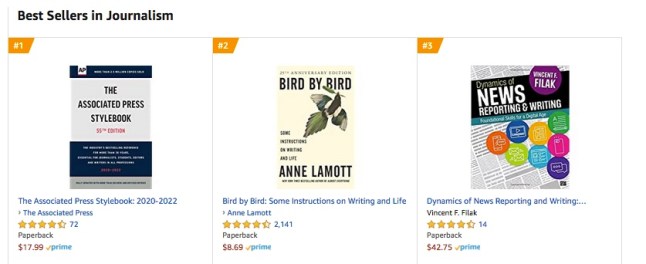
THANK YOU: I was looking for a wall-mounted aluminum-can crusher on Amazon last week, as to keep the number of empty Diet Coke cans from consuming my office, when I did the ego thing and typed in my own name in the search box. When it pulled up the reporting book, I was stunned at what I saw:

Top3

I know that there are 1,001 caveats here, in that this rating happened in only one hour of time, that it happened during textbook buying season, that it’s not representative of larger samples and more. (I know it also feels really self-important to “Google yourself” like this…)

That said, if you had told the 18-year-old version of me as I headed off to college so many years ago that at one point in life, that I would write a book that other people would read, I’d have been doubtful. If you told me the book would be in the top three best sellers in any category for the largest bookstore on the planet at any point in time, it would have been beyond my ability to comprehend. In many ways, it still is.

I don’t think I can adequately explain how big of a thrill it is for me to know that folks out there are using my books and reading the stuff on this blog as part of what they do in teaching this important craft. It’s one of the few times I’m truly at a loss for words, so I’ll just say, “Thank you. And please tell me what else I can do to help.”

See you in September.

Vince (a.k.a. The Doctor of Paper)

Everything you need to know about media writing you can learn from crappy Facebook ads

When students begin my Writing For The Media class, they often feel defeated right off the bat. Our first assignment of any substance is to rewrite a lead and I tell them right off the bat that it will take us about three or four one-hour class periods to analyze professional writers’ leads, write them, analyze their efforts and rewrite them to any level of decency.

Four hours to write one sentence? They look at me like I’m demented.

Then, after it takes four hours and they STILL feel like they have no idea if it’s exactly right or not, more than a few of them tell me a simple truism: “This is way harder than I thought!”

Unfortunately, they often follow it up with this: “Maybe I’m just not meant to be a writer…”

The truth about writing is that nobody is “meant to be a writer.” It’s a skill that takes a long time to develop and even more practice to hone. Even the best writers fall on their keys occasionally, so it’s also a humbling skill that can seem to turn against you and cripple you like a bad back.

I tell the students, “Don’t worry. It’ll get better. We’ll get there together, I promise.”

Those that stick with the class often find that to be true. Then, they start realizing how horrible a lot of the writing around them is and feel really good about how far they’ve come.

If you’re looking for a good place to get that basic ego boost, you should look no further than Facebook’s Marketplace. Even the most mediocre of writing students can feel like Hemingway after cruising through a few ads there.

The advertisements I’m talking about aren’t those that promise “Hot young singles in your area want to talk to you!” Or “One simple trick will enhance your manhood.” Or “Grow back all your hair with this safe, natural supplement.” (Or as I like to call these things, the “Fisher-Price My First Midlife Crisis Kit.”)

I’m talking about ads that regular people in your area post to try to sell everything from used deodorant (it’s out there) to used vehicles. It is here where tortured prose goes to be tortured some more.

For those of you looking for writing lessons in places beyond the textbook or the news sites, send your students to this Valley of Duh and they can learn some valuable writing lessons like these:

VERB TENSE MATTERS: In my writing class, we talk about the verb of the sentence as being like the engine of a vehicle. A strong and powerful verb can really make that sentence fly. A weak verb requires you to prop it up with a dozen adverbs and other descriptors, the way you would have to turbocharge a Yugo.

The tense of that verb can also mean the difference between a great sentence and a horrible correction.

Here’s a fun example: We are looking for a “beater” truck to help us around the Ponderosa these days. The idea is that between Amy’s need to haul mulch and the requirement that we haul our own trash to the dump down the road, we want something with an open bed that can accomplish dirty tasks. It can look like someone set fire to it and put it out with a set of golf clubs, but it needs to start easy, run reliably and stop when we push the brakes.

In flipping through Facebook ads, we found a 1978 Ford F-250 that looked good. The ad noted that it wasn’t much to look at but it “starts and runs great.” So, we drove about an hour up the road to see it.

The first clue things were wrong was that it was in a storage shed behind a bunch of other crap the guy and his kid were frantically moving out of the way. The second clue? Under the hood of the car, the carburetor (which is vitally important to starting and running) was being held open with a screwdriver. When it came time to start the truck, the kid got behind the wheel and the seller began pouring gasoline directly into the engine.

Even then, it didn’t start. It didn’t even make a sound, as the battery was dead, too.

“I thought you said this starts and runs,” I said.

“It did when I put it away last spring,” he replied.

You don’t have to be an expert in much of anything to know that a lot can change in 15 months. If you look back at your Facebook memories from last year at this time, something tells me that you’ll notice more than a few differences between then and now. Hell, 15 months ago, the only reference to a “coronavirus” was probably how you described the morning after a rough Cinco de Mayo party.

After a few more attempts to start it, I told the guy that I was leaving.

Thus, “starts and runs” should have been “started and ran a while ago.”

FACT CHECK THE HELL OUT OF STUFF: As the above example demonstrates, not everything you see in these ads is factually accurate. I suppose I could give the guy a pass on the starting and running as it actually did at one point. (I mean the Enterprise didn’t beam that truck into the storage unit.)

I’m a little less forgiving about things that clearly aren’t true.

We went to see a 1964 Ford 100 that seemed to fit the bill. When I got there, everything was what I wanted: sturdy truck bed, good tires, strong brakes and more. The problem? The truck was listed as having an automatic transmission, something that wasn’t true.

(In case you are unaware, if you have THREE large pedals along the floor of the driver’s side of the car and you need to step on the one on the far left frequently as you shift a stick near your right hand as you drive along, this is a MANUAL transmission. It’s also known as a “stick shift” because you are shifting it manually, with that little stick.

If you have TWO large pedals along the floor of the driver’s side and you need to apply the brake only ONCE as you shift your car to the “D” spot on the gear shift, wherever it is located, and the car does the rest of the gear shifting for you, this is called an AUTOMATIC transmission. It means the car “automatically” shifts for you as you go faster and faster and faster.)

Truth be told, I can’t drive a stick shift. Well… That’s not entirely accurate. If you got mauled by a bear and I had to get you to the hospital to save your life and the only car available was your stick-shift car, I could get you there. You would live, but we’d be holding a funeral for your clutch and gearbox.

This guy was not alone in listing his vehicle with the wrong transmission. I saw FOUR of these online that listed the trucks as being “automatic” when I could see pictures of both the shifter and the clutch in the ad. When I asked a couple people about the inconsistencies, they said, “Oh… Yeah… then I guess it is a stick…”

Good grief.

When it comes to your own writing, fact check the hell out of stuff before you publish it. If you aren’t sure about nuances like the difference between a bacteria and a virus, look both of them up and make sure you’re right. If you don’t know what a word means, look it up before you toss it in there because you’re pretty sure about it.

And, if you don’t know the difference between an automatic and a stick shift… Well, you probably didn’t read this post carefully enough. Go back and take another look.

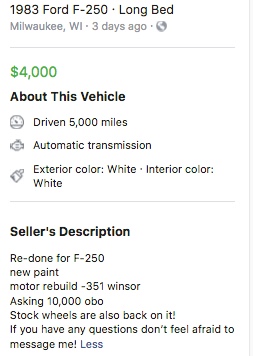
CONSISTENCY AND CLARITY COUNT: When it comes to your writing, you want people to feel informed and grounded in the topic. Being consistent in your writing helps with this. When you get contradictory information in a piece of writing, it can be more than a little jarring. Case in point:

Ford4000

In reading the opening, I’m looking at a $4,000 truck. When I get to the body of ad, it’s $10,000 (or best offer, which I’m guessing won’t be at the $4,000 level).

Another ad showed a truck with a plow for $2,000. The body of the ad noted, “Don’t low ball me by offering $4K for both the plow and the truck.” I wasn’t sure how offering twice what you asked for something would be a “low ball,” so I asked the guy.

“The truck is $2,000 but it doesn’t come with the plow. That’s at least another $5,000.”

So, maybe mention that?

Another oddity of inconsistency comes from a seller who notes “Truck runs, drives and stops as it should. Will need to be trailered.”

OK, wait… If this thing is road-worthy, running, driving AND stopping as it should, WHY do I need to tow it out of there?

In the field of professional advertising, what these folks are doing would be called “bait-and-switch,” where a business offers one thing and then quickly switches it out for a more expensive item or inferior product. I wouldn’t accuse these folks of this tactic, as I think they’re just bad at communicating what they want.

Still, if you’re trying to reach an audience, this can be annoying for your readers.

EVERYTHING CAN USE AN EDIT:

“needs rear main seal eventually ,leeks new brakes”

(I’m guessing it either leaks from the rear main seal or the guy is using giant scallions to stop his truck.)

“needs new breaks and break lines”

(What do we need to break on it?)

“Has manuel transmission”

(I wonder who Manuel is, but if he can run the stick-shift for me, I’m interested…)

“I have a 1966 ford Ltd for sale starts, runs, drives ,surface rust only I have two separate interior for it everything works as it should blinkers, whipers, windows everything works price is negotiable please feel free to contact me with offers and for more information”

(Located on just above and slightly to the right of the space bar is the period key. Try using it once or twice. Or more.)

“2WD, 4SP, 350 CI, Need brks, batt. U haul, 2500 obo No LBall.”

(This is either a text message in code or a ransom note crafted by someone with limited access to magazine covers.)

I’m hopeful these bits and bites of information can help you as you look to work on your writing.

And, yes, we’re still looking for a truck.