

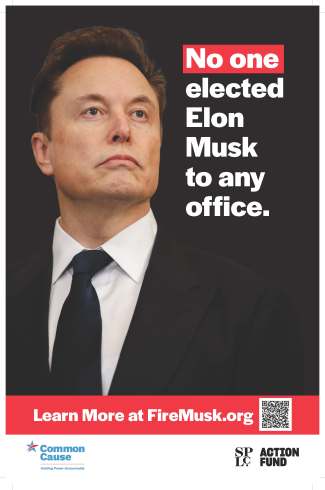


Copies of the ads the Common Cause and Southern Poverty Law Center planned to run in the Post.
THE LEAD: The Washington Post pulled an ad set to run Tuesday that called for President Donald Trump to Fire Elon Musk. Several organizations chipped in to run a wrap-around, a specialized ad approach that tends to draw a lot of attention in print publications.
Common Cause said it was told by the newspaper on Friday that the ad was being pulled. The full-page ad, known as a wraparound, would have covered the front and back pages of editions delivered to the White House, the Pentagon and Congress, and was planned in collaboration with the Southern Poverty Law Center Action Fund.
A separate, full-page ad with the same themes would have been allowed to run inside the newspaper, but the two groups chose to cancel the internal ad as well. Both ads would have cost the groups $115,000.
“We asked why they wouldn’t run the wrap when we clearly met the guidelines if they were allowing the internal ad,” said Virginia Kase Solomón, the president and chief executive of Common Cause. “They said they were not at liberty to give us a reason.”
Jeff Bezos, the owner of the Post and reason why you could drunk-order a pimple-popping ear toy online, has made several moves that indicate a general sense of deference to the Trump administration. Prior to the presidential election, Bezos ended the paper’s tradition of running an editorial endorsement of one candidate. (The unspoken but obvious reason was that the newspaper folks weren’t picking Trump.)
Bezos also was in the “tech bros row” for Trump’s inauguration, along with Mark Zuckerberg and Sam Altman. A key factor in his preferred seating was likely that Amazon had donated $1 million to Trump’s inauguration fund.
Although Bezos was not interviewed or quoted for the “ad kill story,” the Post’s PR division offered a bland response in his stead:
A Washington Post spokeswoman said in an emailed statement that the newspaper did not comment on internal decisions related to specific advertising campaigns and pointed to its publicly available general guidelines for advertising.
(If you don’t feel like downloading the Post’s ad brochure, let me just say it’s the most pedestrian thing on Earth. It also does stipulate that the Post “reserves the right to position, revise, or refuse to publish any advertisement for failure to comply with the guidelines set forth below, or for any other reason.”)
UNDERSTANDING THE LAW AND THE AD GAME: Advertising falls under the umbrella of what the government calls commercial speech, meaning it’s meant to sponsor or promote the purchase of goods and services. It hasn’t always been protected speech, and as recently as the 1940s, courts had ruled that purely commercial advertising is not protected by the First Amendment.
Court rulings since then have either eroded or eliminated that stance and have led to some basic rules in regard to how advertising can or can’t be censored. In short, if someone is trying to get you to buy something or sell something, it’s probably going to fall into the realm of advertising and the courts will engage in strict scrutiny while examining the regulation of it.
Strict scrutiny in this case basically boils down to this: the state has to prove it has a good reason to regulate the ad and that the regulation will actually accomplish the outcome the government says it will and it will do so in a reasonable, not overreaching way.
PUBLIC VERSUS PRIVATE REGULATION: The key thing to understand here is that none of that stuff applies to what the Post did. Those laws basically apply to governmental action. So, if Trump had heard about the ad and decided to force the Post NOT to run it, that’s where the legal stuff on strict scrutiny etc. would come into play. The Post is a private media entity and it has the ability to accept or deny ads for any number of reasons.
Most newspapers (and I’m assuming other media outlets I haven’t dealt with the ad end of) have basic rules about what they will or won’t accept for ads, based on what they think is important to their readers.
Obvious things that get rejected are ads for illegal products. If I wanted to run an ad in the Advance-Titan, our student newspaper at UWO, for “Dr. Vinnie’s House Of Crystal Meth and Cocaine,” I’m guessing I’d get a pretty strong rejection. Back in the day, we rejected ads for off-shored internet casinos because they had all sorts of legal problems. (That almost seems quaint now that we’ve got ESPN’s “journalists” stepping up for gambling apps and pitching parlays to their audiences.)
Other things that get rejected can be based on how the audience is likely to feel about a product or any special stipulations between the media outlet and any intervening organization. For example, a friend who used to advise the student newspaper at the University of Notre Dame once told me that the paper was forbidden from accepting alcohol ads, due to its status as the official paper of the university. I know that some publications accept ads for strip clubs, abortion services and marijuana dispensaries, regardless of the legality associated with those enterprises.
Newspapers also often have a basic “because we said so” stipulation, just like the Post did. As I was fond of saying to my staff, we could institute “Screw You Tuesday,” in which we rejected any ads that people tried to place on a Tuesday, because, well, “Screw you, that’s why.” It’s not a great way to do business, clearly, but it is legal.
DOCTOR OF PAPER HOT TAKE: First, I’d love to be in a financial position to turn down $115,000 “just because.” Have you ever seen how excited people get when they get close to that on “Wheel of Fortune?”
Second, and I can speak from experience on this, it sucks to be pinned in a corner on an ad buy like this. This group could have chosen one of a dozen major metros, but they picked the Post for a pretty good reason and it wasn’t necessarily that Trump reads it.
When I was advising the Advance-Titan, we got an offer to include a 12-page pro-life insert into our paper for about twice what we would normally charge. Like most student newspapers, we were struggling financially, so the money would have been welcome. That said, in digging into how this insert played elsewhere, we found that researchers had found legitimate concerns regarding the factual accuracy of some of the claims in the insert. Furthermore, it would put the paper in the middle of a debate we had no real interest in entering.
After the staff debated and discussed this a bit, the editor came to me and said, “How do we deal with this and not be screwed?”
“You’re screwed either way,” I told him. “If you run it, you’ll have people on the other side of the issue up in arms about it and you’ll catch the same grief as other places that ran it for the accuracy issues.”
He interrupted me. “OK, so then I won’t run it and we’re fine…”
“No,” I explained. “If you don’t run it, this organization is going to put out the Bat Signal to every media outlet that will pay attention saying that you’re pro-abortion and that you’re suppressing their speech. There will be news articles and comments and blog posts and everything else coming at you for this.”
“Like I said, you’re screwed either way. So do what you think is best, stick with it and don’t get into a war of words over it.”
He decided not to run the ad, and pretty much everything I noted above happened, but somehow worse. A press release went out, newspapers ran stories, a local talk radio guy in Milwaukee did about a half-hour on how criminal we were and all that. It eventually went away, but I think the editor doubled his smoking habit until it did.
In the Post case, Bezos clearly doesn’t need the money and he’s clearly dealing with someone who has no compunction about being vengeful when someone is perceived as disloyal, so not running this ad does make sense in that regard. The paper has that right and it can (and has) exercised it.
That said, the optics are really terrible, especially when coupled with the previous actions in regard to Trump. The Post itself will likely suffer credibility issues in general as a result of this.
When Bezos bought the Post, the prevailing thought was, “This is great, because he doesn’t need anyone’s money. He can do whatever he wants and not have to bow to the whims of the rich and powerful.”
Well, we were about half right on all of that.
DISCUSSION STARTER: If you ran the Post, what would you do with this ad? Also, what kinds of ads would you be willing to take (or reject) based on what you think about the publication, its audience and your own sense of what is fair?