Help me help you help your students: Exploring Mass Com is up for a second edition

“It’s a real book!” and it’s aging, so let’s get the next edition rolling with your help.


The good folks at Sage took time out of their busy Tuesday to reach out with a conference call and tell me that my latest textbook was something of an anomaly. “Exploring Mass Communication” was closing in on Year Three in the market and most first editions tend not to do particularly well, they explained. That makes it a tough sell to the powers that be when authors and editors want to pitch for a second edition.

(I lived that experience once with another publisher. The book was not popular enough to merit an improved second edition, while still selling well enough for them to not sell me back the rights to shop it elsewhere. It took 11 years for me to get another bite at the apple, and that was after 10 years of begging…)

In the case of “Exploring Mass Com,” Sage was all gung-ho about getting a second edition to market to make sure it stayed both relevant and popular. The folks set me up Tuesday with a production team and a timeline, meaning we’ll have the next edition of the book out the door by January 2028.

I can’t thank you all enough for the help you’ve given me over the years, both in suggesting content and in adopting my books. Without you all, I’m basically producing exceptionally expensive coffee coasters and door stops. I’m always grateful when someone puts their faith in me and my work to take a chance on something I’ve done and I always want to let folks know that. I also want to make sure I’m meeting expectations.

WHAT WE ARE DOING ALREADY: 

The next edition of the book is in revision mode and we’ve already got a few updates planned for it that should help keep up with current events:

The AI Chapter: One of the first things I pitched was adding a new chapter on artificial intelligence and its impact on media. When I started working on this book about 112 years ago, we weren’t at a point where we were still confusing AI and VR and other bits of alphabet soup. Now, obviously, things have changed.

We’ll go with the same pattern in the chapter as those that were in the first edition: A little historical backstory, a look at the important pioneers, a deep dive into its impact on us as media consumers and a look at the careers that exist now, thanks to growth in the field. We’ll also have some exercises and other goodies to make the chapter appear like it’s been there the whole time.

Law Chapter: A lot has happened in terms of what the law says and what the courts have done in regard to media folks and their rights. We’ll be digging into new cases, adding examples and providing folks with a clearer view of the world of both paper law and trial law.

Data and Example Updates: Each chapter will get a refresh as far as the facts and figures related to the topic at hand. This will help shape discussions in class with a little more “spruced up” data as well as the ability to draw from relevant time frames for the students. No matter what we do in textbooks, examples and data tend to get old fast. With that in mind, we’ll hang on until the last minute to plug in those pieces and give you the freshest look at what the world looks like.

Increased and Improved Visuals: When we started the first edition, we had a certain amount of money set aside for photo and graphic permissions. As I have no idea what anything costs, other than Mustang parts, broken pinball machines and 1956 Topps Baseball Cards, Sage kind of “translated” that amount for me into the number of images we could buy with it and how that would break down across the chapters.

However, a funny thing happened to Mustang parts, pinball machines, baseball cards and photo permission costs between when I agreed to do the book and when we actually had to buy the permissions: Costs went through the roof. However, no one bothered to tell me or my editor that until we were already in production.

At one point, a permissions editor reached out and told me, “You know you’ve used about a third of your budget already and we’re only on Chapter 2…”

Nope. Didn’t know that. So we had to make do.

This time, however, we know what kind of hand we’re playing with from the jump and unless the Strait of Hormuz impacts the cost of photos, we should be able to better estimate things and get you some more and improved visuals.


WHAT I NEED FROM YOU ALL:

One of the best parts about running the blog is that I actually get to hear from people who have seen my stuff and have some suggestions for help. In one case, a professor has been sending me emailed notes about what he’s doing with each of my chapters and what he hopes I might integrate into the next edition. Rest assured, I’m definitely looking into each and every suggestion to see what I can do to make the book more of “your book” than “my book.”

That said, I could use even more help from a wider array of folks, so here’s the pitch: I need a couple favors.

FAVOR ONE: TELL ME WHAT TO FIX, CUT OR LEAVE. I’ve heard from folks over the years who tell me, “Y’know, your book would be great, if only you had X.” For those people, I try my best to do something with the blog to patch that perceived hole, as by the time they notice something is missing, the book is already in production.

I’ve also heard the, “Why did you get rid of X? I loved that thing!” The reason is usually either a) the concept aged out of being useful or b) someone else told me to kill it and I couldn’t think of a reason to argue.

So, if you’re using “Exploring Mass Com,” or have looked at it but gone elsewhere because of any reason whatsoever, please tell me what you like, what you hate and what I need to do to make this better. You can post on comments below or reach out through the Contact Page.

Any feedback is helpful feedback, so please don’t be shy.

FAVOR TWO: TAKE THE CHAPTERS FOR A SPIN: Every time I pitch a book or pitch a revision, the chapters I write go through a vigorous vetting process that involves experts in the field like you all. Sage has a running list of people who have volunteered to critique chapters when I have them ready for a looksee and they provide me with a lot of great feedback.

If you want to make an impact on how the book looks, this is the best place to start in a lot of ways. Sage provides you with the chapters and a brief survey about what you think. (I think they give you like a ham sandwich and a recognition in the preface of the book, but it also counts for service in a lot of places, people have told me. In my way of thinking, it’s a heck of a lot better than serving on the Committee for Determining Committee Assignments for Committee Work or something…)

If you’re interested, hit me up as well and I’ll get you on my pal Charles’ List of Awesomeness, and he’ll reach out when the time comes.


Thanks again for all your help with all of my books and for trusting that my weird way of communicating will somehow make sense to your students.

Vince (a.k.a. The Doctor of Paper)

The Anchoring Bias, The Leak and The Scoop: Why First Is Often Considered Best

(I acknowledge that this phrase is trademarked to Ricky Bobby Inc.)

Since the beginning of competitive media, immediacy has been a core value for all practitioners. As much as it was about “leaking” information to a source to get your position out ahead of competitors or finding the “scoop” to make you and your outlet look great, bigger things are actually at stake in terms of credibility.

Anchoring bias is a psychological theory that states people will always compare all subsequent information they received to the first piece of information they see. In simplest terms, the first piece of information “anchors” one’s opinion of a topic to a point of view or a sense of reality, with everything else simply relating to that concept.

For example, Dad and I were doing a card show this weekend, where we sell sports stuff and generally enjoy just hanging out together. Like most weekends, people come to the table and offer to sell us some of their old cards or memorabilia. The problem we usually have is that the people have “done some research” (read: I checked eBay for the highest priced version of whatever it is I have) and then ask us to buy their stuff.

I can explain until I’m blue in the face that the price on eBay is an “asking” not a “someone paid this amount” price or that the 1951 Mickey Mantle online is in perfect condition while the one they have looks like it was run over by a lawn mower, but it never seems to matter. They are stuck on that price, which rarely leads to a fruitful negotiation. They then try the same thing with a dozen other dealers and are continually disappointed with the outcome.

Anchor bias has a strong hold on people’s minds, which is why being the first voice people hear is crucial in several fields. Let’s take a quick walk through them:

PUBLIC RELATIONS: Messaging is always crucial in public relations, and it’s usually vital to get that message out first. For starters, if news reporter are trying to tell a story and nobody is talking, they’ll listen to those folks who are. That gets you a foot in the door that waiting around won’t.

In crisis communication, good practitioners have adopted the 15-20-60-90 rule, which states that within 15 minutes of a crisis, the organization needs to acknowledge the situation and begin communicating. The faster you get out there, the more your voice will be considered the anchor.

KEY DANGER POINT: When you wait too long and someone else gets to set the agenda and establish the anchor position, you will end up not only playing from behind, but also look like you’re lying. If you are reacting to someone else’s statements, you’re caught in a crouch and you might not be able to convince people what really happened.

Here’s a great scene from the movie “School Ties,” in which one of the students at a prestigious boarding school has cheated, but the students are told they must determine who it was:


In stepping up to say that he saw David cheat, Dillon established the anchor point. After that, it becomes a debate. Had it gone the other way, the arguments that followed would have been much different. If you care to know how it all ends, you can watch it here.

Get out front so you can tell people your side of things while they’re still open to new ideas instead of being anchored to whatever they heard from someone more willing to step up and say their peace.

NEWS FOLKS: Being first has been the gold standard for news people since the concept of a scoop began. I can honestly tell you from experience, being first felt great (only when I was right, however, so accuracy remains a bellwether for what we do here.

Research has found that when people find a source of information that fulfills their informational needs, they’ll keep going back to that source as they build a habit of content consumption. If you can get to something important first, you can demonstrate your value to the readers and viewers. You can also outdo the competition by becoming their “go-to” source of information.

This is why you need to establish sources in the field that will trust you and seek you out as a vessel of content. If you can prove to enough people in enough places that what you do is good, fair and helpful, you’ll become that person who gets the text, email or phone call with the latest information. If you prove the opposite, you’ll be out in the cold.

KEY DANGER POINT (Part I): Being first is great, but even anchors can get pulled up when faced with a torrent of opposing forces. People are likely to believe you as the anchor, but you have to be RIGHT above all else. Otherwise, you might win the battle and lose the war, having them trust you until they literally can’t anymore on this one story and then deciding they need to find a better source going forward.

I’ve told people for years that I’d rather be slower and right than fast and wrong. Fast and right is obviously what we’re shooting for here, but in the end, if you don’t have the goods, don’t make a move.

KEY DANGER POINT (Part II): Keep an eye on how you approach your stories based on what information you got first or which source you interviewed first. If the anchor bias works for the audience in terms of the first piece of information being considered gospel, you are likely to find the same thing happening in your reporting.

For example, let’s say that a developer wants to build a set of apartments for lower-middle-class people in your town. A local environmental agency is opposed to it because the folks there say it will damage a fragile ecosystem in a nearby lake and will also contribute traffic and garbage to the area. A local politician is in favor of it because it will bring much needed homes to his district, along with a strong tax base to help keep the city coffers filled. A local activist is opposing the building, saying the politician and the builder are cutting backroom deals to make money for themselves, while screwing over renters and taxpayers.

When you reach out to contact these people, how much will you be relying on what the first person to respond has to say to you? If the activist gets back to you, will the story shift to one of public corruption? If the developer responds first, will it be about housing for people who usually get priced out of the market? What about the other two?

I can honestly say that there have been times when I contacted a couple sources for comment on a story and I trusted the person who got back to me last the least. In some cases, it even shifted my questions: “I just heard from Alderperson Smith that this is nothing but a financial scam meant to benefit you. What do you have to say in response?” (read: I think you’re a weasel, but I’ll let you try to weasel out of it if you think you can…)

Coming to a story with an open mind is always a good thing, but it can’t just stop at that starting point. It needs to continue throughout the reporting and writing process to give everyone a fair shake.


Want to be a better journalism professor this year? Learn how to weld

It’s not “stacked dimes” as they say in welding, but I was ridiculously proud of my first weld under Gene’s guidance. I need to figure out how to get this into my next textbook, somehow… 

If the headline seems a little click-baity for you, I totally get it, but hang with me for a bit here, and I promise this will make sense.

If welding isn’t your idea of a good time (or if you’re already a master welder on top of your professorial gig), the same thing can apply to any one of a number of skills that fit the following parameters:

It must be something you actually care about doing and doing well. For me, I not only wanted to learn to weld because I thought it was an amazing skill that seemed interesting, but I needed to learn how to do it to get my classic Mustang back into shape. Half the front end started rotting out somewhere in the past 15 years I’ve owned it and I can’t really afford to have someone go through it and rebuild it at about $175 an hour. Thus, I NEED this skill and I have to do it well.

It reminds me of my first stats class in my doctoral program: I’m in an undergrad pit class with a few master’s students thrown in for good measure. It’s at 8 a.m. and members of the men’s basketball team and one-third of the football team are there, barely paying attention. I’m writing things down like I’m getting a list of instructions on how to disarm a bomb I’m sitting on top of.

The difference was in value: They didn’t care about the topic and just needed a passing grade to survive. For me, I HAD TO HAVE this skill if I was ever going to get my Ph.D.  That’s the level of “care” I’m talking about here.


It must have an actual, tangible outcome that can be measured in terms of quality and accuracy. I spent the past 20 years or so learning how to refinish furniture. The tangible outcome was the beat up dresser or mangled table that I restored to something more useful and less ugly. The same thing is true of a task like knitting or sewing: You can have beautifully made clothes or things that look like your cat was playing with a ball of yarn or string.

Like most skills, practice can improve the outcome, which is something that can be measured either concretely (the outcome of a statistical analysis) or with an eyeballing of the item (the table looks nice, great or amazing). You need to pick something where tasks lead to outcomes and those outcomes can easily range from poor to perfect.


THE BACKSTORY ON ALL THIS: When I went to start the Mustang up this summer, I realized that the battery tray under the hood had rusted to the point where the battery was actually going to fall through a hole in the car. As I started trying to disassemble that part of the car, I realized this was all constructed with spot welds in the factory.

In short, I had to drill out all the welds, pry the metal pieces apart and then weld a new piece into place.

By the time I got into it, I realized there were a lot more pieces that needed to be replaced if this car was going to survive, so I couldn’t just get someone to come over and weld one piece for me. I needed to learn how to weld myself or else this was never getting done.

The tech out here offers great programs, but they tend to teach the classes when I’m at work. Furthermore, I’m told that most of that welding is meant for thick steel, like building car frames or working on giant pipes and stuff. I needed to learn how to do thin sheet metal welding.

The internet is always helpful, but it wasn’t enough in this case, so I put out a plea to folks around me via Facebook for a welding instructor. I offered to pay whatever they wanted for an afternoon or two, explaining I knew my way around tools, but had no welding experience.
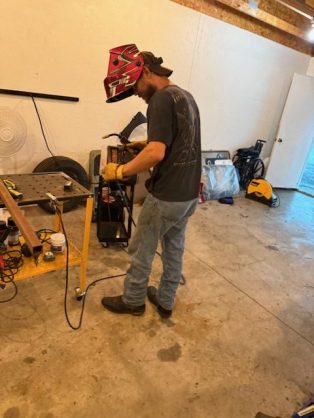
This is Gene. He totally rules.

A nice guy named Gene agreed to help out. He was probably about 10-15 years younger than I was and he had learned welding by doing it with his dad. He picked up his certifications later, adding tools to his toolbox, but he retained that simple, “Watch, understand, now do” approach from his dad’s tutelage.

So, one rainy Saturday in August, Gene came over to my garage and helped me learn the basics of welding, which are pretty inconsequential for most of you here. That said, here are the things I picked up from that experience that I honestly think might be helpful for improving (or maintaining a high standard of) teaching:

Remember what it’s like to be afraid

When I decided I was going to make the leap into welding, I picked up what I thought was a decent used welder, some safety gear and a welding station. It then sat in the garage for more than two months as I read every book and watched every “expert” on YouTube to figure out what to do.

The truth of the matter was, I was scared.

The fear definitely came from at least one video titled something like “Five ways to kill yourself by making a mistake while welding.” However, it was deeper than that, in that I wanted to be good at it, the advice on how to get good was so varied and everything about this process seemed foreign to me.

When was the last time you were honestly afraid of being terrible at something important to you? How hard was it for you to attempt doing that thing? Also, if you were in a room full of other people that you automatically assumed were better at this thing than you are, how tense and awkward are you feeling?

Even when it was just Gene and me, I had trouble pulling the trigger on the welder. He never gave me any sense he’d make fun of me or tell me how bad I was at this, but I still didn’t want to be the guy who he talks about when he meets up with his buddies later and says, “If you think YOU wasted your day, lemme tell you about…”

As much as we say we can all remember being a student in class or being at the beginning of our journey as journalists, it’s a whole different thing to actually be AT that point. Furthermore, maybe we were better at journalism than these kids perceive themselves to be, so it’s gotta be even worse at that point.


There is a difference between a rule and a preference

Various areas of education have specific rules to them that are unbreakable, while other areas have malleable rules, strongly suggested approaches and nuanced levels of preference. As I have aged in this field, I’ve found that the more I lean toward teaching the latter, students tend to crave the former.

As a welding student, I could understand why: Rules provide certainty. Rules lead to specific outcomes. Rules are easier than nuance.

In short, rules rule.

In watching all of the welding videos, I went looking for rules. There were rules as to how to set up my welding helmet so I could see my arc, but not go blind. There were rules as to how big of a hole I should drill in sheet metal to make the appropriate plug weld. There were rules as to the type of wire to use, the settings on the welder, the way to prepare the metal for welding and more.

The problem? All of these rules that each welder told me ran contrary to what every other welder told me. All of which left me more confused and upset when I would try to replicate their work and end up with really miserable results.

Gene was great because he helped me see that a lot of what these guys were calling “rules” were just preferences based on how they had learned or what they felt was best. Even more, breaking any of those rules wouldn’t leave me blind and on fire with giant holes blown through the sides of my car.

The only rules that really mattered, he explained, came down to looking for specific things that happened and reacting accordingly. When the wire sticks to your weld, you’re too far away. When you blow a hole in the metal, you have your settings too high. Start dark on the helmet and move up until you can see but it doesn’t feel overwhelming.

I know that a lot of folks like to lay down a lot of rules with rubrics and scales and “do-this, not-that” requirements, and that can help in some cases. However, I also know that as a student, I started feeling trapped by the rules, especially those that didn’t really work out all that well.

My goal for this year has been to stick with only the rules that are absolute, don’t-break-them-or-else-level rules. The personal preferences, I’m going to explain and moderate with the idea of making sure they hang onto the big things and stop freaking out about everything else.


Explain “how” and “why” a lot

Expertise provides you with a sense of internal logic that allows you to accomplish tasks easily and seamlessly without a lot of thought going into them.

In furniture restoration, it can be picking what grit of sanding disks I use to remove layers of age and crud. In the pinball world, it’s tracking circuits through a diagram to determine which ones aren’t making contact. In journalism, it’s knowing which words to use, in which circumstances, to best tell the story that needs to be told.

The problem for most of us is that we’ve attained the level of expertise in our field, so much so, that we don’t always slow down to explain ourselves to the students. What is natural for the professor needs to be learned in a high-detail way for the student.

Almost from the beginning, Gene was preemptively offering me “how” and “why” answers about the settings on the machine, the pattern he used in “stacking dimes” on a particular weld and how best to move the puddle along. That not only made me feel more confident, but it also helped me feel comfortable asking additional “how” and “why” questions on things that still confused me.

Students, generally, don’t want to ask questions because they fear looking stupid, or because they assume if no one else is asking a question, nobody else must have that question. When those questions are about how something works or why we approach a concept in a certain way, it’s crucial to make sure they get answered one way or the other.

If you’re waiting for a student to ask a question, you’re likely waiting on the corner for a bus that had its route cancelled, so it’s really helpful to proactive in getting the “hows” and “whys” covered.


Encouragement makes all the difference

Contrary to all the click-bait ads I’d received on social media since mentioning an interest in welding, I knew I wasn’t going to be a master welder in one day. I also knew I had tried a few things before Gene agreed to teach me and they looked like absolute garbage to me.

What Gene did, which is something I have to constantly remind myself to do in a classroom, is provide encouraging feedback.

He looked at my earliest attempts and was able to tell me what was wrong with them, in terms of the settings on the machine and the speed of my welding. However, he also pointed out the things I should keep doing, as they were promising first efforts.

“You’re balancing it right,” he told me as he referenced the gun. “You’ve also got a good angle when you’re dragging.”

When I did my welds with him, he was quick to offer encouraging pointers. It wasn’t, “This part is good, this part is bad,” but rather  “Can you see how much cleaner this one is than your last one? That’s great!” He also helped me understand why my welder wouldn’t produce the immaculate welds I was seeing online.

“You’re using flux-core wire,” he told me. “Those guys aren’t showing you that. They’re using a gas set up, which is always going to have less spatter. You aren’t spattering any more than anyone else using flux.”

As a struggling student, all I wanted to know was that I didn’t suck and that I wasn’t a lost cause. When I applied that thought process to lead writing or inverted-pyramid briefs, I realized that even just a “Hey, good verb choice there!” could make a huge difference.

The thing I realized about Gene’s encouragement was that when he was ready to leave, I not only felt like I COULD do some welding on my own, but I WANTED to persist in the activity. I had an excitement about trying things to make them better and wanting to send him pictures of what I had done. It wasn’t about impressing Gene, but rather showing him what he had brought out of me and thanking him for it.

If I can do that for one or two kids this year, I’ll call it a win.

Have a great start to the semester!

Vince (a.k.a. the guy who loves to weld now)

My first four-side pipe weld. That sucker isn’t coming apart any time soon. Gene said it looked amazing, which makes it even better. 

Blog Post No. 1,000: A Bit of Heartfelt Gratitude to Sage

When Sage had me start this blog eight years ago to promote my reporting book, I did so under two strict conditions:

  1. I had total control over the content. They couldn’t demand, require or censor anything I decided to post here.
  2. This was not going to be a “rah-rah site” that just pimped out my books or blindly praised the company that published them.

With those two things in mind, I decided to dedicate the 1000th post of this blog to the company that changed my life 12 years ago and that has my loyalty for as long as they’re willing to have it. Please consider this an honest, heart-felt endorsement. 


My bookshelf the day I got my very first copy of my very first book for Sage. At the time, I couldn’t believe I had three titles with my name on them, and one with my name only on it. 


I can still see the strange confluence of events that happened at an AEJMC convention in Washington, D.C. that really altered the trajectory of my life and led me down a path that has made me ridiculously happy as a teacher, a writer and a colleague.

I was a few years into what seemed to be a terrible professional decision to come home to Wisconsin and teach at the University of Wisconsin Oshkosh. I had given up a job where people loved me, I had a sparse teaching load and I advised one of the best college newspapers in the country for a position that required me to give up rank, take a pay cut and work with at least one “colleague” who had publicly expressed disdain for my hiring.

(Another colleague told me that in the meeting where my hiring was announce, at a pay level that was a 25 percent cut from where I was coming, mind you, this individual stated, “For that kind of money, we could have gotten someone good.” Eeesh.)

The biggest problem I was facing was teaching basic media writing to students across a wide array of disciplines, including advertising, public relations, print-style news, broadcast, interactive web management and more. My background in news was seen as a bias and the books I could offer as texts basically crapped all over everything that wasn’t a newspaper reporting job. Thus, I set out to find a text that would make for a more equitable discussion of media while still imbuing students with the core elements of media writing that most news-writing texts professed.

Matt Byrnie, who was an acquisitions editor staffing the Sage booth at AEJ that year, asked me to sketch out a concept for a book like the one I needed and then meet with him later in the conference. Despite having my name on two books already at that point in time, I had no idea what to do here. That said, in the middle of an interminable panel session, I found a bit of hotel stationary and started scratching out a few concepts. The idea wasn’t necessarily WHAT needed to be taught, but rather HOW to approach this concept.

The rough sketch of what I pitched to Matt Byrnie still hangs in front of me every day in the office. It reminds me of what I promised I’d do and how important it felt to do it well at that point.

After our meeting, Matt seemed enthused, but I’d been there before with people in publishing: At first they’re all excited and then they ghost you like you owe them money. Still, I reached out to Matt and pitched the book. He not only agreed to do this one, but he also had me pitch a second book at that point as well.

He hung in there with me as I fumbled about the process of meeting the needs of his production team while I tried to stick as close as I could to the “rules of the road” I built on that bit of scratch paper. He was enthusiastic and supportive, kind and decent. He made me feel like what I was doing mattered, not just because it could sell X units for a corporate overlord, but because he thought it could add value to the field.

If it had all started and stopped with Matt showing faith in me, I would be fine with Sage, but not nearly as loyal as I am. Shortly before “Dynamics of Media Writing” launched, Matt reached out to me and told me he had been promoted and that my book would now be in the hands of some Terri person I’d never met. I lost my mind, thinking, “Here we go again. I’m totally screwed.”

Instead, Terri turned out to be every bit the partner Matt was. So was the person who followed her when she left the field, and so was the next person after that person got promoted. And on and on it went. Each editor I worked with from Janae to Lily to Anna to Charles and more gave me the sense that I was the most important thing in the world at that moment and that they’d do anything to help me get where I thought my work should go.

They encouraged me to try new things like the blog, guesting on podcasts, doing videos and more. They also provided financial support to keep the lights on at the blog, professional support to make sure the podcasts didn’t sound stupid and strong editors to make my videos look a lot less like a guy filming a hostage video in Saw’s kill room.

They also supported me in some of my more insane ideas, even as I’m sure they had to endure a few moments like this in explaining me to their bosses. When I decided to wear a bulletproof vest around for a week and write about it on the blog, they didn’t try to talk me out of it.

When I referred to promotional efforts as “book pimping,” they winced, but didn’t tell me to knock it off. When I decided to take the 11-day forced vacation from UWO and turn it into a John-Oliver-esque “furlough tour” complete with T-shirts to commemorate the event, Sage not only supported it, but they bought T-shirts for their staffers.

The person who bought the shirts for her team was Staci Wittek, probably the best person I’ve ever had the privilege of working with at any level, anywhere. Staci’s official title is Senior Product Specialist, Communication and Media Studies at SAGE Publications, but that doesn’t come close to what she has done for me (and I’m sure many others) who have books under her watchful marketing eye.

She’s had me do videos for her reps to explain the book, reach out to potential leads on behalf of reps, build additional resources for people who need them and more. She’s also so willing to do pretty much any ridiculous promotional idea that comes rolling out of the junk drawer that is my brain.

Without Staci, none of my books would have succeeded because she put so much work, energy and faith into what I’ve built. She’s the difference-maker, like Michael Jordan was with the Bulls.

The reps for Sage stop by my office for a chat every time they’re on campus. It’s always, “What can I do for you, Vince?” not “Here’s how you need to help me sell your stuff.” We laugh about various things, share stories and get to know each other. It really does have that family vibe, a rarity in a day and age where corporate culture and survival of the fittest seem to rule the roost.

Every time I part company with someone from Sage, I always say the same thing: “Thanks for everything, and if you ever need anything, just tell me what it is and you’ll get it.” It’s the same thing I say to my students, my colleagues and everyone else who matters to me in life.

And by the way, here’s that same bookshelf, 10 years later…

The books in Chinese and Arabic are two translations of one of my textbooks. You have to take my word for it, as I had to take someone else’s word for it. If you read either language, and it turns out they’re actually “Mein Kampf” or something, please tell me so I can fix this…

Thanks for everything, Sage folks. I look forward to the next great adventure.

Most sincerely,

Vince (a.k.a. The Doctor of Paper)

Exercise Time: How did your media frame the ending of the shutdown?

(There’s not a lot of gray area in how Jon Stewart framed this, but you might find more nuance in the other media you consume…)

The government shutdown began its bureaucratic crawl toward completion this week, after eight non-Republicans in the senate joined the Republicans in approving a continuing resolution to keep the lights on here in the U.S.

The shutdown has been the longest work stoppage of its kind in the history of the federal government and it’s interesting to see how various media outlets have chosen to explain this.

As we discussed earlier, framing is a practice in which media outlets emphasize or de-emphasize various aspects of a situation to paint a picture for an audience. For example, a football game in which one team has an overwhelming lead, only to lose late in the contest could be framed as either an amazing comeback or an epic choke job.

Today’s exercise is a simple one: How did the media you consume frame the end of the shutdown? Some obvious approaches include Republican victory and Democratic caving, but there are more and more “think” pieces rolling out recently that look for a “silver lining” on this issue.

Find five or six stories on various media sites and look for stories about the shutdown. What do you see as the prominent issues emphasized in each of these? Do they match your personal viewpoint on this issue or not? What benefits and drawbacks do you see for each frame presented here?

Once you’re done, it’d be a good time for a class discussion about this.

How to make things relevant for your readers when they no longer have shared, collective experiences

On this date in 1960, the Pittsburgh Pirates defeated the New York Yankees in Game 7 of the World Series on Bill Mazeroski’s ninth-inning walk-off home run.

To fully understand the gravity of the moment for many people living in that time, it’s instructive to listen to sports journalist Beano Cook’s assessment of the situation:

“If you grew up in Pittsburgh, the way I did, you remember where you were when heard F.D.R. died, when you heard about Pearl Harbor, when you heard the war ended and where you were when Mazeroski hit the homer.”

I’m sure not every human being on Earth had that kind of reaction to it, especially Yankees fans who considered World Series domination to be their birthright, but it does speak to the larger sense of how we once had a sense of shared moments in time.

During my life time, there have been a few of those “where were you” moments that stick in my head to this day. I remember being on the floor of my parents’ living room on that yellow shag carpeting in front of the old Admiral-brand TV we had when the Miracle on Ice occurred.

I remember being in the Doctoral Pit in Columbia, Missouri with several other former journos-turned-Ph.D.-students huddled around an old tube-style TV as we watched the towers collapse on Sept. 11, 2001. (I also remember having to go to a multi-variate statistics class, taught by an international grad student who had no idea what was going on. To this day, I still can’t figure out binomials.)

In today’s era of quick-hit social media, in which algorithms feed us more of what we want to see and isolate us from a wide array of viewpoints, I don’t know if shared cultural moments are possible for this generation, but the litmus test might be the shooting death of Charlie Kirk.

A recent analysis of what people thought about Kirk, his death and the person arrested on suspicion of shooting him found that social media created completely different worlds in which individuals learned about all of this. In addition, social media companies have removed a lot of the guardrails that were once considered crucial in eliminating factually incorrect content and tamping down rage.

As much as it seems like EVERYONE around me has an opinion on Kirk, his death and everything that’s wrong with the world today that led to it, I am still running into students who know nothing about any of this.

And I’m teaching in a media-based field where knowing what’s going on around you is kind of important.

Rather than going down the rabbit hole of whose values are better or what people don’t see thanks to self-feeding loops of social media destruction, I think it’s more important to realize that horse is out of the barn. What matters now is how we deal with it as journalists, give that most of our job is providing content to people in a way that’s relevant, useful and interesting to them.

Here are a few things to realize about the people out there consuming our content and how we need to serve it up differently for them:

NEVER ASSUME THEY KNOW ANYTHING: This seems a bit blunt and harsh, but we don’t all see the same news at 10 p.m. or read the same newspaper on the train ride into the city anymore. Just because people exist on X, Facebook, SnapChat, TikTok or Chorp, it doesn’t follow that they know anything we’re trying to talk about either.

Everything is individualized, so while my feed might be filled with calm, rational discussions about social policies in higher ed, the person right next to me might be learning that Bad Bunny’s Super Bowl appearance is part of a plot to explode the brains of ICE agents with a sound ray that will also turn undocumented migrants trans.

(We have the technology… You are just being kept in the dark about it. Read more about my inside information at the website http://www.areyoufrickinseriouslystupid.com)

What this essentially means is that we have to start from a position of less than zero to explain situations to our readers if we want them to get anything out of anything we are trying to tell them.

I used to tell students that 1-4 sentences of background was usually enough to catch people up on topics of interest. As much as that number might need to increase exponentially, it also needs to be counterbalanced against the minuscule attention span people have, so it’s going to be a fine line to walk.

This leads to the second point…

WRITE IT LIKE YOU’D WANT TO READ IT: The goal of most standard media writing is to get to the point immediately. The problem is that most people don’t write for others the way they want content sent to them in the realm of social media. That creates a massive disconnect we need to fix.

I did a study a few years back involving student journalists who were responsible for running social media for the media outlet. I asked them to rate a bunch of uses and gratifications they have for social media they received. In other words, what do you like that you get and how you get it from social media? I then asked them to outline the approach they took to sending social media to other people as a source from their media outlet.

The results? Almost zero overlap between what they considered “best practices” for social media they consume and the way they themselves provide it to other people. In most cases, they liked writing really long and involved stuff but they hated reading it. They also liked things to be quick and direct, but felt it necessary to avoid being that direct in their own work.

Studies of social media and its impact on the brain are mixed, but one discussion about the topic seemed to make the most sense to me. The writer basically said that social media exercises our brains in certain ways, so we not only get used to that, but the other aspects of our minds tend to atrophy a bit. The author compared it to “skipping leg day” at the gym but doubling up on core exercises: One part gets weaker while the others get stronger.

This kind of media consumption limits our ability to do the more strenuous mental work that non-social-media use requires. It also impacts our ability to create memories, so writing giant diatribes with six interweaving plot lines isn’t going to help the readers in any meaningful way. So, if we want to get across to the people, we need to build it in a way they’ll best understand it.


SELF-INTEREST IS OUR ONLY SALVATION:  If we have but one thing in common anymore, it is literally the interest we have in why something matters to us personally. If that’s all we have to go on, we’re going to need to saddle up that horse and ride it to death.

To be fair, some larger moments over the past 20 years only stick in my brain because I had a personal connection to them. The 2007 shooting at Virginia Tech mattered a great deal to me because I knew the media advisers at that papers and I had spoken to some student journalists from there at one point. I remember refreshing my email every 0.5 seconds, hoping for a response from a friend to tell me she was OK.

The Las Vegas shooting fell into a similar vein, in that my aunt and uncle were in Vegas at that point. I remember trying to teach a class and keeping an eye on text messages from my mom to tell me if my family members were safe.

And again, I’m PAID to be aware of larger issues that get a ton of media coverage, so if I’m falling down on this, I can’t imagine what it’s like to people who are learning nothing other than what TikTok feeds them.

At one place I worked, we used to require the students to finish the sentence “This matters because…” before they were allowed to start writing their stories. Bringing something like this back for all media writers, with a more direct version like “This matters to YOU, my reader, because…” might help us better focus our attention on the “how” and “why” elements of what we’re covering as we target the demographic, psychographic and geographic needs of our specific audience members.

We often have to remind students that they’re not writing for themselves, but rather the audience. Now, we might not only need to double down on that, but also make sure they have a full sense of who is out there and and a laser-like focus on making it relevant to them.

A Mob Shakedown, Chump Change or An Affront to The Foundations of The Country: Framing Paramount’s $16M Settlement With President Trump

This interview, which literally and figuratively did absolutely nothing to the outcome of the 2024 presidential election, was at the core of a multi-billion-dollar lawsuit President Donald Trump filed against “60 Minutes.” 

THE LEAD: Paramount agreed late Tuesday to pay $16 million to settle President Donald Trump’s lawsuit over the editing of a Kamala Harris interview on “60 Minutes” that Trump deemed fraudulent and deceptive.

Trump sued Paramount in November for $10 billion, claiming the editing of the interview created “partisan and unlawful acts of election and voter interference” intended to “mislead the public and attempt to tip the scales” of the 2024 election toward Harris.

Experts had long noted that the suit was frivolous and that Trump had a better shot of quarterbacking the Cleveland Browns to a Super Bowl title this year than he did of winning this case. Still, the parent company of “60 Minutes” took the settlement route, as a corporate sale of several billion dollars seemed to be at risk if it didn’t:

Many lawyers had dismissed Mr. Trump’s lawsuit as baseless and believed that CBS would have ultimately prevailed in court, in part because the network did not report anything factually inaccurate, and the First Amendment gives publishers wide leeway to determine how to present information.

But Shari Redstone, the chair and controlling shareholder of Paramount, told her board that she favored exploring a settlement with Mr. Trump. Some executives at the company viewed the president’s lawsuit as a potential hurdle to completing a multibillion-dollar sale of the company to the Hollywood studio Skydance, which requires the Trump administration’s approval.

After weeks of negotiations with a mediator, lawyers for Paramount and Mr. Trump worked through the weekend to reach a deal ahead of a court deadline that would have required both sides to begin producing internal documents for discovery, according to two people familiar with the negotiations.

FRAMING THE OUTCOME: We talked about Framing Theory a few months back, but for a brief recap, the idea is that how the media chooses to focus on an issue can shape how people in general will look at that issue. In this case, here are three I’ve seen pop up:

The Mob Shakedown: In most good gangster movies and TV shows, a scene emerges that showcases how to threaten someone without actually threatening them. It’s a pure demonstration of the power the “Don,” the “boss” or the “enforcer” has: Force someone to do something they don’t want to do out of pure fear of what otherwise might happen.

The shakedown scene usually starts with the gangster offering “friendship” or “protection” for a business owner, explaining that the world is a dangerous place and that a lot of bad things can happen. So, for a small percentage of the owner’s finances, this gangster will keep those bad things at bay.

If the owner protests, the gangster tends to get a little more specific while still being vague, offering “God forbid” scenarios like how a mysterious fire could burn the business to the ground or how a random act of violence could lead to the owner being hospitalized for serious injuries. However, fortunately, a payment to this “ambassador of goodwill” can pretty much eliminate those possibilities:

(This was the best “shakedown” scene I could find from any TV show or movie that a) didn’t use enough F-bombs to destroy an underground nuclear bunker, b) use other pejorative language regarding someone’s race, gender, ethnicity, sexual orientation or pet preference and c) didn’t actually use the violence that was suggested earlier in the clip. Still, it’s not pure enough for totally virgin ears, so watch at your discretion.)

In the Paramount case, the company had a multi-billion-dollar deal waiting in the wings, but it needed “the Don’s” blessing to go through and a lot of terrible things can happen to a deal if, God forbid, the FCC decided to look reeeeeeealllly closely at it. I mean, who knows what might happen to all that money? If Paramount lost that deal just because of a little misunderstanding it could make right with this “60 Minutes” thing? Hey… I’m just saying…

Of course, the Trump administration definitely wasn’t doing that:

Brendan Carr, the chairman of the Federal Communications Commission, has said the president’s lawsuit against Paramount was not linked to the F.C.C.’s review of the company’s merger with Skydance. Paramount has also said the two issues were unrelated.

Right. And the business owner got that black eye and broken arm after “accidentally” falling down a flight of stairs before coming to the conclusion that protection money is a small price to pay for proper piece of mind.


Chump Change: If you look at some of the more successful campaigns to get money out of people, they tend to be the ones that appear to be the least taxing or consequential. Case in point, each year, my alma mater (or maters) send me a pledge card, asking for a “gift” of between a few hundred and a few thousand dollars. Those always go right in the trash without a second thought.

That said, I have a hard time recalling the last time I refused to “round up” at the grocery store, the hardware store or anywhere else for whatever charity the business was repping at the time. It’s like, “Hell, I’m already $132.47 into the Kroeger Family at this point. What’s another 53 cents for a good cause?”

In addition, I’ve seen people drop a few coins in a parking lot and refuse to pick them up, folks at rummage sales drop the “and XX cents” on a customer’s total and other similar maneuvers that basically just round off a relatively insignificant amount of cash.

Thus, the concept of “chump change.”

I personally have a hard time thinking about $16 million as “chump change,” but everything in life is relative, as noted in this clip from “The Social Network:”

I suppose if I’m looking at it from the perspective of a multi-billion-dollar company that wants to make several billion dollars on a deal, giving up $16 million isn’t a lot to make things happen. I also suppose that if a collections company told me I owed $1,000 to a creditor, but I could pay it off today for $1.60, I’d probably avoid the argument and fork over the cash. (Trust me on this one: The comparative math is solid.)

To Paramount, this is the cost of doing business. It’s rounding up at the register to move things along. It’s chump change.


An Affront to The Foundations of The Country:  After the news broke about the Paramount capitulation, it might have felt like time stood still for a few minutes. That’s probably because when Edward R. Murrow, Katherine Graham, Walter Cronkite, Ben Bradlee and David Brinkley (among other journalists) started simultaneously started spinning in their graves, the Earth found itself dealing with that “Superman The Movie” trick:

We’ve discussed SLAPP suits here before, where people with virtually no case whatsoever sue for a ton of money to get people to back off. In many of those cases, the defendants lack the sufficient means to truly stand their ground and fight back on behalf of truth, justice and the American way, so they knuckle under.

In this situation, Paramount had the funds, the legal might and the legal precedents to stand up for all the mom and pop media operations (whatever of those are left) and tell the president where to put his suit. Paramount also had the opportunity to stand up for the free press and free speech rights that have defined the country for generations.

It’s something Graham and Bradlee did before when a president came at them. It’s something Murrow did in a time in which a demagogue rattled this country to its core. It’s something so many other journalists and journalism operations have done in big and small ways to reassure us all that our rights are not a “when it’s convenient to people in power” thing.

But a funny thing happened on the way to our current predicament. News outlets are now part of larger conglomerates with larger concerns. TV news always lost money, relative to other programming, but it was seen as part of the deal: You give us quality news, we let you use the public airwaves. Newspapers use to make money and hold sway over larger groups of people. Furthermore, they weren’t part of a collective that also did entertainment programming, sold time shares, controlled real estate and answered to shareholders. Their concern was doing the news well and defending their right to do it.

For Paramount, “60 Minutes” is a “property” of the company, just like all the other stuff they put on TV. If an episode of “School Spirits” pissed off enough people to prevent a multi-billion-dollar deal from happening, they’d kill it or edit it or pay off someone, too. Cost of doing business. That’s the company’s view. The needs of the many outweigh the needs of the one.

However, when one company lets the powerful dictate the news based on threats like this suit, it undermines the strength of those First Amendment rights for everyone else.

’60 Minutes’ leader quits, citing lack of editorial freedom and limited backing from his bosses


THE LEAD: Bill Owens, one of only three people to run “60 Minutes” over its lengthy stay on CBS, resigned this week, telling his staff that he felt the show’s editorial independence was compromised.

“Over the past months, it has also become clear that I would not be allowed to run the show as I have always run it. To make independent decisions based on what was right for 60 Minutes, right for the audience,” Owens wrote. “So, having defended this show- and what we stand for – from every angle, over time with everything I could, I am stepping aside so the show can move forward.”

Much of the concerns related to what “60 Minutes” is or isn’t doing is, spoiler alert, related to President Trump’s attacks on the show, network and parent company. He has filed a $20 billion lawsuit against anything that breathed within the vicinity of the program, stating it was fraudulent in its actions as they related to an answer on the Middle East that Kamala Harris gave.

Trump sued CBS, which is owned by Paramount, a few days before the November election, alleging that the “60 Minutes” interview with Harris was deceptively edited and therefore violated a Texas consumer protection law. He then expanded the lawsuit earlier this year, alleging an additional claim under the federal Lanham Act and seeking at least $20 billion in damages. In March, Paramount and CBS filed two motions to throw out the lawsuit, calling it an “affront to the First Amendment.” And on April 7, their lawyers filed another motion asking the plaintiffs to produce the documents requested in discovery.

“Despite their insistence that discovery move forward, Plaintiffs have shown very little desire to produce their own documents, relying on unfounded objections and delay tactics,” the Paramount and CBS legal team said.

Paramount is in negotiations to sell the company, which requires FCC approval and that means it’s a really awkward time to be in a pit-sticking match with the administration. Therefore, trying to settle the suit and trying to keep its watchdog on a leash is in the financial best interests of Paramount.


SECOND VERSE, SAME AS THE FIRST: This isn’t the first time that independent media outlets have gotten the muzzle treatment out of fear of Trump.

The Washington Post, owned by billionaire Jeff Bezos, had several tussles between speaking truth to power and trying not to piss off power. Artist Ann Telnaes quit the paper after Bezos spiked one of her political cartoons about how the corporate interests in the country worshiped Trump.

Ann Telnaes says the rough version of the cartoon she drew for The Washington Post , shown above, was rejected by the paper's editorial page editor.

Bezos also took heat during the election season when he spiked the paper’s editorial endorsement of Harris for president. The L.A. Times had a similar situation, in which its editor resigned when the paper’s owner killed a Harris editorial prior to the election.

Yep, this is the hard-hitting journalism I’m getting these days from Bezos media….

DOCTOR OF PAPER HOT TAKE: We can call this situation a number of things (disgusting, nauseating, terrible, autocratic), but we shouldn’t call it surprising. Money isn’t everything, but it always beats the hell out of whatever comes in second, so when doing the right thing and speaking truth to power get between a money-person and a payday, it’s pretty obvious what’s going to occur.

We also shouldn’t lay this all at the feet of Donald Trump, as if he were the sole factor in the squelching of public debate and awareness. Sure, he can wave a bigger stick at bigger institutions, but let’s not pretend that this kind of thing hasn’t happened long before he came down that escalator.

A former student of mine worked at a newspaper along the East Coast where he was doing business journalism. The woman who owned the paper had no interest in journalism, as she had inherited it from her publisher husband. When my student wanted to do investigations into local businesses doing shady stuff, she shut him down because she didn’t want him “bothering my friends.”

Another former student worked at a radio station where he found out about a police chief behaving badly. After the station published its stories on the web, the police chief and his lawyer threatened all manner of things. The message was simple: Pull the story down or we’re suing you out of existence.

Had it not been for some legal help from the Reporters Committee for Freedom of the Press, he likely would have folded under the pressure of the threats. The story stayed up and won an award, while the chief moved on and the threat of the suit went away.

And, not to put too fine of a point on it, student newspapers always find themselves dealing with some level of “external pressure” as it relates to covering things administrators, athletics or student “leader” don’t want mentioned. Just because it’s happening to “grown-up journalism” doesn’t mean it hasn’t happened before elsewhere.

As we outlined in various posts before, the First Amendment doesn’t protect against all the stuff people tend to think it protects against. It also doesn’t help people hoping to turn a profit grow a spine.

DISCUSSION STARTER: Is there a difference in your mind between the government stepping in and prohibiting speech and an organization self-censoring for fear of negative external outcomes?

Also, is resigning from the show the best thing Bill Owens can do, or is it not? It’s easy to make the argument in both ways, but focus on the WHY you think what you think about this and what it says about his ability to leave a job like this in this way.


I lost, but it doesn’t suck, and that’s thanks to you all


It can be ridiculously hard not to be a hypocrite some days.

I spent the previous weekend at the Missouri College Media Conference, where among other things, I presented the evening’s keynote address. Because the speech was just before the awards were presented, I decided to keep it short and focus on the topic at hand.

I told the students there something I’ve told every student in every newsroom I ever advised that I honestly believe to be true when it comes to awards:

“Awards are great things, and you should be proud to win one. However, they aren’t the end-all and be-all of life. When you win something, you should be honored, but don’t let it get to your head. When you don’t win something, you should NOT let it make you feel inferior, as you have more than plenty to offer now and in the future.”

The minute I said it, I realized I had essentially jinxed myself. My new textbook, “Exploring Mass Communication,” had been nominated for the Textbook & Academic Authors Association’s “Most Promising Textbook” back in late October and the winners were set to be announced any day now.

Sure enough, the results came out shortly after I got home and I didn’t make the cut.

After I checked the list a couple times to be sure, I emailed my friends at Sage and told them I was sorry I let them down. They spent time and money putting together an extensive application for this thing, not to mention about five years of their lives helping me build this opus, so I felt they deserved this award more than I did.

The answers came back pretty quickly and identically: We don’t know what the hell was wrong with the judges, but we think we have a winner here. The response to the book has been overwhelmingly positive and adoptions are beyond our most optimistic expectations. We’ll take that over a plaque.

That made me feel better, as did thinking about the award itself. I didn’t know the TAA existed six months ago, so being really upset about not winning something from them seems pretty stupid. It also helped that this was one of those “best newbie” awards that often feels like a kiss of death. In scrolling back through my mind, I thought of all the “Rookie of the Year” award winners (Joe Charboneau comes to mind) and “Best New Artist” Grammy winners (A Taste of Honey comes to mind) who became part of that one-hit wonder crowd.

Awards ARE great and winning IS great, but I was right that they don’t mean what people think they mean. Hell, the Starland Vocal Band won two Grammy awards more than a decade before the Rolling Stones even got nominated for one. If you asked me whose career I’d want, you better believe I’d want to be with Mick and the Boys as opposed to Taffy Nivert.

The thing that really made me OK with all of this was my boss, who put a different spin on things when he told me, “You need external validation more than any human being I’ve ever met.” In other words, it wasn’t the award that mattered. It was someone telling me I did something right.

Which is where you all come in and why I’m writing this post today.

Steve is one of the best friends I could ever ask for. He’s put up with me for far longer than the AMA’s recommended lifetime allowance…

The one goal I have in everything I do is to try to make life a little better for the person who is interacting with me. I want a student to learn something. I want an advisee to get through the program more smoothly. I want people who attend my sessions at conferences to feel like they didn’t waste their time. If you’re reading this blog, I never want you to say, “Well that’s 20 minutes of my life I’m never getting back.”

The same is true for my books. I don’t write them to supercharge my ego or to win an award. I write them for other people. I hope that they can help instructors reach kids and help kids learn something that matters in a way that doesn’t feel arduous. The best external validation I get is knowing that people trust me to help them help their students. That validation is much better than any award I could ever receive, and it shows up when I least expect it.

Case in point, a few student media advisers were on a listserv, discussing which media-writing text would be good for their classes. “Dynamics of Media Writing” came up three times. That was amazing to me. I also got a few messages after MCMC from people asking if they could get a desk copy of my “Dynamics of News Reporting and Writing” text, as they wanted to adopt it in the fall because they heard good things.

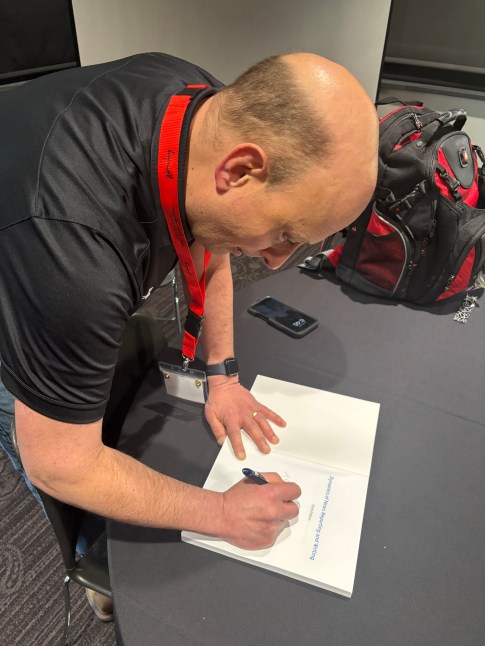
Even the kids, who I have been told a jillion times hate textbooks and never use them, have been amazingly kind to me over the years. For example, I brought a bunch of swag to the MCMC, including “Filak Furlough Tour” T-shirts and a “trophy bat” for the organization to give away.  At the end of the MCMC, the students on the board got copies of my reporting book as a thank you, when one of the kids came up to me and asked if I would sign the book.

“You don’t want me to sign that,” I explained. “If you keep it shrink-wrapped, the bookstore will pay you a chunk of change for it.”

She gave me a “why the hell would I do that?” look and then peeled off the wrapping. I ended up signing all three of the books that day.

Actual proof that someone wanted my autograph on something other than a check or a grade-change form.

When I got back and told the story to my reporting class, one young lady told me, “I read your book. I still think it’s the best textbook because I could understand things from it. It felt really… human.”

In the age of AI, I’ll take the hell out of that.

Perhaps this is the longest way I can think of to say thank you for everything you do for me in the “external validation” department. My goal with each edition of the book and each blog post is to make sure I earn it.

If there’s anything you need, please let me know.

Vince (a.k.a. The Doctor of Paper)


A Lot at Steak: How U.S. Education Secretary Linda McMahon’s AI Blunder Led to Marketing Gold

THE LEAD: Secretary of Education Linda McMahon managed to confuse AI (artificial intelligence) with A.1. (steak sauce) while delivering her comments at the ASU+GSV Summit last week.

The gaffe became fodder for all sorts of internet humor, but company responsible for making the condiment saw an awesome opportunity and took full advantage of the mistake:

A.1. Sauce capitalized on McMahon’s blunder by posting an Instagram post on their verified account saying, “You heard her. Every school should have access to A.1.”

“Agree, best to start them early,” the picture attached to the post reads.

Other Instagram users loved the response from the Kraft Heinz-owned brand. One user even commented, “I will be buying a bottle or two because of this post.”


KRAFT-ING MARKETING GOLD AGAIN: Kraft Heinz, which markets A.1., has a decent track record of grabbing a cultural moment and running with it. The company took advantage of the “Barbenheimer” explosion by introducing a pink “Barbie-cue” sauce and has also linked a ranch dressing to Taylor Swift. In each case, the company drew attention to its brand, garnered some nice free media publicity and avoided the kinds of gaffes often associated with trying to ride a trend.

Despite the random uncertainty in the market these days, the stock closed up on Friday and has shown a gain from $27.60 on April 9 to $29.33 on Friday. Although that time frame corresponds with the comments McMahon made about A.1., it’s a bit simplistic to say the gains were solely connected to that mistake.

In its rating of best food stocks to buy according to billionaires, Insider Monkey rated Kraft Heinz at the top of the list for a number of reasons, including global supply chain and reliance on AI (not A.1.) for keeping factories humming. Still, people are saying they’re buying a bottle or two of the steak sauce as a result of the gaffe:

So far, A.1.’s loyal fans seem to be in support of its “new sauce.”

“My husband wants a bottle for his desk,” one commenter wrote under the brand’s post. “He teaches middle school, at least until they replace him with A.1.”


BLOG FLASHBACK: Kraft Heinz isn’t alone in taking advantage of dumb situation with some marketing genius. As we noted back in 2018, Country Time Lemonade drew a lot of attention after it created its “Legal Ade” defense fund for kids who had been fined for not having a business permit to run their lemonade stands.

Like the A.1. effort, this worked because it was on the right side of the argument, made fun of the utterly ridiculous and didn’t run a significant risk of hurting its brand with this maneuver.

Other organizations tend not to be as lucky when they jumped in on trending hashtags or didn’t think about potential blow back before entering the larger discussion.

DISCUSSION TIME: What do you think Kraft Heinz should do next? Ride the wave? Leave it alone? Try something else? Also, what other marketing maneuvers have you seen that tried to connect with a trend? Did they succeed or fail in your eyes? Why?

It’s all fun and games until someone sues you for being an idiot: Pat McAfee Edition

ESPN forced to put out 'don't sue us' disclaimer as Pat McAfee show launches on live TV as NFL icon apologizes at start | The US Sun

The disclaimer on the front of Pat McAfee’s show.

THE LEAD: Pat McAfee, former NFL punter and current podcast maven, amplified an internet rumor on his show about Ole Miss quarterback Jaxon Dart and his girlfriend, Mary Kate Cornett. The unsupported allegation was that the 18-year-old freshman student was involved in a “triangle” of sexual relations with Dart and Dart’s father.

After suffering weeks of abuse, threats and other unpleasantness via the Online Idiot Brigade of Dude-Bros, Cornett plans to sue for defamation:

Now she is looking to hold accountable those who contributed to ruining her life, with McAfee and his network, ESPN, clearly in her sights.

“I’m not a public figure that you can go talk about on your show to get more views,” Cornett said on NBC.

BACKGROUND: McAfee is one of several larger “main-stream” media outlets that amplified this rumor. Barstool Sports folks promoted the rumor, along with a meme coin of Cornett. Former NFL player Antonio Brown posted a meme about the rumor. And this doesn’t count the number of other yahoos and local “shock-jock” idiots who did their own hot takes on the topic.

As a result, Cornett’s life has become a literal living hell:

As the rumor spread, Cornett removed her name from outside her dorm room, but she still had vile messages slipped under her door. Campus police told her she was a target, and she moved into emergency housing and switched to online courses.

Houston police showed up to her mother’s house, guns drawn, in the early hours of Feb. 27, in an apparent instance of “swatting” – when someone falsely reports a crime in hopes of dispatching emergency responders to a residence. According to security camera footage and a police report reviewed by The Athletic, the homicide division responded to the call.

After her phone number was posted online, Cornett’s voicemail was filled with degrading messages. In one, a man laughs as he says that she’s been a “naughty girl” and cheerfully asks her to give him a call. Another male caller says that he has a son, too, in case she’s interested. Several people texted her obscene messages, calling her a “whore” and a “slut” and advised her to kill herself.


UNDERSTANDING THE LAW: I talked to a couple Legal Eagle friends about this and they’re pretty much in agreement that anything from a defamation suit to an invasion of privacy case would likely tilt in Cornett’s favor. The key things to consider are this:

  • Cornett is not a public figure by any reasonable definition of the term, which means defamation is easier to prove. Yes, she’s dating a high-profile college athlete in the days of NIL money, but that doesn’t make her fair game. If she were a high-profile athlete or if she were promoting her personal brand of something or other online with a “brought to you by Jaxon Dart’s girlfriend,” McAfee’s actions would remain despicable, but the law could be a bit murkier. As a private individual, the standard she has to prove is negligence, not actual malice.
  • The rumor and the people spreading it (especially McAfee) have offered no proof for the allegations they are making about Cornett. As far as anyone can tell, this started out as a random post on YikYak and just kind of spread all over the place. Truth is one of the best “silver bullet” defenses against libel, which is why accuracy is so vital in journalism. If you accuse your university president of running a cocaine ring out of the basement of the student union, and you can prove it, you’re likely up for a Pulitzer, as opposed to a multi-million-dollar legal bill.
  • McAfee is not protected by the word “allegedly,” despite him and his panel of merry men slathering it about like mayo on a BLT. As we’ve discussed before, “allegedly” offers no legal protection.
  • McAfee is also not protected by his stupid disclaimer about it just being a joke-y show with a bunch of “stooges” just throwing bull around. If simple disclaimers like that worked, I’d put one on the back of Amy’s truck that says, “Disclaimer: I have a lead foot and a total disregard for my speedometer, so don’t pull me over to ticket me. I won’t change my behavior.”
  • Hyperbole doesn’t protect him either. The concept of hyperbole is that something has to be so outlandish that no reasonable person would believe it to be true. That’s why the Flynt v. Falwell case ended up in the favor of the porn producer, not the televangelist.

DOCTOR OF PAPER HOT TAKE: The first and most obvious thought is that Pat McAfee should know better than to do this. He’s 37 years old, so he’s been a grown-up for quite some time. He graduated with a communications degree from West Virginia University, so it’s likely he ran into some course at some point about what is and isn’t legal to say on air. He’s got a listener base of nearly 3 million people, so he should know that anything he says has a real chance to have a significant impact.

Even if he were none of those things, basic human decency plus the ability to observe the carnage that has befallen this poor kid* should have clued him in that it’s time to call off the dogs and apologize about this. (*Yes, the law considers her an adult, but she’s still basically a kid. Tell me you felt like a fully formed adult ready to deal with the world at large and I’ll be hard-pressed to believe you.)

Life as a teenager is ridiculously hard as it is. People are angry, petty and stupid. You feel lost and unable to control anything. Your mind races and wanders all at the same time as you try to figure things out for yourself, as every adult around you seems to be asking, “So, what are you going to do next?”

That doesn’t even account for the way in which social media has amplified the “Mean Girls” aspects of life, in which rumors spread more quickly, people get more vitriolic and anxiety can become amplified many times over. The crap teens say to their peers on a daily basis on social media channels could peel paint and give a truck driver the vapors. Now, imagine that it’s the entire world seemingly aligning against you for no good reason other than some chucklehead thought it would be funny to tell people you slept with someone’s dad.

I can’t imagine a way out. Actually, I can and others have as well, which is devastating beyond belief.