

A friend of mine at the University of Oklahoma posted this picture of her Twitter feed shortly after she added the “Dr.” title to her name:


She pointed out that this was the first time something she put out there really went “viral” and that it wasn’t all love, luck and lollipops when it came to the responses she got:


The roots of the #ImmodestWomen movement started with Dr. Fern Riddell, who posted on Twitter her desire to be called “Doctor,” based on her expertise and her Ph.D.:
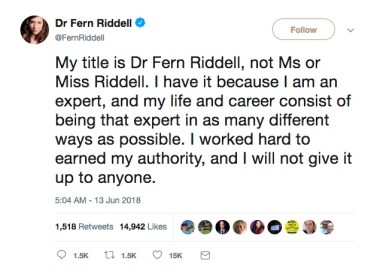

Others joined, as noted in the article, while some folks griped or condemned or just flat-out trolled this idea. I’m sure for some people, who haven’t walked the academic walk, the whole “Doctor” notion can feel like this:

This issue has batted around for years in various social media groups, and I know the hivemind chatted about it a bit ago with folks noting that male professors often got the “Doctor” or “Professor” honorific while female professors got the “Miss,” “Ms.,” “Mrs.” or first-name treatment. I mentioned that I often eschewed the title of “Doctor” because a) I look like a homeless elf half the time, so putting a title on me is like putting prom dress on a pig and b) I never really felt like a “real” doctor.
Which leads us to the origins story of how I came up with “@DoctorOfPaper” and what it means…
When I graduated from Mizzou with my Ph.D., I did the “doctor” thing on graduation night and made dinner reservations under “Dr. Filak” for Amy and me at a fancy restaurant. Later that night, we ran into a student of mine who had just graduated and who was celebrating at a patio bar with her family.
She brought us over so she could introduce us to her mom and sister and everyone else there. During the chit-chat, I mentioned that I had just received my doctorate, which led to this:
Student’s Mom: “So what is your specialty then?”
Me: “Oh, no… I did my Ph.D. I got my doctorate in journalism.”
Student’s Mom: (Pauses before bursting out with laughter) “Wait… You mean… you’re a DOCTOR of PAPER?” (continues to laugh into her alcoholic slushy)
Amy loved that, so whenever she felt I needed to come down a peg or two, she’d remind me I was a “doctor of paper.” It was good-natured ribbing, but the point was clear: When someone’s dying in a restaurant and someone shouts, “Is there a doctor in the house?” I shouldn’t stand up and explain, “Yes! And please allow me to explain how the human surveillance need as part of uses and gratifications theory is why people all over the restaurant are staring at this choking guy.”
Thus, I usually let the whole “Doctor” thing slide with students. That said, one thing that a friend pointed out, which I hadn’t thought of at the time, was that I had the privilege to do that because, as a male professor, students showed me deference up front. For her, she had to fight to get that respect and she wasn’t giving it up for anyone. It’s an important point and a key difference.
Titles can be a weird thing in a lot of ways. A guy my dad worked with used to coach my basketball team from fifth to eighth grade and I always knew him as “Coach Groppi.” When I was about 30, my grandmother died and he came to the funeral. I hadn’t seen him in more than a decade but when he tapped me on the shoulder and said hi, the first words out of my mouth were, “Coach Groppi!” Habits can be hard to break, apparently…
So why is this on a journalism blog and why does it matter to you? Because there are some key things you can take with you as you report and write. Plus, it adds a good critical thinking notion to your thoughts as well as an ethical element. Consider a few points:
- Style matters: When it comes to the simple idea of style, AP has gone out of its way to make things a little easier on you when you write in this area. Everyone gets “last-name-only” treatment on second reference and we eschew courtesy titles for folks up front, including “Mr.” “Mrs.” “Ms.” or even “Dr.” (The New York Times has its own thing with courtesy titles I’ve never understood, so I’m sidestepping that one.) As a writer in a publication that follows AP, abide by the rules in your copy and you’ll be OK there.
- Inequity: Style wasn’t always so “up with people” about how it treated people who weren’t straight, white men. Women in publications used to be referred to as “Mrs. John Smith” as opposed to something like “Mary Smith” on first reference. I remember once seeing a story about a city council action in the 1960s, in which one guy was referred to as “the Negro councilman.” Nobody else had a racial identifier. We discussed the idea of how words create hierarchy and word choice is essential to equality here before. If one race, class, gender or whatever is getting X treatment, use X treatment across the board. The whole goal of style is consistency, but the underlying issue should also be fairness in how you deal with folks.
- The “Mudcat Grant” theory: Jim Grant pitched in the majors for 14 years in the majors, becoming the first black pitcher to ever win 20 games in the American League. He became known as “Mudcat,” he once explained, because some coach at his first Spring Training or Rookie Camp thought he looked like he came from the south, so he nicknamed him as “Mudcat.” Grant said he almost got tossed out of camp because when someone called for “Mudcat Grant,” he just assumed it was someone else. Eventually, Grant had a discussion with the coach about this and explained that it wasn’t his name. “It is now,” the coach, who was white, told the scared rookie. At the end of the day, he dealt with it because he had to but the point is, people deserve the right to be called whatever they feel is most appropriate. We do it with names, as some people go by Vince or Vincent, but not Vinny or Vito. I had a friend who went by his middle name (Andrew) because his first name (Michael) was also his father’s name and he didn’t want to go by “Junior.” We do it with titles, such as university leaders. (I don’t recall a lot of Twitter rage when a university head is called “President Smith,” with people saying, “You’re not a REAL president! Where’s your army, you pencil-necked geek?”)
- Just the smart thing to do: There’s one other thing I liked learning about with Jim Grant’s experiences. He had a simple philosophy: “I try to be nice to everybody.” That’s a pretty good idea for everybody, but specifically for journalists who are approaching people and asking for some of their time. I’m not a person who puts a lot of emphasis on etiquette (I can hear Amy laughing already with the use of “a lot” there…), but when people want something from me, they tend to get further with honey than with vinegar. When students send me emails that start with “Dr. Filak” and then they ask for something, I’m probably more inclined to read on and consider it. When I get the salutation of “Hey Filak” or even once “Brah” (not even a “Dear Brah” or “Dear Dr. Brah.” Just “Brah.”), I’m probably less inclined to read it. Why take a strike against you for no good reason right at the start of the at-bat? When you research the person to whom you wish to speak, look for the Ph.D. and address your email, text or call accordingly. As we noted in the interviewing section, let the source dictate the tone of formality and act accordingly. It’s just the smart thing to do.