The trolling of Gus Walz and the history of people picking on political kids

THE LEAD: Gus Walz, the teenage son of Democratic VP candidate Tim Walz, went viral during the DNC last week for his unabashed love of his father. Gus, who has a nonverbal learning disorder as well as anxiety and ADHD, yelled, “That’s my dad,” before he broke down crying during his father’s speech.

It was a sweet, touching moment of humanity that only took about six seconds for people to start ridiculing online:

Mike Crispi, a Trump supporter and podcaster from New Jersey, mocked Walz’s “stupid crying son” on X and added, “You raised your kid to be a puffy beta male. Congrats.”

Alec Lace, a Trump supporter who hosts a podcast about fatherhood, took his own swipe at the teenager: “Get that kid a tampon already,” he wrote, an apparent reference to a Minnesota state law that Walz signed as governor in that required schools to provide free menstrual supplies to students.


The professional media operatives also decided to get into the act:


Both Coulter and Weber issued apologies of a sort, with Coulter saying she took her post down once someone told her Tim was “austistc” and Weber noting  he “didn’t realize the kid was disabled.”

(SIDE NOTE: It’s unclear exactly how serious to take an apology from anyone who a) doesn’t take the time to spell the apology appropriately, b) takes a shot at a kid and only feels bad when the kid turned out to be “disabled,” or c) uses the term “disabled” rather than learn about the condition the kid he has is mocking.)

A QUICK HISTORY OF RECENT POLITICAL KIDS AND MEDIA: Kids whose parents decide to make a run for the highest office of the land don’t always get the best treatment in the media. I remember a teenage Chelsea Clinton taking a lot of guff in news reports for her “frizzy hair” and “awkwardness.”

The late-night TV crowd got into it as well, with various skits:

An SNL cold opening that featured “Wayne’s World” once took a shot at her that was so bad, NBC edited it out of all the reruns. (Strangely enough, they didn’t edit out the “schwing” the guys gave to the Gore daughters, who ranged in age from 13 to 19 around that time…)

The Bush twins were in their teens when George W. Bush was elected the first time, with Jenna’s “minor in possession” charge becoming fodder for the news reports and tabloids. (SNL mocked the twins as well, but this time had the dignity to wait until Bush was re-elected, putting them in their early 20s.)

Conservative radio host Glenn Beck took potshots at then 11-year-old Malia Obama, as part of a 2010 diatribe about the BP Oil Spill in the gulf,  a move he later apologized for making.

The Obama girls had the misfortune of being in the White House right around the time social media was becoming a thing, so their lives were not just the target of regularly stupid people using traditional media outlets, but also extra stupid ones Facebook and Twitter. In 2014, GOP staffer Elizabeth Lauten resigned after she raked the girls across the coals in a Facebook rant for needing to have “a little class.”

While Donald Trump was in the White House, teenage Barron Trump actually fared fairly well in regard to the media’s mockery machine. Most mainstream outlets considered him to be off limits, and SNL actually suspended Katie Rich for a tasteless Tweet about Barron in 2017.


DOCTOR OF PAPER HOT TAKE: I’m not sure what was worse: Picking on Gus Walz for showing human emotions toward his father or basically saying it would have been fine to mock a 17-year-old kid if he hadn’t had a neurodivergent condition. Both are deplorable, but one seems like it should put you at the gates of hell, while the other seems more like a VIP ticket to hell’s champagne room.

The underage children of political folks really have no agency, as they aren’t the ones who decided to run for office and put themselves in the public eye. When they are adults, they can choose to become more or less part of the public discussion.

Tiffany Trump was more in the background of her father’s political efforts while Don Jr., Eric and Ivanka Trump were part of the Trump political machine. Barron, now that he is 18, chose to be political delegate for Florida at the RNC, which does put him out there for public “discussion.” However, I still go back to the fact that he’s 18 and there should be at least a few guardrails people should consider in “discussing” him.

There aren’t too many hard-and-fast rules about who should or shouldn’t be put in the media spotlight and who shouldn’t but let’s consider a few points:

  • AGE: People we consider to be kids (under 18) should usually be off limits to mockery and punditry. Media professionals often take care to really avoid harming kids or generally putting them through the ringer even if they are tangentially related to a media story. The younger they are, the more protected they tend to be.  (We also tend to protect the very old in society for similar reasons. What makes you “very old” is in the eye of the beholder, but it is something we think about.) I tend to broaden the age range for “being a kid” a bit, with the idea that nobody is their best version of themselves between 18 and 22.


  • LEGAL ISSUES: Crimes open the door to more things being discussed in the media than do other forms of public participation. Thus, if Political Candidate A’s 17-year-old son skipped a class to play the latest version of Madden, leave the kid alone. If the kid crashed a car while driving drunk, started a public fight at a Starbucks or shot someone, that’s getting covered. The degree of the incident, coupled with the age of the participants operate on a sliding scale of debate among journalists as to what to say about whatever the kid has done.


  • COGNITIVE ABILITY AND CULTURAL SOPHISTICATION: Protecting people who are unable to protect themselves is at the core of everything from the SPJ code of ethics to the IRB research dictates. People with cognitive limitations of all varieties should be treated with extreme care when it comes to media coverage. I often extend this to the concept of cultural sophistication as well, given that there’s a huge difference between an 18-year-old kid (yeah, I said kid) who grew up in the spotlight and has been on TV more times than Lester Holt and the 18-year-old kid who grew up in a town of 400 people and never met anyone who wasn’t from that town. How each of those people is able to handle questions from a reporter clearly varies.


DISCUSSION STARTER: What do you think about the media coverage of Gus Walz and the other political “kids” in recent memory? What is or isn’t fair? What should or shouldn’t be out of bounds? What experiences have you had in your life makes you set those kinds of standards?


Help me help you figure out why students use AI to do their work and what it would take to get them to stop

help me help you | HELP ME, HELP YOU! | image tagged in help me help you | made w/ Imgflip meme maker

If you missed Wednesday’s post, we spent a good amount of time talking about what motivates (or deters) students in their use of generative artificial intelligence when it comes to coursework. You can take a look at the ideas behind the motivational theories and how they apply to this issue, but I know the big question is the simple one:

“What can I, as an instructor, do to make them want to do their own work instead of relying on AI to churn out a word salad of content they send in at the last minute?”

This might be the most Pollyanna answer you get all day, but here we go:

“Let’s ask them.”

And this is where I need your help.

I built a Google doc that has two simple questions on it:

  • What kinds of writing assignments do you (or would you) use programs like ChatGPT to do the work for you? What reasons do you have for using the program instead of doing the work independently? (e.g. “I ran out of time,” “I was bored by the work,” “The work was too hard.”) Please expand on your answer as much as you would like.
  • What would motivate you to NOT use generative AI programs like ChatGPT to do your written work for you? In other words, what makes you more willing or able to do the work independently? (e.g. “It would be cheating.” “I’m afraid of getting punished.” “I like what I’m asked to do.”) Please expand as much on your answer as you would like.

(UPDATE: Based on the request of a colleague, I added one more: In what ways have you used AI to facilitate your independent work? How do you wish teachers would allow AI as the tool it could be?)

It collects no private data, it doesn’t require them to log into Google to do it and I’ll have no idea where any of this came from. It’s simply two short answer questions meant to figure out WHY they do (or don’t do) something so we can look for potential solutions based on the research people have done on things like motivation and task completions.

If you want to help me help you, here’s the link:

https://forms.gle/WH9nzpHNT2XbMX5KA

If you have to (or want to) offer extra credit for this, I put a “code phrase” on the completion page you can ask them to give to you.

I’m going to let this run for a couple weeks and see what we get. If we get responses enough to make some soup out of this, I’ll put together something to share with you all a couple weeks after that.

In the meantime, hang in there and keep the faith. We got your back.

Vince (a.k.a. The Doctor of Paper)

What motivates students to use Generative AI and what would motivate them not to?

(The classic scene from “Back to School” that is both outdated and exactly the problem AI presents to us today.)

As most of us have already begun the semester, are headed toward the start of the semester or are in the process of panicking about the semester, we’re booting up the blog to tackle one of the bigger concerns we all seem to have these days.

THE CORE PROBLEM: As the semester began, I started seeing a lot of posts like this one from a friend and longtime college mass com professor:

I am up at nearly 2 a.m., going back and forth about whether to remove a writing component that I’ve used in almost every course I’ve taught over the last 10 years. It’s usually worth 25 to 30 percent of the course grade.
But it’s a massive waste of time to grade writing assignments that have been completed via generative AI.
The alternative? Reading quizzes, blue book responses, heavier emphasis on creative (group) projects, etc. Writing exercises are an opportunity for students to demonstrate the depth and originality of their thought.
The advent of Generative AI seems to be rendering useless a lot of the writing assignments professors have relied on for eons. As students began relying on AI to write their pieces, professors sought AI-detection tools to sniff out the fake stuff, leading to an escalating arms race between improved AI and improved AI detection.
Two years ago, The Atlantic published an essay titled “The College Essay is Dead,” noting that AI would likely challenge our approach to higher ed in ways we were incapable of understanding and dealing with. Journalism professors who once scoffed at this as being more of a “gen ed” problem are now finding AI-written content popping up in their own classes. It has also made several embarrassing forays into the profession itself, with some media chains using it to replace human writers altogether. With AI expanding rapidly to the point in which recorded lectures can be uploaded and integrated into the AI responses and AI helping you to sound less like AI, it can feel like we’re totally screwed.
MOTIVATION TO USE OR NOT USE: I’ve been studying psychological motivation for almost 25 years now and you can find a ton of reasons why people do or don’t do something. I still consider self-determination theory and its motivational spectrum as my bible for such things, including this situation.
Here are the four general motivational pivot points most of us have for doing (or not doing) something:
  • Extrinsic: We are compelled by an outside force to do or not do something. Think of a stick or a carrot as being the sole reason for completing a task: Your parents gave you $5 to cut the grass. Your parents threatened to ground you if you didn’t clean your room. This is the lowest form of motivation and it leads to the worst outcomes overall. This is where “cheating” or corner-cutting usually occurs. So, you pay your little brother $2 to cut the grass and claim the work as your own to get the $5. You take all the stuff that’s messing up your room and cram it in your closet, instead of taking out the garbage and putting the dirty stuff in the laundry etc.
    • NEWSFLASH: This is where we normally are for dealing with stuff like AI, in that we tell the kids in the class not to do it or else they’ll get a zero, fail the class, get expelled or experience whatever this is.
  • Introjected: We are compelled to do something based on motivation that is not entirely ours, but we do it because we feel we have to. Think of guilt or shame as the reason for doing something and you’ve got a handle on this one. You want to go hang out with your friends, but your parents convince you to visit your aunt instead because “she’s probably going to die soon and it would break her heart not to see you one last time.” You don’t feel strongly toward either presidential candidate, but your favorite teacher tells you about “how many people died for your right to vote,” so you cast a ballot.
    • NEWSFLASH: Guilt is a hell of a motivator and this really does work in a lot of cases, particularly for high-engagement people. However, people who are most likely to cut a corner or cheat are those most immune to this form of motivation. In other words, guilting people into avoiding AI for written assignments will work for students who are on the fence about cutting the corner, particularly if there is a strong affinity for you as a professor. However, the people most likely to cut the corner are going to do it, regardless of how much guilt you lay on them.
  • Internalized: We are compelled to do something because we see a benefit in it. Think about a nursing student taking the NCLEX test: They don’t like the test or all the work it requires, but they see value in becoming a nurse and therefore work really hard to pass it. This is one of the better forms of motivation, as the person is geared toward seeing a reason for doing what they’re doing, even if it’s not what they want to do. In short, they own the motivation and value the outcome.
    • NEWSFLASH: This is really the sweet spot for most educators, as it’s more successful than guilt and less Pollyanna than what we’ll discuss next. The underlying issue here is to tell people WHY they’re doing what they’re doing so they can internalize that motivation.
  • Intrinsic: We are compelled to do something because we really like it. This is why my dad sits at the kitchen table for hours doing word searches and why my wife can knit or needlepoint for days without wanting to stop. They really love it.
    • NEWSFLASH: If you can find a whole classroom full of kids that are intrinsically motivated, take a picture for the rest of us.

SO WHY AI? If what we’ve outlined above is true, and about 60 years of research from people way smarter than me says it is, the key to preventing students from AI-ing their homework and calling it good comes down to a few potential things:

  • The work is too hard, so they rely on outside assistance to get it done.
  • The work is too easy, so they figure they’re not missing something by letting AI do it.
    • (NOTE: The concept of flow by Csikszentmihalyi says people are most likely to enjoy an activity and persist in it when the difficulty is just slightly outside of their normal range of ability. In short, if we can feel just a little bit of stretch, we feel motivated to continue. If not, we are bored or frustrated.)
  • Other activities are preferential to the one we use AI to complete.
  • The work provides no inherent or perceived value. (a.k.a. “busy work.”)
  • Lack of repercussions.
    • (NOTE: Carrots and sticks count here, but so does the “So what?” element. In other words, if the kid doesn’t learn about the intricacies of The Council of Trent, what difference will that make in real life? However, if the nursing student doesn’t learn proper titration of drugs into an IV line, they might kill someone.)
  • Other, unknown things we aren’t thinking about but they are. (I’m always amazed at the things I DON’T know when it comes to my students and their reasoning behind doing or not doing something. This includes everything from having seven roommates and one bathroom to getting a ton of tattooing, despite telling everyone how broke they are. This is a true consequence of being old, I imagine…)

So the question obviously is, what is the best way to go about trying to figure out what to do about AI based on all of this.

In tomorrow’s post, I’ll give this a shot, but I’ll need your help.

A dog-gone good end to a ridiculous and weird year

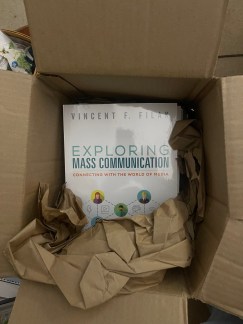
My friend’s dog, Bo, got a chance to assess the “Exploring Mass Communication” text. Add “dog bed” to “coffee coaster” and “door stop” on the list of uses for my books. (Photo courtesy of Bryce McNeil)

In closing off the blog for this academic year, I have to admit, I have not looked forward to a summer quite as much in recent years as I have looked forward to this one.

Maybe it’s because we started later so we’re finishing later.

Maybe it’s because May is finally pretending to be part of summer around here, so we’re not getting 42-degree days with a chance of sleet.

Maybe it’s because this year, 1 in 6 employees here got canned,  the university system decided to put our UWO Fond du Lac branch on hospice carethe chucklenut who basically runs the statehouse decided to greenlight every state employee pay raise except for those in the university system. The reason? Apparently we’re indoctrinating kids with the idea that empathy, equality of access and basic human decency should be valued.

Could be anything…

It’s easy to become negative at the end of a semester like this. However, I remember reading an interview with Keith Richards of the Rolling Stones once where a journalist asked him about the totality of his life in the World’s Greatest Rock and Roll Band.

He said that he didn’t think about it every day or even every week, but occasionally, he’d be on stage playing the same songs he’d played forever and it just felt great. Wave after wave of people made up a packed audience in an arena or stadium and they’d be singing along.

“And just then,” he said. “I’d think to myself, ‘Jesus, what an incredible band.'”

This semester included some truly incredible moments that to not remember them or thank people for them would be disingenuous.

It’s really real! Just ask Bo!

For starters, the Exploring Mass Communication book finally hit the market. This was one of those projects that kept growing, changing, developing and more to the point I honestly wondered if it would ever see the light of day. Somehow it did and it seems like at least a few people like it, so I’m grateful to you all.

It’s a real pain in the rear to revamp an entire class to account for a new textbook, especially one that’s a first edition. My promise to you remains solid, though: I’m here for whatever you need.

And if you’re interested in getting in on the fun, remember, I still have a T-shirt with your name on it. (OK, it’s my name, but that was more metaphor…)

Speaking of T-shirts, I found out that people outside of my university seem to have more of a use for me than those inside of it do.

When the university decided to furlough me for 11 days, I decided to pull a “John Oliver-esque” move and offer to help people at various universities as part of the “Filak Furlough Tour.”

When I pitched it, I assumed it would fall flat, as I have both the promotional appeal of a gecko-flavored lollipop and the smoothness of tartar sauce. However, it became the most popular thing I’ve done in a long time and it was an absolute JOY to see all those folks in Missouri, Illinois, Indiana, Iowa, Kansas, Florida, New Jersey, Delaware, Texas, Ohio, Maryland, Colorado and more.

I have to specially thank Julie Lewis of Central Missouri and the entire crew at Iowa State University for their hospitality when I drove out there to spend several days with these folks. It was really great feeling like what I was doing mattered enough for you to give up large chunks of your week in class as well as stockpile some Diet Coke for me.

Speaking of people who thought I had something to say, I was absolutely floored when I found out that the Scholastic Journalism Division of AEJMC considered me as a finalist for the Honors Lecture at this year’s convention in Philadelphia.

When I looked at the list of finalists, I went back in my head to my first conversation with the legendary scion of the Columbia Missourian, George Kennedy.

In interviewing me for a job, the first thing he said to me over lunch was, “I’ve got four people up for this job, and everybody is more qualified than you are.”

That was true here again, and there was no shame in losing to any of the other people up for this honor. That said, it looks like I’m going to Philly:

I also found out around that time that I was a finalist for the Oshcar Awards here at UWO. The athletic department honors the best of the best across all sports at this Oshcar event, so clearly I’d never heard of this thing, nor thought I would be at it. However, the department honors one person with an “appreciation award” for supporting student athletes in a variety of ways. It turned out the volleyball coach and team nominated me and I made the list of finalists.

No, this is not a Russian gangster named Dmitri. It’s volleyball coach Jon Ellman, a man I’m grateful I’ve been able to work with over the past several years as his team’s team fellow.

I didn’t win and the person who did win really, really deserved it. Even with the loss, it was the happiest I’ve ever been to be somewhere it was ridiculously obvious that I was the slowest, weakest and least coordinated person in the room.

As the term ends, I’ll be finishing the revisions to the third edition of “Dynamics of News Reporting and Writing,” and starting the revisions for the fourth edition of “Dynamics of Media Writing.” Sage seems to have continued faith in me, and that’s really all thanks to you folks. It’s a wonderfully strange feeling when I run into folks I’ve never met in person, only to hear them say, “Hey, I use your book in my class!”

(It really does, however, feel like I’m a total tool when I have to say, “Thanks! Which one?”)

I don’t know what next year holds, as things here have the potential to get better and/or worse at the same time over the summer. If that sentence doesn’t make sense to you, clearly, you’ve never worked in a university setting.

What I do know is that I’m grateful that things ended on a high note, that I’m still here blogging and that I’ve got a great summer to look forward to.

After the usual break, we’ll be back for the summer weekly schedule in mid-to-late-June, barring a disaster.

Have a great summer.

Vince (a.k.a. The Doctor of Paper)


It’s time to do the “but I need a better grade” dance again… (A Throwback Post)

It’s about this time of year that I realize I’m apparently a lot funnier and a lot more intelligent.

The email salutations have turned from “Hey,” to “Hello Professor” to “Dear Almighty Master of Wisdom and Knowledge…”

I am also definitely much more handsome, striking and engaging, almost to the point of being an immortal being.

Yep, grades are coming due and some folks realize they’re screwed so here comes the suck-up.

The bi-annual dance between students and professors begins once again, with finals week upon us. With that in mind, today’s throwback post takes a look at both sides of the discussion as we try to survive just a teeny, tiny bit longer…


Translating “The Dance” between professors and students over final grades

As the term winds to a close, students and professors engage in what I refer to as “The Dance” over grades. It’s a tactical, nuanced discussion that involves trying to beg without it looking like begging, trying to answer an email without promising anything and basically engaging in nuclear-treaty-level diplomacy. If we were all trapped in a “Liar, Liar” world, it would essentially look like this:

Student: Pass me and stop being a jerk, you asshat.

Professor: Oh, now you care about this class, you little twerp? Go to hell and take a left.

However, since we have to “Eddie Haskell” it on both ends, here are the legendary begging statements I’ve gotten from students over the years or variations on those themes provided by the hivemind. I’ve added a few “internal thoughts” your professors have had over the years when it comes to responding to these pleas. Enjoy:


“Could you just add XX small points to my final grade?”

First, all points are created equal. Second, that figure has ranged from 1 to about 100, depending on the level of desperation. Third, when you kept doing the same stupid thing over and over again because instead of reading my comments, you just looked at the grade and thought, “Screw you, dude” you might not need those “small points.”


“I’m graduating this term…”

Not if you need to pass this class, you’re not.


“Is there anything I can do?”

Can you invent a time machine, go back in history and tell the earlier version of yourself to turn stuff in on time, not skip every third class and generally give a better overall performance than a disinterested Jay Cutler on a trick play? If not, no.

OR

Prayer can help, although I’m not certain how strong God’s will is to help you out here.

OR

Sign up for the next semester I teach this class and give a crap a little sooner in the term.


“Is there extra credit?”

Sure, because when the syllabus said, “There will be NO EXTRA CREDIT in this class, so plan accordingly,” I clearly included a loophole for people who didn’t care about anything until the very moment they realized they were screwed.


“Could I rewrite (half of the assignments) for additional credit?”

Sure, because nothing says, “I’m ready to do a good job,” like not doing a good job on anything all term and then expecting to make all of that up in 72 hours before grades are due with no real interest in learning anything other than how many points you need to slide by.


“Could you bump me up just this little bit?”

Sure, because I’m sure that won’t tick off the six other people in your class who sweated bullets to get a passing grade through hard work on that assignment you blew off to go to Cabo and party on the beach.


“Could you possibly round me up?”

I could. Now ask me if I will. Welcome to the grammar lesson you skipped.


“I had some issues this semester…”

Yeah. No kidding.


“Your class is very important to me…”

Um… I believe a lot of things people tell me to make me feel better about myself. This isn’t one of them.


“I don’t understand why you downgraded me…”

You mean the page and a half of comments I included in the body of your paper didn’t clue you in that this random series of unattributed content, fragmented sentence, shifted verb tenses, incorrect word choices and cripplingly bad structure didn’t help? This wasn’t a news story. It was a disaster movie filmed out of sequence.


“This isn’t fair that I should have to take your course over again.”

It isn’t fair I had to grade this pile of sheep dung you referred to as “completed assignments,” but we all have our crosses to bear, I suppose…


“I need (A/B/C grade) to (pass/maintain my scholarship/keep my ego afloat)…”

This is not Burger King. You don’t get it your way.

Filak Furlough Tour Update: Hanging out with Wichita State University and The Sunflower Staff

Repping my Sunflower T-shirt for the Sunflower staff at Wichita State University. A nice photo of the group, although I never photograph well. I think it’s that my eyes always look closed and my mouth always looks open. It’s like a demented baby bird or something. (Photo courtesy of Amy DeVault)


The Filak Furlough Tour’s final stop of the year is the one I was most excited to make. Amy DeVault at Wichita State University is a great friend and colleague. She advises the Sunflower, the student newspaper there and does an incredible job with some incredible students.

I also have a history with these folks, in that we were blogging about the little …. um… people in student government a few years back trying to slash the paper’s funding and kill the publication. In the end, things worked out well, but I’ve always had a soft spot in my heart for the underdog in the fight, which is why I will always do anything I can to help The Sunflower.

Wichita State University — WICHITA, KS

THE TOPIC: The folks there wanted a basic critique of the newspaper itself as well as the opportunity to do some Q and A stuff, so that’s what we did. I had a chance to see the publication a couple times over the years, including a recent review of it for the Kansas College Media contest.

BASICS OF A CRITIQUE: If you want to see a really great, well-rounded news publication that covers its niche well, grab a copy of The Sunflower. They have a great mix of big pieces and small news bits. They have a strong collection of writers, photographers, designers and graphics folks. I loved a lot of what they did, so I made it clear that pretty much any critique was of the “here are some polish points” variety as opposed to a “Dear LORD do you need a wrecking ball and a blowtorch to get this thing into shape” collection of grievances.

Here are some observations I hoped might be helpful to them, and might also be helpful to you all as well:

  • Size versus value: In some cases, stories can get out of hand a bit, particularly when it comes to pieces that feel investigative, but don’t really add up to a lot. For The Sunflower, one piece in particular had a lot of content to it, but it really didn’t add up to a lot. The story looked at allegations of racial animosity during a rec center basketball game. The reporter dug into every allegation and every explanation offered to counter them, but in the end, the story was basically that a couple dudes got out of control playing basketball and nobody could fully corroborate either side of the argument.
    The story could easily have been cut significantly to reflect that reality and the graphic used to create the front-page centerpiece didn’t really add a lot to the storytelling either. This is one of those cases where the size didn’t mirror the value of the piece. It can be tough to see a lot of hard work essentially amount to less than we would hope for as journalists, but it’s worth remembering that the readers need to see value if they’re going to invest a ton of time in a piece. Whacking the hell out of something can be painful, but your readers will thank you.


  • Keeping it local: Overall, there was a TON of great local coverage in the publication. My only minor grouse was a common one on the arts/entertainment page: movie and music reviews. If you can give people something they can’t get anywhere else, fine, do those reviews. If not, leave that stuff for the IMDB’s and Richard Roepers of the world and go cover some local bands or some local theater.
    If you’re asking yourself, “OK, so when WOULD I do a movie review?” my answer is an example from a student paper I critiqued years ago. The paper was from a small religious school out west and it reviewed the movies from the perspective of the faith base. The reviews noted how much violence or sex or whatever was in there and how people who practiced certain levels of the faith’s orthodoxy might be more or less offended by this content. I’m not getting that level of clarity on Rotten Tomatoes.


  • Use your voice: The opinion page was solid, and it’s often difficult to critique an opinion page, because it’s often at the mercy of whatever is going on around you. When the paper was under attack all those years ago, the opinion page thundered against the stupidity of the student government with the fire of a white-hot sun. That’s not always possible to do when you’re faced with some “meh” news days. Even more, it can make things worse if you’re trying to gin up some false-front rage for the sake of feeling like you’re wielding the power of the press.
    That said, I did note that they shouldn’t be afraid to go in the corner and fight for the puck when news merits their viewpoint on behalf of the student body. If something needs to be called out, it’s the publication’s duty to use its voice effectively to do so.

PICKING FILAK’S BRAIN: Here are a few of the things that came up in our time together. The questions aren’t direct quotes, but more of the general gist of what we were going after. Answers fit the same pattern:

QUESTION: What kind of balance do you think should be present in the publication between the kinds of things people like and the things people need? Is there a percentage split on something like this?

BEST ANSWER I COULD COME UP WITH: I’ve had a version of this question in a number of other stops on the tour and throughout my time working with student media. What I’ve tried to convey is that ALL information should be geared toward things that provide value to the readership, whether that value is in the form of entertainment, editorial insights, informational alerts or knowledge-building content.

What tends to happen is that we present content without a strong sense of WHY readers should care. In other words, people tend to blow off the “newsier” stories because as writers, we don’t make a strong enough “this matters because” statement for them.

My suggestion, therefore, is to worry less about trying to get people to eat their vegetables by force-feeding them dry news pieces and worry more about trying to make those pieces clearly personally relevant to the readers so they’ll be drawn to those stories.


QUESTION: What does it take to make a profile really work well as a profile and not feel so blah?

BEST ANSWER I HAD AT THE TIME: A lot of profiles fall flat because they lack observational elements that add flavor and meaning to them. The SCAM model can help you better find ways to capture the setting, character and action of your source through spending time with that person. You can then convey meaning by making sense of how those first three pieces work together to inform the readers about the overall “vibe” of this person.

You don’t have to describe every hair on the source’s head, all the way down to the worn heels on their cowboy boots to do a good job of describing a person. In fact, the opposite is almost always the case. You need to paint a word picture so that I can see this person in my mind’s eye while I’m reading the story. That can be their physical presence, if that’s crucial to the story. It can be their emotional presence, if that matters more.

Case in point, I was reading a profile today that one of my kids wrote about a young woman who is on a national-championship-winning gymnastics team here at UWO, while also having committed to the Army ROTC program. The programs seem ridiculously disparate: One requires individuality, and glitz, while the other required uniformity and plainness. Gymnasts tend to be tiny and Army folk tend to be giant. So, to more fully understand how that worked in one person, we needed to have a physical sense of this kid.

In another instance, the person was describing a religious leader who used his own struggles with faith and his practical nature here on Earth to help others find their way. In this case, whether he was giant or tiny was less important than the emotional interconnectivity he displayed in life.

Whatever route you go is fine, but you need to do a lot of observation of that person to truly capture the source’s essence and communicate that effectively to the audience. In doing so, you can focus less obsessively on getting every detail about the person’s life in there, like you’re crafting a resume.


QUESTION: The people around here in the upper reaches of power tend to like to route everything through the marketing department or just issue statements when we want interviews. How do we get around that kind of thing?

BEST ANSWER I COULD COME UP WITH: This is a trend with a lot of folks, and it happened here as well for a while. The general consensus is that if you don’t actually do an interview, you can’t say something stupid. This is supported by the idea that statements get about 23 people revising them before they go out to the public. Meanwhile, a mouth can yield a lot of problems when someone forgets to put their brain in gear before opening it.

The problem with statements, other than the general reek of bovine excrement that wafts from them, is that there is no chance to ask follow-up questions, refute basic assumptions in them or generally cut through the fog of obfuscation they offer. Thus, getting the interview is vital to making sense of some things reporters are covering.

I argued that you should always push back against the statement approach and track people down who decline to respond to your email requests. The university leaders have offices. Go there. Professors have teaching schedules. Track them down after class and walk with them. Set up camp outside their faculty office or generally be a persistent pain in the rear end. If they refuse to answer questions, turn THAT into part of the story:

“Professor John Smith refused to engage with a reporter who met him after class, instead saying he would ‘have someone issue a statement on the matter.’ When the reporter noted that a statement would be insufficient, Smith went from a slow walk to a brisk trot toward his office. He quickly entered and slammed the door behind him. Knocking to rouse him was unsuccessful.”

In short, as I said to the staff, “Tell the administrators, ‘You mean to tell me that someone of your educational level is afraid of an undergraduate student who works for a newspaper named after a pretty yellow flower? Come on!'”


FIN: And that’s where the Filak Furlough Tour came to an end. Thanks so much everybody for letting me be part of your lives and for making my furlough fun.


Filak Furlough Tour Update: Hanging out with McPherson College

As we finish off the 2023-24 tour, I’d like to say thanks again to Brett for this awesome logo.


The Filak Furlough Tour’s spring stops kind of ended up all over the place. That said, I managed to catch up with all the folks who still wanted me to make a stop by before the end of the term. Thus, as promised, we’re finishing out the year with a post for each stop.

(And yes, to answer the question I got the other day, you’re still getting your bats. I just need to hit a few rummage sales to do some scrounging, as apparently, my bat supply was depleted by you all being awesome people.)

Onward to greatness…

McPherson College — McPHERSON, KS

THE TOPIC: The request here was pretty simple: Talk about journalists as investigators and how journalists handle trauma. “Both super-light topics, I know,” professor Julia Kuttler said in her request email. I think both are great topics, so we’ll give them both kind of a shot here.

THE BASICS OF INVESTIGATION: I love students who are inherently nosy and the opportunity to shape that nosiness into something that can lead to improved journalism. I was meeting with a prospective student and her mother recently and I found myself telling them about the program and various other things. The mother mentioned several schools they were considering, and I often praised a lot of what they had going for them. Then, she mentioned one school with which I had significant experience and I noted that I probably wouldn’t recommend it.

Both the kid and the mom immediately asked, “Why?” with the enthusiasm of my dog seeing the UPS truck pulling into the driveway.

I tried to back away from that a bit, as I didn’t want to come across as crap-talking a program, even if I was being totally honest. The kid stayed  on me, with more, “Why” questions until I gave her a decent answer. (Or at least one that satisfied her curiosity.) I then looked at her and said, “You’re going to be a hell of a journalist, no matter where you go. You’ve got that nosy gene in you that will lead to some great investigative stuff.”

This was kind of the core of what I was trying to convey to the kids at McPherson about investigative work: If you can be engaged and interested, while being undeterred by people who clearly are looking to dodge your questions, you’ll be great at it.

To further explain it, I went back a bit to what I learned from investigative journalist (and former student) Jaimi Dowdell’s work on the FAA and the “Secrets In The Sky” pieces that earned her and co-author Kelly Carr the 2018 TRACE award for investigative reporting. You have to be nosy, you have to be interested and you have to be willing to keep pecking away at a topic until eventually “if we figure something out” becomes “when we figure something out.”


THE BASICS OF TRAUMA: I don’t think I’m alone in that I don’t like thinking about the concept of “trauma” in terms of what journalism has shown me. Or, in some cases, maybe done to me. The truth of the matter is, however, when you see enough of something that is outside of what normal people experience, it is going to mess with how you view the world.

That could be watching a ton of  local news coverage that paints your town as a violent, scary place, which leads you to overestimate your area’s lack of safety. It could be watching a ton of biased political coverage, which leads you to think the world is going to be a lawless hellscape if the “other side” wins the election. It could also be watching a ton of porn, which erroneously convinces you that every pizza delivery guy or plumber is likely to score with a lonely housewife on every house call.

It wasn’t until I started working at various universities, where I was asked to review other people’s classes, that I realized I was some sort of traumatized outlier when it came to my journalism experiences. Guest speakers and veteran journalists were talking about interviewing political figures or reviewing budgets or digging through data sets to find stories. They talked about how they incorporated their profile-style interviewing techniques into their daily journalistic stories to add depth and feel to pieces.

And I’m there thinking, “OK… so why do about 80% of my stories start off with something like, ‘So there was this drunk guy driving a car who ran over a kid on a bicycle and dragged him about half a block…’ instead of having something like those experiences?”

Also, why was I able to pretty reliably remember the name, age and cause of death of every dead kid I ever helped cover?

And why is it, I can still see the body of a 73-year-old woman, who had been set on fire, lying on a lawn, clutching a stranger’s hand as she fought for life and waited for an ambulance?

I’d like to say I just have a good memory and a penchant for war stories, but if I’m being honest, it’s probably because my job scrambled my mind a bit and left me with some ugly brain scars.

The best thing I could tell these kids about trauma is that we now recognize it. The Dart Center is a great resource for journalists who find themselves covering some messed up things. Editors are more attuned to this kind of thing today as opposed to even 25 years ago. The idea of “have a drink to take the edge off” isn’t viewed these days as preferable to talk therapy and other forms of self-care, something that wasn’t the case in previous generations.

In the end, you can’t really avoid it if you spend enough time in journalism. You will eventually run into something that messes with you. However, we have a lot more tools in the toolbox to deal with it once it happens and we’re better at preparing people for it before they see it.

NEXT STOP: Wichita State University.

Journalism, Journalism Education and Generative AI (Part III: The Human Factor)

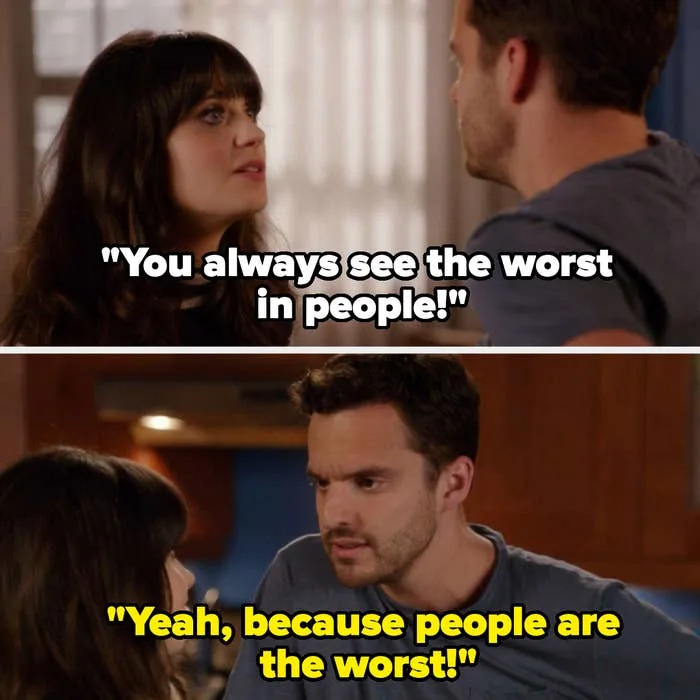
Screenshots from "New Girl"

If we could translate this into Latin, I think we’d have a replacement for the journalist’s motto.

Since AI isn’t going away any time soon, journalists and journalism educators are in a bit of a bind when it comes to how best to use it or to help students use it appropriately. This week, we’re doing a three-part series on the blog this week that take that “overhead” view of generative AI from three key angles:

You can click on the links above for either of the first two parts. The final part is below and a lot more complicated: The human factor.

As we’ve noted before, generative AI is a tool. As such, it can be used for good things or bad ones, based on the person using it and why they’re using it. Let’s consider a few aspects of human nature that can help make AI a useful friend or a mortal enemy:


WHAT’S MY MOTIVATION?: One of the luckiest breaks I ever caught in life was getting into a psych course on human motivation as part of my doctoral program. It not only hooked me up with Kennon Sheldon, a professor with an incredible history of publishing important psychological studies, but it also helped me to better view how people choose to act or not act based on motivating factors.

One of the aspects of self-determination theory (SDT) we looked at was the spectrum of motivating factors that influence people. As it is a continuum, it has a wide array of motivational forces, but scholars have identified four key “stopping points” along the spectrum that capture specific forms of motivation:

  • Extrinsic: You are motivated by an outside force to do something that you otherwise wouldn’t want to do. An example of this might be when your parents told you to clean your room or you would be grounded for the weekend.
  • Introjected: You are motivated to do something through coercive actions of others, such as guilt or shame. An example of this might be skipping a concert you want to attend so you can visit an elderly relative in a nursing home because your parents told you, “Well, she probably doesn’t have much longer to live and I KNOW how hard it would be for you to live with yourself if you didn’t at least see her a few more times.”
  • Internalized: You are motivated by finding value in the outcome of an activity, even if the activity itself isn’t all that enjoyable. An example of this would be a nursing student studying really hard for the NCLEX test. They don’t like the idea of the test, but are motivated by their desire to become a nurse, which requires them to pass this test.
  • Intrinsic: You are motivated by the natural joy of the activity. This is the purest and best form of motivation. An example of this would be Amy and her approach to knitting. She never seems to care if she finishes a project, but rather she enjoys the act of knitting as well as the joy she gets from trying new patterns, new yarn and new needles.

In looking at this, it’s a pretty safe bet that most of what students do for classes in a lot of cases comes down to extrinsic motivation, as they are required to write essays, do assignments and take tests because someone else is forcing them to do it. (Insert your favorite joke about Gen Ed classes here.)

When forced to do something, people will take the easiest way out possible, which is where generative AI comes in. If the only goal is to “get through” whatever someone is forcing you to do, you’re going to let AI take the wheel and just get it done. This is particularly true for those 800-person pit classes, where students figure they have a pretty good shot of getting away with it.

Helping students find motivation to do things that will benefit them in both the short term (pass this class) and the long term (get a better career) will be enough to move them toward a more self-motivated state.

This leads into the second human issue…


THIS MATTERS BECAUSE: We have found that people are more likely to value things if they have an understanding as to why these things are supposedly important. In short, “Why do I have to do this?” A key part of motivational research is what is called autonomy support: If you can give people choices or at least explain why they have to do something and that a choice isn’t possible, they tend to adopt the motivation as their own and do better at it.

When you give them a “Because I’m a PARENT, that’s why!” answer, well, they tend to really hate it and extrinsic motivation rears is ugly head.

I had this discussion/argument with people from our history department. The university was cutting several requirements that were making it difficult for kids to graduate on time and/or with multiple majors/minors/certificates.

One of the “forced classes” was a history one, and I overheard the history folks talking about the situation. One person thought it was a good thing, because maybe the kids would then find history on their own and choose it for a minor. A senior faculty member argued this would be a disaster because, “The kids will NEVER choose us.”

I nosed my way into the conversation and asked to what degree they explained the value of their specific classes to students who were taking them. The senior faculty member was offended: “How could you ask such a thing? Do you think history DOESN’T have value?”

Um… No… but if that’s how you approach your classes, I understand why the kids might feel that way.

The more I kept trying to explain that if you want the students to value something, you have to tell them why they should value it, the more I seemingly upset this man. Apparently, in his way of thinking, history is so damned important and he was such an expert-level vessel for this knowledge that there was no need to provide a rationale for the coursework he put forth. At the end, I left him with this:

“I know that kids can take my class because they want to or because they are forced to. Either way, I make sure to tell everyone what we’re doing, why we’re doing it and what value it has to them in moving forward in their lives. They may still dislike the thing I’m making them do, or they may disagree with my assessment of the situation, but they at least understand the ‘why’ and that tends to make them more willing to do the work than to try to weasel their way out of it.”

Understanding what motivates people to do (or not do) things can help us figure out how to help them use AI without abusing AI. Help them understand why they need to do an assignment, or understand a form of writing or complete a task and they’ll likely find a way to buy into your argument.

If we CAN’T show them a “why” answer, maybe that says more about what we’re doing wrong as educators than what is wrong with “kids today.” Is that 10-page paper really helpful to the kid, or are you just so used to grading them that it would be an inconvenience to you to change? Is the textbook you are using a good one, or do you not want to revamp your whole class and redo all of your lectures, so you stick with what you have? Is the kid really losing out on some major life skill or element of citizenry if they let AI take the wheel on an assignment, or is there a better way to make AI part of the process?

Logic has a lot to say about helping people find value in what they need to do and becoming motivated to do the right thing. Unfortunately, logic isn’t always in driving the bus, which leads to the last element…


PEOPLE ARE BASIC:  We can talk about this from a variety of angles, but the long and short of it is that humans are base-level creatures in a lot of ways.

Our minds are geared to be “cognitive misers,” which is why we find ourselves in mental ruts and often relying on stereotypes to make sense of the world around us.

We are social animals, which leads us to social dominance behaviors that tend to have some folks trying to assert their high value over other, “less valuable” individuals within the collective. If you don’t believe me, hang out for three hours in a middle school classroom and get back to me.

We’re also driven by some baser instincts in regard to our physiological needs. Or, to quote Jeff Foxworthy, a lot of people would like to get a beer and see something naked. (Pretty much every technological development related to media in the past 50 years has in some way gotten either a significant start or a major boost due to that base-level drive for naked stuff.)

Generative AI takes these base-level human drives and supercharges them in a way that other forms of technology haven’t. Whether it’s trying to prove dominance, trying to be lazy or trying to a pervert, AI puts it all and more at the fingertips of the worst among us.

AI chatbots have been linked to false claims of harassment by political figures in New York. Why would anyone think to do a prompt for the chatbot that included the term “sexual harassment?” There’s not a good argument in here, other than some idiot saying, “Hey, y’know what would be HILARIOUS? Ruining someone’s life!” (Here’s a link to a trailer for “The Anti-Social Network” that pretty much encapsulates the whole process by which general dumbassery becomes a toxic weapon when added to a digital platform.)

This is why you have stories like this one about a MIDDLE SCHOOL in California, where students were using AI to turn images of their friends into nude pictures. Or like this one about the students at a CATHOLIC HIGH SCHOOL using AI to create naked photos of their peers. Y’know, just like Jesus would have done to Mary Magdalene, if he had the technology…

Even pedophiles are getting in on the act, which is the start of a sentence that never ends well…

As with most things in the world, the worst among us will use AI to do some godawful stuff. I’m not sure we can avoid that, but we do have a need to instill in the other 90% of the world the reasons NOT to be like those folks.


DOCTOR OF PAPER HOT TAKE: Every time I think of what AI could be used to do and what it’s ACTUALLY being used for, I go back to this scene from “Idiocracy.”

The issue remaining for journalists and journalism educators is how do we go about making AI the tool in the toolbox it can be while avoiding the perils of a society that is slowly riding a Dumpster fire to hell.

The question we need to answer is this: What kind of coherent argument can we, as journalism instructors, make to the students who are in our class that it is in their overall best interest to do the work we assign them instead of letting a machine do it for them? And, how can we present that argument in a way that they will understand it, agree with it and motivate themselves to abide by it, in the face of the human frailties we’ve discussed earlier?

I don’t have an answer for this, but if you figure it out, please post the answer below.


Journalism, Journalism Education and Generative AI (Part II: The Perils of Generative AI)

Thinking is hard But you get used to it De motivation, us,demotivation posters,auto

Since AI isn’t going away any time soon, journalists and journalism educators are in a bit of a bind when it comes to how best to use it or to help students use it appropriately. This week, we’re doing a three-part series on the blog this week that take that “overhead” view of generative AI from three key angles:

    • The tools
    • The potential perils
    • The human angle

We covered the tools in Monday’s post, so if you missed it, you can catch it here.

As for today, let’s consider the perils of generative AI:

WE LOSE SELF-SUFFICIENCY: I will never disparage the concept of technological advances. Microwaves have allowed me to feed myself from college up to this morning without burning down my humble abode. Seat warmers have kept my rear end from flash-freezing to those leather-ish seats of the Subaru on most winter mornings in Wisconsin. The implementation of whatever stretchy stuff they’re making blue jeans out of these days has allowed me to keep fooling myself that my size hasn’t changed over the past five years.

Even as a journalist, I’m grateful that recorders have allowed me to significantly reduce the scrawl and shorthand I used to use while interviewing folks. Google has made it exponentially easier to ease my paranoia when I write something and then think, “Wait… are you SURE that’s right?” Even better still, I am entirely grateful that I no longer have to hold a piece of correction paper in between my teeth while banging out a story on an IBM Selectric typewriter, as I did back in high school.

The problem is that when we become overly reliant on technology, we are at the mercy of its functionality and lack the ability to cope when it fails. I’m not even talking about that “everything will cease to exist” failure. I’m talking about basic stuff that used to be common sense until computers just did the work for us.

(The analogy I immediately think of is my dad paying at a fast-food restaurant with cash. The kid punches in the total and it’s like $11.28. Then, Dad will say, “OK, here, let me give you three pennies to make it easier” after the kid assumes Dad’s just giving him a $20. Watching this kid try to do the math in his head because of those three frickin’ pennies is enough to make you weep for the future of humanity.)

Back when I was in doctoral school, the stats professor I had for my analysis of variance class made us do all the statistical calculations for an ANOVA by hand. This took forever and a day and ate up about 10 pages of notebook paper for each one. When we bitterly complained that we’d be using a computer to do this in a fraction of the time, he’d tell us, “Yes, but if you don’t know how to do each step, you’ll never know why it works the way it does. You’ll also never know if the computer is right or not.” As annoying as it was, I can still just look at an ANOVA result and figure out if I punched something in wrong, thanks to Dr. Osterlind.

There has always been an effort-free default option for everything, even back when you were learning to tie your shoes. If mom or dad was in a hurry, they’d say, “Here. Let me do that.” OK, fine, but if they never let you learn how to do it for yourself, you’d be totally screwed at this point. (Or into cowboy boots, shower shoes and a lot of velcro.) Some level of self-sufficiency has to be built into the process.


WE DON’T KNOW WHAT’S IN THE AI “BOX:” One of the biggest complaints I get about my intro to writing class, other than I keep having it at 8 a.m., is that I make the students buy the print edition of the AP Stylebook and read the whole thing. Random assignments and quizzes are part of the check-in approach I take to seeing how well this is working.

Students find out that for about the same amount of money, they can buy a digital version that provides them with a search-engine function, so they want that one instead. I tell them, “Once you move into the upper-level classes, that’s an option. Until then, you’re reading the damned book in print.”

My rationale is pretty basic: If you don’t know what you’re looking for and you don’t know if it’s in there, you’re at a disadvantage when it comes to finding it. Thus, if you read the book, you get a handle on the things that AP gets all hot and bothered about and thus you are making mental notes about the kinds of things you should look up. At that point, a search function is your friend, not a game of “Wheel of Fortune.”

Generative AI is pretty much the same thing: If you don’t know what’s in the “box,” you have no idea what to expect will come out of it.

Here’s an example of what I’m talking about. I entered a simple prompt that I figured a student in an entry-level civics class might toss in to avoid writing a short, basic essay:

“Write 200 words on how to deter criminal behavior”
Here is what ChatGPT came up with:

Deterring criminal behavior involves a multi-faceted approach that addresses the root causes of crime, enforces strong laws, and promotes a sense of community responsibility. Here are some key strategies to achieve this:

  1. Education and Awareness: By investing in education and awareness programs, communities can help individuals make informed decisions, reducing the appeal of criminal activities. Teaching ethical values and social responsibility from a young age can create a culture where crime is less likely to occur.
  2. Economic Opportunities: High unemployment and poverty are strongly correlated with crime rates. Providing meaningful employment opportunities and vocational training can reduce the incentive for individuals to engage in criminal activities.
  3. Strong Law Enforcement: A robust and fair law enforcement system is crucial. Visible policing, quick response to criminal activities, and the consistent application of justice can act as a deterrent to would-be offenders.
  4. Community Engagement: Encouraging community involvement in safety and crime prevention fosters a sense of ownership and shared responsibility. Neighborhood watch programs, for example, can help deter crime by creating a community that looks out for each other.
  5. Rehabilitation and Support: Implementing effective rehabilitation programs for offenders reduces recidivism. Offering support services like counseling, education, and job placement helps former offenders reintegrate into society, lowering the chances of repeat offenses.

By combining these strategies, communities can effectively deter criminal behavior and create a safer environment for everyone.

I have no idea where this all came from or why it went this way in terms of answering the question. I don’t know from which sources of information it drew its inspiration or how it decided to approach the topic in this fashion. I also have no idea if there are better or worse answers in there.
If all I know is that I wanted an answer to turn in for an assignment, all I know is that ChatGPT provided me with this answer.
As someone who has looked at various resources and looked into this topic before, I find it interesting that when prompted in this nature, chatbot made a couple key choices:

This leads to another primary concern associated with generative AI…


BIAS IN, BIAS OUT: The way AI platforms are trained is by exposing them to tons of content from a vast array of sources in which it kind of picks out a “prototype” of each element it can ascertain from what it has “seen.” The problem with that is the more mainstream content is likely to dominate while the less mainstream content is likely to get shoved aside.

In addition, just because something is shown or written about in a certain way, it doesn’t necessarily follow that it should be a representation of a larger thing. This is how stereotypes are built and reinforced. Consider the following image creations based on several prompts:

A server at a restaurant:

A criminal in court:


A basketball player passing a ball:


A boss of a company at a podium:

(In the future, you will all be ruled by this one white dude. To be fair, the iStock paid generator did slightly better, but not great.)


I tried these prompts with multiple AI generators and these were pretty much the standard fare. Notice we’ve got all fit and relatively attractive looking people in here. The servers are all young and female. The criminals aren’t white, and neither are the basketball players. (To say nothing of the fact only one of them is passing and one of them has two basketballs for some reason.) Bosses are predominantly male and in at least in one set of responses all white and young.

Authors T.J. Thomson and Ryan J. Thomas at The Conversation found similar problems in an assessment of AI, noting that the image generators demonstrated biases from racism and sexism to ageism and classism. As more and more people continue to generate content, this kind of things is only going to continue to build on itself until we’ve got a really stereotypical and myopic view of a lot of how society looks.


DIMINISHED CRITICAL THINKING: Most of what journalism requires of us is to be nosy and to dig into topics that are of interest to us and our audience. When we’re doing our work, if something goes wrong, or a source messes us over or we encounter a strange plot twist, we figure out how to improvise, adapt and overcome. In a broader parlance, the whole driving force behind this job is critical thinking and problem solving.

The risk of relying on AI for too much is that we can cognitively atrophy and find ourselves in a journalistic rut. This already happens in some cases, as I’ve seen with stories written about my own institution. When we decided to do a reorganization, the university announced which plan was going to be favored and the local paper did a piece on the topic. The entire thing was basically direct lifts from the press release statement and several other response statements issued about the topic. No deeper examination, no interviews with the stakeholders and no other content than what was provided.

I’ve also seen it where people decide that rather than look for sources to react to important topics, they’ll scan social media and do screenshots of some of the loudest voices out there. It’s like, “Don’t strain yourself reaching beyond your keyboard, buddy. Let’s not try to do some actual work here…”

Students already tell me things like, “I can’t get a quote in here from (NAME) because they didn’t email me back!” To which I follow up with a few basic concepts like emailing again, picking up the phone and calling the person or even going to someone’s office and talking to them. This isn’t Woodward and Bernstein sorting through library punch cards or something. This is “Can-You-Fog-A-Mirror-level” journalism stuff. If I had a dime for every “You mean I should call them… on the phone?” response I got, I wouldn’t need this job.

If the AI tools can help aid in your critical thinking by challenging you to think about things differently, or to consider options outside of your personal experiences, that’s great. If they tell you to stop thinking for yourself, that’s a bad sign.


DOCTOR OF PAPER HOT TAKE:  As much as I’m worried about kids getting lazy, that’s nothing new, really. When students figured out that the Encyclopedia Britannica could do a better job of explaining what an iguana is, they copied it straight out of the book. When students realized the kid next to them studied harder for the exam than they did, they “dropped their pencil” a few times and took their time leaning over to pick it up. When students realized they could punch search terms into a computer and get an answer better than the one they came up with, they found the copy and paste keys. Generative AI is just the next stage of this process and we’ll all eventually catch on and catch up.

What really bothers me about AI is when it basically becomes a black box.

I don’t have to fully understand how everything I use on a daily basis works, but I do feel better when I have a general grasp of a situation. For example, I might not be able to fix the pump on our well, but when I see smoke coming out of it and we have no water in the house, I can surmise what’s going on and call a plumber. If the plumber comes out and can tell me what happened, I can pretty much follow along. I’m fine with that.

What I’m not fine with is “heavy mystery time” in which we have no idea what a major piece of our lives is doing and people have an increasingly difficult time explaining it to even other people who work in that field. The reason is that it’s hard to trust things that can’t be explained, and even more, it’s hard to believe they will benefit people other than their creators.

I go back to this clip from “The Smartest Guys in the Room,” which chronicles the rise and death spiral of Enron. Financial expert Jim Chanos didn’t buy the bull that Enron was putting out and when he asked the analysts to explain how Enron was making its money in a clear and coherent fashion, he got the “black box” speech:

In other words, trust us… It’s fine… Until it’s not.

NEXT TIME: Why can’t we have nice AI things? Because people are… well… human.


Journalism, Journalism Education and Generative AI (Part I: The Tools For Your Toolbox)

One of the cool things about doing “mechanic stuff” is that parts manufacturers and tool companies would give you stickers for your toolbox when you purchased their wares. Enjoy an AI version of an AI toolbox. (via Pixlr)

After I posted about the need to smack around students who used AI to do their work, a colleague asked a really important question:

(P)lease allow me to respectfully play devil’s advocate here. AI is here to stay. We are not going to manage to get rid of it in our lives and in our classrooms. Students will keep using it no matter how many drums we beat for them not to. So, why don’t we instead embrace it and start teaching them how to properly use AI – responsibly and ethically? We can turn this into a tool for all. A friend, not a foe.

She’s definitely right in that AI isn’t going away and people will use it no matter what we say, something the folks at Arizona State University’s student newspaper learned the hard way last week. The State Press retracted 24 articles a reporter had written after staffers discovered the pieces were the work of generative AI.

It’s worth noting here that ASU is actively partnering with OpenAI to help students on campus see the ways in which generative AI could be used responsibly and ethically. That’s not to pin the blame on the university for the State Press situation, but rather to demonstrate that even with efforts to properly train and guide students, you’ll usually run into a chucklehead or two.

To take a look at AI from more of an “overhead” view, we’re doing a three-part series on the blog over the next week that will look at it from three key angles:

    • The tools
    • The potential perils
    • The human angle

Let’s start with the tools:

HOW GENERATIVE AI WORKS: According to technology experts, generative AI models take large, complex pieces of information and break them down into simple elements that the AI system can retain easily and replicate on demand. The technology is essentially “trained” by introducing it to millions and millions of pieces of content, which it uses to make sense of concepts and then generate new material.

AI scholars at MIT have noted that this approach is not new, in that computers have done these kinds of things on data sets and science hypotheses for decades. What is occurring now is just an outgrowth those early efforts, with computers consuming vast amounts of written and visual material, breaking it down into simple pieces and then recreating new things based on the “rules” it learned during its examination of the content.

This is also how humans learn, as we learn how to write in the inverted pyramid format or paint a picture in the style of one of the great artists, like Picasso or Renoir. Theoretically, what makes this different is that humans are taught other things like morals and ethics (as well as societal norms) that serve as kind of a traffic signal for what they “should” or “shouldn’t” do, as opposed to just what they “can” or “can’t” do, based on the requirements of a prompt.


AI TOOLS THAT CAN BENEFIT YOU AS A JOURNALIST: Of all the analogies I’ve used over the years, the concept of putting “tools in your toolbox” has been the most frequent one. As much as it seems reductive, I like to think of each talent I have, skill I develop or lesson I learn as a tool I’m putting in a toolbox for later use.

In terms of AI, there are tons of great tools out there that can benefit you as a journalist, as they can automate mundane tasks, prompt you to think of things you otherwise wouldn’t and generally make life easier on you. Consider these options:

TRANSCRIPTION: One of the most time-consuming things journalists deal with is taking audio interviews and turning them into useful text for stories. AI has made transcription services both readily available and reasonably accurate. Tools of this kind, such as VG’s Jojo and Otter.ai, use algorithms to decipher speech patterns, pick through background noise and convert sound to text.

IMAGE GENERATORS: These tools have been the source of great fun for people who want to see what kinds of strange combinations of elements they can pair and how the image generator will display their humorous whims. However, AI image generators can assist journalists who are covering serious topics.

Newsrooms have long used photo illustrations and artists renderings to accompany stories in which more traditional means of capturing visual content isn’t possible. Image generators, like Image Creator from Microsoft and versions of DALL-E from OpenAI, can use text prompts from users to generate a wide array of potential visuals. As is always the case in journalism, any kind of illustration or created work should be labeled as such.

RESEARCH: In journalism, good writing is predicated on good reporting, which means we need to dig around a lot. Finding basic facts can be easy through current search engines like Google and Bing, but several companies are constructing AI tools that will allow investigative journalists to do significant deep dives in a fraction of the time. Google introduced Pinpoint in 2024, which is meant to help journalists and other researchers dig through vast quantities of documents to find specific content within the collection. Google states that a Pinpoint collection can contain up to 200,000 documents, including written text, images and audio files.

Other AI tools, like Artifact, which was recently purchased by Yahoo, can be used to create quick summaries of articles and files for you to give you a general sense if the piece is worth digging into more deeply or if it doesn’t fit your specific needs.

FACT CHECKING: The journalistic fact-checking motto has always been, “If your mother says she loves you, go check it out.” Thanks to advances in AI, that might be a lot easier than it used to be. Tools like Chequeado’s Chequeabot are capable of taking factual statements and comparing them to vast repositories of knowledge to determine the accuracy of those statements. These tools can help assess the validity of data-based statements through to public declarations that governmental officials make, in a quicker and more accurate fashion.

WRITING: A number of media organizations have attempted to use chatbots and other similar AI tools to write content for publication, with varying levels of results. Gannett attempted to automate some of its sports coverage, only to stop once it was clear the readers weren’t thrilled by the results. Sports Illustrated even went so far as to create AI staffers to augment their site, something they quickly pulled back from once the situation was discovered. This approach to using some of these content generators is often where problems occur and society at large tends to freak out. That said, it’s important to know how these tools work and that they can be exceptionally helpful. Tools like Writesonic, Notion AI and Text Blaze can assist you in restating material in new and innovative ways, offering suggestions as to how to approach a new topic and assisting you in search-engine optimization efforts. The key here is that these tools are meant to “assist” you, not do all the writing for you.

These are just some of the tools and options out there for you as a journalist. The Society for Professional Journalists maintains a giant list of similar tools for your consideration here.


DOCTOR OF PAPER HOT TAKE: I’ve gone back and forth how best to approach AI, because, like so many other tools we use in life, it has both stated purposes and potentially problematic misuse options.

A hammer is a great tool and you can build a lot of cool stuff with it, but you can also use it to bash in someone’s head. The same concept is true of a knife: You can teach a kid to use a knife carefully and responsibly to help make dinner, while simultaneously explaining that, no, you can’t stick it into your sibling’s head because they took the last Mountain Dew out of the fridge.

(I suppose we could also argue that AI might be more like cocaine: We can’t teach you to “responsibly” use it and in merely introducing it to you, the risks outweigh the rewards. I don’t like that analogy, but given what people have been doing with AI, it perhaps merits a deeper look.)

What AI really lacks at this point that most tools have are things like an instruction manual and set of safety features to prevent unintended disasters. The instruction manuals tell you what each switch or button does on a tool and also how to avoid doing something pathologically stupid. The safety features also limit you in some ways, like putting a guard over a table saw’s blade or having a fuse blow instead of letting the whole thing catch fire. AI feels more like those sci-fi movies, where a human discovers a piece of alien technology and is just kind of winging it.

The other thing that makes AI more dangerous than other tools is that we don’t have learned masters under which we can apprentice, like we would in learning to use other tools. When I started working at the garage as a teen, I had a guy there who knew how to use every tool in the place. He helped me on everything from the basics, like which cars used SAE tools and which ones needed metric ones, to the big safety things, like how to prevent a tire machine from taking off my head with a giant iron bar. Here, we’re all relative newbies and as much as I like the idea of learning from my mistakes, I’d prefer to know if something is going to take my head off before I start playing with it.

NEXT TIME: The significant concerns associated with AI technology.


Recalling Jim Lehrer’s rules of journalism as the Trump trial gets underway (A Throwback Post)

The breathless coverage of every post, sketch and fart of the Trump trial in New York has cable news in a lather these days. Without cameras being allowed in the courtroom, but still having all sorts of time to fill, television has seemingly turned everything about this thing into the Zapruder film. In his return to “The Daily Show,” Jon Stewart used his Monday opening to castigate these folks for their approach to “news” in this situation:


Stewart has long said he’s not a news journalist, so it might be easy to dismiss his critique as arrogance mixed with humor. That’s why we dug out today’s throwback post from four years ago, when Jim Lehrer died to make the same case for us.

Below is a brief tribute to Lehrer upon his death as well as a recap of his “rules” that really should guide our work in a time in which it seems like every shiny object can distract us and minutia can rule the news cycle.


Jim Lehrer’s rules matter now more than ever

Jim Lehrer, a journalist’s journalist to the core, died Thursday (Jan. 23, 2020) at the age of 85. He spent decades of his life covering politics, corporations, international affairs and more, and yet had the none of the pretense associated with the greatness he encountered or the epic stories he conveyed:

Jim was calm and careful in moments of crisis, as demonstrated by his coverage of the September 11 terrorist attacks.

“I’m Jim Lehrer. Terrorists used hijacked airliners to kill Americans on this, September 11, 2001,” Jim reported on national television. “Another day of infamy for the United States of America.”’

Lehrer essentially retired about a decade ago, and he did his work on public television, so it’s likely few folks under a certain age would remember much about him. Truth be told, he was really just a name and a standard to me for much of my life: A symbol of straightforward reporting and a talent to which one should aspire in the field.

However, among the many obituaries written on this titan of news, I came across Jim Lehrer’s Rules, guiding principles he used that can and should continue to influence generations of media students to come. (The world in general would probably be a nicer place, too, if non-media folks kept an eye on these things as well.)

These may seem quaint in the era of “Screaming Head” journalism, opinion-as-fact reporting, “sources say” coverage and a general sense that members of the general public have the IQ of a salad bar. However, with very limited quibbling, I could clearly defend each of these as something worth striving toward in our field.