A plea for sportswriters on Opening Day: Avoid cliches and just tell me what happened (A throwback post)

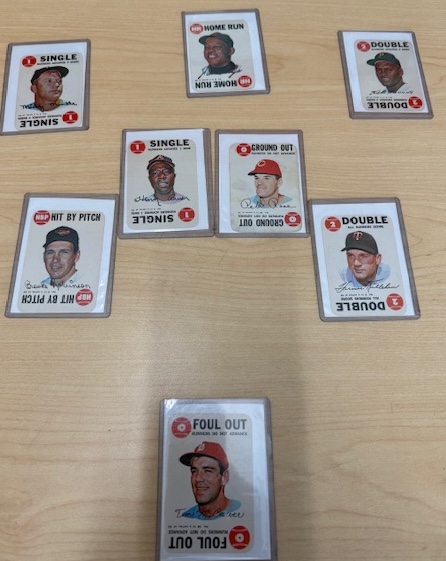
Some of the cards from my 1968 Topps Game insert set. Picking through them, I built the best line up I could imagine. Hank Aaron is out of position at short, although he did come up through the Negro League and Minor Leagues at short before switching to the outfield. I can’t even begin to imagine what this line up would cost today…

With the start of the baseball season today, I dug around and found one of my earlier posts about sports journalism that I thought could use a repeat for Throwback Thursday. Between what I’m already seeing in sports stories for baseball and what my students were writing for “March Madness” leads, I’m pleading once again for sportswriters to write for the audience and not for themselves.

If they don’t, at least I’ll get a few fresh examples for the “bad leads” file that could power at least a dozen lectures at this point.


Writing sports leads that don’t suck: Avoid cliches. Rely on facts. Tell me what happened and why I care.

Newer sportswriters tend to go one of two ways when confronted with writing a lead:

  1. This was the most sensational, inspirational, celebrational, muppetational event in all of human history! The death and resurrection of Jesus Christ? Yeah, take a back seat to this 0-0 soccer game between the Northeast West South-Central State Barbers and the Our Lady of Perpetual Motion Twitchers!
  2. Fill in flat cliche here. That is all.

While we’ve talked about the problems with hyperbole and the need to rely on facts before, a) we haven’t talked about it much in sports and b) the bigger problem in sports tends to be the latter issue. Sports lend themselves to cliche more than any other area of journalism and they do nothing good but bury the actual lead.

Case in point (and a minor plug for our school): The UW-Oshkosh men’s basketball team earned its first trip to the NCAA Final Four. It had been more than 15 years since the Titans even made the Sweet 16. Here are some things to consider as “important” that took place on Saturday night:

  • The team made its first Final Four game in school history.
  • The underdog Titans defeated the No. 9 team in the country on its home court.
  • Ben Boots scored a career-high 36 points to help the team win.
  • One of the reason Boots scored so many is because senior guard Charlie Noone was tossed out/fouled out after catching a technical foul for his fifth foul of the game in the middle of the second half. Noone was a career 1,000-point scorer, a big deal at this level.
  • Down 6 points with 1:45 to go in the game, Boots hit two key threes to knot the score.
  • The game went into overtime, the second time this season a clash between these teams went into overtime. (The previous one was a double-OT game.)
  • Refs called 45 fouls, costing Augustana two of its key big men.

In short, there is no shortage of amazing things you could use for a lead. Here is what the local newspaper posted as its lead:

ROCK ISLAND, Ill. – History was made by the University of Wisconsin-Oshkosh men’s basketball team Saturday night.

jiFfM

Three quick things here:

  1. The lead is a cliche and a bad one at that. History is ALWAYS made. You reading this blog post is technically making history.
  2. The lead is written in passive voice. The cliche of “Titans make history” wasn’t even active.
  3. HOW the Titans made history is probably something people would like to know in the lead. What did they do? Did the coach murder a referee after a bad call? Did the whole team lose its uniforms and play the game in clown costumes borrowed from the circus? Did the team steal basketball powers a la “Space Jam” to win a game? Did they lose by more points than any team ever? Good grief…

When it comes to writing a sports lead, here are three key things to remember:

  1. Rely on the facts and tell me what happened: You don’t have to sell me on something being amazing. Just tell me what happened that was factual and yet cool and let me figure it out for myself. If the authors had woven in any of the components listed in bullets above, they would have had a great lead.
  2. Don’t assume people will read beyond the lead: Deadwood in the lead is a death knell for a story. The second paragraph is better and the head and deck include key information. However, you can’t rely on other components of the story to save you when you write a lousy lead. It’s like telling the cop who pulled you over for speeding how everyone else was driving faster: It doesn’t make you any less guilty.
  3. Remember your audience: Write for your readers, as in people who probably didn’t attend the game. If you went home after watching that game and your roommate asked, “Hey, how was the game?” what would you tell your roommate? “We won! We’re in the Final Four!” Would you ever imagine walking into your apartment and announcing, “History was made!” in response to that question? Probably not.

When it comes to getting quotes, go buy flowers instead of buying flour

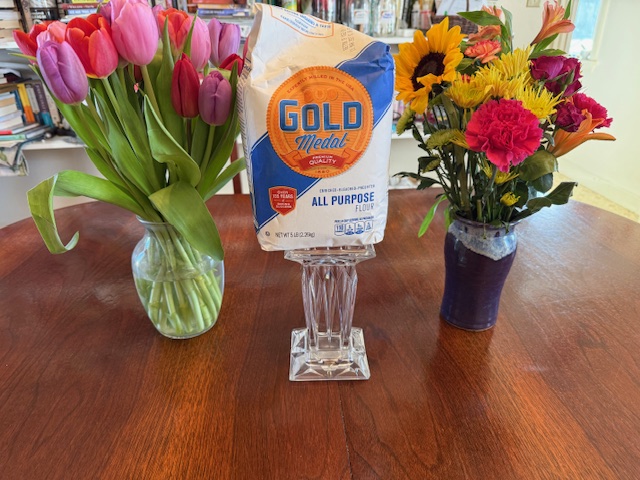
When it comes to quotes, consider the difference between how you buy flowers and how you buy flour. Also, imagine them sitting in a nice vase…

In media writing courses, we talk about quotes being the spice that zips up the story or the sparkly diamond that draws the attention of the reader. However, not all quotes actually do this, because simply slapping quotation marks around a pedestrian set of words doesn’t get the job done.

PR practitioners tend to write press releases that have at least one block quote in them, with some releases being nothing but one giant “statement from X Person” quote. News writers tend to build the bodies of their stories with at least a few paraphrase-quote pairings that are meant to give readers varying views of a topic and a wide array of people a chance to speak. In a lot of cases, those quotes are either relatively pointless or they offer little in the way of quality.

How is it that so many people are proud, happy and thrilled to be there in EVERY PRESS RELEASE, ALL OF THE TIME, even when the writer can craft the quote for the person being quoted? How is it that reporters who get to interview sources also manage to come back with such “meh” quotes from sources who really SHOULD be so proud, happy and thrilled that they can’t shut up about their subject?

Here are the reasons why:

People are afraid to do anything different, lest they offend someone: The phrase, “It is better to remain silent at the risk of being thought a fool, than to talk and remove all doubt of it,” is usually where most people want to be when the chips are down.

To that end, it’s a lot easier to do a bland, mediocre quote than to state something important with your name attached to it. Interview subjects with experience tend to lapse into cliches to avoid really upsetting people, while the press release quotes also tend to play to the middle of boring to avoid controversy.


Writers aren’t as creative as they need to be: One of the things that differentiates PR from news is the concept of quoting sources. If there’s one area where I’ve seen people have the MOST difficulty in making the shift, it’s here.

News requires you to go out, find someone and get something out of their mouth in a word-for-word format. PR in many cases allows for practitioners to write up something on behalf of the client and then just get a “sign off” on it.

Even though you CAN do this, it doesn’t always follow that you SHOULD, primarily for the reason we’re noting here: You don’t know enough about your source, the topic or the non-data stuff to really come up with that whiz-bang quote that will make the difference here.

The same thing can be true of news writers, who don’t put enough time into their research to ask questions that probe or engage the source. If you ask a generic question, you tend to get a generic answer.


Writers aren’t pushing for quality: I can’t tell you how many times I was told to “get a quote” for a story. It was basically like this scene from “The Paper” where Michael Keaton just wants “something:”

I say this as a fellow sinner who often was on the hook for getting a quote, any quote I could from any source, just so that we could say we quoted someone. However, it seems like “get a quote” is a general resting pulse for how we do business.

With those things in mind, here are a few ideas on how to get better stuff:

Don’t shop for flour. Shop for flowers: In the middle of pierogi season at our house, Amy often sends me out for supplies, the most common of which was flour. The direction was simple: “Go to the store and get a bag of flour.” I dutifully comply by driving to the closest place I could and grabbing a five or 10 pound bag off the shelf that resembled the bag she had just emptied.

When I got sent into the field as a journalist, I often felt that was how I was supposed to get quotes. It was like “Go to the store and get a bag of flour.” OK, if that’s all I’m doing, all I care about is going there, picking something off the shelf and coming home.

That’s part of the problem with quotes: You don’t just want something off the shelf.

Instead of shopping for flour, think about shopping for flowers for someone you love. Think about what it is that makes that bouquet special, beautiful and different for them. Think about how you want the reaction to be when they see it. Think about doing more than grabbing whatever is convenient.


Research better beforehand to ask better questions: As we’ve said here repeatedly, the key to everything good we do in journalism is in the preparation. The more work we do at the front end of the process, the better things will be at the back end of the process.

One of the reasons PR quotes are so “meh” is that practitioners don’t dig into the topic or the organization to find things that make it special. When all we have to work off of is a baseline understanding of the concept, which usually comes from a buzzword-laden mission statement, we’re operating in Generic-ville.

The benefit of doing the research before crafting that quote is to make it feel genuine and informed. In adding special touches based on detailed information you found, you not only have a better chance of making your source sound good, but you also have a much better chance of drawing a reporter’s attention.

In the case of reporters and practitioners who rely on interviewing, the research ahead of time can help you shape more pointed and engaging questions that will elicit stronger responses. When you ask that, “So what can you tell me about X?” question, the source will lapse into their “greatest hits album” answer, with all the generic info and cliches. If you can ask something that shows you’ve invested time and energy in the question, you’re likely to get that source to be more engaged.


Change the source’s perspective: Most of the time, the sources we interview either play to us as media practitioners or play to a perceived audience of peers. Those quotes tend to be more jargon laden or otherwise disengaged, and they usually don’t do much for an actual audience that will eventually read their quotes.

Put the source in a different state of mind, based on your full understanding of who you see as the readership. Try asking a question like, “So how would you explain this to a worker on the assembly line?” or “What would you say to a parent in the school district about X?” or even “Could you explain this to me like you are talking to a child?”

In shifting the perspective of the source in terms of understanding the audience, you can get them to shuffle the deck a bit and deal you a better hand. I’m a particular fan of the “child” quote when I’m talking to a source who is clearly exceptionally well-versed on their subject, to the point of assuming everyone else knows as much as they do.

I also like the idea of thinking about who else might be a source in my story to shape the questions. For example, if I’m talking to a product seller, I like to ask them to shift focus to being a product consumer. If they’re a superintendent, I like to get them to shift to think like a parent, a teacher, a custodian or a kid.

In getting them to move, they tend to get out of the rut where cliches live and give me something different.

The Junk Drawer: Hump Day Edition

Is the weekend maybe hiding in here somewhere?

In the middle of the week during the middle of the semester, it’s a bit of a drag for students and professors. With that in mind, here are a few things that might amuse you all, spark some discussions or generally make it feel like the weekend isn’t so far away:

FLORIDA’S VERSION OF “WHO WORE IT BETTER?”

You know you’re a journalist when the first question you have after reading this headline isn’t, “What the hell was wrong with this woman?” but rather “How did the manatee get into a bikini?”

In the world of misplaced modifiers, I think this one is the gold standard.

Speaking of “What the hell is wrong with people…

STOP, THINK, THEN POST: Dan O’Donnell, a conservative talk show host out here in Wisconsin used the occasion of the Iran attacks to call for the death of Minnesota Gov. Tim Walz:

O’Donnell later apologized for his posts and took them down, but there are still copies of this floating all over the internet. It’s also not great optics, given Minnesota House of Representatives Speaker Emerita Melissa Hortman and her husband Mark Hortman were killed in July, in an attack deemed politically motivated.

This serves as one more reminder that stupidity is bad, but amplifying it on social media is worse.

GLAD WE GOT THAT NAILED DOWN: Stories based on opinions, particularly those that can’t be supported or refuted, don’t usually do much for me, but I have to admit this one grabbed me:

The former star of “Growing Pains” and long-time evangelist for Christianity has done a lot for publicizing his faith and reaching out to others to help them find Jesus. That said, I’m wondering where he got the inside scoop on the existence of hell.

I’m also going to argue that if he doesn’t believe in “eternal conscious torment,” he never had a nun for a teacher like I did. Sr. Mary Kenneth still haunts me in my dreams some times…

Speaking of living rent-free in someone’s head…

EVERY TIME A STUDENT REMEMBERS SOMETHING YOU TEACH THEM, AN ANGEL GETS ITS WINGS: I teach a lot of 8 a.m. required classes for sophomores, so I’m never exactly sure how much the students learn from me or how much they think about what I’ve taught them.

That’s why when a student not only remembers what I taught them, but also reaches out to say that they found an example of it in the wild, it just warms my grinchy little heart:

Hi professor, I saw this on Facebook and just thought it was so coincidental that we worked on a draft lead about a case just like this I thought I’d share with you. I think they wrote this terribly:

I’d have to agree with the kid, given that we don’t find out about a dead body until halfway through the piece. I’m also somewhat disturbed by the phrase “a working fire.” As opposed to what? An unemployed fire?

And finally…

SUITABLE FOR FRAMING: Some students wait until week 12 of a 14-week term to start trying to act right in class. At that point, they realize they’re totally screwed, as the math won’t allow them to pass, so they beg for extra credit.

I usually post this on my door right about the time I get that first request:

Feel free to borrow that.

Have a great day.

Vince (a.k.a. The Doctor of Paper)

How to harness self-interest in service of improving story structure (A Throwback Post)

One of the hardest things to get my students to do is to work in the inverted pyramid. I don’t think I’m alone in this, given a) most of the stories they’ve read over the years are chronological instead of driven by descending order of importance and b) most of them tend to write expansive term papers for other classes, in which the focus is predetermined and being lengthy is rewarded.

To get them better focused, I often leverage the concept of self-interest: “Instead of thinking about what you, the writer, wants to tell me, the reader, consider thinking about what you would want to know most if you were reading this and then write it in a way that would best meet those needs.”

Sometimes, like this week, we have to go even more basic than that, which brings me to this week’s throwback post about our fire brief exercise. It’s amazing how quickly their viewpoint shifts when I have them thinking about their home being on fire instead of writing about a fire that happened elsewhere. I hope this will help you help your students find focus as well.


The Self-Interest Gap: Learning how to care less about what you want to write and more about what the audience wants to know

Self-interest is perhaps the one commonality humans share these days and it can be summed up in a simple question: “What’s in it for me?”

When you are on the “receiver” end of the process, it’s something we understand very easily. We know almost instinctively what is of value to us and what we care about right away. That said, when we put on the “sender” hat, we tend to focus more on what we want to tell people, forgetting that those people have their own set of interests we should be focused on.

Case in point, I asked the students to write a brief based on a press release about a fire. Here are the opening lines of a few of those briefs:

  • Firefighters responded to an engulfed single-story house shortly after 6 p.m. Sunday…
  • Boone County Firefighters responded to a call of a Sturgeon house fire…
  • Sunday evening, Boone County Firefighters responded to a call at 6pm on an electrical house fire…
  • A structure fire occurred at 520 S. Ogden in Sturgeon on the evening of Sunday…
  • Boone County Firefighters responded to a home engulfed in black smoke…

What we learn essentially in these things is either:

  1. Firefighters responded to a fire.
  2. A fire occurred somewhere.

If you were on the “receiver” end of the information, how much of this stuff would you care about? Of course the firefighters responded to the fire. That’s what they do. Also, fires occur everywhere from giant farm fields to the burn barrel in my yard. However, as a “sender” we tend to ignore that until we are forced to switch perspectives.

In thinking about this issue, I posed a question to the students meant to tap into that idea of self-interest: “Let’s say you get home after class and your roommate says, ‘Hey, your mom was trying to reach you. There was a fire at your house…’ What would be the first thing you would want to know?

Answers came quickly and easily:

  1. Is everyone OK?
  2. How bad was the fire?
  3. What happened out there?

In this case, a good response might be:

“The fire destroyed the house, but nobody got hurt.”

That’s the core of a good lead, with a strong focus on what matters most (big ticket item) and what people cared about most (answer to the first two sentences). When it’s your mom or your house, you have specific interests that a good source of information will attend to. If you can take that perspective and play on the audience’s self-interest, you can have a much sharper focus when it comes to telling the story directly and clearly.

Four things to know to keep your first media writing class from sucking (A throwback post)

I ran into one of the students from my upcoming media writing class the other day. She’s a graduating senior who’s taking it as an elective for her marketing degree, so I asked what she’d heard about the class and why she wanted to take it.

“I heard it’s hard as hell,” she said. “I also heard it was amusing. I’m taking it because I love to write and I need to write better.”

She then asked if we were doing a lot of writing, to which I obviously replied yes, but with a caveat: “We write a ton, but it’s not like the classes where you’re writing 25-page papers on some obscure topic. In fact, the first assignment you’ll write for a grade is going to be one sentence long, but it’ll take you three class periods to do it.”

Her face turned blank. “That’s a lot of pressure for one sentence. I mean, if I could write more than that, I could probably make it work better…”

“Better for you or better for the people who would want to read it?” I asked her.

Blank again. “Aw…”

And so we start another great semester, remembering a few ways for your students to really get something good out of a class that they probably aren’t really ready to experience:


Four things to know to keep your first media writing class from sucking

With the close of the Labor Day weekend, it’s a safe bet that most students reading this will be starting the fall semester or have just started it (apologies to those of you who are on trimesters or who just have a ridiculously early start date). When we start this week, I know I’ll be face to face with another fresh crop of students experiencing their first media writing class and I can already smell the anxiety.

For those of you students in a similar boat, in that you’ll be taking your first media writing or reporting class, here are four things to know from the start so that your experience will be less painful:

Your work will suck for a while: One of the most difficult things about going into media writing is how frustrating it can be for people who have always been good writers. People who struggled to write? They tend to have an easier time with it, even though that sounds counter-intuitive.

Let’s call the rationale behind this the “Michael Jordan Plays Baseball” Theory. In 1993, Michael Jordan had cemented his place as the best basketball player in the world. He had just led the Bulls to a “three-peat” as NBA champions and he won the MVP award in each of those finals. In October of that year, he retired from basketball and decided to try playing baseball. He’s a super star athlete, he’s in his prime and he never stunk at anything, so this shouldn’t be a problem, right?

Wrong.

Jordan played for Double-A Birmingham Barons and to quote Hall of Fame pitcher Bob Feller, “He couldn’t hit a curve ball with an ironing board.” Eventually, he got his first hit, his first run batted in and so forth. Even though he only hit .202 for the season, his manager (Terry Francona) said that he improved and could have been a major leaguer if he had committed to it. Instead, Jordan went back to basketball, much to the chagrin of everyone who wasn’t a Bulls fan.

The point is, you have always written well, but this is a different kind of writing and you’re going to suck at it for a while. All the things you used to have at your disposal that worked well won’t always fit into this style of writing. The format, the verbiage and the overall approach are all different, so get used to the feeling of falling on your keys for a while.


Learn from your screw ups:  I have this conversation at least once a semester:

Student: “I was wondering why I got such a bad grade on this piece.”
Me: “OK. Did my comments on the paper not make sense to you?”
Student: “I didn’t really read those. I just saw my grade and kind of freaked out.”

Look, I love writing, but writing out tons of comments on a story that was so bad it sapped my will to live, only to have the student ignore them all isn’t my idea of a good time. The whole purpose behind instructors writing comments on papers isn’t so that we have some sort of ground to stand on when an annoying student sues us over a grade. The idea is that we want you to learn something, so we tell you what went wrong so you don’t do it again.

As painful as it is to read the bloody mess of red ink that adorns your paper, dig into it. Learn what didn’t work so you don’t do it again. If you still don’t understand what you did wrong after you look your paper over, be proactive and meet with the instructor. Trust me, we love reading well-written papers so the more help we can give you on the front end, the less Advil we’ll need when we have to grade stuff.


Care more about the skills than the grade: If you would like to cause your instructor to have a “Scanners” moment every single day, make sure to ask two questions at the end of every class:

  1. “Do you know what my grade is?”
  2. “Is this going to be on the test?”


I get that grades matter for some things beyond the classroom: Scholarships, sports eligibility, having mom and dad not disown you… But seriously, once you are done with school, nobody is going to care about your grades, least of all you.

I can remember exactly three grades from my entire academic career:

  1. C-double-minus in penmanship from Mrs. Schutten in third grade. (The rule at that time was that if you got a D, they held you back, and although I was smart enough to pass everything else that year, my penmanship was godawful and she wanted to make absolutely sure I knew that.)
  2. C in Media Law in my junior year of college. (I skipped six weeks of class [long story] and was really, really bad at this whole concept. I prayed out loud for a C to pass during the final. I received applause, much to the chagrin of the instructor.)
  3. A in my first news writing class. (The only reason I remember this is because I wanted so damned badly to impress the instructor that I poured everything I had into that class.)

Beyond that, it’s a long alphabetic blur that ceases to have any value to me. If you focus on just doing stuff to get the grades, you’ll miss out on the skills you need to learn to make yourself marketable once you graduate. Even if you don’t see the point in what you are doing at the time, learn the heck out of the skills and practice them. Case in point:

At the end of the day, the skills will follow you and they will translate from job to job. Nobody, however, is ever going to say to you in a job interview, “So, it looks like you’re a perfect candidate, but let’s talk about this C+ in feature writing…”

Now is the time to care: I’ve told this to students before and it’s the best bit of advice I can possibly give you for any class:

Instead of saying, “I need this class (to graduate, to move on in the major or whatever)!” to your professor after you screwed up your work and you have no hope of getting out alive, say “I need this class (to graduate, to move on in the major or whatever)!” to yourself every day from the beginning of the semester and act accordingly.

Have a great semester and knock ’em dead.

Get the name of the dog and the brand of the beer: Why details matter in journalism.

I have no idea who said it first, but I always attribute my first exposure to the journalism maxim in the headline to the legendary George Hesselberg from the Wisconsin State Journal. It’s become one of those things like, “If your mother says she loves you, go check it out,” where we all heard it from somewhere and it relates to a larger truth about our field. (Poynter’s Roy Peter Clark even wanted to name his book, “Get the Name of the Dog,” so trust me, if you haven’t heard it before, it’s out there.)

It popped up in my mind a couple times this week, particularly after Indiana won the national championship on Monday and a reporter asked coach Curt Cignetti about his reference to cracking open a cold one in celebration:

Aside from giving a massive platform to Upland Brewery in Bloomington, Indiana, and earning himself a lifetime supply of suds to boot, Cignetti helped fill in a detail that would likely make for a great story or 500 the next day.

Despite my father’s theory that the difference between a good beer and a bad beer is three of them, the brands of beer can convey a lot about the person drinking them and how they perceive themselves.

Consider this scene from the original “The Fast and The Furious:”

Rob Cohen, who directed the first film, said he felt Corona had the L.A. vibe he was going for with the film, so he put it in. In spite of not paying a dime for that product placement, Corona ended up with more than $15 million in free advertising throughout the series.

(SIDE NOTE: I’m working on a “Snide Guide to Beer Choice” that falls along the line of the “Bitter Personal Analysis of Your Font Choices” that we did a few years back. We’ll see if it gets there…)

Another reason I thought of that maxim came when I saw this press release from the local fire department:

The lack of a name for the dog isn’t the only problem with this release, as it’s got a number of holes that leave me scratching my head:

How bad is it? We can argue what “heavy” means and what it doesn’t, but I always have trouble when I’m faced with a comparative term instead of a concrete one. Think about it like this: The word “tall” is comparative. Are you tall at 6-foot-1? Well, if you’re in a kindergarten class, you’re a giant. If you’re on an NBA team, you’re a point guard at best.

This is where details matter: If you told me the house was uninhabitable due to that damage, I’d be closer to understanding how heavy it was. If you told me how much damage was done via a financial estimate (The fire caused $150,000 damage.), I’d be closer as well. If you told me the house and its contents were a total loss, I’d be OK as well. However, we lack details to fully understand this.

What else can you tell me about the house? I’ve got a two-story wood-framed dwelling, but that’s it. We tend to measure houses based on size (square footage) or rooms (a four-bedroom, two-bath home). That gives us a size of scope. It’s also important to understand if this was packed among a dozen other homes or by itself.

I did a quick Zillow search to see what I could find and this gave me a better sense of what we’re looking at. Still, we need a bit more help here than, “It was a house. It was on fire.”

The occupants: The first time we hear about them, we hear they weren’t home when this happened. Then, we find out that they apparently were given shelter at Jeff’s on Rugby, which is a local eating establishment. What I don’t know is how many there are, who they are or when they showed up. I also don’t know what’s going to happen to them next.

I understand that not all of this would have likely made any press release from the fire folks, but it is information I would expect to see in a story of any kind on this topic, as these are the details people likely want to know.

To that end, here are a few tips:

Get as many details as you can, sort them out later: I always assumed that a good editor was going to put me through the paces on what I had and what I didn’t have while they read my story. I remember at least one case where Hess himself asked me if I knew the names of the parents of a kid who had passed. I didn’t, and I really should have, so I had to go back out and get them somehow.

In another case, I had someone ask a coroner what was the caliber of the gun used to kill someone on campus. While that might seem prurient or pointless, I wanted to know because some guns make bigger noises than others when fired and supposedly “nobody heard anything” while this incident was taking place.

For all the times we ask really stupid questions like, “Your husband just died in a giant pork processing machine… How do you feel about that?” the least we can do is ask for details that might lead us to better storytelling later.


Put yourself in the shoes of the reader: One of the best exercises we do each year is a fire brief, in which we have the class members each write a short piece off of a fire department press release similar to this one. They almost all read exactly like this release.

Then, I’ll ask one of the kids in the class, “Let’s say you go home after class and your roommate says, ‘Hey, your mom was trying to reach you. There was a fire at your house.'” What would you most want to know FIRST?

The answers become obvious:

  • Is anyone dead or hurt?
  • How bad was the fire?
  • What the heck happened?

Then, we go back to the releases and start reading them aloud and they realize they either didn’t include ANY of that stuff or they put it in the wrong spots.

One of the best ways to get journalism done well is to think of the people for whom you are doing it. Start with their needs and interests and work backwards into your reporting.

EXERCISE TIME: Go pull a press release or a story and look for places where you think key details are missing. It could be “How many kids were in the class that won the award?” or “What made it harder to de-ice the roads this time?” It could even be, “So was it a Diet Coke or a Diet Pepsi?” See what’s not there and make a case for reasons you would want those details.

It’s beginning to look a lot like Cliche-mas in journalistic writing (A Throwback Post)

Stop it. Just stop it. And don’t you dare call me a Grinch, either… 

It’s not that I don’t want a Christmas miracle or a white Christmas or a bit of holiday cheer. And if I had but one holiday wish, as I got a kiss under the mistletoe, it would be this:

“Journalists, please stop using cliches.”

With that in mind, here is a throwback post that looks at more than a few of them…

‘Tis the season to kill these 17 holiday cliches that will land you on the naughty list and get you coal in your stocking

The holiday season brings a lot of things to a lot of people, including family, gifts, joy and faith. Unfortunately for journalists, it also brings a ton of horrible, well-worn phrases that sap your readers’ will to live.

I tapped into the hivemind of jaded journos who were nice enough to come up with their least favorite holiday cliches. Avoid these like you avoid the kid in class with a cough, runny nose and pink-eye:

Turkey Day: The event is called Thanksgiving, so give thanks for journalists who don’t use this cliche. In fact, it took almost 300 years for turkey to become a staple of this event, so you might as well call it “Venison Thursday,” if you’re trying to be accurate.

T-Day: Regardless of if you are “turkey perplexed” or not, you’re compounding the problem with the above cliche with simple laziness. That, and you’re really going to create some panic among distracted news viewers in the military.

‘tis the season: According to a few recent stories, ’tis the season for car break-ins, holiday entertainingto propose marriage, to get bugs in your kitchen and to enjoy those Equal Employment Opportunity Commission year-end reports!

The White Stuff: Unless you are in a “Weird Al” cover band or running cocaine out of Colombia, you can skip this one.

A white Christmas: The only people who ever enjoyed a white Christmas were bookies, Bing Crosby’s agent and weather forecasters who appear to be on some of “the white stuff.”

Ho-ho-ho: It’s ho-ho-horrible how many pointless uses of this phrase turn up on a simple news search on Google. None of these things are helped by the inclusion of this guttural noise.

On the naughty list: The toys “on the naughty list” in this story “all have some type of hazard that could send a child to the hospital. The majority pose a choking hazard but parents should be aware of strangulation, burns, eye injuries, and more.” Including a cliche diminishes the seriousness of this a bit. Also, don’t use this with crime stories around the holidays: The first person to find a story that says Senate candidate Roy Moore, Harvey Weinstein, Louis C.K. or Kevin Spacey landed “on the naughty list,” please send it to me immediately for evisceration.

Charlie Brown tree: Spoken of as something to avoid. You mean you want to avoid having a tree that demonstrated looks aren’t everything and that tries to capture the true deeper meaning of Christmas? Yep. Can’t have that stuff.

“Christmas starts earlier every year…” : Easter, maybe. Christmas, no. It’s the same time every year. Check your calendar and stop this.

War on Christmas: Be a conscientious objector in this cliched battle, please.

“… found coal in their stockings”: Apply the logic of “on the naughty list” here and you get the right idea. The story on the Air Force getting coal for Christmas after tweeting that Santa wasn’t real could have done without the cliche. Then again, maybe we’d all be better off if the Air Force was right, given the picture included with the story.

Making a list, checking it twice: A all-knowing fat man has a list of people who are naughty and nice and will dole out rewards and punishments accordingly. Sounds cute when it’s Santa, but less so when an editorial is using this to talk about Steve Bannon. Let’s be careful out there…

Grinch: There is probably an inverse relationship between the number of people who try to use this cliche and those who actually get it right. Let’s let John Oliver explain:

Jingle all the way: Nothing warms the heart like an in-depth financial analysis of a multi-national retailer like a random reference to Jingle Bells.

Dashing through the snow: This product pitch isn’t improved by the cliche, but it might help you survive hearing the use of it over and over and over…

It’s beginning to look a lot like…: Well, it apparently looks a lot like Christmas for small businesses, at Honolulu’s city hall, through a $1.5 million investment in lights at a Canadian park, and at a mall in Virginia. It’s also looking a lot like 2006 in the NFC. Oh, and it’s beginning to look a lot like Watergate as well. Get ready with that naughty list and coal, I guess…

The true meaning of…: Nothing says, “I understand and want to engage with my readers” like lecturing them on “the true meaning” of something, whether that is Christmas or a VAD.

Wishing you all the best in this season of cliche…

Vince (The Doctor of Paper)

How to make things relevant for your readers when they no longer have shared, collective experiences

On this date in 1960, the Pittsburgh Pirates defeated the New York Yankees in Game 7 of the World Series on Bill Mazeroski’s ninth-inning walk-off home run.

To fully understand the gravity of the moment for many people living in that time, it’s instructive to listen to sports journalist Beano Cook’s assessment of the situation:

“If you grew up in Pittsburgh, the way I did, you remember where you were when heard F.D.R. died, when you heard about Pearl Harbor, when you heard the war ended and where you were when Mazeroski hit the homer.”

I’m sure not every human being on Earth had that kind of reaction to it, especially Yankees fans who considered World Series domination to be their birthright, but it does speak to the larger sense of how we once had a sense of shared moments in time.

During my life time, there have been a few of those “where were you” moments that stick in my head to this day. I remember being on the floor of my parents’ living room on that yellow shag carpeting in front of the old Admiral-brand TV we had when the Miracle on Ice occurred.

I remember being in the Doctoral Pit in Columbia, Missouri with several other former journos-turned-Ph.D.-students huddled around an old tube-style TV as we watched the towers collapse on Sept. 11, 2001. (I also remember having to go to a multi-variate statistics class, taught by an international grad student who had no idea what was going on. To this day, I still can’t figure out binomials.)

In today’s era of quick-hit social media, in which algorithms feed us more of what we want to see and isolate us from a wide array of viewpoints, I don’t know if shared cultural moments are possible for this generation, but the litmus test might be the shooting death of Charlie Kirk.

A recent analysis of what people thought about Kirk, his death and the person arrested on suspicion of shooting him found that social media created completely different worlds in which individuals learned about all of this. In addition, social media companies have removed a lot of the guardrails that were once considered crucial in eliminating factually incorrect content and tamping down rage.

As much as it seems like EVERYONE around me has an opinion on Kirk, his death and everything that’s wrong with the world today that led to it, I am still running into students who know nothing about any of this.

And I’m teaching in a media-based field where knowing what’s going on around you is kind of important.

Rather than going down the rabbit hole of whose values are better or what people don’t see thanks to self-feeding loops of social media destruction, I think it’s more important to realize that horse is out of the barn. What matters now is how we deal with it as journalists, give that most of our job is providing content to people in a way that’s relevant, useful and interesting to them.

Here are a few things to realize about the people out there consuming our content and how we need to serve it up differently for them:

NEVER ASSUME THEY KNOW ANYTHING: This seems a bit blunt and harsh, but we don’t all see the same news at 10 p.m. or read the same newspaper on the train ride into the city anymore. Just because people exist on X, Facebook, SnapChat, TikTok or Chorp, it doesn’t follow that they know anything we’re trying to talk about either.

Everything is individualized, so while my feed might be filled with calm, rational discussions about social policies in higher ed, the person right next to me might be learning that Bad Bunny’s Super Bowl appearance is part of a plot to explode the brains of ICE agents with a sound ray that will also turn undocumented migrants trans.

(We have the technology… You are just being kept in the dark about it. Read more about my inside information at the website http://www.areyoufrickinseriouslystupid.com)

What this essentially means is that we have to start from a position of less than zero to explain situations to our readers if we want them to get anything out of anything we are trying to tell them.

I used to tell students that 1-4 sentences of background was usually enough to catch people up on topics of interest. As much as that number might need to increase exponentially, it also needs to be counterbalanced against the minuscule attention span people have, so it’s going to be a fine line to walk.

This leads to the second point…

WRITE IT LIKE YOU’D WANT TO READ IT: The goal of most standard media writing is to get to the point immediately. The problem is that most people don’t write for others the way they want content sent to them in the realm of social media. That creates a massive disconnect we need to fix.

I did a study a few years back involving student journalists who were responsible for running social media for the media outlet. I asked them to rate a bunch of uses and gratifications they have for social media they received. In other words, what do you like that you get and how you get it from social media? I then asked them to outline the approach they took to sending social media to other people as a source from their media outlet.

The results? Almost zero overlap between what they considered “best practices” for social media they consume and the way they themselves provide it to other people. In most cases, they liked writing really long and involved stuff but they hated reading it. They also liked things to be quick and direct, but felt it necessary to avoid being that direct in their own work.

Studies of social media and its impact on the brain are mixed, but one discussion about the topic seemed to make the most sense to me. The writer basically said that social media exercises our brains in certain ways, so we not only get used to that, but the other aspects of our minds tend to atrophy a bit. The author compared it to “skipping leg day” at the gym but doubling up on core exercises: One part gets weaker while the others get stronger.

This kind of media consumption limits our ability to do the more strenuous mental work that non-social-media use requires. It also impacts our ability to create memories, so writing giant diatribes with six interweaving plot lines isn’t going to help the readers in any meaningful way. So, if we want to get across to the people, we need to build it in a way they’ll best understand it.


SELF-INTEREST IS OUR ONLY SALVATION:  If we have but one thing in common anymore, it is literally the interest we have in why something matters to us personally. If that’s all we have to go on, we’re going to need to saddle up that horse and ride it to death.

To be fair, some larger moments over the past 20 years only stick in my brain because I had a personal connection to them. The 2007 shooting at Virginia Tech mattered a great deal to me because I knew the media advisers at that papers and I had spoken to some student journalists from there at one point. I remember refreshing my email every 0.5 seconds, hoping for a response from a friend to tell me she was OK.

The Las Vegas shooting fell into a similar vein, in that my aunt and uncle were in Vegas at that point. I remember trying to teach a class and keeping an eye on text messages from my mom to tell me if my family members were safe.

And again, I’m PAID to be aware of larger issues that get a ton of media coverage, so if I’m falling down on this, I can’t imagine what it’s like to people who are learning nothing other than what TikTok feeds them.

At one place I worked, we used to require the students to finish the sentence “This matters because…” before they were allowed to start writing their stories. Bringing something like this back for all media writers, with a more direct version like “This matters to YOU, my reader, because…” might help us better focus our attention on the “how” and “why” elements of what we’re covering as we target the demographic, psychographic and geographic needs of our specific audience members.

We often have to remind students that they’re not writing for themselves, but rather the audience. Now, we might not only need to double down on that, but also make sure they have a full sense of who is out there and and a laser-like focus on making it relevant to them.

Just because a source uses a term, it doesn’t mean you should

(I wonder how many transponsters were excessed in this latest round of rightsizing…)

The job of reporters is to take information from sources, distill it into something that makes sense to an audience and convey it effectively. The opening to this story went 1-for-3 with two strikeouts:

I’m going to skip past the empty lead, the two-sentences-that-should-be-one structure and the lack of anything resembling news (if everyone is doing it and it’s not a secret, rarely is it news). I’m wondering what it means to be “excessed.” (A word so stupid, every time I type it, I get the squiggly red line under it.)

Using a partial quote, particularly to showcase an odd turn of phrase, can be valuable. (The mayor calls his opponent a “rump-runt” or a coach calls a compound fracture of a fibula a “teeny tiny break.”) It can also be valuable in calling out the use of a stupid term (“excessed” would likely fit), so the reporter can shed more light on the term in a clear and complete way later.

That didn’t happen here, despite continued use of “excessed,” in quotes and paraphrase. (If I took “excessed” in the “Read this Article Drinking Game,” I’d be hammered after about six paragraphs.

This term is like a number of euphemisms that do nothing to inform readers but instead try to soften the blow of something really bad. A few years back, corporate-speak had journalists using the term “rightsize” or “rightsizing” as a way to explain how a company was cutting jobs and laying off employees. The shift away from “downsize” (which sounds sad because it includes the word “down” in there) was meant to make the actions seem more reasonable.

When faced with something like this, here are a few helpful tips:

AVOID IF POSSIBLE: Just because someone uses a term in their world, it doesn’t follow the rest of us should in ours. It’s the same reason we shouldn’t say someone was “transported to a nearby medical facility” when they are taken to a hospital or say an officer “performed a de-escalation through kinetic application” when a cop smacks someone to get them to stop doing something. Parroting a source because we are a) lazy or b) uninformed is not doing the job. Telling people what happened is.

USE ONCE, DEFINE QUICKLY, MOVE ON: If you have to use a term that is likely unfamiliar to your readers, don’t rely on it constantly. Say it once early in the piece and make sure you define it then and there in a way your readers will understand. Then, use a more common term that relates to the concept throughout the piece, like “the bill” or “the group” or “the process.” That will explain what’s going on without numbing your readers through the repetitive use of something like “excessed.”

ASK THE SOURCE TO TRANSLATE: Sources will likely want to use their preferred terms because a) they are comfortable with those terms and b) those terms are likely advantageous to their position on an issue. “We rightsized the operation to improve productivity” sounds a lot better than “We fired a bunch of people to improve our profits.” Same deal when a law-enforcement agency “neutralized a threat” or “depopulated an area.” Those phrases sound a lot better than, “We shot a guy to death” or “We killed everyone in a two-block radius.”

Have the source put that into English for you and don’t let them use euphemisms to define other euphemisms. If reporters are going to be held to a “what happened?” standard of clarity and simplicity, we need to hold the sources to that standard as well. If they can’t define it for you in a relatively meaningful way, ask them to go through the process associated with that term and clarify it for you. (“So, these people were excessed… What’s the first step in that process? … Do people who get “excessed” lose their right to the job they had? … Can you show me in a contract the explanation and application of this term? …)

Don’t let the sources Jedi mind trick you into thinking that something is normal simply because they use a made-up term repeatedly. If necessary, ask them to explain it to you like you are a child. When they can’t or won’t, that says volumes more than what the term itself is trying to convey.

(And for the love of God, don’t write a lead like this one, no matter what else is going on. The first two or three sentences really should have been “excessed.”)

Eight Years a Blogger: Come for the knowledge, stay for the snark

It’s hard to believe this thing is still going after eight years, kind of in the same way its hard to believe that the almond-colored refrigerator with the faux-leather texture and Bakelite handle that your parents bought in 1983 refuses to die. I always figured Sage would have decided I was more trouble than I was worth by this point, or I would have run out of bits of wisdom, weirdly effective exercises and opportunities to mock god-awful mistakes in the media.

Oddly enough, that’s hasn’t happened. And speaking of exercises, if you still want to get in on Dr. Vinnie’s Bin of Exercises and AI Joy, feel free to hit the link here.

This semester is guaranteed to be a little off as far as the blog is concerned, in that I found out last week I will need to teach a fifth class this term. It’s the second of the five that I’ve never taught before in my nearly 30 years of college teaching and the third of the five that’s not in my area of expertise.

Why, you might ask… Well..


The relative insanity that this blog provides me might be my only salvation, so let’s get started with a few thoughts to brighten your day (and allow me to blow off developing a giant roster of PowerPoints and podcasts I will likely use only once in my lifetime):


STUIPD IS AS STUIPD DOES, TOO: In digging through a ton of examples I wanted to use for the upcoming classes I am prepping, I was stunned at the level of general incompetence when it came to making sure things were edited before they went out. I’m not talking about internet memes or mom-and-pop operations posting on an AOL-Dial-Up-Friendly website. I’m talking about actual organizations with money and staff support.

The number of missing words, misspellings and generally bad writing made it tough to find quality examples for the kids. I mean, I can’t exactly say, “Here’s a great press release, if you ignore the three misspelled words in the lead and the sentence structure that makes Tarzan look like Shakespeare.” Of all the blunders out there, I had to highlight this one:

If you are in the state, promoting the state and having a fair for the state, the least you can do is spell the name of the state properly in the headline…

Also, for the sake of irony, I found this job posting for an entry-level PR position with these two key bullet-points back to back. And I SWEAR I didn’t PhotoShop this:

I looked at it three times and thought, “Is this like one of those tests where they try to trick you? Like that one speed test where you are supposed to read the whole set of directions first, so that you figure out you only need to do the first thing on the list?

Or do they just really need proofreaders that badly?

Speaking of someone who needs a proofreader:

If you really need something that big to house that item, I feel sorry for your significant other…


DID THAT REALLY JUST HAPPEN? I’ve frequently noted that paranoia is my best friend, so much so, that I often find myself doing double-takes on things I swear I saw that turn out to not be as bad as I thought. It usually comes up when I see a sign for “angus” burgers or “first-hand jobs” or something where my mind drifts to the terrible error, even if there isn’t one.

That said, this Milwaukee Journal-Sentinel headline on my phone really should have freaked out a couple people somewhere at the newspaper:

For starters, that’s not Cavalier Johnson unless I have officially gone blind from computer monitor radiation. Here’s his official city photo:

I have no idea who the dude at the podium is, but Arnold Schwarzenegger and Danny DeVito made a more convincing set of Twins than the two people in the photos above.

Second, and this is really what caught me, that has got to be the worst headline break any human or computer could have made with this story. When I saw that “Johnson speaks with black talk,” I think my brain broke, before remembering Robert Townsend’s spoof of how white people do stupid stuff in Hollywood.

I understand that everything can’t be perfect in every publication, but I also know there are certain topics that need a little more attention and care, due to their sensitivity and the long history of insensitivity associated with them. This is one of those where someone fell asleep at the wheel.

Conversely, sometimes we can really go a bit far in clarifying things for our readers:

Thanks for the clarification, CNN. Otherwise, I might have been confused…

And finally…

I, (FILL IN NAME HERE), AM HAPPY TO HELP (FILL IN NAME HERE): As is the case every semester, I got a series of “could you please squeeze me into your full Writing for the Media class?” emails over the past couple weeks. The excuses are usually the same (I missed my registration day, I accidentally dropped it, I died while donating my heart to my cousin, but thanks to revolutionary bionics, I’m back now…) as are the ramifications they use to nudge me in their favor (I need this to graduate, I can’t move on with out the class, I’m planning to join a biker gang but they won’t take me without a bachelor’s…)

This one came oh so close to moving me…

Look, AI can be helpful in some cases, but your really gotta meet it halfway…

And off we go on another semester-long adventure. Let’s stay safe out there…

Vince (a.k.a. The Doctor of Paper)

As Promised, Here is Dr. Vinnie’s Bin of Journalism Exercises, Complete with AI Toys

It might not be as cool as opening Marcellus Wallace’s case, but I hope this pile of exercises will still make you as happy as Vincent and Jules.


As many of you are starting back to school, I figured I’d break radio silence with some goods I promised to deliver by the end of the summer. Back in May, I asked what kinds of things you needed from me and you were all nice enough to hit me with some ideas. Some were really concrete (“These kids need stuff to learn how to write a #%^#ing lead.”) while others were more nuanced (“They need to play with AI, but in a way that helps them see what it can and can’t do. I have no idea how that would work, though…”)

I’ve put together a bin of stuff that tries to cover the gamut of needs, while offering you choices as to how to apply the exercises in your own schools and for your own needs. Think of each of the files as kind of a Swiss Army knife of opportunities that you can use as you see fit.

It should go without saying that the content is either made up or fictionalized versions of stuff that actually happened, so don’t freak out if you see something and think, “Oh my lord! What hath hell wrought!”

Here’s a brief overview:

Breaking News/Ongoing Situation Stuff: A couple files contain information that is divided into several stages of release. The idea is that, just like a breaking news story, or an ongoing event, information is important compared to other information you receive.

It’s meant to mirror the “King of the Mountain” exercise approach we blogged about some time ago, with newer information forcing students to reconsider what’s most important in updating their content and giving them the critical thinking skills needed to do so.

There is also a straight-up crime story with some quotable material for you to play with.

Raw Materials Folder: There is a collection of nothing but interviews on topics that seemed relatively universal (Fires, Campus Illnesses, thought on Gen Ed classes, TikTok etc.) that students did over the years. I stripped out all the names/identifying features for this and left you with some red text where you can insert names that reflect your student body, places your students would know and so forth.

There is also a couple city council stories that are god awful that I rebuilt from local newspapers with name changes, area changes and so forth. Those can be helpful if you want them to work on revising bad copy or with some of the AI stuff we’ll talk about later.

Standard Story Stuff: I’ve put together a list of standard stories that we all tend to write in various types of journalism (breaking news, meeting/speech/news conference, localization etc.) with some suggestions regarding length and source count.

If it’s more of a reporting class, obviously, you can send them out to do stuff, but I included these for the media-writing folk who might not have students ready to go the full “Lois Lane” out there. These can meld nicely with some of the stuff in the raw material folder.

I also tossed in a “canned game story” for people who need to take a shot at sports writing before they cover a game. It includes stats, scores and post-game interview quotes that can be used to build a solid game recap on a pretty fun game.

AI Fun: I build several AI exercises that allow the students to see how AI can be really helpful and where it can fall short. It includes a trial run for them at something I did for the blog over the summer, involving interview questions. A couple of them also can be used on the raw material files to have AI build a story either before or after they do. This can show them how AI might or might not get the gist of what is important in a story.

HOW DO YOU GET THIS STUFF:

In normal times, I’d just post it here, but between AI and overly industrious students, I’m a little leery of just leaving a pile of stuff on the open web. So, to give you the goodies while protecting the pile a bit, here’s what you do:

Hit me up via the contact form on the blog, which is linked here. Just tell me your name, your school, your email address and anything else you think is important. I’ll then send you the unlock for the folders and you can go hog wild.

It’s all freebie and you can do whatever you want with it for your class. If you run into a better way to use this stuff, or have an idea you want to share, I’d appreciate it. Also, I don’t care if you’re using any of my books or not, so this isn’t an exclusive party for adopters. I just like helping people.

Have a great start to the semester. We’ll be back full time next week after Labor Day.

Vince (a.k.a. The Doctor of Paper)