I lost, but it doesn’t suck, and that’s thanks to you all


It can be ridiculously hard not to be a hypocrite some days.

I spent the previous weekend at the Missouri College Media Conference, where among other things, I presented the evening’s keynote address. Because the speech was just before the awards were presented, I decided to keep it short and focus on the topic at hand.

I told the students there something I’ve told every student in every newsroom I ever advised that I honestly believe to be true when it comes to awards:

“Awards are great things, and you should be proud to win one. However, they aren’t the end-all and be-all of life. When you win something, you should be honored, but don’t let it get to your head. When you don’t win something, you should NOT let it make you feel inferior, as you have more than plenty to offer now and in the future.”

The minute I said it, I realized I had essentially jinxed myself. My new textbook, “Exploring Mass Communication,” had been nominated for the Textbook & Academic Authors Association’s “Most Promising Textbook” back in late October and the winners were set to be announced any day now.

Sure enough, the results came out shortly after I got home and I didn’t make the cut.

After I checked the list a couple times to be sure, I emailed my friends at Sage and told them I was sorry I let them down. They spent time and money putting together an extensive application for this thing, not to mention about five years of their lives helping me build this opus, so I felt they deserved this award more than I did.

The answers came back pretty quickly and identically: We don’t know what the hell was wrong with the judges, but we think we have a winner here. The response to the book has been overwhelmingly positive and adoptions are beyond our most optimistic expectations. We’ll take that over a plaque.

That made me feel better, as did thinking about the award itself. I didn’t know the TAA existed six months ago, so being really upset about not winning something from them seems pretty stupid. It also helped that this was one of those “best newbie” awards that often feels like a kiss of death. In scrolling back through my mind, I thought of all the “Rookie of the Year” award winners (Joe Charboneau comes to mind) and “Best New Artist” Grammy winners (A Taste of Honey comes to mind) who became part of that one-hit wonder crowd.

Awards ARE great and winning IS great, but I was right that they don’t mean what people think they mean. Hell, the Starland Vocal Band won two Grammy awards more than a decade before the Rolling Stones even got nominated for one. If you asked me whose career I’d want, you better believe I’d want to be with Mick and the Boys as opposed to Taffy Nivert.

The thing that really made me OK with all of this was my boss, who put a different spin on things when he told me, “You need external validation more than any human being I’ve ever met.” In other words, it wasn’t the award that mattered. It was someone telling me I did something right.

Which is where you all come in and why I’m writing this post today.

Steve is one of the best friends I could ever ask for. He’s put up with me for far longer than the AMA’s recommended lifetime allowance…

The one goal I have in everything I do is to try to make life a little better for the person who is interacting with me. I want a student to learn something. I want an advisee to get through the program more smoothly. I want people who attend my sessions at conferences to feel like they didn’t waste their time. If you’re reading this blog, I never want you to say, “Well that’s 20 minutes of my life I’m never getting back.”

The same is true for my books. I don’t write them to supercharge my ego or to win an award. I write them for other people. I hope that they can help instructors reach kids and help kids learn something that matters in a way that doesn’t feel arduous. The best external validation I get is knowing that people trust me to help them help their students. That validation is much better than any award I could ever receive, and it shows up when I least expect it.

Case in point, a few student media advisers were on a listserv, discussing which media-writing text would be good for their classes. “Dynamics of Media Writing” came up three times. That was amazing to me. I also got a few messages after MCMC from people asking if they could get a desk copy of my “Dynamics of News Reporting and Writing” text, as they wanted to adopt it in the fall because they heard good things.

Even the kids, who I have been told a jillion times hate textbooks and never use them, have been amazingly kind to me over the years. For example, I brought a bunch of swag to the MCMC, including “Filak Furlough Tour” T-shirts and a “trophy bat” for the organization to give away.  At the end of the MCMC, the students on the board got copies of my reporting book as a thank you, when one of the kids came up to me and asked if I would sign the book.

“You don’t want me to sign that,” I explained. “If you keep it shrink-wrapped, the bookstore will pay you a chunk of change for it.”

She gave me a “why the hell would I do that?” look and then peeled off the wrapping. I ended up signing all three of the books that day.
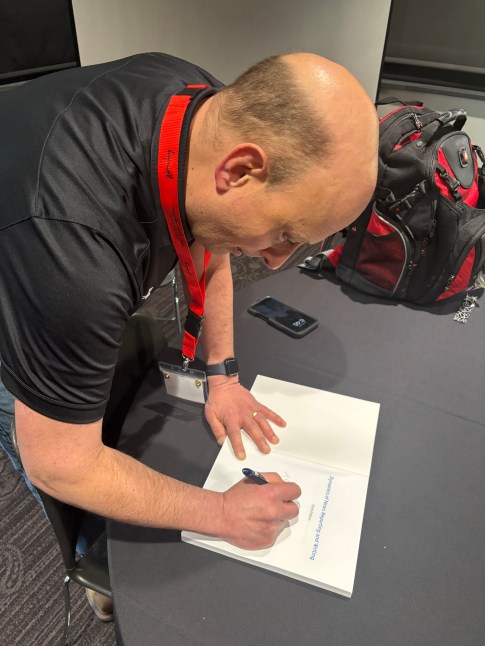
Actual proof that someone wanted my autograph on something other than a check or a grade-change form.

When I got back and told the story to my reporting class, one young lady told me, “I read your book. I still think it’s the best textbook because I could understand things from it. It felt really… human.”

In the age of AI, I’ll take the hell out of that.

Perhaps this is the longest way I can think of to say thank you for everything you do for me in the “external validation” department. My goal with each edition of the book and each blog post is to make sure I earn it.

If there’s anything you need, please let me know.

Vince (a.k.a. The Doctor of Paper)


How AI “expert sources” have duped journalists and four tips on how to avoid being the next victim


Meet Elizabeth Hubbell, a 25-year-old skin-care expert who is willing to be a great source for your next story on anything makeup or skin-care related. She’s actually completely fabricated. Her picture came from an AI generation site and her name is a combination of my car (Betsy) and a baseball player whose card I had laying around (Carl Hubbell). Careful. It’s dangerous out there…

When it comes to doing interviews, I always tell students they need to do them in person.  In response, they often look at me like I’m asking them to use a teletype machine or some semaphore flags. It’s easier, faster and more convenient for both parties if they can do a text, a chat or an email interview, the students say.

I argue that the face-to-face interview allows for a deeper connection for profile and feature pieces. This approach also can prevent sources in news stories from weaseling out of answers they could otherwise work through via several drafts of an email. Plus, if I spend some time in the source’s environment, I can probably find a personal effect that could give us something to talk about, like a family photo, a kid’s drawing or a sports item. At the very least, it’ll help with scene setting.

Apparently, there’s another good reason for my approach these days: Your easy-to-access, extremely helpful, expert source might be AI:

Since the launch of ChatGPT in 2022, anyone can generate comment, on any subject, in an instant.

It is a technology that appears to have fuelled a rise in expert commentators who have appeared widely in national newspapers but who are either not real, not what they seem to be or at the very least have CVs which do not justify their wide exposure in major newsbrands.

The rise in dubious commentators has been fuelled by companies that charge the PR industry in order to share quotes via email with journalists who have submitted requests for comment.

Journalist Rob Waugh found that in a number of cases, digital outlets were mass-generating content from these supposed experts, giving everyone from news journalists to PR practitioners the exact the quote or information they needed on a wide array of topics. However, when challenged to engage more deeply regarding who they are or what they have done in life, the “sources” suddenly had difficulty:

She has been quoted in Fortune talking about “loud budgeting” and by Business.com talking about the best countries in which to obtain a business education (both sites are based in the US).

A profile on Academized describes her as a “biochemist and science educator”. The same byline picture also crops up on a publisher called Leaddev, for someone called Sara Sparrow. Rebecca Leigh has written for DrBicuspid.com about how to write a business plan for your dental practice where she is described as a writer for Management Essay and Lija Help (two online writing services).

When challenged via email to do something that would be difficult to do with AI image-generating software (send an image of herself with her hand in front of her face) or prove that she was an environment expert, Rebecca stopped communicating.

One AI source, “Barbara Santini,” was particularly prolific in the volume and array of topics she could cover for journalists. Waugh found this roster of publications that had included Santini quotes:

She has been quoted in The Guardian talking about the benefits of walking (paid content), in Newsweek talking about white lies, Marie Claire talking about the meaning of money, the Daily Mirror talking about the benefits of sleeping with your dog, in The Sun talking about sexual positions, Pop Sugar talking about astrology, and Mail Online talking about how often to change your pillow.

Santini was recently quoted in a BBC article examining the lifelike responses of AI to Rorschach tests used by some psychologists saying: “If an AI’s response resembles a human’s, it’s not because it sees the same thing but it’s because its training data mirrors our collective visual culture.”

Despite her ability to be all knowing and wise, Santini apparently couldn’t receive phone calls, a relatively easy giveaway that the “person” on the other end is AI. Waugh also found other examples of journalists who were getting taken for a ride by an AI source, including one case where the non-human pitched a sob story about breast cancer survival:

“Seeing my scarred chest in the mirror was a constant reminder of what I had lost,” Kimberly Shaw, 30, told me in an emotional email.

She had contacted me through Help a Reporter Out, a service used by journalists to find sources. I cover skincare and had been using the site to find people for a story about concealing acne scars with tattoos.

<SNIP>

Shaw’s experience may not have been relevant to my acne story, but it tapped into the same feelings of empowerment and control I wanted to explore. Thinking she could inspire a powerful new piece, I emailed her back.

But after days of back-and-forth conversations, something in Shaw’s emails began to feel a little off. After idly wondering to my boyfriend whether she could be a fake, he suggested that I run the emails through a text checker for artificial intelligence.

The result was unequivocal: Shaw’s emails had been machine-generated. I’d been interviewing an AI the entire time.

As a result of Waugh’s story, a number of these information clearinghouses have tried to cull their ranks of AI “experts” while the deceived publications have retooled or removed the stories with fake people in them. Although the founder of one of these “expert mills” blamed much of the situation on “lazy journalists,” he kind of gave up the game a bit when it came to explaining why these platforms don’t prevent the frauds from gaining access in the first place:

Darryl Willcox, who founded ResponseSource in 1997 and sold it in 2018, says that the simplicity and speed of platforms like ResponseSource is key to their appeal and that attempts to add authentication risk slowing down the system.

Willcox said: “The other factor which complicates things a little bit is that these platforms are quite an open system. Once a journalist makes a request they can be forwarded around organisations, and sometimes between them, and often PR agencies are acting for multiple parties, and they will be forwarded onto their many clients.”

In other words, “If we slowed down to make sure things were accurate, we wouldn’t be as appealing as we want to be.” Eeesh.

So what can you to to avoid quoting a fake person? The overarching theme is basically, “Don’t be a lazy journalist,” but here are a few more specific tips:

TRUST, BUT VERIFY: The old Russian proverb really comes into play here and for good reason. I often say that paranoia is my best friend and has kept me out of a ton of problems. To that larger point, not only did I click on every link I could find in Waugh’s story, I also Googled the hell out of Waugh himself. Why? I imagined that it would be the most epic “Punk’d” moment on Earth if the media world was flocking to this story about AI screwing with journalists, only to find out that Rob Waugh was also an AI fake. I found LinkedIn, X, Bluesky, media staff pages and at least a dozen photos. I wouldn’t bet the house on the fact he’s real, but I’d probably bet the lawn tractor.

This can be harder in situations like the one involving the cancer scammer, as regular people tend not to have as big of a social media presence or digital footprint. That said, even regular people under the age of retirement should have left a few breadcrumbs out there for you to find.

KICK THE TIRES: If you can’t find the person clearly through a digital search, feel free to play a little game of 20 Questions to see if you can get some things ironed out. Experts who have kicked the tires on a few bots can offer you specific ways to ask questions that will tend to ferret out fakers. The author in the cancer-scam story revealed that asking for specific photos based on prior conversations can be helpful as well.

I learned about this kind of thing in trying to defeat scams when it came to buying sports memorabilia. When unknown sellers offered either exactly what I wanted when I couldn’t find it anywhere else or provided me with a ridiculously low price for something I knew should cost more, the pros who had been around the block a few times suggested I ask the seller to “coin the image.”

What this meant was that I wanted the person to take a picture of the item with a coin (usually asking for either heads or tails, or maybe even a specific coin) so I could tell they had the item and weren’t messing with me. Turned out, that advice helped me dodge a bullet or two. As weird as it might seem, asking someone to take a picture with their left hand raised or holding a quarter with “heads” showing might help you avoid a problem.

MEET IN PERSON: Again, this is the most obvious one to suggest. If you meet a person, in person, it’s a pretty safe bet that you can consider them real. The rest of the stuff (Are they the expert they claim to be? Did they really do what they say they did? Do they actually have cancer?) remains a risk without substantial additional reporting, but at least you’ll know they exist.

If that can’t happen for legitimate reasons (the person lives too far away etc.), look for other ways to get some human connection with the source. That could be a Zoom/Teams/Whatever video chat or an actual phone call at an actual phone number. In the cases where the frauds proliferated, it was pretty clear that the only connection between the source and the journalist was through a keyboard. That’s especially dangerous when you don’t have a prior relationship with a source.

WHEN IN DOUBT, DO WITHOUT: At the end of the day, there is no journalistic rule that says you have to use a source, a quote or a “fact” just because you have it. If you don’t feel comfortable with how a source is providing you with information or you aren’t 100% sure this person is a person, it’s better to leave that source out of your story than it is to run the risk of getting bamboozled.

If you say, “Well, the whole story will fall apart without this one source and I can’t get anyone else to provide me with this information,” maybe that’s more revealing than anything else we’ve said here.


It’s all fun and games until someone sues you for being an idiot: Pat McAfee Edition

ESPN forced to put out 'don't sue us' disclaimer as Pat McAfee show launches on live TV as NFL icon apologizes at start | The US Sun

The disclaimer on the front of Pat McAfee’s show.

THE LEAD: Pat McAfee, former NFL punter and current podcast maven, amplified an internet rumor on his show about Ole Miss quarterback Jaxon Dart and his girlfriend, Mary Kate Cornett. The unsupported allegation was that the 18-year-old freshman student was involved in a “triangle” of sexual relations with Dart and Dart’s father.

After suffering weeks of abuse, threats and other unpleasantness via the Online Idiot Brigade of Dude-Bros, Cornett plans to sue for defamation:

Now she is looking to hold accountable those who contributed to ruining her life, with McAfee and his network, ESPN, clearly in her sights.

“I’m not a public figure that you can go talk about on your show to get more views,” Cornett said on NBC.

BACKGROUND: McAfee is one of several larger “main-stream” media outlets that amplified this rumor. Barstool Sports folks promoted the rumor, along with a meme coin of Cornett. Former NFL player Antonio Brown posted a meme about the rumor. And this doesn’t count the number of other yahoos and local “shock-jock” idiots who did their own hot takes on the topic.

As a result, Cornett’s life has become a literal living hell:

As the rumor spread, Cornett removed her name from outside her dorm room, but she still had vile messages slipped under her door. Campus police told her she was a target, and she moved into emergency housing and switched to online courses.

Houston police showed up to her mother’s house, guns drawn, in the early hours of Feb. 27, in an apparent instance of “swatting” – when someone falsely reports a crime in hopes of dispatching emergency responders to a residence. According to security camera footage and a police report reviewed by The Athletic, the homicide division responded to the call.

After her phone number was posted online, Cornett’s voicemail was filled with degrading messages. In one, a man laughs as he says that she’s been a “naughty girl” and cheerfully asks her to give him a call. Another male caller says that he has a son, too, in case she’s interested. Several people texted her obscene messages, calling her a “whore” and a “slut” and advised her to kill herself.


UNDERSTANDING THE LAW: I talked to a couple Legal Eagle friends about this and they’re pretty much in agreement that anything from a defamation suit to an invasion of privacy case would likely tilt in Cornett’s favor. The key things to consider are this:

  • Cornett is not a public figure by any reasonable definition of the term, which means defamation is easier to prove. Yes, she’s dating a high-profile college athlete in the days of NIL money, but that doesn’t make her fair game. If she were a high-profile athlete or if she were promoting her personal brand of something or other online with a “brought to you by Jaxon Dart’s girlfriend,” McAfee’s actions would remain despicable, but the law could be a bit murkier. As a private individual, the standard she has to prove is negligence, not actual malice.
  • The rumor and the people spreading it (especially McAfee) have offered no proof for the allegations they are making about Cornett. As far as anyone can tell, this started out as a random post on YikYak and just kind of spread all over the place. Truth is one of the best “silver bullet” defenses against libel, which is why accuracy is so vital in journalism. If you accuse your university president of running a cocaine ring out of the basement of the student union, and you can prove it, you’re likely up for a Pulitzer, as opposed to a multi-million-dollar legal bill.
  • McAfee is not protected by the word “allegedly,” despite him and his panel of merry men slathering it about like mayo on a BLT. As we’ve discussed before, “allegedly” offers no legal protection.
  • McAfee is also not protected by his stupid disclaimer about it just being a joke-y show with a bunch of “stooges” just throwing bull around. If simple disclaimers like that worked, I’d put one on the back of Amy’s truck that says, “Disclaimer: I have a lead foot and a total disregard for my speedometer, so don’t pull me over to ticket me. I won’t change my behavior.”
  • Hyperbole doesn’t protect him either. The concept of hyperbole is that something has to be so outlandish that no reasonable person would believe it to be true. That’s why the Flynt v. Falwell case ended up in the favor of the porn producer, not the televangelist.

DOCTOR OF PAPER HOT TAKE: The first and most obvious thought is that Pat McAfee should know better than to do this. He’s 37 years old, so he’s been a grown-up for quite some time. He graduated with a communications degree from West Virginia University, so it’s likely he ran into some course at some point about what is and isn’t legal to say on air. He’s got a listener base of nearly 3 million people, so he should know that anything he says has a real chance to have a significant impact.

Even if he were none of those things, basic human decency plus the ability to observe the carnage that has befallen this poor kid* should have clued him in that it’s time to call off the dogs and apologize about this. (*Yes, the law considers her an adult, but she’s still basically a kid. Tell me you felt like a fully formed adult ready to deal with the world at large and I’ll be hard-pressed to believe you.)

Life as a teenager is ridiculously hard as it is. People are angry, petty and stupid. You feel lost and unable to control anything. Your mind races and wanders all at the same time as you try to figure things out for yourself, as every adult around you seems to be asking, “So, what are you going to do next?”

That doesn’t even account for the way in which social media has amplified the “Mean Girls” aspects of life, in which rumors spread more quickly, people get more vitriolic and anxiety can become amplified many times over. The crap teens say to their peers on a daily basis on social media channels could peel paint and give a truck driver the vapors. Now, imagine that it’s the entire world seemingly aligning against you for no good reason other than some chucklehead thought it would be funny to tell people you slept with someone’s dad.

I can’t imagine a way out. Actually, I can and others have as well, which is devastating beyond belief.

An Awesome AP Style Exercise That Will Get Your Kids Moving

I’m always a fan of people who have creative ways of helping students learn important tasks. That’s why I’m a mega-fan of Kameron Lunon of McNeese State University, who hit me up with an email back in 2021:

I wanted your thoughts on something. I’ve created (a series of AP rules and items) with the intention of taping them to students backs and they have to 1). Figure out who/what they are, but then 2). they have to pair themselves with their rule. After they’ve been paired, 3). The other students have to ask questions and try and figure out what the other students are.

I thought this was one of the coolest ways ever to do AP style, get students thinking creatively and helping them to remember key style rules. Kameron and I batted a few emails and texts back and forth about his plan to implement this. He also mentioned he’d video recorded it and would share it when it was edited.

As is the case with most things in journalism that lack deadlines, we both kind of lost track of time until last week, when he shared the final product with me. It’s absolutely worth the 12 minutes of watch time:


Kameron was nice enough to put together a quick walk-through for anyone interested in replicating the activity.

(Thanks again, Kameron! If anyone else out there has anything cool you’d like to share with the blog readers, just hit me up.)

Vince (a.k.a. The Doctor of Paper)

I$ Ca$h $peech? Elon Musk has a couple million thoughts on that…

Make It Rain Money GIF - Find & Share on GIPHY
An artistic rendering of Elon Musk’s rally in Green Bay on Sunday…

THE LEAD: Elon Musk handed out two $1 million checks Sunday as part of his efforts to rally voters for Brad Schimel in the Wisconsin State Supreme Court race.

Musk apparently decided that dumping $20 million in ad money into my home state’s Supreme Court Election wasn’t doing enough, so he decided to start handing out money to potential voters like it was parade candy.

Aside from offering people $100 each to sign a petition against “activist judges” (a thinly veiled swipe at the Democrat-backed candidate Susan Crawford), he took it a step further in offering the big cash prizes to a couple Wisconsin voters.

State AG Josh Kaul filed suit in an attempt to block this move, even as Musk was reshaping his offer:

Kaul is asking a Madison-based state appeals court to issue an order barring Musk from handing out $1 million checks to voters ahead of a planned Sunday event in Green Bay. The Democratic Attorney General first sought the ruling from a Columbia County judge who declined to act before Sunday, according to Kaul.

In a since-deleted post on X, Musk said he would hold an event Sunday in Wisconsin and hand out $1 million checks to voters “in appreciation for you taking the time to vote.”

But after election experts and Democrats raised questions about whether the offer violated the state’s election bribery laws, Musk deleted the post and said he would instead be handing over the checks to two people who would serve as spokespeople for his “Petition In Opposition To Activist Judges.” The new post also no longer said attendance would be limited “to those who have voted in the Supreme Court election,” as the original post had stated.

The appeals court rejected Kaul’s efforts on Saturday, noting that he hadn’t fully supported his application properly, so the judges denied his request. The Supreme Court also shot down his request.

BASIC BACKGROUND ON THE RACE: If you live outside of Wisconsin and have a limited interest in politics, you probably never heard of Susan Crawford or Brad Schimel. If you live in the state of Wisconsin, you probably know their names better than you know the name of your current pets.

(It’s also likely that you think all the Supreme Court will do is rule on when to set pedophiles free, given that seemed to be the gist of every attack ad on both sides of this.)

Like most court races, the Wisconsin Supreme Court election is supposed to be a non-partisan affair. As has become the case everywhere, that’s not entirely true, as both Republicans and Democrats basically pick sides and pour time, effort and cash into getting a candidate more to their liking onto the court.

Unlike most other statewide races in the country, people all over the place have taken a vested interest in whether Crawford or Schimel wins. According to a Milwaukee Journal-Sentinel analysis, people from all 50 states have dumped a record amount of cash into this election. The Brennan Center reported last week that the two campaigns and outside groups have spent more than $73 million on the race, which doesn’t account for whatever was spent since March 24.

The main reason is that whoever ends up winning will tilt the “non-partisan” court 4-3 toward a more liberal or more conservative side of the spectrum. With questions about gerrymandered state maps, women’s rights to bodily autonomy, state workers’ union rights, gun regulations and more likely coming down the road to the Supreme Seven, this race is seen as a really big deal for Wisconsin and beyond.

BASIC BACKGROUND ON FINANCIAL SPEECH AND ELECTIONS: In 2010, the U.S. Supreme Court voted 5-4 in the Citizens United v. the Federal Election Commission case that outside interest groups could spend as much money as they wanted to influence the outcome of elections via messaging of all kinds.

According to the Brennan Center, this led to the creation of giant “Super PACs” (political action committees) that wealthy interests could use basically steer election outcomes:

In other words, super PACs are not bound by spending limits on what they can collect or spend. Additionally, super PACs are required to disclose their donors, but those donors can include dark money groups, which make the original source of the donations unclear. And while super PACs are technically prohibited from working directly with candidates, weak rules that are supposed to enforce this separation have often proven ineffective.

The court in the Citizens United decision did note, however, that the law could limit money in politics if it was clear that the money was being used in a form of outright bribery, or  “quid pro quo corruption.” So, in short, Rich Dude/Dudette X can drop $500 billion into ads, mailers, events, social media posts and people wearing sandwich boards promoting a candidate for the Omro Dog Catcher Election, but they can’t hand $100 bills to voters outside a polling place for the purpose of buying their votes.

THE SMELL OF MUSK: Elon’s offers are clearly outside of the norm of what we’ve seen in politics to date (at least in recent years). To be fair, he’s giving out cash to people who sign a pledge that has no legally binding requirements and isn’t capable of creating any legally binding action if he reaches a certain number of signatures. In fact, people could take his money, use it to print up a boat load of Susan Crawford lawn signs and move on if they chose.

He also initially tried to skirt the rules meant to tamp down on bribery by making the two $1 million offers a kind of Publishers Clearinghouse Giveaway of sorts. His offer this time was for those folks who helped get the signature, which again, have no actual value in the broader sense of this election, so offering money for them is kind of like when the tooth fairy would pony up cash for your baby incisors.

What becomes a concern here is the psychological impact of reinforcing desired behaviors. The approach Musk is taking to get people to lean toward his liking is like Pavlov’s dogs, Skinner’s pigeons and Bandura’s bobo dolls all in one. Although the law has outlined strict rules for what is and isn’t bribery, psychological researchers have found the line between bribery and reinforcement to be a little fuzzier.

DISCUSSION STARTER: Where do you stand when it comes to the ideas outlined in the articles linked throughout here, particularly as they relate to the offering of money to complete a task like the petition Musk wanted people to sign? Is this a harmless stunt, a bribery attempt to undermine electoral legitimacy or something in between? Explain what you think and why and see if anyone can change your mind.


It’s the first sentence of your story, not a clown car: Learn to make choices in your leads


The goal of good lead writing is to tell people two basic things:

  1. What happened?
  2. Why do I, as the reader, care about this?

While many leads fail to do one or both of these when they don’t include enough information, some leads do almost the same thing when they give the readers too much stuff all at once.

Here’s one about the death of a former NBA player who became an incredible businessman:

Junior Bridgeman, a former NBA sixth man who rose from modest means to forge one of the most successful post-playing business careers of any professional athlete, becoming a billionaire philanthropist and, recently, a minority owner of the Milwaukee Bucks team for which he once played, died Tuesday after suffering a medical emergency during an event in Louisville, Kentucky.

This 58-word monstrosity gives me way too much information and I find myself struggling to keep up with everything the writer is trying to say. The writer decides not to make any choices about what to keep in the lead and what to relegate to lower paragraphs, thus making this a difficult read.

Let’s take a look at how you can avoid this kind of problem when you have a lot of things happening and they might all seem lead-worthy.

First, let’s lay out all of the facts in the “One Piece at a Time” approach to this lead:

  • Junior Bridgeman died Tuesday.
  • He suffered a medical emergency while at an event in Louisville.
  • He was an NBA player.
  • He won the Sixth Man of the Year award.
  • He was born of modest means.
  • He had a successful post-player business empire.
  • He became a billionaire.
  • He was a philanthropist.
  • He was a minority owner of the Milwaukee Bucks. (meaning he wasn’t the main owner, for folks who are unfamiliar with concept)

That’s a heck of a lot of stuff, even when you consider that it doesn’t include at least one thing most obituary-style stories like this tend to have (age of the deceased). That means we need to make decisions.

Second, start off with the most direct Noun-Verb-Object kind of approach we can take here to what matters most:

Junior Bridgeman died after a medical emergency.

We have a good noun, a solid verb and a solid prepositional phrase with a crucial object of the preposition that tells us how he died (at least somewhat).


Third, start looking for ways that you can condense some of the statements above, removing redundant elements or reshaping them in a more direct way.

For example, we basically say he was rich three ways:

  • Successful business empire
  • Billionaire
  • Team owner

Maybe there’s a way to either eliminate one of those or to recraft the sentence to shrink up what is there to tighten the sentence:

Junior Bridgeman, a billionaire philanthropist and minority owner of the Milwaukee Bucks, died after a medical emergency.

We also say he was an NBA player in two ways:

  • Former Sixth Man of the Year
  • He played for the Bucks

We could rework that to both of those things into this as well with some tightening and structuring:

Junior Bridgeman, a former NBA Sixth Man of the Year  who became a billionaire philanthropist and minority owner of the Milwaukee Bucks after his playing days ended, died after a medical emergency.

I’m at 32 words here, so if I’m going to add anything else, I’m probably going to need to make some changes. Let’s see what we add and what we cut:

Junior Bridgeman, a former NBA Sixth Man of the Year  who became a billionaire philanthropist and minority owner of the Milwaukee Bucks after his playing days ended, died Tuesday in Louisville, Kentucky, after a medical emergency.

If we add the where and the when, we’re at 36. We could go one of two ways to make a cut here. We could remove the phrase “after his playing days ended” if we think it’s obvious that he didn’t become those things before or during his playing days. We could also cut the award and replace it with “player,” which would swap five words for one. We could do both if we wanted to find a way to weave his age in.

Junior Bridgeman, a former NBA player who later became a billionaire philanthropist and minority owner of the Milwaukee Bucks, died Tuesday at 71 after a medical emergency in Louisville, Kentucky.

This gets us to 30 words, adds in the age and allows for development later. We could swap out the age and put back the Sixth Man of the Year award, if we felt it was more valuable to the audience than his age. I’m also not a huge fan of three prepositional phrases in a row, as that starts to make this a little sing-songy. It’s a judgment call at this point. Either way, we basically have a congruent amount of information to the original lead in half the space.

The one thing to remember about lead writing is that there’s nothing wrong with pour out all the info you have into a sentence, but you then have to go back and make decisions. In most cases, the writing of the lead is in the editing, so make sure to give your lead those additional looks that can make the difference between one that’s tight and right and one that’s bloated and confusing.

EXERCISE TIME: Find a lead in a publication that you read that goes way over that 35-word limit. (The longer the better) and use this approach to get it under control. If you need to use other elements from the story to do so, feel free to dig into the body of the piece a little bit.

Then, see what other people think about your changes and be able to justify your actions as you go along.


You are always in the public eye, so it pays to keep that in mind (a.k.a. we used to call it the World Wide Web for a reason)

This ensemble is from the “Dress to fire people” line…

THE LEAD (Part I): Being a social media influencer can take a lot of work, but multitasking between firing people as part of the Office of Personnel Management and showcasing clothing options that collectively cost more than my first car tends to lead to problems:

On the day O.P.M. sent a memo to all federal department and agency heads asking for lists of underperforming employees to terminate, she flaunted a “work look” that included a purple skirt that her followers could also purchase, retailing at $475. She would get a commission if they used her link.

The spokeswoman, McLaurine Pinover, is not the only member of the Trump administration to have used her federal office to promote outside business interests, but former agency officials and ethics watchdogs say that the timing and content of the videos were both unlawful and especially tone-deaf.


I wonder how they tracked her down after she scribble out her… Oh… Yeah…

THE LEAD (Part II): Being a racist jerk tends to lead to a lot of backlash, particularly when you leave enough clues for people to find you.

On March 2, Stephanie Lovins, while dining at Cazuelas Mexican Cantina in Columbus, Ohio, left a message for Ricardo, a U.S. citizen serving her.

In the signature section of her receipt, Lovins wrote: “I hope Trump deports you,” followed by “Zero. You suck.” The incident occurred after Lovins grew upset over the restaurant’s “one coupon per table” policy.

A restaurant employee who found the receipt shared a photo on social media, and it quickly went viral, provoking widespread condemnation and calls for Lovins’ termination.


DIGITALLY DUMB: In both cases, the people involved tried to wiggle their way out of this situation. In Pinover’s case, she did the “Ugh… like, why are you making such a big deal about this?” thing, arguing that she didn’t make any money and trying to garner sympathy for her influencer attempts:

In a statement, Ms. Pinover said she never made any money from the fashion videos.

“While I was battling breast cancer as a new mom, I felt so unlike myself. I turned to social media shortly after as a personal outlet,” she wrote. “I never made any income and with only about 800 followers, I’m surprised the so-called ‘newspaper of record’ finds this newsworthy. My focus remains on serving the American people at O.P.M.”


In the case of Lovins, she went with what I call the “Shaggy Defense” when confronted:

Lovins initially denied any involvement, claiming on social media that her credit card had been lost or stolen and that someone else had used it.

“My credit card was lost/stolen, and someone attempted to use it. Thanks for the notifications! This has been reported through my bank,” she wrote on Facebook.

“Thank you for all the recent notifications of scammers and profile hackers! I recently discovered a lost/missing credit card and an attempted use/purchase. I appreciate your patience while I manage the situation,” she wrote in a post on LinkedIn….

However, this was discovered to be a false statement after the restaurant reviewed CCTV footage and confirmed that she was inside the restaurant, leading to her termination.


DOCTOR OF PAPER FLASHBACK: Two things came to mind in reading these stories. First, it was the idea that anything we do nowadays is private is almost quaint, but particularly so when you actively jump online.

I remember in the early ’00s when I had a student who wrote a blog post/diatribe about a conservative student on our campus. When that conservative kid saw the post, she put out the Bat Signal to conservative websites and media outlets, thus leading to this exchange between me and my student:

HER: This isn’t fair! I’m getting attacked by all these people who she shared the piece with.

ME: What do you mean it’s not fair? You published a hit piece on her, so she’s telling people to tell you what they think about it.

HER: But that wasn’t supposed to be for her! It was only for my friends! It was supposed to be private!

ME: What part of the “WORLD WIDE WEB” do you not understand?

Second, I had a similar situation where we were going to launch the reporting book and the folks at Sage wanted me to do a whole new social media profile:

ME: I’ve got a Twitter account and I’ve got a ton of followers already. Why should I delete that and do a different one?

EDITOR: Vince, do you remember what you ate for lunch yesterday?

ME: Um… No…

EDITOR: How about last week Tuesday?

ME: Not a clue…

EDITOR: Right. So you’ve been on Twitter for about 10 years at this point… How many of those tweets are things you remember well and are totally proud of?

ME: (Quietly setting fire to every digital account and device I ever owned…)

To be fair, I’m sure I wasn’t asking for money or to deport a server, but I was extremely upset about the Cubs stealing the 2016 World Series from my Cleveland squad, so I’m sure I didn’t cover myself in glory there…


BLOG FLASHBACK: We’ve had a number of these cases in which people behaving badly ended up getting shared online, leading to terrible outcomes.

There was the college student who didn’t think anyone would share her “Finsta” tirade about Black people. We also had the kid at UW-Madison, who apparently thought her “private thoughts” on forcing the ghosts of Black people to “pick cotton”   wasn’t going to go viral. Then, there was the kid who had a swastika flag and a whiteboard full of slurs getting outed at UW-Oshkosh.

I’m sure there were more, but I started getting depressed, so let’s just leave it at those and say these are not rare occurrences.


WHY YOU SHOULD CARE: Given that the sheer tonnage of time people spend online each day could stun a team of oxen in its tracks, there are a couple key takeaways for folks that bear repeating:

Nothing is “just” anything anymore: If you’re thinking you “just” sent that photo to a friend or you “just” made that less-than-savory joke to your private Facebook friends or you “just” acted like a dipstick in public once, welcome to your reality check.

Dad used to tell me stories about guys at work who would tell off-color jokes or poke fun at each other in ways that boggle my mind. I don’t know if it’s so much that these things were terrible or if now I’m just so attuned to the crap storm that could come from those jokes or putdowns that freak me out.

I like to think that it’s half of a piece of each, in that more people had thicker skin while fewer people were perpetually offended and that we have evolved to prevent some truly unsavory behavior in the work environment.

Either way, we are clearly beyond getting free passes in life with the justification of, “C’mon, it was just…”


Everything is public: I don’t like that everything I do is public these days or that someone could decide, “Hey, it’s F— with Filak Time!” and look for a McDonald’s receipt I was writing stupid crap on back in 1998 or something.  However, that’s the field I’m in and that’s the reality of our surroundings.

You can avoid a lot of this by not being online as much or not sharing as much stuff online, but for digital natives, media operatives and anyone under the age of 60 who wants to remain part of broader society, that’s a tough ask.

This is why paranoia is my best friend, why I try to count to 10 before I write anything out of anger and I always imagine the headline in the Advance-Titan of “UWO professor suspended for (Dumb thing I’m thinking about doing)” before I do anything.

It doesn’t solve everything, but it does tend to keep me more centered than I would otherwise be.


Know the rules: This more applies to the first case, as opposed to the second one, although understanding “one coupon per table” before losing your mind on a server has a tangential connection here.

When social media first emerged, a lot of people running organizations were in their 50s and 60s and they knew two things about it: 1) They didn’t know what it was or how it worked and 2) They wanted to use it somehow for the betterment of their organization.

Thus, they tended to turn to young people who had grown up a bit with this and really didn’t give them any major rules. It was like the Wild West, although I’d argue you could probably do more damage with one tweet than you could with a trusty six-shooter back in the day.

Once things started to go haywire, due to missteps by the posters or generally not paying attention well enough to the hashtags involved in other posts, the leaders at those places started putting some basic rules in place. By now, most places have a pretty solid rule book on what people can and can’t do on social media, which includes where and when they can or can’t do it.

One of the things most organizations (and the cops who tend to pull Amy over) say is, “Not knowing the rules is no excuse for not following them.” This is why it’s important, upon getting a new job, to know what it is that you can and can’t do, especially in terms of your outward-facing presence.

I know there are things I can’t put up in my office (political endorsement signs) and things that probably could get me in trouble if they upset people (Vintage Cleveland Baseball nodders come to mind). There are also things that are a little more nebulous, like, “What is the rule of the thumb on using my computer to blog like this?”

Long story short, it pays to know what the rules are before they become problematic. And it also pays not to be a racist ass-hat, even if you don’t think people will call you out for it.


When asked about his feelings on using “when asked” in a story, this professor had this to say! (A Throwback Post)

As we moved into the lectures on quotes and paraphrases, an ugly trend in student writing returned: The use of “when asked” to set up quotes.

This might be one more of my “old man yells at cloud” moments, but I’m battling back ferociously against allowing this to creep into their writing. I try to explain grammar or use humor to break this down for them, often noting, “Could you imagine if the sources just ran up to you and started filling you in on a story when they WEREN’T asked? No? So, why are you telling me they did it when they were asked?”

If you are having similar problems with the “when asked” phenomenon, below is a throwback post that looks at the reasons this approach is stupid and how to fix it.

——

Why “when asked” is the dumbest thing you can write and ways to avoid using it

(Are you the most important thing in the story? Probably not. So stop telling me you asked people stuff…)

One of the weaker writing trends that’s been popping up in a lot of writing lately has been the use of “when asked” as part of a lead-in to a quote, or in some cases, as part of a quote:

When asked if he supported the bill, the mayor said, “Not this stupid version.”

When asked about the how best to improve relations between the university and the town, the chancellor said, “We need to work together on this.”

When asked if New York Gov. Andrew Cuomo should resign amid allegations of sexual harassment, President Joe Biden had this to say.

Here’s What Alex Rodriguez Said When Asked If He Was Single Amid Jennifer Lopez Relationship Drama

This is dumb for about a dozen reasons, but here are a few that might matter to you as a journalist:

  1. It’s passive voice: “When asked” implies “by someone,” which means you’re introducing the quote from a weak grammatical position.
  2. It’s first person: “When asked by… ME! LOOK! I ASKED A QUESTION!” Are we that thirsty that we need to mention that we had the temerity to ask a guy at the fair how the corn dogs were this year?
  3. It’s a “No duh” moment: Of COURSE they said it when they were asked. Isn’t that how this normally works in life? Think about how weirded out you’d be if some random stranger just ran up to you and said, “Hey, I just wanted to tell you and all the readers of whatever story that you’ll be publishing that the corn dogs at this fair are FRICKIN’ AMAZING!” I don’t know about you, but I’d be backing away slowly or reaching for some pepper spray.

In the examples above, we have a few other problems as well:

  1. The setup incorporates lousy quoted material: In the first two versions, you get really bad quotes that don’t do a lot for the piece or for the reader. Neither of those quotes add value or quality in a complete quote kind of way. The chancellor quote is lame, while the mayor quote isn’t a full sentence. You can actually make these better through the use of either straight paraphrase or a partial quote:
    1. Mayor Jane Smith said she sees value in a voting-security bill but “not this stupid version,” which would require citizens to cite the pledge of allegiance backwards before casting a ballot.
    2. North Texarkansas State University and the city will continue to clash over parking restrictions unless the city council and the college can work together to resolve ticketing protocols, Chancellor Arlene Selridge said Tuesday.
  2. The set up tells me that you’re going to tell me something: In the latter two, you have actual examples of journalists telling us that they’re going to tell us something. In the Cuomo example, the build up to what the president had to say is the bulk of what’s going on in the sentence. It then leaves us with a “commercial cliffhanger” for that second paragraph. In the A-Rod/J-Lo one, we don’t even get the decency of a full chunk of information as to what that “drama” entails.Think about it like this: If your professor walked into the classroom and said, “I have graded your midterms.” Would that be the ONLY thing you’d want to know? Probably not. Then imagine the professor saying, “I have graded your midterms. When asked by my wife how well people did, here’s what I had to say!” Is it getting any better or are you thinking, “Can I use The Force to pull mine out of the pile or an X-power to read his mind and just get my damn grade?”

The reason that paraphrase-quote works well is because each chunk of that structure has a job: The paraphrase tells you something important that will get you deeper into the piece. The quote then provides flavor, color and “sparkle” to that topic of interest while not repeating what you already know.

“When asked” takes away the best parts of both of those elements.

At least, that’s what I’d say if I were asked…

Whether you agree or disagree with Mahmoud Khalil, you need to watch his case

THE LEAD: Mahmoud Khalil, a graduate student at Columbia University and a legal U.S. resident, was picked up in an ICE raid Saturday and faces deportation. Khalil was a leading voice in the Palestine protests on the university’s campus last spring.

Khalil was detained Saturday night as he and his wife were returning to their Columbia University-owned apartment in upper Manhattan by officials from the U.S. Department of Homeland Security.

The agents told the couple that Khalil was being detained because his student visa had been revoked.

When his wife provided documents proving he was a green card holder, the agents said that was also being revoked and took him away in handcuffs, according to a lawsuit Khalil’s attorneys filed challenging his detention.

President Donald Trump discussed the matter in a social media post in which he supported the arrest and potential deportation, calling Khalil a “terrorist sympathizer” for his stand on the Palestine situation.

Secretary of State Marco Rubio concurred, saying Khalil’s protest actions were “aligned with Hamas” and thus it was acceptable to revoke his green card (and his marriage to a U.S. citizen, I guess) and deport him.

A court held up his deportation and his lawyers will be arguing Wednesday that he’s essentially being punished for exercising free speech.


DOCTOR OF PAPER FLASHBACK: We talked about the issues related to protests last year when a number of campuses were dealing with upheaval and cracking down on students who peaceably assembled. As we noted back then, you can’t just support free speech when it’s speech you like. The same is essentially true for all of the other aspects of the First Amendment.

In other words, if you’re cool with people standing up for Side A of an issue, you have to be cool with people standing up for Side B of that issue. As long as the protests and speech don’t run afoul of what the law has already stated as being out of bounds (fighting words, child porn etc.), the Bill of Rights protects those actions.


WHY YOU SHOULD CARE: You could easily make an argument that this is one guy, speaking out on a topic in a way that a lot of people don’t like, so it shouldn’t really matter.

You could make that argument and it would be both dead wrong and dangerous.

The actions here underlie a broader set of concerns for anyone who supports free expression. Earlier in March, the president noted he would crack down on colleges and universities that allowed for “illegal protests” to persist. It wasn’t clear what made something an “illegal protest” in the eyes of this administration, but I imagine that the translation would be “anything the president doesn’t like.”

Anyone who has an opinion about anything should probably be concerned about this approach, even if you disagree with everything Khalil stands for. Without legal protections for expression, it could be just a matter of time before whatever you think is worth talking about could land you in prison under some sort of trumped up charge.


DOCTOR OF PAPER HOT TAKE: Again, I don’t like a lot of speech or protests, and I’m pretty sure I wouldn’t agree with most of what Khalil has to say. That’s not the point of sticking up for his rights.

The law has long held that the government can’t suppress speech it doesn’t like, but it seems like we’re living in some sort of parallel universe right now where the government tends to do something beyond the pale and ask questions later. The Elon Musk line about how the administration will “make mistakes” but fix them up once they realize they made a mistake is a bad idea in general, but it’s even worse when it come to the inalienable rights associated with our country’s founding.

If the courts give the administration a pass and say, “Well, it’s just this one guy and, yeah, screw Palestine anyway,” it sets a dangerous precedent for when someone else upsets this administration. The cure for speech we don’t like is not to crush that speech. It’s more speech that presents a counterbalance to the original speech.

Even if the courts let this guy go, we still have the problem of how these actions have the potential to chill speech throughout the country. It’s like a bad parent smacking a kid in the head for voicing an opinion. That kid is probably not going to pipe up again, but the rest of the kids in that family are probably also going to keep their mouths shut.

That’s not how we’re supposed to roll as the United States.

When great journalists give up on careers in news much faster than they used to

When the Wisconsin Newspaper Association announced its annual Better Newspaper Contest winners last week, I found myself in a bit of a quandary. On one hand, I located numerous former students who received honors for their work in newsrooms of all sizes across the state. On the other hand, I found myself in a crisis of confidence, wondering how many of them would make next year’s list.

At the core of this conundrum was one of the best students I’d ever taught, who racked up two fistfuls of awards, grabbing everything from first place to honorable mentions across a swath of writing and visual categories. It was an achievement she is unlikely to duplicate, as she left her full-time newspaper gig in favor of a position with a marketing firm. She noted an intent to continue freelancing, which is great for her and helpful to the paper. However, her decision to go elsewhere had me once again pondering the future of journalism.

She was one of the toughest and smartest kids I’d taught in my time at UWO. She had the ability to tell feature stories with a deft touch of narrative and dig deep into investigative pieces that required significant persistence. She also had the “nosy gene,” which tends to separate the good ones from the great ones in journalism.

She paired her passion as a student athlete with her interest in journalism to find important stories that no one else was telling. She did an amazing in-depth piece on the gender inequity present in protective gear for NCAA athletes and also used open-records requests to answer the question of why an extremely successful coach suddenly resigned for a job driving for Domino’s pizza. Upon graduation, she took a sports journalism gig out of state, before returning to her hometown to help improve her local paper.

This pairing seemed ideal, as she could speak the language of the athletes she covered while also knowing the bigger issues the city grappled with on a daily basis. She had an eye for detail, an ear for gossip and the skills to tell readers important stories in a way they could understand and appreciate them.

When she announced she’d be leaving the paper after two years, I was somewhat stunned.

What she revealed to me was exactly what I had feared: The paper was undergoing a “series of transformations,” which basically means things are getting worse, managers are demanding more for less and the publication’s corporate overlords were abdicating any sense of responsibility they had toward quality journalism. Thus, she did what we had trained her to do at UWO, taking her “transferable skills” to a place that valued them and was willing to treat her better.

The idea that news outlets in general, and newspapers in particular, are going down the drain is not a revelation to anyone who has been paying attention to the industry for the last 30 years. With corporate mergers, conglomerate consolidations and hedge-fund asset-stripping of media outlets, it’s often a miracle that these institutions still exist at all.

Researchers at the University of North Carolina found that more and more places in the United States now have either no credible local media outlets in the area, or have extremely weak local media outlets that can’t provide quality content. These scholars have deemed these places “news deserts” and “ghost newspapers,” and the numbers are scary. More than 200 counties in the country have no newspaper while an additional 1,500 counties have only one local newspaper, which is usually a weekly.

It’s also no secret that news jobs tend to have a lot of problems associated with them. The pay is terrible, the hours are worse and the public harassment is becoming almost unmanageable. Reporting gigs for entry-level and early career reporters can pay somewhere between $16 and $21 per hour, depending on the location and size of the publication, and that’s assuming a standard 40-hour work week. (If you’ve ever worked in a newsroom, feel free to laugh at that concept…)

A study by the Poynter Institute found that more than half of the journalists surveyed in 2024 had experienced a level of burnout so bad, they considered leaving the field altogether.  It also found that about three-fourths of the journalists did not have access to adequate mental health support to deal with the crushing weight of constantly being on the look out for news and the pile unpaid overtime they worked.

And don’t even get me started on the abuse and violence they have to endure…

So, the question becomes, “What makes this particular resignation worth discussing?”

The underlying concerns for me are two-fold:

First, it’s not that I haven’t had former colleagues or former students leave news to go into another field. I’m also not offended by their decision to ply their skills in public relations, advertising, marketing and promotions. This isn’t about “going to the dark side” of the field, which is a total cheap shot at people who are trying to put their talents to use.

What is concerning is the speed at which they are making these moves away from news. The students I taught during the first third of my career who went into news tended to stay there for an appreciable time period. They might bounce from reporter to editor or from one news outlet to another, but they tended to hang around until they either found a “forever job” or they found they had advanced as far as they could or wanted to in news. At that point, they either settled in or moved out, but it wasn’t until their mid-30s or even early 40s before that came to pass.

This student’s move is more indicative of what I’ve seen in the current third of my career, with many really good newsies deciding that the news business wasn’t all it was cracked up to be and leaving it behind much sooner.

One student who spent a number of years with me at the student newspaper was a dogged investigative journalist. It once took him 18 months worth of legal support from the Student Press Law Center, coupled with a court case that was one step away from the state’s Supreme Court, to break loose open records that explained why a professor was escorted out of his class at the beginning of the term and not heard from again for almost six months.

The kid ended up taking a job at a small local newspaper outside of Milwaukee and consistently bloodying the nose of the state’s largest newspaper when it came to important coverage in his zone. A little more than three years after taking that job, he left to become a marketing specialist at a private university.

Another student of mine ran the Advance-Titan newsroom for almost two years, overseeing some of our most important and award-winning coverage. She landed a job at a respectable newspaper in the state, serving as a reporter and then the entertainment editor, where she continued the trend of putting out great content. Again, about three years into the gig, she left and took a job as a marketing content specialist. She now works for another company as an inbound marketing strategist.

These are just a few of the students I’ve seen over the past decade who had news in their blood, but left the field nonetheless for greener pastures. These weren’t kids who couldn’t hack it as reporters and had to limp away to an “easier” media gig. If all things were equal, they easily could have built extensive careers in news, providing us with outstanding journalism that helped us understand the world around us. Unfortunately, all things weren’t equal and the only way for them to survive was to give up on the news industry.

This leads to the second concern: The loss of quality news workers and the content they could have created for us. Don’t get me wrong, I remain ridiculously proud of my former students and the good work they do as media professionals. I also don’t begrudge them the desire to out-earn the kid running the hostess stand at Olive Garden. What worries me is the way in which newsrooms have become the slums of the media ecosystem and how that affects what we get as citizens.

Most of what the UNC folks look at has to do with journalism operations that have either been killed off or had their resources stripped to the bone. What has happened here is that the reporters who were once able to weather the onslaught of lousy pay, long hours and difficult tasks are just calling it a day. They either feel they can’t do the work that they want to do, thus making news unappealing, or they feel there isn’t a point to banging their heads into the wall as they attempt to do quality journalism.

They’re figuring out that once college is over, it’s no longer cool to be broke, eat dinner out of a vending machine every night and grind out piece after piece after piece for a disinterested audience. They wanted a decent life in return for the six-figures worth of tuition they ponied up and discovered it’s not in a newsroom that smells of old newsprint and burnt coffee. Their decision not to suffer for their art has limited what we will learn as the audience for their work.

I know that in the small-town newspapers I get in my area, I’m not seeing a lot of deep dives on what the city council is doing or how tariffs are impacting local farmers. I can’t remember the last time I saw a story based on an open-records request or a decent discussion of a ballot initiative. The content would barely be good enough to get through a sophomore reporting class.

When I would pick up a copy of the Omro Herald at the gas station each week, I’d see about 75% of the content written by one fresh-faced kid who apparently never heard of active voice or bothered to learn where the return key was on his keyboard. The stories usually ended up being week-old meeting pieces that lacked a “so what” or “now what” and any weird crime news that happened in the area. The remainder of the paper had local ads, hyperbolic game coverage of the local high school’s sports and a column from a guy who was older than dirt who would just rant about liberals.

I’m sure that was the best that the Herald could get in terms of staff, but that’s really the point. With more and more people taking the skills we give them in media to places that pay better and treat them better, what’s left are the people who either lack the skills or talent to make news valuable to a given audience. I also know that what is happening to these smaller papers is just the canary in the coal mine for news outlets, and that medium and large media operations are likely to see similar losses sooner rather than later.

As that continues to spiral toward its natural conclusion, we’re all going to be worse off.