“Can You Libel a Disaster?” (And several other questions that came to mind after The Atlantic gave Ruth Shalit Barrett $1 Million)

Ruth Shalit Barrett received more than $1 million after suing The Atlantic for defamation, based on its approach to retracting this story. For that kind of money, they must have said this is a photo of Barrett drowning a couple dozen kids in a pool laced with electrical lines. 

THE LEAD: When in doubt, sue somebody, because it apparently works:

The Atlantic quietly agreed to pay more than $1 million early this summer to settle a lawsuit by the writer Ruth Shalit Barrett, who had accused the magazine of defamation after it took the rare step of retracting an article she had written and replacing it with an editor’s note, according to a person with knowledge of the settlement.

Ms. Barrett, who wrote an article about youth sports in wealthy areas as a freelancer for The Atlantic in 2020, sued the publication and one of its editors in January 2022. She said the outlet had smeared her reputation and asked for $1 million in damages.


DOCTOR OF PAPER FLASHBACK: I was working on another post over the weekend when I noticed a post I wrote several years ago about Barrett’s article and subsequent lawsuit was getting heavy traffic for no apparent reason. A quick Google search of her name helped me figure it out.

At the time, I figured there was NO WAY this thing was going anywhere. The strength of my prediction powers is also why I suck at Fantasy Football.


THE DETAILS: Barrett wrote a story about niche sports that rich parents were pushing their kids to enter, in hopes of gaining an edge when the kids applied to Ivy League schools. The story had a number of problems, including an anonymous source that wasn’t that anonymous, the creation of a kid out of thin air, the exaggeration of an injury to a kid during a fencing match and more.

Eric Wemple of the Washington Post dug into this story and started finding more and more things that didn’t make sense, something the editors of The Atlantic also began to notice. At some point, they decided, “Screw it, we can’t save the patient” and retracted the story with a lengthy editor’s note about the story and Barrett’s history in media.

As a result, Barrett filed the suit, arguing that the note defamed her in several ways. She asked for it to be rewritten and that she be given the story’s publishing rights. The two sides went to arbitration, leading to some edits to the note and a lot of cash.


A FEW QUESTIONS: In reading this over and over again, I found myself asking several rhetorical questions, one of which was, “Can I sue Sage for no good reason with the hopes that they give me a squillion dollars to go away for a while?”  While the answer to that one marinates in your mind, here are a couple others:

CAN YOU LIBEL A DISASTER? I’m not calling Barrett a disaster for obvious reasons, not the least of which is I don’t have a million bucks I want to throw away. I’m more or less wondering how we started with a story so bad that it required a full retraction and ended with a pay day of this nature.

The publication stated it was aware of her history of not quite exhibiting the best level of judgment in regard to journalistic integrity. Wemple dug a bit deeper into her life and found more than a few clinkers along the way, including problems with the story on these weird sports. The fact checkers were lied to in at least two cases, with one source being encouraged to lie. (The original note said “at least one” while the new note says “one,” a distinction without merit from a language position. Also, who told you it was “only” one? The person you initially found was involved in all the lying and encouraging others to lie, so… um…)

Courts have ruled on a number of occasions that certain people and situations are “libel-proof,” in that nothing further can be done to harm their reputation. In addition, courts have stated that libel doesn’t apply if only “incremental harm” can be demonstrated. In the former, the courts basically say that someone or something is so bad, any statement that might be libelous toward any other person or group won’t qualify as libel. In the latter, it’s like a person in prison for 10 counts of murder sues you for reporting that they have a dozen unpaid parking tickets.

In looping back to this situation, I fail to see how the changes to the note or the statements regarding Barrett improved the situation to the point of avoiding libel. The distinctions in here feel to me like the quote in “Great Balls of Fire!” when someone yells at Jerry Lee Lewis that  he married his 12 year old cousin, Myra, to which she retorts, “Second cousin, twice removed!” Oh. Well.

The question of how bad was the defamation in relation to what was already out there has me pondering what level of reputation she recouped as a result of the suit. In short, do people who thought poorly of her now think better of her after this? Or did people who thought better of her before the retraction think worse of her AFTER that retraction?

Or did the big check just make things better?


WHEN DID GP GO MIA? I seem to remember a time, not so long ago, when people did things on “GP” or “general principle.” In other words, it was standing up for the right side of something or holding someone to account for something, even if it would be easier to just throw in the towel.

Case in point, my parents told me when I first got my license that if I got a speeding ticket, I’d lose my right to drive for a protracted period of time. No muss, no fuss, no BS. Just put the keys on the table. Sure enough, when I was 17, I was ticketed for speeding along a stretch of road that was a notorious speed trap. I walked into the house, put the ticket on the table, dropped the keys on top of it and that was that for a while.

What my parents DIDN’T foresee was that I was involved in about 912 activities that required me to be at various locations at night and on weekends. It would have been far easier for them to just give me back the keys and let me drive myself. However, Mom and Dad dug in and ended up driving me to and from all those things until the predetermined punishment time had ended. It was inconvenient for them, but they decided the principle of the thing mattered. I learned a lot from that and have since avoided speeding tickets, although now that I’ve said that, I’m sure I’m getting nailed on the way home.

The larger point is: When did we stop fighting just because the fights were hard? We’ve recently had the “60 Minutes” lawsuit, the ABC lawsuit, and several other lawsuits that have the “Fourth Estate” folding like a cheap cardboard box in a rainstorm. It’s like, “It’s cheaper and easier to just pay people to go away.” Well, that’s like paying protection money to the mob, assuming it’s a one-time thing.

It’s not just the news business, but it seems like we fold up everywhere: A kid threatens us, we change a grade. A social media “influencer” pulls focus onto a post we made, we take it down and apologize. Don’t even get me started about what the kids are doing in the ice cream aisle at Walmart these days. What happened to standing on principle?

There are times where I go into a situation knowing full well I’m going to lose and there are other times, where the risks are pretty damned high that I will. Still, there’s something that says, “No. You aren’t folding. You’re gonna play this hand out, because you can’t live with yourself if you don’t.”

I feel this moment so deeply

I understand that money is a predominant factor in pretty much everything in the world today and I know that it’s easy to say what I would or wouldn’t do when it’s not my money to spend. That said, I think back to the people I admire the hell out of in this business, who would never have acquiesced as easily as it seems like so many people are so willing to do.

The “No Comment” Culture and its impact on society

Screenshot

THE LEAD: Ghosting someone may be awkwardly bad form in dating relationships, but it’s a significantly bigger problem when sources do it to journalists. Jim Malewitz of Wisconsin Watch provided some solid examples of why “no comment” can harm the very folks politicians and other public officials are meant to serve:

It’s hard to address homelessness — or any complex challenge — if we don’t even know where leaders stand.

Unfortunately, independent journalists are growing accustomed to being ignored. In a trend spanning multiple levels of government and political parties, public officials are increasingly avoiding answering inconvenient questions about matters of public concern. They’re sending generic statements instead of agreeing to interviews that are more likely to yield clarity. That’s if they respond at all.

<SNIP>

Such tactics are less harmful to journalists than they are to constituents. We ask questions on behalf of the public — not to satisfy our own curiosities. Ignoring us is ignoring the public.

THE “NO COMMENT” CULTURE: The popular quote (often attributed to everyone from Abraham Lincoln to Mark Twain) about keeping your mouth shut does have some merit: “It is better to remain silent and thought a fool than to speak and remove all doubt.” It’s also a lot more dangerous these to say anything that might be construed as… well… anything, thanks to the rage machine that is social media.

Off-the-cuff comments can lead to significant public shaming, as was the case when a press aide for the White House dismissed John McCain’s opposition to a nominee by saying, “It doesn’t matter. He’s dying anyway.” 

When people make public comments as part of longer interviews, it turns out that a lot of the public will, gosh, hold them to those comments. When he was a candidate for governor of Wisconsin, Scott Walker stated that he planned to create 250,000 new jobs in his first term. When people who can do math and understand money figured out this was impossible, Walker tried to back off by saying he was more generally talking about improving work opportunities and making Wisconsin a better place to be for employers. Still, that 250K number hung on him like a millstone.

Public relations practitioners, spokespeople and other “handlers” have done significant work to help people who actually need to say something offer blanket statements through press releases or social media accounts while not really answering any questions or opening them up to public scrutiny. All of this has created kind of a “no comment zone” even when people do offer comments.

DOCTOR OF PAPER FLASHBACK: Perhaps one of my favorite stories ever written here in Oshkosh was one a student of mine cobbled together using almost nothing but “no comment” comments. When a professor was escorted out of a classroom on the first day and then replaced by a long-term sub, students wondered why. Administrators and various other officials figured if they just pulled an “ostrich move” they could prevent the story from getting out. They were wrong.

PLEA TO PR PEOPLE: If you want the media to take your clients seriously, put some actual time into coming up with some sort of statement that doesn’t look like you downed four Monster Energy drinks and started typing buzzwords.

Think about what you can say (in short, what you know), what you can’t say (what you don’t know or are legally prohibited from saying) and what you want to say (things you can say that you prefer to have the public understand). Then, filter that through the concept of audience-centricity: What would the people this journalist is trying to serve want to know from us that we can tell them and that is (at least) mutually beneficial.

Make those statements less of the “we’re proud, happy and thrilled” variety, as people tend to think you’re hiding something. Make them more of a “here’s something of value that matters to you as best as we can tell it to you.”

PLEA TO NEWS PEOPLE: I’ve been out of the game for a while, but I seem to remember a time where we wrote stories based on talking to people with our mouths. I know that it’s easier to wait for everyone to “issue a statement” and then dig through some people’s social media posts for “reactions” and build something out of that.

The question I have, however, is: how does that actually help the audience?

In most cases those statements (see the PR thing above) are as boring as bug turds and as polished as a gem. They give you nothing other than to say you got a statement. (I’d also plead for journalists to not let political hacks pontificate as part of their quotes, taking shots across the aisle, but that’s another plea for another time.)

If these people aren’t talking to you, try listing off all of the stuff that literally tells the readers, “Smith’s statement did not answer X, Y and Z, or P, D and Q.” I understand shame is no longer a real concept these days, but let’s give it the college try.

PLEA TO OFFICIAL SOURCES: Don’t be wussies.

(Regular people who are thrust into the media realm through no fault of their own are exempt from this criticism, as they are inexperienced in working with the media and often dealing with something serious. Those folks deserve our respect and our patience.)

If you are in the public eye and serving the public trust, answering to the public you serve is part of the gig. Yes, using your own social media is part of that, but journalists are meant to serve as a conduit between you and the public that needs to know stuff.

How can we trust you to be operating in our best interest if you run and hide under the bed every time a media operative who is not predisposed to kissing your ass shows up to ask you to justify your actions? If you can’t handle the heat of an impertinent questions, how can we trust you to handle the budget, the school board, state law or federal actions? If you feel you aren’t good at working with the media, OK, but then go learn how to do it.

I’ll be much better for everyone involved if you participate in the process.


The Ethics and The Collateral Damage of Outing ‘Phillies Karen’


THE LEAD: A viral moment during the Marlins/Phillies game on Friday has turned the lives of several women upside down, as internet “sleuths” have tried to “out” an enraged and entitled fan.

THE BACKGROUND: When Harrison Bader’s home run reached the outfield stands, several fans grabbed for it, including Drew Feltwell who retrieved it for his son, Lincoln. The female fan who lost out on the chase confronted Feltwell and demanded the family give up “her ball.”

After several moments of being berated, Feltwell turned the ball over to the woman who has been dubbed “Phillies Karen.”

Feltwell appeared shaken by the confrontation, the video shows. After a brief interaction, he plucks the ball out of his son’s mitt and hands it to the woman in the Phillies jersey.

He said he made the decision because he did not want to do something he’d regret in front of his kids.

“There was kind of a fork in the road, like, I’m gonna go one direction and then probably regret,” Feltwell said. “Or go this direction and do something in front of my kids that, you know, like a teaching moment.”

In probably two of the best PR moves in recent memory, the Marlins organization dispatched a staffer with a swag bag for Logan, who was there to celebrate his birthday, while the Phillies arranged for Logan to meet Bader, who gave the boy an autographed bat.


THE FALL OUT: The woman in the video has yet to be identified, despite the fact more people recorded her than recorded the finale of “M*A*S*H*.” In addition, her photo has been shared around the internet, both as kind of digital “wanted” posters and some pretty amusing memes:

My favorite is this reference to “Field of Dreams.”

What’s less amusing is what has happened to the women who apparently bear a passing resemblance to this woman and have caught hell for it.

“Ok everyone,” Cheryl Richardson-Wagner posted on Facebook Saturday. “I’m NOT the crazy Philly Mom (but I sure would love to be as thin as she is and move as fast)… and I’m a Red Sox fan!”

Richardson-Wagner has been roasted online as the heartless Phillies fan caught on viral video throwing a stadium-sized tantrum at LoanDepot Park in Miami, bullying dad Drew Fellwell into turning over a home run ball he gave to his young son, Lincoln.

Also…

The other name suggested was Leslie-Ann Kravitz’s, with claims circulating that she was the woman in the clip and had been fired from her job at the Hammonton school district in New Jersey. Here’s the truth of what happened.

Is Leslie-Ann Kravitz the ‘Phillies Karen’?

The claim that Leslie-Ann Kravitz is the ‘Phillies Karen’ came from several anonymous social media handles. It was circulated on X without any substantiating proof. HT.com cannot verify these claims.

Accusing someone of doing something that the public hates a person for isn’t made any better when toss a vague, bold-type caveat in there. That said, it’s at least better than what these people did, flat out saying it actually was Kravitz.


DOCTOR OF PAPER HOT TAKE: Not to be too curmudgeonly here, but today’s “citizen vigilantes” apparently aren’t as good at ruining the “right” person’s life as they once were. In 2003, it only took about 8 hours for Steve Bartman to be the most hated man in Chicago Cubs’ fandom.

Setting that aside, the question of when is it OK to name someone involved in a public act like this requires more than rushing to social media so you can yell, “FIRST!” Traditional media outlets would often debate the merits of naming someone in this situation, the confidence the journalists have in their reporting and the potential fallout of naming someone, even if the identification is accurate.

Not everyone receives that level of ethical training, as the dissemination of content no longer rests in the hands of the venerable “Fourth Estate.” That said, even legacy media have rushed out stories or identifications for fear of being late on the deal, even if the reporting is shaky or the impacts can devastate people. Of the interest elements we preach in the FOCII mnemonic, apparently “Immediacy” seems to be the dominant one.

Being first is one of those things that can kick the adrenaline into high gear for journalists, and I say that as a former “scoop junkie.” The idea of breaking a story and getting your info out to the public first can feel better than a first kiss.

However, I’ve also been on the back end of a few of situations where reporting missteps taken while running down glory road had me an inch away from being fired. Had I been more cautious and less interested in being first, I probably could have avoided more than a few of those situations.

In looking at a situation like this, I’d argue that we should remind ourselves of the most cautious journalist adage I’ve ever heard: “The duty to report is not the same as the duty to publish.”

In short, it’s better that 1,000 guilty Karens should go unshamed than one innocent Karen become an internet meme.

DISCUSSION STARTER: As a reporter, how far would you go to identify this person? When would you feel comfortable publishing a name? What benefit do you see in publicly naming this person, and what do you think would force you to reconsider naming her?


Eight Years a Blogger: Come for the knowledge, stay for the snark

It’s hard to believe this thing is still going after eight years, kind of in the same way its hard to believe that the almond-colored refrigerator with the faux-leather texture and Bakelite handle that your parents bought in 1983 refuses to die. I always figured Sage would have decided I was more trouble than I was worth by this point, or I would have run out of bits of wisdom, weirdly effective exercises and opportunities to mock god-awful mistakes in the media.

Oddly enough, that’s hasn’t happened. And speaking of exercises, if you still want to get in on Dr. Vinnie’s Bin of Exercises and AI Joy, feel free to hit the link here.

This semester is guaranteed to be a little off as far as the blog is concerned, in that I found out last week I will need to teach a fifth class this term. It’s the second of the five that I’ve never taught before in my nearly 30 years of college teaching and the third of the five that’s not in my area of expertise.

Why, you might ask… Well..


The relative insanity that this blog provides me might be my only salvation, so let’s get started with a few thoughts to brighten your day (and allow me to blow off developing a giant roster of PowerPoints and podcasts I will likely use only once in my lifetime):


STUIPD IS AS STUIPD DOES, TOO: In digging through a ton of examples I wanted to use for the upcoming classes I am prepping, I was stunned at the level of general incompetence when it came to making sure things were edited before they went out. I’m not talking about internet memes or mom-and-pop operations posting on an AOL-Dial-Up-Friendly website. I’m talking about actual organizations with money and staff support.

The number of missing words, misspellings and generally bad writing made it tough to find quality examples for the kids. I mean, I can’t exactly say, “Here’s a great press release, if you ignore the three misspelled words in the lead and the sentence structure that makes Tarzan look like Shakespeare.” Of all the blunders out there, I had to highlight this one:

If you are in the state, promoting the state and having a fair for the state, the least you can do is spell the name of the state properly in the headline…

Also, for the sake of irony, I found this job posting for an entry-level PR position with these two key bullet-points back to back. And I SWEAR I didn’t PhotoShop this:

I looked at it three times and thought, “Is this like one of those tests where they try to trick you? Like that one speed test where you are supposed to read the whole set of directions first, so that you figure out you only need to do the first thing on the list?

Or do they just really need proofreaders that badly?

Speaking of someone who needs a proofreader:

If you really need something that big to house that item, I feel sorry for your significant other…


DID THAT REALLY JUST HAPPEN? I’ve frequently noted that paranoia is my best friend, so much so, that I often find myself doing double-takes on things I swear I saw that turn out to not be as bad as I thought. It usually comes up when I see a sign for “angus” burgers or “first-hand jobs” or something where my mind drifts to the terrible error, even if there isn’t one.

That said, this Milwaukee Journal-Sentinel headline on my phone really should have freaked out a couple people somewhere at the newspaper:

For starters, that’s not Cavalier Johnson unless I have officially gone blind from computer monitor radiation. Here’s his official city photo:

I have no idea who the dude at the podium is, but Arnold Schwarzenegger and Danny DeVito made a more convincing set of Twins than the two people in the photos above.

Second, and this is really what caught me, that has got to be the worst headline break any human or computer could have made with this story. When I saw that “Johnson speaks with black talk,” I think my brain broke, before remembering Robert Townsend’s spoof of how white people do stupid stuff in Hollywood.

I understand that everything can’t be perfect in every publication, but I also know there are certain topics that need a little more attention and care, due to their sensitivity and the long history of insensitivity associated with them. This is one of those where someone fell asleep at the wheel.

Conversely, sometimes we can really go a bit far in clarifying things for our readers:

Thanks for the clarification, CNN. Otherwise, I might have been confused…

And finally…

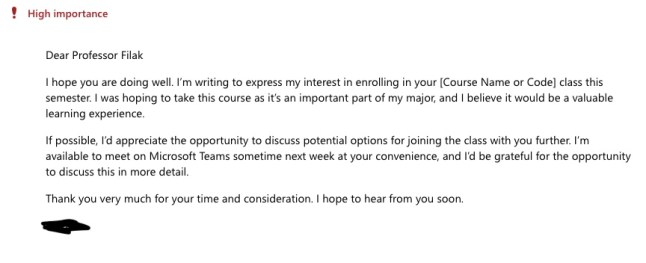
I, (FILL IN NAME HERE), AM HAPPY TO HELP (FILL IN NAME HERE): As is the case every semester, I got a series of “could you please squeeze me into your full Writing for the Media class?” emails over the past couple weeks. The excuses are usually the same (I missed my registration day, I accidentally dropped it, I died while donating my heart to my cousin, but thanks to revolutionary bionics, I’m back now…) as are the ramifications they use to nudge me in their favor (I need this to graduate, I can’t move on with out the class, I’m planning to join a biker gang but they won’t take me without a bachelor’s…)

This one came oh so close to moving me…

Look, AI can be helpful in some cases, but your really gotta meet it halfway…

And off we go on another semester-long adventure. Let’s stay safe out there…

Vince (a.k.a. The Doctor of Paper)

Gone Fishin’: AEJMC Edition

I’m heading to San Francisco for the annual AEJMC convention, where the best minds in journalism and mass communication will meet and engage with each other to improve the entirety of the field as we know it. (Meanwhile, I am clearly there to explore a city rife with awesome pinball spots.)


With the summer starting to creep toward the start of the semester, I figured it’s as good of a time as any to take an actual break (of sorts) to make sure I can finish up some stuff before the semester actually gets here. I’m still building exercises for folks to use, as promised, including some AI stuff I’ve been pondering over the past couple months.

I’ll also be in San Francisco this week at the AEJMC convention. If you are interested in connecting while I’m out there, let me know and I’ll be happy to set up a meeting. Or, you can wander over to the Sage booth on Friday afternoon, where I’ll be hanging out to talk about everything from books to the Journalism and Mass Communication Educator journal.

I’ll boot this back up around Labor Day, or sooner if something pathologically stupid happens and requires some attention.

Vince (a.k.a. The Doctor of Paper)

Not-So-Flippin’ Sweet: UW professor gets an unpaid year off for toppling Young Republicans table during election

(Alvergue’s action wasn’t quite like this, but at least in this case, no political opinions were being subverted and no criminal citations were offered. It’s also Buffalo, so, y’know… things are just different there…)

THE LEAD: A UW-Eau Claire faculty member has received a yearlong unpaid suspension after he upended a table the school’s Young Republicans group during the April elections.

English professor José Felipe Alvergue was removed from his position as chair of the department, had his promotion revoked and will also face several other punitive measures as a result of his April 1 outburst:

(Group adviser Tatiana) Bobrowicz said she explained to the man that the chapter always tabled in that location and UW-Eau Claire had approved it. The man, later identified by police as Alvergue, told her “the time for this is over,” flipped the table over and walked away.

Accounts vary on how aggressive Alvergue was when he flipped the table. Bobrowicz called the incident “violent.” A student witness unaffiliated with the College Republicans described it as “very non-violent,” the report said. Another witness said Alvergue seemed “a little upset.”

Alvergue initially denied flipping the table to a police officer, according to the police report. He later portrayed the table-flipping as accidental instead of intentional, saying his pinky finger caught on the table when he tried clearing off the buttons and stickers, causing it to collapse. He recalled the people at the table snickering at him, which he believed was because he wore a T-shirt and pin promoting transgender rights.

In discussing the situation for the first time publicly, Alvergue told the Milwaukee Journal-Sentinel he is now working a minimum-wage job to compensate for his loss of income and that he regrets his actions on April 1.

Alvergue, who joined UW-Eau Claire in 2013, said he was feeling overwhelmed by the election and Elon Musk’s attempts to sway Wisconsin voters with $1 million checks. As the child of immigrants, he said he was also distressed by the Trump administration’s mass deportations.

“I still care about these things, “he said. “But that doesn’t mean I get to go out and knock tables over.”

DOCTOR OF PAPER HOT TAKE: This situation is one of those important reminders about how free speech in this country actually works, especially in comparing “free speech” to “consequence-free speech.” In this case, Alvergue expressed himself without governmental intrusion, but he still had to deal with criminal (he was cited for disorderly conduct and paid a fine for it) and employment consequences.

I have to say I find the consequences to be relatively metered by today’s standards, where an inappropriate tweet, unearthed 10 years after someone made it, can lead to a lifetime on the “cancelled” list in polite society. Other people have lost their jobs for good in cases like this, while some people have been allowed to skate. This isn’t to say this is a good outcome for the situation, or that future ramifications aren’t going to happen, but it is kind of a “OK… so that’s done now…” situation.

Still, I think the bigger thing that worries me is that set of future ramifications that are oblique, to say the least, for both Alvergue and the educational system on the whole. UW-La Crosse is freaking out about letting Joe Gow go back into the classroom because of his “adult-film hobby,” that literally impacts none of his students. What are students signing up for Alvergue’s next set of classes going to feel in terms of potential outbursts or a general sense that he may have a bias against them due to their political affiliations?

In a previous article, Bobrowicz stated that this kind of thing was representative of the climate on campus when it comes to how conservatives are treated. I would argue that varies from campus to campus, as places like one of my alma maters always felt like it was left of left while one of my work stops felt like being centrist practically placed one at Haight Ashbury. That said, the perception of such things often trumps the reality for people who have to live with a sense of bias, so when incidents like these come to bear, it only makes it harder on the rest of us.

Journalists: If your mother says she loves you, go check it out (and then be damned sure it’s true)

As the Russian proverb says, “Trust, but verify.”

The long-held adage of journalists saying, “If your mother says she loves you, go check it out,” needs a little more updating these days, as it seems like NOTHING is as real as it seems. Thanks in large part to corner-cutting, scam-baiting and general laziness, we’re finding a lot of cases in which it never hurts to make absolutely sure you are sure. Here are a couple examples:


AT THIS POINT, JUST ASK THE MAGIC 8-BALL:  A few months back, we highlighted Rob Waugh’s story about journalists being duped by AI “experts” who churned out content that ranged from generic to highly suspect. Waugh’s latest piece found that journalists who are using supposedly “legitimate” systems to connect with sources are also now at the mercy of AI spamming, all while paying for the privilege of getting screwed:

A PR agency is selling an AI tool that automatically answers pitches from journalists on services such as ResponseSource, HARO and Qwoted.

The AI tool, called Synapse (not be confused with PR pitching platform Synapse Media), “reads” questions sent for for expert comment by journalists via the services, then analyses sources such as books, podcasts and reports per query and uses AI to draft email responses.

Journalist-request services such as HARO charge a fee for connecting PR agencies with journalists. PRs can send out story pitches to journalists and also get access to requests for expert comment.

<SNIP>

The makers of Synapse, Lithuania-based PR agency Wellstone PR, boast that it has a 7-8% acceptance rate, and that used by a human “editor”, it can answer around 20 pitches per hour with one human PR person able to do the work of five.T

The company brags in its pitch to potential clients that it will provide them with fictional content that sounds so much like the real thing, journalists won’t know the difference. I don’t know if it bothers me more that a) it would appear journalists are getting inept/lazy enough not to notice that they’re being fed total bullpucky or b) that the PR professionals are writing such average, generic stuff so often that journalists can’t distinguish it from whatever garbage an AI can produce.

The cost for this service is a one-time fee of $2,500. The only saving grace is that they apparently haven’t sold this to anyone. Yet.

The PR experts quoted in Waugh’s piece are clearly not thrilled by this breach of trust.

Andy Smith, founder of Sourcee, which aims to offer credible, video-checked experts, says that using AI tools in this way erodes trust.

Smith said: “When journalists post a journo request, there’s an implicit level of trust in the person replying. They’re hoping to hear from real people with genuine insights, experiences, and expertise that can bring their story to life.

“They certainly don’t want to receive an automated, AI-generated reply… if that’s what they were after, they could’ve just used ChatGPT themselves.

One thing that has me rethinking my “stop using these stupid “OK-Cupid-For-Quotes” sites” was a point that Smith made about how a good expert pool, like the one he says he’s built, is meant to broaden the reach of journalists. That can prevent them from only reaching out to familiar contacts and ending up with the “usual suspects” in every story. Still, if I had to pick between usual humans and a random lottery of AI word salad, I’ll stick with my boring peeps, thanks.


WSJ PLUS AI EQUALS WTF: If Cliff Behnke isn’t spinning in his grave over this situation, it’s only because he’s actively crawling out of it to come smack the shit out of somebody right now:

A story about development plans for a vacant downtown block that appeared on the front page of the Sunday, July 13, issue of the Wisconsin State Journal was removed Wednesday from the Madison daily newspaper’s website before being replaced by a “re-reported” story Thursday afternoon.

An editor’s note on the re-reported story states that the original “contained incorrect information and quotes that were created by an unauthorized use of AI, which does not adhere to the Wisconsin State Journal’s editorial or ethical standards.”

The story topic itself, both in what I can find of the original and the reboot, is a simple, boring tick-tock story about a development project, in which the material for the proposals are all easily accessible. This wasn’t like the reporter needed whatever the hell Tom Cruise is using in the latest “Mission Impossible” movie to create a miracle out of thin air.

It’s not quite clear what’s more terrifying: That a reporter decided to cut a corner on something this vanilla and didn’t bother to make sure on at least a few basic facts or that the editorial process didn’t catch something that was so wrong:

One section about “The Grove,” a proposal from Neutral, a Madison real estate development firm, outlined plans for a “food hall prioritizing minority-owned vendors” and a “community advisory board” that would shape the development’s public life. Neither of those features, nor the name “The Grove,” appear in Neutral’s proposal linked from a city press release listing the firms that responded to its RFP.

“It’s all wrong,” says Daniel Glaessl, Neutral’s chief product officer. No reporter had contacted the firm about the project before Isthmus reached out on Thursday afternoon, he says.

The Synapse people in the story above are like, “Hey, AI will write all your stuff, but don’t worry! The editor will be there to ‘create enough friction’ to prevent anything terrible from getting into the public sphere.” I’m having even bigger doubts about that concept now, especially since I know the folks involved at the WSJ and I have always respected and admired them. It always hurts a little more when it happens where you live.

And finally…

FOUL BALLS: It’s not a stretch to say that the sports memorabilia world is a multi-billion-dollar industry, in which athletes get paid exorbitant amounts of money for scrawling their names across all manner of items. What makes an athlete’s autograph worth the big bucks is a confluence of the awesomeness of the athlete and the rarity of their willingness to sign items. The more people want an athlete’s signature and the fewer of them exist, the more likely there will be fraud involved at some level.

In the 1990s, the FBI dug into the world of fraudulent autographs with “Operation Bullpen,” a multi-year investigation that took down a series of forgers who made a living faking the signatures of Joe DiMaggio, Mickey Mantle, Mark McGwire and others. In response, the major sports leagues and the preeminent autograph certification houses began using holograms, certificates, registration numbers and QR codes to assure buyers that the autographs they owned were, in fact, real.

It didn’t work as well as they had hoped:

Brett Lemieux, a 45-year-old resident of Westfield, Indiana, was the founder of sports memorabilia site Mister ManCave, which claimed to have sold millions of counterfeit items with net profits exceeding $350 million, and had “the largest framed jersey inventory on the web.”

Lemieux made the claims in a now-deleted Facebook post on the “Autographs 101” group Wednesday, saying the money was “too good” to pass up and that he wanted to stop the fraud, which had been going on for the better part of two decades.

Part of Lemieux’s post, bragging about his fraudulent creation of autographs and the holograms of multiple companies meant to prevent such fraud.

Over the past week, I’ve seen a ton of people submitting their Shohei Otani, Mike Trout, Derek Jeter and other autographs to online authentication groups, only to find that the balls, bats and photos are fakes. Many of these items have one, if  not more, authentic-looking holograms, to boot.

I know this seems far afield for journalists, but it really emphasizes an important point about how and why fraud persists in our space as much as it does everywhere else: If there’s money to be made in an easy way, people without scruples are going to take advantage of the situation.

That means we have to all be extra cautious about what we are willing to accept at face value and what we are willing to walk away from if the situation doesn’t feel right. It’s especially true when we really want something to work out, like getting that crucial source or making that tight deadline.

I’ve often said that paranoia is my best friend. Feel free to make it yours as well.


A Mob Shakedown, Chump Change or An Affront to The Foundations of The Country: Framing Paramount’s $16M Settlement With President Trump

This interview, which literally and figuratively did absolutely nothing to the outcome of the 2024 presidential election, was at the core of a multi-billion-dollar lawsuit President Donald Trump filed against “60 Minutes.” 

THE LEAD: Paramount agreed late Tuesday to pay $16 million to settle President Donald Trump’s lawsuit over the editing of a Kamala Harris interview on “60 Minutes” that Trump deemed fraudulent and deceptive.

Trump sued Paramount in November for $10 billion, claiming the editing of the interview created “partisan and unlawful acts of election and voter interference” intended to “mislead the public and attempt to tip the scales” of the 2024 election toward Harris.

Experts had long noted that the suit was frivolous and that Trump had a better shot of quarterbacking the Cleveland Browns to a Super Bowl title this year than he did of winning this case. Still, the parent company of “60 Minutes” took the settlement route, as a corporate sale of several billion dollars seemed to be at risk if it didn’t:

Many lawyers had dismissed Mr. Trump’s lawsuit as baseless and believed that CBS would have ultimately prevailed in court, in part because the network did not report anything factually inaccurate, and the First Amendment gives publishers wide leeway to determine how to present information.

But Shari Redstone, the chair and controlling shareholder of Paramount, told her board that she favored exploring a settlement with Mr. Trump. Some executives at the company viewed the president’s lawsuit as a potential hurdle to completing a multibillion-dollar sale of the company to the Hollywood studio Skydance, which requires the Trump administration’s approval.

After weeks of negotiations with a mediator, lawyers for Paramount and Mr. Trump worked through the weekend to reach a deal ahead of a court deadline that would have required both sides to begin producing internal documents for discovery, according to two people familiar with the negotiations.

FRAMING THE OUTCOME: We talked about Framing Theory a few months back, but for a brief recap, the idea is that how the media chooses to focus on an issue can shape how people in general will look at that issue. In this case, here are three I’ve seen pop up:

The Mob Shakedown: In most good gangster movies and TV shows, a scene emerges that showcases how to threaten someone without actually threatening them. It’s a pure demonstration of the power the “Don,” the “boss” or the “enforcer” has: Force someone to do something they don’t want to do out of pure fear of what otherwise might happen.

The shakedown scene usually starts with the gangster offering “friendship” or “protection” for a business owner, explaining that the world is a dangerous place and that a lot of bad things can happen. So, for a small percentage of the owner’s finances, this gangster will keep those bad things at bay.

If the owner protests, the gangster tends to get a little more specific while still being vague, offering “God forbid” scenarios like how a mysterious fire could burn the business to the ground or how a random act of violence could lead to the owner being hospitalized for serious injuries. However, fortunately, a payment to this “ambassador of goodwill” can pretty much eliminate those possibilities:

(This was the best “shakedown” scene I could find from any TV show or movie that a) didn’t use enough F-bombs to destroy an underground nuclear bunker, b) use other pejorative language regarding someone’s race, gender, ethnicity, sexual orientation or pet preference and c) didn’t actually use the violence that was suggested earlier in the clip. Still, it’s not pure enough for totally virgin ears, so watch at your discretion.)

In the Paramount case, the company had a multi-billion-dollar deal waiting in the wings, but it needed “the Don’s” blessing to go through and a lot of terrible things can happen to a deal if, God forbid, the FCC decided to look reeeeeeealllly closely at it. I mean, who knows what might happen to all that money? If Paramount lost that deal just because of a little misunderstanding it could make right with this “60 Minutes” thing? Hey… I’m just saying…

Of course, the Trump administration definitely wasn’t doing that:

Brendan Carr, the chairman of the Federal Communications Commission, has said the president’s lawsuit against Paramount was not linked to the F.C.C.’s review of the company’s merger with Skydance. Paramount has also said the two issues were unrelated.

Right. And the business owner got that black eye and broken arm after “accidentally” falling down a flight of stairs before coming to the conclusion that protection money is a small price to pay for proper piece of mind.


Chump Change: If you look at some of the more successful campaigns to get money out of people, they tend to be the ones that appear to be the least taxing or consequential. Case in point, each year, my alma mater (or maters) send me a pledge card, asking for a “gift” of between a few hundred and a few thousand dollars. Those always go right in the trash without a second thought.

That said, I have a hard time recalling the last time I refused to “round up” at the grocery store, the hardware store or anywhere else for whatever charity the business was repping at the time. It’s like, “Hell, I’m already $132.47 into the Kroeger Family at this point. What’s another 53 cents for a good cause?”

In addition, I’ve seen people drop a few coins in a parking lot and refuse to pick them up, folks at rummage sales drop the “and XX cents” on a customer’s total and other similar maneuvers that basically just round off a relatively insignificant amount of cash.

Thus, the concept of “chump change.”

I personally have a hard time thinking about $16 million as “chump change,” but everything in life is relative, as noted in this clip from “The Social Network:”

I suppose if I’m looking at it from the perspective of a multi-billion-dollar company that wants to make several billion dollars on a deal, giving up $16 million isn’t a lot to make things happen. I also suppose that if a collections company told me I owed $1,000 to a creditor, but I could pay it off today for $1.60, I’d probably avoid the argument and fork over the cash. (Trust me on this one: The comparative math is solid.)

To Paramount, this is the cost of doing business. It’s rounding up at the register to move things along. It’s chump change.


An Affront to The Foundations of The Country:  After the news broke about the Paramount capitulation, it might have felt like time stood still for a few minutes. That’s probably because when Edward R. Murrow, Katherine Graham, Walter Cronkite, Ben Bradlee and David Brinkley (among other journalists) started simultaneously started spinning in their graves, the Earth found itself dealing with that “Superman The Movie” trick:

We’ve discussed SLAPP suits here before, where people with virtually no case whatsoever sue for a ton of money to get people to back off. In many of those cases, the defendants lack the sufficient means to truly stand their ground and fight back on behalf of truth, justice and the American way, so they knuckle under.

In this situation, Paramount had the funds, the legal might and the legal precedents to stand up for all the mom and pop media operations (whatever of those are left) and tell the president where to put his suit. Paramount also had the opportunity to stand up for the free press and free speech rights that have defined the country for generations.

It’s something Graham and Bradlee did before when a president came at them. It’s something Murrow did in a time in which a demagogue rattled this country to its core. It’s something so many other journalists and journalism operations have done in big and small ways to reassure us all that our rights are not a “when it’s convenient to people in power” thing.

But a funny thing happened on the way to our current predicament. News outlets are now part of larger conglomerates with larger concerns. TV news always lost money, relative to other programming, but it was seen as part of the deal: You give us quality news, we let you use the public airwaves. Newspapers use to make money and hold sway over larger groups of people. Furthermore, they weren’t part of a collective that also did entertainment programming, sold time shares, controlled real estate and answered to shareholders. Their concern was doing the news well and defending their right to do it.

For Paramount, “60 Minutes” is a “property” of the company, just like all the other stuff they put on TV. If an episode of “School Spirits” pissed off enough people to prevent a multi-billion-dollar deal from happening, they’d kill it or edit it or pay off someone, too. Cost of doing business. That’s the company’s view. The needs of the many outweigh the needs of the one.

However, when one company lets the powerful dictate the news based on threats like this suit, it undermines the strength of those First Amendment rights for everyone else.

Ask a generic question, get a generic answer: The perils and promise of letting ChatGPT build your interview questions

Believe it or not, we actually used to sell beer like this. Try not to let AI make your interview questions as generic as this marketing approach.

As I noted in previous posts, I wasn’t significantly worried about ChatGPT or other AI programs taking over journalism at this point. The writing wasn’t clean, the material we cover is too specific and the nuances of the language tended to create more problems than solutions.

That changed a bit when a former student told me people in her orbit were using ChatGPT to create interview questions for everything from press releases to profiles. My concerns ranged from students becoming lazy to ChatGPT asking some pretty offensive questions that ill-prepared or inexperienced writers would use to their own detriment.

To see what would happen, I relied on a situation a friend found herself in last week while teaching at Missouri Boys and Girls State. One of the guest speakers was Barbara P. Bush, daughter of former President George W. Bush and granddaughter of former President George H. W. Bush. She has also been a significant figure as an author and global health care activist.

My friend noted that one of her students had an exceptionally good interview moment with Barbara P. Bush, which we’ll get to in a moment. Before that happens, I decided to let ChatGPT take the wheel and build me a set of interview questions for the former First Daughter:

Here are five thoughtful and engaging questions an interviewer could ask Barbara Pierce Bush, daughter of former President George W. Bush:

  1. Your work with Global Health Corps has been widely recognized—what inspired you to focus on global health, and how has that mission evolved over the years?
    (This connects her personal passion to her professional work.)

  2. Growing up in one of America’s most prominent political families, how did you navigate forming your own identity outside of politics?
    (This explores the personal challenge of living in the public eye.)

  3. You and your twin sister Jenna have often shared stories of your childhood—how has your bond influenced your adult life and careers?
    (This taps into her well-known relationship with her sister and could elicit warm, relatable stories.)

  4. What lessons did you learn from your mother, Laura Bush, that have shaped how you approach leadership and service?
    (This allows reflection on legacy and values from a female role model.)

  5. In today’s divisive political climate, how do you think members of prominent political families can help encourage civility and understanding?
    (This invites her to speak thoughtfully about public discourse without diving into partisanship.)

It’s a solid list, but here are a couple key problems I noticed:

  1. Bush has been asked and has answered most of these questions at length before. This means she probably has a pretty standard answer for them, so you’re not getting anything new.
  2. Not one of them directly attaches itself to the idea of your dad being the “most powerful man in the world.” (I always believed my dad to be the “most powerful man in the world” back when I was a kid, as I’m sure a lot of kids my age did back in the day. That said, my dad didn’t have Seal Team 6 or the 82nd Airborne to deploy when my room got too messy for him to tolerate.)

The question my friend’s student asked perfectly dealt with those two problems:

“How did your dad change after Sept. 11?”

Bush teared up immediately, not expecting a question like that, nor one phrased exactly that way. She gave a great answer about how he changed but he would always be her dad. She also thanked the student for asking that question and really tapping into something different.

Even in that scenario, it’s hard to pick on ChatGPT’s effort. These are good questions, and the bot does a good job of rationalizing what each question should provide the interviewer. I could clearly imagine being flustered if I were to interview someone famous like a former First Daughter, who has carved out an impressive career of her own. ChatGPT’s questions would put me on some better ground than, “So what’s it like to be a twin?” or “Was it weird having your high school dates pick you up at the governor’s mansion?”

That said, ChatGPT struggles a bit more when it comes to people who aren’t internationally famous. I picked a Facebook friend at random and tried the same thing, ending up with one of my favorite high school teachers, Greg Frederick, as the guinea pig for this situation (Sorry in advance, Mr. Frederick…):

Here are five thoughtful and respectful questions an interviewer could ask Greg Frederick, former teacher at Pius XI High School in Milwaukee, Wisconsin:

  1. What initially inspired you to pursue a career in education, and what led you to Pius XI High School specifically?

  2. How did your teaching philosophy evolve during your time at Pius XI, and what impact did that have on your students?

  3. Can you share a memorable moment or experience from your teaching career that still resonates with you today?

  4. How did you approach balancing academic rigor with the values and mission of a Catholic high school like Pius XI?

  5. What advice would you give to new educators entering the profession, especially those teaching in faith-based schools?

A couple of these are solid “opener” questions that could get the ball rolling for a decent interview. Why you wanted to be a teacher and why you ended up teaching at Pius for as long as you did could establish report. The third question is always a good one, in allowing the person to open up about something important and not forcing the interview subject to feel pigeonholed.

A couple of these feel problematic: The second question is a bit iffy in that we assume he changed over time (not always a guarantee) and that it impacted his students (again, not a guarantee). The fourth question could be taken poorly, as someone might read it as the values and mission of the faith are at odds with educational rigor.

The bigger thing, again, is that they’re generic. These could be asked of any biped who spent an appreciable length of time teaching any subject at any religious-based high school. In short, there’s less out there on Mr. Frederick because he’s not a president, a pope or a Kardashian.

I don’t know him as well as a lot of other people, I’m sure, in that I was a student at the school for four years during a specific time period, and I haven’t kept up with his life like a stalker in a made-for-TV movie. That said, I do know certain things that might have led to different questions:

  • He taught English at the school, including upper-level courses like honors English and a course in science fiction and fantasy literature. Sci fi seems to predict the future in a lot of ways, so I’d love to ask a question relating his work in that area with what we are seeing now (social media, phones glued to our souls etc.). I’d also like to know what thoughts he would have on how best to inspire his best writing kids to do good work these days, given AI’s rampant use in generating essays.
  • His wife was also a teacher at the school for a time, although not in the same department. A question about what it’s like working in the same place as a spouse, including benefits and drawbacks, would be interesting to me and probably a lot of people who face similar issues. I know how weird it was when Amy was working for the MU police department and I was running the crime beat for the local newspaper. I wonder how people who actually work closer than that find themselves coping with it.
  • His kids went to that school, including his son, Chris, who was in my grade. This opens up a ton of real estate for questions, particularly for me as I was also a teacher’s kid. After kindergarten, my mom and I were not at the same school ever. I’d be interested in finding out what discussions led to the Frederick kids going to school where mom and dad worked. I wonder if they’d do it the same way again, based on how it all worked out for the kids and the parents.

(SIDE NOTE: Chris and I participated in a number of musicals together, which speaks more to the desperation the directors felt in getting males into the productions than it did to our musical acumen. In preparing for one such musical, the choral director actually told both of us to just “mouth the words” during the songs as we were not only godawful at singing, but we were screwing up everyone else who could carry a tune. Good memories…)

  • I’d be interested on his take on things like homeschooling, which really beefed up its presence over the past few decades, in terms of teaching your own kids or being able to have other people teach them. I’m sure I could blather on forever here, but let’s move on…
  • It never hurts to ask the “So what are you doing now that you retired?” question, in that it opens the door to something people who learned from Mr. Frederick or taught with him probably want to know.

Again, this is just based on some basic stuff that I know that ChatGPT doesn’t. If I were to end up doing a profile on Mr. Frederick, I’d take my normal “build the donut around the hole” approach and interview his family, some people I know who taught with him, some of his students who have gone on to work in specific fields and so forth. The goal would be to figure out what kinds of questions to ask that are more on point about him specifically as opposed to Generic Catholic High School Teacher X.

This is why it’s important to use ChatGPT as a tool in your toolbox and not view it as a panacea for completing your work. If you don’t go beyond the basics that ChatGPT can offer, you will never create anything better than a basic piece.

Goodnight, Cliff Behnke. There will never be another one like you.

I bogarted this photo of Cliff from the obit. I’d argue “fair use,” but I probably wouldn’t argue it with Cliff.


Cliff Behnke, the former managing editor of the Wisconsin State Journal and generational journalist, died Sunday in Madison at the age of 80.

The irony of this piece is that it’s impossible to explain Cliff without resorting to cliches, a writing failure the man himself disdained.

Cliff despised lazy writing and wasn’t above telling writers how much redundancies, passive voice and unneeded descriptors displeased him. However, if there is one thing anyone who worked under him knew he hated most, it was cliches, so much so that the concept led his obituary this week:


Spring never sprung under Cliff Behnke’s watch.

“White stuff” didn’t fall in winter, and no reporter ever dared refer to Thanksgiving as “Turkey Day.”

Behnke was a stickler for detail and standards during his four-decade career at the Wisconsin State Journal.

(I managed to pull off a minor miracle once in a weather story when I used the phrase “a white, wintery mix” and Cliff never said a word.)

The cliches really did tell the tale of Cliff, as everyone in Barry Adams’ fantastic obituary seemed to use one now that Cliff could no longer stop them.

He was an “old-school editor,” in that he prized big-picture accuracy, clarity and value while simultaneously picking at the details that would rob a piece of any of those things. He was “no nonsense” in that staffers knew him to be serious and direct, focused and fair as he kept the newsroom moving forward. He was a “newspaperman in the best sense,” spending far more time in his college newsroom than his classes and helping to shepherd the state’s official newspaper throughout the salad days of print journalism.

In reading Cliff’s obituary, one fact discombobulated me: His age. I was in my early 20s during the three years I spent working the night desk at the State Journal. That would have put Cliff in his early 50s back then, which is where I find myself now. I can’t square those numbers, given that I have neither the skills, the seriousness or the stature that Cliff had at this age, never mind how he terrified staffers in a way that is almost impossible to explain.

I feared Cliff, as did a number of the folks quoted in Adams’ piece, but not in the cliche way usually associated with “old school” editors. He never yelled at me, nor did he have a large physical presence that had me afraid of violence. He didn’t break out a string of colorful curse words when dressing me down.

(Cliff was always on the lookout for stray curses making it into the paper. I remember him calling out a sports story that contained a quote like, “We played a hell of a game.” Cliff’s restrictions on cussing in print would make a 1950s all-girls boarding school look like a biker bar. It took at least three phone calls for us to run a quote in one of my stories about a riot with the quote “F— the pigs!” in it. And, yes, that was WITH the dashes.)

Listening to Cliff’s assessment of my screw ups was like watching a ninja throwing razor blades at me. It was just slice, slice, slice until I fell into 1,000 pieces. It could be about something big or about something small, but I still remember (and refer to) a number of them.

In one case, it was a redundancy. I was writing a photo caption about a model train railroad show when I felt the presence of Cliff lurking behind me. He began simply enough:

“Can you imagine if there were 88 model railroad layouts that were EXACTLY the same?” he asked.

“Huh?” I replied, unsure as to if I was having an out-of-body experience because Cliff was talking to me.

“Do you think it would be possible for a group of people to build 88 IDENTICAL model railroad layouts?” he said in that calm, metered voice of his.

“Uh… No?”

“Right. So why are you telling me that there are 88 DIFFERENT model railroad layouts in this cutline? Of course they’re different. That’s redundant.”

He then disappeared almost as quickly as he showed up and I still haven’t forgotten that lesson.

I also never forgot the time I should have been fired for screwing up a brief, in which I reported that a guy was dead when he wasn’t.

It wasn’t bad enough that I screwed it up, but then the local radio stations did their “rip and read” journalism on the air, letting EVERYONE know the guy was dead when he wasn’t. Our competing paper also used to love to crib our stories and then claim they had an “unnamed source” that confirmed the info, so those folks also amplified the story. It turns out everyone was wrong because I was wrong.

The man’s wife was getting condolence calls from people who saw or heard the “news” and she freaked out that the news people knew about his death before she did. After a complete clustermess of a situation, I got called into Cliff’s office for what I assumed would be the end of my journalism career.

After slowly and calmly walking me through every stupid thing I had done and every way a reasonably competent biped could have avoided that stupidity, he told me that the woman wasn’t going to sue us, but she had several demands. Aside from a correction for the paper, I had to write a letter apologizing to the man’s children for screwing up and then I had to hand-deliver it to his wife and talk to her for as long as she wanted.

“You need to go to the hospital at 10 a.m.,” Cliff said. “You will not justify your mistake. You will not discuss your feelings. If anything comes out of your mouth other than, ‘Yes, ma’am,’ ‘No, ma’am’ or “I’m sorry, ma’am.’ You are gone. Do you have any questions?”

I was both young and stupid enough to have one: “Yeah. Why don’t you just fire me now instead?”

His response was perfectly Cliff: “I honestly don’t know, so get out of my office before I figure it out.”

What he taught me that day was responsibility for my actions, the importance of paranoia-level accuracy and that I needed to tough out this painful lesson if I was ever going to be much of anything in this world. As another editor explained to me when I said I should just quit, “How are you ever going to teach a student to do something tough if you won’t do it yourself?”

I didn’t work for Cliff as long as many other people did, nor did I spend much time in contact with him during my time at the paper. In reading some of the online tributes to him, he was both everything his obit said and so much more. He was generous with his time to Daily Cardinal kids, serving on the board and kindly mentoring staffers as they gained their legs in journalism. He was a giving person to friends and family who knew him less as a mythological editor and more as a human being.

What I can say is that there will never be another editor like Cliff, as the confluence of events that made him could not exist today. Nobody is going to spend four decades in journalism anymore, least of all in one state or at one publication. That means we won’t have someone like Cliff who can capture the culture and soul of the audience the media outlet serves. It also means no one will have a firm grasp on all the details that add clarity to local stories, such as if Devil’s Lake gets an apostrophe or where the East Side stops and Downtown starts. He was like Google in a shirt and tie.

Accuracy, the driving force behind Cliff’s work at the State Journal, now seems to be as antiquated as the term “newspaperman,” with people caring more about being first, getting views and making sure “their side” is winning. In the days of newspapers, mistakes were permanent and you couldn’t undo your failures. That fact helped Cliff drive the rest of us to obsess over being right. As much as I still obsess, I know that if someone finds a mistake in this thing, two quick clicks and it’s like the error never happened. As nice as it is to be able to erase public errors, it does make for some lazy journalism.

Above all else, I do wonder how this generation would take to Cliff’s brand of leadership, as to cause fear these days is hate crime and to criticize is a soul-crushing micro-aggression. I wonder how Cliff would work with people who have been known to bring a parent with them on a job interview. Not every 22-year-old who rolls off the college assembly line these days is the stereotype of an entitled snowflake, but I’ve seen a significant crop of emotional hemophiliacs who complain about everything from making deadlines to not getting enough praise for things they’re just supposed to do. The amazing thing about working for Cliff was that we knew he was reserved with his praise and generous with his critiques. That’s why his praise really meant something, unlike the vast sums of participation trophies that line the bookshelves of “kids these days.”

What I do know is that if anyone could have found a way to make all of this work well and get the best out of people in this current environment, it would have been Cliff. He just wouldn’t quit until he did.


The Draft Slide of Shedeur Sanders: An Exercise in Framing Theory

DOCTOR OF PAPER DISCLOSURE: I have to put this here or I’ll never hear the end of this from people who know me. Here is the baggage I bring with me to this post:

  • I am a decades-long Browns fan. I have seen more terrible football than I can accurately describe.
  • The Browns quarterbacking situation has always been a disaster and I’ve literally hated everything they’ve ever done with it since they cut Bernie Kosar in 1993. In some cases, I’ve been right as rain (Deshaun Watson, Johnny Manziel, Brandon Weeden, Brady Quinn… How long do we have for this?) while in other cases I was dead wrong (Baker Mayfield; I hated that pick but came to love the guy. Then I hated it when they let him go.)
  • I’m keeping my opinions to myself about Shedeur Sanders and Cleveland picking him for now, as to not ruin the point of the post, but if we had to say anything was “framing” my opinion, it would be the “I wish my Browns didn’t ruin everything they touch and make every bad decision about every player” frame.


Every time someone gets a “Welcome to the Browns” greeting, an angel gets sucked into the engine of a passing American Airlines jet…

THE LEAD: Shedeur Sanders, starting quarterback for Colorado and son of NFL Hall of Famer Deion Sanders, was selected in the fifth round of the NFL Draft this weekend by the Cleveland Browns. Sanders had been projected in numerous mock drafts to be a first-round selection by a QB-hungry team, but fell to pick 144, where the Browns actually traded up to get him.

The slide of Sanders was a major spectacle in the draft, but the reason we’re talking about him here is more about WHY people THINK he ended up as a Day 3 instead of a Day 1 pick.

FACTS ABOUT SHEDEUR SANDERS: For all the discussion about Sanders, here is a list of actual facts about him:

(I have to say “actual facts” here, even though it’s redundant, as so many of the commentators this weekend were screaming opinions and calling them “facts.” The louder you say something doesn’t make it any more true…)

  • He is the son of Deion Sanders, an NFL Hall of Famer and Shedeur’s primary coach throughout college.
  • He weighs in at 6-foot-2, 215 pounds
  • He was a senior at Colorado, where he played for two seasons, an FBS school (a.k.a. Division I). Before this, he played for two seasons at Jackson State University, a FCS school (formerly known as Division II)
  • At Colorado, he amassed a 13-12 record, going 4-7 in 2023 and 9-4 in 2024. In 2024, the Buffaloes went to the Alamo Bowl, where they lost 36-14 to BYU.
  • He received the following accolades in 2024: Second-team Associated Press All-American. Big 12 Offensive Player of the Year. First-team All-Big 12. Finalist for the Davey O’Brien Award (nation’s top QB).
  • In 2024 he also set a school record with 64 career passing TDs and led the FBS by completing a school-record 74 percent of his 477 passes. He ranked second in the FBS with 353 completions and school-record 37 passing TDs (10 INTs) and was fourth with school-record 4,134 passing yards.

This is as close as we can get to a set of facts that will set the stage for how this went from a simple draft story to an epic exercise in framing theory;

FRAMING THEORY 101: Framing is a concept first championed by Erving Goffman in the 1970s that looks at not just what a story is but how it is presented and what influence that has on how the audience comes to understand it:

In essence, framing theory suggests that how something is presented to the audience (called “the frame”) influences the choices people make about how to process that information. Frames are abstractions that work to organize or structure message meaning. The most common use of frames is in terms of the frame the news or media place on the information they convey. They are thought to influence the perception of the news by the audience

Here’s a simple example: The owner of some land in the city of Springfield wants to build a complex of condominiums on that land and is petitioning the city council for the permission to do so.

We could frame this story in a number of ways:

  • Government bureaucracy frame: How long does it take to get stuff done around here and why should someone have to get approval to do something with land they own?
  • Growth frame: The city is clearly in good shape in terms of its financial and population if we need more places for people to live.
  • Social inequity frame: Instead of building pricey condos that X percentage of the population can’t afford, why isn’t the city trying to push builders to create low-income housing that would better meet the needs of so many more people?
  • Environmental frame: This is yet one more project that turns green space into concrete, which will have significant ecological impacts on this area.

There are a ton of others, but this gives you a basic idea of an array of topics.

FRAMING SHEDEUR SANDERS: In looking at the Shedeur Sanders situation, the frames varied widely. The terms I use for each frame below is just a general “vibe” and not an official title for the frames, so worry less about that and look more at the explanation:

  • RACISM FRAME: One of the prominent areas of discussion was the issue of race and how Sanders was unwilling to “code switch.” That term, used in this case by former NFL player Emmanuel Acho in his analysis, meant he was basically a proud, young, Black man who spoke his mind and was unwilling to change who he was to appease the predominantly white ownership/management of the NFL. Thus, the NFL was trying to not only smack Sanders, but also “teach others a lesson” about how the league expects its Black players to “behave.”
  • DADDY ISSUES FRAME: Deion Sanders has long been a vocal individual in public. (That’s probably the most neutral way I can say that.) His “Prime Time” persona was an invention of his that amplified his presence well before social media even became a thing. When it came to his son, Deion was just as vocal about everything from hinting that certain teams shouldn’t draft his son to calling out the Browns before they drafted Shedeur. This frame suggests that teams didn’t want to deal with Deion and his vocal nature.
  • ARROGANCE FRAME: This is one of the flip sides of the “racism” coin that can go around and around and around until we’re dizzy. In this frame, teams passed on him because he was a “me, me, me” guy with a self-aggrandizing temperament that really didn’t sit well in a team sport. What some people saw as remaining true to one’s self, other people saw as cocky and overhyped.
  • NUMBERS FRAME: For every number that showcases significant value in Sanders, someone else can offer numbers that showcase significant weakness. His completion percentage was mindboggling, but he was barely a .500 QB. He led Colorado to a bowl game two years after the team only won one game, but they got crushed by BYU. This one goes either way.

You can go into a TON of other frames as well, and even flip most of these frames on their heads. That’s the goal of today’s exercise.

EXERCISE TIME: Do a search of the Shedeur Sanders post-draft coverage and see what frames you see as showing up most prominently and most frequently. What do you think this says about the overall view of the media and how accurate do you personally feel those predominant frames are.

ALSO:

Pick any story, column, social media tirade, blog post, vlog post, whatever your professor will allow and analyze it for a specific frame in how the draft slide of Shedeur Sanders is being presented. How much do you agree or disagree with this frame and can you counter the argument in a meaningful way, relying on facts and sources to support your point?  (You could even pick out something you know you’re going to disagree with and then work hard on that end.)