The Anchoring Bias, The Leak and The Scoop: Why First Is Often Considered Best

(I acknowledge that this phrase is trademarked to Ricky Bobby Inc.)

Since the beginning of competitive media, immediacy has been a core value for all practitioners. As much as it was about “leaking” information to a source to get your position out ahead of competitors or finding the “scoop” to make you and your outlet look great, bigger things are actually at stake in terms of credibility.

Anchoring bias is a psychological theory that states people will always compare all subsequent information they received to the first piece of information they see. In simplest terms, the first piece of information “anchors” one’s opinion of a topic to a point of view or a sense of reality, with everything else simply relating to that concept.

For example, Dad and I were doing a card show this weekend, where we sell sports stuff and generally enjoy just hanging out together. Like most weekends, people come to the table and offer to sell us some of their old cards or memorabilia. The problem we usually have is that the people have “done some research” (read: I checked eBay for the highest priced version of whatever it is I have) and then ask us to buy their stuff.

I can explain until I’m blue in the face that the price on eBay is an “asking” not a “someone paid this amount” price or that the 1951 Mickey Mantle online is in perfect condition while the one they have looks like it was run over by a lawn mower, but it never seems to matter. They are stuck on that price, which rarely leads to a fruitful negotiation. They then try the same thing with a dozen other dealers and are continually disappointed with the outcome.

Anchor bias has a strong hold on people’s minds, which is why being the first voice people hear is crucial in several fields. Let’s take a quick walk through them:

PUBLIC RELATIONS: Messaging is always crucial in public relations, and it’s usually vital to get that message out first. For starters, if news reporter are trying to tell a story and nobody is talking, they’ll listen to those folks who are. That gets you a foot in the door that waiting around won’t.

In crisis communication, good practitioners have adopted the 15-20-60-90 rule, which states that within 15 minutes of a crisis, the organization needs to acknowledge the situation and begin communicating. The faster you get out there, the more your voice will be considered the anchor.

KEY DANGER POINT: When you wait too long and someone else gets to set the agenda and establish the anchor position, you will end up not only playing from behind, but also look like you’re lying. If you are reacting to someone else’s statements, you’re caught in a crouch and you might not be able to convince people what really happened.

Here’s a great scene from the movie “School Ties,” in which one of the students at a prestigious boarding school has cheated, but the students are told they must determine who it was:


In stepping up to say that he saw David cheat, Dillon established the anchor point. After that, it becomes a debate. Had it gone the other way, the arguments that followed would have been much different. If you care to know how it all ends, you can watch it here.

Get out front so you can tell people your side of things while they’re still open to new ideas instead of being anchored to whatever they heard from someone more willing to step up and say their peace.

NEWS FOLKS: Being first has been the gold standard for news people since the concept of a scoop began. I can honestly tell you from experience, being first felt great (only when I was right, however, so accuracy remains a bellwether for what we do here.

Research has found that when people find a source of information that fulfills their informational needs, they’ll keep going back to that source as they build a habit of content consumption. If you can get to something important first, you can demonstrate your value to the readers and viewers. You can also outdo the competition by becoming their “go-to” source of information.

This is why you need to establish sources in the field that will trust you and seek you out as a vessel of content. If you can prove to enough people in enough places that what you do is good, fair and helpful, you’ll become that person who gets the text, email or phone call with the latest information. If you prove the opposite, you’ll be out in the cold.

KEY DANGER POINT (Part I): Being first is great, but even anchors can get pulled up when faced with a torrent of opposing forces. People are likely to believe you as the anchor, but you have to be RIGHT above all else. Otherwise, you might win the battle and lose the war, having them trust you until they literally can’t anymore on this one story and then deciding they need to find a better source going forward.

I’ve told people for years that I’d rather be slower and right than fast and wrong. Fast and right is obviously what we’re shooting for here, but in the end, if you don’t have the goods, don’t make a move.

KEY DANGER POINT (Part II): Keep an eye on how you approach your stories based on what information you got first or which source you interviewed first. If the anchor bias works for the audience in terms of the first piece of information being considered gospel, you are likely to find the same thing happening in your reporting.

For example, let’s say that a developer wants to build a set of apartments for lower-middle-class people in your town. A local environmental agency is opposed to it because the folks there say it will damage a fragile ecosystem in a nearby lake and will also contribute traffic and garbage to the area. A local politician is in favor of it because it will bring much needed homes to his district, along with a strong tax base to help keep the city coffers filled. A local activist is opposing the building, saying the politician and the builder are cutting backroom deals to make money for themselves, while screwing over renters and taxpayers.

When you reach out to contact these people, how much will you be relying on what the first person to respond has to say to you? If the activist gets back to you, will the story shift to one of public corruption? If the developer responds first, will it be about housing for people who usually get priced out of the market? What about the other two?

I can honestly say that there have been times when I contacted a couple sources for comment on a story and I trusted the person who got back to me last the least. In some cases, it even shifted my questions: “I just heard from Alderperson Smith that this is nothing but a financial scam meant to benefit you. What do you have to say in response?” (read: I think you’re a weasel, but I’ll let you try to weasel out of it if you think you can…)

Coming to a story with an open mind is always a good thing, but it can’t just stop at that starting point. It needs to continue throughout the reporting and writing process to give everyone a fair shake.
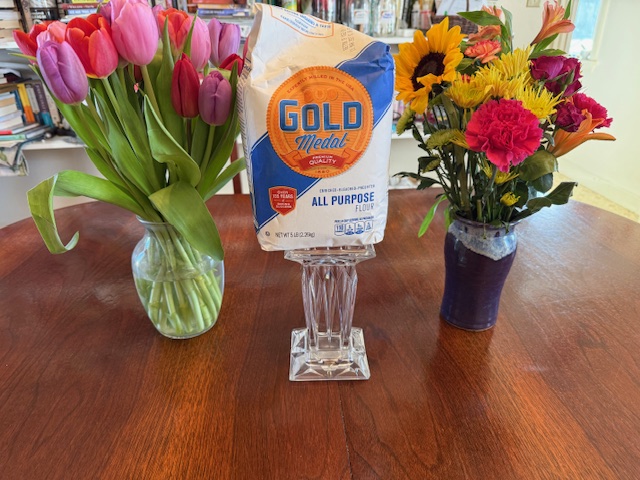
 

When it comes to getting quotes, go buy flowers instead of buying flour

When it comes to quotes, consider the difference between how you buy flowers and how you buy flour. Also, imagine them sitting in a nice vase…

In media writing courses, we talk about quotes being the spice that zips up the story or the sparkly diamond that draws the attention of the reader. However, not all quotes actually do this, because simply slapping quotation marks around a pedestrian set of words doesn’t get the job done.

PR practitioners tend to write press releases that have at least one block quote in them, with some releases being nothing but one giant “statement from X Person” quote. News writers tend to build the bodies of their stories with at least a few paraphrase-quote pairings that are meant to give readers varying views of a topic and a wide array of people a chance to speak. In a lot of cases, those quotes are either relatively pointless or they offer little in the way of quality.

How is it that so many people are proud, happy and thrilled to be there in EVERY PRESS RELEASE, ALL OF THE TIME, even when the writer can craft the quote for the person being quoted? How is it that reporters who get to interview sources also manage to come back with such “meh” quotes from sources who really SHOULD be so proud, happy and thrilled that they can’t shut up about their subject?

Here are the reasons why:

People are afraid to do anything different, lest they offend someone: The phrase, “It is better to remain silent at the risk of being thought a fool, than to talk and remove all doubt of it,” is usually where most people want to be when the chips are down.

To that end, it’s a lot easier to do a bland, mediocre quote than to state something important with your name attached to it. Interview subjects with experience tend to lapse into cliches to avoid really upsetting people, while the press release quotes also tend to play to the middle of boring to avoid controversy.


Writers aren’t as creative as they need to be: One of the things that differentiates PR from news is the concept of quoting sources. If there’s one area where I’ve seen people have the MOST difficulty in making the shift, it’s here.

News requires you to go out, find someone and get something out of their mouth in a word-for-word format. PR in many cases allows for practitioners to write up something on behalf of the client and then just get a “sign off” on it.

Even though you CAN do this, it doesn’t always follow that you SHOULD, primarily for the reason we’re noting here: You don’t know enough about your source, the topic or the non-data stuff to really come up with that whiz-bang quote that will make the difference here.

The same thing can be true of news writers, who don’t put enough time into their research to ask questions that probe or engage the source. If you ask a generic question, you tend to get a generic answer.


Writers aren’t pushing for quality: I can’t tell you how many times I was told to “get a quote” for a story. It was basically like this scene from “The Paper” where Michael Keaton just wants “something:”

I say this as a fellow sinner who often was on the hook for getting a quote, any quote I could from any source, just so that we could say we quoted someone. However, it seems like “get a quote” is a general resting pulse for how we do business.

With those things in mind, here are a few ideas on how to get better stuff:

Don’t shop for flour. Shop for flowers: In the middle of pierogi season at our house, Amy often sends me out for supplies, the most common of which was flour. The direction was simple: “Go to the store and get a bag of flour.” I dutifully comply by driving to the closest place I could and grabbing a five or 10 pound bag off the shelf that resembled the bag she had just emptied.

When I got sent into the field as a journalist, I often felt that was how I was supposed to get quotes. It was like “Go to the store and get a bag of flour.” OK, if that’s all I’m doing, all I care about is going there, picking something off the shelf and coming home.

That’s part of the problem with quotes: You don’t just want something off the shelf.

Instead of shopping for flour, think about shopping for flowers for someone you love. Think about what it is that makes that bouquet special, beautiful and different for them. Think about how you want the reaction to be when they see it. Think about doing more than grabbing whatever is convenient.


Research better beforehand to ask better questions: As we’ve said here repeatedly, the key to everything good we do in journalism is in the preparation. The more work we do at the front end of the process, the better things will be at the back end of the process.

One of the reasons PR quotes are so “meh” is that practitioners don’t dig into the topic or the organization to find things that make it special. When all we have to work off of is a baseline understanding of the concept, which usually comes from a buzzword-laden mission statement, we’re operating in Generic-ville.

The benefit of doing the research before crafting that quote is to make it feel genuine and informed. In adding special touches based on detailed information you found, you not only have a better chance of making your source sound good, but you also have a much better chance of drawing a reporter’s attention.

In the case of reporters and practitioners who rely on interviewing, the research ahead of time can help you shape more pointed and engaging questions that will elicit stronger responses. When you ask that, “So what can you tell me about X?” question, the source will lapse into their “greatest hits album” answer, with all the generic info and cliches. If you can ask something that shows you’ve invested time and energy in the question, you’re likely to get that source to be more engaged.


Change the source’s perspective: Most of the time, the sources we interview either play to us as media practitioners or play to a perceived audience of peers. Those quotes tend to be more jargon laden or otherwise disengaged, and they usually don’t do much for an actual audience that will eventually read their quotes.

Put the source in a different state of mind, based on your full understanding of who you see as the readership. Try asking a question like, “So how would you explain this to a worker on the assembly line?” or “What would you say to a parent in the school district about X?” or even “Could you explain this to me like you are talking to a child?”

In shifting the perspective of the source in terms of understanding the audience, you can get them to shuffle the deck a bit and deal you a better hand. I’m a particular fan of the “child” quote when I’m talking to a source who is clearly exceptionally well-versed on their subject, to the point of assuming everyone else knows as much as they do.

I also like the idea of thinking about who else might be a source in my story to shape the questions. For example, if I’m talking to a product seller, I like to ask them to shift focus to being a product consumer. If they’re a superintendent, I like to get them to shift to think like a parent, a teacher, a custodian or a kid.

In getting them to move, they tend to get out of the rut where cliches live and give me something different.

Journalism-related concepts that played out as well in the medical world while I was getting gallbladder surgery

My boss was nice enough to let people know I’d be out for a bit, but this is a little vague… Not like THAT’S gonna lead to speculation…

At the start of every semester, I try to come back with a “X number of things I’ve learned” or a “X years of teaching have taught me” kind of post. It was ruminating (I swear) when my second gallbladder attack in four days hit me badly enough to head to the ER at midnight the day before school started.

Although everything went well, I found myself living out little moments that had me shifting into “analogy mode” as I saw parallels between where I was (the hospital) and where I wanted to be (a journalism classroom). So, as I continue to mend and catch up with the 82,324 things that have landed on my desk while I was gone, I thought a simple slow-walk post of advice would be a good start to what has already been a shaky semester.

(Also, to be fair, I’m still on meds, somewhat hazy and worried I’d somehow come in hot on a topic like Bad Bunny or something that would end up getting me fired without me entirely knowing why.)

So, here are a couple of the maxims that ring true in journalism that kind of came home to me throughout my hospital stay and recovery:

ACCURACY ABOVE ALL ELSE: We’ve been having a lot of conversations like this around the house:

Me: Who called?

Zoe: She didn’t leave her name on the voicemail.

Me: Can I listen to it?

Zoe: She was just like “Hi, this is mumble mumble and I’m with…

Me: So she did leave a name, but you just didn’t understand it? Is it possible that maybe if I listened to it, I could figure it out?

Zoe: Well, I guess…

As much as I expect that out of my kid, I didn’t think I should expect it from a healthcare provider.

Case in point: Upon leaving the hospital, the discharge nurse is going through all the stuff I should or should do, eat or drink. She tells me to avoid fried food and fatty food like bacon. Due to the lack of the gallbladder, these things are likely to create severe gastric distress in the early stages of my recovery.

OK, got it. Most of my diet goes on the shelf.

The other night, Amy made this amazing chicken and potato thing that was part of our “healthy eating” resolution for the year. About 20 minutes after I ate it, I’m in stomach-cramp hell for about two hours. Turns out, she used olive oil on the stuff, which has the same basic effect as those other two things, even though the nurse didn’t mention it and we all usually seem to think olive oil baking is good and deep-fried drumsticks are bad.

I often think about the way in which we ask questions of people in journalism and how we get “almost” answers, or how sources provide information that’s direct but not entirely accurate. From now on, I plan to start interrogating sources like the entirety of my GI tract depends on it.


VOCABULARY MATTERS: We always talk about picking the right word, the proper descriptor or the exact phrase to help the audience understand things accurately. In news stories, it’s relatively important. In the medical field, it means a hell of a lot more.

In trying to explain what he found when he dug into my gut, the surgeon referred to the gallbladder as “angry,” “wicked” and “gnarly.” Those descriptors sound more like the tappers at a South Boston pub than a description of a human organ.

In addition, he explained that something had happened causing my gallbladder to grow a “rind” over the top of it and encase it tightly against my liver. What created said rind and what the rind was composed of, he would not venture a guess. Apparently, I just have a brie-like defense mechanism against gallstones or something.

I didn’t need the whole medical textbook explanation, but it did dawn on me that I felt like I was interviewing Nuke LaLoosh in “Bull Durham” for a bit here:

When it comes to telling people things, keep your audience in mind and use strong, clear vocabulary that helps the folks out there understand exactly what is going on and why they should care.


CONNECTIONS CUT BOTH WAYS: We talk a lot in reporting about the importance of having strong connections with good sources. Those kinds of relationships can give you an edge when it comes to a big scoop, a key interview or a sense of confidence on a topic.

They can also be a problem if sources try to ask you for things you can’t provide or they assume you won’t write about things they don’t like. I always tell students, “It’s great having the mayor feeding you tips, right up until the point his kid gets busted for a DUI and he wants you to keep it out of the paper.”

In terms of connections at the hospital, I was not only being treated at the same hospital where Amy had worked for several years, but I was actually on her old unit. This led to some significant comfort for me in terms of knowing (relatively speaking) who some of these folks are. It was also great because they had nothing but praise for Amy and wanted to know how she was doing at her new job and so forth. I also knew I had a rock-star surgeon because Amy had worked with this guy’s post-op patients over the years, so she knew him and his work.

The “cuts both ways” part really was more of my own making, in that I was groggy and gimpy most of the time, with that “gown” barely doing much of anything. As a massive social hermit, I don’t even like to be in the house when Amy has friends over, so you can imagine how I’d feel about needing their help to wander semi-bare-assed to the bathroom several times a day.

(The closest parallel I can offer is this one time when my parents and I went to a restaurant during the summer and it turned out one of my mother’s teaching colleagues was there waiting tables. She ended up as our server, which felt awkward as hell when I needed to flag her down for another Diet Coke or ask about desert. And at least I was fully clothed there…)

The nurses and staffers were totally professional, even when I managed to set off the bed alarm that Amy used to tell me would tick off the staff to no end. They were also patient with me as my body seemed to be re-calibrating all functions at the same time for no real reason. And it wasn’t like I would be flailing naked down the halls if Amy DIDN’T know these people. Still, it was a combination of comfort and clumsy.

And finally…

TRANSPARENCY IS THE BEST VIRTUE: My buddy, Pritch, used to tell me that in PR transparency is everything, even if what is happening is something you’d rather hide. Abiding by that rule, the first chance I got, I told everyone in my classes what had happened, what the doctors were saying and when we might be able to get back together.

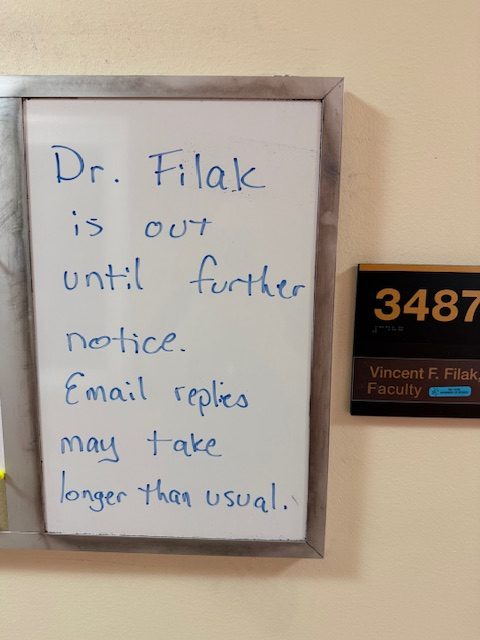
Some kids who knew me but weren’t in the classes I’m teaching got the message on the whiteboard outside my office and kind of freaked out. My boss explained he didn’t want to disclose my health issues without my permission, which is great. However, I know how the minds of journalists work and I could only imagine what it was these people thought had happened to me.

I’ve told Amy this many a’ time: When I die, put the cause of death in the obituary, no matter what. If I died when I broke my neck falling off the couch trying to complete the “bite your own toenails TikTok challenge,” tell people that. It may appear stupid and demeaning, but if I cared enough about it to die doing it, well… there you go. Besides, whatever I did, the speculation of what I might have done will be far worse, I guarantee.

I understand that some folks might be more demure or more guarded than that, which I get, but the less you tell people, the larger the space for the rumor mill to operate. It’s a good rule for PR folks putting out messages and it’s a good thing to remind sources of when they try to get weaselly.


Get the name of the dog and the brand of the beer: Why details matter in journalism.

I have no idea who said it first, but I always attribute my first exposure to the journalism maxim in the headline to the legendary George Hesselberg from the Wisconsin State Journal. It’s become one of those things like, “If your mother says she loves you, go check it out,” where we all heard it from somewhere and it relates to a larger truth about our field. (Poynter’s Roy Peter Clark even wanted to name his book, “Get the Name of the Dog,” so trust me, if you haven’t heard it before, it’s out there.)

It popped up in my mind a couple times this week, particularly after Indiana won the national championship on Monday and a reporter asked coach Curt Cignetti about his reference to cracking open a cold one in celebration:

Aside from giving a massive platform to Upland Brewery in Bloomington, Indiana, and earning himself a lifetime supply of suds to boot, Cignetti helped fill in a detail that would likely make for a great story or 500 the next day.

Despite my father’s theory that the difference between a good beer and a bad beer is three of them, the brands of beer can convey a lot about the person drinking them and how they perceive themselves.

Consider this scene from the original “The Fast and The Furious:”

Rob Cohen, who directed the first film, said he felt Corona had the L.A. vibe he was going for with the film, so he put it in. In spite of not paying a dime for that product placement, Corona ended up with more than $15 million in free advertising throughout the series.

(SIDE NOTE: I’m working on a “Snide Guide to Beer Choice” that falls along the line of the “Bitter Personal Analysis of Your Font Choices” that we did a few years back. We’ll see if it gets there…)

Another reason I thought of that maxim came when I saw this press release from the local fire department:

The lack of a name for the dog isn’t the only problem with this release, as it’s got a number of holes that leave me scratching my head:

How bad is it? We can argue what “heavy” means and what it doesn’t, but I always have trouble when I’m faced with a comparative term instead of a concrete one. Think about it like this: The word “tall” is comparative. Are you tall at 6-foot-1? Well, if you’re in a kindergarten class, you’re a giant. If you’re on an NBA team, you’re a point guard at best.

This is where details matter: If you told me the house was uninhabitable due to that damage, I’d be closer to understanding how heavy it was. If you told me how much damage was done via a financial estimate (The fire caused $150,000 damage.), I’d be closer as well. If you told me the house and its contents were a total loss, I’d be OK as well. However, we lack details to fully understand this.

What else can you tell me about the house? I’ve got a two-story wood-framed dwelling, but that’s it. We tend to measure houses based on size (square footage) or rooms (a four-bedroom, two-bath home). That gives us a size of scope. It’s also important to understand if this was packed among a dozen other homes or by itself.

I did a quick Zillow search to see what I could find and this gave me a better sense of what we’re looking at. Still, we need a bit more help here than, “It was a house. It was on fire.”

The occupants: The first time we hear about them, we hear they weren’t home when this happened. Then, we find out that they apparently were given shelter at Jeff’s on Rugby, which is a local eating establishment. What I don’t know is how many there are, who they are or when they showed up. I also don’t know what’s going to happen to them next.

I understand that not all of this would have likely made any press release from the fire folks, but it is information I would expect to see in a story of any kind on this topic, as these are the details people likely want to know.

To that end, here are a few tips:

Get as many details as you can, sort them out later: I always assumed that a good editor was going to put me through the paces on what I had and what I didn’t have while they read my story. I remember at least one case where Hess himself asked me if I knew the names of the parents of a kid who had passed. I didn’t, and I really should have, so I had to go back out and get them somehow.

In another case, I had someone ask a coroner what was the caliber of the gun used to kill someone on campus. While that might seem prurient or pointless, I wanted to know because some guns make bigger noises than others when fired and supposedly “nobody heard anything” while this incident was taking place.

For all the times we ask really stupid questions like, “Your husband just died in a giant pork processing machine… How do you feel about that?” the least we can do is ask for details that might lead us to better storytelling later.


Put yourself in the shoes of the reader: One of the best exercises we do each year is a fire brief, in which we have the class members each write a short piece off of a fire department press release similar to this one. They almost all read exactly like this release.

Then, I’ll ask one of the kids in the class, “Let’s say you go home after class and your roommate says, ‘Hey, your mom was trying to reach you. There was a fire at your house.'” What would you most want to know FIRST?

The answers become obvious:

  • Is anyone dead or hurt?
  • How bad was the fire?
  • What the heck happened?

Then, we go back to the releases and start reading them aloud and they realize they either didn’t include ANY of that stuff or they put it in the wrong spots.

One of the best ways to get journalism done well is to think of the people for whom you are doing it. Start with their needs and interests and work backwards into your reporting.

EXERCISE TIME: Go pull a press release or a story and look for places where you think key details are missing. It could be “How many kids were in the class that won the award?” or “What made it harder to de-ice the roads this time?” It could even be, “So was it a Diet Coke or a Diet Pepsi?” See what’s not there and make a case for reasons you would want those details.

6 Key Practices for PR Students Who Want to do Crisis Communication

(Crisis communication takes deft skills and clear messaging that require you to do a bit more than this… )

In teaching a course on public relations case studies this semester, I’ve learned that there seems to be a constant stream of situations that need strong crisis communication. The assassination of Charlie Kirk, the censorship of Jimmy Kimmel, the “don’t take Tylenol” proclamation and the LDS church shooting/arson are just a few of the situations where people were essentially going about their daily lives and are suddenly thrust into crisis communication mode.

In some cases, people do exceptionally well handling a moment that needs a deft touch and clear explanations. Other times, we see what can happen when the person at the podium doesn’t exude those traits.

As I’ve explained to students over the years in terms of covering crises from a news perspective, I can give you a lot of examples and advice, but there isn’t a step-by-step set of instructions that will cover every situation. Furthermore, you don’t know how you’re going to feel as you’re getting ready to share this information, whether its about a corporate scandal or a major loss of life. However, here are some guiding principles as you try to do the best you can with what you have:

Be quick: One of the most critical factors in crisis communication is timing. The widely accepted rule of thumb is the “15-20-60-90” timeline: within 15 minutes, an organization must acknowledge the crisis. It should share preliminary facts by 20 minutes. By 60 minutes, more detailed information should be shared, and within 90 minutes, the organization should be ready for a press conference or further media engagement. Everything after that is variable based on the situation.

Be accurate: You are the head of the river and the source of everything that flows down stream in terms of information. This means you need to be cleaner than a cat’s mouth when it comes to the information you put into the media ecosphere. Check every fact like you’re disarming a bomb. Verify anything you aren’t sure of. If you don’t know, tell the people that you don’t know and that you will go get that information for them as soon as you can. “No Comment” isn’t the answer, but “I don’t know” will work once or twice during a breaking situation.

Be consistent: In most cases, people will say to have one spokesperson and speak with one voice. That can work in some cases, particularly in the case of things like simple press conferences after disasters. However, in a lot of cases you are trying to put information into the field in a variety of ways, including social media, standard press releases, press conferences and more.

To that end, the goal is consistency across all platforms. If you are running everything, that can be easier than if you have 12 people involved in keeping 12 platforms up and rolling. The best way to keep a message consistent is to minimize the number of messengers and make sure they all are working from the same page each time they release information. Otherwise, the media outlets will go forum shopping.

Be clear: During a crisis, messages must be simple and direct. Avoid jargon and ensure everyone quickly understands all communication, regardless of familiarity with the situation. This is especially important when dealing with diverse audiences.

When doing internal crisis management, focus on how the crisis will impact the various aspects of the enterprise and use the language that best explains the “what” “so what” and “now what” to these people. This is where using shared vocabulary that isn’t common to the public is fine, as it will be more helpful to them than trying to “dumb it down.”

For external crisis management, think about how you would say it to your mom, your best friend or someone else who would want to know what you have to say. Don’t bury them in jargon that would only make sense to people in your field or organization.

Be human: The best public relations acknowledges the human side of the situation, particularly if there is some sort of significant loss for people. That could be the loss of jobs, the loss of property or even the loss of life.

Expressions of concern and sympathy need to happen and they need to be GENUINE. The generic “thoughts and prayers” line is almost as bad as “no comment” in the PR toolbox, so think about what you can say (check with the lawyers if need be) and then say it in a way that makes people think you actually care.

Be current: The 15-20-60-90 rule is a great starter, but it only gets you ahead of the game for a little while. Whether things work out well for you or not depends on if you STAY ahead of the game. That means being current with what is happening and getting it out to the people who need to know before anyone else does.

The reason why leaks happen is because a) people who know stuff think they’re more important than the organization and b) reporters get antsy and look for ways to get stuff faster. (Think about the people who pass you on a two-lane road.) If you are constantly updating people with the best and most current info, you become the main source of information and you control the narrative.

Be aware: As much as you need to be putting information out into the media ecosphere, you need to be on top of what everyone out there is saying about you and the situation. This means keeping an eye on mainstream media reports, social media posts and even idle chatter around an ongoing event.

Rumors gain traction when they are allowed to fester unchecked. So do conspiracy theories and the “I heard from a crucial source that…” people. You need to quash that stuff and the best way to do it is to make sure you know it is going on.

The “No Comment” Culture and its impact on society

Screenshot

THE LEAD: Ghosting someone may be awkwardly bad form in dating relationships, but it’s a significantly bigger problem when sources do it to journalists. Jim Malewitz of Wisconsin Watch provided some solid examples of why “no comment” can harm the very folks politicians and other public officials are meant to serve:

It’s hard to address homelessness — or any complex challenge — if we don’t even know where leaders stand.

Unfortunately, independent journalists are growing accustomed to being ignored. In a trend spanning multiple levels of government and political parties, public officials are increasingly avoiding answering inconvenient questions about matters of public concern. They’re sending generic statements instead of agreeing to interviews that are more likely to yield clarity. That’s if they respond at all.

<SNIP>

Such tactics are less harmful to journalists than they are to constituents. We ask questions on behalf of the public — not to satisfy our own curiosities. Ignoring us is ignoring the public.

THE “NO COMMENT” CULTURE: The popular quote (often attributed to everyone from Abraham Lincoln to Mark Twain) about keeping your mouth shut does have some merit: “It is better to remain silent and thought a fool than to speak and remove all doubt.” It’s also a lot more dangerous these to say anything that might be construed as… well… anything, thanks to the rage machine that is social media.

Off-the-cuff comments can lead to significant public shaming, as was the case when a press aide for the White House dismissed John McCain’s opposition to a nominee by saying, “It doesn’t matter. He’s dying anyway.” 

When people make public comments as part of longer interviews, it turns out that a lot of the public will, gosh, hold them to those comments. When he was a candidate for governor of Wisconsin, Scott Walker stated that he planned to create 250,000 new jobs in his first term. When people who can do math and understand money figured out this was impossible, Walker tried to back off by saying he was more generally talking about improving work opportunities and making Wisconsin a better place to be for employers. Still, that 250K number hung on him like a millstone.

Public relations practitioners, spokespeople and other “handlers” have done significant work to help people who actually need to say something offer blanket statements through press releases or social media accounts while not really answering any questions or opening them up to public scrutiny. All of this has created kind of a “no comment zone” even when people do offer comments.

DOCTOR OF PAPER FLASHBACK: Perhaps one of my favorite stories ever written here in Oshkosh was one a student of mine cobbled together using almost nothing but “no comment” comments. When a professor was escorted out of a classroom on the first day and then replaced by a long-term sub, students wondered why. Administrators and various other officials figured if they just pulled an “ostrich move” they could prevent the story from getting out. They were wrong.

PLEA TO PR PEOPLE: If you want the media to take your clients seriously, put some actual time into coming up with some sort of statement that doesn’t look like you downed four Monster Energy drinks and started typing buzzwords.

Think about what you can say (in short, what you know), what you can’t say (what you don’t know or are legally prohibited from saying) and what you want to say (things you can say that you prefer to have the public understand). Then, filter that through the concept of audience-centricity: What would the people this journalist is trying to serve want to know from us that we can tell them and that is (at least) mutually beneficial.

Make those statements less of the “we’re proud, happy and thrilled” variety, as people tend to think you’re hiding something. Make them more of a “here’s something of value that matters to you as best as we can tell it to you.”

PLEA TO NEWS PEOPLE: I’ve been out of the game for a while, but I seem to remember a time where we wrote stories based on talking to people with our mouths. I know that it’s easier to wait for everyone to “issue a statement” and then dig through some people’s social media posts for “reactions” and build something out of that.

The question I have, however, is: how does that actually help the audience?

In most cases those statements (see the PR thing above) are as boring as bug turds and as polished as a gem. They give you nothing other than to say you got a statement. (I’d also plead for journalists to not let political hacks pontificate as part of their quotes, taking shots across the aisle, but that’s another plea for another time.)

If these people aren’t talking to you, try listing off all of the stuff that literally tells the readers, “Smith’s statement did not answer X, Y and Z, or P, D and Q.” I understand shame is no longer a real concept these days, but let’s give it the college try.

PLEA TO OFFICIAL SOURCES: Don’t be wussies.

(Regular people who are thrust into the media realm through no fault of their own are exempt from this criticism, as they are inexperienced in working with the media and often dealing with something serious. Those folks deserve our respect and our patience.)

If you are in the public eye and serving the public trust, answering to the public you serve is part of the gig. Yes, using your own social media is part of that, but journalists are meant to serve as a conduit between you and the public that needs to know stuff.

How can we trust you to be operating in our best interest if you run and hide under the bed every time a media operative who is not predisposed to kissing your ass shows up to ask you to justify your actions? If you can’t handle the heat of an impertinent questions, how can we trust you to handle the budget, the school board, state law or federal actions? If you feel you aren’t good at working with the media, OK, but then go learn how to do it.

I’ll be much better for everyone involved if you participate in the process.


Eight Years a Blogger: Come for the knowledge, stay for the snark

It’s hard to believe this thing is still going after eight years, kind of in the same way its hard to believe that the almond-colored refrigerator with the faux-leather texture and Bakelite handle that your parents bought in 1983 refuses to die. I always figured Sage would have decided I was more trouble than I was worth by this point, or I would have run out of bits of wisdom, weirdly effective exercises and opportunities to mock god-awful mistakes in the media.

Oddly enough, that’s hasn’t happened. And speaking of exercises, if you still want to get in on Dr. Vinnie’s Bin of Exercises and AI Joy, feel free to hit the link here.

This semester is guaranteed to be a little off as far as the blog is concerned, in that I found out last week I will need to teach a fifth class this term. It’s the second of the five that I’ve never taught before in my nearly 30 years of college teaching and the third of the five that’s not in my area of expertise.

Why, you might ask… Well..


The relative insanity that this blog provides me might be my only salvation, so let’s get started with a few thoughts to brighten your day (and allow me to blow off developing a giant roster of PowerPoints and podcasts I will likely use only once in my lifetime):


STUIPD IS AS STUIPD DOES, TOO: In digging through a ton of examples I wanted to use for the upcoming classes I am prepping, I was stunned at the level of general incompetence when it came to making sure things were edited before they went out. I’m not talking about internet memes or mom-and-pop operations posting on an AOL-Dial-Up-Friendly website. I’m talking about actual organizations with money and staff support.

The number of missing words, misspellings and generally bad writing made it tough to find quality examples for the kids. I mean, I can’t exactly say, “Here’s a great press release, if you ignore the three misspelled words in the lead and the sentence structure that makes Tarzan look like Shakespeare.” Of all the blunders out there, I had to highlight this one:

If you are in the state, promoting the state and having a fair for the state, the least you can do is spell the name of the state properly in the headline…

Also, for the sake of irony, I found this job posting for an entry-level PR position with these two key bullet-points back to back. And I SWEAR I didn’t PhotoShop this:

I looked at it three times and thought, “Is this like one of those tests where they try to trick you? Like that one speed test where you are supposed to read the whole set of directions first, so that you figure out you only need to do the first thing on the list?

Or do they just really need proofreaders that badly?

Speaking of someone who needs a proofreader:

If you really need something that big to house that item, I feel sorry for your significant other…


DID THAT REALLY JUST HAPPEN? I’ve frequently noted that paranoia is my best friend, so much so, that I often find myself doing double-takes on things I swear I saw that turn out to not be as bad as I thought. It usually comes up when I see a sign for “angus” burgers or “first-hand jobs” or something where my mind drifts to the terrible error, even if there isn’t one.

That said, this Milwaukee Journal-Sentinel headline on my phone really should have freaked out a couple people somewhere at the newspaper:

For starters, that’s not Cavalier Johnson unless I have officially gone blind from computer monitor radiation. Here’s his official city photo:

I have no idea who the dude at the podium is, but Arnold Schwarzenegger and Danny DeVito made a more convincing set of Twins than the two people in the photos above.

Second, and this is really what caught me, that has got to be the worst headline break any human or computer could have made with this story. When I saw that “Johnson speaks with black talk,” I think my brain broke, before remembering Robert Townsend’s spoof of how white people do stupid stuff in Hollywood.

I understand that everything can’t be perfect in every publication, but I also know there are certain topics that need a little more attention and care, due to their sensitivity and the long history of insensitivity associated with them. This is one of those where someone fell asleep at the wheel.

Conversely, sometimes we can really go a bit far in clarifying things for our readers:

Thanks for the clarification, CNN. Otherwise, I might have been confused…

And finally…

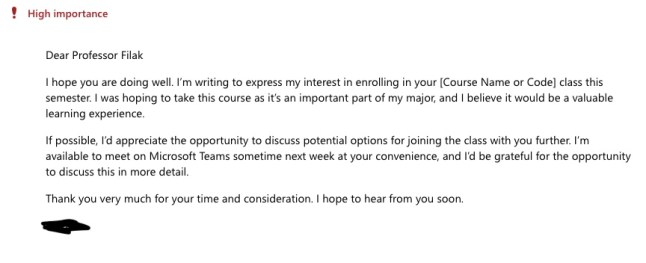
I, (FILL IN NAME HERE), AM HAPPY TO HELP (FILL IN NAME HERE): As is the case every semester, I got a series of “could you please squeeze me into your full Writing for the Media class?” emails over the past couple weeks. The excuses are usually the same (I missed my registration day, I accidentally dropped it, I died while donating my heart to my cousin, but thanks to revolutionary bionics, I’m back now…) as are the ramifications they use to nudge me in their favor (I need this to graduate, I can’t move on with out the class, I’m planning to join a biker gang but they won’t take me without a bachelor’s…)

This one came oh so close to moving me…

Look, AI can be helpful in some cases, but your really gotta meet it halfway…

And off we go on another semester-long adventure. Let’s stay safe out there…

Vince (a.k.a. The Doctor of Paper)

How AI “expert sources” have duped journalists and four tips on how to avoid being the next victim


Meet Elizabeth Hubbell, a 25-year-old skin-care expert who is willing to be a great source for your next story on anything makeup or skin-care related. She’s actually completely fabricated. Her picture came from an AI generation site and her name is a combination of my car (Betsy) and a baseball player whose card I had laying around (Carl Hubbell). Careful. It’s dangerous out there…

When it comes to doing interviews, I always tell students they need to do them in person.  In response, they often look at me like I’m asking them to use a teletype machine or some semaphore flags. It’s easier, faster and more convenient for both parties if they can do a text, a chat or an email interview, the students say.

I argue that the face-to-face interview allows for a deeper connection for profile and feature pieces. This approach also can prevent sources in news stories from weaseling out of answers they could otherwise work through via several drafts of an email. Plus, if I spend some time in the source’s environment, I can probably find a personal effect that could give us something to talk about, like a family photo, a kid’s drawing or a sports item. At the very least, it’ll help with scene setting.

Apparently, there’s another good reason for my approach these days: Your easy-to-access, extremely helpful, expert source might be AI:

Since the launch of ChatGPT in 2022, anyone can generate comment, on any subject, in an instant.

It is a technology that appears to have fuelled a rise in expert commentators who have appeared widely in national newspapers but who are either not real, not what they seem to be or at the very least have CVs which do not justify their wide exposure in major newsbrands.

The rise in dubious commentators has been fuelled by companies that charge the PR industry in order to share quotes via email with journalists who have submitted requests for comment.

Journalist Rob Waugh found that in a number of cases, digital outlets were mass-generating content from these supposed experts, giving everyone from news journalists to PR practitioners the exact the quote or information they needed on a wide array of topics. However, when challenged to engage more deeply regarding who they are or what they have done in life, the “sources” suddenly had difficulty:

She has been quoted in Fortune talking about “loud budgeting” and by Business.com talking about the best countries in which to obtain a business education (both sites are based in the US).

A profile on Academized describes her as a “biochemist and science educator”. The same byline picture also crops up on a publisher called Leaddev, for someone called Sara Sparrow. Rebecca Leigh has written for DrBicuspid.com about how to write a business plan for your dental practice where she is described as a writer for Management Essay and Lija Help (two online writing services).

When challenged via email to do something that would be difficult to do with AI image-generating software (send an image of herself with her hand in front of her face) or prove that she was an environment expert, Rebecca stopped communicating.

One AI source, “Barbara Santini,” was particularly prolific in the volume and array of topics she could cover for journalists. Waugh found this roster of publications that had included Santini quotes:

She has been quoted in The Guardian talking about the benefits of walking (paid content), in Newsweek talking about white lies, Marie Claire talking about the meaning of money, the Daily Mirror talking about the benefits of sleeping with your dog, in The Sun talking about sexual positions, Pop Sugar talking about astrology, and Mail Online talking about how often to change your pillow.

Santini was recently quoted in a BBC article examining the lifelike responses of AI to Rorschach tests used by some psychologists saying: “If an AI’s response resembles a human’s, it’s not because it sees the same thing but it’s because its training data mirrors our collective visual culture.”

Despite her ability to be all knowing and wise, Santini apparently couldn’t receive phone calls, a relatively easy giveaway that the “person” on the other end is AI. Waugh also found other examples of journalists who were getting taken for a ride by an AI source, including one case where the non-human pitched a sob story about breast cancer survival:

“Seeing my scarred chest in the mirror was a constant reminder of what I had lost,” Kimberly Shaw, 30, told me in an emotional email.

She had contacted me through Help a Reporter Out, a service used by journalists to find sources. I cover skincare and had been using the site to find people for a story about concealing acne scars with tattoos.

<SNIP>

Shaw’s experience may not have been relevant to my acne story, but it tapped into the same feelings of empowerment and control I wanted to explore. Thinking she could inspire a powerful new piece, I emailed her back.

But after days of back-and-forth conversations, something in Shaw’s emails began to feel a little off. After idly wondering to my boyfriend whether she could be a fake, he suggested that I run the emails through a text checker for artificial intelligence.

The result was unequivocal: Shaw’s emails had been machine-generated. I’d been interviewing an AI the entire time.

As a result of Waugh’s story, a number of these information clearinghouses have tried to cull their ranks of AI “experts” while the deceived publications have retooled or removed the stories with fake people in them. Although the founder of one of these “expert mills” blamed much of the situation on “lazy journalists,” he kind of gave up the game a bit when it came to explaining why these platforms don’t prevent the frauds from gaining access in the first place:

Darryl Willcox, who founded ResponseSource in 1997 and sold it in 2018, says that the simplicity and speed of platforms like ResponseSource is key to their appeal and that attempts to add authentication risk slowing down the system.

Willcox said: “The other factor which complicates things a little bit is that these platforms are quite an open system. Once a journalist makes a request they can be forwarded around organisations, and sometimes between them, and often PR agencies are acting for multiple parties, and they will be forwarded onto their many clients.”

In other words, “If we slowed down to make sure things were accurate, we wouldn’t be as appealing as we want to be.” Eeesh.

So what can you to to avoid quoting a fake person? The overarching theme is basically, “Don’t be a lazy journalist,” but here are a few more specific tips:

TRUST, BUT VERIFY: The old Russian proverb really comes into play here and for good reason. I often say that paranoia is my best friend and has kept me out of a ton of problems. To that larger point, not only did I click on every link I could find in Waugh’s story, I also Googled the hell out of Waugh himself. Why? I imagined that it would be the most epic “Punk’d” moment on Earth if the media world was flocking to this story about AI screwing with journalists, only to find out that Rob Waugh was also an AI fake. I found LinkedIn, X, Bluesky, media staff pages and at least a dozen photos. I wouldn’t bet the house on the fact he’s real, but I’d probably bet the lawn tractor.

This can be harder in situations like the one involving the cancer scammer, as regular people tend not to have as big of a social media presence or digital footprint. That said, even regular people under the age of retirement should have left a few breadcrumbs out there for you to find.

KICK THE TIRES: If you can’t find the person clearly through a digital search, feel free to play a little game of 20 Questions to see if you can get some things ironed out. Experts who have kicked the tires on a few bots can offer you specific ways to ask questions that will tend to ferret out fakers. The author in the cancer-scam story revealed that asking for specific photos based on prior conversations can be helpful as well.

I learned about this kind of thing in trying to defeat scams when it came to buying sports memorabilia. When unknown sellers offered either exactly what I wanted when I couldn’t find it anywhere else or provided me with a ridiculously low price for something I knew should cost more, the pros who had been around the block a few times suggested I ask the seller to “coin the image.”

What this meant was that I wanted the person to take a picture of the item with a coin (usually asking for either heads or tails, or maybe even a specific coin) so I could tell they had the item and weren’t messing with me. Turned out, that advice helped me dodge a bullet or two. As weird as it might seem, asking someone to take a picture with their left hand raised or holding a quarter with “heads” showing might help you avoid a problem.

MEET IN PERSON: Again, this is the most obvious one to suggest. If you meet a person, in person, it’s a pretty safe bet that you can consider them real. The rest of the stuff (Are they the expert they claim to be? Did they really do what they say they did? Do they actually have cancer?) remains a risk without substantial additional reporting, but at least you’ll know they exist.

If that can’t happen for legitimate reasons (the person lives too far away etc.), look for other ways to get some human connection with the source. That could be a Zoom/Teams/Whatever video chat or an actual phone call at an actual phone number. In the cases where the frauds proliferated, it was pretty clear that the only connection between the source and the journalist was through a keyboard. That’s especially dangerous when you don’t have a prior relationship with a source.

WHEN IN DOUBT, DO WITHOUT: At the end of the day, there is no journalistic rule that says you have to use a source, a quote or a “fact” just because you have it. If you don’t feel comfortable with how a source is providing you with information or you aren’t 100% sure this person is a person, it’s better to leave that source out of your story than it is to run the risk of getting bamboozled.

If you say, “Well, the whole story will fall apart without this one source and I can’t get anyone else to provide me with this information,” maybe that’s more revealing than anything else we’ve said here.


An open letter to Madison Mayor Satya Rhodes-Conway: Media folks don’t like dealing with the death of kids any more than you do, so please don’t treat them like crap

Dear Mayor Satya Rhodes-Conway,

I saw the comments you made to a gaggle of reporters in the wake of the Abundant Life school shooting, in which you basically accused working journalists of being pain vampires, who live off the misery of others. You chastised these folks for asking legitimate questions, told them to have some “human decency” as if that never occurred to them and then shamed them with a “y’all” that could only come from someone who spent most of their life in the land of Yankees.

I don’t know what compelled you to castigate the media at large in that press conference. It might have been just the stress of the day or it might have been previous experiences with a few bad folks in the field. I can tell you for sure that, just like in politics, there are good and bad people in journalism. And, just like in politics, the lousy ones tend to make the biggest impressions and do the most damage for the whole lot of folks. If I had to wager, I’d say that most of the people in that media cluster would have gladly been covering ANYTHING ELSE that day than a school shooting.

I let this post sit for a day or two, in the hopes that you would issue some sort of apology for this, even if it were completely insincere, so that we could all go back to doing what we’re good at: Media folks covering the news, you not pretending to be a journalism expert. Unfortunately, the PR people who advise you are apparently no better than you are, so I thought I’d offer a few insights on what this situation is like for news people.

I spent three years as a reporter, another five as an editor and then about 15 as a newsroom adviser, and in every case, I’ve had to deal with stories involving dead kids. This is not a morbid flex, but rather a chance to help you understand where I’m coming from.

All those things you said at the press conference? Hell, I’ve been told worse and more loudly by far more traumatized people than you. I’ve been called a vulture, a scumbag, a waste of life and a few other things that could peel the paint off of a car. The hardest one was the lady who told me that “Your mother must not have raised you right, if you think what you’re doing is appropriate.”

Believe it or not, journalists are actually human. Sure, we’re really good at hiding it a lot, but we have the same emotional range as most other bipeds you’ve encountered. If you felt pain, agony, shock, angst or anything along those lines, it’s safe to say that the people who were asking questions of you that day did as well.

If you think that reporters in that gaggle are going to enjoy talking to sobbing parents and bothering traumatized kids before heading home for a nice casserole supper, you’re delusional. This kind of thing sticks with most people for a long time, and journalists are no exception.

When my students would ask me about my experiences writing about death and mayhem, I told them that I could remember the name, age and cause of death of every dead kid I ever covered. It’s been decades since I was reporting and editing, but it’s still true.

Casey Rowin, Shawn Magrane, Matthew Dunn,  Deanna Turner… those names and a dozen more stick with me every day. I think about Rachael Himmelberg, the infant who died after receiving what should have been life-saving open heart surgery. She would be in her late 20s now and I wonder what she would be doing. I think of Jordan Sosa, who died at 22 months old when he wandered out of his grandparents’ house and fell into the Black Earth Creek. He might have been a college student of mine, if he hadn’t drown that day.

My first year at Ball State, we had five college kids die of various causes: Michael McKinney was shot to death by a cop,  Karl Harford was robbed and executed after giving some guys a ride… accidents, suicides and more… I remember one of the more veteran editors of the paper, who had lived in Muncie his entire life telling me, “This is not normal for us around here…” like he was trying to convince both of us that what he was saying was true.

The editor also asked me, “How did you get so good at covering stuff like this?”

My answer was simple and I think most journalists would be on board with it: “You don’t get good at doing this. You become more experienced in doing the best you can. If you ever get to a point where you feel you’re good at covering dead kids, it means you are really broken and you need to walk away for a good, long while.”

Each dead kid we cover is like a wound we receive, the scar a permanent reminder of what it was to be there in the worst moment of someone else’s life. Each mistake we made in how we phrased a question or how we approached a source still stings. Each time we did the best we could and still faced the wrath of a pained family member or friend brings about a wince and grimace.

You mentioned that reporters should go away and give people a chance to grieve. Despite your apparent thoughts on the state of media today, reporters can be a crucial component of that grieving process. I go back to what Kelly Furnas, the adviser of student media at Virginia Tech, said to his students as they went out to cover what remains the deadliest shooting on a college campus:

“The students I talked to were terrified of the fact that they would need to call these families and I said, ‘You don’t assume that these families don’t want to talk,’” Furnas said, recalling that day at a college media conference a few months after the shooting. “That’s a very important thing to these families to tell the story of their son’s or daughter’s lives. That’s a very important thing. A lot of people not only want to do it, but expect to do it.”

I can tell you for sure that this holds water. When it came to the dead people I covered in one way or another, I got one of three reactions 99% of the time:

  1. “I just can’t… I’m sorry…” These people were already at the maximum level of stress and pain and they were just incapable of dealing with anything else at that point. I would apologize for intruding on their grief and then leave them alone.
  2. “You #%*%ing VULTURE!” Yep, we talked about that already. This reaction gave me a ton of anxiety and pain, but I understood. It was like putting your hand out toward a wounded animal: They just hurt so badly, they lashed out, regardless of your intent. Again, I’d apologize and back away.
  3. “The pressure-release valve” This is what Kelly was talking about. These people are so full of emotion and they have nowhere to go with it. Everyone around them is feeling the same pain, misery, stress and more… All they want to do is talk about how great their kid was, or how amazing their parent was or whatever stories make them feel less hurt. As a journalist, we’re that opportunity to not only help, but to share their thoughts with others.

So in the future, please feel free not to tell journalists how to do their jobs at a time like this. It’s a job nobody wants, no one revels in and few people can do and remain unscathed.

If someone asks a particularly crappy question like, “Are there plans to call it ‘Less-Abundant Life’ now that people have died there?” or “Don’t you find it ironic that there was a lot of thoughts and prayers happening in there but the kids still got shot?” go ahead and release your inner scold. That kind of person deserves your wrath.

However, the basic “5Ws and 1H” questions are normal, even if the situation is not and you lack the answers. Everyone is frayed to the nth degree, so you need to operate above the fray. If you can’t, don’t hold the press conference or send someone out there who is actually skilled at PR to do the work for you.

I hope this helps, because I somehow doubt this will be the last time you and the media will spend time together discussing a devastating death or two.

Sincerely,

Vince (a.k.a. The Doctor of Paper)


Press Releases and Embargoes: Understanding the basics and three ways to make sure they function as they should

When I teach my media writing students about press release writing, we often stop at the line “FOR IMMEDIATE RELEASE” and have a discussion.

I’ve heard from some pros that this kind of thing isn’t needed any more, and I’ve heard from other pros that it’s still a standard item, even as its value slides toward the realm of ending a press release with “-30-” or “###”

In keeping it on there, I make the argument that I’d rather show them something that only half of the world is doing  and they can cut it out if they work for the other half. In addition, they may need to replace that line with an embargo statement in some cases.

An embargoed press release is meant to benefit both the PR practitioners and the reporters covering their clients’ activities. In some cases, practitioners want to give reporters a running start at an event or announcement, but don’t want the reporters to make that information public before the practitioners do. To that end, the practitioners provide material that they note has an “embargo” on it until a specific time or date. This article on LinkedIn does a pretty good job of outlining the basics of the embargo process and the rationale for it.

Embargoes of this nature tend to be based in professional courtesy (or what people used to call a “gentlemen’s agreement”) in that the PR professionals have no legal say over what the reporters do with this stuff or when. That said, if you’re the reporter who screws over someone by publishing embargoed material before its time, you will likely be on the outs with the PR folks who offered you this courtesy and you might screw it up for everyone else.

A situation like this came to light in Wisconsin, in which the governor’s press office embargoed some stuff, only to find that some journalists published or shared it in defiance of the embargo. This piece in the Isthmus does a great job of looking at what happened and how expectations related to embargoes aren’t always universal.

Here are some thoughts that might help make this process work the way it should:

SHARE EXPECTATIONS: Professor Sue Robinson of UW-Madison makes a great point about this in the Isthmus article: If both sides aren’t understanding each other, this isn’t going to work.

Like most traditions, people often lose track of how they work or why they start. When there were only a handful of news outlets and everyone kind of came up through the ranks the same way, these traditions were more likely to be shared and understood. Today, everyone can be a publisher and not everyone gets the same level of “education” about how certain things work.

I make a similar argument in my books about the concept of “off the record” and how that works. In most cases, people don’t have a firm grasp of what it means or how it works, so there can be confusion and anger when things go south. When we all know what the rules are, we’re more likely to play by them if the rules make sense. That leads us to point two…

DON’T GET “EMBARGO-HAPPY:” Like any other tool, if you use it for the wrong reasons or rely on it too much, it’s not going to be effective. One of the reporters in the Isthmus story noted that people seem to be embargoing everything lately, which makes it kind of a meaningless element of the press release.

Think of an embargo as a NEED item, based on timing. For example, when the governor is going to give the State of the State address, it makes sense to share the text of the speech early so reporters can work on deadline stories. It also makes sense put an embargo on it, as the governor would probably like to tell people what he thinks about the State of the State before the news media does.

That said, every appearance the governor makes at a local Taco Bell doesn’t require a full press brigade and an embargo. If you want to tell the press something, then announce it. If you don’t, don’t. If you feel like you have to hold something back and let them show up to figure it out, that can work, too. However, a constant stream of embargoes isn’t going to work out well for anyone.

DEAL WITH TRUST ACCORDINGLY: In the media realm, trust and credibility are our only true currency. These things aren’t like boomerangs, in that if you throw them away, they don’t come back. If someone knowingly screws you over, they’ve blown their bank account and you don’t have to extend them any additional line of credit at the Bank of Journalistic Trust.

I’m not a huge fan of playing favorites, as it can lead to lousy journalism based on fealty to the wrong principles (namely, sucking up to people and dodging the tough stuff to get on people’s good side). That said, there is no rule out there that says PR professionals HAVE TO give everyone a cookie.

If a reporter breaks faith and fails to see this as a problem, PR practitioners have no reason to trust them. That’s not bias. That’s common sense. If both sides agree to Point One and Point Two, this shouldn’t be hard to manage. However, the definition of insanity is doing the same thing over and over and expecting different results. It’s also a good way to end up in the unemployment line in a situation like this, so treat people the way they have demonstrated they should be treated.

CustomInk-Credible: A textbook way of dealing with a screw-up

Those of you who ordered a “Filak Furlough” T-shirt should be getting a surprise in the mail just before Christmas:

Another T-shirt.

Here’s a look at the back of the one you have, so let’s see if you can figure out why this is happening:

In case you missed it, as I did the first time, I’m not on a “Furlongh.” Here’s the back story on how this happened and a perfect example of how a company, PR organization or news outlet can gain a lot of credibility in the eyes of the public.

As we discussed in an earlier post, CustomInk reached out just before production to tell me I couldn’t include the names of the schools on the shirt without permission. (I’ve since heard from at least two legal experts who remain befuddled by this, but that’s for a different post…)

To make sure that these things got done before I headed out for a conference where several people were expecting them, I had to do a quick fix and get a new version sent back to them that day. I cut the school names, went with the cities, gave everything a once-over and sent it along.

A rep from CustomInk hit me back with a link to the proof, which I scoured for any hint of school stuff I missed and to make sure I didn’t misspell a city or place it in the wrong state. Everything I touched was good, so I green-lit the shirt.

Fast-forward to the day before I’m heading out for this trip and I’m ironing one of the tour shirts when I notice the error. (Yes, I iron my T-shirts. I’m socially inept and fashionologically stunted, but I will not be rumpled.) Immediately, I figure it’s all my fault, so I go back to the proof I sent, wondering how the hell this happened.

It turned out, what I sent was right.

I then looked at the proof and found that was where the error came into play, as the folks at CustomInk infused the misspelling into the mix. I sent an email to them, explaining that this was a mistake that I didn’t create, that somehow got through and it looked doubly stupid because it was a shirt from a journalist. I asked what they’d do to fix it.

My expectations ranged from bad to passable:

BAD: They would come back with something like, “Look, this is why we have you proof the thing before we put it on the shirt. It was there on the proof and you missed it, so c’est la vie. If you want a reprint, you’ll pay for the whole thing.”

COULD BE WORSE: They would come back with something like, “Yeah, it’s kind of our fault but kind of yours as well. We’re willing to do the shirts at a discounted price and you pay for shipping.”

PASSABLE: They would come back with something like, “We’re sorry this happened and we’ll redo the shirts for free, but you’ll need to cover shipping. Next time, though, we have to hold you to what you approved with the proof.”

Never in my wildest dreams did I expect this:

In short, it’s on us.

I agreed and they redid the proof, sending it to me for a review. (And you damned well better believe I studied that thing like it was the Zapruder Film before I hit “send.”)

They then promised to make sure everyone had them before Christmas (as I’m sure many of you were planning to make it a Festive Filak Furlough Holiday Season…).

Aside from essentially guaranteeing my business for every other shirt I’ll ever do, the folks at CustomInk gave us a textbook example of how to deal with a foul-up in any field, regardless of if it’s a newspaper correction or a marketing mistake:

ACKNOWLEDGE IT: The people at CustomInk got back to me right away and said, “We see the issue here.” In doing so, it sets the stage for the rest of the process. If they’re like, “What’s the big deal?” or “Don’t be so petty,” we’re off to a bad start.

Admitting that a mistake happened is really tough in our field, particularly when we pride ourselves on always being accurate and helpful. I know a lot of newspaper folks used to fight tooth and nail to bend reality in a way that made potential errors not worthy of corrections. The idea there was that by fessing up, we somehow undercut our credibility with the readers. In reality, the opposite was true.

EXPLAIN IT: One of the questions I had was how the mistake happened, as I was initially sure it was my fault. Then, when it wasn’t, I had a hard time figuring out how a PDF got screwed up, as that’s not supposed to happen. In this email, CustomInk gave me the basic explanation of what it does and how the error occurred.

In some cases, the errors are your fault and explaining how you screwed that up can be helpful. An amazing reporter I worked with back at the State Journal once covered a bank robbery that a regular citizen foiled by tackling the robber outside the bank. However, she managed to invert the names, thus calling the hero by the name of the robber and the robber by the name of the hero. Clearly, that caused some problems.

Another case we discussed on the blog earlier explained how an award-winning sports journalist accidentally put a former Beatles drummer on the Green Bay Packers of the 1960s.

In both cases, the reporter explained how those mistakes had occurred, with the idea that in figuring this out and talking about it, the reporter would be less likely to have the same thing happen again.

Also, in some cases, it ISN’T your fault: A press release has the wrong information, a source misspoke or one of a dozen other things happened. In explaining those issues, you can also save face in the eyes of your audience.

FIX IT: Not every mistake can be undone, as was the case with our look at the “filthiest” paragraph error. The paper there ran a correction, an apology, a letter from the writer and more, but it still wasn’t enough to make things better for Bubba Dixon.

However, whenever a mistake can be fixed, do so to the best of your ability. It might not be fun and it might not be easy, but do everything you can to restore faith in you and your organization.

Sure, CustomInk could have told me to go pound sand, and from a legal standpoint, I’m sure that would have been OK. However, the folks there realized that a ticked-off customer is not something they want roaming the internet. Even more, I’d had so many good experiences with them, I’m sure they didn’t want the last one to be terrible.

Therefore, they realized the juice wasn’t worth the squeeze here and they decided to fix it in the best way possible, knowing they probably lost some money on the deal, but also knowing that they kept a customer happy.