“We live in mighty times:” Mary Beth Tinker urges high school students to exercise their First Amendment rights

Tinker

Today’s world of anger, mistrust and public friction is a lot like the era in which Mary Beth Tinker went from being a scared teenage girl to being the namesake of a landmark Supreme Court decision, the First Amendment icon said Friday.

“We live in mighty times,” she said. “These times are so much like the times were when I was growing up. It does make life a little more interesting.”

Tinker spoke at UW-Whitewater as part of the Kettle Moraine Press Association’s scholastic journalism conference, in which she told students about her free-speech activities and urged them to find something that matters to them.

“The press is so important to our democracy…,” she said. “You hold government accountable. You hold those in power accountable.”

In 1963, she first wore an arm band to school to protest racists who had been bombing black churches to keep segregation in place, she said. (“They’re back again,” she added.) However, it was her decision to take part in a larger protest against the Vietnam War in 1965 at the age of 13, that brought her to the forefront of the free-speech movement. The school suspended Tinker and several others, including her brother, John, for the actions.

“A lady called on the phone and threatened to kill me,” Tinker said. “She told me, ‘Kids don’t know anything about Vietnam. Guess what I found out? Adults didn’t know anything about Vietnam. They couldn’t find it on the map.”

The Tinkers and other sued the district and lost at every level of appeal except the one that mattered most: The U.S. Supreme Court. In its 1969 decision, the court ruled 7-2 in favor of Tinker, with Justice Abe Fortas famously noting that “It can hardly be argued that either students or teachers shed their constitutional rights to freedom of speech or expression at the schoolhouse gate.”

At the time, Tinker said she wasn’t thinking about being a free-speech icon.

“We lost at the district level and we lost at the appeals level,” she said. I went on with my life. I went rollerskating and I went back to my classes… I had no idea how important that case was.”

Fifty years later, Tinker continues to preach the importance of student activities that serve the best the First Amendment has to offer. She told the audience of student journalists that they should find something that matters to them and speak out about it.

“The number one reason for censorship?” she asked rhetorically. “An article reflects poorly on the school… Without controversy we have no democracy, we have no education. We can deal with controversy in ways that are respectful.”

One of the biggest things that came out of the entire legal fight, Tinker said, was that the courts opened the door to more speech from traditionally suppressed sources.

“The court ruled sometimes students have something to teach our teachers,” she said. “It said, ‘Students are persons.'”


An Iowa newspaper faces financial ruin because it held a police officer accountable for hitting on teenage girls

The concept of a “free press” is really a misnomer, in that what we mean is that the press should operate unfettered by government interference. When we hear “free press,” people incorrectly assume one of the following things:

  1. Journalists can write whatever they want with impunity.
  2. The press can exist without fear as long as it tells the truth.
  3. It won’t cost you anything to defend yourself as long as you are right.

The truth of the matter is a lot more nuanced, as we explain in the law chapter of both the reporting and the writing books. Journalists have to be right if they want to publish content and not get smacked by the law. Reporters who tell the truth don’t always get embraced for it, with readers crying “Fake News” at stuff that they don’t like to hear.

Even more, the public’s right to know can be costly when news organizations are dragged into court for no good reason:

The Carroll Times Herald in the small town of Carroll, Iowa, heard from a source that a local police officer was having inappropriate relationships with teenage girls.

It was exactly the type of accountability journalism that co-owner and vice president of news, Douglas W. Burns, thought the paper should be doing, and before long, reporter Jared Strong was chasing leads. He spent at least two months gathering Carroll police officer Jacob Smith’s personnel records, private messages and other public documents, interviewing the teenagers and others — until finally, just as the Times Herald was ready to publish, the officer resigned.

And then he filed a libel lawsuit immediately.

Now, even though the newspaper handily won the case, the legal expenses have left the family-owned local newspaper in financial peril…

(You can read the Times Herald’s story here to see what it was that got the paper into this tussle.)

This approach to using the frivolous law suits to threaten or bankrupt media outlets is known as Strategic Lawsuits Against Public Participation, or SLAPP. Several states have anti-SLAPP laws on the books that allow media defendants (and others) to recover financial legal losses related to suits like the one the Times Herald faces.

Unfortunately for the paper, Iowa isn’t one of them.

Burns started a GoFundMe fundraiser to try to cover the $140,000 in court costs and other losses the paper sustained as a result of this incident. As of this morning, the paper has raised about $81,000, much of it coming in small donations from thousands of donors.

And, according to Burns’ most recent update, that money has made a huge difference to the paper:

I had a tearful interaction Friday with a talented young reporter who can remain on our staff as a result of this funding. This reporter produces excellent accountability journalism and asked me for an expanded role in that regard. This not only boosts our paper but benefits others as the reporter has an enormously promising career and will no doubt excel at other newspapers someday.

We will continue to post updates and links to the work we do.

Journalism has a lot of risks associated with it, even when it is done well and right. Some of the largest cases of outstanding journalism that your professors celebrate in reporting or law classes carried with them serious ramifications for the journalists and their publications.

If you watched the movie “The Post,” you can see how a lot of the concerns associated with the publication of the Pentagon Papers dealt with the way publishing this content could destroy the paper financially. For some people in that film (and the real life it depicted), it was less about “Is this journalism?” and more about “Is it going to kill us?” in those discussions.

Think about this and then realize less than four years later, that same paper went into some particularly dark territory again to break the Watergate story. The risks were the same, if not worse. Even more, although we now lionize Woodward and Bernstein for their acts, they weren’t “name” journalists at the time and they took a few swings that missed as they kept the story alive.

In the case of Burns’ paper, it was clearly right on the money. This wasn’t a case of a newspaper pushing a vendetta against a cop over some speeding tickets. This wasn’t a case in which there was levels of nuance to the situation. It was quite literally exactly what the paper thought it was: A cop who was doing some shady and sketchy stuff.

If I lived in that area, I’d want to know if an officer was abusing his power. If a police officer out here was cruising the high school for the next Mrs. Shady Cop, I’d REALLY want to know what’s going on (and I’d probably start homeschooling Zoe…). The degree to which I know about a situation like this one should not be dependent upon how much cash the local newspaper has in the bank or how scared it would be about losing a lawsuit.

I often push for donations when possible, and pony up myself before I ask for help from others, but even if you don’t (or can’t) contribute, this story is an important one to keep an eye on.

Theft as censorship: Why stealing “free” newspapers makes no sense

The University Press at Florida Atlantic University led this week’s issue with a blockbuster of a story: The quarterback of the football team had been accused of sexual battery and the university appeared to have botched the investigation. The piece is a detailed and winding narrative that includes an interview with the person accusing Chris Robison, a deep dive into federal law and some incredible storytelling from top to bottom.

Apparently, someone (or multiple someones) didn’t think people should see this, as the staff soon noticed its newspaper bins were empty and piles of the paper had been dumped in the trash. The paper, in kind of tongue-in-cheek move, wrote a thank-you note to the thief or thieves, noting that the move had drawn more attention to the situation than anything the paper itself could have done.

The UP’s editorial noted that this wasn’t the first case of censorship via theft of the paper. It lists about a half-dozen instances in which someone thought the UP wasn’t being positive enough in its coverage and decided to dump the print edition in the trash. This also isn’t the only case of censorship by theft of college or high school newspapers out there. The Student Press Law Center keeps track of these kinds of things and lists dozens of them on its website.

(As an adviser back at Ball State, I saw this kind of thing up close, when we ran a story about the women’s soccer player getting arrested, only to find out that about one-third of our print run had gone missing. Although no one was ever caught, people who saw the folks taking the papers told us they were women, dressed in black Ball State athletic department gear.)

Frank LoMonte, a legal eagle and long-time Student Press Law Center leader, explains in the UP’s editorial that this kind of thing is illegal. LoMonte gave an example of how something can be entirely free (soup at a homeless shelter’s soup kitchen) but its inappropriate use (you pouring it down the sewer) can lead to legal concerns.

Most publications list something in the masthead of the paper, noting that the first copy is free, but additional copies are a quarter or 50 cents. This establishes a value for them in case of just such an incident. In most cases, if you grab a half dozen of them because you wrote an article and want to send one home so grandma can put it up on the fridge, the paper isn’t coming after you. However, when you take them all to deprive others of their right to see the content (including advertising, which financially drives most papers), that’s where the publication gets edgy about this.

In other words, it is possible to steal something that’s free.

Even if it weren’t, censorship by theft is a patently stupid idea for three key reasons:

  • The internet still exists: Taking all the print copies of a paper and destroying them to prevent people from seeing the content makes as much sense as covering your eyes so that other people can’t see you. It doesn’t work.
    The print product, as those of us in student media have been told repeatedly, isn’t where most of our readers live. They live online, so they will see the story much in the same way you did: Someone posts/shares it on a site you read or via social media. You click the link and there it is.
    Unless these censors have a way of hacking your website and taking down the story there, all they have done is overload the trash bins at the university.
  • Censorship draws attention: When someone destroys content is to prevent people from seeing it, all they have really done is make people want to see it more. Truth be told, I never would have seen this story had someone not tried to censor it. Once the person or people destroyed the papers, the UP called them out, the message went viral (at least in my circles) and I suddenly became more interested in what was going on.
    Like anything else we try to keep people from seeing, the harder we try to prevent access, the more people want it. Think about every argument pertaining to limiting access to pornography and you get the right idea here: If someone doesn’t want me to see it, it must be AMAZING!!!
    Now, instead of only a few people on campus finding out about this, and maybe a few folks in disparate patches of readership across the country, TONS of people are finding out who Chris Robison is, what he was accused of and what FAU did in response. The result was akin to trying to extinguish a fire with a bucket of gasoline.
  • Never pick a fight with people who buy data by the terabyte: It’s a bit of poetic license on the old line about challenging the press: Never pick a fight with a guy who buys ink by the barrel. Still, the point holds water. Journalists are much better at putting out content than most people are at censoring it.
    When we had the situation at Ball State, rather than cower in a corner and worry that we had offended people, we actually reran the entire edition of the paper as an insert to the next day’s edition. In the main paper, we wrote an editorial to the people who tried to censor us: “Nice Try. We’re Still Here.” We then promised that if THIS edition went missing, we’d run BOTH papers as inserts the next day and continue until either they stopped or we went bankrupt. The thefts did not reoccur.
    The point is, journalists are essentially stubborn, principled and generally unrelenting. We’re like a dog with Frisbee: We don’t let go. When you decide to come after us, we tend to decide that this is the hill we’re going to die on. Even more, we have connections to other journalists who have chewed the same dirt we have at student media. These people might be “grown ups” now, but they remember what it was like to be picked on and abused back in the day. They, too, have the pitbull personality and are going to stand with these folks. In a game of, “You bring your friends and I’ll bring mine and we’ll see who wins,” journalists are always going to win in this situation.


Antonio Brown’s “Ain’t No More Games” video, California’s two-party consent law and what you need to know about recording your sources

The saga of former-Raider-turned-Patriot wide receiver Antonio Brown took a strange legal turn this week, thanks in part to a law that actually matters to you as a student journalist.

Brown, a talented and yet volatile player, began this season with the Oakland Raiders by complaining about rules surround his helmet, complaining about his injured feet and ripping his own general manager for levying fines against him. He then asked for his release on social media and the Raiders complied gladly.

In the middle of all this, Brown published a hype video of himself playing with his kids and working out. The video included content from a call between Brown and his coach, Jon Gruden.


What makes this problematic is that it appears Gruden knew nothing about the recording of the call, and California has a law against that.

(NOTE: I put this together early Tuesday, only to find out when I woke up this morning that Brown has been accused of rape in a lawsuit. Deadspin posted both the formal complaint on its website along with text messages included in it that Brown is accused of sending to plaintiff Britney Taylor. I had an easier time understanding the legal jargon in the court filing than I did translating Brown’s off-color texts. With all this in mind, I think we can all agree that Brown now has more on his plate from a legal standpoint than worrying if Gruden is coming after him over a phone call. )

States have specific laws when it comes to recording people on the phone (or other similar communication devices), but most laws center on how many people on the call have to know the recording is occurring:

  • One-party consent: This means that only one of the two people on the call needs to be aware that the call is being recorded. In other words, if you live in a one-party-consent state, you can call someone and be recording from the moment of the dial tone. You are not legally obligated to tell that person you are recording or to get that person’s permission to record the call. (Whether you should be up front about this as an ethical consideration is a totally different argument.) According to the Digital Media Law project, 38 states and the District of Columbia operate under this approach.
  • Two-party consent: This means that all people (usually only the two people on the call, but in the case of conference calls etc., everyone involved has to be on board) have to know about the recording and approve of it. California is one of the 12 states that operate this way, which theoretically presents a problem for Brown.

(To find out which way your state swings on this, you can go to this guide from the Reporters Committee for Freedom of the Press, which lays out everything in both a grid and a state-by-state analysis for you.)

On one of the Sunday pre-game shows, former Steelers coach Bill Cowher mentioned that it was illegal for Brown to do this. Once I checked to make sure he was right, I reached out to Chip Stewart, a faculty member at TCU and one of my favorite legal eagles, to see what he thought the shake out from this would be, if anything.

His response was kind of what I figured, given that the Raiders wanted to get away from this Dumpster fire as fast as possible:

I’d say it’s not likely Brown would be prosecuted for doing this, but presuming that the conversation – Gruden calling and Brown recording – took place in California, and that the parties reasonably expected that nobody was recording it, then yes, it is technically a violation of California law.

Section 632 of the California Penal Code makes recording a conversation without the consent of all parties to that conversation a crime punishable by up to a $2,500 fine or up to a year in jail. But that’s not really going to happen.

I doubt Gruden would make such a big deal of it that he’d want to file a complaint to a prosecutor, and likewise, I doubt prosecutors would take this up on their own initiative to prosecute and drag everyone to court as a witness.

Further complicating this situation, news reports filed late Monday and early Tuesday noted that Gruden had known about the recording and had given his blessing to Brown’s use of it in the video:

“I don’t like it” isn’t the same as “You are factually inaccurate:” Four tips for when people say they’re going to sue you for something you wrote

I spent part of Wednesday afternoon on a conference call with students from Oshkosh North and the attorney for Hans Nelson, the school’s former vice principal. The story the North Star wrote about Nelson and his unceremonious transition from high school VP to a special-needs educator elsewhere in the district was at the crux of the whole censorship debacle last month.

In one of the articles on the Oshkosh North situation, Nelson’s lawyer, Charles Hertel, stated that the article was inaccurate and intimated a lawsuit might be forthcoming:

On Friday, Charles Hertel, a partner with the Dempsey Law Firm in Oshkosh, provided a statement to the Journal Sentinel on Nelson’s behalf. He called the article “factually false and defamatory.” He said Nelson is considering legal action against Doemel and possibly others.

“What he is doing is not privileged,” Hertel said.

The students, still pursuing a story to try to find out what happened to Nelson, were told via emailed letter that Hertel would speak for Nelson and that a call should be arranged. One of the students asked me to join, so I sat quietly for most of the call until at least the second time Hertel stated with certainty that the story was somehow false or inaccurate.

I asked Hertel to outline the factual inaccuracies, so the students could either correct the record or investigate this more clearly.

Hertel first stated that Nelson hadn’t been terminated. I asked the students if the story stated that. They said no. He then said Nelson hadn’t resigned. We quibbled over language a bit, noting that if he doesn’t have his previous position and he now has a different one, how could that be characterized as not resigning something?

After one more question, in which an inaccuracy did not emerge, Hertel noted he didn’t have the article right in front of him. He also said he didn’t think the students had a source (which, again, would not be an issue of factual inaccuracy). At that point, I suggested we move on.

This isn’t the first conversation I’ve had like this in my career as a reporter, editor and adviser, in which there seems to be a basic misunderstanding between the concepts of “I don’t like what you’re saying” and “What you are saying is factually inaccurate and libelous.” Since I spent much of my pro life on the crime beat, I had a number of people who were arrested or family members of the accused calling me to threaten lawsuits.

I vividly remember once having said the sentence, “Ma’am, it’s not our fault your son was involved in a shoot out at a Taco Bell Drive Thru.” This did not placate the woman, who continued to scream that our publication of the incident made her son (an adult) look bad. (I would argue it was the shooting he engaged in at the drive thru that made him look bad, but I figured she didn’t want to hear that.)

I took a call from a bounty hunter in Missouri, who was outraged that we wrote about his arrest. Police told us that he had spotted a person who was wanted for some outstanding traffic tickets, so the bounty hunter engaged in a high-speed chase that eventually flipped the suspect’s truck onto its roof. The truck came to rest on some active railroad tracks. If memory serves, the bond amount was no more than a couple hundred bucks. He, of course, threatened to sue us. It’s been about 20 years and I’ve yet to be served.

One guy who ran for the school board argued that we had factually misrepresented numerous things, including his military records. I remember being in a conference room with this guy, our head editor and the reporter who wrote the story. The guy had this giant binder of information that he said clearly outlined everything that was wrong. When the editor asked to see it, the man declined and said we’d see it in court and he didn’t want to talk to us (that despite the fact he was the one who requested the meeting). Again, I’m still waiting on that one to make the court dockets.

If you’re worried when someone says “I’m going to sue you,” you are completely normal. Legal stuff can get freakish and panic is easy when the word “lawyer” is bandied about. That said, here are four tips from the book that might help you when you are dealing with this:

  • Remain calm: Just like when you are in the field, a panicking reporter is a useless reporter in this situation. You need to realize that the threat of a lawsuit is just that: a threat. It is highly unlikely that the person will sue you at all, let alone sue you successfully. However, you should take every call or email like this seriously and keep your wits about you while you do.
  • Determine the problem: Just because someone doesn’t like something, it doesn’t necessarily follow that they have grounds for legal action. The key thing is to determine what has upset this person so you can figure out your best course of action. For example, if a caller says something in the story is wrong, you can determine if there is a factual error or if the person just disagrees with a source in your story. This will help you see if you need to run a correction or if you need to explain how reporters gather information from sources.
  • Don’t make a promise you can’t keep: When a person is yelling at you on the phone about how you screwed something up, the “fight or flight” instinct can kick in pretty quickly. You might feel like the best way to get out of the situation is “flight,” where you apologize profusely for everything and assure the person everything will be fixed right away. This can lead you to make promises you can’t keep, such as changing a story, pulling something off the web or something else to make this person back off. In other cases, you might go into “fight” mode, where you push back at the caller with some anger of your own. This can further enrage the person and lead to even worse consequences if your publication eventually has to correct an error or apologize for a story. You probably won’t be the final arbiter of how your publication will deal with these situations, so don’t promise action when it’s not yours to promise. The only thing you should promise is that you will do your best to look into this and inform your superiors.
  • Get contact information: You will almost certainly need to do a bit of digging before you can solve any problem. Even if the problem isn’t yours to solve, you want to make sure you have the contact information from the person who raised the issue. With email, this is easy enough, as you can forward the complaint to the reporter involved in the story (if it’s not you) or to your editor and the person’s email address is right there. In the case of a phone call, make sure you get the person’s name and number so you or someone else at your office can get back to him or her as needed.


Privacy, Free Expression and Instagram: UW-Oshkosh deals with another “hate speech” moment

There are many times I am wistful that I do not advise the student paper at UW-Oshkosh anymore, but Friday definitely was not one of them.

OSHKOSH – University of Wisconsin-Oshkosh leaders say they’re investigating viral social media posts that show photos of racist and homophobic messages and hateful symbols they believe involve students.

The images, which appear to show messages posted in off-campus student housing, prompted calls for expulsions and drew the attention of state lawmakers.

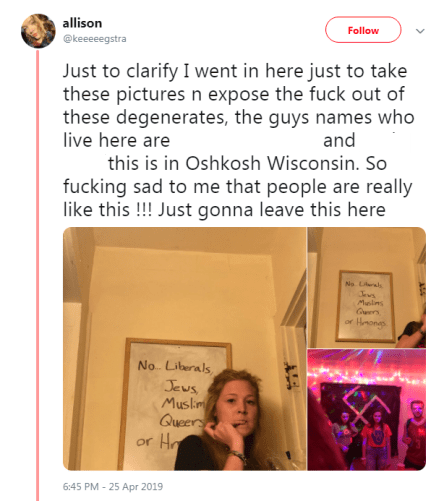
A social media post of three photographs, taken at a party the previous night, attempted to “out” the party hosts (UWO students) for racist and homophobic elements that were on display at their home:

Racism

(Editor’s note: Both students were named, but I blocked them here. That’s not because I believe in hiding racism, but rather because I couldn’t independently verify that these guys lived there etc. More on this later.)

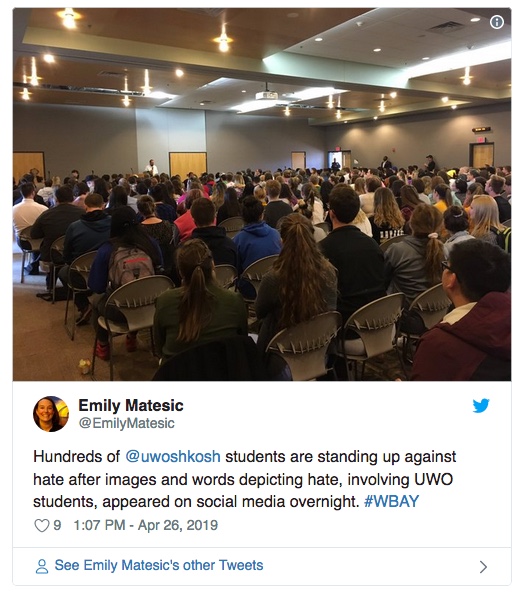
Very few things will lead to the chancellor of a major university cancelling everything he or she is doing that day to call an impromptu open forum to deal with something. Even fewer of those things are positive events. An infinitesimal number of those things will pack a giant ballroom with students on a Friday afternoon like this one did:

Matesic

Then again, this wasn’t the first of these social media posts to paint the university’s citizenry in an awful light. During the student government elections in March, a student posted on social media his support for a particular slate of candidates, noting “UWO Vote for these guys today unless you want a lesbian or a hmong to win.”

The editor of the student paper told me his social media had been blowing up all night over this incident. He said he’d been getting DMs and more asking if the Advance-Titan was going to cover this and what it was going to say. Before he reached out to me, I had been emailing with Frank LoMonte, a legal eagle who formerly served as the executive director of the Student Press Law Center and now runs the Brechner Center for Freedom of Information at the University of Florida, on this topic.

My questions to Frank were for the blog, both in terms of lessons to learn and how to keep my own keester out of the fryer while writing about this issue. I gladly shared the answers with the editor as well, because this kind of situation deals with all sorts of legal and ethical issues. Here are a couple things I pondered and things Frank told me, written in a loosely structured format, that might help some of you in the future:

Clearly the speech here (a laundry list of racist and homophobic ideals as well as a giant Swastika painting) is not something the university supports or enjoys having associated with the institution. That said, I knew that there were issues involved here about this being a public institution, this happening off campus and so forth. Essentially I asked Frank, are these students and their speech still protected?

“There’s an especially aggressive strain of First Amendment case law, which I think is completely incorrect, that says if you’re enrolled in a pre-professional program, you have near-nonexistent First Amendment rights and your university can punish you if your speech falls short of the standards of what would be acceptable workplace behavior in the profession…

“The better-reasoned view is that students have at least as much First Amendment protection online as they do in the hallways, so that means at a bare minimum they have the Tinker v. Des Moines level of protection — if not more, since the Supreme Court has never limited college students to the Tinker standard.

“I think it would be quite hard for a college to show that just saying ‘I hate [fill in the blank minority]’ is an act disruptive of the campus, absent a threat to actually act on the animus. Once speech becomes threatening, yes, it loses its First Amendment protection and can be punished, but if someone does no more than express racial or religious hatred, there is no “hate speech” exception to the First Amendment, particularly not off-campus on personal time.”

I knew other colleges and institutions have dealt with this before. We’ve detailed a number of these things on the blog, including Harley Barber’s infamous rant on Martin Luther King, Jr. Day. One incident that made major national news was at the University of Oklahoma, where a video surfaced of  SAE fraternity members singing a racist chant. The chapter was banned from campus and at least two students were expelled, although one of their attorneys said the student withdrew prior to being expelled. Again, neither of these incidents, or the one at UWO was good, but do universities have the power to expel students based on off-campus things like this? Frank’s take:

“I think the reality today is that most colleges do in fact either impose disciplinary sanctions or strongly encourage the students to ‘voluntarily’ withdraw and start over somewhere else. Colleges know that these cases are quite hard for student speakers to win, and if you’re really caught saying something so boneheaded that you’d be humiliated to continue living with it every day for the next 24 months, you’re not going to sue over it. You’re probably going to slink away in humiliation, close your social media accounts, and hope nobody at your new college Googles you.

“You can look at what David Boren did to the fraternity pledge who sang the racist song on a video that went viral. That speech was almost certainly not within the school’s authority to punish constitutionally — it was incredibly offensive, but not threatening, and there’s no “offensiveness” exception to the First Amendment — but Boren calculated that the price of not doing anything would be worse for him than the minimal risk of a First Amendment lawsuit. And he was right, nobody sued and his expulsion held up.”

Aside from the issues of free speech, I was curious about the issue of someone entering a house, taking a couple pictures and then putting people on blast via social media with those images.

We’ve discussed invasion of privacy topics both here and in both books, but those are usually clear-cut examples: If the chancellor at your university is running down Main Street like Will Ferrell in “Old School,” you have every right to take pictures of the chancellor and publish them. If you climb up the drainpipe of my house and lean inside to take pictures of my kid while she’s sleeping, you’re in deep trouble.

This situation felt a little murkier, so I asked Frank about issues pertaining to privacy and open displays of stuff within an off-campus home like this:

“Everything depends on the factual details. First, was this a gathering with a large number of people, some of whom were not intimately close friends-and-family? If it’s a roomful of 50 people and half of them barely know each other, it’s quite hard to argue that something you willingly displayed in front of dozens of strangers is ‘private.’

“Second, was the act of taking the photograph open or concealed? If I see you snapping the photo openly and conspicuously and I stand by and do nothing — and if other people are doing the same — then I can’t very well complain that you took the photos against my wishes.

“But let’s assume those things aren’t true. Let’s assume it’s 10 people who all know each other very well and the photo is snapped surreptitiously. In that event, then yes, I think there’s an invasion-of-privacy claim. When you’re inside of a private home, you have an expectation of privacy, and that’s even true to some degree if you’re a house guest rather than the owner.”

As a journalism nerd, the question that most rattled around in my head (and that of the editor, I’m sure) were about what should people publish in regard to this story. Some media outlets blurred out the faces of the people in the photos. Others blurred out one or more words on the white board. Still others didn’t run the images, but rather summarized the content.

In some cases, those were issues of taste, while in others those were issues of risk. Naming the guys runs a huge risk for a number of reasons, including that you need to make sure of your source. For example, when I posted about the Oshkosh North situation, I pretty much laid out the whole story that Brock Doemel wrote and did so with almost no fear. The reason was, I spoke with Brock, I trusted Brock as a source of that information and I knew that the blow back about his story had nothing to do with factual accuracy.

In this case, however, I’m getting a third-hand (at least) photo of an Instagram post compiled by someone I do not know. The risks are much higher. In addition, I don’t know if maybe these guys have a third roommate who put the stuff up there and they have nothing to do with it. (One of the students called out in the post initially posted on Twitter that he had nothing to do with this. He has since deleted his account.) I also couldn’t prove these photos were taken at this house and that these guys live there and more. In other words, a lot more unknown elements made naming these guys a lot riskier, so I was more cautious.

What to publish and what not to publish in terms of the images and the post gave me pause. I also was sure there were other things I wasn’t thinking about as potential landmines, so I asked Frank to give me a map to the landmine field here:

“I think it’s powerful in a situation like this to show the audience: ‘Here’s exactly what this looked like to the people attending this gathering in the apartment. They were big, clear, legible words in a visible place that couldn’t help but be noticed.’ The picture helps you get that across.

“Where I would be really careful is in over-characterizing or over-describing beyond what you can say for sure based on firsthand observation. For instance, maybe the photo shows Jane Jones standing and smiling as she looks at the words. I wouldn’t say ‘Jane Jones stood by without doing anything,’ because for all you know, Jane immediately ran up and erased the words. This is the issue we saw with adding interpretation to the video of the Kentucky high-school Trump fans who got into a confrontation outside the Lincoln Memorial. Is the smiling student expressing his smug superiority over the Native America protester, or is he trying to remain stoical in the face of insults shouted at him? If you don’t know, don’t speculate and don’t guess.

“I don’t think it’s a bad editorial call not to use the photos, if there is concern over people who were innocent bystanders being targeted for blame. That’s not impossible. Maybe Joe walked in for 30 seconds to pick up his roommate, and in those 30 seconds his picture got snapped, but he didn’t have any involvement in the writings and he barely stopped to look at them. Again, it comes down to what you know, ideally from people who were in the room at the time, and not what you infer.”


Four things other high school administrators should learn from the Oshkosh North Star situation

I’ll be the first to admit, I was stunned at the way in which the Oshkosh Area School District decided to end the crisis involving the school’s publication, the North Star. If you missed the previous posts you can find them here and here and here.

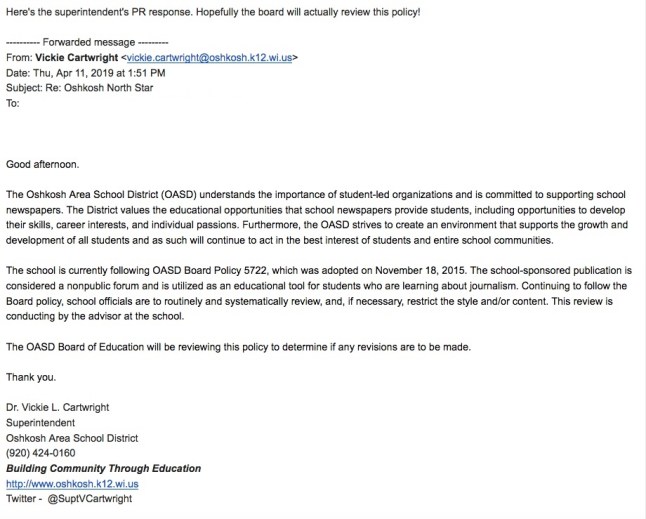
The short version is that the district issued a two-page press release on Monday, saying it will no longer pursue any action in regard to the Hans Nelson story. It also stated the district has put the publication back into the hands of the students and the adviser and it will work to put in place a policy that codifies this for the future.

I have never seen a district turn that fast or that hard in that direction on an issue like this. And as my mother always told me, “If you’re going to criticize, you have to be willing to praise.” I emailed the district folks and thanked them for their work on this and I offered to help with the new policy in any way I can. The district made the smart play here and the folks there deserve the credit for that.

Other districts could learn a few things from how this all came to pass, so feel free to give this a read and consider using it if your administration decides to take a shot across the bow at your student media:


CENSORING THE STUDENT MEDIA IN THIS ERA IS POINTLESS

Administrators at Oshkosh North weren’t the first people to try this kind of information repression, nor will they be the last. However, I think it’s important for any administration to fully understand the point of censorship and why it has absolutely no chance of succeeding.

The idea behind censorship, in its purest form, is to eliminate the ability of people in an audience to get information on a given topic. If you have the ability to completely black out coverage of a topic, you will succeed in suppressing that information from reaching the readers and thus keep secret whatever it is you want to hide. This is why censoring a student newspaper in the digital era makes about as much sense as trying to catch water in a pasta strainer.

In this case, the district managed to pull the article off the website and stop people from seeing this information there. What happened next? WBAY, FOX11, at least two other journalists and one blog hack showed up at a public listening session where Brock Doemel outlined, on the record, every aspect of what was in his article. The Milwaukee Journal-Sentinel and the USA Today-Wisconsin network did a deep dive into this as well, only further focusing attention on this situation.

In addition, students have been sharing information via social media ever since this guy disappeared, other media outlets have offered to publicize the story and now everyone with internet access now knows what happened. The district’s press release seemed to indicate they realized this had gotten way more attention than if they had left the story alone.

Simply put, censoring the student media to keep this issue quiet works about as well as trying to extinguish your campfire with a bucket of gasoline. It. Doesn’t. Work.

EVEN IF YOU WIN, YOU LOSE

I was having a hard time making this clear to the attorney for the district when we spoke last week, so maybe I’ll do better here. I kept trying to explain that using the Hazelwood decision like a cudgel, treating student press rights as “less than” and coming down like a ton of bricks on students and media advisers doesn’t work.

Legally speaking, administrators usually have the Hazelwood precedent on their side, but a) it’s not the silver bullet people think it is and b) it was meant as a shield, not a sword at the time it was decided. Go back and read the decision. It’s terrible, but the core rationale behind this isn’t “Give administrators the right to censor at will just for funzies.”

Just for the sake of argument, let’s say censoring administrators run into a judge who has a strict interpretation of Hazelwood, hates student press and will side with an administrator, regardless of the situation, they will STILL lose. For starters, the administrators haven’t prevented the information they wanted to silence to remain private. Even worse, they have to go to court and beat up on one of their own students as a part of the process.  The court of law may side with them but the court of public opinion will never forgive them.

As one alumnus of Oshkosh North pointed out to me, the media coverage of this issue wasn’t even about the bathrooms or the Hans Nelson at this point. It was about how the administration tried to kneecap one of its own students and one of its own institutions. The whole narrative changed and they realized they were on the wrong side of it. That’s why the decisions they made were the smart move. Other schools can learn something from them on this one, for sure.


THIS DRAWS MORE ATTENTION, THE KIND YOU DON’T LIKE

I got to sit through the core of the school board meeting last week, as the open forum session where I could speak came at the middle of the event. In doing so, I learned a ton of great things that the schools in the district are doing. The robotics team won state and is now headed to nationals. The students are putting on an incredible play that I want to see now. The student newspaper at the other high school in the district won a ton of awards at the state media competition. In all, there were at least a dozen really cool accomplishments highlighted that the district has every right to shout from the rooftops.

And yet the one thing everyone was talking about the next day in regard to this district was the administrative overreach of a principal and the suppression of free press in Oshkosh. That’s what people found the next day when they Googled “Oshkosh North” and looked under news. It was what showed up on the nightly news and in multiple newspapers. It’s also got people on social media tweeting at them, sending emails and letters.

The district essentially came to the conclusion outlined in Filak’s First Rule of Holes: When you find yourself in one, stop digging. They backed off of Doemel and adviser Jason Cummings, went back to the spirit of the law for the North Star and they agreed to move forward to change the policy for good. Once they get this nailed down through the board, I’m hoping they make the announcement to show they completed this whole process so everyone can feel good as they move on.

That will get you the kind of attention that befits a quality educational institution.


THE MORE YOU TOUCH IT, THE RISKIER IT IS FOR YOU

Opening up the door to allow students to do whatever they want under the guidance of an honest-to-goodness journalistic adviser can scare the hell out of administrators.

In some cases, it’s because the admin folks are control freaks who enjoy dominion over all they survey, like an Alexander the Great with a master key. In other cases, it’s because they have been told a squillion times about the liability that that comes when a kid does a dumb thing. In other cases, it’s because nobody likes hearing bad things about a place they care about, especially if they are responsible for the upkeep of that place’s image.

I’m sure I’m missing a few other reasons, but the point is, this idea of giving a group of kids free reign over a publication with the school’s blessing can seem terrifying.

So why not slam the lid on this thing, eliminate the risk and take control over the whole thing? Because that puts you at even greater risk than you are if you opened up the whole thing and let kids do whatever they want.

The minute you touch the student media, you put yourself in the unenviable position of being responsible for it. That means the one day you blow off reading an article and some kid libels a janitor, that’s on you and the district. The attorney for the Oshkosh district told me after the listening session that the district is “where the deep pockets are in the case of a lawsuit.” Right. Which is why you don’t want your pockets associated with those people who might go digging.

Court rulings, even those after Hazelwood, have found that the best case a district can make against being successfully sued for the content of a student media outlet is to leave the content decisions in the hands of the students.

In other words, you break it, you bought it.

Which actually reinforces an even larger point when it comes to the students’ behavior. If you provide them with the ability to control the dice and yet the responsibility for dealing with the blow back from anything they publish, you train them to treat that responsibility seriously.

If you tell them that you’re going to be backstopping everything they want to run, you will have one of two unpleasant scenarios:

  1. They will be less diligent when it comes to accuracy, ethics and other similar things, thus leading to riskier journalism due to their lack of care.
  2. They’ll spend half of their time trying to sneak something past you because it’s fun to mess with authority, thus forcing you to spend most of your day on Urban Dictionary trying to find out if ‘mercan is a patriotic typo or something that should result in a phone call to the author’s parents.

Back to normal: Read the Official Statement from the Oshkosh Area School District regarding the North Star

When I first met Brock Doemel, and we discussed the situation he and the North Star found themselves in as a result of his article on Hans Nelson, I asked him what his goal would be if he could have anything come of this. He told me:

“I would want all our writers to be able to go back to the way it was,” he said. ” I want them to let us do (the North Star) without school censoring… I want Jason’s job to be safe. I want a free student press at our school.”

It looks like he got it. The district released a statement about 10 minutes ago that you can read in its entirety below.

Honestly, I’m not 100 percent sure on every twist and turn in this, but I absolutely give credit where credit is due: The District appears to be moving in the right direction on this.

P2_Page_1P2_Page_2

“This is not just about some locked bathrooms anymore:” Open records requests, allegations of fabrication and threats of a lawsuit follow the media coverage of censorship at the Oshkosh North Star

If you missed Thursday’s post on the Oshkosh school district’s attempt to censor the students at the North Star, force a reporter to give up a confidential source and impose a policy of prior restraint, you can catch the link here.

Once you read the story, if you feel compelled to make your position heard on this topic, please consider contacting any or all of the following people:

  • Oshkosh North Principal Jacquelyn Kiffmeyer: jacquelyn.kiffmeyer@oshkosh.k12.wi.us
  • Oshkosh Superintendent Vickie Cartwright:
    vickie.cartwright@oshkosh.k12.wi.us
  • Barbara Herzog, the school board president:
    herzogb@uwosh.edu


If you just want the short version of the situation, try this:

  • Student journalist writes story administrators don’t like
  • Administration censors student publication, demands name of confidential source
  • Student journalist refuses, requests open records to support the story
  • Administration requests $138 and access to the newspaper’s files before processing request
  • Student journalist refuses, goes to school board listening session to discuss this
  • Media gets wind of all this, everything jumps up a notch

That’s about as tight as I can do it.

The school board listening session and the school board meeting that followed allowed multiple people (including me) to talk about how this approach to student media wasn’t in the district’s best interest. Superintendent Vickie Cartwright stated in the meeting that there was no intended quid-pro-quo approach for the public records and that once the article’s author, Brock Doemel, produced the cash, the records were all his. (If you go back to the previous post and reread both of the response letters, I am uncertain as to how that statement jibes with what they sent the students, but at least this was now on the record.)

Doemel and fellow student journalist Tess Fitzhenry went to the admin building on Thursday to seal the deal:

FOIABrock

Doemel also had to go back to school on Thursday to finish off his week of classes and such. He said a lot of people at Oshkosh North supported the efforts he and Fitzhenry were putting forth.

“I was overwhelmed by the support I received from peers, teachers, and faculty on Thursday and Friday,” he said in an email. “Students and staff alike are well aware of the culture of secrecy that exists within the Oshkosh Area School District, and I’m committed to changing that culture for the better, starting with getting to the bottom of this story and ensuring that future student writers can practice journalism without fear of censorship or retribution.”

In the mean time, the story jumped up another notch when Devi Shastri wrote an incredibly detailed story for the USA Today-Wisconsin Network, which includes the Oshkosh Northwestern and the Milwaukee Journal-Sentinel. Revelations about this situation included the following:

  • Cartwright said she and North Star adviser Jason Cummings agreed to take the story down because they began “thinking about journalism ethics and guidelines and spoke to another staff member.”
  • Cartwright said Doemel’s characterization of his interactions with Principal Jacquelyn Kiffmeyer were “false,” noting that she had spoken to Kiffmeyer, who is on medical leave. Cartwright was not present during those interactions.
  • The district is operating under a student media policy crafted for it by Neola, a “policy mill,” according to the Student Press Law Center. What makes this even weirder is that the district’s administrative guidelines for student press are exactly the opposite of what the district’s policy states:
    • Administrative guidelines: “No student media, whether non-school-sponsored of official, will be reviewed by school administrators prior to distribution or withheld from distribution,” the 2018 guideline states. “The school assumes no liability for the content of any student publication, and urges all student journalists to recognize that with editorial control comes responsibility, including the responsibility to follow professional journalism standards each school year.”
    • FROM THE DISTRICT POLICY: “All school-sponsored student publications and productions are nonpublic forums. While students may address matters of interest or concern to their readers/viewers, as nonpublic forums, the style and content of the student publications and productions can be regulated for legitimate pedagogical, school-related reasons. School officials shall routinely and systematically review and, if necessary, restrict the style and/or content of all school-sponsored student publications and productions prior to publication/performance in a reasonable manner that is neutral as to the viewpoint of the speaker. Legitimate pedagogical concerns are not confined to academic issues, but include the teaching by example of the shared values of a civilized social order, which consists of not only independence of thought and frankness of expression but also discipline, courtesy/civility, and respect for authority. School officials may further prohibit speech that is grammatically incorrect, poorly written, inadequately researched, biased or prejudiced, vulgar or profane, or unsuitable for immature audiences.”
  • The lawyer for Hans Nelson, the subject of the article that started all this, issued a statement to Shastri, stating the article was “false and defamatory” and that Nelson is considering legal action as a result of the article.
  • Cartwright said the district now believes Doemel doesn’t have a source within the school district who told him anything about Nelson’s situation.

Some of these things seemed a bit odd, so I emailed Doemel and Cartwright a few questions about this. I got this back immediately from Cartwright:

CartwrightRobo

(NOTE: If Cartwright does get back to me, I’ll post her responses on the blog. I did get an email note from an alumnus of Oshkosh North who said he spoke with Cartwright for about an hour the other day regarding this issue. So, the superintendent is around and is discussing the story and the policy, both of which are important aspect of this situation. The alumnus noted that the board is open to reevaluating the policy and that Cartwright will be involved in that during the process. That’s all I know from the district standpoint.)

Doemel did respond to my questions and said he disagreed with the way in which Cartwright explained how the school dealt with the story and also how it treated him.

“Mr. Jason Cummings, our faculty advisor, removed the article after talking with another teacher, who feared Cummings might face discipline for it,” Doemel said in the email “It was not removed, as Cartwright claimed, because Cummings was questioning the ethics of my writing. The Superintendent’s account of how I was treated by Principal Jacquelyn Kiffmeyer is also false, and I’m upset that Dr. Cartwright has not taken more care to investigate my treatment, but instead shrugs it off as if it didn’t affect me.”

After several attempts to get Doemel to roll over on his source, the district appears to have taken the position that no such source exists. According to Shastri’s article the district sees the source issue a “non-issue,” which makes little sense, given the previous statements made regarding the story and its source.

For his part, Doemel said he is standing by his story and he’s upset that the district is essentially calling him a liar.

“The most concerning of Cartwright’s quotes, however, is her sudden, out-of-thin-air assertion that I must not have had a source for my story and made the whole thing up,” he said. “Dr. Cartwright’s rhetoric is especially dangerous in an era where truth has taken a back seat to sensationalism and personal opinion. I won’t let it go unanswered. I’m not just some angry kid with a predisposed hatred for authority. I’m a young man who carefully researched and wrote an important story.”

In response to Nelson’s attorney threatening to sue him, Doemel said he isn’t worried, because the story was factually based and was intended only to inform the school what happened to him. On a personal note, he added that he likes Nelson, but that this issue has grown beyond a single article.

“Mr. Nelson was a highly-respected assistant principal, and I enjoyed his good sense of humor and his leadership over the last couple of years,” he said. “If I had a way to get in touch with Mr. Nelson, I would remind him that this is not just about some locked bathrooms anymore. It’s about poorly-written policy and school district officials’ gross mishandling of the situation.”


UPDATE: Oshkosh Superintendent responds to your emails regarding the Oshkosh North Star with a blanket PR statement about freedom.

If you’ve been following along with the prior post about Oshkosh North High School administrators censoring student media, trying to force a student journalist to give up a confidential source and relying on a policy of prior restraint, here’s your update of the day.

It seems you have been emailing the administration with your concerns, as was witnessed by this response a friend forwarded me:

NorthStarResp

The policies that were passed were part of the board’s overall policy revisions as suggested by NEOLA, a policy mill with a strong anti-student rights stance where free speech and press are involved.

In the following days and weeks, we’ll be digging into what all of this involves, but in the meantime, please feel free to continue to email the following people and express yourself regarding this North Star situation. You might get a robo-response like this one, suitable for framing. Or the wheels might start turning toward student press freedom once again.

  • Oshkosh North Principal Jacquelyn Kiffmeyer: jacquelyn.kiffmeyer@oshkosh.k12.wi.us
  • Oshkosh Superintendent Vickie Cartwright:
    vickie.cartwright@oshkosh.k12.wi.us 
  • Barbara Herzog, the school board president:
    herzogb@uwosh.edu

More to follow as it becomes available.

The Oshkosh North Star needs your help after administrators censor the publication, demand the name of a confidential source and move to prior restraint.

I spent my Wednesday morning at the Northeastern Wisconsin Scholastic Press Association convention, teaching high school students how to write effective headlines for their publications. I spent the night teaching high school administrators and school board members why censoring and prior review are bad things. If I had to bet on where I was more effective, I’d put my money on the kids, even though I certainly hope not.

In both environments was Brock Doemel, a senior at Oshkosh North High School, who writes for the school’s publication, the North Star. Doemel found himself in hot water when he had the temerity to publish a factually accurate story on the paper’s website about the resignation of an administrator at his school. Assistant Principal Hans Nelson’s office was empty for two weeks and Nelson was nowhere to be found. Eventually, the district released a happy-time note indicating that Nelson was graciously moving to a position at another school teaching special education.

Doemel, however, got a source to confirm to him that Nelson had been placed on a two-week suspension after he locked off all the bathrooms in the school and lied about it to administrators. A legal threat led to an agreement to land Nelson elsewhere, Doemel said in an interview Wednesday morning.

The story spent about 20 minutes on the website before officials had it yanked down, claiming that this somehow violated privacy rules:

Oshkosh schools superintendent Vickie Cartwright says the article breached Nelson’s privacy and violated the district’s policy.

“Anytime that you’re dealing with any types of things that would infringe upon the rights of others, as a public employee, I do have to implement anything and put in protections for those individuals,” Dr. Cartwright said.

Doemel explained in our interview that Principal Jacquelyn Kiffmeyer wasn’t even that clear about the reason for pulling down the story.

“I’m not even sure how she saw it so fast,” Doemel said. “She had it pulled down in less than 20 minutes. She said it was a ‘legal issue’ for anything to go on the website like that before the issue was settled. She didn’t even explain anything else.”

What Kiffmeyer did instead was require the North Star to post an unedited letter she wrote on its website that refuted the story that is no longer available. In the letter, she stated that it was removed due to “inaccurate and unverifiable content” and that the story “did not include credible information or sources.”

She also began harassing Doemel to give up his source. He said Kiffmeyer pulled him out of multiple classes over a week’s time to demand information about his source. He estimates this cost him about seven total hours of education.

“She requested my working notes,” he said. “I refused to identify the source… My mom works at the middle school and at one point they called the middle school’s principal and accused him of being the source.” (UPDATE NOTE: The principal talked to Brock late Thursday and wanted to clarify that the call made to him regarding the story was not accusatory, but instead a call from a friend at central office to let him know that the district was looking into him as a possible source.)

The situation got increasingly intense, Doemel said, noting that “it felt like I was guilty of a national security crime.” Some of the questions were intent on pinning down potential sources, such as “Is this person an administrator?” and “Is this source a man or a woman?” Doemel said other questions felt vague and threatening, such as “Brock, do you have a sister?”

“At one point, she placed her hands on the desk and leaned toward me,” Doemel said, mimicking the action. ” She said, ‘Sooner or later Brock, you’re going to tell me who your source was.'”

(INTERESTING SIDE NOTE: The whole point of this story being pulled down, according to Kiffmeyer’s own letter, was that the source wasn’t credible, and yet Kiffmeyer doesn’t know who the source is. Furthermore, nothing she said in any of those meetings, according to what Doemel told me, or in that letter explains WHAT was inaccurate or HOW it was wrong.)

Instead of giving up his source, Doemel and fellow North Star staffer Tess Fitzhenry filed an open-records request with the district to find out what happened to Nelson. What they received was a response letter unlike anything I’ve ever seen:

BrockFirstLTR

The law allows for fees to be used to recoup costs associated with record copying and such, although such fees are often used as a way of limiting access to documents. In this case, the students had a financial backer who agreed to cover whatever the cost was. That said, I’d bet my house on the fact that if the students had requested a similar number of records that revealed every good-time happy moment that happened in the district, the fee would have been waived.

The bigger issue was the requirement in the second response paragraph. Doemel said administrators had previously demanded the North Star’s passwords and logins and had also searched adviser Jason Cummings’ computer for information on this story. This letter essentially plays an illegal game of quid pro quo: Give us your information and we’ll fulfill the request.

“The Wisconsin Open Records law is not a bargaining chip,” SPLC’s Senior Legal Counsel Mike Hiestand told me in an email. “It is the law. They can’t withhold public records until the students turn over passwords — or whatever other demands they’re making.”

The students, who were working with Hiestand on this request, sent back a response in mid-March, noting that they were fine paying the costs, they want the records and they won’t turn over anything to make this happen. The students didn’t hear back until Wednesday morning with essentially more of the same:

BrockLTR1

Again, in case you’re not clear on the law, this approach is illegal. If the records are public and someone makes a request for them, you have to turn them over. You can’t hang caveats on these responses, aside from copying costs or other legal matters, such as notification issues, which this letter does note. I was willing to prove that point by filing my own request, paying the exact amount in advance and seeing what would happen next. Doemel called the district office while we were all at this journalism convention Wednesday and asked, point blank, if the release of the records was contingent upon the release of the passwords. Cartwright said no, something she reiterated at the board’s listening session Wednesday night.

“Brock, I do want to make it very clear, we have every intention of processing your request, the only element that is missing, at this point in time, is the financial commitment for the request,” she said.

What remains, however, are several pressing issues:

  • The story is still censored.
  • The students are locked out of their ability to post content without administrative approval (in other words, they’re operating under prior review and prior restraint).
  • Doemel said anything he writes has been embargoed and must go through a specific administrative review.
  • The district is operating under a draconian policy that governs student media, something that was passed a few years back without anyone in the student media area really noticing. In the decades prior to that, the North Star operated under the doctrine of open public forum.
  • Cummings is still in trouble and Doemel said the students fear for his job.

Doemel said he doesn’t want to create serious problems at the school or be a thorn in the side of the district. All he wants is to be able to do his job.

“I would want all our writers to be able to go back to the way it was,” he said. ” I want them to let us do (the North Star) without school censoring… I want Jason’s job to be safe. I want a free student press at our school.”

HERE’S HOW YOU CAN HELP:

Kiffmeyer

This is Oshkosh North Principal Jacquelyn Kiffmeyer. You can email her at: ‎

jacquelyn.kiffmeyer@oshkosh.k12.wi.us

and tell her if you dislike the censorship of student journalists, if you are concerned about the tone she took in trying to get a journalist to reveal his source or if you want the this situation resolved in a way that protects journalistic principles and the job of the adviser.


Cartwright_Vickie_cropped

This is Oshkosh Superintendent Vickie Cartwright. You can email her at:

vickie.cartwright@oshkosh.k12.wi.us

and tell her if you want to see the North Star return to the days of no prior review or prior restraint, if you want to see important stories and if you support the rights of student journalists. You might also encourage her to work with the board to undo the policies implemented in the 2015-16 era that undercut student press rights.


Herzog

This is Barbara Herzog, the school board president. You can email her at:

herzogb@uwosh.edu

Herzog noted in the listening session that policies like the one done to undermine student press rights can be reviewed and revised through the board. Someone just has to bring it up to the board and a board member has to take it to the policy and governance committee. From there, if it passes it goes to the whole board. Feel free to email her if you would like her to know that you want this to happen, that the policies are in need of revision and that the school district needs an open public forum for all of its publications.

Finally, you can reach the staffers of the North Star via their website. You can also post some positive thoughts on their Facebook page here or reach out via Twitter (they only have nine followers, so maybe we can help them get a boost, too).

Let these folks know they’re not alone, that you support their rights and that you have their back. One of the things I have seen over the years in terms of “admin vs. student pub” battles is that the districts often win when they make the students feel scared, isolated and weak. When the kids win, it’s because they feel like pros, profs and other folks interested in free press have their back.

Help if you can.