3 reasons why porn mogul Larry Flynt matters to you in journalism, whether you like him or not

Larry Flynt,  who turned strip clubs and a fledgling nudie magazine in the 1970s into a pornographic empire, died Wednesday at the age of 78. To say he changed the field of publishing  and the concept of “adult publications” with his launch of Hustler magazine, is akin to saying Babe Ruth changed how baseball was played.

To put my editor’s mind at ease, as I can already picture the folks at SAGE breathing heavily into a paper bag and fighting off heart palpitations when they saw this headline, this piece isn’t a lionization of a man who clearly had more than his share of  marks on the negative side of his ledger in life.

Critics note that his magazines were not only horrifically crude, but also that his efforts were misogynistic and taboo, as Flynt seemed to revel in the idea of pushing the boundaries of taste and legality as far as possible. Gloria Steinem referred to him as a “violent, sadistic pornographer,” and it’s hard to argue with that, given one of Hustler’s more famous covers featured a woman being fed into a meat grinder.

However, whether you abhor everything to do with pornography or your computer cowers in the corner when it sees you opening up an internet browser, Flynt had an impact on journalism in three key ways that still matter to this day:


SATIRE AND HYPERBOLE WERE CODIFIED AS PROTECTED SPEECH

The words “pornographer Larry Flynt” and “landmark Supreme Court Decision” don’t seem like a logical coupling, but they are, in fact, linked in history in a way that provides us with crucial speech and press protections.

Jill St. John In Campari First Time (1983)

One ad from the actual Campari series, featuring actress Jill St. John.

In the early 1980s, Campari liquor was running a series of ads in which famous people described their “first time.” The Q and A format had an interviewer asking about the “first time” and the answers contained a great degree of sexual innuendo. At the end, of course, it was revealed that the people were talking about their “first time” drinking Campari liquor.

In 1983, Flynt parodied the ad, using as his subject the Rev. Jerry Falwell. In the Hustler version, Falwell was said to have had his “first time” in an outhouse with his mother and a goat. It also referenced his need to get drunk before preaching because how else could he spout such ridiculous religious garbage.
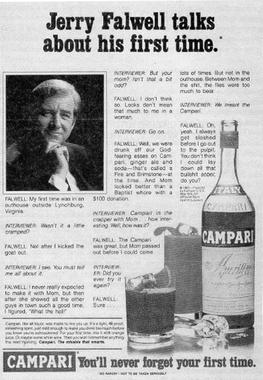
A copy of the Hustler ad that was at the center of the court case.

Falwell sued Hustler and won a six-figure jury award for emotional distress, which Flynt appealed all the way to the Supreme Court. The Rehnquist court delivered its decision in 1988, unanimously finding for Hustler Magazine. The ruling noted that public figures could not sue for emotional distress over statements that were patently offensive unless those statements could be shown to be factually inaccurate in nature and demonstrated an instance of actual malice.

The bigger point, however, was that the court noted that the First Amendment rights of individuals to make patently offensive statements outweighed the interest to protect public figures from them, so long as the statements could not be reasonably construed as true. In other words, nobody in their right mind was reading Hustler in Jerry Falwell’s congregation and thinking, “Wow! I never knew he had an Oedipal/bestiality obsession before! Guess you learn something new every day!”

The case established both a strong position for journalism in general, codifying actual malice as a standard for libel against public figures as well as providing a shield for humorists who relied on hyperbole to make their points. If Ted Cruz could sue Seth Meyers every time Meyers says his beard looks like a pile of raccoons died on Cruz’s face or something similar, we’d probably never have “Late Night with Seth Meyers” on TV.

If you enjoy shows like “Last Week Tonight With John Oliver,” “The Daily Show,” “Late Night with Stephen Colbert,” “The Colbert Report” or any other show that relies on hyper-exaggeration to make you laugh about public figures, you’ve got Larry Flynt to thank for their existence in their current stasis.


THE MAN UNDERSTOOD (AND SOME WOULD SAY EXPLOITED) AUDIENCE CENTRICITY

In the 1960s, the primary men’s magazine was Hugh Hefner’s Playboy. It combined humor, culture, interviews and literature with photos or illustrations of semi-nude or fully nude women to entice its readership. The description of Hefner and the magazine was often “bon vivant,” which roughly translates to a cultural person with refined social tastes and interests.

While Hefner was hobnobbing around town, reflecting the kind of people you’d see in “Mad Men,” Flynt was grinding out a living in the dirtier parts of Cincinnati. The people who visited Flynt’s bars and dance clubs were the blue-collar, truck-driver, factory-worker gritty folks that populated much of the Rust Belt and other similar parts of the country. They weren’t interested in the latest stories from Jack Kerouac or Jean Sheppard. They weren’t buying the silk socks and calf garters advertised in the back of Playboy. They didn’t see the social incongruity of having African American Alex Haley interviewing George Lincoln Rockwell, the head of the American Nazi Party.

To borrow a phrase from comedian Jeff Foxworthy, they wanted a beer and to see something naked.

Flynt understood this and used that understanding to tap into a completely under-served audience. He saw things from the perspective of readers who weren’t rich or smooth or refined, but had extremely base tastes and were willing to pay for content that reflected them. He came at the publication itself from an audience-centric perspective, knowing that for every one person who would gasp audibly at the horrifying indecency of his publication, there were at least three others who would buy it specifically for that indecency.

A perfect example of his comprehension of how best to serve his audience was illustrated in the 1996 film, “The People vs. Larry Flynt,” in which Flynt (played by Woody Harrelson) is arguing with a photographer about how best to shoot a photo of a naked woman. The more the photographer is trying to soften the content and hide the nudity, the more Flynt is pushing back to make the nudity more prominent. Finally, Flynt says, “Look we’re not running a flower shop here. We’re selling the girl. So stop playing with all the props and pillows and flowers and just shoot the girl.”

The concept of audience-centricity has been one that journalism in general has been painfully slow in comprehending. It’s a safe case to make that newspapers continue to crumble because they still have a major disconnect between what matters to the writers and what matters to the readers. The degree to which internet publications have succeeded or failed over the past decade is almost entirely linked to their ability to define, reach and appease an audience. It’s something we now teach in journalism as a matter of course.

You might not like that Flynt was “selling the girl” or how he sold it or what else he did, but the truth is, not many publishers (now or then) had as keen of a sense for whom they were publishing and what those people wanted. You can also argue what people should or shouldn’t want, but that’s a completely different discussion.

And it also leads to the final point…


SPEECH AND PRESS SHOULD BE PROTECTED, EVEN IF THEY OFFEND YOU

People who debate the various aspects of the First Amendment have a wide array of opinions regarding Larry Flynt and his overall place in its pantheon. To some, his efforts have created a wider array of protections for speech that otherwise could not have existed had he not gone to such outlandish lengths with his publications. To many, many more people, however, he’s a filth monger who exploited women, debased sex and profited greatly by abusing one of the most important rights of our society: The right to free expression.

Wherever you fall on this issue or this person is completely understandable, particularly if his actions offended you. That said, the concept of a free society is that sometimes you get offended by the expressions of others. You cannot, however, simply destroy speech or press because you dislike what it has to say. Edward Norton, playing the role of Flynt lawyer Alan Isaacman, makes that case in this scene from the film:

Your rights to say what you want are always in jeopardy if other people have the right to shut you up because they don’t like what you have to say. Then the question becomes, “Who sets the standards and who gets to determine the penalties?” The freedoms accorded to us in the First Amendment need to protect all of us, or they protect none of us.

Or, as Flynt was known to say, “If the First Amendment will protect a scumbag like me, it’ll protect all of you.”

Unforgettable Indiscretions: Student newspapers and requests for deleting old stories in the wake of the Boston Globe’s Fresh Start Initiative

In the 15 years or so I advised student newspapers, the most popular feature we produced was the police blotter.

At the Ball State Daily News, the listings appeared under the “Police Beat” title, while UWO’s Advance-Titan went with the more accusatory name of “BUSTED!” In both places, a reporter would go to the campus police station once a week and collect a litany of small crime items that weren’t worth a huge story, but likely held some level of interest to folks.

We tended to have a lot of underage drinking tickets, public intoxication arrests, drug busts and similar consumption concerns. Occasionally, we would end up with a fight, a verbal altercation or a case of vandalism. Anything more serious than that tended to be highlighted and relayed to us by the police department in the form of an alert or a press release.

(The one “BUSTED!” item that sticks in my mind all these years later happened the year before I started advising the paper. A male student and a female student were caught having sex behind the giant concrete UW-Oshkosh sign near the main thoroughfare of campus. When the police “stepped in,” the male begged the cop not to write a report or issue a citation, because then his sexual indiscretion would end up in “BUSTED!” and his girlfriend would find out about it…)

Although these features were popular among our general readers, we found them to be less popular among the people whose names ended up in them. In many cases, we received requests to not publish a particular person’s legal infraction or to remove the reports of them that we had previously printed. At one point, the requests became so popular that the Daily News put the phrase “It’s not our fault you ended up in Police Beat” on the back of the staff T-shirts.

The standing response was that we don’t edit our archives or try to change history. If it happened and we wrote it, it stays put.

Those papers I advised weren’t the only ones to hold that line, as many of student media outlets have policies like this one from the newspaper at Northwest Missouri State University, where my buddy Steve Chappell serves as the adviser:

The Northwest Missourian never knowingly publishes inaccuracies. If any error is found, The Northwest Missourian is obligated to correct the error as soon as possible, regardless of the source of the error. A consistent location, signature and style for corrections and clarifications is recommended.
The Northwest Missourian does not remove any editorial content from its website. However, if there is a factual inaccuracy in a story, the editors will run a correction or an update as needed. When a person calls in question of a fact published they should never be guaranteed a correction will run. A section editor must first confirm that the fact in question is an inaccuracy.

In a lot of ways, this can make sense. The hard-line approach prevents staffers from having to pick and choose among which things are worthy or unworthy of “scrubbing” from an archive. The requirement of factual accuracy being at issue makes it clear that someone being embarrassed or upset over accurate coverage isn’t going to cut it in terms of a correction or retraction.

What seems like a simple cut-and-dried approach to archived indiscretion became more complicated recently when the Boston Globe decided to give people a chance to get a pass on their past. The “Fresh Start Initiative” allows people to request a review of previously published content about them for updates, removal or other reconsideration:

Similar to “right to forget” programs that have cropped up in a number of newsrooms across the country, the undertaking is meant to address the lasting impact that stories about past embarrassments, mistakes,or minor crimes, forever online and searchable, can have on a person’s life.

“It was never our intent to have a short and relatively inconsequential Globe story affect the futures of the ordinary people who might be the subjects,” said Brian McGrory, editor of The Boston Globe. “Our sense, given the criminal justice system, is that this has had a disproportionate impact on people of color. The idea behind the program is to start addressing it.”

Truth be told, student newsrooms have been talking about these concerns for years and have had policies that support whatever position they took. To get a better grip on what student media outlets were doing regarding “take-down requests” and their thoughts on them based upon what the Globe had done, I posed the question on the College Media Advisers listserv.

In many cases, folks explained they had a pretty solid and long-running policy on how they viewed their content. The policy at The Temple News, for example, offers authority to any given editor-in-chief to remove or retain content, but it notes that published content, regardless of format, is seen as part of the “historical record.”

Others, like the Elon News Network at Elon University, provide a pathway to content removal and a process to petition the organization:

ENN has created a review board of organization leaders and faculty advisers to review content that has been petitioned to have content changed. The board will meet at least once a semester to review all requests.

The content removal petition form is available online, and should meet the following requirements:

  • The petition must be filed by the person directly involved, and not be made on behalf of an individual.

  • Three years must have passed from the content’s publication.

  • The form below must be filled out and submitted. Any relevant documents that the review board should be made aware of should be submitted in the form. The review board will not take into consideration any documents submitted after the board has met.

One adviser noted that her students were looking at revising the policy, given the ubiquity of the internet. The line of “Nothing ever truly disappears on the internet” is more true now than ever before. It used to be that a web page could be abandoned and it would fall so far off the beaten path, nobody would find it. Even more, I know at least one student paper where I worked lost a ton of archives when it switched providers.

Today? That stuff would be easy to find and accessible with about two clicks and a simple search term.

(Another interesting angle someone brought up was the way in which efforts to preserve the past are now opening up more windows to older embarrassing incidents. When libraries or media outlets decide to digitize past issues and make them searchable, suddenly that arrest for drinking and driving that your step-dad swears never happened is at your fingertips, complete with his bad 1970s feathered-hair mug shot.)

The question of how to do this is often more concerned with what are the ramifications for doing this at all. In a listserv discussion on this topic, the director of publications at Western Kentucky mentioned a concern I often had in regard to this situation:

The attorney who represents the College Heights Herald and the Talisman has pretty consistently given the advice that you open a Pandora’s Box by granting a takedown request. If you later turn a request down, then you could be subject to being found arbitrary if the matter went to court.

It will be interesting to see if litigation emerges from what The Boston Globe is doing. For the time being, I still favor the “you can’t rewrite history” mantra, with offering to update the story to reflect how it turned out – but with documentation.

As for most legal things, I turn to the Student Press Law Center, which has a giant list of things to consider and processes to follow in this regard. The explanation of how the law works and why it works that way makes a lot of sense. It also outlines the potential legal potholes you might hit along the road.  One other thing SPLC touches on in this write up is the way in which the law and ethics can diverge.

In other words, just because you “can” do something, it doesn’t follow that you “should” do something, and that involves both publishing and removing content. In the case of removing content, the law might say you are on firm ground leaving up the story about the freshman who was arrested after police found him asleep, naked in a tree. However, that kid is now a 30-year-old local minister who has done a world of good, but for some reason, Google’s algorithm keeps putting that at the top of any search of his name. Is it “right” to keep that at the forefront of any discussion of this guy?

To that end, was it “right” to publish it in the first place, even though the law said you could? When it was a day-long or week-long embarrassment that probably won’t make it beyond the campus confines, publishing the content might not seem like that big of a deal. However, if you knew something would follow this person their entire lives and nothing they did could ever scrub it off, would you think twice before publishing something about a drunk freshman peeing in a campus parking lot after a house party?

I don’t know exactly how to split that hair, but an adviser who has worked with me to make the reporting book much better explained his approach in fantastic fashion:

This is the reason I strongly encourage our editors not to pursue stories focusing on minor “crime” stories, things involving drugs and alcohol and general college-aged stupidity. College is a time in a person’s life when they should explore and experiment. And they should not have to live with the punishment of such misdeeds for the rest of their lives. Good gosh, if Google was a thing when I was in college …

I usually err on the side of the person over any notion of journalism ethics.

Human first. Journalist second.

“I’ve got to go. I’m being arrested.” (or every time a law enforcement officer violates the rights of the media, a journalist gets their wings)

The joke around the student newsrooms I used to advise was whenever someone called in and said, “I need help,” we would respond with, “The newsroom doesn’t pay bail money…”

So it was kind of a shock when I got this photo from Alex Crowe, a radio journalist who has contributed to the blog on several occasions:

Courtesy of Alex Crowe

With it, he wrote, “Good morning, Vince! Got my journalism wings yesterday.”

Crowe was in Milwaukee, covering a protest over the shooting death of 17-year-old Alvin Cole. Wauwatosa police officer Joseph Mensah killed Cole in February 2020, and on Oct. 7, the Milwaukee County District Attorney John Chisolm announced there would be no charges filed in this case. Mensah had shot and killed two other people over the past five years in the line of duty and had been cleared in both cases.

“I was sent to the Milwaukee County Safety Building to interview protesters and gather pictures and video of the scene while people waited for a decision to be announced,” Crowe said in an email interview. “I witnessed a crowd that was mostly peaceful but became agitated as time went on. The Cole family and their lawyer were inside the Milwaukee County Safety Building for about two hours, and during that time the crowd began to grow and some people became increasingly aggravated as they awaited what they felt would be an unjust outcome.

“Finally, when the Cole family and their lawyer came outside, some protesters shoved a member of the media and pushed his camera off its tripod and onto the concrete. While the family’s lawyer was speaking, several protesters were shouting obscenities forcing some stations to cut the live coverage. Once the lawyer and family members were done speaking, the protesters began to march towards the interstate where several members of the Milwaukee County Sheriff’s Office were waiting to try and prevent people from marching onto the highway.”

(Video courtesy of Alex Crowe)

Crowe followed the protesters to the highway ramp, where protesters were walking around the squad cars meant to limit access to freeway. Some clashed with officers and were subsequently tossed onto the hoods of squad cars. As Crowe and other media representatives took photos and video of these encounters, deputies from the Milwaukee County Sheriff’s Department demanded that they stop following the crowd up the ramp and cease recording.

“There were simply too many people to arrest all at once,” Crowe said. “The protesters kept moving onto the highway. This had happened to me once before, during the protests after the death of George Floyd. During that experience, officers allowed protesters and media onto the highway, calmly stopped traffic and directed protesters and media members off at the next exit. This time, however, as protesters continued onto the interstate, a member of the Milwaukee County Sheriff’s Office turned towards myself and several other media members and ordered us off.”

One officer targeted Crowe, coming up behind him and placing him in handcuffs.

“I was on the phone with my boss when it happened and said ‘I’ve got to go. I’m being arrested,'” Crowe said. “Apparently my boss already knew that, because he was watching a live TV feed of the whole event back in the newsroom. I was able to remain calm because I knew that even if I were to be arrested and brought somewhere, they couldn’t charge me with anything and I would eventually be let go.”

The officer told Crowe to hang up the phone, before he confiscated Crowe’s recording equipment and patted him down for weapons.

“As we were walking, I explained that I was simply doing my job and that he had let the protesters go while targeting me,” Crowe said. “He told me he was sick of the media ‘thinking they can do whatever they want.’ It was at this time that another officer within the Milwaukee County Sheriff’s Office came over to us and asked which organization I was with. I told him and he ordered the other deputy to take me towards the back of the bank of squad cars, where no other protesters or media members were being held.

“He further instructed the officer holding me to uncuff me, give me my equipment back and let me go without any charges. The first officer begrudgingly did as he was told and let me go… I still don’t know why that single officer decided to go after me and insisted on bringing me away in handcuffs when he knew I was a member of the media.”

Once he was released, Crowe said he collected himself a bit and then went back to work, covering the protest.

“I called my boss to let him know that I was OK, then ran back to the highway area but this time on the other side of the fence, so I wasn’t on the road, I was in the grass on the other side of the highway,” Crowe said. “I found a place where about 20 officers were waiting on bikes to ride onto the highway if needed. I pulled out my equipment and started getting right back to work like nothing had happened.”

As far as advice for student journalists who might find themselves in similar situations, Crowe said knowing he was in the right and keeping his wits about him made a huge difference.

“I’m sure if I had made a big scene, the officers would have brought me downtown just for fun,” he said. “I just tried to remain calm and continually explained that I was a member of the media, that I had equipment in their hands that proved why I was there and that they could call my boss right away and get the whole thing straightened out. I just remained calm because I knew that eventually they would realize that I wasn’t lying and that they would be in a lot of trouble if they went through with processing and arresting a member of the media who was following every order given by officers on the scene. I would just tell students to remain calm and keep explaining who you are and who you’re with.”

Actual Malice: An open letter to college administrators regarding COVID-19

Dear chancellors, presidents and other top administrators of U.S. colleges and universities,

If you want to see what kind of college experience you are providing to your students, I would invite you to spend your morning where I did on Monday: In a line on campus for a COVID-19 test.

I had two emails over the weekend from students I met with on Wednesday who told me they either were in contact with someone who had tested positive or were exhibiting symptoms of the illness.

My wife, a nurse who works with an elderly and immuno-compromised community of people, demanded that I get tested, in spite of my explanations that I had sanitized, I was masked, I was distanced, I only saw the students once and more. I had done everything my university had told me and yet, there I was, outside of Albee Hall at 10:30 a.m. with a burgeoning line of undergraduate students.

You need to go out where your kids are being tested for COVID-19, administrative folks, as I lack the ability to adequately capture the eeriness of our “new normal.” The only normal thing about this experience was that everyone in line was typing on their phone.

The line was mostly socially distanced as it bent through the wide pathway where students often crowd between classes. Aside from a few stragglers walking out of the student union and one kid wandering in and out of the library in about 10 seconds, we saw almost no one. Campus felt deserted and tense.

Nobody in line spoke and no one really spoke to anyone in line. The silence was such that not only could I hear the soft chirps of a few birds in a distant tree, but I could hear the wind ruffling the environmentally friendly grasses and plants that dotted the walkway. When a student recognized me and we began a conversation, it seemed like I should lower my voice. I kept feeling like I was yelling during a funeral visitation, even as I spoke at a relatively subdued volume.

One by one, students walked out of Albee, wiping their noses with tissue or folding up paperwork. Some had friends who came to be tested while others brought someone for moral support. One younger woman slowly walked out of the testing site, her shoulders slumped slightly and her demeanor one of exhaustion. Her friend approached her and for a second looked like she was going to give her what she desperately appeared to need: A hug. The friend seemed to catch herself just in time and stopped short. They then left the area, walking together, but at least three or four feet apart.

The line moved slowly inside where a crew of more than a dozen people had donned the kind of things you’d expect to see in a movie about aliens. Shields, gloves, gowns, masks and more. They were plastified to the nines.

The signs on the door, apparently left over from last year, told students to enjoy the updated athletic facilities. Plastered over the top of some of them were printouts that explained who could or couldn’t be tested for the coronavirus. Each student was asked, “Do you have an appointment?” An alarming number of them said, no, they didn’t, but they called a university hotline to explain their circumstances and were told to report immediately to testing. Some had appointments later in the week, but symptoms appeared and they were told, “Get here. Now.”

So, to Albee Hall they came, at 10:30 on a Monday morning, less than one week into their first week of the semester, to find out if they would test positive for an illness that has already killed enough people in this country to fill Lambeau Field to capacity more than twice.

Welcome to college.

In the courses I am teaching this term, we discuss the concept of culpability as it relates to libel and it often comes down to one of two standards: Negligence and actual malice.

Negligence is easier to prove. The concept is that the defendants in the case either did something they shouldn’t have or failed to do something they should have to prevent the harmful outcome. In other words, you did your job in a sloppy fashion and thus created the problem.

Actual malice is tough to prove, but it isn’t impossible. Defendants accused of this, essentially,  knew something was wrong and did it anyways. It’s a conscious choice to act in a way that creates harm, knowing full well the problematic outcome that can follow.

The question we ask in this situation is, “Did you have a reckless disregard for the truth?”

If we had to apply those standards to the reopening of colleges in this country, it might not be a hard case to prove negligence against administrators who began school in the late weeks of July or the early weeks of August.

You know social distancing is required to keep this illness from spreading, but your institutions have spent years trying to cram students into classrooms, libraries, dorms and other facilities to maximize enrollment and thus increase institutional income.  You stack bodies like cord wood where possible and rely on communal bathroom facilities in many living quarters.

(Dorms have changed a good deal since I was in school, but the stories I hear from students tell me one thing is still true: You’re basically on top of your roommate whenever you’re both in the room.)

You pushed faculty to offer in-person classes or classes that could at least have an in-person component. Classes that drew students to campus and put butts in classroom seats were valued. You created all sorts of untested hybrid options with the idea that some personal interaction was better than none. Faculty objected and students went with online options when possible, but still you persisted.

You created pokazukha websites and plans and fliers for your students and faculty, complete with testing sites and “dashboard numbers” of tests and cases. You told them that “We’re all in this together” and that things would be fine because you were locked and loaded for this war.

Then, you passed the buck to a group of 18-to-22-year-olds and told them, “We want you to have a normal college experience” in the same breath that you layered on admonitions and restrictions that made such an experience impossible. You also told these students to act in a fashion that belied your decades of experience observing students, even as you lacked the resources or structure to enforce such edicts to the extent necessary to avoid case spikes.

Administrators, flip your calendar back to any point in your entire academic career. Mentally recall the scene at a campus-area bar on Friday. Think back to your memories of one of your more raucous “party places” (frats, sororities, BMOC homes or whatever matters on your campus) on Saturday.

(Hell, look at what happened when states “relaxed” stay-at-home orders and thousands of chuckleheaded so-called adults poured into bars, restaurants and anywhere else that served food and booze with a side order of dangerous proximity issues.)

Now think about what you told students to do to avoid this plague. I don’t think Rebecca of Sunnybrook Farm was as optimistic as you all were about the likelihood of this succeeding.

Could these early adopters have crossed all your fingers and toes, thought, “Maybe the kids are going to game up” and hoped for the best? Sure, but that level of naiveté is still enough to make an argument for negligence.

As for those of you who brought students to campus in the past two weeks? I could imagine Dick Wolf doing a “Law and Order” special “ripped from the headlines” episode about actual malice in this case.

You relied on the same sanitation methods, the same masking requirements and the same social distancing efforts that led other schools to fail miserably, and yet you went ahead and opened your campuses anyway.

You saw the spikes happening at school after school, just as everyone with a brain predicted, and instead of rethinking your approach, you pressed forward.

You saw the dead canaries piling up at the entrance to the mine shaft and you said, “My canary will be fine. Onward.”

You saw those schools that tried to make a go of it fail and fail and fail again and yet you refused to accept reality.

As W.C. Fields famously noted, “If at first you don’t succeed, try, try again. Then quit. There’s no use being a damned fool about it.”

You weren’t fools. You were reckless.

You were reckless with the physical health and safety of your students, faculty and staff, most of whom, I would imagine, find themselves pondering every cough, sniffle and sneeze.

You were reckless with the physical health of those people’s family and loved ones, because they might carry home with them an undetected case of COVID-19.

You were reckless with the mental health of everyone in both of those groups. I bet I’m not the only one who spends countless hours worrying about everything from catching this thing to figuring out how to immediately “go online” the minute someone above my pay grade decides the tuition checks have cleared or the numbers look too bad to persist. Between furloughs, increased class loads, shifting platforms, delivery shifts and more, I find myself panicking more now than at any point in my two decades in higher education about my ability to do my job.

As I wrote this, my email inbox popped up with a new message. My results came back as negative.

No quarantine or isolation for me. Amy says I don’t have to sleep in the milk house to keep her and the kid safe.

At least, until I get another email, from another kid, telling me about another set of symptoms and another crest of anxiety builds within.

If you want to discuss this cycle of disaster further at that point, you know where to find me.

In a line outside Albee Hall, hoping for the best and praying it’s not the worst.

Best,

Vince (a.k.a. The Doctor of Paper)


‘Can you?’ vs. ‘Should you?’ A secret recording of a Wisconsin government phone call that inspired five random thoughts for journalism students

In trying to explain ethics to my intro writing students, I often fall back on the line that, “Ethics basically deal with things that aren’t illegal, but can get you in a lot of trouble, anyway.” Another way we separate law and ethics is the line between, “Can I do X?” vs. “Should I do X?”

This concept came into focus in a strange way last week, as Wisconsin continued to put the “fun” in “dysfunction” at the state government level:

MADISON – Republican legislative leaders lashed out Wednesday at Democratic Gov. Tony Evers after his staff secretly recorded a May 14 phone conversation over how to respond to the coronavirus pandemic the day after the state Supreme Court struck down the state’s stay-at-home order.

The recording and the reaction to it all but ensures a permanently broken relationship between Evers and Republicans who control the Legislature. The two sides have rarely gotten along since Evers was elected in 2018 and Wednesday’s episode was characterized by GOP leaders as unprecedented.

Republicans referred to the recording effort as “Nixonesque,” referring to former Republican President Richard Nixon’s desire to record everything involving him at the White House. I’m uncertain if this is irony, self-loathing behavior or something just randomly laughable, but I’m at a loss for words while watching a Republican use the name of a former two-term (almost) president as an insult. I guess I’m also pretty sure that the relationship between Evers and the Republicans was permanently shattered like Waterford Crystal thrown off the top of the Empire State Building waaaaaaay before this incident.

In any case, here are a few random thoughts for journalism students that don’t delve into the political grandstanding in this case that makes soccer “injuries” look honest by comparison:


THIS SHOULD HAVE BEEN PUBLIC ANYWAY: Bill Lueders, president of the Wisconsin Freedom of Information Council, made the best point about this situation. Why the hell was this a “private phone call” among three key governmental officials?

(Lueders) said recording a conversation without alerting the other parties isn’t illegal in this state, but is in bad form — and that the nature of the meeting should have pushed the three to talk publicly instead of privately.

“I wouldn’t do that as a journalist, to record someone without them knowing,” Lueders said. “On the other hand, I don’t know what would have been said in that meeting that needed to be kept private.”

Maybe if this is a public meeting, none of this becomes an issue in the first place. Sunlight is said to be the best disinfectant, and it would appear to be so in this case.


RECORD EVERYTHING, BUT BE HONEST: According to the numerous accounts I’ve read, Richard Nixon was paranoid as hell and believed people were always out to screw him over. If you have spent any time as a reporter in this day and age, I bet Tricky Dick starts making a little more sense in that regard.

I can’t tell you how many times I have written something I got from a source, quoted a source or provide information I got about a source, only to have the person who gave me that information tell me I was wrong. And I did most of my work before the era of people in power calling everything they don’t like “fake news.”

Thus, my advice to students? “Record everything.”

That said, recording is one of those key areas where law and ethics diverge. According to the Digital Media Law Project, 38 states plus the District of Columbia have what is known as one-party consent. This means that if you are on a phone call with another person, you may record it legally without letting that other person know. The other 12 states have two-party consent, which means BOTH parties on the call must know and agree to the recording before it happens. (You can read more on your state’s rules and what happens if your recording across state lines etc. here.)

The law says, “Record them all. Let God sort them out.” Ethics, however, would dictate that secretly recording people kind of undermines trust, as Lueders pointed out. This is why I always tell the students to be up front about their recording. Tell the source, “I would like to record this interview. Is that a problem?” In most cases, sources will be fine with it.

Some folks will be reticent, so I tell the students to explain WHY they want to record the interview: “I want to make sure I don’t make a mistake,” or “I want to be sure the quotes are accurate,” or “I want to protect both of us.” However, the students want to explain it is fine, but at the end of the day, it’s about having a permanent record of what occurred so if the stuff hits the fan, and suddenly everyone is pulling a “Shaggy” on this situation, you have a complete record of what happened.


STILL, WATCH OUT FOR YOU FIRST: I totally get why the person recorded the conversation: The Evers administration and the Republicans out here who will rule the assembly in perpetuity, thanks to gerrymandering the likes of which we’ve never seen before, are constantly in a bombastic struggle to define “truth” for the public. I’ll read one story one day and think, “OK, they’re doing X” only to read the next day some recasting of the situation that makes me think it was a dream.

In the end, if you know someone’s going to try to screw you, get a permanent record of reality.

Honestly, I’ve recorded people without their knowledge. I don’t say this with a great deal of pride, but this is what happens when you run a crime beat in an area where people felt no compunction about calling you up to scream at you about coverage. After I almost got smoked once, I considered it an insurance policy.

The first time this happened, a person called the main desk at the newspaper, asking to talk to the person in charge of crime stuff. The staffer sent the person to me, and the caller spent at least five minutes screaming at me about a story we ran. It turns out her kid/brother/friend/whatever was “illegally arrested” (a phrase I still love to this day) and what we wrote needed to be retracted RIGHT NOW.

After mentioning places that I could put my head, which defied the laws of physics, and questioning the lineage of my parents, this woman was not happy with my decision not to acquiesce to her demands. She wanted to speak to my boss.

I gave her his number and he got a much different treatment: A lot of “sir” mentions and some polite questions and so forth. She mentioned how horrible I was and how I said horrible and unspeakable things to her. Of course, my boss brought me in to ask me about this. He bought my version of events, but I swore it would be the last “he said/she said” thing I dealt with at that paper.

I hooked up a tape recorder to the phone and kept it at the ready. When I got the next call transferred, questioning my approach to crime news, I recorded it. After my boss got the complaint about me, I offered to let him listen to the recording. Eventually, that became our routine:

Him: “I got a complaint that you were horrible to (SOMEONE) who was complaining about (WHATEVER I DID).”
Me: “Uh… No… Would you like to hear the recording of the call?”
Him: “Fair enough…”

Still, the most important moment of recording I can recall came when I was an adviser at Ball State University. The school was in the middle of a provost search when one of the three candidates pulled out. The remaining two candidates were relatively polarizing: The president clearly favored one and the faculty and staff favored the other.

Just to back up her notes, the reporter borrowed my recorder for the phone call with the president. She asked the obvious question if the president had planned to restart the search. I can still remember to this day hearing the reporter as, “Is that even an option in your mind?”

The answer was no. We have two qualified candidates and we’re moving forward.

That was the story we ran, and then all hell broke loose.

Faculty were outraged, figuring they were going to get screwed, so they started talking. The president, clearly not wanting this to be a mess, decided the best thing to do was throw the newspaper under the bus.

She issued a statement via email to faculty and staff that basically said, “Look, the kids at the newspaper try really hard, but they’re kids and they screw up stuff. I never said we wouldn’t restart this. In fact, that’s what I’m doing right now. So, relax and don’t worry about the mistakes of children.”

Her problem was, we had it recorded. She didn’t know.

To be fair, the student SHOULD have told her we were recording her, and that was a lesson we made clear in the post-game analysis with the reporter. Thus, we gave the president a chance to do the right thing. The editor-in-chief called her and told her that she made us look stupid and that we were asking for a retraction. We’d let it go if she fessed up. She immediately went back to her talking points about the reporter screwing up and how this happens with cub reporters and how she wasn’t mad, but she had to set the record straight.

At that point, he let the cat out of the bag. She paused, said some unprintable things and then asked, “Are you recording me now?”

I remember thinking, “No, but I wish we were…”

In the end, she held firm. We ran her email alongside a transcript of the phone call along with an editorial on the whole thing. She was displeased, but that was on her. If the primary complaint someone has about you recording them is that you’ll report exactly what they said and they don’t like what they said, I have very little sympathy for them.

This leads to the next point…


IT’S NOT OUR FAULT YOU’RE A DIPSTICK: The reason we know about this recording in the first place is because the Milwaukee Journal-Sentinel put in an open records request for everything associated with a coronavirus meeting between the two sides. Once they asked for everything, including recordings of the meeting, the recording came to light.

(Good side note: In open-records requests, ask for stuff that MIGHT exist, even if you don’t think it does. You might get lucky. In this request, the reporter apparently asked for any recordings of the meeting when requesting documents from Vos as well and got nothing because he didn’t record anything. The request sent to Evers yielded the tape. Short version: It never hurts to ask for stuff.)

Evers did the right thing in turning over the file, even though I’m sure he really didn’t want to. It had to be like that scene in “Silence of the Lambs” when the moth flies out of the basement and basically the killer knew he was screwed. The game was over at that point, and he basically had to brace for impact.

The recording was what I would have expected of divorced parents who were forced into a dinner with their kid at graduation: A lot of people talking past one another, some pointed jabs and the essential “How much longer must we endure this fool?” vibe. One thing that did pop up as a story was Assembly Speaker Robin Vos blaming immigrants for the coronavirus:

MADISON – Assembly Speaker Robin Vos blamed the culture of immigrant populations for a coronavirus outbreak in Racine County, according to a secret recording of his meeting last month with Gov. Tony Evers.

“I know the reason at least in my region is because of a large immigrant population where it’s just a difference in culture where people are living much closer and working much closer,” the Rochester Republican said of an outbreak in Racine County.

Of course, Vos didn’t like the story that pointed this out and tried to move the discussion back to how shameful Evers was for recording the call. He also tried to spin this to make it about how he had a deep concern for people of color who were disproportionately suffering the effects of the virus.

(Hang on… I’m dealing with the vertigo caused by that spin… OK… Phew…)

At the end of the day, neither group looks good and Vos has to deal with what would appear to every Latino group the MJS contacted as a dog-whistle, anti-immigrant blame-fest.

What’s important to remember, however, if you record something as a journalist and someone says something stupid, it’s not your fault.

This is one of the few cases where people aren’t blaming journalists, because the journalist didn’t make the recording. Vos comes the closest, in accusing the paper of not keeping its eye on the ball with the whole “Nixon-esque” recording. However, usually, in a story in which someone records something (telling the source or not) and it turns out the source says something horrible, the outrage is more over the recording or the choice to run the story than it is the horrible thing the person said.

It shouldn’t be, and you shouldn’t feel bad about it.

Your job is to report the facts, getting as close as you can to the purity of truth, in an attempt to inform your readers of something important. Rarely are those revelations something pretty and happy, so someone will be upset.

If a state rep or a city council member or a school board president says something offensive about race, gender, sexual-orientation, socio-economic status or some dude named Chad’s little brother, and you think your readers need to know about it, that’s called editorial discretion. Use it to guide you in your choices.

ALWAYS ASK, “IS THE JUICE WORTH THE SQUEEZE?”: In looking at ethical behavior, I sometimes find myself being a pragmatist more than I would like. Still, that’s because I know I have to live in the real world and not in an ivory tower, subsisting on creeds and mottoes. What I “can” do versus what I “should” do often comes down to a weighing of my options and examination of the ramifications.

(This situation is weird, in that the journalists didn’t make recording, so whatever they picked out of the open record was less on them than it was on the person making the comments and the staffer who recorded it.)

If I record a source, and the source knows the information is on the record, and the source knows I’m recording it, I pretty much have carte blanche to do as I see fit. That’s where editorial discretion comes in. What am I trying to do here?

If I run a story based on one part of an hour-long interview that makes a long-time and trusted source look bad, will I be cutting off my nose to spite my face? Probably. Some folks would say that ethics demand the unveiling of any ill that could showcase the true nature of public figures. Others would say that, short of watching that source kill a guy, you’re not ratting him out because sources like that are hard to find.

This is where I spend more time bean-counting than I might otherwise like. Is one flashy story worth not getting another story again from this source? Is my ability to tell people important things, thanks largely to this source, going to be undermined by me taking a shot across the bow at this guy? Am I protecting a person I shouldn’t be protecting, primarily because he makes me job easier?

This is why journalists who have ethics tend to drink like fish and chew Xanax like Tic-Tacs.

As a journalist, what you do is up to you (and to that extent, your publication/boss/editor/whomever runs the show), so you need to decide for yourself if the juice is worth the squeeze.


Throwback Thursday: What you can learn from an “ecom Dude” who violated copyright and bitched about it

Based on yesterday’s post on copyright infringement, I thought it might be worth it to dig up this gem from the past and outline some of the key things pertaining to how copyright protects people from having their work stolen. One of the major concerns I had was that people would see the lawsuit from the post and think, “Hey, cool! Now I can take whatever I want from the internet without a problem!”

Um… No…

The Mashable case is a small sliver of what can happen in terms of copyright, so I wanted to make sure people had a better understanding of the majority of copyright law. (Or at least whatever majority I can bring to bear. I had, let’s call it, a somewhat “difficult” undergraduate law experience…)

The only thing that saddens me about this update from 2017 is that the original video of this guy talking about how horrible photographers are in claiming copyright is now deleted. I remember watching it the first time and thinking, “This is like watching a random frat guy who forgot his speech was due today trying to BS his way through a law school presentation.” Anyway, the main points still hold so enjoy.

What you can learn from an “ecom Dude” who violated copyright and bitched about it

I often tell my students that I learned more by screwing up than I ever did by doing things right and that no mistake is worthless if you learn something from it. It turns out that not everyone has that same experience with errors, often learning the wrong lesson from making a dumb decision.

Dan Dasilva is a “YouTube celebrity” and an “internet entrepreneur,” two terms that are pretty vague and meaningless. He also has a website called “eCom Dudes” where he operates “a collective group of individuals and coaches as well, that we come on and we share what’s working now.”  (Truth be told, I watched his intro video about four times and I still have no idea what he does or how it works. We’re bordering on the “Underpants Gnomes” model of commerce at this point.)

Dasilva took to YouTube recently to complain about a lawsuit that a photographer filed against him for copyright infringement. In most cases, people who violate copyright and are sued learn a valuable lesson: Don’t steal people’s stuff. Dasilva, however, seems to have learned something else entirely:

To put it into context, the reason I was sued was because I used a picture that I found on Google Images. Now, I should have known better, yes, in my position I should know better. But, again, I never really thought that there are malicious people out there that all they do and this is what I want to tell you is that there are people out there maliciously put pictures on the Internet.

They copyright pictures that they take and what they do is they’ll get like a copyright on it, and they’ll put it out on the Internet, and it’s freely available on the Internet if you run a Google search their image will appear… And they have a team they’ll have like three or four people who are searching the Internet for their image to find all the sites [that use the images without permission]…

His business model is taking photos and suing people for a settlement.

In other words, photographers create photographs. Other people then take those photographs and use them without permission, in violation of copyright law. The photographers then sue to protect their work and receive settlements based on those copyright violations. In Dasilva’s world, this is somehow a “malicious” racket that is meant to entrap people like him and bilk him of his hard earned cash. And what he apparently learned from all of this is that you have to be careful to avoid these “malicious” individuals and instead use “lesser quality” images from Creative Commons.

Dasilva didn’t name the “malicious” photographer with whom he settled the case, but other sites posting on this issue have done so. Nick Young, whose actual “business model” appears to be taking stock photos for a variety of uses, runs his photography business through nyphotographic.com. (I emailed Young and asked him for a short interview about all this. If he gets back to me, I’ll update and post it on the blog.)

Young’s website is upfront about his usage rules:

I allow some of my series of images to be used on a free basis in return for an attribution link back to my web site, I do this as it provides useful advertising for my business:

These images are offered under a Creative Commons Attribution-ShareAlike license and if you want to use the images for free it is very important you follow the terms of the licence. Underneath each image are the details needed to fulfill the conditions of the license and also a link to the license so you can read for yourself the terms of the license.

Should you not wish to follow the terms of the license then please purchase a rights managed license through this site which does not require any attributions.

Many of the complaints surrounding Young’s quest to control his own work fall into two basic categories:

  1. He only charges small amounts of money for some of his photos (one poster noted a $9.95 rate), so suing over the use of these images for upwards of six figures is clearly a scam.
  2. He is shooting “generic” images of food, computers and other “stock” items, so it’s unfair that he can copyright these shots and make money off of people who just want to use them on their websites.

Let’s unpack the first premise in some other legal venues and see if this makes sense in any other way:

  1. It’s unfair that I had to pay a $1,000 ticket for stealing a $1 candy bar from the store. I mean, it was only a $1, so that fine shouldn’t be so high.
  2. It’s so mean that this guy who parks his 2004 Honda Civic in outside my office locks his car and takes his keys with him. I mean, there are TONS of cars around here, there’s nothing special about this and I just want to use it to get home in time to watch the Packer game.

First, the rate (the cost of the image or the candy bar) is based on you doing the right thing and paying for something you want up front. The fine (the lawsuit or the ticket) are in place to penalize you in a way that prevents you from doing the wrong thing again. That’s why tickets for speeding or illegal parking or other similar things are really high. If we dropped all speeding tickets to the price of a gallon of gas, the roads out near my house would look like “Death Race.” The penalty is supposed to teach you a lesson, something Dasilva clearly did not learn

Second, the guy OWNS the material. He paid for gear, studio time, the subject matter (fruit, eggs whatever) and other overhead to shoot that image. He also paid for an education that helped him become good at this. The whole reason people are taking his images is because they are GOOD PHOTOS. If you think the images aren’t worth paying for, you go try to shoot a bowl of fruit or a dozen eggs or whatever and make it look as good as Young can. It’s not that easy and therefore, you are paying for his TALENT not just the PHOTO. Just because you’re used to people letting you ignore the law, it shouldn’t become a stunner when someone catches you and penalizes you. It’s no more of a defense than telling the cop who pulled you over, “Officer, I know it’s only 25 mph out here, but nobody ever ticketed me for going 50 on this road before, so this is really unfair!”

One other thing that you should consider about copyright: It’s not always about money. The goal of copyright is to provide you with a legal right to control your work. Let’s say I take a photo of my kid (she’s really cute) and I register the copyright  (which you don’t have to do for it to be copyrighted, but it is essential if you want to ever sue over that right), I control how it’s used.

So, if a guy from a white supremacists website comes to me and wants to buy that photo for use on his blog, I have the right to say, “No.” Without copyright laws, and a means to enforce them, that photo could be used to promote child trafficking, white supremacy, gluten-free breakfast cereal and McDonald’s burgers (the last of which would really be horrifying to me). I don’t think that Young is worried about his photo of carrots will be used nefariously to promote a “master race,” but if he is, that’s his business.

Literally.

Copyright goes wrong for photographer, thanks to Instagram’s terms of service

Copyright law has never been a simple thing, but in the pre-digital era, it was often easier to determine who owns what. In the days of darkrooms and contact sheets, photographers were able to develop negatives, make prints and track the physical movements of their work.

However, thanks to digital copies, social media and the “sharing” of content, it can often be difficult for some people to figure out what is and what is not a fair use of something, let alone who has the rights to do what with a photo, a graphic or a piece of video.

Things got more complicated in some ways this week, thanks to a court ruling on the use of embedded content: (h/t Kelli Bloomquist for the head’s up on this)

A court ruled yesterday that Mashable can embed a professional photographer’s photo without breaking copyright law, thanks to Instagram’s terms of service. The New York district court determined that Stephanie Sinclair offered a “valid sublicense” to use the photograph when she posted it publicly on Instagram.

The case stems from a 2016 Mashable post on female photographers, which included Sinclair and embedded an image from her Instagram feed. Mashable had previously failed to license the image directly, and Sinclair sued parent company Ziff Davis for using Instagram embedding as a workaround.

A large part of this ruling came down to the user agreement associated with Instagram:

“Here, [Sinclair] granted Instagram the right to sublicense the Photograph, and Instagram validly exercised that right by granting Mashable a sublicense to display the Photograph,” rules Wood.

Wood comes to this conclusion by discussing how Sinclair agreed to Instagram’s Terms of Use when creating her account. Those terms granted to Instagram “a non-exclusive, fully paid and royalty-free, transferable, sub-licensable, worldwide license to the Content.”

Wood writes that because Sinclair “uploaded the Photograph to Instagram and designated it as ‘public,’ she agreed to allow Mashable, as Instagram’s sublicensee, to embed the Photograph in its website.”

In other words, you agreed to let us do certain things with your stuff, so you can’t complain when we do it. Sinclair argued that it’s an unfair choice photographers must make: They either give up some rights to their work or avoid being on one of the most dominant visual-sharing platforms.

The degree to which this will be the start of something bigger remains to be seen, but it does add yet one more wrinkle to the question of who owns what and how much trouble you can get in by engaging in which online activities.

The best use of the First Amendment ever

Frank LoMonte, one of our favorite legal eagles and frequent contributor to the “Dynamics” franchise, came up with the best extra credit assignment for his media law class during this pandemic:

Here’s what I told them. You’re going to learn to recite the 45 words of the First Amendment, by heart. If you do it right, it takes about 20 seconds. Just the right length for a respectable hand-wash. Film yourself doing it while washing your hands, and you get 10 extra-credit points. Make me laugh and it’s 15.

If this kid doesn’t earn the full 15 points, something is really wrong:


Throwback Thursday: Theft as censorship: Why stealing “free” newspapers makes no sense

A friend who advises the student newspaper notified a few of us that a large chunk of the paper’s press run had been stolen from around the campus. In digging into it a bit, the staff of the Commonwealth Times at VCU discovered student government folks had likely done the deed in retaliation for some less-than-favorable coverage:

Members of the Student Government Association cleared out copies of The Commonwealth Times from kiosks on Monroe Park Campus, according to multiple confirmations from students and employees, following an article published Wednesday that detailed conflict and allegations of harassment within the organization.

Witnesses said they saw SGA leaders taking the newspapers from a kiosk within the University Student Commons, another outside of Cabell Library, one next to the Trani Life Sciences Building and another outside Hibbs Hall. They spoke on the condition of anonymity in fear of retaliation from their employers.

In honor of yet another fundamental misunderstanding of reality, today’s Throwback Thursday post reexplains why stealing student newspapers as a form of censorship is a really stupid idea.

Theft as censorship: Why stealing “free” newspapers makes no sense

The University Press at Florida Atlantic University led this week’s issue with a blockbuster of a story: The quarterback of the football team had been accused of sexual battery and the university appeared to have botched the investigation. The piece is a detailed and winding narrative that includes an interview with the person accusing Chris Robison, a deep dive into federal law and some incredible storytelling from top to bottom.

Apparently, someone (or multiple someones) didn’t think people should see this, as the staff soon noticed its newspaper bins were empty and piles of the paper had been dumped in the trash. The paper, in kind of tongue-in-cheek move, wrote a thank-you note to the thief or thieves, noting that the move had drawn more attention to the situation than anything the paper itself could have done.

The UP’s editorial noted that this wasn’t the first case of censorship via theft of the paper. It lists about a half-dozen instances in which someone thought the UP wasn’t being positive enough in its coverage and decided to dump the print edition in the trash. This also isn’t the only case of censorship by theft of college or high school newspapers out there. The Student Press Law Center keeps track of these kinds of things and lists dozens of them on its website.

(As an adviser back at Ball State, I saw this kind of thing up close, when we ran a story about the women’s soccer player getting arrested, only to find out that about one-third of our print run had gone missing. Although no one was ever caught, people who saw the folks taking the papers told us they were women, dressed in black Ball State athletic department gear.)

Frank LoMonte, a legal eagle and long-time Student Press Law Center leader, explains in the UP’s editorial that this kind of thing is illegal. LoMonte gave an example of how something can be entirely free (soup at a homeless shelter’s soup kitchen) but its inappropriate use (you pouring it down the sewer) can lead to legal concerns.

Most publications list something in the masthead of the paper, noting that the first copy is free, but additional copies are a quarter or 50 cents. This establishes a value for them in case of just such an incident. In most cases, if you grab a half dozen of them because you wrote an article and want to send one home so grandma can put it up on the fridge, the paper isn’t coming after you. However, when you take them all to deprive others of their right to see the content (including advertising, which financially drives most papers), that’s where the publication gets edgy about this.

In other words, it is possible to steal something that’s free.

Even if it weren’t, censorship by theft is a patently stupid idea for three key reasons:

  • The internet still exists: Taking all the print copies of a paper and destroying them to prevent people from seeing the content makes as much sense as covering your eyes so that other people can’t see you. It doesn’t work.
    The print product, as those of us in student media have been told repeatedly, isn’t where most of our readers live. They live online, so they will see the story much in the same way you did: Someone posts/shares it on a site you read or via social media. You click the link and there it is.
    Unless these censors have a way of hacking your website and taking down the story there, all they have done is overload the trash bins at the university.
  • Censorship draws attention: When someone destroys content is to prevent people from seeing it, all they have really done is make people want to see it more. Truth be told, I never would have seen this story had someone not tried to censor it. Once the person or people destroyed the papers, the UP called them out, the message went viral (at least in my circles) and I suddenly became more interested in what was going on.
    Like anything else we try to keep people from seeing, the harder we try to prevent access, the more people want it. Think about every argument pertaining to limiting access to pornography and you get the right idea here: If someone doesn’t want me to see it, it must be AMAZING!!!
    Now, instead of only a few people on campus finding out about this, and maybe a few folks in disparate patches of readership across the country, TONS of people are finding out who Chris Robison is, what he was accused of and what FAU did in response. The result was akin to trying to extinguish a fire with a bucket of gasoline.
  • Never pick a fight with people who buy data by the terabyte: It’s a bit of poetic license on the old line about challenging the press: Never pick a fight with a guy who buys ink by the barrel. Still, the point holds water. Journalists are much better at putting out content than most people are at censoring it.
    When we had the situation at Ball State, rather than cower in a corner and worry that we had offended people, we actually reran the entire edition of the paper as an insert to the next day’s edition. In the main paper, we wrote an editorial to the people who tried to censor us: “Nice Try. We’re Still Here.” We then promised that if THIS edition went missing, we’d run BOTH papers as inserts the next day and continue until either they stopped or we went bankrupt. The thefts did not reoccur.
    The point is, journalists are essentially stubborn, principled and generally unrelenting. We’re like a dog with Frisbee: We don’t let go. When you decide to come after us, we tend to decide that this is the hill we’re going to die on. Even more, we have connections to other journalists who have chewed the same dirt we have at student media. These people might be “grown ups” now, but they remember what it was like to be picked on and abused back in the day. They, too, have the pitbull personality and are going to stand with these folks. In a game of, “You bring your friends and I’ll bring mine and we’ll see who wins,” journalists are always going to win in this situation.


5 important things that get lost in the mess that is the “Richard Jewell” movie

After reading Tracy Everbach’s excellent review of, “Richard Jewell,” the Clint Eastwood film that looks at the 1996 Olympic Centennial Park Bombing, it became clear that the film missed the opportunity to provide a new generation with important lessons.

In the wake of the movie’s release, multiple groups have dialed in on the film’s key failures. The discussion of how Kathy Scruggs, and by implication female journalists, was portrayed has people upset with the trope that women trade sex for tips in journalism. The Atlanta Journal-Constitution has spoken out about the Scruggs issue, as well as how the movie fails to show that the journalism the paper did that helped turn the tide in Jewell’s favor.

I have long used the Richard Jewell story as an example of what can happen when “EVERYBODY KNOWS!” becomes, “Um… Whoops…” in journalism.

I show, and will continue to show, the ESPN 30 for 30 Short “Judging Jewell,”as it covers the case from all angles, including having representation from the AJC. It’s about 30 minutes and it’s worth the time. So is the “60 Minutes” piece on Jewell from 2002:


I have not seen the “Richard Jewell” movie yet, so I can’t say what it actually did or did not do. What I can say is that the film’s approach has enough people upset about the issues listed above (and a few others) that several key things got lost along the way:


It wasn’t one reporter or one publication that created this clustermess: The focus on Kathy Scruggs and the Atlanta Journal-Constitution makes the media coverage feel like a game of one-on-one between Scruggs and Jewell. It wasn’t even close to that.

The Olympics were in town and you had participants from 197 countries present. That put thousands of journalists in that area at the time of the bombing, thus leading to a giant pack of TV and print reporters chasing one big question: “Who did it?”

Pictures and video taken outside Jewell’s mother’s apartment had photographers, videographers, reporters and more swarming the area as Jewell went to work the day after the attack. As the FBI showed up to interview him, and later to search the apartment, the media was all over the place with all sorts of equipment. (In one interview, Jewell said there were at least five satellite trucks in the apartment’s parking lot.)

(Scruggs wasn’t even the only reporter from the AJC to be on the story. In a review of the news coverage that came out after the infamous, “FBI suspects `hero’ guard may have planted bomb,” story, I found nearly a dozen names of journalists attached to stories about the attack.)

People everywhere seemed to be piling on. Entertainers and tabloids called Jewell, “Una-Doofus” and “Una-Bubba,” a reference to the recently captured Unabomber, Ted Kaczynski. This was a global story.

To pin any one thing on any one journalist or one publication is more than a stretch. As Henry Schuster, a former producer at CNN, noted, “This thing just goes nuclear.”


Attributions matter, so use them: The courts that heard Jewell’s cases against the Atlanta Journal-Constitution reviewed statements made in several articles in which Jewell was identified as the key suspect in the bombing. In a 2011 Appeals Court Ruling in favor of the AJC’s reporting, the court noted:

On July 31, in an article entitled “`Hero’ denies planting bomb,” the AJC reported that, “[i]nvestigators now say… they believe [Jewell] placed the 911 call himself.” Likewise, in the same August 4 article referenced in Division (III)(A), the AJC stated that “[i]nvestigators have said they believe Jewell … phoned in a warning to 911.”

Again, we cannot agree with Jewell that the challenged statements are actionable. Although the July 31 article repeats the opinion of investigators who reportedly believed that Jewell may have placed the 911 call, it includes within its text the factual premise of that reported opinion.

In other words, the reporter properly attributed the information to an official source, who was acting in an official capacity, thus giving the paper protection against a claim of libel. (This concept is often referred to as “qualified privilege.”) Several other sections of the court’s ruling note similar attributions protecting several of the paper’s other stories.

This is one of the many reasons why I often write “SAYS WHO?” on statements my students make in their stories and why I’m a major pain in the keester about attributing information to a source. It can keep you out of a hell of a lot of trouble.


You are a reporter, not God: The one story I kept looking for was the original piece Scruggs and fellow reporter Kent E. Walker published in that July 30 “Extra” edition of the paper that declared, “FBI suspects `hero’ guard may have planted bomb.” I noticed it wasn’t mentioned in the appeals and it wasn’t in the archives I had access to. Jewell stated in multiple interviews that this was the piece that really started the entire whirlwind of controversy about him.

After paying for access to the AJC’s archives, I found it and I could better understand why he thought so. If attributions are like armor and shields against an attack, this story was butt-naked. Consider the first three sentences:

The security guard who first alerted police to the pipe bomb that exploded in Centennial Olympic Park is the focus of the federal investigation into the incident that resulted in two deaths and injured more than 100.

Richard Jewell, 33, a former law enforcement officer, fits the profile of the lone bomber. This profile generally includes a frustrated white man who is a former police officer, member of the military or police “wannabe” who seeks to become a hero.

This whole opening gives me hives, and I’m guessing I wasn’t the only one afraid of it. CNN actually read the paper’s piece live on air, making absolutely certain to be clear they were just telling people what the AJC reported.

Who made up this “profile?” How was it conceived? How many other people might “fit” that profile? Who says Jewell is “frustrated?” A “wannabe?” Not a single sentence here is attributed to anyone, least of all an official source acting in an official capacity. Also, by not having ANY attribution, the story reads as if the paper itself is saying the guy is not only the focus of the investigation but he fits the profile of a bomber.

Journalists only get away with those kinds of statements when they are of the “water is wet” variety, so when the AJC states this, it’s like, “Water is wet, the sky is blue and Richard Jewell, a man who ‘found’ a bomb, fits the pattern of the kind of guy who would plant one.”

In a case study of the AJC’s coverage, the author notes that the managing editor, John Walter, made the decision not to attribute the information:

Walter decided that Scruggs should use what the paper calls the “voice of God” approach when it came to attributing the information. The voice of God approach means that the paper would not attribute the story to unnamed sources. Rather it would take the responsibility on itself, implying that not only has the paper learned these things, but vouches for their accuracy.

As Walter explained later, he didn’t think attributing the story to unnamed sources “was fair.” The reason, he said, is that “once you start introducing sources, then you can have those sources do anything you want. They can speculate wildly. And so I felt safe, I felt better without that word in there.” In other words, if the paper took the responsibility itself, because it had multiple sources and was confident it was right, it was more authoritative than if it hung it on some anonymous source who might or might not be someone with real authority.


A couple things:

  1. I have always found the “Voice of God” approach to be stupid as hell, as it essentially says, “Look, just take my word for it. I’m a journalist and I know stuff.” It removes possible protections you might have and it really does put the media outlet at risk for anything that might go wrong.
  2. I reread Walter’s explanation a dozen times and found it to have the same internal logic as saying, “I smelled gas in a dark room and I didn’t feel safe not knowing where it was, so I felt it was important to light a match and see what I could find.” It reminded me of the way in which our student newspaper editors at Ball State would say stuff like, “Oh that photo/graphic/story is way to bloody/naked/unproven to run in the print paper. Just stick it online.”
  3. You’re not God. You’re a journalist. Act like it.

Again, this wasn’t just the AJC who decided to play God when it came to laying out information. NBC, which ended up settling out of court with Jewell, ran several pieces in which Tom Brokaw took on the “Voice of God,” including one particular exchange he had with Bob Costas, live on air:

“The speculation is that the FBI is close to making the case, in their language. They probably have enough to arrest him right now. Probably enough to prosecute him but you always want to have enough to convict him as well. There’s still some holes in this case.”

Brokaw explained to Mike Wallace in a 1996 “60 Minutes” interview his reason for making the statement he did on air. It sounded like a word salad that a drunk puked onto a passing bus:

Brokaw later in the interview said that he had multiple sources in high places in law enforcement telling him they were focusing on Jewell.

Fine. Then say THAT:

“I spoke with multiple law enforcement officials who said Jewell is the primary suspect in the bombing. They also told me they plan to arrest him if and when they get enough evidence together to convict him of the bombing.”

How hard is that to say?

In short, don’t let a sense of either self-importance or general knowledge get in the way of nailing down your facts. If you have a “water is wet” fact, tell it to me straight up. If it’s a “Vince Filak is a great professor” fact, you need an attribution on that thing because, God knows, a lot of folks are going ask, “Says WHO?”


A key court ruling about Jewell’s status made a huge difference: Lost in the argument about the accuracy of the reporting was the courts’ decision that Jewell was viewed as a limited-purpose public figure. The initial court ruling, as well as the 2001 appeals court decision, explained why this mattered:

The central issue presented by this appeal is whether Jewell, as the plaintiff in this defamation action, is a public or private figure, as those terms are used in defamation cases.   This is a critically important issue, because in order for a “public figure” to recover in a suit for defamation, there must be proof by clear and convincing evidence of actual malice on the part of the defendant.  Plaintiffs who are “private persons” must only prove that the defendant acted with ordinary negligence. Jewell contends the trial court erred in finding that he is a “public figure” for purposes of this defamation action.   We disagree.

Had Jewell won this point, all he would have needed to show to win the case was that the AJC should have done a better job than it did during its reporting on him. His standing as a limited-purpose public figure meant he had to prove actual malice, which means that the paper knew what it was doing was wrong and did it anyway because the folks there wanted to mess with him.

Private citizens get a lot more protection than public figures in a lot of ways. For example, journalists have frequently reported on allegations that President Donald Trump cheated on his wife with a porn star and then paid her $130,000 to keep it quiet. As a public figure (and maybe the MOST public figure in the United States), this kind of stuff is fair game for journalists.

If I, as a private citizen, were to cheat on my wife like that today, the first time the media would be justified reporting on it would be in my obituary that would run the day after Amy found out about it, or in a story about her being charged with murder.


Regardless of who was right or wrong, the Jewell case is an important cautionary tale: The movie has a lot of stakeholders trying to shore up their positions: The producers, the AJC, other media outlets, the FBI, Jewell’s family/attorneys and more. When that happens, we tend to find ourselves arguing about what kind of bark is on the tree in front of us instead of seeing the entire forest.

The FBI was under pressure to get this situation resolved, but folks who dealt with the Jewell investigation knew that some agents cut corners they shouldn’t have. In several interviews, Former US Attorney for the Northern District Kent Alexander noted that the FBI tried to trick Jewell into admitting things he didn’t do under the pretense of creating a “first-responder video.” Alexander and journalist Kevin Salwen outline a lot of this in their book, “The Suspect.”

The AJC didn’t settle its case while other outlets quickly folded and paid off Jewell. The paper was convinced it reported the news in a legitimate and legally protected fashion and the courts agreed. However, the folks at the paper stated, in retrospect, that there were issues in how everything came together in the reporting. Former Senior Managing Editor Bert Roughton explained in his “Judging Jewell” interview that he still isn’t entirely comfortable with the way attributions were or weren’t used, as well as some of the choices the paper made in terms of phrasing.

Last month, Roughton wrote a first-person essay about the movie, the book and his own experiences and it really does leave journalists and journalism students with something to take with them every time they ply their trade:

For the rest of my career, however, the lessons of the Jewell story remained with me. The most important one is that journalists must never forget that we are writing about flesh-and-blood people whose lives may be changed forever.

We owe them our best work.


SLAPPed around: How people with money who dislike your work can make your life miserable (legally)

About a year ago, we talked about the legal triangle that existed between coal magnate Bob Murray, comedian John Oliver and a 7-foot-tall squirrel named Mr. Nutterbutter.

The short version of this was that Oliver did a big piece on the coal-mining industry, in which he called out Murray’s company and made fun of the 79-year-old for a variety of things he did and said. Murray filed suit in West Virginia, claiming Oliver defamed him and seeking not only damages (to be specified by the court), but also a permanent injunction barring Oliver from ever broadcasting the piece again. It also sought to eliminate all copies of the “Last Week Tonight” story from public viewing.

A year ago, the state threw out the case against Oliver and HBO, stating that this was satire in some cases and free speech in all cases. (I still think the greatest legal argument came from the amicus brief filed by the West Virginia ACLU that noted, “Anyone Can Legally Say, ‘Eat Shit, Bob.'”) When the court tossed the case, Oliver let his fans know about it in a truly “Last Week Tonight” fashion:

Contrary to the title of that clip, however, Murray hadn’t given up the ship quite yet. He appealed the decision to the state’s supreme court before eventually dropping the case recently. Oliver then finally made good on his 2-year-old promise to tell us “the whole story” about what happened with the suit.

(Normally, I would upload the link to the piece here, but I think my publisher would kill me in this case if I did so. I have been told repeatedly that “students at small religious institutions” read this blog as part of their homework. Let’s just say that the dancing and singing number at the end is “a lot.” Feel free to find it on your own on YouTube.)

Oliver, however, didn’t spend all 25 minutes of the main story on a self-congratulatory Broadway-style number that pushed satire into a completely incredible stratosphere. His main point was about the way in which people with money can engage in ridiculous lawsuits to crush dissent, which is something of serious concern to journalists these days.

Strategic Lawsuits Against Public Participation, or SLAPPs, use the legal system as a sword as opposed to a shield. The goal of these, according to the Public Participation Project, is to crush free speech with lawsuits that have no merit:

SLAPPs are used to silence and harass critics by forcing them to spend money to defend these baseless suits. SLAPP filers don’t go to court to seek justice. Rather, SLAPPS are intended to intimidate those who disagree with them or their activities by draining the target’s financial resources.

In short, even if you win the point as the target of one of these SLAPP suits, you lose because you go broke. We covered this kind of situation when we talked about the small-town Iowa newspaper that went after a police officer who had been showing waaaaay too much interest in underage girls. The cop sued for libel and lost in a huge way. However, the paper ran up a six-figure debt defending itself and turned to a GoFundMe campaign to try to save itself.

In Oliver’s case, it cost about $200,000 to defend the coal piece and led to a tripling of his libel insurance premiums. And that was BEFORE he ran his giant Broadway number that went even further in talking crap about Bob Murray.

About 30 states have anti-SLAPP laws on the books now, which try to cut this kind of nonsense off at the pass. Although they vary from state to state, the gist of anti-SLAPP laws is that the person being sued can ask the court to view the story in question as being in the public interest (or at least free speech). It then is the plaintiff’s job to show that the suit has merit.

If those folks can’t meet that burden and it becomes clear it’s a SLAPP suit, the case gets tossed. In some cases, the law calls for the plaintiff to cover all legal bills derived from this stupid exercise.

However, not every state has these laws (Murray sued Oliver in West Virginia for precisely that reason) and not all laws are equally helpful to journalists. This makes life a little dicey for you if you want to take a shot at someone who has probably done something wrong but is likely to be extremely litigious.

Every time you ply your trade, you run the risk of being sued, regardless of if you did something wrong or if someone is just being a chucklehead. With that in mind, here are a few things to think about when it comes to SLAPPs:

IT’S NOT A SUIT UNTIL IT’S FILED: My good buddy Fred Vultee used to say this a lot on the copy desk when a story about someone threatening to sue would come across his desk. His point, and it’s a good one, was that anyone can threaten anything. Until paperwork is filed, all this huffing and puffing does is create a lot of wind.

As we pointed out in earlier posts, you shouldn’t panic and try to run away whenever someone threatens you with a suit. Instead, you should see what it is that is upsetting that person, if that concern has merit and if something needs to be done to resolve the concern before it gets too far down the road. If you’re wrong, an anti-SLAPP law isn’t going to help you.

As the Reporters Committee for Freedom of the Press points out, anti-SLAPP laws aren’t meant to solve every legal problem for journalists. They are just one more tool in your toolbox that can be helpful when a specific situation comes up.

If you’re right, and it become clear this person is just trying to mess with you, then you can start thinking about lawyers, laws and SLAPP stuff.

DOES SOMEONE HAVE YOUR BACK?: When we talked to Alex Crowe of The Great 98 a year or so ago, he found himself in the middle of what could be considered a SLAPP case. He reported on a messy police situation, which included a reference to a drug bust and a cop’s kid. The officer involved threatened to sue unless the station scrubbed its website of all stories involving this.

Although point one really applies here, sometimes, just the threat of a suit is enough to make people up the chain nervous about sticking their necks out for you. In Crowe’s case, the first inclination of the people around him was to back off. He did, however, know that if he could protect himself and the station without draining every resource from the organization, he would still be in decent shape. That’s where the RCFP came into play. The folks there provided him with legal advice, some pro-bono counsel and a chance to push back at the threats. That was enough to put the kabosh on the whole thing.

Organizations vary as do bosses. I’ve worked for people who would step in front of a bus for me. I’ve also worked for people who would not only push me in front of a bus, but would be more than glad to drive it over me a couple times if it kept their keesters out of the fire. This was the determining factor for a lot of what it was that I was doing in terms of fighting with angry sources, disgruntled subjects and other folks who were potentially litigious.

If you know where you stand with the people who might or might not stand with you on a situation, you at least have a sense of how scared you should be going forward. For all of his zany antics, something tells me that Oliver had more than a few conversations with his bosses at HBO about what might happen as a result of going after Murray before he aired the piece.

IS THE JUICE WORTH THE SQUEEZE?: In employing this “Filak-ism,” I’m likely to earn the ire of many old-school news journalists. In the idealized world of news, the goal is to tell the truth, consequences be damned. You HAVE to tell the truth and you MUST push back against powerful forces. In the movies, it always looks like this:

There’s that sense of “Damn the torpedoes! Full speed ahead!” that brings vigor to journalism and that is trumpeted as “this is why we do what we do.” I’ll never argue that in a perfect world, the bad guys get punished, the truth gets told and Gary Cooper always rides off into the sunset with Grace Kelly.

We don’t live in a perfect world and if you need any proof of that, go look at the approval ratings of journalists these days.

My friend Allison and I used to ask when we would deal with difficult situations or plan those Quixotic efforts, “Is this the hill you’re willing to die on?” In other words, if everything goes to hell in a speedboat and you don’t end up winning the day and Gary Cooper gets run over by a horse while Grace Kelly runs off with the blacksmith instead, are you OK with that? Was this worth it?

In the case of Crowe’s story, he felt it was worth it and he ran the risk of losing the fight, the ability to do good news and maybe even his job. In the case of the “Spotlight” story, the Boston Globe eventually got the pieces in front of the public and unveiled some of the darkest elements of the powerful force that was the Catholic church.

In the case of John Oliver, well, we got another awesome moment or 12 from Mr. Nutterbutter, so I guess that was good as well.

The point is, if you’re going to take on someone who will likely torture you with legal stuff and drain your piggy bank of every last cent, make sure you feel it’s a worthwhile endeavor. If you don’t, then let it go and be OK with the fact someone is getting away with lousy behavior because of your choices.