A modest proposal for fixing the UW-Oshkosh’s policy regarding source restriction when it comes to student media outlets

If you have been following the story of UW-Oshkosh and how its University Marketing and Communications department has forced student journalists to route all interview requests through its staff, the story continues later today. Chancellor Andrew Leavitt, Editor-In-Chief Cory Sparks, UW-Oshkosh’s head of marketing and communications Peggy Breister and several other interested parties are meeting this morning to discuss this situation and try to figure out how best to move forward. If hear how that meeting turns out, I’ll make sure to let you all know.

If you haven’t been following this saga over the past couple days, you’ll want to start here, with the post in which  Breister, outlines how her department deals with student media. Breister was responding to a report from FIRE that said UMC was forcing students to go through her office for ALL interview requests to UWO personnel.

Breister denied that the school had a policy like that or that she ever vetted any questions from the student newspaper, The Advance-Titan, before they were given to potential sources.

The next post, linked here, shows that Breister lied about both of those things and that former staffers were willing to go on the record to detail how stringently Breister and her department tried to control information at UWO.

If you have the inclination, you can help with this situation by reaching out to the following people:

This is Chancellor Andrew Leavitt. He’s the head of UWO and a really all-around decent guy.

He prizes student press freedom and he was exceptionally helpful to me when I was advising the paper. I also know that he’s listening to people, as several folks have emailed him already and told me he was nice enough to respond to them.

His email is: leavitt@uwosh.edu

Please feel free to email him and explain to him why the approach UMC is taking here is problematic to you. Also, feel free to explain what you think the “best practices” should be for the relationship between UMC and student and/or all media.


This is Peggy Breister. She is the head of UMC at UWO and the person who wrote the emails I screen-shotted above.

Her email is: breistep@uwosh.edu

Please feel free to email her your thoughts about her approach to UMC, student media and other similar topics. Also, if you are displeased by her actions regarding the Advance-Titan, please feel free to respectfully explain how you think things should be handled in the future.


This is Cory Sparks. He is the current editor of the Advance-Titan and, in the interest of full disclosure, one of my students.

I’ve done my best to keep him out of the danger zone on any stupid thing I write on the blog and not ask him to comment on any of this, lest there be questions about entangling alliances.

That said, he and the A-T crew have been dealing with a lot of garbage these days because of this situation, so please feel free to email the kids at: atitan@uwosh.edu

Please let them know you’re supportive of their rights and that you are behind them.

In the mean time, I’m going to offer an unsolicited proposal for how best to make the UMC/A-T situation work so that both sides can get some work done and peacefully coexist.

Let’s start on the UMC side:

OPEN THE GATE, STOP THE GATEKEEPING: The first crucial thing to do is to unbottleneck the portal of information on the campus by eliminating UMC as a “must-stop shop” for all sources. Journalists, as noted in the earlier posts and basically every introductory reporting text ever written, work hard to build trust with sources and to create relationships with them. This whole approach of gatekeeping that provides only the sources UMC wants with ONLY the questions they vet in ONLY the timeline they see fit doesn’t jibe with the free and unfettered press elements of our Constitutional rights.

UMC can start by basically saying to the A-T, and any other journalist who wants to hear it, “You do you. If you want to go find sources on your own, contact people via whatever methods work for you both and work the field like the professionals you are, that’s cool by us. Go get ’em.” That’ll be a good first step to establishing trust and transparency.


OFFER SERVICES ON BOTH ENDS: The true goal of public relations practitioners is to facilitate relationships. That’s where the UMC should both start and stop, if the folks there want to be really successful. This means that the UMC folks should be there when a journalist needs an expert in the stock market or the situation in Ukraine or the history of UWO. When a journalist needs help, UMC has the ability to be an excellent matchmaker.

The same is true when sources want their stories told. Pitching stories to outside media outlets or developing content for publication on the university’s website can draw a lot of good attention for the students, faculty, staff and other folk at the university. That’s a great use of time, energy and skills to make UWO shine. Just knowing what some of my intro reporting kids are finding on the campus has given me some great insights as to some really cool things happening here that I’m sure folks would like to report in their media outlets.


PROVIDE TRAINING FOR POTENTIAL SOURCES: Here are two things I’ve heard from some weak UMC folks over the years as rationale behind their desire to control information or limit sources:

  1. “If we let journalists wander around on campus, they might report on things that make the university look bad.”
  2. “If we let anyone talk to journalists, who knows what those people will say?”

OK, well, for the first one, if you don’t want people to report things that make the university look bad, maybe fix the stuff that’s out there you fear people finding out about. This approach is akin to me locking the basement door because I’m afraid we’ll discover mold down there. The mold is either there or not, but it sure as hell isn’t going away just because we don’t see it.

Second, if you are really worried that people will have awkward conversations with journalists, try to help them feel more comfortable about talking to journalists. Again, avoiding something doesn’t tend to make things better.

Have a program with some professional folks (read: like our PR faculty) and give the UWO community the opportunity to get used to talking to other people about what’s going on. It’s not about keeping a lid on anything but about making it so these people are not putting everyone into a jam if they talk about stuff they don’t know about, get worried about saying the wrong thing (which usually leads to saying the wrong thing) or getting fired for talking to the press. The goal here is education so the right people can talk to reporters and deliver the most accurate message possible for the audience of the media outlets.


TAKE THE STAFF OFF THE LEASH: A couple things that bothered me in the emails I posted yesterday and in the conversations I had with former staffers was the idea that only a few people were strategically allowed to talk to the A-T on any given story. The folks who work, serve and learn here should all have the right to speak as they see fit. Of course, if they’re told “Don’t talk to the media,” they’re going to fear what could happen to them, even without an explicit penalty or threat.

(When my father or mother said, “Do something-or-other OR ELSE!” I was at least smart enough to know I didn’t want to know what the “or else” was. I have a feeling that’s where a lot of folks find themselves on this campus when told not to talk to the student journalists.)

Make a blanket statement to the campus community that they are free to talk to whomever they want without a papal blessing from UMC. If they choose to do so, there will be no harm and no foul that will befall them.  If they feel uncomfortable about doing so, they can either get some advice from UMC, training through that future training program proposed above or beg off without concern. It’s their choice.

If the chancellor, the provost, the police chief or other “top dog” folk who are constantly running from pillar to post need UMC to help play matchmaker, that’s something that could be easily established and would make sense if need be. However, eliminate the blanket policy of nobody gets to talk to anybody without UMC’s say-so.


LEARN WHAT HILLS YOU ACTUALLY ARE WILLING TO DIE ON: The emails and the stories tell me that UMC personnel had no compunction about complaining vociferously about stories, headlines and other such things. Anyone has the right to complain about anything, really, as that’s also part of the free expression approach we are pushing on this blog.

That said, learn to let a few things go. Good grief, this is worse than when my mother-in-law was arguing with me over the importance of salted butter.

If there are true fact errors (The paper spells the chancellor’s name wrong, a professor is said to be “murdered” instead of “honored,” etc.), absolutely feel free to reach out with a “Hey, I just saw this and you might want to fix it.” Explain that you have no say over content whatsoever (because the law dictates that you have no say over content whatsoever) but that you wanted to let people know what’s up.

If it’s more nuanced, debatable, limited in scope or otherwise not that damned important, it’s worth understanding that every hill isn’t worth dying on. The more you complain about every little thing, the less likely people are to listen to you at all.


Let’s look at the A-T side:

ACCEPT THE RESPONSIBILITY: Perhaps one of the best experiences I ever had was when we took a group of student journalists to the Minnesota Twins game as part of a media convention. They were given a daily press pass and told by the PR staff there: “Batting practice starts at 4. You’re just like every other journalist here. Act accordingly.”

In a few cases, the students screwed up here and there with protocol and such, but for the most part, they made a reasonably good accounting of themselves. That’s what happens when you get responsibility and take it seriously, something I know the A-T staff (and every other student-media staff I’ve hung around with) understands.

Still, few things were more upsetting to my editors and fellow advisers over the years than when a staffer tripped over their own ego and fell on their ass, embarrassing the rest of us along with them. Editors realized that the more freedom they had to go get stuff, the more they had to be careful in training and reporter selection. Not every Johnny or Janie Freshman with an attitude and two clips from the Beaver County High School Tidbit could be sent to interview the chancellor or cover a shooting.

Knowing what I know about the A-T folks I’ve met, they know this and are more than capable of establishing this as a credo in the newsroom.


WORK WITH UMC: Working “with” someone means that there is shared understanding of goals, roles and equality. It’s two professionals, making a go of a relationship. This is what PR is all about and it’s what we teach here in the department.

When I worked cops and courts, I often met with a public information officer. We’d chat about things he thought were interesting and I’d ask questions about stories I had upcoming. If I needed something, I knew I could trust that person because we had a relationship that didn’t so much mirror the one in “Mommie Dearest.” I also worked with PIOs at the sheriff’s office, fire department and more in this same way.

The relationship between the paper and the PIOs wasn’t adversarial. It wasn’t a case of “us versus them.” It was the idea that, for the most part, we pretty much could agree that we wanted accurate information getting to the public in a way that was relevant, useful and interesting. Sure, we occasionally disagreed on how that was all supposed to work, but that’s what often happens in a relationship, so we worked it out.


ESTABLISH GROUND RULES: The key to working with UMC comes down understanding what the ground rules each side expects the other to play by. That’s a conversation the paper needs to start so there is no confusion about how this relationship is going to function.

One PR person at another university told me she would always answer my questions accurately and honestly. Then, she flat-out lied to me and when I caught her lying to me, her response was, “Well, in that situation, I decided it wasn’t something you should know.” That has the same internal logic as Amy telling me she’s never going to cheat on me and when I catch her in the act, she tells me, “Well, we’ve never had a pool boy before…”

Another person told me, “I’ll never lie to you, but I’m not going to tell you everything, either. That said, if you ask the right questions, I’ll always answer them honestly.” In other words, he wasn’t going to come out and tell me, “Hey, did you know the provost is running an ultimate bum-shock fight club in the basement of Academic Hall with homeless guys each weekend?” That said, if I knew enough of what was going on to ask him about that situation, he was going to tell me that it was happening. I got used to that.

The point is, you need to know how honest someone is going to be with you, and if what I’ve seen over the past couple days is an indication of where we stand, there’s going to need to be some serious bridge building on the UMC side of things. At this point, if Breister walked in to my office drenched to the bone and told me it was raining outside, I’d probably call at least six people and take a walk outdoors myself before believing it.


I have no idea if any of this helps, but I can’t imagine implementing any of it would make things any worse at this point.

In any case, we’re all pulling for you folks to get this thing done well. Have a great meeting.

Here is proof that UW-Oshkosh’s marketing department restricted the access student journalists had to interview subjects, and some ways you can help end this gatekeeping mess

I tried my best to give my university, the University of Wisconsin Oshkosh, and its head of University Marketing and Communications, Peggy Breister, every possible benefit of the doubt when it came to FIRE’s allegations that UMC was suppressing student journalism. The exact charges in FIRE’s article included the requirement that student journalists MUST contact UMC for ALL interviews with university personnel.

Breister said no such policy existed.

Breister lied to me. And here’s the proof.

She told students at the Advance-Titan, the university’s independent student newspaper, they MUST  request interviews through UMC:

She short-stopped interview requests student journalists made to UWO personnel without talking to her first and demanded that all requests for interviews be routed through UMC.

In this instance, she also required that the questions be submitted in advance, something else she said never happened:


She leaned on the staff to make changes to published copy.  In addition, as recently as this fall, she reiterated that the A-T MUST go through UMC for any interviews, stating it is a “required procedure” for reporters who wanted to interview UWO personnel:

These are just the emails I was provided through former A-T staffers who had graduated. I imagine there are more with similar messaging that I could find with a full open-records request.

In light of these revelations, today’s post is going to look at what has happened, what needs to happen next and how you can help fix this situation:

THE PAST

I reached out to a couple former staffers at the Advance-Titan for their recollections of working through UMC over the past two or three years, which is when I’m told this non-policy policy started to take shape.

Jack Tierney was the editor in chief for the A-T in the 2018-19 school year and said he had generally positive interactions with UMC during the earlier part of his tenure, noting “I always thought that working with Peggy was easy.” During the later part of his time at the A-T, he said UMC officials established a policy in which interview requests needed to go through them.

“That became a problem toward the end of my time with the paper,” Tierney said in an email interview. “Instead of having streamlined communication between officials and the paper, the messaging would be filtered through UMC. This would add time, hours or sometimes days between requesting for comment and getting an interview done, which is a problem when working on deadlines.”

By the fall semester of 2019, several A-T staff members noted they sensed a change in how UMC was interacting with the paper.

“There definitely was a shift in UMC’s approach to dealing with the A-T in Fall 2019, and it escalated early in Fall 2020,” former managing editor Joe Schulz said in an email. “My first year on staff, I don’t remember talking about how UMC would feel about a story or feeling that UMC had much of an impact on our work. By Fall 2019 and Spring 2020, it became clear that UMC really didn’t want us printing anything negative about the university.”

Carter Uslabar, the editor-in-chief from Jan. 2020 to May 2021, said UMC had clearly established criteria that required A-T staffers to use UMC as a portal to university sources.

“There definitely was a policy that we were supposed to go through UMC to get interviews,” he said in an email. “Peggy repeatedly demanded that we go through UMC to set them up. In one email from Peggy on Sept. 15, 2020, she said she told Joe Schulz that ‘A-T staff must work through UMC regarding any requests for interviews with staff.’ She also said we should contact her if we ‘don’t understand this,’ which I thought was kind of comically rude, like a Newspeak way of calling someone an idiot.”

Schulz said he remembered “swearing like a sailor in the newsroom” when the staff received Breister’s email that mandated all interview requests for UWO personnel go through UMC.

“It’s understandable to have a marketing person sit in on an interview with the chancellor, but making all interviews with staff go through UMC is ridiculous,” he said. “Direct communication with sources is key to building good relationships with sources and establishing a sense of mutual trust. Being able to directly communicate with staff enabled me to build relationships with professors that I otherwise wouldn’t have built. Having a rapport with sources is crucial to reporting.”

The ability to build rapport was also important to Uslabar, who said he thought going through UMC made the whole process of reaching sources feel “very impersonal.”

“The general feeling was that it was bogus, and that if we had to do that, it would make it exceedingly and unnecessarily difficult for us to do anything meaningful,” he said. “I think people mostly ignored it at first. I was particularly frustrated because this really hurt our ability to build rapport with sources in the university. A lot of these relationships were built by students dropping by during office hours or sending cold emails to staff, and now that was going to be mediated.”

Former managing editor Amber Brockman said the transition to this new policy also included frequent chastising from Breister.

“Before all this,  we could just reach out straight to our sources and email them,” Brockman said in a phone interview. “We had no problem and we’d get an email back. Easy as pie. Then this thing started happening where Peggy started emailing us back instead and saying we had to work through her. In one case, the professor I emailed must have emailed (Breister), and Peggy scolded me for not going through her.”

Other former staffers, who asked not to be named, also noted emails getting intercepted or sources getting cold feet in talking to the paper after UMC rebuked them for talking to the A-T. One former reporter said she was working on a story in 2020 about custodial staff and what precautions existed for them as they sanitized the campus during the pandemic when UMC stepped in.

“I had four interviews with custodial staff already set up when they all turned around and told me they weren’t allowed to give interviews,” the former staffer wrote in an email. “Breister then emailed me saying reaching out to those staff was against policy and I was only allowed to talk to their supervisor. I had to vet my questions with Breister to get a response and I only ended up getting a brief statement from the supervisor saying UWO was doing its best to keep its custodial staff safe. This completely impeded my ability to be a quality journalist and essentially shut down the story. It was stuff like this that continually kept A-T staff out of key COVID-19 responses the university was taking.”

Uslabar also said not only was the policy that all interviews must go through UMC problematic for getting the news covered, but the department’s overreaching approach to what the A-T covered made him leery.

“It was disappointing that we were being told to go through UMC for interviews,” he said. “It made things slower for students and staff, and made it more difficult to work on a deadline. Additionally, it was concerning because the paper has always had trouble receiving adequate funding, and I was worried that if we ran coverage critical of the university or its administrators, our paper would receive even less funding in the future.”

Although all of the sources interviewed here said that neither Breister nor UMC issued any direct threats to funding, Schulz said the paper felt the department was looming large in staff discussions in an uncomfortable way.

“We received several somewhat demeaning emails regarding our coverage, and UMC became a regular topic of discussion at our meetings,” he said. “It was always a fear that UMC would cross a line that would make it impossible to do our jobs. It didn’t reach that point during my time at the A-T, but we did have those fears.”

Tierney said UMC’s actions did lead to at least one story being censored. After Breister reached out to him to complain of what she called a series of inaccuracies, he and journalism Chairwoman Sara Hansen scoured a story, looking to see how what Tierney wrote was different from what Breister was telling them.

(In a separate discussion, Hansen confirmed working with Tierney as he explained. She also said she found the paper had quoted Breister accurately, but Breister continued to argue that the paper had incorrectly stated the facts.)

“After working together for nearly an hour to get the story to a place where Dr. Hansen and I felt was accurate, the A-T re-published the story,” Tierney said. “UMC reached out to the A-T after re-publishing and said they found more errors than what was originally published. The story was about a funding change to the college of letters and science with opposition to the change from the faculty union. After continued messaging from Breister about the noted inaccuracies of the story, we decided to pull the story entirely. I followed the story for the remainder of the year without publishing anything about it.”


THE PRESENT

The student journalists at the Advance-Titan continue to operate under a system in which all interviews of UWO personnel must go through UMC. Uslabar said he felt UMC was more concerned with the university’s image than treating student journalists with dignity and respect.

“The way UMC interacted with student journalists was shameful,” he said. “The pedantic, all-bold email I received from Peggy was the most unprofessional communication I have ever seen, and it was clear that the university and UMC were more concerned with controlling its appearance than providing real learning opportunities for students.”

Tierney said he understands that the goal of UMC is to present a positive image of the university, but the press still has rights.

“I think this situation shows a university using its leverage to maintain its image,” he said. “I have respect for the university and the people who lead the university, but I think it is clear the university is hyper-concerned about the message that gets put out into the public and does not like to have any negative communications surrounding its image. I think this issue reflects larger on the university than it does on Peggy or UMC.”

The fact the policy has gotten to this point has upset former staffers, who didn’t like the intrusive nature of the process and the way in which this has all kind of flown under the radar to this point.

“I think student reporters at the A-T should be able to talk directly to their sources without being filtered through UMC,” Brockman said. “I can see where UMC is needed for busy people like the chancellor and other people who need more schedule-conflict help, but they shouldn’t be the middleman with all the communication.”

In the wake of the FIRE article, Chancellor Andrew Leavitt and Editor-In-Chief Cory Sparks connected to discuss the situation. Leavitt, Sparks, Breister, adviser Barb Benish and several other folks plan to meet on Thursday on this topic.

“I’m glad this is getting some attention and hopefully something will be able to happen,” Brockman said.

As an alumnus, Schulz said he plans to keep an eye on the situation, hopeful that this issue gets resolved in a way that protects the autonomy of the paper.

“I sincerely hope the policy is changed to give student journalists and UWO employees the freedom to speak to each other without marketing interference,” he said. “I can’t imagine having all interviews go through UMC. In covering any community, whether a campus community, a big city or a small town, more often than not most news stories will be a positive reflection of that community. However, local reporters — at any level — should not fear that negative stories will hamper their ability to do their jobs moving forward.”


HOW YOU CAN HELP

The whole group meets on Thursday, where I’m sure some of these issues will likely be discussed. This situation isn’t as bleak as it might seem and there is something you can do to help:

This is Chancellor Andrew Leavitt. He’s the head of UWO and a really all-around decent guy.

He prizes student press freedom and he was exceptionally helpful to me when I was advising the paper. At that time, a group of little… um… student government people tried to get me fired. It would have been much simpler for him if he just did it, but he told me, “That’s not how we do business here.”

He told me on multiple occasions he appreciates the importance of the paper to the campus and I believe that he honestly believes that.

His email is: leavitt@uwosh.edu

Please feel free to email him and explain to him why the approach UMC is taking here is problematic to you. Also, feel free to explain what you think the “best practices” should be for the relationship between UMC and student and/or all media.


This is Peggy Breister. She is the head of UMC at UWO and the person who wrote the emails I screen-shotted above.

Her email is: breistep@uwosh.edu

Please feel free to email her your thoughts about her approach to UMC, student media and other similar topics. Also, if you are displeased by her actions regarding the Advance-Titan, please feel free to respectfully explain how you think things should be handled in the future.


This is Cory Sparks. He is the current editor of the Advance-Titan and, in the interest of full disclosure, one of my students.

I’ve done my best to keep him out of the danger zone on any stupid thing I write on the blog and not ask him to comment on any of this, lest there be questions about entangling alliances.

That said, he and the A-T crew have been dealing with a lot of garbage these days because of this situation, so please feel free to email the kids at: atitan@uwosh.edu

Please let them know you’re supportive of their rights and that you are behind them. I can speak from experience in this one case: When you’re in student media, you are isolated in a lot of ways, since there is usually only one paper or one TV station or one radio station on a campus. You can feel alone or that no one cares about what you’re dealing with.

Please disabuse them of that notion with a note of support.

Why almost everyone in today’s social media era should be happy Sarah Palin lost her libel case

Former Alaska Governor and former Vice Presidential candidate Sarah Palin lost her libel lawsuit against the New York Times last week, as she failed to prove the news outlet was purposefully inaccurate and/or out to get her:

… after two weeks of testimony and nearly three days of deliberation, a jury decided Tuesday that the Times did not libel her in a faulty 2017 editorial — echoing a decision by the judge, who a day earlier said that he would dismiss her case regardless of its decision.

The jury’s decision conformed with that of U.S. District Court Judge Jed S. Rakoff, who said on Monday — while the jury was still deliberating and unaware of his comments — that the former Alaska governor had not demonstrated that the Times acted with “actual malice,” the high legal standard that public figures must demonstrate to claim libel.

The editorial in question inaccurately tied Palin’s political action committee to a mass shooting in 2011, an error the Times corrected within eight hours of publication. Palin brought suit against the paper anyway, even though she would have to prove the paper acted with reckless disregard for the truth, a barrier neither the judge nor the jury believed the paper breached.

In picking through the coverage of the outcome, what struck me was the voluminous nature of comments and posts from readers who were outraged that the Times “got away with” an attack on Palin. Consider a few comments from just one article that I could repost without violating the “unnecessary cursing” edict I operate under:

“What is the purpose of a Free Press if they can abuse their libel and slander protections to the benefit of their preferred politicians?”

“She will take to the SCOTUS if she loses here. We know Roberts will vote with the wrong side again, but Palin should win 5-4 – and hopefully start the flow of lawsuits against the legacy MSM.”

“I’m amazed that there hasn’t been more outrage that Clinton-appointed judge, who already had one of his Stalinist rulings against Palin thrown out last year by the appeals court, was allowed to pull another Stalin last night. This is not the US anymore.”

“So they can print totally false information that smears the name of a politician who is running for public office, admit they lied and still get off scot-free. Just saying “Oops” the next day seems to be the magic word. Never mind that it has already planted the seed. Never mind that this gives them free rein to smear anyone they want with impunity as long as they say “Oops” the next day. How comforting.”

In these and other responses across the digital universe, a common theme of “hang ’em high” seems to have emerged among a particularly angry sect of folks. The argument is that the best answer to published mistakes is to smack the media publishers as hard as possible so they get the message.

Well, keyboard warriors, here’s the problem with that: You are publishers. You are the media.

And if this case, or any of its progeny, gets any closer to opening up those libel laws, as one politician famously requested, it isn’t the New York Times that will be in the most trouble.

It’ll be you.

In teaching students the basics of writing, I’m a beast about accuracy, punishing fact errors with the stiffest of penalties all throughout the semester. I’m a pain in the rear end about making sure opinions are properly attributed and that the students are sure to be sure about any information they include in a piece. They grumble and grump about my overreactions to these seemingly minor concerns, wondering why being a journalism professor seemingly equates to being a reactionary jerk.

When we get to the end of the term, I outline the concepts of libel, defamation, slander and so forth. They see how these things have led to lawsuits, the loss of careers and other painful things, and they admit, this is all terrible. Still, they seem to be oddly detached from these stories, especially since they’re not working for a major newspaper or TV station.

I then ask, “How many of you are on social media?”

Everyone of them raises a hand.

“Great,” I explain. “You are all publishers. Anything you have written that meets the standards we outlined here could get you sued for defamation.”

It hits them kind of like this:


The responses I have heard over the years are priceless:

“But I wrote that just for my friends. It was supposed to be just a private thing…”

You put it on the WORLD WIDE WEB. What part of “world wide” don’t you get?

“I’m not a professional journalist, so that shouldn’t count!”

We don’t license journalists in this country. Everyone enjoys the same rights and everyone gets the same kick in the pants when they libel somebody.

“It was just on Twitter!”

You can libel someone on a gum wrapper if you put your mind to it, so your digital dissemination that has the potential to go viral isn’t immune to libel laws.

“I didn’t really think about it before I posted it.”

That’s a great answer. “Your Honor, I’m just a sloppy dimwit. Sorry about that.”

When the excuses are exhausted and the reality sets in, the students start to get why I am the way I am about facts and accuracy and keeping stupid stuff out of the public eye. They also start taking those apps on their phones a little more seriously.

Which brings us back to why basically everyone is so much better off that Palin lost this case.

The Times, the Washington Post, CNN, ABC and every other major media outlet out there have operated in a world for quite some time in which libel was a real threat. These outlets have trained professionals who know what can and can’t get them in trouble. The publications also have lawyers and experts who can vet content prior to publication, just in case someone is a little too close to producing defamatory content. In short, these folks know the game and they play it carefully.

In comparison, here are just a handful of cases that have made it to court involving “regular citizens” who published content online:

Now let’s imagine a world in which Palin won, in which the bar to prove libel was much lower. Who is likely going to end up in deeper trouble? The major media outlets with trained reporters and experienced legal teams or randomly enraged citizens with no legal training, no verbal filter and who are the reason silica packets have to bear the phrase “DO NOT EAT” on them?

So, as great as it would seem to some folks if the Times “got what was coming to them,” I’d argue we all probably better off that it remains just a little bit harder to libel someone.

Throwback Thursday: It’s not our fault you’re bad at this: Law and ethics and “accidentally” public information

In honor of Constitution Day (Sept. 17), I dug up this look at the law from a few years back. This was written shortly after the Parkland shooting, when the courts ruled that the school district had to provide certain documents to journalists. The administrators did, but redacted certain information, which they had a right to do. However, they didn’t redact things PROPERLY, which gave the journalists the ability to see what they tried to hide, and boy… was that some serious stuff.

What I didn’t know at the time was that shortly after we published this, I’d find myself working with a former student in a similar set of circumstances. Alex Nemec had written about a professor who was removed from his classroom on the first day. He then sought records associated with that incident, a legal battle that end up just below the state’s Supreme Court. When the court dust finally settled, he got them, but the redactions were screwed up. What followed was a lot of the same things that happened here in terms of legal wranglings, but Nemec eventually prevailed.

This is one of the main reasons I always despise people who belittle student newspapers as “kids playing journalists.” Truth be told, journalists of all stripes and experience levels can find themselves dealing with the same kinds of serious legal issue.

Happy Constitution Day (tomorrow…)

Vince
(a.k.a. The Doctor of Paper)

—-

It’s not our fault you’re bad at this: Law and ethics and “accidentally” public information

Journalists often use open records requests to shed light on things public officials would prefer remain secret. Courts often seek to balance the public’s right to know against individual privacy rights in determining which documents merit public scrutiny and which ones should be kept out of the public eye.

In some cases, courts or public information officials will try to “split the baby” on the release of documents through a process known as information redaction. For example, if a document contains information that meets the standard of public information, but it also includes information that should clearly remain private, record keepers can “black out” those private parts before releasing the documents. Here’s an example of what that might look like:

redact

In the “old days, the copying and redacting process was often done with a thick, black marker and a photocopier. Now, since many of the documents are kept and shared digitally, records keepers use PDFs and some Adobe editing tools to do the redactions, which is what led to a clash between the Broward school district and the South Florida Sun-Sentinel.

The paper requested documents pertaining to the school district’s interactions with Nikolas Cruz, the former Marjory Stoneman Douglas student, who killed 17 people at the school in February. The courts ruled that the documents should be released, but that certain information needed to be redacted, which the district thought it did.

However, when reporters downloaded the files and pasted the information into a word-processing file, they found that all of the redacted information was visible. They also found that the information in the documents painted a much different picture of Cruz and the school district than the public officials had put forth. Seeing this information as valuable and in the public interest, the Sun-Sentinel published it. The judge who ordered the release of the documents was not pleased about this, as she demonstrated in a hearing to determine if the reporters should be held in contempt of court: 

Scherer was not swayed. She threatened to restrict what the media can report, a practice known as prior restraint.

“From now on if I have to specifically write word for word exactly what you are and are not permitted to print – and I have to take the papers myself and redact them with a Sharpie … then I’ll do that,” she said.

At this point, let’s unpack a few things you might find useful or at least amusing:

  • The statement Judge Elizabeth Scherer issued about writing “word for word exactly what you are and are not permitted to print” is a bit scary and more than a bit unconstitutional. The courts cannot dictate content to the press in this fashion. It’s barely legal for your high school principal to do this, and that’s only through gross misinterpretation of one of the worst court cases in media law history.


  • In the video, the judge berates the publication for manipulating the documents by downloading them and then pasting them into another program, saying she had “never heard of such a thing.” Scherer is 42 years old, so computers have been around for much of her lifetime. It’s not like she’s Sen. Strom Thurmond, who lived to be 101 and once referred to a microphone as “the machine.” I have no idea how she never had to use a PDF before. In any case, just because you don’t understand how something works, it doesn’t follow it’s not standard operating procedure for the rest of the world.


  • She also made this statement: “You all manipulated that document so that it could be unredacted,” Scherer said. “That is no different than had they given it to you in an old-fashioned format, with black lines, and you found some type of a light that could view redacted portions and had printed that. It’s no different.”
    Right, and I know that more than a few of us have done something like this to try to figure out what was behind the black lines. In the days of typewriters, the keys made impressions on the page, which were still visible through the black marker. With toner (essentially plastic powder melted onto a page), the black of the text was different from the black of the marker, which allowed reporters to backlight the page and read the content. None of this is illegal.


  • I checked in with two legal experts about the issue of publishing information that was intended to be redacted to see what the law had to say about the topic. Both of them told me that it’s the record keeper’s job to redact the information he or she wants to keep out of the public eye. It’s not the newspaper’s job to look the other way. In short, it’s not our fault you’re bad at this. The law does not prohibit the publishing of this information.

What you should be concerned about is the ethical issues associated with publishing information in a case like this. This is where the balancing test comes into play, where you weigh the public’s right to know against an individual’s right to privacy. As one of the “legal eagles” explained to me:

Basically, I think it’s completely ethical for journalists to hold redacted documents up to the light (or, in the digital sense, to search for letters/words to see if they show up in the redacted blocks of text). In fact, I think our job demands us to find out as much info as possible (seek truth and report it, right?).

That said, I think ethics come in when it comes to publishing. It’s a bit like handling a leak — what distinguishes us from Wikileaks, besides the Russian control and efforts to undermine democracy of course, is that we make editorial decisions based on journalism principles and practices. So you’ll be balancing public need to know with privacy concerns.

So, as a reporter, you might not want to publish certain information you receive from a source or a document, such as the name of a crime victim or an unproven rumor. However, that’s a judgment call that rests with the journalists, not the courts. When you have the information, it’s up to you to determine what the public should know and what they probably shouldn’t. It’s a monumental responsibility, but that’s why journalists make the big money.

The paper saw within the documents a pattern of the district failing Cruz, as it denied him access to services he desperately needed. Reporting this information was within the best interest of the public, the paper decided.

Earlier reporting on this, done without those documents, was refuted by the superintendent, Robert Runcie, who called the coverage inaccurate and even “fake news.” Runcie and his colleagues sought to hide these failures and gloss over the district’s responsibilities and without those reports, the paper was at a decided disadvantage. This is why open records matter and why using the information within them can shine a light where it matters most.

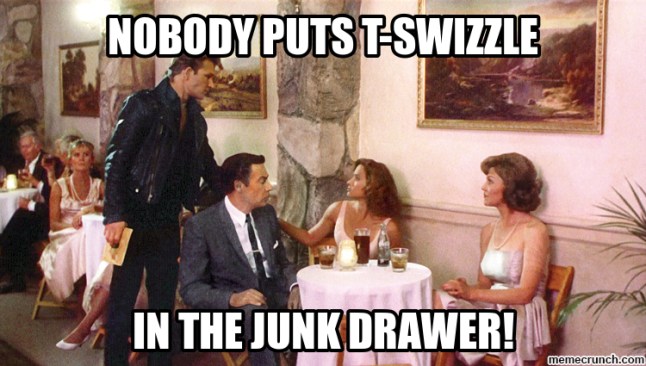
The Junk Drawer: Taylor Swift Can’t Save The Cops edition

Welcome to this edition of the junk drawer. As we have outlined in previous junk drawer posts, this is a random collection of stuff that is important but didn’t fit anywhere else, much like that drawer in the kitchen of most of our homes.

Here’s a look at some screw-ups, stories and updates:

MAYBE JUST BE BETTER AT YOUR JOB? At the risk of creating anarchy with the title of this post, let’s tackle how Taylor Swift ended up in the middle of a controversy surrounding police officers in Alameda County. It turns out that, in addition to not understanding copyright law, the First Amendment and general common sense, at least one officer in this fine hamlet doesn’t understand how YouTube’s service agreement works either:

Last month, Sergeant David Shelby, an Alameda County Sheriff’s Department officer, was caught playing Taylor Swift’s “Blank Space” from his phone as he was being filmed by activists, in a move he said was done “so that you can’t post on YouTube.” The incident was the latest in a bizarre trend in which police officers play copyrighted music while they are being filmed by the public, in hopes of triggering social media antipiracy filters, which would theoretically get the video deleted. 

Aside from not doing what he had hoped it would do (keeping people from filming him and/or allowing YouTube’s “bots” to save him), Shelby actually brought more attention to his actions from both inside and outside of the police department. He is apparently not the only one who has tried this:

In the last few months, cops across the country have been trying this cute little trick for keeping their interactions with the public off social media: Playing pop songs over interactions with the public when they’re being filmed. One Beverly Hills cop played Sublime’s “Santeria” when he realized he was being live-streamed in February and another with the Beatles’ “Yesterday,” and another in Illinois tried it with Blake Shelton’s “Nobody But You” in March.

They think that if the audio captured was smothered by a copyrighted song, posting it to sites like Instagram or YouTube would result in the poster getting smacked with a copyright takedown notice—and the platform would either remove the video, mute the audio, or ban the user altogether. In each of these cases, it didn’t work, and the videos remained online. People have a First Amendment right to film the police.

Shelby tried it, but it didn’t work: the video stayed up on the Anti Police-Terror Project channel, and now has almost 740,000 views.

It’s unclear what any of these officers were doing at the time that made them so worried that they were being filmed, but maybe THAT should have been the bigger concern. If you’re doing something so bad that evidence of it requires you to try to force illegal actions (copyright infringement) on other people to get away with it, that doesn’t say much for you.

On the other hand, I’m waiting for the first time some officer tries this with a Brittney Spears song, so this can start making the rounds again:

Speaking of outrage…

I AM FURIOUS AT… UM…: Journalism has two simple rules when it comes to telling a decent story:

  1. Tell me what happened.
  2. Tell me why I care.

Usually, people being upset with something leads to a pretty good answer to both of those stories. That said, it only really works if you let us in on what you know:

OK, Augusta McDonald might have been following the story, and the outrage, and the lawsuit, but maybe a couple people out there reading this thing (read: Me and Amy at least…) have no damned idea what happened, so how about filling us in? The photo of a basketball team (I think) with blurred faces and three smug looking weasels in red shirts isn’t helping here either.

I get that you don’t always want to give away the whole story in the promo like they do in “The Kentucky Fried Movie” but for Pete’s sake, give us a bit of a hint in either the head, the lead or the photo captions.

Speaking of things that are usually Kentucky-fried…

THE CHICKENS COME HOME TO ROOST FOR THE AP: Fred Vultee, a journalism professor at Wayne State University and eternal copy-editing god, was fond of telling folks that it’s just as easy to drown in 2 inches of water as is to drown in the Pacific Ocean. His point, in the editing realm, was that we should read every piece of copy carefully and fact check everything, regardless of how important we think it is.

I’ve often taken this a step further in explaining to students that it’s rarely the deep-dive, FOIA-driven, scandal-based investigative piece that ends up with problems or that costs journalists their jobs. It’s usually the small stuff that we either overlook, joke about or just make random assumptions on that tend to kill us.

A case in point is this article that shows how the Associated Press did the chicken industry wrong with its use of improper “chicken art” with a story on a corporate poultry merger:

When the AP distributed the story to all of its member news outlets, it also distributed a photo of an egg laying operation, rather than one of a broiler operation such as Sanderson Farms, or Wayne Farms, with which Sanderson Farms will merge.

And that layer operation photo was published on the websites of some of the nation’s major news outlets, such as USA Today, Financial Times, U.S. News and World Report, Boston Globe, and many others. Considering USA Today is part of the Gannett network, which owns over 100 daily newspapers and 1,000 weekly newspapers, its hard to tell how many readers saw this.

But the simple fact is that way too many people did. And my guess would be most of those people don’t understand that broilers and layers are totally different breeds of chicken and the operations are completely different.

Chickens are chickens, in their minds.

(Side Note: We have eight chickens at the ol’ homestead now and all I really know about them is how to build stuff like a coop, a “poultry palace” and a chicken run. Well, that and that it’s a major pain in the keester to try to catch them when Amy says, “Go make sure the chickens are in the coop for the night.”

If you ever want to visualize a humorous moment, imagine the author of your textbook cursing in the darkness while diving headlong after a pile of fleeing poultry, only to grab one by the leg and be beaten about the face with its wings.

You’re welcome…)

The thing that is important to understand here is not that the AP had some sort of fowl up (Sorry, I had to…) but rather that there are ALWAYS people out there who have niche interests reading your stuff and they are ALWAYS going to be upset when you screw up their beloved topic. For an earlier edition of the media writing book, I interviewed Meghan Plummer, who was working at the Experimental Aircraft Association as a publications editor. She told me stories about how she would get angry letters and emails when she’d mistake one kind of tail rudder from another in a piece or incorrectly note the year in which a plane was built or flown.

To some folks, planes are planes, but Plummer understood that these people have a passion for the topic and have come to expect that the material they read from an aviation publication will feed that passion. Keep those kinds of folks in mind when you’re writing about a topic, even if you couldn’t care less about it.

And finally, speaking of things you couldn’t care less about…

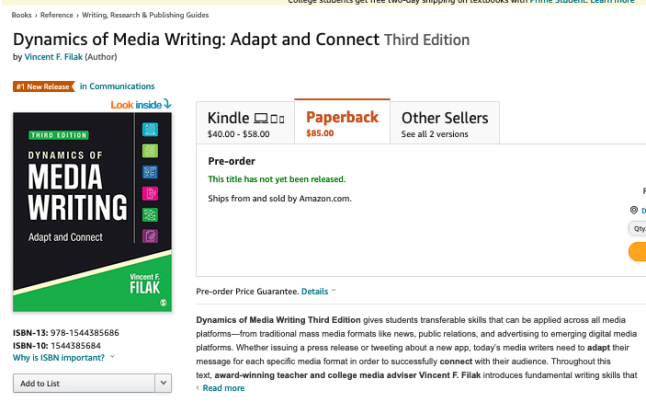
THIRD TIME IS THE CHARM: The Dynamics of Media Writing’s Third Edition has just pressed and is available for purchase at all fine textbook institutions (and I imagine free downloading already on at least three hacker sites). The update covers a lot of the crucial updates in the law, ethics, social media and web writing while doubling down on the basics that that still matter in all fields of writing.

It’s been more than a decade since I went looking for a media-writing text that treated each field of media equitably and honestly, if for no other reason than I was tired of having students in my class say, “I’m going into PR! Why do I need this stuff? The whole book is just news, news, news…” I can still remember the conversation I had with Matt Byrnie of SAGE at an AEJ conference that led to this book:

Matt: “That’s a great book! We don’t have it. You should totally write it.”
Me: “I don’t want to write a book. I want you to have someone write it so I can buy it from you.”
Matt: “You don’t understand. NOBODY has that book. That’s why I need you to do it.”

We scheduled a sit down for noon the next day where I would pitch him a concept. I remember doodling on a piece of paper from the Renaissance Hotel with ideas, rules and core concepts. When I showed it to him, he said, “We might have something here.”

I looked the book up at Amazon when putting this post together and saw this:

Number one new release in communications? Maybe we do have something here… And I’d like to thank all of you who read my stuff for making that happen.

Have a great week.

Vince

(a.k.a. The Doctor of Paper)

Reviewing the “foul-mouthed cheerleader” Supreme Court decision with a legal eagle

About a week or so ago, the Supreme Court ruled 8-1 in the case of Mahanoy v. B.L., supporting the free expression rights of students who were operating outside of the schoolhouse gates and on their own time. We took a look at this decision at the time on the blog, picking through the outcomes of the case, but here’s a brief recap:

Brandy Levy was a cheerleader in 2017, when she dropped several F-bombs on Snapchat after failing to make the varsity squad. Although her social media post was done on a Saturday, at a local convenience store and caused no major school disruption, officials at Mahanoy’s high school penalized her by banning her from cheer activities for a year. When Levy and her parents were unable to get the school to reconsider this situation, they sued over the abridgment of free speech.

As with most major court decisions, a lot of the important content is in the nuances of the decision and what precedents the case can set for future situations. To help untangle what happened and what this case means, legal eagle Daxton “Chip” Stewart was nice enough to grant the blog an interview on this topic. Stewart is a full professor at Texas Christian University, where he teaches courses in media law. He has a Ph.D. in journalism from Mizzou and a JD from the University of Texas School of Law. He has also written “Social Media and the Law” and co-authored “The Law of Public Communication.”

Below is an edited transcript of the interview conducted a few days after the decision came down:

Before the ruling came out, what were you generally expecting the court to say in this case? In other words, did this ruling surprise you or was is something you saw coming?

“I want to say I saw this decision coming… I had a conversation about this a few days before I said, ‘Probably what the court is going do is extend Tinker to off campus speech in certain circumstances and that’s exactly what they did. So in a way I sort of saw that coming but I had a lot of fear and justified fear. Some of this was when the third circuit decision came out last summer, it was a great decision and I was gleeful about it.

“I’m working on a new edition of the social media law book and I thought, ‘This is great.’ We finally have a federal court of appeals saying off campus speech has First Amendment protection from administrator supervision and extra-curricular speech or extra-curricular activities are an extension of curricular activities so if you discipline somebody for doing something regarding extra-curricular activities like suspending them from the football team or the dance team, that’s a violation of the First Amendment. We didn’t have a decision say that clearly at this level before. So I loved that third circuit decision…

“So my fear was the Supreme Court doesn’t take up decisions to say, ‘Good job, Third Circuit! We agree.’ They take up decisions because they think there was some kind of error that needs to be resolved. So I was very worried that they were going to come in and strike down the Third Circuit opinion and basically do what they did in Morse versus Frederick, which is hedge or decide against the students. So going in my fear was the Supreme Court hadn’t ruled in favor of a student in 50 years. It was Tinker and then basically a lot of curbing and limiting Tinker… Case after case after case, it was someone saying, ‘Let’s extend Tinker here!’ and the court saying, ‘Nope.’

“So in that context with 50 years without a good pro-student, free-speech case, I was worried they’d go down that path again. And they didn’t and that surprised me.”


Aside from the ruling itself, did the 8-1 majority decision surprise you at all? It seems like most decisions are coming across as 5-4’s these days, so to have that number of justices on one side of a free-speech case… Was that surprising to you when you saw it?

“A little bit, yeah. I thought at least it would be 7-2 and the two being Alito and Thomas. We knew Thomas wasn’t going to agree. Thomas famously continues to say Tinker was wrongly decided… So my concern was that it was going to be a majority of Alito and Thomas, where they bring along the three Trump appointees to constitute a 5-4 majority…

That the eight could come together and agree that this kind of speech is protected was a very good thing to see. A little bit surprising, but a very good thing.


What’s your general sense of what this ruling says for free expression, particularly as it pertains to high school and maybe even college students? What are some key things people should be aware of when it comes to this ruling, either positive or negative in relation to free expression?

“Two things, really. One is explicit, one is implicit. The explicit is that the Tinker test is going to extend to off campus speech not during school activities. We saw in Morse versus Frederick, the ‘Bong Hits 4 Jesus’ case, that the SC said in that one, ‘Yes, this speech was off campus, it was an Olympic torch relay, but it was a school-sponsored activity, so the Tinker test applies here.’ The court had not gone so far as to say, ‘We’re going to extend it not only to off campus but also off campus, non-school activities.’

“In this case, it was a girl writing on Snapchat at the Cocoa Hut, a convenience store. So the Supreme Court says, ‘Yes, the First Amendment even applies there… Students still have free speech, First Amendment protections not just inside the school house gates but also off campus in their free time, in their non-school time, even if it might have on-campus implications.’ So the First Amendment extends out into the real world, 24-7 when it comes to schools disciplining student speech. That’s a great outcome.

“A better outcome might have been that schools have no authority to discipline students over external speech and that was kind of the coalition that Breyer built for his balancing test was to say, ‘OK, school administrators do have some rights to sanction off-campus, non-school speech if it’s going to have an influence on campus, like starting on campus disruption.’ They mention harassment and dangerous violence. All things considered, it’s a pretty good outcome.

“So that’s your explicit one: The Supreme Court saying, ‘We’re going to extend Tinker, off-campus, 24/7. School administrators, if they want to discipline students for what happens on non-school time, they have to pass the Tinker substantial disruption test.’ That’s a good outcome.

“As for the implicit one, it goes back to the Third Circuit decision, which says extra-curricular activities have value and can create an avenue for appeal for students who have been disciplines by those extra curricular activities.

“So, in this case, we’re talking about a student on the cheer squad or who didn’t make the cheer squad or whatever it was being punished. In the past we did not have a good decision in which the court said, ‘That’s protected by the First Amendment.’ You can’t just kick someone out of school for speech but you can take them off the dance team or the football squad because that’s not school.

“So the implicit one here is that even the cheer squad, having been suspended from the cheer squad… You have a right to sue for that. It’s valuable There’s a First Amendment harm. That’s where this is the only way this decision works is to recognize that extracurricular activities at schools are valuable and that you and sue if you lose the privilege to be on a team due to speech. That’s really, really valuable.”


Do you think this will at all deter schools from trying to clamp down on unpopular expression? Or will it continue to be business as usual for administrators and educators who want to suppress free speech?

“I do worry about that. You have what the law says, what the Supreme Court says and then you have what actually happens in practice. The cheer squad is going to have a policy,  A football coach is going to have those rules and if you don’t like those rules, you’re going to have to be willing to go to court and sue over those rules. They’re still the boss and they don’t care about judges and courts. There is very little for them to lose due to qualified immunity where they say, ‘I thought I was doing the right thing.’ So, the law for public officials have that right.

“Practically, you’re still going to have basically speech codes and behavior codes that clearly restrict free speech rights. There are going to be dress codes, behavior codes and social media codes and people are going to be disciplined for them. It’s just going to be easier for them to sue and win now because it’s clear in every court in the country now. That’s great, but you’re still going to have to be willing to take on the expense of suing your school and hoping that four or five years later, you get a good decision.”

Usually when a court makes a free speech or free press ruling on a high school level, some college administrators think, “Hey, we can do that too!” and vice versa. Do you see this decision having any impact on colleges?

“What I expect and what I hope is that we already have a sliding scale where little kids have the least rights, college kids have the most rights. I sort of expect that whatever restrictions a HS can place on kids, it’s going to be hard for a college to do that.

“The thing in this case is that it uses Loco Parentis, which is asking how much room do we give the administrators in high school to act as parents to oversee the kids. I loved the line that said, ‘We highly doubt that BL’s parents gave the school the right to act in Loco Parentis at the Cocoa Hut.’ Private time, the school isn’t acting as a parent when she’s off campus. Well, once you’re adult, once you’re in college, you don’t have loco parentis because you’re adult. I don’t think this case will work in a college situation because you won’t have the loco parentis issue.”


If there were any big take away you think you would want people to have that we hadn’t discussed to this point, what would it be? What’s crucial that goes beyond the basics?

“When Breyer says why this is important, he uses that “Schools are the nurseries of democracy line.’ Breyer says that we need to understand that public schools are where students learn how to be good democratic citizens, good participants in a democracy. We need these places to educate people about the value of free speech. Free speech is necessary in these environments to build good citizens of our democracy and that includes speech we don’t like in some cases.

“This is something that a lot of free speech organizations and advocates like SPLC and FIRE have been pushing for years: If we have our high schools be places where administrators can act like petty tyrants when it comes to free speech, then the lesson students get is that it’s OK to be a tyrant over speech and they carry that into their college years and their adult lives. What they learn is that it’s OK to sanction speech you disagree with or don’t like…

“This is what petty tyrants do. They silence speech they don’t like. When it starts with principals and teachers telling students, “We’ve got the power and we can silence speech we don’t like,” students get that message and they live that out. That’s a real problem… We should be teaching our students to tolerate speech they disagree with, not punishing them for saying things we disagree with. And we should be leading by example.”

Gimme an F! Gimme a U! Supreme Court rules in favor of foul-mouthed cheerleader, free expression for students


The Supreme Court ruled Wednesday that schools cannot regulate students’ off-campus speech in the same manner as if the speech happened on campus, giving free-expression advocates an important precedent in today’s social media age. In an 8-1 decision on the case of Mahanoy Area School District v. B.L., the Court affirmed a lower court’s ruling that the school infringed upon the First Amendment rights of Brandy Levy when it attempted to suspend her from the cheer-leading squad.

We talked about this case at length when the Court heard arguments back in April, but the short version is this: In 2017, Levy didn’t make the varsity cheer squad and took to Snapchat to F-bomb the process and her school. The snap was done outside of school and on her own time, deleted shortly after it was posted and caused no major problems at the school. Still, the school decided to suspend her from team activities for a year. When an agreement couldn’t be reached to undo the punishment, she and her parents sued the school.

Writing for the majority, Justice Stephen Breyer made three key points that should help free-expression advocates in the future:

  1. While the school has an interest in the activities of the students while they are off campus, it is the parent, not the administrator, who makes the rules for the kids (and dispenses the punishments) when the kids aren’t in school. Thus, if the parents are cool with a kid spending the weekend dropping F-bombs on Snapchat, the school will just have to cope.
  2. If the school had won this case, it would essentially have the right to monitor student speech and punish students for it on a 24/7 schedule. That could give students ZERO opportunities to free expression that was not school approved for the entirety of their academic careers. If Tinker established that students don’t shed their Constitutional rights by entering the schoolhouse gates, students sure as heck shouldn’t shed them by the mere dint of being of school age.
  3. Schools have a vested interest in allowing free speech of the students, so that they can learn how to contribute to the marketplace of ideas. In other words, if you don’t give them the chance to learn how to do this, they’ll never do it well.

Breyer also noted that there were already ruling on the books that would deal with concerns the school had regarding issues like fighting words, true threats and bullying, also saying this didn’t rise to that level.

Despite the pro-student ruling, some journalists noted that this ruling didn’t provide a decisive blow for free expression:

B.L. offered the justices an opportunity to announce a single unifying rule that would govern all free speech cases involving off-campus speech by public school students. But the Court dodged that opportunity.

The reason is that it is quite difficult to come up with such a unifying rule. Though Breyer’s opinion holds that Levy’s school went too far when it punished her, he also acknowledges that there may be examples of off-campus speech that should be punished by public schools — including cases of “serious or severe bullying or harassment targeting particular individuals” or “threats aimed at teachers or other students.”

I can see the point there, but let’s consider a few key points:

  1. Free speech won on this one, despite the “Suicide Squad” style case we were dealing with here. Nobody likes a mouthy teen, so the fact that people the age of Levy’s parents and grandparents stood up for her right to F-bomb the universe says something important about the rule of law and the protections of the First Amendment.
  2. It was an 8-1 ruling. Justice Clarence Thomas wrote a dissent that I’m still not clear on, but he stood alone. (I’m interviewing a legal expert for next week’s post, so I’ll try to get an answer on that.) I was thinking if we won at all on this one, it would be a 5-4. Getting eight of nine of these people to agree on anything from free speech to which D.C. restaurant has the best egg rolls is a miracle of modern man.
  3. It establishes some ground to prevent school districts from trying to write rules that allow them to regulate social media and off-campus speech. Sure, they can give it a shot now, but this ruling gives free-speech advocates a pretty heavy bat to swing back.

To close up, here are a few tidbits that I loved:

Give Me Freedom AND Give Me Cocoa Hut: It was great watching the nine most revered legal minds in our country today issue an opinion with multiple F-bombs in it. It was also great having them dissect the use, tenets and purpose of Snapchat in a decision as well. However, I loved this section most of all, in which they explained the school’s lack of loco parentis on behalf of B.L. when she made the post:

“B. L. spoke under circumstances where the school did not stand in loco parentis. And there is no reason to believe B. L.’s parents had delegated to school officials their own control of B. L.’s behavior at the Cocoa Hut.”

I want a “Loco Parentis at the Cocoa Hut” T-shirt…

Drama? We’re talking about DRAMA? I’m sure legal scholars will have a serious set of debates regarding the lack of a bright line established in the following paragraph, regarding the necessary level of academic disruption to allow for the punishment of off-campus speech:

Third, the school presented some evidence that expresses(at least indirectly) a concern for team morale. One of the coaches testified that the school decided to suspend B. L., not because of any specific negative impact upon a particular member of the school community, but “based on the fact that there was negativity put out there that could impact students in the school.” App. 81. There is little else, however, that suggests any serious decline in team morale—to the point where it could create a substantial interference in, or disruption of, the school’s efforts to maintain team cohesion. As we have previously said, simple “undifferentiated fear or apprehension . . . is not enough to overcome the right to freedom of expression.” Tinker, 393 U. S., at 508.

Me? I’m the parent of a high school cheerleader and I can tell you unequivocally that EVERYTHING on the face of the PLANET could be covered by the school’s claim regarding diminution of morale vis a vis the cheer squad.

The drive home from practice every night is a play-by-play of who is ignoring whom on Snapchat(“Leaving people unread is so much drama,” I have been told…) or who is saying who isn’t putting in enough effort or who is skipping practice to be with her boyfriend or who is calling whom a “hoe” today because… well… they’re just a FRESHMAN and they sent a Snap to someone else’s boyfriend and shouldn’t have…

The school might have been better off just saying, “Look, if they’re breathing and on the cheer squad, we have jurisdiction over them” rather than trying to claim a cheer squad could be drama free.

Don’t Hate the Snap, Hate the Quadratic Equation: What leads to a “substantial disruption” of school activities is a key trigger to allow for schools to suppress student speech. The school’s claim of such disruption was discussed at this point in the ruling:

[T]he school argues that it was trying to prevent disruption, if not within the classroom, then within the bounds of a school-sponsored extracurricular activity. But we can find no evidence in the record of the sort of “substantial disruption” of a school activity or a threatened harm to the rights of others that might justify the school’s action. Tinker, 393 U. S., at 514. Rather, the record shows that discussion of the matter took, at most, 5 to 10 minutes of an Algebra class “for just a couple of days”

I remember algebra courses quite well and I can guarantee that I would have gladly discussed ANYTHING to kill off 5-10 minutes of that class period. I somehow doubt we can lay the blame on Levy for this here.


Cardi B’s “Invasion of Privacy” prequel gets her sued on allegations of invasion of privacy (and two things you can learn from this debacle)

Trying to find fresh and relevant cases involving “misappropriation” or “false light” claims of invasion of privacy can be difficult.

Thank God for Cardi B.

A suit that is headed to trial later this year will determine if the rapper engaged in both of these acts when she included a distinctive tattoo on one of her album covers:

A federal judge in Santa Ana, California, has refused to dismiss a lawsuit alleging that a man’s distinctive back tattoo was used without his permission in a sexual picture on an album cover by rapper Cardi B.

U.S. District Judge Cormac Carney of the Central District of California refused to dismiss the suit by plaintiff Kevin Michael Brophy Jr., who sports a full back tattoo that shows a tiger battling a snake.

<SNIP>

Brophy said his likeness was misappropriated in the photoshopped image in “a misleading, offensive, humiliating and provocatively sexual way.” He alleges misappropriation of likeness or identity, violation of the right to publicity under California law, and false light invasion of privacy.

Based on the decency standards my editors have for me here, I can’t include a copy of the album cover (I tried adding it to a Facebook post on this and I got flagged for violating community standards…). I also can’t mention the title of the album cover or even EXPLAIN what it is that is happening ON the album cover here.

Just Google “Cardi B,” “album cover” and “Gangsta” and you’ll like find it.

Essentially, let’s just say that Cardi B is drinking a beer while the male model upon whom Brophy’s back tattoo has been superimposed is doing something where the tattoo is fully visible and the man’s face is not.

The concept of misappropriation is the use of someone’s image without their approval. A simple example of this would be if one of my students was running for student body president and thought my endorsement would be valuable to him. Thus, he grabbed a photo of me teaching and included it on his posters without asking for my endorsement.

False light claims tend to put two true things close enough together that people will see them as related, even if they’re not. In cases like these, the court is looking at the “gist” of the material to see if a falsehood is implied. For example, in Solano v. Playgirl, Inc., actor Jose Solano won a false-light suit after the magazine published his photo along with headlines implying he posed nude in the magazine, which he did not.

Some states, like Colorado, don’t recognize these kinds of legal nuances, rolling them instead into either general defamation or copyright claims, depending on what is at the core of the case. In other cases, the claims are without merit and get tossed quickly, leaving few true battles over who has the right to control a personal image.

In this case, it’s a daily double, in that the “misappropriation” claim of Brophy’s image (it’s a heck of a tattoo…) and the “false light” claim (that isn’t Brophy on the cover, but anyone who knows him and that tattoo would be hard-pressed to determine that on first glance) seem to fit the definitions perfectly.

The rapper’s legal team asked a federal judge to toss the suit back in December, arguing the album art was covered under a fair-use claim, in that the reworking of the tattoo into the piece made the work transformative. The court disagreed and the case will move forward to trial in the near future.

To say Cardi B is displeased with these allegations would be a slight understatement, based on her deposition:

“I’m really upset because I really have to be with my kid. All because of some bulls**t trying to get money and then $5,000,000. Are you f***ing kidding me? That mixtape didn’t even make, not even a million dollars.” Cardi added, “I got real lawsuits with real sh**, and I got to deal with this bulls**t. This is four hours long taking away from my time, my job, my motherhood.”

Ah, yes… If I close my eyes, I can almost hear my own mother’s voice uttering those exact words…

In any case, regardless of how this turns out, here are two key things you can learn from just watching this train wreck take place:

Permission for use solves almost everything: In reading through the coverage of this case and the depositions, it turns out the guy who designed the cover just Googled “back tattoo” and grabbed this one at random. (It also turns out he was paid $50 to build the cover, which could be the cautionary tale of “You get what you pay for,” I suppose.)

I would bet every dollar in my pocket right now against a pile of nothing that when this guy built the cover, he NEVER thought anyone would complain about their image being used in this fashion. The… let’s call it “up close with Cardi B”… nature of this image would likely be bragging rights for almost every human male on the planet, I would imagine.

In this case, he appears to have found the one guy with the one tat who didn’t feel this way. That’s why it’s important to ask people for permission to use their stuff. I could assume that any journalism outlet would LOVE to have its stories or photos or illustrations included in a textbook to illustrate how the true greats of the field operate. However, my publisher believes in covering its keester, so we have permission forms that get signed and stored.

Maybe Brophy is making a power play and could care less how he would be portrayed on an album cover, so long as he got paid. Maybe Brophy is truly a man who views this representation of him as “misleading, offensive, humiliating and provocatively sexual,” and is truly upset by this. Who knows? The key is that it’s his right to have his body portrayed as he sees fit, which is why this is going to court.

Permission would have made this much easier to figure out, so make sure you get it.

“But it’s JUST for X” is never an excuse: Somewhere in the sprawling field of asterisks that populate Cardi B’s quote above is the notion that the album only made $1 million, so to have to pay out $5 million is ridiculous. The problem here is that she’s not being sued for a portion of revenue. She’s being sued to penalize her for her actions.

The law can be more or less forgiving in certain situations, but it is the law. Therefore, deciding to steal something and then say, “but it was JUST…” isn’t necessarily going to keep you out of trouble. I can’t remember how many times I’ve critiqued a high school or college paper that basically stole an image and published it. (Writing “Photo courtesy of Google” didn’t make it any better.) When I pointed out how much trouble this could create, I got the “Well, it’s JUST for a HIGH SCHOOL newspaper. I’m sure people have better things to do that try to sue us.”

Maybe. But a) Is that a risk you want to take? and b) Is that the lesson you want to teach your students? (“Steal small, kids, and you’ll never have to take responsibility for it!”)

I’ve seen this happen both ways, with bigger news outlets stealing from student newspapers (One told my photographer, “You’re just a student publication. You should be happy we’re using your work…” Um… No…) and student papers stealing from the big dogs. Both cases are wrong and in both cases, you can get into trouble for doing it.

I’m sure this guy who got paid $50 to design this thing for one of the myriad women who would likely crash and burn on “Love and Hip Hop” was thinking, “I’m just doing this thing for beer money. No way anyone buys this stupid thing.” However, he hit big, so now everyone is paying the price.

It’s like speeding: Sure, you might get away with five over, but when the cop in Rosendale pulls you over for doing 31 in a 30, the “But I was just speeding a little!” excuse is not going to fly.


A rock star with a heroin problem, the “Bong Hits 4 Jesus” guy and a foul-mouthed cheerleader: The Suicide Squad of free speech court cases

A frequent joke told among lawyers is that the best case is the one with a carload of nuns as your client and a busload of priests as your witnesses. In most cases, however, it seems more like this scene from “The Wire.”


When it comes to First Amendment law, it would be great if we had more cases in which polite, articulate young people like Mary Beth Tinker who quietly wore a black armband to school to protest the Vietnam War. Her choice led to hate mail and threats, but also a ground-breaking Supreme Court case regarding student free-speech rights. And, looking back on it now, people can understand better her underlying concerns about the war as well as her relatively mild statement against it.

Tinker v. Des Moines (1969) established that students do not shed their Constitutional rights at the schoolhouse gate. It also provided protections for students who wish to express themselves against intrusion from school overreach.

Unfortunately, an upcoming case in which a high school student did her best “Scarface” dialogue on Snapchat could be the case that undoes a lot of those protections in a digital age:

In 2017, ninth-grader Brandi Levy said on Snapchat some version of what stressed-out students have been saying on the back of the school bus since the invention of buses: “Fuck school fuck softball fuck cheer fuck everything.”

The post was shared on a Saturday afternoon during a trip to the local convenience store, disappeared from Snapchat by Sunday afternoon, and caused no disturbance at school whatsoever—except to irritate the cheerleading coach, who banned Levy from the squad for a year.

She filed suit, and in June 2020, a federal appeals court ruled that school authorities violated the First Amendment by disciplining her for the off-campus speech. Now, the Mahanoy district is asking the Supreme Court to overturn that ruling.

The case doesn’t matter in regard to that single incident anymore. Levy is now a college student, the cheer team has had a complete turnover in terms of membership and nothing the court could do would change what happened in regard to the punishment levied at the time.

However, if the court decides to overturn that appeals court’s ruling, it could mean that schools can now actively monitor social media and punish students for ANYTHING that appears to be “objectionable.” If that doesn’t scare you, you probably had one of the six “really cool” high school principals I was always told existed somewhere.

Me? I dealt with a lot of nuns and balding guys who wore short-sleeve shirts with brown ties. This is terrifying…

This leads to the point of the post: It seems like we NEVER get the perfect Supreme Court case that perfectly showcases speech that deserves to be protected for the betterment of society. It’s never the student newspaper that was censored for reporting that the principal had stolen money or the kid with the bullhorn outside the school telling people not to eat cafeteria food because the workers were being abused.

It’s always something with an F-bomb, a nude pick or a drug reference that we get to stand behind and say, “Hey, look… You CAN’T censor this because… well… geez…”

We don’t get Superman, Batman, Aquaman or Wonder Woman as our defenders of freedom.

We get The Suicide Squad:

In other words, we get a “mental defective dressed as a court jester,” a “guy who wears a toilet seat on his head” and a “shark with hands,” to quote the red-band trailer I’m not allowed to show you here…

If you think I’m kidding about this, consider the following court cases on important topics:

The landmark case for online speech and defamation? Rocker/Actress/Woman I’d be most scared of meeting in a dark alley Courtney Love won and survived an appeal of her “twibel” case (Twitter plus libel) in 2014. Love, whose outlandish behavior and heroin abuse have long been the subject of media coverage, stated that an attorney had been “bought off” instead of helping Love recoup parts of her late husband’s estate.

A crucial Supreme Court case regarding speech at school sponsored events? Morse v. Frederick, also known as the “Bong Hits 4 Jesus” case. A student held up a sign at an event proclaiming the cryptic message. When the sign was taken away by school administrators, the student later sued claiming his First-Amendment rights had been violated. The SCOTUS ruled that schools have the right to remove pro-drug messages, even though students have some free speech rights at school.

The case that dealt directly with a reporter’s right to maintain confidential sources? Branzburg v. Hayes, which dealt with reporters being forced to disclose the names of sources who were manufacturing hashish.

And, of course, the case involving satire and hyperbole in regard to public figures comes from the apparent patron saint of this blog, pornographer Larry Flynt.

Now, the question of whether students can get smacked around for writing things on their own time on their own social media that school officials dislike comes down to one foul-mouthed 14-year-old cheerleader.

The problem with all of these cases is that it becomes so much easier to suppress speech that is unpopular, vulgar or otherwise disagreeable.

If the reporters in Branzburg were protecting whistleblowers who had uncovered some sort of dark plot by a foreign government to go all “Red Dawn” on the U.S., it would likely feel better to the courts to support their interests in remaining anonymous.

If the school was trying to suppress speech about the superintendent stealing money from the district to buy weed, maybe a “No Bong Hits 4 Superintendent Smith” sign would have garnered a different outcome.

If Sally Fields had tweeted about potential legal malfeasance (while wearing her “Flying Nun” costume), it might not have felt like the entire future of online free speech hinged on whether the defendant was going to lose her mind on the stand and start throwing things at the jury.

If the cheerleader had done her rant without the f-bomb, maybe the courts would be more inclined to side with her at every level.

However, we don’t get to choose the cases that decide our fate, which is why it’s important to make sure that we stand up for all speech because what one person thinks is a felony charge, others might consider a misdemeanor at best. In the mean time, keep an eye on this one, as it’s got a lot more at stake than a lot of people think.

It’s all fun and games until Dominion Voting Systems sues you for a couple billion dollars

During the 2020 presidential election, multiple people made claims that the voting systems had been rigged to favor Democrat candidate Joe Biden. Several of then-President Donald Trump’s allies and associates took to various media platforms to repeat these allegations, arguing that the voting systems had been compromised and that any outcome which did not place Trump back in the White House was a result of fraud.

Dominion Voting Systems, which produces many of the electronic voting machines used in the election, apparently isn’t too thrilled about this, as the folks there have filed several lawsuits regarding these claims. It’s gotten so bad that some media outlets are keeping track of who is being sued, for how much and for what reason, like ESPN tracking the movement of NFL free agents.

The most recent suit is one that is most likely of interest to the folks reading the blog, as Dominion filed a $1.6 billion suit Friday against Fox News, alleging the company knew it was allowing lies about the election to proliferate:

In the lawsuit, Dominion argued that Fox and several of its on-air personalities elevated baseless claims about the voting company rigging the 2020 election and allowed falsehoods by their guests to go unchecked, including a wild claim that the company’s machines were manufactured in “Venezuela to rig elections for the dictator Hugo Chávez” and that Dominion’s algorithm manipulated votes so that then-President Trump would lose.

“Fox engaged in this knowing and reckless propagation of these enormous falsehoods in order to profit off these lies,” reads the lawsuit. “Fox wanted to continue to protect its broadcast ratings, catering to an audience deeply loyal to President Trump.”

The lawsuit argues that there are actual damages to the company’s brand, but also to the workers who are just trying to make a living. The suit notes that Fox’s conduct not only will cost the company more than $600 million in the next eight years, but also that front-line workers have been threatened.

Fox has noted that it will defend itself, having already filed several motions to dismiss and that the company “is proud of our 2020 election coverage, which stands in the highest tradition of American journalism.”

Here are a few things to take away from this and several other lawsuits filed in regard to the voting systems:

A FREE PRESS IS NOT A CONSEQUENCE-FREE PRESS: A lot of folks misinterpret the First Amendment to mean you are protected against all sorts of things when you publish content. The truth is that all the amendment guarantees is that the government shall not prevent you from publishing material. That’s basically it.

It doesn’t mean that other people can’t stop you, like the owner of a website where you post content, the publisher of a newspaper or a producer at a broadcast station. It also doesn’t mean you can get away with whatever you want without paying the price.

When you say something that is false and harmful, you can be in a lot of trouble, which is why professors push so hard on students to make ABSOLUTELY SURE on every fact in a story. It’s also why editors pick and pick and pick at stories with reporters, as to avoid any potential landmines.

If I get up on Fox News and tell the world that I have information supporting the notion that the chancellor of my university is running a cocaine ring out of the student union in exchange for getting away with a murder he committed in 1987, I’m going to be in a HECK of a lot of trouble because it’s not true and it’s going to harm him.

It also leads to the second point…

UNLIKELY, UNREAL AND COMPLETELY UNBELIEVABLE ARE ALL DIFFERENT THINGS: One of the dumber defenses in a Dominion suit is that of former Trump lawyer Sidney Powell. The company is suing her for $1.3 billion, arguing she knowingly spread a baseless claim that Dominion and another voting system company were working with the late Hugo Chavez of Venezuela to rig the election.

Powell has argued in motions to dismiss that her claims were so outlandish that nobody in their right mind would believe them:

It was just conjecture. No reasonable person would conclude those allegations were true statements of fact. Besides, in heated political arguments, people tend to exaggerate. You should dismiss the lawsuit or at least move it to my home state.

That’s essentially the defense offered by Sidney Powell’s lawyers to the $1.3 billion defamation lawsuit brought by Denver-based voting Dominion Voting Systems, Inc. Dominion provides voting equipment to more than 1,300 jurisdictions in 28 states including Colorado.

We’ve talked about this kind of claim earlier this year when porn mogul Larry Flynt died. The “no reasonable person” defense was at the core of his Supreme Court appeal, when the Rev. Jerry Falwell sued Flynt for publishing a spoof advertisement involving him. Flynt won the appeal with a unanimous decision, but before Powell pops open the champagne, I’d consider these issues:

  • Flynt was publishing a porn mag, known for all sorts of really outlandish stuff, including a photo of a woman being stuffed into a meat grinder. Powell was on nightly news outlets and other media platforms purporting to deliver truthful information gathered from inside sources.
  • Flynt’s ad claimed that the highly religious Falwell lost his virginity by having sex with his mother and a goat in an outhouse, which is almost the textbook definition of outlandish. Powell was claiming election fraud, something other countries had experienced and something that people within the government were also stating as fact.
  • Flynt was a strip-club owner who published pictures of naked people in magazines that had been banned in multiple cities. Powell had been a counselor to the president of the United States.

When it comes to the idea of hyperbole and satire, or otherwise outlandish things, you have a pretty high bar to clear if you want to be on safe side of that argument. Had Flynt claimed that Falwell stole money from his congregation, he would have likely been on much shakier ground, given that other high-profile preachers had been accused or convicted of such things. The same thing could be said had he claimed Falwell had slept with prostitutes or committed adultery, given the climate of the time. However, nobody reading the Campari spoof thought, “Wow! Reverend Jerry is a really kinky guy! Guess you learn something new every day…”

Powell’s defense in this case is that nobody could have believed a legal expert who worked with the president in regard to voting irregularities when she said the company responsible for voting reliability failed in its task. I’m really interested to see how that plays out, but more out of morbid curiosity to see if the judge can keep a straight face throughout the trial, not because it’ll set a new precedent.

THE MUDDLING OF OPINION AND FACT IS ALWAYS A CONCERN: When I teach basic media writing to students, one of the hardest things for them to figure out is what is an opinion and what is a fact. It often comes down to me scrawling “SAYS WHO?” on their paper 183 times before they understand what they can say and what they shouldn’t say. Occasionally, we would have the discussion of “You are wearing a black shirt. That is a fact. You are wearing a NICE black shirt. That is my opinion.”

Cable news organizations have long muddied the waters of what is opinion and what is fact, almost to the point where people either don’t know the difference or don’t care as long as it matches up with what they believe. I often wonder if a lot of high-profile people end up buying their own BS to the point that they themselves think, “If I believe it, it must be true.”

Journalism pushes harder on people to verify information, clarify where the information originated and remain rigorous in reporting only what we can prove. At least, that’s the goal we have in mind when it comes to separating opinion from fact.

To help us clarify the distinctions a bit better, the U.S. Court of Appeals offered a four-step examination as part of its ruling in Ollman v. Evans (1984) to help people see if a statement falls into the realm of fact or opinion:

Can the statement be proved true or false? Courts have held that factual statements can be proved true or false. A statement like “The New York Yankees have won 27 World Series championships” can be proved true or false by examining their records in the annals of baseball. The truth or falsity of a statement like “The New York Yankees are the best baseball team ever” cannot be determined, because it lacks several key elements for us to examine. In a defamation case, the plaintiff must prove that the material is false, and this can be the case only if the material of a factual, as opposed to an opinion-based, nature.

What is the common or ordinary meaning of the words? People often use euphemistic language in their daily discourse. If you referred to a sloppy person as a pig, that person might be upset, but they can’t win a libel suit by demonstrating that they are not “an omnivorous domesticated hoofed mammal with sparse bristly hair and a flat snout for rooting in the soil, kept for its meat.” The common meaning that the person has poor personal hygiene or fails to keep their home neat and clean is clearly the way in which most people would interpret that remark.

What is the journalistic context of the remark? Who is saying something and the way in which they are saying it matter greatly in determining if something is a fact or not. For example, if you’re telling a joke involving two men walking into a bar, people are clearly expecting something different than if you are testifying in front of Congress. Content published on the news pages of a legacy media outlet is contextually different from a series of blog posts on a goofball-based website that would make the staff at the National Enquirer roll their eyes. The statements made on air during a newscast are contextually different from those made on a “morning zoo” radio show.

What is the social context of the remark? Where we tend to see opinions and where we tend to see facts often help define which are which. For example, a lecture on the biology related to procreation is expected to be based in facts, while two groups of protesters confronting each other outside an abortion clinic will be a more heated and opinionated exchange.


SLAPPing around a grocery clerk: A prominent Georgia family decided to sue a service-industry worker for saying accurate things about them on social media

If there’s one thing I hate, it’s a bully.

Saying that, however, could have some pretty costly consequences if the Cagle family of Pickens County, Georgia has its way.

The Cagles have filed a suit against Rayven Goolsby, a grocery clerk, for criticizing them on social media for their presence at the Jan. 6 Capitol insurrection and other statements they made on Facebook about various political and social concerns.

Goolsby’s remarks focused on Kathryn and Thelma Cagle for their alleged “central roles” in organizing busloads of attendees through the “Women for America First” tour; they also touched on William Cagle, husband of Thelma and father to Kathryn, calling him a homophobic “loser.”

Goolsby’s remarks, made in various community Facebook groups, were in reference to William Cagle musing on Facebook when the county was mulling separate bathrooms for transgender people that he did “not appreciate his tax dollars being spent on supporting indecency and a couple of FREAKS that can’t make up their mind where to take a leak.”

(Goolsby’s lawyer Andrew) Fleischman said the defamation suit against Goolsby is a way of making it expensive to criticize the Cagles — “even if the criticism is true.”

“We shouldn’t be afraid that criticizing an important person in our community could cost us thousands of dollars,” Fleischman told The Washington Post. He argued that Goolsby has truth and public interest on her side.

One of the primary things we emphasize in journalism is that if you present information that is factually accurate, you are safe from harm when it comes to libel suits and other claims of defamation. What we really mean is that you’re not going to lose a suit if you write that your governor stole $6 million from the state to build a replica of Graceland in his backyard, if you can prove that this actually happened.

That said, getting sued itself can be a painful process that will costs you time and money, while subjecting you to a great deal of anxiety and aggravation. The only real saving grace of being sued as a staff reporter is that you are working for an organization that has lawyers and managers who will take on the brunt of the costs and work with you.

As an individual operating on a social media platform, you take on the role of “publisher” without having all those helping hands and financial backstops to make life a little less terrible. That said, what we have here is pretty clearly a case of a strategic lawsuit against public participation, or a SLAPP case, as anti-slapp.org explains:

These damaging suits chill free speech and healthy debate by targeting those who communicate with their government or speak out on issues of public interest.

SLAPPs are used to silence and harass critics by forcing them to spend money to defend these baseless suits. SLAPP filers don’t go to court to seek justice. Rather, SLAPPS are intended to intimidate those who disagree with them or their activities by draining the target’s financial resources.

SLAPPs are effective because even a meritless lawsuit can take years and many thousands of dollars to defend. To end or prevent a SLAPP, those who speak out on issues of public interest frequently agree to muzzle themselves, apologize, or “correct” statements.

We’ve talked about SLAPPs before on the blog, including the one that comedian John Oliver faced involving a coal magnate and a giant talking squirrel. To prevent this kind of thing, 30 states and Washington, D.C. have anti-SLAPP laws, which can force plaintiffs to prove they’re not using the courts as a cudgel to shut people up.

According to anti-SLAPP.org, Georgia actually has a pretty good anti-SLAPP law on its books, which states that if a person is found to have engaged in a SLAPP suit, the case will be dismissed and that person is on the hook for legal fees and costs incurred by the person they “SLAPPed.”

In other words, if you have a great deal of money and plan to use it to sue someone into silence, it might end up costing you some additional cash in a way you hadn’t planned on.