I Guess I’ll Never Run Out of Current Examples of Mass Shootings (A Throwback Post)

I had another Throwback Thursday post on the launch pad, ready to go, when news about Apalachee High School in Georgia broke:

Four people were killed by gunfire at a high school in northern Georgia on Wednesday, the state’s bureau of investigation said, sending schools across the region into lockdown just over a month after the end of summer vacation.

President Biden called the shooting — the deadliest episode of school violence in Georgia history — “another horrific reminder of how gun violence continues to tear our communities apart.”

I remember once thinking about how certain events were touchstones for certain generations. There were things like the moon landing, the Kennedy assassination, the Miracle on Ice and more. I remember thinking the Columbine shooting would be one of those eternal events, as nothing like it could ever really happen again at that level.

Shows what I know…

As was the case when I was writing the original post below, I’m in the middle of two revisions to two textbooks and I’m constantly looking for fresh examples of things like a social media influencer running afoul of the FTC, a famous person doing something stupid and public relations efforts that were massively successful, with varying levels of results. That said, I’m never at a loss for something having to do with either defamation or a mass shooting.

The saddest thing is that I’ve actually already DONE one of these shooting posts on a Throwback Thursday. That was when 15-year-old Ethan Crumbley used a handgun to kill four and wound seven others at Michigan’s Oxford High School.

I can’t remember if I wove the Crumbley example into a textbook, as the timing might not have fit my deadlines, but I know that whatever emerges in Georgia will likely make the cut for at least one of these upcoming texts.

I am devastated and saddened beyond all belief, but unfortunately not surprised.

As was the case in 2017 when I originally wrote this:


The horrifying revisions of my textbooks: Chapter by chapter, shooting by shooting

The first draft of what would become the “Dynamics of News Reporting and Writing” featured a sample chapter written in 2008, discussing at length the Virginia Tech shooting. I was pitching a reporting book to another publisher when the rep for that company asked for two chapters that could help her sell the book to her acquisitions committee.

Kelly Furnas, then the adviser at the student newspaper at VT, had done a session at a student media conference about his newsroom’s efforts in the wake of the attack. I knew Kelly through friends and helped book him for that session. I also was able to talk to him after the session for this chapter, assuming that the magnitude of this event would never be equaled.

It turned out I was wrong about that, much to my continuing dismay.

The arguments of when is the right time to discuss broader issues are beginning to emerge in the wake of Monday’s attack in Las Vegas. So are the calls for all sorts of regulations, restrictions, restructuring and more. It is hard to see the carnage wrought upon the citizens of this country and remain dispassionate or above the fray when it comes to the continually evolving topic of attacks like this one.

As a reporter and then an editor and then an adviser, I always believed in the simplest of ideas when it came to covering something like this:

  • Show, don’t tell.
  • Provide facts and let them speak for themselves.
  • Don’t try to oversell it.
  • Just let the readers know what happened.

This blog isn’t a podium or a pulpit, nor will I use it to advance whatever agenda or whatever “side” some displeased readers would disparagingly note I must be on as a professor, a journalist or whatever other label was convenient.

That said, it struck me tonight as I thought about the morning post that the two books featured here, “Dynamics of Media Writing” and “Dynamics of News Reporting and Writing,” catalog the expansive nature of violent outbursts, here and abroad. Even more, they do so in a way that shows me something exceedingly painful: My continual endeavors to update these volumes in a meaningful way as they relate to these horrific events is an ongoing, losing effort.

After a few years of discussions, the book in which the Virginia Tech shooting story was included did not come to fruition. The proposal was scuttled when the publisher decided to “go another way,” corporate-speak for “we didn’t really think this was worth the time.”

About three years after that happened, I met a rep from SAGE while at a journalism convention. I was looking for a book to use in my writing across media class, while Matt was trying to convince me to write one instead. In writing the pitch, I built two chapters for him, one of which was on social media. I included a reference to the Aurora, Colorado shooting, in which a gunman shot up a theater during the midnight showing of the Batman film, “The Dark Knight Rises.” The point there was not to show the magnitude of the attack, but rather what can happen when people are inept at social media: The hashtag used (#aurora) to keep people abreast of the unfolding situation was co-opted by a fashion boutique to promote the Aurora dress.

After reviewing the pitch and the chapters, Matt came to the conclusion that I really had two books: one for general media writing and one for news reporting, so he signed me to both. This was 2014 and I had already written several chapters for each book. Almost by accident, I had layered in references to additional shootings.

In my initial discussion of the importance of geographic referents in the audience-centricity chapter, I tried to explain how a reference to a “Cudahy man” who had killed six people at a Sikh Temple in Wisconsin drove me to a fit of anxiety. My mother taught grade school and middle school in that town for 40-odd years at the time, so I feared some level of connection between Mom and a monster. (As it turned out, there was none as he had moved to the area more recently. In addition, the whole explanation was overly complicated, so I cut it during one of the draft chapters.)

In the reporting book, I referenced the Charlie Hebdo attack in my discussion of hashtags. In the media writing book, I included a reference to Sandy Hook in discussing magnitude. In a law chapter for one of them, I discussed the Boston Marathon Bombing and the “Bag Men” cover that essentially libeled two guys who just happened to be at event.

At one point, I added and cut references to the Northern Illinois shooting, in which a grad student killed five and injured 17. I knew the DeKalb area, as my grandfather had been a police chief there for years and I had interviewed for a job there about four years before the shooting. The adviser at that student paper was also a friend of mine at the time.

I remember thinking when I cut it that it was because it hadn’t been “big enough” for people to easily recall it. It galls me to think that five dead and 17 wounded could be prefaced by the modifier “only.” Unfortunately, it was accurate: Sunday’s attack in Las Vegas had fatalities ten times that one and injuries scores and scores beyond that attack.

Somehow, and I honestly don’t know how this happened, I was between edits or editions of both books when the Pulse nightclub shooting happened in 2016. I could find no reference to this in any draft chapters and it defies logic that the murder of 49 people somehow slipped past me or didn’t make the cut in one of these books.

However, in finalizing the Reporting book, I ended up coming back around to the story Kelly Furnas told me all those years ago. I was building a section on obituaries and realized I never actually published the story he told me about how his staff wrote literally dozens of obituaries for a single issue of the paper. He had long left VT, but I found him and got his permission to finally publish this incredible explanation as to how his extremely green reporters gritted their teeth and met this challenge.

That book is currently in press and is already out of date as a result of the attack in Las Vegas. However, the Media Writing book is in the completed draft phase of a second edition, so this information will likely supplant some previous horrifying event and make the cut. At the very least, I’m going to include the Jack Sins incident to outline the importance of fact checking, even when it feels almost slimy to do so.

In looking back, it’s not so much the number of these incidents or the magnitude of them that disturbs me in an inexplicable way. Rather, it’s that I have recounted these events not by impacted memory but rather a search through my hard drive, using key terms like “shooting,” “dead,” “killed” and “attacked.”

Each time I added one of these “recent events,” it was fresh, clear and horrifying. As I review them now, it is more like looking through a photo album that provided refreshed glimpses and renewed recollections of vague people and places.

Each incident wasn’t so much of a “I’ll never forget” moment as a “Oh, now I remember” one.

A look back at threats and violence against journalists we know in the wake of the Robert Telles verdict. (A Throwback Post)

Jeff German’s page remains on the Las Vegas Review-Journal’s website more than two years after he was killed. A jury convicted Robert Telles of stabbing German to death over stories Telles found critical of him.

A former Las Vegas official was convicted Wednesday of murdering a journalist who wrote accurate stories about the official’s bad acts while in office.

Robert Telles, an administrator at the Clark County Public Administrator’s office, lost his bid to retain his position in 2022, due in part to Jeff German’s stories of Telles’ inappropriate acts while in office. Telles stalked German at his home and stabbed the 69-year-old man to death, the jury concluded:

The prosecution has indicated it won’t pursue the death penalty. The jury, which said it found the murder to be “willful, deliberate and premeditated,” is set to hear further evidence before deciding on a sentence. Telles could get life in prison without parole, life with the possibility of parole after 20 years, or 50 years in prison with a chance at parole after 20 years. The use of a deadly weapon may also add to the sentence.

“He took the life of an individual who was simply doing his job,” prosecutor Christopher Hamner said at closing arguments.

District Attorney Steve Wolfson said the verdict sent a message that attacks against members of the media won’t be tolerated.

In reading this story, I recalled a post we did more than five years ago where the hivemind folks recalled some of their scariest moments on the job. Threats, violence and intimidation were part of what they tolerated to do nothing but tell their audiences relevant and valuable information. Here’s a look back at what these folks endured and what we still face as journalists today:


“I slept with a baseball bat under my bed:” Journalists share stories of being threatened and attacked.

Rage against “the media” is a common form of expression among people who have the same difficulty in differentiating between “fake news” and “factual stuff they don’t like” as they do “their ass” and “a hole in the ground.”

One of the things that many people forget is that “the media” is actually full of real people who go to work every day. Moms and dads. Sons and daughters. Friends, loved ones and more.

For these people, and those people who care about them, hatred of the media is not an abstract concept. The anger they face is palpable. The threats they receive cause fear. As we noted a while back, we all feel the pain when a journalist is attacked or a newsroom is the site of a shooting.

And all of this takes its toll.

Lori Bentley Law, a broadcast journalist at KNBC, wrote a piece that Poynter featured, titled, “Taking the Leap: Why I’m leaving TV news after 24 years.” Of all the things she mentioned, this one stuck with me:

I’m a happy, positive, optimistic person. I don’t want to be immersed in sadness every day. I don’t ever again want a cute little girl in pigtails to look up at me and say, “We hate you.” I don’t want to hear “Fake News” shouted at me anymore. Or to be flipped off while driving my news van. Or worse yet, to have the passenger in the vehicle pacing me hang their naked butt out the window and defecate. Yes. That happened.

(Law posted her original piece and made her decision even before CNN received a pipe bomb, one of at least a dozen explosive devices sent through the mail to people and organizations throughout the country. Then people like this emerged:)

Bomber
(Yet one more moment where I think, “What the hell is wrong with people?”)


I often tell my students stories of how I had been called a “vulture” and a “scumbag” and worse. I remember one person who told me, “Your mother didn’t raise you right!” Another one, for some reason, told me that he was “gonna get my cousin and we’ll be over to take care of this.” I forget why he was so upset, and I still have no idea why the guy was getting his cousin, but I doubt his relative was a conflict counselor.

The other screaming fits kind of blur into a mess of random anger. Occasionally, I was fearful when I went to shootings or other things and people would tell me to “get the (expletive) out” of their neighborhood. However, most of the time, I was covering late-night crime, so the presence of the police tended to make me feel a bit safer.

In this age of the media being dubbed “the enemy of the American people,” I wondered how bad things are now or what others had faced during their time in the field. I asked the hivemind for any recollections they had of incidents involving angry people, threats or worse.

These are their stories:

The local crank is a constant job hazard for journalists. Between the conspiracy theories related to the clues in the crossword  and the allegations of biased coverage of the local dog show, some people have a lot of issues to work through. One former student encountered a particularly virulent crank with some serious issues:

At a small-town newspaper in Ohio we had a guy who would get mad about articles we wrote, photocopy pages of our newspaper, write profanity on the copies then mail them to us…

My boss actually got a restraining order against the guy because he was stalking her. He liked to slowly drive past her house and glare at her and her family. Following some court hearings and visits by the police, the letters stopped coming, but he’d still curse at me when he saw me covering an event. When I knew he was around I sometimes would have a recorder ready to go so I could record him if he ever threatened me.

This went on for about seven-and-a-half years, beginning in 2010, until the guy died earlier this year.

That same guy also sent an email to our web editor once requesting a full body photo of a high school volleyball player, which was pretty creepy. He loved going to high school sporting events, especially high school girls games.

According to my boss, a teenage girl from another school also had a restraining order against the guy. He apparently printed photos of the girl, action shots from sports and senior portraits, and mailed them to her, requesting she autograph them and send them back to him.


Aside from the generally creepy people, journalists tend to take the most abuse from people who feel they’ve been unfair. A media instructor who covered local politics shared the kind of story people have seen an unfortunate amount lately:

I was threatened by a political candidate a few years ago while working at our local paper. I called him to get his reaction to losing the election, and one of his supporters answered the phone pretending to be the winning opponent. It was obnoxious. I told one of our editors what had happened, and he took to Twitter. The losing candidate called me the next day threatening me (I took it as a physical threat) and promising to exclude me from any news tips he might have — and he had a lot, he claimed.


In some cases, it’s not even the topic of a story who gets angry with the media. A general assignment and sports reporter once came face to face with the family members of a man convicted of a crime:

Closest call came when friends of a defendant charged with killing his friend in a drunk driving crash recognized me one night while I was out with friends watching a band … started with stares, then to whispers and pointing, then to getting in my face to confront me … luckily, had more friends than they did so the issue was quickly calmed down.


A good friend of mine who broke the news of a “Spotlight” -like molestation scandal in the Chicagoland area found herself targeted by the leaders of her own faith:

Torrents of abuse while covering the Catholic Church sex scandal, including being screamed at by a nun (who was basing her rage on being lied to by her bishop, who she probably couldn’t yell at, so) and the now-deceased Cardinal Archbishop of Chicago once shouted at me that a story was unfair in front of an entire congregation.

She also found herself threatened physically for criticizing another “holy man” in the paper:

Our newsroom in Elgin got shot at (we never knew if it was deliberate or just that we worked in a gang territory in dispute). I wrote something semi-critical of Saint Ronald Reagan after he died and a guy called my editor and threatened to kick HIS ass once he was done with mine.


Being blamed for the problems of others is common in the media. I remember once telling a woman on the phone who called to scream at me about a story, “Ma’am, it’s not my fault your son was involved in a shoot out at a Taco Bell Drive Thru.”

Usually, it’s just someone screaming on the phone about a DUI report or something, but for a former student of mine, the “blame game” was much worse:

I covered the lengthy trial of a dermatologist who was accused by about 16 women of abusing his position to sexually assault them. It was already going to be a high-profile case because he was a doctor, one of the most sacred positions of trust. Every time I’ve covered a courts story involving a physician there’s been hordes of satisfied patients who come out of the woodwork to blame the messenger (me, or the media in general) — I’m assuming because that’s easier than acknowledging you put complete trust in someone who is flawed.

Anyway, this trial went to a whole other level of crazy after the doctor alleged he was being unfairly targeted because he previously had a one-night-stand with the female district attorney (she adamantly denied it), and that she was trying to put him behind bars only because she was a spurned ex-lover. The trial, unsurprisingly with so many accusers, didn’t go his way. And on the last day his adult son walked out onto the freeway and stepped in front of a semi-truck to commit suicide…

In a newsletter to the hundreds of patients still supporting him, which he forwarded to other media outlets, he singled me out as causing his son to commit suicide. The case ended up lingering over more than a year as he appealed, and he repeated the accusation over and over again over that time.

It would have bothered me if it wasn’t so batshit crazy. But then again that was nearly 10 years ago and I’m still thinking about it, so maybe he did deliver a few blows to my reporter psyche.


A publisher of a Midwestern paper, who also teaches courses in journalism, said she received blame after covering a football coach and his abuse of players:

I was working as a sports editor at a small market newspaper in the early 2000s. I had to be escorted to and from the office by law enforcement for almost a month after a coach threatened my life following stories I wrote about him assaulting players in the locker room after a tough loss. I was outside the locker room and heard it happening and got it on tape and many of his players came forward and went on record. He was fired and of course, it was all my fault.

That journalist also received some sexist and violent threats more recently:

Last year, I had the mayor of the town I own the newspaper in call my husband and scream at him to “manage his bitch of a wife.” I published a story with his quotes about how the city was knowingly dumping raw sewage into a local creek. Later… our farm (was) vandalized.


People can clearly get angry when you report things they don’t want you to cover. A good friend said he once found himself almost being a punching bag for an angry young man whose house had caught fire:

One time in the early to mid-2000s, I was covering a house fire, and the teenage/young adult son of a man presumed to be inside got right in my face and threatened to beat the daylights out of me (pretty sure that’s not the phrasing he used) because I had no business being there. Turns out the dad was fine, and I’m sure the kid was upset because he thought his dad was dead, but I really felt like I was a millisecond away from taking a right cross to the head.


And that wasn’t even the scariest situation in which he found himself:

There was a period of time when I slept with a baseball bat under my bed, and I remember that was directly connected to some kind of threat I received while on the cop beat — but I really don’t remember exactly what it was. Kind of funny that this sort of thing happens regularly enough that I can’t even recall why I was sleeping with a defensive weapon nearby …


Of all the stories shared among the hivemind, this one was the most terrifying. A journalist recalled an incident that happened to him as a student editor at his college newspaper. A reporter began looking into what he thought was a fairly pedestrian story about a professor. The professor didn’t like the story idea and posted a screed on a website, which led to the whole story blowing up on a national level:

A fan of the professor’s work (unaffiliated with the university as far as I can tell) started sending death threats via Twitter and Facebook to me, some of which was wildly anti-Semitic.

I frankly didn’t know about them until after Public Safety contacted me to warn me about the posts. After months of online harassment and my multiple meetings by phone or in person with law enforcement, he showed up on campus one day looking for me.

He even found and entered the school newspaper office, but luckily I was in class across campus at the time. Public Safety at the school detained him, interrogated him and told him to never return.

I’ve never heard from him since.

Journalism, Journalism Education and Generative AI (Part III: The Human Factor)

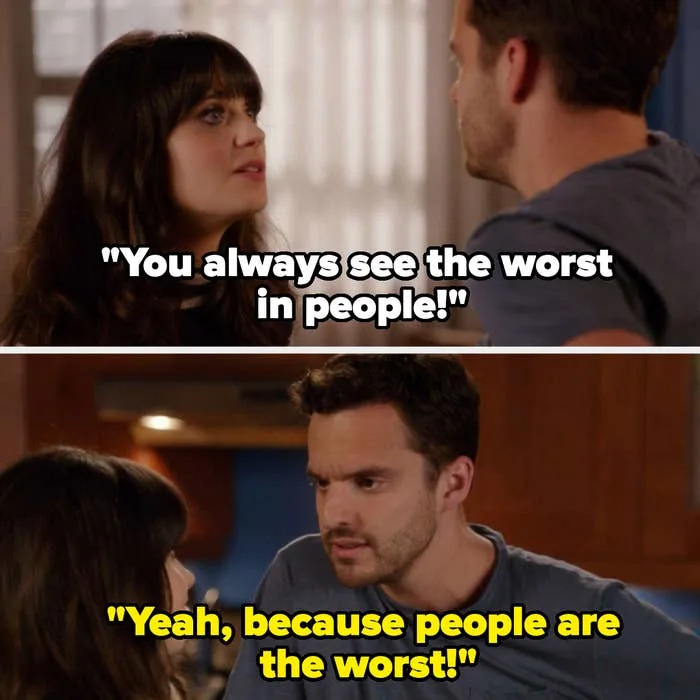
Screenshots from "New Girl"

If we could translate this into Latin, I think we’d have a replacement for the journalist’s motto.

Since AI isn’t going away any time soon, journalists and journalism educators are in a bit of a bind when it comes to how best to use it or to help students use it appropriately. This week, we’re doing a three-part series on the blog this week that take that “overhead” view of generative AI from three key angles:

You can click on the links above for either of the first two parts. The final part is below and a lot more complicated: The human factor.

As we’ve noted before, generative AI is a tool. As such, it can be used for good things or bad ones, based on the person using it and why they’re using it. Let’s consider a few aspects of human nature that can help make AI a useful friend or a mortal enemy:


WHAT’S MY MOTIVATION?: One of the luckiest breaks I ever caught in life was getting into a psych course on human motivation as part of my doctoral program. It not only hooked me up with Kennon Sheldon, a professor with an incredible history of publishing important psychological studies, but it also helped me to better view how people choose to act or not act based on motivating factors.

One of the aspects of self-determination theory (SDT) we looked at was the spectrum of motivating factors that influence people. As it is a continuum, it has a wide array of motivational forces, but scholars have identified four key “stopping points” along the spectrum that capture specific forms of motivation:

  • Extrinsic: You are motivated by an outside force to do something that you otherwise wouldn’t want to do. An example of this might be when your parents told you to clean your room or you would be grounded for the weekend.
  • Introjected: You are motivated to do something through coercive actions of others, such as guilt or shame. An example of this might be skipping a concert you want to attend so you can visit an elderly relative in a nursing home because your parents told you, “Well, she probably doesn’t have much longer to live and I KNOW how hard it would be for you to live with yourself if you didn’t at least see her a few more times.”
  • Internalized: You are motivated by finding value in the outcome of an activity, even if the activity itself isn’t all that enjoyable. An example of this would be a nursing student studying really hard for the NCLEX test. They don’t like the idea of the test, but are motivated by their desire to become a nurse, which requires them to pass this test.
  • Intrinsic: You are motivated by the natural joy of the activity. This is the purest and best form of motivation. An example of this would be Amy and her approach to knitting. She never seems to care if she finishes a project, but rather she enjoys the act of knitting as well as the joy she gets from trying new patterns, new yarn and new needles.

In looking at this, it’s a pretty safe bet that most of what students do for classes in a lot of cases comes down to extrinsic motivation, as they are required to write essays, do assignments and take tests because someone else is forcing them to do it. (Insert your favorite joke about Gen Ed classes here.)

When forced to do something, people will take the easiest way out possible, which is where generative AI comes in. If the only goal is to “get through” whatever someone is forcing you to do, you’re going to let AI take the wheel and just get it done. This is particularly true for those 800-person pit classes, where students figure they have a pretty good shot of getting away with it.

Helping students find motivation to do things that will benefit them in both the short term (pass this class) and the long term (get a better career) will be enough to move them toward a more self-motivated state.

This leads into the second human issue…


THIS MATTERS BECAUSE: We have found that people are more likely to value things if they have an understanding as to why these things are supposedly important. In short, “Why do I have to do this?” A key part of motivational research is what is called autonomy support: If you can give people choices or at least explain why they have to do something and that a choice isn’t possible, they tend to adopt the motivation as their own and do better at it.

When you give them a “Because I’m a PARENT, that’s why!” answer, well, they tend to really hate it and extrinsic motivation rears is ugly head.

I had this discussion/argument with people from our history department. The university was cutting several requirements that were making it difficult for kids to graduate on time and/or with multiple majors/minors/certificates.

One of the “forced classes” was a history one, and I overheard the history folks talking about the situation. One person thought it was a good thing, because maybe the kids would then find history on their own and choose it for a minor. A senior faculty member argued this would be a disaster because, “The kids will NEVER choose us.”

I nosed my way into the conversation and asked to what degree they explained the value of their specific classes to students who were taking them. The senior faculty member was offended: “How could you ask such a thing? Do you think history DOESN’T have value?”

Um… No… but if that’s how you approach your classes, I understand why the kids might feel that way.

The more I kept trying to explain that if you want the students to value something, you have to tell them why they should value it, the more I seemingly upset this man. Apparently, in his way of thinking, history is so damned important and he was such an expert-level vessel for this knowledge that there was no need to provide a rationale for the coursework he put forth. At the end, I left him with this:

“I know that kids can take my class because they want to or because they are forced to. Either way, I make sure to tell everyone what we’re doing, why we’re doing it and what value it has to them in moving forward in their lives. They may still dislike the thing I’m making them do, or they may disagree with my assessment of the situation, but they at least understand the ‘why’ and that tends to make them more willing to do the work than to try to weasel their way out of it.”

Understanding what motivates people to do (or not do) things can help us figure out how to help them use AI without abusing AI. Help them understand why they need to do an assignment, or understand a form of writing or complete a task and they’ll likely find a way to buy into your argument.

If we CAN’T show them a “why” answer, maybe that says more about what we’re doing wrong as educators than what is wrong with “kids today.” Is that 10-page paper really helpful to the kid, or are you just so used to grading them that it would be an inconvenience to you to change? Is the textbook you are using a good one, or do you not want to revamp your whole class and redo all of your lectures, so you stick with what you have? Is the kid really losing out on some major life skill or element of citizenry if they let AI take the wheel on an assignment, or is there a better way to make AI part of the process?

Logic has a lot to say about helping people find value in what they need to do and becoming motivated to do the right thing. Unfortunately, logic isn’t always in driving the bus, which leads to the last element…


PEOPLE ARE BASIC:  We can talk about this from a variety of angles, but the long and short of it is that humans are base-level creatures in a lot of ways.

Our minds are geared to be “cognitive misers,” which is why we find ourselves in mental ruts and often relying on stereotypes to make sense of the world around us.

We are social animals, which leads us to social dominance behaviors that tend to have some folks trying to assert their high value over other, “less valuable” individuals within the collective. If you don’t believe me, hang out for three hours in a middle school classroom and get back to me.

We’re also driven by some baser instincts in regard to our physiological needs. Or, to quote Jeff Foxworthy, a lot of people would like to get a beer and see something naked. (Pretty much every technological development related to media in the past 50 years has in some way gotten either a significant start or a major boost due to that base-level drive for naked stuff.)

Generative AI takes these base-level human drives and supercharges them in a way that other forms of technology haven’t. Whether it’s trying to prove dominance, trying to be lazy or trying to a pervert, AI puts it all and more at the fingertips of the worst among us.

AI chatbots have been linked to false claims of harassment by political figures in New York. Why would anyone think to do a prompt for the chatbot that included the term “sexual harassment?” There’s not a good argument in here, other than some idiot saying, “Hey, y’know what would be HILARIOUS? Ruining someone’s life!” (Here’s a link to a trailer for “The Anti-Social Network” that pretty much encapsulates the whole process by which general dumbassery becomes a toxic weapon when added to a digital platform.)

This is why you have stories like this one about a MIDDLE SCHOOL in California, where students were using AI to turn images of their friends into nude pictures. Or like this one about the students at a CATHOLIC HIGH SCHOOL using AI to create naked photos of their peers. Y’know, just like Jesus would have done to Mary Magdalene, if he had the technology…

Even pedophiles are getting in on the act, which is the start of a sentence that never ends well…

As with most things in the world, the worst among us will use AI to do some godawful stuff. I’m not sure we can avoid that, but we do have a need to instill in the other 90% of the world the reasons NOT to be like those folks.


DOCTOR OF PAPER HOT TAKE: Every time I think of what AI could be used to do and what it’s ACTUALLY being used for, I go back to this scene from “Idiocracy.”

The issue remaining for journalists and journalism educators is how do we go about making AI the tool in the toolbox it can be while avoiding the perils of a society that is slowly riding a Dumpster fire to hell.

The question we need to answer is this: What kind of coherent argument can we, as journalism instructors, make to the students who are in our class that it is in their overall best interest to do the work we assign them instead of letting a machine do it for them? And, how can we present that argument in a way that they will understand it, agree with it and motivate themselves to abide by it, in the face of the human frailties we’ve discussed earlier?

I don’t have an answer for this, but if you figure it out, please post the answer below.


Recalling Jim Lehrer’s rules of journalism as the Trump trial gets underway (A Throwback Post)

The breathless coverage of every post, sketch and fart of the Trump trial in New York has cable news in a lather these days. Without cameras being allowed in the courtroom, but still having all sorts of time to fill, television has seemingly turned everything about this thing into the Zapruder film. In his return to “The Daily Show,” Jon Stewart used his Monday opening to castigate these folks for their approach to “news” in this situation:


Stewart has long said he’s not a news journalist, so it might be easy to dismiss his critique as arrogance mixed with humor. That’s why we dug out today’s throwback post from four years ago, when Jim Lehrer died to make the same case for us.

Below is a brief tribute to Lehrer upon his death as well as a recap of his “rules” that really should guide our work in a time in which it seems like every shiny object can distract us and minutia can rule the news cycle.


Jim Lehrer’s rules matter now more than ever

Jim Lehrer, a journalist’s journalist to the core, died Thursday (Jan. 23, 2020) at the age of 85. He spent decades of his life covering politics, corporations, international affairs and more, and yet had the none of the pretense associated with the greatness he encountered or the epic stories he conveyed:

Jim was calm and careful in moments of crisis, as demonstrated by his coverage of the September 11 terrorist attacks.

“I’m Jim Lehrer. Terrorists used hijacked airliners to kill Americans on this, September 11, 2001,” Jim reported on national television. “Another day of infamy for the United States of America.”’

Lehrer essentially retired about a decade ago, and he did his work on public television, so it’s likely few folks under a certain age would remember much about him. Truth be told, he was really just a name and a standard to me for much of my life: A symbol of straightforward reporting and a talent to which one should aspire in the field.

However, among the many obituaries written on this titan of news, I came across Jim Lehrer’s Rules, guiding principles he used that can and should continue to influence generations of media students to come. (The world in general would probably be a nicer place, too, if non-media folks kept an eye on these things as well.)

These may seem quaint in the era of “Screaming Head” journalism, opinion-as-fact reporting, “sources say” coverage and a general sense that members of the general public have the IQ of a salad bar. However, with very limited quibbling, I could clearly defend each of these as something worth striving toward in our field.

Putting a voice in your head: Filak’s SAGE podcasts on media trends, approaches to media education and the importance of DEI

THE LEAD: As part of the launch of the “Exploring Mass Communication” textbook, I was asked to sit down with some folks at Sage and discuss my thoughts about the field of media. These included things like where we are, where we started and what matters now.

I also talked about the importance of critical thinking, the value in being a “non-denominational skeptic” and the way in which diversity, equity and inclusion are vital in media today.


THE CATCH: Clearly, this is part of the book roll out, so there will be a few minor “book plugs” in here, but I did my best to avoid full-on book pimping. Still, I listened back to the info in here and found that it might be more helpful to folks than not, so I’m posting it.


THE VOICES IN YOUR HEAD: When I was speaking at a convention one year, a student came up to me and said, “My professor uses your book for our class, so I wanted to hear you speak. When I read your stuff, I imagine how I think you would sound because it feels like you’re talking to me instead of writing. You sound just like the voice in my head.”

I told the kid, “I hear voices in my head, too. Don’t worry too much about it until the start arguing with each other.”

We then both had a good laugh about it.

So, if you always wanted to know if the voice you imagine coming out of me is the same as the voice that actually comes out of me, hop on below:

Here is the link to podcast one, where we talk about the evolution of mass com, the state of mass com today and the importance of being a “non-denominational skeptic.”


Here is the link to podcast two, where we discuss the importance of diversity, equity and inclusion, as well as how we integrate that into my Exploring Mass Com text.

Hope they are helpful or enjoyable or maybe even both!

Vince (a.k.a. The Doctor of Paper)

Read your stories for holes and plug them before you publish (A Throwback Post)

This is the last minute of what Sports Illustrated called the greatest sports moment of the 20th century and I remember watching it live as a kid. Today, it turns 44 years old, making me feel even older than I already feel…


On Feb. 22, 1980, the U.S. Olympic Hockey team, comprised of college kids and amateurs, took on the greatest team of hockey players ever assembled, The Soviet Union’s Red Army Club in the semi-final game of the medal round.

The 4-3 U.S. victory became known as the Miracle on Ice and after the U.S. beat Finland two days later, the “Boys of Winter” became the second U.S. Hockey team ever to win a gold medal.

Why do I tell you this?

  1. I love telling that story, so I’ll tell it every chance I get.
  2. It showcases the point of this throwback post: Don’t leave a hole in a story.

If you’re like most people reading this, and you hit that final statement about only being the second U.S. Hockey team to win gold, you might wonder, “OK, but when did they win the first gold?” In short, I teased some information and didn’t follow through.

(For the record, it was the 1960 team, which performed its own “miracle on ice” by defeating half the Communist countries on Earth, it seemed, en route to the gold. The captain of that team was a 34-year-old named Jack Kirrane, a firefighter from Brookline, Massachusetts, who sold his truck to pay for his travel to the tryout site and then went unemployed for four months for the privilege of being an Olympian. I could talk about this stuff for days…)

The point is, you need to look through your stories and figure out if you have left people hanging or if you have filled in every key hole that could pop up in your piece.

Take a read:


Stories with holes: It’s not really journalism if you leave me with more questions than answers

10 Cities With the Big Bad Pothole Problems | Firestone Complete Auto Care

If your story looks like this, you’ve got problems.

Sunday morning had me facing my own level of mortality when my dad flashed the obituary section of the paper in front of me and asked, “Did you know this guy?”

Sure enough, I did.

Peter and I had gone to high school together and even been on the debate team at the same time. He was a year ahead of me and was wicked smart. He tutored me in geometry, a Herculean task to say the least, and he was the school’s valedictorian the year he graduated.

He went off to two Ivy League schools, earning a law degree and spending much of his career in patent law out on the West Coast. He died far too young, at age 47, which left me with the question I’m sure most people would have asked:

“How did he die?”

Despite my best googling and research skills, I couldn’t figure this out. I asked a couple people we held in common over the years, only to have them asking the same question I had. I even emailed his law firm and they didn’t have anything to tell me.

Which leads us to the point of this piece: Journalistic content shouldn’t have your readers asking crucial questions when they are done with the story. When I teach editing, I refer to stories that have this problem as having holes. The job of reporters and editors is to make sure the holes get filled or discussed before a story is published.

In the case of obituaries, we’ve discussed this before and explaining that they’re more for the living than the dead, so we need to make sure they serve as a complete telling of the person’s life. It should be clear that the story of the person’s life is the most important portion of the story, but it also remains the case that the only reason we’re telling it now is because the person has died.

(Side note: When I worked at a newspaper a long time ago, the local style guide dictated that an obituary written on anyone under the age of 70 included the cause of death whenever possible, as most people would be curious of what caused this person’s too-soon demise. I found an older edition of the style guide, which required the COD for those older than 60. Several of us surmised that our boss changed it when he got older, as he didn’t want to be in the “acceptable to be dead” demographic.)

(Second side note: I have told Amy that when I die, however I die, she needs to include the cause of death in my obituary. I don’t care if I died breaking my neck by falling off the couch trying to kiss my own butt as part of a TikTok challenge. If it mattered enough for me to die while doing it, tell people. I don’t need folks speculating…)

In the case of larger investigative stories, holes can unintentionally undermine the credibility of sources. When something is missing and readers have questions, they can become suspicious of the entire story.

Case in point: The Kansas City Star dropped a bombshell story of a former KU football player who stated that several of his former teammates harassed and threatened him and his family. The allegations included a teammate loosening the lug nuts of one of his car’s tires, teammates bursting into his apartment to threaten his family and the athletic department trying to buy his silence to the tune of $50,000.

The story mentions four players, but never names them.

I spent half the story wondering who these former KU football players were.

I spent the other half of the story why, if these allegations were credible, the paper didn’t name these dudes who attacked and threatened this kid.

Neither question got answered in the text, leading me to wonder more about the kid making the allegations and the author of the piece than anything else.

Filling in holes like this can allow the readers to make up their own minds about the credibility of sources, the seriousness of a situation and a dozen other things. However, when they are left hanging, they can’t exercise proper judgment.

I recall reading a story more than a dozen years ago about a small-town beef between a mayor and a city administrator over something the mayor had said. The administrator called it something like “the most offensive slur I have ever heard” while the mayor said it was something like “just a plain-folks saying that was being misinterpreted.”

I read the whole story, waiting to see what was said. The writer didn’t include it, didn’t clue me in on what it might be (a racial slur, a demeaning phrase describing people with disabilities, a sexist remark) and also didn’t tell me why that wasn’t included.

The fact I remember this, while I can’t remember what I had for lunch yesterday, clearly demonstrates that holes can stick with a reader for quite some time.

Here are a few things you can do to find and fill holes that will have your readers thanking you:

CONVERSE WITH THE READER AS YOU WRITE: Journalism has long had a tradition of filling in 5W’s and 1H or checking off news values and considering the job done. Those elements still have value, but we really should be spending more time focusing on the needs of the audience.

After all, when those tenets were crafted, journalists usually knew their audiences intimately and the number of sources of information were far more limited than they are now. Audience-centricity was baked into the process back then and people couldn’t just hop on the internet and find answers to their questions elsewhere.

A good way to make sure that you’re working for the audience is to imagine a conversation with the readers when you are writing. You tell them the most important thing you can and then follow the thread of how you imagine that conversation will go:

You: Hey, your mom called. There was a fire at your house around 2 a.m.

Reader: OH NO! Is everyone OK?

You: No one got hurt because the smoke detector woke them up and they got out right away.

Reader: How bad was the fire?

You: The house is a total loss. Firefighters say more than $200,000 in damage.

Reader: How did this happen?

You: The water heater in the basement got a short circuit and started some oily rags on fire…

When you’re done going through the process, see if what you’ve written does what it needs to or if there are holes. Also, you can review the ordering of your content to see if it follows the pattern of what you think they’ll want to know first. This helps you avoid starting the story with “The Berlin Fire Department, assisted by volunteer firefighters from the town of Aurora, responded to a report of a fire at 111 S. Main St. around 2 a.m. Sunday…”

IF YOU GIVE THE READERS DIRECTIONS, MAKE SURE THEY CAN FOLLOW THEM: A number of stories will tell people to do something or avoid something or respond to something. These stories become problematic when people aren’t told how to do these things.

Back when the illness we were all freaking out about was the Swine Flu (H1N1), a local daycare had an outbreak and had to shut down. The people at the daycare told parents to watch their kids carefully for symptoms of the illness. In fact, the story on the outbreak mentioned this important activity at least three times in six paragraphs.

The problem? The story never said what the symptoms were, so that wasn’t really helpful at all.

A similar story I remember reading was back when Zoe was about 4 and she really had an interest in Santa. The local paper reported that breakfast with Santa, which was in danger of being cancelled, had been green-lit, thanks to a generous donor. The whole story talked about how kids were going to have breakfast with Santa and that it was so great we didn’t lose breakfast with Santa and how important breakfast with Santa was.

The story never once mentioned when and where the event was taking place. Did the writer expect parents to wander the streets of Omro, looking for a fat guy in a red suit?

In the digital age, we can, obviously, look up things like H1N1 symptoms or local events on a city website, but that’s not the point. If we’re supposed to inform readers about important things, we need to go all the way. Saying, “Well, they can look it up” is akin to listing Chicken Kiev on the menu at a nice restaurant, and then serving patrons bunch of raw ingredients and a recipe card.

IF YOU CAN’T (OR WON’T) FILL THE HOLE, ACKNOWLEDGE IT: Not all holes in stories come from poor writing and reporting. In some cases, information isn’t available. In other cases, a publication decides to err on the side of caution while reporting. Even more, the publication might have a policy that prohibits the publication of certain content.

In those cases, you’re going to leave a hole. When you do, explain what’s going on so your readers can follow along:

“At the family’s request, the name of the MegaJackpot winner will not be released.”

“The cause of death has not been determined, the medical examiner stated.”

“In accordance with the Daily Tattler’s policies, stories do not name assault victims and instead provide a first-name-only pseudonym.”

Explaining WHY the paper wasn’t naming names could have been really helpful Kansas City Star story:

“Due to the lack of supporting legal documents/At the request of the paper’s legal team/Because we believed the kid enough to run the story, but not enough to risk a libel suit, The Kansas City Star is not naming the four players accused of harassing Caperton Humphrey…”

At that point, I could figure out if this was a case of “The lawyers won’t let us, even though we have the goods” or a case of “This story’s hanging by a thread anyway, so let’s not make it collapse.” Knowing which way the wind is blowing on this story would not only satisfy my own curiosity, but it would also make me feel more or less willing to share it on my social media.

In the end, make sure you’re giving the readers the most complete picture possible, even if that means explaining why that picture is incomplete.

Dealing with interview subjects and memory lapses in telling your stories (A Throwback Post)

In discussing interviewing today in class, a student asked me a question that should bother more folks than it probably does:

“What if a source is wrong about something, but it’s not a big factual thing you can check? What do you do?”

It’s a good question, in that I’m sure I’ve told the same story 10,001 times to various classes with variations on a theme. In some cases, I’m often wondering if I’m accurately remembering the car I was driving when I went to the scene of a shooting, the editor who told me to “check on that fatality” that turned out not to be dead or a dozen other things that pretty much anybody involved might remember in some other way, but in no way does a big book of facts help settle the issue.

Case in point: This Christmas, I was at a family gathering where the time I somehow volunteered my dad to be a grade school soccer coach came up. The story was that Dad agreed to go to a meeting where this whole thing would be discussed and he then agreed to coach with a bunch of other dads.

The memory I had was of Dad putting on his nice brown suit to go to this meeting, where it turned out all the other dads were told that they’d be playing the game a bit. So my dad, being the awesome guy he is/was, ended up playing a bit in his dressed up clothes. To me, that story was burned in my head, as I remembered him coming home sweaty and carrying his coat. It also was a great touchstone for me about how much Dad loved me, in that he’s out there banging around a soccer ball in his good suit.

Dad looked at me and said, “That never happened.”

I explained my memory about it and said, “I know it happened because of (XYZ).”

He said, “No, that never happened that way. I never played soccer in a suit. I don’t know where you’re getting that from…”

We both immediately turned to Mom as the arbiter, and she couldn’t remember any of this, so for the rest of the night, I kept thinking, “I know I’m right” and I’m sure my Dad thought the same thing, too.

The point is, not everyone remembers everything the right way, so what happens when you’re supposed to tell stories that revolve around facts and not everyone agrees with what those are?

Here’s a look at how to help work through that issue:


How to avoid letting a source’s memory lapses or outright lies destroy your stories

I’ve made a point of telling anyone who will listen that if they need ANYTHING from me in terms of content to help their students or their student newsrooms, all they have to do is ask. Thus, the following request came from a fellow journalism teacher:

Do you have any great lessons or content on how to analyze if a source, esp a source for a profile, is lying or misrepresenting information (either purposefully or due to memory erosion)?

It’s difficult to know for sure when someone is lying or if there are memory gaps that make for some problematic moments within the story you want to tell. As I’ve often told folks in my classes, it’s not always about being perfectly successful in your efforts when it comes to something like this, but rather avoiding the things that can really screw you over that matters most.

With that said, here are a few things beginning reporters can do to mitigate disaster when dealing with a source that might not have the facts 100% perfect:

GET A SENSE OF THE SOURCE: One of the primary reasons I tell students they need to conduct interviews in person is so they can capture more observational elements to add color and feel to their pieces. A good side benefit of being in person is you can get the vibe of the source and decide how much you really want to trust them.

Some sources are great at hyping themselves up like they’re trying to sell you the Bass-O-Matic ’76. Others do some great “humblebrag” stuff that really can sound like they’re important and vaguely decent people. In spending time with these people, you can find out who is likely worth trusting and who you can’t trust any further than you’d trust a pyromaniac at a gas station.

The one thing to understand is that there is a crucial difference between people who are full of crap and people who literally have lost track of things over time. Honestly, I have told a number of stories over and over again to the point that I’m not sure if they’re perfectly accurate, slightly altered or complete BS. (I am grateful, however, that I found support for the famous “Olde Un Theatre” robbery and the “Mraz, where’s Mrefund?” headline.)

I had one student who SWORE she wrote an obituary that had a particularly awkward headline on it. I found the piece, with the headline she described, and it wasn’t her byline. Maybe she wrote the headline, or edited the piece or something else, but it wasn’t her byline. This is why it’s important to fact check basically everything when it comes to people telling you stuff that you plan to use in your work.

Once you get that vibe, you can do more work with the questions you have and the level of insistence you enact when dealing with your questions.

IN GOD WE TRUST, ALL OTHERS MUST PAY CASH: Even in profiles, there is a benefit to becoming what I call a “non-denominational skeptic” about the information you received. Whether you like the source or you wouldn’t believe them if they came into your house, soaking wet, and told you, “It’s raining out there,” apply a similar level of rigor to your questioning. This is particularly important when it comes to things you really plan to focus on as part of your story.

Let’s say you’re doing a profile on a business person who turned his life around after a rather rough patch in his 20s and now helps ex-convicts find work. You likely are going to ask what was the turning point that got this guy on the right path, and here’s the answer you get:

“I wasn’t a good person back then. I was arrested for a series of burglaries back in ’85 around the Cleveland area. I was supposed to get 6 years, but the judge gave me 12 and shipped me off to Folsom prison, way across the country. Being that far from home, in a prison like that, well, it changes a man. About 50 prisoners were killed while I was there for those 12 years and I always thought I’d be one. I told God, ‘If I ever get out of here alive, I’ll make my life right for whoever else gets out of here.’”

Sounds compelling and amazing. Now, how much of that is stuff you NEED to check? A goodly amount:

  • Check arrest records from “the Cleveland area” in 1985 and find out if this guy was ever arrested.
  • Check court records to find out if he did get sentenced to 12 years.
  • Check prison records to find out if he went to prison, let alone Folsom
  • Check prison records (and others) to find out if 50 people REALLY got killed out there from about 1985 to 1997.

This is just smart reporting and it will help you fill in some of the key details about the source’s live. Also, the more of this you can verify, the better off you are. The less you can verify, the less you should trust this source.

Clearly, you can’t verify if he “wasn’t a good person” or if he had a conversation with God. (“Hello, St. Peter? Yes, this is Vince Filak with the Dynamics of Writing blog. Is God there? I need to confirm a conversation He had back in 1985 or so…”) But you can check out enough stuff to feel like you’re not getting fed a line.

TRUST, BUT VERIFY: Another key way to poke back at people is to show interest and engagement with their stories while offering them ways to help verify this information for you.

If you’re interviewing someone and they say, “I was amazed when I received my Silver Star for my tour in Vietnam, but I really was just doing the same job as everybody else…” you could check a database when you get done with the interview. However, you could also try this approach during the interview:

“That is truly incredible! Could you show me the medal? I’d love to see it!”

or

“Do you have any pictures of the ceremony? My editor would love to put something visual with the story!”

If the answer is yes, you’re in decent shape. If the answer is a dodge or something like, “Nah, I threw it away.” then you are probably going to want to push back a bit more with stuff like, “So where was the incident that took place that got you considered for the honor?” or “I would love to talk to anyone who was in your platoon at the time for more on this…”

In other words, you’re giving the person an opportunity to verify this stuff for you. If they can’t or won’t, tread cautiously.

WEIGH COST VERSUS VALUE: Journalism in a lot of ways is like catching sand in a sieve. You’re never going to catch everything, but you want to make sure you don’t lose too much of the small stuff or any of the big stuff. To that end, you want to weigh the cost versus value of the amount of work you’re doing on any particular fact-finding dig.

Let’s say you’ve got a source that was paralyzed from the waist down during a car accident in high school. After that, he went into a deep depression, but found God and now goes on speaking tours throughout the country to explain how to overcome obstacles in life. The source tells you this:

“I was driving a 1979 Ford Thunderbird with this great V-8 351 Cleveland in it when I had the accident. The truck that hit me mangled that car like you wouldn’t believe. I honestly feel that if I had been driving something smaller, I’d be dead.”

The guy shows you a picture of the wreck, so you can see what happened to the car. He’s clearly paralyzed or has been faking it well for decades. The opinion is his that he might have died in a Toyota Camry. is it really important to fact check whether that car had the 351 Cleveland engine in it or if it might have had a 302 or a 351 Windsor? Probably not.

Look at what matters most and make sure those things are solid. The random fringe stuff can be checked if you have time and if it’s easy. However, it’s not going to behoove you to go plowing through thousands of DOT and Ford Factory Sheets to figure out what engine landed in what car in a case like this.

RESEARCH BEFORE, FACT CHECK AFTER: The goal of quality research in advance of talking to a source is to make sure you ask good questions and that you don’t get turned around if the source tries to BS you. The goal of a quality fact check is to make sure what the source told you makes sense before you publish the piece.

You then can decide to what degree you want to keep certain bits of information and what degree you feel the need to actively fact check with in a story. Ted Bridis, a fellow journalism prof, shared this example with a bunch of us to outline the ways in which a “personal tale” can have enough bullcrap in it to fertilize the back 40 acres. The writer of the piece literally takes each element that this source outlines as “fact” and checks it out with people after the fact to show what is clearly not true and why it matters.

If you ask the right questions, you’ll find that many sources will try to snow you less, as it’s clear you aren’t coming to them fresh off a turnip truck. However, there are still people out there who will try to convince you that they were the one who convinced Lin-Manuel Miranda to go with Hamilton instead of “Aaron Burr: The Death Metal Musical!”

That’s where the fact check really comes in.

FIND OTHER PEOPLE TO HELP: I remember certain things about my childhood that might or might not be true. Some of them, Mom or Dad might have an angle on (and judging by how we kept pretty much everything I ever did in the file cabinet in my folks’ back room at the house, we might actually have physical proof of that thing).

REPORTER: “Hey, I was talking to your mom and she said you never scored a basket in your fifth-grade season. She still has all the box scores. You did almost foul out of nine games, thought.”
ME: “I’ll be darned. I swear I hit a basket at least once. Anyway, I’m sure that foul out thing is right, as I played basketball like Danny from ‘Grease’ that year…”

If you can get verification from people who would likely know, it’s probably a safe bet you can go with that information. If you can’t or the information seems to contradict, go back to the original source for verification:

REPORTER: “Hey, I was talking to your mom and she said she thinks that story about Mrs. Schutten screaming at your class was from fifth grade, not third grade. She said the woman taught you in both grades. I just wanted to know if you’re sure on what you told me.”
ME: “Oh, yeah… I forgot that she got us twice… After I had Sr. Kenneth in fourth grade, the beatings we all took from that nun basically scrambled my memory for some things…  Mom’s probably right, then.”

The goal of asking other people for things is to help solidify things that are important to telling your story. In some cases, you’ll have conflicting reports from key sources and it’s up to you to determine who you believe and how important those conflicting elements are.

A great example of this is in the book “Loose Balls” by Terry Pluto, where he outlines the wild life of the old American Basketball Association. He tells this one story about Marvin “Bad News” Barnes and how he missed a team flight to Norfolk, where Barnes and the Spirits of St. Louis were supposed to play the Virginia Squires.

Barnes blows off the flight and figures he’ll catch a later one, but it turns out he missed the last commercial flight to Norfolk. So he chartered a plane (something unheard of at the time) and got down there at the last minute. He shows up to the locker room with like 10 minutes to go before game time wearing a full-length fur coat, carrying a couple bags of McDonald’s burgers and a big smile. He opens his coat to reveal his uniform like he was changing from Clark Kent to Superman and declares, “Have no fear, BB (his nickname) is here.”

The story was verified by a number of people who all told essentially the same story. However, people deviated on one detail. During the game, the pilot supposedly showed up in the team huddle and demanded to be paid for the flight, so someone had to run back to the locker room and get Marvin’s checkbook so he could write the guy a check. The amount of the check varied widely from about $700 to more than $1,500, depending on who told it.

Pluto recognizes that the story perfectly captures the insanity that was Marvin Barnes and this team of weirdos. He knows that it is mostly true and pretty solid in its confirmation. He also knows people want to know what it cost to do this little stunt and that he doesn’t have the goods. He acknowledges that by including that information and the variations in his chapter. Something like that is easy enough to do if you have a few inconsistencies that don’t undermine the larger truth you’re trying to convey.

THE DUTY TO REPORT VERSUS THE DUTY TO PUBLISH: No matter how much effort a reporter puts into a story, there is never a guarantee that the story is absolutely right. Mistakes happen, memories fade, BS intrudes and more. The goal is to try to put forth the best version of reality, regardless of how difficult that is.

This is where we separate the duty to report and the duty to publish. As journalists, we need to ask questions and poke at facts to figure out what happened and why our readers should care. Not every effort we make in that realm will give us the results we feel comfortable with. To that end, we have to be OK with the decision not to publish something if we’re not 100% certain on the issue.

It’s better to have something missing or come up a little thin in a story than it is to publish something that is flat-out wrong.

A great example of this is an article Bethany McLean, a financial journalist, wrote in 2001 about Enron. The company basically had stock that just kept going up and up and up for no real reason and the company big wigs couldn’t explain to her in any meaningful way how money moved through the company. She knew something wasn’t right, but she wasn’t 100% sure of what it was.


In several interviews, she noted that there were several partnerships that were doing deals with Enron that appeared to be owned or operated by Enron executive Andy Fastow. She saw them disclosed, but she never mentioned them in her article. In the documentary, “The Smartest Guys in the Room,” she explained:

“There were these partnerships that were run by Andy Fastow that were doing business with Enron and they were disclosed in the company’s financial statements, but I didn’t mention them in the story because I thought, ‘Well, the accountants and the board of directors have said this is OK so I must be crazy to think there’s anything wrong with this.’ The story I ran was actually pretty meek. The title was “Is Enron Overpriced?” (because) in the end, I couldn’t prove that it was anything more than an overvalued stock and I was probably too naive to suspect there was anything more than that.”

She realized she had the duty to dig in hard on this. When she couldn’t make it work perfectly on the first pass, she understood that she didn’t want to screw this up, so she went with what she could prove.

As it turned out, the partnerships were a large component of a major financial fraud and the company was a house of cards, things McLean and others found out after she put out that first article. However, at the time, she couldn’t go beyond what she had, so she stuck to what she could prove and lived to fight another day.

Filak Furlough Tour Update: Hanging out at Iowa State University (Part I)

I think I only own one or two shirts. Also, I do not like my “Alfred Hitchcock Presents” profile…

The Filak Furlough Tour actually hit the road a few weeks back to drive out and visit a campus. Most people were fine with the “Vince on Zoom” experience, as it allowed them to shut me off and mute me when I got annoying. The good folks at Iowa State University knew me and decided that a couple days of me would be, at the very least, interesting.

Of all the campuses I’ve been on as a student, parent, faculty member and more, I found Iowa State to be among the best in terms of just feeling like it fit my personality. (I mean that as a compliment, not as a potentially libelous statement…) Nice people, smart kids, good questions and more. Totally worth the 4 a.m. car ride…


IOWA STATE UNIVERSITY – AMES, IOWA

THE TOPIC: I did one class on finding stories and trying to come up with the best ways to tell those stories and one on sports journalism, sports marketing and DEI. Since I’ve done a lot on the issue of finding stories, we’ll go after the second one.

THE BASICS: This had to be one of the more interesting experiences I’ve had, in that the class was set up like a press conference, with the students driving the discussion on the topic and then live-tweeting the entire thing as they saw fit. The professor gave me the option of asking them not to record or put me on social media.

“Nah,” I said. “Let them do it. If I say something pathologically stupid, that’s my fault.”

Thus began my life on a tightrope for an hour or so…

One of the key things we discussed was the way in which race, gender and other similar issues get covered in the media. We talked a lot about how the “oddity” interest element tends to get played up when it comes to those topics. It’s often stories about “The first (fill in the blank) to do (job white guys have done for forever)” instead of “Here is a person who brings XYZ skills and valuable elements to the (job).”

I apparently made this case about not being at a point of equity yet in a truly “me” way:


A student asked me how we could get closer to that kind of thing, both in terms of news/sports coverage and in terms of sports marketing. I think the key is to look at the person first and what it is that makes the person worthy of focus. It could be an athletic skill set or their personality or a dozen other things. Then, help that person tell the story they want to tell about themselves, rather than focusing on whatever quick and easy distinction we can make, whether it’s race, gender, sexual orientation or whatever:

The important thing to understand is that nothing gets done in an instant. That doesn’t mean we should accept mediocrity when it comes to making progress, nor should we say, “Well, that’s good enough for now.” However to fail to see that things have come a decent distance over a protracted period of time is to diminish the value of the people who worked and fought to get as much improvement as we have gotten to this point.


BEST QUESTION OF THE DAY: What did you think of how Coach Prime dealt with the media and how the media was dealing with Coach Prime?

BEST ANSWER I HAD AT THE TIME: Deion Sanders has always been very much his own person and has not really given a damn what other people thought of him the sense of if he was being “too much.” (Whatever the heck that means.) He was never going to come to college coaching and suddenly turn into a “We gotta play them one day at a time… I’m just glad to be here…” kind of person. He is who he is and he’s comfortable in his own skin, which I think is fantastic.

The person that I most thought of when I saw his situation in Colorado was Muhammad Ali: He was brash, confident and not afraid of telling people what he thought. In doing so, he ruffled a lot of feathers of people who didn’t like his approach. It was like the media was waiting for him to fail so they could say, “See? You’re not all that. Now sit down and shut up.”

That’s never going to happen. He will continue to be who he is throughout the process. Even if you don’t like him as a person or find him to be annoying on those Duck commercials, you gotta respect the sense of self he has and the way it can inspire and raise up his players.


ONE LAST THING: I saw these advertised in the campus bookstore.

Despite my best efforts, Amy wouldn’t let me come home with a pair of these.

Another addition to the “club” of campus shootings, 5 injured at Morgan State University

The front page of The Spokesman, Morgan State University’s student newspaper, after someone shot five people during a homecoming event overnight. I’m not sure if it’s irony, coincidence or just a damn shame that the publication covered an event aimed at stanching gun violence two days earlier (see the recent stories rail).

I woke up to a news alert in my email to find that Morgan State University joined “a club we don’t want to be a member of and we don’t want any more members in it,” to quote a friend who survived a mass shooting on a college campus. Five people were shot overnight during a homecoming event at the Baltimore-area institution. The injuries are not life-threatening, according to officials, and the shooter hasn’t been captured.

The first stop on the Filak Furlough Tour covered the issue of crime, chaos and disasters. We discussed how to cover them and what kinds of things you need to do to keep yourself safe, both mentally and physically. In covering this topic, I’ve mentioned before the discussion I had with my friend Kelly Furnas, who was the adviser of the student newspaper at Virginia Tech when a mass shooting took the lives of 32 innocent people on that campus.

When I was able to secure him for a presentation at a college media convention less than a year after that event, it was a huge “get” because he and his editorial staff had experienced something so rare and mystifying that we all were desperate to hear what he had to say. He told me later that as he continued to do the “convention circuit,” he went from being an anomaly to being one of an increasingly growing group of people who had dealt with this. His sessions, he said, went from being a “here’s what happened” to a “here’s how you cover it when it happens to you.”

The students at The Spokesman did a good job of strong journalism on this one, and I’d argue they were stronger than the national outlets who somehow managed to not get the last names of sources or time elements into their stories. The Spokesman promised additional updates as more information becomes available and I’m sure by the time authorities capture this person, the big-wig media will have moved on to something else. Meanwhile, the folks at Morgan State will be left to pick up the pieces of their shattered sense of security.

Please keep an eye on this story via The Spokesman and think about those kids on that campus. They need to know we are watching and that we care.

The Filak Furlough Tour posts will continue next week.

Vince (a.k.a The Doctor of Paper)

EDITOR’S NOTE: An earlier version of this called the paper “The Spectator” for reasons past my understanding. I think I had a brain glitch. Thanks to the folks at The Spokesman for bring it to my attention. You deserved better from me on this. Keep doing great work. –VFF


Journalistic Malfeasance Strikes Again: Another tragic tale of wasted youth (A throwback post)

A colleague who is advising a student media operation asked a question in an internet group setting after a kid on his staff admitted to fabricating a story for the publication:

Does anyone have any experience or policies to shed light on how such a person might be given a path to redemption?

The old editor in me says, “That’s it. Your journalism career is over.” But these days I see too many long-lasting severe consequences for young people who do dumb things, including criminal activity. TBH, I’m not really trying to open the philosophical debate here. I’m interested in options I can present to the student EIC, who will make the decision.

I thought about the question the guy was asking and put together what I thought was a pretty reasonable answer based on what he wanted to know: How do you give the kid a path to redemption? After I posted, several other folks chimed in with the idea that the kid SHOULDN’T get a path, given that this was likely not a one-off and that keeping the kid is borrowing trouble.

Truth be told, that’s actually the better instinct, based on a lot of things we’ve seen in the media world lately. We’ve covered this topic here and here and here where we had professional journalists get caught after years of making crap up. It’s never a one-time deal and the journalist’s whole career comes apart like when you pull a loose thread on a sweater once someone starts digging into the past.

The sad part was that the colleague updated us a couple days later:

Probably because of posts I’d read on this list about earlier situations, on Sunday I started emailing all the sources named in the reporter’s earlier stories. This morning, I started calling businesses where some of the sources allegedly worked. By lunchtime, there were several cases where no such person could be found to exist. After trying to come up with explanations for the first couple, the reporter finally admitted this had been a pattern. The reporter resigned.

This brings me to today’s throwback post, which looks at a similar situation involving a young reporter at USA Today. It’s not meant to “tsk tsk” people, but rather as a reminder, this kind of thing can happen to anyone in the right (or wrong) circumstances, so it is important to remain personally vigilant.


“It’s the first time you caught her.”

Stories of journalistic malfeasance are not incredibly rare, but they always sting. The most recent publicly noted case occurred over the summer, in which USA Today pulled 23 articles from its archives after an audit revealed quotes and sources were likely fabricated. The journalist responsible for those stories, Gabriela Miranda, began working for the media outlet in 2021. During the audit, she resigned.

Whenever a situation like this comes up, I think back to the first episode of the Netflix show “Ozark” and the issue of how to deal with someone who has cheated. The main character is involved with a drug cartel in a money-laundering scheme out of Chicago.

Del, the connection south of the border, makes an unexpected visit, accusing the laundering crew of stealing from him. He tells a story about his father’s grocery store and how his dad spotted a loyal cashier (a woman so close to the family, you call her aunt, he remarks) stealing $5  from the till one day.

She begged for forgiveness, saying she needed the money for a child’s medicine and that she’d never do it again. Del then asks each of the four men in the operation what his father should have done. Three of the men say he should forgive her, give her a second chance. After all, one mistake after 15 years of loyalty? The three men are brutally killed shortly after that. The fourth, Marty, doesn’t answer, but he manages to worm his way out of getting killed.

Later, Del asks Marty question again:

As much as people want to believe something like this was just a one-off, it rarely turns out to be the case.  After someone pulls on the first loose thread on sweater, others began to do so as well, and we see everything unravel.

The Gainesville Times, where Miranda worked for three months as a freelancer and a reporter, published a piece on her USA Today situation and audited her work. The paper stated it pulled only one story just to be on the safe side, noting Miranda had produced “only a small volume of work” for the publication.

Her college paper, the Red and Black at the University of Georgia began conducting its own audit of Miranda’s work after the USA Today situation came to light. That paper flagged 14 articles of concern of the 121 articles associated with Miranda. The publication then made the appropriate corrections or clarifications to six articles that didn’t pass muster after they were reexamined.

(If anyone wants to see perhaps the best example of transparency, thoroughness and honesty in the face of a potential disaster, read this write up on the Red and Black’s website that details the work the staff went through to address the problem. These folks essentially wrote the book on how to self-audit in a situation like this.)

To ask “why” is a pointless exercise. Each time a journalistic fraud emerges, we get a different story, none of which excuse the actions of the individual or fully satisfy the readers. It also provides us with an undeserved sense of superiority, as if “we” could never be capable of such a thing.

We all are.

Some of us deal with pressure better. Some of us grew up with a guilt complex. Some of us have a pathological fear of getting caught that keeps “bad things” in check for the most part.

But rest assured, not one of us is any less capable of cutting a corner or fudging a source. We just haven’t done it. Yet.

For journalists, journalism teachers and students who want to keep that demon at bay, go to the Red and Black and USA Today websites and look up the stories Miranda wrote in her brief journalism career. They are powerful, engaging and interesting pieces that run the gamut of social justice explorations to fun news features.

Now, just do a Google search on “Gabriela Miranda.”

Almost every link comes back to a story about her journalistic transgressions.

Confidence or Thuggery? A quick look at avoiding double-standards in journalism writing

In the wake of the Women’s NCAA Basketball Championship game, the question of double standards emerged as a major plot point.

During LSU’s 102-85 defeat of Iowa, Tiger star Angel Reese made the “can’t see me” hand gesture toward the Hawkeyes’ Caitlin Clark as a form of trash talking. Clark had made similar gestures throughout the tournament toward opposing players.

In one case it was deemed “confident” and “self-assured.” In another case, people decried the “lack of sportsmanship” and “thuggery.”

If you can’t guess who got which critique, here’s a clue: Clark is white and Reese is Black.

William Rhoden, a distinguished author and sports journalist, broke down the entirety of this situation on Andscape, drawing on prior examples of this throughout athletics:

On Sunday, Reese simply gave it back to Clark. Many neutral observers and Clark’s fans were not pleased and played the sportsmanship and class card. Double standards: When we do it, it’s bravado. When you do it, it’s crass. When we play hard, it’s gritty. When you play hard, it’s thuggery.

I saw this this firsthand in the 1980s with John Thompson’s Georgetown team. They were routinely cast as villains and thugs. We saw the same thing with UNLV’s great teams of the 1990s. When UNLV played Duke for the national title in 1990, Duke’s players were cast as “choirboys” while UNLV players were cast as villains and thugs. Then, of course, there was Michigan’s Fab Five which, critics say, introduced hip-hop elements into basketball.

Now that the women’s game has grown and African American women continue to become increasingly prominent, the same stereotypes are emerging: Black women portrayed as rough-and-tumble street fighters, their white counterparts as stalwart, heady competitors.

And let’s not even get into the whole history of Don Imus and his “nappy-headed hos” review of the Rutgers women’s basketball team…

We’ve talked about this kind of thing at length a few years back when stories had framed women based on their gender identity first and their accomplishments as an afterthought. We also touched on the issue of race and framing of athletes back when Brian Flores launched his discrimination suit against the NFL.

As a brief reminder here to journalism students, consider the following issues when including descriptors or making word choices in ways you might not initially consider:

WOULD YOU USE THE DESCRIPTOR OF THE SITUATION WAS REVERSED?: One of the key ways to determine fairness in language or description is to turn the tables and see if it still works for you. My favorite example comes from Jim Bouton’s book, “Ball Four,” in which one of his teammates notes that he wouldn’t mind the papers referring to him as “the black first baseman” if only they would refer to his counterpart as “the white first baseman.”

The same is true of descriptions like “the female mayor” or “the woman CEO” and so forth. Feminist scholars have long noted the incongruity in language as to how men and women are described. A few common pairings include:

    • Women are “pushy” while men are “assertive”
    • Women are “bossy” while men “take charge”
    • Women are “stubborn” while men are “persistent”

Calling attention unnecessarily to an attribute that you wouldn’t flip the other way is clearly an indicator that you might want to rethink that descriptor. I can’t remember seeing headlines about “the white quarterback” or “the male company president” and I bet most of you can’t either. Same thing with references to a “straight wedding” or a “cis gender politician.”

I can’t imagine someone calling Caitlin Clark a “thug” for her trash talking, but I know that word showed up in a number of discussions involving Angel Reese. That’s clearly part of the problem.


DOES THE TERM HAVE A LOADED MEANING?: I can’t think of any time I’ve heard someone described as “a looter” or “a rioter” and had a positive reaction to that person. Those terms carry with them some negative baggage.  Conversely, I’ve seen an array of meanings ascribed to the term “clowning around” that range from bright and happy to racist.

A few years back, I remember seeing an analysis of the term “unskilled labor.” In a post on this term, someone noted that all labor is skilled. If you took Bill Gates and stuck him with a road construction crew, he would be as lost as can be. If you took Jamie Dimon and put him in charge of a Naperville McDonald’s during lunch rush, he would probably end up with a crowd of really angry people and some severe grease burns. The term “unskilled labor” is meant to diminish the value of what certain people do and thus make it easier to discount them or pay them less.

We could go on for days, but the point is that language matters in how we tell stories and how we frame the characters in them.