(If you’d like to see a master course on sterile jargon, enjoy reading Patient Zero here…)
All faculty members are getting some degree of furlough, while the folks who are in the academic staff, administrative staff and other non-tenured spots on the campus await layoffs and other levels of anxiety-provoking announcements.
(Some of us sat through an hour-plus event that included the explanation that to close our $18 million budget deficit, the university would be using the $5 million remaining in its surplus fund, furloughing faculty to save $3 million and then relying on $1 million in cuts. Even my journalism brain realized something was wrong with that math.)
Given my use of humor to deal with darkness, the jokes on this have come fast and furiously through my brain:
“Welcome to UW-O, home of the furlough!”
“It’s UW-Furlough, where the customer comes… into an empty office at least a few days this month.”
“You can’t spell furlough without F-U!”
I also liked the line of “You are not to be performing any work for UW-Oshkosh” as I’m trying to imagine the enforcement mechanisms that will be employed:
(Sound of SWAT officers kicking down my front door, annoying the dog and scattering the chickens)
Cop: “Filak! Are you GRADING PAPERS? Hands off that laptop now!”
Me: “No! Officer! I swear, I’m just surfing for porn!”
Cop: “Yeah… you BETTER BE!”
In any case, this isn’t a pity party for me but more of an opportunity to go out Irish-Wake style on this thing, so here’s what I’m pitching:
THE 2023-24 UW-UH-OH, FILAK’S ON FURLOUGH TOUR
I’ve basically got 11 days to kill, so let’s do something positive with those. I’m putting out the Bat Signal for anyone out there who is teaching journalism at the high school or college level, anyone running a student media outlet at any level, any group of students who need help in journalism or basically anyone who is looking to take advantage of a journalism professor/blogger chimp with a desire to help you in any way I can while making a mockery of the system.
I am ready, willing and able to do pretty much anything you want me to do for your classroom, your newsroom, your student media organization or whatever for one of my 11 furlough days.
You want me to hop on a Zoom call and teach a topic? Fine.
You want me to drive out to your school and meet with students to do some brainstorming for the next issue of the student publication? Totally cool.
You want me to come out to your student media conference and teach a dozen sessions on stuff that people want/need? I’m there.
You need me to go through resumes, cover letters, copies of your student newspaper, last year’s yearbook and your relatively weak “break-up poetry” from sophomore year? Sure… Hey… Let’s do it!
In addition to that, I’m willing to kick in the following things:
A blog post about whatever we did, promoting your place and giving the readers a nice bit of information they can use in their own classroom/newsroom/journalistic lair
A copy of the latest edition of any of my textbooks. (I’ve got your choice of Media Writing, News Reporting and Writing, Media Editing and Exploring Mass Com, all of which are suitable substitutes for Ambien.)
One of my personalized, hand-burned wooden baseball bats for your office or classroom
(I’ve done some pretty cool bats…)
And, if I sell out the tour on all 11 dates, I’m getting T-shirts with your class/team/organization as an official tour stop.
Who you are, what you do and where you are located
What you want me to do for your class/group/organization
When you want this to happen, as apparently I can only take a certain number of furlough days in a certain set of pay periods for reasons past my understanding
How you want to do this (in-person, on Zoom, via the Pony Express, whatever)
Why you want to do this
Let’s turn a truly stupid thing into something awesome for you and your folks, which I think Is the unofficial motto of this blog.
You might think, “Gee, Vince, it seems like the only reason you do these odes to your Dad on his birthday is to feature his really bad fashion choices of the 1970s…” Well, you wouldn’t be ENTIRELY wrong about that…
My reporting class inspired me to dig up these words of wisdom from my dad today on his actual birthday.
About six or seven weeks ago, we discussed open records and launched our “Fun with FOIA” assignment, which was relatively simple:
Come up with a story that is predicated on public records of any kind
Create and file an open-records request with the agency responsible for those records
Write a two-page, double-spaced story that incorporates the info you got back and at least two human sources who can discuss the topic in a meaningful way.
This isn’t rocket science and I wasn’t looking for a Watergate story. Find the budget of the student government, figure out what they spend money on and ask the leaders some questions. Pull the contracts used to hire speakers for campus events and see who got paid what and if anything was hinky. Get the total number of parking tickets given on campus, see where the most/least tickets were given and talk to parking services folks about it.
That said, I told them about 832 times that the only truly problematic thing would be if they waited too long to file their open-records request. That would limit the time people on the other end would have to look at your stuff, find the records and get back to you. “Yeah… Yeah… We know…” was the general attitude as they left class that day.
Today, drafts are due and I’m getting emails that start like this:
So, this is honestly my own fault, but I submitted my open records request to the University Police on Monday and for some odd reason I thought they could get to me by Thursday, but they just got back to me today saying they’re so busy with open record requests, so he won’t have done for another 10 days.
And thus came forth advice my father constantly gave me that I then shared with them: “Dammit, you should have done it right away…”
Dad believed in the idea that if we got stuff done when it came up, we wouldn’t end up forgetting about it or getting painted into a corner by circumstance. It’s why we always pack the car for card shows the night before, print off an itinerary for a trip immediately (even if the trip is six months away) and make damned sure to file our taxes right away.
It’s why when I get asked to judge a contest, I try my best to nail it down as soon as I get the assignments. It’s why I respond to emails right after I open them. It’s also why nothing irritates me more than if something slips past me and then I’m behind on it.
Today’s throwback post brings back Dad’s maxims I put together on his birthday a few years back. These still fit perfectly in everything I teach. I also wanted to add these two items that I find myself coming back to every, single day as a journalist and a professor:
Learn to haggle: If there is one life skill students desperately need, it’s to understand how to appropriately value things and negotiate. I learned this when I was about 7 years old at a baseball card show.
I wanted a 1973 Roberto Clemente card, and one dealer had a whole bunch of them for sale. When Dad asked the guy how much one would cost, the dealer pulled out a price guide, and said they were $25 each.
“I’ll give you $10 for one,” Dad replied.
“Look at the book,” the guy said, pushing the guide toward Dad. “They’re booking at $25.”
“Well, I’ll give you $10 for whichever one you want to sell,” Dad replied.
The guy sighed, and said, “Pick whichever one you want. It’s a deal.”
I still couldn’t understand how that all worked, but I waited until we got in the car to ask Dad about it. I mean, the BOOK SAID the card was worth $25. That’s got to be how much you pay, right? It was at that point, Dad said something that sticks with me until this day:
“Something isn’t worth what somebody says it is. It’s worth what someone’s willing to give you for it.”
Not only was that good advice when it came to garage sales, flea markets, baseball cards and auto purchases, it was phenomenal advice when it came to negotiating debts, getting info from sources and prying documents loose from wary record keepers.
Even more, it’s the skill I teach students the most when they get job offers: Here’s how you ask for a better salary, better hours, specific computer systems, more vacation, extra 401K matches and more. Haggling can feel awkward until you get used to it, which is why it’s important to understand how to do it well and to get plenty of practice at it with small stuff.
Like baseball cards.
Live up to your word: The best and worst moments of my life came from this maxim, in that Dad did what he said.
When I was 8, I asked to go to a Milwaukee Brewers game. Dad agreed to take me on the day I had asked, not quite realizing that it was Free Bat Day, and that the team was in the middle of a pennant race. The place would be packed, the traffic would be awful and who knows if they had enough bats to satisfy every kid.
Still, Dad said yes, so we went. It was a heck of a game and I still have that bat somewhere.
Conversely, when I turned 16 and got my driver’s license, Dad told me, “If you get a speeding ticket, you’re done. I don’t want any (bovine excrement). You get a ticket and you give me your keys.”
About a year later, I was flying down a stretch of road notorious for speed traps when I got clocked at 17 over. No warning and no mercy from the officer. I got the ticket.
Dad was making dinner and he asked, “Where the hell were you?” I didn’t say a word. I just put the ticket on the kitchen table, dropped the keys on top of it and that was that for a while. (Eventually, I got my driving privileges back but 32 years later, I’m still smarting from that to the point Amy accuses me of being an elderly woman behind the wheel.)
Dad always said, “If I said yes, it was yes. If I said no, it’s no. A ‘maybe’ means ‘maybe.'”
I try to live by that with my own kid and with my career as well. If I commit to something, whether it’s as pathologically stupid as writing three books at the same time or as easy as keeping my door open during office hours, I do it.
As my reporting class learned this morning when they asked, “Can’t we move the deadline for the FOIA story?”
Nope. It is what it is.
So, on Dad’s birthday, here’s a look back at his previous words of wisdom and what I hope students can learn from them.
Happy Birthday, Dad: 4 valuable things I learned from my father that might help you, too
It might be hard to believe that a guy who dressed like this could have valuable advice, but trust me, he always does.
As my daughter was going stir-crazy the other day, whining loudly about missing her friends, her extracurricular activities and even in-school classes, I told her the one truism I hoped would keep her sane:
“You can’t focus on the things you can’t do because of social distancing. You have to focus on the things you DO get to do. Otherwise, you’ll go batty.”
For me, an introvert with a long-standing aversion to social situations, this has been an easy adage to espouse and obey.
Until today. Today is my dad’s birthday.
Like everyone else in this country, Dad is stuck at home with limited contact to the outside world, for fear of contracting a virus that is decimating people at an incredible rate. While this “wait this out at home” rule is rough on a lot of people, it has to be killing my dad, who earned the family nickname of “No-Line Frank” for his disdain of waiting in line for anything. (It probably isn’t any great shakes for my mom, either, as she’s isolated in the house with him like this for at least another month.)
I wish with all my heart I could jet down I-41 and give him a big hug (and a nice bottle of Drambuie) today. The fact I can’t saddens me to the point of distraction. That said, he would be the first one to tell me it’s fine, not to worry and that I should get back to work.
My parents were and still are instrumental in who I am and what I do in life. In honor of dad’s 76th birthday, here are four “Filak-isms” he taught me that helped make me who I am and likely will help me make it through this pandemic unscathed:
HUSTLE WHILE YOU WAIT: I can’t remember when he first said it to me, but I rely on it almost daily: “The best things in life come to he who hustles while he waits.”
Although Dad later told me he heard this in a Credit Union seminar or something, I still attribute it to him because he not only said it, but he lives it. I often joke that I’m a “human twitch” when it comes to keeping busy, constantly writing books, teaching classes, refinishing furniture and doing almost anything else anybody asks of me.
Compared to my dad, I’m a piker.
I can’t remember the last time I saw him watch a whole ballgame or TV show without getting up and looking for something to do. He might be cleaning out the junk drawer in the dining room or sorting some baseball cards or looking for something in the basement, but he’s constantly on the move. Seeing this always inspired me to find more stuff to do and to keep looking for new opportunities to make the most of my time.
If you’re always hustling, the good things will come your way.
DON’T BRING SHAME ON THE FAMILY: I know I’ve explained this before, but it bears repeating. Dad told me this when I went off to college and decades later, it still rings true. “When you go out there, have fun,” he said. ” But, don’t bring shame on the family. It’s my name, too.”
The sheer tonnage of stupid things I avoided doing in college, simply based on that bit of advice, could stop a speeding locomotive from moving another inch forward. Even now, when I considered doing something, I would imagine the headline “UWO Professor Arrested for (Fill in whatever stupid thing I thought about doing)” and immediately decided against doing that stupid thing.
Whether it was being a success or just avoiding failure, the goal was pretty simple: When Dad saw someone he knew at the grocery store, it would be great if the person didn’t start the conversation with, “Hey, yeah… Heard about your son… Geez… That’s not good…”
YOU ARE NOT AVERAGE: In fifth grade, I came home with five C’s on my report card, much to the dismay of my parents. Dad was less than pleased that I wasn’t living up to my potential, whatever that was, and he pretty much knew full well that I fell short because I wasn’t giving a crap.
We were in the middle of a “silent supper,” thanks to my transgressions, when I finally broke the silence with what I thought would be a pretty good argument for my folks to not be so upset: “I read the report card, and it says that a C is average, so-”
Dad cut me off in a firm tone, “You are NOT average.”
I got the point. I could do better. And I knew it.
From that moment, I didn’t get another C on a report card until I hit my freshman year of college. In that case, it was more of a scheduling mistake than a lack of effort, because I took an introductory zoology course that served as the “weed-out” class for the veterinary medicine program at the U.
It’s always easy to take it easy, but that’s not the right way to do things. I was lucky enough to get a set of tools and the ability to use them in a way that matters. I was also lucky as hell to have parents who wouldn’t let me slide because I was good enough to get by or because other people’s kids were doing something worse.
Once that got stuck in my head, I realized that it’s important to always push beyond average whenever possible.
FINISH THE WORK FIRST, DRINK BEER LATER: Dad always believed in the separation of work and relaxation. He once told me about my grandfather and how he liked to do part of a job and then relax a bit and then go back and do more of it. Dad fell into the mode that my great-grandfather espoused: Finish the work first, drink the beer later.
What I learned from this was not only the importance of a strong work ethic but also the idea that I could find joy in completion of work. Seeing things get checked off a list or looking at a well-done job brought me happiness that could far exceed the joy of a brief respite and the knowledge that I had to do more work.
Even more, the beer always tasted better when I knew I was done for the day.
The shooting victims were going about their daily routines, never once thinking, “These are likely the last moments of my life.” As a friend who survived a mass shooting once said, it’s not like what people tend to think of when they think of a situation like this. It’s not like The Doors music starts playing to let you know what’s about to occur.
However, kids of this generation know that death in this fashion is not rare for their peer group. As much my students don’t like to admit it, they have occasionally let it slip that they know something like this could happen to them at any point in time. More than a few have told me over the years they had concerns about the “one kid” in a classroom or a residence hall who “wasn’t quite right.”
The choices in how to proceed become frightful for them:
Is the kid just odd or a true threat? What if I report them and they decide to come after me?
What if I don’t speak up and something terrible happens?
So many of the basic choices these kids make every day can have fatal consequences that no one could ever see coming.
“If I run in a straight line, it’s easier for the person to shoot me,” she said in such a matter-of-fact tone, I still can’t process it.
What she and so many of her generation are forced to endure should be astounding to any reasonable person, whether they ever face a situation like the one at MSU or not.
It is no wonder that the kids aren’t all right these days.
The world they consume on those devices is one of pure bifurcation. One world is bursting with impossible dreams of aspirational lives. Social media images make everyone seem like they have more money, more friends, more experiences and more of every other amazing thing than they do. Even more, the filters on these social media apps make everyone look thinner, prettier and cooler as well.
The other world is soaked in tension and coated with anguish, just one spark away from exploding at any point in time, like a Molotov cocktail left near campfire. Mistakes aren’t just brief learning experiences. Thanks to the ability for information to spread like a virus, one wrong move can have a battalion of keyboard warriors attack them without warning or mercy. A post on social media, an ill-timed text message or a poorly conceived moment of levity could create a wave of devastation that could lead to incalculable losses, up to and including, their lives.
All of this doesn’t even take into account all of the other ways in which the world has repeatedly bludgeoned these kids.
This generation of students has just survived a once-in-a-century pandemic that took what little normalcy they had in their lives and tossed it about like a rag doll. They studied in isolation to complete courses that were hastily pushed online. Educational institutions sent them between home and school, never really knowing if the risk public gatherings presented to their physical health mattered more than the risks that isolation had for their mental health.
Both during and after this epidemic, college students worked two or three jobs to maintain any semblance of life, as they pay ridiculously high rents and bloated tuition fees, all so they could hear a professor with an incomprehensible sense of ego drone on about the importance of Viking pottery during the Middle Ages. Why? Because that blowhard got a Ph.D. on that topic and then convinced an entire institution of higher learning that this was an essential element of students’ “general education requirements.”
When they graduate, they know they are entering a world in which they will never be able to live as well as their parents, something that used to be the benchmark of generational success. Housing has become an investment commodity, making even a basic home out of reach for many college grads. Student loan debt continues to cripple borrowers, even as the government tries to stabilize things for them. Current students will face the same problems, knowing that not only will they not receive similar help, but also prior generations will scoff at them for being “fiscally irresponsible.”
Where is their port in the storm? Where is their “good life” that each generation was promised for “doing the right thing” and “playing by the rules?” Isn’t that what the students of MSU were doing Monday night? They were showing up for class, taking notes, getting the grades and pursuing the degree.
All to be “members of a club we don’t want to be a member of and we don’t want any more members in it,” to quote the friend I mentioned earlier. He meant the growing collective of people who are physically, mentally and emotionally scarred for life by the act of a violent domestic terrorist.
And that’s only if they were lucky enough to survive.
If all we can be is responsible for ourselves and all we can do is find ways to make incremental differences in the lives of those around us, it has to start here. If we can’t stop these terrifying events, we should at least find ways to help these kids exist better in the world in which the events occur.
It starts with grace and forgiveness for missteps and social faux pas that come from trying to balance far too much on too fragile of shoulders.
It starts with compassion and empathy for these students, who might not always look like it, but who are actually doing the best they can with what they have.
It starts with admitting the truth about the reality of our surroundings.
The kids aren’t all right. They need us to understand that.
With the start of the new semester (for us, anyway), I am kicking the blog back into gear this week. As is usually the case, I have no idea if I’m doing the right thing or the wrong thing without getting feedback from you all. Over the past year, I gathered a bunch of “asks” and “mentions” for the blog, the book and me in general that I figured I’d post here for the sake of the group. Hope they help.
If you want more of something that I’m doing here, let me know. If I’m doing something you want less of, tell me that, too. Also, if I’m missing anything, that’ll really help me fill the blog this year.
WRITE SHORTER: A friend who publishes a newspaper said this to me as we passed on the way to a meeting. “I love the blog, but I never get to read it all because you write so long…”
Damn. That hurt, but she was probably right.
It comes from two places: a) the Polish/Catholic environment in which I was raised, where we feed people as much as possible and then apologize for not having enough food and b) the idea that I’m writing for students who might need an extra example, a few more lines of text to enforce a point or a random meme that could make them laugh. Truth be told, I need to shorten up, so I’ll be trying a few tweaks here and there (including an adaptation of the Axios model) to shrink the posts while delivering value.
HELP ME APPLY THIS: A teacher or two noted that the content helped them keep current on a topic or give students some insight on a topic, but they could use some exercises here and there. I’m going to build more posts that have a “Try This” element at the end for those folks. I’ll also look for more assignments that can get posted on the blog as well.
BROADEN THE BASE: The Media Writing teachers noted they would love more examples from Ad and PR to fill this in. Broadcast also, unfortunately, gets a bit of a short shrift here. I hear you. I’m definitely looking for options, examples and lessons for these areas and I’ll post them here first.
RANDOM QUESTIONS
“Do you take requests/guest posts?”A couple people, not counting the spambots that keep telling me how they can increase my traffic through their posting content, have asked to guest on the blog. Hey, I’d love to have you. Just tell me what you want to do, when you can do it and let’s go.
I feel guilty just asking folks for guest appearances. To me, it feels like that moment at a concert when the lead singer just thrusts the mic out toward the audience and and screams, “SING IT!”
Dude, I paid like $300 for this ticket. YOU sing.
In any case, I love requests for things to post and anyone who would like to write for this site, hey, let’s talk.
“We need an intro to mass com book. Any suggestions?” Ask me again in January 2024…
“Do you ever talk to classes/newsrooms/student groups?” I’ve been asked to do Zoom or in-person gigs for everything from high schools to college media outlets and I’m thrilled to do them. If you want me to show up in your class, just tell me when, where and how (Zoom/Teams/in-person/hologram) and I’ll make it work. If you want me there in person, also tell me if they have Diet Coke on your campus so I know if I need to bring my own.
I dug this one out for Throwback Thursday for two reasons:
It’s the end of the semester and I’ve got a lot of kids dragging out there who are operating under the overbearing expectations of some truly stupid professors, bosses and other alleged adults. I’ve heard “I must really suck” more often these days than I would at a vacuum cleaner self-affirmation conference.
My kid just got into the college of her choice.
The first one is pretty obvious: When people like this Everett Piper dude decide to make themselves out to be the second coming of perfection, while simultaneously crapping all over you, all for their own personal benefit, you need to know there are folks out here who want you to know you’re fine. Hang in there. Don’t give up.
The second one needs more context: Last year, Zoe sat down with her high school guidance counselor and talked about what she would like to do after graduation. She listed off several schools she wanted to attend, two of which were pretty heady picks, but not Ivy-League places or schools with a 0.0001 acceptance rate. These out-of-state places had strong accounting programs, an area for which she has a passion that defies explanation.
The counselor told her not to bother. Pick a couple UW branch schools because, “Nobody from Omro ever leaves the state for school.”
There is nothing wrong with a UW branch school. Her first acceptance letter came from a UW branch school and she was totally happy with that opportunity before her dream school came calling. Hell, I’m TEACHING at a UW branch school, despite what the marketing folks here will tell you through their branding.
(The rule in the marketing department, I’m told, is that they use hyphens with all UW schools except for us and the flagship campus because they need to set the tone as being a quality institution, not a second-rate branch. Never once have I met a student who told me, “I was considering UW-Stevens Point, but then I saw that hyphen and thought it had to be a total crap hole.” Then I saw the hyphen-free UW Oshkosh, and realized, “This is the place for me!”)
The point is, why would this person think it’s acceptable to tell a kid, “Look, don’t bother trying for stuff you want. It’s kind of a waste of both of our times.” Who does that?
Quite a few chuckleheads, including the one we’re covering in this post below. Enjoy the burn…
Dear students, Don’t let Everett Piper tell you that you suck.
For reasons past my understanding, this thing is making the rounds again:
The President of Oklahoma Wesleyan University gave a lecture to students they’ll never forget. Recently a student complained about a sermon that made him feel guilty and blamed the school for making students feel uncomfortable. This is not uncommon. Many universities now are so afraid of offending even one student, that political correctness has run amuck.
However, this University is based on religion and so one would expect that discipline, good character and personal accountability would be a big part of the curriculum.
Everett Piper, who is the President of the school, wrote a letter to the students admonishing them that playing the victim, blaming others and not admitting mistakes is not a way to live a productive and meaningful life. Here is the letter titled “This is Not a Day Care. It’s a University!”
Piper’s open letter originally made waves in 2015 when he first posted it and it suddenly went viral, thanks to his leveraging of social media and the talk-show circuit. Every so often, someone finds it again and posts it to a listserv or a Facebook feed and it starts to catch fire again.
Professors often deal with a wide array of students, but it is usually the best and worst ones that make the greatest of impressions. Thus, we tend to recall the kid who skipped seven weeks of class and then showed up for the final or the guy who swears his grandmother died 19 times in the semester to justify his frequent absences. Get about four professors in a room around this time of year and a game of, “I bet you can’t top this” will inevitably happen, as we tell tales about student baffling student behavior.
That said, this letter is total crap for a number of reasons. For students out there reading this, and who are tired of getting dumped on, here are a couple points to ponder before you let a guy like Everett Piper make you feel miserable during finals week:
Recall the Johnny Sain Axiom on Old Timers Day
Johnny Sain, a longtime pitcher and pitching coach, had a disdain for Old Timers Day, when out-of-shape old players would return and tell stories of their glory. He captured the reason perfectly and with a phrase you should always remember:
“The older these guys get, the better they used to be.”
I don’t know Everett Piper personally, but if he’s like every other human adult I ever met, I’m fairly confident he wasn’t perfect at the age of 19. If I had a nickel for every mistake I made, stupid thing I said, dumb question I asked and wrong position I held in my college years, I could buy Earth and evict Piper from it. The point is to learn from those mistakes and help other people who are likely to make those mistakes as well.
I occasionally get a question that goes something like, “Wow, you work with college students? Don’t you ever feel jealous of them for (whatever freedom they supposedly have to drink like a fish, hook up every night or just have a metabolism that doesn’t reflexively add inches to my waistline every day)?”
The answer, “No and HELL no.” I remember living off of buckets of Ramen and those frozen chicken things that were probably part cat, but were 10 for $5 at the local convenience store. I remember having to decide between another beer and laundry money. I remember the anxiety associated with asking people out, trying not to screw up a relationship and having to listen to The Cure for hours on end after each break up.
Would I care for a return to crappy apartments where the heat was controlled in only one unit, brown water that came out of the tap and a basement that smelled of god-knows-what? No thank you. I survived the first time and I’m lucky I got out with 10 fingers and 10 toes. Remembering that is what drives me to help you get better.
Too many people eventually get older and develop selective amnesia, thus allowing them to tell kids, “When I was YOUR AGE, I (never/always) did (whatever)…” and really believe it. I’d bet every dollar in my pocket against whatever Piper has in his that there were times when he whined as a student or groused about something being unfair or complained about how he felt without thinking about how it would sound to other people.
It’s not that we have too many trigger warnings or that too much stuff is gluten free or that we can’t say “Merry Christmas” to anyone without starting a culture war these days. Those are all strawmen, just like Piper’s student at the front of his letter.
The fact is, there have always been good things and bad things that people exalted or wailed about in life. It’s just the people doing it now have forgotten how much they hated hearing about their grandparents explaining how ungrateful “kids in your generation are these days,” which is why they do it to other people.
Keep that in mind if you ever end up the president of a university and you have an urge to yell at a kid for standing on your lawn.
Consider the Source
In journalism, we teach people to look at the source of the information before we consider how much weight to give it. Sure, from the outside, Everett Piper may look like the shining beacon of greatness upon the hill of glory, but consider the following information before you worry what he thinks about you:
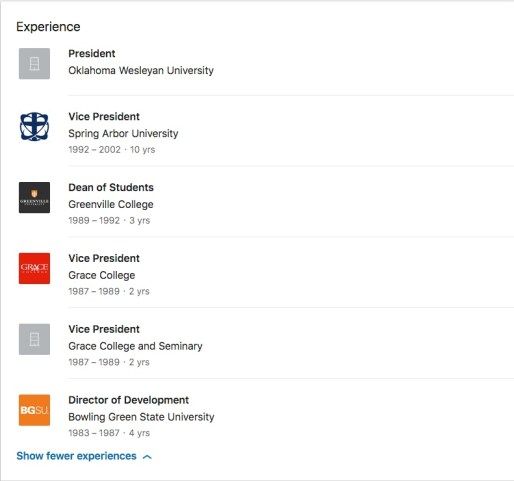
He grew up in a town of about 8,000 people and attended a nearby private school of about 2,000 people in late 1970s/early 1980s, when you weren’t required to hock an internal organ to pay tuition. Upon graduation in 1982, he took off for the work world, as you can see below:
So he graduated at the age of 22/23, immediately went into academic administration and never left. Not exactly the story his university tells about him:
A native of Hillsdale Michigan, Dr. Piper grew up in a family that valued hard work, a mindset he carried with him as he moved from industry into pursuing a college degree.
Not sure how much “industry” work he did between the ages of 18 and 23 while in school, but he wasn’t a returning student, or a single parent, or a GI Bill kid, or any of those other kinds of folks I see on a daily basis who work their asses off to survive. He might or might not be the prototypical example of a guy who thinks he hit a triple when he was actually born on third base, but he’s also isn’t a latter-day “Rudy,” either.
Piper’s proud defense of his university not being a daycare seems a bit suspect, as he is making money off the deal. He turned his “catchphrase” into a nice cottage industry of castigating the youth and yelling about the snowflakes on his lawn.
Also, consider this line from his letter to the masses:
If you’re more interested in playing the “hater” card than you are in confessing your own hate; if you want to arrogantly lecture, rather than humbly learn; if you don’t want to feel guilt in your soul when you are guilty of sin; if you want to be enabled rather than confronted, there are many universities across the land (in Missouri and elsewhere) that will give you exactly what you want, but Oklahoma Wesleyan isn’t one of them.
(The emphasis on those two statements is mine.)
If the irony of that first line doesn’t send your hater-ade filled soul into laughing fits, I don’t know what will. It’s easy to “arrogantly lecture” people, as Piper has clearly shown with his letter doing exactly that. Also, instead of dumping all over the kid who came to you with this concern about a Bible passage you likely understood far better than he did, why not help that little snowflake “humbly learn” what it meant instead of using the kid as a strawman to bolster your self-serving position?
(Side note:When someone tells me that something “actually” happened and “I am not making this up” in successive paragraphs at the front of a story, I’d bet money that person is making something up.)
(It’s even more amazing than when you have the ability to monetize your grousing…)
The second line (and any other similar phrase) always annoys me when it comes from people in a position of advantage. When is the last time University President and Almighty Deity of Knowledge Everett Piper was called out for his horsepucky? Probably back when people were rocking popped collars and jamming out to Duran Duran. It’s easy to say that people need to be confronted when you possess the power and position to do so, without fear of retribution.
The problem isn’t that Everett Piper exists or that he has created a nice little business out of shaming college students with the tone of a high-strung school marm. The problem is that he isn’t alone.
Each generation likes to blame the one before for its problems and dump all over the one after it for not being perfect. As mentioned earlier, people like to get together and complain about how “a student did something you wouldn’t believe…”
Like any other stereotype, it contains a kernel of truth. Like any other stereotype, you can beat it. And like any other stereotype, you should call it out when you hear it.
Don’t let Piper and his ilk decide that you damned kids and your hippity-hoppity music are ruining this world and that if we could just get “Happy Days” back on the air, life would be good again. Don’t let this guy sell books off of the assumption that you will crumble or melt or whatever the comparative is that Piper or the next chucklehead uses to deride your generation. When someone decides to grump in your general direction, use your finely honed interviewing skills to pick apart their self-serving rubbish and demonstrate your intellectual journalistic superiority.
Sure, there are self-absorbed twerps in college who will claim their goldfish’s death merits a six-week extension on an already late paper. There are also dingleberries out there who misapply triggers and trigger warnings to mean anything they would prefer to avoid, as opposed to the actual medical situation they are. There are plenty of examples of students that make us shake our heads until we develop neck cramps.
However, when you see something like this, written by someone like Piper, take a moment and smile. Think to yourself, “Gee, it must be so sad to think so little of the people you are supposed to help that your best approach to dealing with ONE QUESTION is to publicly rip AN ENTIRE GENERATION to shreds with a letter and then go write a book to pat yourself on the back for being superior to anyone under the age of 22.”
Then, go back to working hard to be better than this guy is. Commit yourself to being the antithesis of what he purports you to be. In other words:
Welcome to this edition of the junk drawer. As we have outlined in previous junk drawer posts, this is a random collection of stuff that is important but didn’t fit anywhere else, much like that drawer in the kitchen of most of our homes.
Let’s get going:
LET’S BE POSITIVE: For nearly two years, I managed to dodge, dive, dip, duck and dodge COVID, thanks to masking, my predilection toward isolation and getting every shot the doctor would put into me.
Last week, the streak ended, when I “started feeling weird” and Amy ran a test on me. It was supposed to take 15 minutes to post a result. Mine showed up in 3.
I spent the next seven days hunkered down in the milk house, trying to keep my family from getting it, which turned out to be a futile exercise, as Amy got it two days later. The initial cough was followed by full body aches, dry cough, fever dreams and more.
At one point, I woke up after 8 hours of sleep and my body literally wouldn’t move. I couldn’t command it to do anything, which naturally freaked me out. I fell back to sleep for another 8 hours and when I woke up I could move. It hurt like hell, but at least I was ambulatory.
I’m still half a mess, although the main symptoms have gone away. My mind doesn’t exactly work the way I’m used to yet and I’m exhausted by things like unloading the dishwasher or walking to the mailbox. I suppose this is a long way of saying, this is why the blog has been quiet these past couple weeks and please give me some latitude if I say something stupid on here.
HOT “SAID” SUMMER: I’ve wanted to share this for quite some time, as it captures the perfect feeling I get in reading intro media writing pieces when it comes to attributions. Shout out to Steve Chappell for his brilliance and meme skills:
MURDER-TRIAL JURY IS IN! FOR RESULTS SEE PARAGRAPH 128: I often quibble with professional journalists when it comes to lead-writing or the inverted pyramid. Pros tell me it can get boring to just tell people what happened or that there are more ways to tell a story than cramming everything into a 25-35 word lead.
I often push back with, well, you’re not writing to amuse yourselves, but rather to inform the people. Sometimes, we just want to know what the heck happened. And, yes, there are other ways to tell a story other than the 5W’s and 1H, so long as you are serving the audience.
I think we’re both right in some cases, but as the friend who sent me this article noted, “You have to actually know what you’re doing if you’re not going to use the inverted pyramid:”
I get that the story’s headline does tell the tale, but that’s not an excuse to basically pull a “Johnny from Airplaine!” in explaining what is going on.
PLEASE TELL ME WE DON’T HAVE A VIDEO OF THIS: I get that not every headline can be perfect, but you have GOT to be careful in structuring these things when they touch on delicate topics:
There are several ways to read this, and most of them are not good…
WHEN A BAD BREAK MEETS A BAD PAIRING: I get that some “junk drawer” type columns mix a lot of stuff from various parts of the news, but it’s probably always best to keep serious news in the serious bin and the more feature-y stuff in the feature bin.
At the very least make sure your headline break doesn’t send people who wish to end a pregnancy to Milwaukee’s Big Gig:
And Finally…
THAT’S THE SPIRIT! At the end of June, I finished up the main writing and editing on my latest textbook, “Exploring Mass Communication.” It’s an intro text that took about three years and 1,942 revisions to get to this point. With that in mind, I figured I’d take a little break until the semester started.
Two weeks later, we lost one faculty member to a gig in the dean’s office, another to a private sector job and I’m suddenly teaching mass com law. Of all the things I didn’t want to do, teaching law came in second (Chairing the department came first, so that’s how I got law, I s’pose… Well, that and I’m sure my department realized sending me out into the real world to talk to academics on our behalf made as much sense as peanut-buttering your car…)
With two weeks left before school starts, I need to build an entirely online version of a class I never taught, powering through on the reduced mental capacity of a COVID patient, all while making sure I’m getting ready for the rest of the term. Oh, and did I mention we’re up for our accreditation visit this fall?
I have been told it’s important to have the proper spirit throughout this, so here you go:
Needless to say, we’re going on break until after Labor Day unless something really dramatic happens. If you control dramatic things, please make sure they don’t happen until then.
I can still remember the exact conversation I had with my publisher that launched this blog five years ago this week:
Her: For this reporting book, we are going to want you to have a complete digital presence, so that means Facebook posts, a new Twitter account and a blog you’ll be running.
Me: Wait, what the hell do I know about blogging?
Her: You’ll learn. Anyway…
I initially hated this idea, because I saw it as a kitschy marketing idea that would have me constantly yammering about why people needed to check out the book and how cool stuff in there really is. I am many things (and students have no compunction about writing those things on Rate My Professor), but a “rah-rah” guy for my own self-interest is not one of them. Still, SAGE had been really good to me, so I figured I’d give it a shot.
Over that time, I learned a lot about blogging formats, posting schedules and that I curse too much for quite a few people. I also learned that in reaching out to an interested and engaged audience in a relevant and meaningful way, we could do some really good stuff together.
The Corona Hot Line is the obvious example of that. Between stuff I’d stockpiled and things people sent me, we built a pretty good collection of stuff that helped people teach online in a pinch during a life-changing pandemic. Someone (not at SAGE) sent me a note asking if “giving away all that good stuff” was smart from a “marketing and brand approach.” That thought never occurred to me and if it had, I would have punched it in the throat. The goal of this has always been to help people and if anything gets in the way of that, it gets removed, ignored or otherwise dealt with.
However, that collection of stuff wasn’t the best of what we (and that means you all and me) do here together. That hit home when I reported on my own university and its control of student media access to sources. After the big stories hit, I emailed the university marketing people for a quick follow up, only to find my email went up the chain of command and all over the place. The chancellor himself emailed me back a polite no comment, but not before a couple people had emailed my chairwoman with some, “What the hell is going on?” inquiries.
Again, another conversation ensued that stuck in my brain:
Boss: They’re very concerned about what you’re writing because it’s having a significant impact. You called someone out BY NAME and now there are ramifications for her out there.
Me: Really? They’re upset about me? I’m a chimp with a blog. I dress like a homeless elf. They need thicker skin or something.
Boss: You’re a prestigious textbook author with a blog that apparently can mobilize people to a cause.
Here’s the thing, and there’s no good way of getting around it: I still don’t know exactly what I’m supposed to be doing here. I kind of just do stuff and see what people think about it. My hope is that I’m doing something helpful every day, even though I know I have a few misses in there with the hits.
That’s where you all come in: I need to know what you want more of, less of, some of, or none of going forward. Hit me up through the contact link and tell me what you want going forward and I’ll do my level best to make that happen.
In the mean time, I’m going back to the once-a-week summer schedule until school kicks in. Then, it’s back to the grind.
I came home from the UWO graduation ceremony Saturday afternoon, in which I saw way too many of our students graduate to feel comfortable about our enrollment numbers next year, to find a wonderful gift in the mail.
Shirts, a bobblehead, a can cooler, copies of the paper, stickers and more. I felt like a kid getting a college package from home. The kids and Dr. Lewis wrote some wonderful notes as well that are now pinned to my corkboard at work.
As I take the annual summer blog break, I do so with a different feeling than I have the last couple summers. Exhaustion, anxiety, fear, anger and more have been the resting pulse so many of us have had over the past several years when we crash landed into that summer break we desperately needed. I know I’m not alone in the feeling that summer is often a time to just lick some wounds and try to reload for the next year.
This year, however, I find myself overwhelmed with gratitude as to where my career has landed me. I really am just lucky as hell and I need to remember that.
Students sought me out at graduation because they thought I mattered to them.
Former students still look to me for life advice, even as they are long from the days of the disheveled teenager who couldn’t make an 8 a.m. under penalty of death.
The folks at SAGE keep my books active and out there instead of letting them just wither away and get lost in the bargain bin.
Many folks assign my books for their class, making a change that requires them to revamp a class, just to give me a shot. (Side note: It feels really weird when I hear people use my name and a number together as an assignment: “Hey, I read in Filak Chapter 5 that…” Weird.)
You all actually read this blog, something I never believed would happen when we launched it five years ago.
Above all else, I have folks out there like Julie Lewis who are doing wonderful things with themselves, and even though it’s been years (or decades) since I taught them, they still think of me kindly.
That’s a hell of a gift, and one for which I’ll always be grateful.
Have a wonderful summer. Weekly posting will resume in mid-June.
Today’s post takes a look at things that go beyond the job hunt that recent grads told me they wished someone had told them before they graduated.
WELCOME TO WHEREVER YOU ARE:
I got a note from a former student who asked me about how to deal with “bad things.” She had recently graduated and was about nine months into her first career job. She was living in another state, in a small town in which she had never heard of prior to taking a job she loved.
After a few false starts of me guessing at what she meant, I picked up on a thread in her responses and asked, “Wait a minute. Are you feeling lonely?”
Bingo.
She had been actively involved in clubs, sports and other stuff while building an immaculate GPA at UWO. She was always on the go and always known wherever she went. Now, she was in a completely new place where she knew no one and she didn’t know how she was supposed to feel.
I had fewer friends, fewer interests and fewer people who knew/liked me when I made my first big move, but I felt similar pangs of anxiety. After my dad helped me move in, he spent the night before saying goodbye and leaving the next morning.
After he left, it dawned on me: Nobody here knows me at all.
(Side note thought: I could die in this apartment and nobody would notice until eventually I missed a rent payment or someone caught a whiff of decomp.)
I went from running constantly from 8 a.m. to 3 a.m. every day to working a nine-hour-a-day job and going home to… what? I took a lot of walks, bought groceries at normal times of day and generally looked for a place to fit in. It wasn’t easy, and apparently that was something others faced as well, given some responses I got from my former students:
It takes AWHILE to transition from being a college student to a working adult. Give yourself time and grace when going through this transition and don’t doubt your worth. You’ve got this.
Envision your life outside of work when considering a job – If you’re outdoorsy, does it have great trails? If you dig X, does it have X? The city has to pass the vibe check, or you’ll depend too much on work to bring you all your happiness.
Others noted that life got a little weird for them, living somewhere new, knowing nobody around them and generally losing that entire support structure of friends and family they’d taken for granted.
Friends and family are still there for you, just in a different way. It’s also an opportunity to spread your wings. Think about when you landed on campus four (or five or six) years earlier and how you didn’t know a damned thing about anything. It’s like that again, which sucks. That said, you survived and thrived in that once before, so the precedent is there for you to succeed.
WELCOME TO ROOKIE BALL
One of the hardest transitions people often make is from being the big cheese to the lowest of Limburger. It hit me hard when I took my first pro gig.
At the student newspaper, I didn’t get much editing. People generally said, “You’re great!” or at the very least, they had bigger problems to fix, so I kind of skated by with the assumption that whatever I was doing was fine.
When I got to the Major Leagues, I got a rude awakening. A lot of my copy was getting hacked and slashed. My source material was being questioned. My use of quotes was second-guessed. My overall ability to do a good job was under constant scrutiny.
At the time, I needed help, guidance and support, but I had a boss who had either no interest or no capability to provide those things:
(This editor can’t be bargained with. She can’t be reasoned with… And she won’t stop until you realize you suck!)
I eventually gained my sea legs, but I never forgot what it felt like to get my ears boxed in on a daily basis. Apparently, neither did some of the folks who responded to my post:
Imposter syndrome is real and it is awful.
Nobody knows what they’re doing… They’ve just been working through it longer than you have. Hang in there.
Being the newest person means everyone else has a leg up in some way… Be ready to work weekends and holidays.
You have to know what the rules are first before you break them.
It’s tempting when you’re new to think folks with more experience have everything figured out. The truth is everyone is making it up as they go along on most things.
In kind of pairing these previous two thoughts, something else a student mentioned resonated with me when it came to being the new kid: You’re often the youngest kid by a stretch.
The student who got me thinking about this issue told me she had this weird age gap thing. She was too old to connect with the people she covered (high school athletes) and yet too young to really connect with the people she spent time with (colleagues and the athletes’ parents). It felt like there was nobody her age to connect with.
For the majority of my career life, I was always the youngest person in the room. I was 21 when I got my first gig in a pro newsroom, 22 when I got my first teaching gig, 24 when I got my first professor/editor gig, 28 when I got my first tenure-track gig and so on…
Those early years were awkward, in that I often had nothing in common with my coworkers. The people at newsroom parties were talking about kids and soccer games and 401K accounts. Conversely, I was like, “Hey, uh… is that beer over there free for, like, anyone to take?” I was told rather bluntly that if I was caught “associating” with students, my boss would hide strap my ass to a pine rail and ship me out of town.
It wasn’t the easiest of situations in those early years, but it was even harder because I had nobody to talk to who was going through the same thing. Maybe that’s why still tell my students my door is always open, even after they graduate.
I know it sucks to be the rookie.
KEEPING UP WITH THE JONESES
Of all the advice the hivemind chipped in with, this insight needs to be screamed from the top of every mountain:
Try not to compare yourself to your friends who have seemingly better jobs. Instead of resenting the job you have, see what you can do to make it better – to make yourself better at it so you can easily move onto the next position.
During my doctoral program, I researched in the area of Social Comparison Theory, which examines the way in which people try to figure out how they stack up in a particular area of life by looking at other similar people in their area. I also watched it play out on a daily basis there as I taught kids at the journalism school.
It was a constant game of keeping up with the Joneses. If Bobby got a front-page article, Suzie needed to get the top article on the front page. If Jane wrote 40 stories in a semester, Carl needed to write 45.
It got even worse when they went after internship and employment opportunities. If Marco got an internship at a 75,000 circulation daily, Maria had to get an internship at a 100,000 circulation paper. If Nellie got a gig at a top 50 market TV station, Willie had to get one in a top 20 market.
I watched this transpire long after I left, with former students chasing each other up the golden ladder for no real reason other than to prove some level of superiority. I saw students leave perfectly good jobs to take on jobs that didn’t fit them because one of their peers had moved up a rank or got a gig at a larger publication.
In one case, a great student left a job where he was perfectly suited and wonderfully gifted as an editor in a smaller publication to chase other jobs that made no sense. He eventually ended up doing night cops at a paper in Kentucky, working for a mentally unbalanced night editor and feeling miserable. When I asked why he took the job, he cited two reasons:
The paper’s circulation was huge, comparatively speaking to his previous job.
One of his former cohorts had gotten a gig at some place “better” than where he was.
This made no sense unless you understand the competitive nature of the school, the kids and the field. I eventually got him to see that “better” is in the eye of the beholder.
I have friends that make more money than I do, but I wouldn’t trade positions with them under threat of death. I have friends with classier titles and bigger offices, but they also have more problems, or at least the types of problems I hate dealing with. I have friends who do a lot of things that, on paper, sound like they’re living a much “better” life than I am. However, I get a lot of stuff that can’t be measured on a spreadsheet and I’m relatively happy with a great portion of my life.
Every day is not an Academy-Award-winning performance, but it’s what I found works for me. I figured out that chasing someone else’s dream or trying to prove superiority by making myself miserable in my career made no sense.
A few other folks who chimed in on this topic made similar statements, saying they wished someone had told them to just worry about themselves and not chase the dreams of others. They finally figured out that comparing themselves to their former classmates made no sense and it made them miserable.
Once they settled in and just enjoyed being themselves, they found happiness.
THE FINAL ADVICE LIGHTNING ROUND:
Some of the best bits of advice didn’t really fall into a perfect category but it was so worth keeping, I figured this would be a good way to do it. So here comes the lightning round of advice:
Ask questions, ask for feedback, ask for what you need to succeed in a position and know that they hired you for a reason. And if that still isn’t working out, find something else that you love to do.
Know your worth and celebrate your accomplishments, achievements, and recognize the significance of your contributions. Don’t downplay them.
It’s very rare that in reality something is as high stakes as it can feel in the moment. After a fuck-up that felt career-ending for me but in retrospect did not matter in the slightest in the big picture, my boss told me “we’re not curing cancer.” And that’s stayed with me – very little is life or death, at the end of the day.
Your career is not your identity. It’s a reflection of you but it does not define you.
Well, that might not be everything, but I hope it’s a start.
If you have any other questions, comments or concerns, feel free to hit me up on the contact page.
Otherwise, have a great summer and best of luck in all you do.
Today in my reporting class, we’re watching the first film on this list, “Judging Jewell,” so I thought it would be interesting to go back and look at what I had here.
I’m still pretty locked in for my first, third and fourth picks. Given the more recent films I’ve seen and the suggestions of the hivemind, I might slip “The Post” in there for either two or five. I still like them both, but I did broaden my horizons.
I might also slip in one of the Fyre Fest documentaries, in that although they aren’t “journalism” films in the purest sense, they do demonstrate the importance of social media as a driver for social interests. Plus, it touches on how little reporting can go on with some stories, like those that made Billy McFarland an wunderkind. Or, to quote someone from one of the films, “I guess it doesn’t take much to fool a reporter these days.”
Still, read on and enjoy.
The journalism films you should watch if you want to be a journalist (Part I)
Journalism films are all over the place lately, as are documentaries about journalists. It seems like if a film can include a typewriter, somebody smoking indoors and a sense of “taking on The Man,” it’s on a screen these days. Seth Meyers did a fantastic send up of this on his late-night show:
In the 1970s, “All The President’s Men” became the “must-watch movie” for journalism students. When I was in college, we gravitated to “The Paper,” as we all seemed to know random guys like Randy Quaid’s character who bordered on insane. (One of my newsroom friends started calling me “Hackett” after Michael Keaton’s Coke-guzzling, workaholic character.) Now? It could be one of a dozen or more fictional, documentary or “based on a true story” films, so I dug back through IMDB and put out the question to the Hivemind on what was “required” watching for budding journalists.
Below are my “Top Five” films in no particular order with some rationale behind my picks. I tended to consider three things in each pick I made:
Did I watch it more than once because I liked something about it?
Does it give viewers something important in it, regardless of the genre or format?
Do I think students would actually watch this if they weren’t forced to and actually enjoy it?
Those considerations knocked out a couple films for me that others picked up on. I’m also quite certain it will have people screaming at me that I’m wrong.
In any case, here we go:
1) Judging Jewell (2014, ESPN: 30 for 30) – At shade under 22 minutes, this story packs a lot of lessons into a short space. In 1996, a bomb shattered the peace of the Olympics in Atlanta, Georgia, killing 2 people and injuring more than 100 others. This could have been much worse had it not been for the heroic actions of Richard Jewell, a security guard who was working at the Games for AT&T. Jewell spotted the package and began moving people away from that area before the bomb detonated.
Jewell was originally considered a hero, but the media turned on him when public sentiment held that Jewell was likely the bomber. What followed was an 88-day “trial by media” that demonstrates what can happen when the race to get the story becomes all-consuming. (My favorite lesson comes from the Atlanta Journal-Constitution, which ran a line about how Jewell “fits the profile of the lone bomber,” and why attribution matters so much in news writing.) Jewell was eventually exonerated, as terrorist Eric Robert Rudolph was captured and confessed to the bombing. However, Jewell never really recovered. This is a sad story and yet a good cautionary tale for journalists.
2) Spotlight (2015)– Critics have compared this film to the classic “All The President’s Men,” in that it shows how reporting can bring down a powerful institution. It also has similarities in the ways in which the journalists had to engage in real “shoe leather” reporting to make this happen. The critical nature of sources, fact checking, working around problems and other things journalists pride themselves on are on full display here. One of the more interesting things is the early resistance from within the paper when it comes to “going after” the church. Although, like most “based on a true story” movies, we know how it will end, the tension that comes from the fear of being wrong makes this both a tale of aspiration and one of caution.
3) Shattered Glass (2003) – In between his stints as a young Anakin Skywalker, Hayden Christensen portrayed another character drawn to the dark side. Stephen Glass was a young, well-liked journalist at The New Republic when he engaged in a series of fraudulent behaviors that shook the magazine to its core in the late 1990s. Glass started by faking a few quotes here and there before eventually writing pure fiction and passing it off as fact. The epilogue of the film notes that 27 of the 41 pieces he published during his time at the magazine were partially or completely made up, not to mention fabrications he freelanced to a number of other publications.
Some aspects of the film, which is now 15 years old and based on an incident that happened two decades ago, don’t age well for younger viewers. The idea of having to use “every search engine on the web” to get information seems quaint, as does the discussion of the fear associated with an “internet publication going after a giant.” That said, the lessons are fantastic.
At some point in life, almost everyone has wanted to be “the cool kid.” Glass fell into that trap, as you can see in the “60 Minutes” interview below. He loved the attention and would do anything to get it, including wandering down a path of self-destruction.
I would also wager, most people also have found themselves in a jam at some point and thought, “If I just cut a corner here, I could get out of this alive.” Some do it and convince themselves they’ll “only do it this once.” Like most other things that are horrible for you, it’s never just once. If you take the Red Pill, you never hit the bottom of the rabbit hole. Even today, Glass is still dealing with his past.
4) The Paper (1994) – It’s fiction, it’s ridiculous in spots and yet it is one of the few films that captures the complete randomness of life in a newsroom. From the A/C that breaks to the guy who swears he has “Watergate” on every story, this is a funny story with a great cast. If nothing else, this scene just nailed it for me:
“Who the hell took my stapler?”
If I had a dollar for every time something in a newsroom made me laugh, I’d be able to fund all the newspapers in the world forever. This movie reminds me of that every time I watch it. Probably a biased pick, but give it a look and tell me I’m wrong.
5) Nobody Speak: Trials of the Free Press (2017) – A wrestler, a sex tape and sleazy internet publication are at the central junction point of this film and perhaps the most important free-press case in decades. The movie looks at the trial of Bollea v. Gawker, which pits wrestling star Hulk Hogan (aka Terry Bollea) against an internet gossip magazine. Gawker was a publication that a lot of people hated for being mean-spirited and snotty, but it also went after “true things about bad people” to quote a former worker. However, at the heart of this case and this film are several crucial questions including, if a sex tape is news, who gets to decide that and what forces are at play behind all of this.
The film goes beyond the “guess who saw the naughty stuff” issue and digs into who was funding Hogan’s legal team, what other multi-millionaires are out there potentially undercutting press freedoms and what this means going forward.
Feel free to tell me I’m wrong about everything, if you so choose.
“There’s two kinds of dumb. The guy who gets naked and runs out into the snow and barks at the moon, and the guy who does the same thing in my living room. The first one don’t matter. The second one you’re kinda forced to deal with.”
Journalists at universities are essential to keeping the public informed on campus activities, whether through reporting on mundane affairs or acts of impropriety.
Administrators at the University of Wisconsin Oshkosh have impeded this function, imposing an onerous process on reporters, including student reporters, who want to interview university employees.
Journalists at The Advance-Titan, an independent student newspaper at UWO, maintain they must go through particular steps in order to secure an interview with university employees. While university officials have refused to outline the details of this process in writing, these hurdles have been in place for at least two years and impose a constant barrier to the work of the paper’s journalists, whose reporting focuses on UWO and its personnel.
FIRE stands for the Foundation for Individual Rights in Education and its mission is “to protect fundamental rights on campus concentrates on four areas: freedom of speech and expression; religious liberty and freedom of association; freedom of conscience; and due process and legal equality on campus.”
I’ve worked with them on a couple occasions in various areas of student press and found the organization to be really interested in making sure people’s rights don’t get stepped on just because they work or learn on college campuses. The folks there aren’t above being a tad hyperbolic, but I haven’t known them to be flat-out wrong on something. I’d heard rumblings similar to those FIRE described from former and current students about “having to go through UMC to get an interview” with pretty much anyone on campus.
Still, journalism is the field in which if your mother says she loves you, you go check it out. So, I read the article, dug into some research, talked to a couple students and then reached out to the head of the University Marketing and Communications department, Peggy Breister.
Breister has worked in UMC for about five years at UWO, currently serving as the department’s executive director. She also has news chops, having spent 25 years of reporting and editing experience in our state and having earned a bachelor’s degree in journalism from the University of Minnesota. I asked for an interview, but added that I knew she was busy, so I included a number of questions about the FIRE story, the university policies and the situation at hand in case she wanted to type up some stuff.
She responded via email and here’s a chunk of her response:
We ask media to contact us when they would like to do a story about the University. We are here to help reporters connect with the individuals who can best respond to their questions. We have not changed our practices. Since the A-T is the media, we feel we should work with them in the same way that we work with other media.
We don’t require the A-T to provide us with written questions, but that is often the way we receive their initial requests, often due to deadline, or it is what is requested of us by the individual they are seeking to connect with. Reporters are welcome to request interviews, send questions via email, etc. We do not pre-approve questions or responses. We do try to clarify vague requests to help us identify the topic and appropriate source.
We try to make connections so requests can be responded to quickly. I think we have been very responsive. The A-T also does many stories that we are not involved with.
Several things concerned me with this response:
THE NON-ANSWER: I know I don’t always ask the best questions, but I think I was pretty clear with this one:
What is the explicit policy regarding student journalists and access to university employees? Is it true that all their requests must go through your office?
I spent at least five minutes playing a game of “Where’s Waldo?” with Breister’s response, trying to find a simple yes/no answer to that second part and some clarity for the first one. In regard to the first part, Breister responded by pointing me to this part of the university website, which isn’t so much of a policy as it is set of vague tips on how faculty can talk to media folks about stuff.
In regard to the second part of the question, I got about four half-answers to completely different questions: We prefer if media folks contact us. The A-T gets the same treatment from us as we give to other media outlets. We never ask for questions from them in advance. We’re working really hard here.
All of those things might be true and yet none of them really addresses the important issue, which requires a simple yes or no answer. Or, as I explained it to a equally peeved colleague: “It would be like if you asked if I thought you were a good classroom teacher and I responded with, “Well, there’s no doubt you’re here at a University, and nobody ever questioned your research skills and I know you think teaching is really important.”
Eeesh.
THE NON-DENIAL: The FIRE article really lays it on thick when it comes to allegations of First Amendment denial, information hoarding and generally weaselly behavior. As someone who prizes objectivity and fairness in journalism, it was a bit disturbing to me to see no mention of trying to get UWO to comment or trying to check this out with the university. I appreciate the heat FIRE likes to bring, but let’s play fair. So, I gave Breister a shot:
What is the rationale behind limiting access in the fashion the FIRE article describes? Or if you feel the article is inaccurate, please feel free to explain the inaccuracies here…
Nowhere in her email did she address the FIRE article, either to agree with it or to refute it. The closest she came was this:
I guess if a national organization dragged me to the middle of the internet and started smacking me around, I would like to think I’d stand up for myself. Or, if they were right, I’d issue some sort of explanation as to how sorry I was about it or that I’d do better or whatever it is we make people say these days so they don’t get put in Twitter Jail.
Maybe that’s just me, but not hearing a full-throated defense of my own institution made me a bit queasy.
THE RAMIFICATIONS: In reading through that email, I saw the lack of a clear policy, and that created problems for me on two fronts.
First, as a student-press advocate and journalism educator, I was concerned how this was going to impact my students. I don’t advise the paper anymore, but I send plenty of kids into the field for class assignments that get published there or elsewhere. I train them to go to sources for interviews and get answers from people who have them. Any restrictions that prevent these journalists from getting to those sources is worrisome.
Second, as an employee of the university, I know I’m governed by a lot of policies and rules. I also know that I’ve been interviewed for more than a few stories over the years, both through UMC hookups and from folks independently reaching out to me. If there’s a rule as to how I’m supposed to deal with something, I’d like to know what it is before I accidentally violate it.
Also, I’d like to know what the penalty is for breaking that rule. Contrary to popular belief, me having tenure doesn’t mean I can show up dressed like and acting like Rahad Jackson. Even more, there are plenty of people out there without tenure who would be operating under this policy, so that’s a concern.
So, I pushed back with two pointed questions that sought yes/no answers about the university’s policy regarding interview-seeking behaviors and the veracity of the claims of FIRE. I also provided this simple explanation for my concerns:
I guess what concerns me most is that student journalists (even those in my classes who aren’t operating student media outlets) are being told they HAVE TO go through UMC for anything on campus.
If that’s not true, let’s disabuse them of that notion and make it clear that UMC’s job is to help facilitate interviews when journalists need that help. I’ve worked with UMC many times at multiple universities over the years where some TV station wanted a professor who knows X and the UMC played matchmaker. That’s totally acceptable and makes sense.
If, however, it is a situation where the students ARE being told that public employees at a public institution are being actively withheld from them unless they go through UMC, lest some form of punishment (whatever it is… lack of access… a stern talking to…) befall them, that’s different.
If you can more clearly answer those concerns, it’ll make things a lot easier and simpler for me when I’m teaching the students and working with student journalists in various capacities.
Breister was clear in her response:
Hopefully this information will help you in your contacts with students:
UMC has guidelines related to media relations that we ask people to follow.
There is no policy, nor is there a penalty for not working through us.
OK, fair enough. I have worked in journalism, student media, education and parenting long enough to know that a lot of wires can get crossed over time and what I say isn’t exactly always what someone else hears. Let’s give each other the benefit of the doubt, right? Bygones be bygones and all that…
So, I forwarded this to the one student who had been helpful to me as I tried to iron out what was “suggestion” and what was “required,” hoping this would close the book on the situation. If nothing else, it’s a good note to have on file for any future staffers.
Then, someone forwarded me this email between Breister and a former editor of the paper that just pissed me off:
Well, shit, sheriff, I guess this changes things a tad…
TOMORROW: What has happened, what needs to happen and what should be done about this situation.



 Last week, the streak ended, when I “started feeling weird” and Amy ran a test on me. It was supposed to take 15 minutes to post a result. Mine showed up in 3.


