The Four-Word Interview Rides Again (A Throwback Post)

Today’s post was sparked by a Facebook memory that reminded me both how damned old I am and how lucky I am.

My dad took the above picture 16 years ago today, just after I purchased my first mid-life crisis vehicle: A 1968 Ford Mustang. Dad knew it was the right thing to do as we were taking a test drive. (I can’t repeat exactly what he said here, as the editors at Sage might have their heads implode, but trust me, it was accurate recognition of pure joy.)

The old part should be obvious, but I want to quantify the lucky part.

I’m lucky that I’ve got a wife who told me, “Go get it. We’ll figure out the rest later.” I’m lucky my dad, who always “had a guy,” could take it to a mechanic to get an honest review and then help me go get it. I’m lucky I have a mom who helped me understand that everyone needs some joy in their lives, or else life isn’t really worth a whole lot. I’m lucky I have a job where a car like this wasn’t going to negatively impact the family or what we need to do to survive.

Beyond that, I wanted to say I’m lucky to have the opportunity to converse with you all on a weekly basis. Yesterday’s post had a number of people I’ve never met reaching out to tell me, “Thank you! I’ve been complaining about (FILL IN THE TOPIC) for a while and maybe the kids will now listen!” I’m lucky that I’ve got the folks at Sage, especially Staci Wittek, who is constantly finding ways to tell people that what I write is good for their students.

Not everything is roses and sunbeams in life, but I will say that when I would get behind the wheel of that car, a lot of the anxiety or distress that comes from all the world’s problems just kind of melt away a little bit.

For that and everything else good around me, I am grateful.


The Four-Word Interview

262061_2304935341586_1282884_n
(The subject of a four-word interview.)

I stopped off to get gas this morning when a man in his 70s approached me.

“What year?” he asked, pointing to the Mustang.

“’68.” I told him.

He nodded. “Nice.” He then got in his truck and drove away.

In the simplest of terms, this was a perfect interview and the whole thing took four words.

In all the reporting and writing classes I have taught, the biggest problem students tell me they have is interviewing. They don’t know what to ask or how to ask it. They feel awkward talking to other people or they get the sense that they’re being pests. They would rather just email people and hope for answers instead of approaching people in public and talking to them. This is why interviewing features prominently in both the Dynamics of Media Writing and the Dynamics of News Reporting & Writing.

Interviewing is a skill and like any skill, you need to practice it to become better at it. That said, it is important to understand that every day, you conduct dozens of interviews, so you are probably better at it than you think you are. You ask your roommates how their day went, you ask the waitress what the special of the day is and you ask your professor, “Will this be on the test?” If you don’t think of these interactions as interviews, it’s because you are overthinking the concept of interviewing.

The purpose of an interview is to ask someone who knows something that you need to know for the information you seek. When you get that information, you do something with it. The guy at the gas station wanted to know one thing: What year Mustang was I driving? He figured the best source was me, the owner of the car. He asked a question that would elicit the answer he sought. He got his information and he moved on.

Interviewing as a journalist can seem much more complicated than that, mainly because you have to do a lot of preparation, you need to troll for quotes and you need to figure out how the answers fit in the broader context of your story. That’s all true, but if you start with the basic premise of “What do I need to know?” your interviews can feel more natural and less forced.

Terrible tragedies occur when shots fired by armed gunmen ring out (A throwback post)

A newspaper of note sent me an alert recently that told me that police were engaged in an  “active investigation” near on the campus of my alma mater.

When I noted on social media that I’d give anything to know if police were ever in the middle of a “passive investigation,” a mentor messaged me a few more stupid terms that needed to die in the fire of journalistic hell.

(My favorite remains “armed gunman.” If you ever see a guy with no arms holding up a bank with an uzi in his mouth, I’ll back off on this one. Until then, knock it off.)

When police were investigating the Charlie Kirk killing, he sent along one more term that was getting a lot of use:

If you have a “to do” list, please add the “shot rang out” cliche. God I hate that.

The wall-to-wall coverage of Kirk’s death seemed to find as many ways as possible to weave that phrase into the mix, along with one of the problematic phrases listed below (terrible tragedy). Thus, in hopes of getting the message across this time, I dug up the list of bad terms and phrases that really need to go away immediately if not sooner.


An Unprecedented List of Radical, Breaking News Items that Need to have their Ticket Punched to the Ash Heap of History

Every so often, we hit up the Hivemind here for words that are getting used way too frequently for no really good reason. Without further ado, here is the list that emerged from our most recent visit to cliche town:

Unprecedented: Between the pandemic, the Trump lawsuits and the trend of cooking chicken with Nyquil, we are the point where the bar for something receiving the “unprecedented” label is pretty high. At this point, it better be Jesus riding a unicorn while throwing tacos to his followers.

(And thanks to the AI artists program, we actually can check this one off our bucket list of “unprecedented” things.)

You’re welcome. Now, go find something else to use in place of this word…

UPDATE NOTE: Since AI is advancing at a ridiculous rate, I gave this prompt another shot and got the image below:

(I’ve gotta say, we got a much better Jesus and unicorn, as well as some minor improvements on the followers but apparently AI is still having problems with tacos. At best, those are pitas or loaves of unleavened bread…)


Miracle (sports): I’m sure it was a great game or an incredible comeback, but unless the seas parted between third and home or loaves and fishes multiplied in the end zone, we can stop with this.

Radical (political ads): Did the candidate threaten to castrate guys with tin snips in the parking lot of an Aldi’s as part of their plan to limit the needs for abortions? THAT’S radical. The rest is just stuff you don’t like.

Squash (legal term): It is not. You quash a subpoena. You squash a bug. Or you plant a squash.

Agenda (political ads): I’ve yet to run into a politician who has a fully formed set of motives and efforts that they’ve outlined and subsequently enacted, which is the literal definition of an agenda. In most cases, it feels like this:

Punched their ticket to: Nobody punches tickets anymore. I can’t even get a paper ticket so I can keep the stub as a souvenir. I think if the bands you’re seeing are old enough to qualify for Social Security, the fans should be allowed to request paper tickets. And those will still remain unpunched.

Phone ring off the hook: Phones no longer have hooks. They rarely ring. I get that “Phone buzzing off the desk” doesn’t have the same feel, but maybe just take the next train out of Clicheville… I bet they’ll punch your ticket on the way out.

Weaponize (politics): If you accuse people of “weaponizing” race or gender, they’d better be able to launch a missile out of something. Same thing with anything else we “weaponize.”

Officer-involved shooting: Tell me the cop shot someone or that someone shot the cop. Active, not passive.

Breaking news: It’s not breaking just because you finally figured out about it. Also, it’s not breaking news just because you want to tell me something now. “Breaking news: I just started writing this blog post… More at 11…”

Parlay: By definition, it is, “a cumulative series of bets in which winnings accruing from each transaction are used as a stake for a further bet.” You did not “parlay initial success” of anything into anything else. Unless you could lose that success, stop it.

Brandish: It requires a waving with a flourish, usually in anger. The robber with the gun in his pocket didn’t brandish anything. Unless he broke out into show tunes with a dance number…

Parents’ worst nightmare: Really? We sure on that? I just finished watching the Netflix series on Jeffrey Dahmer, and I lived in Milwaukee during that whole time period, so I’ve got a pretty high “nightmare” threshold. I’m sure whatever happened sucked, but if you spent any time in my nightmares, you’d probably not be talking about a kid not answering a cell phone on time in that regard…

Iconic: A friend notes this article on Ben Affleck and a nap as the moment “iconic” jumped the shark. (Another phrase we should stop using, probably, unless this happens again…)

Unique: It means one of a kind. Unless it’s a snowflake or the Hope Diamond, find a different descriptor.

Ash Heap of History: Unless we really are burning the books, stop using this to describe things we stopped using.

Worth noting: Translation- “I don’t have this from a source, but I want to tell you something.”

Terrible tragedy: As opposed to what? Those fantastic tragedies that make us all happy to be here?

Incident (cop speak): “Police responded to an incident in which…” We know it’s an incident. Everything is an incident. Me typing right now is an incident…

“Can You Libel a Disaster?” (And several other questions that came to mind after The Atlantic gave Ruth Shalit Barrett $1 Million)

Ruth Shalit Barrett received more than $1 million after suing The Atlantic for defamation, based on its approach to retracting this story. For that kind of money, they must have said this is a photo of Barrett drowning a couple dozen kids in a pool laced with electrical lines. 

THE LEAD: When in doubt, sue somebody, because it apparently works:

The Atlantic quietly agreed to pay more than $1 million early this summer to settle a lawsuit by the writer Ruth Shalit Barrett, who had accused the magazine of defamation after it took the rare step of retracting an article she had written and replacing it with an editor’s note, according to a person with knowledge of the settlement.

Ms. Barrett, who wrote an article about youth sports in wealthy areas as a freelancer for The Atlantic in 2020, sued the publication and one of its editors in January 2022. She said the outlet had smeared her reputation and asked for $1 million in damages.


DOCTOR OF PAPER FLASHBACK: I was working on another post over the weekend when I noticed a post I wrote several years ago about Barrett’s article and subsequent lawsuit was getting heavy traffic for no apparent reason. A quick Google search of her name helped me figure it out.

At the time, I figured there was NO WAY this thing was going anywhere. The strength of my prediction powers is also why I suck at Fantasy Football.


THE DETAILS: Barrett wrote a story about niche sports that rich parents were pushing their kids to enter, in hopes of gaining an edge when the kids applied to Ivy League schools. The story had a number of problems, including an anonymous source that wasn’t that anonymous, the creation of a kid out of thin air, the exaggeration of an injury to a kid during a fencing match and more.

Eric Wemple of the Washington Post dug into this story and started finding more and more things that didn’t make sense, something the editors of The Atlantic also began to notice. At some point, they decided, “Screw it, we can’t save the patient” and retracted the story with a lengthy editor’s note about the story and Barrett’s history in media.

As a result, Barrett filed the suit, arguing that the note defamed her in several ways. She asked for it to be rewritten and that she be given the story’s publishing rights. The two sides went to arbitration, leading to some edits to the note and a lot of cash.


A FEW QUESTIONS: In reading this over and over again, I found myself asking several rhetorical questions, one of which was, “Can I sue Sage for no good reason with the hopes that they give me a squillion dollars to go away for a while?”  While the answer to that one marinates in your mind, here are a couple others:

CAN YOU LIBEL A DISASTER? I’m not calling Barrett a disaster for obvious reasons, not the least of which is I don’t have a million bucks I want to throw away. I’m more or less wondering how we started with a story so bad that it required a full retraction and ended with a pay day of this nature.

The publication stated it was aware of her history of not quite exhibiting the best level of judgment in regard to journalistic integrity. Wemple dug a bit deeper into her life and found more than a few clinkers along the way, including problems with the story on these weird sports. The fact checkers were lied to in at least two cases, with one source being encouraged to lie. (The original note said “at least one” while the new note says “one,” a distinction without merit from a language position. Also, who told you it was “only” one? The person you initially found was involved in all the lying and encouraging others to lie, so… um…)

Courts have ruled on a number of occasions that certain people and situations are “libel-proof,” in that nothing further can be done to harm their reputation. In addition, courts have stated that libel doesn’t apply if only “incremental harm” can be demonstrated. In the former, the courts basically say that someone or something is so bad, any statement that might be libelous toward any other person or group won’t qualify as libel. In the latter, it’s like a person in prison for 10 counts of murder sues you for reporting that they have a dozen unpaid parking tickets.

In looping back to this situation, I fail to see how the changes to the note or the statements regarding Barrett improved the situation to the point of avoiding libel. The distinctions in here feel to me like the quote in “Great Balls of Fire!” when someone yells at Jerry Lee Lewis that  he married his 12 year old cousin, Myra, to which she retorts, “Second cousin, twice removed!” Oh. Well.

The question of how bad was the defamation in relation to what was already out there has me pondering what level of reputation she recouped as a result of the suit. In short, do people who thought poorly of her now think better of her after this? Or did people who thought better of her before the retraction think worse of her AFTER that retraction?

Or did the big check just make things better?


WHEN DID GP GO MIA? I seem to remember a time, not so long ago, when people did things on “GP” or “general principle.” In other words, it was standing up for the right side of something or holding someone to account for something, even if it would be easier to just throw in the towel.

Case in point, my parents told me when I first got my license that if I got a speeding ticket, I’d lose my right to drive for a protracted period of time. No muss, no fuss, no BS. Just put the keys on the table. Sure enough, when I was 17, I was ticketed for speeding along a stretch of road that was a notorious speed trap. I walked into the house, put the ticket on the table, dropped the keys on top of it and that was that for a while.

What my parents DIDN’T foresee was that I was involved in about 912 activities that required me to be at various locations at night and on weekends. It would have been far easier for them to just give me back the keys and let me drive myself. However, Mom and Dad dug in and ended up driving me to and from all those things until the predetermined punishment time had ended. It was inconvenient for them, but they decided the principle of the thing mattered. I learned a lot from that and have since avoided speeding tickets, although now that I’ve said that, I’m sure I’m getting nailed on the way home.

The larger point is: When did we stop fighting just because the fights were hard? We’ve recently had the “60 Minutes” lawsuit, the ABC lawsuit, and several other lawsuits that have the “Fourth Estate” folding like a cheap cardboard box in a rainstorm. It’s like, “It’s cheaper and easier to just pay people to go away.” Well, that’s like paying protection money to the mob, assuming it’s a one-time thing.

It’s not just the news business, but it seems like we fold up everywhere: A kid threatens us, we change a grade. A social media “influencer” pulls focus onto a post we made, we take it down and apologize. Don’t even get me started about what the kids are doing in the ice cream aisle at Walmart these days. What happened to standing on principle?

There are times where I go into a situation knowing full well I’m going to lose and there are other times, where the risks are pretty damned high that I will. Still, there’s something that says, “No. You aren’t folding. You’re gonna play this hand out, because you can’t live with yourself if you don’t.”

I feel this moment so deeply

I understand that money is a predominant factor in pretty much everything in the world today and I know that it’s easy to say what I would or wouldn’t do when it’s not my money to spend. That said, I think back to the people I admire the hell out of in this business, who would never have acquiesced as easily as it seems like so many people are so willing to do.

Eight Years a Blogger: Come for the knowledge, stay for the snark

It’s hard to believe this thing is still going after eight years, kind of in the same way its hard to believe that the almond-colored refrigerator with the faux-leather texture and Bakelite handle that your parents bought in 1983 refuses to die. I always figured Sage would have decided I was more trouble than I was worth by this point, or I would have run out of bits of wisdom, weirdly effective exercises and opportunities to mock god-awful mistakes in the media.

Oddly enough, that’s hasn’t happened. And speaking of exercises, if you still want to get in on Dr. Vinnie’s Bin of Exercises and AI Joy, feel free to hit the link here.

This semester is guaranteed to be a little off as far as the blog is concerned, in that I found out last week I will need to teach a fifth class this term. It’s the second of the five that I’ve never taught before in my nearly 30 years of college teaching and the third of the five that’s not in my area of expertise.

Why, you might ask… Well..


The relative insanity that this blog provides me might be my only salvation, so let’s get started with a few thoughts to brighten your day (and allow me to blow off developing a giant roster of PowerPoints and podcasts I will likely use only once in my lifetime):


STUIPD IS AS STUIPD DOES, TOO: In digging through a ton of examples I wanted to use for the upcoming classes I am prepping, I was stunned at the level of general incompetence when it came to making sure things were edited before they went out. I’m not talking about internet memes or mom-and-pop operations posting on an AOL-Dial-Up-Friendly website. I’m talking about actual organizations with money and staff support.

The number of missing words, misspellings and generally bad writing made it tough to find quality examples for the kids. I mean, I can’t exactly say, “Here’s a great press release, if you ignore the three misspelled words in the lead and the sentence structure that makes Tarzan look like Shakespeare.” Of all the blunders out there, I had to highlight this one:

If you are in the state, promoting the state and having a fair for the state, the least you can do is spell the name of the state properly in the headline…

Also, for the sake of irony, I found this job posting for an entry-level PR position with these two key bullet-points back to back. And I SWEAR I didn’t PhotoShop this:

I looked at it three times and thought, “Is this like one of those tests where they try to trick you? Like that one speed test where you are supposed to read the whole set of directions first, so that you figure out you only need to do the first thing on the list?

Or do they just really need proofreaders that badly?

Speaking of someone who needs a proofreader:

If you really need something that big to house that item, I feel sorry for your significant other…


DID THAT REALLY JUST HAPPEN? I’ve frequently noted that paranoia is my best friend, so much so, that I often find myself doing double-takes on things I swear I saw that turn out to not be as bad as I thought. It usually comes up when I see a sign for “angus” burgers or “first-hand jobs” or something where my mind drifts to the terrible error, even if there isn’t one.

That said, this Milwaukee Journal-Sentinel headline on my phone really should have freaked out a couple people somewhere at the newspaper:

For starters, that’s not Cavalier Johnson unless I have officially gone blind from computer monitor radiation. Here’s his official city photo:

I have no idea who the dude at the podium is, but Arnold Schwarzenegger and Danny DeVito made a more convincing set of Twins than the two people in the photos above.

Second, and this is really what caught me, that has got to be the worst headline break any human or computer could have made with this story. When I saw that “Johnson speaks with black talk,” I think my brain broke, before remembering Robert Townsend’s spoof of how white people do stupid stuff in Hollywood.

I understand that everything can’t be perfect in every publication, but I also know there are certain topics that need a little more attention and care, due to their sensitivity and the long history of insensitivity associated with them. This is one of those where someone fell asleep at the wheel.

Conversely, sometimes we can really go a bit far in clarifying things for our readers:

Thanks for the clarification, CNN. Otherwise, I might have been confused…

And finally…

I, (FILL IN NAME HERE), AM HAPPY TO HELP (FILL IN NAME HERE): As is the case every semester, I got a series of “could you please squeeze me into your full Writing for the Media class?” emails over the past couple weeks. The excuses are usually the same (I missed my registration day, I accidentally dropped it, I died while donating my heart to my cousin, but thanks to revolutionary bionics, I’m back now…) as are the ramifications they use to nudge me in their favor (I need this to graduate, I can’t move on with out the class, I’m planning to join a biker gang but they won’t take me without a bachelor’s…)

This one came oh so close to moving me…

Look, AI can be helpful in some cases, but your really gotta meet it halfway…

And off we go on another semester-long adventure. Let’s stay safe out there…

Vince (a.k.a. The Doctor of Paper)

Goodnight, Cliff Behnke. There will never be another one like you.

I bogarted this photo of Cliff from the obit. I’d argue “fair use,” but I probably wouldn’t argue it with Cliff.


Cliff Behnke, the former managing editor of the Wisconsin State Journal and generational journalist, died Sunday in Madison at the age of 80.

The irony of this piece is that it’s impossible to explain Cliff without resorting to cliches, a writing failure the man himself disdained.

Cliff despised lazy writing and wasn’t above telling writers how much redundancies, passive voice and unneeded descriptors displeased him. However, if there is one thing anyone who worked under him knew he hated most, it was cliches, so much so that the concept led his obituary this week:


Spring never sprung under Cliff Behnke’s watch.

“White stuff” didn’t fall in winter, and no reporter ever dared refer to Thanksgiving as “Turkey Day.”

Behnke was a stickler for detail and standards during his four-decade career at the Wisconsin State Journal.

(I managed to pull off a minor miracle once in a weather story when I used the phrase “a white, wintery mix” and Cliff never said a word.)

The cliches really did tell the tale of Cliff, as everyone in Barry Adams’ fantastic obituary seemed to use one now that Cliff could no longer stop them.

He was an “old-school editor,” in that he prized big-picture accuracy, clarity and value while simultaneously picking at the details that would rob a piece of any of those things. He was “no nonsense” in that staffers knew him to be serious and direct, focused and fair as he kept the newsroom moving forward. He was a “newspaperman in the best sense,” spending far more time in his college newsroom than his classes and helping to shepherd the state’s official newspaper throughout the salad days of print journalism.

In reading Cliff’s obituary, one fact discombobulated me: His age. I was in my early 20s during the three years I spent working the night desk at the State Journal. That would have put Cliff in his early 50s back then, which is where I find myself now. I can’t square those numbers, given that I have neither the skills, the seriousness or the stature that Cliff had at this age, never mind how he terrified staffers in a way that is almost impossible to explain.

I feared Cliff, as did a number of the folks quoted in Adams’ piece, but not in the cliche way usually associated with “old school” editors. He never yelled at me, nor did he have a large physical presence that had me afraid of violence. He didn’t break out a string of colorful curse words when dressing me down.

(Cliff was always on the lookout for stray curses making it into the paper. I remember him calling out a sports story that contained a quote like, “We played a hell of a game.” Cliff’s restrictions on cussing in print would make a 1950s all-girls boarding school look like a biker bar. It took at least three phone calls for us to run a quote in one of my stories about a riot with the quote “F— the pigs!” in it. And, yes, that was WITH the dashes.)

Listening to Cliff’s assessment of my screw ups was like watching a ninja throwing razor blades at me. It was just slice, slice, slice until I fell into 1,000 pieces. It could be about something big or about something small, but I still remember (and refer to) a number of them.

In one case, it was a redundancy. I was writing a photo caption about a model train railroad show when I felt the presence of Cliff lurking behind me. He began simply enough:

“Can you imagine if there were 88 model railroad layouts that were EXACTLY the same?” he asked.

“Huh?” I replied, unsure as to if I was having an out-of-body experience because Cliff was talking to me.

“Do you think it would be possible for a group of people to build 88 IDENTICAL model railroad layouts?” he said in that calm, metered voice of his.

“Uh… No?”

“Right. So why are you telling me that there are 88 DIFFERENT model railroad layouts in this cutline? Of course they’re different. That’s redundant.”

He then disappeared almost as quickly as he showed up and I still haven’t forgotten that lesson.

I also never forgot the time I should have been fired for screwing up a brief, in which I reported that a guy was dead when he wasn’t.

It wasn’t bad enough that I screwed it up, but then the local radio stations did their “rip and read” journalism on the air, letting EVERYONE know the guy was dead when he wasn’t. Our competing paper also used to love to crib our stories and then claim they had an “unnamed source” that confirmed the info, so those folks also amplified the story. It turns out everyone was wrong because I was wrong.

The man’s wife was getting condolence calls from people who saw or heard the “news” and she freaked out that the news people knew about his death before she did. After a complete clustermess of a situation, I got called into Cliff’s office for what I assumed would be the end of my journalism career.

After slowly and calmly walking me through every stupid thing I had done and every way a reasonably competent biped could have avoided that stupidity, he told me that the woman wasn’t going to sue us, but she had several demands. Aside from a correction for the paper, I had to write a letter apologizing to the man’s children for screwing up and then I had to hand-deliver it to his wife and talk to her for as long as she wanted.

“You need to go to the hospital at 10 a.m.,” Cliff said. “You will not justify your mistake. You will not discuss your feelings. If anything comes out of your mouth other than, ‘Yes, ma’am,’ ‘No, ma’am’ or “I’m sorry, ma’am.’ You are gone. Do you have any questions?”

I was both young and stupid enough to have one: “Yeah. Why don’t you just fire me now instead?”

His response was perfectly Cliff: “I honestly don’t know, so get out of my office before I figure it out.”

What he taught me that day was responsibility for my actions, the importance of paranoia-level accuracy and that I needed to tough out this painful lesson if I was ever going to be much of anything in this world. As another editor explained to me when I said I should just quit, “How are you ever going to teach a student to do something tough if you won’t do it yourself?”

I didn’t work for Cliff as long as many other people did, nor did I spend much time in contact with him during my time at the paper. In reading some of the online tributes to him, he was both everything his obit said and so much more. He was generous with his time to Daily Cardinal kids, serving on the board and kindly mentoring staffers as they gained their legs in journalism. He was a giving person to friends and family who knew him less as a mythological editor and more as a human being.

What I can say is that there will never be another editor like Cliff, as the confluence of events that made him could not exist today. Nobody is going to spend four decades in journalism anymore, least of all in one state or at one publication. That means we won’t have someone like Cliff who can capture the culture and soul of the audience the media outlet serves. It also means no one will have a firm grasp on all the details that add clarity to local stories, such as if Devil’s Lake gets an apostrophe or where the East Side stops and Downtown starts. He was like Google in a shirt and tie.

Accuracy, the driving force behind Cliff’s work at the State Journal, now seems to be as antiquated as the term “newspaperman,” with people caring more about being first, getting views and making sure “their side” is winning. In the days of newspapers, mistakes were permanent and you couldn’t undo your failures. That fact helped Cliff drive the rest of us to obsess over being right. As much as I still obsess, I know that if someone finds a mistake in this thing, two quick clicks and it’s like the error never happened. As nice as it is to be able to erase public errors, it does make for some lazy journalism.

Above all else, I do wonder how this generation would take to Cliff’s brand of leadership, as to cause fear these days is hate crime and to criticize is a soul-crushing micro-aggression. I wonder how Cliff would work with people who have been known to bring a parent with them on a job interview. Not every 22-year-old who rolls off the college assembly line these days is the stereotype of an entitled snowflake, but I’ve seen a significant crop of emotional hemophiliacs who complain about everything from making deadlines to not getting enough praise for things they’re just supposed to do. The amazing thing about working for Cliff was that we knew he was reserved with his praise and generous with his critiques. That’s why his praise really meant something, unlike the vast sums of participation trophies that line the bookshelves of “kids these days.”

What I do know is that if anyone could have found a way to make all of this work well and get the best out of people in this current environment, it would have been Cliff. He just wouldn’t quit until he did.


I lost, but it doesn’t suck, and that’s thanks to you all


It can be ridiculously hard not to be a hypocrite some days.

I spent the previous weekend at the Missouri College Media Conference, where among other things, I presented the evening’s keynote address. Because the speech was just before the awards were presented, I decided to keep it short and focus on the topic at hand.

I told the students there something I’ve told every student in every newsroom I ever advised that I honestly believe to be true when it comes to awards:

“Awards are great things, and you should be proud to win one. However, they aren’t the end-all and be-all of life. When you win something, you should be honored, but don’t let it get to your head. When you don’t win something, you should NOT let it make you feel inferior, as you have more than plenty to offer now and in the future.”

The minute I said it, I realized I had essentially jinxed myself. My new textbook, “Exploring Mass Communication,” had been nominated for the Textbook & Academic Authors Association’s “Most Promising Textbook” back in late October and the winners were set to be announced any day now.

Sure enough, the results came out shortly after I got home and I didn’t make the cut.

After I checked the list a couple times to be sure, I emailed my friends at Sage and told them I was sorry I let them down. They spent time and money putting together an extensive application for this thing, not to mention about five years of their lives helping me build this opus, so I felt they deserved this award more than I did.

The answers came back pretty quickly and identically: We don’t know what the hell was wrong with the judges, but we think we have a winner here. The response to the book has been overwhelmingly positive and adoptions are beyond our most optimistic expectations. We’ll take that over a plaque.

That made me feel better, as did thinking about the award itself. I didn’t know the TAA existed six months ago, so being really upset about not winning something from them seems pretty stupid. It also helped that this was one of those “best newbie” awards that often feels like a kiss of death. In scrolling back through my mind, I thought of all the “Rookie of the Year” award winners (Joe Charboneau comes to mind) and “Best New Artist” Grammy winners (A Taste of Honey comes to mind) who became part of that one-hit wonder crowd.

Awards ARE great and winning IS great, but I was right that they don’t mean what people think they mean. Hell, the Starland Vocal Band won two Grammy awards more than a decade before the Rolling Stones even got nominated for one. If you asked me whose career I’d want, you better believe I’d want to be with Mick and the Boys as opposed to Taffy Nivert.

The thing that really made me OK with all of this was my boss, who put a different spin on things when he told me, “You need external validation more than any human being I’ve ever met.” In other words, it wasn’t the award that mattered. It was someone telling me I did something right.

Which is where you all come in and why I’m writing this post today.

Steve is one of the best friends I could ever ask for. He’s put up with me for far longer than the AMA’s recommended lifetime allowance…

The one goal I have in everything I do is to try to make life a little better for the person who is interacting with me. I want a student to learn something. I want an advisee to get through the program more smoothly. I want people who attend my sessions at conferences to feel like they didn’t waste their time. If you’re reading this blog, I never want you to say, “Well that’s 20 minutes of my life I’m never getting back.”

The same is true for my books. I don’t write them to supercharge my ego or to win an award. I write them for other people. I hope that they can help instructors reach kids and help kids learn something that matters in a way that doesn’t feel arduous. The best external validation I get is knowing that people trust me to help them help their students. That validation is much better than any award I could ever receive, and it shows up when I least expect it.

Case in point, a few student media advisers were on a listserv, discussing which media-writing text would be good for their classes. “Dynamics of Media Writing” came up three times. That was amazing to me. I also got a few messages after MCMC from people asking if they could get a desk copy of my “Dynamics of News Reporting and Writing” text, as they wanted to adopt it in the fall because they heard good things.

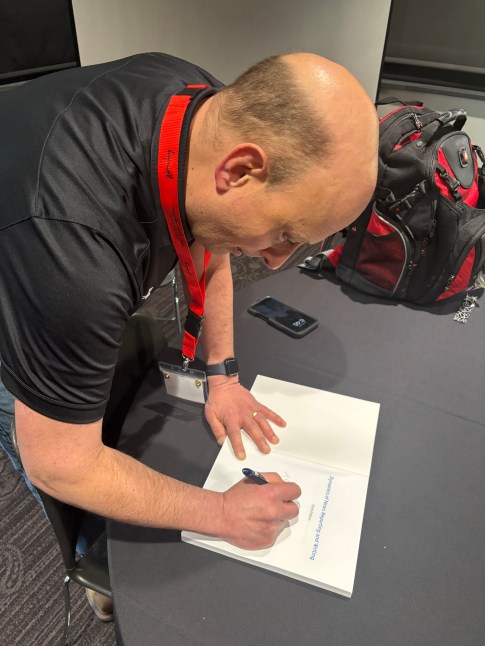
Even the kids, who I have been told a jillion times hate textbooks and never use them, have been amazingly kind to me over the years. For example, I brought a bunch of swag to the MCMC, including “Filak Furlough Tour” T-shirts and a “trophy bat” for the organization to give away.  At the end of the MCMC, the students on the board got copies of my reporting book as a thank you, when one of the kids came up to me and asked if I would sign the book.

“You don’t want me to sign that,” I explained. “If you keep it shrink-wrapped, the bookstore will pay you a chunk of change for it.”

She gave me a “why the hell would I do that?” look and then peeled off the wrapping. I ended up signing all three of the books that day.

Actual proof that someone wanted my autograph on something other than a check or a grade-change form.

When I got back and told the story to my reporting class, one young lady told me, “I read your book. I still think it’s the best textbook because I could understand things from it. It felt really… human.”

In the age of AI, I’ll take the hell out of that.

Perhaps this is the longest way I can think of to say thank you for everything you do for me in the “external validation” department. My goal with each edition of the book and each blog post is to make sure I earn it.

If there’s anything you need, please let me know.

Vince (a.k.a. The Doctor of Paper)


6 thoughts for new journalism graduates on the job hunt that have nothing to do with actually getting a job (A Throwback Post)

It’s not quite graduation time yet, but given the palpable anxiety I am sensing from my students, the job hunt for soon-to-be graduates is clearly underway. A young woman with a great set of experience showed up in my office this week with that “frustrated nnnnnggghhhh” vibe about her, as she had put multiple resumes into the field and gotten few responses.

“Should I call them or something?” she asked. “They’re not getting back to me and I’m worried.”

“When did you apply?” I asked.

“Last week…”

So that was a “No” on my end, as well as a reminder that as to how she needed to look at this whole situation. As I began to say it, she cut me off.

“I know, I know,” she said. “You were right. This is like bad dating. I need to be patient.”

Along with that pearl of weird-dom, here are a few other thoughts for your graduates looking for some help on life beyond the ivory towers and dive bars that formed their college experience.


6 thoughts for new journalism graduates on the job hunt that have nothing to do with actually getting a job

Graduation swept through town this weekend, and along with it came the speeches, the pomp, the circumstance and academic regalia (When I wear mine, I look like Henry the VIII got a Mr. T starter kit for Christmas).

img_5057.jpg

I no longer have the beard, but the medals are still pretty sweet…

Along with all this comes the anxiety of, “OK, now what?” Some students have jobs and they’re worried about how well they’ll do at them. Others have no jobs and wonder if they’ll ever get one. Parents worry that their children will be happy. Some probably also wonder if they’ll have to give up the home gym or a spot in the basement for a returning grad who hasn’t “found it” yet (whatever “it” is). What comes next?

For journalism grads, the anxiety can be even more palpable, as everyone seems to be telling you that your field is dead and you should have gone into business. Other fields can spend months or even years cultivating students for a job that’s waiting for them upon graduation. Journalism? I’ve been told once during a first interview, “We’d like to offer you the job today (Saturday). Could you start Monday?”

I asked the hivemind of pros and profs what advice they had for you all and it was really a mixed bag this time. Usually, everyone chimes in and it’s all in the same vein. This time, things were all over the place. One professor friend of mine noted:

My adult daughter just moved back home, soooo I got nuthin’.

I have often relied on the famous William Golden quote about Hollywood as well: “Nobody knows anything.” Whoever tells you, “This is how to get your perfect job” is either lying to you or trying to recruit you into a cult. Unlike all of those multiple-choice tests you’ve taken over the years, this question doesn’t have a right answer. That said, here are a few to think about as you try to game up for the next stage of life:

  • You have to be idealistic, but you have to be practical: U.S. Olympic hockey coach Herb Brooks once said this in explaining his team’s chance to do well in the 1980 Olympics. His point was you should shoot for the best possible outcome, but you shouldn’t do so without a reality check. In the case of the job search, take a shot. You want to work at a top five newspaper, in a top 10 TV market, a Fortune 500 company or whatever right away? Toss an application out there. What’s the WORST that can happen? They say no and you don’t get the job, which is right where you are right now.
    That said, a 22-year-old journalism graduate with five clips from an internship at the Tamany Tattler and a year’s experience at the student newspaper isn’t likely to land at one of those spots right away, so feel free to look elsewhere. Apply to starter jobs, smaller firms and other places that have openings and you think would be worth a shot. You have to eat. You have to pay rent. And, as they mentioned in “Bull Durham,” it beats selling Lady Kenmore’s at Sears.


  • Don’t become a desperate psycho-hose-beast: As Tom Petty noted, the waiting is the hardest part. For you, this is the most important thing ever, especially if you’re searching at this time of the year. Even if it’s not cold, snowy and gray where you are, a winter job search can be danged depressing. You know that you don’t want to go home for the holiday where every well-meaning relative will ask, “So, what are you doing now that you’re graduated? Do you have a job?” (Side note 1: When you say “No” and they look at you like you just came down with an incurable disease, remember that look so that you never give it to anyone else ever. Side note 2: Realize that these people will always ask you questions like this that will sap your will to live, even after you get a job. “Do you have a job?” will become “Are you dating anyone special?” will become “So when are you getting married?” will become “Don’t you two want kids?” will become “Are you sure you only want (1, 2, 3…) kids?” Your only hope is to outlive this person so you don’t have to hear, “Are you sure you want to be buried here?”)
    This can drive you crazy and it can manifest itself in a number of ways, none of which are good. The worst thing you can do is take it out on potential employers as you decide to call, email or text repeatedly to find out exactly WHERE they are in the hiring process. Most people can smell desperation a mile away and it naturally repels them. Think about the guy at the bar who is insistently trying to buy a gal a drink, a shot, an appetizer, a game of darts or a 1979 Chrysler Cordoba. Does that interaction ever end well for that guy? If you ever need a reminder of how bad this can get, catch the classic “Mike from ‘Swingers’” scene (NSFW- some cussing) or the “Wayne’s World” look at Stacy’s unrequited love.
    In short, don’t push it. Breathe.


  • Look more deeply into your toolbox: The premise of both of these books is that we’re putting tools in your toolbox that you can use in a variety of ways. If you can find the perfect job that  makes you happy right away, that’s great. If not, don’t be afraid to apply those tools elsewhere. A recent grad sent me this note, which touched on something I never considered:

    After I graduated while I was looking for work I hooked up with a temp agency. It’s a great way to try different stuff without major commitment, you gain experience (and interview skills), you get to network, and you get a weekly paycheck. And some positions are temp-hire.

    A journalism professor noted something similar:

    Think creatively about ways you can use your journalism skills for other professions, such as PR, teaching, trade publications, advertising, web producer and social media manager jobs. Many more people cross back and forth into journalism and other careers these days than they did back when we were journalists.’

    Look around you and see what kinds of places need your skills and don’t fret if they don’t have your exact degree specified in the requirements. You will bounce a lot in this day and age (sometimes by choice, sometimes by necessity, sometimes against your will), so look for things that you think might pay the bills and give you a leg up the next time your perfect job comes around.


  • Remember the Johnny Sain Axiom on Old-Timers Day: Sain, a longtime pitcher and pitching coach, used to disdain Old-Timers Day. It wasn’t the concept he opposed, but rather that banter among the older players. Sain used to note that “The older these guys get, the better they used to be.”
    The same thing can be true for you when dealing with people who are more than happy to tell you that when they were “your age” they got a job right out of school or they had a perfect job waiting for them or whatever. In their mind, they had it all figured out perfectly and made a seamless transition between their education and a career, so why can’t you?
    The truth is, it wasn’t that easy for most of them. Some people just got a fortuitous bounce, a lucky break or a family connection. Others don’t work in your field, so comparing your search to theirs is like comparing apples and Hondas. It’s not that they’re better or stronger or faster or whatever. It’s just the way it happened for them. Each search and each job is unique (and I mean that in the truest sense of the word), so don’t let what other people tell you about how great life is get you down.
    Even more, don’t presuppose that people you see as your role models nailed the perfect job on the first take. I met with a couple students last week who kept referring to a recent grad as “having it all worked out.” She was their role model who, according to them, interned at Company X, graduated into a full-time job at Company X and then got promoted at Company X in less than a year. She was their Golden Goddess.
    What they didn’t know was all the anxiety she had about getting ANY internship, how she had been rejected twice by Company X for an internship and how she ended up sobbing in my office multiple times after that. They also didn’t know about the office fights and other less-pleasant aspects of Company X. In short, the grass isn’t always greener.


  • Don’t keep up with the Joneses: The easiest way to make you hate yourself and your job search is to compare yourself to other people in a constant game of one-upmanship. If Billy gets a job in a top 75 market, you shouldn’t try to get one at a top 50 market. If Jane gets a job as a writer at a 50,000 circulation newspaper, don’t just go looking for a job at a 100,000-circ paper to prove a point.
    I watched this happen constantly among peer groups of students at several of my previous stops, in which it wasn’t enough to get A job, but rather it was crucial to get a job that was better than someone else’s job. Here’s the problem: Just because a job is at a bigger place or somewhere with more cachet, it doesn’t follow it’s a good fit for you. This was how one of my former students ended up in Kentucky doing night-cops, despite not wanting anything to do with Kentucky or a night-cops beat, simply so he could look more impressive. It didn’t work out and he was miserable, before eventually going back to a job that was more “him.”
    I know it’s hard to push back against that competitive thinking. (Trust me, it happens everywhere, even in my gig. Former professors will tell their former doctoral students, “Oh, I see you’re at (less prestigious university)… Did you know that James is now at (mega-university) and he’s a dean?”) However, if you find something you like doing, you’ll never really work a day in your life.


  • Never forget this moment: You will eventually get a job and  you will do well. You will get older and get more responsibility. You might change jobs or careers or whatever. However, what should never change is your memory of this moment right now, when you’re scared out of your mind about getting any job at all, making rent, dodging Aunt Ethyl and her questions at the family holiday party, trying to avoid calling the Beaver County Tidbit 1,002 times to find out if they are still interested in you and everything else you feel.
    If you can remember the feeling you have at this moment, you will never lose your empathy for the future generations who are going through it. It might help you in little ways like not asking the “Aunt Ethyl” questions of your younger family members or hustling a bit more to get through that stack of resumes you need to read. It might help you in big ways as well, like thinking a little better about the next generation instead of a little worse of it. (People  more than occasionally ask me if being around younger people all the time doesn’t make me kind of envious of their youth. My answer is always, “Hell, NO!!!!!” I survived my 20s the first time and made it this far. There’s not enough of anything in the world to make me want to go back to that point in time).
    When it comes to getting employed, things almost always work out. I know that sounds ridiculous, but my batting average on things like is pretty good and in the end, you’ll have some great stories to tell.
    And thanks to your journalism education, you’ll tell them well.

The Junk Drawer: Only Good News Edition


I’m sure I put my happiness in here somewhere…


Despite all evidence to the contrary, this blog will not be renamed “Dr. Vinnie’s Trip Through Depressing News and Abject Sadness.” Over the past couple weeks, we’ve focused a lot on things that range from “not all that great” to “Can we get that asteroid Bruce Willis supposedly destroyed to take another shot at us?”

In a somewhat Quixotic attempt to make for a brighter day, despite the fact it might still snow here today and it’s likely that next week, the Easter Bunny will be frozen to the ground, we’re going to do a round up of a few things that give us some happiness. At least that’s the goal…

Let’s start with the best news for journalism…


AP’S BACK IN THE (WHITE) HOUSE: The Trump administration banned the Associated Press from the White House Press Pool in February for not agreeing to use the preferred term of “Gulf of America” when referring to the body of water everyone else calls the “Gulf of Mexico.”

AP sued to regain access and a judge found in favor of the wire service on Tuesday:

In a sharply worded opinion, Judge Trevor N. McFadden of the Federal District Court for the District of Columbia wrote that the Trump administration must “immediately rescind their viewpoint-based denial” of The Associated Press from presidential events.

“The government repeatedly characterizes The A.P.’s request as a demand for ‘extra special access.’ But that is not what The A.P. is asking for, and it is not what the court orders,” he wrote. “All The A.P. wants, and all it gets, is a level playing field.”

Trump actually appointed McFadden to his current position, so there’s no room for the argument that he’s some sort of Commie-Pinko, Barak-Hussain-Obama, Panickan judge. (I’m sure someone will argue that anyway, but still…) The judge did actually stay the order for five days to give the Trump crew a chance to appeal, but the opinion is very pro-AP.

Speaking of awesome journalism wins…


A LOOK AT THE UT-DALLAS STUDENT-MEDIA DEBACLE EMERGES: Of all the stories we’ve discussed about student media getting shafted, the one I dodged was the story of UT-Dallas. The reason was that a good guy and former staffer at the school’s paper, Ben Nguyen, was working on a deep dive about the topic. He and I first crossed paths at a student media conference in Minnesota, when he and one of his colleagues ended up breaking a story about a professor at UTD saying disgusting things on social media.

In this case, the story looked like a short piece on how the school wasn’t acting right. Ben had sources and background on all of that. However, the more he dug, the weirder it got. We talked a couple times about where this could go or what he had found.

He just emailed me a little bit ago with the published product and a note:

Throughout everything, I’ve appreciated our conversations while I’ve put this draft together. It’s definitely ended up twice as long and about 5 months later than I initially expected, but I hope it’s at least a more comprehensive record of what was a truly absurd chain of events.

Click here to read all of Ben’s hard work.

Speaking of journalistic hard work…


TAKE SOME POYNTERS FROM A GREAT SOURCE: Barbara Allen, the former director of college programming for the Poynter Institute, has taken on a new adventure with the launch of her new project that covers college journalism from all angles.  The website can be found here, where she outlines the kinds of stories she covers, the resources she provides and the content she curates for educators, students and media folks.

You can also subscribe to the newsletter she puts out weekly, which keeps you up to date on the crucial events impacting student media as well as highlighting some amazing pieces that students are doing in their own communities. I was proud to be one of the early adopters on this one and I have found a ton of great stuff on this site.

And finally, speaking of being proud of something…


THAT’S “HEY, YOU DISTINGUISHED IDIOT” TO YOU, PAL: I try to keep the personal promotional stuff to a minimum here, as this blog isn’t about me, but rather it should be about stuff you care about.

That said, I have to mention this because it speaks volumes about what makes for a good job and a good boss.

I was submitted for a promotion earlier this year, and when a rather specious decision came back from the committee, my boss and my boss’s boss had my back. They could have easily said, “Well, the committee makes the decisions,” or “Well, you’ll get ’em next time.” Instead, they said, “This is stupid and wrong and we’re going to fix it somehow.”

And they did. So, along with not having to file an extra post-tenure review report, I got the benefit of being named a “distinguished professor” at UW-Oshkosh.

The title is nice, although I still go back to all the students who wrote fire briefs in which they noted how firefighters “distinguished the fire.” I also think back to the “Doctor of Paper” origin story. Trust me, I’m not getting cuff links made with “Distinguished” on one and “Professor” on the other.

However, I will continue to tell my students that while more money or a cooler title can be appealing during your job search, finding the kind of boss you’d walk in front of a bus for is really worth a lot as well.

I hope this was positive enough for everyone. 🙂

Vince (a.k.a. The Doctor of Paper)

PS- I’ll be headed to Missouri to speak at the Missouri College Media Convention this weekend, so the blog is on break until next week. Can’t wait to blog all about it.


“It gave me a purpose and quite literally saved my life a few times.” Why Student Media Matters (A Throwback Post_

With Friday being the Daily Cardinal’s anniversary day (133 years and counting), I decided to dig up this look at student media and why it matters to so many people for so long.

These days, I check in on the Cardinal website from time to time, read articles of various student media outlets that their college media advisers share and often sit with a print copy of the Advance-Titan (the UWO student publication). I also find myself thinking about how student media are leading the way these days when it comes to important issues.

Tufts University’s student publication, The Tufts Daily, has been on top of the story about Rumeysa Öztürk, a graduate student detained on March 25 by Homeland Security as part of a “pro-Palestine” sweep in Boston. The Minnesota Daily on the U of M campus has covered similar issues, including a lawsuit a student filed as the result of ICE detention. The Daily Northwestern has looked into the denial of tenure for a professor who had spoken in favor of Palestine.

(And not to let my bias show, but the Daily Cardinal is nailing down significant stories about how the federal government’s cuts to the Fulbright program have bigger consequences in some lesser-known areas, the Wisconsin Supreme Court election and more.)

Without free and independent student journalism, we’re not going to see these kinds of stories getting covered as honestly and fervently. When friends say something like, “Hey, the chancellor is giving us a big new building for student media because we’re getting moved under the umbrella of UNIVERSITY COMMUNICATIONS AND OUTREACH!” I start to develop a twitch.

Sure, you can still write stories about the cool new clubs or the professor who won a major award, but you’re going to have a hard time running stories about sexual assault reports, football player misconduct or hazing attacks. That’s one of the many reasons why I still support my student media friends and causes to this day.

(SPOILER ALERT: The post below starts with a look at Doane University and a problem related to student media. The situation at Doane University got worked out and Doane Student Media kept on rolling.  You can see all the great work students there continue to do through this link.)

Enjoy this look why student media matters so much to so many people.


“It gave me a purpose and quite literally saved my life a few times.” Why Student Media Matters

The Board of Trustees at Doane University approved of President Jacque Carter’s suggested cuts and mergers during its Monday meeting, meaning that Doane Student Media is on a downward spiral to financial insolvency. Editor in chief Meaghan Stout has been covering the situation since the cuts were first announced, which is a lot like being asked to serve as a pall bearer for your own funeral.

According to former Doane student media adviser David Swartzlander, the cuts don’t go into effect until July 1, which gives Stout and others about nine months to raise unholy hell about them, something we’ve asked you all to do throughout the week.

If you’re thinking, “None of this makes any sense. She’s graduating in a month, so she’s done with this place. And why are you dedicating so much time and energy blathering on about student media cuts at a university the size of your high school? You don’t have a horse in this race….,” well, I get it.

From the outside, this looks pathologically stupid.

If you’ve ever spent any time in student media, this makes all the sense in the world.

I asked people I know who have gone in myriad directions after their educational careers came to a close if they ever worked in student media and, if so, why it mattered to them. One of the best journalists I’ve ever been lucky enough to work with, a wordsmith and a storyteller unlike any other, didn’t disappoint:

My high school had no paper. I started one, called “The Cardinal Chirps.” There was news, sports and jokes on four mimeographed pages. (Smelled great!) It may have lasted three issues. The jokes were filler and I learned that not everyone has the same sense of humor. Don’t print jokes. Working at that paper was a revelation. I could find something that didn’t make sense – a section of the lockers were inexplicably located in a dark room with one narrow door – and write about it. It wasn’t safe for those who had their lockers in there. The principal and school board took note and changed it. No had ever brought it to their attention. The learning was true: You can’t fix something if you don’t know it is broken.

I expected a few responses from a few other people, but not much.

I was stunned when I got dozens, like this one from a journalism professor with a background in news:

I graduated from a small rural high school that didn’t even have a school paper. My interest in news grew from my mom’s obsessive consumption of newspapers (we subscribed to two and sometimes three), news magazines (I think we got four), news talk radio (on constantly), morning/noon/evening local and national TV news, public affairs shows on PBS and all the Sunday morning news talk shows, and my own growing awareness that there were other places in the world far from Tonganoxie, Kansas, that I dreamed of seeing someday. It seemed wise to understand what was going on in them before going. And before going, I had to have money. I understood from my good friend that one could be paid actual money for fixing errors in news writing by being something called a copy editor. The University Daily Kansan and my professors with newsroom experience showed me how to be that.

Another higher-ed friend who works as a student media adviser had a similar life experience:

Working in college media was the step for me that solidified how I could attain my dream to work as a professional journalist. Before my college media experience, the concept was very abstract. Moving from dreaming to doing via my student newspaper made it real for me. I am forever grateful to those who gave me the opportunity and helped me see I could do it.

Folks who took the path out of news and into corporate communications, consulting and other similar fields found that student media benefited them as well:

I wanted to write books before I signed up for journalism class in high school on kind of a whim. In that class, I found that I had a knack for journalistic writing, most likely from reading the local paper and my dad’s influence as a TV journalist. Taking that class and continuing that path led me to attend J-School at MU and altered my career path. It also gave me an understanding of and appreciation for the importance of LOCAL journalism.

These responses made sense: Student media was like an internship and a training center for going on to do great and mighty things in the field itself. However, I also saw how the people who went into fields that had nothing to do with news or PR still found amazing value in student media:

I draw from my experience at the DN almost every day. I’ve worked for two law firms and a dental office since college. I’m comfortable asking questions, I’ve learned how to build relationships and I have a better understanding of how government works. The most important thing I have learned is that no matter how much effort you put toward your day, something could change and you need to be ready to shift your priorities and maybe undo all you’ve just done.
My boss at SAGE, who puts up with an awful lot from me, apparently found her muse through student media as well:
Basically shaped my entire college experience. Learned the basic responsibilities, ethical implications, and work ethic of a journalist. Being on the paper motivated me to write about things I was interested in, when I already had to write so much for school…Also I got to interview some really interesting people!
The one common thread, I saw overall, however, was that student media was more than a thing people did. It was who they were. The newsroom wasn’t like a classroom where they HAD to go. It was a place that gave them something special and they WANTED to be there:
It was my happy place. The place where I always knew what I was doing, and why. The place where everything just made sense. Why else would someone finish a shift, go home, get their books and go back to the newsroom to study. Because that’s where I was always focused.

And…

It was my home away from home. And it allowed me to experiment with what I wanted to do.
And…


Genuinely don’t know where to start. The friends, the experiences, now I’m working in media. Joined junior year of high school and haven’t looked back since. It gave me a purpose and quite literally saved my life a few times. I could go on and on.
And so many other people did as well, sharing stories of life-long friendships that developed thanks to pressure-packed deadlines, no sleep and a sense of belonging they never found before or since. At the risk of becoming hyperbolic, student media provides people with something that borders on magical, a familial bond forged in a way that never truly seems to break.


I understand why Meaghan Stout is fighting like hell, against all common sense, for her student media family, because 25 years ago, I was her.


I remember sitting in my journalism adviser’s office six weeks after our student newspaper closed under the weight of $137,700 in debt. My adviser was also my teaching assistant for Media Law, a course I was essentially flunking because I had poured all of my time into fixing the Daily Cardinal.


“You need to quit the paper,” she told me. “You’re going to fail.”


In retrospect, I think she meant the law class, but that’s not how I heard it.


I then listened as she told me how when she was in college, her student newspaper was moving from a weekly to a daily and how she was pressured to put the paper first and everything else second. Instead, she stuck with her classwork and got her degree. Besides, she explained, even if I managed to fix the problems, the paper was likely to shrivel up and die after I left, so what was the point?


In the abstract, she was right. Take care of yourself. Get the grades. Besides, there was another student newspaper on campus I could work for, so what made this Quixotic journey so important? I couldn’t explain it, but even if I could, I doubt she would have understood.


So, I let her finish, told her I’d think about it and then I went back down to the newsroom and kept working on fixing the paper. By the next semester, we’d pulled it back from the brink of collapse and started printing again.


It’s still running to this day.


For me, my student media experience wasn’t about the articles I wrote or the editorial positions I held or the arguments we had. (We often joked that we were a family in the newsroom, in that we drank a lot and hurt each other…)


It wasn’t that, without that paper, there’s no way I would have gotten this far in life, and I’d probably have had a heck of a career as a fairly decent auto mechanic. It also wasn’t the life experiences it gave me either, although without the paper my kid would likely have different godparents and I would have been deprived of the opportunity to return the favor.


I still can’t adequately explain what it is that makes student media matter so much, whether it’s the paper I worked for, the papers I advised or the papers I never ever knew of before a crisis threatened them.


What I can say is that I love reading the articles the students write, as I wonder how much blood, sweat and tears went into just getting that inverted-pyramid piece to hold together. I love seeing those 20-somethings I knew through my media conference presentations or newsroom visits doing great and mighty things as reporters, editors, copy editors and more. I love it even more when I see them finding joy in life outside of the field, moving into politics, social work or psychology.


I treasure the photos I see of engagements and weddings that bloomed from seeds planted on a production night. The houses they buy, the babies they have, the lives they develop… Somehow, it all comes back to that moment they found someone else who had the weird sense of humor that grew from spending too much time in a windowless bunker that smelled of old newsprint and burnt coffee.


In all my time at all these institutions of higher learning, I’ve yet to come across another student organization or activity that even came close to what student media does, both for the campus and for its practitioners. This is something people like Jacque Carter don’t understand, because to them, it’s a pain in the ass that costs money and points out things they don’t want pointed out.


To us, it’s life.


P.S. – I passed law with a C that semester. Even if I hadn’t, I wouldn’t have changed a thing.

An open letter to Madison Mayor Satya Rhodes-Conway: Media folks don’t like dealing with the death of kids any more than you do, so please don’t treat them like crap

Dear Mayor Satya Rhodes-Conway,

I saw the comments you made to a gaggle of reporters in the wake of the Abundant Life school shooting, in which you basically accused working journalists of being pain vampires, who live off the misery of others. You chastised these folks for asking legitimate questions, told them to have some “human decency” as if that never occurred to them and then shamed them with a “y’all” that could only come from someone who spent most of their life in the land of Yankees.

I don’t know what compelled you to castigate the media at large in that press conference. It might have been just the stress of the day or it might have been previous experiences with a few bad folks in the field. I can tell you for sure that, just like in politics, there are good and bad people in journalism. And, just like in politics, the lousy ones tend to make the biggest impressions and do the most damage for the whole lot of folks. If I had to wager, I’d say that most of the people in that media cluster would have gladly been covering ANYTHING ELSE that day than a school shooting.

I let this post sit for a day or two, in the hopes that you would issue some sort of apology for this, even if it were completely insincere, so that we could all go back to doing what we’re good at: Media folks covering the news, you not pretending to be a journalism expert. Unfortunately, the PR people who advise you are apparently no better than you are, so I thought I’d offer a few insights on what this situation is like for news people.

I spent three years as a reporter, another five as an editor and then about 15 as a newsroom adviser, and in every case, I’ve had to deal with stories involving dead kids. This is not a morbid flex, but rather a chance to help you understand where I’m coming from.

All those things you said at the press conference? Hell, I’ve been told worse and more loudly by far more traumatized people than you. I’ve been called a vulture, a scumbag, a waste of life and a few other things that could peel the paint off of a car. The hardest one was the lady who told me that “Your mother must not have raised you right, if you think what you’re doing is appropriate.”

Believe it or not, journalists are actually human. Sure, we’re really good at hiding it a lot, but we have the same emotional range as most other bipeds you’ve encountered. If you felt pain, agony, shock, angst or anything along those lines, it’s safe to say that the people who were asking questions of you that day did as well.

If you think that reporters in that gaggle are going to enjoy talking to sobbing parents and bothering traumatized kids before heading home for a nice casserole supper, you’re delusional. This kind of thing sticks with most people for a long time, and journalists are no exception.

When my students would ask me about my experiences writing about death and mayhem, I told them that I could remember the name, age and cause of death of every dead kid I ever covered. It’s been decades since I was reporting and editing, but it’s still true.

Casey Rowin, Shawn Magrane, Matthew Dunn,  Deanna Turner… those names and a dozen more stick with me every day. I think about Rachael Himmelberg, the infant who died after receiving what should have been life-saving open heart surgery. She would be in her late 20s now and I wonder what she would be doing. I think of Jordan Sosa, who died at 22 months old when he wandered out of his grandparents’ house and fell into the Black Earth Creek. He might have been a college student of mine, if he hadn’t drown that day.

My first year at Ball State, we had five college kids die of various causes: Michael McKinney was shot to death by a cop,  Karl Harford was robbed and executed after giving some guys a ride… accidents, suicides and more… I remember one of the more veteran editors of the paper, who had lived in Muncie his entire life telling me, “This is not normal for us around here…” like he was trying to convince both of us that what he was saying was true.

The editor also asked me, “How did you get so good at covering stuff like this?”

My answer was simple and I think most journalists would be on board with it: “You don’t get good at doing this. You become more experienced in doing the best you can. If you ever get to a point where you feel you’re good at covering dead kids, it means you are really broken and you need to walk away for a good, long while.”

Each dead kid we cover is like a wound we receive, the scar a permanent reminder of what it was to be there in the worst moment of someone else’s life. Each mistake we made in how we phrased a question or how we approached a source still stings. Each time we did the best we could and still faced the wrath of a pained family member or friend brings about a wince and grimace.

You mentioned that reporters should go away and give people a chance to grieve. Despite your apparent thoughts on the state of media today, reporters can be a crucial component of that grieving process. I go back to what Kelly Furnas, the adviser of student media at Virginia Tech, said to his students as they went out to cover what remains the deadliest shooting on a college campus:

“The students I talked to were terrified of the fact that they would need to call these families and I said, ‘You don’t assume that these families don’t want to talk,’” Furnas said, recalling that day at a college media conference a few months after the shooting. “That’s a very important thing to these families to tell the story of their son’s or daughter’s lives. That’s a very important thing. A lot of people not only want to do it, but expect to do it.”

I can tell you for sure that this holds water. When it came to the dead people I covered in one way or another, I got one of three reactions 99% of the time:

  1. “I just can’t… I’m sorry…” These people were already at the maximum level of stress and pain and they were just incapable of dealing with anything else at that point. I would apologize for intruding on their grief and then leave them alone.
  2. “You #%*%ing VULTURE!” Yep, we talked about that already. This reaction gave me a ton of anxiety and pain, but I understood. It was like putting your hand out toward a wounded animal: They just hurt so badly, they lashed out, regardless of your intent. Again, I’d apologize and back away.
  3. “The pressure-release valve” This is what Kelly was talking about. These people are so full of emotion and they have nowhere to go with it. Everyone around them is feeling the same pain, misery, stress and more… All they want to do is talk about how great their kid was, or how amazing their parent was or whatever stories make them feel less hurt. As a journalist, we’re that opportunity to not only help, but to share their thoughts with others.

So in the future, please feel free not to tell journalists how to do their jobs at a time like this. It’s a job nobody wants, no one revels in and few people can do and remain unscathed.

If someone asks a particularly crappy question like, “Are there plans to call it ‘Less-Abundant Life’ now that people have died there?” or “Don’t you find it ironic that there was a lot of thoughts and prayers happening in there but the kids still got shot?” go ahead and release your inner scold. That kind of person deserves your wrath.

However, the basic “5Ws and 1H” questions are normal, even if the situation is not and you lack the answers. Everyone is frayed to the nth degree, so you need to operate above the fray. If you can’t, don’t hold the press conference or send someone out there who is actually skilled at PR to do the work for you.

I hope this helps, because I somehow doubt this will be the last time you and the media will spend time together discussing a devastating death or two.

Sincerely,

Vince (a.k.a. The Doctor of Paper)


Giving Thanks before Thanksgiving Break

Apparently one of my favorite errors has been making the rounds on social media, as several students have come running up to me with their Instagram or TikTok accounts open and a “Have you seen THIS?” look on their faces.

“The minute I saw this, I thought about you!” one young lady said excitedly, before realizing exactly what she said.

“I mean… I saw the head thing and… I thought about…,” she said, continuing to turn a brighter shade of red as she fumbled her way through trying to explain what she meant. Eventually, we both burst out laughing.

That was just one moment that made me remember how thankful I am for the kids I teach. They actually think to share things with me and I apparently make some sort of an impact on them that they can’t wait to do so. Sure, it’s about pseudo-pornographic headlines or stories about people who stored dead bodies in an abandoned mall or something, but it’s nice nonetheless.

I remember telling one group of students that they kind of got screwed having me as a teacher, because if they had a normal person who covered something like the education beat, they’d hear stories about board meetings and first-graders who made hand-print turkeys for Thanksgiving. Instead, I’m starting every other story off with some reference to a dead body.

The next class, just before the Thanksgiving break, one of the more artistic students slipped this to be before she left class:

That’s still on my corkboard to this day, despite that student being long graduated and it’s highly unlike she remembers doing it at all.

With this week ending in a tidal wave of football and food, I wanted to start the break with a big thank you to all of you out there who read the blog and who use the books that it supports. I’m always amazed when I meet someone that I have long admired for their work and they turn around and say, “Hey! I’m using your book!”

(The feeling is only slightly undercut by the awkward feeling I get when I have to ask, “Nice! Which one?”)

I’m so happy to know that so many of you were interested in last year’s “Filak Furlough Tour” and can’t wait until the next edition of the “Dynamics of News Reporting” and “Dynamics of Media Writing” come out (Early next year for the former and August 2025 for the latter, God willing). I’m also eternally grateful to those of you who took a chance on “Exploring Mass Communication” for your pit classes and group sessions. It’s never easy to rewrite a course for a book, so when people actually do it and find that it was worth it, it really does make me feel great.

I’m grateful for my family and friends, who have somehow managed to tolerate me all these years through the weird work schedules and other general weirdness I produce. Amy is due for a canonization for sainthood any day now, I’m sure.

This break I’ll be trying to finish the last touches on the draft of a book and maybe even get a little family time in. It’s Thanksgiving at my brother-in-law’s house, which means twin 3-year-olds doing their ballet dance routine over and over again in the living room.

I could ask for much more, could I?

Thanks for everything. See you after the break.


Vince (a.k.a. The Doctor of Paper)