I’m blogging about Florida officials. I will never register my blog with that state. Come get me, Sen. Jason Brodeur.

(Note to Florida Sen. Jason Brodeur: Nothing says, “Trust me on how to make the media work better” like being interviewed by a dude who looks like he’s about to engage in a rap battle with the protagonist from the Offspring’s “Pretty Fly for a White Guy” video. Unless, of course, it’s doing a video interview in your car outside of what looks like the most pathetic water park in Florida.)

I’m happy to report that all of the kids in my media law class this year passed their first exam. I am sad, however, to report that their knowledge of how the First Amendment works would likely disqualify them for a position in the Florida Senate, if Sen. Jason Brodeur is any indication of what passes for intellectual leadership out there:

A Republican state senator in Florida has introduced a bill that, if passed, would require bloggers who write about Gov. Ron DeSantis, his Cabinet or state legislators to register with the state.

Sen. Jason Brodeur’s bill, titled “Information Dissemination,” would also require bloggers to disclose who’s paying them for their posts about certain elected officials and how much.

This is part of a movement among numerous political figures, including Florida Gov. Ron DeSantis, who like the power that comes with political positions, but don’t like being held to any level of scrutiny by member of The Fourth Estate.

Among the 823,245,219 bad ideas in this bill, consider these key elements:

  • It argues that bloggers are essentially lobbyists, so if lobbyists need to register with the government, so should bloggers. (I spent 30 minutes trying to come up with an equally absurd comparative and basically rolled snake eyes on that one. Just imagine the dumbest comparison you can and then imagine it being made during a drunken screaming match on a “Housewives of Meth-topia” episode and you’re probably close to what I was trying to come up with.)


  • It would require the disclosure of payments for any posting the bloggers do, never mind for a moment that a) most bloggers aren’t paid for specific posts, (at best supported ad revenue or donations on the entirety of the blog) and b) this somehow overlooks the entire public relations industry, which would be essentially eviscerated by this kind of thing.


  • It seeks to fine people up to $2,500  a day for “late registration” of the blog, as outlined in the bill, which again makes no sense due to the point made above.

Brodeur and fellow backers of the bill couldn’t be more transparent in their self-interest if they were made of Saran Wrap: By creating a climate of fear among people who might be critical of these officials, these public figures can cut down on the amount of criticism they face.

That said, they face significant problems in making this thing stick for a few basic reasons:

  • It violates the essential rationale behind the First Amendment and other actions by the country’s founders. Before it declared its independence, the then-colonial state of this country operated under English laws pertaining to printing, including the rule that all presses were to be licensed by the government. The soon-to-be-a-country’s first newspaper, Publick Occurrences, was shut down in 1690 for printing without a license. Colonists realized the suppression of the press was a key way England kept its thumb on its critics,  and thus made sure the newly independent country DIDN’T license journalists for precisely this reason.
  • It violates common sense in regard to how anything works in a digital world. Let’s pretend for a minute that this thing gets passed in Florida and for some reason, we’re all sitting around for a year, waiting for the Supreme Court to do something about it. So… I have a few questions:
    • It only applies to PAID posting in regard to registration and disclosure. Does that mean I can spend as much of my time as I want calling Brodeur and DeSantis and the rest of the bill’s supporters peanut-brained, no-account, speech-suppressing ass-hats? I mean, if I’m just doing it without financial sponsorship, how am I violating the law here?
    • It’s a FLORIDA law. I read through Brodeur’s bio and was unable to figure out if this chucklehead actually understands that, unlike most physical things some politicians want to allow (carrying a gun) or prevent (ending a pregnancy), the internet doesn’t recognize state borders. Thus, I can write a blog in Wisconsin, criticizing stupidity in Florida, and people in all 50 states (and apparently Trinidad and Tobago, where I’ve apparently got exactly one really frequent reader), can enjoy the various ways I can poke holes in this bill.
    • Digital media covers more ground than this bill, so are you ready for some highly creative   fun people will have at Brodeur’s expense? I”m looking forward to some really long Twitter tirades, a “Violate a Fundamental Constitutional Liberty like Jason” TikTok challenge and something on YikYak that would make Bubba the Love Sponge blush…

So, in hopes of inspiring a generation of digital natives who love free speech and have a dark sense of humor, let’s have some fun:

This is a link to Sen. Jason Brodeur’s home page on the Florida State website. You can find a contact button there, which will allow you to tell  him EXACTLY what you think of this bill and his rather patronizing “Government Folk Know Best” approach to free speech. If you’re taking a law class, please feel free cite a particular precedent that would allow you to express yourself in a particular way. Speak the truth about a bad official, offer an opinion, participate in hyperbolic speech, present content that does not rise to the level of actual malice or anything else your free-speech-loving heart desires.

(Bonus points to the first person who redoes the Falwell Campari parody with Brodeur in it, or whoever arranges an amazing John Oliver singing extravaganza about Bob Murray that I’m not allowed to link here, but that you should definitely find on your own.)

To prove you understand the actual legal limits of the amendment, please do not engage in any fighting words, true threats or incitement to imminent lawless actions, to name a few.

To those of you who might think this approach is petty and childish, I would argue that the defense of the First Amendment in all of its forms is vital to the preservation of our democracy. Any dissent provided to rebuke those who would undercut our most basic freedoms should be embraced by all those who cherish the values that created the foundation of our country.

I guess I could also argue, “Well, he started it…”

Either way, take your shot and make your voice heard.

If Brodeur has his way, it might be the last chance you get to do any of this.


Scott Adams’ racist tirade leads newspapers to drop his comic strip, “Dilbert” (A free-speech primer)

The “Dilbert” website is still up and running, complete with the cartoons that were slated to run in the papers Sunday and Monday. This might be the last place on earth you can find Adams’ work after his racist tirade last week.


EDITOR’S NOTE: In an attempt at “less is more,” we’re trying out the Axios approach to working through some of the more “event-based” posts. Tell us what you think in the comments. — VFF

The Lead: Dilbert creator and artist Scott Adams released a racist screed on his YouTube channel last week, leading multiple newspaper chains and independent media outlets to cut ties with him and pull his strip from publication.

Newspapers across the United States have pulled Scott Adams’s long-running “Dilbert” comic strip after the cartoonist called Black Americans a “hate group” and said White people should “get the hell away from” them.

The Washington Post, the New York Times, the Los Angeles Times and the USA Today network of hundreds of newspapers were among publications that announced they would stop publishing “Dilbert” after Adams’s racist rant on YouTube on Wednesday. Asked on Saturday how many newspapers still carried the strip — a workplace satire he created in 1989 — Adams told The Post: “By Monday, around zero.”

Things got even worse for Adams on Sunday, when his distributor, Andrews McMeel Universal, publicly stated it severed ties with him.

Andrews and Sareyan said Andrews McMeel supports free speech, but the comments by the cartoonist were not compatible with the core values of the company based in Kansas City, Missouri.

“We are proud to promote and share many different voices and perspectives. But we will never support any commentary rooted in discrimination or hate,” they said in the statement posted on the company website and Twitter.

Catch Up Quickly: Adams has been slowly sliding into various danger zones since the mid-2010s.

  • In a 2011 “men’s rights” blog post, he noted: “The reality is that women are treated differently by society for exactly the same reason that children and the mentally handicapped are treated differently. It’s just easier this way for everyone.”
  • In 2017, he said in a  podcast that he supported family separations at the border
  • After the 2019 shooting at the Gilroy Garlic Festival, he tweeted an offer to anyone who witnessed it, allowing them to “set your price” on the purchase of his app.
  • In 2020, he stated that his “Dilbert” TV show was canceled after one season because he was white, adding “That was the third job I lost for being white. The other two in corporate America. (They told me directly.)”

Why You Should Care: This is another perfect example of how the First Amendment actually works and doesn’t work. We covered this when Spotify and Joe Rogan got into a tussle last year around this time.

The First Amendment does:

Prohibit the government from suppressing unpopular speech or unpopular press. City, county, state or federal officials cannot exercise prior restraint on publication or speech in almost every situation.

It does NOT:

Cover everything ever said or printed. The law has deemed some forms of speech (fighting words, words that create a clear and present danger etc.) to be unprotected. The law has also deemed some content (child pornography, for example) to be irredeemable in any way and thus not be afforded protection under the law.

Prevent the speaker (or writer) from ramifications from free expression. Free speech does not equal consequence-free speech. If you express yourself in a way that legally defames a person, you can be sued for it and lose a boatload of money, if found to be guilty. If you engage in speech or publication that leads to imminent lawless action, you can be held accountable for the damage caused and charged with certain crimes.

Stop private businesses from suppressing or punishing speech.Private institutions are perfectly capable of hiring or firing people for a wide array of reasons. In the case of Scott Adams, the publications that once paid to run his comic are choosing now not to. That’s not censorship, a violation of the First Amendment or even “canceling” someone. Adams has the right to find other venues for his thoughts and artwork, of which he noted on Twitter he plans to avail himself. These publications can choose to run “Peanuts” in perpetuity instead of ever letting “Dilbert” back in the paper. Both of these actions are completely legal and in no way violate the First Amendment.

Force other people to listen to you or be happy about what you say.  Constitutionally speaking, Scott Adams can stand on a street corner and scream his theories about “Black People, Hate Group” into oncoming traffic. That doesn’t mean other people have to enjoy his blather. They have the right to shout him down, ignore him or scream about how “Dilbert” has really started to suck lately.

Promote “cancel culture.”  As we noted during the Joe Rogan debacle last year, the thing about the First Amendment is that it’s essentially content neutral. You want to tell people you hate dogs, that’s fine. You want to tell people you love dogs, that’s fine. You want to tell people you want to eat dogs, that’s fine. It’s gross and you’ll likely be home alone a lot on weekends, but it’s not against the law.  With the legal exceptions outlined above (and a few others), the type of speech doesn’t really play into whether that speech should be “free” or not.

It’s important to understand that free speech was always supposed to work this way, in which bad or dumb speech got knocked on its keester by good or smart speech. The whole concept of a “marketplace of ideas” is to give everyone a chance to speak so we could pick out the best ideas and use them as we saw fit. The ones that were dumb got discarded and the people who proclaimed those dumb ideas could either stick with their dumbness and be alone or come around to better ways of doing things and be part of those better ideas

CLASSROOM EXERCISE: Find recent examples of how public or private enterprises have dealt with unpopular speech or press. Follow the basic “5W’s and 1H” approach to outlining the situation (who was involved, what did they say, when/where did they say it, how did this shake out etc…). Then, discuss the ways in which this is similar to and different from the Scott Adams situation. This could be in regard to the speech taking part in a public institution, which affords speech more protections, or the topic at hand, or anything else. Try to come up with a sense of what kinds of patterns exist in how this speech is dealt with and if/how the person who created that speech eventually dealt with the situation (apology, bounced back years later, still living in an undisclosed location).

I love student media, and here’s why I want everyone else to love it, too. (A Throwback Post)

It’s been 28 years since the Daily Cardinal halted publication amid a sea of financial mismanagement. To commemorate that moment, every Feb. 7, I check in on the Daily Cardinal’s website, just to make sure it’s still there. It always is and based on the strength of fundraising through the Daily Cardinal Alumni Association and the passion of the student staff, year after year, I have great faith that it always will be.

What I have come to realize over all of those years is that I love student media. It has become my life, my passion and my purpose. Student media  gave me the life I love so much now, and the venue it provides me to help others find their way to the life of their dreams.  I also learned that I’m not alone in how I feel.

Today’s throwback post takes a look at a situation involving the potential death of a student media outlet brought about by short-sighted administrators and stupid budgeting. Beyond that, it gave people from many walks of life a chance to learn, laugh and love in an environment that gave them freedom and responsibility.

(SPOILER ALERT: The situation at Doane University got worked out and Doane Student Media kept on rolling.  You can see all the great work students there continue to do through this link.)

Enjoy this look why student media matters so much to so many people.


“It gave me a purpose and quite literally saved my life a few times.” Why Student Media Matters

The Board of Trustees at Doane University approved of President Jacque Carter’s suggested cuts and mergers during its Monday meeting, meaning that Doane Student Media is on a downward spiral to financial insolvency. Editor in chief Meaghan Stout has been covering the situation since the cuts were first announced, which is a lot like being asked to serve as a pall bearer for your own funeral.

According to former Doane student media adviser David Swartzlander, the cuts don’t go into effect until July 1, which gives Stout and others about nine months to raise unholy hell about them, something we’ve asked you all to do throughout the week.

If you’re thinking, “None of this makes any sense. She’s graduating in a month, so she’s done with this place. And why are you dedicating so much time and energy blathering on about student media cuts at a university the size of your high school? You don’t have a horse in this race….,” well, I get it.

From the outside, this looks pathologically stupid.

If you’ve ever spent any time in student media, this makes all the sense in the world.

I asked people I know who have gone in myriad directions after their educational careers came to a close if they ever worked in student media and, if so, why it mattered to them. One of the best journalists I’ve ever been lucky enough to work with, a wordsmith and a storyteller unlike any other, didn’t disappoint:

My high school had no paper. I started one, called “The Cardinal Chirps.” There was news, sports and jokes on four mimeographed pages. (Smelled great!) It may have lasted three issues. The jokes were filler and I learned that not everyone has the same sense of humor. Don’t print jokes. Working at that paper was a revelation. I could find something that didn’t make sense – a section of the lockers were inexplicably located in a dark room with one narrow door – and write about it. It wasn’t safe for those who had their lockers in there. The principal and school board took note and changed it. No had ever brought it to their attention. The learning was true: You can’t fix something if you don’t know it is broken.

I expected a few responses from a few other people, but not much.

I was stunned when I got dozens, like this one from a journalism professor with a background in news:

I graduated from a small rural high school that didn’t even have a school paper. My interest in news grew from my mom’s obsessive consumption of newspapers (we subscribed to two and sometimes three), news magazines (I think we got four), news talk radio (on constantly), morning/noon/evening local and national TV news, public affairs shows on PBS and all the Sunday morning news talk shows, and my own growing awareness that there were other places in the world far from Tonganoxie, Kansas, that I dreamed of seeing someday. It seemed wise to understand what was going on in them before going. And before going, I had to have money. I understood from my good friend that one could be paid actual money for fixing errors in news writing by being something called a copy editor. The University Daily Kansan and my professors with newsroom experience showed me how to be that.

Another higher-ed friend who works as a student media adviser had a similar life experience:

Working in college media was the step for me that solidified how I could attain my dream to work as a professional journalist. Before my college media experience, the concept was very abstract. Moving from dreaming to doing via my student newspaper made it real for me. I am forever grateful to those who gave me the opportunity and helped me see I could do it.

Folks who took the path out of news and into corporate communications, consulting and other similar fields found that student media benefited them as well:

I wanted to write books before I signed up for journalism class in high school on kind of a whim. In that class, I found that I had a knack for journalistic writing, most likely from reading the local paper and my dad’s influence as a TV journalist. Taking that class and continuing that path led me to attend J-School at MU and altered my career path. It also gave me an understanding of and appreciation for the importance of LOCAL journalism.

These responses made sense: Student media was like an internship and a training center for going on to do great and mighty things in the field itself. However, I also saw how the people who went into fields that had nothing to do with news or PR still found amazing value in student media:

I draw from my experience at the DN almost every day. I’ve worked for two law firms and a dental office since college. I’m comfortable asking questions, I’ve learned how to build relationships and I have a better understanding of how government works. The most important thing I have learned is that no matter how much effort you put toward your day, something could change and you need to be ready to shift your priorities and maybe undo all you’ve just done.
My boss at SAGE, who puts up with an awful lot from me, apparently found her muse through student media as well:
Basically shaped my entire college experience. Learned the basic responsibilities, ethical implications, and work ethic of a journalist. Being on the paper motivated me to write about things I was interested in, when I already had to write so much for school…Also I got to interview some really interesting people!
The one common thread, I saw overall, however, was that student media was more than a thing people did. It was who they were. The newsroom wasn’t like a classroom where they HAD to go. It was a place that gave them something special and they WANTED to be there:
It was my happy place. The place where I always knew what I was doing, and why. The place where everything just made sense. Why else would someone finish a shift, go home, get their books and go back to the newsroom to study. Because that’s where I was always focused.

And…

It was my home away from home. And it allowed me to experiment with what I wanted to do.
And…


Genuinely don’t know where to start. The friends, the experiences, now I’m working in media. Joined junior year of high school and haven’t looked back since. It gave me a purpose and quite literally saved my life a few times. I could go on and on.
And so many other people did as well, sharing stories of life-long friendships that developed thanks to pressure-packed deadlines, no sleep and a sense of belonging they never found before or since. At the risk of becoming hyperbolic, student media provides people with something that borders on magical, a familial bond forged in a way that never truly seems to break.


I understand why Meaghan Stout is fighting like hell, against all common sense, for her student media family, because 25 years ago, I was her.


I remember sitting in my journalism adviser’s office six weeks after our student newspaper closed under the weight of $137,700 in debt. My adviser was also my teaching assistant for Media Law, a course I was essentially flunking because I had poured all of my time into fixing the Daily Cardinal.


“You need to quit the paper,” she told me. “You’re going to fail.”


In retrospect, I think she meant the law class, but that’s not how I heard it.


I then listened as she told me how when she was in college, her student newspaper was moving from a weekly to a daily and how she was pressured to put the paper first and everything else second. Instead, she stuck with her classwork and got her degree. Besides, she explained, even if I managed to fix the problems, the paper was likely to shrivel up and die after I left, so what was the point?


In the abstract, she was right. Take care of yourself. Get the grades. Besides, there was another student newspaper on campus I could work for, so what made this Quixotic journey so important? I couldn’t explain it, but even if I could, I doubt she would have understood.


So, I let her finish, told her I’d think about it and then I went back down to the newsroom and kept working on fixing the paper. By the next semester, we’d pulled it back from the brink of collapse and started printing again.


It’s still running to this day.


For me, my student media experience wasn’t about the articles I wrote or the editorial positions I held or the arguments we had. (We often joked that we were a family in the newsroom, in that we drank a lot and hurt each other…)


It wasn’t that, without that paper, there’s no way I would have gotten this far in life, and I’d probably have had a heck of a career as a fairly decent auto mechanic. It also wasn’t the life experiences it gave me either, although without the paper my kid would likely have different godparents and I would have been deprived of the opportunity to return the favor.


I still can’t adequately explain what it is that makes student media matter so much, whether it’s the paper I worked for, the papers I advised or the papers I never ever knew of before a crisis threatened them.


What I can say is that I love reading the articles the students write, as I wonder how much blood, sweat and tears went into just getting that inverted-pyramid piece to hold together. I love seeing those 20-somethings I knew through my media conference presentations or newsroom visits doing great and mighty things as reporters, editors, copy editors and more. I love it even more when I see them finding joy in life outside of the field, moving into politics, social work or psychology.


I treasure the photos I see of engagements and weddings that bloomed from seeds planted on a production night. The houses they buy, the babies they have, the lives they develop… Somehow, it all comes back to that moment they found someone else who had the weird sense of humor that grew from spending too much time in a windowless bunker that smelled of old newsprint and burnt coffee.


In all my time at all these institutions of higher learning, I’ve yet to come across another student organization or activity that even came close to what student media does, both for the campus and for its practitioners. This is something people like Jacque Carter don’t understand, because to them, it’s a pain in the ass that costs money and points out things they don’t want pointed out.


To us, it’s life.


P.S. – I passed law with a C that semester. Even if I hadn’t, I wouldn’t have changed a thing.

New Year’s Resolutions for the blog: Responding to audience requests and looking for more

help me help you | HELP ME, HELP YOU! | image tagged in help me help you | made w/ Imgflip meme maker

With the start of the new semester (for us, anyway), I am kicking the blog back into gear this week. As is usually the case, I have no idea if I’m doing the right thing or the wrong thing without getting feedback from you all. Over the past year, I gathered a bunch of “asks” and “mentions” for the blog, the book and me in general that I figured I’d post here for the sake of the group. Hope they help.

If you want more of something that I’m doing here, let me know. If I’m doing something you want less of, tell me that, too. Also, if I’m missing anything, that’ll really help me fill the blog this year.

Hit me up via the Contact Us link and I’ll do it.

In any case, here we go:

BASIC PLEAS FROM READERS

WRITE SHORTER: A friend who publishes a newspaper said this to me as we passed on the way to a meeting. “I love the blog, but I never get to read it all because you write so long…”

Damn. That hurt, but she was probably right.

It comes from two places: a) the Polish/Catholic environment in which I was raised, where we feed people as much as possible and then apologize for not having enough food and b) the idea that I’m writing for students who might need an extra example, a few more lines of text to enforce a point or a random meme that could make them laugh. Truth be told, I need to shorten up, so I’ll be trying a few tweaks here and there (including an adaptation of the Axios model) to shrink the posts while delivering value.


HELP ME APPLY THIS: A teacher or two noted that the content helped them keep current on a topic or give students some insight on a topic, but they could use some exercises here and there. I’m going to build more posts that have a “Try This” element at the end for those folks. I’ll also look for more assignments that can get posted on the blog as well.


BROADEN THE BASE: The Media Writing teachers noted they would love more examples from Ad and PR to fill this in. Broadcast also, unfortunately, gets a bit of a short shrift here. I hear you. I’m definitely looking for options, examples and lessons for these areas and I’ll post them here first.

RANDOM QUESTIONS

“Do you take requests/guest posts?” A couple people, not counting the spambots that keep telling me how they can increase my traffic through their posting content, have asked to guest on the blog. Hey, I’d love to have you. Just tell me what you want to do, when you can do it and let’s go.

I feel guilty just asking folks for guest appearances. To me, it feels like that moment at a concert when the lead singer just thrusts the mic out toward the audience and and screams, “SING IT!”

Dude, I paid like $300 for this ticket. YOU sing.

In any case, I love requests for things to post and anyone who would like to write for this site, hey, let’s talk.


“We need an intro to mass com book. Any suggestions?” Ask me again in January 2024…


“Do you ever talk to classes/newsrooms/student groups?” I’ve been asked to do Zoom or in-person gigs for everything from high schools to college media outlets and I’m thrilled to do them. If you want me to show up in your class, just tell me when, where and how (Zoom/Teams/in-person/hologram) and I’ll make it work. If you want me there in person, also tell me if they have Diet Coke on your campus so I know if I need to bring my own.


On to a new semester!

Vince (a.k.a. The Doctor of Paper)


Police accuse Bryan Kohberger of killing four in Idaho, while news outlets allow random acquaintances to accuse him of being weird and mean

(EDITOR’S NOTE: We’re still on break for a few weeks, but for those of you who go back early and are looking for a timely topic in a reporting class, this seemed to have some potential.  We’ll return to the regular posting schedule in late January. — VFF)

In the race to fill in some important personal details about the man accused of killing four college students in Idaho, a few news outlets seem willing to let almost anyone step up to the microphone and call Bryan Kohberger an asshat:

Consider what ABC, a national media outlet, just did:

  • It relied on a first-name-only source, who was apparently interviewed over the phone, to provide “new details” about this guy.
  • It relied on “Thomas,” a former childhood friend, to provide key insights on a guy who is now 28 years old.
  • It then gave us the major insight that Kohberger was “mean” as a kid and apparently put “Thomas” into a headlock at some point.

The New York Times, which at least gave Thomas a last name, did similar digging into his life and strung together a series of random anecdotes that, when placed in the context of a guy accused of quadruple homicide, sound downright damning:

Jack Baylis, who became friends with Mr. Kohberger in eighth grade, said Mr. Kohberger had long been fascinated with why people acted the way they did and had seemed to enjoy his job as a security guard for the Pleasant Valley School District, where he worked for several years until 2021.

The last time Mr. Baylis saw Mr. Kohberger was in 2021, when they shot airsoft guns together in the Poconos. At the time, Mr. Baylis said, Mr. Kohberger drove a white Hyundai Elantra, the same model of car that the police in Moscow said had been spotted near the Idaho victims’ home on the night of the attacks.

Hmmm… the “he liked being a security guard and did gun stuff” accusation… where have we seen this kind of reporting before… Oh yeah! Now I remember!

Also, Hyundai sold more than 650,000 Elantras of the 2011-13 model that Kohberger drove, and a goodly number of them were probably white…

The Times then set about painting a picture of him through facts that essentially say, “Here’s some random crap we found. Feel free to make it feel as chilling as you want…”

At Washington State, Mr. Kohberger was continuing with his studies, his classmates said. B.K. Norton, who was in the same graduate program as Mr. Kohberger, said his quiet, intense demeanor had made some classmates uncomfortable.

That’s right… he was quiet… You have to watch out for the quiet ones… Especially the quiet ones that get loud and argue…

The fellow student, who spoke on the condition of anonymity because he feared that speaking publicly could jeopardize his safety, described Mr. Kohberger as the black sheep of the class, often taking contrarian viewpoints and sometimes getting into arguments with his peers, particularly women.

The classmate recalled one instance in which Mr. Kohberger began explaining a somewhat elementary criminology concept to a fellow doctoral student, who then accused him of “mansplaining.” A heated back-and-forth ensued and the doctoral student eventually stormed out of the classroom, he said.

Look, I love the people I went through the doctoral program with at Mizzou and still stay in touch with many of them more than 20 years later. That said, there were more than a few occasions in which we were spending all day, everyday with each other and it got to a point where I’m sure at least one or more of us felt like throwing a chair at one or more of the rest of us.

I probably even “mansplained” something, long before we had a term for that and just referred it as “being a dink.”

That said, students also had some key insights regarding Kohberger:

Mr. Kohberger was also a teaching assistant in a criminal law class during the fall semester, said Hayden Stinchfield, 20, one of the students in that class. He said that Mr. Kohberger often cast his eyes down while addressing the students, giving the impression that he was uncomfortable.

TA fails to make eye contact. How did investigators miss this? Also, why didn’t they study his pattern of grading for clues that he was likely to murder four people?

Students said Mr. Kohberger had a strong grasp of the subject matter but was a harsh grader, giving extensive critiques of assignments and then defending the lower marks when students complained as a group. Later in the fall, roughly around the time of the killings, Mr. Stinchfield said Mr. Kohberger seemed to start giving better grades, and the assignments that once had his feedback scrawled across every paragraph began coming back clean.

Apparently when you have just killed four people, it makes you less judgmental of your students, so A’s for everyone! It also apparently makes you “chattier” according to a fellow doctoral student that the New York Post managed to locate:

“Bryan seemed like he was on the knife’s edge between exhaustion and worn out and at the time it was extremely difficult to tell which was which,” he told the outlet.

But Kohberger’s behavior changed markedly after he allegedly killed Kaylee Goncalves, 21, Madison Mogen, 21, Xana Kernodle, 20, and her boyfriend Ethan Chapin, 20, on Nov. 13 in their off-campus home in Moscow, Idaho, Roberts said.

“He did seem to get a little chattier going into the later parts of the term,” the fellow criminal justice doctoral student told NewsNation.

“On the knife’s edge…” Even for the Post that was a bit much.

Still, this pales in comparison to the breathless game of “Six Degrees of Serial Killer Weirdness” that News Nation played in this report:

So, let me see if I follow this: You interviewed serial killer Dennis Rader’s daughter about her thoughts on Kohberger because Kohberger took undergrad classes from a professor who wrote extensively about her dad? Her insights include that she has no idea if Kohberger actually contacted her father, was influenced by her father, admired her father or  otherwise thought twice about her father.

We could spend days here going through the incredibly insightful coverage from myriad news outlets that have managed to track down Kohberger’s dentist from first grade who always knew he was a bad seed because he failed to floss twice a day. Instead, consider this a reminder of the “the duty to report isn’t the same as the duty to publish” mantra journalists should rely upon when deciding how best to tell a story.

The giant pile of “friends,” “colleagues” and other people who showed up in news reports with tidbits about how Kohberger wasn’t the greatest guy they ever met can seem damning when presented in the context of his arrest on suspicion of killing four people. However, if you go back and watch “Judging Jewell,” you can see a similar pattern of storytelling and anecdote stacking. This is not to say Kohberger is innocent, but it’s not the job of journalists to say he’s guilty, either.

Here’s a good classroom exercise: Go through your own past and pick out several facts that if applied to a story about you being accused of a significant crime would look damning even if they aren’t. For example, here’s mine:

I’m sure I could go on, but I’m already worried about running into myself in a dark alley somewhere…

Says who? Sources lack value when they are unnamed and wrong

One of the first things we teach in reporting is that you need to find sources with knowledge of the topic you are covering and interview those people so you can tap into that knowledge for the betterment of your readers.

The next thing we teach students is that those sources need to be named. The rationale is that naming a source gives the readers a better sense of how much trust they should place in that source. It also prevents the source from being a weasel or saying things the source wouldn’t otherwise say.

In a previous post, we groused about the ways in which sports journalists tended to bend that rule frequently, relying instead on “sources” or “a source” or “people with knowledge of the situation.” After the post ran, several sports journalists and journalism profs took me to task over this criticism, noting that “if we didn’t give people anonymity, they wouldn’t talk to us” and “this is standard practice in this part of the field.”

My point was that a) this violates the basic ethical standards we outline for journalists and b) it can come back to bite you in the ass. Case in point, the Wisconsin Badger football team hired Cincinnati’s Luke Fickell as head coach, which meant that interim head coach and presumed favorite for the full-time job Jim Leonhard had a decision to make about his future. Leonhard could return to the team in another position or leave it and go elsewhere.

The Milwaukee Journal-Sentinel, the state’s largest paper, led the coverage with this big scoop about Leonhard’s future on Saturday:

MADISON – Jim Leonhard has decided to return to Wisconsin in 2023 under new head coach Luke Fickell, likely as the team’s defensive coordinator.

Leonhard met with Fickell on Wednesday and took time to mull his options. Leonhard was expected to meet with the team Saturday to tell the players about his decision, according to a source.

Turns out, the writer was wrong, which the world found out about when Jim Leonhard  took to Twitter on Tuesday to announce he was leaving the program:

It’s not just that the writer got the story wrong, which every journalist does from time to time. It’s HOW he got it wrong. It’s also what was and wasn’t noted in that first story.

In the original story, we don’t get a comment from Jim Leonhard saying he is staying or leaving. It doesn’t even say the writer attempted to contact Leonhard, or if Leonhard issued a “no comment,” or whatever. That would seem to be a basic journalism move. Instead, we have “a source” which could be anyone from former Athletic Director and program God Barry Alvarez to Mittens the Cat.

We also don’t get a confirmation from Fickell saying Leonhard was staying.

What we DO get is a large section of quoted material in which Fickell talks at length about telling Leonhard he needs to think it. This soliloquy is then followed by the writer then stepping in with the “Voice of God” to not only declare Leonhard was staying but to provide a judgment about Leonhard’s personal values:

“I told him,” Fickell said Monday: “‘You’ve got a lot of things to think about. You’ve got to figure out where you want to be in five years and where you want to be in 10 years. … That is going to help you to figure out where you want to be next year.’

“That’s not easy. There’s a lot of things we all have to be able to get over. It takes a special person in some ways to get over a lot of those things.

“I had a hard time with it. But I do believe it was the right thing for me and the way that I did it and went out about it and it helped me become who I am.

“But my way is not always the right way. It’s not the way for everybody else. But that is what it really comes down to. What is in your heart and what is in your mind?”

Leonhard has revealed that by deciding to stay at UW.

OK, so now that Leonhard ISN’T staying, what has this revealed, o’ wise and powerful seer of things to come? How shall we detail this declaration of heart and mind? Well, with a little more straightforward news and a little less personalized allegory:

MADISON – Jim Leonhard announced Tuesday night he will not return as Wisconsin’s defensive coordinator in 2023.

Leonhard plans to coach UW through the Guaranteed Rate Bowl, set for Dec. 27 in Phoenix.

“It has meant the world to me to be able to pour my heart and soul into the UW football program for the last seven years,” Leonhard wrote on Twitter. “After discussions with my family and Coach Fickell I will remain DC through the bowl game but will no longer be part of the staff after the conclusion of the 2022 season.

“It has been an honor to coach these young men and thank you to all the fans who supported us along the way.”

The writer also then does the “I’m not going to say I was wrong, but I have to correct the record” thing:

Sources told the Journal Sentinel last week they expected Leonhard to stay on in 2023.

First, this is weaksauce. You went from “LEONHARD IS A MAN OF PRINCIPLE AND GREATNESS WHO REVEALED TO ME THROUGH A KNOWING SOURCE HE IS STAYING HERE” to “they expected Leonhard to stay.”  Second, we went from “a source” to “sources” somehow, which unless the Journal Sentinel owns one of these, I don’t see how it happened:

If you take nothing else from this, consider these key points:

  • Unnamed sources put you in the danger zone: Unless you get a name on it, you’re taking a risk. The degree to which you feel that risk is necessary is a personal one, but don’t be surprised when things go to hell in a speedboat.
  • Get it from the horse’s mouth, or at least try to: Don’t run off and think because one person (or cat) has confirmed something you desperately want to write about, you are done with the work. Take the extra steps and then show people how you took those steps.
  • Stay out of the story: You’re a journalist, not a soothsayer. Tell me what happened, tell me how we know it happened and keep your own personal declarations  for the bar after work.

POST-SCRIPT: “Let ye who is without sin cast the first stone has come back to haunt me.” Full disclosure: I misspelled Leonhard’s name in the first draft of this and forgot the word former before Barry Alvarez in terms of being AD (I just think of him as eternally in that position of God of Wisconsin). This was the work of a stupid person, who operates without an editor and needs to occasionally be reminded not to be the asshat he accuses others of…  (h/t to journalist Jason McMahon (whose name I actually made sure to look up) for the correction and the piece of humble pie.)

Dear Students, Don’t let the “grownups” make you feel like you suck (A throwback post)

I dug this one out for Throwback Thursday for two reasons:

  1. It’s the end of the semester and I’ve got a lot of kids dragging out there who are operating under the overbearing expectations of some truly stupid professors, bosses and other alleged adults. I’ve heard “I must really suck” more often these days than I would at a vacuum cleaner self-affirmation conference.
  2. My kid just got into the college of her choice.

The first one is pretty obvious: When people like this Everett Piper dude decide to make themselves out to be the second coming of perfection, while simultaneously crapping all over you, all for their own personal benefit, you need to know there are folks out here who want you to know you’re fine. Hang in there. Don’t give up.

The second one needs more context: Last year, Zoe sat down with her high school guidance counselor and talked about what she would like to do after graduation. She listed off several schools she wanted to attend, two of which were pretty heady picks, but not Ivy-League places or schools with a 0.0001 acceptance rate. These out-of-state places had strong accounting programs, an area for which she has a passion that defies explanation.

The counselor told her not to bother. Pick a couple UW branch schools because, “Nobody from Omro ever leaves the state for school.”

There is nothing wrong with a UW branch school. Her first acceptance letter came from a UW branch school and she was totally happy with that opportunity before her dream school came calling. Hell, I’m TEACHING at a UW branch school, despite what the marketing folks here will tell you through their branding.

(The rule in the marketing department, I’m told, is that they use hyphens with all UW schools except for us and the flagship campus because they need to set the tone as being a quality institution, not a second-rate branch. Never once have I met a student who told me, “I was considering UW-Stevens Point, but then I saw that hyphen and thought it had to be a total crap hole.” Then I saw the hyphen-free UW Oshkosh, and realized, “This is the place for me!”)

The point is, why would this person think it’s acceptable to tell a kid, “Look, don’t bother trying for stuff you want. It’s kind of a waste of both of our times.” Who does that?

Quite a few chuckleheads, including the one we’re covering in this post below. Enjoy the burn…

Dear students, Don’t let Everett Piper tell you that you suck.

For reasons past my understanding, this thing is making the rounds again:

The President of Oklahoma Wesleyan University gave a lecture to students they’ll never forget. Recently a student complained about a sermon that made him feel guilty and blamed the school for making students feel uncomfortable. This is not uncommon. Many universities now are so afraid of offending even one student, that political correctness has run amuck.

However, this University is based on religion and so one would expect that discipline, good character and personal accountability would be a big part of the curriculum.

Everett Piper, who is the President of the school, wrote a letter to the students admonishing them that playing the victim, blaming others and not admitting mistakes is not a way to live a productive and meaningful life. Here is the letter titled “This is Not a Day Care. It’s a University!”

Piper’s open letter originally made waves in 2015 when he first posted it and it suddenly went viral, thanks to his leveraging of social media and the talk-show circuit. Every so often, someone finds it again and posts it to a listserv or a Facebook feed and it starts to catch fire again.

Professors often deal with a wide array of students, but it is usually the best and worst ones that make the greatest of impressions. Thus, we tend to recall the kid who skipped seven weeks of class and then showed up for the final or the guy who swears his grandmother died 19 times in the semester to justify his frequent absences. Get about four professors in a room around this time of year and a game of, “I bet you can’t top this” will inevitably happen, as we tell tales about student baffling student behavior.

That said, this letter is total crap for a number of reasons. For students out there reading this, and who are tired of getting dumped on, here are a couple points to ponder before you let a guy like Everett Piper make you feel miserable during finals week:


Recall the Johnny Sain Axiom on Old Timers Day

Johnny Sain, a longtime pitcher and pitching coach, had a disdain for Old Timers Day, when out-of-shape old players would return and tell stories of their glory. He captured the reason perfectly and with a phrase you should always remember:

“The older these guys get, the better they used to be.”

I don’t know Everett Piper personally, but if he’s like every other human adult I ever met, I’m fairly confident he wasn’t perfect at the age of 19. If I had a nickel for every mistake I made, stupid thing I said, dumb question I asked and wrong position I held in my college years, I could buy Earth and evict Piper from it. The point is to learn from those mistakes and help other people who are likely to make those mistakes as well.

I occasionally get a question that goes something like, “Wow, you work with college students? Don’t you ever feel jealous of them for (whatever freedom they supposedly have to drink like a fish, hook up every night or just have a metabolism that doesn’t reflexively add inches to my waistline every day)?”

The answer, “No and HELL no.” I remember living off of buckets of Ramen and those frozen chicken things that were probably part cat, but were 10 for $5 at the local convenience store. I remember having to decide between another beer and laundry money. I remember the anxiety associated with asking people out, trying not to screw up a relationship and having to listen to The Cure for hours on end after each break up.

Would I care for a return to crappy apartments where the heat was controlled in only one unit, brown water that came out of the tap and a basement that smelled of god-knows-what? No thank you. I survived the first time and I’m lucky I got out with 10 fingers and 10 toes. Remembering that is what drives me to help you get better.

Too many people eventually get older and develop selective amnesia, thus allowing them to tell kids, “When I was YOUR AGE, I (never/always) did (whatever)…” and really believe it. I’d bet every dollar in my pocket against whatever Piper has in his that there were times when he whined as a student or groused about something being unfair or complained about how he felt without thinking about how it would sound to other people.

It’s not that we have too many trigger warnings or that too much stuff is gluten free or that we can’t say “Merry Christmas” to anyone without starting a culture war these days. Those are all strawmen, just like Piper’s student at the front of his letter.

The fact is, there have always been good things and bad things that people exalted or wailed about in life. It’s just the people doing it now have forgotten how much they hated hearing about their grandparents explaining how ungrateful “kids in your generation are these days,” which is why they do it to other people.

Keep that in mind if you ever end up the president of a university and you have an urge to yell at a kid for standing on your lawn.


Consider the Source

In journalism, we teach people to look at the source of the information before we consider how much weight to give it. Sure, from the outside, Everett Piper may look like the shining beacon of greatness upon the hill of glory, but consider the following information before you worry what he thinks about you:

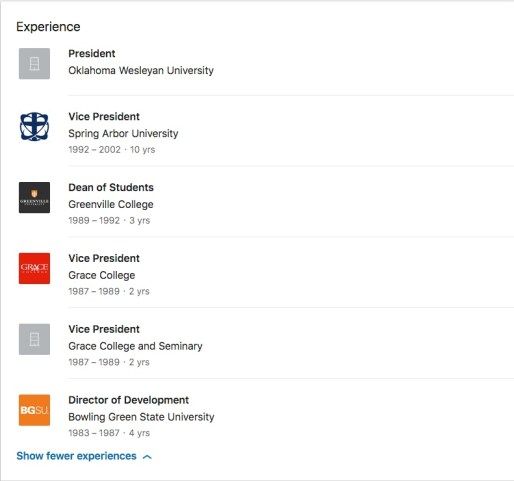
He grew up in a town of about 8,000 people and attended a nearby private school of about 2,000 people in late 1970s/early 1980s, when you weren’t required to hock an internal organ to pay tuition. Upon graduation in 1982, he took off for the work world, as you can see below:

PiperExperience

So he graduated at the age of 22/23, immediately went into academic administration and never left. Not exactly the story his university tells about him:

A native of Hillsdale Michigan, Dr. Piper grew up in a family that valued hard work, a mindset he carried with him as he moved from industry into pursuing a college degree.

Not sure how much “industry” work he did between the ages of 18 and 23 while in school, but he wasn’t a returning student, or a single parent, or a GI Bill kid, or any of those other kinds of folks I see on a daily basis who work their asses off to survive. He might or might not be the prototypical example of a guy who thinks he hit a triple when he was actually born on third base, but he’s also isn’t a latter-day “Rudy,” either.

Piper’s proud defense of his university not being a daycare seems a bit suspect, as he is making money off the deal. He turned his “catchphrase” into a nice cottage industry of castigating the youth and yelling about the snowflakes on his lawn.

The university even promotes the purchase of this stuff on its website. (What was that story about Jesus and the money changers in the temple? Oh, yeah…)

Also, consider this line from his letter to the masses:

If you’re more interested in playing the “hater” card than you are in confessing your own hate; if you want to arrogantly lecture, rather than humbly learn; if you don’t want to feel guilt in your soul when you are guilty of sin; if you want to be enabled rather than confronted, there are many universities across the land (in Missouri and elsewhere) that will give you exactly what you want, but Oklahoma Wesleyan isn’t one of them.

(The emphasis on those two statements is mine.)

If the irony of that first line doesn’t send your hater-ade filled soul into laughing fits, I don’t know what will. It’s easy to “arrogantly lecture” people, as Piper has clearly shown with his letter doing exactly that. Also, instead of dumping all over the kid who came to you with this concern about a Bible passage you likely understood far better than he did, why not help that little snowflake “humbly learn” what it meant instead of using the kid as a strawman to bolster your self-serving position?

(Side note:When someone tells me that something “actually” happened and “I am not making this up” in successive paragraphs at the front of a story, I’d bet money that person is making something up.)


(It’s even more amazing than when you have the ability to monetize your grousing…)

The second line (and any other similar phrase) always annoys me when it comes from people in a position of advantage. When is the last time University President and Almighty Deity of Knowledge Everett Piper was called out for his horsepucky? Probably back when people were rocking popped collars and jamming out to Duran Duran. It’s easy to say that people need to be confronted when you possess the power and position to do so, without fear of retribution.

And if all that hasn’t convinced you, read his Twitter feed. The guy has a transphobic Chuck Norris meme up there (as one of his many anti-LGBTQ tweets), called incoming house Rep. Alexandria Ocasio-Cortez a clueless child and referred to universities (all except for his, I’m guessing) as “bigoted, Intolerant, ill-liberal, inconsistent and closed minded.” Not exactly the bastion of intellectual argumentation I’d expect from a guy who reflexively calls himself “Doctor” more times than you’d hear it on a Thompson Twins’ Greatest Hits album.


Don’t Let These Guys Win

The problem isn’t that Everett Piper exists or that he has created a nice little business out of shaming college students with the tone of a high-strung school marm. The problem is that he isn’t alone.

Each generation likes to blame the one before for its problems and dump all over the one after it for not being perfect. As mentioned earlier, people like to get together and complain about how “a student did something you wouldn’t believe…”

Like any other stereotype, it contains a kernel of truth. Like any other stereotype, you can beat it. And like any other stereotype, you should call it out when you hear it.

Don’t let Piper and his ilk decide that you damned kids and your hippity-hoppity music are ruining this world and that if we could just get “Happy Days” back on the air, life would be good again. Don’t let this guy sell books off of the assumption that you will crumble or melt or whatever the comparative is that Piper or the next chucklehead uses to deride your generation. When someone decides to grump in your general direction, use your finely honed interviewing skills to pick apart their self-serving rubbish and demonstrate your intellectual journalistic superiority.

Sure, there are self-absorbed twerps in college who will claim their goldfish’s death merits a six-week extension on an already late paper. There are also dingleberries out there who misapply triggers and trigger warnings to mean anything they would prefer to avoid, as opposed to the actual medical situation they are.  There are plenty of examples of students that make us shake our heads until we develop neck cramps.

However, when you see something like this, written by someone like Piper, take a moment and smile. Think to yourself, “Gee, it must be so sad to think so little of the people you are supposed to help that your best approach to dealing with ONE QUESTION is to publicly rip AN ENTIRE GENERATION to shreds with a letter and then go write a book to pat yourself on the back for being superior to anyone under the age of 22.”

Then, go back to working hard to be better than this guy is. Commit yourself to being the antithesis of what he purports you to be. In other words:

Jargon or Vocabulary? 3 ways to determine which one you’re using

The use of simple language is the bedrock of what we do in journalism. Introductory writing courses pound the idea of eliminating complex terminology, removing unknown acronyms and generally cutting anything that might be considered jargon.

This approach makes a lot of sense when it comes to general-interest, mass-media publications, in which a wide array of readers who might be unfamiliar with the verbiage of a particular field come together to understand a complex topic.

However, the media isn’t always so “mass” these days, which means writers are serving thinner slices of narrower target audiences with content on niche topics. To that end, what might be “jargon” to a broader group of readers is merely “vocabulary” to the people who are reading, watching or hearing it.

Here’s a fun example from one of my favorite movies, “Dazed and Confused:”

In less than 15 seconds, Wooderson (Matthew McConaughey) proudly describes his beloved car, Melba Toast, to Clint (Nicky Katt) in a form of shared “gear head” language. Clint clearly isn’t impressed, but he’s also not confused.

(If you are confused, here’s a general translation of what he said. If you don’t care, skip past the bullets and pick up after them to get to my point):

So, how do you know if you’re relying on shared vocabulary or burying people in jargon? Here are some helpful hints:

WHO IS YOUR AUDIENCE?

When it comes to writing for your readers, you need to have a strong sense of who is out there and what they know or don’t know about your subject. This might require you to do some additional research about the people who are in your target audience before you start whipping around insider terminology. It might also require you to write various versions of the same piece for different groups of readers.

For example, in public relations, you might do some internal PR that explains some changes to the way in which your company’s factory will be dealing with the creation of certain product lines. If the readers are all coworkers who fully understand the ins and outs of the old process, some company-based shorthand and shared verbiage is probably fine. However, if you then have to put that information in a press release for general media outlets or shareholders who don’t have those same insights, you need to rework your writing to meet their needs.

In the blogging class, I find myself working with students who write about competitive swimming, sorority recruiting, offensive line play, k-pop and “mumble rap.” In each case, I am reading at a level well below what the expected audience will be, but I’m still expected to be able to help the writers reach those readers.

Thus, I often ask, “Is this a word/concept/process your readers would understand?” I then ask them other questions, like “At what level of swim do you learn this concept?” or “Is this a term that sororities use outside of UW-Oshkosh or even outside of Wisconsin?” After we poke at that idea for a little bit, it either stays or it gets a rewrite.

Not every reader will be able to follow everything you write, regardless of what that topic is or for whom you are writing, but knowing who you’re trying to reach can help you make the first cut on the jargon versus vocabulary decisions.


HOW EDUCATED IS YOUR AUDIENCE ON  YOUR TOPIC? 

Probably my favorite story about this came when I was reading a draft of a final project story one of my reporting students was doing on the concept of raw milk. The student was a farm kid, who saw firsthand the various people who had angles on the topic, including farmers who wanted to sell it, organic fans who wanted to buy it, legislators who were for its legalization, legislators who were against its legalization, milk conglomerates who opposed, food-safety administrators who had concerns about its safety and more.

I’m reading through this thing and I’m learning a ton about this, as the writing was complex and yet clear. I had heard about this concept before, as the local newspaper had covered it, but not to this extent. With that in mind, I suggested to her that she should get it published, but that she should target one of the farm publications that dotted the newspaper racks around here.

When I mentioned those publications, she looked at me the way that a parent looks at a small child who just said something adorably innocent.

“Um…” she began. “This is a little… basic for people who read those papers…”

I still laugh thinking about that moment because it perfectly captures the concept of writing at the acumen level of the audience. For me, she had to make certain things a bit less (OK, a lot less…) complicated in how the farming stuff worked. She get more detailed with the legislative stuff, because it was more universally understood. However, she used the right words to make her point based on how educated her audience was on the given topic.

As mentioned in the earlier point, not every reader is going to be at the same level as every other reader in your audience, but understanding the level at which you should be writing will make life easier on everyone involved. For example, if you’re writing about something like car repair, you might be targeting people with Wooderson-level acumen or people who want to be able to solve a few basic problems to avoid going to the repair shop for everything.

So, if you’re writing about what to look at when it feels like the gas pedal isn’t working, you need to determine how much knowledge your audience has in advance. For the regular folks, you might say, “Open the hood of the car and look at the right side of the engine, next to the big plastic piece that says ‘NISSAN’ on it for a small half-circle of black plastic with a silver cable attached to it. Have a friend step on the gas pedal and see if this moves at all. Also see if the cable moves but it doesn’t rotate that half-circle.”

For a gearhead, you might  say, “Look to the right side of the engine block and find the throttle body. Rotate it to see if the engine responds. Check the throttle cable to see if it has become dislodged or detached.”

This kind of thing applies a lot for student media outlets because some things are universally understood by students from the first minute they hit campus while others might be common knowledge to seniors but new concepts to freshmen. (I once went to a summer camp at a university where I was the only person from outside of that state. The students kept saying “I’ll meet you at the duck,” so I went looking for a statue of a duck or a pond. Eventually, I found out it was the DUC, which stood for Dobbs University Center.)

Everything from what you call the transcript of your classes as you move toward graduation (the STAR report at UWO) to the nearby off-campus housing (the J-Slums at Mizzou) is up for grabs based on how well your readers know your topic.


IS THIS READABLE CONTENT OR ALPHABET SOUP?

Regardless of how much you know about your audience or how smart those folks are, you still want to create readable content. When you start tossing around a boatload of acronyms, abbreviations and inside lingo, you can really find yourself sounding less like a storyteller and more like this scene from “Good Morning, Vietnam:”


As with most things in writing, the discretion of the writer and the editor come into play here, but make smart decisions when it comes to which items get the shorthand and which ones get some additional explanation. For example, “mph” is pretty much understood university as “miles per hour” so that car blog would be fine using it regardless of any user. However that CFM abbreviation might need expansion for some audiences and almost no explanation for others. Either way, when you find yourself writing something like, “The CFM determines the MPH or KPH based on the RPMs, IMA, MJ, CAT and the presence of an HIC.” you want to do a significant rewrite.

Three tips that will keep your blog operating at full steam in good times and in bad

blogging

The conversation with the PRSSA kids yesterday went really well, considering that we’ve got the accreditation team on campus, it was hour 13 of my day and I was still wearing a tie at that point in time. We talked about a number of things that would lead to a good blog and I honestly think a couple folks there might want to take a shot at developing one of their own.

One of the questions that came up during the discussion was that of “best practices” when it came to running a blog. In other words, if they got past the three basic rules I laid out for blogging, well, then what?

We picked through a couple examples that were based on their interests and kind of came up with three basic areas of importance that separated the good blogs from the ones that died on the vine. They aren’t anything particularly shocking, but understanding why they matter can make a huge difference:

Educational Acumen

Having expertise is a great thing, but you have to be able to use that expertise in a way that effectively communicates it to the people who are reading your blog. Otherwise, it’s a waste and the readers will become frustrated and leave.

This is where knowing your audience becomes crucial, as you can meter your use of jargon, your level of explanation and your overall approach to the content based on who is reading.

For example, let’s say you want to run a blog about how to fix old pinball machines. You have spent half your life working on these things and you have repaired more than 100 games that ranged from mild tune ups to massive rebuilds.

If your audience is comprised of first-time pinball owners, you will need to use a lot of visuals to show them what things like coils and targets are. You will need to explain how to do simple things like remove the glass or disconnect a coin mechanism. You will need to offer more caution regarding dangerous things to touch or things that can break.

If your audience is comprised of more veteran repair folks, you can skip some of the basics, rely more on shared terminology and even go into deeper rebuild topics. As one of the students asked, “If people in your audience are really into your topic, can you use jargon?” I explained that it’s not jargon if the people understand it; It’s shared language. Jargon is stuff that you use that other people in your audience DON’T understand.

Additionally, you’ll need consider word choices to help people complete tasks in an effective way. So if you want them to use a hammer on something, there’s a world of difference between “hit” “pound” and “gently tap.” Experts will likely know these differences instinctively, while newbies will need more hand holding.

Passion

Being good at something and liking something are not the same thing. This is the argument I have with my mother to this day: She thought I should have been a political speech writer. Her point was that I was good at speaking, speech writing and that I could really make a difference in how people saw the world. My point was that I hated politics and I hated politicians, so no matter how good I was at this, I was never going to go anywhere in this field.

Or to quote a professor who spoke to my dissertation prep class, “Pick a topic that you really love because you’re going to be with it in good times and in bad, in sickness and in health, until death or doctorate will you part.”

To be good at something and to do well at it constantly, you need to have a passion for the thing you are doing. Never is this more true than in blogging, because without the passion, you’re never going to make it. Here’s why:

  • You have no deadlines. It’s easy enough to blow off an assignment when you have a deadline. When you don’t, you can always push something down the road a bit further. If you don’t believe me, consider the ugly yellow plastic windows we had on one of our kitchen cabinets back at our previous house. When we moved in, Amy asked me, “When you get a chance, could you get rid of those and put new doors on that cabinet?” When we sold the house two years ago, the plastic remained. We got to know the most-recent owners of the home and got a tour of the place a few weeks ago. Ugly plastic is still there. In short, when I WANT to get something done, I’ll get it done in a New York Minute. When I don’t have a deadline, I’ll blow it off.
  • The quality of the work suffers: Mom used to read the State Journal every day when I was working there. She’d often call me up and talk to me about the articles I had written. In one case, she told me, “I read X. You didn’t really want to write that one, did you?” The truth was, I hated the story she was talking about, but I wanted to know what led her to figure that out. I asked if there were flaws or mistakes or whatever and she said, “No. It read fine and there wasn’t anything wrong. I could just tell that you didn’t want to do this.”
    If you don’t have a passion for the topic, as in you love this thing and you want to spend a lot of time with this topic, writing to other people about it, you’ll end up with a really lousy blog. You can’t just have a passing interest. You have to love it. If you don’t it will show up in the writing and people will tell.
  • You will run out of stuff to talk about: People who love a topic will talk about nothing other than that. If you don’t believe me, go back and watch Forrest Gump again and listen to how Bubba talks about shrimp. You want your blog to be like a diesel engine: It might take you a little longer to get started, but once it gets going, it can run long and hard without stopping. If you don’t have a passion for the topic, it’ll be like a bottle rocket: It’ll take off in a hurry, explode quickly and then dissipate.

Dedication

This puts together the above two with the idea of understanding what it takes to make this thing work and forcing yourself to do it every day or every week or whatever. You must make sure you are constantly looking for things to add to the blog. You must make sure you post when you are required to post things. You can’t just blow it off when you don’t feel like writing. You can’t push it down the line because you can’t think about something or because other things become more important. If you are going to develop an audience that has an interest in you, you must continue to find things to give them.

Dedication leads to consistency and leads to success.

Nolan Ryan pitched in the major leagues until he was 46 years old and he credited his workout regimen after games for a lot of his longevity. When he won his 300th game, his family wanted to take him out and celebrate right after the game. Instead, they had to wait for him to finish his post-game workout before they could go out. Even though they pleaded with him to skip it “just this once,” he said, no and went to work.

Think about all the things that you might have succeeded at or failed at. It could be the New Year’s resolution to work out. You get going all gangbusters and then it’s really, really, REALLY cold outside and you don’t want to get out of bed and suddenly, goodbye exercise.

It could be a diet where you have meals planned and things are going along fine, but then you get caught short of your health nut mix and Hello, Taco Bell!

A blog can’t be like that if you want to be successful at it because it takes a long, long time to get an interested and engaged audience and it will take no time for them to leave you like a cheating fiancée on Temptation Island.

Honestly, not every day will be an academy award, but you have to ply your trade every day no matter what.

Life 101 (Part II): Everything you wished you’d known before you graduated but nobody told you

What Am I Doing With My Life?

Monday’s post looked at the Life 101 issue of looking for and getting your first career job out of college. If you missed it, you can see it here.

Today’s post takes a look at things that go beyond the job hunt that recent grads told me they wished someone had told them before they graduated.


WELCOME TO WHEREVER YOU ARE:

I got a note from a former student who asked me about how to deal with “bad things.” She had recently graduated and was about nine months into her first career job. She was living in another state, in a small town in which she had never heard of prior to taking a job she loved.

After a few false starts of me guessing at what she meant, I picked up on a thread in her responses and asked, “Wait a minute. Are you feeling lonely?”

Bingo.

She had been actively involved in clubs, sports and other stuff while building an immaculate GPA at UWO. She was always on the go and always known wherever she went. Now, she was in a completely new place where she knew no one and she didn’t know how she was supposed to feel.

I had fewer friends, fewer interests and fewer people who knew/liked me when I made my first big move, but I felt similar pangs of anxiety. After my dad helped me move in, he spent the night before saying goodbye and leaving the next morning.

After he left, it dawned on me: Nobody here knows me at all.

(Side note thought: I could die in this apartment and nobody would notice until eventually I missed a rent payment or someone caught a whiff of decomp.)

I went from running constantly from 8 a.m. to 3 a.m. every day to working a nine-hour-a-day job and going home to… what? I took a lot of walks, bought groceries at normal times of day and generally looked for a place to fit in. It wasn’t easy, and apparently that was something others faced as well, given some responses I got from my former students:

It takes AWHILE to transition from being a college student to a working adult. Give yourself time and grace when going through this transition and don’t doubt your worth. You’ve got this.


Envision your life outside of work when considering a job – If you’re outdoorsy, does it have great trails? If you dig X, does it have X? The city has to pass the vibe check, or you’ll depend too much on work to bring you all your happiness.

Others noted that life got a little weird for them, living somewhere new, knowing nobody around them and generally losing that entire support structure of friends and family they’d taken for granted.

Friends and family are still there for you, just in a different way. It’s also an opportunity to spread your wings. Think about when you landed on campus four (or five or six) years earlier and how you didn’t know a damned thing about anything. It’s like that again, which sucks. That said, you survived and thrived in that once before, so the precedent is there for you to succeed.


WELCOME TO ROOKIE BALL

One of the hardest transitions people often make is from being the big cheese to the lowest of Limburger.  It hit me hard when I took my first pro gig.

At the student newspaper, I didn’t get much editing. People generally said, “You’re great!” or at the very least, they had bigger problems to fix, so I kind of skated by with the assumption that whatever I was doing was fine.

When I got to the Major Leagues, I got a rude awakening. A lot of my copy was getting hacked and slashed. My source material was being questioned. My use of quotes was second-guessed. My overall ability to do a good job was under constant scrutiny.

At the time, I needed help, guidance and support, but I had a boss who had either no interest or no capability to provide those things:

(This editor can’t be bargained with. She can’t be reasoned with… And she won’t stop until you realize you suck!)

I eventually gained my sea legs, but I never forgot what it felt like to get my ears boxed in on a daily basis. Apparently, neither did some of the folks who responded to my post:


Imposter syndrome is real and it is awful.


Nobody knows what they’re doing… They’ve just been working through it longer than you have. Hang in there.


Being the newest person means everyone else has a leg up in some way… Be ready to work weekends and holidays.


You have to know what the rules are first before you break them.


It’s tempting when you’re new to think folks with more experience have everything figured out. The truth is everyone is making it up as they go along on most things.


In kind of pairing these previous two thoughts, something else a student mentioned resonated with me when it came to being the new kid: You’re often the youngest kid by a stretch.

The student who got me thinking about this issue told me she had this weird age gap thing. She was too old to connect with the people she covered (high school athletes) and yet too young to really connect with the people she spent time with (colleagues and the athletes’ parents). It felt like there was nobody her age to connect with.

For the majority of my career life, I was always the youngest person in the room. I was 21 when I got my first gig in a pro newsroom, 22 when I got my first teaching gig, 24 when I got my first professor/editor gig, 28 when I got my first tenure-track gig and so on…

Those early years were awkward, in that I often had nothing in common with my coworkers. The people at newsroom parties  were talking about kids and soccer games and 401K accounts. Conversely,  I was like, “Hey, uh… is that beer over there free for, like, anyone to take?” I was told rather bluntly that if I was caught “associating” with students, my boss would hide strap my ass to a pine rail and ship me out of town.

It wasn’t the easiest of situations in those early years, but it was even harder because I had nobody to talk to who was going through the same thing. Maybe that’s why still tell my students my door is always open, even after they graduate.

I know it sucks to be the rookie.


KEEPING UP WITH THE JONESES

Of all the advice the hivemind chipped in with, this insight needs to be screamed from the top of every mountain:

Try not to compare yourself to your friends who have seemingly better jobs. Instead of resenting the job you have, see what you can do to make it better – to make yourself better at it so you can easily move onto the next position.

During my doctoral program, I researched in the area of Social Comparison Theory, which examines the way in which people try to figure out how they stack up in a particular area of life by looking at other similar people in their area. I also watched it  play out on a daily basis there as I taught kids at the journalism school.

It was a constant game of keeping up with the Joneses. If Bobby got a front-page article, Suzie needed to get the top article on the front page. If Jane wrote 40 stories in a semester, Carl needed to  write 45.

It got even worse when they went after internship and employment opportunities. If Marco got an internship at a 75,000 circulation daily, Maria had to get an internship at a 100,000 circulation paper. If Nellie got a gig at a top 50 market TV station, Willie had to get one in a top 20 market.

I watched this transpire long after I left, with former students chasing each other up the golden ladder for no real reason other than to prove some level of superiority. I saw students leave perfectly good jobs to take on jobs that didn’t fit them because one of their peers had moved up a rank or got a gig at a larger publication.

In one case, a great student left a job where he was perfectly suited and wonderfully gifted as an editor in a smaller publication to chase other jobs that made no sense. He eventually ended up doing night cops at a paper in Kentucky, working for a mentally unbalanced night editor and feeling miserable.  When I asked why he took the job,  he cited two reasons:

  1. The paper’s circulation was huge, comparatively speaking to his previous job.
  2. One of his former cohorts had gotten a gig at some place “better” than where he was.

This made no sense unless you understand the competitive nature of the school, the kids and the field. I eventually got him to see that “better” is in the eye of the beholder.

I have friends that make more money than I do, but I wouldn’t trade positions with them under threat of death. I have friends with classier titles and bigger offices, but they also have more problems, or at least the types of problems I hate dealing with. I have friends who do a lot of things that, on paper, sound like they’re living a much “better” life than I am. However, I get a lot of stuff that can’t be measured on a spreadsheet and I’m relatively happy with a great portion of my life.

Every day is not an Academy-Award-winning performance,  but it’s what I found works for me. I figured out that chasing someone else’s dream or trying to prove superiority by making myself miserable in my career made no sense.

A few other folks who chimed in on this topic made similar statements, saying they wished someone had told them to just worry about themselves and not chase the dreams of others. They finally figured out that comparing themselves to their former classmates made no sense and it made them miserable.

Once they settled in and just enjoyed being themselves, they found happiness.


THE FINAL ADVICE LIGHTNING ROUND:

Some of the best bits of advice didn’t really fall into a perfect category but it was so worth keeping, I figured this would be a good way to do it. So here comes the lightning round of advice:


Ask questions, ask for feedback, ask for what you need to succeed in a position and know that they hired you for a reason. And if that still isn’t working out, find something else that you love to do.


Know your worth and celebrate your accomplishments, achievements, and recognize the significance of your contributions. Don’t downplay them.


It’s very rare that in reality something is as high stakes as it can feel in the moment. After a fuck-up that felt career-ending for me but in retrospect did not matter in the slightest in the big picture, my boss told me “we’re not curing cancer.” And that’s stayed with me – very little is life or death, at the end of the day.


Your career is not your identity. It’s a reflection of you but it does not define you.

Well, that might not be everything, but I hope it’s a start.

If you have any other questions, comments or concerns, feel free to hit me up on the contact page.

Otherwise, have a great summer and best of luck in all you do.

Vince

(a.k.a. The Doctor of Paper)

THROWBACK THURSDAY: Your parents’ generation sucked at this, too: 4 helpful thoughts on finding your way through life

I think I set a record this week for “number of students breaking into tears in my office for reasons that have nothing to do with their grades.” The sheer volume of terrible things befalling my students would stun a team of oxen in its tracks and has me wondering if I’m somehow radioactive.

The one kid that really got to me was the best of the bunch: She’s six weeks from graduation, has worked in student media for quite some time, has a great resume and would be a great hire anywhere she chooses. Her problem is that the places that are hiring for things she’s good at are either just out of her educational or experiential range in many cases. In other cases, they’re not getting back to her or hiring other people.

The frustration for her was palpable, even as she started to cry, because she told me, “I swore to myself I wasn’t going to cry in your office. Dammit…” Once we got past that, it turned out she was not only facing all of these pressures, but also the pressure that comes with being the first in her family to go into this educational level and field. Her parents are in the “You got a job yet?” mode, which only makes sense if you’ve never gotten a job in this field at a point like this.

For her and all the other people who are dealing with anxiety, self-doubt and possibly antsy relatives, here’s a throwback post that I hope provides some solace.

—-

Your parents’ generation sucked at this, too: 4 helpful thoughts on finding your way through life

Scott Cunning, an associate professor of economics at Baylor University, recently laid out his life path and his feelings regarding jumping into grad school right after college as part of a Twitter thread.  He makes a number of points that are good, including the idea that grad school shouldn’t be about inertia or self-doubt, but rather when you know what you want (and that you want grad school). He talks about job choices and the benefits to getting one as well here, and I highly recommend giving the whole thing a read.

The nexus of his thesis is something students should keep in mind: You won’t know what you want to do until you end up running into it. That can make for some pretty high levels of anxiety for students and parents, as well as some really awkward family gatherings where random relatives feel it is their duty in life to say, “So you STILL don’t know what you’re doing yet?” instead of “Nice to see you. Pass the potatoes.”

In hopes of helping you defend your psyche from the chaotic panic and shutting down the naysayers who keep blaming your generation’s downfall on “FaceSpace and those iText things,” here are four things to keep in mind:


Everyone in college is lost and that’s just fine: At the beginning of each semester, I ask the students in each of my classes what they want to do with themselves once they get out of school. Some of them have a vague notion, half of an idea or a general sense, and that is about the BEST it gets. Only once in all my time teaching did I ever really have a kid tell me something straight-up honest and it was last semester:

Me: So what do you want to do with your IWM (Interactive Web Management) degree?
Him: Make a ton of money.
Me: How will that work?
Him: I don’t know. I’m gonna figure that out when I graduate.

For the rest of the people in my class, it’s like this: “I want to graduate, get a job, not move into my parents’ basement and not have to answer stupid questions like this one from every relative who runs a business selling wiener dogs out of a mobile home and somehow thinks they’re better than me.” Spoiler alert: That’s the American dream of this generation.

Cunning is right, though, in that you won’t know what you want to do until you do it, which is why they force you to take a boatload of general education requirements in college: They figure you don’t know what you want, so they give you a taste of a bunch of stuff.

Instead of taking those classes with only the edict of “Please, God, not another 8 a.m. on Fridays,” look at classes that might interest you and see where they take you. That’s how you bump into things you might like to do for the rest of your life and find some direction. In the mean time, it’s not a problem to not know.


Being good at something doesn’t mean you should do it: The longest-running argument in my life is between my mom and me about what I should have done right out of college. She still believes that I would have made a great speechwriter for politicians, based on my various skill sets. I liked to write and had the ability to turn a phrase fairly easily. I did well in public speaking courses and extracurricular activities, such as debate and forensics. I worked well under pressure and could logically process information quickly. It seemed like a perfect fit for me.

Here’s the counterargument I had for mom: I hate politics.

I spent a lot of time with political figures during college, ranging from student government folks on up through the city and county leaders and found I disliked the majority of them and their attitudes. I never understood the wrangling and the gamesmanship they used to carve up their little portion of the world just a little bit finer. I also hated the arrogance and ego associated with the jobs. Why on Earth would I want to write things for people like this so they could snow under a whole bunch of voters in hopes of furthering their own petty agendas?

The point is, Mom and I were both right in some way. She was right that I had the talent and skill set to do this as a job, and I was right that I’d rather gargle with raw sewage than subject myself to that career path. Thus, the maxim outlined above.

You might have a talent, a skill or some general proclivities that push you into a realm of study or onto a career path, but keep in mind that just because you can do something, it doesn’t necessarily follow that you should. If you don’t like something, don’t put yourself in a position where you dedicate your life to it.

In this regard, Dad had the better take on this topic: Find something you like doing and you’ll never work a day in your life.


You are not a fraud, even though you will feel like one: During my doctoral program, we had a class in which every faculty member in the school could come in and discuss his or her research or offer us advice. Of all the advice I got at that point, a couple stuck with me, including this one from Dr. Stephanie Craft:

A few years into your career, you are going to look around and panic because you think that you are a fraud. You will worry that you aren’t good enough or smart enough or whatever and you figure that it’s only a matter of time before everyone else figures this out, too. You then start counting the days until the entire illusion you’ve built will shatter and you won’t know what to do.

Don’t worry. It’s not true. You are not a fraud. You will be able to push past this.

A few years ago, I read about this concept called “imposter syndrome” that essentially captures this whole notion perfectly. It happens to a lot of people and it’s not something you can necessarily dodge in advance of its arrival. When it hit me, it didn’t matter how much work I had done, how well I had done at that work or what everyone else thought about how awesome I was. All that mattered was that I figured I’d eventually get caught short and revealed as something between a carnival huckster and a guy selling snake oil out of the back of a covered wagon.

The one thing that made the difference was remembering what Dr. Craft told me and realizing her prescience on this fraud fear arriving also made it likely that she was right that I could beat it.


Your parents’ generation sucked at this, too: If your parents tell you that they knew everything when they were your age or that they had a job or that they knew their destiny, I’ve got two words for you: “Reality Bites.” This movie came out 25 years ago, or roughly around the time many of your parents were finishing up their college careers and looking around for whatever that next stage of life would provide. This movie really captured the post-collegiate zeitgeist better than almost anything else at the time, and it provides you with the perfect time capsule to look at what your parents dealt with.

You have Lelaina, Winona Ryder’s character, who was working as a young assistant producer for a cheesy morning show where the host (John Mahoney) treated her like crap.  When she got fired for perhaps the best on-air prank possible, she tried to find a job in her field, only to realize that she couldn’t get hired anywhere. Her father thought her generation had no work ethic. She craps all over her friend Vickie for offering her a job at The Gap, and falls into the bell jar of trying to find meaning in life via a “psychic partner” phone line. It only gets weirder from there (although the final love connection she makes is really too Hollywood for its own good).

If you strip away that last part, you realize that this generation didn’t know anything either, and I say that as PART OF IT. Sure, she fell in love at the end, which is pretty much what the film industry was selling at that point, but she didn’t have a job, was dead broke, had to use her father’s gas card to pay bills and there was no sense she was figuring it out. (And yes, that’s why reality really does bite.) Still, that generation eventually dug in, figured something out and managed to build a life that produced you.

Whatever they tell you about their origin story, view it through the prism of “Reality Bites” and you’ll probably be closer to reality.

Verified by ExactMetrics