When Write Goes Wrong: How to avoid the trap of journalistic fabrication (A Throwback Post)

It’s rare to have a group of students be exceptionally engaged at 8 a.m., but when it came to our ethics lecture today, the room was humming. Tons of hands up, tons of questions, tons of despair.

They had read stories about a drug addict and a rape survivor, seeing how their lives were forever altered by the choices they had made and the choices made for them. They cringed as the description of the these people’s circumstances, they flashed anger about the way in which the people around them had acted and they felt both helpless and compelled to act at the same time.

“I wanted to drive (out there) and beat those people up,” one student said of the people who engaged in the sexual assault.

I let them get all of it out, before I asked them to describe their feelings about these stories in one word or a simple phrase. They came up with things like, “anger,” “disturbed,” “disgusted” and “sad.”

I then took a deep breath and told them the truth: None of these stories were real.

In case you haven’t guessed, they read “Jimmy’s World” by Janet Cooke, “Hack Heaven” by Stephen Glass and “A Rape on Campus” by Sabrina Erdley. Each story was fabricated in some part or entirely. Each one fooled people at some of the most influential publications in the country. Each one had readers enraptured in a way that only amazing writing and terrifying topics can.

After that brief reveal, I asked the students how they felt now, knowing this new information. The answers were somewhat similar (anger, disgusted) but also different (relieved, stupid). As we shifted the topic toward how NOT to put themselves in this situation, I told them that any time they feel like they want to cut a corner or bend the rules in this kind of way, they should think about how they felt when they found out these stories weren’t real. Then, realize that’s how they’ll be making their own audiences feel if they fake it and get caught.

Today’s throwback piece takes a look at another case of fabrication and some potential things that might help your students come to grips with this issue.


“Don’t Bring Shame On The Family.” 4 helpful thoughts related to the Mike Ward fabrication debacle

Every time I see a situation like the one involving former Houston Chronicle journalist Mike Ward, who was found to have fabricated sources for his stories, I always think, “What the hell is wrong with this guy (or gal)?” Thanks to my overly Catholic upbringing and the guilt that comes with it, my next immediate thought is, “Hey, there but by the grace of God, go any of us.”

However, at various points in life, family and friends have hit me with a few helpful thoughts that stuck with me that kept me out of a lot of trouble. In hopes that these things might help you in your journalism career (or life in general), here are four of those bits and bites that might be useful:


If you’re going to steal something, steal the whole store

My dad can always make sense of things in a way that usually kept me from doing a lot of stupid things. He once told me a simple adage that helped me understand cost/benefit analysis in a truly elementary way.

“If you’re going to steal something,” he said. “Don’t steal a candy bar. Steal the whole store. I mean when they come back in the morning to open up, there should be nothing left but wires sticking out of the ground.”

His point was that once you steal something (or do something else despicable), you were marked for life, so it better be worth it when you throw away everything for it. I have no idea what Mike Ward was best known for before this, but it’s pretty clear he won’t be known for much else other than this going forward.

It’s hard to find a lot of background on Mike Ward, but he’s not like some of the other “fabulists” like Jayson Blair or Stephen Glass who was a 20-something who got in over their heads. He spent more than 40 years in the field of journalism and nearly 30 years doing it in the state of Texas. He was working for one of the best newspapers in the state and a well-respected publication overall.

Was it worth throwing away his whole career and reputation to pep up the stories with random quotes that weren’t all that great to begin with? I doubt he thought about it like that, but I know I always let flights of paranoia take me to the worst possible scenario before I even think about “candy-bar-level theft” let alone taking out an entire store.


Stupid is bad, lazy is worse

I think this one came from my mother, but I’m not 100 percent sure. In any case, the underlying premise of not being lazy usually was Mom’s stock-and-trade when it came to things I was doing.

I know my general laziness was like a stone in a shoe for my mother. I can’t tell you how many times I’d be doing my homework and yell to Mom, who was in another room, “How do you spell (whatever I didn’t want to bother to look up)?” Her answer was always the same, “Look it up! You have a dictionary in there.” In short, don’t be lazy.

It could be unfair to deem Ward as lazy, but the way in which he seemed to make up random people would indicate at least some corner-cutting behavior.

It’s easy to find sources you use all the time for stories and to get used to those folks being ready to comment. The investigation into his various stories found that most of his “meat and potatoes” official sources were real people with legitimate quotes. Those folks could be interviewed with a quick phone call or a simple email.

The “real people” who hated guns or gun control, who planned to vote for a specific party, who didn’t like that the McRib wasn’t available all year and so forth require some “shoe-leather reporting.” Reporters have to go to local diners, knock on doors with “Don’t Tread On Me” flags flying outside, ask people they know for help finding people they don’t and generally chase around to get that one pancake-eating source who can give you the “salt-of-the-earth person” quote.

That part of the job is a major pain in the keester and it can be awkward as hell. Truth be told, I used to prefer asking people for comments after a shooting or a fire or something else horrible than walking up to a guy eating a funnel cake at the county fair to find out how much fun he was having at the event. Still, it’s part of the job, so I did it, despite the fact people treated me like I was from the KGB when I asked for their names.

Why Ward thought he could pull this off was a mystery, but it would seem to either be a dumb decision or general laziness. Neither of those approaches is good, so do your best to avoid both of them as a journalist.


They never did it just once

This one came from a former journalist and great friend of mine who covered the Chicagoland Catholic church molestation scandals of the early 2000s. I used to ask her how she knew for sure that the priests in her stories were serial pedophiles. The information she gathered came from the accusers, usually years or decades later, and was almost impossible to back up with documents or other “official source” content that I had gotten used to using in my own work.

Her answer was simple: She did a ton of digging, verified in every way she could and then she published the content and waited. In almost every case, if she published one or two accusations, she immediately heard from at least three or four other people who told her the same things had happened to them. It was like this scene at the end of “Spotlight.”

“They never did it just once,” Allison told me. “And they always did it the same way.”

She found that if a priest had trapped a child in the 1970s by promising baseball tickets and then luring the young man into his room, he did the same thing in the 1980s and 1990s. It was never a one-off and it was always the same.

Even though the magnitude is in no way the same, I think about this whenever a student mentions that they only cheated on an exam once or only lied about a source once or only did anything else sketchy once. It’s never just once. It’s just that they finally got caught.

When Blair was caught in New York, his student newspaper at the University of Maryland went back and found other fabrications and noted people were alerted to these problems at the time.Ward has a 40-year career in this field and he just got caught now in Houston. I would be willing to bet that this didn’t just happen once and it didn’t just occur to him now to do it. I have no idea how far back people want to go, but it wasn’t “just this once.”

If the thought ever occurs to you to cut the corner “just this once” and make up a source or hide a detail to spare a friend or fake your way through a story, don’t do it. It’s never just once.

It’s only hard the first time. After that, it becomes standard practice without a second thought.


Don’t bring shame on the family

I hear this in my head on a daily basis, courtesy of my father.

As I was preparing to go off to college, my mother was a veritable trove of advice, thoughts and wisdom that made “Oh, the Places You’ll Go!” seem underwhelming by comparison. She told me of all things I would see and the experiences I would have and everything else good that college away from home would bring.

Dad was more practical and blunt: “Go have fun, but don’t bring shame on the family. It’s my name, too.”

Tarnishing the family name was unacceptable to Dad, and to be fair, it kept me out of a lot of stupid situations. To this day, whenever I imagine doing something that might not be all that bright, I can see the headline in my mind: “UWO professor arrested on suspicion of (fill in the stupidity here).” I imagine the folks “back home” seeing my dad in the grocery store or running into him at the local farmer’s market and saying, “Hey… I read about your kid…” I STILL do this and I’m middle-aged, to put it kindly.

However, I also think about mistakes that tarnish that other “family” I referred to in the post about how journalists aren’t the enemy. In his 2016 piece on Janet Cooke, Mike Sager talks about how her fabrications led to the general mistrust of various groups of people. Some of his sources said that Cooke led others to distrust African-Americans in the newsroom. Others said it tarnished all journalism, leaving the public to regard all content with a wary eye.

I wonder what Cooke’s professors at the University of Toledo felt when they saw her quick rise and even quicker fall. I remember a few years back when a journalist in Alaska, Charlo Greene, quit her job during a live broadcast while outing herself as the owner of a marijuana-related enterprise.

A number of professors were chatting about this online when a professor I knew messaged me to say she had been a student of his. In discussing Greene’s collegiate experiences and the current situation, I could almost feel his grimace over the internet. If it were my student, I know I would have been rubbing my head and searching for aspirin while muttering, “Oh, good grief…”

Maybe it’s an old-fashioned notion that has people like me avoiding disaster by asking, “Good LORD! What would the NEIGHBORS think?” but I really believe it goes deeper than that. Each of us owes a debt of some kind to the people who helped us get here. The people who support us. Who take part in our lives. Those folks are family in the best possible sense and to create shame through poor judgment is to spread that shame upon them as well.

I might not always be thinking of myself when I do something good or bad, but you better believe I’m doing my best to not bring shame on those people.

Journalism 101: Facts matter, so don’t feel bad about forcing people to get them right

Screenshot

THE LEAD: In a blinding flash of the obvious, the Washington Post reported that politicians don’t like being told they’re wrong about things via a journalistic fact check. In other “water is wet” news, Donald Trump and his campaign seem particularly outraged by the temerity of journalists who actually researched topics and can prove he’s full of beans from time to time:

Trump nearly backed out of an August interview with a group of Black journalists after learning they planned to fact-check his claims. The following month, he and his allies repeatedly complained about the fact-checking that occurred during his debate with Vice President Kamala Harris, berating journalists and news executives in the middle of the televised debate.

And this month, Trump declined to sit down for an interview with CBS’s “60 Minutes” because he objected to the show’s practice of fact-checking, according to the show.

<SNIP>

The moves are the latest example of Trump’s long-held resistance to being called to account for his falsehoods, which have formed the bedrock of his political message for years. Just in recent weeks, for example, Trump has seized on fabricated tales of migrants eating pets and Venezuelan gangs overtaking cities in pushing his anti-immigration message as he seeks a second term in office.

THE BACKGROUND: The joke I always go back to is the familiar one of, “How can you tell when a politician is lying? Their lips are moving.” The idea that politicians fabricate situations is not a new one. Nixon’s “I am not a crook,” Clinton’s “I did not have sexual relations…” and Mark Sanford’s “hiking on the Appalachian trail” are some of the more infamous ones, as they intended to cover over embarrassing personal failings and limit political fall out.

Even more, politicians invent people they saw, they met and they heard, all in the service of some anecdote about salt-of-the-earth farmers getting the shaft, military leaders praising their brilliance or other similar moments of self-aggrandizing puffery. And of course there is the myth-making that surrounds some politicians, like George Washington’s cherry tree or Reagan’s trickle-down economics…

As far as this election is going, Tim Walz was fact-checked on his claims about his service, his presence in China during the Tiananmen Square protests and his family’s use of IVF services, each of which resulted in some disparities. Kamala Harris is also ringing up a few “false” ratings from Politifact on some of her claims regarding illegal drugs and her own previous political efforts.

Still, most of this is piddly stuff compared to what Trump does on a daily basis, both in terms of frequency and intensity. If Walz’s “carried weapons of war” statement is a leak in the truth boat, Trump is continually bashing the Titanic into the iceberg and flooding every compartment.

WHY DO WE CARE AS JOURNALISTS: Despite what the former president of the United States things, facts have a definition:  things that are known or proved to be true. The job of a journalist is to get the facts and report them, so that people can make informed decisions on important things in their lives. If you strip away everything else from journalism, that’s the beating heart at its core.

Telling journalists you will only talk to them if they promise not to fact check you is like telling me, “You can come to our party, but only if you promise to not be a bald, middle-aged white guy.” It’s what I am, so that’s going to be a bit hard to square that circle.

People rely on facts to have a shared understanding of reality, so that society can function. It’s why when we bring a shirt to the check out kid and that shirt is priced $19.99 plus tax, we understand it’s probably going to cost about $21 or $22, give or take your part of the country. If the kid says, “That price is fake news. You owe me $150 and can’t leave until you do,” that breaks the whole “shared understanding of reality” thing.

For years, journalists have been telling people, “You’re entitled to your own opinion, but not your own facts.” Somewhere along the way (I blame the internet), it actually became, “Pick your own facts and then be outraged when someone disagrees with you.”

EXERCISE TIME: Pick out a TikTok on any hot topic that’s going on today (politics, Diddy trial etc.) and write down whatever statements these people are declaring to be facts. Then, go fact check them against

Indiana University administrators unilaterally killed the still-profitable print edition of the Indiana Daily Student in order to try a “convergence” model that we proved to be a failure back in 2002

“Here is your news robot, Mrs. Burgess! It’ll beam content into your brain until you forget that the Indiana Daily Student used to have a newspaper you liked!” (screenshot from the IU home page; sarcasm naturally grown in Wisconsin)

THE LEAD: In yet another ham-handed, “we grownups know best,” maneuver, administrators at Indiana University decided to kill the weekly print edition of one of the country’s best college newspapers, without discussing it with anyone involved at the Indiana Daily Student:

The IU Media School plans to eliminate the Indiana Daily Student’s weekly print edition beginning this spring as a key part of its plan for student media, claiming the move will save money and help make a converged IDS, WIUX and IU Student Television operation revenue neutral within three years.

The school announced the plan publicly Tuesday afternoon before consulting with student media leaders or the IU journalism faculty, even though the school had scheduled meetings with both groups Wednesday. Most of the IDS’ student staff members, including the designers that work to design a print product each week, were unaware of the change when it was announced.

THE FALLOUT: Well, for starters, not telling someone that you’re about to do something painful to them, without their consent or input, only to have them find out on their own is not really going to build confidence in the approach.

(It reminds me of when Zoe had to get her 18-month boosters and no one mentioned it until the nurse came in and plunged three needles into her leg before Zoe got a glance. The fourth needle hit and she began to sob uncontrollably as she looked at me with the, “Why hast thou forsake me?” look and I wanted to die.)

The IDS staffers, who were supposed to have a meeting on Wednesday to talk about this with administrators, found out when a draft of the plan leaked early (because of course it did) and a press release leaked (because, y’know, these kids are good journalists who find stuff).

Let’s just say their letter from the editor reflected that sense of betrayal, but also the clarity of a newsroom that understands big, sweeping changes may sound great, but they impact granular-level aspects of daily life:

We believe this plan was made with good intentions, but we do not believe it was made with proper consultation of the people who know the most about the IDS. That is clear throughout the report, where many ideas that sound good in theory have left our professional and student staffers wondering how they will work.

Since 2017, the IDS has undergone multiple reductions to its print edition, as well as its professional staff members — decisions that were made to combat the growing financial burdens that plague newspapers nationally. Years later, these cuts have not solved the deficit. The Media School’s latest decision — the first time a print cut has been mandated by administrators — will only perpetuate the problem.

We believe slashing print will have unintended negative consequences for our revenue. The plan poses a host of logistical problems associated with a reduced paper delivery schedule, such as the challenge of retaining delivery drivers.

(NOTE: I’ve got emails out to the editors and advisers at the IDS and we’ll do more on this Monday if those things bear fruit. If not, I’m sure I’ll still have enough outrage for a post or 12 in the next week or so.)

WELCOME TO 2000: One of the primary things the university has cited here is that by converging the media operations, not only will things run more smoothly from a content-delivery standpoint, but the university can save money.

If this sounds vaguely familiar, it’s because we’ve tried this before. Convergence was a concept that popped up in the late 1990s, but really became prevalent in the early 2000s. Laws had previously created walls between various media operations, so only a few operations like the Tampa Tribune, WFLA and TBO could exist in this converged environment. Once those laws went away, bean counters… er… corporate media titans found ways to couple up and thruple up as many of their organizations as possible.

The goal was multifold:

  • Eliminate redundant financial operations and general day-to-day expenses. (Why have three websites when you can have one? OR Why have three front-desks staffed with workers when you could have one?)
  • Expand advertising packaging to improve sales across multiple platforms (This is why you still get a landline with your cable and internet package, even if the last time you used a landline was never)
  • Create synergistic content creation among reporters, editors and media professionals from previously competitive backgrounds (Hold on to that one. We’ll get to it later.)
  • Dominate a particular area against the sad one-platform operations (Presupposing, of course, that bigger is always better. Is it? Asking for a friend…)

DOCTOR OF PAPER FLASHBACK: I first heard of convergence when my doctoral adviser came in from a weekend conference at the University of Kansas in a huff.

“Some jackass out there said that KU had already started working on some aspects of this convergence thing and that it planned to roll out some ideas in the next year or so,” she said. “I stood up and told them we had a guy who was already ahead of all that from a research standpoint and was probably doing his dissertation on that topic.”

Yep. I was dead.

WHY IT SUCKED: In researching the topic and how it was being portrayed in the world of media, any reasonable person would have thought this has a real chance to change how journalism works. What I found out, using the concepts I’d learned in my outside doctoral area of social psych, along with what I’d found out by working in student media, was that this thing had massive flaws that no one wanted to admit:

The forced nature of change: If you want to make sure people absolutely hate something, force it upon them without consulting them or without giving them a voice. The problem that most of these convergence-happy idealists faced was that they didn’t realize this isn’t like moving cans of soup from three shelves onto one. This was going to be about forcing people to do things they didn’t want to do for reasons that made little to no sense to them.

Social identity theory: One of the most obvious flaws I saw a mile away was that for eons, studies of newsrooms demonstrated that they retained the same dynamics as any other group in which social identity was strong. The basic idea is that you tend to relate to your group whether it’s an ethnicity (Proud to be Polish), a fan base (Go Guardians) or any other collection of like-minded individuals (Elect Smith). Newsrooms develop their own little community identities and you can’t just pour people from them together in one pot and figure, “Hey they’re all journalists” any more than you can pour baseball fans together and say “Hey, all their teams are in the playoffs right now.”

The folks at BYU figured this out the hard way almost a decade before anyone else did. In 1995, they tried this whole “converge to save money and supercharge the news” thing without involving the people actually getting stuck together. It turned out that at the end of the five-year experiment, nothing was better than when things started, including finances, content or staff attitudes. In fact, the students could only agree on three things:

  • They liked “their people.”
  • They hated “the other people.”
  • They hated convergence.

This was the starting point for my dissertation and when I surveyed professionals about convergence and the idea of converging their operation with other operations in the area, social identity reared its ugly head. Follow-up studies I did in the years to follow showed this was still the case, even as we all stopped using the word “convergence.”

The price of cost savings: The old joke of “How can you drop 15 pounds of ugly fat in a minute? Cut off your head.” seems appropriate here. No matter how much people claim convergence saves money or improves a product, it has never been shown to do both simultaneously. In fact, you usually go the other way with it, as costs rise from things you failed to account for and quality falls because you cut a bunch of positions/people.

You might have one fewer administrative assistant and say, “Look at the salary we saved!” but you never account for the wasted time of the 12 people left over who are trying to figure out how to make things work as well as that person did. You might remove the cost of one day’s worth of print, but you might also lose out on hundreds of extra eyeballs on ads that inspired local businesses to invest their promotions budget with you. This is the dirty secret of convergence that doesn’t make the front page of E & P when the whole process goes to hell on a rocket ship and the people who decided to force it upon the organization are now off somewhere else making money on the latest batch of snake oil.

DOCTOR OF PAPER HOT TAKE: Never in a million years did I ever see this happening at IU or with the IDS. This publication is one of the best in the country and I should know, as I was constantly trying to beat it for my five years at Ball State.

Every national award, we were both up for it and we usually both got it. I remember it being harder to win first place in the Indiana Collegiate Press Association newspaper division than it was to win a Gold Crown from Columbia University or a Pacemaker from ACP. Indiana was just stuffed full with amazing places from IU, ISU, Purdue, Notre Dame and Ball State to name the ones I remember in our division.

In the past decade or so since I left, they haven’t slowed down, either. I still see IDS stories showing up in national contests I judge and state ones as well. The work they do is phenomenal from the designing of print to the deep-dive investigative journalism the kids there produce. If this media school had any smarts about it, it would pour buckets of cash into this thing and thank God it was lucky enough to do so. If these people at the IU Media School had any idea how hard it was to build a consistently excellent winner like the IDS, they’d understand that.

If the kids want to keep one day of week for print and the rest of this is humming along well, leave them alone. You can’t BUY enthusiasm and motivation, especially in the jaded world of journalism. They’ve already made cuts and taken on sacrifices, so they are willing to work with this institution to keep things from getting out of hand.

In the mean time, the students are asking for people to help. Here’s the link they posted in that regard, if you are so inclined.


I Guess I’ll Never Run Out of Current Examples of Mass Shootings (A Throwback Post)

I had another Throwback Thursday post on the launch pad, ready to go, when news about Apalachee High School in Georgia broke:

Four people were killed by gunfire at a high school in northern Georgia on Wednesday, the state’s bureau of investigation said, sending schools across the region into lockdown just over a month after the end of summer vacation.

President Biden called the shooting — the deadliest episode of school violence in Georgia history — “another horrific reminder of how gun violence continues to tear our communities apart.”

I remember once thinking about how certain events were touchstones for certain generations. There were things like the moon landing, the Kennedy assassination, the Miracle on Ice and more. I remember thinking the Columbine shooting would be one of those eternal events, as nothing like it could ever really happen again at that level.

Shows what I know…

As was the case when I was writing the original post below, I’m in the middle of two revisions to two textbooks and I’m constantly looking for fresh examples of things like a social media influencer running afoul of the FTC, a famous person doing something stupid and public relations efforts that were massively successful, with varying levels of results. That said, I’m never at a loss for something having to do with either defamation or a mass shooting.

The saddest thing is that I’ve actually already DONE one of these shooting posts on a Throwback Thursday. That was when 15-year-old Ethan Crumbley used a handgun to kill four and wound seven others at Michigan’s Oxford High School.

I can’t remember if I wove the Crumbley example into a textbook, as the timing might not have fit my deadlines, but I know that whatever emerges in Georgia will likely make the cut for at least one of these upcoming texts.

I am devastated and saddened beyond all belief, but unfortunately not surprised.

As was the case in 2017 when I originally wrote this:


The horrifying revisions of my textbooks: Chapter by chapter, shooting by shooting

The first draft of what would become the “Dynamics of News Reporting and Writing” featured a sample chapter written in 2008, discussing at length the Virginia Tech shooting. I was pitching a reporting book to another publisher when the rep for that company asked for two chapters that could help her sell the book to her acquisitions committee.

Kelly Furnas, then the adviser at the student newspaper at VT, had done a session at a student media conference about his newsroom’s efforts in the wake of the attack. I knew Kelly through friends and helped book him for that session. I also was able to talk to him after the session for this chapter, assuming that the magnitude of this event would never be equaled.

It turned out I was wrong about that, much to my continuing dismay.

The arguments of when is the right time to discuss broader issues are beginning to emerge in the wake of Monday’s attack in Las Vegas. So are the calls for all sorts of regulations, restrictions, restructuring and more. It is hard to see the carnage wrought upon the citizens of this country and remain dispassionate or above the fray when it comes to the continually evolving topic of attacks like this one.

As a reporter and then an editor and then an adviser, I always believed in the simplest of ideas when it came to covering something like this:

  • Show, don’t tell.
  • Provide facts and let them speak for themselves.
  • Don’t try to oversell it.
  • Just let the readers know what happened.

This blog isn’t a podium or a pulpit, nor will I use it to advance whatever agenda or whatever “side” some displeased readers would disparagingly note I must be on as a professor, a journalist or whatever other label was convenient.

That said, it struck me tonight as I thought about the morning post that the two books featured here, “Dynamics of Media Writing” and “Dynamics of News Reporting and Writing,” catalog the expansive nature of violent outbursts, here and abroad. Even more, they do so in a way that shows me something exceedingly painful: My continual endeavors to update these volumes in a meaningful way as they relate to these horrific events is an ongoing, losing effort.

After a few years of discussions, the book in which the Virginia Tech shooting story was included did not come to fruition. The proposal was scuttled when the publisher decided to “go another way,” corporate-speak for “we didn’t really think this was worth the time.”

About three years after that happened, I met a rep from SAGE while at a journalism convention. I was looking for a book to use in my writing across media class, while Matt was trying to convince me to write one instead. In writing the pitch, I built two chapters for him, one of which was on social media. I included a reference to the Aurora, Colorado shooting, in which a gunman shot up a theater during the midnight showing of the Batman film, “The Dark Knight Rises.” The point there was not to show the magnitude of the attack, but rather what can happen when people are inept at social media: The hashtag used (#aurora) to keep people abreast of the unfolding situation was co-opted by a fashion boutique to promote the Aurora dress.

After reviewing the pitch and the chapters, Matt came to the conclusion that I really had two books: one for general media writing and one for news reporting, so he signed me to both. This was 2014 and I had already written several chapters for each book. Almost by accident, I had layered in references to additional shootings.

In my initial discussion of the importance of geographic referents in the audience-centricity chapter, I tried to explain how a reference to a “Cudahy man” who had killed six people at a Sikh Temple in Wisconsin drove me to a fit of anxiety. My mother taught grade school and middle school in that town for 40-odd years at the time, so I feared some level of connection between Mom and a monster. (As it turned out, there was none as he had moved to the area more recently. In addition, the whole explanation was overly complicated, so I cut it during one of the draft chapters.)

In the reporting book, I referenced the Charlie Hebdo attack in my discussion of hashtags. In the media writing book, I included a reference to Sandy Hook in discussing magnitude. In a law chapter for one of them, I discussed the Boston Marathon Bombing and the “Bag Men” cover that essentially libeled two guys who just happened to be at event.

At one point, I added and cut references to the Northern Illinois shooting, in which a grad student killed five and injured 17. I knew the DeKalb area, as my grandfather had been a police chief there for years and I had interviewed for a job there about four years before the shooting. The adviser at that student paper was also a friend of mine at the time.

I remember thinking when I cut it that it was because it hadn’t been “big enough” for people to easily recall it. It galls me to think that five dead and 17 wounded could be prefaced by the modifier “only.” Unfortunately, it was accurate: Sunday’s attack in Las Vegas had fatalities ten times that one and injuries scores and scores beyond that attack.

Somehow, and I honestly don’t know how this happened, I was between edits or editions of both books when the Pulse nightclub shooting happened in 2016. I could find no reference to this in any draft chapters and it defies logic that the murder of 49 people somehow slipped past me or didn’t make the cut in one of these books.

However, in finalizing the Reporting book, I ended up coming back around to the story Kelly Furnas told me all those years ago. I was building a section on obituaries and realized I never actually published the story he told me about how his staff wrote literally dozens of obituaries for a single issue of the paper. He had long left VT, but I found him and got his permission to finally publish this incredible explanation as to how his extremely green reporters gritted their teeth and met this challenge.

That book is currently in press and is already out of date as a result of the attack in Las Vegas. However, the Media Writing book is in the completed draft phase of a second edition, so this information will likely supplant some previous horrifying event and make the cut. At the very least, I’m going to include the Jack Sins incident to outline the importance of fact checking, even when it feels almost slimy to do so.

In looking back, it’s not so much the number of these incidents or the magnitude of them that disturbs me in an inexplicable way. Rather, it’s that I have recounted these events not by impacted memory but rather a search through my hard drive, using key terms like “shooting,” “dead,” “killed” and “attacked.”

Each time I added one of these “recent events,” it was fresh, clear and horrifying. As I review them now, it is more like looking through a photo album that provided refreshed glimpses and renewed recollections of vague people and places.

Each incident wasn’t so much of a “I’ll never forget” moment as a “Oh, now I remember” one.

The trolling of Gus Walz and the history of people picking on political kids

THE LEAD: Gus Walz, the teenage son of Democratic VP candidate Tim Walz, went viral during the DNC last week for his unabashed love of his father. Gus, who has a nonverbal learning disorder as well as anxiety and ADHD, yelled, “That’s my dad,” before he broke down crying during his father’s speech.

It was a sweet, touching moment of humanity that only took about six seconds for people to start ridiculing online:

Mike Crispi, a Trump supporter and podcaster from New Jersey, mocked Walz’s “stupid crying son” on X and added, “You raised your kid to be a puffy beta male. Congrats.”

Alec Lace, a Trump supporter who hosts a podcast about fatherhood, took his own swipe at the teenager: “Get that kid a tampon already,” he wrote, an apparent reference to a Minnesota state law that Walz signed as governor in that required schools to provide free menstrual supplies to students.


The professional media operatives also decided to get into the act:


Both Coulter and Weber issued apologies of a sort, with Coulter saying she took her post down once someone told her Tim was “austistc” and Weber noting  he “didn’t realize the kid was disabled.”

(SIDE NOTE: It’s unclear exactly how serious to take an apology from anyone who a) doesn’t take the time to spell the apology appropriately, b) takes a shot at a kid and only feels bad when the kid turned out to be “disabled,” or c) uses the term “disabled” rather than learn about the condition the kid he has is mocking.)

A QUICK HISTORY OF RECENT POLITICAL KIDS AND MEDIA: Kids whose parents decide to make a run for the highest office of the land don’t always get the best treatment in the media. I remember a teenage Chelsea Clinton taking a lot of guff in news reports for her “frizzy hair” and “awkwardness.”

The late-night TV crowd got into it as well, with various skits:

An SNL cold opening that featured “Wayne’s World” once took a shot at her that was so bad, NBC edited it out of all the reruns. (Strangely enough, they didn’t edit out the “schwing” the guys gave to the Gore daughters, who ranged in age from 13 to 19 around that time…)

The Bush twins were in their teens when George W. Bush was elected the first time, with Jenna’s “minor in possession” charge becoming fodder for the news reports and tabloids. (SNL mocked the twins as well, but this time had the dignity to wait until Bush was re-elected, putting them in their early 20s.)

Conservative radio host Glenn Beck took potshots at then 11-year-old Malia Obama, as part of a 2010 diatribe about the BP Oil Spill in the gulf,  a move he later apologized for making.

The Obama girls had the misfortune of being in the White House right around the time social media was becoming a thing, so their lives were not just the target of regularly stupid people using traditional media outlets, but also extra stupid ones Facebook and Twitter. In 2014, GOP staffer Elizabeth Lauten resigned after she raked the girls across the coals in a Facebook rant for needing to have “a little class.”

While Donald Trump was in the White House, teenage Barron Trump actually fared fairly well in regard to the media’s mockery machine. Most mainstream outlets considered him to be off limits, and SNL actually suspended Katie Rich for a tasteless Tweet about Barron in 2017.


DOCTOR OF PAPER HOT TAKE: I’m not sure what was worse: Picking on Gus Walz for showing human emotions toward his father or basically saying it would have been fine to mock a 17-year-old kid if he hadn’t had a neurodivergent condition. Both are deplorable, but one seems like it should put you at the gates of hell, while the other seems more like a VIP ticket to hell’s champagne room.

The underage children of political folks really have no agency, as they aren’t the ones who decided to run for office and put themselves in the public eye. When they are adults, they can choose to become more or less part of the public discussion.

Tiffany Trump was more in the background of her father’s political efforts while Don Jr., Eric and Ivanka Trump were part of the Trump political machine. Barron, now that he is 18, chose to be political delegate for Florida at the RNC, which does put him out there for public “discussion.” However, I still go back to the fact that he’s 18 and there should be at least a few guardrails people should consider in “discussing” him.

There aren’t too many hard-and-fast rules about who should or shouldn’t be put in the media spotlight and who shouldn’t but let’s consider a few points:

  • AGE: People we consider to be kids (under 18) should usually be off limits to mockery and punditry. Media professionals often take care to really avoid harming kids or generally putting them through the ringer even if they are tangentially related to a media story. The younger they are, the more protected they tend to be.  (We also tend to protect the very old in society for similar reasons. What makes you “very old” is in the eye of the beholder, but it is something we think about.) I tend to broaden the age range for “being a kid” a bit, with the idea that nobody is their best version of themselves between 18 and 22.


  • LEGAL ISSUES: Crimes open the door to more things being discussed in the media than do other forms of public participation. Thus, if Political Candidate A’s 17-year-old son skipped a class to play the latest version of Madden, leave the kid alone. If the kid crashed a car while driving drunk, started a public fight at a Starbucks or shot someone, that’s getting covered. The degree of the incident, coupled with the age of the participants operate on a sliding scale of debate among journalists as to what to say about whatever the kid has done.


  • COGNITIVE ABILITY AND CULTURAL SOPHISTICATION: Protecting people who are unable to protect themselves is at the core of everything from the SPJ code of ethics to the IRB research dictates. People with cognitive limitations of all varieties should be treated with extreme care when it comes to media coverage. I often extend this to the concept of cultural sophistication as well, given that there’s a huge difference between an 18-year-old kid (yeah, I said kid) who grew up in the spotlight and has been on TV more times than Lester Holt and the 18-year-old kid who grew up in a town of 400 people and never met anyone who wasn’t from that town. How each of those people is able to handle questions from a reporter clearly varies.


DISCUSSION STARTER: What do you think about the media coverage of Gus Walz and the other political “kids” in recent memory? What is or isn’t fair? What should or shouldn’t be out of bounds? What experiences have you had in your life makes you set those kinds of standards?


Help me help you figure out why students use AI to do their work and what it would take to get them to stop

help me help you | HELP ME, HELP YOU! | image tagged in help me help you | made w/ Imgflip meme maker

If you missed Wednesday’s post, we spent a good amount of time talking about what motivates (or deters) students in their use of generative artificial intelligence when it comes to coursework. You can take a look at the ideas behind the motivational theories and how they apply to this issue, but I know the big question is the simple one:

“What can I, as an instructor, do to make them want to do their own work instead of relying on AI to churn out a word salad of content they send in at the last minute?”

This might be the most Pollyanna answer you get all day, but here we go:

“Let’s ask them.”

And this is where I need your help.

I built a Google doc that has two simple questions on it:

  • What kinds of writing assignments do you (or would you) use programs like ChatGPT to do the work for you? What reasons do you have for using the program instead of doing the work independently? (e.g. “I ran out of time,” “I was bored by the work,” “The work was too hard.”) Please expand on your answer as much as you would like.
  • What would motivate you to NOT use generative AI programs like ChatGPT to do your written work for you? In other words, what makes you more willing or able to do the work independently? (e.g. “It would be cheating.” “I’m afraid of getting punished.” “I like what I’m asked to do.”) Please expand as much on your answer as you would like.

(UPDATE: Based on the request of a colleague, I added one more: In what ways have you used AI to facilitate your independent work? How do you wish teachers would allow AI as the tool it could be?)

It collects no private data, it doesn’t require them to log into Google to do it and I’ll have no idea where any of this came from. It’s simply two short answer questions meant to figure out WHY they do (or don’t do) something so we can look for potential solutions based on the research people have done on things like motivation and task completions.

If you want to help me help you, here’s the link:

https://forms.gle/WH9nzpHNT2XbMX5KA

If you have to (or want to) offer extra credit for this, I put a “code phrase” on the completion page you can ask them to give to you.

I’m going to let this run for a couple weeks and see what we get. If we get responses enough to make some soup out of this, I’ll put together something to share with you all a couple weeks after that.

In the meantime, hang in there and keep the faith. We got your back.

Vince (a.k.a. The Doctor of Paper)

Filak Furlough Tour Update: Hanging out with McPherson College

As we finish off the 2023-24 tour, I’d like to say thanks again to Brett for this awesome logo.


The Filak Furlough Tour’s spring stops kind of ended up all over the place. That said, I managed to catch up with all the folks who still wanted me to make a stop by before the end of the term. Thus, as promised, we’re finishing out the year with a post for each stop.

(And yes, to answer the question I got the other day, you’re still getting your bats. I just need to hit a few rummage sales to do some scrounging, as apparently, my bat supply was depleted by you all being awesome people.)

Onward to greatness…

McPherson College — McPHERSON, KS

THE TOPIC: The request here was pretty simple: Talk about journalists as investigators and how journalists handle trauma. “Both super-light topics, I know,” professor Julia Kuttler said in her request email. I think both are great topics, so we’ll give them both kind of a shot here.

THE BASICS OF INVESTIGATION: I love students who are inherently nosy and the opportunity to shape that nosiness into something that can lead to improved journalism. I was meeting with a prospective student and her mother recently and I found myself telling them about the program and various other things. The mother mentioned several schools they were considering, and I often praised a lot of what they had going for them. Then, she mentioned one school with which I had significant experience and I noted that I probably wouldn’t recommend it.

Both the kid and the mom immediately asked, “Why?” with the enthusiasm of my dog seeing the UPS truck pulling into the driveway.

I tried to back away from that a bit, as I didn’t want to come across as crap-talking a program, even if I was being totally honest. The kid stayed  on me, with more, “Why” questions until I gave her a decent answer. (Or at least one that satisfied her curiosity.) I then looked at her and said, “You’re going to be a hell of a journalist, no matter where you go. You’ve got that nosy gene in you that will lead to some great investigative stuff.”

This was kind of the core of what I was trying to convey to the kids at McPherson about investigative work: If you can be engaged and interested, while being undeterred by people who clearly are looking to dodge your questions, you’ll be great at it.

To further explain it, I went back a bit to what I learned from investigative journalist (and former student) Jaimi Dowdell’s work on the FAA and the “Secrets In The Sky” pieces that earned her and co-author Kelly Carr the 2018 TRACE award for investigative reporting. You have to be nosy, you have to be interested and you have to be willing to keep pecking away at a topic until eventually “if we figure something out” becomes “when we figure something out.”


THE BASICS OF TRAUMA: I don’t think I’m alone in that I don’t like thinking about the concept of “trauma” in terms of what journalism has shown me. Or, in some cases, maybe done to me. The truth of the matter is, however, when you see enough of something that is outside of what normal people experience, it is going to mess with how you view the world.

That could be watching a ton of  local news coverage that paints your town as a violent, scary place, which leads you to overestimate your area’s lack of safety. It could be watching a ton of biased political coverage, which leads you to think the world is going to be a lawless hellscape if the “other side” wins the election. It could also be watching a ton of porn, which erroneously convinces you that every pizza delivery guy or plumber is likely to score with a lonely housewife on every house call.

It wasn’t until I started working at various universities, where I was asked to review other people’s classes, that I realized I was some sort of traumatized outlier when it came to my journalism experiences. Guest speakers and veteran journalists were talking about interviewing political figures or reviewing budgets or digging through data sets to find stories. They talked about how they incorporated their profile-style interviewing techniques into their daily journalistic stories to add depth and feel to pieces.

And I’m there thinking, “OK… so why do about 80% of my stories start off with something like, ‘So there was this drunk guy driving a car who ran over a kid on a bicycle and dragged him about half a block…’ instead of having something like those experiences?”

Also, why was I able to pretty reliably remember the name, age and cause of death of every dead kid I ever helped cover?

And why is it, I can still see the body of a 73-year-old woman, who had been set on fire, lying on a lawn, clutching a stranger’s hand as she fought for life and waited for an ambulance?

I’d like to say I just have a good memory and a penchant for war stories, but if I’m being honest, it’s probably because my job scrambled my mind a bit and left me with some ugly brain scars.

The best thing I could tell these kids about trauma is that we now recognize it. The Dart Center is a great resource for journalists who find themselves covering some messed up things. Editors are more attuned to this kind of thing today as opposed to even 25 years ago. The idea of “have a drink to take the edge off” isn’t viewed these days as preferable to talk therapy and other forms of self-care, something that wasn’t the case in previous generations.

In the end, you can’t really avoid it if you spend enough time in journalism. You will eventually run into something that messes with you. However, we have a lot more tools in the toolbox to deal with it once it happens and we’re better at preparing people for it before they see it.

NEXT STOP: Wichita State University.

Journalism, Journalism Education and Generative AI (Part III: The Human Factor)

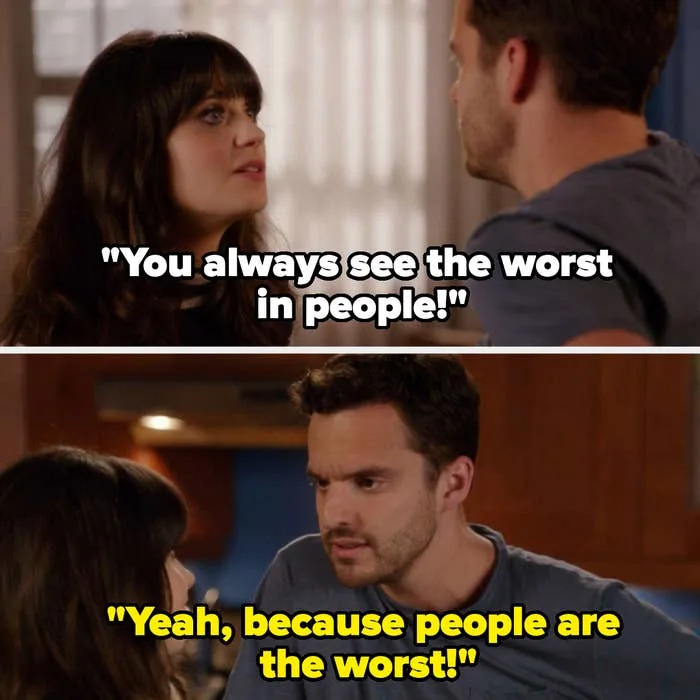
Screenshots from "New Girl"

If we could translate this into Latin, I think we’d have a replacement for the journalist’s motto.

Since AI isn’t going away any time soon, journalists and journalism educators are in a bit of a bind when it comes to how best to use it or to help students use it appropriately. This week, we’re doing a three-part series on the blog this week that take that “overhead” view of generative AI from three key angles:

You can click on the links above for either of the first two parts. The final part is below and a lot more complicated: The human factor.

As we’ve noted before, generative AI is a tool. As such, it can be used for good things or bad ones, based on the person using it and why they’re using it. Let’s consider a few aspects of human nature that can help make AI a useful friend or a mortal enemy:


WHAT’S MY MOTIVATION?: One of the luckiest breaks I ever caught in life was getting into a psych course on human motivation as part of my doctoral program. It not only hooked me up with Kennon Sheldon, a professor with an incredible history of publishing important psychological studies, but it also helped me to better view how people choose to act or not act based on motivating factors.

One of the aspects of self-determination theory (SDT) we looked at was the spectrum of motivating factors that influence people. As it is a continuum, it has a wide array of motivational forces, but scholars have identified four key “stopping points” along the spectrum that capture specific forms of motivation:

  • Extrinsic: You are motivated by an outside force to do something that you otherwise wouldn’t want to do. An example of this might be when your parents told you to clean your room or you would be grounded for the weekend.
  • Introjected: You are motivated to do something through coercive actions of others, such as guilt or shame. An example of this might be skipping a concert you want to attend so you can visit an elderly relative in a nursing home because your parents told you, “Well, she probably doesn’t have much longer to live and I KNOW how hard it would be for you to live with yourself if you didn’t at least see her a few more times.”
  • Internalized: You are motivated by finding value in the outcome of an activity, even if the activity itself isn’t all that enjoyable. An example of this would be a nursing student studying really hard for the NCLEX test. They don’t like the idea of the test, but are motivated by their desire to become a nurse, which requires them to pass this test.
  • Intrinsic: You are motivated by the natural joy of the activity. This is the purest and best form of motivation. An example of this would be Amy and her approach to knitting. She never seems to care if she finishes a project, but rather she enjoys the act of knitting as well as the joy she gets from trying new patterns, new yarn and new needles.

In looking at this, it’s a pretty safe bet that most of what students do for classes in a lot of cases comes down to extrinsic motivation, as they are required to write essays, do assignments and take tests because someone else is forcing them to do it. (Insert your favorite joke about Gen Ed classes here.)

When forced to do something, people will take the easiest way out possible, which is where generative AI comes in. If the only goal is to “get through” whatever someone is forcing you to do, you’re going to let AI take the wheel and just get it done. This is particularly true for those 800-person pit classes, where students figure they have a pretty good shot of getting away with it.

Helping students find motivation to do things that will benefit them in both the short term (pass this class) and the long term (get a better career) will be enough to move them toward a more self-motivated state.

This leads into the second human issue…


THIS MATTERS BECAUSE: We have found that people are more likely to value things if they have an understanding as to why these things are supposedly important. In short, “Why do I have to do this?” A key part of motivational research is what is called autonomy support: If you can give people choices or at least explain why they have to do something and that a choice isn’t possible, they tend to adopt the motivation as their own and do better at it.

When you give them a “Because I’m a PARENT, that’s why!” answer, well, they tend to really hate it and extrinsic motivation rears is ugly head.

I had this discussion/argument with people from our history department. The university was cutting several requirements that were making it difficult for kids to graduate on time and/or with multiple majors/minors/certificates.

One of the “forced classes” was a history one, and I overheard the history folks talking about the situation. One person thought it was a good thing, because maybe the kids would then find history on their own and choose it for a minor. A senior faculty member argued this would be a disaster because, “The kids will NEVER choose us.”

I nosed my way into the conversation and asked to what degree they explained the value of their specific classes to students who were taking them. The senior faculty member was offended: “How could you ask such a thing? Do you think history DOESN’T have value?”

Um… No… but if that’s how you approach your classes, I understand why the kids might feel that way.

The more I kept trying to explain that if you want the students to value something, you have to tell them why they should value it, the more I seemingly upset this man. Apparently, in his way of thinking, history is so damned important and he was such an expert-level vessel for this knowledge that there was no need to provide a rationale for the coursework he put forth. At the end, I left him with this:

“I know that kids can take my class because they want to or because they are forced to. Either way, I make sure to tell everyone what we’re doing, why we’re doing it and what value it has to them in moving forward in their lives. They may still dislike the thing I’m making them do, or they may disagree with my assessment of the situation, but they at least understand the ‘why’ and that tends to make them more willing to do the work than to try to weasel their way out of it.”

Understanding what motivates people to do (or not do) things can help us figure out how to help them use AI without abusing AI. Help them understand why they need to do an assignment, or understand a form of writing or complete a task and they’ll likely find a way to buy into your argument.

If we CAN’T show them a “why” answer, maybe that says more about what we’re doing wrong as educators than what is wrong with “kids today.” Is that 10-page paper really helpful to the kid, or are you just so used to grading them that it would be an inconvenience to you to change? Is the textbook you are using a good one, or do you not want to revamp your whole class and redo all of your lectures, so you stick with what you have? Is the kid really losing out on some major life skill or element of citizenry if they let AI take the wheel on an assignment, or is there a better way to make AI part of the process?

Logic has a lot to say about helping people find value in what they need to do and becoming motivated to do the right thing. Unfortunately, logic isn’t always in driving the bus, which leads to the last element…


PEOPLE ARE BASIC:  We can talk about this from a variety of angles, but the long and short of it is that humans are base-level creatures in a lot of ways.

Our minds are geared to be “cognitive misers,” which is why we find ourselves in mental ruts and often relying on stereotypes to make sense of the world around us.

We are social animals, which leads us to social dominance behaviors that tend to have some folks trying to assert their high value over other, “less valuable” individuals within the collective. If you don’t believe me, hang out for three hours in a middle school classroom and get back to me.

We’re also driven by some baser instincts in regard to our physiological needs. Or, to quote Jeff Foxworthy, a lot of people would like to get a beer and see something naked. (Pretty much every technological development related to media in the past 50 years has in some way gotten either a significant start or a major boost due to that base-level drive for naked stuff.)

Generative AI takes these base-level human drives and supercharges them in a way that other forms of technology haven’t. Whether it’s trying to prove dominance, trying to be lazy or trying to a pervert, AI puts it all and more at the fingertips of the worst among us.

AI chatbots have been linked to false claims of harassment by political figures in New York. Why would anyone think to do a prompt for the chatbot that included the term “sexual harassment?” There’s not a good argument in here, other than some idiot saying, “Hey, y’know what would be HILARIOUS? Ruining someone’s life!” (Here’s a link to a trailer for “The Anti-Social Network” that pretty much encapsulates the whole process by which general dumbassery becomes a toxic weapon when added to a digital platform.)

This is why you have stories like this one about a MIDDLE SCHOOL in California, where students were using AI to turn images of their friends into nude pictures. Or like this one about the students at a CATHOLIC HIGH SCHOOL using AI to create naked photos of their peers. Y’know, just like Jesus would have done to Mary Magdalene, if he had the technology…

Even pedophiles are getting in on the act, which is the start of a sentence that never ends well…

As with most things in the world, the worst among us will use AI to do some godawful stuff. I’m not sure we can avoid that, but we do have a need to instill in the other 90% of the world the reasons NOT to be like those folks.


DOCTOR OF PAPER HOT TAKE: Every time I think of what AI could be used to do and what it’s ACTUALLY being used for, I go back to this scene from “Idiocracy.”

The issue remaining for journalists and journalism educators is how do we go about making AI the tool in the toolbox it can be while avoiding the perils of a society that is slowly riding a Dumpster fire to hell.

The question we need to answer is this: What kind of coherent argument can we, as journalism instructors, make to the students who are in our class that it is in their overall best interest to do the work we assign them instead of letting a machine do it for them? And, how can we present that argument in a way that they will understand it, agree with it and motivate themselves to abide by it, in the face of the human frailties we’ve discussed earlier?

I don’t have an answer for this, but if you figure it out, please post the answer below.


Journalism, Journalism Education and Generative AI (Part II: The Perils of Generative AI)

Thinking is hard But you get used to it De motivation, us,demotivation posters,auto

Since AI isn’t going away any time soon, journalists and journalism educators are in a bit of a bind when it comes to how best to use it or to help students use it appropriately. This week, we’re doing a three-part series on the blog this week that take that “overhead” view of generative AI from three key angles:

    • The tools
    • The potential perils
    • The human angle

We covered the tools in Monday’s post, so if you missed it, you can catch it here.

As for today, let’s consider the perils of generative AI:

WE LOSE SELF-SUFFICIENCY: I will never disparage the concept of technological advances. Microwaves have allowed me to feed myself from college up to this morning without burning down my humble abode. Seat warmers have kept my rear end from flash-freezing to those leather-ish seats of the Subaru on most winter mornings in Wisconsin. The implementation of whatever stretchy stuff they’re making blue jeans out of these days has allowed me to keep fooling myself that my size hasn’t changed over the past five years.

Even as a journalist, I’m grateful that recorders have allowed me to significantly reduce the scrawl and shorthand I used to use while interviewing folks. Google has made it exponentially easier to ease my paranoia when I write something and then think, “Wait… are you SURE that’s right?” Even better still, I am entirely grateful that I no longer have to hold a piece of correction paper in between my teeth while banging out a story on an IBM Selectric typewriter, as I did back in high school.

The problem is that when we become overly reliant on technology, we are at the mercy of its functionality and lack the ability to cope when it fails. I’m not even talking about that “everything will cease to exist” failure. I’m talking about basic stuff that used to be common sense until computers just did the work for us.

(The analogy I immediately think of is my dad paying at a fast-food restaurant with cash. The kid punches in the total and it’s like $11.28. Then, Dad will say, “OK, here, let me give you three pennies to make it easier” after the kid assumes Dad’s just giving him a $20. Watching this kid try to do the math in his head because of those three frickin’ pennies is enough to make you weep for the future of humanity.)

Back when I was in doctoral school, the stats professor I had for my analysis of variance class made us do all the statistical calculations for an ANOVA by hand. This took forever and a day and ate up about 10 pages of notebook paper for each one. When we bitterly complained that we’d be using a computer to do this in a fraction of the time, he’d tell us, “Yes, but if you don’t know how to do each step, you’ll never know why it works the way it does. You’ll also never know if the computer is right or not.” As annoying as it was, I can still just look at an ANOVA result and figure out if I punched something in wrong, thanks to Dr. Osterlind.

There has always been an effort-free default option for everything, even back when you were learning to tie your shoes. If mom or dad was in a hurry, they’d say, “Here. Let me do that.” OK, fine, but if they never let you learn how to do it for yourself, you’d be totally screwed at this point. (Or into cowboy boots, shower shoes and a lot of velcro.) Some level of self-sufficiency has to be built into the process.


WE DON’T KNOW WHAT’S IN THE AI “BOX:” One of the biggest complaints I get about my intro to writing class, other than I keep having it at 8 a.m., is that I make the students buy the print edition of the AP Stylebook and read the whole thing. Random assignments and quizzes are part of the check-in approach I take to seeing how well this is working.

Students find out that for about the same amount of money, they can buy a digital version that provides them with a search-engine function, so they want that one instead. I tell them, “Once you move into the upper-level classes, that’s an option. Until then, you’re reading the damned book in print.”

My rationale is pretty basic: If you don’t know what you’re looking for and you don’t know if it’s in there, you’re at a disadvantage when it comes to finding it. Thus, if you read the book, you get a handle on the things that AP gets all hot and bothered about and thus you are making mental notes about the kinds of things you should look up. At that point, a search function is your friend, not a game of “Wheel of Fortune.”

Generative AI is pretty much the same thing: If you don’t know what’s in the “box,” you have no idea what to expect will come out of it.

Here’s an example of what I’m talking about. I entered a simple prompt that I figured a student in an entry-level civics class might toss in to avoid writing a short, basic essay:

“Write 200 words on how to deter criminal behavior”
Here is what ChatGPT came up with:

Deterring criminal behavior involves a multi-faceted approach that addresses the root causes of crime, enforces strong laws, and promotes a sense of community responsibility. Here are some key strategies to achieve this:

  1. Education and Awareness: By investing in education and awareness programs, communities can help individuals make informed decisions, reducing the appeal of criminal activities. Teaching ethical values and social responsibility from a young age can create a culture where crime is less likely to occur.
  2. Economic Opportunities: High unemployment and poverty are strongly correlated with crime rates. Providing meaningful employment opportunities and vocational training can reduce the incentive for individuals to engage in criminal activities.
  3. Strong Law Enforcement: A robust and fair law enforcement system is crucial. Visible policing, quick response to criminal activities, and the consistent application of justice can act as a deterrent to would-be offenders.
  4. Community Engagement: Encouraging community involvement in safety and crime prevention fosters a sense of ownership and shared responsibility. Neighborhood watch programs, for example, can help deter crime by creating a community that looks out for each other.
  5. Rehabilitation and Support: Implementing effective rehabilitation programs for offenders reduces recidivism. Offering support services like counseling, education, and job placement helps former offenders reintegrate into society, lowering the chances of repeat offenses.

By combining these strategies, communities can effectively deter criminal behavior and create a safer environment for everyone.

I have no idea where this all came from or why it went this way in terms of answering the question. I don’t know from which sources of information it drew its inspiration or how it decided to approach the topic in this fashion. I also have no idea if there are better or worse answers in there.
If all I know is that I wanted an answer to turn in for an assignment, all I know is that ChatGPT provided me with this answer.
As someone who has looked at various resources and looked into this topic before, I find it interesting that when prompted in this nature, chatbot made a couple key choices:

This leads to another primary concern associated with generative AI…


BIAS IN, BIAS OUT: The way AI platforms are trained is by exposing them to tons of content from a vast array of sources in which it kind of picks out a “prototype” of each element it can ascertain from what it has “seen.” The problem with that is the more mainstream content is likely to dominate while the less mainstream content is likely to get shoved aside.

In addition, just because something is shown or written about in a certain way, it doesn’t necessarily follow that it should be a representation of a larger thing. This is how stereotypes are built and reinforced. Consider the following image creations based on several prompts:

A server at a restaurant:

A criminal in court:


A basketball player passing a ball:


A boss of a company at a podium:

(In the future, you will all be ruled by this one white dude. To be fair, the iStock paid generator did slightly better, but not great.)


I tried these prompts with multiple AI generators and these were pretty much the standard fare. Notice we’ve got all fit and relatively attractive looking people in here. The servers are all young and female. The criminals aren’t white, and neither are the basketball players. (To say nothing of the fact only one of them is passing and one of them has two basketballs for some reason.) Bosses are predominantly male and in at least in one set of responses all white and young.

Authors T.J. Thomson and Ryan J. Thomas at The Conversation found similar problems in an assessment of AI, noting that the image generators demonstrated biases from racism and sexism to ageism and classism. As more and more people continue to generate content, this kind of things is only going to continue to build on itself until we’ve got a really stereotypical and myopic view of a lot of how society looks.


DIMINISHED CRITICAL THINKING: Most of what journalism requires of us is to be nosy and to dig into topics that are of interest to us and our audience. When we’re doing our work, if something goes wrong, or a source messes us over or we encounter a strange plot twist, we figure out how to improvise, adapt and overcome. In a broader parlance, the whole driving force behind this job is critical thinking and problem solving.

The risk of relying on AI for too much is that we can cognitively atrophy and find ourselves in a journalistic rut. This already happens in some cases, as I’ve seen with stories written about my own institution. When we decided to do a reorganization, the university announced which plan was going to be favored and the local paper did a piece on the topic. The entire thing was basically direct lifts from the press release statement and several other response statements issued about the topic. No deeper examination, no interviews with the stakeholders and no other content than what was provided.

I’ve also seen it where people decide that rather than look for sources to react to important topics, they’ll scan social media and do screenshots of some of the loudest voices out there. It’s like, “Don’t strain yourself reaching beyond your keyboard, buddy. Let’s not try to do some actual work here…”

Students already tell me things like, “I can’t get a quote in here from (NAME) because they didn’t email me back!” To which I follow up with a few basic concepts like emailing again, picking up the phone and calling the person or even going to someone’s office and talking to them. This isn’t Woodward and Bernstein sorting through library punch cards or something. This is “Can-You-Fog-A-Mirror-level” journalism stuff. If I had a dime for every “You mean I should call them… on the phone?” response I got, I wouldn’t need this job.

If the AI tools can help aid in your critical thinking by challenging you to think about things differently, or to consider options outside of your personal experiences, that’s great. If they tell you to stop thinking for yourself, that’s a bad sign.


DOCTOR OF PAPER HOT TAKE:  As much as I’m worried about kids getting lazy, that’s nothing new, really. When students figured out that the Encyclopedia Britannica could do a better job of explaining what an iguana is, they copied it straight out of the book. When students realized the kid next to them studied harder for the exam than they did, they “dropped their pencil” a few times and took their time leaning over to pick it up. When students realized they could punch search terms into a computer and get an answer better than the one they came up with, they found the copy and paste keys. Generative AI is just the next stage of this process and we’ll all eventually catch on and catch up.

What really bothers me about AI is when it basically becomes a black box.

I don’t have to fully understand how everything I use on a daily basis works, but I do feel better when I have a general grasp of a situation. For example, I might not be able to fix the pump on our well, but when I see smoke coming out of it and we have no water in the house, I can surmise what’s going on and call a plumber. If the plumber comes out and can tell me what happened, I can pretty much follow along. I’m fine with that.

What I’m not fine with is “heavy mystery time” in which we have no idea what a major piece of our lives is doing and people have an increasingly difficult time explaining it to even other people who work in that field. The reason is that it’s hard to trust things that can’t be explained, and even more, it’s hard to believe they will benefit people other than their creators.

I go back to this clip from “The Smartest Guys in the Room,” which chronicles the rise and death spiral of Enron. Financial expert Jim Chanos didn’t buy the bull that Enron was putting out and when he asked the analysts to explain how Enron was making its money in a clear and coherent fashion, he got the “black box” speech:

In other words, trust us… It’s fine… Until it’s not.

NEXT TIME: Why can’t we have nice AI things? Because people are… well… human.


Earth to Universities: You can’t like free expression only when it’s expression you like

A print of artist Phil Hands’ cartoon on free speech hangs on the wall of my office, with a nice message from this incredibly talented person. I think this message matters now more than ever.

THE LEAD: Universities are pushing back on speech and assembly efforts in the wake of pro-Palestine protests on campuses throughout the country. Both on campuses and at the federal level, concerns regarding antisemitism and Islamophobia have led to inquires and crackdowns.

Zoom in: Tensions at Columbia bubbled over last week after university president Minouche Shafik called in the NYPD to disband a pro-Palestinian encampment at the center of campus.

  • The University of Michigan said it would draft a new policy on punishable disruptive behavior following a pro-Palestinian protest at its convocation.
  • The University of Southern California canceled its valedictorian’s commencement speech, citing safety concerns that the student called a “campaign of racist hatred.”
  • Stanford University banned overnight camping in February to end an encampment populated by dueling pro-Palestinian and pro-Israeli tents, citing student safety, extreme weather and rodents.

FIRST-AMENDMENT BASICS: The First Amendment to the Constitution allows for freedom of expression in a number of ways, including speech, press and assembly. State actors (meaning public officials, public organizations or otherwise government-ish people or groups) cannot step in and deny these rights without some exceptional circumstances.

The law requires a risk of “imminent lawless action” or “clear and present danger” to exist for the government prohibit these kinds of expressions. Examples of this kind of risk include things like inciting a crowd to destroy property or chanting “We are going to kill the chancellor” during a march. That’s why yelling “Mike Pence is a traitor” isn’t the same as yelling “Hang Mike Pence” during the Jan. 6 incident in Washington, D.C.

In some cases, the law can allow for restrictions based on the time, place and manner of the expression, but it also states that the restrictions must be content neutral. In other words, if the mayor of your town refuses to allow a “Pro-Vegetable” march at 5 a.m. because it would be disruptive to the sleeping habits of the citizens, that mayor can’t then allow a “Pro-Beef” march to occur at 5 a.m.

For a more complete view, check out this great primer at the Freedom Forum.

KEY FREAKOUT POINT: This is what happens when the vaguely educated (Congress) asks questions of the overly educated (Ivy League university administrators) and fear is a driving force in the discussion.

Back in November, the presidents of Harvard University and the University of Pennsylvania resigned after they reacted to questions of campus antisemitism the way my dog does when I present her with a physics textbook.

Congress, trying to make a point, asked if “calling for the genocide of Jews” violated the campus speech codes and neither of these esteemed educators could find a coherent answer. (As these are both private institutions, they get more leeway about what can and can’t happen on their campus than do public institutions. More on that later.)

What happened next was what always happens next at a time like this: More administrators get called to answer similar questions under a totally disingenuous guise by people who have no interest other than “pwning” these folks.

Thus, to avoid being the next university egghead on the chopping block, these folks force everything 180-degrees in the opposite direction, to the point where saying “bless you” is somehow a hanging offense. Fear drives the silencing of certain voices that people worry might not be as popular as others. The goal is to “run clock” for a while, in hopes that everything will just calm down once the kids find a new TikTok challenge or something.

Words are scary, particularly when you are being accused of certain things. Nobody likes being accused of antisemitism, Islamophobia, homophobia, racism, sexism and other such things. Certain words carry with them a permanent stain, and that can be terrifying enough to make people do or not do certain things. I often think back to this clip from “Apt Pupil” in that regard:


REALITY CHECK: As much as it would be great if we could all just get along about everything, that’s not the way life works. This is why we have laws in place to deal with what can and can’t happen when people feel the need to disagree.

The law is clear on how speech and assembly work: Unless you can demonstrate that whatever these people are saying or wherever they are going will lead to lawless action, they have the right to say what they want to say and go where they want to go. The law isn’t here to protect popular speech, but ALL speech.

This is why, as much as it can infuriate folks that a group of Nazis can march through a predominantly Jewish part of Illinois, or that a group of “religious” folks can show up with signs at a military funeral proclaiming “Thank God for dead soldiers,” speech can’t be suppressed for being repulsive alone.

The Foundation for Individual Rights and Expression explicitly explains why even calls for the genocide of a particular group remain protected under the First Amendment.

DOCTOR OF PAPER HOT TAKE: Everyone has a level at which they think a line should be drawn when it comes to speech being problematic, but quite literally, the cure for bad speech isn’t speech suppression. It’s MORE speech. It’s also been clear that there are always risks that unpopular speech may lead to violence, but we have laws to deal with that violence once it actually occurs. Stopping speech because it might end poorly has the same internal logic as the traffic cop who pulls over the Corvette driver because the car “looks like it could go fast.”

The administrators of these schools need to have stronger intestinal fortitude when it comes to supporting free speech, even if it’s going to be wildly unpopular or allow some senator from Bumbledirt, Wyoming to call them all sorts of names on the Senate floor.

Yes, it sucks when you have to deal with difficult situations, but standing for principles is supposed to be administrators’ resting pulse. If you think having people say mean stuff about you on Twitter/X is rough, read this piece by David Goldberger, a Jewish attorney who represented the Nazis in the Skokie case. Members of Jewish Defense League showed up at Goldberger’s office with baseball bats trying to beat the hell out of him. The rabbi at his parents’ synagogue gave a speech denouncing Goldberger personally for taking the case.  He was threatened and called a self-loathing Jew for his troubles and yet in retrospect, he remains as stalwart in his beliefs as ever:

To this day, I have no doubt that the ACLU’s commitment to equal rights for all is a backbone of our democracy — no matter how offensive our clients are. Chipping away at this commitment will open the door to the erosion of the First Amendment as a bulwark against rule by tyrants.

In short, if you want your free speech, you have to be willing to stand up for everyone else’s speech as well.

A PROMISING POST-SCRIPT: As I was finishing this off, a friend forwarded this article about how student journalists on these campuses are not only covering the situation, but taking strong editorial stances in favor of free speech.

As we always say in student media, “Leave it to the kids to lead the way.”


Using AI to cheat on writing assignments is bad. Doing it in journalism classes is downright stupid (A Throwback Post)

Me to kids who use AI to cheat: “What I do have are a very particular set of skills, skills I have acquired over a very long career, skills that make me a nightmare for people like you…”

I often wonder when I’m reading some of the essay work I get these days that is clearly written by generative artificial intelligence if my students are lazy and stupid or if they think I am.

Truth be told, I usually don’t have a lot of problems in this area because AI has yet to master the art of writing for the media, as it has clearly and repeatedly demonstrated. However, from time to time, I have a class that requires a reflection paper or personal essay, and suddenly, the students who couldn’t find a coherent sentence with a searchlight and a posse have managed to put Shakespeare to shame.

In one case, I found about 20 percent of the kids had completely or mostly written their ETHICS assignment using artificial intelligence programs. The irony on that is so thick, you couldn’t cut through it with a chainsaw.

In another case, I gave students a 1-1.5 page, typed, double-spaced reflection paper before each test that is there to do nothing but make them think about what we covered in the chunk of the class leading up to the test. I did this so that the kids who suck at multiple choice could have a chance to express themselves and to also defray the overall impact of each test.

The prompt was laughably simple. Tell me briefly:

  • What we covered that you already knew before you took the class
  • What we covered that you didn’t know before you took the class
  • What we touched on that you would want to know more about.

That’s it. If you can fog a mirror, it’s almost a guaranteed B+. If you can write a word or two in the mirror fog with your finger, it’s practically an A.

Caught at least one kid AI-ing it, through basic common sense, journalistic skepticism and checking through multiple detection programs. I’ve gotten to the point that I can almost tell exactly WHICH program they used to write it.

And, yes, it’s really quite upsetting. (I’d use other words to describe my feelings on this, but Sage is trying to sell a book or two here.)

As friends and colleagues have told me that this kind of thing is “rampant” on their campuses as well, I figured I’d break out this throwback post on why cheating in journalism (especially in terms of AI stuff) is a really, really bad idea:


4 Self-Serving Reasons Not to Cheat in a Journalism Course

At the beginning of each semester, most professors I know give some version of the “Don’t Cheat” lecture. We explain the university policies about cheating and how we can make your life so miserable that you will wish you had never been born. We outline the logical reasoning behind avoiding unethical behavior and try to guilt you into acting right.

And right about now is where we start to notice that none of that really sunk in for some of our students.

Somewhere between midterms and finals week is where I tend to find whatever cheating I’m likely to notice over the span of a semester. It’s always the same: The student who couldn’t write a sentence with a subject and a verb is suddenly putting Bob Woodward to shame. The kid who spent the last two weeks in our “draft” sessions with nothing done suddenly produces a magnum opus in two days. The story I get from a student that seems shockingly familiar for some reason, mainly because his roommate turned in the same thing last semester.

It’s also the same when the students are confronted. They go through all five stages of grief in about three minutes: Denial, Anger, Bargaining, Depression and Acceptance. (Or, in at least one case, a note from a parent that told me “The family lawyer will be in touch.) It’s gotten so bad that I keep tissues hidden in my office for that exact moment when a student suddenly realizes there is no way out and tears begin flowing. (For the record, men cry as much or more than women do when the stuff hits the fan like this.)

Since journalism is always about telling people “What’s in it for me?”, consider these four self-serving reasons why you shouldn’t cheat, least of all in a journalism course:

You have much worse odds of getting away with it: Students have come up with so many great ways of cheating on various tests, projects, quizzes and assignments, it gives me hope for the future in terms of innovation. There are the water bottle labels with the answers printed on them. There is the “phone/texting” thing that students have developed over the years. There are “cheat sheets” and “crib notes” written in places that defy logic.
Many journalism classes, however, are performance based and skill structured, so it’s not about memorizing things and regurgitating them, so those tricks don’t always apply. Instead, students tend to plagiarize from published material, use stuff from sources that don’t exist or otherwise “improvise” their ways around their writing assignments and tests.
Here’s the problem with that: Journalists and journalism professors (a.k.a. former journalists) are naturally suspicious, so they have a harder time believing that you managed to track down the governor for a sit-down interview on deadline. They are trained researchers, so they know how to fact check and verify stuff through a number of platforms beyond “TurnItIn.” They usually have connections with sources in the area, so it’s not a stretch to imagine them calling up a city council rep, a high school football coach or an administrator and asking, “Hey, did you have an interview with someone in my course and say XYZ?”
The whole purpose of being a journalist is to dig past the BS veneer that people show us and get to the heart of the truth.
We live for this. And trust me, our ability to dig is better than your ability to hide at this point in your career.


You really piss us off and trust us, you don’t want that: When journalists dig into something, we are like a dog with a Frisbee: We just don’t let go. Most of the time, when someone lies to us, we are desperate to dig even deeper to determine how bad this is and what else that person might be lying about.
We will be bound and determined to dig into EVERY, SINGLE, OTHER thing you have EVER written for us and see if there is ANYTHING you did that fits this pattern of plagiarism. We will talk to colleagues about you to see if you were in their classes and see if they had any inclination that you might not be producing work that is on the level. We will look to see what penalties are available and how far this can all go.
The reason is that we operate in a field where trust is earned and all you have is your reputation. If you throw that all away over a crappy assignment in a single college course, what’s going to happen when you get out in the field? Even more, if you go out there with a degree from our institution and people know you had us as professors, how will that reflect on us when you do something this pathologically stupid on the job? Those kinds of thoughts keep a lot of us up at night, not out of fear but out of anger. We are not about to let our field slide into the Dumpster (or further into the Dumpster) because you cheated when you felt “overwhelmed” by your six extracurricular activities and the death of your goldfish. In most cases, professors will be far more forgiving if you essentially tell them everything up front when you can’t complete an assignment. If you cheat, we have a burning desire to make sure you don’t get away with it.


Two degrees of separation: The concept of “Six Degrees of Separation” explains that we are all somehow connected to every other person on Earth through no more than six links. In the field of journalism, however, that linkage is a lot shorter.
I have done no definitive work on this, but if I had to guess, I’d say those of us in journalism are probably operating within two or three degrees. Case in point happened this weekend at the college media convention I attended: I was reviewing a student newspaper from Florida when I mentioned that I had a number of former students working in the state. One of the students said that she was in frequent contact with an editor of a particular newspaper. I recognized the name immediately as one of my former students and did the old “humblebrag” thing about it. “Really?” the student asked, her eyes lighting up. “Could you tell her you met me and that I’m really interested in the paper?” She was a smart kid and I liked what I had read in her stories I was critiquing, so I said sure. I dashed off a simple email to my former student about this woman and moved on with life. Today, I got this message back:

Vince,

Small world!

We are considering her for a spring internship. Your recommendation just put her at the top of list.

Hope you are doing well.

I honestly don’t know if my email helped or if maybe the editor was trying to make me feel good about myself, but the underlying point remains: In the most random place and set of circumstances possible in journalism, I was linked to two people in the field like that. This kind of connection is invaluable in our field if the word on the street about you is good. If you plagiarize and get caught, the word on the street spreads as well and, simply put, everybody in this field seems to know everybody else somehow. The “A” you got on that plagiarized assignment better be worth knowing that you will never get a job because everywhere you go, someone will know someone who knows about it.


You will never really recover: My dad was fond of telling me that if I ever planned to steal something, I shouldn’t steal a candy bar from a store. Instead, I should steal the whole store, as in when the owner came back the next day, all that was left would be a basement and some wires sticking out of the ground. The reason Dad had for this was simple: If you steal something, no matter how big or small, you’re a thief. If you’re going to steal and ruin your life, you might as well do it for something that matters.
Obviously, his point wasn’t that I should go big or go home, but rather that if I took that path of thievery, I’d never be able to recover everything I lost because of the stupid choice I made. The same is true in plagiarism, cheating and more.
The famous cases are always the ones your professors roll out for you during the semester: Stephen Glass, the wunderkind of the New Republic, who falsified dozens of stories before being forced out in disgrace. He is now a graduate of law school who still can’t practice law because of his prior transgressions. Jayson Blair, the rising star at the New York Times, who supposedly broke stories about the D.C. sniper case, turned out to be a serial liar. He now lives in Virginia and said he knows he could never go back to journalism because of the trust he broke. Janet Cooke, who wrote a compelling tale of an 8-year-old heroin addict name Jimmy, returned the Pulitzer Prize she won after it turned out she made him up. Today, as the story linked above notes, she lives in the U.S. and works in a field not associated with writing.
Beyond those “big names” are the day-in, day-out foul ups that cost people everything. I was on an ethics panel last week when one of my fellow panelists told a story of a student who made things up or plagiarized content. His name was so clearly bad in the field, he ended up legally changing it.
I still have the “ethical agreement” one of our writers signed at the student paper shortly before he made up an entire softball story. We only caught him because someone on the sports desk was roommates with a guy who was dating a softball player and she mentioned it in passing. I have no idea what ever happened to that guy after we fired him, but I do pull out that agreement from time to time and show students. His name is etched in their minds as a cautionary tale.


Interestingly for me, I find that this kind of stuff happens most with my upper-level classes. Freshmen and sophomores screw up occasionally by bumping into a problem when they don’t know any better. However, it’s the seniors who are getting ready to graduate that actively cheat. Why? My theories vary.
Look, we all get it. Everyone in journalism has felt the pressure at one point in time. Deadline is approaching, we get caught short and we figure, “If I can just cut this corner this one time, I’ll survive.” The truth is, it’s not worth it. If you screw up that assignment, the worst that happens to you is that you fail that one piece or that one test. If you cheat on that assignment, everything gets so much worse.

Verified by ExactMetrics