Goodnight, Cliff Behnke. There will never be another one like you.

I bogarted this photo of Cliff from the obit. I’d argue “fair use,” but I probably wouldn’t argue it with Cliff.


Cliff Behnke, the former managing editor of the Wisconsin State Journal and generational journalist, died Sunday in Madison at the age of 80.

The irony of this piece is that it’s impossible to explain Cliff without resorting to cliches, a writing failure the man himself disdained.

Cliff despised lazy writing and wasn’t above telling writers how much redundancies, passive voice and unneeded descriptors displeased him. However, if there is one thing anyone who worked under him knew he hated most, it was cliches, so much so that the concept led his obituary this week:


Spring never sprung under Cliff Behnke’s watch.

“White stuff” didn’t fall in winter, and no reporter ever dared refer to Thanksgiving as “Turkey Day.”

Behnke was a stickler for detail and standards during his four-decade career at the Wisconsin State Journal.

(I managed to pull off a minor miracle once in a weather story when I used the phrase “a white, wintery mix” and Cliff never said a word.)

The cliches really did tell the tale of Cliff, as everyone in Barry Adams’ fantastic obituary seemed to use one now that Cliff could no longer stop them.

He was an “old-school editor,” in that he prized big-picture accuracy, clarity and value while simultaneously picking at the details that would rob a piece of any of those things. He was “no nonsense” in that staffers knew him to be serious and direct, focused and fair as he kept the newsroom moving forward. He was a “newspaperman in the best sense,” spending far more time in his college newsroom than his classes and helping to shepherd the state’s official newspaper throughout the salad days of print journalism.

In reading Cliff’s obituary, one fact discombobulated me: His age. I was in my early 20s during the three years I spent working the night desk at the State Journal. That would have put Cliff in his early 50s back then, which is where I find myself now. I can’t square those numbers, given that I have neither the skills, the seriousness or the stature that Cliff had at this age, never mind how he terrified staffers in a way that is almost impossible to explain.

I feared Cliff, as did a number of the folks quoted in Adams’ piece, but not in the cliche way usually associated with “old school” editors. He never yelled at me, nor did he have a large physical presence that had me afraid of violence. He didn’t break out a string of colorful curse words when dressing me down.

(Cliff was always on the lookout for stray curses making it into the paper. I remember him calling out a sports story that contained a quote like, “We played a hell of a game.” Cliff’s restrictions on cussing in print would make a 1950s all-girls boarding school look like a biker bar. It took at least three phone calls for us to run a quote in one of my stories about a riot with the quote “F— the pigs!” in it. And, yes, that was WITH the dashes.)

Listening to Cliff’s assessment of my screw ups was like watching a ninja throwing razor blades at me. It was just slice, slice, slice until I fell into 1,000 pieces. It could be about something big or about something small, but I still remember (and refer to) a number of them.

In one case, it was a redundancy. I was writing a photo caption about a model train railroad show when I felt the presence of Cliff lurking behind me. He began simply enough:

“Can you imagine if there were 88 model railroad layouts that were EXACTLY the same?” he asked.

“Huh?” I replied, unsure as to if I was having an out-of-body experience because Cliff was talking to me.

“Do you think it would be possible for a group of people to build 88 IDENTICAL model railroad layouts?” he said in that calm, metered voice of his.

“Uh… No?”

“Right. So why are you telling me that there are 88 DIFFERENT model railroad layouts in this cutline? Of course they’re different. That’s redundant.”

He then disappeared almost as quickly as he showed up and I still haven’t forgotten that lesson.

I also never forgot the time I should have been fired for screwing up a brief, in which I reported that a guy was dead when he wasn’t.

It wasn’t bad enough that I screwed it up, but then the local radio stations did their “rip and read” journalism on the air, letting EVERYONE know the guy was dead when he wasn’t. Our competing paper also used to love to crib our stories and then claim they had an “unnamed source” that confirmed the info, so those folks also amplified the story. It turns out everyone was wrong because I was wrong.

The man’s wife was getting condolence calls from people who saw or heard the “news” and she freaked out that the news people knew about his death before she did. After a complete clustermess of a situation, I got called into Cliff’s office for what I assumed would be the end of my journalism career.

After slowly and calmly walking me through every stupid thing I had done and every way a reasonably competent biped could have avoided that stupidity, he told me that the woman wasn’t going to sue us, but she had several demands. Aside from a correction for the paper, I had to write a letter apologizing to the man’s children for screwing up and then I had to hand-deliver it to his wife and talk to her for as long as she wanted.

“You need to go to the hospital at 10 a.m.,” Cliff said. “You will not justify your mistake. You will not discuss your feelings. If anything comes out of your mouth other than, ‘Yes, ma’am,’ ‘No, ma’am’ or “I’m sorry, ma’am.’ You are gone. Do you have any questions?”

I was both young and stupid enough to have one: “Yeah. Why don’t you just fire me now instead?”

His response was perfectly Cliff: “I honestly don’t know, so get out of my office before I figure it out.”

What he taught me that day was responsibility for my actions, the importance of paranoia-level accuracy and that I needed to tough out this painful lesson if I was ever going to be much of anything in this world. As another editor explained to me when I said I should just quit, “How are you ever going to teach a student to do something tough if you won’t do it yourself?”

I didn’t work for Cliff as long as many other people did, nor did I spend much time in contact with him during my time at the paper. In reading some of the online tributes to him, he was both everything his obit said and so much more. He was generous with his time to Daily Cardinal kids, serving on the board and kindly mentoring staffers as they gained their legs in journalism. He was a giving person to friends and family who knew him less as a mythological editor and more as a human being.

What I can say is that there will never be another editor like Cliff, as the confluence of events that made him could not exist today. Nobody is going to spend four decades in journalism anymore, least of all in one state or at one publication. That means we won’t have someone like Cliff who can capture the culture and soul of the audience the media outlet serves. It also means no one will have a firm grasp on all the details that add clarity to local stories, such as if Devil’s Lake gets an apostrophe or where the East Side stops and Downtown starts. He was like Google in a shirt and tie.

Accuracy, the driving force behind Cliff’s work at the State Journal, now seems to be as antiquated as the term “newspaperman,” with people caring more about being first, getting views and making sure “their side” is winning. In the days of newspapers, mistakes were permanent and you couldn’t undo your failures. That fact helped Cliff drive the rest of us to obsess over being right. As much as I still obsess, I know that if someone finds a mistake in this thing, two quick clicks and it’s like the error never happened. As nice as it is to be able to erase public errors, it does make for some lazy journalism.

Above all else, I do wonder how this generation would take to Cliff’s brand of leadership, as to cause fear these days is hate crime and to criticize is a soul-crushing micro-aggression. I wonder how Cliff would work with people who have been known to bring a parent with them on a job interview. Not every 22-year-old who rolls off the college assembly line these days is the stereotype of an entitled snowflake, but I’ve seen a significant crop of emotional hemophiliacs who complain about everything from making deadlines to not getting enough praise for things they’re just supposed to do. The amazing thing about working for Cliff was that we knew he was reserved with his praise and generous with his critiques. That’s why his praise really meant something, unlike the vast sums of participation trophies that line the bookshelves of “kids these days.”

What I do know is that if anyone could have found a way to make all of this work well and get the best out of people in this current environment, it would have been Cliff. He just wouldn’t quit until he did.

 

I lost, but it doesn’t suck, and that’s thanks to you all


It can be ridiculously hard not to be a hypocrite some days.

I spent the previous weekend at the Missouri College Media Conference, where among other things, I presented the evening’s keynote address. Because the speech was just before the awards were presented, I decided to keep it short and focus on the topic at hand.

I told the students there something I’ve told every student in every newsroom I ever advised that I honestly believe to be true when it comes to awards:

“Awards are great things, and you should be proud to win one. However, they aren’t the end-all and be-all of life. When you win something, you should be honored, but don’t let it get to your head. When you don’t win something, you should NOT let it make you feel inferior, as you have more than plenty to offer now and in the future.”

The minute I said it, I realized I had essentially jinxed myself. My new textbook, “Exploring Mass Communication,” had been nominated for the Textbook & Academic Authors Association’s “Most Promising Textbook” back in late October and the winners were set to be announced any day now.

Sure enough, the results came out shortly after I got home and I didn’t make the cut.

After I checked the list a couple times to be sure, I emailed my friends at Sage and told them I was sorry I let them down. They spent time and money putting together an extensive application for this thing, not to mention about five years of their lives helping me build this opus, so I felt they deserved this award more than I did.

The answers came back pretty quickly and identically: We don’t know what the hell was wrong with the judges, but we think we have a winner here. The response to the book has been overwhelmingly positive and adoptions are beyond our most optimistic expectations. We’ll take that over a plaque.

That made me feel better, as did thinking about the award itself. I didn’t know the TAA existed six months ago, so being really upset about not winning something from them seems pretty stupid. It also helped that this was one of those “best newbie” awards that often feels like a kiss of death. In scrolling back through my mind, I thought of all the “Rookie of the Year” award winners (Joe Charboneau comes to mind) and “Best New Artist” Grammy winners (A Taste of Honey comes to mind) who became part of that one-hit wonder crowd.

Awards ARE great and winning IS great, but I was right that they don’t mean what people think they mean. Hell, the Starland Vocal Band won two Grammy awards more than a decade before the Rolling Stones even got nominated for one. If you asked me whose career I’d want, you better believe I’d want to be with Mick and the Boys as opposed to Taffy Nivert.

The thing that really made me OK with all of this was my boss, who put a different spin on things when he told me, “You need external validation more than any human being I’ve ever met.” In other words, it wasn’t the award that mattered. It was someone telling me I did something right.

Which is where you all come in and why I’m writing this post today.

Steve is one of the best friends I could ever ask for. He’s put up with me for far longer than the AMA’s recommended lifetime allowance…

The one goal I have in everything I do is to try to make life a little better for the person who is interacting with me. I want a student to learn something. I want an advisee to get through the program more smoothly. I want people who attend my sessions at conferences to feel like they didn’t waste their time. If you’re reading this blog, I never want you to say, “Well that’s 20 minutes of my life I’m never getting back.”

The same is true for my books. I don’t write them to supercharge my ego or to win an award. I write them for other people. I hope that they can help instructors reach kids and help kids learn something that matters in a way that doesn’t feel arduous. The best external validation I get is knowing that people trust me to help them help their students. That validation is much better than any award I could ever receive, and it shows up when I least expect it.

Case in point, a few student media advisers were on a listserv, discussing which media-writing text would be good for their classes. “Dynamics of Media Writing” came up three times. That was amazing to me. I also got a few messages after MCMC from people asking if they could get a desk copy of my “Dynamics of News Reporting and Writing” text, as they wanted to adopt it in the fall because they heard good things.

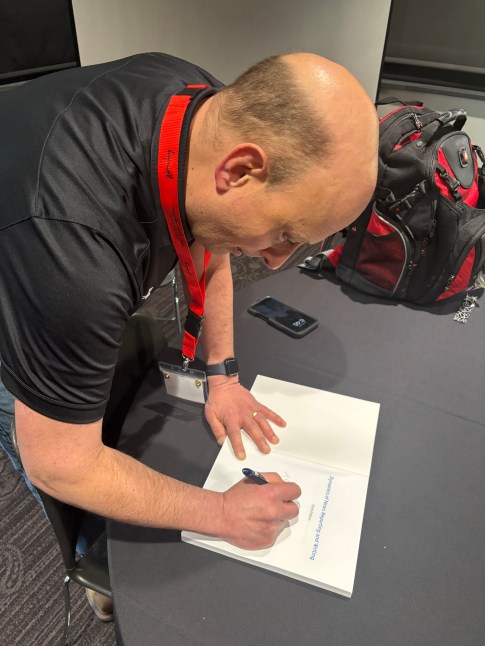
Even the kids, who I have been told a jillion times hate textbooks and never use them, have been amazingly kind to me over the years. For example, I brought a bunch of swag to the MCMC, including “Filak Furlough Tour” T-shirts and a “trophy bat” for the organization to give away.  At the end of the MCMC, the students on the board got copies of my reporting book as a thank you, when one of the kids came up to me and asked if I would sign the book.

“You don’t want me to sign that,” I explained. “If you keep it shrink-wrapped, the bookstore will pay you a chunk of change for it.”

She gave me a “why the hell would I do that?” look and then peeled off the wrapping. I ended up signing all three of the books that day.

Actual proof that someone wanted my autograph on something other than a check or a grade-change form.

When I got back and told the story to my reporting class, one young lady told me, “I read your book. I still think it’s the best textbook because I could understand things from it. It felt really… human.”

In the age of AI, I’ll take the hell out of that.

Perhaps this is the longest way I can think of to say thank you for everything you do for me in the “external validation” department. My goal with each edition of the book and each blog post is to make sure I earn it.

If there’s anything you need, please let me know.

Vince (a.k.a. The Doctor of Paper)


6 thoughts for new journalism graduates on the job hunt that have nothing to do with actually getting a job (A Throwback Post)

It’s not quite graduation time yet, but given the palpable anxiety I am sensing from my students, the job hunt for soon-to-be graduates is clearly underway. A young woman with a great set of experience showed up in my office this week with that “frustrated nnnnnggghhhh” vibe about her, as she had put multiple resumes into the field and gotten few responses.

“Should I call them or something?” she asked. “They’re not getting back to me and I’m worried.”

“When did you apply?” I asked.

“Last week…”

So that was a “No” on my end, as well as a reminder that as to how she needed to look at this whole situation. As I began to say it, she cut me off.

“I know, I know,” she said. “You were right. This is like bad dating. I need to be patient.”

Along with that pearl of weird-dom, here are a few other thoughts for your graduates looking for some help on life beyond the ivory towers and dive bars that formed their college experience.


6 thoughts for new journalism graduates on the job hunt that have nothing to do with actually getting a job

Graduation swept through town this weekend, and along with it came the speeches, the pomp, the circumstance and academic regalia (When I wear mine, I look like Henry the VIII got a Mr. T starter kit for Christmas).

img_5057.jpg

I no longer have the beard, but the medals are still pretty sweet…

Along with all this comes the anxiety of, “OK, now what?” Some students have jobs and they’re worried about how well they’ll do at them. Others have no jobs and wonder if they’ll ever get one. Parents worry that their children will be happy. Some probably also wonder if they’ll have to give up the home gym or a spot in the basement for a returning grad who hasn’t “found it” yet (whatever “it” is). What comes next?

For journalism grads, the anxiety can be even more palpable, as everyone seems to be telling you that your field is dead and you should have gone into business. Other fields can spend months or even years cultivating students for a job that’s waiting for them upon graduation. Journalism? I’ve been told once during a first interview, “We’d like to offer you the job today (Saturday). Could you start Monday?”

I asked the hivemind of pros and profs what advice they had for you all and it was really a mixed bag this time. Usually, everyone chimes in and it’s all in the same vein. This time, things were all over the place. One professor friend of mine noted:

My adult daughter just moved back home, soooo I got nuthin’.

I have often relied on the famous William Golden quote about Hollywood as well: “Nobody knows anything.” Whoever tells you, “This is how to get your perfect job” is either lying to you or trying to recruit you into a cult. Unlike all of those multiple-choice tests you’ve taken over the years, this question doesn’t have a right answer. That said, here are a few to think about as you try to game up for the next stage of life:

  • You have to be idealistic, but you have to be practical: U.S. Olympic hockey coach Herb Brooks once said this in explaining his team’s chance to do well in the 1980 Olympics. His point was you should shoot for the best possible outcome, but you shouldn’t do so without a reality check. In the case of the job search, take a shot. You want to work at a top five newspaper, in a top 10 TV market, a Fortune 500 company or whatever right away? Toss an application out there. What’s the WORST that can happen? They say no and you don’t get the job, which is right where you are right now.
    That said, a 22-year-old journalism graduate with five clips from an internship at the Tamany Tattler and a year’s experience at the student newspaper isn’t likely to land at one of those spots right away, so feel free to look elsewhere. Apply to starter jobs, smaller firms and other places that have openings and you think would be worth a shot. You have to eat. You have to pay rent. And, as they mentioned in “Bull Durham,” it beats selling Lady Kenmore’s at Sears.


  • Don’t become a desperate psycho-hose-beast: As Tom Petty noted, the waiting is the hardest part. For you, this is the most important thing ever, especially if you’re searching at this time of the year. Even if it’s not cold, snowy and gray where you are, a winter job search can be danged depressing. You know that you don’t want to go home for the holiday where every well-meaning relative will ask, “So, what are you doing now that you’re graduated? Do you have a job?” (Side note 1: When you say “No” and they look at you like you just came down with an incurable disease, remember that look so that you never give it to anyone else ever. Side note 2: Realize that these people will always ask you questions like this that will sap your will to live, even after you get a job. “Do you have a job?” will become “Are you dating anyone special?” will become “So when are you getting married?” will become “Don’t you two want kids?” will become “Are you sure you only want (1, 2, 3…) kids?” Your only hope is to outlive this person so you don’t have to hear, “Are you sure you want to be buried here?”)
    This can drive you crazy and it can manifest itself in a number of ways, none of which are good. The worst thing you can do is take it out on potential employers as you decide to call, email or text repeatedly to find out exactly WHERE they are in the hiring process. Most people can smell desperation a mile away and it naturally repels them. Think about the guy at the bar who is insistently trying to buy a gal a drink, a shot, an appetizer, a game of darts or a 1979 Chrysler Cordoba. Does that interaction ever end well for that guy? If you ever need a reminder of how bad this can get, catch the classic “Mike from ‘Swingers’” scene (NSFW- some cussing) or the “Wayne’s World” look at Stacy’s unrequited love.
    In short, don’t push it. Breathe.


  • Look more deeply into your toolbox: The premise of both of these books is that we’re putting tools in your toolbox that you can use in a variety of ways. If you can find the perfect job that  makes you happy right away, that’s great. If not, don’t be afraid to apply those tools elsewhere. A recent grad sent me this note, which touched on something I never considered:

    After I graduated while I was looking for work I hooked up with a temp agency. It’s a great way to try different stuff without major commitment, you gain experience (and interview skills), you get to network, and you get a weekly paycheck. And some positions are temp-hire.

    A journalism professor noted something similar:

    Think creatively about ways you can use your journalism skills for other professions, such as PR, teaching, trade publications, advertising, web producer and social media manager jobs. Many more people cross back and forth into journalism and other careers these days than they did back when we were journalists.’

    Look around you and see what kinds of places need your skills and don’t fret if they don’t have your exact degree specified in the requirements. You will bounce a lot in this day and age (sometimes by choice, sometimes by necessity, sometimes against your will), so look for things that you think might pay the bills and give you a leg up the next time your perfect job comes around.


  • Remember the Johnny Sain Axiom on Old-Timers Day: Sain, a longtime pitcher and pitching coach, used to disdain Old-Timers Day. It wasn’t the concept he opposed, but rather that banter among the older players. Sain used to note that “The older these guys get, the better they used to be.”
    The same thing can be true for you when dealing with people who are more than happy to tell you that when they were “your age” they got a job right out of school or they had a perfect job waiting for them or whatever. In their mind, they had it all figured out perfectly and made a seamless transition between their education and a career, so why can’t you?
    The truth is, it wasn’t that easy for most of them. Some people just got a fortuitous bounce, a lucky break or a family connection. Others don’t work in your field, so comparing your search to theirs is like comparing apples and Hondas. It’s not that they’re better or stronger or faster or whatever. It’s just the way it happened for them. Each search and each job is unique (and I mean that in the truest sense of the word), so don’t let what other people tell you about how great life is get you down.
    Even more, don’t presuppose that people you see as your role models nailed the perfect job on the first take. I met with a couple students last week who kept referring to a recent grad as “having it all worked out.” She was their role model who, according to them, interned at Company X, graduated into a full-time job at Company X and then got promoted at Company X in less than a year. She was their Golden Goddess.
    What they didn’t know was all the anxiety she had about getting ANY internship, how she had been rejected twice by Company X for an internship and how she ended up sobbing in my office multiple times after that. They also didn’t know about the office fights and other less-pleasant aspects of Company X. In short, the grass isn’t always greener.


  • Don’t keep up with the Joneses: The easiest way to make you hate yourself and your job search is to compare yourself to other people in a constant game of one-upmanship. If Billy gets a job in a top 75 market, you shouldn’t try to get one at a top 50 market. If Jane gets a job as a writer at a 50,000 circulation newspaper, don’t just go looking for a job at a 100,000-circ paper to prove a point.
    I watched this happen constantly among peer groups of students at several of my previous stops, in which it wasn’t enough to get A job, but rather it was crucial to get a job that was better than someone else’s job. Here’s the problem: Just because a job is at a bigger place or somewhere with more cachet, it doesn’t follow it’s a good fit for you. This was how one of my former students ended up in Kentucky doing night-cops, despite not wanting anything to do with Kentucky or a night-cops beat, simply so he could look more impressive. It didn’t work out and he was miserable, before eventually going back to a job that was more “him.”
    I know it’s hard to push back against that competitive thinking. (Trust me, it happens everywhere, even in my gig. Former professors will tell their former doctoral students, “Oh, I see you’re at (less prestigious university)… Did you know that James is now at (mega-university) and he’s a dean?”) However, if you find something you like doing, you’ll never really work a day in your life.


  • Never forget this moment: You will eventually get a job and  you will do well. You will get older and get more responsibility. You might change jobs or careers or whatever. However, what should never change is your memory of this moment right now, when you’re scared out of your mind about getting any job at all, making rent, dodging Aunt Ethyl and her questions at the family holiday party, trying to avoid calling the Beaver County Tidbit 1,002 times to find out if they are still interested in you and everything else you feel.
    If you can remember the feeling you have at this moment, you will never lose your empathy for the future generations who are going through it. It might help you in little ways like not asking the “Aunt Ethyl” questions of your younger family members or hustling a bit more to get through that stack of resumes you need to read. It might help you in big ways as well, like thinking a little better about the next generation instead of a little worse of it. (People  more than occasionally ask me if being around younger people all the time doesn’t make me kind of envious of their youth. My answer is always, “Hell, NO!!!!!” I survived my 20s the first time and made it this far. There’s not enough of anything in the world to make me want to go back to that point in time).
    When it comes to getting employed, things almost always work out. I know that sounds ridiculous, but my batting average on things like is pretty good and in the end, you’ll have some great stories to tell.
    And thanks to your journalism education, you’ll tell them well.

“It gave me a purpose and quite literally saved my life a few times.” Why Student Media Matters (A Throwback Post_

With Friday being the Daily Cardinal’s anniversary day (133 years and counting), I decided to dig up this look at student media and why it matters to so many people for so long.

These days, I check in on the Cardinal website from time to time, read articles of various student media outlets that their college media advisers share and often sit with a print copy of the Advance-Titan (the UWO student publication). I also find myself thinking about how student media are leading the way these days when it comes to important issues.

Tufts University’s student publication, The Tufts Daily, has been on top of the story about Rumeysa Öztürk, a graduate student detained on March 25 by Homeland Security as part of a “pro-Palestine” sweep in Boston. The Minnesota Daily on the U of M campus has covered similar issues, including a lawsuit a student filed as the result of ICE detention. The Daily Northwestern has looked into the denial of tenure for a professor who had spoken in favor of Palestine.

(And not to let my bias show, but the Daily Cardinal is nailing down significant stories about how the federal government’s cuts to the Fulbright program have bigger consequences in some lesser-known areas, the Wisconsin Supreme Court election and more.)

Without free and independent student journalism, we’re not going to see these kinds of stories getting covered as honestly and fervently. When friends say something like, “Hey, the chancellor is giving us a big new building for student media because we’re getting moved under the umbrella of UNIVERSITY COMMUNICATIONS AND OUTREACH!” I start to develop a twitch.

Sure, you can still write stories about the cool new clubs or the professor who won a major award, but you’re going to have a hard time running stories about sexual assault reports, football player misconduct or hazing attacks. That’s one of the many reasons why I still support my student media friends and causes to this day.

(SPOILER ALERT: The post below starts with a look at Doane University and a problem related to student media. The situation at Doane University got worked out and Doane Student Media kept on rolling.  You can see all the great work students there continue to do through this link.)

Enjoy this look why student media matters so much to so many people.


“It gave me a purpose and quite literally saved my life a few times.” Why Student Media Matters

The Board of Trustees at Doane University approved of President Jacque Carter’s suggested cuts and mergers during its Monday meeting, meaning that Doane Student Media is on a downward spiral to financial insolvency. Editor in chief Meaghan Stout has been covering the situation since the cuts were first announced, which is a lot like being asked to serve as a pall bearer for your own funeral.

According to former Doane student media adviser David Swartzlander, the cuts don’t go into effect until July 1, which gives Stout and others about nine months to raise unholy hell about them, something we’ve asked you all to do throughout the week.

If you’re thinking, “None of this makes any sense. She’s graduating in a month, so she’s done with this place. And why are you dedicating so much time and energy blathering on about student media cuts at a university the size of your high school? You don’t have a horse in this race….,” well, I get it.

From the outside, this looks pathologically stupid.

If you’ve ever spent any time in student media, this makes all the sense in the world.

I asked people I know who have gone in myriad directions after their educational careers came to a close if they ever worked in student media and, if so, why it mattered to them. One of the best journalists I’ve ever been lucky enough to work with, a wordsmith and a storyteller unlike any other, didn’t disappoint:

My high school had no paper. I started one, called “The Cardinal Chirps.” There was news, sports and jokes on four mimeographed pages. (Smelled great!) It may have lasted three issues. The jokes were filler and I learned that not everyone has the same sense of humor. Don’t print jokes. Working at that paper was a revelation. I could find something that didn’t make sense – a section of the lockers were inexplicably located in a dark room with one narrow door – and write about it. It wasn’t safe for those who had their lockers in there. The principal and school board took note and changed it. No had ever brought it to their attention. The learning was true: You can’t fix something if you don’t know it is broken.

I expected a few responses from a few other people, but not much.

I was stunned when I got dozens, like this one from a journalism professor with a background in news:

I graduated from a small rural high school that didn’t even have a school paper. My interest in news grew from my mom’s obsessive consumption of newspapers (we subscribed to two and sometimes three), news magazines (I think we got four), news talk radio (on constantly), morning/noon/evening local and national TV news, public affairs shows on PBS and all the Sunday morning news talk shows, and my own growing awareness that there were other places in the world far from Tonganoxie, Kansas, that I dreamed of seeing someday. It seemed wise to understand what was going on in them before going. And before going, I had to have money. I understood from my good friend that one could be paid actual money for fixing errors in news writing by being something called a copy editor. The University Daily Kansan and my professors with newsroom experience showed me how to be that.

Another higher-ed friend who works as a student media adviser had a similar life experience:

Working in college media was the step for me that solidified how I could attain my dream to work as a professional journalist. Before my college media experience, the concept was very abstract. Moving from dreaming to doing via my student newspaper made it real for me. I am forever grateful to those who gave me the opportunity and helped me see I could do it.

Folks who took the path out of news and into corporate communications, consulting and other similar fields found that student media benefited them as well:

I wanted to write books before I signed up for journalism class in high school on kind of a whim. In that class, I found that I had a knack for journalistic writing, most likely from reading the local paper and my dad’s influence as a TV journalist. Taking that class and continuing that path led me to attend J-School at MU and altered my career path. It also gave me an understanding of and appreciation for the importance of LOCAL journalism.

These responses made sense: Student media was like an internship and a training center for going on to do great and mighty things in the field itself. However, I also saw how the people who went into fields that had nothing to do with news or PR still found amazing value in student media:

I draw from my experience at the DN almost every day. I’ve worked for two law firms and a dental office since college. I’m comfortable asking questions, I’ve learned how to build relationships and I have a better understanding of how government works. The most important thing I have learned is that no matter how much effort you put toward your day, something could change and you need to be ready to shift your priorities and maybe undo all you’ve just done.
My boss at SAGE, who puts up with an awful lot from me, apparently found her muse through student media as well:
Basically shaped my entire college experience. Learned the basic responsibilities, ethical implications, and work ethic of a journalist. Being on the paper motivated me to write about things I was interested in, when I already had to write so much for school…Also I got to interview some really interesting people!
The one common thread, I saw overall, however, was that student media was more than a thing people did. It was who they were. The newsroom wasn’t like a classroom where they HAD to go. It was a place that gave them something special and they WANTED to be there:
It was my happy place. The place where I always knew what I was doing, and why. The place where everything just made sense. Why else would someone finish a shift, go home, get their books and go back to the newsroom to study. Because that’s where I was always focused.

And…

It was my home away from home. And it allowed me to experiment with what I wanted to do.
And…


Genuinely don’t know where to start. The friends, the experiences, now I’m working in media. Joined junior year of high school and haven’t looked back since. It gave me a purpose and quite literally saved my life a few times. I could go on and on.
And so many other people did as well, sharing stories of life-long friendships that developed thanks to pressure-packed deadlines, no sleep and a sense of belonging they never found before or since. At the risk of becoming hyperbolic, student media provides people with something that borders on magical, a familial bond forged in a way that never truly seems to break.


I understand why Meaghan Stout is fighting like hell, against all common sense, for her student media family, because 25 years ago, I was her.


I remember sitting in my journalism adviser’s office six weeks after our student newspaper closed under the weight of $137,700 in debt. My adviser was also my teaching assistant for Media Law, a course I was essentially flunking because I had poured all of my time into fixing the Daily Cardinal.


“You need to quit the paper,” she told me. “You’re going to fail.”


In retrospect, I think she meant the law class, but that’s not how I heard it.


I then listened as she told me how when she was in college, her student newspaper was moving from a weekly to a daily and how she was pressured to put the paper first and everything else second. Instead, she stuck with her classwork and got her degree. Besides, she explained, even if I managed to fix the problems, the paper was likely to shrivel up and die after I left, so what was the point?


In the abstract, she was right. Take care of yourself. Get the grades. Besides, there was another student newspaper on campus I could work for, so what made this Quixotic journey so important? I couldn’t explain it, but even if I could, I doubt she would have understood.


So, I let her finish, told her I’d think about it and then I went back down to the newsroom and kept working on fixing the paper. By the next semester, we’d pulled it back from the brink of collapse and started printing again.


It’s still running to this day.


For me, my student media experience wasn’t about the articles I wrote or the editorial positions I held or the arguments we had. (We often joked that we were a family in the newsroom, in that we drank a lot and hurt each other…)


It wasn’t that, without that paper, there’s no way I would have gotten this far in life, and I’d probably have had a heck of a career as a fairly decent auto mechanic. It also wasn’t the life experiences it gave me either, although without the paper my kid would likely have different godparents and I would have been deprived of the opportunity to return the favor.


I still can’t adequately explain what it is that makes student media matter so much, whether it’s the paper I worked for, the papers I advised or the papers I never ever knew of before a crisis threatened them.


What I can say is that I love reading the articles the students write, as I wonder how much blood, sweat and tears went into just getting that inverted-pyramid piece to hold together. I love seeing those 20-somethings I knew through my media conference presentations or newsroom visits doing great and mighty things as reporters, editors, copy editors and more. I love it even more when I see them finding joy in life outside of the field, moving into politics, social work or psychology.


I treasure the photos I see of engagements and weddings that bloomed from seeds planted on a production night. The houses they buy, the babies they have, the lives they develop… Somehow, it all comes back to that moment they found someone else who had the weird sense of humor that grew from spending too much time in a windowless bunker that smelled of old newsprint and burnt coffee.


In all my time at all these institutions of higher learning, I’ve yet to come across another student organization or activity that even came close to what student media does, both for the campus and for its practitioners. This is something people like Jacque Carter don’t understand, because to them, it’s a pain in the ass that costs money and points out things they don’t want pointed out.


To us, it’s life.


P.S. – I passed law with a C that semester. Even if I hadn’t, I wouldn’t have changed a thing.

When the marketing pitch is juuussst a bit outside (A throwback post)

In spite of what the optics suggest, my goal in life is not to write a book for every possible subject I might ever teach. In fact, I’m often on the look out for a good book for certain courses, including blogging, principles of advertising and feature writing (the one I have been using is discontinued).

So, when a company pitches an email at me about a book I’ve requested (usually through an online form or as a “standing order” in case they find something), I’m all ears. That said, here’s an email I got this morning that isn’t going to cut the muster:

Here are a couple reasons why this pitch isn’t going to work:

  1. I’m not teaching a convergent media class any time soon, nor have I taught a class in a while that might fit this bill for this book.
  2. I didn’t actually request this book, or access to it.
  3. Most importantly, if I wanted to peruse the book for any reason, I wouldn’t need a special code for this, as it’s my book.

Look! It’s got my name on the cover and everything!

I understand that publishers are in need of reaching out to sell stuff, and I’m glad that my other publisher (Focal) is doing something to try to connect people with this book. However, it does make me question their overall approach when they a) couldn’t bother to eliminate the author from the sales database and b) approach the selling like those scam texts that are “just providing you with information that you requested on this exciting opportunity!”

So, for the last Throwback Thursday before Spring Break, here’s a look back at another time where the pitch a publisher threw was juuuuuuusssssst a bit outside….


So… No, then? (or why it’s important to research your readers before you pitch to them)

I understand this blog tends to skew more toward news than some folks might appreciate, given that my entire pitch for the “Dynamics of Media Writing” is that ALL disciplines of media (news, PR, Ad, marketing etc.) can get something of value out of it. The skew is due to trying to cover both the media-writing text and the news reporting and writing text in one spot. It also also comes from the idea that a lot of things people perceive as “news” things are actually valuable for all media, including skills like interviewing, research, inverted-pyramid writing and so forth. Finally, it seems that news folks tend to make more public mistakes than do some of the other disciplines, so I get more content there. (If you want me to hit on more topics in the PR/Ad/Marketing stuff, feel free to pitch me some thoughts. I’d love to do it.)

That said, occasionally there is a specific foul up in a specific part of the field that bears some analysis. Consider that when you look at this email I got the other day. I redacted the identifiers as best I could:

Dear Professor Filak,

​Greetings from (COMPANY NAME)! ​I hope this finds you well. In the coming months, (AUTHOR NAMES) will begin to revise the twelfth edition of their introductory journalism text, (REPORTING BOOK NAME). ​This text strives to give students the knowledge and skills they need to master the nuts and bolts of news stories, as well as guidance for landing a job in an evolving journalism industry.
Right now we are seeking instructors to review the twelfth edition of (REPORTING BOOK NAME) ​a​nd provide feedback. This input is invaluable to us, ​as it ​giv​es​ us a greater sense of how to best address both instructor and student needs. ​If you are currently teaching the introductory news reporting and writing course or will be teaching the course soon, would you be interested in offering your feedback?
If you would like to review, please respond to this email and let me know if you will need a copy of the printed text. You should plan to submit your comments via TextReviews by 2/6/18. In return for your help, we would like to offer you (MONEY).
At your earliest convenience, kindly respond to this e-mail to let me know if you are available and interested in participating. ​Again, please let me know if you will need a copy of (REPORTING BOOK NAME)
I’m always happy to help people and I’m not averse to making a buck by pretending to know what I’m talking about, but this felt both awkward and ridiculous. One of the things both “Dynamics” books push a lot is the idea of making sure you know what you’re talking about before you ask a question. The books also push the idea of researching your audience members so you know how best to approach them. Either the person writing this email didn’t do that or just didn’t care.
Here’s how I know that: It’s called “Google.”
Had this person done even a basic search on me she would have learned several things:
  • I am teaching the courses they associate with this book. I teach nothing but these courses, as you can find on the UWO journalism department website. The line of “If you are currently teaching the introductory news reporting and writing course or will be teaching the course soon…” tells me I’m on a list somewhere and this is a form email at best.
  • I wrote several books, including one that is likely to be some form of competition for this book. (I’m not saying it will be as good or better or anything, but my title includes words like “news,” “reporting” and “writing,” so it’s a pretty safe bet we’re vying for the same students.) This was literally one of the top five items on the first page of my Google search. She also sent her message the same day I got this alert from Amazon:NumberOne
    (I have no idea how Amazon quantifies “#1 New Release in Journalism” but I’ll take it.)

    The point is, it wasn’t a secret, so it appeared that she didn’t look me up and was like the guy at the bar telling me, “Hey, see that babe over there? I’m totally going to score with her!” and I’m like, “Uh, dude, that’s my wife…”
    On the other hand, maybe she did look me up, found the book and asked anyway, which is like the even-worse guy at the bar who’s saying, “Hey man, your wife is pretty hot. Any chance you can give me some tips on how to score with her?”

Thinking about all of that for a moment, I did the polite thing and emailed back, explaining how I felt this would be a conflict of interest (it is), and that any advice I gave her would be likely be somewhat problematic as the author of a competing book (it is).  I also noted that I know the book she is pitching well (I do) and I know the authors well (I do), so this would also be a bit awkward for me (it really is). Here was her email back to me, which again made me think she wasn’t actually reading this:

Hi Professor Filak,

Thanks so much for letting me know. We will certainly keep you in mind for future projects!

So, again, the point of the blog isn’t to beat people up for doing things poorly but rather to offer advice on how to do things better. Here are a few basic tips:

  • Research first, then write: You don’t have to do an Ancestry.com profile on every person to whom you market or with whom you engage in outreach, but it’s not hard to Google someone. Most people put more social-media stalking effort into learning about the “new kid” at school than this person put into finding out about me. In marketing, you often have access to proprietary data as well, so you can find out if this person had any previous engagement with your organization. In my case, I used that book for more than a decade and still keep up with it, so that might have been something she could have found.
  • Personalize when possible: If you are sending out 100,000 requests for something like a survey and you are expecting a 10 percent response, you will not have the ability to personalize all of the information on everyone’s card or email. That makes sense. However, when you are microtargeting a group of people with a specific set of skills or interests and that group isn’t going to overwhelm a data center, work on personalizing your content. That line about “If you are currently teaching the introductory news reporting and writing course or will be teaching the course soon…” could have easily been tweaked to say something like, “I see you have taught writing and reporting courses at UW-Oshkosh…” and it wouldn’t have taken much. Making these minor tweaks shows that you have done your research. Engaging in some personalized communication shows your readers you care enough to see them as individuals as opposed to a wad of names on a spreadsheet.
  • Try not to screw up, but if you do, don’t ignore it: The one thing that stuck with me when I got that response email from her was that I didn’t think she figured out what she was actually asking me or why it was weird. I had that feeling that if I had written her back and said, “I’m sorry I can’t do this because I’ve just been placed in an intergalactic prison for the rest of my life for murdering a flock of Tribbles with a phaser I set to ‘kill’ instead of ‘stun,’” I would have gotten the exact same email back. The whole exchange really reminded me of this scene:
 The thing that is important to realize is that you are going into a field that has two important and scary things going for it:
  1. It’s small enough that you’re really about two degrees of separation from everyone else, so people know other people.
  2. People in the field love to talk.

If you end up screwing up because you didn’t do the first two things suggested above, don’t compound the problem.

I have no idea if I’ll ever get approached by this publisher to review anything, but I know I will always carry with me the memory of this interaction. Had it been a great interaction, that would have been good for the publisher. Unfortunately, that wasn’t the case.

A Mississippi newspaper can criticize the city once again after a judge lifts her suppression order

The paper’s banner says, “We are patriotic blues lovers on buckle of the Cotton Belt.” The editorial says, “Don’t mess with the First Amendment.” The approach to website design says, “This site will download easily with your AOL free trial.”

THE LEAD: A judge in Mississippi, who had forced a local newspaper to remove an editorial critical of the city government from its website, reversed her decision on Wednesday, after the city dropped its lawsuit against the paper and the entire Fourth Estate lost its mind on her.

The judge, Crystal Wise Martin of Hinds County Chancery Court, lifted the order after Clarksdale city officials voted earlier this week to abandon their libel lawsuit against the local paper, The Clarksdale Press Register.

On Thursday, Wyatt Emmerich, the president of Emmerich Newspapers, which owns the The Press Register, said that he planned to republish the editorial at the center of the case.


THE BACKGROUND: The Clarksdale Press Register wrote that the city was being shifty in not notifying the publication that it planned to ask for a 2 percent “sin tax” at a Feb. 4 special meeting. The editorial also alleged the city leaders might have ulterior, personal motives for keeping the press ignorant of the event to give the proposal a smoother ride.

It turned out, the city clerk drafted the notice, but forgot to send it to the paper. The clerk apologized, but the horse was already out of the barn. The city voted at its next meeting to sue for libel, and that the editorial was likely to create problems at the legislative level for the bill.

As part of the suit, the city asked the court to force the paper to remove the editorial from its website, which the judge did, prior to her subsequent reversal.


STUPIDITY ON PARADE: First Amendment proponents (and college students cramming for their media law midterms) can easily point to why both parts of the city’s claims are stupid.

First, a city can’t sue for libel like Clarksdale was doing and get away with it. The 1964 NY Times v. Sullivan case set the standard for this issue, in that a public figure must demonstrate that the publication acted with “actual malice,” meaning it knew it was wrong and did something anyway. In this case, it was clear the paper DIDN’T have the document and that was the crux of the argument.

The only place it comes close to being problematic is in the paragraph: “Have commissioners or the mayor gotten kickback from the community?” it asked. “Until Tuesday we had not heard of any. Maybe they just want a few nights in Jackson to lobby for this idea — at public expense.” However, you can’t libel someone with a question, which is how all those talking heads on B-list “news” outlets have gotten away with their outlandish crap for years.

(I’d love to try this some time for marketing purposes: “Can we assume that using textbooks other than those written by Vince Filak means your media instructor is a psychopathic pedophile with several dead bodies in their garage?” I think I just heard one of the folks at Sage drop like a stone…)

Second, nothing says, “Let’s keep this quiet,” like starting a lawsuit against a newspaper, thus GUARANTEEING everyone on Earth is going to find out about this and want to read it. In fact, the paper reestablished the editorial on its website after the court ruling, and you can read the paper’s piece here.

The Press Register claims a weekly readership of 7,750. To put that in context, we were cranking out about 14,000 DAILY COPIES of the Ball State Daily News in Muncie, Indiana when I was advising that student newspaper back in the 2000s. Still, something tells me the Google searches for that place could draw enough energy to dim the sun after this ham-handed censorship effort and it’s not because people were excited to learn about “the birthplace of the blues” all of a sudden.


QUOTE OF THE YEAR: This one comes from Wyatt Emmerich, whose company owns the Press Register, talking about the city’s approach to this whole debacle:

“As I warned them, it blew up in their face and it created a national outcry,” he said. “It embarrassed the city, and they realized what they had done was a mistake.”


An avid proponent of Pedialyte is born (A Throwback Post)

The first conversation of my morning went something like this:

Colleague: “Hey, you’re back! How are you doing?”

Me: “I’m drinking blue Pedialyte out of a rocks glass at 7:30 in the morning, so there’s that…”

The reason for my foray into the world of children’s beverages was also the reason for the blog being MIA this week: The Norovirus.

I somehow managed to contract this fun bug over the weekend and it made its presence known loudly and viciously multiple times around 1, 2 and 3 in the morning. The next three days were nothing but sleep and fear of subsequent outbursts.

I will not get graphic, but I will say that I have not been that violently ill or subsequently headache-crippled in years. If I had to put it in the Pantheon of Filak Deathspirals, it would be only below the time I got food poisoning so bad I still refuse to eat at that restaurant 20 years later and the “Free Tequila Slammer Debacle of 1992.”

My Lord and Savior, with deference to the Catholic Church, in this week of malady was Pedialyte drink and Pedialyte popsicles. This nectar of the divine gave me much needed hydration while not further angering the stomach gods. If the folks at Pedialyte ever need an endorsement, they’ve got it. (I highly recommend blue, purple and orange, although the pink popsicles aren’t bad.)

With me still on the mend and with work having overcome my desk, I thought it wise to use a Throwback Thursday to make a post and set up next week, where I will hopefully be more alert and back on solid foods.

Thus, enjoy this earlier ode to Pedialyte and its amazing marketing shift.

Sick toddlers and drunk college students unite! (Why Pedialyte’s marketing shift worked and what you can learn from the company’s approach.)

The first time I heard the word “Pedialyte,” my wife was yelling it at me.

Our daughter was less than a year old and had consumed some formula that wasn’t agreeing with her. She had started vomiting, even though she didn’t have the vomit reflex yet. Her whole head would turn red and then she’d expel some of the semi-digested crud and look up at us like, “What did you do to me?”

Amy was worried Zoe would get dehydrated and thus fall into some series of other horrifying illnesses. (We were first-time parents, so everything freaked us out. Our friends with seven kids were like, “Let her barf a bit. She’ll learn…”) Thus, I was dispatched to the closest store to get Pedialyte.

“What is this stuff?” I asked, as I struggled to understand her over the screaming child rolling about on her blanket.

“PEDIALYTE! For GOD’S SAKE. It’s (expletive) PEDIALYTE!” she screamed over the noise machine that was our child.

At first, I couldn’t find it, as I wandered around like the clueless dad I was. Still, I wasn’t leaving without “(expletive) Pedialyte,” lest I end up buried in a shallow grave in my backyard that night.

Fear of death and vomit are inspirational.

I eventually found the stuff and got home and the kid started to normalize. As she got older, Pedialyte became less important to us around the house. I would only see it in parenting magazine ads or during daytime TV shows, hawked as essentially kiddie Gatorade. The marketers had a great niche product that sold a simple idea to a key demographic: Parents who were freaked out about their vomit-plagued kids becoming brain-dead raisins.

That’s why I was amazed when I saw this article on how Pedialyte has shifted market focus to draw in a whole new generation of users: Vomit-plagued older kids, who would likely drink toxic waste if you told them it would cure a hangover.

The article notes that about three years ago, Pedialyte began targeting the “hangover market,” pitching itself as a cure for dehydration that could provide relief for those who over-imbibe. In the years before that, the “Pedialyte cure” had been passed along by word of mouth in colleges and universities across the country, so the company decided to embrace it with marketing. The company’s Twitter feed and other social media outlets focus on this premise, with images of college-aged people guzzling the beverage and tweets that respond to people asking for hangover help. It incorporated the hashtag of #notjustforbabies to brand itself as being useful for these situations.

I asked my 8 a.m. class, which usually looks like extras on “The Walking Dead,” if they ever heard of Pedialyte and at least four people woke up long enough to tell me, “Oh, yeah! That’s the hangover cure stuff!”

And it works on vomiting infants, too!

Consider the following points to help you understand why this worked for Pedialyte, when so many other shifts like this fail:

The market expansion didn’t cost the company its initial market. On far too many occasions, a company will go after a different demographic or take a different approach to grab new users in a way that undermines or degrades it original audience. When a company decides to market to a younger audience to tap the youth market, it can lose older audience members, who feel left out or abandoned.

In this case, the Pedialyte people managed to tap another demographic (hungover college-aged students/drinkers of alcoholic beverages who need hangover relief) without losing the people who initially used the product (parents of dehydrating infants and toddlers). The markets are not mutually exclusive, nor would marketing to one group make the other group uneasy. It’s not like a baby-formula manufacturer marketing its product as “the best formula for helping drug lords cut their cocaine!


The new pitch doesn’t force an identity change. Pedialyte still does what it says it does: It rehydrates people. It’s not trying to market itself now in an off-label way, like telling people they can use it to scrub rust off a car muffler or something. The identity remains the same and thus all of the characteristics and benefits of the product still apply in the marketing material. If you boil down the pitch for Pedialyte, you can simply say, “Drink this stuff because it stops you from feeling yucky when you’re dehydrated.” That’s true for infants who contracted a “tummy bug” and college students who “swear tequila never messes me up like this.”


The tone/feel for each marketing approach matches the vibe of the audience. Here is an advertisement that Pedialyte runs to target parents:

PedialyteKids

See what you have here in terms of tone and feel: Caring parent, cute kid, doctor’s recommendation, easy to use and fun flavors. It also reflects a softness with the colors, the background, the imagery and more.

Now look at the one for adults:

PedialyteHangover

A half-naked college-age guy who just woke up, clearly in pain and blinded by the light of his refrigerator. The fridge is a mess of random stuff with the only color coming from the Pedialyte bottle. The images are starker, the color scheme is darker and the fonts are more utilitarian. Even though the characteristics of the product are the same (rehydration), the benefits described are different than those outlined in those in the parenting ad (kids= easy to use, less sugar, fixes the kids after they get diarrhea; adults= stop the head pounding, fix the dry mouth, defeat the hangover).

Each piece works because it acknowledges its audience, targets the people in it and then makes a reader-appropriate pitch. The parents feel safer that they aren’t giving their kids something sugary or with too much extra non-essential stuff in it. They feel comforted that it’s the number one pediatrician-approved drink. It provides reassurances for them that they are doing a good, safe, effective thing for their children. For the hangover crowd, it’s not about doctor approval or the active ingredients that make parents feel secure in their choices. The ad essentially says, “Well, you got really messed up last night. Here’s something that will stop you from feeling like you were run over by a bus.”

AP Peeves: What are the style errors your students (or you) frequently make or that bother you the most?

A colleague who oversees the student newspaper at her college had this question about potential ways to make life easier on her staffers:

Our student newspaper does not have any prerequisite, so I have students who know nothing about AP Style. I’d love to put a poster in our lab of AP highlights.  I found some AP Style highlight posters online, but they’re outdated. Before I create my own (instead of grading…), does anyone have one they use? Something editable to change every so often?


The Associated Press style book is the bible (not Bible) for media writers across the board. Despite students’ protestations to the contrary, the AP is not trying to torture them or kill their grades. Rather, the goal is to come up with some standardized conventions on important stylistics so that we best meet the needs of our readers and we’re all using a similar language to do so.

If I’m being honest, it’s almost impossible to have a complete handle on everything in the style book unless you have a photographic memory or are really anal retentive (or is that anal-retentive?) because things keep changing. One year, AP stated it made something like 168 changes, revisions and additions between the previous style book and that year’s model. This isn’t always a bad thing, as the additions can explain important global issues, provide more inclusive language or help clarify difficult concepts.

One of the key things I’ve tried to get across to the students is that most of getting to know the AP book is less about trying to know everything in it and more about trying to know what kinds of things the rules generally try to address. Therefore, I don’t necessarily need to know if I spell out “Avenue” with a full address or not, but I do need to know that there’s a rule on that, so I should open the book and make sure I’m sure about it.

However, when you’re trying to learn everything that’s going in there, it can feel like this:

(Yes,  I know they misspelled bar mitzvah… No, I don’t control the internet…)

For the “Dynamics of Media Writing,” “Dynamics of News Reporting and Writing” and “Dynamics of Media Editing” books, we included Fred Vultee’s 5-Minute AP Guide, which did a great job of giving students a quick look at the key rules in short order. That said, I also know that a) not everyone has the books, b) not everyone makes the same mistakes and c) the request was for a poster.

I pitched the good folks at Sage the idea of building a poster based on what you all say you see most often and/or hate the most when it comes to AP style errors.

So here’s the deal: I’m starting with a few basic AP peeves of mine and I’m asking you to add yours. You can add them in the comments below,  send them to me via the Contact page, hit me up on social media or get in touch with me however you otherwise would. As long as I get your peeve, I’ll do my best to add it to the poster.

Here we go:

  • Titles: Formal titles are capitalized only in front of a name, unless the name is part of a subordinate clause:
    • RIGHT: I met Mayor Jane Jones at the grocery store
    • RIGHT: I met the mayor at the grocery store.
    • RIGHT: I met the mayor, Jane Jones, at the grocery store.
  • Numbers: Unless there’s a specific exception, spell out numbers under 10. Anything 10 or higher is a figure. (Don’t worry, I’m adding numbers to this poster like a BOSS…)
  • Time of day: It’s a.m. and p.m. not AM/PM, A.M./P.M. or any other combo.
  • Affect/Effect: My personal demon. I have to look it up every time.


Your turn. Go for it!

Vince (a.k.a. The Doctor of Paper)

An open letter to Madison Mayor Satya Rhodes-Conway: Media folks don’t like dealing with the death of kids any more than you do, so please don’t treat them like crap

Dear Mayor Satya Rhodes-Conway,

I saw the comments you made to a gaggle of reporters in the wake of the Abundant Life school shooting, in which you basically accused working journalists of being pain vampires, who live off the misery of others. You chastised these folks for asking legitimate questions, told them to have some “human decency” as if that never occurred to them and then shamed them with a “y’all” that could only come from someone who spent most of their life in the land of Yankees.

I don’t know what compelled you to castigate the media at large in that press conference. It might have been just the stress of the day or it might have been previous experiences with a few bad folks in the field. I can tell you for sure that, just like in politics, there are good and bad people in journalism. And, just like in politics, the lousy ones tend to make the biggest impressions and do the most damage for the whole lot of folks. If I had to wager, I’d say that most of the people in that media cluster would have gladly been covering ANYTHING ELSE that day than a school shooting.

I let this post sit for a day or two, in the hopes that you would issue some sort of apology for this, even if it were completely insincere, so that we could all go back to doing what we’re good at: Media folks covering the news, you not pretending to be a journalism expert. Unfortunately, the PR people who advise you are apparently no better than you are, so I thought I’d offer a few insights on what this situation is like for news people.

I spent three years as a reporter, another five as an editor and then about 15 as a newsroom adviser, and in every case, I’ve had to deal with stories involving dead kids. This is not a morbid flex, but rather a chance to help you understand where I’m coming from.

All those things you said at the press conference? Hell, I’ve been told worse and more loudly by far more traumatized people than you. I’ve been called a vulture, a scumbag, a waste of life and a few other things that could peel the paint off of a car. The hardest one was the lady who told me that “Your mother must not have raised you right, if you think what you’re doing is appropriate.”

Believe it or not, journalists are actually human. Sure, we’re really good at hiding it a lot, but we have the same emotional range as most other bipeds you’ve encountered. If you felt pain, agony, shock, angst or anything along those lines, it’s safe to say that the people who were asking questions of you that day did as well.

If you think that reporters in that gaggle are going to enjoy talking to sobbing parents and bothering traumatized kids before heading home for a nice casserole supper, you’re delusional. This kind of thing sticks with most people for a long time, and journalists are no exception.

When my students would ask me about my experiences writing about death and mayhem, I told them that I could remember the name, age and cause of death of every dead kid I ever covered. It’s been decades since I was reporting and editing, but it’s still true.

Casey Rowin, Shawn Magrane, Matthew Dunn,  Deanna Turner… those names and a dozen more stick with me every day. I think about Rachael Himmelberg, the infant who died after receiving what should have been life-saving open heart surgery. She would be in her late 20s now and I wonder what she would be doing. I think of Jordan Sosa, who died at 22 months old when he wandered out of his grandparents’ house and fell into the Black Earth Creek. He might have been a college student of mine, if he hadn’t drown that day.

My first year at Ball State, we had five college kids die of various causes: Michael McKinney was shot to death by a cop,  Karl Harford was robbed and executed after giving some guys a ride… accidents, suicides and more… I remember one of the more veteran editors of the paper, who had lived in Muncie his entire life telling me, “This is not normal for us around here…” like he was trying to convince both of us that what he was saying was true.

The editor also asked me, “How did you get so good at covering stuff like this?”

My answer was simple and I think most journalists would be on board with it: “You don’t get good at doing this. You become more experienced in doing the best you can. If you ever get to a point where you feel you’re good at covering dead kids, it means you are really broken and you need to walk away for a good, long while.”

Each dead kid we cover is like a wound we receive, the scar a permanent reminder of what it was to be there in the worst moment of someone else’s life. Each mistake we made in how we phrased a question or how we approached a source still stings. Each time we did the best we could and still faced the wrath of a pained family member or friend brings about a wince and grimace.

You mentioned that reporters should go away and give people a chance to grieve. Despite your apparent thoughts on the state of media today, reporters can be a crucial component of that grieving process. I go back to what Kelly Furnas, the adviser of student media at Virginia Tech, said to his students as they went out to cover what remains the deadliest shooting on a college campus:

“The students I talked to were terrified of the fact that they would need to call these families and I said, ‘You don’t assume that these families don’t want to talk,’” Furnas said, recalling that day at a college media conference a few months after the shooting. “That’s a very important thing to these families to tell the story of their son’s or daughter’s lives. That’s a very important thing. A lot of people not only want to do it, but expect to do it.”

I can tell you for sure that this holds water. When it came to the dead people I covered in one way or another, I got one of three reactions 99% of the time:

  1. “I just can’t… I’m sorry…” These people were already at the maximum level of stress and pain and they were just incapable of dealing with anything else at that point. I would apologize for intruding on their grief and then leave them alone.
  2. “You #%*%ing VULTURE!” Yep, we talked about that already. This reaction gave me a ton of anxiety and pain, but I understood. It was like putting your hand out toward a wounded animal: They just hurt so badly, they lashed out, regardless of your intent. Again, I’d apologize and back away.
  3. “The pressure-release valve” This is what Kelly was talking about. These people are so full of emotion and they have nowhere to go with it. Everyone around them is feeling the same pain, misery, stress and more… All they want to do is talk about how great their kid was, or how amazing their parent was or whatever stories make them feel less hurt. As a journalist, we’re that opportunity to not only help, but to share their thoughts with others.

So in the future, please feel free not to tell journalists how to do their jobs at a time like this. It’s a job nobody wants, no one revels in and few people can do and remain unscathed.

If someone asks a particularly crappy question like, “Are there plans to call it ‘Less-Abundant Life’ now that people have died there?” or “Don’t you find it ironic that there was a lot of thoughts and prayers happening in there but the kids still got shot?” go ahead and release your inner scold. That kind of person deserves your wrath.

However, the basic “5Ws and 1H” questions are normal, even if the situation is not and you lack the answers. Everyone is frayed to the nth degree, so you need to operate above the fray. If you can’t, don’t hold the press conference or send someone out there who is actually skilled at PR to do the work for you.

I hope this helps, because I somehow doubt this will be the last time you and the media will spend time together discussing a devastating death or two.

Sincerely,

Vince (a.k.a. The Doctor of Paper)


The Universities of Wisconsin System is trying to steal faculty’s copyright rights to educational material. Please help fight this stupid power grab.

(The system says, “We would never look to diminish your rights or take your hard-earned work away from you.” What the system actually does is more accurately depicted in the scene above.)

THE SHORT, SHORT VERSION: The Universities of Wisconsin System is trying to rewrite its copyright policy and assign itself the rights to the educational work and scholarly materials faculty create. If this goes through, faculty who have spent years building and improving their courses could get the shaft and I have no idea if I’ll be able to share stuff that I’ve always shared with you.

If you think this is as stupid as I do, please email system President Jay Rothman at president@wisconsin.edu and tell him not to let this policy pass.


THE LONGER, MORE NUANCED VERSION: Here’s a deep dive on the way the system is trying to recreate its copyright policy in a way that disenfranchises its faculty:

THE LEAD: The Universities of Wisconsin has decided to rewrite its rules involving intellectual property, giving the system total ownership over pretty much everything faculty create:

The UW System is proposing a new copyright policy that professors say would eliminate faculty ownership of instructional materials. The revisions are stoking alarm among professors statewide who say such a move would cheapen higher education into a mass-produced commodity.

“This policy change is nothing less than a drastic redefinition of the employment contract, one that represents a massive seizing of our intellectual property on a grand scale,” professors from nine of the 13 UW campuses wrote in a recent letter to UW System President Jay Rothman. “It would allow any UW campuses to fire any employee and nonetheless continue teaching their courses in perpetuity with no obligation to continue paying the employee for their work.”

Aside from owning faculty syllabi, lecture notes and exam materials, UW would also have ownership rights over the scholarship faculty create:

A draft of the new policy, obtained by the Milwaukee Journal Sentinel, would eliminate existing copyright language and replace it with the assertion that UW System holds ownership of both “institutional work” and “scholarly work.”

<SNIP>

“Scholarly work” includes most of what professors produce, such as lecture notes, course materials, journal articles and books. The UW System transfers copyright ownership to the author, as is customary in higher education, but notes that it “reserves” the right to use the works for purposes “consistent with its educational mission and academic norms.”


DOCTOR OF PAPER HOT TAKE: Given that I’ve got about a dozen textbooks in the field, I edit a journal that needs scholarly work to keep it running, I spent seven years crafting hundreds of blog posts and that I’ve built a ton of courses over my nearly 30 years of teaching, this was basically my calm, metered reaction:

beaker from the muppet show is screaming with the words time to freakout above him

I’ve already sent a copy of the proposal to Sage for its team of lawyers to go over, so I’m hopeful that I receive an answer along the lines of, “Calm down… Have a Diet Coke… This isn’t going to destroy what you’ve spent decades creating…”

In the meantime, let’s lay out how stupid and problematic this is:

The quality of your courses depend on the people you’re pissing off:  We essentially went through this in my media-writing class today and a collection of sophomores and juniors understood it, so I’m hoping it might make sense to the Board of Regents.

I proposed the following scenario to one kid in the class: Let’s say you turned in a really good story as an assignment for this class. In fact, I thought it was so good, I took your name off of it, put my name on it and submitted it to the local paper. The paper then paid me $50 for the story.

I then asked the kid, “So, given that every time you turn in something good, I’m going to take it, put my name on it and make money from it, how likely are you to put forth your best effort in this class?”

The kid said, “There’s no way I’m going to do anything good for you anymore.”

Right. So, let’s play that out here: If every time I work REALLY hard on making good stuff for my class, the U is just going to claim it as its own, why would I bother to do anything more than the bare minimum to make my class work?

I guess you could make the argument that pride in our work and a desire to make things better for our students could inspire us to do great things, even in the face of a naked power grab by the system, but if you’re going to treat us like mercenaries, we’re going to behave that way.

This will stifle innovation, limit interest in developing new courses and create a general sense of animosity among faculty. It will also likely inspire professors to find new ways to hide stuff from the administration folks, as one person on social media suggested to me:

This stuff isn’t a product, but rather a process: Inherent to the system’s argument is the basic premise of work product: You built this stuff while you were employed by us and required to do so. Therefore, since we paid you for this, the stuff is ours.

That works in the private sector, where we’re tasked with specific outcomes and granted special provisions to create this kind of work product. For example, I know that when I worked at the Wisconsin State Journal, I wrote a lot of articles that the paper published. Implicit in my employment agreement was the premise that I was acting on behalf of the paper, writing things that the paper tasked me to write and publishing those things in a copyrighted publication. They own that stuff and I’m cool with that. I don’t think I’m ever going to want to republish a weather story I wrote in 1996, and if I did something cool I wanted to show my students, that’s acceptable use.

However, when it comes to my media-writing class, I didn’t get hired to write lecture notes and syllabi for that class. In fact, what I wrote was a tweaked version of something I’d been working on for decades. I’d drafted some of this conceptual stuff when I was working at UW-Madison, improved upon it when I was at Mizzou, reconfigured it at Ball State and then adapted it here. This isn’t like you hired me to bake a cake for your birthday. This is a tree I’ve been growing and tending for years and years.


The material might not be UW’s to steal: Even if you don’t buy the argument above, the instructors might not own the material they’re using in the first place.

Textbook publishers aren’t just sending out desk copies of a dead-tree books and telling fledgling professors, “Vaya con Dios.” They actually build a ton of back-end stuff into the educational packages they provide these days, which includes a lot of the stuff the system is trying to get its grubby little paws on.

I know for my books at Sage, we have sample syllabi, PowerPoint slides for lectures, notes for instructors, exercises and test banks crammed with questions. I might even be forgetting some of the stuff we provide.

(Shameless Plug: Sage really is amazing when it comes to this kind of stuff. If you ever need a book, check these folks out first, especially if you need some help with the shaping and molding of the entire class experience.)

These things are available to instructors because Sage built them to go along with the authors’ textbooks. The professors can use them as they are, add stuff, cut stuff or otherwise tweak what they receive. That said, it’s not theirs to sell or give away. Sage holds the copyright for this stuff and I imagine Sage and the other book publishers who pour a ton of time and resources into building these things would be more than a bit peeved if the UW System tried to claim it as its own.


The Coy and Vance Duke Theory of Education: When I was a kid, I loved “The Dukes of Hazzard” television show, which ran every Friday for about seven or eight years. The show involved two cousins, Bo and Luke Duke, getting into scrapes with the corrupt law enforcement of Hazzard County and doing amazing car chases in their 1969 Dodge Charger. Along with patriarch Uncle Jesse Duke and the lovely cousin Daisy Duke, the boys were “makin’ their way, the only way they know how,” to quote the theme song.

It was a simple show that drew a good audience and it seemed to work well. However, around the fifth season, John Schneider and Tom Wopat (who played Bo and Luke, respectively) got into a contract dispute with the studio over salaries. Rather than pay them and move on with life, the studio had the idea in its head that the car (the General Lee) was actually the star of the show, so it didn’t matter who was driving it and that they didn’t need these two pretty boys at all.

Enter new cousins: Coy and Vance Duke.

If ever there was a knock-off of a brand name, this was it. Like the original Duke Boys, one was blonde, one was brunette. They essentially wore the same wardrobe, had the same catch phrases and did the same insane driving stuff. That said, the ratings took a dump and after one season, Bo and Luke “returned from driving the NASCAR circuit” and Coy and Vance ended up fading from memory.

What the universities are doing here is essentially the same kind of thing. They figure, “Well, hell, if we have the notes, the syllabus and the PowerPoint slides, we don’t really need the professor who created them at the front of the room.” These folks assume that once we decide to leave, retire or whatever, they can just plug in an adjunct at a fraction of the cost and things will run like a Swiss watch.  And that’s not just me being paranoid, as other folks see it as well:

I pretty much know my notes aren’t going to be helpful to other people as I wrote them based on a lot of my experiences in the field. Notes like (BUS FIRE STORY GOES HERE) or (EXPLAIN DRUG DEALER SHOT THING) probably won’t work for a random Coy or Vance they bring in to teach my class after they decide they don’t need me anymore.


HERE’S WHY YOU SHOULD CARE (AND WHAT YOU CAN DO ABOUT IT): One of the biggest reasons I’m worried about this is because it impacts what I can do with my materials. That’s also the main reason why I think you should care about it, too.

I never took this job to get rich and I certainly don’t like the idea of coming across like Daffy Duck when he found the treasure room:

However, when I know stuff is mine to do with as I please, that tends to benefit a lot of other people as well. Whenever someone shoots me an email and says, “Hey, how do you organize your class?” I’m always happy to give them a copy of my syllabus. When someone needs an assignment I’ve built, I’m glad to share it with them or on the blog.

When we went into COVID lock down, I basically dumped everything I ever did that I thought would help people into the Corona Hotline section of the blog for free. All those goodies remain there to this day, so feel free to help yourself.

If this policy passes, I might not be as free to offer that kind of generosity any more, and that would really tick me off.

So, here’s how you can help me remain capable of helping you. The university system has extended comments on this until Dec. 13. If you are part of the UW system, you can use this link for sure to register your thoughts. (Not sure if it works for those of you elsewhere.)

If you can’t use that link, here is another option:

This is Jay Rothman, the president of the Universities of Wisconsin system. Feel free to call him at the number above or email him at president@wisconsin.edu and tell him to leave the copyright in the hands of the professors, instructors and students.

I appreciate the help and I’m sure my colleagues throughout the system do as well.


Let’s Reinforce the Driver’s Ed Rules of Journalistic Writing (A Throwback Post)

The view from my driveway this morning told me two things: 1) It wasn’t going to be an easy trip to the office and 2) at least 75% of my students would suddenly come down with food poisoning and couldn’t possibly make the 8 a.m. class.

The first decent snow of the year in Wisconsin provided me with the impetus for this week’s Throwback Thursday Post.

When it comes to weather like this, we generally have two types of drivers that account for 95 percent of the people on the road:

  • The driver who goes 12 mph, is constantly sliding all over the road, can’t avoid skids on curves and practically stops about every quarter mile. In spite of this, they will continue down the road and drive just fast enough to prevent you from passing them.
  • The driver who has the philosophy of “I got my jacked up 4 x 4 with brass truck nuts on it and God is my co-pilot, now let’s DO THIS!” as they fly past everyone at 95 mph on a two-lane road.

I spent my morning behind the former and noted a few of the latter had landed in the ditch all along Highway 21. (Dad’s theory on four-wheel drive was always, “It just means you get stuck deeper in the ditch.) Throughout my drive, I found myself going back to my days of driver’s ed, where I learned how to reverse the gas and brake process while making sure I didn’t stomp on a puppy. (It makes sense if you read the rest of this, I swear.)

I thought this post might also help those of us who are near the end of the semester and feeling a bit vexed by the students who STILL can’t seem to figure out how an attribution works, what a fact really is or why they should not have 21 adjectives in the average media-writing sentence.

As much as it seems like a good time to throw our hands up and say, “Screw it. Write however you want.” it’s actually a good time to double down on those “driver’s ed rules” of writing and pound them in even harder. The kids might not like it now, but they’ll come to value it later.


Teaching the Driver’s Ed Rules of Journalism

The guy who taught me driver’s ed at the “Easy Method” school was a balding man with a ginger mustache and sideburns to match. He told us to call him “Derkowski.” Not Mr. Derkowski or Professor Derkowski. Just Derkowski.

I remember a lot from that class, as he basically beat certain things into us like the company would murder his children if we didn’t have these rules down pat.

Hands on the wheel? 10 o’clock and 2 o’clock.

Pedals? Release the brake to go, release the gas to slow.

Feet? One foot only. We were required to tuck our left foot so far back into the seat that we could feel the seat lever with the heel of our shoe.

Seat belt? You touch that before you touch anything else in the car or you fail the test. (Or as one of my dad’s friends told me just before the exam, “Get in the car. Put on your seat belt. Then, have your mom hand you the keys through the window.”)

There are a dozen other things that still stick with me, ranging from the left-right-left view of the mirrors to the probably-now-unspeakable way to look behind you when backing up. (“Put your arm across the back of the seat and grab the head rest like you’re putting a move on your girl at the drive-in,” he told me once, I swear…)

After 30 years behind the wheel, I still can’t shake some of this stuff, and most of it is still really helpful. Do I use it all the time? No. (I’m sure the man would be having a stroke if he saw me eating a hash brown, drinking a Diet Coke and flipping through the radio all at the same time while flying down Highway 21 at 10 over…) However, it was important to have that stuff drilled into my brain so that I knew, when things got iffy, how best to drive safely.

When I had to drive 30 miles up I-94 in a white out, in a 1991 Pontiac Firebird that had no business being a winter car, you better believe I abided by the gospel of Derkowski.

I had my hands in the right spots, I was looking left-right-left before a lane change and I treated those pedals like I was stepping on puppies (Another one of his euphemisms, I believe; “You wouldn’t stomp on a puppy!” he’d yell at someone who did a jack-rabbit start or a bootlegger brake.)

It took two hours, more than four times what Mapquest would have predicted, as I slowly passed among the littering of cars and semis that had slid into ditches and side rails. Still, I got there alive.

The reason I bring all of this up is because with the advent of another semester (we still don’t start for two weeks, but I figure you all are up and running), many folks reading this blog will be teaching the intro to writing and/or reporting courses. That means in a lot of cases, students will be coming in to learn how to write the same way I came into that driver’s ed class so many years ago: All we know is what we have observed from other people.

My folks were good drivers, but even they were like lapsed Catholics when it came to the finicky points of the rules: Five miles over the limit was fine, seat belts were pretty optional and one hand on the wheel did the trick. Outside of them, the world looked like a mix of “Death Race” and “The Dukes of Hazzard.” Gunning engines at stop lights, squealing tires, the “Detroit Lean” and more were what I saw.

Students coming into writing classes have been writing for years, so they figure they’ll be fine at it. They also figure writing is writing, so what’s the big deal if I throw 345 adjectives into this hyperbolic word salad of a sentence and call it good? Nobody ever said it was a problem before…

The students need some basic “rules” pounded into the curriculum, repeated over and over like a mantra, to emphasize the things that we find to be most important to keeping them out of trouble in the years to follow. Mine are simple things: Noun-verb-object, check every fact like you’re disarming a bomb, attributions are your friend, one sentence of paraphrase per paragraph… It’s as close to a tattoo on their soul as they’re ever going to get.

It’s around this time I often get into random disagreements with fellow instructors about this stuff. Some are polite, while others react like I accused them of pulling a “Falwell Campari” moment. In most cases, the argument centers on the idea that there aren’t really rules for writing or that “Big Name Publication X” writes in 128-word sentences or that paragraphs often go beyond one sentence, so why am I teaching students these “rules” this way?

It’s taken me a long time to figure out how best to explain it, but here’s it is: I’m teaching driver’s ed for journalism.

In other words, you will eventually be on your own out there and you won’t have your instructor yelling at you about where your hands are or if you looked at the right mirror at the right time. You probably won’t die if you drive without your foot all the way back against the seat, nor will not maintaining a “car-length-per-10-mph” spacing gap lead to a 42-car pile up on the interstate.

In that same vein, you won’t automatically lose a reader if your lead is 36 words, or confuse the hell out of them if you don’t have perfect pronoun-antecedent agreement. Libel suits aren’t waiting around every corner if you don’t attribute every paragraph and if you accidentally (or occasionally deliberately) tweak a quote, you won’t end up in the unemployment line.

However, if the basics get “The Big Lebowski” treatment up front, there’s no chance of those students being able to operate effectively when the chips are down. (There’s a reason the military teaches people to march before it teaches people how to drive a tank.) Until those basics are mastered, the students will never know when it’s acceptable to break a rule or why it makes sense to do so.

Of all the things I remember about Derkowski (other than that godawful straw cowboy-looking hat thing he wore) was that even though he enforced the rules with an iron fist, he could always tell us WHY the rule mattered and WHY we needed to abide by it. Say what you want to about the items listed in my “this is a rule” diatribe above, but I can explain WHY those things are important in a clear and coherent way. Even if the students didn’t like them, they at least understood them.

Sure, over the years, the rules change (Apparently 10 o’clock and 2 o’clock is now a death sentence…) with AP apparently deciding to keep all of us on our toes almost to the point of distraction. We adapt to them as instructors and the ones that are most germane to the discipline, we write into our own version of gospel.

We also know that we’re not going to be there to press the point when a former student at a big-name publication uses “allegedly” in a lead. (That doesn’t mean we still don’t. Just ask any of my former students and they can tell you about conversations we’ve had about quote leads and lazy second-person writing.)

I tell the students once they get off of “Filak Island,” they can do it however they want or however their boss wants. (I also tell them to ask their bosses WHY they want to use allegedly or randomly capitalize certain words. In most cases, the answer is silence mixed with “duh face,” I’m told.) However, my job is to teach them the rules of the road, and I think that’s how a lot of us view things in those early classes.

I will admit, however, that it’s fun when I hear back from a long-graduated student who tells me how they can still hear my voice in the back of their head when they’re writing something. (It’s even more fun when they tell me how shorter leads or noun-verb attributions are now the rule at work.)

If we do it right, enough of the important things will stick, they’ll revert to the basics when in danger and they’ll be just fine, even without us there to pump the brakes.