Stress and Burnout, Part II: Why Journalism Students and Student Journalists Get Hit Hard

Editor’s Note: This week, we’re doing a deep dive into the topic of stress and burnout among student journalists and journalism students. The issues addressed here are part of a larger set of research articles I’ve done with colleagues, outside work done by those colleagues and presentations I’ve done over the years at student media conventions. If you are interested in learning more, please hit me up on the contact page.

In case you missed Part I, you can access it here.


Burning Freak Out GIF by Jin - Find & Share on GIPHY

(If your life feels like this, you’re not alone…)

A few weeks back, a student stopped by my office and she was a mess. She was falling behind on her classes, she was worried about her family and she had serious concerns about if she was majoring in the right area. There was a sense of tension about her that I had seen in hundreds of other students.

She was in full-tilt stress mode and on the edge of a burnout.

We will talk about stress and burnout and how each works in the next post and why one is clearly worse than the other. For the moment, just think about stress being a temporary situation of varying levels with burnout being a permanent one from which there is limited hope of recovery.

In other words, stress is when the oil light goes on in your car. Burnout is when you ignore it until your engine seizes up and your car becomes a 4,000-pound paperweight.

In any case, the student and I discussed what it was that was going on that made her feel so burdened and a lot of what she mentioned fit most of what I’d talked about for years with students.

Here are some of the key things she touched on that consistently lead to heavy stress and potential burnout:

Overachiever syndrome: A lot of college students suffer from this, but journalism students tend to fall into this trap a lot more easily for a variety of reasons. You have always been the human embodiment of the line from “The Breakfast Club,” in which the nerd is asked, “What else would you be doing if you weren’t out making yourself a better citizen?”

You were always good at juggling a ridiculous amount of things: In high school, you were the kid who could get A’s, letter in four sports, run the debate team, participate in three student organizations, jog six miles a day and more. When you got to college, you didn’t really stop moving forward.

You kept up that heavy load of stuff and then you tried to pick up that double major or extra minor because someone somewhere told you it would be a good idea and look GREAT on your resume.

You basically had a big red S across your chest. You were a gamer.

Then, you hit the student newsroom or other journalism endeavors and found your muse, so you poured even more of yourself into this than you had any other thing. Suddenly, the center couldn’t hold and you began to panic about your ability to maintain balance. Toss in a feisty pandemic, some personal turmoil and 18 months of breathing through a sweat sock, lest you be blamed for grandma’s untimely death, and things really ground you down to a nub.

Money talks: Perhaps you aren’t an overachiever by choice, but by necessity. You’re working a double shift to cover rent, you’ve got a work-study job at the library to cover tuition and you’re trying to squeeze in 21 credits this term so you don’t have to stick around an extra semester.

I have always said that money might not be everything, but it tends to beat the crap out of whatever comes in second. That’s particularly true when it comes to rent, food and tuition. You can’t always dictate terms on this kind of thing, so as much as you might like to have a free ride, reality steps in and suddenly that extra shift or five at Beef O’Brady’s becomes your default option.

For all the “back in my day” stuff kids tend to hear from adults, I can honestly say the one that galls me the most is when old folks talk about how they worked part-time at McDonald’s in college like they were cleaning sewers with a toothbrush or something that “kids these days” could never understand. Most of my students have two or more jobs that are more than full-time hours. And that’s not enough to even ante up in the college game for a lot of universities these days.

Fewer dogs, heavier sled: I’ve only seen an iditarod once, but it was pretty clear what the point was: All of the dogs pulling the sled in one direction, each working for the betterment of the team.

The point is, many hands make light work.

The problem is, if you’re getting burned out, so are other people, which makes the load heavier and, when coupled with the “over-achiever syndrome,” you end up pulling harder. If you’re in the student newspaper, you’re pulling double or triple duty as a writer, editor, copy editor, designer or more. If you’re in a class with group projects, you’re literally just grabbing the project by the scruff of the neck and doing the work yourself, lest the kid who did six bong rips before your group meeting tank your grade. You don’t want this, but now you feel really backed into a corner and people are relying on you.

Internet buzz kill: I cannot say enough good things about the way in which the Internet has improved my life. Between grading directly on students’ work while they make edits to not having the frustration of repeatedly asking Amy, “OK, WHAT show was this guy ON before?” (thanks, IMDB), I know I get more done now than ever before.

That said, the Internet can really suck your time as well as your will to live, because you never get a moment when you’re not “on.”

Case in point: When I went to school, we finished up the paper as quickly as possible, put it to bed and thanks to Wisconsin’s lax bar time laws, we had an ample time to knock back a few. If someone called the bar where we hung out and said a news story was breaking, hey, that waited until tomorrow. Nothing we could do now.

However, thanks to the web, you’ve got a major buzz kill on your hands. The 24-7 world of web has made it harder for dailies and even worse for weeklies in that you’re trying to run a constant news operation with what used to be a staff for just a once a day or once a week publication. Making it worse, you’re now adding video, audio, slide shows and virtual reality to the mix.

Think about how classes have changed as well: When a blizzard blanketed your area, making the roads all but impassable (Wisconsin = 16 inches, Texas = 16 flakes), you used to get the day off. The same thing was true when your professor’s kid brought home the Black Plague from daycare and now Dr. Smith looks like Dr. Death. Now? They upload a podcast, share a digital quiz they built for last semester’s online-only version and you’re stuck doing work.

Those necessary or unexpected down-time breaks were crucial in keeping you on an even keel. Now? Forget about them. The Internet has spoken.

People are jerks: I had a professor who was an amazingly good journalist about 20 years before he came to teach us. When he was helping out with the student newspaper, we thought it was a great idea. However, the guy worked at the New York Times and practically started every sentence with “Back at the times, we used to…” and that was good for about the first three sentences, but he kept turning this into an indictment of what we were doing now.

Well, we aren’t at the New York Times, we aren’t fully formed veteran journalists and we’re doing the best we can. Still, at least he had the chops to back up his complaints. If I had a nickel for every time that a nitwit who once had a letter to the editor published came at me like they were Bob Woodward over whatever they thought “kids these days” should be doing in the paper, I’d have a lot of nickels.

As we have repeatedly noted here, the Johnny Sain Axiom on Old Timers’ Day rings true: “There sure is a lot of bullshit around here. The older these guys get, the better they used to be.”

Many administrators and professors don’t cut the students any slack in general. They seem to forget that the students are just that — students. They’re putting in way more time than they’re compensated for, and they’re learning the ropes as they go along. They’re doing too much with too little support and under far more strenuous circumstances.

—

One of the things I have noted was that so many of our universities have been so excited to tell us that “We’re back to normal now,” that we’re starting to buy into the illusion. Thus, a lot of professors have gone back to the “no extensions” policies of pre-pandemic days or insisted on obituaries for students who claim a death requires them to miss a class. (I wish I were kidding…) We have people asking students to hop back to work getting that dormant student media club back online and pondering what is wrong with kids these days who don’t want to join up for this exciting opportunity?

Well, it’s because unless your version of “normal” required you to miss classes after coughing twice, get a giant Q-tip crammed into your brain on a frequent basis, Purell the crap out of everything you own and wear a mask more often than the robbery crew in “The Town,” I’d say things aren’t quite normal yet. Watching people pretend like “We’re all normal” is as awkward as the dinner scene from “Reality Bites:”


The student I was talking about earlier was facing a lot of these things and we had to talk about what things mattered most to her and her mental well-being. It’s never easy to cut something or trim something back. However, we started realizing that the more things she kept doing, the fewer of them she was doing WELL. That only made her feel worse about ALL OF THEM.

And that’s where stress starts to become burnout, as we’ll see tomorrow.

Big McLarge Huge (Or how to improve the descriptive power in your writing)

(The headline is both a great description that lacks value and also a total excuse for me to include this clip from MST3K’s “Space Mutiny” where the actors mock actor David Ryder with multiple nicknames.)

Descriptions are often crucial in journalism, as your writing will be the only way in which your readers will experience something important. The ability to describe something well can help put the audience right next to you as you outline the excitement of a sporting event, the beauty of a sunset or the tension of a crime scene.

To improve description, we need to look for words that are both universally understood and yet specific in their purpose. We also need to avoid words that are vague, ill-defined or otherwise problematic. Here are a few places where we often fail and ways in which we can improve our efforts:

DESCRIPTORS THAT LACK COMPARISON: One of the easiest ways to describe one thing is to relate it to something familiar to the readers. That’s why metaphors and similes often work well in all forms of writing. Describing the face of an embarrassed person as being “red as a clown’s nose” or the torso of a stout person as “barrel-chested” work because we’re familiar with those items.

(Perhaps my favorite descriptor was a hyperbolic one in which Detroit Piston Rick Mahorn was said to be “the size of your average freeway overpass.”)

The descriptors that don’t work are the ones where we need some form of comparative and it’s not there. To make that point, I’ll ask a student who has used one of these comparatives how tall they are. It often goes like this:

Me: How tall are you?
Student: 5-foot-11
Me: Are you tall?
Student: Not really.
Me: Well, in a K-4 class, you’re a giant.
Student: OK, I guess I’m tall.
Me: But on an NBA basketball team?
Student: Yeah, I’m kind of short.

The point is with out a sense of comparison, I have no way of using the descriptor “tall” in a meaningful way. The same is true of “short” or “thin” or “fat” or “average” whatever else falls into that area.

Instead, find words that are more succinct or spend a few extra words to describe the person, place or thing in more detail.

DESCRIPTORS THAT ARE VAGUE: Specifics are often key to description, as this comparison shows:

VAGUE: “He needed to kill four zombies and he had a few bullets left.”
SPECIFIC: “He needed to kill four zombies and he had three bullets left.”

The vague one offers hope. The specific one says this guy is lunch.

Words like “many” or “some” or “few” lack value as do words like “enough” because they lack a concrete meaning for the people who are trying to understand what you want them to see. To improve this, find ways of using context, specific numbers or other similar means to give the readers a better sense of the situation.

VAGUE: Frank had a lot of bobbleheads.
SPECIFIC: Frank had 1,218 bobbleheads.

VAGUE: Jill had many friends attend her speech.
SPECIFIC: Jill’s friends packed the auditorium to hear her speak.

VAGUE: Jim didn’t have enough money.
SPECIFIC: Jim didn’t have the money to pay both his electric bill and his water bill this month.

Perhaps the greatest (or most pointless) word we use often is “very.” Grammarian Don Ranly was fond of telling students that if they wanted to use the word “very,” they should substitute the word “damn,” as it had exactly the same level of meaning:

“Bill was very lucky the fall didn’t kill him.”
“Bill was damn lucky the fall didn’t kill him.”

“Rashawn was very hungry before dinner.”
“Rashawn was damn hungry before dinner.”

DESCRIPTORS OF OPINION: As noted in previous posts, author Stephen King noted that “The road to hell is paved with adverbs.” I’m not sure about that, but it is true that adverbs and other similar opinionated descriptors can do more harm than good in some situations.

Adverbs often convey the writer’s assessment of a situation, something that readers  or sources might not necessarily agree with. Consider the following:

“He  sustained only minor injuries, including a broken arm.”
“Fortunately, the firefighters limited the spread of the fire to half of the home.”
“The team clearly outperformed its opponent.”

In each case, I’m sure there could be an argument brewing from folks reading this stuff. A broken arm doesn’t seem like an “only” level of an injury. (I remember reading that, in sports lingo, a minor injury is one that happens to someone else.)

Even though the firefighters limited the fire, I doubt people feel fortunate about watching half their stuff go up in flames.

Finally, it’s unclear how clear that performance was or how it was defined. It could be by the score, the level of effort or some other such thing. Even more, maybe fans of the opponent would argue, “No, they just got lucky.”

A good way to fix this is to go hunting for those -ly words in your copy during your first edit. See if those words adequately augment what you’re trying to describe or if they just add conjecture or cause other problems.

Most of the sports reporters condemning Adam Schefter for violating the basic tenets of journalism are adorable hypocrites

ESPN’s Adam Schefter found himself in hot water last week after journalists kept digging through emails procured during the Jon Gruden debacle and found that Schefter was a little too close for comfort with a source:

In one of them from July 2011, ESPN NFL Insider Adam Schefter sent Allen the draft of an unpublished story that was published later the same day.

“Please let me know if you see anything that should be added, changed, tweaked,” Schefter wrote. “Thanks, Mr. Editor, for that and the trust. Plan to file this to espn about 6 am ….”

ESPN released the following statement in response to the correspondence: “Without sharing all the specifics of the reporter’s process for a story from 10 years ago during the NFL lockout, we believe that nothing is more important to Adam and ESPN than providing fans the most accurate, fair and complete story.”

Schefter released a statement Wednesday saying it was rare for him to send a story to a source in advance of publication and he did so because of the “complex nature of collective bargaining talks.” He added, “In no way did I, or would I, cede editorial control or hand over final say about a story to anyone, ever.”

The overwhelming consensus in Schefter situation is that sharing a complete story with a source is a violation of the most basic tenets of journalism, which should lead to some serious and tangible consequences for Schefter. Poynter’s Tom Jones makes it clear that what Schefter did is a rather a serious offense in the field of reporting itself:

Now, would it be all right to share just a sentence or brief passage to make sure specific language about a convoluted subject is accurate? Perhaps, but only in very rare, last-resort cases and only to confirm facts, not editorial tone. It’s also OK, in many cases, to verbally tell a source what you’re working on and allow them to share their thoughts, preferably on the record.

But a reporter should never share the entire story and should never invite the source to offer something be “added, changed or tweaked,” as Schefter put it.

Fellow sports journalists also took to their various platforms to slap Schefter around for this indiscretion that happened more than a decade ago.

Andrew Bucholz at Awful Announcing noted the lack of ethics this demonstrates, as Schefter would seem to be biased toward the owners in his work, trading inside favors for inside information. 

Jemele Hill, formerly of ESPN and currently of The Atlantic, stated that Schefter never should have done it, noting that in her 20 years in the field “I’ve never let a source proofread, preview or edit any story.” (In defending Schefter against this and similar claims, business/sports analyst Darren Rovell tweeted that “we’ve all done this in the name of accuracy,” a claim he walked back a bit later.)

Jane McManus, a legendary sports journalist, outlined the way Schefter operates outside of journalism tenets for Deadspin in a piece titled: “Don’t be mad at Adam Schefter, he’s not really a journalist anymore” in which she notes:

Schefter isn’t so much an insider as he is a liaison. He has broken massive news, but he doesn’t do investigative reporting on every piece of information he gets. He can’t afford to alienate league sources, and he needs all 32 NFL teams behind him if he wants to continue to break news across the league.

We also have Barry Petchesky of Defector giving the situation a strong once-over with his piece “Adam Schefter is Pathetic and ESPN is Gutless.” He notes that Schefter’s actions don’t just violate “some arcane, ivory-tower, j-school ethical holdover” but really create a serious problem for sports journalism:

The story in question was not the typical Schefter pap. It would be one thing if Schefter was asking someone to sign off on the sort of disposable, 300-word filler item he usually traffics in. Tom Brady, please let me know if you see anything that should be added, changed, tweaked in this story reporting that you still have “the will to win.” That wouldn’t be fine, exactly, but also who cares.

But this story was actual news. It was a story about CBA negotiations between the players and owners during the 2011 lockout. It was a labor battle, with both sides keen to get their spin on events in front of the public. It was a story with real implications for the livelihoods of the people involved. And Adam Schefter chose to let someone from the management side of the bargaining table have final say on how it was presented.

I could easily turn this into a content curation piece titled, “Hey, let’s take Adam Schefter out back and beat the crap out of him!” And I suppose I could just join the clucking chorus of people who find Schefter’s decision to be a terrible violation of journalistic ethics to grind out a simple post. (Truth be told, I DO think this editorial offer and the cozy relationship between Schefter and former WFT President Bruce Allen, clear in the language in this exchange, are seriously problematic for someone purporting to be an objective journalist.)

Instead, I’m laughing at the sheer chutzpah of some “sports journalists” who are treating Schefter like a he’s a whore in church while ignoring that a large wing of the building has been converted to a brothel. How else could you explain “journalist” Jay Glazer’s actions at the 2010 NFL Pro Bowl where he’s begging the coach to let him call a play during the game?

Let me get this straight: I’m not supposed to take a cup of coffee from a source, but this chucklehead gets to badger a source into letting him become part of the action at a professional sporting event? I somehow doubt I’d get away with yelling out during a city council meeting, “Mr. Mayor! Mr. Mayor! Let me propose an amendment! Let me propose an amendment! C’mon….”

It’s not that I’m against sports or sports journalism. I love reading this stuff for info on my favorite teams and updates on my favorite players. I like to know more than who won or who lost, sure, and much of this field and many of my former students and colleagues have gone on to do a lot of good work in this area.

However, many people operating in the field of sports journalism long ago abandoned the “Driver’s Ed Rules of Journalism” that so many of them are claiming to uphold in the wake of the Schefter revelation.

I’m not just talking about the way I can’t get a score in the first three paragraphs of a story because the writer has chosen to blather on about some random detail that they think gives them “insider cred.” Nor am I talking about every lousy rhetorical device and beat-a-dead-horse cliche that shows up in everything they write like rhetorical questions or “game of inches” mentions.

I’m not even talking about the way in which some of these self-professed austere authorities on journalistic writing can’t seem to find a period or a return key if their lives depend on it.

And yes, it still bugs me when reporters say that “Aaron Rodgers has thrown for over 300 yards, completing passes to eight different receivers.” No, he has thrown for MORE THAN 300 yards and of course the receivers are “different.” If we could have cloned Davante Adams, don’t you think we would have done that by now?

And don’t get me started on verbs of attribution…

I’ve given up on all of that ever changing, much in the way that I know nobody really goes the speed limit anymore and rolling stops are totally acceptable behavior unless a cop is nearby and really wants to put the screws to you.

I’m talking about how many of the supposedly vigilant journalists in this area of journalism violate significant journalistic norms on a frequent basis. Consider these areas of concern:

UNNAMED SOURCES: The rule in journalism is that we name our sources except in the most extreme cases. Those cases tend to be things like if the person’s life is in danger or the information is so explosive as to create serious consequences for the source. Think Deep Throat in Watergate, in which the information led Woodward and Bernstein to help bring down the presidency of Richard Nixon.

The Code of Ethics for the Society of Professional Journalists makes the clear in two key points:

Identify sources clearly. The public is entitled to as much information as possible to judge the reliability and motivations of sources.

Consider sources’ motives before promising anonymity. Reserve anonymity for sources who may face danger, retribution or other harm, and have information that cannot be obtained elsewhere. Explain why anonymity was granted.

Sports journalists hand out anonymity like Halloween candy. If you think I’m overstating this, consider this set of stories at the top of an ESPN feed:

You have three journalists, covering three sports, all for ESPN, relying on a “source” or “sources.” And I just randomly grabbed this while trying to make this point on a random weekday in October, so it’s not like I had to work really hard to find an example of this approach. In going through the stories, none of the stories name that “source” or “sources,” so we have no idea who said these things, how likely they are to be true or what those individuals’ agendas might be in sharing this information.

I asked a former student of mine who shall remain nameless (since we’re doing that now, apparently) who covers professional sports about the lack of named sources in this part of the field. He said, “If we made these people put their names on this stuff, they wouldn’t tell us anything.”

OK, I get that it can be tough to get a source to put their name on a statement calling Tom Brady a pretentious dingleberry or something, but that’s something we ALL face in EVERY part of journalism.

The question we often have to ask ourselves in journalism is if the juice is worth the squeeze: Can we get this from another source? Is this material worth giving someone the cloak of anonymity? What will this do to future interactions I have with this and other sources who don’t want to talk on the record?

I would wager a pretty hefty amount that a good percentage of the pearl-clutching contingent that is castigating Schefter right now have at least a few “sources said” pieces in their portfolio.


OBJECTIVITY AND FAIRNESS: Most ethical codes surrounding journalism require journalists to adhere to the premise of objectivity and apply the principles of fairness. What that means can vary, but here are some thoughts from a few codes that govern the field:

For every story of significance, there are always more than two sides. While they may not all fit into every account, responsible reporting is clear about what it omits, as well as what it includes.

Ethical journalism resists false dichotomies – either/or, always/never, black/white thinking – and considers a range of alternatives between the extremes.

Show compassion for those who may be affected by news coverage…

So, be decent, fair, balanced and such, all of which don’t seem to be reflected in The Defector’s piece titled “Kirk Cousins Sucks:”

If the proliferation of highly effective COVID-19 vaccines has done one thing for us, aside from providing life-saving protection against a deadly virus, it’s to reveal exactly what sorts of dickweeds have always been surrounding us in our daily lives. For example, before the vaccines existed, I always thought of Vikings quarterback Kirk Cousins as a corny, harmlessly dim guy who I would never want to hang out with, but who for the most part seemed decent enough. He was just a dude. But now, I know the truth: Kirk Cousins fucking sucks!

And let’s go to Deadspin, which is where several of my students have told me that they hope to work someday:

Kyrie is Kyrie’s greatest foe. He has an affinity for becoming the catalyst of hoopla and endless Twitter conversations due to his willful and stupid decisions. We’ve become an audience to a man that’s failing and succeeding on a public stage and every hit and miss — on or off the court — is a fascinating watch. And because of that, one thing has become clear: Kyrie Irving has no idea what the hell he’s doing.

These are a few of the more tame ones from a couple publications that shamed Schefter that I can toss up without truly watching the folks at SAGE explode “Scanners style.” Let’s just say these places aren’t exactly taking an evenhanded approach to content.

UNATTRIBUTED OPINION AND SELF-IMPORTANT GARBAGE: Author Stephen King has been quoted as saying, “The road to hell is paved with adverbs.” I also seem to recall at least one editor telling me after I wrote that someone “luckily” escaped a fire, that “If they were lucky, the damned fire wouldn’t have happened at all.”

Maybe that’s a bit too restrictive for the world in which we currently live, but avoiding the inclusion of any opinion is definitely among the basic rules of journalism we supposedly all held near and dear as true bastions of the field. So let’s consider a few sports leads.

Here’s one about my beloved Badgers that ran over the weekend:

MADISON, Wis. — — The one big weakness of Wisconsin’s otherwise outstanding defense this season has been its inability to force turnovers.

(Side note: The Badgers gave up 41 and 38 points on consecutive weekends, so I’m not sure how outstanding that defense is, and no, holding Eastern Michigan to 7 points isn’t supportive evidence of that supposition.)

And here’s one about the Louisiana State game:

BATON ROUGE, La. — — LSU running back Tyrion Davis-Price and the Tiger’s offensive line apparently have figured something out.

That could improve LSU’s prospects for the balance of what has been a turbulent season.

And here’s one about Georgia, the No. 1 team in the country:

ATHENS, Ga. — — The final seconds were meaningless.

Except to the Georgia defense.

If I were grading these leads, I’d be scrawling “SAYS WHO?” all over the place.

There’s nothing wrong with not leading with the score, although I’d argue that’s what most people would actually want to read, as opposed to whatever self-important tortured prose the writer feels necessary to impose upon us to inflate their ego. However, if you’re going to dive into this field of random concept leads, let’s do it in a way that actually works.

Find people who say that Wisconsin’s defense is awesome, but sucks at getting turnovers, that LSU is having more turbulence this year than the final scene of “Passenger 57” and that Georgia’s D cared about the final seconds. Then actually quote those people and make that your lead.

Even worse than that is when the journalists decide that it’s super-important to mention themselves in their work. Again, I’ve given up on the “Told ESPN” or “exclusively revealed to WXYZ” or other self-aggrandizing crap that masquerades as “branding” and “marketing.”

However, here’s the lead of Mike Florio’s piece on the latest shoe to drop in the WFT email scandal:

Well, now we know why NFL general counsel Jeff Pash declined a request to be interviewed by PFT.

In one sentence, he references his publication (Pro Football Talk), pats himself on the back for requesting an interview, weaves in first person and essentially writes in the language of “smirk.” Not bad for a guy who took  Schefter to task for not following standard operating procedures when it comes to real journalism. (And that was the best “smirk back” I could manage.)

In any case…

The bigger question of “Is all of this terrible?” deserves to be addressed here. If the people who publish this stuff are serving an audience, providing information and not harming others who don’t deserve it, OK, fine.

Go ahead and call someone a “dickweed” or spend six paragraphs explaining how a coach picking his nose was a profound moment that led to a 58-0 blowout win. Write opinion pieces that go on for about 7,000 words and include the word “doucheknuckle” or whatever.

But admit that’s what you are and stop trying to pretend you wouldn’t do anything outside of the restrictive tenets of journalism because its beneath the dignity of the field you hold in such high esteem. Be honest with yourself and your audience by saying something like, “No, it wasn’t smart what he did, but we’ve all bent a rule here or there and probably shouldn’t have.”

Or to put it in language these folks might understand:

“Let ye who is without an amazingly, viciously, painfully awkward personal or professional screw up look off the free safety and then use your laser-rocket arm to cast that first stone and put it right on the numbers when your team needs it the most.  Otherwise, dig deep into your bag of tricks and diagram a better response in your playbook.”

It’s not the students’ fault we professors got old (but here are 3 things we can do to bridge the generation gap)

A friend and colleague of mine from my student media days posted this on Facebook last week just to take the temperature in the academic room:

FILL IN THE BLANK:
Three of my 32 first-year journalism majors had heard about Anita Hill’s accusations against Clarence Thomas. That’s ____________.

What followed was the general “tsk tsking” from people in our age group, noting that this was sad, unacceptable or Exhibit A as to what’s wrong with kids today.

I went another direction, noting that this event happened about 12 years before these students were even born. I received a couple messages telling me essentially, “That’s not the point. They should know stuff like this. Shame on them.”

The implication I often get from youth-shaming posts is that by not knowing IMPORTANT THING X en masse based on events that happened more than a decade before they were a “twinkle in their daddy’s eye,” the students don’t value the lessons associated with it.

(In the case of Hill/Thomas I’d argue that they probably DO value those things (probably even more than the Senate did back in 1991, or 2001, or 2011…) but they have their own cultural touchstones like R. Kelly, Harvey Weinstein and Jeffrey Epstein to (unfortunately) name only a few.)

The truth of the matter is probably more about us than it is about them: We got old really fast and we really don’t like it.

Journalists and by extension journalism professors are storytellers. We use examples to help people understand things, often relying on the newsworthy events that are happening around us. We also tend to recall things that had an impact on us, thus allowing us to feel more connected to the example and better able to use that “for instance” in a meaningful way.

What happens, however, is the longer we use examples or the more often we rely on certain ones, the less relevant they become, because they are no longer at the forefront of everyone’s minds. What “just happened” in our world NEVER happened in theirs.

If you want to depress the hell out of yourself, follow me down this rabbit hole:

Let’s say you are a professor who has just gotten tenure and you are a real hard charger who has taken the most direct path to get there, so that was seven years of your life.

2021-7 = 2013 is when you started as a professor.

You had to do your Ph.D. and a master’s degree to get that job and you were lucky enough to get that job right away after graduation. In journalism, a Ph.D. can take between three and 817 years, but let’s just say it was four for the Ph.D. and two for the master’s.

2013-6 = 2007 is when you started your grad career.

You probably didn’t take the grad-school plunge until after you had been in the “real world” a while, doing jobs in the field. Let’s say you did the six-year approach of two three-year stops for jobs (a decent “stay-awhile, learn some stuff” couple of gigs.)

2007 – 6 = 2001 is when you graduated with your bachelor’s degree.

You were one of those miracle kids who got the four-year degree in four years, so…

2001-4 = 1997 is when you started your degree at age 18. That means you were born in 1979. Subtract 12 years from that and that year (1967) is exactly as relevant to your students as the Anita Hill/Clarence Thomas hearings are to your students.

I  did the math for my life journey and landed on the 1962-1963 era, so around the time of the Kennedy assassination (which I would argue everyone gets taught at some point in school). Beyond that, here are things that I’m guessing the “Tsk, Tsk, Damned Kids,” people would expect me to know at age 18 based on what was big news or cool stuff at that time:

  • Barry Keenan’s trial
  • The quote: “If we’ve been telling lies, you’ve been telling half-lies. A man who tells lies, like me, merely hides the truth. But a man who tells half-lies has forgotten where he put it.”
  • Jimmy Gilmer and the Fireballs
  • The battle over the Poll Tax amendment
  • Mike Mansfield

Truth be told, I didn’t know ANY of those things (although I did recognize the song from Jimmy Gilmer and the Fireballs that held the number one spot on the pop charts the longest that year).

Not only do we get old, but what also happens is what I call “Wooderson Syndrome,” in terms of keeping track of who is in our classes. I don’t mean this in the creepy “alright, alright, alright” sense, but more in the “age-gap” sense:

I really started coming to grips with this about two years ago when I started to write an intro to mass com textbook. I was putting in references to things that seemed both new and relevant and my editor kept sending my chapters back with notes about needing to get “more current examples.”

At one point I got exasperated and asked how in the hell it wasn’t relevant to put references to media coverage about 9/11 in there. He responded, “Your readers weren’t born yet. You should think about the things your daughter would remember and stick with those for examples.”

Zoe? That’s ridiculous. I remember changing her diapers, teaching her how to read, taking her to kindergarten…

Annnnd when the book is set to publish, she’ll be exactly the same age as the kids taking a class that would assign the text…

Dammit. “Old” caught me.

I don’t like the fact that my students don’t get my references to the Miracle on Ice, “Reality Bites” or Duran Duran lyrics. I also don’t like that my music is now on the “oldies” channel, or worse yet, PLAYING ON (EXPLETIVE, EXPLETIVE, EXPLETIVE) AM RADIO STATIONS. I hate that I’m getting mail-order fliers for hearing aids and AARP memberships. I really dislike the fact that my attempts to remain “with it” are met with comments like this:

Me: I heard this “One Direction” song, and…

Student: Oh, Dr. Filak! It’s so cool that you like the oldies, too!

So, since we’re all here in comfortable “Dad jeans” or “maxi skirts” and we can’t fully explain the true magnitude what it meant to have a car with a cassette player in it when we turned 16, let’s work the problem. Here are a few simple ways to do it:

If something is important, explain it to them: Instead of being incredulous about what students know or don’t know, let’s work a little harder on telling them stuff and helping them understand why they should care. It’s easy to look for superiority high ground; it’s a lot harder to help other people climb up there with us.

Have a simple explanation in your pocket for when students stare at you with a look like, “Is this going to be on the test?” and give them the 30-second version of what happened. If you really want them to to hang onto it, feel free to touch on a few of the more memorable details. (I still find it amazing that somewhere in the congressional record, Orrin Hatch is quoted dropping the N-word multiple times and referring to porn star “Long Dong Silver,” thanks to the Hill/Thomas trial.)

Then, explain WHY it matters in regard to the class they’re taking or the situation they’re discussing. If they get the “why” aspect of something, they’ll remember it more often than not.

Case in point: I put a simple sentence diagram on the board at the beginning of my intro to media writing class. It’s the same thing the nuns used to torture me with that I had no real use for until much later in life. I explain how they can use this to improve sentence structure, find the main idea of their lead or generally make sure they keep a focus on what matters most to them. I’m often gratified when I find scrap paper after a midterm and that little diagram is scratched out with a few nouns and verbs surrounding it.

Look for better and newer examples: I get that not only is it more fun to recall things that mattered in my life than to try to learn new stuff, but it’s also something that feels as comfortable as well-worn shoes. However, nobody really likes slipping into someone else’s old, nasty sneakers, so let’s go shopping for some new things, OK?

Again, I don’t want to have to look at TikTok videos or learn what the hell BTS is:

(I mistakenly referred to this group as BTK once, which would have been a serious problem if the kids were old enough to remember who the hell BTK was. it was one of the few times, I’m glad they lacked historical perspective…)

That said, the whole point of journalism is reaching an audience with content that is relevant, useful and engaging, so I’ve gotta practice what I preach. There is literally no shortage of current examples of people behaving poorly, so dig around and see what you can find.

If you want to talk about sexual harassment and exploitation stuff like what happened in the Hill/Thomas case, there are more current examples of it in today’s world (unfortunately).

If you want to talk about lawsuits from famous people who feel “hurt” by jokes in the public eye, the Larry Flynt v. Jerry Falwell case is the gold standard, but why not talk about John Oliver and Bob Murray?

If you want to talk about sketchy behavior and pyramid schemes, Bernie Madoff is old news. Look at the leggings empire covered in this documentary.

If you can’t find something good, stick with the classics. There’s a reason James Bond always can carry off a dinner jacket. However, in most cases, you’ll find an example that’s newer and quite good.

Take it easy on the kids: I often refer to the Johnny Sain Axiom of Old Timers’ Day: “There sure is a lot of bullshit going on around here. The older these guys get, the better they used to be.” I’m quite certain that there were a few “Young Sheldon” types in my field, who scoured the newspapers, magazines and cable news shows to get full updates of every important thing at the age of 18 or 19.

However, most of us were probably more concerned about an upcoming test, if we had money in our meal account or whether that person we met at a party would “call us back.” (Yes, even that now is an ancient adage… Zoe: “You mean you would call girls you liked on the telephone? And they didn’t know who it was because call ID didn’t exist? Oh my GOD, Dad!”)

The person who posted the original item that started this rolling weighed in after we all had kicked in our two cents and it’s clear he gets this point better than most:

I don’t really expect them to know it. About the same number knew what Watergate was when I mentioned it a few weeks ago. I, personally——as both a journalism major and one of those all-A students——didn’t understand Watergate until I read All the President’s Men as a junior in college, and Watergate occurred about the same time I was born. I still don’t understand the Teapot Dome scandal, partly because it’s so dang complicated and partly because I’ve never seen it as being relevant in my life.
Part of the reason I use the Clarence Thomas example is so I can make connections to Kavanaugh and make the point that they need to understand history in order to be good journalists. Not seeing the Anita Hill situation as relevant for a profile shows a lack of news judgment to me. The fact that Anita Hill is all over the news because of her book tour also shows me that they need to be paying more attention to current news.
And, also, only about a quarter of them knew what NPR was. But they’re only 18. They’ll get there.
Especially with good folks like this guy teaching them.

Throwback Thursday: Learn from the worst! The 3 top tips for balancing college and journalism (and the ways I failed at them but still hung in there)

Today’s throwback post was inspired by the editor-in-chief of the Michigan Daily, Claire Hao, who wrote an open letter to her readers that explained her need to take a couple weeks off from the job:

For one week starting today, I am taking a break from The Michigan Daily. I’ll be stepping back from the entirety of my job’s responsibilities, deleting all of my social media and staying away from any contact related to The Daily.

This is not a decision I make lightly. I wouldn’t be doing this unless absolutely necessary, because since my first day here I’ve cared about The Daily more than for myself.

But after almost going to the hospital when leaving The Daily’s office alone late Monday night, I refuse to keep allowing severe panic attacks as part of my day-to-day routine. I refuse to keep losing more hair, weight and blood and as nearly as much sleep.

Yesterday, I told a friend my work at The Daily is ever-so-rapidly destroying my physical, mental and emotional health, not to mention my interpersonal and intrapersonal relationships or my dedication to my academics. He replied this destroying can lead to a “violent and deeply entrenched burnout.”

The various things she describes in the piece resonate with me and probably do with many folks who spent any part of their collegiate career in the insane asylum we call a student newsroom. Back when I was in student media, we didn’t have conversations about mental health or key stressors or emotional exhaustion. We just were kind of told to suck it up. When other people did notice stuff like this, the response was basically, “God, that guy is being a total a–hole today. What the hell is his problem?” instead of “Gee, I wonder if they’re doing OK in terms of their mental health.”

Clearly, things are changing for the better in that regard.

I plan to dig into the concept of burnout and student journalism later in the month, but for now, enjoy my brief foray into the topic of what not to do if you want to feel less like a piece of journalistic toast.

—


Learn from the worst! The 3 top tips for balancing college and journalism (and the ways I failed at them but still hung in there)

The good folks at the Poynter Institute built a nice list of nine things to help you balance your college life with your journalism life. Of all the tips listed here, I would have to place my highest level of support on the last three:

Take care of yourself.

Learn to say no.

Do your best not to compare yourself.

These are also the three HARDEST ones to really accomplish, at least they were for me and the majority of students I have encountered over the last 20-plus years in higher education. As “Knish” said in “Rounders,” here’s a chance to learn from the bad beats I took in these areas:


TAKE CARE OF YOURSELF:

Truth be told, I never really took care of myself in the way in which the Poynter piece explains. I often thought a balanced meal was a bag of Doritos in one hand and a can of Coke in the other. I would stock my desk drawers with protein bars and Girl Scout cookies so I wouldn’t starve while working on a deadline. I’d often get light-headed at certain points in the day, only to realize, I forgot to eat at all that day.

“Vegetable” was an obscenity and I only ran when I was being chased. I knew the guy who opened and closed the campus McDonald’s by name and he knew me by sight. After pulling an all-nighter, I’d head over there and wait for him to open up so I could get my two Egg McMuffins and hash browns, which always sounded so good at the time and yet wreaked havoc with my digestive system for the rest of the day. When Big Macs went on sale at 2 for $2, I bought four, eating one right away and metering out the other three throughout the day. I can’t think of anything as disgusting as a 16-hour-old, room-temperature Big Mac. Unless it was a 16-hour-old, 99-cent Whopper from the campus Burger King.

Sleep was what other people got while I was working on a story for the paper or trying to fix its finances. “I’ll sleep when I’m dead,” I told people who asked why I looked like something out of a zombie movie. My friend Tony once replied, “That’ll be sooner than you think if you keep this (stuff) up.” It was also what a few of my fellow journalism students occasionally got in class, sawing logs loudly in the middle of lectures. There was nothing quite as embarrassing as the time a professor in a pit class asked me to “kindly wake the gentleman sitting next to you.”

There’s no “Behind the Music” story here, though. I made it through just fine. However, I know that I was sick a lot more often in those days and illnesses tended to linger more. I can blame my baldness on stress, but I’m sure hereditary issues played a major role as well. I will confess, however, that I was a raging a-hole during that time and the lack of sleep, good nutrition and stress reduction probably played a major role in that. I’m an awkwardly social human being to begin with, but I know I wasn’t making friends and influencing people with that kind of behavior.

Treating yourself better leads to feeling better and that helps you in acting better. In short, you become a much higher quality of human being and most people will appreciate that. At least, that’s what other people tell me…


LEARN TO SAY NO:

The “Just Say No” phenomenon was a big deal when I was a kid. I said no to drugs, just like the First Lady told me to, but almost nothing else. To borrow another quote from the 1980s:

Between the standard Catholic guilt and the constant refrain of “this is going to look GREAT on a resume,” I think I participated in about 912 things, all at the same time. In addition, I couldn’t say no to the student newspaper when it needed a story written or a financial overhaul. I couldn’t say no when the State Journal offered an extra shift or an extra assignment. I wouldn’t say no to almost anything that looked like it would give me an inch up on the competition within the school, the job market or anything else.

Years later, I found out from a conversation with a hiring manager at a major sports website that most of those things probably didn’t matter all that much. (OK, the extra State Journal shifts kept me from going broke, but in terms of making me a Golden God of a candidate, none of my actions got me there.) The reason, he noted, was that most people in his position don’t care about what I did or how much of it I did. Rather, they cared about what I could do for their company or their organization.

In other words, working for work’s sake didn’t help a lot. What would have been better would have been a more strategic approach to doing certain things well that would have showcased my talents to the people who did the hiring.

I always felt like I gave my best effort each time I was trying to do something someone had asked of me. However, the more things I juggled, the lower the bar was for “my best” and I usually found myself hampered by a lack of focus or other impediments. I can’t even remember the number of times I was sick with a cold or something, but I took on an extra shift or agreed to stay late at work or something. I was practically mainlining DayQuil or whatever the cheap gas-station equivalent was to keep from hacking up a lung. My head felt like it was floating above my body and I was nowhere near “my best.”

At least once I answered the city desk phone at the State Journal in such a state and forgot where I was, only saying, “Uh… Hi?” to the person on the other end. My editor sent me home in one such situation and I panicked about how this would “look on my performance evaluation.”

The point is, even if you are awesome (which I wasn’t), you can only do so much. You might be able to do one or two or even three things at a top-notch level. However, once you get past that in terms of commitments, you’re going to slip here and there and nothing good is going to come of that.

On occasion, just say no.


DO YOUR BEST NOT TO COMPARE YOURSELF

If I could figure out a way to get all my students to abide by this rule, I could solve any other problem on Earth, including world hunger and how to avoid getting sucked into a “Real Housewives” marathon for no good reason.

Social comparisons happen all the time, so much so, there is literally a psychological theory based entirely around this concept. I remember reading about psych experiments where people were offered X dollars but if they took it, another person in the study would get Y dollars. What researchers found is that some people would take less money overall if it meant the gap between what they got and what the other person got was larger.

In other words, instead of taking something like $100 and letting the experimenter pay the other person $90, the subject would take $50 if the other person only got $5 or something. It makes no sense financially or logically, but it clearly demonstrates how people get locked into a comparative value struggle and do their best to “win” it.

I’ve seen this way, way, way too many times with my students over the years, particularly at some of the higher-ranked J-schools. If Bill got an internship at a top 50 marketing firm, Suzie felt the need to get an internship at a top 25 marketing firm. If Jayne got a job at a 100,000 circulation newspaper, Bobby felt the need to get a job at a 250,000 circulation publication.

It led some of my best students down the rabbit hole, going after jobs they hated or pursuing careers that didn’t fit their skills. I had a lot of sobbing seniors in my office, complaining about how someone else was clearly better because of a better internship or something. I had a lot of “quarter-life crisis” kids dropping by my office on random week days, asking me if they were wasting their lives.

I get that social comparison is a big deal, and I know it took me a while to figure that out as well. However, you should just do you to the best of your ability. The sooner you figure out that life isn’t perfect for your friends or peers, regardless of how often they self-aggrandize on FaceBook, you can relax and just enjoy the weirdness that is your own path through the jungle of life.


Throwback Thursday: Remembering that first journalism class: “I was scared out of my mind.”

With school starting up for most of us in the next few weeks, it’s looking a lot like another year of masks, rule changes, hybrid courses and other things. We’ve spent a lot of time building contingencies on top of contingencies, only to find that some last-minute administrative change has us going back to the drawing board.

What actually stopped me from having a full-on panic attack about the classes I’m still rewriting or the protocols I’m going to be following was a post someone made on an educators’ Facebook group. It went into how, despite the fact we’re all “totally normal” now, our students (and likely our colleagues) are still damaged and wounded by the past 18 months and counting. One person said he can’t remember seeing so many students just bursting into tears as he has this opening week.

In one case, it was because the zipper on her backpack got stuck and she couldn’t fix it. Something tells me, he noted, that wasn’t why she was crying, but the precipitating factor that finally unleashed her torrent of tears.

I went back to this post because journalism classes in general can be a traumatic experience, even when not accompanied by a pandemic (and a broken backpack) so I’d like to start the year thinking about how to keep the education and reducing the trauma. Also, since the people who ponied up for this are all professionals, I like reminding myself and my fellow educators that we weren’t always perfect at this. Or, as Johnny Sain was known to remark about Old Timers’ Day: “The older these guys get, the better they used to be.”

Enjoy and have a great start to your semester.

—

Remembering that first journalism class: “I was scared out of my mind.”

I was recently on a panel that discussed student media and self-censorship. Most, if not all, of the people on the panel were former journalists and several people in the audience had made the transition to the field to the classroom. One theme that came up repeatedly was the way in which students “these days” didn’t have SOMETHING about them. It might be drive, it might be curiosity or it might be a skill. In any case, many of the people who spoke recalled that when THEY were students at THAT age, THEY had whatever it was that the students today seemed to lack in their estimation.

Me? I remember my first journalism class where I thought I knew everything. After working on one assignment, I thought I should go back home and work on that mechanic’s apprenticeship at the gas station.

The instructor was a former journalist, who was working on his Ph.D. He always graded in green because he said green was an affirming color. Well, he affirmed the crap out of me in that first assignment. The paper looked like a shamrock patch had thrown up on it. Arrows and lines were zigging and zagging all over the place like John Madden getting overly excited while using a telestrator. I figured I’d never make it in this business.

A few years later, I had a job at a good local paper, I had been publishing stories frequently and I was given the opportunity to teach that same “first journalism class” that the green-pen instructor taught many years earlier. When he found out I was teaching it, he called me to his office and handed me a file folder with one piece of paper in it: It was my first assignment, still green as a St. Patrick’s Day parade in Chicago.

As I read through all that tortured prose, I remember telling him, “Wow. I sucked.”

“No, you didn’t,” he said. “You were just new at this. When you go to teach your class, remember that in most cases, these students are going to be even worse than you were back then. You need to be patient with them and help them be patient with themselves.”

I thought about that moment after the panel. Maybe those folks were really great journalists since birth. Or, maybe the “Johnny Sain Axiom” on Old Timer’s Day applied here: “The older these guys get, the better they used to be.”

To get a better perspective on this, I asked the hivemind what the folks there could recall about their first journalism class, as in the first time they had to sit down and write for a course. The answers made me feel a little better about my initial experience and I hope they will give you a sense of hope as you start your semester:

This is from an award-winning journalist and professor who spent more than a decade at the Dallas Morning News. She covered the 1995 Oklahoma City Bombing and the 1993 federal raid on the Branch Davidian complex in Waco, Texas:

The class was full of typewriters. A grizzled old reporter from The Boston Globe taught it. He made us write an obituary on the first day. I got a C. I was scared out of my mind.

Here’s an ode to people who marched to the beat of their own drum from a former Wall Street Journal editor who now works for an Ivy League university as a social sciences writer:

My first journalism instructor in college was a longtime news editor at big metro papers. Along with lots of practical stuff, he taught me that desk editors — and particularly the good ones — tend to march to the beat of their own drummer. He was never on time to class — ever. He told jokes no on else got. He waxed on about obscure figures from his past jobs. But when the lead started flying, he was the guy you wanted in your foxhole. He taught me to appreciate all the weird, talented people newspapers attract.

A longtime photo journalist and college journalism professor had this take away: If your experience with your first journalism course isn’t perfect, don’t give up right away. Take another course or two before you decide that maybe truck-driving school is right for you:

My undergraduate writing Journalism professor was very intimidating. An older guy who had lots of real life experience. I can’t say as I enjoyed the class, but I made it through and went on to be a photojournalist for many years.

As the movie “Bull Durham” teaches us, in the major leagues, everyone can hit a fastball, so you’ll need to work a little harder to be “the best” (It also helps to have a curve ball.)

A former PR professional in the medical field who now teaches all forms of writing noted that her first experience in a journalism class made that concept clear quite quickly:

The professor asked everyone who was “one of the best writers” at their high school to raise their hand. Lots of hands went up. He asked us to look around. “You have competition, now. And not all of you can still be the best. Get used to it.” It was true – I’ve used that line in my classes as well.

The first writing class can be scary as hell for some people and a piece of cake for others. (One member of the hivemind told me that his class was a piece of cake as he was “ the college paper’s editor before I took J101. Doing the work before taking the class made the class pretty easy.” Score one more for getting involved in student media.)

You aren’t going to be the same writer going out of that class as you are coming in. Give yourself a chance to develop and work with the instructor to improve each time you try something. The more you practice, the better you will get.

One last story: One of the toughest women I ever taught was about to graduate and head off to a prestigious job at a top-flight newspaper. She was dogged, determined and relentless in her reporting. She was a disciplined writer and a demanding editor at the student newspaper. For some reason, the students were reminiscing about their first class in journalism and this woman spoke up:

“You know, you scared the shit out of me that first day,” she told me.

“Me? What did I do?”

“I really don’t remember exactly, but I remember just being freaked out of my mind,” she said. “I went home and cried for like two hours. I thought I’d never make it and I thought about changing my major.”

Go figure.

Yik Yak is back: Love it or hate it, this anonymous social media tool has value for journalists

Yik Yak, an anonymous social media app that drew heavy criticism for the horrifying crap its users posted, has returned after a four-year hiatus, promising new rules and better behavior:

Before shutting down, Yik Yak was the subject of hate speech and cyberbullying across high school and college campuses.

But with the newly launched app, the owners say they’re committed to taking a strong stance against threats and other abuse.

“On the new Yik Yak, it’s against the Community Guardrails to post bullying messages or use hate speech, make threats, or share anyone’s private information,” the company says on its website.

The app had a four-year run, starting in 2013 and closing in 2017, amid diminished use and criticism that it protected awful people and the awful things they said. The new owners have pledged to keep the anonymity the users loved while weeding out the bad actors:

We’re committed to combating bullying and hate speech on the Yik Yak platform by any means necessary.

On the new Yik Yak, it’s against the Community Guardrails to post bullying messages or use hate speech, make threats, or share anyone’s private information.

If someone bullies another person, uses hate speech, makes a threat, or in any way seriously violates the Community Guardrails or Terms of Service, they can be immediately banned from Yik Yak. One strike and you’re out.

I’m not sure how a model that says “Nobody knows who you are, but we can ban you if you misbehave” works, but I’m not a tech dude, so I’ll let that slide and believe it when I see it. Also, if we’ve seen anything over the past eight years, it’s a massive spike in misinformation, cyber-rage and online harassment, so I imagine the folks at Yik Yak will find themselves working like this when it comes to trying to stop the bad actors from getting through:


Prior to this reboot, I asked one of my media writing classes if they ever heard of Yik Yak or used it and I probably would have been better off asking them if they ever rode a penny farthing bicycle, given the blank stares I received. Apparently, four years is enough time to completely obliterate market awareness among the 18-24-year-old market.

However, when Yik Yak was at its peak, the staff members at the paper I advise followed it with an almost religious furvor. The paper ran the “Top Five Yaks” of the week on the entertainment page. I wasn’t a fan of the app or its approach to media, and I knew that for every “good” thing we got out of Yik Yak, there were at least a dozen awful things that I couldn’t believe people had the audacity to write. Still, there were moments that gave me hope this thing could work.

With all that said, here are some potential benefits Yik Yak can provide to campus journalists and journalism students with its return:

GEOGRAPHY IS FRONT AND CENTER: When I wrote the first edition of the reporting book, I featured Yik Yak because it touched on the audience element of geography, something few other social media platforms did at that time. While the other apps were trying to expand people’s reach to the farthest reaches of the globe, Yik Yak was keeping its users close to home.

The platform used a 5-mile radius to establish a local community, which was usually enough to capture a college campus and maybe even a few off-campus venues. Whenever someone in that range tossed out a “yak,” everyone in that zone could see it. Those people didn’t have to “follow” someone to see what they were saying or sort the posts into certain streams. This kept people abreast of what was going on all around them.

The benefit of this approach is that your geographic location follows you (or at least it did… We’ll see how this new version shakes out) while still allowing you to have a home base. Thus, you can see what’s going on around you when you visit a friend at another campus, while staying on top of what’s happening back home. It is the digital equivalent of reading a good local newspapers while you’re on vacation.

Geography is often the overlooked audience element, as demographic and psychographic information tend to be both easier to define and more relevant in a digital world. However, this app shows that world nearest to the user can matter a great deal.


BREAKING NEWS TIPS AT THE READY: When I groused about the return of Yik Yak on Facebook, one of my former editors reminded me, “That’s how I found out about the ricin kid.” UWO student Kyle Smith was arrested on suspicion of possessing the deadly substance in 2014, a story the Advance-Titan broke at the time. Follow ups that remain online show he eventually pleaded guilty to the crime and received a 40-month prison sentence.

Another said, “That’s how we found out about the dorm fires.” At the time, someone had set fire to multiple pieces of furniture in the laundry room of one of the residence halls. (That Advance-Titan story has somehow managed to disappear into the internet ether as well, but it was a big deal.)

I remembered both of those pieces and they were amazingly good ones, but I had forgotten we got the tips through “yaks.”

In flipping back through a few issues of the paper I kept from those days in the mid 2010s, I realized that Yik Yak alerted us to accidents on campus, police calls to certain buildings, those fires and, of course, the FBI swooping in on “the ricin kid.” Obviously, we did a lot more digging into each of those stories before publishing them, but they each had their genesis in Yik Yak.

To that end, it basically became a digital police scanner (and then some) of sorts for us. When someone “yakked” about something like, “WTF R all the cops doing @ South Scott?” we could run over to that residence hall and figure it out. We also knew that whatever people were yammering about on the app was happening within a bike ride of our office, so we could figure out what was going on and quickly decide if it merited coverage.


ANONYMITY DOES PROVIDE OPPORTUNITIES: I am fully aware of the dark side of the anonymity of Yik Yak. Professors have been threatened and sexually harassed in their own classrooms DURING CLASS. People have used the app to make racist statements and threats, with one even saying they would “shoot every black person I see. Users have threatened rape on too many occasions to count.

In short, I’m still not thrilled that this thing is back, despite general reassurances from the app’s new owners that this will be a kinder, gentler Yik Yak. However, now that the die has been cast, it’s probably worth trying to make chicken salad out of this chicken crap. And that starts with understanding the value of anonymity when paired with an easy-to-use platform.

Back in the pre-digital days, newsrooms often had a tip line, where people could call in about things that concerned them or that they thought people had the right to know. It could be a complaint about their landlord or it could be an allegation against a city official or it could be some truly whacked-out weird story that only made sense in the demented mind of the caller. Journalists were able to separate wheat from chaff and dig through these tips, many of which yielded important stories.

The distinction here is that the tip-line tips that failed to pass muster never saw the light of day back then, while Yik Yak is basically a full public display of EVERYTHING, including whatever racist, sexist, homophobic, terrifying crap some imbeciles decided to type up with their thumbs. That doesn’t mean there aren’t diamonds in the cesspool, so it’s worth digging around.

When granted anonymity and easy access to something that gives them a voice, people are more likely to be honest in exposing things that are problematic. Journalists often talk about how things like Larry Nassar’s behavior and Harvey Weinstein’s behavior were “open secrets” among people in their areas of employment, but nobody would put that information out for public display. The #metoo movement has its roots in the idea that sexual violence affected more people than anyone knew, but the survivors remained silent for fear of public identification among other reasons. The ease of use associated with social media allowed the hashtag to spread and more people to come forth without having to fill out a 23-page document.

Yik Yak has the potential to take those key elements and provide you with information about things happening around you that people otherwise wouldn’t say publicly. It could be that the track coach is skimming money or that a professor in the art department is “handsy” with certain students. It could be that a CA or RA is selling weed to people on their floor or that the security cameras at a residence hall have been broken for six months.

With most “hush hush” stories, once there is a crack in the foundation, other people begin to chip in their experiences and help bring the whole house down. A single “yak” could start that process or at the very least get you the thread you need to start digging into that story more deeply. Like all stories rooted in anonymous tips, you should make absolutely certain that you have fully reported the piece before it sees the light of day.

However, every story has to start somewhere. Maybe it’ll be on Yik Yak this time.


The Junk Drawer: The “Bad At Your Job” edition

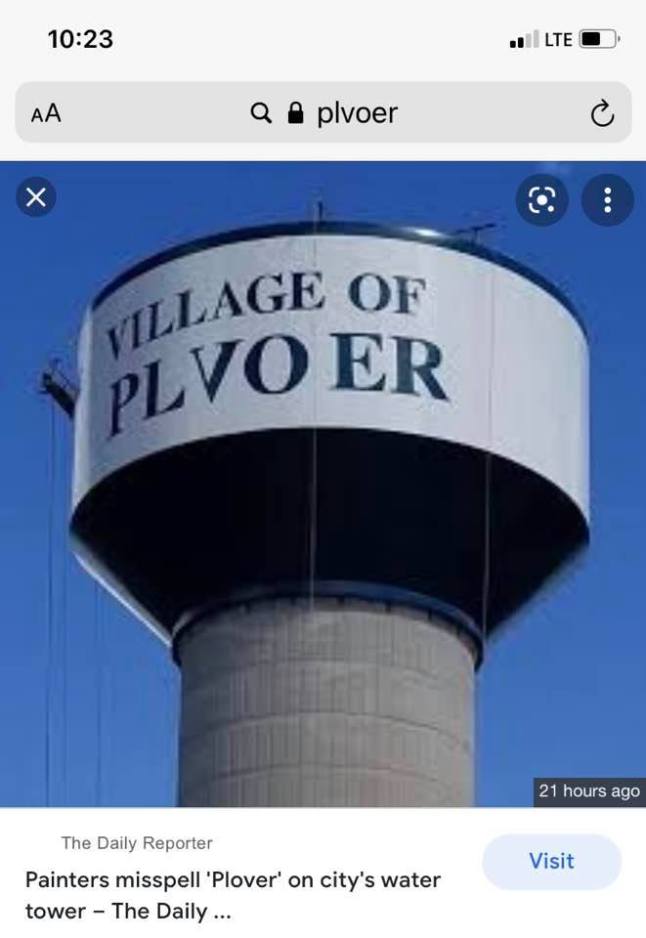
(Allegedly, we’ve got enough paint in here to fix the Plover water tower.)


Welcome to this edition of the junk drawer. As we have outlined in previous junk drawer posts, this is a random collection of stuff that is important but didn’t fit anywhere else, much like that drawer in the kitchen of most of our homes.

Here’s a look at some screw-ups, stories and updates:


WHERE IS BILL GATES AND HIS SQUIGGLY RED LINE WHEN YOU NEED THEM?

I often rely on spell check to bail me out of a “how is that spelled?” situation. That said, people can’t always rely on a spellcheck function to save them, as the folks in Plover, Wisconsin found out recently:

As painters scrambled to fix the error, some folks, like those at RayGun T-shirts had some fun with this:

In other news…

THE MILWAUKEE JOURNAL-SENTINEL HAS LEARNED BASIC MATH

Some things are kind of patently obvious, but when you say them in sports with conviction (or a big honkin’ headline) they seem almost profound. To wit, in advance of Game 5 of the NBA finals, my hometown paper made this bold proclamation:

Let’s review how the NBA finals and basic math work:

  • The Phoenix Suns have the home-court advantage in the best-of-seven series, meaning four games will be played in Phoenix and three will be played in Milwaukee.
  • To win a best-of-seven series, a team needs to win four games out of the seven available.
  • If only three games are played in Milwaukee, the Bucks will obviously need to win at least one game in Phoenix.

This reminds me of the time I heard a coach say something along the lines of, “Most of our best come-from-behind wins happened when the other team was ahead.”

And, the Bucks did win one in Phoenix and won the championship, so I guess the headline wasn’t wrong, just dumb…

In other “Bucks-related news…”


IT’S A LEAD, NOT A CLOWN CAR

(If you’ve got this vibe happening in your lead, you might want to rework it…)

I get that not every lead can be 25-35 words, simply covering the 5W’s and 1H, but there needs to be some sort of limit to how much stuff a writer tries to cram into a single sentence. Here’s a look at a lead written shortly after the “Bucks in Six” victory on Tuesday night:

MILWAUKEE — In the immediate aftermath of a legendary performance to close out the 2021 NBA Finals and win a championship for the first time in his career, Milwaukee Bucks superstar Giannis Antetokounmpo declared that he signed his five-year, supermax contract extension prior to the season because “there was a job that had to be finished,” and that staying in Milwaukee meant doing it the “hard way.”

That’s 67 words, which is almost twice the “legal max” for a decent news lead. The problem with this lead isn’t just that it’s too long, but also that it’s a rambling word salad that abuses every element of writing we teach:

  • Lousy word choice: “Aftermath” means “the consequences or aftereffects of a significant unpleasant event.” If this was this wonderful and legendary thing, it shouldn’t have aftermath for Giannis. It should have aftermath for the Suns.
  • Adjective-palooza: “Immediate aftermath” and “legendary performance” go without saying, but there’s also “his five-year, supermax contract extension.” You could chop upwards of five words out of here and still have the same meaning.
  • “Partial Quotes” that “don’t help:” Read both of those partial quotes and tell me exactly why they are in quote marks. Save partial quotes for things that merit them like odd phrases or dangerous terms: (During his post-game interview, forward Bob Smith called referee Jim Xfer a “racist, cracker punk” for calling a foul on him in the game’s closing seconds, adding, there was no way Xfer would make “that bulls–t call on a bench-warming white boy.”)
  • Drowning the noun-verb-object: When students have difficulty figuring out what a sentence is trying to convey, I tell them to do a simple sentence diagram so they can locate the noun and verb (and possibly the object). Once they find those, they can build around them judiciously. Here, the author drowns the sentence core in all sorts of slop that doesn’t help people understand the point of the story. The simpler and more plain the sentence core, the better off you are. Let this cheesy PSA from the 1980s be your guide:

And finally, speaking of leads that need a hug…


ALLEGEDLY, ALLEGATIONS ARE ALLEGED

When it comes to words to avoid, put “allegedly” at the top of the list. As we’ve detailed here before, this offers you no legal protection, hides the source of the allegations and often leads to misplaced modifiers.

I get the journalists are often trying to couch their statements or cover their keesters, but the use of allegedly here makes even less sense than it usually would:

A vehicle allegedly struck a 6-year-old girl who was riding a bike on the 2100 block of High Ridge Trail in Fitchburg between 7:30 and 8 p.m. Sunday evening.

A few reasons why this is dumb:

  • If “allegedly” is meant to keep us safe as writers (which it doesn’t do, but let’s just say it does for the sake of the argument), exactly what are we worried about getting sued for here? Are we worried that an unnamed vehicle will sue? The girl’s parents? The bike? Allegedly used in association with a direct accusation at least would make sense (“Sen. Jane Jones allegedly stole money from her campaign fund.”) but here?
  • If “allegedly” is trying to cover us as writers in case the thing we said happened didn’t happen (which again… yeah… I know… broken record here…), what are we trying to say in the lead? That we don’t believe the girl? (“Mommy! I got hit by a car while riding my bike!” “Honey, is that really true or were you doing street BMX again?”)
  • If we are really worried about couching things in the lead, why was this the headline: 6-year-old riding bike struck by vehicle in Fitchburg

When it comes to “allegedly,” we’ll let Lou Redwood of “Semi Pro” have the final say here:

Thanks for reading. See you next week.

Vince (a.k.a. The Doctor of Paper)

A rock star with a heroin problem, the “Bong Hits 4 Jesus” guy and a foul-mouthed cheerleader: The Suicide Squad of free speech court cases

A frequent joke told among lawyers is that the best case is the one with a carload of nuns as your client and a busload of priests as your witnesses. In most cases, however, it seems more like this scene from “The Wire.”


When it comes to First Amendment law, it would be great if we had more cases in which polite, articulate young people like Mary Beth Tinker who quietly wore a black armband to school to protest the Vietnam War. Her choice led to hate mail and threats, but also a ground-breaking Supreme Court case regarding student free-speech rights. And, looking back on it now, people can understand better her underlying concerns about the war as well as her relatively mild statement against it.

Tinker v. Des Moines (1969) established that students do not shed their Constitutional rights at the schoolhouse gate. It also provided protections for students who wish to express themselves against intrusion from school overreach.

Unfortunately, an upcoming case in which a high school student did her best “Scarface” dialogue on Snapchat could be the case that undoes a lot of those protections in a digital age:

In 2017, ninth-grader Brandi Levy said on Snapchat some version of what stressed-out students have been saying on the back of the school bus since the invention of buses: “Fuck school fuck softball fuck cheer fuck everything.”

The post was shared on a Saturday afternoon during a trip to the local convenience store, disappeared from Snapchat by Sunday afternoon, and caused no disturbance at school whatsoever—except to irritate the cheerleading coach, who banned Levy from the squad for a year.

She filed suit, and in June 2020, a federal appeals court ruled that school authorities violated the First Amendment by disciplining her for the off-campus speech. Now, the Mahanoy district is asking the Supreme Court to overturn that ruling.

The case doesn’t matter in regard to that single incident anymore. Levy is now a college student, the cheer team has had a complete turnover in terms of membership and nothing the court could do would change what happened in regard to the punishment levied at the time.

However, if the court decides to overturn that appeals court’s ruling, it could mean that schools can now actively monitor social media and punish students for ANYTHING that appears to be “objectionable.” If that doesn’t scare you, you probably had one of the six “really cool” high school principals I was always told existed somewhere.

Me? I dealt with a lot of nuns and balding guys who wore short-sleeve shirts with brown ties. This is terrifying…

This leads to the point of the post: It seems like we NEVER get the perfect Supreme Court case that perfectly showcases speech that deserves to be protected for the betterment of society. It’s never the student newspaper that was censored for reporting that the principal had stolen money or the kid with the bullhorn outside the school telling people not to eat cafeteria food because the workers were being abused.

It’s always something with an F-bomb, a nude pick or a drug reference that we get to stand behind and say, “Hey, look… You CAN’T censor this because… well… geez…”

We don’t get Superman, Batman, Aquaman or Wonder Woman as our defenders of freedom.

We get The Suicide Squad:

In other words, we get a “mental defective dressed as a court jester,” a “guy who wears a toilet seat on his head” and a “shark with hands,” to quote the red-band trailer I’m not allowed to show you here…

If you think I’m kidding about this, consider the following court cases on important topics:

The landmark case for online speech and defamation? Rocker/Actress/Woman I’d be most scared of meeting in a dark alley Courtney Love won and survived an appeal of her “twibel” case (Twitter plus libel) in 2014. Love, whose outlandish behavior and heroin abuse have long been the subject of media coverage, stated that an attorney had been “bought off” instead of helping Love recoup parts of her late husband’s estate.

A crucial Supreme Court case regarding speech at school sponsored events? Morse v. Frederick, also known as the “Bong Hits 4 Jesus” case. A student held up a sign at an event proclaiming the cryptic message. When the sign was taken away by school administrators, the student later sued claiming his First-Amendment rights had been violated. The SCOTUS ruled that schools have the right to remove pro-drug messages, even though students have some free speech rights at school.

The case that dealt directly with a reporter’s right to maintain confidential sources? Branzburg v. Hayes, which dealt with reporters being forced to disclose the names of sources who were manufacturing hashish.

And, of course, the case involving satire and hyperbole in regard to public figures comes from the apparent patron saint of this blog, pornographer Larry Flynt.

Now, the question of whether students can get smacked around for writing things on their own time on their own social media that school officials dislike comes down to one foul-mouthed 14-year-old cheerleader.

The problem with all of these cases is that it becomes so much easier to suppress speech that is unpopular, vulgar or otherwise disagreeable.

If the reporters in Branzburg were protecting whistleblowers who had uncovered some sort of dark plot by a foreign government to go all “Red Dawn” on the U.S., it would likely feel better to the courts to support their interests in remaining anonymous.

If the school was trying to suppress speech about the superintendent stealing money from the district to buy weed, maybe a “No Bong Hits 4 Superintendent Smith” sign would have garnered a different outcome.

If Sally Fields had tweeted about potential legal malfeasance (while wearing her “Flying Nun” costume), it might not have felt like the entire future of online free speech hinged on whether the defendant was going to lose her mind on the stand and start throwing things at the jury.

If the cheerleader had done her rant without the f-bomb, maybe the courts would be more inclined to side with her at every level.

However, we don’t get to choose the cases that decide our fate, which is why it’s important to make sure that we stand up for all speech because what one person thinks is a felony charge, others might consider a misdemeanor at best. In the mean time, keep an eye on this one, as it’s got a lot more at stake than a lot of people think.

I love Pat Simms, and I’d like to ask all of you to love her, too

Trying to tell a story about Pat Simms is like trying to paint a portrait of Leonardo da Vinci: You are working in the master’s medium, the master is awe inspiring and you’ll never perform half as well as they would.

Here’s a screen capture of Craig Schreiner’s photo of Pat that ran when she retired a decade ago. I tried desperately to find a different image, but I hope my former colleagues at the State Journal won’t come after me for a copyright violation.

For 42 years, she broke barrier after barrier at the Wisconsin State Journal, as she put the fear of God in her sources and told her audience what they needed to know most. She was constantly ahead of the curve, becoming one of the first women in the newsroom and definitely the first one who got maternity leave. She was a coiled steel spring who would hold her own against the men who wondered why she was “allowed” in what had previously been an all-boys club. She could also bring the heat at sources who thought they could pat her on the head and send her on her way with a fluffy soundbite.

The legendary newsroom story about Pat is of her strapping on a gas mask to cover the Vietnam War protests at UW-Madison at the beginning her career at the paper. At the end of it, she was covering the Act 10 protests at the State Capitol. In between, she was a reader’s dream and a weaselly source’s nightmare.

This week, I got a message from a friend that almost stopped my heart:

“Pat Simms is in hospice with uterine cancer. We all thought she could beat it with chemo. It spread. I am sad beyond words.”

Her daughter reached out to her former colleagues at the paper with this message:

We would like you to inform fellow journalists about my mom’s condition at this time.
In January my mom was diagnosed with uterine cancer. We were optimistic that with chemotherapy it would be treatable. Unfortunately we have received some bad news.
New scans were done and the cancer has now spread to her lungs. We need to stop the chemo because her body can’t take it. And we can’t do radiation because you can’t radiate the whole lungs. So we are now focusing on quality of life. We are going to get a second opinion so we will see what they say. But for now we are preparing for living out her days at home with calm and as comfortable as possible.
They have given her about 6 months.

When I was at the State Journal in mid-1990s, the desk I shared with the day-shift GA reporter was right next to Pat’s. Our computers faced each other and consisted of old ugly hard drives and giant beige monitors that were so tall you couldn’t see the person across from you. Still, I could hear every conversation Pat had, as her phone was constantly ringing with tips, scoops and “guess-what-I-heard” insights.

At that time, she was writing her “Snoop” column, which served as a mix of Page Six style gossip and a floodlight of attention she shone on area hypocrisy. In my mind’s eye, I can still see the mug shot that ran with each column: She had her chin resting on her hand and her eyes sparkled with an “I-know-something-you-don’t-know” look.

The sheer volume of people who called her in a day would be enough to stop a speeding 18-wheeler in its tracks. People from all over the place called in to tip her about some shady deal, some hushed-up arrest or some bizarre tale. It was every day, all day that she took call after call and listened to these people, some of whom I’m absolutely certain were just bat-shit nuts.

Somehow, she was able to parse fact from crap, truth from political hatchetry and interesting content from inside baseball. How she was able to fact check all of those insane stories people shared with her was beyond me.

Whenever I thought I had gotten an exclusive tip on something and I was explaining it to an editor, the answer was almost always, “Oh, yeah. That ran in Snoop on (fill in the day).” It got to the point where I read Pat’s column first every day so I would stop looking like an idiot by pitching old news. On the extremely rare occasion where I did have something she hadn’t heard, her head would pop up like a Whack-A-Mole over the top of those computer monitors and she’d be asking questions of me, trying to figure out what I knew and how she hadn’t heard it first.

When I left the paper to head off to Mizzou, Pat congratulated me, but went out of her way to remind me that her alma mater, Northwestern, was the best J-school in the country. If it produced journalists like Pat, it was really hard to disagree.

The last time I saw Pat was a little more than two years ago. Out of the clear blue sky, I got an email from her that simply read: “I just decided to use your book as the textbook for my Fall Introduction to Journalism class. How about that?”

In her “retirement” she had taken on a job as a journalism professor at Edgewood College in Madison, where she had also started advising student media. She told me she’d been reading the blog and that’s why she picked my book. She asked if I was going to be at the state media convention and if we could talk about the book and her class.

When we met up, she grilled me like I was a source. It was all “How does this work?” and “So, why would I include this in the syllabus?” and “Wait, that doesn’t make sense. Explain it again.”

It was incredible to me because I wanted to say, “You’re Pat FRICKIN’ Simms. The kids in your class are going to pick up about 50 IQ points by just being near you. The hell do you need me for?”

Still, there she was, seven years into retirement, 50 years into her journalism career, trying something new. She was bound and determined to learn how best to ply her trade.  She was going to make absolutely certain that she did it right and that she left no stone unturned in making that happen.

Pat’s daughter asked people to share stories about Pat to buoy her spirit. The stories I have pale in comparison to those of people who knew her longer and better, but in the few years I spent with my computer terminal butted against hers at the State Journal, she made a profound impact on me. Here are two memories that still stick with me:

“THEY’RE YOUR STORIES. GO DO THEM.”

I worked nights and weekends at the paper. During the nights, we had a consistent crew of me from 6 p.m. and 2 a.m., a specific swing-shift reporter from 3 p.m. to 11 p.m. and the night city editor from godknowswhen to godknowswhen. Weekends were a different story, in that I was always there on Sundays from 10 to 6, but the reporter and the editor were always changing, based on who got stuck taking a reporting turn that day.

One Sunday, I got a call from someone who complained that there were recruiting pamphlets for the Ku Klux Klan in a free newspaper rack outside of a local grocery store. I was ready to rush out there when I got another call from someone telling me that a tagger or group of taggers had basically destroyed the side of a Walgreens on campus with spray paint.

I went to the grocery store, got the last two copies of the Klan brochures and interviewed the store manager. I then stopped outside of the Walgreens to take some notes when a kid in a trench coat stopped and asked me, “Do you like that stuff?”

I told him I didn’t have an opinion one way or the other, but I wanted to know more about it. He then opened up his coat and showed me a couple cans of spray paint stuffed into his inside pockets.

I interviewed the tagger kid, who gave me some great stuff and I got back to the newsroom just in time to catch a call from the editor who was coming in later that day. He asked me if anything was going on and I told him all about the two stories I had.

“OK, Simms is coming in about an hour from now,” he told me. “Give her the pick of those two stories and you do the other one.”

My heart sank, as I was wondering which one she was going to pick. They were both REALLY good stories and I knew they would be byline-worthy. No matter which one she got, Pat’s story was going to be amazing and way better than what I could have done.

Pat showed up about a half hour later in a rush, as usual. She was unloading her purse and coat at her desk when I told her about the two stories and how she was supposed to pick one of them.

“You do them both,” she said. “Ralph Hanson died and I need to do an obit.”

Hanson was the former police chief at UW-Madison, who ran the department during the 1960s and 1970s. He was famously involved in the Dow protest in 1967 and the Black Student Strike of 1969.

Pat had gotten a tip (as she always did) and was pulling sources from her files to write his obituary. Still, Pat could have written that piece, my two pieces and probably another story during her shift and done it without breaking a sweat.

“But the editor said-” I began.

“They’re YOUR stories,” she told me. “Go do them. I’ll tell (the editor) when he gets here what’s going on.”

The KKK story made the top of the front page and led every newscast the next day. The tagging story was on the local section’s front cover. Both had my bylines. It was the greatest day I’d ever had as a professional writer.

One thing that I still treasure about that day was how Pat treated me as an equal. She was quite literally doing professional journalism before I was born, and yet in her way of thinking, we were just two reporters in a newsroom, banging out stories and waiting for an editor to show up. The way she saw it, I caught the story, I did the work and I should keep going on it.

The other thing, however, was that she had a sense as to how much this really mattered to me. I was 21, had less than a year in at the paper and barely got any bylines. Pat’s byline file was crammed with so much great stuff, that I doubt she would even remember either of these two stories. For me, it was the kind of thing that would have me buying a dozen extra copies of the paper to send to my parents and grandparents.

To not only give me ownership of those stories, but to “tell the editor” that they were my stories (a concept for me that, at the time, was like trying to set God straight about a few things) showed me something important: It was possible to be the big dog while not making someone else feel like the runt of the litter.

Ever since that day, I always looked for the opportunity to do that for someone else, which is probably why I ended up in education. I wanted to aid in those moments that made someone desperate to pick up a phone and call home to say, “The best thing just happened!”


“WE’RE GOING OUT.”

I had broken off my engagement with a city council rep, something that was awkward personally and professionally. Given that I had to tell my employers we were in a relationship, I now had to tell them we were no longer an item. It was a messy situation and I wasn’t handling things really well.

Around that time, Pat was going through some personal turmoil as well. We were bantering over our life misfortunes when she got out of her chair and poked her head over the top of our computer monitors.

“Are you on the desk Saturday night?” she asked.

“No,” I said. “Why?”

“We’re going out.”

She said she had four tickets for a comedy club opening and she’d given two of them to a couple of her friends. She wanted me to go with her because “you need a laugh.”

We got to this club and a few things became clear.

First, everyone, and I mean EVERYONE, knew Pat. It was like going somewhere with the pope.

People were coming up to her from every direction to tell her something or ask her something. The club owner told her the club area wouldn’t open for a few more minutes, but she could wait in this little area to the side so she wouldn’t be bothered. Pat refused, staying right in the middle of the action and talking to anyone who came within shouting distance.

Second, she had some serious pull. We got escorted to this table that is up front and slightly left of center. A friend of mine later explained that this was the best table in a club, because they usually seated VIPs there. Comedians were told not to bother these people with their shtick. Thus, while some poor guy from Baraboo was being berated for living “in that city with the (expletive) clowns” and the bride in a bachelorette party got ripped on for using a “penis sipper cup,” we remained unscathed.

Also, when Pat’s “friends” arrived with the other two tickets, it turned out to be our congressman and his wife. Looking at that table, I felt like the answer to a game of “Which one of these is not like the other?”

At the end of the night, where I laughed until I hurt,  the congressman picked up the check for us. Pat and I walked out together, reliving some of the better bits from the comics as people were still trying to get a moment of her time. I got to feel like a big shot for a moment simply by being in Pat’s general vicinity.

Pat was probably the most perceptive reporter I’ve ever been near, but that night she made clear she also was an extremely perceptive human being with wide streak of humanity and empathy to match. She could have asked a hundred other people to take that ticket or just decided to give the pair away and stay home that night. Instead, she used it in a way that still resonates for me.

She saw I was broken and she took the opportunity to salve my soul.

—

Contrary to what you might believe based on the word count, I had trouble trying to write this. My memories and stories with Pat happened years or decades ago, but to refer to her in a past tense felt almost shameful to me.

Pat isn’t a “was.” She is an “is.” And no matter what happens going forward, she will continue to be one.

That’s what happens when you spend your life making things better for people through your work, your craft and your sheer force of will. The lives Pat continues to influence are like seeds planted in premium soil, growing strong because of her. I know that, because I like to think I’m one of them.

It’s never too late to tell people how much they matter, so that’s what I’ve tried to do here. I’ve flailed about a bit and probably overwritten in spots because Pat matters so much more than my skills can accurately explain.

As I said, it’s really hard working in the master’s craft.

But I hope Pat knows I love her dearly and will be thinking of her always.

Well, allow me to retort: The Milwaukee Journal-Sentinel counters Sen. Ron Johnson’s “unhinged” tirade with a series of well-timed footnotes

The Milwaukee Journal-Sentinel took aim at several of Wisconsin’s political figures after they supported former President Donald Trump’s allegations of wide-spread voter fraud, even after the Jan. 6 attempted coup at the U.S. Capitol. The paper’s editorial called for the removal or resignation of Sen. Ron Johnson, Rep. Tom Tiffany and Rep. Scott Fitzgerald for giving “aid and comfort to an insurrection.”

The editorial clearly peeved Johnson, who requested space within the paper to respond to this call for his ouster. This painted the paper into a potentially untenable corner. The options appeared to be:

A) Give Johnson space in the paper to write about his views, knowing full well that Johnson will roll out an insane series of conspiracy theories, misstatements and other content unburdened with the need to be accurate. In doing so, the Journal-Sentinel basically elevates his lies via their platform and undermines its initial editorial.

B) Refuse him the space, thus allowing him to go on every right-wing TV show, radio show, podcast, blog and puppet show to complain about the bias of the media and how the paper has violated his First Amendment rights in the most egregious way possible. (In case you were asleep when they taught press freedom, that’s clearly not true, but hey, neither is about 93% of what Johnson says…) In other words, the Journal-Sentinel would give him more attention and a bigger stage by denying him.

So what do you do? Apparently, the people at the paper were watching the movie “Speed” when they made this decision:

(Side note: I would really have rather used a clip from “Pulp Fiction,” where Samuel L. Jackson confronts Brett over his poor decision-making in regard to Marcellus Wallace. Alas, I think I used up all the cussing I’m allowed for the year in yesterday’s post, so Keanu it is. Still, I worked the main line into the headline, so I guess it’s almost like a win…)

Here’s the preamble to Johnson’s diatribe:

Editor’s note: After the Editorial Board called on Sen. Ron Johnson to either resign or be expelled from office for his role in spreading disinformation about the presidential election, the senator asked for space to respond. We are providing him that courtesy today. We also are taking the rare step of footnoting Johnson’s commentary to provide additional context so that readers have a fuller understanding of the senator’s actions.

In other words, “You can say whatever you want, but we’re not going to let you get away with lying to people on our pages without putting up a fight.”

Fact checking a politician isn’t a new thing, as PolitiFact has done this thousands of times over the years. It’s also not a new thing for a publication or website to call out misstatements or general fiction, something Snopes does on everything from whether Trump had a “Diet Coke button” in the Oval Office to whether a drunken man lost his genitals after attempting to have sex with a snowman.

However, in most of these cases, the reality check was presented in a post-hoc approach, giving people the right to say what they wanted and then cleaning up the mess with a later piece. The approach here is like lawyers getting the right to object repeatedly during a deposition, casting doubt on claims immediately upon their statement.

Journalists and academics have debated the approach taken here because it is so extraordinary, something the paper acknowledged right up front. So here are a couple questions that might make for good class conversation (or for the non-school folk who read the blog, a great argument over a beer, provided that takes place in a socially distanced environment while wearing masks):

  1. What do you think of the approach the paper took with Johnson’s editorial?
  2. Should the paper have gone with a traditional “Option A” or “Option B” noted above?
  3. Did the paper have an obligation to tell Johnson about its “extraordinary” approach before running it? (Perhaps thinking of this another way, should the paper have given Johnson a chance to spike his piece rather than let it run as it did?)
  4. What are some other options you’d like to see the paper take, rather than this one, if you disagree with the approach?