The Junk Drawer: Taylor Swift Can’t Save The Cops edition

Welcome to this edition of the junk drawer. As we have outlined in previous junk drawer posts, this is a random collection of stuff that is important but didn’t fit anywhere else, much like that drawer in the kitchen of most of our homes.

Here’s a look at some screw-ups, stories and updates:
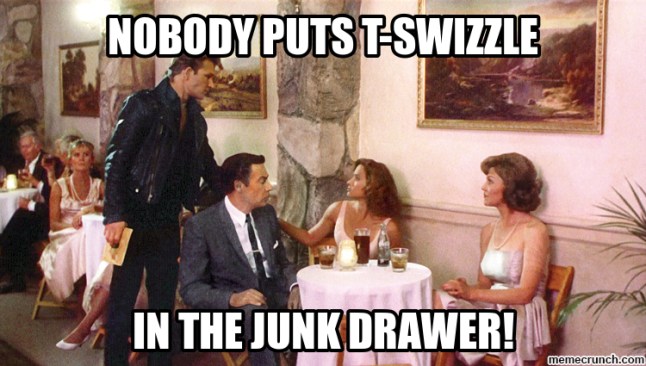
MAYBE JUST BE BETTER AT YOUR JOB? At the risk of creating anarchy with the title of this post, let’s tackle how Taylor Swift ended up in the middle of a controversy surrounding police officers in Alameda County. It turns out that, in addition to not understanding copyright law, the First Amendment and general common sense, at least one officer in this fine hamlet doesn’t understand how YouTube’s service agreement works either:

Last month, Sergeant David Shelby, an Alameda County Sheriff’s Department officer, was caught playing Taylor Swift’s “Blank Space” from his phone as he was being filmed by activists, in a move he said was done “so that you can’t post on YouTube.” The incident was the latest in a bizarre trend in which police officers play copyrighted music while they are being filmed by the public, in hopes of triggering social media antipiracy filters, which would theoretically get the video deleted. 

Aside from not doing what he had hoped it would do (keeping people from filming him and/or allowing YouTube’s “bots” to save him), Shelby actually brought more attention to his actions from both inside and outside of the police department. He is apparently not the only one who has tried this:

In the last few months, cops across the country have been trying this cute little trick for keeping their interactions with the public off social media: Playing pop songs over interactions with the public when they’re being filmed. One Beverly Hills cop played Sublime’s “Santeria” when he realized he was being live-streamed in February and another with the Beatles’ “Yesterday,” and another in Illinois tried it with Blake Shelton’s “Nobody But You” in March.

They think that if the audio captured was smothered by a copyrighted song, posting it to sites like Instagram or YouTube would result in the poster getting smacked with a copyright takedown notice—and the platform would either remove the video, mute the audio, or ban the user altogether. In each of these cases, it didn’t work, and the videos remained online. People have a First Amendment right to film the police.

Shelby tried it, but it didn’t work: the video stayed up on the Anti Police-Terror Project channel, and now has almost 740,000 views.

It’s unclear what any of these officers were doing at the time that made them so worried that they were being filmed, but maybe THAT should have been the bigger concern. If you’re doing something so bad that evidence of it requires you to try to force illegal actions (copyright infringement) on other people to get away with it, that doesn’t say much for you.

On the other hand, I’m waiting for the first time some officer tries this with a Brittney Spears song, so this can start making the rounds again:

Speaking of outrage…

I AM FURIOUS AT… UM…: Journalism has two simple rules when it comes to telling a decent story:

  1. Tell me what happened.
  2. Tell me why I care.

Usually, people being upset with something leads to a pretty good answer to both of those stories. That said, it only really works if you let us in on what you know:

OK, Augusta McDonald might have been following the story, and the outrage, and the lawsuit, but maybe a couple people out there reading this thing (read: Me and Amy at least…) have no damned idea what happened, so how about filling us in? The photo of a basketball team (I think) with blurred faces and three smug looking weasels in red shirts isn’t helping here either.

I get that you don’t always want to give away the whole story in the promo like they do in “The Kentucky Fried Movie” but for Pete’s sake, give us a bit of a hint in either the head, the lead or the photo captions.

Speaking of things that are usually Kentucky-fried…

THE CHICKENS COME HOME TO ROOST FOR THE AP: Fred Vultee, a journalism professor at Wayne State University and eternal copy-editing god, was fond of telling folks that it’s just as easy to drown in 2 inches of water as is to drown in the Pacific Ocean. His point, in the editing realm, was that we should read every piece of copy carefully and fact check everything, regardless of how important we think it is.

I’ve often taken this a step further in explaining to students that it’s rarely the deep-dive, FOIA-driven, scandal-based investigative piece that ends up with problems or that costs journalists their jobs. It’s usually the small stuff that we either overlook, joke about or just make random assumptions on that tend to kill us.

A case in point is this article that shows how the Associated Press did the chicken industry wrong with its use of improper “chicken art” with a story on a corporate poultry merger:

When the AP distributed the story to all of its member news outlets, it also distributed a photo of an egg laying operation, rather than one of a broiler operation such as Sanderson Farms, or Wayne Farms, with which Sanderson Farms will merge.

And that layer operation photo was published on the websites of some of the nation’s major news outlets, such as USA Today, Financial Times, U.S. News and World Report, Boston Globe, and many others. Considering USA Today is part of the Gannett network, which owns over 100 daily newspapers and 1,000 weekly newspapers, its hard to tell how many readers saw this.

But the simple fact is that way too many people did. And my guess would be most of those people don’t understand that broilers and layers are totally different breeds of chicken and the operations are completely different.

Chickens are chickens, in their minds.

(Side Note: We have eight chickens at the ol’ homestead now and all I really know about them is how to build stuff like a coop, a “poultry palace” and a chicken run. Well, that and that it’s a major pain in the keester to try to catch them when Amy says, “Go make sure the chickens are in the coop for the night.”

If you ever want to visualize a humorous moment, imagine the author of your textbook cursing in the darkness while diving headlong after a pile of fleeing poultry, only to grab one by the leg and be beaten about the face with its wings.

You’re welcome…)

The thing that is important to understand here is not that the AP had some sort of fowl up (Sorry, I had to…) but rather that there are ALWAYS people out there who have niche interests reading your stuff and they are ALWAYS going to be upset when you screw up their beloved topic. For an earlier edition of the media writing book, I interviewed Meghan Plummer, who was working at the Experimental Aircraft Association as a publications editor. She told me stories about how she would get angry letters and emails when she’d mistake one kind of tail rudder from another in a piece or incorrectly note the year in which a plane was built or flown.

To some folks, planes are planes, but Plummer understood that these people have a passion for the topic and have come to expect that the material they read from an aviation publication will feed that passion. Keep those kinds of folks in mind when you’re writing about a topic, even if you couldn’t care less about it.

And finally, speaking of things you couldn’t care less about…

THIRD TIME IS THE CHARM: The Dynamics of Media Writing’s Third Edition has just pressed and is available for purchase at all fine textbook institutions (and I imagine free downloading already on at least three hacker sites). The update covers a lot of the crucial updates in the law, ethics, social media and web writing while doubling down on the basics that that still matter in all fields of writing.

It’s been more than a decade since I went looking for a media-writing text that treated each field of media equitably and honestly, if for no other reason than I was tired of having students in my class say, “I’m going into PR! Why do I need this stuff? The whole book is just news, news, news…” I can still remember the conversation I had with Matt Byrnie of SAGE at an AEJ conference that led to this book:

Matt: “That’s a great book! We don’t have it. You should totally write it.”
Me: “I don’t want to write a book. I want you to have someone write it so I can buy it from you.”
Matt: “You don’t understand. NOBODY has that book. That’s why I need you to do it.”

We scheduled a sit down for noon the next day where I would pitch him a concept. I remember doodling on a piece of paper from the Renaissance Hotel with ideas, rules and core concepts. When I showed it to him, he said, “We might have something here.”

I looked the book up at Amazon when putting this post together and saw this:
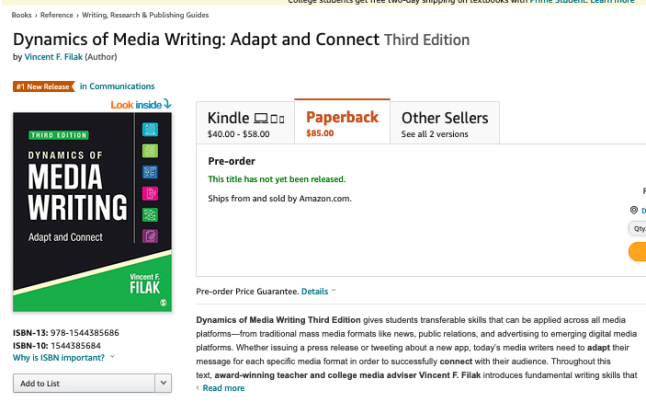
Number one new release in communications? Maybe we do have something here… And I’d like to thank all of you who read my stuff for making that happen.

Have a great week.

Vince

(a.k.a. The Doctor of Paper)

Principal failure: Why public relations matters for school districts and how some places are really, really bad at it

Few organizations have a greater need for public relations assistance than do educational institutions. Between edgy parents, state oversight and a rotating stream of burnt out teachers, schools tend to have a need for a calming influence and a clear voice during turbulent periods.

I’ve dealt with a number of administrations over the years, primarily when someone does something dumb that infringes upon the free press rights of students, and I’ve found that if these folks just had someone to help them plan what to say and how to say it… well… they’d end up a lot better off.

Here’s an example of what can go wrong without some PR help:

My daughter is entering her junior year at the local high school, which had been looking for a full-time principal for about a year. Like everything else, the administration at the school was kind of in flux due to the pandemic. Eventually, though, the school hired someone for the job.
With school right around the corner, the parents recently received an email from the new hire at the school:

August 11, 2021

Hello Omro Foxes!

Welcome back to the Fox Den.

    I am Chris Fox, the new Principal of the Omro High School Fighting Foxes.  Yes, that really is my last name.  I am settling into the building and meeting new people everyday.  I look forward to meeting all of the outstanding students and their families as we begin a new school year.  We are going to have a great school year lifting each other to new heights and continuously improving.  The maintenance and custodial crews are working very hard to improve the building and put a clean new look into the Fox Den.  Teachers and staff are enjoying their summer but are very excited about meeting the students in their classrooms again.  We want to welcome all returning students and our new students to Omro High School.

The letter goes on to talk about new people in new places and all the great stuff we’ll be seeing this year. Overall, he seems like a nice guy, he has some humor (our mascot is the fox, so that’s kind of amusing) and he’s got some interesting background. This could be a good start to the year.

The next day, we get this emailed to us:

As a parent (OK, probably more because I’m a nosy journalist…) I was a bit perplexed that within a period of less than 24 hours, we went from “Hey I’m the new guy and I’m excited” to a tersely worded statement from the superintendent saying the “new guy” is now the “former guy.” So, I shot an email to Superintendent Jay Jones, asking what the heck happened, knowing full well he probably couldn’t or wouldn’t tell me anything. His response came on Aug. 13:

Good Morning Vince,
I am not allowed to provide the reason that Mr. Fox decided to resign. Mr. Fox has employee/personal rights that must be followed. He tendered his resignation this week and the board met last night and approved the resignation.
Sincerely,
Jay Jones

In doing some basic math, I realized that if Fox sent his “glad to be here” message on Wednesday and the board approved his resignation on Thursday, that resignation was likely turned in before that initial message went out. At best, it was the same day he sent it. Regardless, his response made things weirder, not clearer, for me.

This wasn’t the first time I’d seen something like this, oddly enough. The principal who was supposed to take over my grade school when I was in eighth grade bailed on us just before the start of school to take a better job with more money.

So, I went to his LinkedIn page to see if maybe a rival school had ponied up a better gig and found this:

(A bit flummoxed, I sent a note to an Omro Facebook group, asking if anyone knew what was going on. Of the flood of messages I got, about one-third came from parents who asked the same thing, one-sixth made jokes about how this was somehow Joe Biden’s or Donald Trump’s fault and the rest chastised me for “starting the rumor mill” or being a general a-hole for digging into the man’s private life. )

I could continue to dig into this guy and this situation for days, trying to get someone to answer the basic “What the heck is going on around here?” question, but that’s not the point of this post. The point here is that there were several simple things public relations professionals could have done to help the school district cut all this off at the pass. Here are a couple of those things:

PLAN FIRST, WRITE SECOND: I have seen a number of these three-line press releases before from school districts, police folks and other organizations that should be hiring PR professionals. They come across like a Jedi mind trick: “We are making a statement. You will have no questions. Go back about your business with the innocence of a newborn kitten.”

That’s not going to happen, so you need to plan for it.

People are going to be upset, curious, nosy, worried and a dozen other things in a situation like this. We have lived through far too much to just let a statement like that stand without question. We also were just told a day earlier BY THIS GUY that he’s happy to be here and now he’s gone? Asking “What the heck just happened?” is a normal, human response that you should be ready for.

Public relations practitioners learn early to plan out a strategy for the entire lifespan of a crisis, or at least as much of it as they can easily foresee. They won’t make a move without understanding how that move will lead to three other things happening down the road. They come loaded for bear with answers and explanations that they can anticipate needing to provide after receiving questions and concerns from their audiences. Only THEN do they make a statement publicly.

Speaking of which…

BE TRANSPARENT: My buddy, Pritch Pritchard, used to tell me how hard it was for him to get his PR students to understand the antithetical concept that says people trust you more if you tell them everything that is happening in a crisis situation. Pritch was in the Navy for 25 years and did public information, so he also noted he had similar problems explaining that to people above his rank and pay grade as well.

The goal of PR, he explained, should be transparency. The more you hide something, the worse it gets.

To explain this to my writing students, particularly those who were going into PR, I once played the Johnny Cash song, “A Boy Named Sue” for them. There’s a point in the song where part of it gets bleeped out:

We talked about all the things it could be and their imaginations ran toward the truly vulgar. As it was, what actually got bleeped out was the phrase “the S.O.B.” (A later version included the full version of that abbreviation.) They all seemed stunned that it could have been something that benign, which made my point that hiding (or bleeping) this thing only made the situation worse in the minds of the audience.

In bringing it back to PR and education, you will deal with a TON of concerns that parents have about what goes on at their kids’ schools, and rightly so. Those of us who are parents worry about what’s being taught, who the teachers are, what students are doing to each other, what rules are being violated, who might be bullying someone, if there’s vaping/sex/other terrifying stuff happening in the bathrooms and more. When someone up and leaves like this, our minds tend to wander to the most terrifying things that could be going on.

Not telling us anything gives our minds a chance to really kick into panic overdrive.

All we know is that Fox resigned. Did the board discover a dark secret about him or something he did and thus issue an ultimatum like this?


Or was Fox the good guy here? Was it Fox had a beef with a policy regarding masks and pulled out at the last minute? Was it a promise someone made to him that they reneged on and thus he did the only thing he could do? Did the board operate in bad faith, thus bringing into question its ability to hire the next-next principal?

Or was it something more personal? We’re in a pandemic, so everything is out of whack. Was it a family issue or a personal matter that he couldn’t deal with at the same time as being principal?

The mind can go in a dozen or more directions, but trust me when I say that literally 99.7% of the things that MIGHT have led to a resignation like this are far less problematic than the remaining one or two that jumped to the front of my mind immediately.

(And I’m not alone on this. I won’t repeat what I thought here, but when I laid this scenario out for a half dozen family members and friends, they each immediately jumped mentally to the same “EEEEWWWW” scenario that was in my mind. One response was great: “I’d CCAP the guy,” a friend said, turning our court record database search system into a verb. I had already done so. I found nothing there that would shed light on this situation. )

PR practitioners know that you want something like this dealt with quickly and in a way that restores the faith of the audience. This is where transparency serves the best interests of everyone involved. I understand there are rules and regulations, but transparency is crucial to keeping something like this from getting far, far worse in the minds of your constituents.

Which leads to the final point:

EMBRACE SYMBIOSIS: In the animal kingdom, symbiosis happens between different species that coexist in a way that can benefit each. The clownfish using the sea anemone for safety while the anemone receives nutrients from the waste of the fish is a good example. My personal favorite is the oxpecker and the rhinoceros:

In a case like the one involving the principal and the school district, a little symbiosis could go a long way in keeping both parties happy while reassuring parents of what happened here.

Sitting down together to plan out what they want to release, what they agree upon saying and how best to present this information to the public should be PR 101.

Fox has a legal right to say he doesn’t want the reason for his resignation to be released. That said, he might have been amenable to allowing the district to say certain things while avoiding other specifics in a press release to avoid any wild speculation. The district might be worried about what people would think if the administration said any more than the three lines in that press statement. That said, maybe getting permission to put a little more meat on the bone there would have helped the parents of the district be less fearful of what’s going on.

A symbiotic agreement on what can be said or how to best present what is clearly a weird outcome, couched in a series of odd moments, could benefit both sides, even as this relationship is clearly over. A good PR practitioner would find a way to arbitrate some sort of closure that would allow Fox the ability to exit in a “peace with honor” way while moving on to whatever he wants to do next, while simultaneously giving the district the ability to move forward in its next hire.

When it comes to public relations, it’s often about making everyone as marginally happy as possible. Good PR practitioners know that a truly quality solution benefits each player in the game. If only the practitioner’s client benefits, other stakeholders and member of the public can feel distrustful if they realize they’ve been duped. If the practitioner’s client doesn’t benefit, well… why is that client paying for this person’s services?

In many cases, practitioners serve as counselors, psychiatrists, arbitrators, surrogate parents and wise overseers for people who have become too involved in a situation to see the forest for the trees. It’s the practitioners’ ability to see what each move the client makes on the chessboard will result in six or seven moves later in the game that make these media professionals valuable.

At the very least, they can tell you what NOT to say that will only serve to make things worse, a maneuver that many educational institutions could really use help with.

Throwback Thursday: Remembering that first journalism class: “I was scared out of my mind.”

With school starting up for most of us in the next few weeks, it’s looking a lot like another year of masks, rule changes, hybrid courses and other things. We’ve spent a lot of time building contingencies on top of contingencies, only to find that some last-minute administrative change has us going back to the drawing board.

What actually stopped me from having a full-on panic attack about the classes I’m still rewriting or the protocols I’m going to be following was a post someone made on an educators’ Facebook group. It went into how, despite the fact we’re all “totally normal” now, our students (and likely our colleagues) are still damaged and wounded by the past 18 months and counting. One person said he can’t remember seeing so many students just bursting into tears as he has this opening week.

In one case, it was because the zipper on her backpack got stuck and she couldn’t fix it. Something tells me, he noted, that wasn’t why she was crying, but the precipitating factor that finally unleashed her torrent of tears.

I went back to this post because journalism classes in general can be a traumatic experience, even when not accompanied by a pandemic (and a broken backpack) so I’d like to start the year thinking about how to keep the education and reducing the trauma. Also, since the people who ponied up for this are all professionals, I like reminding myself and my fellow educators that we weren’t always perfect at this. Or, as Johnny Sain was known to remark about Old Timers’ Day: “The older these guys get, the better they used to be.”

Enjoy and have a great start to your semester.

Remembering that first journalism class: “I was scared out of my mind.”

I was recently on a panel that discussed student media and self-censorship. Most, if not all, of the people on the panel were former journalists and several people in the audience had made the transition to the field to the classroom. One theme that came up repeatedly was the way in which students “these days” didn’t have SOMETHING about them. It might be drive, it might be curiosity or it might be a skill. In any case, many of the people who spoke recalled that when THEY were students at THAT age, THEY had whatever it was that the students today seemed to lack in their estimation.

Me? I remember my first journalism class where I thought I knew everything. After working on one assignment, I thought I should go back home and work on that mechanic’s apprenticeship at the gas station.

The instructor was a former journalist, who was working on his Ph.D. He always graded in green because he said green was an affirming color. Well, he affirmed the crap out of me in that first assignment. The paper looked like a shamrock patch had thrown up on it. Arrows and lines were zigging and zagging all over the place like John Madden getting overly excited while using a telestrator. I figured I’d never make it in this business.

A few years later, I had a job at a good local paper, I had been publishing stories frequently and I was given the opportunity to teach that same “first journalism class” that the green-pen instructor taught many years earlier. When he found out I was teaching it, he called me to his office and handed me a file folder with one piece of paper in it: It was my first assignment, still green as a St. Patrick’s Day parade in Chicago.

As I read through all that tortured prose, I remember telling him, “Wow. I sucked.”

“No, you didn’t,” he said. “You were just new at this. When you go to teach your class, remember that in most cases, these students are going to be even worse than you were back then. You need to be patient with them and help them be patient with themselves.”

I thought about that moment after the panel. Maybe those folks were really great journalists since birth. Or, maybe the “Johnny Sain Axiom” on Old Timer’s Day applied here: “The older these guys get, the better they used to be.”

To get a better perspective on this, I asked the hivemind what the folks there could recall about their first journalism class, as in the first time they had to sit down and write for a course. The answers made me feel a little better about my initial experience and I hope they will give you a sense of hope as you start your semester:

This is from an award-winning journalist and professor who spent more than a decade at the Dallas Morning News. She covered the 1995 Oklahoma City Bombing and the 1993 federal raid on the Branch Davidian complex in Waco, Texas:

The class was full of typewriters. A grizzled old reporter from The Boston Globe taught it. He made us write an obituary on the first day. I got a C. I was scared out of my mind.

Here’s an ode to people who marched to the beat of their own drum from a former Wall Street Journal editor who now works for an Ivy League university as a social sciences writer:

My first journalism instructor in college was a longtime news editor at big metro papers. Along with lots of practical stuff, he taught me that desk editors — and particularly the good ones — tend to march to the beat of their own drummer. He was never on time to class — ever. He told jokes no on else got. He waxed on about obscure figures from his past jobs. But when the lead started flying, he was the guy you wanted in your foxhole. He taught me to appreciate all the weird, talented people newspapers attract.

A longtime photo journalist and college journalism professor had this take away: If your experience with your first journalism course isn’t perfect, don’t give up right away. Take another course or two before you decide that maybe truck-driving school is right for you:

My undergraduate writing Journalism professor was very intimidating. An older guy who had lots of real life experience. I can’t say as I enjoyed the class, but I made it through and went on to be a photojournalist for many years.

As the movie “Bull Durham” teaches us, in the major leagues, everyone can hit a fastball, so you’ll need to work a little harder to be “the best” (It also helps to have a curve ball.)

A former PR professional in the medical field who now teaches all forms of writing noted that her first experience in a journalism class made that concept clear quite quickly:

The professor asked everyone who was “one of the best writers” at their high school to raise their hand. Lots of hands went up. He asked us to look around. “You have competition, now. And not all of you can still be the best. Get used to it.” It was true – I’ve used that line in my classes as well.

The first writing class can be scary as hell for some people and a piece of cake for others. (One member of the hivemind told me that his class was a piece of cake as he was “ the college paper’s editor before I took J101. Doing the work before taking the class made the class pretty easy.” Score one more for getting involved in student media.)

You aren’t going to be the same writer going out of that class as you are coming in. Give yourself a chance to develop and work with the instructor to improve each time you try something. The more you practice, the better you will get.

One last story: One of the toughest women I ever taught was about to graduate and head off to a prestigious job at a top-flight newspaper. She was dogged, determined and relentless in her reporting. She was a disciplined writer and a demanding editor at the student newspaper. For some reason, the students were reminiscing about their first class in journalism and this woman spoke up:

“You know, you scared the shit out of me that first day,” she told me.

“Me? What did I do?”

“I really don’t remember exactly, but I remember just being freaked out of my mind,” she said. “I went home and cried for like two hours. I thought I’d never make it and I thought about changing my major.”

Go figure.

The Junk Drawer: The “Bad At Your Job” edition

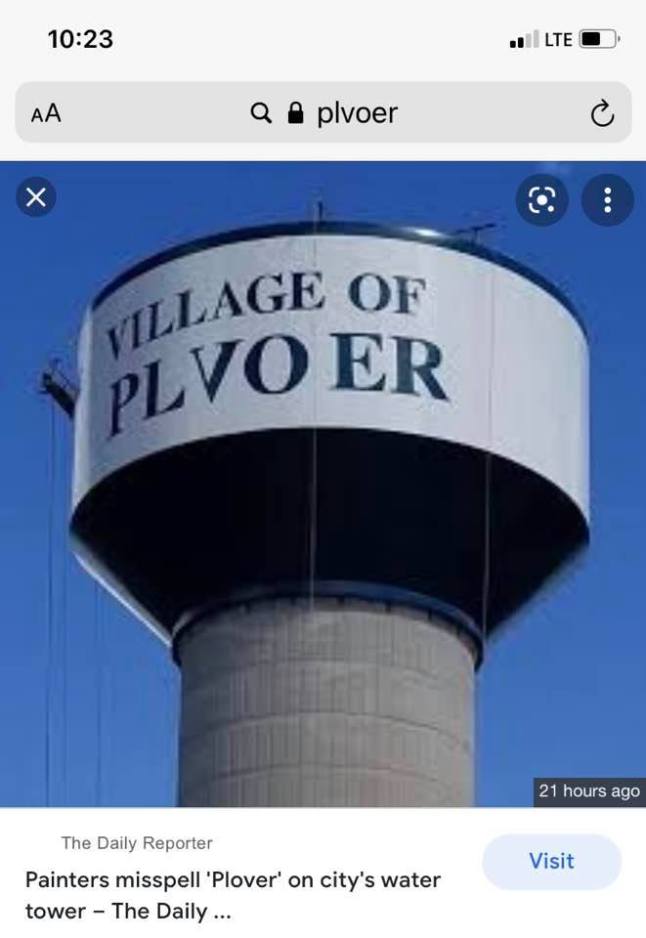
(Allegedly, we’ve got enough paint in here to fix the Plover water tower.)


Welcome to this edition of the junk drawer. As we have outlined in previous junk drawer posts, this is a random collection of stuff that is important but didn’t fit anywhere else, much like that drawer in the kitchen of most of our homes.

Here’s a look at some screw-ups, stories and updates:


WHERE IS BILL GATES AND HIS SQUIGGLY RED LINE WHEN YOU NEED THEM?

I often rely on spell check to bail me out of a “how is that spelled?” situation. That said, people can’t always rely on a spellcheck function to save them, as the folks in Plover, Wisconsin found out recently:

As painters scrambled to fix the error, some folks, like those at RayGun T-shirts had some fun with this:

In other news…

THE MILWAUKEE JOURNAL-SENTINEL HAS LEARNED BASIC MATH

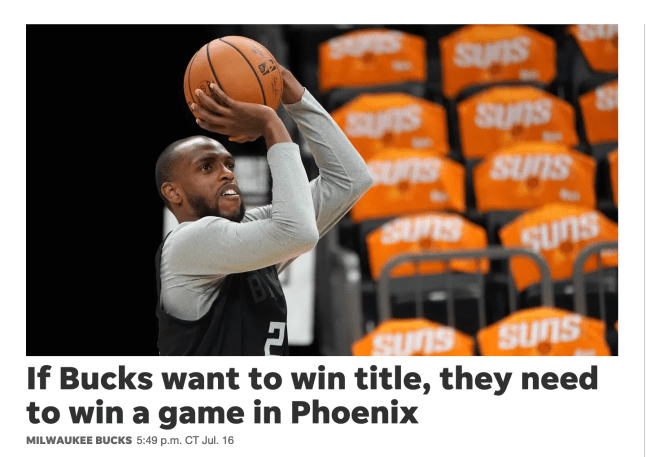
Some things are kind of patently obvious, but when you say them in sports with conviction (or a big honkin’ headline) they seem almost profound. To wit, in advance of Game 5 of the NBA finals, my hometown paper made this bold proclamation:

Let’s review how the NBA finals and basic math work:

  • The Phoenix Suns have the home-court advantage in the best-of-seven series, meaning four games will be played in Phoenix and three will be played in Milwaukee.
  • To win a best-of-seven series, a team needs to win four games out of the seven available.
  • If only three games are played in Milwaukee, the Bucks will obviously need to win at least one game in Phoenix.

This reminds me of the time I heard a coach say something along the lines of, “Most of our best come-from-behind wins happened when the other team was ahead.”

And, the Bucks did win one in Phoenix and won the championship, so I guess the headline wasn’t wrong, just dumb…

In other “Bucks-related news…”


IT’S A LEAD, NOT A CLOWN CAR

(If you’ve got this vibe happening in your lead, you might want to rework it…)

I get that not every lead can be 25-35 words, simply covering the 5W’s and 1H, but there needs to be some sort of limit to how much stuff a writer tries to cram into a single sentence. Here’s a look at a lead written shortly after the “Bucks in Six” victory on Tuesday night:

MILWAUKEE — In the immediate aftermath of a legendary performance to close out the 2021 NBA Finals and win a championship for the first time in his career, Milwaukee Bucks superstar Giannis Antetokounmpo declared that he signed his five-year, supermax contract extension prior to the season because “there was a job that had to be finished,” and that staying in Milwaukee meant doing it the “hard way.”

That’s 67 words, which is almost twice the “legal max” for a decent news lead. The problem with this lead isn’t just that it’s too long, but also that it’s a rambling word salad that abuses every element of writing we teach:

  • Lousy word choice: “Aftermath” means “the consequences or aftereffects of a significant unpleasant event.” If this was this wonderful and legendary thing, it shouldn’t have aftermath for Giannis. It should have aftermath for the Suns.
  • Adjective-palooza: “Immediate aftermath” and “legendary performance” go without saying, but there’s also “his five-year, supermax contract extension.” You could chop upwards of five words out of here and still have the same meaning.
  • “Partial Quotes” that “don’t help:” Read both of those partial quotes and tell me exactly why they are in quote marks. Save partial quotes for things that merit them like odd phrases or dangerous terms: (During his post-game interview, forward Bob Smith called referee Jim Xfer a “racist, cracker punk” for calling a foul on him in the game’s closing seconds, adding, there was no way Xfer would make “that bulls–t call on a bench-warming white boy.”)
  • Drowning the noun-verb-object: When students have difficulty figuring out what a sentence is trying to convey, I tell them to do a simple sentence diagram so they can locate the noun and verb (and possibly the object). Once they find those, they can build around them judiciously. Here, the author drowns the sentence core in all sorts of slop that doesn’t help people understand the point of the story. The simpler and more plain the sentence core, the better off you are. Let this cheesy PSA from the 1980s be your guide:

And finally, speaking of leads that need a hug…


ALLEGEDLY, ALLEGATIONS ARE ALLEGED

When it comes to words to avoid, put “allegedly” at the top of the list. As we’ve detailed here before, this offers you no legal protection, hides the source of the allegations and often leads to misplaced modifiers.

I get the journalists are often trying to couch their statements or cover their keesters, but the use of allegedly here makes even less sense than it usually would:

A vehicle allegedly struck a 6-year-old girl who was riding a bike on the 2100 block of High Ridge Trail in Fitchburg between 7:30 and 8 p.m. Sunday evening.

A few reasons why this is dumb:

  • If “allegedly” is meant to keep us safe as writers (which it doesn’t do, but let’s just say it does for the sake of the argument), exactly what are we worried about getting sued for here? Are we worried that an unnamed vehicle will sue? The girl’s parents? The bike? Allegedly used in association with a direct accusation at least would make sense (“Sen. Jane Jones allegedly stole money from her campaign fund.”) but here?
  • If “allegedly” is trying to cover us as writers in case the thing we said happened didn’t happen (which again… yeah… I know… broken record here…), what are we trying to say in the lead? That we don’t believe the girl? (“Mommy! I got hit by a car while riding my bike!” “Honey, is that really true or were you doing street BMX again?”)
  • If we are really worried about couching things in the lead, why was this the headline: 6-year-old riding bike struck by vehicle in Fitchburg

When it comes to “allegedly,” we’ll let Lou Redwood of “Semi Pro” have the final say here:

Thanks for reading. See you next week.

Vince (a.k.a. The Doctor of Paper)

“Don’t Take No From Someone Who Isn’t Empowered To Say Yes”

My friend Allison used the quote in the headline this weekend when we were teaching her daughter/my goddaughter how to negotiate for better prices at a flea market in South Haven, Michigan. It turned out to be a golden bit of advice she learned from Peter Greenberg, a Emmy-award-winning journalist who was talking to the students at our old college newspaper.

Here’s the story as relayed by Allison (Greenberg himself recalled this story during a guest appearance on the “Destination Everywhere” Podcast):

Greenberg was explaining how to get an important story and how to persist when people didn’t want to be helpful.

He wanted access to a nuclear attack sub as part of a story he was working on. This was in the late 1980s when this was happening, which happened to be when we were still in the middle of the Cold War with the Soviet Union, so letting a journalist wander around a nuclear sub was laughable at best.

Greenberg kept poking at Naval officials for access, each one basically telling him, “There is no way this is happening.” At one point he asked, “OK, if this COULD be done, who would be the one person who could allow it to happen?” It turned out to be the commander-in-chief in the Pacific, stationed in Pearl Harbor.

Greenberg got the Navy to agree to give him the meeting, which was supposed to be kind of a 10-minute, “we had a meeting” meeting. Instead, Greenberg noticed a photo of a ship on the admiral’s wall and Greenberg knew a lot about that particular ship. Instead of talking about sub access, they started talking about the boat. By the time the 10 minutes had ended, the admiral invited Greenberg to lunch and eventually granted him the permission he sought.

“Don’t take ‘No’ from someone who isn’t empowered to say ‘Yes,'” he told the group.

At the heart of his story were three key things that can be helpful to you as a journalist:

TAKE A SHOT: When Greenberg kept hearing “no,” he asked for a meeting that the people essentially told him wasn’t going to lead anywhere. In the podcast mentioned earlier in this post, Greenberg said the people setting up the meeting for him basically asked him why he’d want to fly all the way to Pearl Harbor just to hear “no” from one more person. He figured he had nothing at this point, so he might as well take a shot in person with the one person who could get him what he needed. What was the worst thing that could happen? He might have no story and a case of jet lag and that’s about it.

If the story is important enough to you, you need to take a shot at it before deciding it’s not going to happen. You never know what you might get if you give up before you give it a chance to succeed.

FIND COMMON GROUND: The thing that made this work was a bit of serendipity. If the admiral had a picture of a sunset, a poster of Porsche or a velvet Elvis on his wall, Greenberg might have not found his in. However, as he explained in the podcast, he realized he needed a connection and he found it:

They gave me a ten-minute appointment at 9:00 in the morning on a Monday. I flew up on a Saturday. I walked in to see him. He could care less about me. I was told to have a meeting. He didn’t want to be there. It was an office the size of Grand Central Station. Everybody was in their dress whites. They didn’t want me to be there. It was like a courtesy call, give him a commemorative coin and get him out.

This is the difference. You seek out common ground and I knew that I had maybe fifteen seconds to figure out what the common ground was. I got lucky because behind his desk was a photograph of a boat and it turned out I knew the boat well.

I said to him, “Is that a Bertram 31?” He said, “Damn straight.” I said, “That’s the best boat they ever built.” He said, “You’re not kidding?” I said, “Let me guess. When you make a hard right turn, the engine cavitates and the water pump overflows?” He goes, “Yeah.” I said, “Here’s how you fix it. You’re going to do a bypass on the impeller.”

We start talking like that and ten minutes later, the officer is going to say, “Admiral, your time is up.” He looked at me and said, “Do you got lunch plans?” I said, “I’m all yours.”

<SNIP>

That’s called chutzpah and luck.

If I’d walked into his office for that ten-minute meeting, he’s like, “Can I go on a sub?” “Get the hell out of here.”

You want to look for ways to connect with a source during an interview. That’s why doing it in person is often so valuable. You can look around and see things that they have around them to help you size up your subject. Starting with a discussion about a picture or a plaque or even a baseball card they have on display can get you an “in” that makes them see you as a kindred spirit as opposed to a pain the butt.

GO TO WHO CAN SAY YES: I think I’m going to use that quote with every interviewing class for as long as I live now, in that it perfectly captures what we should be doing when it comes to getting key information.

“Don’t take ‘No’ from someone who isn’t empowered to say ‘Yes'” is simple, direct and yet amazingly mind-blowing, as it dawns on me that I’ve probably failed in this regard myriad times in my journalism career and my daily life.

When you want permission for something, you need to go to the person who can grant it. Unfortunately, there are often underlings, minions and other pencil-pushers who get put in your path and try to dissuade you from getting that permission. If it’s important enough for you to pursue that permission, get past those people and go find the person who is empowered to grant it.

Like many things, this can be taken too far or in the wrong way. I am in no way saying you should become the snotty person who is holding up the line at the store, loudly proclaiming, “I need to speak to your manager!” because the bananas are ringing up at 39 cents per pound when the sign clearly said 36 cents per pound. However, I am saying most folks take the first “no” as a reason to give up far too easily.

Find the person empowered to say yes and see what that person says. If it’s still “no” at least you’ll know that nobody else is getting your story. If it’s “yes,” you got what you came here to get.

A rock star with a heroin problem, the “Bong Hits 4 Jesus” guy and a foul-mouthed cheerleader: The Suicide Squad of free speech court cases

A frequent joke told among lawyers is that the best case is the one with a carload of nuns as your client and a busload of priests as your witnesses. In most cases, however, it seems more like this scene from “The Wire.”


When it comes to First Amendment law, it would be great if we had more cases in which polite, articulate young people like Mary Beth Tinker who quietly wore a black armband to school to protest the Vietnam War. Her choice led to hate mail and threats, but also a ground-breaking Supreme Court case regarding student free-speech rights. And, looking back on it now, people can understand better her underlying concerns about the war as well as her relatively mild statement against it.

Tinker v. Des Moines (1969) established that students do not shed their Constitutional rights at the schoolhouse gate. It also provided protections for students who wish to express themselves against intrusion from school overreach.

Unfortunately, an upcoming case in which a high school student did her best “Scarface” dialogue on Snapchat could be the case that undoes a lot of those protections in a digital age:

In 2017, ninth-grader Brandi Levy said on Snapchat some version of what stressed-out students have been saying on the back of the school bus since the invention of buses: “Fuck school fuck softball fuck cheer fuck everything.”

The post was shared on a Saturday afternoon during a trip to the local convenience store, disappeared from Snapchat by Sunday afternoon, and caused no disturbance at school whatsoever—except to irritate the cheerleading coach, who banned Levy from the squad for a year.

She filed suit, and in June 2020, a federal appeals court ruled that school authorities violated the First Amendment by disciplining her for the off-campus speech. Now, the Mahanoy district is asking the Supreme Court to overturn that ruling.

The case doesn’t matter in regard to that single incident anymore. Levy is now a college student, the cheer team has had a complete turnover in terms of membership and nothing the court could do would change what happened in regard to the punishment levied at the time.

However, if the court decides to overturn that appeals court’s ruling, it could mean that schools can now actively monitor social media and punish students for ANYTHING that appears to be “objectionable.” If that doesn’t scare you, you probably had one of the six “really cool” high school principals I was always told existed somewhere.

Me? I dealt with a lot of nuns and balding guys who wore short-sleeve shirts with brown ties. This is terrifying…

This leads to the point of the post: It seems like we NEVER get the perfect Supreme Court case that perfectly showcases speech that deserves to be protected for the betterment of society. It’s never the student newspaper that was censored for reporting that the principal had stolen money or the kid with the bullhorn outside the school telling people not to eat cafeteria food because the workers were being abused.

It’s always something with an F-bomb, a nude pick or a drug reference that we get to stand behind and say, “Hey, look… You CAN’T censor this because… well… geez…”

We don’t get Superman, Batman, Aquaman or Wonder Woman as our defenders of freedom.

We get The Suicide Squad:

In other words, we get a “mental defective dressed as a court jester,” a “guy who wears a toilet seat on his head” and a “shark with hands,” to quote the red-band trailer I’m not allowed to show you here…

If you think I’m kidding about this, consider the following court cases on important topics:

The landmark case for online speech and defamation? Rocker/Actress/Woman I’d be most scared of meeting in a dark alley Courtney Love won and survived an appeal of her “twibel” case (Twitter plus libel) in 2014. Love, whose outlandish behavior and heroin abuse have long been the subject of media coverage, stated that an attorney had been “bought off” instead of helping Love recoup parts of her late husband’s estate.

A crucial Supreme Court case regarding speech at school sponsored events? Morse v. Frederick, also known as the “Bong Hits 4 Jesus” case. A student held up a sign at an event proclaiming the cryptic message. When the sign was taken away by school administrators, the student later sued claiming his First-Amendment rights had been violated. The SCOTUS ruled that schools have the right to remove pro-drug messages, even though students have some free speech rights at school.

The case that dealt directly with a reporter’s right to maintain confidential sources? Branzburg v. Hayes, which dealt with reporters being forced to disclose the names of sources who were manufacturing hashish.

And, of course, the case involving satire and hyperbole in regard to public figures comes from the apparent patron saint of this blog, pornographer Larry Flynt.

Now, the question of whether students can get smacked around for writing things on their own time on their own social media that school officials dislike comes down to one foul-mouthed 14-year-old cheerleader.

The problem with all of these cases is that it becomes so much easier to suppress speech that is unpopular, vulgar or otherwise disagreeable.

If the reporters in Branzburg were protecting whistleblowers who had uncovered some sort of dark plot by a foreign government to go all “Red Dawn” on the U.S., it would likely feel better to the courts to support their interests in remaining anonymous.

If the school was trying to suppress speech about the superintendent stealing money from the district to buy weed, maybe a “No Bong Hits 4 Superintendent Smith” sign would have garnered a different outcome.

If Sally Fields had tweeted about potential legal malfeasance (while wearing her “Flying Nun” costume), it might not have felt like the entire future of online free speech hinged on whether the defendant was going to lose her mind on the stand and start throwing things at the jury.

If the cheerleader had done her rant without the f-bomb, maybe the courts would be more inclined to side with her at every level.

However, we don’t get to choose the cases that decide our fate, which is why it’s important to make sure that we stand up for all speech because what one person thinks is a felony charge, others might consider a misdemeanor at best. In the mean time, keep an eye on this one, as it’s got a lot more at stake than a lot of people think.

It’s all fun and games until Dominion Voting Systems sues you for a couple billion dollars

During the 2020 presidential election, multiple people made claims that the voting systems had been rigged to favor Democrat candidate Joe Biden. Several of then-President Donald Trump’s allies and associates took to various media platforms to repeat these allegations, arguing that the voting systems had been compromised and that any outcome which did not place Trump back in the White House was a result of fraud.

Dominion Voting Systems, which produces many of the electronic voting machines used in the election, apparently isn’t too thrilled about this, as the folks there have filed several lawsuits regarding these claims. It’s gotten so bad that some media outlets are keeping track of who is being sued, for how much and for what reason, like ESPN tracking the movement of NFL free agents.

The most recent suit is one that is most likely of interest to the folks reading the blog, as Dominion filed a $1.6 billion suit Friday against Fox News, alleging the company knew it was allowing lies about the election to proliferate:

In the lawsuit, Dominion argued that Fox and several of its on-air personalities elevated baseless claims about the voting company rigging the 2020 election and allowed falsehoods by their guests to go unchecked, including a wild claim that the company’s machines were manufactured in “Venezuela to rig elections for the dictator Hugo Chávez” and that Dominion’s algorithm manipulated votes so that then-President Trump would lose.

“Fox engaged in this knowing and reckless propagation of these enormous falsehoods in order to profit off these lies,” reads the lawsuit. “Fox wanted to continue to protect its broadcast ratings, catering to an audience deeply loyal to President Trump.”

The lawsuit argues that there are actual damages to the company’s brand, but also to the workers who are just trying to make a living. The suit notes that Fox’s conduct not only will cost the company more than $600 million in the next eight years, but also that front-line workers have been threatened.

Fox has noted that it will defend itself, having already filed several motions to dismiss and that the company “is proud of our 2020 election coverage, which stands in the highest tradition of American journalism.”

Here are a few things to take away from this and several other lawsuits filed in regard to the voting systems:

A FREE PRESS IS NOT A CONSEQUENCE-FREE PRESS: A lot of folks misinterpret the First Amendment to mean you are protected against all sorts of things when you publish content. The truth is that all the amendment guarantees is that the government shall not prevent you from publishing material. That’s basically it.

It doesn’t mean that other people can’t stop you, like the owner of a website where you post content, the publisher of a newspaper or a producer at a broadcast station. It also doesn’t mean you can get away with whatever you want without paying the price.

When you say something that is false and harmful, you can be in a lot of trouble, which is why professors push so hard on students to make ABSOLUTELY SURE on every fact in a story. It’s also why editors pick and pick and pick at stories with reporters, as to avoid any potential landmines.

If I get up on Fox News and tell the world that I have information supporting the notion that the chancellor of my university is running a cocaine ring out of the student union in exchange for getting away with a murder he committed in 1987, I’m going to be in a HECK of a lot of trouble because it’s not true and it’s going to harm him.

It also leads to the second point…

UNLIKELY, UNREAL AND COMPLETELY UNBELIEVABLE ARE ALL DIFFERENT THINGS: One of the dumber defenses in a Dominion suit is that of former Trump lawyer Sidney Powell. The company is suing her for $1.3 billion, arguing she knowingly spread a baseless claim that Dominion and another voting system company were working with the late Hugo Chavez of Venezuela to rig the election.

Powell has argued in motions to dismiss that her claims were so outlandish that nobody in their right mind would believe them:

It was just conjecture. No reasonable person would conclude those allegations were true statements of fact. Besides, in heated political arguments, people tend to exaggerate. You should dismiss the lawsuit or at least move it to my home state.

That’s essentially the defense offered by Sidney Powell’s lawyers to the $1.3 billion defamation lawsuit brought by Denver-based voting Dominion Voting Systems, Inc. Dominion provides voting equipment to more than 1,300 jurisdictions in 28 states including Colorado.

We’ve talked about this kind of claim earlier this year when porn mogul Larry Flynt died. The “no reasonable person” defense was at the core of his Supreme Court appeal, when the Rev. Jerry Falwell sued Flynt for publishing a spoof advertisement involving him. Flynt won the appeal with a unanimous decision, but before Powell pops open the champagne, I’d consider these issues:

  • Flynt was publishing a porn mag, known for all sorts of really outlandish stuff, including a photo of a woman being stuffed into a meat grinder. Powell was on nightly news outlets and other media platforms purporting to deliver truthful information gathered from inside sources.
  • Flynt’s ad claimed that the highly religious Falwell lost his virginity by having sex with his mother and a goat in an outhouse, which is almost the textbook definition of outlandish. Powell was claiming election fraud, something other countries had experienced and something that people within the government were also stating as fact.
  • Flynt was a strip-club owner who published pictures of naked people in magazines that had been banned in multiple cities. Powell had been a counselor to the president of the United States.

When it comes to the idea of hyperbole and satire, or otherwise outlandish things, you have a pretty high bar to clear if you want to be on safe side of that argument. Had Flynt claimed that Falwell stole money from his congregation, he would have likely been on much shakier ground, given that other high-profile preachers had been accused or convicted of such things. The same thing could be said had he claimed Falwell had slept with prostitutes or committed adultery, given the climate of the time. However, nobody reading the Campari spoof thought, “Wow! Reverend Jerry is a really kinky guy! Guess you learn something new every day…”

Powell’s defense in this case is that nobody could have believed a legal expert who worked with the president in regard to voting irregularities when she said the company responsible for voting reliability failed in its task. I’m really interested to see how that plays out, but more out of morbid curiosity to see if the judge can keep a straight face throughout the trial, not because it’ll set a new precedent.

THE MUDDLING OF OPINION AND FACT IS ALWAYS A CONCERN: When I teach basic media writing to students, one of the hardest things for them to figure out is what is an opinion and what is a fact. It often comes down to me scrawling “SAYS WHO?” on their paper 183 times before they understand what they can say and what they shouldn’t say. Occasionally, we would have the discussion of “You are wearing a black shirt. That is a fact. You are wearing a NICE black shirt. That is my opinion.”

Cable news organizations have long muddied the waters of what is opinion and what is fact, almost to the point where people either don’t know the difference or don’t care as long as it matches up with what they believe. I often wonder if a lot of high-profile people end up buying their own BS to the point that they themselves think, “If I believe it, it must be true.”

Journalism pushes harder on people to verify information, clarify where the information originated and remain rigorous in reporting only what we can prove. At least, that’s the goal we have in mind when it comes to separating opinion from fact.

To help us clarify the distinctions a bit better, the U.S. Court of Appeals offered a four-step examination as part of its ruling in Ollman v. Evans (1984) to help people see if a statement falls into the realm of fact or opinion:

Can the statement be proved true or false? Courts have held that factual statements can be proved true or false. A statement like “The New York Yankees have won 27 World Series championships” can be proved true or false by examining their records in the annals of baseball. The truth or falsity of a statement like “The New York Yankees are the best baseball team ever” cannot be determined, because it lacks several key elements for us to examine. In a defamation case, the plaintiff must prove that the material is false, and this can be the case only if the material of a factual, as opposed to an opinion-based, nature.

What is the common or ordinary meaning of the words? People often use euphemistic language in their daily discourse. If you referred to a sloppy person as a pig, that person might be upset, but they can’t win a libel suit by demonstrating that they are not “an omnivorous domesticated hoofed mammal with sparse bristly hair and a flat snout for rooting in the soil, kept for its meat.” The common meaning that the person has poor personal hygiene or fails to keep their home neat and clean is clearly the way in which most people would interpret that remark.

What is the journalistic context of the remark? Who is saying something and the way in which they are saying it matter greatly in determining if something is a fact or not. For example, if you’re telling a joke involving two men walking into a bar, people are clearly expecting something different than if you are testifying in front of Congress. Content published on the news pages of a legacy media outlet is contextually different from a series of blog posts on a goofball-based website that would make the staff at the National Enquirer roll their eyes. The statements made on air during a newscast are contextually different from those made on a “morning zoo” radio show.

What is the social context of the remark? Where we tend to see opinions and where we tend to see facts often help define which are which. For example, a lecture on the biology related to procreation is expected to be based in facts, while two groups of protesters confronting each other outside an abortion clinic will be a more heated and opinionated exchange.


Throwback Thursday: So… No, then? (or why it’s important to research your readers before you pitch to them)

This blog post from three years ago kept popping up as a “suggested read” for me on various other posts, so I think it’s the blogging gods’ way of saying it needs a rerun.

Not to get into an Academy Award speech or anything, but I have to say I’ve been really, really blessed and really, really lucky that folks seemed to take a liking to my books. I’m grateful to you all every day because, as we say in the first chapter of every book, if I don’t have an audience, nothing else matters.

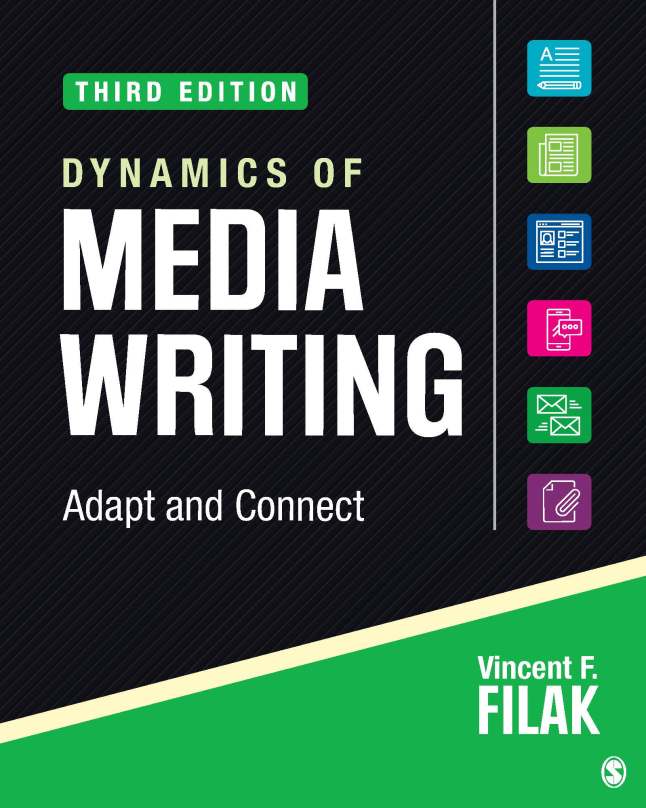
The folks at SAGE sent along the cover for the upcoming third edition for the “Dynamics of Media Writing” text, which should be out this August or September, I believe. I’m finishing the copy edits now with my main man, Jim Kelly. (If anyone you know ever tells you that copy editors don’t matter, send them my way for a firm and thorough verbal beat down. Jim has saved my keester so many times, I lost track.)

In case you wanted a sneak peek, here you go:

So, without further ado (or book pimping), here’s a look at what happens when you don’t have a good marketing staff to do your research and you end up on the embarrassing end of an email exchange with someone. (Rest assured, the folks at SAGE are great at marketing, and I can pretty much already guess who’s going to email me with a reminder to “please stop using the phrase ‘book pimping’ on your blog.”)


So… No, then? (or why it’s important to research your readers before you pitch to them)

I understand this blog tends to skew more toward news than some folks might appreciate, given that my entire pitch for the “Dynamics of Media Writing” is that ALL disciplines of media (news, PR, Ad, marketing etc.) can get something of value out of it. The skew is due to trying to cover both the media-writing text and the news reporting and writing text in one spot. It also also comes from the idea that a lot of things people perceive as “news” things are actually valuable for all media, including skills like interviewing, research, inverted-pyramid writing and so forth. Finally, it seems that news folks tend to make more public mistakes than do some of the other disciplines, so I get more content there. (If you want me to hit on more topics in the PR/Ad/Marketing stuff, feel free to pitch me some thoughts. I’d love to do it.)

That said, occasionally there is a specific foul up in a specific part of the field that bears some analysis. Consider that when you look at this email I got the other day. I redacted the identifiers as best I could:

Dear Professor Filak,

​Greetings from (COMPANY NAME)! ​I hope this finds you well. In the coming months, (AUTHOR NAMES) will begin to revise the twelfth edition of their introductory journalism text, (REPORTING BOOK NAME). ​This text strives to give students the knowledge and skills they need to master the nuts and bolts of news stories, as well as guidance for landing a job in an evolving journalism industry.
Right now we are seeking instructors to review the twelfth edition of (REPORTING BOOK NAME) ​a​nd provide feedback. This input is invaluable to us, ​as it ​giv​es​ us a greater sense of how to best address both instructor and student needs. ​If you are currently teaching the introductory news reporting and writing course or will be teaching the course soon, would you be interested in offering your feedback?
If you would like to review, please respond to this email and let me know if you will need a copy of the printed text. You should plan to submit your comments via TextReviews by 2/6/18. In return for your help, we would like to offer you (MONEY).
At your earliest convenience, kindly respond to this e-mail to let me know if you are available and interested in participating. ​Again, please let me know if you will need a copy of (REPORTING BOOK NAME)
I’m always happy to help people and I’m not averse to making a buck by pretending to know what I’m talking about, but this felt both awkward and ridiculous. One of the things both “Dynamics” books push a lot is the idea of making sure you know what you’re talking about before you ask a question. The books also push the idea of researching your audience members so you know how best to approach them. Either the person writing this email didn’t do that or just didn’t care.
Here’s how I know that: It’s called “Google.”
Had this person done even a basic search on me she would have learned several things:
  • I am teaching the courses they associate with this book. I teach nothing but these courses, as you can find on the UWO journalism department website. The line of “If you are currently teaching the introductory news reporting and writing course or will be teaching the course soon…” tells me I’m on a list somewhere and this is a form email at best.
  • I wrote several books, including one that is likely to be some form of competition for this book. (I’m not saying it will be as good or better or anything, but my title includes words like “news,” “reporting” and “writing,” so it’s a pretty safe bet we’re vying for the same students.) This was literally one of the top five items on the first page of my Google search. She also sent her message the same day I got this alert from Amazon:NumberOne
    (I have no idea how Amazon quantifies “#1 New Release in Journalism” but I’ll take it.)

    The point is, it wasn’t a secret, so it appeared that she didn’t look me up and was like the guy at the bar telling me, “Hey, see that babe over there? I’m totally going to score with her!” and I’m like, “Uh, dude, that’s my wife…”
    On the other hand, maybe she did look me up, found the book and asked anyway, which is like the even-worse guy at the bar who’s saying, “Hey man, your wife is pretty hot. Any chance you can give me some tips on how to score with her?”

Thinking about all of that for a moment, I did the polite thing and emailed back, explaining how I felt this would be a conflict of interest (it is), and that any advice I gave her would be likely be somewhat problematic as the author of a competing book (it is).  I also noted that I know the book she is pitching well (I do) and I know the authors well (I do), so this would also be a bit awkward for me (it really is). Here was her email back to me, which again made me think she wasn’t actually reading this:

Hi Professor Filak,

Thanks so much for letting me know. We will certainly keep you in mind for future projects!

So, again, the point of the blog isn’t to beat people up for doing things poorly but rather to offer advice on how to do things better. Here are a few basic tips:

  • Research first, then write: You don’t have to do an Ancestry.com profile on every person to whom you market or with whom you engage in outreach, but it’s not hard to Google someone. Most people put more social-media stalking effort into learning about the “new kid” at school than this person put into finding out about me. In marketing, you often have access to proprietary data as well, so you can find out if this person had any previous engagement with your organization. In my case, I used that book for more than a decade and still keep up with it, so that might have been something she could have found.
  • Personalize when possible: If you are sending out 100,000 requests for something like a survey and you are expecting a 10 percent response, you will not have the ability to personalize all of the information on everyone’s card or email. That makes sense. However, when you are microtargeting a group of people with a specific set of skills or interests and that group isn’t going to overwhelm a data center, work on personalizing your content. That line about “If you are currently teaching the introductory news reporting and writing course or will be teaching the course soon…” could have easily been tweaked to say something like, “I see you have taught writing and reporting courses at UW-Oshkosh…” and it wouldn’t have taken much. Making these minor tweaks shows that you have done your research. Engaging in some personalized communication shows your readers you care enough to see them as individuals as opposed to a wad of names on a spreadsheet.
  • Try not to screw up, but if you do, don’t ignore it: The one thing that stuck with me when I got that response email from her was that I didn’t think she figured out what she was actually asking me or why it was weird. I had that feeling that if I had written her back and said, “I’m sorry I can’t do this because I’ve just been placed in an intergalactic prison for the rest of my life for murdering a flock of Tribbles with a phaser I set to ‘kill’ instead of ‘stun,’” I would have gotten the exact same email back. The whole exchange really reminded me of this scene:
 The thing that is important to realize is that you are going into a field that has two important and scary things going for it:
  1. It’s small enough that you’re really about two degrees of separation from everyone else, so people know other people.
  2. People in the field love to talk.

If you end up screwing up because you didn’t do the first two things suggested above, don’t compound the problem.

I have no idea if I’ll ever get approached by this publisher to review anything, but I know I will always carry with me the memory of this interaction. Had it been a great interaction, that would have been good for the publisher. Unfortunately, that wasn’t the case.

3 reasons why porn mogul Larry Flynt matters to you in journalism, whether you like him or not

Larry Flynt,  who turned strip clubs and a fledgling nudie magazine in the 1970s into a pornographic empire, died Wednesday at the age of 78. To say he changed the field of publishing  and the concept of “adult publications” with his launch of Hustler magazine, is akin to saying Babe Ruth changed how baseball was played.

To put my editor’s mind at ease, as I can already picture the folks at SAGE breathing heavily into a paper bag and fighting off heart palpitations when they saw this headline, this piece isn’t a lionization of a man who clearly had more than his share of  marks on the negative side of his ledger in life.

Critics note that his magazines were not only horrifically crude, but also that his efforts were misogynistic and taboo, as Flynt seemed to revel in the idea of pushing the boundaries of taste and legality as far as possible. Gloria Steinem referred to him as a “violent, sadistic pornographer,” and it’s hard to argue with that, given one of Hustler’s more famous covers featured a woman being fed into a meat grinder.

However, whether you abhor everything to do with pornography or your computer cowers in the corner when it sees you opening up an internet browser, Flynt had an impact on journalism in three key ways that still matter to this day:


SATIRE AND HYPERBOLE WERE CODIFIED AS PROTECTED SPEECH

The words “pornographer Larry Flynt” and “landmark Supreme Court Decision” don’t seem like a logical coupling, but they are, in fact, linked in history in a way that provides us with crucial speech and press protections.

Jill St. John In Campari First Time (1983)

One ad from the actual Campari series, featuring actress Jill St. John.

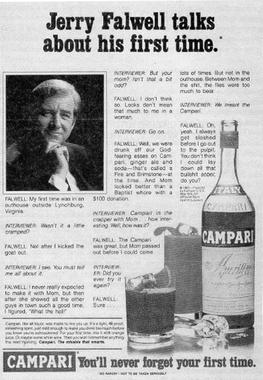
In the early 1980s, Campari liquor was running a series of ads in which famous people described their “first time.” The Q and A format had an interviewer asking about the “first time” and the answers contained a great degree of sexual innuendo. At the end, of course, it was revealed that the people were talking about their “first time” drinking Campari liquor.

In 1983, Flynt parodied the ad, using as his subject the Rev. Jerry Falwell. In the Hustler version, Falwell was said to have had his “first time” in an outhouse with his mother and a goat. It also referenced his need to get drunk before preaching because how else could he spout such ridiculous religious garbage.

A copy of the Hustler ad that was at the center of the court case.

Falwell sued Hustler and won a six-figure jury award for emotional distress, which Flynt appealed all the way to the Supreme Court. The Rehnquist court delivered its decision in 1988, unanimously finding for Hustler Magazine. The ruling noted that public figures could not sue for emotional distress over statements that were patently offensive unless those statements could be shown to be factually inaccurate in nature and demonstrated an instance of actual malice.

The bigger point, however, was that the court noted that the First Amendment rights of individuals to make patently offensive statements outweighed the interest to protect public figures from them, so long as the statements could not be reasonably construed as true. In other words, nobody in their right mind was reading Hustler in Jerry Falwell’s congregation and thinking, “Wow! I never knew he had an Oedipal/bestiality obsession before! Guess you learn something new every day!”

The case established both a strong position for journalism in general, codifying actual malice as a standard for libel against public figures as well as providing a shield for humorists who relied on hyperbole to make their points. If Ted Cruz could sue Seth Meyers every time Meyers says his beard looks like a pile of raccoons died on Cruz’s face or something similar, we’d probably never have “Late Night with Seth Meyers” on TV.

If you enjoy shows like “Last Week Tonight With John Oliver,” “The Daily Show,” “Late Night with Stephen Colbert,” “The Colbert Report” or any other show that relies on hyper-exaggeration to make you laugh about public figures, you’ve got Larry Flynt to thank for their existence in their current stasis.


THE MAN UNDERSTOOD (AND SOME WOULD SAY EXPLOITED) AUDIENCE CENTRICITY

In the 1960s, the primary men’s magazine was Hugh Hefner’s Playboy. It combined humor, culture, interviews and literature with photos or illustrations of semi-nude or fully nude women to entice its readership. The description of Hefner and the magazine was often “bon vivant,” which roughly translates to a cultural person with refined social tastes and interests.

While Hefner was hobnobbing around town, reflecting the kind of people you’d see in “Mad Men,” Flynt was grinding out a living in the dirtier parts of Cincinnati. The people who visited Flynt’s bars and dance clubs were the blue-collar, truck-driver, factory-worker gritty folks that populated much of the Rust Belt and other similar parts of the country. They weren’t interested in the latest stories from Jack Kerouac or Jean Sheppard. They weren’t buying the silk socks and calf garters advertised in the back of Playboy. They didn’t see the social incongruity of having African American Alex Haley interviewing George Lincoln Rockwell, the head of the American Nazi Party.

To borrow a phrase from comedian Jeff Foxworthy, they wanted a beer and to see something naked.

Flynt understood this and used that understanding to tap into a completely under-served audience. He saw things from the perspective of readers who weren’t rich or smooth or refined, but had extremely base tastes and were willing to pay for content that reflected them. He came at the publication itself from an audience-centric perspective, knowing that for every one person who would gasp audibly at the horrifying indecency of his publication, there were at least three others who would buy it specifically for that indecency.

A perfect example of his comprehension of how best to serve his audience was illustrated in the 1996 film, “The People vs. Larry Flynt,” in which Flynt (played by Woody Harrelson) is arguing with a photographer about how best to shoot a photo of a naked woman. The more the photographer is trying to soften the content and hide the nudity, the more Flynt is pushing back to make the nudity more prominent. Finally, Flynt says, “Look we’re not running a flower shop here. We’re selling the girl. So stop playing with all the props and pillows and flowers and just shoot the girl.”

The concept of audience-centricity has been one that journalism in general has been painfully slow in comprehending. It’s a safe case to make that newspapers continue to crumble because they still have a major disconnect between what matters to the writers and what matters to the readers. The degree to which internet publications have succeeded or failed over the past decade is almost entirely linked to their ability to define, reach and appease an audience. It’s something we now teach in journalism as a matter of course.

You might not like that Flynt was “selling the girl” or how he sold it or what else he did, but the truth is, not many publishers (now or then) had as keen of a sense for whom they were publishing and what those people wanted. You can also argue what people should or shouldn’t want, but that’s a completely different discussion.

And it also leads to the final point…


SPEECH AND PRESS SHOULD BE PROTECTED, EVEN IF THEY OFFEND YOU

People who debate the various aspects of the First Amendment have a wide array of opinions regarding Larry Flynt and his overall place in its pantheon. To some, his efforts have created a wider array of protections for speech that otherwise could not have existed had he not gone to such outlandish lengths with his publications. To many, many more people, however, he’s a filth monger who exploited women, debased sex and profited greatly by abusing one of the most important rights of our society: The right to free expression.

Wherever you fall on this issue or this person is completely understandable, particularly if his actions offended you. That said, the concept of a free society is that sometimes you get offended by the expressions of others. You cannot, however, simply destroy speech or press because you dislike what it has to say. Edward Norton, playing the role of Flynt lawyer Alan Isaacman, makes that case in this scene from the film:

Your rights to say what you want are always in jeopardy if other people have the right to shut you up because they don’t like what you have to say. Then the question becomes, “Who sets the standards and who gets to determine the penalties?” The freedoms accorded to us in the First Amendment need to protect all of us, or they protect none of us.

Or, as Flynt was known to say, “If the First Amendment will protect a scumbag like me, it’ll protect all of you.”

Confessions of an unpretentious, anti-academia professor

Over the course of the past nine months, we’ve all endured the pandemic of COVID-19 as well as the changes to our daily lives as educators and students. What I have come to notice more and more is that because we all seem to be facing mortality in a more direct way than ever before, people seem ready to rage against every microscopic thing at the drop of a hat.

In addition, it seems that most of the faux outrage and pearl-clutching behavior comes from people who should have a better sense of reality, namely folks involved in higher education. I would like to attribute it to the stress and anxiety associated with the coronavirus outbreak, but I think a lot of it has been there all along. There has long been a demarcation between people who teach and work at universities and college and “academics,” who seem to think they exist on a higher plane of reality than the rest of human kind and need to “set other people straight.”

Truth be told, no matter how many books I wrote, degrees I earned, studies I conducted or symposiums I attended, I never embraced the “academic” lifestyle. Sure, I liked having an office, a decent health plan and the ability to hear people call me “professor” from time to time, but I never forgot who I was or where I came from. I’m basically just another person who found something they liked and got lucky enough that it led to a career. Had it not been for crossing paths with a few crucial people, I might have been an auto mechanic, a cops reporter or a factory worker. Knowing that has always kept me from getting too full of myself or thinking that my excrement lacks odoriferous qualities. (Yeah, that was a bit much…)

With that in mind, here are a list of things I have actively done, said, considered or otherwise found myself thinking  as a professor that only make sense if  you understand the self-important, pseudo-intellectual, easily offended, drama-twerp reality that is “academia” and the people who embrace it:

  • When I first meet people around where I live, they often ask what I do. I tell them “I work at the U,” with the hope they’ll think I’m a janitor or facilities manager. Their view of what professors are does not jibe with what I want them to think of me.


  • I noticed an inverse correlation between the human decency of professors and the percentage of the final grade they assign to final exams or final projects. Students have told me some professors value a final up to almost 70 percent of their total grade. That’s insane, but that’s “academia” for some folks. I put as little emphasis on final exams and final projects as possible, making them count for about 15 percent of the total grade at most when I can get away with it. I find that keeping the percentage lower tends to relax the students a bit more, especially because they’re also working on final projects and final exams for other classes. It also takes pressure off me when I’m burnt to a crisp and grading a ton of papers. I worry less about each point I take off or give back because I don’t feel like I’m disarming a bomb.


  • When I read postings on Facebook groups for academics, I am constantly reminded why I hate academics. I forgot who said it, but the line about how the fights in academia are so extreme because the stakes are so low always rings true there. I have to constantly remind myself not to post something about them needing to grab a ratchet and loosen their sphincters a few turns because a) that would be undignified and b) most of those people wouldn’t know what a ratchet is.


  • I often refer to students as “my kids,” and it bugs me when people tell me not to because they see it as a somehow insulting to the students. First, bite me. Second, I do this because, no matter how old they get or where they go, there won’t be anything I won’t do for them. Once you become one of “my kids,” you’re there for life. Just ask the students I’ve taught who are now in their 40s or 50s and have  spent half their lives still connected to me in some truly meaningful ways.


  • If I have a choice between helping one of my kids and doing something that fits within the formal rigors of expected pedagogy, well, that’s an easy choice: I’m helping the kid. Nobody ever died and said, “No matter what happened, I’m so glad I abided by the strictest interpretation of academic rules.” Except for maybe people who need to have their sphincters loosened a turn or two.


  • When forced to attend multi-disciplinary meetings, I look around the room carefully when someone tells a fairly innocuous joke. I look at all the people around the table to see who stiffens and who doesn’t and I take note of the stiffies. If anyone notes sternly the way in which this is highly inappropriate because it insults (fill in the blank), I make note of that as well. I then guess which departments they work in and spend half the meeting looking them up through the U’s database. I’m usually dead on, or at least one of my top three guesses are right.


  • I would guess that about 90 percent of academics fall into one of two categories: Those who are insulted by nothing because they have no sense of anything outside of their discipline and those who are actively waiting to hear something potentially insulting and then loudly castigate everyone else for such things existing in this “plane of higher learning.” The other 10 percent usually came to higher ed after working a job in which we spent time around actual humans, so we tend to function a bit differently.


  • I find “woke” academics who employ guilt in Facebook discussions over petty squabbles they’ve turned into land wars totally adorable. I grew up Catholic, spent 12 years in Catholic school (much of it where nuns were involved) and remain an active Catholic. Guilt is the milieu in which I live and breathe. It’s like trying to discombobulate a fish by getting it wet.


  • Dealing with academics who begin every discussion by outlining their educational credentials has always made me feel like I needed to carry around a pocket full of quarters:


  • I fully support my female colleagues who engaged in the “Dr.” movement a few years back, where women added that term to their social media handles, academic emails and more to indicate their academic level of achievement. They take more shit than I think anyone should simply because men feel inferior around smarter women. I’ve worked for more women than men and most of my best bosses were women.


  • Conversely, I find it ridiculous when Ph.D. or Ed.D. academics (usually men) demand that EVERYONE call them “doctor,” as opposed to “professor,” or even “dean.” As I once explained to the superintendent of schools in Fond du Lac who required such formality of all creatures, I’m proud of my Ph.D. and I know he’s proud of his Ed.D., but ain’t neither one of us getting called into surgery tonight.


  • I have been blessed to work with a lot of students who are farm kids, first-gen college students and those who are attending school on a GI Bill and for some reason, we tend to get along pretty well because we’re honest with each other in a way academics tend not to be. I think it’s because there’s a shared sense that the world is full of hard stuff, so trying to make things harder for no real reason doesn’t really serve a purpose. Or that after you spend your day ankle-deep in cow manure, you can much more easily detect professors who are full of it.


  • I don’t get a ton of complaints about final grades and I attribute that to some really good upbringing  by the parents of my students. My friends at other universities get a lot of threats about how “you will be hearing from my parents” when students don’t get the grades they want. I once asked one of my small-town farm-kid students, “If you went home and told your mom that she needed to call me and demand that your grade was changed so you could pass my class, what would she say?” The kid paused for a minute and then she looked right at me and said, “My mom would kick my ass twice. Once for f—ing up and once for telling her to call you.”


  • One of the best ways to get me to do the exact opposite of what you want me to do is to ascribe to my behavior something that most sane humans would not consider logical or fair. In short, I’m calling it a “manhole” when I’m yelling out to you because I think that’s the best way to tell you what you’re about to fall into and die, not because I’m supporting the hetero-normative, patriarchal system that is using nomenclature to create a permanent underclass.


  • I can already think of at least a half dozen people who are furiously typing a six-page email to me, denouncing that last statement.


  • Humor is an honest coping mechanism for a lot of people. There’s a reason that people like Richard Pryor were so funny, and it was because humor helped keep them deal with a lot of dark stuff. Sometimes, when I’m telling a joke, I need to laugh more than anyone else does. If someone is making a joke or sharing a humorous anecdote, you should feel free to laugh even if it’s not that funny. If it might be insulting, but it’s still tolerable, let it go.


  • And finally, whenever I find myself in the middle of one of those “academic” shit fights that tend to show up in administrative town-hall meetings or on Facebook threads, I can hear my father’s voice in my head, reminding me that “Educated doesn’t always mean smart.”

The Junk Drawer: A laugh before dying, Election 2020 edition

Honey? I can’t find our Western-style democracy… Yes, I’m looking in the junk drawer…

Welcome to this edition of the junk drawer. As we have outlined in previous junk drawer posts, this is a random collection of stuff that is important but didn’t fit anywhere else, much like that drawer in the kitchen of most of our homes.

It’s election day, I’m practically brain dead this morning and I think we all could use a laugh, so here’s my best effort:


Don’t tell Baker Mayfield’s wife!

Nothing like a typo to turn a rhetorical question that sounds like something the late sports announcer Mel Allen would say into something that sounds like the QB for the Browns is looking for some side action:

Speaking of “That’s not what we meant…”


Are we not doing “phrasing” anymore? Well, Obama is:

Maybe the greatest line I have seen in any election story in the 1,253,312 years of this election cycle came from this story, which covered an exchange between an excited Democrat and Barack Obama:

In Miami Springs, Fla., where Barack Obama visited last week, an eager volunteer cried out “you were my first!” and the former president thanked her, before gently suggesting a rephrasing.


Speaking of things that might need a tweak or two…


I’m “confused” and “concerned” about what this use of quotes means:

Partial quotes are often used to showcase important vernacular that needs to be captured in an exact way for something to have value:

President Donald Trump said a “herd mentality” would lead to the end of the COVID-19 pandemic.

Judge Leonard Franklin refused to abide by a prosecutor’s suggestion to go easy on convicted molester Carl Joseph, saying a life sentence was fair for a “kid-diddling pedo-freak.”

After his star running back took police on a four-state high-speed chase that ended in a shoot out, Cowpokes head coach James McFeely said the incident was “unfortunate” and “ill-timed.”

They can also be used when something is suspect:

The “fair-trade clause” in the contract actually allowed for additional exploitation of workers in developing countries, the ambassador stated.

After leaving the mechanic, James found that his “fixed” car still had no brakes.

So, explain this usage to me, fans of Hobby Lobby:

I’m uncertain as to why “one” would need to be in quotes here. Is it an allegation of only “one” item or is this some sort of requirement that they purchase the cassette single for this tune from “A Chorus Line?”

It’s not as creepy as if I saw a menu that noted something like Breaded “Chicken” Nuggets or “Beef” Stew, but it’s still kind of creepy.

Speaking of disturbing promotions…


Do we get it in place of, or along with, the snack bags?

It’s likely you’d get COVID-19 anyway on those cigar tubes of recycled air and beer farts, but it’s nice when they promise it to you right up front.


But, if you do get the free COVID, don’t expect Sunshine Bear to come bail you out…

Headline breaks are among the most frequent complaints of journalists, as that one tweak between lines can make a huge difference in what something means. Here’s a simple headline that compares the treatment President Trump got after contracting COVID-19 and that of regular folks:

Most Patients’ COVID -19 Care Bears Little Resemblance to Trump’s

Makes sense until the headline breaks ruin your day:

In case you aren’t a child of the 1980s, these are the “Care Bears,” apparently using their special powers to cure our president:

care bears | Trending Gifs


And finally, here’s a good way to undercut your own argument:

If the world hasn’t ended by then, see you Wednesday.

Vince (a.k.a. The Doctor of Paper)