Why should a reader care? A question you need to answer in all media writing

As part of a book I’m putting together for introduction to mass communication courses, I decided to break out key events and important people in an expanded timeline. In doing this, I added a chunk of text under each one of the points that I titled, “Why You Should Care.”

The folks at SAGE, and at least one reviewer, thought this was kind of jarring, almost a snarky affront to educational standards. Me? I thought it was common sense, given that if I can’t tell you why you should care about something, well… Why would you?

In today’s media climate, more and more sources are disseminating more and more messages  more and more frequently and in louder and louder ways. The idea, at least based on what I’m seeing out there, is that if we scream something loudly enough and do it often enough, people will eventually start to think, “Well, I guess that’s important.” In truth, we have often found that this repetition becomes more of an annoyance than anything else, plus once we stop bludgeoning people with those messages, they eventually stop caring about them.

When it comes to all forms of media writing, you need to be able to tell people not just WHAT happened, but also the “So What?” aspect of it, as one of my old bosses would say. If you can’t do that, you’re not coming at the content from an audience-centric perspective. You’re just cranking content out of a grist mill.

Here are two conversations I had with people this week who work in the field that really drove that home for me:

The first was a conversation with a student who is graduating and currently works as the main reporter at a small-market local news operation. He was grousing about how hard it is to get people to see value in his paper and his stories.

He told me that people care about certain things in the region he covers and he writes about those things, so why is it more people aren’t reading what he’s writing?

“How do you know that?” I asked him. “How do you know that they care about X, Y or Z?”

“Well, they SHOULD care…” he replied, leading me to understand what the problem was.

Journalists have long adopted the philosophy that we know best when it comes to what matters to our readers. For quite some time, we were right about that, almost entirely by accident.

Reporters lived in the areas they covered, earned wages similar to the people for whom they wrote and dealt with the same problems as their readers. In addition, they were integral members of the community, so people TOLD them things that mattered to them and thus the reporters used that insight to cover things of interest.

That’s not the case anymore today, so we have to work a lot harder to figure out what matters to the readers and we have to compete with a lot more voices that are drowning us out.

It’s no longer enough to write about a city council meeting and figure that our readers are going to figure out why it matters or what happened of value. We can’t assume that readers are going to look at the paper or our website and think, “Hey, I bet these folks have all the answers. Let me carefully and deliberately examine their content and assess it through a high level of critical thinking.”

As fast as things move these days, you have to tell people, “Hey, look over here! This matters because….” It’s like trying to feed your dog a pill some days, but once you get good at it, it becomes easier the next time, as people will continue to use media that shows them value.

The second conversation was with a colleague who teaches PR in our department. We were commiserating over the way in which students were writing stories and press releases.

What we both realized was that our students were going in one of two directions with their opening paragraphs:

  1. “An event is occurring. You now know this.”
  2. Welcome to hyperbole central, in which we make the intro to “The Muppet Show” look subdued by comparison.

When she told the students to dial down the hyperbole, they essentially went back and wrote the “An event is occurring” paragraph. They then groused that the opening was boring.

“Well, you better find something that makes it interesting,” she said she tells the kids. “If you don’t care about something, why should a reporter?”

It’s a good point and one that can go even a step further: If the reporter actually goes to the event and only can report that the event occurred, why will the readers care? There has to be SOMETHING that made the reporter think the event was worth covering or SOMETHING that came out of it that can be of value to the readers.

If you can’t find that as a writer of any form of media, you’re in trouble. Advertisers can’t just write, “Buy my stuff. It’s available.” News writers can’t put out a story that says, “Something happened and I went there to look at it.” PR professionals can’t send out press releases that note, “Our client is doing a thing that you can look at. C’mon over.”

This is why audience centricity and the interest elements of Fame, Oddity, Conflict, Immediacy and Impact need to be at the forefront of your mind as a writer. What do you know about your audience’s needs and what interest element or elements might grab their attention so you can fulfill those needs?

In other words, tell people why they should care in a simple and direct way. After that, they’ll keep coming back for more.

Why Editing Counts: Oops Edition

Editing is like catching sand in a pasta strainer: No matter how good you are, you’re never catching everything. Even if you have dozens of shots at something and myriad folks editing the hell out of something, you’ll still miss something at some point.

Case in point: I got the final proofs for the second edition of the reporting book this week. This is literally the very last look we get at the content before it shows up on Amazon and in your school bookstore. It has been reviewed at least a dozen times by no fewer than eight people, all of them with the goal of keeping anything stupid from hitting the page.

On the second to last chapter, in a caption involving Elon Musk, I just had a weird feeling so I Googled the name of someone else involved in the photo. Turns out, we had the wrong first name on that other person.

Twelve edits, eight people, thousands of hours into this thing, it’s a brain twitch at the last minute that catches something like that. And I’m sure I missed at least a few things anyway.

That’s why it often feels like a rigged game when you’re working in journalism, under pressure, with limited resources, an understaffed editorial crew and such to try to get things right. Still, we do better than most at least half the time. Besides, you can’t beat the hours…

Here are a couple moments of “oh boy” that could have been avoided with an edit (or maybe not):

Even if he didn’t, that’s still an impressive buck:

I found this among my Facebook memories, with one of my friends having sent it to me saying, “I thought you should see this one!” I still don’t know how I feel about being the “go-to guy” for entropy, but I’m grateful for the support:

With an 8-point rack on that deer, I really hope he didn’t do what the paper says he did. Hemorrhoids are no laughing matter…


It’s either a great headline or a horrible headline, depending on if you meant to do it:

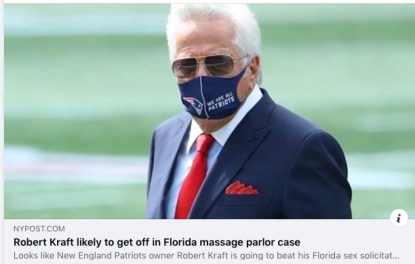
I have no love for the New England Patriots, so I found it somewhat amusing when the team owner, Robert Kraft, had been accused of soliciting prostitution at a “spa” in South Florida. Earlier this month, prosecutors decided to drop the charges against him.

One news source reported this in a truly spectacular way:

I love the New York Post some days…

From the “There’s My Flair” Department

I caught this one while reading up on my beloved Cleveland baseball team:

Um… No, they haven’t. They’ve had a “flair for the dramatic,” which means they’ve got a talent or an innate ability to produce something of exciting and engaging proportions.

A “flare for the dramatic” would be more like this scene: (Trigger Warning: Don’t watch if you don’t like scary movies or foul language.)


Throwback Thursday: The five conversations journalism professors have in hell.

For me, this week has been like falling down a never-ending flight of stairs: It’s painful, random and you want it to stop. At a certain point, it’s like, “Either get me to the bottom or just knock me unconscious so I don’t have to deal with this…”

My students have been disappearing like crazy, thanks in large part to testing positive for COVID-19 or being around someone who has. Yesterday alone, I answered five emails for one of my 13-student classes, explaining how online-only instruction works because the sender was going to have to sit this one out until the test came back. My kid’s cheer team had three kids test positive, so we had to get her tested and isolate her. Her dance coach tested positive. At least three high schools around us have gone online only. Every time I turn around, something else has blown up or thrown up and I have no idea what’s coming next.

And when we thought it couldn’t get worse, yesterday, my kid’s rabbit died. So there I am, digging a hole under an aspen tree near the back of our property to give Clover a proper send off.

I’m sure I’m not the only one who could use a little humor, so I dug this post up for the sake of a laugh. I hope it helps:

The five conversations journalism professors have in hell.

Growing up as a Catholic kid, who spent way more time near nuns than is now recommended by the FDA, I found the concept of hell horrifying. Conceptually speaking, it was a place of fire, brimstone and evil where you went after you had sinned without repenting, angered God through evil acts or accidentally ate a Slim Jim on a Friday during Lent.

Later in life, I asked a priest who was a little more “new school” about the faith for his views on eternal damnation. He told me it was probably more of never-ending sorrow and sadness than the torture outlined by those who grew up before the Vatican II era. It was a a longing and pain for better things and regret over what we should have been. In other words, hell is more individualized and accounts for what we did and who we were.

If hell hits somewhere in that “sweet spot” between those points, I’m sure I know exactly what I’ll be getting myself into if I’m not a decent human being. Since I’ve invested most of my life in teaching and journalism, I know that hell will involve reliving certain conversations I’ve had with students over the past 20 years that continue to sap my will to go on.

So without further ado, I bring you the five conversations journalism professors have in hell and how you can help us avoid them while we’re still alive:


CONVERSATION 1: SO WE NEEDED THE BOOK?

Look, I get it. Textbooks are expensive. In fact, the entire premise of this blog is that textbooks cost too much, change too often and usually have the lifespan of a mayfly. That said, we assign them for a reason: They actually contain stuff you’ll need to know. This is particularly true for books like the AP style guide. Here was an actual conversation I had with a student half way through the semester:

Student: How much are these books?
Me: What do you mean?
Student: This AP book, how much does it cost?
Me: About $20-25. Why?
Student: It must not have been listed on the criteria for the class. I think I’ll go buy it though.

OK, let’s pretend that I hadn’t mentioned it about 10,002 times already and that I didn’t include it as a required book in the syllabus and that I didn’t mention this as a MUST HAVE for the class (as in, “If you are broke, don’t buy the textbook, but buy the AP book.) AND that it wasn’t stocked at the book store.

Every other student in that class had the book. What, they were clairvoyant and just figured I wanted them to have it?

Making things weirder, a student in the very next section of that class, sitting in that very same seat asked the EXACT SAME QUESTION about the AP book, swearing he had no idea that this thing would be important. I think I need to call in some sort of holistic medicine person to burn sage on that chair or something…

Still, this pales in comparison to the year I told the students in WEEK 12 that they should bring their AP style guides to class, only to have one student reach into his backpack and whip his out. “GOT IT!” he said, proudly displaying the book he was supposed to have read by that point in time.

It was still shrink wrapped.

HOW TO PREVENT THIS: Buy the books and read them. If you are REALLY broke (as in, stacking pennies for Ramen broke) and you CAN’T afford them, talk to the professor and see what is absolutely essential and what you might be able to dodge. However, do this somewhere before the midterm.

CONVERSATION 2: I LOOKED EVERYWHERE!

The constant yelling of old people (read: me) about “damned kids these days” come from the fact that we often wonder how hard students really tried before giving up all hope and saying, “Just give me the answer.”

Damned Kids

Case in point, here was a conversation I had about a midterm question in which students were asked to rewrite a lead on one of four stories. Each story included a specific time peg, so I told students to use the day specified in the story (e.g. The game happened Saturday, so use “Saturday” as your “when” element.) when they wrote their lead. About an hour into the test, here was the conversation:

Student: I know you said that there is a time element we need to use with each of these stories, but I honestly can’t find one in this story I’m using.
Me: OK, pull it up and let me see. (he does)
Student: I looked through this whole thing and there’s no time element.
Me: Really?
Him: Yes, I can’t find it anywhere.
Me: Read the first sentence out loud for me.
(Silence)
Him: Oh.

Yep. Right there in the lead was that elusive time element he sought. I suppose I was lucky the student didn’t have trouble finding his pants before showing up in class…

HOW TO PREVENT THIS: Don’t give up so easily on figuring things out. There is something to be said for figuring stuff out on your own. Print it out or magnify the text or whatever you need that will help you consume the content. Also, if you really CAN’T find the content, when you ask, do so in a way that doesn’t immediately insinuate your professor is an idiot who failed to include the content.

Trust me, this is a great fear of many instructors and there are days we can’t remember what we ate for lunch, so screwing up a test is always a possibility. We then panic when you are “so sure” that whatever it is you’re looking for isn’t actually there. Finding out that, no, it actually is present and, no, we don’t have early onset dementia, is both a relief and a moment of “What the hell is wrong with kids these days?”


CONVERSATION 3: I KNOW YOU SAID X, BUT…

Rules are put in place to assure fairness, standardize procedures and give everyone guidance on how to proceed with a test, an assignment or a project. If you want to curdle a professor’s soul, explain to him or her that, yes, you understand rules exist for all those reasons, but the rules really only apply to other people.

Student: I know you said we can’t interview relatives for this assignment, but I was wondering if I could interview my mom.
Me: OK, what does your mom have to do with (the story topic)?
Her: Well, she’s a parent of a college student…
Me: But that’s really not what the story is about and even if it was, there are like 14,000 students on this campus, many of whom have parents. Does she have some special insights that none of the others would have had?
Her: Um… I don’t understand what the problem is. Why can’t I just interview my mom?
Me: Again, she has nothing to do with the story and I need you to get out of your comfort zone and interview people that you don’t know. It’s a skill you’re going to need as a reporter.
Her: So that’s a no?
Me: Yes. That’s a no.

HOW TO PREVENT THIS: Start by assuming that the rules, however arcane, have a reason behind them. Envision that “Karate Kid” moment where Daniel realizes that he hasn’t just been an indentured servant, but rather has been learning karate:

Also, realize that we WILL give people special dispensation for certain things, but it has to be germane to what we’re doing and provide a rare glimpse into something no one else could provide. If you’re doing a story on what it’s like to be an NFL referee and your uncle is an NFL referee, we might think, “That would actually work.” However, if you’re doing a story on how bad parking is on campus and you want to interview your best friend because he owns a car, think twice before asking on that one.

Nothing sounds worse to a professor than a student essentially saying, “Look, I know you told me what to do here, but you have to understand that rules don’t really apply to me because I want to do it my way and obviously that’ll be better for me, so can you just rubber stamp my demands? Thanks!”

CONVERSATION 4: HEY, DID I MISS ANYTHING?

Professors have a ton of stuff to do and most of them feel like they’re not doing it well enough to make anyone happy. The ability to focus well enough to deliver a two-hour lecture on something you will need to know to succeed in the class is the Educational Dream of the Millennium.

When you blow it off, fail to take notes or get way too into a SnapChat battle with your roommates during lecture, it can be irritating to us. When you then ask us to “fill you in” on what you “missed,” We tend to have this reaction:

Actual email:

I was just wondering what exactly the group interview project is again and what needs to be turned into you by Friday! I don’t quite remember everything you said at the end of class yesterday so if you could remind me that would be great.

At least that guy showed up, unlike the student who blew off class, skipped an assignment she knew about and then sent this:

Sorry, I was not able to attend class today. What did I miss? When is the interview paper due?

Perhaps my favorite one was years ago when I had a student tell me she spent six hours in the ER with a kidney infection and that she was way too sick to attend my 3 p.m. class. I explained I understood and that these kinds of things happen.

Later that night, my wife and I were at the local journalism bar and guess who walked in? Yep. The student.

She saw me, got a freaked-out look on her face and practically dove into the party room next to the entrance.

The conversation that followed the next class period was epic:

Her: Hi, I was wondering if I missed anything in class…
Me: Well, it’s been said that the appearance of impropriety is worse than impropriety itself, which is what I thought about when I saw you walk into the Heidelberg the other night, four hours after skipping my class.
Her: Oh! I can explain that!
Me: I’d love to hear it.
Her: Well, it was my friend’s birthday and I was feeling much better at that point so I just stopped by for a drink.
Me: With a kidney infection?
Her: Oh, yeah! I have my doctor’s note for you. Let me get that!
Me: (feeling aneurysm building in my brain, fueled by her complete lack of self-awareness) Um… That’s OK… Let’s just start class.

HOW TO PREVENT THIS: Go to class. If you don’t go to class, get notes from somebody before asking us to rebuild a lecture for you. If you went to class and forgot to write something down, ask a classmate. If you are going to class, writing stuff down and still failing to remember major things, seek help immediately.

CONVERSATION 5:

Me: Hello? Anyone out there?
Voice: Welcome to hell. I am Lucifer, the fallen one, evil incarnate, the lord of the underworld. Do you know who you sinned against to land you here?
Me: Do you mean, “Do I know against WHOM I sinned to land here?”
Voice: Oh great. Another journalism professor. Y’all are down the hall, third door on the left.


May the Odds Be Ever In Your Favor: Coronapocalypse University Edition

We start school today and that always feels weird, given that most of my colleagues have already got a couple weeks under their belts by this point in time. I usually feel like the guy in “Spinal Tap” who can’t get out of the pod, watching the rest of you deal with what’s going on while I’m stuck in limbo:

That said, this year, I feel like the last miner into the shaft, looking around me and seeing an awful lot of dead canaries, and thinking, “Hmm… maybe they’ll decide I shouldn’t go in there….”

Thanks to the coronavirus outbreak, pretty much everything we’ve watched this year has involved numbers, percentages, odds and more. With that in mind, here are some odds and numbers to consider as we continue our college/university journey through Coronapocalypse 2020:

87 – Percentage increase of students who request a completely online version of your 8 a.m. class when compared to your noon class.

4 – The over/under mark for number of weeks you are doing in-person classes before a COVID spike moves you completely online. (Take the under.)

5:1 – Odds of the student who asked for online accommodations for “health-related concerns” ends up on a YouTube video licking a doorknob at a frat party.

2:1 – Odds that despite your school’s edict that only essential personnel are on campus, and that nobody come to campus who isn’t needed, and the proclamation that “We are all in this together,” Parking Services will ticket you for being 6 inches over the line in a semi-empty parking lot.

10:1 – Odds that your university will create a mandatory two-hour weekly meeting of some kind that is supposed to help you deal with all of the extra work and anxiety you are feeling right now.

1,001:1 – Odds that group will make things better for you.

9:2 – Odds the carrots you left in your office before everything shut down in March have developed language skills by now.

8 – Number of professors who will be fired for accidentally uploading a sex tape instead of a lecture file because they never bother to label any of their video files and they stick them all in a file folder marked “Stuff” on their hard drive.

1,020 – Percentage increase in successful Title IX complaints, thanks to Zoom lectures providing video evidence of what everyone at your school has been complaining about for years.

247 – Dollars you will spend out of your own pocket to record your lectures and post them after your university has stated it will “provide any and all equipment you deem necessary for online learning, free of charge.

11 – Percentage of student put on quarantine trying to tunnel out of their dorm room like Andy Dufresne in the “Shawshank Redemption.”

0.03 – Percentage of students who are old enough to understand that reference.

3:2 – Odds at least one student forgets a mask each class period.

47 – Percentage of faculty members looking for “that adapter thingy that came with my recorder” before every live lecture.

0.47 – Percentage of faculty members who will find it.

87,351,842:1 – Odds your school makes national news this year for anything other than a coronavirus outbreak or a student getting stuck in a Taco Bell drive thru window after being shorted a chalupa.

754 – Number of times your university president or chancellor uses the word “unprecedented” in every email or speech this year.

Even Money – Odds the student who skipped every lecture, swore they saw them all online and “worked really hard” in this class, will fail with a score almost too low to compute.

8:1 – Odds you will be able to identify at least half of your students after the mask mandate is repealed.

7:1 – Odds you are able to identify at least half of your students in any given semester.

12 – Percentage of professors who will ask, “Instead of using (fully supported video software program the university has used for years successfully), why can’t we use (glitchy video program only six people know about on Earth, but they read about in The Chronicle of Higher Education and think will somehow be better)?”

5:2 – Odds the professor on a video lecture isn’t wearing pants.

83 – Percentage of professors who want to do live streaming lectures because “they’re more authentic,” that will be interrupted at least four times by pets, kids, the mailman or a door-to-door Bible salesperson.

96 – Percentage of students who say they watch every video lecture entirely.

0.96 – Percentage of students who actually watch every video lecture entirely.

92,249:1 – Odds your school stays open all year without a single problem.

100 – Percent of school administrators who will “express surprise and disappointment” that they were unable to keep their schools open all year, even after watching dozens of other schools crash and burn all around them.

Have a great semester, everybody!

Everything you need to know about media writing you can learn from crappy Facebook ads

When students begin my Writing For The Media class, they often feel defeated right off the bat. Our first assignment of any substance is to rewrite a lead and I tell them right off the bat that it will take us about three or four one-hour class periods to analyze professional writers’ leads, write them, analyze their efforts and rewrite them to any level of decency.

Four hours to write one sentence? They look at me like I’m demented.

Then, after it takes four hours and they STILL feel like they have no idea if it’s exactly right or not, more than a few of them tell me a simple truism: “This is way harder than I thought!”

Unfortunately, they often follow it up with this: “Maybe I’m just not meant to be a writer…”

The truth about writing is that nobody is “meant to be a writer.” It’s a skill that takes a long time to develop and even more practice to hone. Even the best writers fall on their keys occasionally, so it’s also a humbling skill that can seem to turn against you and cripple you like a bad back.

I tell the students, “Don’t worry. It’ll get better. We’ll get there together, I promise.”

Those that stick with the class often find that to be true. Then, they start realizing how horrible a lot of the writing around them is and feel really good about how far they’ve come.

If you’re looking for a good place to get that basic ego boost, you should look no further than Facebook’s Marketplace. Even the most mediocre of writing students can feel like Hemingway after cruising through a few ads there.

The advertisements I’m talking about aren’t those that promise “Hot young singles in your area want to talk to you!” Or “One simple trick will enhance your manhood.” Or “Grow back all your hair with this safe, natural supplement.” (Or as I like to call these things, the “Fisher-Price My First Midlife Crisis Kit.”)

I’m talking about ads that regular people in your area post to try to sell everything from used deodorant (it’s out there) to used vehicles. It is here where tortured prose goes to be tortured some more.

For those of you looking for writing lessons in places beyond the textbook or the news sites, send your students to this Valley of Duh and they can learn some valuable writing lessons like these:

VERB TENSE MATTERS: In my writing class, we talk about the verb of the sentence as being like the engine of a vehicle. A strong and powerful verb can really make that sentence fly. A weak verb requires you to prop it up with a dozen adverbs and other descriptors, the way you would have to turbocharge a Yugo.

The tense of that verb can also mean the difference between a great sentence and a horrible correction.

Here’s a fun example: We are looking for a “beater” truck to help us around the Ponderosa these days. The idea is that between Amy’s need to haul mulch and the requirement that we haul our own trash to the dump down the road, we want something with an open bed that can accomplish dirty tasks. It can look like someone set fire to it and put it out with a set of golf clubs, but it needs to start easy, run reliably and stop when we push the brakes.

In flipping through Facebook ads, we found a 1978 Ford F-250 that looked good. The ad noted that it wasn’t much to look at but it “starts and runs great.” So, we drove about an hour up the road to see it.

The first clue things were wrong was that it was in a storage shed behind a bunch of other crap the guy and his kid were frantically moving out of the way. The second clue? Under the hood of the car, the carburetor (which is vitally important to starting and running) was being held open with a screwdriver. When it came time to start the truck, the kid got behind the wheel and the seller began pouring gasoline directly into the engine.

Even then, it didn’t start. It didn’t even make a sound, as the battery was dead, too.

“I thought you said this starts and runs,” I said.

“It did when I put it away last spring,” he replied.

You don’t have to be an expert in much of anything to know that a lot can change in 15 months. If you look back at your Facebook memories from last year at this time, something tells me that you’ll notice more than a few differences between then and now. Hell, 15 months ago, the only reference to a “coronavirus” was probably how you described the morning after a rough Cinco de Mayo party.

After a few more attempts to start it, I told the guy that I was leaving.

Thus, “starts and runs” should have been “started and ran a while ago.”

FACT CHECK THE HELL OUT OF STUFF: As the above example demonstrates, not everything you see in these ads is factually accurate. I suppose I could give the guy a pass on the starting and running as it actually did at one point. (I mean the Enterprise didn’t beam that truck into the storage unit.)

I’m a little less forgiving about things that clearly aren’t true.

We went to see a 1964 Ford 100 that seemed to fit the bill. When I got there, everything was what I wanted: sturdy truck bed, good tires, strong brakes and more. The problem? The truck was listed as having an automatic transmission, something that wasn’t true.

(In case you are unaware, if you have THREE large pedals along the floor of the driver’s side of the car and you need to step on the one on the far left frequently as you shift a stick near your right hand as you drive along, this is a MANUAL transmission. It’s also known as a “stick shift” because you are shifting it manually, with that little stick.

If you have TWO large pedals along the floor of the driver’s side and you need to apply the brake only ONCE as you shift your car to the “D” spot on the gear shift, wherever it is located, and the car does the rest of the gear shifting for you, this is called an AUTOMATIC transmission. It means the car “automatically” shifts for you as you go faster and faster and faster.)

Truth be told, I can’t drive a stick shift. Well… That’s not entirely accurate. If you got mauled by a bear and I had to get you to the hospital to save your life and the only car available was your stick-shift car, I could get you there. You would live, but we’d be holding a funeral for your clutch and gearbox.

This guy was not alone in listing his vehicle with the wrong transmission. I saw FOUR of these online that listed the trucks as being “automatic” when I could see pictures of both the shifter and the clutch in the ad. When I asked a couple people about the inconsistencies, they said, “Oh… Yeah… then I guess it is a stick…”

Good grief.

When it comes to your own writing, fact check the hell out of stuff before you publish it. If you aren’t sure about nuances like the difference between a bacteria and a virus, look both of them up and make sure you’re right. If you don’t know what a word means, look it up before you toss it in there because you’re pretty sure about it.

And, if you don’t know the difference between an automatic and a stick shift… Well, you probably didn’t read this post carefully enough. Go back and take another look.

CONSISTENCY AND CLARITY COUNT: When it comes to your writing, you want people to feel informed and grounded in the topic. Being consistent in your writing helps with this. When you get contradictory information in a piece of writing, it can be more than a little jarring. Case in point:

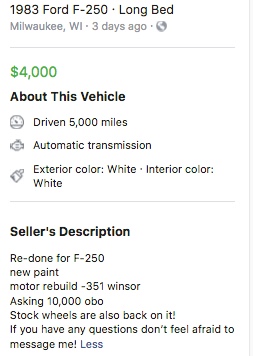
Ford4000

In reading the opening, I’m looking at a $4,000 truck. When I get to the body of ad, it’s $10,000 (or best offer, which I’m guessing won’t be at the $4,000 level).

Another ad showed a truck with a plow for $2,000. The body of the ad noted, “Don’t low ball me by offering $4K for both the plow and the truck.” I wasn’t sure how offering twice what you asked for something would be a “low ball,” so I asked the guy.

“The truck is $2,000 but it doesn’t come with the plow. That’s at least another $5,000.”

So, maybe mention that?

Another oddity of inconsistency comes from a seller who notes “Truck runs, drives and stops as it should. Will need to be trailered.”

OK, wait… If this thing is road-worthy, running, driving AND stopping as it should, WHY do I need to tow it out of there?

In the field of professional advertising, what these folks are doing would be called “bait-and-switch,” where a business offers one thing and then quickly switches it out for a more expensive item or inferior product. I wouldn’t accuse these folks of this tactic, as I think they’re just bad at communicating what they want.

Still, if you’re trying to reach an audience, this can be annoying for your readers.

EVERYTHING CAN USE AN EDIT:

“needs rear main seal eventually ,leeks new brakes”

(I’m guessing it either leaks from the rear main seal or the guy is using giant scallions to stop his truck.)

“needs new breaks and break lines”

(What do we need to break on it?)

“Has manuel transmission”

(I wonder who Manuel is, but if he can run the stick-shift for me, I’m interested…)

“I have a 1966 ford Ltd for sale starts, runs, drives ,surface rust only I have two separate interior for it everything works as it should blinkers, whipers, windows everything works price is negotiable please feel free to contact me with offers and for more information”

(Located on just above and slightly to the right of the space bar is the period key. Try using it once or twice. Or more.)

“2WD, 4SP, 350 CI, Need brks, batt. U haul, 2500 obo No LBall.”

(This is either a text message in code or a ransom note crafted by someone with limited access to magazine covers.)

I’m hopeful these bits and bites of information can help you as you look to work on your writing.

And, yes, we’re still looking for a truck.


The Kindergarten Survival Guide

IMG_2219

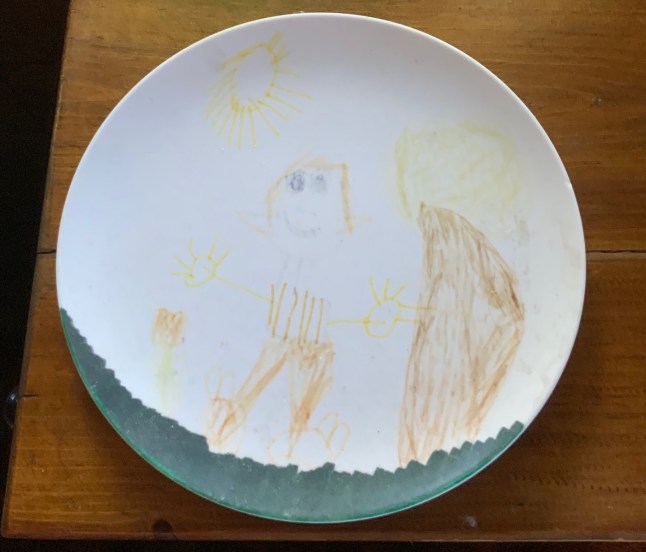
I did this about 40 years ago. My mother still has it on display in the kitchen. Unfortunately, it’s probably still the best thing I’ve ever drawn, which is why I’m grateful that SAGE employs actual artists for my books.

Today is my birthday and it dawned on me that I’ve now spent more than half my life teaching college students. (Really, I have. The math checks out and everything).

One of the many benefits of spending this much time Peter Pan-ing my way through life is that I get to see a lot of my former students grow into adulthood, family life and parenthood. Seeing the updates of graduations, jobs, weddings and children is one of the best things this job offers as a continually renewing benefit.

Two of my former students, who have been immensely helpful to my book-writing and blog-pimping careers, got married a number of years ago, became parents and raised one heck of an amazing kid. As he completed his pre-school career, his mom asked if anyone on Facebook had any advice for him regarding kindergarten.

In an attempt to be helpful, and maybe amuse his parents, I sent the following “Kindergarten Survival Guide” to this young man and I figured I’d share it here as well. Enjoy:

1) Make sure the teacher knows your name for all the good reasons (good napper, drinks milk well, doesn’t fight) as opposed to all the bad reasons (makes noise, does not work and play well with others)

2) Always be nice to the kid who doesn’t seem to have any friends. If you pick on that kid or be mean to him/her, it will haunt you for the rest of your life.

3) Put time and effort into ANY major project that your teacher tells you is “going home for your parents to keep.”

My mother STILL displays the drawing I did for her that was turned into a plastic plate, and had I known that, I would have put more time into coloring it and I wouldn’t have drawn the tree so big.

(It STILL pisses me off that I forgot to color in that guy’s shoe…)

4) There’s nothing wrong with doing your own thing. Just because the bossy girl says, “We are ALL playing kitchen and I’M the chef” doesn’t make it so. Feel free to wander away and read or play with cars or something. You are under no obligation to feed into her delusions of grandeur.

5) Nobody likes a tattletale. Don’t run to the teacher for every minor grievance. Save your tattling for when it counts. Like when a kid accuses you of setting fire to the reading nook or when the milk money goes missing.

6) Kindergarten is not a competition over whose family is more dysfunctional. Feel free not to share everything that goes on at home.

7) You have the coolest mom and dad in the world. You know it, the teacher knows it and your parents know it.

8) Nobody really sleeps during nap time. Except the teacher. Let her snore. She’ll wake up eventually.

9) The kid who says he saw a leprechaun on St. Patrick’s Day is LYING TO YOU ALL. MAYBE he saw his dad drunk on green beer, but that doesn’t count. Don’t feel bad you didn’t see one. (OK, maybe that’s my own personal scar coming through, but still…)

10) Enjoy every minute of it. You are a great kid and don’t let anyone ever tell you any different.

Throwback Thursday: You will screw up. You are not on a lunchbox

In honor of this week’s random lottery of meaningless tragedy, I pulled this post from way back to talk about how people manage to screw things up.

Even as other people were reading my post on Emily Reise and laughing at the fact I misspelled her name, they were sharing their own screw ups over their careers. People declared dead when they weren’t, places listed for events that had no such events and even one marijuana raid that happened somewhere else, much to the befuddlement of neighbors in that area.

It’s never great to make a mistake, but it’s going to happen because, as Sam Kinison once noted, you’re not on a lunch box:

Filak-ism: You will screw up. You are not on a lunchbox.

Sam-Kinison
Who wouldn’t want this face on their third-grade lunchbox?


Filak-ism: A random observation, borrowed idea from a movie/song/TV show/book, odd concept or weird phrase that has been warped in the mind of Dr. Vince Filak for broader application within journalism situations.

The late shock-rock comedian Sam Kinison once had the misfortune of ticking off a major comedy figure on a slow news day. Kinison was slated to be the main guest on the “Joan Rivers Show,” but managed to blow it off, leaving Rivers with about 20 minutes of essentially dead air and shadow-puppet tricks. News stations picked this up and it became a pretty big, albeit overblown, deal.

In his posthumously released album, “Live From Hell,” Kinison reflected on the error, leaving me with one of my favorite Filak-isms. “I can (expletive) up. I’m not on a lunch box.” The point being that unlike the kiddie characters and perfect heroes who were marketed on lunchboxes through his youth, Kinison was never going to be perfect.

As a journalist, neither will you.

Trying to be perfect at journalism is your goal, but to quote the famous coach Vince Lombardi, you will never catch perfection. That said, in its pursuit, you will catch excellence and that’s usually good enough. Also during its pursuit, you are going to screw up in some pretty spectacular ways. We already detailed the “filthiest” screw up in all of sports journalism here (as well as one of mine that follows me to this day), but I asked the Hivemind folks for some of the biggest screw-ups they made and if they learned anything from them. Here are some of the things that went wrong:

WHAT’S IN A NAME?
Getting a name wrong can feel like the worst thing in the world, especially after you realize, it’s impossible to make up for it. The most recent error was from an award-winning sports journalist, who managed to confuse an NFL Hall of Fame Green Bay Packer with a Rock and Roll Hall of Fame drummer:

DIPpgArXgAAA3kI-566x447

The reason? The writer said he was in the middle of several stories when he caught the Kramer story and had to get it done immediately. When Jerry Kramer started listing off all the people who mattered to him, he mentioned both legendary Packers Jim Ringo and Bart Starr. In his notes, the writer wrote last names, leading to the Ringo Starr moment:

Now, after the initial shock and ensuing, hysterical laugh (trust me, I laughed about 10 minutes, full on tears and everything), a very reasonable question is how does someone write Ringo Starr instead of Jim Ringo? I’m not an idiot. I know who Jim freaking Ringo is. Seems like an impossible error to make, right?

Well, I don’t remember writing “Ringo Starr.” At the point I wrote it, I was typing to fast — between two word docs, remember — to grasp everything I was doing. (This is fairly normal for sports writers; usually we get away with it.) But I do remember Kramer going down the list of teammates he appreciated. “Fuzzy… Forrest… Ringo… Starr…” BAM!

Another longtime journalist had a similar switcharoo moment, confusing the man who played Ben Hur and Moses with one of the “Dirty Dozen:”

I once wrote Charles Bronson when I meant Charlton Heston while making a Soylent Green reference. Forgot to fix it on the page and it made it to print. The complaint letters were well deserved.

We both agreed “The Ten Commandments” would have been different if his mix-up had played out in real life:

It can be even worse if the person is local, in that I doubt Charles Bronson or Charlton Heston even read about the mix up. One writer talked about her experience highlighting the opening of a local business:

One that always sticks with me is when I used the wrong first name of a gentleman who had just opened up a restaurant with his wife. My editor told me that now he couldn’t frame and hang that article highlighting his accomplishment because of my error. He didn’t scream at me because he didn’t have to. I felt terrible when he put my screw-up into those terms.


I DIDN’T MEAN FOR THAT TO GO PUBLIC:

Whenever a student in the newsroom can’t figure out a headline and writes, “SCREW IT, I’LL PICK A HEADLINE LATER” (or in one case, just the F-bomb over and over again) in that space, I get hives. The student always says, “I’m not going to run that,” but that’s not always your choice. In text-based journalism, we always say you should never write something you wouldn’t want your grandmother to read, even if it’s just as a joke. In broadcast, the rule is to treat every microphone like it’s broadcasting or “hot,” something that is easier said than done. A radio journalist who also worked in PR shared this:

Didn’t realize my mic was hot and said “what the fuck?”

A photojournalist noted that the “I didn’t mean for that to go public” situation isn’t only for the word folks, as only a lucky save by the press operators kept this from getting ugly (or uglier):

This was my photo editor’s goof up. He was showing off to a cute intern one day when he Photoshopped an eye on the middle of a guy’s forehead. He apparently thought he had removed it, but the pressmen discovered it several hundred copies into the first run. They had to re-web the press–He was not fired but was skating on thin ice for a while…

DEATH BECOMES YOU (MAYBE):
Life and death issues are no joking matter. Making an error about someone being alive or dead can affect you as a writer for a really, really long time. (Trust me on that one.) One journalism instructor who worked in the field noted that his assumption about a source seemed to create a life-and-death situation:

I gave a guy cancer in a story (he never had cancer-just advocated for patients with it. Learned that just because you THINK you know someone’s story- double check it. And turn down interviews so close to deadline.

A longtime copy editor managed to “resurrect” a source after catching an error from one of the writers on her publication’s staff:

(I) once brought a man back from the dead: The writer was convinced that saying “the late mayor” was the same thing as “the former mayor.” I always tell my interns that fact-checking and careful editing can save lives.

JUST… OW…
Perhaps one of the most gifted and socially aware journalists and professors I have ever known got hit with perhaps one of the most unfortunate typos ever. Of all the people this could have happened to, it was so unfair this one happened to her, given her genuine understanding of race, gender, ethnicity, sexual orientation and other sensitive issues:

I wrote a story about kids in a summer camp learning about the Buffalo Soldiers (African-American soldiers). Somehow a production error changed the word “counselor” to “coounselor” only in some editions. It was not in the edition I got at home or in the office. Imagine my surprise when a woman called me the next morning and started screaming at me that I was a racist and did I think that was funny? I didn’t know what had happened and had to apologize profusely.

The takeaway here is that nobody in journalism is perfect and we all have our moments of “Oh… God… Why?” When it came to the “Ringo Starr” screw up, the writer told me he laughed hysterically until he cried because there was nothing else he could do. Others said they grimaced and moved on. Some said it informs how they teach or what they do to help students avoid their screw ups.

For me, I go all the way back to the guy who gave my high school graduation’s valedictory address. The guy’s name was Willie Nelson (Really. He went by Willie.) and he told the story about how he once got annoyed by his sister and smacked her in the face with a baseball bat. When he was sent to his room as a punishment, his grandfather came and told him some invaluable advice:

“Boy, I hope you learned something today,” he said. “Everybody makes mistakes. It’s the stupid ones you gotta learn to avoid making twice.”


“The dog ate my jump drive and gave it the coronavirus!” A professor’s plea for honesty in the age of COVID-19

Since the beginning of education, students have offered educators false reasons for missing assignment deadlines. “The dog ate my homework,” later became, “I ran out of loose leaf,” which begat “The printer ran out of ink,” which led to “My floppy disk/Zip disk/thumb drive got corrupted,” which came along with “My computer got a virus” and of course “I SWEAR I uploaded the right file…”

One tried and true excuse has been that of illness or death, which unfortunately hasn’t taken a break during this time of coron-apocalypse. A fellow educator asked this question in a “pandemic education” group:

Sorry if this has been posted by another….rcvd an email from a student asking for advice on how to handle their two roommates lying to profs about family members having the virus to get extensions on class work.

Is anyone asking their students for documentation? Or is it the honor system for the most part?

My initial question, naturally, was, “What the hell is wrong with people who would falsely claim this, especially now?”

During a regular school year, I get it: You’re hung over. You overslept. The Packer game went into OT on Monday Night Football. Claiming illness isn’t the end of the world.

In fact, when it comes to missing class, I don’t have an attendance policy. I’m like Planet Fitness: You paid your monthly dues to be here, but if you’re not here, I’m not losing any sleep over it. You get the results you deserve based on your efforts.

What I never understood was when a student would falsely claim something catastrophic to get out of a jam. That never sat well with me.

I vividly remember one encounter with a student who showed up in my office to tell me she was going to miss class later that week. She obviously had been crying and she was visibly shaken by something.

“My grandfather died…” she began, as she started to cry again. I found a few renegade napkins in my desk drawer and handed them over as she tried to compose herself. “I’m going home tomorrow for the funeral and I’ll be gone the rest of the week.”

I offered my condolences, told her to take as much time as she needed and that we’d catch her up when she was ready to return. What she said next blew me away:

Her: “When I get back, I’ll bring you a copy of his obituary.”
Me: “Why?”
Her: “To prove where I was. My other professor said he wouldn’t accept an absence without it.”

I couldn’t fathom that, not even having watched this scene from “Ferris Bueller’s Day Off” about 100 times. Asking for proof, something I would do as a matter of course as a journalist, seemed beyond the pale in this situation. I told her not only did I not need it, but that I didn’t want it.

“If you felt you had to lie to me about the death of your grandfather to get out of my class, you have problems that I can’t solve,” I said.

The idea that someone would lie on that grand of level for such an insignificant reason as my class just boggles my mind.

I think a large part of it is that I work in a field in which credibility is our stock and trade. If you throw away your credibility, it’s not like a boomerang. In fact, it’ll never come back. In trying to train students to be honest and clear with their sources and their editors, I’d like to think they learned how to be honest and clear with me.

Another part of it goes back to something I wrote a few years ago about why it’s a stupid idea to lie to your journalism professors. We’re like a mix of bloodhounds and pit bulls: We dig into something until we’re totally satisfied and if we find malfeasance, we’ll burn you so bad you will wish you had died as a child.

I’ve caught students lying to me (or lying in general) more times than I care to count. In most cases, they get in a jam and they try to cut a corner, figuring they’re doing something I’ll never manage to catch. Maybe that’s true, as I’m sure several former students are reading this and thinking, “You think you’re so smart, Filak, but I totally pulled one over on you…” However, I like to think I’ve got a pretty good batting average, and even if I don’t, lying this way is like passing a cop as part of a group of speeders: Even if he’s only going to get one of you, it totally sucks if it’s you.

Here’s the thing I think students need to understand: Your professors are all screwed up, too, right now.

We’re working from kitchen tables and basement work benches with makeshift equipment. We’re not on our regular schedule, either sleeping too much or not enough. We’re failing at various tasks, despite our best efforts.

(For some reason, I keep linking the wrong podcasts to the wrong days. The same kid gets there first each day and emails me about it, with a “Sorry to bother you again…” note. I tell him the same thing each time: “You’re never a bother and thank you for helping me find and fix this.”)

We’re watching the same news reports that terrify everyone else and we’re not above being scared of something ourselves. Friends and family are locked away from us. People we know are losing jobs and businesses. Our health, which a lot of people take for granted each day, is now a constant sense of fear, with every cough or sniffle leading us to retrace every step we took over the last two weeks.

We’re clinging to as much as we can that’s normal, and it feels like every day, more of that normalcy slips through our fingers.

And we have no idea when, or even if, that normalcy will return.

I can’t speak for all professors, but I would bet dollars to doughnuts that we’d be much more willing to extend deadlines, offer help and do anything else students need in this time of crisis without anyone giving us a false sob story.

The truth is much more viable at this point in time:

“I had trouble getting online because there are five of us in the house, all trying to livestream a lecture at the same time.”

“I got called in to the grocery store and I had to work a double, because someone else was sick.”

“I’m trying not to worry about everything right now, so I played XBox until 3 a.m. and I overslept.”

“I haven’t seen my family in more than a month and it bothers me to the point of distraction.”

“I lost my job and I don’t know what I’m going to do next.”

“I just can’t. I’m sorry.”

Professors are as human as anyone else. We want to understand and help.

Just be honest.

Happy Birthday, Dad: 4 valuable things I learned from my father that might help you, too

DadSuit

It might be hard to believe that a guy who dressed like this could have valuable advice, but trust me, he always does.

(Editor’s Note: I do my best to follow the 70-20-10 rule for social media, in which only 10 percent is about some form of self-promotion. Today is one of those 10 percent days, so feel free to skip it if you feel I’ve already used up your willingness to tolerate me in promotion mode.

Also, if this or anything else I’ve ever done has helped you in any way, please feel free to wish my dad a happy birthday in the comments section. I’m sure it would be appreciated. -VFF)

As my daughter was going stir-crazy the other day, whining loudly about missing her friends, her extracurricular activities and even in-school classes, I told her the one truism I hoped would keep her sane:

“You can’t focus on the things you can’t do because of social distancing. You have to focus on the things you DO get to do. Otherwise, you’ll go batty.”

For me, an introvert with a long-standing aversion to social situations, this has been an easy adage to espouse and obey.

Until today. Today is my dad’s birthday.

Like everyone else in this country, Dad is stuck at home with limited contact to the outside world, for fear of contracting a virus that is decimating people at an incredible rate. While this “wait this out at home” rule is rough on a lot of people, it has to be killing my dad, who earned the family nickname of “No-Line Frank” for his disdain of waiting in line for anything. (It probably isn’t any great shakes for my mom, either, as she’s isolated in the house with him like this for at least another month.)

I wish with all my heart I could jet down I-41 and give him a big hug (and a nice bottle of Drambuie) today. The fact I can’t saddens me to the point of distraction. That said, he would be the first one to tell me it’s fine, not to worry and that I should get back to work.

My parents were and still are instrumental in who I am and what I do in life. In honor of dad’s 76th birthday, here are four “Filak-isms” he taught me that helped make me who I am and likely will help me make it through this pandemic unscathed:

HUSTLE WHILE YOU WAIT: I can’t remember when he first said it to me, but I rely on it almost daily: “The best things in life come to he who hustles while he waits.”

Although Dad later told me he heard this in a Credit Union seminar or something, I still attribute it to him because he not only said it, but he lives it. I often joke that I’m a “human twitch” when it comes to keeping busy, constantly writing books, teaching classes, refinishing furniture and doing almost anything else anybody asks of me.

Compared to my dad, I’m a piker.

I can’t remember the last time I saw him watch a whole ballgame or TV show without getting up and looking for something to do. He might be cleaning out the junk drawer in the dining room or sorting some baseball cards or looking for something in the basement, but he’s constantly on the move. Seeing this always inspired me to find more stuff to do and to keep looking for new opportunities to make the most of my time.

If you’re always hustling, the good things will come your way.


DON’T BRING SHAME ON THE FAMILY: I know I’ve explained this before, but it bears repeating. Dad told me this when I went off to college and decades later, it still rings true. “When you go out there, have fun,” he said. ” But, don’t bring shame on the family. It’s my name, too.”

The sheer tonnage of stupid things I avoided doing in college, simply based on that bit of advice, could stop a speeding locomotive from moving another inch forward. Even now, when I considered doing something, I would imagine the headline “UWO Professor Arrested for (Fill in whatever stupid thing I thought about doing)” and immediately decided against doing that stupid thing.

Whether it was being a success or just avoiding failure, the goal was pretty simple: When Dad saw someone he knew at the grocery store, it would be great if the person didn’t start the conversation with, “Hey, yeah… Heard about your son… Geez… That’s not good…”


YOU ARE NOT AVERAGE: In fifth grade, I came home with five C’s on my report card, much to the dismay of my parents. Dad was less than pleased that I wasn’t living up to my potential, whatever that was, and he pretty much knew full well that I fell short because I wasn’t giving a crap.

We were in the middle of a “silent supper,” thanks to my transgressions, when I finally broke the silence with what I thought would be a pretty good argument for my folks to not be so upset: “I read the report card, and it says that a C is average, so-”

Dad cut me off in a firm tone, “You are NOT average.”

I got the point. I could do better. And I knew it.

From that moment, I didn’t get another C on a report card until I hit my freshman year of college. In that case, it was more of a scheduling mistake than a lack of effort, because I took an introductory zoology course that served as the “weed-out” class for the veterinary medicine program at the U.

It’s always easy to take it easy, but that’s not the right way to do things. I was lucky enough to get a set of tools and the ability to use them in a way that matters. I was also lucky as hell to have parents who wouldn’t let me slide because I was good enough to get by or because other people’s kids were doing something worse.

Once that got stuck in my head, I realized that it’s important to always push beyond average whenever possible.


FINISH THE WORK FIRST, DRINK BEER LATER: Dad always believed in the separation of work and relaxation. He once told me about my grandfather and how he liked to do part of a job and then relax a bit and then go back and do more of it. Dad fell into the mode that my great-grandfather espoused: Finish the work first, drink the beer later.

What I learned from this was not only the importance of a strong work ethic but also the idea that I could find joy in completion of work. Seeing things get checked off a list or looking at a well-done job brought me happiness that could far exceed the joy of a brief respite and the knowledge that I had to do more work.

Even more, the beer always tasted better when I knew I was done for the day.

Thanks for everything, Pop. I love you.

Dad


So, you have to teach your journalism class online now, thanks to the coronavirus? We’re from the internet and we’re here to help.

Schools throughout the country have reacted to the spread of the coronavirus by pushing for “alternative delivery methods of instruction.” The goal is basically to get people away from one another while not having to cancel class. For most of us that means online instruction, a concept that some folks know well, others have had a little experience and still others react to with a level of freaking out that would impress Beaker from the Muppets.

I’ve taught online for more than a decade now, providing content through various delivery systems for multiple classes. I also am currently teaching courses I’ve taught for upwards of 20 years. Still, I’m probably at the freakout stage, primarily because nobody around here has been willing to pull the trigger on this yet and say, “Look, we’re making the call now. You get an extra week off after spring break to get your stuff together for online delivery. Plan for a month’s worth, but be ready for the whole term.”

I’m also one of those stupid people who likes to help other people, even as I’m drowning. Either I’m as dumb as a bucket full of hammers when it comes to deciding how to prioritize my time, or I’m way too old-school Polish-Catholic, in that we feed everyone else around us, even if we’re starving.

Either way, as my friend Allison would always say when taking on some sort of Quixotic do-good adventure on behalf of her blog: We’re from the internet and we’re here to help.

With that in mind, starting on Monday, I’m turning the blog into a pile of stuff that anyone who wants it can use for free. I’ll link to previous exercises I’ve built, stuff I’m building to teach my students, previous posts on the site and other stuff. Take whatever you want, use as much of it as you want and bastardize it for your own purposes however you want.

In the mean time, either post comments below or contact me through this form to tell me what you need and I’ll see what I have.

For those of you who have never taught online before, or who have limited experience, below is a list of things I’ve figured out over time that might be helpful:


YOUR BEST BET IS ASYNCHRONOUS CHUNKS: The argument of how best to reach students and make sure they’re keeping up with things often emerges when we’re dealing with online classes. If we do live-streaming stuff, we can force people to stay on track with certain parts of the class. If we do a full class dump online, we can let students work at their own pace.

Both of these approaches have benefits and drawbacks, and I’ve found that the drawbacks outweighed the benefits in both cases. This is why I’ve come up with a system meant to allow freedom of access while still creating firewalls against students who wait until the day before the class ends to try to do the work: Asynchronous chunks.

Here’s what I do: On day one of week one of the class, I open up everything the students will need for that week’s “chunk” of the course. Any lectures I do, any powerpoints they need, any quizzes they need to take, any readings they will need and any assignments or tests they need to accomplish. The due date for this material is usually Friday by noon of that week.

The students can do whatever they need, however they want, just as long as they meet the deadline of Friday at noon for dropping their work into the drop box for that week or finishing the online quiz portions. I then spend my weekend grading like crazy to try to get this stuff back to them as quickly as I can without making a mess of it. Once they get their graded stuff back, usually Sunday or Monday, I unlock week two and the system starts all over again.

What this does is it allows students to work however they want within a set of parameters. It prevents people from blowing off the work to the last minute, but it also prevents those “go-getter” students from drinking 27 Red Bulls and trying to do the whole class in 72 hours. The lazy ones are what we’re used to, so we might have a plan to deal with them. However, the quick-moving students will likely cause you a problem by screwing up something in week one and then repeatedly screwing it up in the work for weeks two, three, four and five because you didn’t have the opportunity to correct them on it. This “chunk” approach helps with that problem.


KNOW WHAT TOOLS THEY HAVE: “Go online” sounds like a great idea, but then again, I’m sure “Let them eat cake” sounded like a plausible solution at the time as well. We have students out here from a variety of backgrounds and circumstances and I’m sure we’re not alone in this. Depending on where your students will be sent, home might have the technological wizardry of the U.S.S. Enterprise or of two cans and a string.

A number of folks on various teaching message boards I frequented were talking about how their students were trying to get a month trial of the Adobe Creative Suite for a reduced price. Others talked about how certain video sharing services were allowing campuses free access to some of their higher-end tools to do virtual meetings.

My bigger question was, “Can students even run any of this stuff on what they own?” I’ve seen a number of my students carrying some of the jankiest laptops on Earth. In addition, I have students who live in rural areas where DSL is barely available, let alone anything with a true high-speed to it. If you are fortunate enough to work in a place where everyone is required to buy the same tech or where everyone is rich enough to have their own survival bunker, that’s great. For the rest of us, it comes down to a MacGyver approach of making do with what we have:

If you are still in your regular class periods, ask around to figure out what people have and what they don’t. If you’re not, it’s worth emailing your students before you launch and asking them what they have the capability to accomplish with the tools at hand.

One of the bigger reasons I went to the “chunk” approach was that I had students who were taking my class in areas where they would have to go somewhere to get internet access. (Last summer, two students who took my editing class online were living together in a converted SUV while selling fireworks at a roadside stand. At the start of each week, they would trudge to town and use the wifi from the laundromat to download all the stuff. Then, at the end of the week, they’d repeat the trek and upload their finished work.)

Knowing what kind of tools the students have is vital in limiting frustration on both of your ends.


GO BACK TO THE NOUN-VERB-OBJECT FOR YOUR GOALS: When I take students online, the goal is to give them an experience that is as valuable as the one they would get in the classroom. That said, I know full well it won’t be the same experience as they will have in the classroom. It can’t be.

What helped me in building my online courses was the same thing that helped me write books when I had trouble with communicating a concept: I went back to the basics of noun-verb-object. In short, I tried to figure out how to finish the sentence “Students need X” or “I must give students Y.” Doing this allowed me to re-calibrate my thought process on what I was actually accomplishing within the classroom and what needed to come out of that for the online kids. Once I nailed that down, I was able to build things specifically for that class to accomplish that goal online.

Case in point: When I taught media writing online, what I wanted students to get out of a news writing assignment was the issue of balance among sources. To do this in the classroom, I had the students individually interview people (one interview per student) and then I would collect those interviews into a giant pile that everyone in the group could use to write from (think the old “bring a dish to pass” approach).

Online, I couldn’t do that as easily, nor could I employ my “pitch a topic” approach I used in class. For a while I was stuck because I kept trying to replicate the entire assignment online and found I couldn’t do it. Eventually, I realized that I wanted them to a) write a story and b) use multiple sources to c) create balance between viewpoints. When I figured that out, I rebuilt the assignment. I gave them the transcript of a speech I made up, along with two press releases that “reacted” to that speech from various perspectives. (Pro and con) They then had all of that material to use for the assignment. It ended up working just fine.

Did they get the interviewing experience? No, but I realized that wasn’t the point of the assignment, so I didn’t go nutty trying to force that in here. Instead, I found a different way to get them that experience when I had the chance.

Figure out what you want them to do in that simplest way and you’ll be in much better shape as you reconfigure this for a different environment.


RE-EXAMINE YOUR EXPECTATIONS: People who see this point might be thinking, “He wants us to lower our standards of grading and work quality!” Not really. It is about trying to determine how best we want to assess our students in this new environment.

Think about it this way: Let’s say you’re catching a flight overseas for a two-week vacation. As the plane is taking off, you’re thinking, “I hope they get us there on time for me to make the opera I have tickets to,” or “I hope they have a good meal for us for dinner” or “I hope that the movie on this flight is good.”

Then, 20 minutes into the flight, all four engines quit and you’re in a total stall over the Atlantic Ocean. You probably are now thinking, “I hope I don’t die.”

That re-examination of expectations doesn’t mean you’re lowering your standards. It means you’re dealing with the reality of your circumstances. If your last thought as the plane crashes was, “Oh, God, not another damned ‘Avengers’ movie…” you have some serious issues.

This point can dovetail nicely with the previous one. A photo colleague and I were talking about this before classes began today. He noted that his students were supposed to be doing studio work at the exact time the university would likely be moving everything online. He thought about re-configuring his class to move the studio assignment later in the semester in hopes things would come back to campus. However, he said if that didn’t happen, he didn’t know what he’d do.

I said I’d dig around and figure out what I MOST wanted out of that studio experience and see how it could be replicated somewhere else. If the goal was to shoot photos against a neutral background, could they use something other than the studio backgrounds to do it? If the goal was to shoot still life images with certain lighting situations, would they have stuff around the house they could use to replicate that? In other words, how could we improvise and adapt the expectations of the work to get them the key aspect of the experience?

Not everything can be done this way, clearly, but in terms of looking at it less as “The assignment demands X, Y and Z” and more in terms of “Here is what I want you to get and that’s what I’m going to grade you on,” the better off you both will likely be.

Clearly, there is a lot more to this than these tips, but I hope they’ll get you started or at the very least, confirm what you already know about this. In between now and Monday, please send me any needs or concerns or pleas for help and I’ll do my best to make this work.

We’re all in this together, so let’s see what we can do.

Best,

Vince (a.k.a. the Doctor of Paper)


Catching up with the coronavirus: A look at some things student journalists might want to know

Confession time: My first reaction when I heard about the “Wuhan coronavirus” was, “This sounds like something one of my students would make up after getting way too drunk at a Wu-Tang-Clan-themed party.”

In the subsequent weeks, it became clear that the coronavirus was going to be at the center of our attention for the foreseeable future. To help you in dealing with the coverage, whether you’re trying to localize it or just understand it, here are a few tools for your toolbox:

AP RULES: As per usual, the Associated Press has come out with some solid guidance on how to approach the topic, including explaining what this thing is, how it works and what we should and shouldn’t write:

coronaviruses

A family of viruses, some of which can infect people and animals, named for crownlike spikes on their surfaces.

The viruses can cause the common cold or more severe diseases such as SARS (severe acute respiratory syndrome), MERS (Middle East respiratory syndrome) and COVID-19, the latter of which first appeared in late 2019 in Wuhan, China.

As of early 2020, phrasing like the new coronavirus or the new virus is acceptable on first reference for COVID-19, though stories should contain a mention of the disease’s official name, accompanied by an explanation. COVID-19 is also acceptable on first reference.

In stories, do not refer simply to coronavirus without the article the. Not: She is concerned about coronavirus. Omitting the is acceptable in headlines and in uses such as: He said coronavirus concerns are increasing.

Passages and stories focusing on the science of the disease require sharper distinctions.

COVID-19, which stands for coronavirus disease 2019, is caused by a virus named SARS-CoV-2. When referring specifically to the virus, the COVID-19 virus and the virus that causes COVID-19 are acceptable. But, because COVID-19 is the name of the disease, not the virus, it is not accurate to write a new virus called COVID-19.

SARS is acceptable on first reference for the disease first identified in Asia in 2003. Spell out severe acute respiratory syndrome later in the story.

MERS is acceptable on first reference. Spell out Middle East respiratory syndrome later in the story.

Symptoms of COVID-19 can include fever, cough and breathing trouble. Most develop only mild symptoms. But some people, usually those with other medical complications, develop more severe symptoms, including pneumonia, which can be fatal.

Do not exaggerate the risks presented by any of the three diseases by routinely referring to them as deadly, fatal or the like.

In terms of keeping up with the coverage associated with the virus, AP has continuing coverage here about the outbreak and some info hereto help understand the basics of the virus.

SCHOOL’S OUT? A number of universities have already looked at canceling classes or moving classes to online-only endeavors. NPR does a great reviewof the places that are keeping people away from people at more than 40 colleges and universities.

Specific publications have localized the outbreak, such as the Boston Globe, which took a look at Harvard’s decision to go online and how campus life has been upended thanks to the virus.

Some conventions, such as the Columbia Scholastic Press Association’s spring conference, have decided the risk isn’t worth it while others are pressing forward with their efforts. With Spring Break around the corner for many universities, the question of if cheap tickets are worth the risk has come up frequently in media reports.  Additionally, some universities are using Spring Break as the demarcation period for deciding to move entire classes online, thus giving professors the chance to figure out how best to do this.

Some questions that probably are worth asking, if you want to dig into the situation on your campus, could include:

  • What is our plan for this, particularly in terms of kids who live in dorms, where one person coughing on Monday leads to a total zombie farm of illness by Tuesday?
  • If we’re all leaving the campus, what happens to all that meal money that we’re being charged to eat at this fine institution? Even more, is it safe to gather in these large areas where open food is available and people tend to push through illness when it comes to avoiding calling in sick?
  • Is it actually feasible to move ALL classes online? It would be kind of ridiculous to move journalism stuff online, especially in terms of reporting on meetings and speeches. English classes are likely easier transitions than chemistry or biology labs. (Imagine mom and dad’s surprise when they find you dissecting a frog on the kitchen table…) How much thought has gone into this?
  • What’s the trigger point to bring everything back to the campus itself? Is there a break point that says, “Ollie, Ollie, Oxen Free!” for the students and staff? Or is this pretty much a done deal for the semester once the U pulls the trigger?
  • If we’re keeping classes open, what kind of pressure has this put on the student health center on campus? If every fever or ache is supposed to be checked out, that seems like it would be an awful lot to do with whatever staff is available for the health center folks.


MOMENT OF ZEN: Of all the things I’ve heard about this so far, sadly, the only thing that sticks in my head was something my wife told me this weekend: “Did you know that you can sing ‘COVID-19’ to the tune of ‘Come on, Eileen?'”  I don’t know where she got this from, but now it’s all I can think of.

You’re welcome: