Why should a reader care? A question you need to answer in all media writing

As part of a book I’m putting together for introduction to mass communication courses, I decided to break out key events and important people in an expanded timeline. In doing this, I added a chunk of text under each one of the points that I titled, “Why You Should Care.”

The folks at SAGE, and at least one reviewer, thought this was kind of jarring, almost a snarky affront to educational standards. Me? I thought it was common sense, given that if I can’t tell you why you should care about something, well… Why would you?

In today’s media climate, more and more sources are disseminating more and more messages  more and more frequently and in louder and louder ways. The idea, at least based on what I’m seeing out there, is that if we scream something loudly enough and do it often enough, people will eventually start to think, “Well, I guess that’s important.” In truth, we have often found that this repetition becomes more of an annoyance than anything else, plus once we stop bludgeoning people with those messages, they eventually stop caring about them.

When it comes to all forms of media writing, you need to be able to tell people not just WHAT happened, but also the “So What?” aspect of it, as one of my old bosses would say. If you can’t do that, you’re not coming at the content from an audience-centric perspective. You’re just cranking content out of a grist mill.

Here are two conversations I had with people this week who work in the field that really drove that home for me:

The first was a conversation with a student who is graduating and currently works as the main reporter at a small-market local news operation. He was grousing about how hard it is to get people to see value in his paper and his stories.

He told me that people care about certain things in the region he covers and he writes about those things, so why is it more people aren’t reading what he’s writing?

“How do you know that?” I asked him. “How do you know that they care about X, Y or Z?”

“Well, they SHOULD care…” he replied, leading me to understand what the problem was.

Journalists have long adopted the philosophy that we know best when it comes to what matters to our readers. For quite some time, we were right about that, almost entirely by accident.

Reporters lived in the areas they covered, earned wages similar to the people for whom they wrote and dealt with the same problems as their readers. In addition, they were integral members of the community, so people TOLD them things that mattered to them and thus the reporters used that insight to cover things of interest.

That’s not the case anymore today, so we have to work a lot harder to figure out what matters to the readers and we have to compete with a lot more voices that are drowning us out.

It’s no longer enough to write about a city council meeting and figure that our readers are going to figure out why it matters or what happened of value. We can’t assume that readers are going to look at the paper or our website and think, “Hey, I bet these folks have all the answers. Let me carefully and deliberately examine their content and assess it through a high level of critical thinking.”

As fast as things move these days, you have to tell people, “Hey, look over here! This matters because….” It’s like trying to feed your dog a pill some days, but once you get good at it, it becomes easier the next time, as people will continue to use media that shows them value.

The second conversation was with a colleague who teaches PR in our department. We were commiserating over the way in which students were writing stories and press releases.

What we both realized was that our students were going in one of two directions with their opening paragraphs:

  1. “An event is occurring. You now know this.”
  2. Welcome to hyperbole central, in which we make the intro to “The Muppet Show” look subdued by comparison.

When she told the students to dial down the hyperbole, they essentially went back and wrote the “An event is occurring” paragraph. They then groused that the opening was boring.

“Well, you better find something that makes it interesting,” she said she tells the kids. “If you don’t care about something, why should a reporter?”

It’s a good point and one that can go even a step further: If the reporter actually goes to the event and only can report that the event occurred, why will the readers care? There has to be SOMETHING that made the reporter think the event was worth covering or SOMETHING that came out of it that can be of value to the readers.

If you can’t find that as a writer of any form of media, you’re in trouble. Advertisers can’t just write, “Buy my stuff. It’s available.” News writers can’t put out a story that says, “Something happened and I went there to look at it.” PR professionals can’t send out press releases that note, “Our client is doing a thing that you can look at. C’mon over.”

This is why audience centricity and the interest elements of Fame, Oddity, Conflict, Immediacy and Impact need to be at the forefront of your mind as a writer. What do you know about your audience’s needs and what interest element or elements might grab their attention so you can fulfill those needs?

In other words, tell people why they should care in a simple and direct way. After that, they’ll keep coming back for more.

Everything you need to know about media writing you can learn from crappy Facebook ads

When students begin my Writing For The Media class, they often feel defeated right off the bat. Our first assignment of any substance is to rewrite a lead and I tell them right off the bat that it will take us about three or four one-hour class periods to analyze professional writers’ leads, write them, analyze their efforts and rewrite them to any level of decency.

Four hours to write one sentence? They look at me like I’m demented.

Then, after it takes four hours and they STILL feel like they have no idea if it’s exactly right or not, more than a few of them tell me a simple truism: “This is way harder than I thought!”

Unfortunately, they often follow it up with this: “Maybe I’m just not meant to be a writer…”

The truth about writing is that nobody is “meant to be a writer.” It’s a skill that takes a long time to develop and even more practice to hone. Even the best writers fall on their keys occasionally, so it’s also a humbling skill that can seem to turn against you and cripple you like a bad back.

I tell the students, “Don’t worry. It’ll get better. We’ll get there together, I promise.”

Those that stick with the class often find that to be true. Then, they start realizing how horrible a lot of the writing around them is and feel really good about how far they’ve come.

If you’re looking for a good place to get that basic ego boost, you should look no further than Facebook’s Marketplace. Even the most mediocre of writing students can feel like Hemingway after cruising through a few ads there.

The advertisements I’m talking about aren’t those that promise “Hot young singles in your area want to talk to you!” Or “One simple trick will enhance your manhood.” Or “Grow back all your hair with this safe, natural supplement.” (Or as I like to call these things, the “Fisher-Price My First Midlife Crisis Kit.”)

I’m talking about ads that regular people in your area post to try to sell everything from used deodorant (it’s out there) to used vehicles. It is here where tortured prose goes to be tortured some more.

For those of you looking for writing lessons in places beyond the textbook or the news sites, send your students to this Valley of Duh and they can learn some valuable writing lessons like these:

VERB TENSE MATTERS: In my writing class, we talk about the verb of the sentence as being like the engine of a vehicle. A strong and powerful verb can really make that sentence fly. A weak verb requires you to prop it up with a dozen adverbs and other descriptors, the way you would have to turbocharge a Yugo.

The tense of that verb can also mean the difference between a great sentence and a horrible correction.

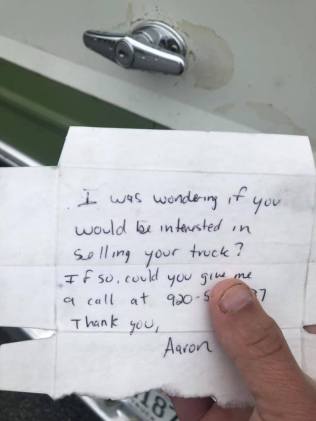
Here’s a fun example: We are looking for a “beater” truck to help us around the Ponderosa these days. The idea is that between Amy’s need to haul mulch and the requirement that we haul our own trash to the dump down the road, we want something with an open bed that can accomplish dirty tasks. It can look like someone set fire to it and put it out with a set of golf clubs, but it needs to start easy, run reliably and stop when we push the brakes.

In flipping through Facebook ads, we found a 1978 Ford F-250 that looked good. The ad noted that it wasn’t much to look at but it “starts and runs great.” So, we drove about an hour up the road to see it.

The first clue things were wrong was that it was in a storage shed behind a bunch of other crap the guy and his kid were frantically moving out of the way. The second clue? Under the hood of the car, the carburetor (which is vitally important to starting and running) was being held open with a screwdriver. When it came time to start the truck, the kid got behind the wheel and the seller began pouring gasoline directly into the engine.

Even then, it didn’t start. It didn’t even make a sound, as the battery was dead, too.

“I thought you said this starts and runs,” I said.

“It did when I put it away last spring,” he replied.

You don’t have to be an expert in much of anything to know that a lot can change in 15 months. If you look back at your Facebook memories from last year at this time, something tells me that you’ll notice more than a few differences between then and now. Hell, 15 months ago, the only reference to a “coronavirus” was probably how you described the morning after a rough Cinco de Mayo party.

After a few more attempts to start it, I told the guy that I was leaving.

Thus, “starts and runs” should have been “started and ran a while ago.”

FACT CHECK THE HELL OUT OF STUFF: As the above example demonstrates, not everything you see in these ads is factually accurate. I suppose I could give the guy a pass on the starting and running as it actually did at one point. (I mean the Enterprise didn’t beam that truck into the storage unit.)

I’m a little less forgiving about things that clearly aren’t true.

We went to see a 1964 Ford 100 that seemed to fit the bill. When I got there, everything was what I wanted: sturdy truck bed, good tires, strong brakes and more. The problem? The truck was listed as having an automatic transmission, something that wasn’t true.

(In case you are unaware, if you have THREE large pedals along the floor of the driver’s side of the car and you need to step on the one on the far left frequently as you shift a stick near your right hand as you drive along, this is a MANUAL transmission. It’s also known as a “stick shift” because you are shifting it manually, with that little stick.

If you have TWO large pedals along the floor of the driver’s side and you need to apply the brake only ONCE as you shift your car to the “D” spot on the gear shift, wherever it is located, and the car does the rest of the gear shifting for you, this is called an AUTOMATIC transmission. It means the car “automatically” shifts for you as you go faster and faster and faster.)

Truth be told, I can’t drive a stick shift. Well… That’s not entirely accurate. If you got mauled by a bear and I had to get you to the hospital to save your life and the only car available was your stick-shift car, I could get you there. You would live, but we’d be holding a funeral for your clutch and gearbox.

This guy was not alone in listing his vehicle with the wrong transmission. I saw FOUR of these online that listed the trucks as being “automatic” when I could see pictures of both the shifter and the clutch in the ad. When I asked a couple people about the inconsistencies, they said, “Oh… Yeah… then I guess it is a stick…”

Good grief.

When it comes to your own writing, fact check the hell out of stuff before you publish it. If you aren’t sure about nuances like the difference between a bacteria and a virus, look both of them up and make sure you’re right. If you don’t know what a word means, look it up before you toss it in there because you’re pretty sure about it.

And, if you don’t know the difference between an automatic and a stick shift… Well, you probably didn’t read this post carefully enough. Go back and take another look.

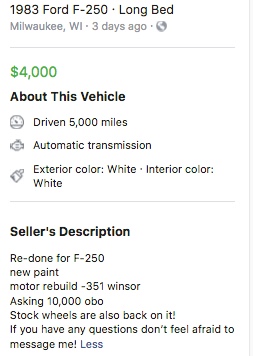
CONSISTENCY AND CLARITY COUNT: When it comes to your writing, you want people to feel informed and grounded in the topic. Being consistent in your writing helps with this. When you get contradictory information in a piece of writing, it can be more than a little jarring. Case in point:

Ford4000

In reading the opening, I’m looking at a $4,000 truck. When I get to the body of ad, it’s $10,000 (or best offer, which I’m guessing won’t be at the $4,000 level).

Another ad showed a truck with a plow for $2,000. The body of the ad noted, “Don’t low ball me by offering $4K for both the plow and the truck.” I wasn’t sure how offering twice what you asked for something would be a “low ball,” so I asked the guy.

“The truck is $2,000 but it doesn’t come with the plow. That’s at least another $5,000.”

So, maybe mention that?

Another oddity of inconsistency comes from a seller who notes “Truck runs, drives and stops as it should. Will need to be trailered.”

OK, wait… If this thing is road-worthy, running, driving AND stopping as it should, WHY do I need to tow it out of there?

In the field of professional advertising, what these folks are doing would be called “bait-and-switch,” where a business offers one thing and then quickly switches it out for a more expensive item or inferior product. I wouldn’t accuse these folks of this tactic, as I think they’re just bad at communicating what they want.

Still, if you’re trying to reach an audience, this can be annoying for your readers.

EVERYTHING CAN USE AN EDIT:

“needs rear main seal eventually ,leeks new brakes”

(I’m guessing it either leaks from the rear main seal or the guy is using giant scallions to stop his truck.)

“needs new breaks and break lines”

(What do we need to break on it?)

“Has manuel transmission”

(I wonder who Manuel is, but if he can run the stick-shift for me, I’m interested…)

“I have a 1966 ford Ltd for sale starts, runs, drives ,surface rust only I have two separate interior for it everything works as it should blinkers, whipers, windows everything works price is negotiable please feel free to contact me with offers and for more information”

(Located on just above and slightly to the right of the space bar is the period key. Try using it once or twice. Or more.)

“2WD, 4SP, 350 CI, Need brks, batt. U haul, 2500 obo No LBall.”

(This is either a text message in code or a ransom note crafted by someone with limited access to magazine covers.)

I’m hopeful these bits and bites of information can help you as you look to work on your writing.

And, yes, we’re still looking for a truck.


God (and your husband) will be watching: The failed Peloton Christmas ad campaign

Unless you have been living in a cave, or a part of the country in which your brother’s spouse is considered inheritable property, you probably know that Peloton has landed on the “most-hated” list for gifts this Christmas, thanks in large part to the ad shown above.

Social media users have skewered the ad for its gender stereotypes, its use of a “gender normative” set of characters and its generally creepy “God is watching” vibe:

Peloton is so far sticking by its widely mocked holiday ad. The spot, called “The Gift that Gives Back,” continued to air Tuesday evening on networks including ESPN, Lifetime, Bravo and HGTV, according to ad-tracking service iSpot, even as criticism grew.

The ad, about a woman whose husband gifts her an apparent life-changing exercise bike, sparked a gender backlash that clearly clashed with any seasonal cheer the brand was expecting.

“It’s a complete male fantasy ad,” says Kit Yarrow, a consumer psychologist, noting that the spot could inspire men to be “gifting heroes” and get “skinnier spouses.”

A Peloton costs between $2,250 and $2,700, depending on which package you buy. That’s pretty pricey for something destined to become a high-tech clothing rack. It’s probably even more expensive when you factor in the therapy you’ll need when the instructor starts screaming at you to work harder or in the case of this parody, your divorce:

https://twitter.com/evaandheriud/status/1201610153549848580?s=09

A good friend who is a feminist scholar nailed the Peloton ad in a way I couldn’t:

She is already fit and she documents every minute for him as if he is watching her every move. Look at her face. At the end she says her life is so much better but there is no evidence given why her life is better, except that she gets up before dawn when she doesn’t want to so she can ride some bike for him. No one should do such things only because another person wants them to.

After I read that post, I went back and rewatched the ad. I noticed things like the look on the wife’s face on day one: It’s a mix of fear and “I hope to please you.” The fact she records every day for the purpose of eventually showing him the video at the end is freakish. The fact that she seems to be biking at all hours seems obsessive. The daughter seeing her already-thin mom biking like a maniac provides a strange modeling behavior. Also, what the hell was the guy doing all this time? Is he in a room full of TVs watching her like Billy Baldwin in “Sliver?”  At the local bar getting fat on beer and pork rinds, because, hey, it’s not like he has to worry about his waistline.

Holiday ads for high priced items tend to really lead to awkward advertisements. The Kay Jewelers “Woman who is scared of lightning and needs man to protect her” ad stereotypes women in multiple ways. Also their slogan of “Every Kiss begins with Kay” seems to imply, “Wanna get laid? Buy her some jewelry!”

Pick any Lexus ad that involves a big red bow and you essentially can see even more awkwardness. If you want to step past the fact it’s pretty much always some rich handsome dude buying some trophy wife woman an overpriced Toyota with better hubcaps, you can still see some real creepy in this ad:

Not sure what they were going for here. “Lexus: Bring out the little girl in your wife.” Eeew.

If the maxim, “There’s no such thing as bad publicity” is true, Peloton is getting a heck of a lot of value out of body-shaming a stick-thin woman. People are debating the ad online and morning shows are running it on a constant loop to give it an official “tsk tsk.”

However, the truth probably is that the company did more harm than good to its brand. The stock price, which got a quick uptick after the ad went viral, has since gone back down, in a slide some are calling a “nightmare.” Also, any guy who picked up a Peloton in November thinking, “She was asking about this thing. I’m a great guy for getting it.” is now swearing up and down to Citibank that this was a fraudulent charge.

Maybe the only person who came out of this with any benefit was Monica Ruiz, the wife in the commercial, who scored another gig based on her role:

4 non-digital things the digital marketing experts at DealerSocket do that would benefit any media professional

DealerSocket

Rachel Choy and Kat Pecora of DealerSocket answer questions from students at UW-Oshkosh during a panel session on digital marketing Friday.

Three members of the DealerSocket team visited their alma mater Friday to showcase various elements of the technology they use and the ways in which they apply digital marketing effort for car dealerships throughout the country.

Rachel Choy, Kat Pecora and Wes Lungwitz work at the Oshkosh portion of the company (which used to be known distinctly as DealerFire). The company helps build, oversee and market digital content for automotive dealers all across the country. Their panel presentation, “Digital Content Development and Analytics,” and the subsequent Q and A covered a wide variety of topics ranging from cutting edge SEO techniques to measuring key analytics via up-to-date digital tools.

Between the explanations relating to the impact voice search is having on the industry to the analysis of PPC and CPC, the students who watched were enthralled with the possibilities available to them in the digital marketing realm. As important as those things were, I noticed that underlying the tech talk were several non-digital rudiments that these folks said made their efforts successful.

Here are four takeaways I pulled from their panel that matter a great deal to journalists of all stripes, regardless of if they’re digital geniuses or working with old Commodore 64s:

WRITE FOR THE AUDIENCE: The key distinction between media writing today and media writing of the past comes down to who’s in charge. In the days in which media professionals ran the show and readers had limited outlets, it was about journalists telling an audience what they thought readers should know. Today, the model is exactly the opposite: Readers have more choices than ever before, so it’s more about writing for the readers, based on what they want to know.

The DealerSocket approach is a good one for all writers: Do research about your specific readership, find out what matters to those people and then write about those things. This is often difficult for news journalists, but it can be even more frustrating for clients who want to see direct results. In other words, the people paying the web folks just want to tell the audience, “Buy a car!”

Instead, the staff writes content to make the readers happy and entice Google.

“Content is a really great way for people to find you,” Pecora said. “Oftentimes, you don’t have a lot of content on your website, so you’re going to show up really low on search terms. It’s a very competitive area and a tough market so the best they can do is create content.”

Lungwitz mentioned that content isn’t just about cars, but things people care about, like a post a staffer wrote for a site about trick-or-treat times in a given area. The post wasn’t helpful in selling a car, but it was helpful in drawing people to the site where the dealer sold cars. The staff then monitors things like bounce rate, to see if people just came in for that one thing and left or if they transferred into the site.

As Pecora said, the goal is to develop an audience that wants to hear what you have to say.

“The more Google is seeing your search terms, and your content is meaningful and useful (to the audience), the more Google is going to send people to your website and that will boost your domain authority.”

BECOME DISTINCT: In most cases, the team at DealerSocket starts working with car dealerships at ground zero of their digital build. With that in mind, they have the opportunity to create both the content for a variety of digital platforms and the general persona the company wants to express publicly. The goal is to understand what the client has that no one else has and then communicate that effectively.

“We try to dig something out of them,” Lungwitz said. “‘How are you different?’ We take our cues from journalism. It’s like any of the interviews you’ve done.”

Like most sources in journalism, people tend to have problems talking about themselves or seeing things about themselves that are unique. It’s the goal of good journalists to find ways to access those things and then showcase them to the readers in a valuable way.

“We take a white-glove approach to customer service,” Pecora said. “What does the customer need and what is unique about this customer? We take the time to really find that out and dedicate energy and time to doing what’s right for them. It really pays off.”

Choy noted that she would research her clients to find the things that made them different from other dealers within a geographic area, as well as what made them different from others dealers within the market segment. When she would discuss these things with her clients, they were often impressed with how a person in Wisconsin could know so much about a dealership in California or Texas or North Carolina.

This not only helped her sharpen the focus of the site for her clients, but it also helped with the next main point…

BUILD RELATIONSHIPS: Advertising has moved far from the old “Eat at Joe’s” billboard days, but the underlying premise still remains the same: A client needs people to buy or rent or believe X and the marketing professional has to build content to make that happen. Unfortunately, the line between ad and sale isn’t as direct or as clear as it once was, so trust becomes a huge part of making this relationship work over time.

“It’s a marathon, not a sprint,” one of the folks noted on the panel.

As much as DealerSocket is building custom landing pages for dealers, publishing press releases and managing reputations on social media, the folks who work with the dealers also understand it’s about building trust. To earn this trust, the staff members do their best to explain not only what they are doing with a dealer’s website, but also WHY they are doing it, in the context that makes sense to the clients.

“I explain that your website is like your car and your digital marketing is like the gas,” Choy said. “If you don’t continue to put gas in the car, it’s only going to go so far.”

“Some clients say, ‘I’m not getting enough contact on the website.’ We ask, ‘What are you doing?’ and they say, ‘Well, I have the website!'” Choy added. “Google likes sites that are continually updating… We explain that you need to be proactive to be sure you are the resource for the people… There has to be some kind of proactive action so that your car has gas.”

To some clients, this could sound a lot like a “trust me story,” where a company asks a client to keep throwing money into a hole with the idea that it will eventually lead to something good. Lungwitz said the relationships between the clients and the staff lead to actual trust and eventually the outcomes the dealers want to see. He mentioned this in discussing the trick-or-treat post noted earlier.

“This kind of thing isn’t directly tied to a sale, but we have to explain, ‘Let’s look at these other things,'” Lungwitz said. “It’s lifting all boats, it’s lifting your home page… Organic marketing is the long play. It’s not a direct response plan. It’s building over time.”

Just like most good relationships.

NEVER STOP LEARNING: The field of digital marketing, like most parts of journalism, is continually changing. What made sense six months ago might not make sense now. What works in one part of the country or with one brand might fail elsewhere.

As was the case with most panels involving professionals and students, the students asked for tips and hints on how to get a job and become proficient in this area of the field. Lungwitz had the answer that professors dream about when we hear that question:

“You try to further your knowledge every chance you get,” he said. “I read a lot of social media and SEO blogs. We get certification (on digital media tools) each year and we have to continue that.”

In other words, you should never stop learning.


Unblock this: Modern advertising and why we hate it

According to the media-writing book:

Advertising is about more than telling people what to buy and where to buy it. It is a communication format that mixes information and persuasion elements in an attempt to convince audience members to act. The desired action can take many forms, including purchasing a product, supporting a candidate or forming an opinion. In addition, some advertising is geared toward preventing action, such as buying some other company’s product, supporting a different candidate or changing an opinion.

Much of what makes this happen is about knowing your audience, which we discussed at length elsewhere in this blog and in these books. Demographics, geographics, psychographics and more all play a role in making sure the message gets from a valued organization to an interested and engaged receiver. Given what most of us experience on a daily basis, particularly on the web, that might seem as idealistic as taking Cinderella as your spirit animal.

If you want to know why advertising and media operations are in such ugly spots today, consider a recent experience I had in trying to read an online column. See if it matches with what you tend to experience and then ask yourself if that initial paragraph meets with reality:

One of my favorite authors, Terry Pluto, writes about Cleveland sports for the Plain-Dealer’s website and a link to one of his columns popped up in my Facebook feed. I clicked on the link and hopped over to the PD’s site, only to get a lock screen in which it noted I was using an ad blocker and asked me to disable it.

Some sites give you an option to continue without shutting off the blocker. Some try to guilt you into shutting it off. Some are like a Joe Pesci character on a meth bender, demanding you turn off the frickin’ blocker, you frickin’ mook… In this case, the PD gave me the “shut it off” option and nothing else. (Previous times, I got an option.)

As I noted earlier, I’m OK with paying for content. I’m also fine with the model that has driven media for decades through its salad days: Ads pay the bills for the content. However, consider these crucial messages that I got as a result of shutting off the blocker:

AdBlock1

Um… OK, apparently “history” is now about ’70s fashion and boobs… And thanks for trying to entice me with the “not suitable for all eyes.” It’s like the Simpsons monorail trick, but with sexual intrigue.

AdBlock3

AdBlock4

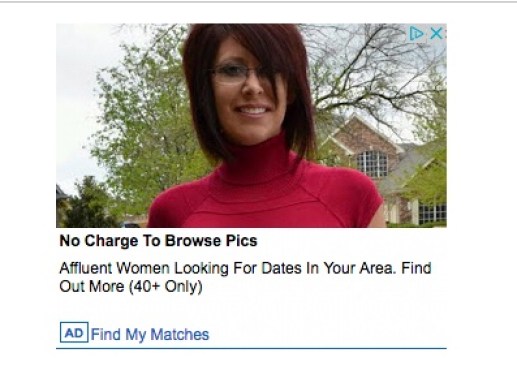
What the internet apparently thinks it knows, is that I’m broke, looking to cheat on my wife/get murdered and I have attention deficit disorder since it gave me TWO of these ads. It also presupposes that “older women” means anyone who can buy booze without the clerk breaking out a black light on her ID and that I wasn’t thinking, “Isn’t that Elizabeth Shue?” Moving on…

AdBlock6

If you touch your lip, you’re dying of cancer. Got it. Thanks.

AdBlock2

I’m not really deaf. I’m just ignoring you…

And finally:

AdBlock5

(I spent three minutes trying to type a word that effectively captures that sound I make when I’m feeling like I’m throwing up in my mouth. Whatever that noise is, fill it in here…)

I’m guessing your experiences are somewhat similar to mine, with tweaks for age brackets and theoretical senses of what “kids your age” want to see: Hot chicks/dudes are waiting in your area… 10 simple ways to stop (Acne/HPV/Failing Calculus for a third time)… SHOCKING! You won’t believe what (Fill in your childhood Disney Show love interest) looks like now!…  Drivers in (fill in your area) can BEAT SPEED TRAPS…

This is what advertising has devolved into for a number of reasons:

  1. It’s cheaper: You can place millions of impressions for the cost of what it would take to get a full page ad in a major metro paper.
  2. You have wider reach: A newspaper or a broadcast signal can only reach so far. An internet ad can come from anywhere on earth (except our old newsroom, where apparently you can’t get a signal to save your life).
  3. Fewer risks/restrictions: There used to be a lot of vetting and careful checking of ads and products. Now, ad groups and sites and collectives just send out anything as long as the CC number works or the check clears.
  4. Money: Media outlets have always been accused of being cash whores when it comes to advertising. Back in the earlier days when money was free-flowing, they could rebut this by avoiding sketchy ads. In the “we’re still OK” days, they were more like Julia Roberts in “Pretty Woman.” Today? Um…  My only analogies will get me redflagged by my editor, so just think of the lowest level of willingness to do stuff for money you can and you’re about there…

The unfortunate byproduct of this approach is a race to the bottom for advertising in the same way there appears to be a race to the bottom in news and other media fields. It can be easy to go along with the crowd in this regard, but if you want to make your advertising worth something, think about what it is you’re trying to do to create a message that reaches your readers and effectively evokes something from them. A great example of this just came out today (h/t Al Tompkins) with Nike showcasing the Women’s World Cup Team victory:


And here’s my favorite one from a few years back that still gives me the chills:

Nike gets it: Tap into something. Know your audience. Showcase the emotions associated with those people.

In the soccer one, it was one of announcing their presence with authority. With the Cavs one, it was that complete sense of quiet disbelief. The audience EXPECTED the women’s team to win and so it talked about the greatness of that team. Cleveland had gotten crushed so many times before, the audience EXPECTED the Cavs to lose (especially after going down 3-1 in the series). It got the emotions just right and it didn’t layer on the schmaltz.

If advertisers want to get beyond an eyeball grab, they have to fit more into this mold and touch on what we talked about at the beginning of the post. If the media companies that take their money want people to shut off the ad blockers, they’re going to have to ask questions that go beyond, “And what’s the 3-digit verification code on the back of the card?”

And if I ever want to eat lunch again, I’m not ever seeing another episode of Dr. Pimple Popper.

Guest Blogging: How “telling the truth” served Mary Beth Reser as she transitioned from a news reporter to a marketing COO.

As often as possible, we strive to post content from a guest blogger with an expertise in an area of the field. This week, we are fortunate to have Mary Beth Reser, the COO of Wilderness Agency. As marketing director for prominent real estate development groups and publishing companies, she leverages content to drive revenue and she works with organizations across industries to clarify messaging and share truthful stories to drive sales.

Reser.jpgShe manages operations for a team of 50+ creatives, but before her move into the “C suite,” she spent several years as a reporter, including for the Fairborn Daily Herald and Dayton Business Journal. Her post is about her movement from news to marketing and how her skills transferred across these fields. Interested in being our next guest blogger? Contact us here.

Nothing is more embarrassing than turning in an article past deadline to your college journalism adviser. It’s even more embarrassing when you’ve spent the last month restructuring your company partly on the basis of missed deadlines.

How did we get here?

I didn’t set out to be a COO. In fact, my career path is nothing if not defined by a series of pivots. I spent 15 years, from age 10 to 25, dedicated to being the absolute best journalist I could be. I started school newspapers. I pushed them to the limits. I chose my high school and college purely on the goal that I would spend my future as a daily reporter in some metro somewhere, pounding pavement and investigating tips.

I didn’t count on a couple things. The economy. The availability of jobs. The lack of pay. Sexism and ethical dilemmas I encountered while in the industry.

I told myself I wanted to focus on telling positive stories. I couldn’t bear the weight of covering crashes, fires and violence, so I switched to business reporting, which had interested me in college. Then the recession hit, and positive stories on my mostly positive beats turned sour.

In the end, I could only blame my discontent on myself, and after five years as a professional reporter, I pivoted. Having turned on the most steady passion of my life, I went through some lengthy periods of self evaluation. I knew was that I still loved telling stories. True stories. With positive results.

I spent the next four years as in-house marketing/PR at two commercial real estate firms. I was telling stories in the form of press releases, and I was starting to tell–and sell–commercial space to tenants based on stories I was telling through marketing.

Chasing happiness, I jumped back into publishing and helped to develop social media sales strategies and digital sponsored content for a mostly advertorial publication. We’ll call this my gap year.

Four years ago, I made the jump into agency work and discovered my true passion. I could work with a variety of clients and tell TRUE stories in several ways that achieved measurable results. I graduated my first agency job and convinced a friend from the business reporting days to pull me in as a project manager at Wilderness Agency. I was still telling stories, but now I was putting teams together and telling them on a larger scale, not just through copy, but also design, websites, digital marketing, content strategy and video.

I was using my storytelling skills in new ways, and the business was growing as a result. In fact, we were skyrocketing. This is not to brag, but to explain the place I find myself currently. As we grew, I grew, and I started making major decisions for the company. I moved into a director of operations role, and started focusing on the Wilderness Agency story. Who do we hire? Where do we spend? How does it all fit together?

I looked around and suddenly, I had gone from business reporter to running a business. I look up how to spell proforma at least once a week because, I am flabbergasted at how I came to see one as an extension of myself.

These days, I am still telling stories, but the stakes are higher. When I worked on our clients’ accounts, I was affecting their businesses, but now I am affecting our own. The stories I tell now, with numbers, with org charts, with process decisions, affect not just my own income, but the livelihood of the 10 employees and 40 contractors who work for Wilderness Agency. They support my boss, that same friend from the business newspaper, who had blinked and found himself transitioned from sales intern to CEO.

We are the fastest growing agency in our market. We attribute it to telling the truth, which is painful, but welcome in the current climate. It’s not always comfortable for businesses to hear what they should or should not be doing, but we find we don’t have time to mince words or present them with smoke and mirrors, and they don’t have time to hear anything else.

And sometimes, I have to prioritize work over a lot of other things I’d like to do, such as turning in this article on time — sorry, Vince.

The stories I tell now are guided by the ridiculously annoying number of questions I ask in sales meetings, because after all, I have the heart of a reporter. We dig down to the truth and use it to everyone’s advantage. And when I focus on turning that interrogation on Wilderness Agency, we benefit as well.

I may not be telling the same kinds of stories as I did 15 years ago. They don’t get measured in inches or hits. But the stories I tell now are supporting a business, and the passions of myself an a team of special marketing operatives we call Wilderness Agency.

Sick toddlers and drunk college students unite! (Why Pedialyte’s marketing shift worked and what you can learn from the company’s approach.)

The first time I heard the word “Pedialyte,” my wife was yelling it at me.

Our daughter was less than a year old and had consumed some formula that wasn’t agreeing with her. She had started vomiting, even though she didn’t have the vomit reflex yet. Her whole head would turn red and then she’d expel some of the semi-digested crud and look up at us like, “What did you do to me?”

Amy was worried Zoe would get dehydrated and thus fall into some series of other horrifying illnesses. (We were first-time parents, so everything freaked us out. Our friends with seven kids were like, “Let her barf a bit. She’ll learn…”) Thus, I was dispatched to the closest store to get Pedialyte.

“What is this stuff?” I asked, as I struggled to understand her over the screaming child rolling about on her blanket.

“PEDIALYTE! For GOD’S SAKE. It’s (expletive) PEDIALYTE!” she screamed over the noise machine that was our child.

At first, I couldn’t find it, as I wandered around like the clueless dad I was. Still, I wasn’t leaving without “(expletive) Pedialyte,” lest I end up buried in a shallow grave in my backyard that night.

Fear of death and vomit are inspirational.

I eventually found the stuff and got home and the kid started to normalize. As she got older, Pedialyte became less important to us around the house. I would only see it in parenting magazine ads or during daytime TV shows, hawked as essentially kiddie Gatorade. The marketers had a great niche product that sold a simple idea to a key demographic: Parents who were freaked out about their vomit-plagued kids becoming brain-dead raisins.

That’s why I was amazed when I saw this article on how Pedialyte has shifted market focus to draw in a whole new generation of users: Vomit-plagued older kids, who would likely drink toxic waste if you told them it would cure a hangover.

The article notes that about three years ago, Pedialyte began targeting the “hangover market,” pitching itself as a cure for dehydration that could provide relief for those who over-imbibe. In the years before that, the “Pedialyte cure” had been passed along by word of mouth in colleges and universities across the country, so the company decided to embrace it with marketing. The company’s Twitter feed and other social media outlets focus on this premise, with images of college-aged people guzzling the beverage and tweets that respond to people asking for hangover help. It incorporated the hashtag of #notjustforbabies to brand itself as being useful for these situations.

I asked my 8 a.m. class, which usually looks like extras on “The Walking Dead,” if they ever heard of Pedialyte and at least four people woke up long enough to tell me, “Oh, yeah! That’s the hangover cure stuff!”

And it works on vomiting infants, too!

Consider the following points to help you understand why this worked for Pedialyte, when so many other shifts like this fail:

The market expansion didn’t cost the company its initial market. On far too many occasions, a company will go after a different demographic or take a different approach to grab new users in a way that undermines or degrades it original audience. When a company decides to market to a younger audience to tap the youth market, it can lose older audience members, who feel left out or abandoned.

In this case, the Pedialyte people managed to tap another demographic (hungover college-aged students/drinkers of alcoholic beverages who need hangover relief) without losing the people who initially used the product (parents of dehydrating infants and toddlers). The markets are not mutually exclusive, nor would marketing to one group make the other group uneasy. It’s not like a baby-formula manufacturer marketing its product as “the best formula for helping drug lords cut their cocaine!


The new pitch doesn’t force an identity change. Pedialyte still does what it says it does: It rehydrates people. It’s not trying to market itself now in an off-label way, like telling people they can use it to scrub rust off a car muffler or something. The identity remains the same and thus all of the characteristics and benefits of the product still apply in the marketing material. If you boil down the pitch for Pedialyte, you can simply say, “Drink this stuff because it stops you from feeling yucky when you’re dehydrated.” That’s true for infants who contracted a “tummy bug” and college students who “swear tequila never messes me up like this.”


The tone/feel for each marketing approach matches the vibe of the audience. Here is an advertisement that Pedialyte runs to target parents:

PedialyteKids

See what you have here in terms of tone and feel: Caring parent, cute kid, doctor’s recommendation, easy to use and fun flavors. It also reflects a softness with the colors, the background, the imagery and more.

Now look at the one for adults:

PedialyteHangover

A half-naked college-age guy who just woke up, clearly in pain and blinded by the light of his refrigerator. The fridge is a mess of random stuff with the only color coming from the Pedialyte bottle. The images are starker, the color scheme is darker and the fonts are more utilitarian. Even though the characteristics of the product are the same (rehydration), the benefits described are different than those outlined in those in the parenting ad (kids= easy to use, less sugar, fixes the kids after they get diarrhea; adults= stop the head pounding, fix the dry mouth, defeat the hangover).

Each piece works because it acknowledges its audience, targets the people in it and then makes a reader-appropriate pitch. The parents feel safer that they aren’t giving their kids something sugary or with too much extra non-essential stuff in it. They feel comforted that it’s the number one pediatrician-approved drink. It provides reassurances for them that they are doing a good, safe, effective thing for their children. For the hangover crowd, it’s not about doctor approval or the active ingredients that make parents feel secure in their choices. The ad essentially says, “Well, you got really messed up last night. Here’s something that will stop you from feeling like you were run over by a bus.”


3 things you can learn from Florida Atlantic University’s decision to “Photoshop” away crack cocaine

Student newsrooms usually maintain an inexplicable sense of humor that would appall most of polite society and mentally scar most human resources officials. One newsroom I visited had a “Wall O’ Creepy,” where staffers would post odd pictures or weird stories. Others had inside jokes, Photoshopped images and random quotes written, stapled or stenciled on walls, computer monitors and desks.

In the newsrooms I worked in and oversaw, we had all manner of oddity posted about. My boss at Ball State would usually call or email me to let me know if an important alumnus or big-name journalism personality was visiting the area that day, asking me to “sanitize” the newsroom. I know I failed at this at least once, as one of the top editors at the Indianapolis Star stopped by and happened to notice a photo of a monkey performing a sex act on itself that was glued to a computer monitor in our design pod. The conversation was awkward:

Him: Is that monkey (EXPLETIVE) itself?
Me: Yes, sir, I believe so… Over here is our photography desk…

Like I said, we’re all a bit weird.

Even as administrators wince at our idiosyncrasies, they often like to promote the newspapers on their website, thus leading to the issue for today’s post: How to handle the weirdness when promoting an inherently weird operation.

Florida Atlantic University has a long, awkward history in dealing with its amazingly good student newspaper, the University Press. The school once fired the paper’s adviser, Michael Koretzky, only to have him continue to volunteer to help the students, thus leading the school to try to fire him again. The student government also tried to get rid of a student editor because he pointed at someone. The paper has broken numerous stories on student government misdeeds, reported on campus concerns and generally been a pain in the keester to the university through strong journalistic practices. However, as a successful and valuable entity, the school included a photo of the newsroom on its website, albeit one that didn’t quite reflect the actual state of the newsroom.

“When the photographer visited our newsroom, the editors were in a meeting,” Koretzky explained in an email. “She told us to ‘act naturally,’ but apparently, our natural state isn’t photogenic. So she asked us to pose as if we were critiquing the paper – which was months old because we don’t print over summer.”

The photographer took several shots of the posed staffers, as well as a random woman who just came in to ask questions about how the paper worked. However, the background included a not-so-PR quote, as shown in a photo Koretzky shared:

Crack

When the image the photographer shot appeared on the FAU website, however, the quote was gone:

NoCrack

“The photographer then said she’d Photoshop out the Dan Rather quote,” Koretzky said. “I don’t think we believed her, because that seemed silly and FAU’s administration doesn’t have a reputation for completing tasks it touts. Weirdly, the photog shot only that angle, not the other walls that have no crack cocaine quotes.”

(Side note: I wasn’t clear if this was the photographer’s own sense of what to do or if this was a FAU marketing policy. I shudder to think what would happen to the photographer if she just did this, handed it over to an editor who ran it with the understanding it wasn’t Photoshopped and then caught the brunt of the backlash. This is why being on the same page as the boss matters.)

The fields of news, marketing and PR have different standards of what is and isn’t acceptable in a case like this. In addition, visual journalists have specific ethical standards as well that mandate what can and can’t be done to manipulate reality.

Generally speaking, in news, it would be a large ethical breach to manipulate images and news outlets have fired photographers for doing this in some cases. Marketing, advertising and public relations have more leeway in some cases, but in some cases, professionals in these areas have been excoriated for some Photoshop manipulations.

In the case of the University of Wisconsin-Madison, for example, the school had to reprint its entire run of freshman welcome guides and apologize to the public after officials manipulated a photo to make the student body appear more diverse.

Shabazz
(Note the one guy’s head on the left behind the woman in white’s arm.)

To get a fuller grasp on this, I asked several people who have worked on both sides of the fence to get a handle on the FAU’s approach to the “crack quote” in the image.

The most basic answer was one Koretzky noted earlier: Don’t shoot toward the wall with the quote on it.

“Two words: different angle,” a former news photographer and current visual journalism professor said. “Shooting the room at a different angle could resolve any ethical dilemma.”

Although the professor said marketing materials, including photos for advertisements, do alter images, the subject of the photo makes this manipulation a bit more concerning.

“I don’t mind elements being edited out for most advertising–that’s the nature of it, like taking out a street sign for a car on road ad,” he said. “Except in this case the promo is for a real tangible place, whose mission is the truth. The university is just asking for attention and not the kind they desire.”

One pro, who has served as a communications director for multiple organizations and who also worked as a newspaper journalist, said the university didn’t do anything to violate basic tenets of marketing.

“I think the university acted within bounds,” he said. “Marketing is about presenting things in the best light to the most people. So while students will find that quote inspiring, parents and donors might not. As long as the photo was not used in a journalistic capacity, which by your description it wasn’t, then it’s totally in bounds.”

Another pro, who wrote for the editorial side of magazines and also served in the marketing department of a major university, said she disliked both the shot and the alteration.

“I don’t think the PhotoShopping is a good idea, BUT i wouldn’t use that quote OR that photo,” she wrote. “Personally, I’d just use something altogether different.”

Whether this is an acceptable practice often lies in the eye of the beholder, the ethical standards of the organization and the common sense of the media professionals involved. However, here are a couple points to consider when you find yourself in a similar situation:

  • Get more than you need: This is a mantra of most broadcast journalists when it comes to gathering video and audio. The idea is to make sure you have enough content to cover your needs so you don’t end  up having to cut a corner to make something work, thus opening yourself up to an awkward situation like this. The photographer could have shot in multiple directions, taken various types of shots and done more to avoid the quote on the wall. It wasn’t as if she didn’t notice it. When you see that something might create a problem, get some backup options to keep yourself out of trouble.


  • Don’t be lazy: The photographing of this newsroom wasn’t a one-time-only deal, like a photographer capturing the first moon landing or a random explosion in a small town. It’s a newsroom that exists on the campus and is probably within walking distance of wherever the FAU marketing organization resides. Once she realized the words “crack cocaine” were going to be in the shot no matter how she cropped it, she could have probably found another 15 minutes to walk back to the newsroom and shoot some other shots. Photoshopping, while an important skill, was a crutch for laziness in this case. It was so much easier to just “blue-out” the background than to go shoot more images. Don’t be lazy. Go back and do the job right.


  • Know your code of ethics: I am uncertain as to which code this individual or the FAU marketing department adheres, but understanding that one exists and what it says about certain things can’t hurt. The Public Relations Society of America’s code includes a line about honesty: “We adhere to the highest standards of accuracy and truth in advancing the interests of those we represent and in communicating with the public.” The American Marketing Association has similar language pertaining to honesty, transparency and fairness in its code. Does a staged photo fit that level of accuracy and truth? Probably, as posed images are a standard element of most marketing materials and even some posed shots (environmental portraits, group shots) make their way into newspapers and magazines. Is the Photoshopping here accurate and truthful? Eh… Maybe yes, maybe no. The point is that understanding what your particular code has to say about certain activities might give you pause before simply saying something like, “I’ll just PhotoShop that out.”

“But I’m not going into news!” (or why you still need to know the basics of media writing to survive in life)

When my daughter was 5 years old, she often protested doing something my wife or I asked her to do with a whining version of, “But I don’t WANNNAAAAAA!” When people get older, they realize that’s not an acceptable answer, so they adopt a different tactic.

In the case of many of my students in the Writing for the Media course, the latter-day version of “I don’t WANNNAAAAA!” is “But I’m going into PR! Why do I need to know this stuff?” I get that from a variety of majors including those entering marketing, interactive web management, advertising and public relations. The argument is that if you aren’t a news hound, you don’t need to deal with all this grammar, interviewing and inverted-pyramid garbage.

Think again.

Everything you will do in any media-related field will require you to communicate effectively with other people. This will include written and oral communication, so you need to know how to write and how to speak in a way that gets a message across to people who need it. You also need to learn how to be almost paranoid about spelling, grammar and style as to avoid becoming a laughing stock among your peers and the public.

You don’t want people coming to the “State of the Uniom”

UniomTicket.jpg

You also don’t want to advertise in a way that gets kids too excited about going to their “Pubic School”

PubicSchool.jpg


You definitely don’t want your brochures to announce the graduation of people in “pubic affairs:

PubicAffairs.jpg


In PR, your inability to write a coherent sentence shouldn’t lead to a press release like this one (h/t to Nicky Porter at copypress.com):
PressFAIL.jpg

If you read through this list of Five Startup Press Release Fails, you’ll notice a lot of commonalities between what makes for good news pieces and good releases: Quality quotes, getting to the point immediately and avoiding jargon. Good writing is good writing in the media, whether you’re writing a press release or trying to translate a horribly written one into a news story.

I have often told students I can teach them almost anything in this area, except for how to “wanna” do it. If you don’t “wanna,” I have no chance of making you care and if you don’t care, why should the people who will read what you wrote?

How to avoid promoting the most racist sweatshirt in the world (or 3 things to help you avoid looking stupid, insensitive or worse when you publish something.)

monkey
(Yes, this actually ran as an ad. No, it did not go over well…)

Clothing manufacturer H&M found itself scrambling Monday when the advertisement above went viral on social media, leading many people to accuse the company of racism. The image of a black child wearing a “coolest monkey in the jungle” sweatshirt was pulled from all of the company’s advertising and company officials issued an apology. (As the article notes, this isn’t the first time an advertiser has manged to pump out a racially tone-deaf advertisement.)

The stereotyping of black people as “monkeys” or “apes” is not a new phenomenon, nor is it germane only to the United States, so attempting to give the Swiss-based company a pass on this racially insensitive ad doesn’t hold water. That said, the goal of this blog isn’t to beat up on people who make mistakes but to help you figure out how to avoid making mistakes like this in the first place. Here are three simple tips to help you avoid something like this:

  • Paranoia is your friend: Murphy’s Law includes the famous line about “whatever can go wrong, will go wrong” so it’s always best to plan for the worst. When you find yourself putting together ANYTHING that will be disseminated to the general public, you want to engage in some active paranoia. Read every word as if it might have a double meaning or if a misspelling might lead to an awkward moment (e.g. “Bill Smith, a pubic librarian, reads…”). Look at every image you have to see if anything could be misconstrued in a negative way or would cast aspersions on an individual or group. Go through every potential stereotype you can think of in your head and see if something looks like it might be playing into that stereotype (e.g., Is a blond woman shown to be less intelligent? Did you put a person of color into a “monkey” sweatshirt?). For example, check out this University of North Georgia course catalog cover:

    Notice anything particularly problematic? Like the white guy is winning the race, the other white guy is coming in second and the woman and the only person of color included in the image are coming in far behind?
    If you come across something that could cast a negative light on you or your organization, rethink your approach before publishing it.


  • Diversity is not a buzzword: One of the main reasons why having a broad array of people from various backgrounds and experiences in a media organization (or any organization for that matter) is because it help the organization gain a more diversified view of reality. Unfortunately, some places see diversity as a “check box” item in terms of race, gender or other demographic elements.
    In organizations that embrace this wider view of societal understanding, people can put ideas out there and open the floor for discussion. If the person who put the kid in the “monkey” sweatshirt didn’t see how this could be a negative stereotype, (and I’m not sure how this is possible, but still…) someone else in that organization who might have dealt with this kind of negative language could raise the issue. In the end, this likely would not have seen the light of day and thus we could have had a “cute kid in a sweatshirt” ad that didn’t lead people to think of the company as racially insensitive.


  • Know where the landmines are: As the famous Filak-ism notes, you will screw up at some point. Your face is not on a lunchbox. That said, some screw-ups are bigger deals than others, whether you know it or not. Case in point: I was interviewing for a job at a university in the southwest, so my wife and I went out and bought me some newer shirts and ties. When I got there, I got the stink-eye from some of the students and more than a few faculty members.

What I didn’t find out until much later in the interview was that my new shirt and tie combo was in the colors of that university’s most hated in-state rival. It probably wasn’t the only reason I didn’t get the job, but I’m sure it didn’t help.

When you are putting content out for public display, you should know what specific topics, ideas and issues are most sensitive to anyone in your audience. In the United States, pretty much anything having to do with race, gender or sex will have some pretty sensitive tripwires. In some cases, companies don’t pay enough attention to these possibilities, like when Bud Light got into a jam for using the phrase “The perfect beer for removing ‘no’ from your vocabulary for the night.” Critics charged it accentuated the ties between alcohol and rape culture.

It’s not easy to catch every mistake or avoid every public snafu, but it’s not hard to do a little research to figure out exactly where the biggest landmines might be and avoid them.

Clickbait, murderous gnomes and the Rummage Sale Theory of Journalism

In an attempt to point out how problematic question headlines, question leads and rhetorical questions were in journalism, I wrote a post using a hyperbolic question as a headline to prove my point: Are gnomes in your underwear drawer planning to murder you?

I inadvertently proved a second point: Why people use them and why they’re worse than I thought.

I posted the headline on Facebook and Twitter, which usually leads to a few dozen hits. About 20 minutes later, I went back to make a minor correction and found that my web traffic had spiked. The tweet was being retweeted like crazy (a relative term for a no-name blog) and I was getting people from Egypt, England and any other E place I’d never been showing up on the site. I don’t get paid for this and there are no ads, so web traffic isn’t vital to putting food on the table or keeping shoes on my kid’s feet, but it is kind of a rush to see actual, live people showing up to read something I wrote.

Here’s the problem: They were one-click wonders. For them, it was essentially clickbait.

They showed up because the headline made them curious, but once they figured out this was basically a site for journalism students and contained no actual murderous gnomes, they left. Traffic in the subsequent days was back to its usual collection of my three closest friends and that one former student who keeps looking for spelling errors so he can torment me.

In quality journalism, regardless of if we are talking about news, ad, pr, marketing or anything else, we don’t want to have what I call a Rummage Sale Theory mentality. The idea behind this “Filak-ism” is based in a tradition in Wisconsin, whereby summer comes and everyone in this proud state starts selling stuff out of their garages on weekends. Cities build events around “citywide rummage days” and there are flea markets all over the place.

A rummage-sale mentality says, “I want to sell this thing and get it the heck out of my garage.” Thus, when you are selling a somewhat wonky lawnmower and someone asks, “Does it run?” you might respond with, “Yeah! Runs great!” The idea is that if this person buys the mower, you will never see him or her again. It’s not like someone is coming back in two weeks to knock on your door and tell you, “Hey, that mower sucks!” It’s a one-time transaction-based relationship with someone you will never see again and about whom you care very little.

You have to approach journalism like the owner of a local store: You live there, people will come to you multiple times and if you mess them over, you are in a lot of trouble. People will avoid your store and tell other people about the bad experiences they had with you. You will gain a reputation that harms your ability to do your job.

Conversely, if you treat people right, give them what they need in an honest and upfront fashion and avoid the one-hit-wonder, clickbait mentality, you will develop great relationships that further your reputation as a trusted resource. It’s why ads need to be more fact than hype. It’s why PR professionals profess transparency as the main virtue of the field. It’s why reporters stick to promises of anonymity, even when it would be better for them to throw a source to the wolves.

In this field, we own the store. We live here. We need to act like it.

We can’t sell people broken lawnmowers powered by homicidal gnomes and expect to survive.