“But I’m not going into news!” (or why you still need to know the basics of media writing to survive in life)

When my daughter was 5 years old, she often protested doing something my wife or I asked her to do with a whining version of, “But I don’t WANNNAAAAAA!” When people get older, they realize that’s not an acceptable answer, so they adopt a different tactic.

In the case of many of my students in the Writing for the Media course, the latter-day version of “I don’t WANNNAAAAA!” is “But I’m going into PR! Why do I need to know this stuff?” I get that from a variety of majors including those entering marketing, interactive web management, advertising and public relations. The argument is that if you aren’t a news hound, you don’t need to deal with all this grammar, interviewing and inverted-pyramid garbage.

Think again.

Everything you will do in any media-related field will require you to communicate effectively with other people. This will include written and oral communication, so you need to know how to write and how to speak in a way that gets a message across to people who need it. You also need to learn how to be almost paranoid about spelling, grammar and style as to avoid becoming a laughing stock among your peers and the public.

You don’t want people coming to the “State of the Uniom”

UniomTicket.jpg‘

You also don’t want to advertise in a way that gets kids too excited about going to their “Pubic School”

PubicSchool.jpg


You definitely don’t want your brochures to announce the graduation of people in “pubic affairs:

PubicAffairs.jpg


In PR, your inability to write a coherent sentence shouldn’t lead to a press release like this one (h/t to Nicky Porter at copypress.com):
PressFAIL.jpg

If you read through this list of Five Startup Press Release Fails, you’ll notice a lot of commonalities between what makes for good news pieces and good releases: Quality quotes, getting to the point immediately and avoiding jargon. Good writing is good writing in the media, whether you’re writing a press release or trying to translate a horribly written one into a news story.

I have often told students I can teach them almost anything in this area, except for how to “wanna” do it. If you don’t “wanna,” I have no chance of making you care and if you don’t care, why should the people who will read what you wrote?
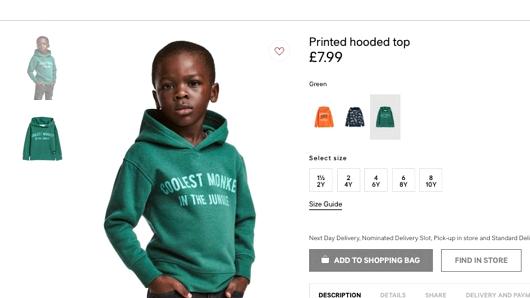
How to avoid promoting the most racist sweatshirt in the world (or 3 things to help you avoid looking stupid, insensitive or worse when you publish something.)

monkey
(Yes, this actually ran as an ad. No, it did not go over well…)

Clothing manufacturer H&M found itself scrambling Monday when the advertisement above went viral on social media, leading many people to accuse the company of racism. The image of a black child wearing a “coolest monkey in the jungle” sweatshirt was pulled from all of the company’s advertising and company officials issued an apology. (As the article notes, this isn’t the first time an advertiser has manged to pump out a racially tone-deaf advertisement.)

The stereotyping of black people as “monkeys” or “apes” is not a new phenomenon, nor is it germane only to the United States, so attempting to give the Swiss-based company a pass on this racially insensitive ad doesn’t hold water. That said, the goal of this blog isn’t to beat up on people who make mistakes but to help you figure out how to avoid making mistakes like this in the first place. Here are three simple tips to help you avoid something like this:

  • Paranoia is your friend: Murphy’s Law includes the famous line about “whatever can go wrong, will go wrong” so it’s always best to plan for the worst. When you find yourself putting together ANYTHING that will be disseminated to the general public, you want to engage in some active paranoia. Read every word as if it might have a double meaning or if a misspelling might lead to an awkward moment (e.g. “Bill Smith, a pubic librarian, reads…”). Look at every image you have to see if anything could be misconstrued in a negative way or would cast aspersions on an individual or group. Go through every potential stereotype you can think of in your head and see if something looks like it might be playing into that stereotype (e.g., Is a blond woman shown to be less intelligent? Did you put a person of color into a “monkey” sweatshirt?). For example, check out this University of North Georgia course catalog cover:

    Notice anything particularly problematic? Like the white guy is winning the race, the other white guy is coming in second and the woman and the only person of color included in the image are coming in far behind?
    If you come across something that could cast a negative light on you or your organization, rethink your approach before publishing it.


  • Diversity is not a buzzword: One of the main reasons why having a broad array of people from various backgrounds and experiences in a media organization (or any organization for that matter) is because it help the organization gain a more diversified view of reality. Unfortunately, some places see diversity as a “check box” item in terms of race, gender or other demographic elements.
    In organizations that embrace this wider view of societal understanding, people can put ideas out there and open the floor for discussion. If the person who put the kid in the “monkey” sweatshirt didn’t see how this could be a negative stereotype, (and I’m not sure how this is possible, but still…) someone else in that organization who might have dealt with this kind of negative language could raise the issue. In the end, this likely would not have seen the light of day and thus we could have had a “cute kid in a sweatshirt” ad that didn’t lead people to think of the company as racially insensitive.


  • Know where the landmines are: As the famous Filak-ism notes, you will screw up at some point. Your face is not on a lunchbox. That said, some screw-ups are bigger deals than others, whether you know it or not. Case in point: I was interviewing for a job at a university in the southwest, so my wife and I went out and bought me some newer shirts and ties. When I got there, I got the stink-eye from some of the students and more than a few faculty members.

What I didn’t find out until much later in the interview was that my new shirt and tie combo was in the colors of that university’s most hated in-state rival. It probably wasn’t the only reason I didn’t get the job, but I’m sure it didn’t help.

When you are putting content out for public display, you should know what specific topics, ideas and issues are most sensitive to anyone in your audience. In the United States, pretty much anything having to do with race, gender or sex will have some pretty sensitive tripwires. In some cases, companies don’t pay enough attention to these possibilities, like when Bud Light got into a jam for using the phrase “The perfect beer for removing ‘no’ from your vocabulary for the night.” Critics charged it accentuated the ties between alcohol and rape culture.

It’s not easy to catch every mistake or avoid every public snafu, but it’s not hard to do a little research to figure out exactly where the biggest landmines might be and avoid them.

Clickbait, murderous gnomes and the Rummage Sale Theory of Journalism

In an attempt to point out how problematic question headlines, question leads and rhetorical questions were in journalism, I wrote a post using a hyperbolic question as a headline to prove my point: Are gnomes in your underwear drawer planning to murder you?

I inadvertently proved a second point: Why people use them and why they’re worse than I thought.

I posted the headline on Facebook and Twitter, which usually leads to a few dozen hits. About 20 minutes later, I went back to make a minor correction and found that my web traffic had spiked. The tweet was being retweeted like crazy (a relative term for a no-name blog) and I was getting people from Egypt, England and any other E place I’d never been showing up on the site. I don’t get paid for this and there are no ads, so web traffic isn’t vital to putting food on the table or keeping shoes on my kid’s feet, but it is kind of a rush to see actual, live people showing up to read something I wrote.

Here’s the problem: They were one-click wonders. For them, it was essentially clickbait.

They showed up because the headline made them curious, but once they figured out this was basically a site for journalism students and contained no actual murderous gnomes, they left. Traffic in the subsequent days was back to its usual collection of my three closest friends and that one former student who keeps looking for spelling errors so he can torment me.

In quality journalism, regardless of if we are talking about news, ad, pr, marketing or anything else, we don’t want to have what I call a Rummage Sale Theory mentality. The idea behind this “Filak-ism” is based in a tradition in Wisconsin, whereby summer comes and everyone in this proud state starts selling stuff out of their garages on weekends. Cities build events around “citywide rummage days” and there are flea markets all over the place.

A rummage-sale mentality says, “I want to sell this thing and get it the heck out of my garage.” Thus, when you are selling a somewhat wonky lawnmower and someone asks, “Does it run?” you might respond with, “Yeah! Runs great!” The idea is that if this person buys the mower, you will never see him or her again. It’s not like someone is coming back in two weeks to knock on your door and tell you, “Hey, that mower sucks!” It’s a one-time transaction-based relationship with someone you will never see again and about whom you care very little.

You have to approach journalism like the owner of a local store: You live there, people will come to you multiple times and if you mess them over, you are in a lot of trouble. People will avoid your store and tell other people about the bad experiences they had with you. You will gain a reputation that harms your ability to do your job.

Conversely, if you treat people right, give them what they need in an honest and upfront fashion and avoid the one-hit-wonder, clickbait mentality, you will develop great relationships that further your reputation as a trusted resource. It’s why ads need to be more fact than hype. It’s why PR professionals profess transparency as the main virtue of the field. It’s why reporters stick to promises of anonymity, even when it would be better for them to throw a source to the wolves.

In this field, we own the store. We live here. We need to act like it.

We can’t sell people broken lawnmowers powered by homicidal gnomes and expect to survive.

Tell me a story without a single word

The goal of a good media writer is twofold:

  1. Tell me a story.
  2. Make me care.

Too often, advertising gets short shrift in this discussion because the cynical mind says the only goal in that field is to get me to buy stuff, by hook or by crook. The truth is advertising is the ultimate storytelling opportunity with a built-in feedback mechanism. It uses visual and audio elements to set a mood, tell a story and elicit a response. In some cases, the response is simple: Go out and buy this. However, in most cases, the responses are more nuanced in terms of brand loyalty and creating positive affect. In short, it can be less about “buy this” and more about “buy into this idea.”

In the media discipline, we push the idea that less is more and simplicity should be valued over complexity. Let the audience members come to their own conclusions and realize their own sense of things. “Show, don’t tell,” is the motto of the media writer.

This advertisement from State Farm does just that. It tells a story through visuals and audio cues. You get the whole point of the story without a single word. Only at the end does the company then step in to let you know, “Hey, we get you. We’re with you.”

Consider how best to tell your story in an ad as you approach your topic and your content. Remember, above all else, a good story will connect with your audience.