

The traditional “person on the street” interview has given way to the “tweet on the information superhighway” when it comes to getting a public perspective on big news. Journalists used to head out to a bustling area of town to talk to random citizens about issues ranging from who would win the World Series to what the upcoming year would bring:

I remember having to do a few of these things for localizations or reaction stories on things like the arrest of a person suspected of murder to the fans thoughts on Green Bay winning the Super Bowl. I can honestly think of nothing more pointless than trying to get drunken Packer fans on State Street in Madison, Wisconsin, to tell me something about their emotional state after winning The Big Game. The only person who had it worse than I did was Rick Blum. This poor guy from Channel 3 was standing on top of his van trying to go live at 10, as drunks pelted him with snowballs and chanted, “RICK BLUM SUCKS!” over and over again.
Interviewing the general public on any topic can be dicey, but it can get worse when you find out you are the victim of a horrible practical joke, as was the case in 2001 when the New York Post’s Neil Graves interviewed a local real estate developer:


If you don’t get the joke, Google Mr. Jablome or ask the closest pervert you know. Making this worse, I found this article again just last night and his quote is STILL THERE. Either the Post doesn’t get it or someone on the copy desk SWEARS he knows the guy.
It could always be worse, as this KTVO-TV morning team in Kirksville, Missouri, came to realize during a simple “Happy Birthday, Viewers!” segment that went horribly, horribly wrong:

The reason I bring this stuff up was because the descendants of Heywood Jablome and Dixie Normous showed up in KTVU-TV’s coverage of the Nike/Colin Kaepernick discussion. Check out the source for the quote at the bottom:


Honestly, I missed it the first time, but fortunately, I have plenty of well-trained former students out there, such as Alex Nemec, who basically had to walk me through this with four text messages until I saw it. (If you’re still missing it, read it aloud and also realize anything with the word “cock” in it has a really good chance of being dirty.)
I could spend all day looking up the various media outlets that got stung by quoting “Mike Rotch” or “Seymour Butts,” (and if the afternoon gets slow, I probably will), but the point here is to help you figure out how to protect yourself from these kinds of twerps. Consider the following advice:
- Watch “The Simpsons.” Or at least this compilation. If Bart Simpson called Moe’s Tavern looking for your source, it’s probably a good idea to go interview someone else for that scintillating, “Do you like sweet corn?” quote at the county fair.
- Go a few tweets deep: If you feel the best way to weave in that “man of the people” vibe into your writing is to find people on Twitter who you don’t know but are blathering on about your topic, look at a few tweets. “Barry” has a few interesting tweets on his timeline on a variety of topics. If I posted the ones here related to his quote about how Kaepernick’s Nike ad is affecting his marriage, I’m sure half the SAGE marketing team would have heart attacks. (Let’s just say he noted that his marriage was harmed when he caught his wife being unfaithful to him with a man wearing only Nike socks.) Here are a few tamer tweets he posted:
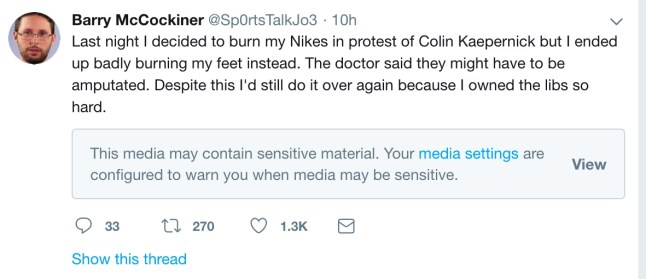

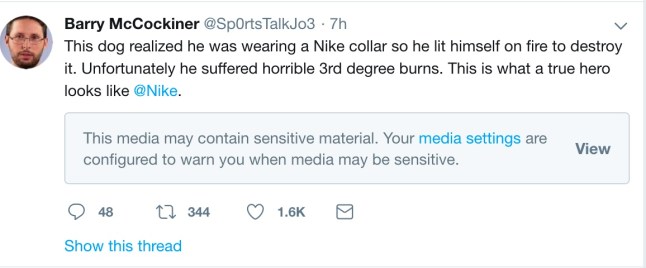

He also has a wonderful diatribe about how he has been constantly on heroin… Long story short: Is this REALLY a source you would want to represent anything you’ve written? If you are going to use a Twitter user, try to find someone who a) you recognize, b) has something important to say and c) doesn’t look like a loon in everything he or she is saying
- Trust, but verify: The Russian proverb works wonders here, as not every double entendre of a name is a prankster. The Cleveland Indians once had a pitching coach named Dick Pole. I’m not kidding. Here is a doubly unfortunate card of his when he pitched for a minor league team in Portland:


I knew a weird guy who used to show up at baseball card shows with a binder full of cards like this called his “Book of Dicks,” containing cards of Dick Allen, Dick Pole, Pete La Cock, Woody Held and others. The point is, those are real names, so it’s not always an attempt to punk you if you get a weird name.
However, it’s up to you to go take a look around and see if there is any supporting evidence that guys like Barry McCockiner exist. One of the downsides of Twitter is that you are limited to what people tell you about themselves, so it’s a little more difficult to verify the source. In the case of Mr. Jablome, a check of area real estate developers could have limited the embarrassment. In either case, you obviously can’t “card” a source to verify his or her name, (although some jokesters have gone to great lengths to prove their identity) but you can do some Googling and social media checks to see how likely it is that Jack Mehoff is a real person.
- Ask for help: As we noted in earlier posts, it pays to have a person in your organization with a demented mind. The old saying of “it takes a thief to catch a thief” rings true in this type of work as well. You should read the name aloud, have others do the same and then eventually hit up Jimmy The Crime Guy or whoever in your organization has the ability to turn anything into a dirty joke. If Jimmy can’t figure it out, you’re probably safe.