

I learned something incredibly important and potentially valuable for other social media users on Saturday night: Popularity as a social media practitioner can be an illusion and you really should check in on your audience fairly often.
By way of some backstory, when I was finishing up the “Dynamics of News Reporting and Writing” book, some folks in focus groups offered feedback that this would need a digital and social media presence. Thus, we launched the blog and tried to let people know that I’d be doing this as part of both of my “Dynamics” books. As for social media, the people recommended a strong Twitter presence, which I had, but it probably wasn’t going to helpful in selling books.
I was a pretty early adopter of Twitter (relatively speaking to the field and really for me, given that I still own a VCR) so I have been using it for almost a decade now. I built up a “following” of more than 500 people over the years and I had always managed to keep pretty good Klout scores (when that mattered) and the right ratio of followers to people I followed. Almost 7,000 tweets later, I really didn’t want to start all over again. However, given how far back I was tweeting (I can’t remember what I ate for lunch today, let alone what level of stupid crap I might have put on Twitter in 2009) and my general ability to fly into a Twitter rage when I felt the Indians or Cavs were getting screwed by the officials on any given day, it seemed like the smart thing to do.
I tweeted out to my followers about three months ago that I was shifting to my new handle and told people to follow me there. I did this a couple times and found that about 75 people either moved over or joined me at the new handle. I was wondering how and why I didn’t have more support from those other folks. I found a suggestion online to remedy this: Pull up each follower, determine that follower’s value and then send off a personal direct message to that person, asking him or her to shift over. Then, do one final “Closing Time” tweet and shut off the old account.
In my “direct message” adventure, I found out a few things that might be helpful to you as you analyze your true social media reach and determine how best to serve your audience. A working knowledge of “Dazed and Confused” could be helpful here…
- FILTERS DON’T CATCH EVERYTHING: I have some pretty good filters on my social media accounts to avoid the viruses and spammers, mainly because really smart people at the U helped me set them up. That said, I found at least a few things got through. A couple accounts for “Free” whatevers were in there, although my favorite was from the account of a woman, who posted a picture where she appeared to be in her 20s. She was leaning against a white wall and had her finger seductively pulling down the middle of her blouse to reveal cleavage, and her bio noted that she was lonely and hoped I’d be in touch soon.
To be fair to me, I think it says a lot about my own personal sense of self that when I saw that, I immediately went, “Yep. Spam.” As I know fully well nobody in their right mind a) sends something like that on Twitter and b) would ever think to send something like that to me in any way, shape or form. I am not a middle-aged, self-deluded Wooderson:
https://media.giphy.com/media/g5zvwUa9720pO/giphy.gif
LESSON 1: You need to go through and hand-cull some of these spam accounts yourself as to avoid problems in the future as well as to have a better sense of who is really paying attention to you and why. Fellow journalists: Keep ’em. Guys from Jersey who swear they’re hot Swedish models in your area who are just dying to meet you: It’s probably not worth the risk. Block ’em.
- AND YOU ARE…? : In flipping through the list of followers, I did have more than a few “Wooderson’s little black book” moments, as I had apparently picked up people I was following and they were following me and I had no idea who the heck they were:

(C-Y-N-T-H-I-A? Yeah… Who are you again?)These were random people who I apparently met at various media conventions, or whose papers I critiqued or who were former colleagues for 10 minutes some place or… Heck, I don’t even know. What made it worse is that they had no real context clues on their biographies. When someone put “Journalist” in there at least I had a clue, or “Former EIC of Smithville Junior College Paper,” I could employ some deductive reasoning. However, your favorite Bible verse or random quote didn’t help me figure out if I should keep you or ignore you. (To be fair, my Twitter bio never changed in 10 years and it sucked: “If you follow me, you are not allowed to be offended. Opting in is an implicit admission of guilt.” Yes, you can say it. I sounded like a dipshit.)
LESSON 2: Your audience might be full of people you really don’t know at all. That can make it harder for you to tailor a message for them. It’s a good idea to go through that list of people occasionally to see if you really have a message for these people or not. Obviously, you shouldn’t randomly block people, but consider the degree to which these people are valuable beyond your ability to count them. The goal of social media is to increase sharing and interactivity on topics of common interest. If that’s not your audience (or if you’re not hitting your audience because you don’t know them), you need to review your options. (Side note lesson: Use your bio to actually help other people know you and give a damn about you. It’ll help both of you. I will be updating mine shortly after I finish this post…)
- DEAD WEIGHT, DEAD WEIGHT EVERYWHERE: I was amazed that so many of the people who followed me and who were in the “social media demographic” were basically nothing but a Twitter shell. Several accounts hadn’t posted anything in years. One even noted: “I’m only creating this account because you made me.”
Fantastic….
Some accounts were from people who started them as projects before hashtagging became a more popular way to track tweets on a topic. Thus, I was being followed by a few journalism conventions from 2009 or so, and they obviously had very little to say. Some people had long ago left their gigs as media advisers or journalists and their accounts basically ran dry.
LESSON 3: Chicago elections aside, the dead shouldn’t be adding to your account tallies. If you find people who aren’t active or who aren’t giving you value, feel free to thin the herd and make that audience a bit clearer and a bit more honest in terms of the people who are truly “following” you.

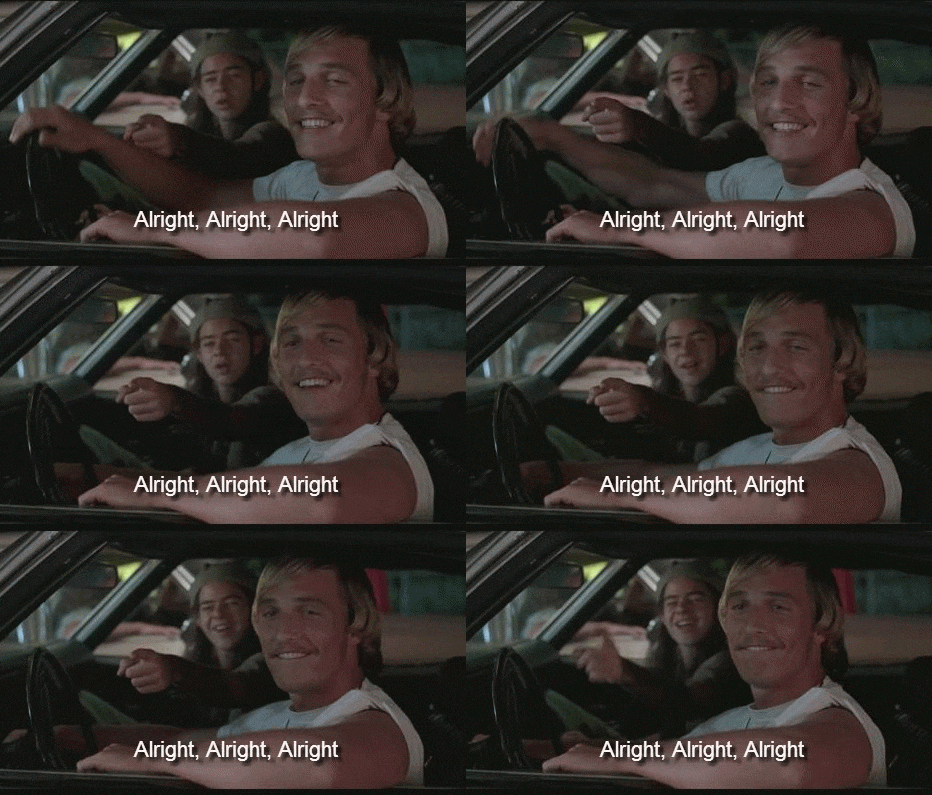
When all was said and done, the people I had to block or cut shrunk my number to about 450. When I got rid of the “I don’t know you” people, the number shrunk even more. Between the people who were already following me from the old account and the amount of people who responded to the DMs, I ended up with about 25 percent of my original audience.
I’ll be honest: The number of people following me gave me this false sense of popularity. Sure, it was only 500 people, so I wasn’t like Donald Trump’s Twitter feed, but that number was still a lot higher than a lot of folks I knew. Having it shrink by almost 80 percent was kind of a kick in the ego. Still, I’m going to follow up on this about every six months or so to see who is following me, why they’re (likely) following me and if what I’m putting out there fits their needs.
And if you’d like to be part of that group, feel free to follow me on Twitter at DoctorOfPaper.
(And yes, I’ll probably follow you back… Hey, we all have an ego to feed. 🙂 )