Last Chance to buy a “Filak Furlough Tour” T-Shirt

Of all the things I’ve done with this blog, I have to admit, the most amazingly fun thing has been this Furlough Tour. I’ve got to meet all sorts of educators, talk to a ton of students I never otherwise would have met and burned a boatload of baseball bats.

When I pitched this idea, I jokingly said that if we sold out 11 days, I’d have tour T-shirts. Well, we ended up with almost three times that many stops (and good seats are still available if you want me to just randomly show up on one of my own days to do something fun for your class or newsroom).

The T-shirts were simply a promise kept, which is what I always try to do. When two really cool design folk got involved, they became my pride and joy. I don’t make money off these, but I’ve got to tell you, they make me smile every time I see them.

The order form closes tonight, so this is your last chance to buy a Filak Furlough Tour T-shirt.

Thanks for playing along with my lunacy. More tour posts will be coming up this week.

Filak Furlough Tour Update: Hanging out at Iowa State University (Part I)

I think I only own one or two shirts. Also, I do not like my “Alfred Hitchcock Presents” profile…

The Filak Furlough Tour actually hit the road a few weeks back to drive out and visit a campus. Most people were fine with the “Vince on Zoom” experience, as it allowed them to shut me off and mute me when I got annoying. The good folks at Iowa State University knew me and decided that a couple days of me would be, at the very least, interesting.

Of all the campuses I’ve been on as a student, parent, faculty member and more, I found Iowa State to be among the best in terms of just feeling like it fit my personality. (I mean that as a compliment, not as a potentially libelous statement…) Nice people, smart kids, good questions and more. Totally worth the 4 a.m. car ride…


IOWA STATE UNIVERSITY – AMES, IOWA

THE TOPIC: I did one class on finding stories and trying to come up with the best ways to tell those stories and one on sports journalism, sports marketing and DEI. Since I’ve done a lot on the issue of finding stories, we’ll go after the second one.

THE BASICS: This had to be one of the more interesting experiences I’ve had, in that the class was set up like a press conference, with the students driving the discussion on the topic and then live-tweeting the entire thing as they saw fit. The professor gave me the option of asking them not to record or put me on social media.

“Nah,” I said. “Let them do it. If I say something pathologically stupid, that’s my fault.”

Thus began my life on a tightrope for an hour or so…

One of the key things we discussed was the way in which race, gender and other similar issues get covered in the media. We talked a lot about how the “oddity” interest element tends to get played up when it comes to those topics. It’s often stories about “The first (fill in the blank) to do (job white guys have done for forever)” instead of “Here is a person who brings XYZ skills and valuable elements to the (job).”

I apparently made this case about not being at a point of equity yet in a truly “me” way:


A student asked me how we could get closer to that kind of thing, both in terms of news/sports coverage and in terms of sports marketing. I think the key is to look at the person first and what it is that makes the person worthy of focus. It could be an athletic skill set or their personality or a dozen other things. Then, help that person tell the story they want to tell about themselves, rather than focusing on whatever quick and easy distinction we can make, whether it’s race, gender, sexual orientation or whatever:

The important thing to understand is that nothing gets done in an instant. That doesn’t mean we should accept mediocrity when it comes to making progress, nor should we say, “Well, that’s good enough for now.” However to fail to see that things have come a decent distance over a protracted period of time is to diminish the value of the people who worked and fought to get as much improvement as we have gotten to this point.


BEST QUESTION OF THE DAY: What did you think of how Coach Prime dealt with the media and how the media was dealing with Coach Prime?

BEST ANSWER I HAD AT THE TIME: Deion Sanders has always been very much his own person and has not really given a damn what other people thought of him the sense of if he was being “too much.” (Whatever the heck that means.) He was never going to come to college coaching and suddenly turn into a “We gotta play them one day at a time… I’m just glad to be here…” kind of person. He is who he is and he’s comfortable in his own skin, which I think is fantastic.

The person that I most thought of when I saw his situation in Colorado was Muhammad Ali: He was brash, confident and not afraid of telling people what he thought. In doing so, he ruffled a lot of feathers of people who didn’t like his approach. It was like the media was waiting for him to fail so they could say, “See? You’re not all that. Now sit down and shut up.”

That’s never going to happen. He will continue to be who he is throughout the process. Even if you don’t like him as a person or find him to be annoying on those Duck commercials, you gotta respect the sense of self he has and the way it can inspire and raise up his players.


ONE LAST THING: I saw these advertised in the campus bookstore.

Despite my best efforts, Amy wouldn’t let me come home with a pair of these.

Helpful Hints and Tips on Writing Obituaries (A Throwback Post)

Former basketball coach Bob Knight died this week at the age of 83. His family released the information on Wednesday, noting he had been in poor health for some time.

Actor Matthew Perry died over the weekend at the age of 54. Police reports state he drown in a hot tub at his home.

Both men were well-known and both men accomplished a good amount of incredible things. Knight won three NCAA championships and won more games than anyone in history when he retired. He was a hall of fame inductee and coached the last undefeated NCAA D-I college basketball team (the 1976 Indiana Hoosiers). Perry was an award-winning and Emmy-nominated actor, who had multiple film roles and published a best-selling memoir.

Both men had demons. Knight’s temper was always his undoing, whether it was throwing a chair across the court during a game or choking a player during practice. He was also hostile and belligerent in dealing with almost everything on earth at one time or another. Perry’s drug addiction was well chronicled in his book, “Friends, Lovers and the Big Terrible Thing.” Between huge weight swings, rehab and trying to find dozens of opioids each day just to keep himself going, Perry made life extremely difficult on himself and others around him.

These two deaths made me reach back into the Wayback Machine and pull up this throwback post about obituary writing. To write about either without showcasing all of their best and worst aspects would be disingenuous and inaccurate. When we have to write about people who have died, keeping that in mind is crucial:


Obituary Writing: Telling truths, not tales, in a reverent recounting of a life

In a discussion among student media advisers, one person noted that obituaries are probably the second-hardest things journalists have to do frequently. (The hardest? Interviewing family members about dead kids.) When a person dies, media outlets often serve as both town criers and official record keepers. They tell us who this person was, what made him or her important and what kind of life this person led. This is a difficult proposition, especially given that people have many facets and the public face of an individual isn’t always how those who knew the person best see him or her. Couple these concerns with the shock and grief the person’s loved ones and friends have experienced in the wake of the death and this has all the makings of a rough journalistic experience.

The New York Times experienced this earlier in the week when it published an obituary on Thomas Monson, the president of the Mormon Church. The Times produced a news obituary that focused on multiple facets of Monson and his affect on the church. This included references to his work to expand the reach and the population of its missionary forces as well as his unwillingness to ordain women and acknowledge same-sex marriages. The obituary drew criticism from many inside the church, leading the obituary editor to defend the choices the paper made in how it covered Monson. (For a sense of comparison, here is the official obituary/notification of death that the church itself wrote for Monson.)

You will likely find yourself writing an obituary at some point in time if you go into a news-related field.  Some of my favorite stories have been obituaries, including one I did on a professor who was stricken by polio shortly after he was married in the 1950s. I interviewed his wife, who was so generous with her recollections that I was really upset when we had to cut the hell out of the piece to make it fit the space we had for it. Still, she loved it and sent me a card thanking me for my time.

Some of my most painful stories have also been obituaries. The one that comes to mind is one I wrote about a 4-year-old boy who died of complications from AIDS. His mother, his father and one of his siblings also had AIDS at a time in which the illness brought you an almost immediate death sentence and status as a societal pariah. I spoke to the mother on the phone multiple times that night, including once around my deadline when she called me sobbing. Word about the 4-year-old’s death had become public knowledge and thus she was told that her older son, who did not have AIDS, would not be allowed to return to his daycare school. Other things, including some really bad choices by my editor, made for a truly horrific overall situation in which the woman called me up after the piece I co-wrote ran and told me what a miserable human being I was. She told me the boy’s father was so distraught by what we published that he would not leave the house to mourn his own son and that she held me responsible for that. Like I said, these things can be painful.

No matter the situation, there are some things you need to keep in mind when you are writing obituaries:

  • Don’t dodge the tough stuff: Your job as a journalist is to provide an objective, fair and balanced recounting of a person’s life. The Times’ editor makes a good point in noting that the paper’s job is to recount the person’s life, not to pay tribute or to serve as a eulogist. This means that you have to tell the story, however pleasant or unpleasant that might be. One of my favorite moments of honesty came from hockey legend Gordie Howe who was recalling the tight-fisted, cheap-as-heck former owner of the Detroit Red Wings:

    “I was a pallbearer for Jack,” says Howe. “We were all in the limousine, on the way to the cemetery, and everyone was saying something nice, toasting him. Then finally one of the pallbearers said, `I played for him, and he was a miserable sonofabitch. Now he’s … a dead, miserable sonofabitch.’”

    It’s not your fault if the person got arrested for something or treated people poorly. If these things are in the public record and they are a large part of how someone was known, you can’t just dodge them because you feel weird. Check out the Times’ obituary on Richard Nixon and you’ll notice that Watergate makes the headline and the lead. As much as that was likely unpleasant for the people who were closest to Nixon, it was a central point of his life and needed to be discussed. In short, don’t smooth off the rough edges because you are worried about how other people might feel. Tell the truth and let the chips fall where they may.


  • Avoid euphemisms: This goes back to the first point about being a journalist. You don’t want to soften the language or use euphemisms. People don’t “pass on” or “expire.” NFL quarterbacks pass and magazine subscriptions expire. People die. Also, unless you can prove it, don’t tell your readers that the person is “among the angels” or “resting in the arms of Jesus.” (Both of these euphemisms ended up in obituaries I edited at one point or another. They obviously didn’t make it to publication.) Say what you know for sure: The person died.


  • Double down on accuracy efforts: People who are reading obituaries about loved ones and friends are already on edge, so the last thing you want to do is tick them off by screwing up an obituary. I don’t know if this was just a matter of newspaper lore or if it was a real thing, but I was told more than once at a paper where I worked that there were only two things that would get us to “stop the presses:” 1) we printed the wrong lottery numbers and 2) we screwed up an obituary.
    True or not, the point was clear to me: Don’t screw up an obituary.
    Go back through your piece before you put it out for public consumption and check proper nouns for spelling and accuracy. Do the math yourself when it comes to the age (date of birth subtracted from date of death) and review each fact you possess to make sure you are sure about each one. If you need to make an extra call or something to verify information, do it. It’s better to be slightly annoying than wrong.


  • Accuracy cuts both ways: As much as you need to be accurate for the sake of the family, you also need to be accurate for the sake of the public record. This means verifying key information in the obituary before publishing it. The person who died might told family and friends about winning a medal during World War II or graduating at the top of her class at Harvard Law School. These could be accurate pieces of information or they could be tall tales meant to impress people. Before you publish things that could be factually inaccurate, you need to be sure you feel confident in your sourcing.
    Common sense dictates that you shouldn’t be shaking the family down for evidence on certain things (“OK, you say she liked to knit. Now, how do we KNOW she REALLY liked knitting? Do you have some sort of support for that?”) but you should try to verify fact-based elements with as many people as possible or check the information against publicly available information. Don’t get snowed by legends and myths. Publish only what you know for sure.


  • Don’t take things personally: Calling family, friends and colleagues of someone who just died can be really awkward and difficult for you as a reporter. Interviews with these people can be hard on them as well as hard on you. I found that when I did obituaries, I got one of three responses from people that I contacted:
    1. The source told me, “I’m sorry, but I really just can’t talk about this right now.” At that point, I apologized for intruding upon the person’s grief and left that person alone.
    2. The source is a fount of information and wanted to tell me EVERYTHING about the dead person. I found that for some of them, it was cathartic to share and eulogize and commemorate. It was like I was a new person in their circle of grief and they wanted to make sure I knew exactly why the person who died was someone worth knowing.
    3. The source was like a wounded animal and I made the mistake of sticking my hand where it didn’t belong. I have been called a vulture, a scumbag and other words I’ve been asked to avoid posting on this blog. One person even told me, “Your mother didn’t raise you right” because I had the audacity to make this phone call. I apologized profusely and once I hung up, I needed a couple minutes to shake it off. I knew it wasn’t my fault but it wasn’t easy either.

Your goal in an obituary is always to be respectful and decent while still retaining your journalistic sensibilities. It’s a fine line to walk, but if you do an obituary well, you will tell an interesting story about someone who had an impact on the world in some way. I like to think a story about this person who died should be good enough to make people wish they’d known that person while he or she was alive.

An Update on The Filak Furlough Tour: Hanging out with William Paterson University

QUICK UPDATE: The “Filak Furlough T-shirts” are live and have a few days left on their ordering clock. If you want to order one, here’s the link and here are the shirts:

Thanks to about a dozen random things, I fell behind a bit on the Furlough Tour updates. Part of it was we did a lot of stops in a short period of time and the other part of it was catching up with work after being furloughed. There’s something weird about having work pile up while you’re not allowed to touch said work. I think this is what vacations must be like for normal people…

In any case, it’s good to be back and we’re starting off on the East Coast with…

William Paterson University – Wayne, NJ

I think I was happy here because I didn’t see the kid wearing the Yankees sweatshirt until after the photo was taken. 🙂


THE TOPIC: What kinds of stories are out there and how do we find them?

THE BASICS: The students had some great story ideas when it came to things going on around them at the school. The one that sticks in my mind is about a woman who lives on or around campus and she takes care of stray cats that are around the area. (It was more complicated than that, but that’s the gist of what my age-addled brain can remember at this point.)

The other students had ideas that percolated from things they had seen every day as well, which is a pretty good way to go about finding stories: Open the aperture of your mind and look at the things going on around you as potential story ideas. In that way, if something is of interest to you, it’s probably going to be of interest to other people.

HELPFUL LINKS:

BEST QUESTION OF THE DAY: One of the key issues that the person working on the cat story brought up was how best to make sure that she wasn’t exploiting the woman or portraying her in a way that might be offensive to her. How can a journalist tell a story about someone like this without potentially damaging that person?

BEST ANSWER I HAD AT THE TIME: This is a good sign of a good reporter who is growing into their role in the business. Far too often, we think, “Get the story!” instead of “How can we do this in a way that causes the least amount of damage?” In many cases, we learn a lot by screwing up in that way, but it’s so much better for everyone concerned if we can avoid screwing that up in the first place.

One of the key things to do is to spend time with the source and get a handle on how that person feels about the story, the concept and the approach you want to take. In some cases, like crime or politics, this isn’t really a thing, in that the facts and the public’s right to know might outweigh how a criminal or politician would like to be portrayed. However, in the case of a feature story on a private individual who has no duty to be in the public eye, it’s important to make sure you think about these things.

If your approach and the person’s general sense of the situation match up well, it’s easier to move forward. If they don’t, you can either try to explain why you’re doing what you’re doing to that source, or you can see if that person’s thoughts should reshape your approach to the content.

At the end of the day, you want to consider if the juice is worth the squeeze when it comes to doing the story and the potential collateral damage that could come with it.

NEXT STOP: Iowa State.

ESPN does a DeepFake video of Damian Lillard and then tries to BS its way out of the outrage over ethics

A screenshot of the video ESPN posted that was digitally altered to put him in a Bucks uniform on the Bucks’ court after his Bucks debut.


THE LEAD: ESPN is backpedaling faster than the defense trying to stop Dame on a fast break after people figured out it created a “deepfake” video of Lillard using altered video footage from 2020 on its social media feed.

BACKGROUND: Lillard joined the Bucks in the off-season from Portland in a blockbuster trade. His debut against the 76ers lived up to the hype, as he scored 39 points, grabbed eight rebounds and handed out four assists.

After that, ESPN tweeted out a six-second video that featured Lillard in his Bucks jersey, with an ESPN microphone held at length, in which he lets people know this is basically going to be his resting pulse for the whole year as he’s making a run at a championship.

The problem is that people started figuring out this wasn’t legitimate, as the game was on TNT, so why was ESPN alone on this interview? Also, what was up with the weird pole thing? More detailed sleuths took issue with the fact the Bucks arena floor and Lillard’s jersey didn’t look right compared to the game footage they’d seen.

ESPN then issued a statement trying to explain away the fact they’d taken a video from the 2020 “Bubble Era,” removed TNT’s logo, PhotoShopped a Bucks jersey over Dame’s old Portland jersey and basically made stuff up:

“We occasionally look to connect sports moments of the past with contemporary imagery and storylines as part of our social content. While it was never our intention to misrepresent anything for fans, we completely recognize how this instance caused confusion.”


DOCTOR OF PAPER HOT TAKE:

Shenanigans – REGION ONE REPORT

Uh-huh. SURE you didn’t mean to mislead people.

It’s hard to know the motivation of any one person and any one post, but this self-serving statement is total crap. That said, here’s the bigger problem: When you are the purveyor of actual content (games, SportsCenter, breaking news on athletes’ lives etc.), you are held to an actual ethical standard higher than that of a dipshit teen playing with an Instagram filter.

The spin that ESPN put on this thing about trying to “connect sports moments of the past with contemporary imagery” is laughable at best. If they had done something like a series of clips of Lillard over his career, with that audio over the top, fine. That’s at least “past meets present” (sort of).

But what they did was fabricate reality in a way that they KNEW would lead people to believe this was a contemporary moment, captured in its entirety by ESPN. (Also, what, exactly, was the need to PhotoShop out a competitor’s logo and PhotoShop in yours, if this was only an issue of trying to “connect sports moments?” Seems more like a cheater’s attempt at self-promotion to me.)

Deadspin does a good deep dive into this, where the ethical issue is front and center in chunks like this:

The ethical problems revealed by ESPN’s inexplicable lack of judgment are complex but illustrative of the battle currently being waged in sports media, and in news media overall.

First, there’s the problem of much of society seeing sports as entertainment, rather than news. If you justify sports as a space where people come to have fun — especially NBA Twitter, TikTok, and Instagram, which is undefeated in terms of passionate fans who continually make hilarious memes and videos — then pretty much anything is ethical, right? After all, we’re all just having fun; no one thinks any of this is real.

And that’s very much the attitude had been many in the sports media space including, apparently, whoever green-lighted the Dame video at ESPN. And with the loss of shows that featured actual investigative reporting in sports, like ESPN’s Outside the Lines and HBO’s Real Sports, the space for real journalism in sports media continues to shrink.

In short, if you want people to take you seriously, you can’t do stupid crap that says, “Hey, we’re just screwing around with stuff for fun!”


DISCUSSION STARTER: What, if anything, should ESPN be doing in this arena?

  • Should it be making stuff up, but telling people enough to let them know it’s made up? Or will that just perpetuate a problem and keep sliding toward the line between journalism and fiction?
  • Should it get the heck out of this kind of “construction of reality,” in that it’s not ESPN’s gig, even if everyone else is doing it?
  • Should it find ways to use the digital technology that helped them do this in specific ways but not other ones?
  • Is there a different angle we’re missing?

Help protect student journalists in Wisconsin by supporting New Voices legislation this week. (Please share)

Please put this on blast: The State of Wisconsin is moving toward passing New Voices legislation. Assembly Bill 551 will have a hearing on Thursday, Oct. 26 (see below) and they need your help.

The Student Press Law Center has a whole roster of information on New Voices legislation throughout the United States. In simplest terms, here’s how it works:

New Voices is a student-powered nonpartisan grassroots movement of state-based activists who seek to protect student press freedom with state laws. These laws counteract the impact of the 1988 Hazelwood v. Kuhlmeier Supreme Court decision, which dramatically changed the balance of student press rights. New Voices supporters include advocates in law, education, journalism and civics who want schools and colleges to be more welcoming places for student voices.

Seventeen states have this legislation passed in some form, which guarantees  student press rights Not only will this free high school media outlets from significant censorship, but it will codify the rights of college student media outlets and voices as well. In short, ham-handed administrators who just don’t like things that fail to paint the rosiest of pictures about their institution can’t crush student media for reporting the facts.

Please read the information forwarded to me last night via Matt Smith, the Wisconsin JEA president about this important hearing and how you can help get this law moving in the right direction


After years of waiting, Wisconsin finally has movement on a New Voices bill that protects student First Amendment rights by stipulating that student journalists are responsible for determining the content of student publications at public secondary schools and colleges! Assembly Bill 551 would prohibit administrative prior review and outline specific, legally defined forms of expression that are unprotected (such as libel, obscenity and invasion of privacy or speech that would cause a substantial disruption of school activities or violate other state or federal laws).

Students at every level need to know they can ask questions about and report on topics that are important to them and their communities without fear that their choices will be made for them or removed altogether. It’s more important than ever that our institutions put learning first and foster environments that develop critical thinking and communication skills our students will need to succeed in future workplaces and as future citizens in a democracy.

URGENT: This Thursday, Oct. 26, at 10 a.m. in Room 412 East of the Wisconsin State Capitol Building in Madison, the Assembly Committee on Colleges and Universities will hold a public hearing on the bill (Assembly Bill 551). The legislation is sponsored by several representatives, both Republican and Democratic, but it is IMPERATIVE that we show how important this bill is for our students. If at all possible, please help out by doing AT LEAST one of the following in the next couple days.

ATTEND THE HEARING

If it is at all possible for you (or any of your students or former students or anyone else who is supportive) to attend, it would mean a LOT to have more numbers involved. Those in attendance may share some brief testimony outlining their reasons for supporting the legislation. See some suggestions HERE and HERE.

EMAIL STATEMENTS TO THE COMMITTEE CHAIR AND OTHERS

The chair of the committee is Rep. David Murphy (R-Greenville). If you (or any of your students or former students or anyone else who is supportive) can send messages of support for the legislation to Rep. Murphy and any of the other committee members (and maybe your own legislators) prior to the hearing on Thursday, that would be amazing. Again, find some suggestions for points to make HERE and HERE. You can find your own legislators using THIS LINK, and contacts for the committee members are below:

PROVIDE VIRTUAL SUPPORT DURING THE HEARING ON THURSDAY

Starting at 9:30 a.m. on Thursday the window will open for online testimony that should allow everyone to virtually signal support for the bill. You (or, again, any of your students or former students, etc.) can click THIS LINK to access the legislative calendar. Starting at 9:30 a.m. on Thursday the listing for that day labeled “Colleges and Universities” should provide an option for online-only testimony. Please consider having anyone interested jump in, if they can.

USE THE BILL TO START OR CONTINUE DISCUSSIONS WITH YOUR STUDENTS

The hearing for the legislation may not only help enshrine their rights in state law but also provide a chance to discuss history in the making. Use this as an opportunity to have students research or discuss New Voices laws (the Student Press Law Center is an excellent resource for this). What are the benefits to such legislation? Why is it important? What are conditions like for students at your school?

  • If you or any students would like to write statements in support of the New Voices bill or explanations of ways they have experienced restrictions on their expression, feel free to send them along to New Voices Wisconsin (newvoiceswisconsin@gmail.com) or to the Wisconsin Journalism Education Association (wisconsinjea@gmail.com). Thoughts on this topic may also obviously just be written up and shared in-class, if you prefer.

STAY INVOLVED

Feel free to share this email or information with any students or others you know who may be interested!

Filak Furlough Tour Update: Hanging out with Indiana Wesleyan University

QUICK UPDATE: The “Filak Furlough T-shirts” are live and have a little more than a week left on their ordering clock. If you want to order one, here’s the link and here are the shirts:

Again, no proceeds go to me, but it does make me feel awesome to know people are actually out there wearing them.

Speaking of things that make me feel awesome, I got the chance to meet with two of Amy Smelser’s classes at Indiana Wesleyan University.

I realized very quickly that their college experience was different from what I’ve dealt with, in that Amy told me we had to cut off some discussion at the end of the first class because the students couldn’t be late for chapel. The only times I can recall my students praying are before the midterm and after Pub Crawl.

Indiana Wesleyan University –  Marion, IN

Busted out my “Badger Project” T-shirt as a shout out to great independent journalism via Peter Cameron and his crew.

TOPIC: Mass com theory and how to write a big honkin’ paper with it.

THE BASICS: I’ve always kind of thought of theory in the way I think about most other things I teach: It’s a tool that can do a lot of great things, or it can be pathologically misused. People can find practical value in applying and advancing it, or they can just ponder it like the Integrated Liberal Studies professor I had one year who stared at an acorn for 45 minute in a pit class, before asking, “What is this acorn’s arate… or purpose…. ?”

Theories help us gather concepts through observation and then test those concepts to determine how robust they are, if they apply to specific groups/topics and if they can help us predict future actions, thoughts or outcomes. In the field of mass com, we don’t really have one giant, overarching theory. Instead we have a lot of “medium-sized theories” that cover specific elements of communication, each of which seeks to answer a certain type of question or examine a particular problem.

The first true attempt at making a big theory was the magic-bullet theory, also known as the hypodermic needle theory. It essentially said that senders of mass com messages could inject their messages into the minds of the audience and compel these people to do as the senders saw fit. Clearly, that didn’t work, because if it did, I’d have a lot more kids at my 8 a.m. classes. After that kind of fell apart, a number of other theories emerged with varying levels of success/support. Here’s a quick look at  a “greatest hits album” of these things:


THEORY BASIC EXPLANATION EXAMPLE
Magic Bullet/”Hypodermic Needle” Model Media messages are simple and direct, penetrating the mind of consumers and creating specified actions. You see an ad for Diet Coke and you go out and buy one.
Gatekeeping Media messages pass through a series of decision points that determine if they get to the audience. A newspaper editor decides there isn’t enough room to run a story on a high school basketball game, so no one in the community knows who won.
Agenda Setting Media establishes the key topics in our day-to-day lives. However, it doesn’t necessarily change our opinions about those events. The media’s coverage of the U.S. withdrawal from Afghanistan keeps that story on your mind, but it doesn’t change whether you support or oppose the withdrawal.
Framing Media practitioners place emphases on specific aspects of a topic, thus coloring the way in which consumers view it. The construction of a new apartment complex is framed as “bad for the environment,” focusing our attention on ecological issues.
Spiral of Silence The more a person’s opinion is in the majority, the more likely that person is to speak out. The less a person’s opinion is in the majority, the quieter they remain about the issue. A group of your friends support Bill Smith for homecoming court. You don’t like Bill, but you keep that to yourself.
Third-person Effect People drastically overestimate the influence messages have on other people while underestimating the impact the messages have on themselves. Your roommate says the violent videogames he plays online never bother him, but he worries about “all those weirdos I play against.”

One theory that kind of stands out is that of uses and gratifications, in that it focuses less on what the media does to people and looks more at what people do with the media as well as what benefits we receive from using it.

Over the years, a number of uses, or specific things that drive our media  use, have emerged, including some of these:

NEED EXPLANATION EXAMPLE
Surveillance People feel a need to be aware of what is happening around them. Checking a traffic app to see if any accidents have occurred that might make your daily commute longer.
Education People have a need to become more informed on topics that matter to them. Reading a blog post to learn how to keep your plants from dying.
Entertainment People want to content to amuse them and make them feel good. Watching a YouTube video of cats that can play the piano.
Social Utility People need to feel connected to other people in society. Reading a “Book of the Month” to discuss it at an upcoming book club meeting.
Personal Identity People enjoy seeing content from people to whom they can relate. Listening to a podcast from a fellow college student who talks about how bad the food is on campus.
Escape People want to mentally free themselves from the problems they experience in their daily lives. Playing a videogame in which the main character flies through space and saves the universe.

Now, true theoreticians will likely decry the idea that this whole “tools in the toolbox” approach as cheapening the importance of higher-level work. I’d argue that in most cases, theories are only as good as their applicability, especially when it comes to mass communication. In short, if I can’t use it for something worthwhile, I’m probably not going to value it.

If you’re the kind of big thinker academic who wants to smoke three joints and argue with a squirrel if a chestnut has a soul, go for it. I’ve got work to do.

BEST QUESTION OF THE DAY: I can understand what I’m reading about the theories, but I don’t know what they do or mean. How do you figure out how a theory works?

BEST ANSWER I HAD AT THE TIME: When I can’t figure out how something works, I look at journal articles and conference papers that used the theory in furtherance of trying to test some hypotheses or answer some research questions. This helped me see how the authors saw what the theory  could do and then tried to see  if it worked in relation to what they wanted to test.

I boiled it down like this: When I’m working on a pinball machine, usually some part of the machine isn’t doing what it’s supposed to be doing. The nice thing about these machines is that they usually have several basic systems that all work in the same way on a single machine. That lets me see a working version of the part that needs repair.

So let’s say I have a really weak flipper and I don’t know what’s wrong. Fortunately for me, most of these things have two or more flippers, so I can look at how the strong, working flipper is behaving and then compare it to how the weak, non-working one is behaving and see what’s different. Maybe it’s missing a screw. Maybe a switch isn’t touching right. Maybe a coil is burnt out. In figuring this out, I can probably fix the problem.

The same thing is true about theories and those other papers. Let’s say I came across a theory called X-O Myopia Theory (totally made up, I’m pretty sure). Let’s say the theory states that the definitive nature of self-selecting exculpating choices yields a negative reaction to all constructs that would otherwise undermine that choice and thus leads to a narrowing of overall viewpoints related to choices that could follow outside the realm of the original choice.

I don’t understand what the heck that means by reading the theory stuff so I go and pull five or six articles on it and see how it behaves. In each article, the author is trying to figure out how people react to a close-ended question. In two-thirds of the studies, the question touched on a controversial topic. In all of the studies, the question was meant to eliminate personal guilt. In half the studies, the researchers found people stuck to their original choice, even when other better choices came along. In two-thirds of the studies, people continued to support their choice, even when proven wrong.

Well, from all that I can gather that this has to do  with answering questions that are true/false, right/wrong, yes/no etc. I can also figure out that the question is somehow irksome or worrisome to the person answering it and that they have a strong attachment to an answer they feel makes them look the best or avoid looking shady. I can then figure out that the theory posits that people tend to hold tight to that answer, for fear of a bunch of stuff, even if other options might be better.

This approach helps break down they mystique of theories in that “toolbox” kind of way.

ONE LAST THING: When it comes to big papers, theses, dissertations and so forth, I go back to two things I learned from two really smart people.

In my first year of the doctoral program, Charles Davis (now the dean at Georgia) was a professor at Mizzou who spoke to my class in a seminar setting. He told us that when it comes to the dissertation, we should take this approach: “Your dissertation is not, nor is it supposed to be, the best thing you ever write. It’s just meant to prove that you can write it, so knuckle down and get it done.”

In my first journalism class, Steve Lorenzo (the first teacher I ever desperately wanted to impress), was on my case about finishing an assignment on deadline. When I told him it wasn’t done yet, he told me, “Journalism is never done. It’s just due.”

Buy a Filak Furlough Tour T-Shirt from the World’s Worst Businessperson!

If I’ve been through a worse day at work than Tuesday, I don’t want to remember it. UWO just passed out more than 140 pink slips to employees, with another 75 or so folks taking early retirement and dozens others not being rehired on annual contracts. According to the news, 1 in 6 employees here got canned.

In addition, the university system decided to put our UWO Fond du Lac branch on hospice care, killing off in person classes starting in the fall, which likely spells the end for all the folks there in a relatively short amount of time. Also, the chucklenut who basically runs the statehouse decided to greenlight every state employee pay raise except for those in the university system. The reason? Apparently we’re indoctrinating kids with the idea that empathy, equality of access and basic human decency should be valued.

I needed something to make me smile, and thanks to Jenny Fischer and Heather Tice, who have design and art ability far, far, far beyond mine, I got it.

The Filak Furlough Tour T-shirts are ready to go.

Since there seemed to be a split between a neutral color and a loud color, we decided to offer both.

HERE IS THE LINK TO THE ORDER FORM. The window is about two weeks to order with another two weeks to ship. The cost should range between $15 and $18 depending on how many we sell. Each order has a shipping charge, but it will be directly shipped to you and you pay the company directly.

No “middle-Vince” to screw things up.

Just to make this absolutely clear, what you pay is what the shirt costs based on what CustomInk is doing. I don’t make a dime on this and I sure as hell don’t want to.

Look, I’ve been accused of a lot of things over the years in academia, with many people using words that my editors at SAGE would not allow me to repeat here. Being an opportunistic entrepreneur has never been one of them.

When the Filak Furlough Tour started, people were asking, “So how much are you charging to do this? Is there a fee for you to teach a class or visit my school?”

Nope. I just figured it’d be a nice thing to do. The best part of my day is working with kids in media, helping out fellow educators and feeling like I’m relatively useful. The furloughs took all that away from me, so I saw the tour as a way to get some of that back.

Then it was, “OK, so is this your attempt to gin up some job opportunities? Are you looking for the next big career move out of Oshkosh?”

Nope. Despite UWO treating folks here like my nieces treat their diapers, I really want to stay here. I love the kids, I love my classes and it would take somewhere close to half of a year to pack up all my bobbleheads. Besides, I really like our house, my workshop and even the chickens have kind of grown on me.  If they fire me, OK, fine, I’ll go somewhere else. In the meantime, UWO is stuck with me.

Then it was, “So you’re trying to do some book-pimping, right? Is SAGE sponsoring this?”

Nope again. They had no idea  I was going to do this. Other than what people tell me, I have no idea if anyone signed up for the tour is using my books for any of their classes. Just like the blog, it’s open to everyone for without cost.

The books I’m giving away are from my author’s stash that I got for publishing each book and if I run out, I’ll buy some more on my author’s discount and use those. The bats were nicely donated from the stash my dad had in the basement of my parents’ house. I’m paying for the supplies and postage myself. I made a promise to give this stuff away, and even though I had no idea people actually liked me and/or free stuff this much, I’m making it happen.

This leads me to the T-shirt thing: I set up a design at CustomInk because I’d used them before and the quality and service are good. I could have made it a fundraiser or something, but I just wanted as many people who wanted to buy a shirt able to buy a shirt at the best price. And if I’m honest, I wanted to rub a little shame on UWO as well for this debacle.

So buy a shirt and enjoy telling the story about this insane weirdo you know who took a pay cut due to his school’s fiscal mismanagement and turned it into a Quixotic adventure that involved free books, bats and classroom lectures.

If you really want to know what I’m getting out of all this, that explanation should cover it nicely.

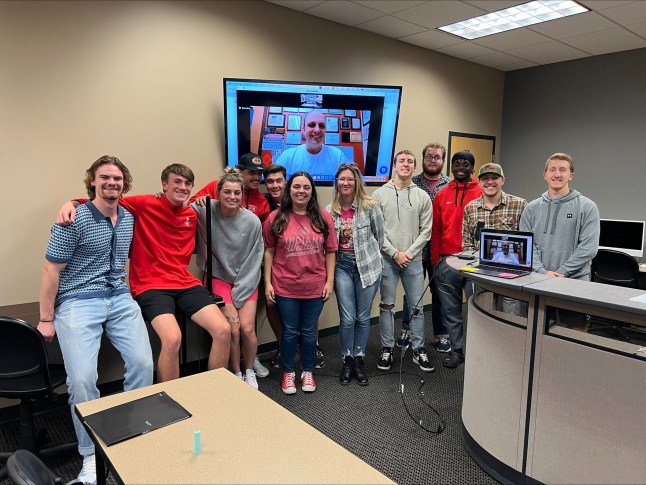
Filak Furlough Tour Update: Hanging out with Northwest Missouri State University

One of the biggest hidden gems in education is the media program at Northwest Missouri State University. The program there has had a ton of success with student media outlets, often securing the top awards available through CMA, ACP and others. The place also boasts great journalism educators, including at least two CMA Hall of Famers, and a ton of great young talent.

Dr. Kyle Miller was nice enough to bring me in via Zoom as part of a two-part panel with Latonya Davis, the coordinator of diversity and inclusion at NWMSU. Professor Davis had an amazing presentation that covered most of the broad strokes on this topic, which covered a wide array of issues we need to continually discuss. For me to try to repeat it here without screwing up on my part is like trying to catch last night’s rainstorm, but I’m sure she’d be more than willing to share with anyone who asked.

Once she was done, I spent my time filling in around the edges, covering more of the sports angles in relation to diversity, equity and inclusion.

Northwest Missouri State University — Maryville, MO

A nice bit of promo work on X by Dr. Miller.

THE TOPIC: Race, gender and other DEI issues in sports writing

THE BASICS: Sports writing is one of the more interesting areas when it comes to racial, gender, socio-economic and other forms of biases. In a lot of ways, it comes from the way in which there was significant segregation in sports. For example, it took until 1947 for an African-American player to enter Major League Baseball and it took until 1975 until an African-American man was given the opportunity to manage a team in that league.

In my lifetime, and I don’t mean like when I was an embryo, we had people saying stuff like this on TV about people of color and sports:

We also had the head of international soccer at one point answer a question about how to make the women’s side of the game more popular with this gem:

“Let the women play in more feminine clothes like they do in volleyball,” he said.

“They could, for example, have tighter shorts. Female players are pretty, if you excuse me for saying so, and they already have some different rules to men – such as playing with a lighter ball. That decision was taken to create a more female aesthetic, so why not do it in fashion?”

In short, sports isn’t the most socially enlightened place on earth when it comes to issues of race, gender and more.

In today’s coverage, a lot of what we see falls into what some have dubbed “aversive” racism or sexism as opposed to people coming straight out and saying stupid stuff like this:

This is where language choices can make a difference, particular in how we write about certain players. For example, let’s look at a couple descriptions that area almost the same:

Quarterback Jim Johnson is gifted when it comes to finding the open receiver downfield.

Quarterback Jim Johnson is talented when it comes to finding the open receiver downfield.

Quarterback Jim Johnson is skilled when it comes to finding the open receiver downfield.

They all seem to be saying the same thing: This guy can find a receiver down the field better than other people can. However, if you look at the descriptors, you realize that they mean different things.

GIFTED: He was given something by God or nature that other people don’t have through no fault of their own or through no actions of his own.

TALENTED: He had an advantage based on something innate within him that allowed him to be better at this than other people.

SKILLED: He worked hard to develop an ability based on his desire to get better at something that was important to him or his craft.

This is not to say that every reference to being gifted is unfair. Sometimes, you just get an advantage by the mere dint of something about you. My uncle coached basketball for 40 years and he used to say, “I can’t teach tall, but I can teach almost anything else.” In other words, if you are born with genes that make you 8-feet-tall, you are gifted with an advantage of height in a game where that matters, like basketball. It’s not like you worked hard to getting taller every day.

The point is, how we describe people can lead an audience to feel certain ways about them. The more we tell people that certain players are “gifted,” the more it seems like they don’t work hard for their success. Therefore, it’s important to think about what we’re saying and how we’re saying it.

HELPFUL LINKS:

BEST QUESTION OF THE DAY: What do you think about the Jets not signing Colin Kaepernick after Aaron Rodgers went down?

BEST ANSWER I HAD AT THE TIME: It’s a joke, but it’s been a joke all along when it came to how the NFL teams have treated this guy.

Most of the reasons given over the years for not having “Mr. Take-a-knee” on a roster is that it would be too much of a distraction and that he has too much baggage to be considered for a role. That said, consider this:

I could fill the universe with examples of people who got to play, got to play again or are still playing despite social, moral or criminal indiscretions worse than what Kaepernick did. (And, not to put too fine of a point on it, it was a WHITE GUY with a military background who told him that taking a knee would be the better way to go here…)

I have a sense they’ll keep pulling this stuff until eventually the guy is too old to really be an effective player and then they’ll do the, “Oh, it’s such a shame he’s too old… We really would have LOVED to have someone with his talent…” thing.

People can feel however they want to feel about what Kaepernick did, what he felt he was doing, how that relates to society and so forth. That’s a personal opinion and I’m never going to tell anyone how to feel about stuff like this. That said, when your fans are not above doing stuff like this at tailgate parties, this pearl-clutching by NFL teams about Kaepernick’s supposed baggage is complete crap.

NEXT STOP: Indiana Wesleyan University

Three tips to make the editing process more valuable (A throwback post)

In visiting multiple newsrooms and various classrooms through the Filak Furlough tour, one question that popped up a bit was how to get people to “do it right” when it came to writing stories. Editors spoke of frustration due to writers who wouldn’t listen, wouldn’t learn or otherwise made life vexing for the editors.

What was absent in this situation, however, were the writers, many of whom I would imagine had a completely opposite view of the situation. If I had to wager, I’d argue that they probably felt editors were demanding, picky or otherwise vexing.

In digging back for a Throwback Thursday post, I found this one that might be helpful to both sides: kind of a “peace with honor” thing that might make life easier in understanding how editing should work.


The battle of wills between writers and editors: Three tips to make the editing process more valuable

If you read Ruth Reichl’s column about her editor, Susan Kamil, you can get the idea of how a good editor can make all the difference. In reflecting on Kamil after her recent death, Reichl offered a wonderful assessment of her friend, colleague and editor in a way that is both honest and honorific.

I have been both the editor and the edit-ee throughout my life and I have found neither of them are a bowl of cherries. As the person being edited, I find myself vacillating between the desire to be told how awesome I am and the need to be told where I really screwed up. It’s almost a borderline disorder of personality: When someone tells me I’m perfect, I push back by saying, “No, I NEED feedback so I can improve before people who read the published version rip me to shreds.” When someone heaps “helpful suggestions” upon me, I often feel like saying, “OK, screw you and everyone who looks like you.”

Sounds dumb? Yep, but I bet I’m not the only one in that boat.

As an editor, the frustration is just as palpable: I can see what needs to happen so I’m pulling in one direction. However, the writer keeps thinking, “What the hell does this chucklehead know?” Having to edit strong-willed people has on occasion led to some of my worst moments, including once telling a student, “I’ve taken (bowel movements) that I would be more proud of than I would be of this lead.” It was like, “If you would just be reasonable and see it MY WAY, we’d get done with this a lot faster and better.”

Eventually, I found more equilibrium in the relationship. It also helped when I started finding editors who worked with me in a way that made sense to me. (As Harvey Spector says in “Suits,” you don’t want to play the case. You want to play the person.) It has gotten to a point where each book I do, I ask if Jim Kelly (the former journalist, not the football player) is available to be my copy editor. Otherwise, can we wait on this?

For those of you who don’t get the chance to pick your poison… er… editor… and for those editors who still don’t get why the writers suck at this, consider a few helpful hints that might make the relationship make more sense:

  • You’re both right, but in different ways: In most cases, reporters are the experts on their stories. They were in the field, they’ve done the research, they have the interviews and they collected additional information. When it comes to the “who did what to whom” elements of the story, the reporters are the experts on everything, which is why they can feel frustrated when an editor starts putzing around with their copy.
    Conversely, the editors are the experts on what the readers are seeing, what they need to see and where the gaps exist in the stories they are editing. The reporters are hip-deep in the content and thus sometimes have trouble seeing the forest through the trees. The editors come to the content with fresh eyes, a general interest in the topic and limited background on what’s going on. That’s exactly how the readers will see it, so it pays to have the editors poking around and changing stuff.
    Much like every other situation in life, if multiple people are involved in a collective task, the goal is to play to each person’s strength and away from each person’s weakness. Thus, the editor should get some leeway in terms of changing things that get in the way of the readers’ understanding of the content while the reporter should get more control over the general gist of the story.
  • You must be able to explain why: I often tell my students that little kids are amazing because they always want to understand what’s going on around them. This is why a 4-year-old’s favorite question is “Why?” They want to figure out how something works, how come something is the way it is and what reasons you have for doing something. It’s an innate element of their being.
    Eventually we stop asking those questions, either because we start to figure things out on our own or for fear that an adult might push us into traffic out of frustration. That doesn’t mean we still don’t have those questions, but rather, we stop verbalizing them, so instead of getting decent answers to our concerns, we simply have to stew in our own displeasure.
    As a writer or an editor, the goal of every decision you make should be to have a reason for whatever it is you are doing. Then, you need to be able to verbalize it in a clear and concise fashion for anyone who might need to know. For example, if you used a narrative lead on your story instead of a standard inverted-pyramid lead, your editor might ask, “Why does it take me three paragraphs to get to the point of the story?” If you have a good reason, like “I wanted to set up the lead more as a nut graf, because I keep weaving this guy in the opening back into the story as a thread,” your editor might see things the way you do and let it sit. If you have the “I just wanted to mix it up” or the dreaded “I dunno” answer, you’re probably not going to have things work out your way.
    The same thing is true for an editor: If you want to change something, have a reason to do so. Also, it helps to ask the “why” question of the writer before you decide to make that change. It shows an interest in what the writer has done, and it provides you an opportunity to reconsider your change. As noted earlier, you’re both going to have strengths and weaknesses, so play to the strengths and explain why you think your position is stronger. If you have established trust with the writer, the writer should give you some leeway on this. If not, you need to start establishing trust, like, yesterday.
  • The goal is the same: In the end, the thing you both need to understand is that you both want the same thing: the best possible product. In some cases, this can be inordinately frustrating because you can’t fully agree on what that “best possible product” actually is. In addition, you might have different ways to get there.
    This is where trust comes in and you both need to make a decision about the value of this relationship. In one of the most frustrating relationships of my life, my doctoral adviser and I butted heads constantly on the editing of my dissertation. I kept pushing for the “good enough” version of things and she kept pushing for the “best possible” version of things. It took a long time for me to admit she was right, but she was. Her goal was my goal, even when I couldn’t see it: Write a piece that was going to be easy to defend and that would help me complete my degree.
    At the end of the day, if you are both honest with yourselves and care about the outcome, you will have the best interest of your readers in mind. That means you’ll care less about getting your way or making your changes than you will making sure the reader gets a good, strong, clear and valuable story.
    If that’s not the case, and you just want to win, everyone involved is going to lose.

More Confessions of an Unpretentious, Anti-Academia Professor

I spent a lot of time with college parents this summer as part of my kid’s orientation and as part of our recruiting efforts on campus. What I learned is that I’m apparently more parent than professor, as I cared greatly about how much the college experience cost, what majors were available, what services could help my kid succeed and what jobs were at the end of this extremely expensive rainbow.

Despite what so many academics around here believe, not once did I, nor anyone else in these groups, ask, “But wait, what about the broadening of their horizons through general education courses that will offer my child a transformative life experience?”

I’ve thought about that a lot lately as my institution of higher learning is undergoing some fundamental changes, to put it mildly, even as a core group of academics attempt to obstruct changes necessitated by the unfortunate presence of reality.

Also, I got an alert the other day to tell me that while my institution is cutting hundreds of jobs, the system that oversees us and the other 12 schools that are mostly in trouble is spending a half-million dollars to rebrand itself. It also doesn’t help  that calling our system the “Universities of Wisconsin” is likely to really piss off at least a dozen other institutions of higher learning in this state that aren’t part of our system.

Over the years, I’ve attempted to make sense of things like this that make no sense to anyone who has common sense, only to realize that while I work in academia, I’m in no way an academic. With that in mind, here are even more confessions of an unpretentious, anti-academia professor.

(If you missed the first round, here you go…)

  • I find myself actively wincing when someone “outs” me to the general public as a professor. The people who are doing it don’t do it to make me feel uncomfortable, but when someone says, “Oh, he’s a professor of journalism!” to some random person I don’t know, I almost feel the need to jump in with, “But I’m not like most of them.” As I’ve even told my provost, when people ask me what I do for a career, I tell them “I work at the U,” with the hope they think I’m a janitor or groundskeeper. What the world sees as the stereotypical professor is not what I want these people thinking of me.


  • I care what my students think of me, but more in the “I want to make sure I’m not boring the hell out of you” way, as opposed to what they think of me personally. That’s why I’m not spending any time on “Rate My Professor” or sites like it. If you want to tell me I’m a terrible human being, I’m fine with that. Whatever you think about me can’t be nearly as bad as what I’m currently thinking about myself.


  • A corollary to the above point: If you spend more than five minutes at the front end of any class, reading aloud from your “Rate My Professor” rating to complain about what students say about you, chances are you’re exactly the dingleberry the kids say you are. And yes, more than one student told me this happens…


  • Whenever I try to ask an academic what value they provide to students, I find myself essentially having this conversation:


  • Just because I like something, I don’t necessarily believe that other people need to like it as well. This is particularly true when it comes to class topics. I had a student tell me he took a class that was absolutely painful and pointless. The final project for that class required him to write an 18-page paper on the Cambodian genocide. When I asked why he picked that topic, he explained it was better than writing on the Rwandan genocide, the Holocaust, the Bosnian genocide… I then asked why the hell was he taking a class on genocide, only to find that he hadn’t. It was a general education writing class requirement that the professor focused on genocide because he was a scholar on the topic. If ever there was a clear example of why students hate professors, I think this is it.


  • I feel bad for my students because my teaching examples are formed through my work experiences. If they had a professor who spent time covering the education beat, they’d get stories about school board meetings and first-graders making hand-print turkeys for Thanksgiving. If they had a professor who worked the government beat, they’d hear about political wrangling and and how they did deep-dive stories on campaign finance spreadsheets they got via open records requests. Since I spent my whole career on the night desk or the crime beat, most of my stories start off like, “This one time, a drug dealer got shot to death on his porch, so I go out there…”


  • We recently got a memo from the dean’s office that I think captures what’s wrong with academia. In explaining how classes should be selected for teaching, the dean noted: “Curriculum offerings should support mission critical array and should be built to meet student demand and need. Curriculum offerings should not be built around faculty preference and specialties.”  In reading that I thought, “Do we NEED a memo that says that? Isn’t that what we’re supposed to be doing?” And then I realized, “Well, yes, we need a memo that spells that out because kids are being forced to take writing courses about genocide and  18th Century response poetry.”


  • Many of the faculty members who claim that untenured adjuncts are “vital members” of the university system are adorable little hypocrites. It’s not that I disagree that adjuncts have value, but the reason these tenured folk value the adjuncts is because adjuncts teach the classes that those tenured folk don’t deign to teach. The next time I see a tenured faculty member teaching a 500-person freshman pit class so that an adjunct can teach a “passion project” course of 15 people, I’ll buy this argument. Until then, it’s just window dressing.


  • When I deal with academics, I go back to something my dad told me a long time ago: “The only thing a vacuum cleaner salesman knows is that you definitely need a new vacuum cleaner.” In watching how people justify their existence around here, I’ve come to realize that we’ve got a lot of vacuum salespeople around here.


  • When I see the various departments proclaiming how students can get jobs with their majors, I think we need to be more honest about how the college-to-career path works. There are basically three levels of this:
    • Majors that lead to careers: Nursing and teaching come to mind here. You take the classes that are career-specific, you do “clinicals” or internships in the field while in school, you get the degree and you enter that field.
    • Majors that tangentially relate to careers: Areas like English and communications come to mind. You take the classes and learn skills and those skills help you find a job in a field in which those skills are valued.
    • Majors you get a career in spite of you majoring in it: Philosophy, world religions, sociology and so forth come to mind. My best friend has a job that pays him about twice what I make and he has a poli sci degree. The job is working on coding and tech development for Google. He didn’t learn that in his Comparative Political Systems class.


  • Whenever I get an expansive email about the importance of liberal arts as the foundation of all knowledge and societal advancement that must remain in all students’ lives no matter what, I figure out who sent it and then look that person up on LinkedIn. In most cases, these people turn out to be life-long academics who have never spent a day in the professional world, where things like layoffs, rule changes and corporate restructuring occur on the regular. Only someone of this ilk could think such things are an unjustified attack on scholastic pulchritude and not just part of life.


  • When I hear people bemoaning how terrible it is that their teaching load has been increased by one extra class per semester, I want to scream about perspective:
    • The first job I had where they took taxes out of a paycheck was as a grounds crew member at the “Summerfest” grounds in Milwaukee. My job was to pick up litter, clean up after drunks in bathrooms, sweep up vomit and haul bags of trash that were hot to the touch. I also had to climb into trash compactors to sweep out “liquid run off” and clear the maggots that had infested the place.
    • My second job was as a garage mechanic, a job that nearly became a career path at one point. Aside from occasionally being burned by exhaust pipes, coated in grease and having oil poured into my eyes, I worked in a garage with no ventilation and limited concerns about occupational safety. After work, before I was allowed in the house, I had to wash up in the yard. Then, I had to strip off my work clothes in the basement and wash them by themselves so they wouldn’t mess up any good laundry.
    • I can’t tell you how damned lucky I feel every day that I have a job like the one I have and that I don’t have to come home in a broken and disheveled heap every day. Unless your job leads to you becoming dirty, bloody or nauseated, I’m not buying the “woe is me” act regarding having to do more of it.


  • When the usual suspects in academia complain about how we’re “shifting into a tech-school mindset,” I want to say a) “If you mean we’re actually trying to get students ready for a career in something that they enjoy and will support them, it’s about damned time,” and b) “It’s not my fault you picked a shitty academic field that lacks any semblance of realistic value.”


  • I believe in treating students like actual people, up to and including my desire to get them to understand what they’re doing and why they’re doing it. In every class I teach, if a student asks, “Why do I need to know this?” or “Why is this class required?” I can give them a detailed, logical answer that attaches to their degree program and what they plan to do with their life after graduation. This apparently makes me an outlier and a nutjob among tenured professors.


  • When people have the time to write a four-screen email, complete with rhetorical questions and at least 11 self-referential boasts, they probably aren’t the kind of people I want to spend time with.


  • I can’t help but laugh hysterically when I get emails from faculty members who are part of my “representative governance group.” Why? First,  reread the item above. Then, look at the list below. Of the 28 people across four colleges in this institution, 19 of them come from ONE COLLEGE. Here is the breakdown of home departments of these 19 people:
    • History   3
    • Philosophy  3
    • English 2
    • Biology  2
    • Math 2
    • Chemistry 1
    • Social Work   1
    • Music  1
    • Art  1
    • Theater  1
    • Poli Sci 1
    • Engineering  1

Nearly half of these people come from three major areas, none of which would lead my dad to say, “Great choice of a major, son! With that major, I’m sure you’ll have a financially and emotionally fulfilling career and never have to live in our basement after graduation!” Speaking of career paths, of the major areas listed here, I can only realistically count TWO that could make a solid case for a “college to career” path, something I emphasize in every class I teach. So, “representative governance,” my ass…

  • And finally, I understand that nobody likes to go through changes that are forced upon them, especially when they involve unpleasant situations. However, for all the complaining academics do about students lacking critical-thinking and problem-solving skills, you’d think they themselves would be more willing to engage in these types of behaviors themselves when their place of employment is going down the dumper. Or, to put it another way: