THROWBACK THURSDAY: “Get shot,” “Soccer Blows” and “Robbed Accidentally:” Four tips on writing headlines that mean what you want them to mean

We were discussing horrible headline in class the other day, so I dug this one up from the Wayback Machine and figured it’d be worth a share on Throwback Thursday.

Enjoy!


“Get shot,” “Soccer Blows” and “Robbed Accidentally:” Four tips on writing headlines that mean what you want them to mean


As we have discussed here before, I spend a less time thinking about how a headline or a photo or anything else can be awesome and a lot more time thinking about how it can go horribly wrong. That level of mild-to-moderate paranoia keeps me out of more than the average amount of trouble when it comes to my writing here and elsewhere.

I’m teaching an editing class this summer, which has me on the lookout for gaffes, stumbles and other snafus that pop up on all manner of platforms. Although horrible spelling and awkward moments make up a great deal of my finds, I have noticed more than a few areas in which the way in which a word can be interpreted or misread can lead to problems within writing.

One of my favorites came from USA Today as the country was crawling out from under the mortgage meltdown:

Shot.jpg

The questions I had were a) do I get to pick where they shoot me? and b) where do I sign up?

Obviously, in this case, the writer meant “shot” to be a synonym for “chance.” However, “get shot” can also easily be interpreted to mean someone put a bullet in you. (I suppose if you want to get technical, it could also mean a needle full of something or a small glass of hard liquor. “Barkeep! I’ll take a Tequila Sunrise and a shot of “Loan Abatement.”)

A similar problem emerges in this headline:

GayStraight

(Glad they finally got those Gay-Straight Alliance ruffians to stop picking on people in the school…)

Stressing different words in different ways can help you avoid issues like this one as well:
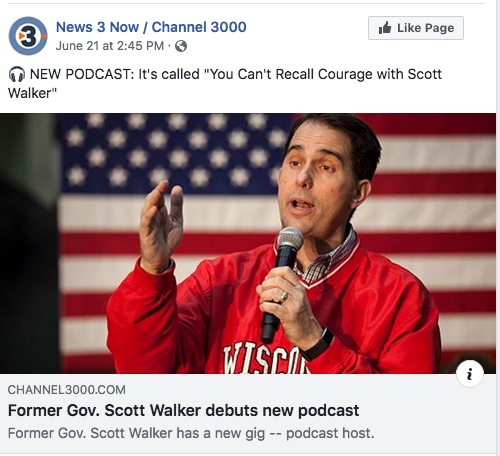
WalkerPodcast

The title in the tweet showcases the problem: “You can’t recall courage with Scott Walker.” The title is a play on words, in that Walker became the first governor in U.S. history to survive a recall election. However, on a first pass, the word “recall” more likely sounds like people are trying to remember something. (“I clearly recall putting my wallet in my pocket, but now it’s missing.”) So, it sounds like we can’t remember anything about courage when it somehow relates to Scott Walker. (“I can’t recall any acts of courage on the part of Scott Walker.”) I’m sure that sits well with the former governor…

In any case, the point is that had the writers read these items aloud, we wouldn’t be debating the issue. Other similar problems happen when you get a bad headline break. In print, when you “break” a headline between columns, you create a natural pause at the end of the first line, similar to a comma. On one line, the head makes sense:

Smith, Jones dead even in polls

However, when split at the wrong spot, you get a zombie movie of sorts:

Smith, Jones dead
even in polls

When this happens in print, it’s often due to layout issues and those issues can lead to some awkward headlines:

Blows

(Wow… the soccer team must be exhausted…)

Even in digital copy, this can happen (h/t Testy Copy Editors)

SplitsMatter

How does one get “robbed accidentally?” (To be fair, it could be worse, I’ve seen “robbed” end up getting spelled “robed,” which always makes me think of Hugh Hefner for some reason…)

Here are a couple points to help you avoid these problems:

  • Read your stuff aloud: I often tell students to read their copy out loud, as that will help them find grammar errors, run-on sentences and structural issues. One other benefit is that if you emphasize different words in different ways while reading the copy aloud, you can see how something might not read quite right.
  • Watch your swaps for size: In many cases, the headline errors come when people are trying to swap out a longer word for a shorter one or (occasionally) vice versa. This is how you get things like “shot” for “chance” and similar errors.
  • Keep an eye on your breaks: When you have a break in a headline, regardless of platform, realize it’s going to shift the way in which the content is read. Therefore, you need to put the breaks in the right spots to avoid people hearing that two candidates are “dead… even in polls”
  • Beware of potentially hazardous word choices: We talked about this before when it comes to reading like a 12-year-old boy, but it’s not just the double-entendre sex-ed stuff that can get you into trouble. A headline on suburban sprawl could have a politician hoping to “retard growth.” That word, although technically accurate, has the potential for danger, as the “R-word movement” can clearly explain. All sorts of words can create danger for you, so always think, “How can this go wrong?” and you’ll save yourself some explaining and agony for sure.

Throwback Thursday- Writing 101: We’re still not using the right damned words…

I had to go back and find this post after I had a student note in a report that something “cone sided” with something else. Immediately, the j-nerds were off and running with their “all intensive purposes,” “youth in Asia,” “acid tape” and more.

With that in mind, here’s a look back at using the right damned words again…

—

Writing 101: We’re still not using the right damned words…

Journalism is about using the right word in the right way all of the time, a task we fail at far too often as we saw with last week’s “Throwback Thursday” post on using the right damned word. When this post first ran, some editors chimed in with a few of their favorite errors, but not much else happened.

This time, the post hit the academic circuit, where instructors of all kinds found themselves sharing the “greatest hits album” of errors as well, proving once again that it’s not just journalism where wordplay can turn ugly.

(One reader chastised me, noting that “learning disabilities make it hard for some people to recognize their errors,” and that I should think twice about posting such a list. I have taught hundreds of students with diagnosed and undiagnosed learning disabilities over my decades in higher ed. I’ve also worked closely with the various offices that serve these students so I could assist my pupils and recognize signs that students may need this kind of assistance. I can assure you that I would never make fun of a student, or the student’s work, in such a case. I can also assure you that what we’re talking about here sure as hell ain’t that.)

So, with that out of the way and with all of this in mind, here’s an expanded list of word failures educators seem to be seeing more of these days:


ethnic: Related to large groups of people classed according to common racial, national, tribal, religious, linguistic or cultural origin or background. “Leaders of ethnic communities met Thursday to discuss bias complaints against community police officers.”

ethic: A set of moral principles, especially ones relating to or affirming a specified group, field, or form of conduct. “People admired Stan for his strong work ethic.”


barely: By a small amount; almost not. “After that final exam, I barely passed statistics.”

barley: A hardy cereal plant that is used in various cooked dishes. “Ethel added barley to her beef soup to make it thicker and more delicious.”


(Speaking of cereal, the “c” version of this is meant to denote certain grains used in food or breakfast foods made, in part, from those grains. The “s” version, as in “serial,” means in an order or a pattern, like the sequential numbers on money or the specific way certain people kill. Thus, if you hear read the phrase “cereal killer,” it’s time to watch out for that damned leprechaun on your Lucky Charms box.)


insight: The ability to understand or comprehend something at a higher level than others can. “Because she studied royal protocol for years, YaVonda had a keen insight as to how to behave when she met the queen.”

incite: An attempt to get others to act in a violent or lawless fashion. “If Bobby goes down to that peaceful protest, he will incite the crowd to riot.”


Spainders: Not a damned word.

Spaniards: People from Spain.

Spaniels: A dog breed with long silky hair.


Coulda/Woulda/Shoulda: What your mother tells you after you screwed up.

Could of/Would of/Should of: Not damned word couplings.

Could have/Would have/Should have: What you could have, would have or should have written in your paper instead of the previous two sets of words.


highschool: Not a damned word, unless there’s a drug euphemism I can’t locate online. “Jimmy had trouble rolling a joint, but after Susie took him to highschool, he was a master of the Zig Zags.”

high school: Where kids in the U.S. go from ages 14-18 (or more) to learn stuff. “If I had paid attention in high school, I probably wouldn’t be making all these word-choice errors.”


trial: A court hearing in which people are found to be guilty or not guilty on charges brought against them. “Liam was found not guilty after his recent murder trial.”

trail: A path or roadway you hike on. “The cowboys agreed that after the cattle drive, they’d meet at the end of the Chisholm trail to camp for the night.”


manor: A place people live. “Batman’s Batcave was hidden under the stately Wayne Manor.”

manner: A way of being. “Jim’s off-putting manner made the women in his office feel awkward when they were near him.”


saleing: Despite what your marketing professor is trying to make happen, it’s not a damned word:

selling: What people are actually doing when other people are actively buying stuff the marketing people are promoting. “These Melon Patch Dolls are selling like hot cakes this holiday season!”

sailing: A boating activity that takes me away to where I’ve always heard it could be… Just a dream and the wind to carry me…


Weeknd: Something that used to not be a damned word until Abel Makkonen Tesfaye came along and created some truly bangin’ music.

weekend: The time at the end of the week, in which some people who aren’t teachers or professors, get to relax and enjoy themselves. “I can’t wait for the weekend to get here so I can sleep late.”

weakened: Something that has deteriorated in some way from its previous position of strength. “Luis is worried about COVID-19 because he has a weakened immune system.”

(Side note: If anyone tells you they have a “weekend immune system,” they either a) have word-choice issues, b) need to spend Monday through Friday in a plastic bubble or c) are making some reference about their partying prowess like, “Don’t worry, bro… I can handle as much tequila as you can sling my way due to my weekend immune system!”)


thrown: Tossed, pitched or otherwise hurled. “The ball was thrown to the plate, but the runner was safe at home.”

throne: The thing kings and queens get to sit on. “The throne in Buckingham Palace is not as ornate as I would have imagined it to be.”

(Side note: “Game of Thrones” would be a lot different if it were “Game of Throwns.”)


customer: Person buying something. “The customer is always right, even if they’re being a total knob about it…”

costumer: A person or company that makes fanciful outfits for actors and actresses. “Janine spent five years on Broadway as a costumer for a prominent theater group.”


porpoise: An aquatic mammal that looks like a dolphin but is actually a small-toothed member of the whale family. “I wanted to go to Sea World so I could look at a porpoise.”

purpose: A reason for being. “I believe my purpose in life is to embarrass my kid in front of any boy, girl or creature she chooses to date.”


peak: The top level of an occurrence, or the highest elevation of a mountain. “Lamont ate four sandwiches before the race, so there’s no way he’ll reach peak performance.” OR “Alaina climbed to the peak of Mount Everest.”

peek: A quick glimpse of something. “I just needed to take a peek inside my kid’s room to realize the place was a disaster area.”

pique: Heighten or stimulate. “The package that came for her roommate served to pique Marlena’s curiosity.”


bizarre: Weird, strange, unexpected, abnormal. “When the superintendent jumped on the table and began to cluck like a chicken, the school board meeting took a bizarre turn.”

bazaar: A place in which goods are sold or traded, traditionally linked to Middle Eastern cultures. “To make money for his family, Abdul sold trinkets to tourists at the bazaar.”


ballot: A thing you use to cast a vote. “On her ballot, Maria selected ‘None of the Above’ for mayor.”

ballad: A slow, folksy song of a narrative nature. “Johnny Cash sang ‘The Ballad of Ira Hayes,’ on his ‘Bitter Tears’ album.”


Flamingo: A tall wading bird that is often pink. “I saw a flamingo while vacationing in Florida.”

Flamenco: A form of song and dance traditionally associated with cultures in southern Spain. “There are more than 50 types of Flamenco that experts have distinguished within the art form.”

Although I would like to say that there is no such thing as a “flamingo dance,”  it turns out that in one instance, it is the case. Enjoy:

Throwback Thursday: What journalists really mean when they say…

Because this week needs humor, I went into the Wayback Machine and pulled one of the earliest posts I built for the blog. I can’t remember exactly who was all in on this riff, but I still appreciate what we accomplished: Making a bunch of people laugh.

Enjoy.


What journalists really mean when they say…

This week already feels 182 days long and I’m not in a flood zone, a hurricane path or a country that just had a missile fired over it. In an attempt to add a little relief for those feeling burnt to a crisp or who just need a laugh, here’s a post on the lighter side: A list of things journalists say and what they actually mean:

BASIC TERMS

Recently: The reporter lost the press release

In recent memory: As far back as the reporter can remember or at least past last Tuesday.

Arguably: The reporter didn’t have time to look up the facts

Debatable: These people are clearly wrong but we need to look objective

“It has been said…” : Where the hell did I hear that from?

“Declined to comment,” : When contacted, person said, “I really want to talk but my lawyer said no. Please don’t hate me.”

“Refused to comment,” : When contacted, person acted like an ass before hanging up.

“Repeated attempts to reach the source were unsuccessful,”: That jerkweed is screening his calls.

Breaking news: We’re telling you about it at the same time everyone else is.

Gone viral: We just found out about something everyone else already knows about


POLITICAL TERMS

Spry: Person over the age of 80 who doesn’t need portable oxygen

Feisty: Short, female.

Concerned citizens: Busybodies with nothing better to do than complain

Engaged citizens: People who lead the busybodies

An outsider: “Who the hell is this guy?”

Fake news: Anything that tells me something I don’t want to hear.

Repeatedly: (as in repeatedly declined or repeatedly defended) Person is sticking to his/her stupid position no matter how many times we ask.

Assured: Said more than once but only because the cameras were on; In reality, this won’t be happening.

 “An exciting new opportunity” or “A lifelong dream.” : The reason a public figure gives for leaving public life shortly before the lawsuits start rolling in.

“Trim the budget” : Cut stuff for other people but leave my stuff alone.

 “Devastating budget cuts” : They cut my stuff.


SPORTS:

“All he does is win,” : His stats are bad.

“Can’t quantify his value,” : His stats are atrocious.

“A great clubhouse guy,” : He plays cards with the manager and hasn’t had an at bat since the Bush administration.

“He gave it a shot,” : A coach defied all logic and common sense and it backfired.

“He went with his gut” : A coach defied all logic and common sense and it actually worked out for him.


CRIME AND DISASTER

Fortunately, Luckily: Somebody just got royally screwed but we’re trying to put a good face on it.

“The altercation escalated” : Somebody said something about somebody’s mama.

 “Sources say,” : I attended a press conference.

“Sources tell me,” : I made a phone call.

“Sources have confirmed,” : Somebody told me that what other people already reported was right.

“Sources exclusively tell me,” : I was trapped in an elevator for an hour with a source who was bored.

“It remains unclear,” : Everyone knows something but nobody’s telling me.

Destruction: Something a fire yields

Devastation: Something a hurricane or tornado yields

“The following images are disturbing…” : Holy crap! You’ve gotta see this!

An uncertain future: The guy is going to jail

If you liked these, the book “Journalese” by Paul Dickson and Bob Skole takes on a wider array of similar terms from a variety of perspectives.

Couldn’t have said it better myself: How a great quote can grab your readers by the eyes

Direct quotes are an important part of journalistic storytelling. They allow the sources to speak directly to the readers in the sources’ own words, providing both information and a “feel” for the topic with the choice of their vocabulary.

Unfortunately, some journalists view quotes as just “meat” between the slices of bread that are “paraphrase” in their stories, and the writers care very little about the quality of that meat. Just because someone said something, it doesn’t necessarily mean it’s going to be a good quote. It’s our job to separate the trash from the treasures when it comes to that word-for-word component of our stories.

When you get great quotes, they can really grab your reader’s attention as they just nail the underlying concept of a story in a way that few other things can. Here is a series of quotes that fit the bill and that make reading the whole piece worthwhile:


“Showing up to a school with zip ties is not a way to solve a problem.”
-Vail Unified School District Superintendent John Carruth

The story behind this one comes from a story about the “mask battles” we have seen during the pandemic. An Arizona man was contacted by a school employee and told his son had to quarantine at home after being in close contact with a person infected with the coronavirus.

Instead, the father and two “other men” (the words “dudes,” “buddies,” and “idgits” would seem to be more on point here, but then again this is Washington Post) went to the kid’s school to demand the kid be taken back:

“Apparently Mesquite Elementary thinks they can break the law and act like the covid Gestapo,” the man wrote, referencing Nazi Germany’s secret police. “We will be headed over there shortly to disagree. Come join us because we won’t have this in OUR community!”

Later that morning, the father and his son arrived at the school. The other two men met them in the school’s parking lot, Carruth said.

In a live video posted to Instagram, one of the two men who joined the dad told his followers that they were about to “confront this administration” for “breaking the law.

“If necessary, we’ll do a citizen’s arrest,” the man said before showing off the “law enforcement zip ties” they brought.

So these three yahoos end up in Principal Dianne Vargo’s office, threatening her with arrest if she didn’t let the kid back in school. The whole thing escalated until Vargo left the office and called the police. The men, who moments earlier were so certain of the legality of their actions, left before the cops showed up.

In reviewing the incident for the Post, Carruth mentioned the need to model good behavior for kids and such, before delivering a great closing quote.


“I’m like Gerard Butler in ‘300.’ I’m in the hot gates at Thermopylae, holding the pass against the million-man Persian army.”
-Lawyer John Pierce

https://www.youtube.com/watch?v=kj11Pj2T7Bw

Quick question: He does know that Leonidas ended up with about 1,085 arrows through him at the end of that movie, right?

Pierce is the now-missing attorney for defendants associated with the Washington, D.C., riot on Jan. 6. Aside from his comparison to the leader of the Spartan resistance, he has offered up some insight as to how he planned to get his clients off:

A self-described pro-Trump populist, Mr. Pierce has promised, for example, to force the government to give him video footage of the Capitol for several days before and after Jan. 6, and has said he will demand information about every police officer working at the building that day. He has also vowed to subpoena hostile witnesses like Speaker Nancy Pelosi, ostensibly to learn what she may have known about security at the Capitol before the attack.

Without citing evidence, Mr. Pierce has said he intends to implicate the F.B.I. and the intelligence community by showing that the riot was something like a grand act of entrapment or an inside job. He has often talked about his cases with a conspiratorial zeal, painting himself as something like a lonely legal warrior out to save his clients from an overreaching government.

https://www.youtube.com/watch?v=9HVejEB5uVk

All of the words the New York Times puts together to explain and describe this guy don’t do half as good of a job as Pierce’s own quote does.


“The defendant stated he was trying to show off for his date. The female said she was screaming at him to stop, but he refused. This was their first date.”
– Police Report, Clearwater, Florida

Some of the greatest quotes ever come from police officers trying to explain something completely insane in a report that requires them to be clear, concise and even-handed in the description. (My personal favorite was a road rage incident in which the combatants “exchanged hand gestures,” according to the report.)

In this case, a 22-year-old man apparently eyed up a cop at a stoplight and then decided to lead the officer on a high-speed chase. The reason? He wanted to impress the woman riding on the motorcycle with him:

Police temporarily broke off the chase while Beverly darted through traffic, running multiple additional red lights and traveling “at well over 100 [miles per hour].” They were able to apprehend him at an intersection minutes later. Court records indicate that Beverly also refused to slow down as his date was “screaming at him to stop.”

The article did not note if the couple had planned a second date…


“Mr. Lee was incredibly stupid, felony stupid but, I think given the situation and the fact that he has absolutely no record I am going to listen to pretrial services.”
– Arizona Judge Rosemary Panuco

https://www.youtube.com/watch?v=yScR9ngQLyI

(“My client’s a moron. That’s not against the law…”)

Judges operate under what is called “absolute privilege,” which means they can say stuff the rest of us would really like to but can’t for fear of being sued. Thus, they tend to have some of the best quotes when it comes to summing up situations like this one:

Tucson police released surveillance video from a Suntran bus showing Zachary Lee just before he got off the bus and approached the police officer last Friday at 29th and Swan.

The video showed the sergeant’s vehicle parked.

The risk assessment form read, “According to the arresting agency, the defendant got into a verbal exchange with a Tucson Police Department Sergeant, who was conducting unrelated surveillance in an unmarked car.”

Mike Storie represents the Tucson Police Officer’s Association of which the sergeant is a member. He said the assessment is incorrect.

“Actually, there were no words exchanged. The sergeant was in a vehicle with the windows rolled up and never spoke to this person,” Storie said.

The video showed Lee using hand gestures. Storie said lee was throwing gang signs, shortly after that he added Lee began firing at the officer. Tucson police said they found a gun on Lee when he was arrested, and casings at the scene that matched the gun.

The judge in this case released Lee prior to the trial without requiring him to post bail, something that drew the ire of the prosecutor and the police. To explain her rationale as to why a man accused of trying to kill a cop could go home for the day, she relied on a pretrial report and a sense of the man’s own stupidity.

I don’t know what kind of judge she is, but I would love to interview her if these are the kinds of quotes she comes up with.

Gone Fishin’: LEEROY JENKINS edition

Somehow, I made it through the semester that felt like this:

For those of you unfamilar with the reference, here is the video that quite literally might be Patient Zero for “going viral.”

There were days it felt like we were Leeroy… Charging headlong into the unknown without any sense of what danger was ahead. There were most days where we felt like the rest of the people in the “Pals for Life” group, trying desperately to calculate the best way to do something as our administrators screamed, “Nuff talk, Let’s do this!” and ran headlong into a clearly bad situation.

In either case, I hope you were amused, informed and energized by this year’s posts.

As is the case, I’m closing up shop for about a month, give or take, before I come back with the weekly summer schedule. If anything important happens or if you need me, I’ll be back early and make sure we’re keeping current on whatever is going on.

Take care and get some rest. You earned it.

Vince (a.k.a. the Doctor of Paper)

Throwback Thursday: So… No, then? (or why it’s important to research your readers before you pitch to them)

This blog post from three years ago kept popping up as a “suggested read” for me on various other posts, so I think it’s the blogging gods’ way of saying it needs a rerun.

Not to get into an Academy Award speech or anything, but I have to say I’ve been really, really blessed and really, really lucky that folks seemed to take a liking to my books. I’m grateful to you all every day because, as we say in the first chapter of every book, if I don’t have an audience, nothing else matters.

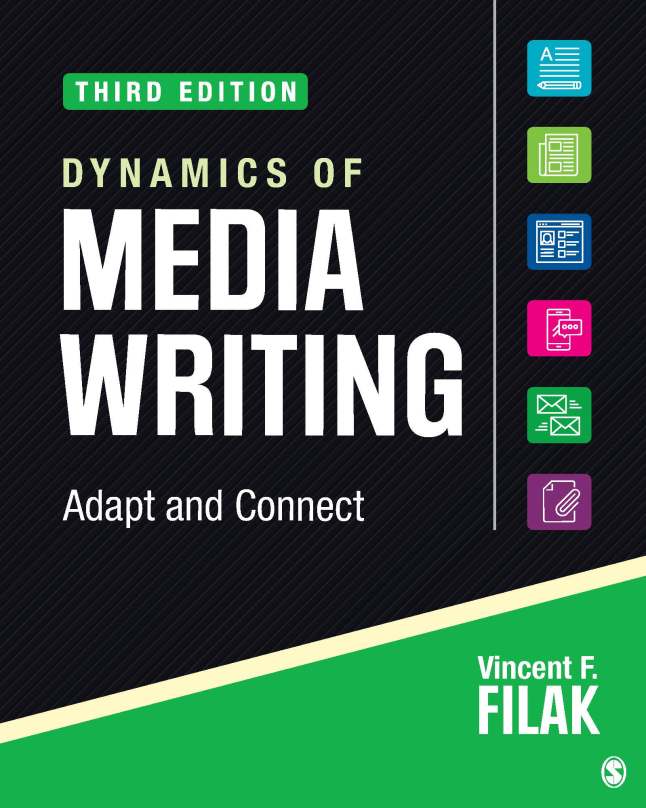
The folks at SAGE sent along the cover for the upcoming third edition for the “Dynamics of Media Writing” text, which should be out this August or September, I believe. I’m finishing the copy edits now with my main man, Jim Kelly. (If anyone you know ever tells you that copy editors don’t matter, send them my way for a firm and thorough verbal beat down. Jim has saved my keester so many times, I lost track.)

In case you wanted a sneak peek, here you go:

So, without further ado (or book pimping), here’s a look at what happens when you don’t have a good marketing staff to do your research and you end up on the embarrassing end of an email exchange with someone. (Rest assured, the folks at SAGE are great at marketing, and I can pretty much already guess who’s going to email me with a reminder to “please stop using the phrase ‘book pimping’ on your blog.”)


So… No, then? (or why it’s important to research your readers before you pitch to them)

I understand this blog tends to skew more toward news than some folks might appreciate, given that my entire pitch for the “Dynamics of Media Writing” is that ALL disciplines of media (news, PR, Ad, marketing etc.) can get something of value out of it. The skew is due to trying to cover both the media-writing text and the news reporting and writing text in one spot. It also also comes from the idea that a lot of things people perceive as “news” things are actually valuable for all media, including skills like interviewing, research, inverted-pyramid writing and so forth. Finally, it seems that news folks tend to make more public mistakes than do some of the other disciplines, so I get more content there. (If you want me to hit on more topics in the PR/Ad/Marketing stuff, feel free to pitch me some thoughts. I’d love to do it.)

That said, occasionally there is a specific foul up in a specific part of the field that bears some analysis. Consider that when you look at this email I got the other day. I redacted the identifiers as best I could:

Dear Professor Filak,

​Greetings from (COMPANY NAME)! ​I hope this finds you well. In the coming months, (AUTHOR NAMES) will begin to revise the twelfth edition of their introductory journalism text, (REPORTING BOOK NAME). ​This text strives to give students the knowledge and skills they need to master the nuts and bolts of news stories, as well as guidance for landing a job in an evolving journalism industry.
Right now we are seeking instructors to review the twelfth edition of (REPORTING BOOK NAME) ​a​nd provide feedback. This input is invaluable to us, ​as it ​giv​es​ us a greater sense of how to best address both instructor and student needs. ​If you are currently teaching the introductory news reporting and writing course or will be teaching the course soon, would you be interested in offering your feedback?
If you would like to review, please respond to this email and let me know if you will need a copy of the printed text. You should plan to submit your comments via TextReviews by 2/6/18. In return for your help, we would like to offer you (MONEY).
At your earliest convenience, kindly respond to this e-mail to let me know if you are available and interested in participating. ​Again, please let me know if you will need a copy of (REPORTING BOOK NAME)…
I’m always happy to help people and I’m not averse to making a buck by pretending to know what I’m talking about, but this felt both awkward and ridiculous. One of the things both “Dynamics” books push a lot is the idea of making sure you know what you’re talking about before you ask a question. The books also push the idea of researching your audience members so you know how best to approach them. Either the person writing this email didn’t do that or just didn’t care.
Here’s how I know that: It’s called “Google.”
Had this person done even a basic search on me she would have learned several things:
  • I am teaching the courses they associate with this book. I teach nothing but these courses, as you can find on the UWO journalism department website. The line of “If you are currently teaching the introductory news reporting and writing course or will be teaching the course soon…” tells me I’m on a list somewhere and this is a form email at best.
  • I wrote several books, including one that is likely to be some form of competition for this book. (I’m not saying it will be as good or better or anything, but my title includes words like “news,” “reporting” and “writing,” so it’s a pretty safe bet we’re vying for the same students.) This was literally one of the top five items on the first page of my Google search. She also sent her message the same day I got this alert from Amazon:NumberOne
    (I have no idea how Amazon quantifies “#1 New Release in Journalism” but I’ll take it.)

    The point is, it wasn’t a secret, so it appeared that she didn’t look me up and was like the guy at the bar telling me, “Hey, see that babe over there? I’m totally going to score with her!” and I’m like, “Uh, dude, that’s my wife…”
    On the other hand, maybe she did look me up, found the book and asked anyway, which is like the even-worse guy at the bar who’s saying, “Hey man, your wife is pretty hot. Any chance you can give me some tips on how to score with her?”

Thinking about all of that for a moment, I did the polite thing and emailed back, explaining how I felt this would be a conflict of interest (it is), and that any advice I gave her would be likely be somewhat problematic as the author of a competing book (it is).  I also noted that I know the book she is pitching well (I do) and I know the authors well (I do), so this would also be a bit awkward for me (it really is). Here was her email back to me, which again made me think she wasn’t actually reading this:

Hi Professor Filak,

Thanks so much for letting me know. We will certainly keep you in mind for future projects!

So, again, the point of the blog isn’t to beat people up for doing things poorly but rather to offer advice on how to do things better. Here are a few basic tips:

  • Research first, then write: You don’t have to do an Ancestry.com profile on every person to whom you market or with whom you engage in outreach, but it’s not hard to Google someone. Most people put more social-media stalking effort into learning about the “new kid” at school than this person put into finding out about me. In marketing, you often have access to proprietary data as well, so you can find out if this person had any previous engagement with your organization. In my case, I used that book for more than a decade and still keep up with it, so that might have been something she could have found.
  • Personalize when possible: If you are sending out 100,000 requests for something like a survey and you are expecting a 10 percent response, you will not have the ability to personalize all of the information on everyone’s card or email. That makes sense. However, when you are microtargeting a group of people with a specific set of skills or interests and that group isn’t going to overwhelm a data center, work on personalizing your content. That line about “If you are currently teaching the introductory news reporting and writing course or will be teaching the course soon…” could have easily been tweaked to say something like, “I see you have taught writing and reporting courses at UW-Oshkosh…” and it wouldn’t have taken much. Making these minor tweaks shows that you have done your research. Engaging in some personalized communication shows your readers you care enough to see them as individuals as opposed to a wad of names on a spreadsheet.
  • Try not to screw up, but if you do, don’t ignore it: The one thing that stuck with me when I got that response email from her was that I didn’t think she figured out what she was actually asking me or why it was weird. I had that feeling that if I had written her back and said, “I’m sorry I can’t do this because I’ve just been placed in an intergalactic prison for the rest of my life for murdering a flock of Tribbles with a phaser I set to ‘kill’ instead of ‘stun,’” I would have gotten the exact same email back. The whole exchange really reminded me of this scene:
 The thing that is important to realize is that you are going into a field that has two important and scary things going for it:
  1. It’s small enough that you’re really about two degrees of separation from everyone else, so people know other people.
  2. People in the field love to talk.

If you end up screwing up because you didn’t do the first two things suggested above, don’t compound the problem.

I have no idea if I’ll ever get approached by this publisher to review anything, but I know I will always carry with me the memory of this interaction. Had it been a great interaction, that would have been good for the publisher. Unfortunately, that wasn’t the case.

Do us all a favor: Laugh at your professor

Monday was the first day in almost two months that I’d been in physical proximity of the students I was teaching, and I got something valuable that I didn’t know I had been missing.

Laughter.

We were about 10 minutes into an 8 a.m. session that had five students in it, due in large part to social distancing protocols and online-only opt-out kids, when I started to explain something or other and I totally flubbed it.

One of the kids chuckled. I smiled and tried to work through it again before I paused and told them this:

“Look,” I said. “It’s going to be weird for you and weird for me this year. You all haven’t been in a classroom for somewhere between two and six months and I haven’t been in front of this many people in a while. The only thing I got going for me is that my wife made sure I shaved, wore a nice shirt and cut my hair so I didn’t come here looking like an unemployed Muppet.”

Suddenly, they all started cracking up, apparently imagining me with an unintentional mullet, begging them for spare change in Elmo’s voice.

The old saying that laughter is the best medicine might not be true for everyone, but it was for all of us in that moment. The pall lifted and the awkwardness and fear seemed to dissipate for that hour. When the class ended, the students wiped down their areas with anti-bacterial towelettes and sprayed down their chairs, but they kept chatting and laughing about various things.

For a fleeting moment, it felt OK to be there.

The rest of the day flew by, with each new set of students going through the same process of trying to figure out what “normal” was going to look like. I made efforts to crack a joke or two at my own expense. (“I’ve now said the same thing four class periods in a row,” I told my last class. “If I’m saying something to you multiple times, just treat me like you treat great-grandpa at Thanksgiving when he asks, ‘Did I ever tell you about the time I was stationed in Berlin after World War II?’ Just let me roll on and pretend this is all new to you.”)

There is a hope in a lot of us right now that this will be the last semester of social distancing, masks and a yearlong pandemic. We see some numbers going down, even as others go up. We see videos on the news of people getting needles stuck in their arms and we eagerly await our turn. We try to remember what it was like to be in a roomful of people and not feel palpable anxiety.

Throughout this, I’ve told my students that I know they’re dealing with way more than anyone should expect of them: Double shifts at grocery stores because other people called in sick, weekly medical tests and online classes in subjects that really shouldn’t be online. I can’t make a lot of these things better, I explained, so my goal is to try my best not to make their lives worse.

Not exactly something inspirational to write on a vision board or needlepoint onto a couch pillow, but it’s the best I have, I told them.

In the mean time, I’m going to do my best to keep things light. I want to hear them laugh at the lame “Dad Jokes” they have heard a dozen times. I want them to snicker as they think about the misplaced modifier in a lead that makes it sound like a burglar has threatened a pair of underpants. I want that sound of muffled snorts when they think of what a homeless elf would dress like and that I’ve compared some of my better clothing choices to that caricature.

I can’t say for sure, but I don’t think I’m alone in that desire for human amusement. Sure, there are professors out there who view everything as dark and important and would admonish people for finding humor in ANYTHING in the time of a pandemic.

(A student came to me last term, telling me about one such person. I asked, “Wow. Was this guy born an (EXPLETIVE) or did he take lessons to get this way?” I quickly looked up the guy on our faculty database. “Oh,” I told the kid. “He got a Ph.D. in sociology from (NAME INSTITUTION). I guess the answer to that question is ‘both.'”)

For a lot of us, we just want to know we’re connecting on a human level, so if  you feel that vibe in the room, do us all a favor.

Laugh at us. We sure could use it.

The Junk Drawer: Doritos Conspiracy Edition

If you stare into this mess long enough, you’ll see the message to the followers of QAnon… Unless, of course, you’re in on the conspiracy…

Welcome to this edition of the junk drawer. As we have outlined in previous junk drawer posts, this is a random collection of stuff that is important but didn’t fit anywhere else, much like that drawer in the kitchen of most of our homes.

Without further ado, here’s a mix of the good, the bad and the truly weird…

Update on the Indiana Daily Student

Last week, we talked about the financial problems associated with the Indiana Daily Student, the student publication at Indiana University. The staff published a letter-from-the-editor, explaining how the paper was likely to run out of money at the end of the semester and its future was tenuous at best.

As the editors gear up for another semester, there appears to be some potential good news, as IU has made it clear it knows the paper is hurting and that this media outlet has too much value to let it die on the vine.  According to the joint statement from the IDS, the School of Media and the provost’s office, the paper can operate at a deficit for three years, starting in the 2021 fiscal year. During that time, the three groups will work together to find a viable long-term solution to make the paper financially stable.

This shows some great forethought on the part of the school and it provides the student journalists the opportunity to breathe a bit while this gets sorted out. It’s truly one of the best possible outcomes anyone had the right to expect, so congratulations to all parties involved.

Speaking of dealing with tough times as a journalist…


Reporting: Come for the insurrection, stay for the threats

The riot on Jan. 6 demonstrated a number of things, not the least of which was a general disdain for journalists and journalism. Consider what happened to several reporters during the scrum when they had to abandon their gear:

Just in case you weren’t entirely clear of how these people felt about journalists, here’s another tidbit from that scene…


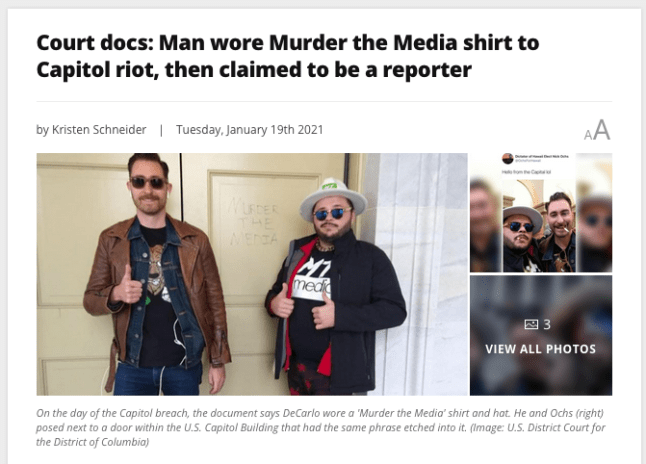
The one that got me the most, however, was a shot of the door inside the Capitol. Someone had found the time (and the spelling acumen) to express their dissatisfaction with how journalists operate in this country through graffiti:

(Side note: He might have pretended to be a writer, but he sure as hell couldn’t have passed as a photog, given that no photojournalist I know would EVER do a posed shot let alone one with the “thumbs up” approach.)

I find it interesting that the people who want to “murder the media” probably couldn’t adequately define the media, outline what areas of it are most dissatisfying to them or explain what it is they dislike about it. Because to do that, hey, they’d need to be educated or at least aware of things going on around them… and that might require MEDIA!

Speaking of life-and-death issues…


One professor is releasing more posthumous material than Tupac

Students often wonder to what degree professors pay attention to their emails, questions, discussion board posts and other forms of interaction. In at least one case, the professor has a pretty good reason for being less-than-responsive to their inquiries this semester.

He’s been dead for almost two years.

During one of those recent lectures, a question occurred to Ansuini that he wanted to follow-up on with the professor. He was eager to learn more about a particular example the professor had used.

So he paused the video on his laptop and Googled the professor’s name in order to find his email — that seemed quicker than hunting around for the syllabus on his desktop. What he found instead was an obituary. At first he assumed it must be for someone else with the same name.

In fact, no: François-Marc Gagnon, an art-history professor at Montreal’s Concordia University, had passed away in 2019 at age 83. Turns out Ansuini’s favorite new professor was dead.

Turns out, there had been another professor “ghost teaching” the course at the direction of the university. While people debate property rights of his lectures, I’d have a real hard time sticking with this class. It was weird for me watching the final episodes of “Jeopardy!” with Alex Trebek, knowing he was dead already. I also haven’t been able to listen to my Bill Cosby records for years, now that I know he was a sexual predator.

Speaking of other awkward collections…


That’s a pretty nice ass. you’re trying to sell

In editing, we joke about how headline abbreviations need to avoid causing more problems than they solve. (The best one was about an interstate murder investigation which states, “Ill. man accused of Mass. murder”) In working through some Marketplace listings, I came across an offer I almost couldn’t refuse:


And, finally, speaking of things that you can’t make up, no matter how hard you try…


Doritos: Illuminati and Sea Salt Flavor

I always appreciate honesty and thoroughness in all of the corrections I read, but I have to admit, I wondered how in the world the content in this one ever saw the light of day:

I’m only imagining the conversation that led up to this:

Editor: “You sure on this QAnon pin thing?”

Writer: “Well, it was orange and triangle shaped… I mean what else could it be?”

Editor: “All right, let’s run it!”

As always, this comes with a valuable lesson, which is, “If you don’t want to be accused of being part of a conspiracy-theory group with ties to all sorts of unsavory people and actions, don’t eat Doritos.”

UPDATE: Turns out, I got smoked. This was apparently debunked, as a friend told me after this ran:

The content in that one never did see the light of day.

https://www.usatoday.com/story/news/factcheck/2021/01/16/fact-check-cnn-correction-ted-cruz-dorito-chip-fake/4189434001/

Dammit. I hate when this happens. Goes to show that I’m going to need to work on being a bit more careful.

Vince

(a.k.a. The Doctor of Paper)

Confessions of an unpretentious, anti-academia professor

Over the course of the past nine months, we’ve all endured the pandemic of COVID-19 as well as the changes to our daily lives as educators and students. What I have come to notice more and more is that because we all seem to be facing mortality in a more direct way than ever before, people seem ready to rage against every microscopic thing at the drop of a hat.

In addition, it seems that most of the faux outrage and pearl-clutching behavior comes from people who should have a better sense of reality, namely folks involved in higher education. I would like to attribute it to the stress and anxiety associated with the coronavirus outbreak, but I think a lot of it has been there all along. There has long been a demarcation between people who teach and work at universities and college and “academics,” who seem to think they exist on a higher plane of reality than the rest of human kind and need to “set other people straight.”

Truth be told, no matter how many books I wrote, degrees I earned, studies I conducted or symposiums I attended, I never embraced the “academic” lifestyle. Sure, I liked having an office, a decent health plan and the ability to hear people call me “professor” from time to time, but I never forgot who I was or where I came from. I’m basically just another person who found something they liked and got lucky enough that it led to a career. Had it not been for crossing paths with a few crucial people, I might have been an auto mechanic, a cops reporter or a factory worker. Knowing that has always kept me from getting too full of myself or thinking that my excrement lacks odoriferous qualities. (Yeah, that was a bit much…)

With that in mind, here are a list of things I have actively done, said, considered or otherwise found myself thinking  as a professor that only make sense if  you understand the self-important, pseudo-intellectual, easily offended, drama-twerp reality that is “academia” and the people who embrace it:

  • When I first meet people around where I live, they often ask what I do. I tell them “I work at the U,” with the hope they’ll think I’m a janitor or facilities manager. Their view of what professors are does not jibe with what I want them to think of me.


  • I noticed an inverse correlation between the human decency of professors and the percentage of the final grade they assign to final exams or final projects. Students have told me some professors value a final up to almost 70 percent of their total grade. That’s insane, but that’s “academia” for some folks. I put as little emphasis on final exams and final projects as possible, making them count for about 15 percent of the total grade at most when I can get away with it. I find that keeping the percentage lower tends to relax the students a bit more, especially because they’re also working on final projects and final exams for other classes. It also takes pressure off me when I’m burnt to a crisp and grading a ton of papers. I worry less about each point I take off or give back because I don’t feel like I’m disarming a bomb.


  • When I read postings on Facebook groups for academics, I am constantly reminded why I hate academics. I forgot who said it, but the line about how the fights in academia are so extreme because the stakes are so low always rings true there. I have to constantly remind myself not to post something about them needing to grab a ratchet and loosen their sphincters a few turns because a) that would be undignified and b) most of those people wouldn’t know what a ratchet is.


  • I often refer to students as “my kids,” and it bugs me when people tell me not to because they see it as a somehow insulting to the students. First, bite me. Second, I do this because, no matter how old they get or where they go, there won’t be anything I won’t do for them. Once you become one of “my kids,” you’re there for life. Just ask the students I’ve taught who are now in their 40s or 50s and have  spent half their lives still connected to me in some truly meaningful ways.


  • If I have a choice between helping one of my kids and doing something that fits within the formal rigors of expected pedagogy, well, that’s an easy choice: I’m helping the kid. Nobody ever died and said, “No matter what happened, I’m so glad I abided by the strictest interpretation of academic rules.” Except for maybe people who need to have their sphincters loosened a turn or two.


  • When forced to attend multi-disciplinary meetings, I look around the room carefully when someone tells a fairly innocuous joke. I look at all the people around the table to see who stiffens and who doesn’t and I take note of the stiffies. If anyone notes sternly the way in which this is highly inappropriate because it insults (fill in the blank), I make note of that as well. I then guess which departments they work in and spend half the meeting looking them up through the U’s database. I’m usually dead on, or at least one of my top three guesses are right.


  • I would guess that about 90 percent of academics fall into one of two categories: Those who are insulted by nothing because they have no sense of anything outside of their discipline and those who are actively waiting to hear something potentially insulting and then loudly castigate everyone else for such things existing in this “plane of higher learning.” The other 10 percent usually came to higher ed after working a job in which we spent time around actual humans, so we tend to function a bit differently.


  • I find “woke” academics who employ guilt in Facebook discussions over petty squabbles they’ve turned into land wars totally adorable. I grew up Catholic, spent 12 years in Catholic school (much of it where nuns were involved) and remain an active Catholic. Guilt is the milieu in which I live and breathe. It’s like trying to discombobulate a fish by getting it wet.


  • Dealing with academics who begin every discussion by outlining their educational credentials has always made me feel like I needed to carry around a pocket full of quarters:


  • I fully support my female colleagues who engaged in the “Dr.” movement a few years back, where women added that term to their social media handles, academic emails and more to indicate their academic level of achievement. They take more shit than I think anyone should simply because men feel inferior around smarter women. I’ve worked for more women than men and most of my best bosses were women.


  • Conversely, I find it ridiculous when Ph.D. or Ed.D. academics (usually men) demand that EVERYONE call them “doctor,” as opposed to “professor,” or even “dean.” As I once explained to the superintendent of schools in Fond du Lac who required such formality of all creatures, I’m proud of my Ph.D. and I know he’s proud of his Ed.D., but ain’t neither one of us getting called into surgery tonight.


  • I have been blessed to work with a lot of students who are farm kids, first-gen college students and those who are attending school on a GI Bill and for some reason, we tend to get along pretty well because we’re honest with each other in a way academics tend not to be. I think it’s because there’s a shared sense that the world is full of hard stuff, so trying to make things harder for no real reason doesn’t really serve a purpose. Or that after you spend your day ankle-deep in cow manure, you can much more easily detect professors who are full of it.


  • I don’t get a ton of complaints about final grades and I attribute that to some really good upbringing  by the parents of my students. My friends at other universities get a lot of threats about how “you will be hearing from my parents” when students don’t get the grades they want. I once asked one of my small-town farm-kid students, “If you went home and told your mom that she needed to call me and demand that your grade was changed so you could pass my class, what would she say?” The kid paused for a minute and then she looked right at me and said, “My mom would kick my ass twice. Once for f—ing up and once for telling her to call you.”


  • One of the best ways to get me to do the exact opposite of what you want me to do is to ascribe to my behavior something that most sane humans would not consider logical or fair. In short, I’m calling it a “manhole” when I’m yelling out to you because I think that’s the best way to tell you what you’re about to fall into and die, not because I’m supporting the hetero-normative, patriarchal system that is using nomenclature to create a permanent underclass.


  • I can already think of at least a half dozen people who are furiously typing a six-page email to me, denouncing that last statement.


  • Humor is an honest coping mechanism for a lot of people. There’s a reason that people like Richard Pryor were so funny, and it was because humor helped keep them deal with a lot of dark stuff. Sometimes, when I’m telling a joke, I need to laugh more than anyone else does. If someone is making a joke or sharing a humorous anecdote, you should feel free to laugh even if it’s not that funny. If it might be insulting, but it’s still tolerable, let it go.


  • And finally, whenever I find myself in the middle of one of those “academic” shit fights that tend to show up in administrative town-hall meetings or on Facebook threads, I can hear my father’s voice in my head, reminding me that “Educated doesn’t always mean smart.”

Throwback Thursday: Translating “The Dance” between professors and students over final grades

Thanks to the corona-pocalypse, many of us are ending our semesters around this time having done so many things differently than we ever have done before. What seemingly hasn’t changed in this time, at least based on my reading of Facebook threads operated by college professors, is the laundry list of excuses, requests and overall whining about final grades.

As is the case with most things this year, a lot of us have been a lot more liberal with our approach to grades, missed work or other such things. It’s like “OK, the manual says X, but we’ve just crash-landed and aliens are clawing at the door of the ship, so let’s just try to survive this instead of worrying about strict military protocol.” I also know that we’ve had a lot of burnout in faculty and students this year, so a lot of us have tried to be more humane.

That said, if you can’t find amusement in that sarcastic voice in your head when a student approaches you with one of these lines at the end of a semester, well… you have problems I can’t solve.

Thus, let’s look back at a simpler time where we were much more attuned to BS and much less worried about sanitizing every surface around us:


—–

Translating “The Dance” between professors and students over final grades

As the term winds to a close, students and professors engage in what I refer to as “The Dance” over grades. It’s a tactical, nuanced discussion that involves trying to beg without it looking like begging, trying to answer an email without promising anything and basically engaging in nuclear-treaty-level diplomacy. If we were all trapped in a “Liar, Liar” world, it would essentially look like this:

Student: Pass me and stop being a jerk, you asshat.

Professor: Oh, now you care about this class, you little twerp? Go to hell and take a left.

However, since we have to “Eddie Haskell” it on both ends, here are the legendary begging statements I’ve gotten from students over the years or variations on those themes provided by the hivemind. I’ve added a few “internal thoughts” your professors have had over the years when it comes to responding to these pleas. Enjoy:

“Could you just add XX small points to my final grade?”

First, all points are created equal. Second, that figure has ranged from 1 to about 100, depending on the level of desperation. Third, when you kept doing the same stupid thing over and over again because instead of reading my comments, you just looked at the grade and thought, “Screw you, dude” you might not need those “small points.”


“I’m graduating this term…”

Not if you need to pass this class, you’re not.


“Is there anything I can do?”

Can you invent a time machine, go back in history and tell the earlier version of yourself to turn stuff in on time, not skip every third class and generally give a better overall performance than a disinterested Jay Cutler on a trick play? If not, no.

OR

Prayer can help, although I’m not certain how strong God’s will is to help you out here.

OR

Sign up for the next semester I teach this class and give a crap a little sooner in the term.


“Is there extra credit?”

Sure, because when the syllabus said, “There will be NO EXTRA CREDIT in this class, so plan accordingly,” I clearly included a loophole for people who didn’t care about anything until the very moment they realized they were screwed.


“Could I rewrite (half of the assignments) for additional credit?”

Sure, because nothing says, “I’m ready to do a good job,” like not doing a good job on anything all term and then expecting to make all of that up in 72 hours before grades are due with no real interest in learning anything other than how many points you need to slide by.


“Could you bump me up just this little bit?”

Sure, because I’m sure that won’t tick off the six other people in your class who sweated bullets to get a passing grade through hard work on that assignment you blew off to go to Cabo and party on the beach.


“Could you possibly round me up?”

I could. Now ask me if I will. Welcome to the grammar lesson you skipped.


“I had some issues this semester…”

Yeah. No kidding.


“Your class is very important to me…”

Um… I believe a lot of things people tell me to make me feel better about myself. This isn’t one of them.


“I don’t understand why you downgraded me…”

You mean the page and a half of comments I included in the body of your paper didn’t clue you in that this random series of unattributed content, fragmented sentence, shifted verb tenses, incorrect word choices and cripplingly bad structure didn’t help? This wasn’t a news story. It was a disaster movie filmed out of sequence.


“This isn’t fair that I should have to take your course over again.”

It isn’t fair I had to grade this pile of sheep dung you referred to as “completed assignments,” but we all have our crosses to bear, I suppose…


“I need (A/B/C grade) to (pass/maintain my scholarship/keep my ego afloat)…”

This is not Burger King. You don’t get it your way.

3 ways to avoid letting Tucker Boner, Dick Hertz and Heywood Jablome turn your story into a prank

The world of news features is fraught with danger when you couple unsuspecting reporters with people who enjoy trolling them. A journalism colleague and friend alerted me to this potentially suspect source in a New York Times story about Zillow Surfing:

As my friend noted, “I couldn’t help but think the reporter got duped,” before referencing this classic “source” in a New York Post story:

If you need the joke spelled out, I’ll answer the question for you: “No, I would not like to blow you…”

The Post story is coming up on two decades old, but the folks there are apparently not giving up the ship when it comes to Heywood’s bona fides (sorry… couldn’t resist) as this story is STILL AVAILABLE.

Is it possible that these guys were both real people with just unfortunate names? Sure. I mean, one of the best pitching coaches in baseball history (at least in my mind) had probably the world’s worst name if he wanted people to take him seriously: Dick Pole.

Of all the greatest “add another layer” moments was the year in which Pole played for the Portland Beavers. Although you should know by now I’m not creative enough to make this stuff up, here’s proof:

We could spend hours going through a list of names people have used to punk reporters. The Seymour Buttz and Mike Rotch’s of the world are well known, thanks in large part to “The Simpsons” and Bart’s penchant for pranking the local bar.

There are plenty of cases where “regular” people have names that go beyond common spellings or those we have seen hundreds of times before. We once had a music guy who kept calling us to promote the promising bands he represented. His first name was Spackle. I have no idea how or why…

Even more, there are cases where people share famous names with people who have entered the public spotlight in an unfortunate fashion. (In my time at the State Journal, I worked with a “Susan Smith” right around the time another “Susan Smith” was in the news for all the wrong reasons. Our “Susan” actually wrote a column about these unfortunate pairings…) And, of course, it’s probably no great shakes for these regular folks, either, who have to deal with this on a daily basis:

However, as a journalist, you can’t cut people out of your stories or avoid them just because “that name sounds weird.” With that in mind, here are a few tips for keeping yourself out of trouble in these situations:

Trust but verify: In most cases, you’re getting people to tell you their names and spell them, so you’re in pretty good shape for making sure you got the name itself right.

If the name seems like it might be a “trolling moment,” you can’t automatically assume this person is messing with you. (“So that’s Dick P-O-L-E… wait a minute!”) It would be in poor form to demand ID from that person, but you can get around that concern in a few other ways.

Make use of the other publicly available databases, such as those for court records. Maybe “Yankton Weiner” was sued, filed suit, got a speeding ticket or got a divorce from the former Mrs. Weiner, which would help you figure this out.

Do a search through multiple other websites connected with the topic at hand to see if that person was cited as a source. A quick run through your own news site and a few others in the area would be helpful as well. If you keep coming up empty, telephone directory searches are also helpful.

Also, the internet has a burgeoning public records industry where various companies swear they can find out anything about anybody. If you search for a name, chances are, you’ll get at least something in the free version of the company’s site. Worst case, pay the $20 or whatever if you’re desperate to use the source but afraid of looking like an idiot.

Box the source in: One of the easiest ways to prevent a source from snowing  you is to pin that source down with specific questions about themselves. A person might quickly give you “I. P. Frehleigh” as a name, but would likely be less adept telling you what the I and P stand for. The more questions you ask, the more hemmed in that source will be.

If the source works in some professional field, ask for a business card with the idea that you might want to reach out to them later. If they balk, that’s a pretty good indication that something might not be above board. If they offer a phone number instead, use that number to reach out to them from another phone and see how they answer. Or use a reverse-directory app to get their name from that number.

Throw some basic chatter at the person to get some other information such as, “So how long have you lived around here?” or “Where did you say your office was?” If the answers are quick and easy, the person is likely on the level. If they feel forced, be wary. Either way, write the answers down so you can check them against other information. Also, don’t be afraid to go back and ask a basic question a second time to see if they have it the same way twice: “I’m sorry, but HOW did you spell ‘Frehleigh’ again?”

Ask that source to give you some contact information for their colleagues or other folks who might be just as helpful. This will help limit the number of lies that you can hear. At the end of the day, paranoia will be your best friend, so ask as many questions about the person as you need to

Cut it: There’s no rule that says you have to use a source just because you got the source to talk. Granted, some sources are crucial to a story, but if you review what Mr. Jablome and what Mr. Boner told the reporters here, you can see nothing vital or unique. This is a case of a reporter just deciding, “Well, I got the source, so I’m using him,” a concept in journalism known as notebook emptying.

At the end of the day, I’d rather be one source short than to add to the legend of “Elle Phunt,” “Dee Z. Knutz” or “Barry McCockiner.”