3 reasons Twitter moving to 280 characters won’t help journalists communicate more effectively (Or, “Filak-ism: Just because you can do something, it doesn’t mean you should)

(Once again proving that just because you can do something, it doesn’t mean you should do it.)

Before I wrote my first book for SAGE, I sketched out a handful of “Rules of the Road” that had to apply to ALL journalism. That ratty piece of hotel stationary with fading black ink on it sits in front of me every day at work, a reminder of the core principles of what matters most in this field.

When Twitter announced the other day that it was taking a trial run at doubling its character limit, I hated it, specifically because it violated several of those “Rules,” specifically:

  • Right tool for the right job
  • Just because you can do something, it doesn’t mean you should
  • Audience (and timeliness) matter most

In other words, Twitter could make it so tweets are 914,292 characters each, but that won’t make them any better or more helpful to readers, thus negating the value of the tool.

Here are three reasons why Twitter’s move to 280-character isn’t a great idea and/or why you should still shoot for that 140 limit:

  1. Noun-Verb-Object tells the best story: One of the biggest problems students have in transitioning from other forms of writing to media writing is learning to write tightly. One of the biggest reasons for that is their lack of strong sentence structure. In both books, we talk about the idea of starting with the noun-verb-object approach to a sentence and then building outward from that. Twitter, in its 140-character perfection, forces you to do that if you want to get your point across. When a sentence lacks a concrete noun or a vigorous verb, the writer must slather on adjectives and adverbs to get a point across. That makes for longer, weaker, lousier sentences.
  2. The Homeowner Theory on the Accumulation of Stuff: The more space you have, the more worthless crap you will accumulate.
    My first “grown-up job” had me moving 500 miles across the country and as such, they included a nice perk: A moving service. I packed everything in my studio apartment and had it ready for what I expected would be a full day of moving guys coming in and out of my place. The three movers walked in, looked around and started to laugh. “Is this it?” My total accumulation of goods didn’t even cover the back wall of the truck.
    The next move was from a two-bedroom apartment to our first house. The house had a giant rec room, where I dreamily envisioned adding a pool table and giant entertainment center. At the time, however, all we had to put in there was the beige velour floral couch I bought off a guy’s dead aunt for $50. We put the couch in that room and started laughing uncontrollably. It was this tiny speck of furniture in this giant room. We eventually bought a sectional and a pool table.
    Each move meant a bigger place and more crap. No matter what we thought we were doing, we kept adding more and more stuff. Thus the point: If you have extra space, you’re going to fill it with a lot of stuff you probably don’t need. If you are like our friends who live in tiny big-city apartments, you know you need to maximize space and get rid of stuff you don’t really need.
    Its true of space in a home, time in your day and characters in your tweet. If you are limited to 140, you’ll make the most of it. If you get 280, you’ll fill that space as well. Eventually, 280 also will seem too small because you keep cramming extra stuff in there and you get used to the larger size. It’s like knowing you’re gaining weight and that it’s not good but instead of trying to exercise more, you just buy bigger pants.
  3. It fails to demonstrate audience centricity: Look at the explanations that people have offered for this switch to 280:

    The idea of extending the length of Twitter posts has been contentious internally, batted around among product groups that are trying to find ways to persuade people to use the service more frequently. At 328 million users, Twitter has been criticized for its inability to attract more people. Investors have grown nervous, as that slowing of user growth has affected the company’s revenue.

    “We understand since many of you have been tweeting for years, there may be an emotional attachment to 140 characters,” the company said.

    As a result, Twitter said, if rules around characters are loosened, English-speaking users — who tend to use more characters in tweets — will also hit character limits less frequently. That may, in turn, lead English-speaking users to post more regularly.

    So, in short, Twitter is looking at this as a way to get more people sending more tweets as part of a profit motive and people who got used to the 140 characters are essentially just “emotional” in their concerns. Notice what’s missing here: The focus on people who RECEIVE information on twitter, a.k.a. the audience.
    The value of any tool you use in media writing is how well it does in reaching your audience members and providing them relevant, useful and interesting information. Nothing about the increase of the characters focuses on how much better the tweets will be or how the audience will be best served. The reason? It won’t, primarily for the reasons outlined in Points 1 and 2.

In the end, this might be tilting against windmills and everything will be fine. However, keep in mind this is just a “test” of the new limit so if you get to play with it, don’t get too attached. After all, once you get used to 280, it’s going to be hard to fit into that 140-character space.


3 lessons I learned by examining my Twitter “followers” (Or why culling the herd is bad for the ego, but good for the soul)

I learned something incredibly important and potentially valuable for other social media users on Saturday night: Popularity as a social media practitioner can be an illusion and you really should check in on your audience fairly often.

By way of some backstory, when I was finishing up the “Dynamics of News Reporting and Writing” book, some folks in focus groups offered feedback that this would need a digital and social media presence. Thus, we launched the blog and tried to let people know that I’d be doing this as part of both of my “Dynamics” books. As for social media, the people recommended a strong Twitter presence, which I had, but it probably wasn’t going to helpful in selling books.

I was a pretty early adopter of Twitter (relatively speaking to the field and really for me, given that I still own a VCR) so I have been using it for almost a decade now. I built up a “following” of more than 500 people over the years and I had always managed to keep pretty good Klout scores (when that mattered) and the right ratio of followers to people I followed. Almost 7,000 tweets later, I really didn’t want to start all over again. However, given how far back I was tweeting (I can’t remember what I ate for lunch today, let alone what level of stupid crap I might have put on Twitter in 2009) and my general ability to fly into a Twitter rage when I felt the Indians or Cavs were getting screwed by the officials on any given day, it seemed like the smart thing to do.

I tweeted out to my followers about three months ago that I was shifting to my new handle and told people to follow me there. I did this a couple times and found that about 75 people either moved over or joined me at the new handle. I was wondering how and why I didn’t have more support from those other folks. I found a suggestion online to remedy this: Pull up each follower, determine that follower’s value and then send off a personal direct message to that person, asking him or her to shift over. Then, do one final “Closing Time” tweet and shut off the old account.

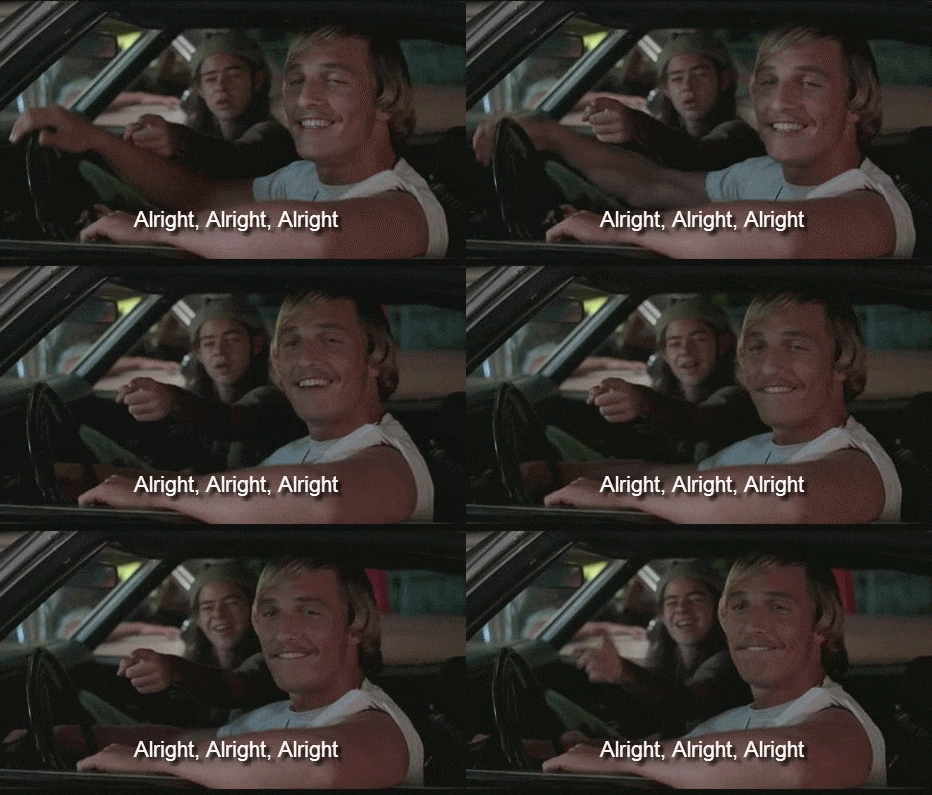
In my “direct message” adventure, I found out a few things that might be helpful to you as you analyze your true social media reach and determine how best to serve your audience. A working knowledge of “Dazed and Confused” could be helpful here…

  • FILTERS DON’T CATCH EVERYTHING: I have some pretty good filters on my social media accounts to avoid the viruses and spammers, mainly because really smart people at the U helped me set them up. That said, I found at least a few things got through. A couple accounts for “Free” whatevers were in there, although my favorite was from the account of a woman, who posted a picture where she appeared to be in her 20s. She was leaning against a white wall and had her finger seductively pulling down the middle of her blouse to reveal cleavage, and her bio noted that she was lonely and hoped I’d be in touch soon.

    To be fair to me, I think it says a lot about my own personal sense of self that when I saw that, I immediately went, “Yep. Spam.” As I know fully well nobody in their right mind a) sends something like that on Twitter and b) would ever think to send something like that to me in any way, shape or form. I am not a middle-aged, self-deluded Wooderson:

https://media.giphy.com/media/g5zvwUa9720pO/giphy.gif

LESSON 1: You need to go through and hand-cull some of these spam accounts yourself as to avoid problems in the future as well as to have a better sense of who is really paying attention to you and why. Fellow journalists: Keep ’em. Guys from Jersey who swear they’re hot Swedish models in your area who are just dying to meet you: It’s probably not worth the risk. Block ’em.


  • AND YOU ARE…? : In flipping through the list of followers, I did have more than a few “Wooderson’s little black book” moments, as I had apparently picked up people I was following and they were following me and I had no idea who the heck they were:

    Wooderson-dazed-and-confused-1626354-200-200
    (C-Y-N-T-H-I-A? Yeah… Who are you again?)

    These were random people who I apparently met at various media conventions, or whose papers I critiqued or who were former colleagues for 10 minutes some place or… Heck, I don’t even know. What made it worse is that they had no real context clues on their biographies. When someone put “Journalist” in there at least I had a clue, or “Former EIC of Smithville Junior College Paper,” I could employ some deductive reasoning. However, your favorite Bible verse or random quote didn’t help me figure out if I should keep you or ignore you. (To be fair, my Twitter bio never changed in 10 years and it sucked: “If you follow me, you are not allowed to be offended. Opting in is an implicit admission of guilt.” Yes, you can say it. I sounded like a dipshit.)

    LESSON 2: Your audience might be full of people you really don’t know at all. That can make it harder for you to tailor a message for them. It’s a good idea to go through that list of people occasionally to see if you really have a message for these people or not. Obviously, you shouldn’t randomly block people, but consider the degree to which these people are valuable beyond your ability to count them. The goal of social media is to increase sharing and interactivity on topics of common interest. If that’s not your audience (or if you’re not hitting your audience because you don’t know them), you need to review your options. (Side note lesson: Use your bio to actually help other people know you and give a damn about you. It’ll help both of you. I will be updating mine shortly after I finish this post…)

  • DEAD WEIGHT, DEAD WEIGHT EVERYWHERE: I was amazed that so many of the people who followed me and who were in the “social media demographic” were basically nothing but a Twitter shell.  Several accounts hadn’t posted anything in years. One even noted: “I’m only creating this account because you made me.”

    Fantastic….

    Some accounts were from people who started them as projects before hashtagging became a more popular way to track tweets on a topic. Thus, I was being followed by a few journalism conventions from 2009 or so, and they obviously had very little to say. Some people had long ago left their gigs as media advisers or journalists and their accounts basically ran dry.

    LESSON 3: Chicago elections aside, the dead shouldn’t be adding to your account tallies. If you find people who aren’t active or who aren’t giving you value, feel free to thin the herd and make that audience a bit clearer and a bit more honest in terms of the people who are truly “following” you.

When all was said and done, the people I had to block or cut shrunk my number to about 450. When I got rid of the “I don’t know you” people, the number shrunk even more. Between the people who were already following me from the old account and the amount of people who responded to the DMs, I ended up with about 25 percent of my original audience.

I’ll be honest: The number of people following me gave me this false sense of popularity. Sure, it was only 500 people, so I wasn’t like Donald Trump’s Twitter feed, but that number was still a lot higher than a lot of folks I knew. Having it shrink by almost 80 percent was kind of a kick in the ego. Still, I’m going to follow up on this about every six months or so to see who is following me, why they’re (likely) following me and if what I’m putting out there fits their needs.

And if you’d like to be part of that group, feel free to follow me on Twitter at DoctorOfPaper.

(And yes, I’ll probably follow you back… Hey, we all have an ego to feed. 🙂 )

Social media: Does a politician have to “like” you?

Public employees and public officials have a lot more of their lives on display than most private citizens. The documents they produce at their job can become public records. Emails from their official work account can be sought in open record requests. Their salary is often published in governmental manuals and “watchdog” databases.

That said, they can use a non-official email like Gmail for their non-work communication and that information is as private for them as it is for anyone else. The same is true for the personal documents they create at home.

What sits in between these public and private demarcations is a fuzzy, messy gray area and social media sits right in the middle of it.

For public officials, social media has become an integral part of daily life in reaching out to their constituents and discussing important issues with the public. The president has more than 36 million followers on Twitter and his tweets have been the subject of many news stories over the first nine months of his administration. Facebook pages often run a that quasi-official line between personal information and political wrangling. However, these accounts are not “official” in the same way a .gov email address or a state paycheck would be.

Dee Hall from the Wisconsin Center for Investigative Journalism takes a deeper look at how the courts have ruled on these issues of a politician’s right to “block” users or to use social media in official capacities. (Disclosure: I worked with Dee and her husband, Andy, at the State Journal for several years and still see them from time to time at journalism functions. Also, Andy once got me to cover his shift and report on a high school graduation with the promise of a six-pack of beer from Indiana and a bucket of Tell City Pretzels. Not sure if that matters, but better to say it than not, I s’pose.)

The question is a good one: If you’re using something as a public official, should you have the right to shield its use from certain members of the public? The courts have almost famously been behind the curve in terms of dealing with technological advances, but as we see social media continue to become an almost preferred form of political communication, it will need to catch up in a hurry. Otherwise, the first filter on what we learn from our leaders will be whether or not they let us “like” or “follow” them.

The Cav Daily and its amazing “Unite the Right” coverage (Part I)

18279_dsc_7517_2f
Tim Dodson’s photo of the tiki-torch-wielding white supremacists on the U.Va. campus Friday night. (Courtesy of Tim Dodson, Cavalier Daily)

Editor’s Note: I wanted to take a look at the events of Charlottesville for the blog, but I wanted to look at it through the eyes of the student media. Far too often, student media gets the cruddy end of the stick or just gets ignored, so I went to the website for the student newspaper at the University of Virginia to see if anyone wrote a story on the topic. I was blown away by the overall coverage here in terms of quantity, quality and depth from the Cavalier Daily. The use of video, social media, text, links to previous work and photography was beyond what most local publications could handle. They “flooded the zone,” to borrow a phrase.

These are just a few of the stories the Cav Daily published:

I reached out to Tim Dodson, the managing editor of the Cavalier Daily on U.Va.’s campus, who was gracious enough to talk to me about all of this. He wanted to make sure I understood that he wasn’t the only one on staff working the story: Senior Associate News Editor Alexis Gravely, News Editor Anna Higgins and Senior Writer Daniel Hoerauf comprised the team that produced this incredible work. EIC Mike Reingold was chipping in as well, aggregating his staffers’ social media posts and flowing them through the Cav Daily’s formal social media channels. Opinion writers were building additional pieces and others were also adding what they could from wherever they were while still on summer break. As much as I knew I would end up telling this story through Tim’s eyes because he was my main source, he clarified at every turn that it was NOT “his reporting” or “his work” but that of the whole staff. So, if that doesn’t always come through in the writing, you should blame me, not him.

In going back through the notes of a more than hour-long interview, there is no way to do this well in one giant chunk, so I’m splitting it up across several posts on the next few days. In the mean time, here’s the first chunk of the story. Corrections and tweaks are likely necessary and gratefully received.

Corrections:  Date of Tim’s election to news editor has been fixed and clarification on who was covering which events on which days has been added. Keep ’em coming if I messed up.

—

Two days before his 21st birthday, Tim Dodson found himself working with a small group of journalists from the student newspaper at U.Va. to cover the chaotic events in Charlottesville.

“I think we all knew there was a potential for violence,” he said in a phone interview Tuesday afternoon. “I don’t think anyone was expecting to see everything that unfolded.”

The national media kept a wary eye on this city of nearly 47,000 as white supremacists, the alt-right and other hate groups gathered for the “Unite the Right” rally on Friday. Dodson, the managing editor of the Cavalier Daily, was part of a skeleton crew of staffers that planned to cover the event that was happening on U.Va.’s front doorstep. Aside from his position at the paper, Dodson had another reason to care about the weekend’s events: Charlottesville was his hometown.

“I’ve grown up here this is my hometown,” he said. “I’ve never seen anything like this. I’m in no way making light of anything that happened Friday but in some ways, it felt like I was in one those “Purge” movies because of all the stuff that was going on.”

Dodson graduated in 2015 from Western Albemarle High School, where he worked on the student newspaper (“It wasn’t this hard core,” he said. “I didn’t do any breaking news.”) before he enrolled at U.Va. He found out about the Cav Daily while attending a student organization fair and became a reporter on staff. He was then elected as one of two news editors in December 2016. A year later, he was elected managing editor and his 20-30 hours per week at the paper surged to 30+ hours as he helped the editor in chief oversee the publication’s operation.

During this summer, he was on his second internship at Charlottesville Tomorrow, a nonprofit, nonpartisan news organization focused on covering quality of life issues in the area, and his weekend gig at News Talk 107.5 WCHV, a local radio station. Thanks to the flexibility of his various bosses, he was able to work with the Cav Daily staff on the “Unite the Right” events.

“I’m honored and blessed that my bosses have been really good about flexibility with me,” he said. “We are in a period where nobody is formally writing things (for the Cav Daily) so several of us were really trying to figure out who is in town and how we could get all hands on deck for this.”

Dodson said he went to the Cav Daily office on Friday night after working one of his other media gigs to await a court ruling regarding the event. The city tried to force the group of white supremacists to a different location, but the group sued the city and got an injunction. As Dodson awaited a court’s decision on how all this would shake out, he got several texts from people he knew saying the white supremacists would be holding a rally at the rotunda, which is right in the middle of campus.

“I have no photo skills, but I grabbed a camera and headed over there,” he said. “I found two other reporters and we were all walking around together. Then we start getting pictures of people lighting tiki torches and walking around on campus… I called the other members of the staff and said, ‘How quickly can you get over here?'”

Staffers Alexis Gravel and Daniel Hoerauf arrived and everyone threw themselves into the mix, even as people were twirling torches and chanting. (News Editor Anna Higgins joined the group on Saturday as the team covered the events downtown.) Dodson said the staff members were not only working on telling stories but also watching out for each other as mob’s frenzy grew.

“I was looking down on (the crowd) from a balcony area and if there’s one word for it, it would be chaotic…” he said. “We knew there was a high potential for violence and we knew it was going to be a mess the next day.”


Improvise. Adapt. Overcome. (or how Pat Finley’s set of “toddler-ish” drawings shed light on the Chicago Bears’ pointless media policy)

For the past week, Sun Times journalist Patrick Finley has covered the ins and outs of Chicago Bears’ training camp. Entering his fifth year on the Bears beat, Finley has provided readers with an abundance of copy since camp opened on July 27. He has discussed the issues QB Mike Glennon has in throwing deep and the promise associated with rookie Mitch Trubisky. He has conducted one-on-one podcasts with linebacker Danny Trevathan and running back Jordan Howard. He has also filed feature pieces like his look inside the wide receivers’ room and his story about three players who got a second chance thanks to the Bears.

However, it has been his use of awkward artwork in response to the Bears’ restrictive media policies that has fans and journalists alike paying the most attention to him.

Finley said the Bears allow journalists and fans to watch all of the training camp work, but journalists can only take photos and videos during the first 20 minutes of the day. On the other hand, fans can shoot whatever they want, whenever they want and post it wherever they want.

To provide a touch of levity regarding the absurd double standard, Finley did what journalists have done in court for decades: He created artist’s renderings of what he saw.

The only problem? He can’t draw:

DF1g9rAXUAAm2qo
Finley’s “live look at (rookie QB Mitch) Trubisky.”

“I wish I could say I planned it out, but it made my giggle the first day I drew one,  so I kept doing one a day,” Finley said in an email interview Friday afternoon. “I knew it was silly, but also subversive. Also, that’s the way I draw; I didn’t make it look toddler-ish on purpose.”

Over the next several days, he kept adding to his portfolio with drawings of punt return drills:
DF6y8D-W0AAVAcT

The innovative use of tennis racquets and volleyballs as training tools:

And even a fantastic TD hookup today between Trubisky and wide out Tanner Gentry:

DGZ5M7CW0AM1Dm7

WGN-TV has even made a point of featuring Finley’s work. Finley said his sketches are among the most-viewed tweets he has published all week and has even drawn the attention of some of the Bears’ PR folks:

“In the last couple days, some PR staff members have asked me about it, but not in a threatening way, and certainly with no request that I stop,” he said.

Finley said he hopes his subversive sketches will draw some much-needed attention to the bigger picture: Why is there one set of rules for journalists and another for the general public?

“You’d think that this would help them realize the policy is silly,” he said in an email. “I mean, fans can post videos and photo online all day! — but we passed that point years ago, I think. If anything, it’s been interesting to watch the public’s reaction (on social media at least) to the media policy.”

To see more great writing and interesting artwork from Finley, follow him here on Twitter.

Free Beer from Gov. Scott Walker! (or why social media isn’t a joke)

Social media is easy to use, adaptable to the needs of the users and can reach many people easily. This is why it has become a popular way for athletes, politicians, entertainers and journalists to reach out to the public. However, when you combine that simple, quick media publishing with a lack of journalistic education and virtually no editorial oversight, a lot of “not-so-good” things can happen. This is why I tell students every semester that if they have a Twitter, Instagram, Flickr or Facebook account, they are publishers in the eyes of the law and responsible for everything the disseminate.

In short, you’re playing with live ammo, so be careful.

The book includes the story of Justine Sacco, a PR official who lost her job and saw her life go into a tailspin after an ill-advised tweet about a trip to Africa. Other examples include MLB pitcher Curt Schilling, who lost his job as an analyst at ESPN after he posted comments regarding transgender issues and a teenager from Texas who was fired ON TWITTER for cursing about her job ON TWITTER.

In some cases, it’s not a career-ending situation when someone makes a snap-back comment on social media, but in the case of Wisconsin Gov. Scott Walker, it could lead to a heck of a bar tab.

The governor was said to be perturbed about a WIRED story that accused him of having a boring Instagram account. In response, Walker sent a comeback to his haters:
WalkerBeer

Of course, the story went viral, with multiple media outlets picking it up. Many social media users have also hopped on the issue, calling Walker out for a free beer (and in some cases, a better beer). Walker then upped the ante by offering some cheese curds to go along with the tasty beverage.

Clearly, social media is not a legally binding contract in a situation like this, but it’s a pretty safe bet that the governor would probably like a mulligan on that post.

Lesson of the day: Once something gets out there on social media, you no longer control it, so think for more than a minute or two about what you’re going to post before you post it.

After all, you are playing with live ammo.

Why Word Choice Matters

Check out these two Tweets from big-name media outlets:

FYRE2FYRE1

The gist of these is the same, but consider the CBS tweet’s use of “for” and how much trouble could occur as a result of that word. This implies the guy is guilty and has engaged in fraud, something that has yet to be proven in a court of law.

“For” fits a pattern of X results in Y. You get paid for working at your job. The pay results from the work. You get kicked out of class for cheating on a test. The suspension comes as a result of the cheating. One presupposes the other. What happens if this guy isn’t found guilty?

The WaPo tweet is more accurate in what happened. He has been arrested and he has been charged with a crime. Guilt comes later, if at all. (Truth be told, I’m not a huge fan of the use of “disastrous” in the tweet, as that sits between opinion and hyperbole, but it’s probably going to be OK once a reader digs into the story and sees what happened with Fyre.)

It’s unlikely that a tiny turn of phrase in this situation will devastate CBS. That said, a multi-million-dollar labor dispute is hinging on a single comma, so it never hurts to be careful.