The Junk Drawer: Raiders and Haters edition

“No, I don’t know where your mask went…”

Welcome to this edition of the junk drawer. As we have outlined in previous junk drawer posts, this is a random collection of stuff that is important but didn’t fit anywhere else, much like that drawer in the kitchen of most of our homes.

Let’s take a spin:

I SUPPOSE ALL NUMBER 16s LOOK ALIKE TO SOME PEOPLE:

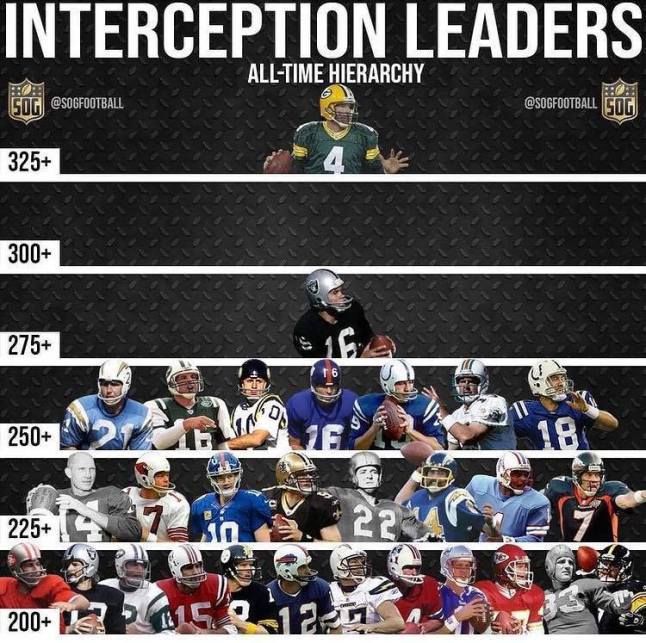
A friend forwarded this to me to point out the truly awful nature of Brett Favre’s accuracy issues:

Point taken. Brett made Vinny Testaverde look like a pin-point passer. However, that’s not the only thing I noticed here.

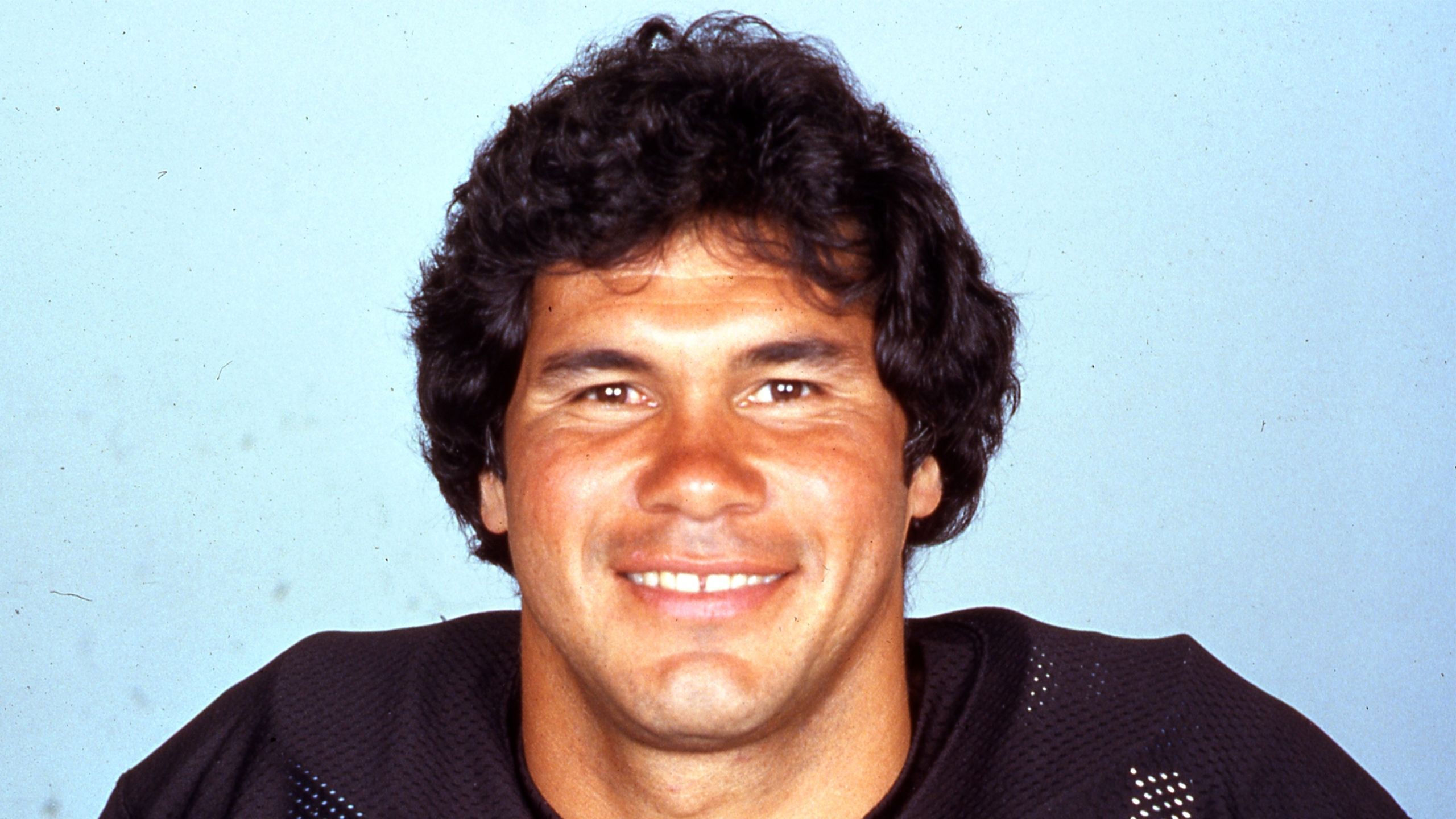
When Favre threw his 278th pick of his career, he passed longevity legend George Blanda, who did spend an appreciable part of his career with the Oakland Raiders. The problem here? That’s not a picture of Blanda. It’s fellow Raider and fellow Number 16, Jim Plunkett.

Jim Plunkett - All-Time Roster - History | Raiders.com

Plunkett, the guy in the first picture, only threw 198 picks while Blanda, the guy in the second picture, who started his career before Favre was born, threw 277.

I suppose there’s something to be said for being accurate when you’re trying to pick on someone else…

THE GREATEST HEADLINE EVER (AT LEAST I THINK SO):

When you get to my age, you start to wonder if you actually saw some of the things you saw, or if you are literally stuck in “legend mode.” (As in, “I swear to GOD that happened… It didn’t? Where the hell did I get that from?”)

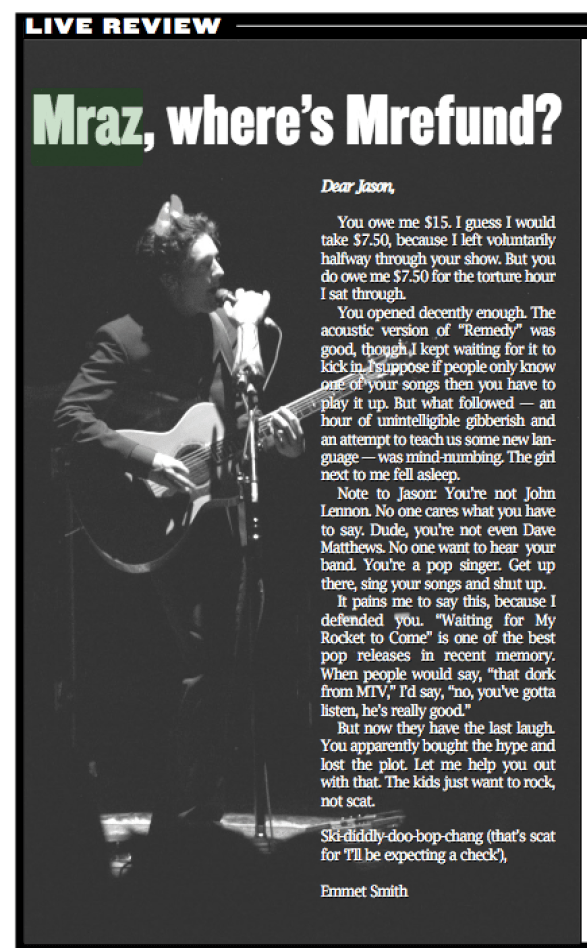
Case in point, I’ve often talked about one of the most clever and off the cuff headlines I’ve ever seen, even though I never could find a copy of it. When  up-and-coming-performer Jason Mraz played a concert at Ball State in the early 2000s, it was a disaster witnessed by one of our newsroom design vets. He promised to not only write a review for it, but he had the headline picked out.

Given the student and given the performance, I spent a week fearing what he would come up with. When it ran, I thought it was the most amazing thing I’d seen in years.

Somewhere along the way, I lost my copy of that paper and no one else seemed to have it. Eventually, I figured I just made it up. However, another former student let me know that Ball State just digitized all sorts of archives, including the student paper. I did a little digging and I”m so glad I did.

Behold the glory of Emmet Smith’s snark:

Speaking of great headlines…

YOU HAD ME AT “VASECTOMIES”…

To keep up with what’s going on the PR side of the business, I signed up for a press release service that literally sends me about a half dozen emails a day. Every one of them is some organization promoting something or other and I’d say that when I’m not working on PR stuff for a book or a class, 99.99% of them end up in the trash without a second thought.

Then there was this:

I have to admit it was a good release and campaign, in that, it did the following:

  • Drew my attention with a headline that had me thinking, “What the heck is this? I gotta find out.”
  • Fulfilled the promise set out in the headline.
  • Clearly and in descending order of importance told me what was going on, why it was going on and why it mattered.
  • Tied two things that could seemingly not be further apart together in a coherent and logical way, once I actually read into it.
  • Took a risk, but a calculated one that probably paid off better than if these folks soft-peddled it.

And, finally, speaking of things take some testicular fortitude…

HATERS GONNA HATE, TEXTBOOK AUTHORS GONNA TEXTBOOK, I GUESS…

I’m in a number of teaching groups online where we to our best to help each other out. I didn’t think I was overdrawn at the favor bank, so I asked for some help to find a textbook for a freelancing class I’m going to teach in the fall.

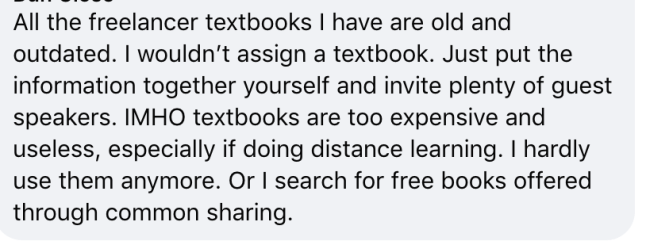
Here was the one response that kind of bugged me (I cut the name off to save the embarrassment):

Couple things:

  1. I was looking at trying to find a book, so you telling me not to bother isn’t really helpful. It would be like calling Triple A for a tow after my car broke down and the operator saying, “You really should just use public transportation. It’s safer and more ecologically friendly.” Maybe, but that’s not the point right now.
  2. Saying “In my humble opinion” doesn’t make it humble when you say it this way. In fact, it’s rarely humble. It’s like whenever someone says, “I’m not racist, but…” I’m bracing for some stuff that would make Archie Bunker blush.
  3. “Too expensive and useless…” Um… Dude? The very first chapter in all of my textbooks I’ve done for SAGE is about how to know you’re audience. Maybe if you read one of them, you’d know why this statement kind of rubs me the wrong way. Then again, maybe not.

HATERS GON HATE soul train haters gun hate haters gonna hate dance trending GIF

Time to go back to writing another chapter for an expensive and useless textbook I’m working on. I’m guessing I shouldn’t ask this guy for a back cover blurb…

Vince (A.K.A. The Doctor of Paper)

THROWBACK THURSDAY: Tips for Self-Editing: Find the Hole, Fill the Hole

I asked a colleague in PR what she would like to see in our editing class if I were to start it over from scratch and try to incorporate the needs of all our sequences into it. It took her no time to answer:

“Teach them how to self-edit,” she said. “They need to look at their copy and realize what’s wrong with it.”

Much of that would be covered with grammar and style, but here’s a key thing that often gets left twisting in the wind: Story holes.

Here’s a throwback post that explains holes, outlines why they happen and explains how to fill them. This can benefit your readers in a lot of ways.

Tips for Self-Editing: Find the Hole, Fill the Hole

As the finishing touches take place on the next book in the “Dynamics” series (Dynamics of Media Editing), I thought it would be a good to give you a peek at a key area of writing and editing that often goes overlooked: Holes.

The idea of a hole is simple: It is the absence of something that should be there to make an item complete. A hole in a shirt, a hole in the yard or a hole in your story all fit that same basic premise. The goal of good writers is to fill in the holes that exist to keep your readers fully engaged and fully informed.

Or as we might say elsewhere, “Don’t leave me hanging, bro…”

Here’s a clip from the editing book so you can get a better sense of how this all works and how to fix it:

Filling holes

A hole in copy is when a writer raises an issue that interests a reader but doesn’t provide enough information to satisfy that interest. Editors develop an intuitive sense over time as to where holes exist and what is required to fill them. Here are some simple examples of holes and how to fill them:


A question with no answer: Writers often spend enough time working in a specific area of interest that they start to understand things that go beyond what readers will intuitively know. It can be jargon, historical references or “inside baseball” issues, and in most cases, the writer will assume that others know these items as well. A hole can develop in a story when a gap emerges between what the writer knows and what the readers do. Here’s an example:

Francisco Smart took over as San Antonio’s mayor six months ago, completing the end of his predecessor’s term.

This situation raises several questions including:

  • Who was the predecessor?
  • Why was he/she unable to complete the term?

You can easily fill in the hole with a simple edit:

Francisco Smart, who is completing Carol Jafkey’s term as San Antonio’s mayor, took on his current role six months ago when Jafkey moved to Arizona.

This might raise additional questions, such as “Why did Jafkey move to Arizona?” That said, you have plugged the bigger holes and you can address the additional questions later.

Any time you see a statement that has you asking a question that the writer hasn’t answered later in the story, you need to acknowledge the presence of a hole and find way to fill it.


An accusation with no response: News traditionally requires balance, but that’s not just an ideal associated with newspapers. Unless you want people to see you as a slanted source of information, you need to look for fairness when you are editing. In some cases, a source will fire a shot across the bow and accuse someone else of something nefarious. The first question you should ask is if that accusation needs to be in your piece in the first place or if it’s just a cheap shot that lacks value. If it merits inclusion, see what truth there is to that accusation or afford the accused an opportunity to respond so you don’t end up with a hole like this:


Paul Lazlo has filed suit six times against Rich Wood, accusing his neighbor of running an illegal gambling ring in his basement.


The accusation is pretty serious, so make sure you don’t just let it linger:

Paul Lazlo has filed suit six times against Rich Wood, accusing his neighbor of running an illegal gambling ring in his basement. In each of those cases, the court has dismissed the case as being without merit.

OR

Paul Lazlo has filed suit six times against Rich Wood, accusing his neighbor of running an illegal gambling ring in his basement. Wood testified in court each time that this was nothing more than a friendly poker game that Lazlo detested because he was not invited to participate.

The goal is to make sure that you don’t leave the door open on an accusation when you can easily close it and give your readers a more complete version of the truth.


An “oddity” with no context: Oddity is an interest element that writers often emphasize in their work to give readers a sense of how special an outcome or issue is. However, when a writer fails to provide context for that information, the readers often feel lost or don’t have a full appreciation of this rarity. Here’s an example:

Mel Purvis of the Cincinnati Reds pitched an opening day no-hitter, marking only the second time in major league history that a pitcher accomplished this feat.


A couple questions are left unanswered here:

  • Who did it first?
  • When did he do it?

Mel Purvis of the Cincinnati Reds threw an opening day no-hitter, marking only the second time since 1940 that a pitcher accomplished that feat.

Or

Cincinnati’s Mel Purvis joined Bob Feller of the Cleveland Indians as the only pitchers to throw opening-day no-hitters in major league history.

However, to plug both holes, you need to reconsider the approach a bit:

Cincinnati’s Mel Purvis became the second player in the last 78 years to throw an opening-day no-hitter, joining Cleveland’s Bob Feller who first accomplished the feat in 1940.

That plugs both holes and helps the readers understand the rarity of the feat.

Any time you have an oddity, you run the risk of having a hole in the story. Make sure you edit to provide context and meaning to help your readers more fully understand the magnitude of what you want them to know.

The Avocado Pig and the value of oddity in journalism

In both books, we talk about the FOCII elements of interest: Fame, Oddity, Conflict, Impact and Immediacy. As far as the elements go, we tend to pay a lot of attention to certain ones, and less to others. Conflict, fame and immediacy tend to be at the front of the list, with impact almost being a requirement, based on audience-centricity.

Oddity, is well… the odd element out.

In the past two months, however, I’ve come to appreciate and value the importance of things that are out of the ordinary, thanks in large part to what we have come to call the Avocado Pig.

To make a long story longer than it needs to be, when we moved to the farm, we found out that we didn’t have trash service and that we’d have to haul our own mess to the dump. Amy didn’t want her car to be a filth magnet and I wasn’t about to put rotting crud in the back of our Highlander, so we set about looking for a beater pickup truck to do the deed.

After months of searching in advance of the move, I found one truck that tickled my fancy: A 1975 Ford F-150 super cab. It had everything I wanted: It had a large bed, so I could move a lot of stuff if I needed to. It had a cap on it so the bed wouldn’t fill with snow. It had a “back seat” (and yes, that deserves to be in quotes, given what that actually entails) so I could fit extra stuff or extra kids in there if I got called at the last minute to do after-school pick up. And, it was an older Ford, so I knew how to fix most problems on it, based on my Mustang adventures.

The thing came out of North Dakota, a state that apparently doesn’t use salt on its roads during the winter, so it had almost no rot or rust on it. The guy selling it was doing it as a favor for a friend, so it was reasonably priced and he was happy to tune it up at his automotive business before I bought it. It also didn’t hurt that it was the least amount of money I had spent on vehicle ever.

With all of this going for it, why did it sit on this guy’s car lot for multiple months, you might ask. Well, it screams “1970s” louder than a polyester plaid leisure suit with a John Holmes porn mustache, wearing stack boots:

It’s not only painted 1970s avocado green on the outside, but on the inside panels as well. The dash, the seats and the glove box are all avocado green. The flooring is the same color, done in beautiful shag carpeting to boot. It’s got an AM only radio, making it almost impossible to find anything other than talk radio or polka for in-cab entertainment. It also has a CB radio.

(If you don’t know what that is, ask your parents. Chances are, they will spend the next 20 minutes telling you about some sort of trucker story and explaining why they used something like “Foxy LaRue” as their CB handle.)

This thing is the vehicular equivalent of the uncle who shows up at your wedding in the same ruffled tux he wore to his wedding 30 years ago and proceeds to hit on every bridesmaid in the wedding party.

I didn’t care. It started, ran and hauled stuff. I was able to fix several problems on it for about 10% of what it would cost to hire someone. Also, and it becomes clear if you’ve ever seen how I dress, I could give a crap less about being fashionable or trendy.

As is the tradition in our house, we sought a name for this vehicle, eventually settling on “The Avocado Pig.” Why?  First, it’s avocado green, so that was a given. Second, it’s a fuel pig, in that it has a 390 engine and two gas tanks that need constant refilling, due to its gas-guzzling nature.

It was the kind of vehicle only I could love, or at least that’s what I thought. Turns out, people have some sort of weird fixation with this truck.

It started about a day after I bought it and drove it to my parents’ house in Milwaukee. I was putting stuff into it while it was sitting on the street when I noticed a police cruiser pass. It pulled a U turn and sidled up next to the truck and I thought, “Oh crap…”

“Is that your truck?” one officer asked.

“Yes, sir.”

“What year?”

“1975.”

“That is the coolest thing I’ve ever seen. I told my partner we had to swing around to take another look.”

“Thank you…?”

He left and I was just happy I hadn’t violated Milwaukee’s arcane parking laws somehow.

About a week later, we moved into the farm house and I had it parked out back. A truck pulled into our driveway and someone was banging on the back door. I was elsewhere in the house, so Amy answered the door and was faced with someone who had known the previous owner. We figured this would happen, as the guy lived here for 54 years, but the reason these people stopped had nothing to do with the guy.

“They wanted to know if you were selling the truck,” Amy said with a tone that mixed exasperation and bewilderment. “What the hell is wrong with these people?”

Apparently, if they suffered from some sort of avocado fetish, they weren’t alone. Over the next two weeks, I couldn’t go to the grocery store, the dump or a hardware store without at least one person asking about the truck, including at least one offer to buy it on the spot.

On the way home from work one day, I was at a stoplight, when someone coming through the intersection on my left pulled over on the median. He got out of his vehicle and pointed at me before doing the “Wayne’s World” thing of “We’re not worthy.” He then got back in his brand new truck and drove off.

Later that week, another guy in a truck that Amy said looked like a pimped out UFO showed up while I was at work and asked if he could buy the truck.

At a certain point, this feels like either I’m making this up or that we’re in the theater of the absurd, but I can assure you I’m not good enough at fiction to pull this off as some sort of metaphor. Even more, I had the truck at work a week or two ago and came out to find this note, written on the back of a “WalPhed” box, stuck under my windshield wiper:
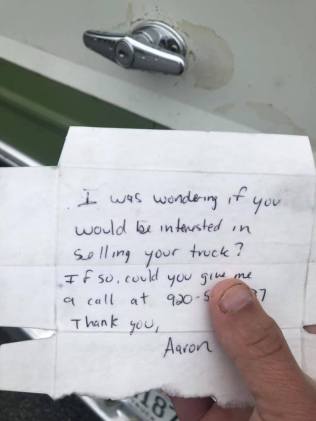
I completely understand why people ogle other people’s vehicles. I’ve practically gotten whiplash looking at vintage vehicles and screaming sports cars on the road. But of all the vehicles I’ve owned or driven… the Avocado Pig? Really? The Firebird, the classic Mustang, the Buick Grand National… sure. I also had a 1966 F250 camper edition for truck fans, but nobody seemed to have this level of fascination with it. I’ve been behind the wheel of a vintage Corvette, a Cadillac sedan and even an Escalade or two. Never even got half of a conversation or a cash offer.

What was it about this 45-year-old eyesore that got people into such a lather?

Amy nailed it. “When was the last time you saw something like this on the road? People love weird shit.”

And if we’re measuring weird, the Avocado Pig has it in spades.

So, after that extensive build up that was, as promised, longer than it needed to be, what does this mean to you?

If you want to draw attention to your work, you need to find things that make it unique in a truly distinctive way.

ADVERTISING: Bad advertising tries to get people to pay attention to it through hype, calling things the “fastest” or the “cleanest” or the “richest” or the “cheapest” or whatever “-est” you can manage to stick in there. The intent is to highlight oddity, but all it does is bore people.

Instead of “-est”ing me to death, look for exactly WHAT makes some something faster or better or stronger or whatever in regard to that product. The oddity of this product or good or service is likely right in front of you. Find the characteristic in the product that is special and then tie it directly to the benefit the users can get out of it.

NO: “Filak’s wet wipes are the strongest protection you can get against the coronavirus!”

YES: “Filak’s wet wipes are the only wipes on the market with Plutoxin-7, which means they kill the coronavirus as soon as it lands on any surface that was cleaned within the past 24 hours.”


PUBLIC RELATIONS: When you are planning an event or attempting to garner media coverage of something, focus on what makes this situation different from the other 912 things you’ve sent me a press release about in the past month. At a certain point, much like we do with “-est” advertising, we’re going to tune you out the minute we see your letterhead or email address.

The key thing in public relations that tends to get missed in this regard is that PR professionals know what their clients are doing and have a sense of why those actions matter. Because they tend to internalize this, it’s like reporters who become too attuned to “inside baseball” on their beats. In short, the practitioners KNOW the value, so they can’t believe that the reporters can’t see it, too.

What helps is taking that extra step and outlining the “this matters because” step for the reporters. Don’t assume they see the unique element of what you’re doing or the key value in what it is that you’re pitching. Instead, take them by the hand and show it to them by saying, “Look how neat this is!”

NO: Comedian and world traveler Bill Jones will speak at Central College on Friday as part of the school’s “Never Give Up” motivational program.

YES: “Bill Jones, the only man to ever eat an entire elephant in 24 hours, will deliver his “One Bite At A Time” comedy routine at Central College on Friday as part of the school’s motivational program.


NEWS: News folks have no problem looking for weird things. It’s why we’ve had “News of the Weird” as a syndicated column for years and why local radio shows play their “Small Town Crime Wave” stuff to the delight of morning-show listeners. That is usually where we find oddity to start and stop.

In short, if it involves a man from Florida, requires a firefighter to note “please don’t use a blowtorch to kill spiders,” or includes the phrase “priest’s three-way with dominatrices,” we’re pretty much clear it’s going to go viral. (If all three of those topics converged, I’m pretty sure we’d break the internet for good…)

However, oddity isn’t just about those items. It’s about focusing on firsts, lasts and onlies, so don’t be afraid to start asking questions like, “When was the last time X occurred?” This sense of wonder can turn an interesting story about a sports triumph into a bigger piece involving certain rarities. It can push you to look for things like what was the longest we had to wait to figure out who was president? Or when was the last time a bishop had to burn an altar that had been desecrated?  Or what was the fastest amount of time it took for someone to drive the cross-country “Cannonball Run?” (That last one is a heck of a story.)

Or even, “How many 1975 Ford F-150 Supercab trucks came in avocado green?”


Why should a reader care? A question you need to answer in all media writing

As part of a book I’m putting together for introduction to mass communication courses, I decided to break out key events and important people in an expanded timeline. In doing this, I added a chunk of text under each one of the points that I titled, “Why You Should Care.”

The folks at SAGE, and at least one reviewer, thought this was kind of jarring, almost a snarky affront to educational standards. Me? I thought it was common sense, given that if I can’t tell you why you should care about something, well… Why would you?

In today’s media climate, more and more sources are disseminating more and more messages  more and more frequently and in louder and louder ways. The idea, at least based on what I’m seeing out there, is that if we scream something loudly enough and do it often enough, people will eventually start to think, “Well, I guess that’s important.” In truth, we have often found that this repetition becomes more of an annoyance than anything else, plus once we stop bludgeoning people with those messages, they eventually stop caring about them.

When it comes to all forms of media writing, you need to be able to tell people not just WHAT happened, but also the “So What?” aspect of it, as one of my old bosses would say. If you can’t do that, you’re not coming at the content from an audience-centric perspective. You’re just cranking content out of a grist mill.

Here are two conversations I had with people this week who work in the field that really drove that home for me:

The first was a conversation with a student who is graduating and currently works as the main reporter at a small-market local news operation. He was grousing about how hard it is to get people to see value in his paper and his stories.

He told me that people care about certain things in the region he covers and he writes about those things, so why is it more people aren’t reading what he’s writing?

“How do you know that?” I asked him. “How do you know that they care about X, Y or Z?”

“Well, they SHOULD care…” he replied, leading me to understand what the problem was.

Journalists have long adopted the philosophy that we know best when it comes to what matters to our readers. For quite some time, we were right about that, almost entirely by accident.

Reporters lived in the areas they covered, earned wages similar to the people for whom they wrote and dealt with the same problems as their readers. In addition, they were integral members of the community, so people TOLD them things that mattered to them and thus the reporters used that insight to cover things of interest.

That’s not the case anymore today, so we have to work a lot harder to figure out what matters to the readers and we have to compete with a lot more voices that are drowning us out.

It’s no longer enough to write about a city council meeting and figure that our readers are going to figure out why it matters or what happened of value. We can’t assume that readers are going to look at the paper or our website and think, “Hey, I bet these folks have all the answers. Let me carefully and deliberately examine their content and assess it through a high level of critical thinking.”

As fast as things move these days, you have to tell people, “Hey, look over here! This matters because….” It’s like trying to feed your dog a pill some days, but once you get good at it, it becomes easier the next time, as people will continue to use media that shows them value.

The second conversation was with a colleague who teaches PR in our department. We were commiserating over the way in which students were writing stories and press releases.

What we both realized was that our students were going in one of two directions with their opening paragraphs:

  1. “An event is occurring. You now know this.”
  2. Welcome to hyperbole central, in which we make the intro to “The Muppet Show” look subdued by comparison.

When she told the students to dial down the hyperbole, they essentially went back and wrote the “An event is occurring” paragraph. They then groused that the opening was boring.

“Well, you better find something that makes it interesting,” she said she tells the kids. “If you don’t care about something, why should a reporter?”

It’s a good point and one that can go even a step further: If the reporter actually goes to the event and only can report that the event occurred, why will the readers care? There has to be SOMETHING that made the reporter think the event was worth covering or SOMETHING that came out of it that can be of value to the readers.

If you can’t find that as a writer of any form of media, you’re in trouble. Advertisers can’t just write, “Buy my stuff. It’s available.” News writers can’t put out a story that says, “Something happened and I went there to look at it.” PR professionals can’t send out press releases that note, “Our client is doing a thing that you can look at. C’mon over.”

This is why audience centricity and the interest elements of Fame, Oddity, Conflict, Immediacy and Impact need to be at the forefront of your mind as a writer. What do you know about your audience’s needs and what interest element or elements might grab their attention so you can fulfill those needs?

In other words, tell people why they should care in a simple and direct way. After that, they’ll keep coming back for more.

The Junk Drawer: The End of “What Summer Vacation?” Edition

As we noted in several earlier posts, the Junk Drawer is usually full of stuff that didn’t fit anywhere else but you still need. Since we start school after Labor Day, this will be the last post on the weekly summer schedule, with daily(ish) posts beginning shortly after that. Given the summer that was, it seems appropriate that we’re looking at a mess of really weird stuff that is random at best.

Consider some of these moments:

YEAH, THAT’S SMOOTH…: Like many other universities, UWO is in a fiscal pickle these days, thanks to the COVID-19 outbreak and other fun variables. To bring the budget back from the brink, the U decided to cut faculty salaries, although that’s not how they decided to put it in the email we got last week:

Smoothing

First, way to bury the lead. “Furlough… mumble, mumble… Smoothing… mumble, mumble… Reduced by… WHAT THE HELL!?!?!” Second, if you’re going into PR, realize that euphemisms don’t make things better. When rolling out a plan to force people to take days off that they don’t want to take (or will likely end up doing work on anyway), referring to jobbing them equally across the rest of the semester is anything but “smooth.”

Just be honest: “You’re taking a kick in the groin of about X percent each month to the end of the year.”

See? Much smoother.


PIVOT THIS: During my battle with smoothness, I found that one of the hivemind folks started the list of words and phrases that we really need to kill with fire. If you find yourself using these in any of your media writing efforts, consider taking an inflection point in these uncertain times and pivot away from them:

  • Inflection point
  • Grow (as in enrollment)
  • Uncertain times
  • Unprecedented
  • Pivot
  • For the foreseeable future
  • Remain flexible
  • De-Densify
  • Continue to be nimble
  • New normal
  • Synergy
  • Do the needful
  • Out of an abundance of caution
  • Circle back

Feel free to add your own candidates in the comment section.

SINE OF THE THYMES: I’m occasionally baffled by signage I see here and there, like this one from a local flea market:

IMG_4569

As God as my witness, I’m not entirely sure what’s going on here. That said, a few things stuck out:

  • The author (and I use that term loosely) either started with the “A-C-C” version of accepted and went, “Nah, that can’t be right” or did the “E-X-C” version only to realize the other one was right, tried to change it, realized they couldn’t and then thought, “Hell, nobody will know the difference around here.”
  • The apostrophe in “Offer’s” looks to be done with a different marker, meaning this person thought, “Wait, I gotta fix that or someone will think I’m stupid.”
  • I think we should add “reasonal” to the list of words above.


STIP JOYNTE: Our new home had some godawful wallpaper in the dining room, so we needed to get rid of it. In purchasing some items to help me do so, I came across this spelling gem:

IMG_4578

If I can find that “wallpaper stipper,” I’ll definitely be using this sponge…


WHEN LIFE GIVES YOU CLUSTERS….: As pretty much anyone with a brain or the ability to observe human behavior expected, once college students came back to campus for the start of the fall semester, COVID-19 spikes followed almost immediately. At UNC, the school saw multiple coronavirus clusters (maybe another word to add to that list above) appearing, as students didn’t engage in perfect social distancing, mask wearing and personal sanitizing. The student newspaper, the Daily Tar Heel, captured the mood on campus with a perfect headline and editorial:

ClusterfuckHeadline

I couldn’t have said it better myself, mainly because my publisher wouldn’t let me…


YOU BE ILLINOIS-ING: Some abbreviations lead to problems in headlines and decks, like this one for coronavirus-based travel restrictions between Wisconsin and Illinois:

IMG_4555

I think keeping Ill. residents home might be a good idea, but not as good as watching out for a Mass. murderer.


JUST A BIT OUTSIDE: This sign caught my attention because of the color and such, but the font choice put that first line in jeopardy of being  a terrible typo, much like the “Thompson’s Pen is A Sword” headline.

IMG_4566

If you’re going with this campaign, use a simple headline break or rewrite this. The last thing you need is people asking what an “Anals Superhero” does.


BILINGUAL BIAS: We often talk about reaching your audience where they are. For example, a number of really great student news outlets with heavy Spanish-speaking readership include Spanish versions of their work within the paper. When I saw this sign, I was torn in how to feel about Fazoli’s use of Spanish:

IMG_4549

You can make the argument that bilingual outreach is always a good thing, but why is it that the times and days in which the place is open for business is only written in English, while the alert to potential armed robbers is written in both English and Spanish? In short, if you speak Spanish, we don’t expect you to eat at our establishment, but we’d like to wave you off since you’re probably planning to rob the joint.

Eeesh.

And finally….


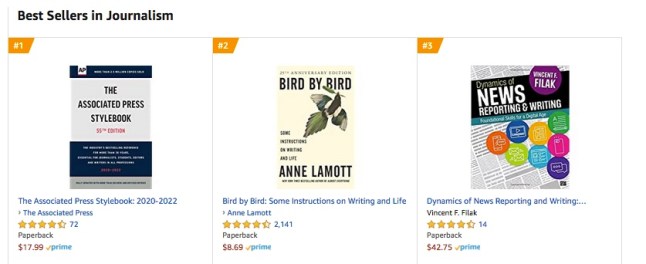
THANK YOU: I was looking for a wall-mounted aluminum-can crusher on Amazon last week, as to keep the number of empty Diet Coke cans from consuming my office, when I did the ego thing and typed in my own name in the search box. When it pulled up the reporting book, I was stunned at what I saw:

Top3

I know that there are 1,001 caveats here, in that this rating happened in only one hour of time, that it happened during textbook buying season, that it’s not representative of larger samples and more. (I know it also feels really self-important to “Google yourself” like this…)

That said, if you had told the 18-year-old version of me as I headed off to college so many years ago that at one point in life, that I would write a book that other people would read, I’d have been doubtful. If you told me the book would be in the top three best sellers in any category for the largest bookstore on the planet at any point in time, it would have been beyond my ability to comprehend. In many ways, it still is.

I don’t think I can adequately explain how big of a thrill it is for me to know that folks out there are using my books and reading the stuff on this blog as part of what they do in teaching this important craft. It’s one of the few times I’m truly at a loss for words, so I’ll just say, “Thank you. And please tell me what else I can do to help.”

See you in September.

Vince (a.k.a. The Doctor of Paper)

Dead Ducks: How a minor-league baseball team made a major-league screw-up while trying to be funny during a pandemic

Dead Ducks

I never know how to take it when former students tell me things like, “I saw this massive media screw-up and immediately thought of you!” That said, I’m grateful for the help in identifying the face-palm moments of life that keep the blog humming.

UPDATE: The president of the organization got back to me on this. I posted his response in full below.


Like many other sports franchises, the Madison Mallards baseball team in Wisconsin is coming to terms with what to make of a lost season. The Northwoods League team decided Wednesday to formally cancel its entire schedule, announcing the decision with an approach that could politely be referred to as “tone-deaf:

In Memoriam: Madison Mallards 2020 Season (2020-2020)
The 2020 Mallards Baseball season, a highly anticipated summer mainstay on the cusp of its 20th season, ended before it even had a chance to start on Wednesday, June 24th at 5:00 pm.

Survived by its mascots, Maynard, Millie, and Bonehead, a dedicated staff, supportive corporate partners, and a city full of fans, the season will be dearly missed by many. The Mallards, born in 2001, have provided decades of fun, community, and wieners. Their 20th season in Madison would have been no different.

The cause of the “death” of this season is, of course, the coronavirus pandemic that has sickened more than 2.3 million people in the United States as of the latest count. The death toll has reached past the 120,000 mark for the country, with more than 750 of those in the state of Wisconsin. Dane County, where the Mallards play, is listed as a hot spot for the virus, one of 22 counties in the state registering spikes in the “high” range, according to state DHS data.

So, maybe the obituary approach wasn’t exactly the wisest of ways to alert the readers on this one. (Also, and I know it’s a minor point, but how in the hell did the Mallards provide “decades of fun” if the team is short of its 20th season? I get that journalists aren’t good at math, but you gotta get at least two of something, in this case it would be decades, before you can pluralize something.)

The closing paragraphs of the “obituary” decided to take the concept of “EEEESHHH” to a major-league level:

A Celebration of Life will take place at the Duck Pond on June 29th, 2020 from 5:00pm to 8:00pm. Entry will be free for fans, with beer and concessions for purchase, and the opening of our new Team Store.

In lieu of flowers, fans are encouraged to support by attending upcoming events at the Duck Pond, shopping in our online team store, or sending condolences and fan mail to info@mallardsbaseball.com.

Let’s unpack this:

  • We are having a “funeral” for a season that was essentially “stillborn,” to carry out the writer’s death metaphor to its most disturbing and yet accurate end.
  • The writer is encouraging people to come out en masse for this “funeral” during a pandemic in which social distancing is the primary way of avoiding contracting an actual illness that has the potential to be fatal.
  • What’s the draw? A free admission to an empty ball field in celebration of a NEW TEAM SHOP where you can buy stuff for a team that’s not playing. Oh, and you can buy beer and hotdogs as well.
  • The “in lieu of flowers” line had me shaking my head. Also, I’m not sure why I’m sending you “condolences” at this time…

I put in a note to the “Info” address above, asking for some thoughts and rationale on their approach here. The president of the organization got back to me with this note:


Professor,

Thanks for your note. The Mallards role in our community for 20 years has been to provide a place for people to escape from their day-to-day routine. One of our old ad slogans was actually “Welcome to your 9-inning vacation.”
As we grapple with the real challenges of 2020 for our world, our community and our business, we thought it was important for the Mallards to continue to do what we do & hopefully provide a bit of levity for our fans. As evidence of us most likely being on the right path, I still haven’t seen a negative comment on social media related to the obituary part of what we did. I think our fans understand our satirical tone & that we would never intend to offend anyone. And, when we have delivered the wrong message in the past (which we have done) our fans have been quick to point it out & scold us on social media, as you would expect.
We will have more measures in place than simply socially distancing people at our Monday event. We didn’t feel the need to outline all the protocols in this post, but we will be clarifying them as we move forward. We’ve worked extremely closely with the Health Dept here & we know how to execute safe events and we will not allow a scene to develop similar to what has been seen at bars across the country. We have one of the largest venues in Madison & we’ll have plenty of room for people to safely gather.
Thanks for your time & consideration of our position on this. I authentically hope to see you at the ballpark next summer!
Vern Stenman
President
Big Top Sports + Entertainment

I have to say, I appreciate that the guy who runs the show would actually take time to respond to me, basically a chimp with a blog. I’m not exactly sure I’m buying into the “we haven’t seen a negative comment” defense, because a) not having seen something doesn’t mean it’s not there and b) the word “yet” should be clearly implied there… Granted, this isn’t as horrible as some of the other gaffes we’ve covered on the blog before, but “This could have been worse” isn’t exactly the target I’m thinking you want to be shooting for.

He’s standing by his approach, which is fine. Maybe I’m wrong about this, having lost a family friend to the coronavirus and knowing other immuno-compromised people I worry about every day. (It must be a cold day in hell right now, as I’m potentially being overly sensitive to something…) If I’m not, I’m sure the more people who see this will tell him. And to be fair, he did say if this gets ugly and they were wrong, they’d pony up. That’s a fair and fine strategy.

I’ll also stick by my two points below, made prior to Mr. Stenman’s email:

You aren’t as clever as you think you are: The idea of trying to “spice” up dull copy is an admirable one, but some situations call for straight-forward information dissemination. It’s the reason we don’t note that people who died during an explosion “went out with a bang” or that a drug overdose victim “failed the Pepsi Challenge and went with coke.”

I got smoked on a lead to a story once like that when I was filling in for a day-side cops reporter. The PIO at the station clued me into a burglary where this guy stole some tools and about 20 cases of soda from a local business. It was hot outside and we were talking about being too thirsty for their own good, so I wrote a lead that played on this idea, focusing on the soda.

The owner of the business called to complain that the true loss was the high-end manufacturing tools, worth tens of thousands of dollars, not the soda from the break room. He felt we were mocking his situation and that I wasn’t taking the burglary seriously. My managing editor crawled inside me with his shoes on, and I deserved it.

The point is that, yes, you write a seemingly interminable number of “noun-verb-object” leads that just give people the facts and you desperately want to do something more amazing than that. That said, this isn’t about you. It’s about your readers. Think about what happens when a Madison Mallards fan who lost a family member or a friend to the coronavirus reads this. Whatever you’ve got in your head, I bet it’s not good.


Paranoia is your best friend: I think I say this at least once per week during regular class periods, and it bears repeating here. A really good way of avoiding problems in your writing, reporting and publishing is to first consider what you are doing and then ask, “What are the infinite number of ways this could go wrong and make me look like a complete idiot?”

I joke about the voices in my head arguing about stuff quite a bit, but I’ll honestly tell you this: I do listen to specific voices when I’m writing. When I come across an issue of race, I think about a friend of mine who is an expert on this and another friend who deals with racist stuff on a way-too-frequent basis. When I come across an issue that could be seen as sexist, I have another friend’s voice in my head, arguing that there is a better way to write whatever it is I’m writing. When I start cursing on the blog, I can hear my publisher’s voice, yelling, “Vince, people from small religious schools read this!” (I then quietly delete the cussing and find a euphemism like “chucklehead” to replace what I really want to say.)

The paranoia that something could turn me into a tragic tale of wasted youth… er… middle-age… keeps me from doing a lot of tragically stupid things. Keeping your paranoia meter finely tuned won’t prevent every problem, but it will keep you from walking off a 20-foot ledge directly into a lava pool populated by robot sharks. Or whatever your recurring nightmare is…


Throwback Thursday: “He’s dying anyway.” (A primer on how not to do PR)

Given the number of people having to speak to the public these days about a crisis, it would seem to be a good time to look back at this post about how to avoid looking like an idiot.

Las Vegas Mayor Carolyn Goodman gave an interview to Anderson Cooper the other day, and her missives about opening casinos as the coronavirus continues to spread managed to befuddle the veteran newscaster. CNN even posted a story on “The 20 most bizarre lines” from it.

My favorite of the bunch? “We offered to be a controlled group.”

When an incredulous Cooper asked Goodman if she really was willing to make the citizens of Las Vegas a control group for the coronavirus by reopening everything and seeing what happened, Goodman admonished him not to put words in her mouth.

“I offered to be a control group and I was told by our statistician that we can’t do that,” she said.

I’m sure the citizens of Las Vegas will sleep better after that clarification…

In any case, here’s a post from a year or so ago that shows not only when interviews with the media go bad, but also how you can avoid these problems with some common sense and decent PR skills.

“He’s dying anyway.” (A primer on how not to do PR)

If I had a nickel for every stupid thing I ever said, I’d wouldn’t need to work anymore and I could probably eradicate world hunger. This is one of the many reasons I have a lot of respect for good public relations practitioners: They manage to keep on message, make key points clear and connect with an audience in some of the more difficult situations out there.

In discussing public relations with my buddy Pritch (a member of the College of Fellows and a decades-long PR professional and instructor) a number of years ago, he told me that one of the more underrated elements of PR is honest empathy. It’s hard to get across a message while still realizing that there are other forces at play, many of which can be painful for others. I translated this into “be humane” in one of the books and several lectures, and I think it sticks well.

I thought about this when this story broke about a White House staffer’s reaction to Sen. John McCain’s stand against confirming CIA nominee Gina Haspel:

“It doesn’t matter, he’s dying anyway,” press aide Kelly Sadler said about McCain’s opposition to CIA nominee Gina Haspel at a meeting of White House communications staffers, according to an unnamed source cited by The Hill’s Jordan Fabian.

McCain is battling brain cancer and is unlikely to win that fight, according to all available information. As we noted in the book, the accuracy of a statement like “He’s dying anyway” isn’t the issue, but rather the fact it makes Sadler sound cold and calloused. Even worse from a PR perspective, she has now become the news and that news is clearly negative.

Consider the following thoughts as a short primer on the idea of keeping yourself out of trouble:


You are like plumbing: We talk in most of my classes about good media professionals being conduits of information, moving content from valuable sources to interested audiences. I often equate this to being like plumbing: The water exists at Point A and you want to drink it at Point B. You don’t really know how every single thing works, but you just want it to work.

Perhaps more to the point, the only time people notice plumbing any more is when something goes wrong. If the water in your tap comes out in a lovely shade of beige, like mine did in my first college apartment, you notice it. When a pipe breaks under the house and starts spraying water all over the crawl space, like it did when we lived in Indiana, you notice it. When it’s running fine? I don’t think, “Man, that toilet can FLUSH! So awesome!”

Get the information that matters from Point A to Point B in its best possible form and you’re doing the job well.


You aren’t the news: The 1980s show “The Fall Guy” follows the adventures of a TV and movie stuntman who moonlights as a bounty hunter, thus getting into all sorts of danger and wacky mishaps.

Perhaps the only enduring thing about this program was the theme song, in which the show’s star, Lee Majors, sings about life as an “Unknown Stuntman” with lyrics like:

I might fall from a tall building,
I might roll a brand new car.
‘Cause I’m the unknown stuntman that made Redford such a star.

If you do your job well, people behind the scenes will know your name, appreciate your professionalism and use the information you provide to them. However, you will never BE the news. Your clients may bask in the spotlight thanks to your hard work. Your organization might succeed because you did the dirty work. Your company may have a sterling image that you built, brick by brick. However, you are the unknown stuntperson who needs to make them look so fine.


Stop. Think. Then Speak: One of the hardest things in the 24/7 news cycle and the constant demand for information is the ability to pause before communicating without looking like a weasel. It often feels like if we don’t have an answer RIGHT NOW, we are clearly scrambling for some well-worn cliche or a bit of BS. However, once you open your mouth or send a release or do anything else, you can’t get it back, so it pays to be on top of your game.

Collect yourself before you speak on something. Think about who might hear what you have to say or share what you publish. Some PR professionals have told me when they have something they have to say, they imagine their grandmother was in the audience. I often tell students that there is no crime in not knowing something, so instead of going rogue, tell the people, “I don’t know the answer, but I will find it out for you.” As long as you live up to that promise (and it isn’t the answer to every question), you should be OK.


Stupid is eternal: Mardela Springs, Maryland is town of about 350 people in the western part of the state and the only reason I remember it is because of Norman Christopher, who was a town official in the early 1990s. Christopher famously brought attention to this tiny hamlet with his explanation as to why he couldn’t reach county officials on Martin Luther King Day:

He reportedly was explaining to other commission members why he could not reach county workers by telephone Jan. 20, the King holiday. “I forgot no one was working. Everyone had Buckwheat’s birthday off,” he was quoted as saying in the Daily Times in Salisbury. Buckwheat was the stage name of a black child who starred in the “Our Gang” comedy films of the 1930s and 1940s.

It’s been more than a quarter century since he made that comment and I still remember it as a “What the hell was THAT?” moment when it became news. In a similar way, I will never forget Justine Sacco and her “hope I don’t get AIDS” tweet, that we feature in the book.

Sacco has managed to find work recently, as IAC brought her back on board for a separate venture. In looking back at all of this, she had a pretty decent observation for anyone involved in any form of media:

“Unfortunately, I am not a character on ‘South Park’ or a comedian, so I had no business commenting on the epidemic in such a politically incorrect manner on a public platform,” she wrote. “To put it simply, I wasn’t trying to raise awareness of AIDS or piss off the world or ruin my life.”

Kelly Sadler worked on a number of projects before and will likely have many more years of professional work in the future, but this might hang around her neck like an albatross for a while. If you think about anything stupid you have ever said, imagine that being the one thing people remember about you and then act accordingly.


South Dakota tells the world it’s on meth (or how to make a fool of your state for less than $500,000)

MethLogo

Sometimes, the jokes just write themselves…

South Dakota wanted to take on its burgeoning methamphetamine problem head on, so it invested heavily both in an attempt to treat addicts and a marketing campaign to let people know the state was serious about addressing the crisis.

Well, at least one of these things might work:

South Dakota is on meth — at least, that’s the message behind a new anti-drug ad campaign so widely mocked that one marketing expert could only laugh before calling it “a colossal blunder.”

The “Meth. We’re On It.” awareness initiative was unveiled Monday by South Dakota Gov. Kristi L. Noem (R) to address the state’s methamphetamine crisis. In a news release, officials underscored the importance of combating drug use in a state where twice as many 12- to 17-year-olds reported using meth compared with the national average.

According to news reports, Broadhead Co. out of Minneapolis was responsible for the meth campaign, which cost about $449,000

 The state’s contract with Broadhead, effective until May 31, 2020, states that the contract shouldn’t exceed $1.4 million.

In its proposal, Broadhead says the tagline “I’m on Meth” will create “a movement for all South Dakotans to take an active role in keeping their state a great place to live.”

Right… Because when someone walks up to you and says “I’m on Meth,” the first thing you’re thinking is, “Wow! I want to live near that guy!”

Broadhead has several other campaigns on its website that have kind of that “edgy” feel to them, with many of them related to agriculture:

CattleFirst

Given their motto of breaking through with non-status quo ideas, I was left wondering if “Cow Lives Matter” was taken… Then there was this:

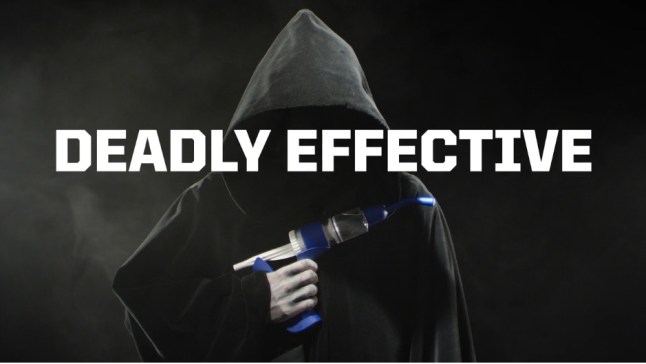
DeadlyEffective

I don’t even want to know what that thing is used for, but I now have much more sympathy for cows than I did before I saw this…


I kept imagining this conversation going on at Broadhead when it came to the “meth” campaign:

Rep 1: Hey, remember our #porkplease campaign? I bet we can’t look any dumber with an awkward approach than that!

Rep 2: Hold my beer…

In any case, here are two “teachable moments” to take away from this fiasco:

PARANOIA IS YOUR FRIEND: As we have said time and time again here, paranoia is your best friend when launching any kind of public endeavor. It’s the reason I reread the word “public” every time I write it, just to avoid something like this:

PublicSchoolBillboard

It’s why magazine names should really be considered when you start designing things:

pic-dump-303-7

Even if you think, “There’s no way this could be a problem…” just think again:

PenisMag

Or why you need you still need to “consider the fold” when you design pages:

Headweiner

You want to always ask yourself, “How could this thing go wrong?” The first person who said, “Meth? I’m on it!” should have had six people around him/her saying, “Uh… PHRASING!”


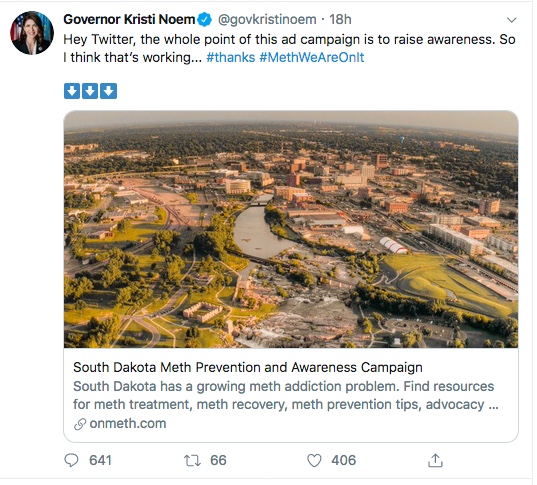
OBSERVE FILAK’S FIRST RULE OF HOLES: The rule is simple: When you find yourself in a hole, stop digging. Instead, Gov. Kristi Noem “doubled down” on the meth slogan in media statements after Twitter basically had a good laugh at her state’s expense.

South Dakota Gov. Kristi Noem (R) is defending the state’s launch of an anti-drug campaign with the slogan “Meth, we’re on it.”

The tagline drew a mix of criticism and ridicule across Twitter on Monday, but Noem cited the backlash as proof that efforts to raise awareness around South Dakota’s methamphetamine crisis was, in fact, working.

“Meth is IN SD. Twitter can make a joke of it, but when it comes down to it – Meth is a serious problem in SD. We are here to Get. It. OUT,” Noem tweeted Monday night.

She also decided that it was a good thing everyone was now asking if the entire state was on meth:

NoemTweet

OK, look, I get that everyone is paying attention to you now, and there’s nothing you can do about it (and you just blew through about half-a-million dollars to turn your state into a laughing stock). And we can argue that “There’s no such thing as bad publicity,” until the end of time.

However, saying we told everyone “we’re on meth” was a good idea because it “drew attention” is like saying former Toronto Mayor Rob Ford helped people understand the severity of the city’s crack epidemic:


Or trying to combat child sex abuse with the slogan: “Kids, We Feel You.”

Once you realize you’re going to do more harm than good when you continue to insist this really isn’t as bad as people are making it out to be, stop digging.


The Junk Drawer: An update on the Daily Northwestern apology, the tao of Vin Diesel and an honest look at journalism salaries

As we noted in an earlier post, the Junk Drawer is usually full of stuff that didn’t fit anywhere else but you still need, so here are a few bits and bites of things that are helpful or at least somewhat amusing:

REASON 283,435,139 I’M NOT A DEAN: In covering the Daily Northwestern apology story earlier this week, we took some liberties in explaining the best and worst ways in which people reacted to the paper’s editorial choices. A good number of folks I knew who were Medill alumni emailed the dean of the school, Charles Whittaker, asking exactly what the heck was going on at Northwestern.

Whittaker was in a tough spot: He didn’t control the paper (as is the case with almost all colleges and universities, despite what many administrators like to think) and yet the students running the place were most likely kids in his program. The paper’s actions reflected poorly on the school, even though the school itself had nothing to do with the paper. People wanted him to say SOMETHING, although anyone who has ever worked in crisis communication knows that rarely do statements in times like this satisfy everyone. (And, in many cases, these statements end up doing the PR equivalent of trying to extinguish a fire with gasoline…)

Whittaker put out a statement that, in my view, covered the bases and nailed the key points. It also did so in a way that didn’t throw anyone under the bus and yet moved the school beyond the hand-wringing point most alumni seemed to be stuck on. In reading it, I found that his points tended to mirror some of the concerns we raised here, but he did it with an eloquence that I couldn’t pull off at the time. This paragraph covered the three unpleasant truths I outlined in the post in a much tighter and with better language:

And to the swarm of alums and journalists who are outraged about The Daily editorial and have been equally rancorous in their condemnation of our students on social media, I say, give the young people a break. I know you feel that you were made of sterner stuff and would have the fortitude and courage of your conviction to fend off the campus critics. But you are not living with them through this firestorm, facing the brutal onslaught of venom and hostility that has been directed their way on weaponized social media. Don’t make judgments about them or their mettle until you’ve walked in their shoes. What they need at this moment is our support and the encouragement to stay the course.

Again, this is why I couldn’t be a dean. Well, that and I’d have to wear a tie…


YOU LEARN A LOT ON THE WAY TO 500: In listening to all the people talk about the Daily Northwestern’s position and how they were “much tougher back in the day,” I found myself going back to this Vin Diesel clip from “Knockaround Guys:”

Rarely do the words “Vin Diesel,” “stronger journalism” and “great philosophy” converge in a single sentence, but they all seem to work here. If those previous generations of journalists were tougher, it was because they got started earlier on their 500 fights. It’s the battles, the mistakes and the ability to live through everything that happens that gives you that toughness. That’s how you develop thicker skin, as so many people kept telling the staffers at the DN to do. It’s how you learn to tough out certain things and acquiesce in other situations.

You learn a lot of things on the way to 500, but none more important than this: You will survive and you will get better at fighting.

COME FOR THE ABUSE, STAY FOR THE LOW PAY!: Why journalists do what they do is often beyond explanation. In some cases, we find a calling, like a priest or a rabbi would. In other cases, we see how our skills match up with what news organizations need and we go for it. In many more cases, we realize we stink at math, so we figure this is the best field for us.

However, even if you’re bad at math, you can tell pretty quickly that the salaries of journalists aren’t among the highest in the world. Anecdotes often filled the ears of students who were working their way through college that, hey, you’d be better off working a fry machine at Hardee’s than doing this. Still, getting people to talk about money is really rough, so no true salary database existed in this area.

Some folks in the field wanted to change that with an open access Google spreadsheet and some publicity.

Journalists doing anonymous journalism about journalism, in the shape of Google docs, is a new development in form. And examples like the SMM list definitely bring up ethical implications that should be considered. But in the long run, we would probably all be better off if the salary list sparked a healthy conversation about who is paying whom how much, and for what.

If you want to dig around, feel free to depress yourself here. Also, if you’re living in Kearney, Nebraska or Butte, Montana and you see the six-figure salaries, remember those are mostly in New York where it can cost almost a quarter-million dollars for a parking space.

Still, you can’t beat the hours…

Until next week,

Vince

(a.k.a. The Doctor of Paper)


“I am a brother.” 3 tips on how to avoid a racially tone-deaf social media disaster like the one from the University of Missouri

Watching my alma maters compete for supremacy in an arena of national attention is usually fun for me, but not this month:

UW-Madison: We built a homecoming video where we cut out all the video involving people of color who agreed to be filmed for it. No way anyone could screw up a situation like this worse than we did.

University of Missouri: Hold my beer.

(CNN)The University of Missouri Athletic Department is apologizing for a tweet it says was meant to celebrate diversity but was instead criticized as insensitive.

The tweet posted Wednesday included graphics of three student athletes and a staff member. Two are black and two are white.

The graphics featuring the white athletes highlighted their career ambitions. Gymnast Chelsey Christensen’s said, “I am a future doctor.” Swimmer CJ Kovac’s said, “I am a future corporate financer.”
Staff member Chad Jones-Hicks’ post said, “I value equality.” Track and field athlete Arielle Mack’s said “I am an African American Woman.”
The post was criticized on social media for defining Mack and Jones-Hicks by their race instead of their goals and accomplishments.
The athletic department deleted the tweet Wednesday night and apologized.

Yes, it really was that bad…

MizzouRace2

In other words, “Look at all the cool stuff we get to do as white people!” and “Look! We’re black!” aren’t exactly interchangeable concepts.

And when you think it can’t get any worse…

MizzouBrother

I kept thinking, “This one has to be an internet spoof version, right? Nobody thinks, ‘Hey let’s call the black guy ‘a brother’ and see what we can get away with…'”

Nope, it’s real, leading me to ask the same question this person asked on Twitter:

AfroTweet

(Hell, you could have run this past Breckin Meyer’s character in “Go” and HE would have caught it…)

The athletic department tweeted out an apology for its actions, which led more people to complain about how tone deaf THAT was as well.

This kind of “someone does something horrible they didn’t see coming, particularly in regard to race” has become kind of a repeating theme on the blog. Although we talked about ways to avoid this kind of thing when we discussed the “Coolest Monkey in the Jungle” sweatshirt issue, consider these key points again:

Paranoia is your BEST friend: A great line about one of the greatest hockey coaches guides my actions in journalism quite a bit. After his team had won a national championship, a friend found him emotionally drained sitting quietly away from the celebration. The writer remarked, “They had succeeded. He had avoided failure.” Maybe that seems sad, but that approach keeps your keester out of a lot of trouble.

As we noted the last time we covered this: Murphy’s Law includes the famous line about “whatever can go wrong, will go wrong” so it’s always best to plan for the worst. When you find yourself putting together ANYTHING that will be disseminated to the general public, you want to engage in some active paranoia. Read every word as if it might have a double meaning or if a misspelling might lead to an awkward moment (e.g. “Bill Smith, a pubic librarian, reads…”).

Look at every image you have to see if anything could be misconstrued in a negative way or would cast aspersions on an individual or group. Go through every potential stereotype you can think of in your head and see if something looks like it might be playing into that stereotype (e.g., Is a blond woman shown to be less intelligent? Did you put a person of color into a “monkey” sweatshirt?). Approach your work in this way and you will not always succeed, but you can avoid a lot of failure.

Ask for help: As we noted during the sweatshirt debacle, diversity is not a buzzword. The goal of having a wide array of perspectives and a diverse collection of people with different experiences is to allow a fuller examination of bigger issues.

Even if your newsroom, your PR firm or your ad agency doesn’t have a cornucopia of diversity, you can still avoid dumb mistakes by asking for help. Call a friend who knows the topic better than you. Ask a source who is involved in the topic for a quick read. Talk to an expert on the issue with whom you worked on an earlier project. You probably know someone out there who has a connection to almost any topic if you think about it hard enough.

To be fair, I’m usually the person seeking help in this regard because I’m your garden-variety straight, white male, but what I have found is that most people are happy to help if you are honest, humble and forthright. The earnest gesture of, “I don’t understand X but I really don’t want to screw it up,” tends work when you approach people from varied backgrounds. I have asked all sorts of questions when it came to faith, race, gender, LGBTQ issues and more using that approach and I can’t ever remember being yelled at or shamed.

(I do remember once going to see the Kevin Smith movie “Dogma” with a group of friends, none of whom were Catholic. At about a dozen points in the movie, one of them would ask a question about something that just happened and I’d give a quick answer with a promise to explain more later. About halfway through the movie, my friend, Adam, leaned over to me and whispered, “Now you know what it’s like for me, being the only Jew in the newsroom, when we’re covering Passover.” Point taken.)

Know where the landmines are: This one is a direct pull from the sweatshirt post, but it bears repeating. I still ascribe to the Fred Vultee Theory of Drowning, which states you should treat EVERY piece of copy like it could come back to kill you. That said, the level of extreme care should jump up a few notches from the caution I employ in fixing the garbage disposal and the caution I would employ in disarming a nuclear warhead.

Some things just have much lower margins for error, have far higher consequences and are far more likely to kill you. In terms of the United States, gender, race and sexual orientation are the issues that lead to a lot of “Oh, crap, how did we write THAT?” apologies than many other topics. If you know that going in, you can game up a little bit more than normal when you start working on something in that area. It’s a lot like driving through Rosendale: I always try to adhere to the speed limit, give or take 5 mph. However, when I hit the Rosendale city limits, I’m ALWAYS driving 27 in a 30 because I know what I’m getting into.

In the end, you might not avoid every problem, but you’ll do a lot better in avoiding the really stupid ones.


The Perfect Pitch: A look at what journalists want PR pros to know

When it comes to the “frenemy” relationship that seems to exist between news reporters and public relations practitioners, the question that gets asked a lot is, “What do you want from me?” News reporters are naturally suspicious and see any attempt of PR pros to offer them tips, story ideas and other suggestions as problematic. PR professionals often note frustration that their work doesn’t yield results in terms of news coverage.

I have worked with multiple PR classes as a guest speaker and the questions they often have are along the lines of “How do I get you to trust me?” and “What does it take to get you to pay attention to my stuff?” In news classes, I often find that beginning reporters have awkward or weaselly experiences with PR pros, thus breeding an “us vs. them” mentality.

Muck Rack, a PR software company, conducted its “State of Journalism 2019” study recently in an attempt to bridge the gap between these groups that thrive under symbiotic conditions. Here’s a great look at what they found in terms of the things journalists say they want and don’t want from their PR counterparts:

PRPitch

If you want the whole report, you can connect with them at this link.

(H/T Teachapalooza group and Al Tompkins for alerting me to this.)