Auschwitz is not a marketing strategy and neither is blaming your users

Thursday marks the 75th anniversary of the Invasion of Normandy, an event that is largely seen as a critical turning point in World War II. In the following 15 months, Allied Forces would bring an end to the Nazi regime and discover the death camps throughout Europe and the Holocaust that took place.

Some camps have been preserved as memorials of what happened, in hopes that nothing like this will ever happen again. However, there’s a reason why you have never seen a “My friend went to a concentration camp and all I got was this lousy T-shirt” kinds of products out there: Auschwitz is not a marketing strategy, something that apparently came as a shock to internet store, Redbubble:

NaziSkirts

Redbubble, which began in 2006, is an Australian company that promotes itself as a marketplace in which artists can sell their artistic efforts to people interested in unique products. The company states it connects more than 700,000 artists and designers all around the planet.

The company responded on Twitter, noting it would remove the offensive material and that it has community guidelines that are suppose to prevent this kind of thing:

Redbubble Help responded to the Auschwitz Memorial tweet on Tuesday, writing: “Thank you for bringing this to our attention. The nature of this content is not acceptable and is not in line with our Community Guidelines.”

“We are taking immediate action to remove these and similar works available on these product types,” it added.

It also said Redbubble “is the host of an online marketplace where independent users take responsibility for the images they upload.”

The “Community Guidelines” actually touch on two aspects of this, neither of which is really helpful in guiding people not to wear Auschwitz:

Redbubble is a respectful, supportive, and encouraging community who is deeply passionate about art and creativity. We welcome artists of all experience levels and walks of life. Redbubble asks that you do not seek or engage with content you don’t agree with (no need for troublemaking). And if you see behavior or content that goes against our guidelines, please flag it through one of the reporting functions on our site. Above all, we urge you to make the most of your time here by offering support to artists. Contribute positively to the community, and you’ll find that Redbubble can be a fun and rewarding place. (Yay.)

<SNIP>

Works that deal with catastrophic events such as genocides or holocausts need to be sensitively handled. Works that have the potential to cause the victims serious distress may be removed.

Even more, this wasn’t the first dumb Holocaust-themed item for which it managed to provide a marketplace:

DrHolocaust

In terms of bad marketing, weak apology and generally not getting the full weight of one’s own responsibility, this will likely serve as a decent case study for media classes. If you decide to work in marketing, it’s wise to remember three simple rules:

  1. Even if you aren’t legally responsible for content, it doesn’t follow that the public won’t dislike you for that content.
  2. Blaming your users for something you should have caught (it says “Auschwitz” right on the sales page for these thing), is the grown-up equivalent of “BUT HE STARTED IT!” That boat won’t float.
  3. Genocidal acts aren’t a marketing strategy. I know this pretty much goes without saying, but clearly it needed to be said, because as recently as a month ago, a multi-national marketer of myriad products allowed you to buy a skirt/purse/pillow combo featuring a death camp. Just as stupid as it is when reporters refer to people as being like Hitler, a group of people being like the Nazis or a rigorous event as akin to the Bataan Death March, the Redbubble situation is equally stupid here.

Guest Blogging: How “telling the truth” served Mary Beth Reser as she transitioned from a news reporter to a marketing COO.

As often as possible, we strive to post content from a guest blogger with an expertise in an area of the field. This week, we are fortunate to have Mary Beth Reser, the COO of Wilderness Agency. As marketing director for prominent real estate development groups and publishing companies, she leverages content to drive revenue and she works with organizations across industries to clarify messaging and share truthful stories to drive sales.

Reser.jpgShe manages operations for a team of 50+ creatives, but before her move into the “C suite,” she spent several years as a reporter, including for the Fairborn Daily Herald and Dayton Business Journal. Her post is about her movement from news to marketing and how her skills transferred across these fields. Interested in being our next guest blogger? Contact us here.

Nothing is more embarrassing than turning in an article past deadline to your college journalism adviser. It’s even more embarrassing when you’ve spent the last month restructuring your company partly on the basis of missed deadlines.

How did we get here?

I didn’t set out to be a COO. In fact, my career path is nothing if not defined by a series of pivots. I spent 15 years, from age 10 to 25, dedicated to being the absolute best journalist I could be. I started school newspapers. I pushed them to the limits. I chose my high school and college purely on the goal that I would spend my future as a daily reporter in some metro somewhere, pounding pavement and investigating tips.

I didn’t count on a couple things. The economy. The availability of jobs. The lack of pay. Sexism and ethical dilemmas I encountered while in the industry.

I told myself I wanted to focus on telling positive stories. I couldn’t bear the weight of covering crashes, fires and violence, so I switched to business reporting, which had interested me in college. Then the recession hit, and positive stories on my mostly positive beats turned sour.

In the end, I could only blame my discontent on myself, and after five years as a professional reporter, I pivoted. Having turned on the most steady passion of my life, I went through some lengthy periods of self evaluation. I knew was that I still loved telling stories. True stories. With positive results.

I spent the next four years as in-house marketing/PR at two commercial real estate firms. I was telling stories in the form of press releases, and I was starting to tell–and sell–commercial space to tenants based on stories I was telling through marketing.

Chasing happiness, I jumped back into publishing and helped to develop social media sales strategies and digital sponsored content for a mostly advertorial publication. We’ll call this my gap year.

Four years ago, I made the jump into agency work and discovered my true passion. I could work with a variety of clients and tell TRUE stories in several ways that achieved measurable results. I graduated my first agency job and convinced a friend from the business reporting days to pull me in as a project manager at Wilderness Agency. I was still telling stories, but now I was putting teams together and telling them on a larger scale, not just through copy, but also design, websites, digital marketing, content strategy and video.

I was using my storytelling skills in new ways, and the business was growing as a result. In fact, we were skyrocketing. This is not to brag, but to explain the place I find myself currently. As we grew, I grew, and I started making major decisions for the company. I moved into a director of operations role, and started focusing on the Wilderness Agency story. Who do we hire? Where do we spend? How does it all fit together?

I looked around and suddenly, I had gone from business reporter to running a business. I look up how to spell proforma at least once a week because, I am flabbergasted at how I came to see one as an extension of myself.

These days, I am still telling stories, but the stakes are higher. When I worked on our clients’ accounts, I was affecting their businesses, but now I am affecting our own. The stories I tell now, with numbers, with org charts, with process decisions, affect not just my own income, but the livelihood of the 10 employees and 40 contractors who work for Wilderness Agency. They support my boss, that same friend from the business newspaper, who had blinked and found himself transitioned from sales intern to CEO.

We are the fastest growing agency in our market. We attribute it to telling the truth, which is painful, but welcome in the current climate. It’s not always comfortable for businesses to hear what they should or should not be doing, but we find we don’t have time to mince words or present them with smoke and mirrors, and they don’t have time to hear anything else.

And sometimes, I have to prioritize work over a lot of other things I’d like to do, such as turning in this article on time — sorry, Vince.

The stories I tell now are guided by the ridiculously annoying number of questions I ask in sales meetings, because after all, I have the heart of a reporter. We dig down to the truth and use it to everyone’s advantage. And when I focus on turning that interrogation on Wilderness Agency, we benefit as well.

I may not be telling the same kinds of stories as I did 15 years ago. They don’t get measured in inches or hits. But the stories I tell now are supporting a business, and the passions of myself an a team of special marketing operatives we call Wilderness Agency.

Sick toddlers and drunk college students unite! (Why Pedialyte’s marketing shift worked and what you can learn from the company’s approach.)

The first time I heard the word “Pedialyte,” my wife was yelling it at me.

Our daughter was less than a year old and had consumed some formula that wasn’t agreeing with her. She had started vomiting, even though she didn’t have the vomit reflex yet. Her whole head would turn red and then she’d expel some of the semi-digested crud and look up at us like, “What did you do to me?”

Amy was worried Zoe would get dehydrated and thus fall into some series of other horrifying illnesses. (We were first-time parents, so everything freaked us out. Our friends with seven kids were like, “Let her barf a bit. She’ll learn…”) Thus, I was dispatched to the closest store to get Pedialyte.

“What is this stuff?” I asked, as I struggled to understand her over the screaming child rolling about on her blanket.

“PEDIALYTE! For GOD’S SAKE. It’s (expletive) PEDIALYTE!” she screamed over the noise machine that was our child.

At first, I couldn’t find it, as I wandered around like the clueless dad I was. Still, I wasn’t leaving without “(expletive) Pedialyte,” lest I end up buried in a shallow grave in my backyard that night.

Fear of death and vomit are inspirational.

I eventually found the stuff and got home and the kid started to normalize. As she got older, Pedialyte became less important to us around the house. I would only see it in parenting magazine ads or during daytime TV shows, hawked as essentially kiddie Gatorade. The marketers had a great niche product that sold a simple idea to a key demographic: Parents who were freaked out about their vomit-plagued kids becoming brain-dead raisins.

That’s why I was amazed when I saw this article on how Pedialyte has shifted market focus to draw in a whole new generation of users: Vomit-plagued older kids, who would likely drink toxic waste if you told them it would cure a hangover.

The article notes that about three years ago, Pedialyte began targeting the “hangover market,” pitching itself as a cure for dehydration that could provide relief for those who over-imbibe. In the years before that, the “Pedialyte cure” had been passed along by word of mouth in colleges and universities across the country, so the company decided to embrace it with marketing. The company’s Twitter feed and other social media outlets focus on this premise, with images of college-aged people guzzling the beverage and tweets that respond to people asking for hangover help. It incorporated the hashtag of #notjustforbabies to brand itself as being useful for these situations.

I asked my 8 a.m. class, which usually looks like extras on “The Walking Dead,” if they ever heard of Pedialyte and at least four people woke up long enough to tell me, “Oh, yeah! That’s the hangover cure stuff!”

And it works on vomiting infants, too!

Consider the following points to help you understand why this worked for Pedialyte, when so many other shifts like this fail:

The market expansion didn’t cost the company its initial market. On far too many occasions, a company will go after a different demographic or take a different approach to grab new users in a way that undermines or degrades it original audience. When a company decides to market to a younger audience to tap the youth market, it can lose older audience members, who feel left out or abandoned.

In this case, the Pedialyte people managed to tap another demographic (hungover college-aged students/drinkers of alcoholic beverages who need hangover relief) without losing the people who initially used the product (parents of dehydrating infants and toddlers). The markets are not mutually exclusive, nor would marketing to one group make the other group uneasy. It’s not like a baby-formula manufacturer marketing its product as “the best formula for helping drug lords cut their cocaine!


The new pitch doesn’t force an identity change. Pedialyte still does what it says it does: It rehydrates people. It’s not trying to market itself now in an off-label way, like telling people they can use it to scrub rust off a car muffler or something. The identity remains the same and thus all of the characteristics and benefits of the product still apply in the marketing material. If you boil down the pitch for Pedialyte, you can simply say, “Drink this stuff because it stops you from feeling yucky when you’re dehydrated.” That’s true for infants who contracted a “tummy bug” and college students who “swear tequila never messes me up like this.”


The tone/feel for each marketing approach matches the vibe of the audience. Here is an advertisement that Pedialyte runs to target parents:

PedialyteKids

See what you have here in terms of tone and feel: Caring parent, cute kid, doctor’s recommendation, easy to use and fun flavors. It also reflects a softness with the colors, the background, the imagery and more.

Now look at the one for adults:

PedialyteHangover

A half-naked college-age guy who just woke up, clearly in pain and blinded by the light of his refrigerator. The fridge is a mess of random stuff with the only color coming from the Pedialyte bottle. The images are starker, the color scheme is darker and the fonts are more utilitarian. Even though the characteristics of the product are the same (rehydration), the benefits described are different than those outlined in those in the parenting ad (kids= easy to use, less sugar, fixes the kids after they get diarrhea; adults= stop the head pounding, fix the dry mouth, defeat the hangover).

Each piece works because it acknowledges its audience, targets the people in it and then makes a reader-appropriate pitch. The parents feel safer that they aren’t giving their kids something sugary or with too much extra non-essential stuff in it. They feel comforted that it’s the number one pediatrician-approved drink. It provides reassurances for them that they are doing a good, safe, effective thing for their children. For the hangover crowd, it’s not about doctor approval or the active ingredients that make parents feel secure in their choices. The ad essentially says, “Well, you got really messed up last night. Here’s something that will stop you from feeling like you were run over by a bus.”


Guest Blogging: Knowing your audience matters in each area of media, and it will matter a great deal

Each week, we will strive to post content from a guest blogger with an expertise in an area of the field. This week, we are fortunate to have Kelli Bloomquist, an adjunct instructor at Drake University and Iowa State University. She is a 22-year journalist and freelance digital media specialist. She also owns the Dayton Review newspaper which has served the rural farming community of Dayton, Iowa for nearly 140 years. Her post today looks at how failure to know about your audience can have some painful consequences for everyone involved. Interested in being our next guest blogger? Contact us here.

As journalism professors, we harp in almost every unit of every single class about knowing your audience and how to target the people in it. It’s of the utmost importance, despite some of the glazed over looks that I’ve seen recently during 8 a.m. classes when I’ve been lecturing on the subject.

The fact of the matter is simple, if you don’t know the intricacies of your audience, you know nothing about your product or the job expected of you. Audience analytics are simple to find thanks to digital media outlets who have provided access to this information in various shapes and forms. Organizations and employees that don’t take advantage of this information are doing a disservice not just to themselves, but to their professional targets and goals too.

While I do harp on the subject, I have few personal examples that are so gregarious that they’re shocking in tone and act. That is, until this past week.

My family and I live on the farm that my husband’s great-grandfather built when he emigrated from Sweden more than 100 years ago. It’s a farm that has seen the rise of farming and sadly shed many tears when farming has taken tumbles in the markets.

Earlier this week, a random truck came peddling down our farm lane. If you’ve lived in the country before, you know that it’s considered somewhat brazen to enter farmland without being invited or knowing the owners. It heightens my anxiety to see an uninvited guest driving up our quarter-mile lane. Like any good farm wife, I first set the dogs after the man, hoping that their barks would run him off. But the man walked up to the door, knocked, and stood there waiting.

He was a salesman. I have nothing against door-to-door salespeople at all, though it’s uncommon for them to visit rural farmers.

The man held a clipboard with a plat map of area farms, including ours. The map was highlighted and written on. He told me about how he was selling specialized insurance to area farmers with a special focus on cancer, mortality, and long-term medical problems.

“We have insurance for farmers because you know, the mortality rate is getting bad,” the salesman said. “You know, farming is pretty bad right now and there’s a lot of farmers killing themselves. Don’t you think you need insurance like this on your husband?”

I was shell-shocked that this man had just said what he had to me. Completely and totally floored.  Clearly, he had not done even a simple bit of research on the farms that he had highlighted and marked on his plat map. He didn’t know his audience at all.

You see, my husband is actually a college music professor and we’re hobby farmers. But most importantly, my father-in-law died on our farm during the height of the hedge-to-arrive disputes in the late 1990s. State-wide media reported on it noting his suicide and the many others.

I stood, staring at this man. I’m certain my jaw dropped and my brow furrowed. “You need to leave now,” I told the man in my meanest mom/teacher voice. “Now!”

Then my cell phone started ringing. Then our landline began ringing simultaneously. I repeated that the man needed to leave and he did, though I’m quite certain he had no idea what he had just done to offend me.

The phone calls were neighbors telling us the man’s sales pitch, knowing how it would affect us and knowing how it would send us into a tailspin.

The man didn’t know his audience. He hadn’t done any research into the area or the people that he would be speaking with. He had a highlighted plat map but a simple Google search would have told him more about the homeowners in the area he was visiting.

A simple comparison of that information against his product would have given him even more information about how to sell his product. Instead, this man didn’t sell a single product that day, but many were offended by his pitch, all because they knew my father-in-law and respected our family who have been part of the community for more than a century.

Knowing your audience is of the utmost importance whether you work in sales and marketing, public relations, even journalism. Your audience demographic affects how you write, how you approach your audience, and even how your audience views you and your product.  If you don’t know your audience, you’re doing your audience a tremendous disservice and make yourself look like a heartless professional.

3 things you can learn from Florida Atlantic University’s decision to “Photoshop” away crack cocaine

Student newsrooms usually maintain an inexplicable sense of humor that would appall most of polite society and mentally scar most human resources officials. One newsroom I visited had a “Wall O’ Creepy,” where staffers would post odd pictures or weird stories. Others had inside jokes, Photoshopped images and random quotes written, stapled or stenciled on walls, computer monitors and desks.

In the newsrooms I worked in and oversaw, we had all manner of oddity posted about. My boss at Ball State would usually call or email me to let me know if an important alumnus or big-name journalism personality was visiting the area that day, asking me to “sanitize” the newsroom. I know I failed at this at least once, as one of the top editors at the Indianapolis Star stopped by and happened to notice a photo of a monkey performing a sex act on itself that was glued to a computer monitor in our design pod. The conversation was awkward:

Him: Is that monkey (EXPLETIVE) itself?
Me: Yes, sir, I believe so… Over here is our photography desk…

Like I said, we’re all a bit weird.

Even as administrators wince at our idiosyncrasies, they often like to promote the newspapers on their website, thus leading to the issue for today’s post: How to handle the weirdness when promoting an inherently weird operation.

Florida Atlantic University has a long, awkward history in dealing with its amazingly good student newspaper, the University Press. The school once fired the paper’s adviser, Michael Koretzky, only to have him continue to volunteer to help the students, thus leading the school to try to fire him again. The student government also tried to get rid of a student editor because he pointed at someone. The paper has broken numerous stories on student government misdeeds, reported on campus concerns and generally been a pain in the keester to the university through strong journalistic practices. However, as a successful and valuable entity, the school included a photo of the newsroom on its website, albeit one that didn’t quite reflect the actual state of the newsroom.

“When the photographer visited our newsroom, the editors were in a meeting,” Koretzky explained in an email. “She told us to ‘act naturally,’ but apparently, our natural state isn’t photogenic. So she asked us to pose as if we were critiquing the paper – which was months old because we don’t print over summer.”

The photographer took several shots of the posed staffers, as well as a random woman who just came in to ask questions about how the paper worked. However, the background included a not-so-PR quote, as shown in a photo Koretzky shared:

Crack

When the image the photographer shot appeared on the FAU website, however, the quote was gone:

NoCrack

“The photographer then said she’d Photoshop out the Dan Rather quote,” Koretzky said. “I don’t think we believed her, because that seemed silly and FAU’s administration doesn’t have a reputation for completing tasks it touts. Weirdly, the photog shot only that angle, not the other walls that have no crack cocaine quotes.”

(Side note: I wasn’t clear if this was the photographer’s own sense of what to do or if this was a FAU marketing policy. I shudder to think what would happen to the photographer if she just did this, handed it over to an editor who ran it with the understanding it wasn’t Photoshopped and then caught the brunt of the backlash. This is why being on the same page as the boss matters.)

The fields of news, marketing and PR have different standards of what is and isn’t acceptable in a case like this. In addition, visual journalists have specific ethical standards as well that mandate what can and can’t be done to manipulate reality.

Generally speaking, in news, it would be a large ethical breach to manipulate images and news outlets have fired photographers for doing this in some cases. Marketing, advertising and public relations have more leeway in some cases, but in some cases, professionals in these areas have been excoriated for some Photoshop manipulations.

In the case of the University of Wisconsin-Madison, for example, the school had to reprint its entire run of freshman welcome guides and apologize to the public after officials manipulated a photo to make the student body appear more diverse.

Shabazz
(Note the one guy’s head on the left behind the woman in white’s arm.)

To get a fuller grasp on this, I asked several people who have worked on both sides of the fence to get a handle on the FAU’s approach to the “crack quote” in the image.

The most basic answer was one Koretzky noted earlier: Don’t shoot toward the wall with the quote on it.

“Two words: different angle,” a former news photographer and current visual journalism professor said. “Shooting the room at a different angle could resolve any ethical dilemma.”

Although the professor said marketing materials, including photos for advertisements, do alter images, the subject of the photo makes this manipulation a bit more concerning.

“I don’t mind elements being edited out for most advertising–that’s the nature of it, like taking out a street sign for a car on road ad,” he said. “Except in this case the promo is for a real tangible place, whose mission is the truth. The university is just asking for attention and not the kind they desire.”

One pro, who has served as a communications director for multiple organizations and who also worked as a newspaper journalist, said the university didn’t do anything to violate basic tenets of marketing.

“I think the university acted within bounds,” he said. “Marketing is about presenting things in the best light to the most people. So while students will find that quote inspiring, parents and donors might not. As long as the photo was not used in a journalistic capacity, which by your description it wasn’t, then it’s totally in bounds.”

Another pro, who wrote for the editorial side of magazines and also served in the marketing department of a major university, said she disliked both the shot and the alteration.

“I don’t think the PhotoShopping is a good idea, BUT i wouldn’t use that quote OR that photo,” she wrote. “Personally, I’d just use something altogether different.”

Whether this is an acceptable practice often lies in the eye of the beholder, the ethical standards of the organization and the common sense of the media professionals involved. However, here are a couple points to consider when you find yourself in a similar situation:

  • Get more than you need: This is a mantra of most broadcast journalists when it comes to gathering video and audio. The idea is to make sure you have enough content to cover your needs so you don’t end  up having to cut a corner to make something work, thus opening yourself up to an awkward situation like this. The photographer could have shot in multiple directions, taken various types of shots and done more to avoid the quote on the wall. It wasn’t as if she didn’t notice it. When you see that something might create a problem, get some backup options to keep yourself out of trouble.


  • Don’t be lazy: The photographing of this newsroom wasn’t a one-time-only deal, like a photographer capturing the first moon landing or a random explosion in a small town. It’s a newsroom that exists on the campus and is probably within walking distance of wherever the FAU marketing organization resides. Once she realized the words “crack cocaine” were going to be in the shot no matter how she cropped it, she could have probably found another 15 minutes to walk back to the newsroom and shoot some other shots. Photoshopping, while an important skill, was a crutch for laziness in this case. It was so much easier to just “blue-out” the background than to go shoot more images. Don’t be lazy. Go back and do the job right.


  • Know your code of ethics: I am uncertain as to which code this individual or the FAU marketing department adheres, but understanding that one exists and what it says about certain things can’t hurt. The Public Relations Society of America’s code includes a line about honesty: “We adhere to the highest standards of accuracy and truth in advancing the interests of those we represent and in communicating with the public.” The American Marketing Association has similar language pertaining to honesty, transparency and fairness in its code. Does a staged photo fit that level of accuracy and truth? Probably, as posed images are a standard element of most marketing materials and even some posed shots (environmental portraits, group shots) make their way into newspapers and magazines. Is the Photoshopping here accurate and truthful? Eh… Maybe yes, maybe no. The point is that understanding what your particular code has to say about certain activities might give you pause before simply saying something like, “I’ll just PhotoShop that out.”

When life gives you lemons, turn them into marketing gold: Country Time and its “Legal Ade” campaign

If you want to see a perfect example of how to use a stupid situation into a great marketing opportunity, look no further than what Country Time Lemonade is doing this summer.

Stories have emerged throughout the country of over-zealous officials slapping fines on little kids for the crime of running a lemonade stand without a business permit. The argument, somehow, is that trying to peddle the semi-warm watery grave of several gnats for a quarter a cup requires city or state sanctions. Although many have ridiculed these ham-handed approaches to justice, Country Time took it up a notch.

According to Ad Week, Country Time is fighting fire with fire by offering its “Legal Ade” services to the kids who find themselves at the wrong end of the long arm of the law. The program offers to pay the legal fees arising from their entrepreneurship. The company set aside about $60,000 for this program, which is peanuts for the Kraft-owned brand. The free media and attention has got to be worth exponentially more, with major news outlets running glowing stories about this campaign.

If you go back through the marketing chapter in the media writing book, you can see a few reasons why this works and how you can emulate this approach in your writing:

  • Simplicity: The message is an easy one for people to grasp. Kids are getting screwed and we’re standing up for them. This doesn’t go deep into the weeds on how or why or whatever about the law. Instead, it shows sad kids and how the company is giving them a big bat to play ball against the chuckleheads who have hit them with fines.
  • Tone: The whole idea of fining 4-year-olds for running a lemonade stand in their front yard is ridiculous. It smacks of being officious and arrogant, and has the feeling like these governmental agents have so little power in life they have to lord over children. The Country Time campaign plays right back at that vibe with a faux-serious tone: “OK, you think you have the law on your side? Check out our legal dream team that’s gonna make you wish you were never born!” It’s a fantastic approach to take that makes people laugh while still supporting the main assertion: Kids are getting screwed and we’re standing up for them.
  • Strategic relevance: The idea here is to make the creative aspects of the campaign relevant to the product itself. This is a lemonade company standing up for little kids who have lemonade stands. Had kids been getting shafted for running rummage sales or bake sales, this “Legal Ade” campaign wouldn’t work as well. However, this is like Briar Rabbit in the briar patch. The components go together perfectly.

This is a great example of how creativity and circumstance can really propel a brand into the public consciousness. If you see an opportunity to serve your clients when a situation like this emerges, go for it.

“But I’m not going into news!” (or why you still need to know the basics of media writing to survive in life)

When my daughter was 5 years old, she often protested doing something my wife or I asked her to do with a whining version of, “But I don’t WANNNAAAAAA!” When people get older, they realize that’s not an acceptable answer, so they adopt a different tactic.

In the case of many of my students in the Writing for the Media course, the latter-day version of “I don’t WANNNAAAAA!” is “But I’m going into PR! Why do I need to know this stuff?” I get that from a variety of majors including those entering marketing, interactive web management, advertising and public relations. The argument is that if you aren’t a news hound, you don’t need to deal with all this grammar, interviewing and inverted-pyramid garbage.

Think again.

Everything you will do in any media-related field will require you to communicate effectively with other people. This will include written and oral communication, so you need to know how to write and how to speak in a way that gets a message across to people who need it. You also need to learn how to be almost paranoid about spelling, grammar and style as to avoid becoming a laughing stock among your peers and the public.

You don’t want people coming to the “State of the Uniom”

UniomTicket.jpg

You also don’t want to advertise in a way that gets kids too excited about going to their “Pubic School”

PubicSchool.jpg


You definitely don’t want your brochures to announce the graduation of people in “pubic affairs:

PubicAffairs.jpg


In PR, your inability to write a coherent sentence shouldn’t lead to a press release like this one (h/t to Nicky Porter at copypress.com):
PressFAIL.jpg

If you read through this list of Five Startup Press Release Fails, you’ll notice a lot of commonalities between what makes for good news pieces and good releases: Quality quotes, getting to the point immediately and avoiding jargon. Good writing is good writing in the media, whether you’re writing a press release or trying to translate a horribly written one into a news story.

I have often told students I can teach them almost anything in this area, except for how to “wanna” do it. If you don’t “wanna,” I have no chance of making you care and if you don’t care, why should the people who will read what you wrote?

So… No, then? (or why it’s important to research your readers before you pitch to them)

I understand this blog tends to skew more toward news than some folks might appreciate, given that my entire pitch for the “Dynamics of Media Writing” is that ALL disciplines of media (news, PR, Ad, marketing etc.) can get something of value out of it. The skew is due to trying to cover both the media-writing text and the news reporting and writing text in one spot. It also also comes from the idea that a lot of things people perceive as “news” things are actually valuable for all media, including skills like interviewing, research, inverted-pyramid writing and so forth. Finally, it seems that news folks tend to make more public mistakes than do some of the other disciplines, so I get more content there. (If you want me to hit on more topics in the PR/Ad/Marketing stuff, feel free to pitch me some thoughts. I’d love to do it.)

That said, occasionally there is a specific foul up in a specific part of the field that bears some analysis. Consider that when you look at this email I got the other day. I redacted the identifiers as best I could:

Dear Professor Filak,

​Greetings from (COMPANY NAME)! ​I hope this finds you well. In the coming months, (AUTHOR NAMES) will begin to revise the twelfth edition of their introductory journalism text, (REPORTING BOOK NAME). ​This text strives to give students the knowledge and skills they need to master the nuts and bolts of news stories, as well as guidance for landing a job in an evolving journalism industry.
Right now we are seeking instructors to review the twelfth edition of (REPORTING BOOK NAME) ​a​nd provide feedback. This input is invaluable to us, ​as it ​giv​es​ us a greater sense of how to best address both instructor and student needs. ​If you are currently teaching the introductory news reporting and writing course or will be teaching the course soon, would you be interested in offering your feedback?
If you would like to review, please respond to this email and let me know if you will need a copy of the printed text. You should plan to submit your comments via TextReviews by 2/6/18. In return for your help, we would like to offer you (MONEY).
At your earliest convenience, kindly respond to this e-mail to let me know if you are available and interested in participating. ​Again, please let me know if you will need a copy of (REPORTING BOOK NAME)
I’m always happy to help people and I’m not averse to making a buck by pretending to know what I’m talking about, but this felt both awkward and ridiculous. One of the things both “Dynamics” books push a lot is the idea of making sure you know what you’re talking about before you ask a question. The books also push the idea of researching your audience members so you know how best to approach them. Either the person writing this email didn’t do that or just didn’t care.
Here’s how I know that: It’s called “Google.”
Had this person done even a basic search on me she would have learned several things:
  • I am teaching the courses they associate with this book. I teach nothing but these courses, as you can find on the UWO journalism department website. The line of “If you are currently teaching the introductory news reporting and writing course or will be teaching the course soon…” tells me I’m on a list somewhere and this is a form email at best.
  • I wrote several books, including one that is likely to be some form of competition for this book. (I’m not saying it will be as good or better or anything, but my title includes words like “news,” “reporting” and “writing,” so it’s a pretty safe bet we’re vying for the same students.) This was literally one of the top five items on the first page of my Google search. She also sent her message the same day I got this alert from Amazon:NumberOne
    (I have no idea how Amazon quantifies “#1 New Release in Journalism” but I’ll take it.)

    The point is, it wasn’t a secret, so it appeared that she didn’t look me up and was like the guy at the bar telling me, “Hey, see that babe over there? I’m totally going to score with her!” and I’m like, “Uh, dude, that’s my wife…”
    On the other hand, maybe she did look me up, found the book and asked anyway, which is like the even-worse guy at the bar who’s saying, “Hey man, your wife is pretty hot. Any chance you can give me some tips on how to score with her?”

Thinking about all of that for a moment, I did the polite thing and emailed back, explaining how I felt this would be a conflict of interest (it is), and that any advice I gave her would be likely be somewhat problematic as the author of a competing book (it is).  I also noted that I know the book she is pitching well (I do) and I know the authors well (I do), so this would also be a bit awkward for me (it really is). Here was her email back to me, which again made me think she wasn’t actually reading this:

Hi Professor Filak,

Thanks so much for letting me know. We will certainly keep you in mind for future projects!

So, again, the point of the blog isn’t to beat people up for doing things poorly but rather to offer advice on how to do things better. Here are a few basic tips:

  • Research first, then write: You don’t have to do an Ancestry.com profile on every person to whom you market or with whom you engage in outreach, but it’s not hard to Google someone. Most people put more social-media stalking effort into learning about the “new kid” at school than this person put into finding out about me. In marketing, you often have access to proprietary data as well, so you can find out if this person had any previous engagement with your organization. In my case, I used that book for more than a decade and still keep up with it, so that might have been something she could have found.
  • Personalize when possible: If you are sending out 100,000 requests for something like a survey and you are expecting a 10 percent response, you will not have the ability to personalize all of the information on everyone’s card or email. That makes sense. However, when you are microtargeting a group of people with a specific set of skills or interests and that group isn’t going to overwhelm a data center, work on personalizing your content. That line about “If you are currently teaching the introductory news reporting and writing course or will be teaching the course soon…” could have easily been tweaked to say something like, “I see you have taught writing and reporting courses at UW-Oshkosh…” and it wouldn’t have taken much. Making these minor tweaks shows that you have done your research. Engaging in some personalized communication shows your readers you care enough to see them as individuals as opposed to a wad of names on a spreadsheet.
  • Try not to screw up, but if you do, don’t ignore it: The one thing that stuck with me when I got that response email from her was that I didn’t think she figured out what she was actually asking me or why it was weird. I had that feeling that if I had written her back and said, “I’m sorry I can’t do this because I’ve just been placed in an intergalactic prison for the rest of my life for murdering a flock of Tribbles with a phaser I set to ‘kill’ instead of ‘stun,'” I would have gotten the exact same email back. The whole exchange really reminded me of this scene:
 The thing that is important to realize is that you are going into a field that has two important and scary things going for it:
  1. It’s small enough that you’re really about two degrees of separation from everyone else, so people know other people.
  2. People in the field love to talk.

If you end up screwing up because you didn’t do the first two things suggested above, don’t compound the problem.

I have no idea if I’ll ever get approached by this publisher to review anything, but I know I will always carry with me the memory of this interaction. Had it been a great interaction, that would have been good for the publisher. Unfortunately, that wasn’t the case.

How to avoid promoting the most racist sweatshirt in the world (or 3 things to help you avoid looking stupid, insensitive or worse when you publish something.)

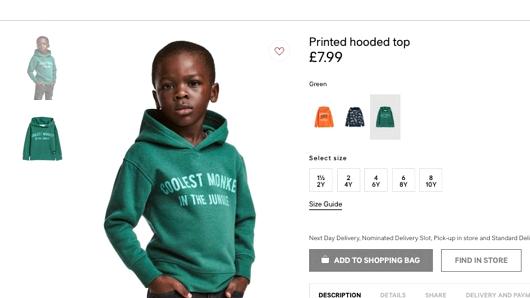
monkey
(Yes, this actually ran as an ad. No, it did not go over well…)

Clothing manufacturer H&M found itself scrambling Monday when the advertisement above went viral on social media, leading many people to accuse the company of racism. The image of a black child wearing a “coolest monkey in the jungle” sweatshirt was pulled from all of the company’s advertising and company officials issued an apology. (As the article notes, this isn’t the first time an advertiser has manged to pump out a racially tone-deaf advertisement.)

The stereotyping of black people as “monkeys” or “apes” is not a new phenomenon, nor is it germane only to the United States, so attempting to give the Swiss-based company a pass on this racially insensitive ad doesn’t hold water. That said, the goal of this blog isn’t to beat up on people who make mistakes but to help you figure out how to avoid making mistakes like this in the first place. Here are three simple tips to help you avoid something like this:

  • Paranoia is your friend: Murphy’s Law includes the famous line about “whatever can go wrong, will go wrong” so it’s always best to plan for the worst. When you find yourself putting together ANYTHING that will be disseminated to the general public, you want to engage in some active paranoia. Read every word as if it might have a double meaning or if a misspelling might lead to an awkward moment (e.g. “Bill Smith, a pubic librarian, reads…”). Look at every image you have to see if anything could be misconstrued in a negative way or would cast aspersions on an individual or group. Go through every potential stereotype you can think of in your head and see if something looks like it might be playing into that stereotype (e.g., Is a blond woman shown to be less intelligent? Did you put a person of color into a “monkey” sweatshirt?). For example, check out this University of North Georgia course catalog cover:

    Notice anything particularly problematic? Like the white guy is winning the race, the other white guy is coming in second and the woman and the only person of color included in the image are coming in far behind?
    If you come across something that could cast a negative light on you or your organization, rethink your approach before publishing it.


  • Diversity is not a buzzword: One of the main reasons why having a broad array of people from various backgrounds and experiences in a media organization (or any organization for that matter) is because it help the organization gain a more diversified view of reality. Unfortunately, some places see diversity as a “check box” item in terms of race, gender or other demographic elements.
    In organizations that embrace this wider view of societal understanding, people can put ideas out there and open the floor for discussion. If the person who put the kid in the “monkey” sweatshirt didn’t see how this could be a negative stereotype, (and I’m not sure how this is possible, but still…) someone else in that organization who might have dealt with this kind of negative language could raise the issue. In the end, this likely would not have seen the light of day and thus we could have had a “cute kid in a sweatshirt” ad that didn’t lead people to think of the company as racially insensitive.


  • Know where the landmines are: As the famous Filak-ism notes, you will screw up at some point. Your face is not on a lunchbox. That said, some screw-ups are bigger deals than others, whether you know it or not. Case in point: I was interviewing for a job at a university in the southwest, so my wife and I went out and bought me some newer shirts and ties. When I got there, I got the stink-eye from some of the students and more than a few faculty members.

What I didn’t find out until much later in the interview was that my new shirt and tie combo was in the colors of that university’s most hated in-state rival. It probably wasn’t the only reason I didn’t get the job, but I’m sure it didn’t help.

When you are putting content out for public display, you should know what specific topics, ideas and issues are most sensitive to anyone in your audience. In the United States, pretty much anything having to do with race, gender or sex will have some pretty sensitive tripwires. In some cases, companies don’t pay enough attention to these possibilities, like when Bud Light got into a jam for using the phrase “The perfect beer for removing ‘no’ from your vocabulary for the night.” Critics charged it accentuated the ties between alcohol and rape culture.

It’s not easy to catch every mistake or avoid every public snafu, but it’s not hard to do a little research to figure out exactly where the biggest landmines might be and avoid them.

How to annoy your survey participants in six easy steps

As a researcher, I end up asking a lot of people to participate in surveys I’m doing and studies I’m conducting. As such, I feel compelled to reciprocate whenever someone out there is asking for help in a similar vein. Thus, when a survey from one of my alma maters landed in my in box, I decided to give it a shot. Ten minutes out of my life? Happy to help.

I’m not sure how much help I was to the people who put the survey out, but given the various problems I had with this survey, I’m hoping I can help you all learn how to avoid what went wrong for them. Thus, you have today’s look at how you can really annoy your survey participants in six easy steps:


STEP 1: FAIL TO BETA TEST THE HELL OUT OF IT BEFORE YOU ROLL IT OUT

This is perhaps the simplest rule for trying to gather information from people who really don’t owe you anything: Make it a simple, intuitive and error-free experience.

To do that, you need to have people within the group or who won’t be part of the larger data pool take your survey before you send it to your population/sample. This is where you work out the kinks, troubleshoot confusing items and generally make sure you don’t look dumb. It became clear to me in the first screen that this group failed to do this:

SJMCNextFIXED
(NOTE: The blank spot is where the name of the university was. I deleted it to be decent.)

OK, do I click “next” to continue before or after I select my graduation group? Also, does clicking “next” move me to the next screen or do I need to click the arrow (something that seems more intuitive)? I tried a few ways of doing this and the only rule seemed to be that I had to make a click on “next” and pick my year at some point before I clicked on the arrow (which I was never actually told to do).

You are conducting a survey, not giving me a game of “Oregon Trail.” Make sure I know what I need to do or that you tell me how to do it simply. That’s one big thing in pretesting digital surveys.


STEP 2: DON’T GIVE ME CHOICES WHEN I ACTUALLY NEED THEM

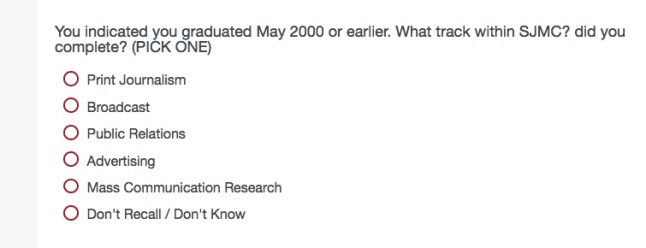
In some cases you want people to tell you multiple things on an item (Which of the following ice cream flavors do you like? Select as many as you want). In other cases, you want to force a choice (Which flavor of ice cream is your favorite? Select one.) When it comes to forced choices, you need to make sure you WANT to force the choice and that the forcing of that choice is conveyed to the participant in a way that allows him or her to make the best choice. Here’s where it doesn’t work:

SJMCTracks

OK, but I did both Print and Broadcast. Which am I supposed to pick? The one most closely attached to my job? The one I liked best? The first one?

This happened at least twice more in this survey:

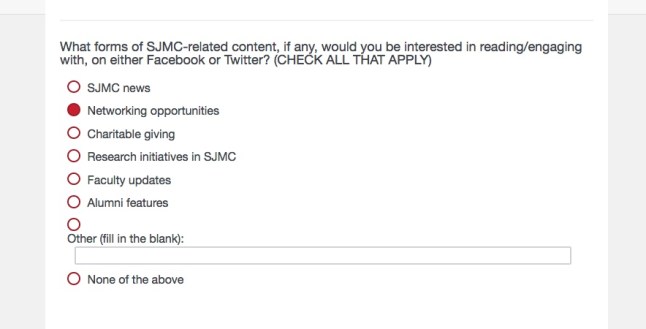
SJMC1
(I tried to click more than one and couldn’t. Trust me, this place has no trouble finding me for stuff like this.)
SJMC2
(Again, “all that apply” turned out to be “pick one.”)

If you want to force a choice where I might want to select more than one, remember the ice cream example: Tell me to pick a specific item (your favorite flavor). If that isn’t clear, explain what you want me to do if I fit more than one category (If you completed more than one track, please select the one you most closely associate with your current field of employment.). This will put the onus on the participant to choose, while still giving the person a sense of direction.


STEP 3: GIVE ME MUTUALLY EXCLUSIVE OPTIONS THAT I CAN MESS UP

As we noted before on this blog, people can be jerkweeds for their own sense of enjoyment. You want to make sure they don’t have ways to screw up your data. In a similar vein, you don’t want to give people a chance to mess something up accidentally as well. This can happen when you give me mutually exclusive options that I can select simultaneously, as you can see below:

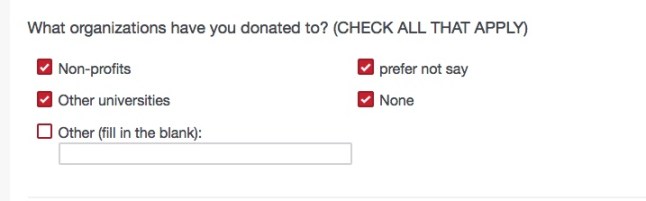
Mutually Exclusive Checkboxes

I could check all of the boxes I wanted, even though it makes no sense to say that I will tell you all of the things I donate to even though I donate to none of them and prefer not to tell you about it. If you need to get at if I donate or not, you can do one item that forces a choice (Do you donate money to organizations of any kind? Y/N/Won’t say) and then let the choice on that lead to another question. This is called logic within digital programs and allows people who pick “Yes” to get a screen filled with potential places you donated money (non-profits, universities, OTBs etc.) and people picked anything other than “Yes” to skip that item and drop into the next “everyone gets to answer” question.

(To be decent to the people doing the survey, I unchecked the options that didn’t make sense and answered honestly. It seemed like the right thing to do…)


STEP 4: GIVE ME A MEASUREMENT TOOL I DON’T FULLY UNDERSTAND

People generally understand simple choices like rankings (Of the following three sports, please rank them in the order you enjoy watching them, with your favorite choice ranking first and your least-favorite choice ranking third.). People also are used to scales if those scales have numbers that attach themselves to choices (On a scale of 1 to 5 in which 1 = Strongly disagree, 3 = Neither agree nor disagree and 5= Strongly agree, please rate the following items.). However, when you have a set of rules and measurements like we’re playing “Bamboozled,” you will annoy the hell out of your participants. Consider these three answers:

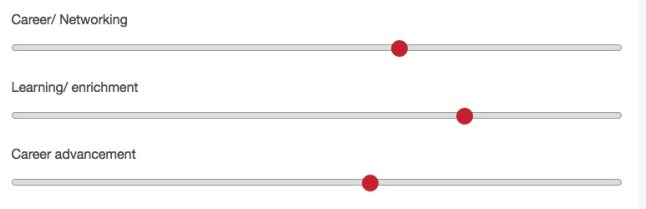
Which 5 is 5?

According to the numerical equivalency the sliders gave me, each of these answers correspond to the number 5 on a scale of 1-7. I have no idea if that’s true or if my positioning of the sliders will indicate that I like Learning/Enrichment much more than career advancement (if I move either of those sliders just a teeny, tiny bit to the right and left respectively, you have a two-point gap on a seven-point scale). If I really wanted each of them to be EXACTLY 5, did I need to align them perfectly? And if so, where along that “five continuum?”

Why we needed sliders for this was beyond my ability to comprehend, as buttons with numbers would have worked out just fine.


STEP 5: CONFUSE ME BY TELLING ME HOW I ANSWERED SOMETHING AND DON’T LET ME CHECK ON IT

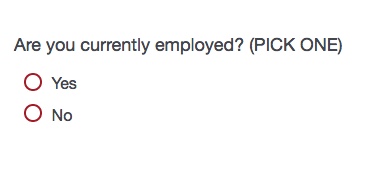
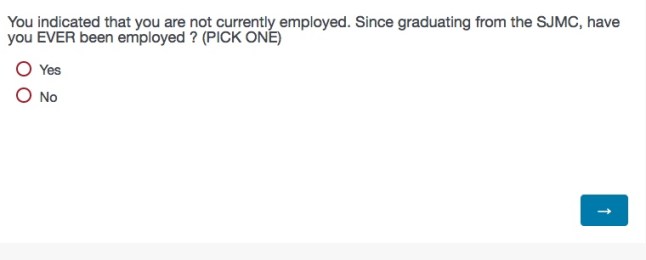
In some cases, you will want to reaffirm people’s choices before they proceed on a question (You noted that you have a Ph.D. How many years beyond your master’s degree did it take for you to complete that degree?). However, you don’t want to confuse people for no good reason. I was asked this question:

EMPLOYED

I picked “Yes” and then went on to a second screen where I was given some particularly unhelpful options regarding my rung on the corporate ladder. Once I finished that, I got this:

NotEmployed

Well, I said I AM employed, so I’m worried that I’m screwing up their data set. I want to go back and check, but I was not only unable to do it with an arrow at the bottom of the page (“Forward” is not only our state motto but also the edict of this survey.) but I couldn’t use the browser’s “back” arrow either. Fortunately, they sent me another link and I did the same thing and found that, no, I wasn’t screwed up. The survey was.

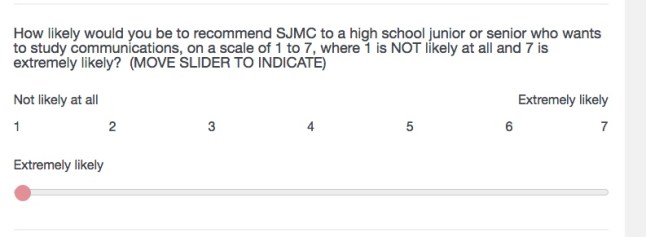
The same thing was true of confusing items like this one:

Extremely Likely TWICE

Which “extremely likely” is the right one? Or is this like a Russian election and you just really want me to pick something supportive?


STEP 6: WASTE MY TIME

Research (particularly marketing research) is supposed to be mutually beneficial. In other words, the goal is for the organization to learn something and the participant to feel good about taking part in the work. The best response you can hope for from participants is, “That was pretty interesting. I’d like to know what you find out.” The worst response you can get is what I got from a friend of mine who just completed the same survey:

AllisonFIXED

Before you go through the trouble of asking people to help you, make sure you are doing your level best to be respectful of their time. Give them a clean, clear and simple instrument, have all the kinks ironed out and make sure they feel as good about the process as you do.

Guest Blogging: PR and Marketing- How do you get your audiences to believe you?

Each week, we will strive to post content from a guest blogger with an expertise in an area of the field. This week, we are fortunate to have Rick Fox, the president and founder of Riverside Strategic Communications, LLC. He has two decades of experience in communications for some of the world’s leading brands, and he is an award-winning journalist and PR professional. His post is about the most crucial aspect of marketing nad PR: How do you get your audiences to believe you? Interested in being our next guest blogger? Contact us here.

It’s often said in marketing and PR that the truth isn’t written or spoken, it’s believed. So, how do you get your audiences to believe you?

Building Trust

The success of public relations, whether using the traditional press release or media pitch, or social media channels such as Facebook or Twitter, relies on effectively connecting with your audience. Whether your goal is to sell a product, get more clicks on your website, or inform consumers about the bad behaviors of a corporation, your success depends on your ability to get their attention and keep it long enough to make your point.

This requires strategic thinking, organization, research, and the ability to communicate. But does that require good writing?

It All Comes Down to Words

We live in a time of skepticism. The terms authentic and transparent are thrown around quite a bit. But in PR, transparency and authenticity really do matter. Your success in convincing others to buy what you’re selling depends on the words you type on your keyboard.

Overused superlatives no longer cut it. If it sounds too good to be true, it probably is. Rather than claiming perfection, strong messaging requires plausibility. Your audiences, reporters and customers alike, prefer to hear pros and cons versus a self-congratulatory message claiming how good your product is.

Don’t get caught up in the buzzwords of the day. Avoid words such as guarantee, financial freedom, and best of breed. Use protection, financial security, and effective instead. Build your credibility by under-promising and over-delivering.

Nuance Matters

When someone asks you for a favor and you say “I can do that” it would reasonable for that person to assume you are going to do it, right? But in PR, the difference between can and will is real.

Take, for example, this response to questions about an employee accused of embezzling funds from a company. “We agree this is unacceptable and this employee will be fired.” You’ve stated that you are going to fire him. But what happens when your internal investigation reveals the funds were simply miscoded by another employee? Could you have instead told reporters that “We agree that the allegations are unacceptable and we can take actions as appropriate when we complete our investigation”

A well-written holding statement should focus on what is, not about what isn’t. For example, one of your buildings has burned and a reporter is asking you what happened.

An unprepared spokesperson may say something such as, “We don’t know the cause of the fire yet. We don’t know how much was damaged. We don’t know when we’ll be operational again.”

A prepared spokesperson will refer to his written statement that states, “All our people are safe. We have a well-rehearsed, fire-safety plan that we executed very well. We’re proud of the way our people acted during this emergency.”


What’s Your Story?

If you don’t tell it, someone else will. And when someone else tells it, they rarely do so the way you would want. I had a client who prepared a media statement to use following the release of an inspector’s report that confirmed a pest problem in his restaurant.

After drafting key messages, working through multiple rounds of edits and approvals, a member of his team responded to a reporter and felt good about the exchange. Then he read the first headline, in a highly-credible news outlet, that read as follows: ‘ABC Restaurant staff working to rid kitchen of roaches’. He couldn’t understand how they came to that conclusion. After all, there were no longer any cockroaches in the restaurant.

When he re-read the statement, he quickly realized that he mentioned all of the important things: they were sorry they let their customers down; they took immediate action and were addressing issues to ensure this would never happen again; they immediately saw dramatic improvements. But it’s what he left out that caused the problem. He never actually said the roaches were gone or the problem has been resolved.

Luckily, he had a good relationship with the reporter and was able to add five words to his statement that said, “the conditions present in our restaurant were unacceptable… and have since been addressed.” This simple addition resulted in a new, more favorable headline, while reversing the tone of the story.

Write to Your Audience

Remember, the truth is what people believe. Your communications – tweets, videos, blog posts – all need to be believable before they can be effective. Believable stories require strategic thinking to understand what’s meaningful to your audience, and solid writing deliver a story that hits the mark.

Every word should have a purpose – helping convey exactly what you are trying to communicate. Each message should be proven with facts. Each fact should support your overriding objective. And your objective should be clear.

Evan as the channels we use to communicate continue to evolve, the fundamental ability to write clarity, brevity and relevancy is more important today than ever. Strong writing will separate your pitch from the rest, just as is will separate you from your competition when looking for a job. If you can write, you can tell more effective stories, and if you’re planning a career in PR, telling stories is the business we’re in.