When the marketing pitch is juuussst a bit outside (A throwback post)

In spite of what the optics suggest, my goal in life is not to write a book for every possible subject I might ever teach. In fact, I’m often on the look out for a good book for certain courses, including blogging, principles of advertising and feature writing (the one I have been using is discontinued).

So, when a company pitches an email at me about a book I’ve requested (usually through an online form or as a “standing order” in case they find something), I’m all ears. That said, here’s an email I got this morning that isn’t going to cut the muster:

Here are a couple reasons why this pitch isn’t going to work:

  1. I’m not teaching a convergent media class any time soon, nor have I taught a class in a while that might fit this bill for this book.
  2. I didn’t actually request this book, or access to it.
  3. Most importantly, if I wanted to peruse the book for any reason, I wouldn’t need a special code for this, as it’s my book.

Look! It’s got my name on the cover and everything!

I understand that publishers are in need of reaching out to sell stuff, and I’m glad that my other publisher (Focal) is doing something to try to connect people with this book. However, it does make me question their overall approach when they a) couldn’t bother to eliminate the author from the sales database and b) approach the selling like those scam texts that are “just providing you with information that you requested on this exciting opportunity!”

So, for the last Throwback Thursday before Spring Break, here’s a look back at another time where the pitch a publisher threw was juuuuuuusssssst a bit outside….


So… No, then? (or why it’s important to research your readers before you pitch to them)

I understand this blog tends to skew more toward news than some folks might appreciate, given that my entire pitch for the “Dynamics of Media Writing” is that ALL disciplines of media (news, PR, Ad, marketing etc.) can get something of value out of it. The skew is due to trying to cover both the media-writing text and the news reporting and writing text in one spot. It also also comes from the idea that a lot of things people perceive as “news” things are actually valuable for all media, including skills like interviewing, research, inverted-pyramid writing and so forth. Finally, it seems that news folks tend to make more public mistakes than do some of the other disciplines, so I get more content there. (If you want me to hit on more topics in the PR/Ad/Marketing stuff, feel free to pitch me some thoughts. I’d love to do it.)

That said, occasionally there is a specific foul up in a specific part of the field that bears some analysis. Consider that when you look at this email I got the other day. I redacted the identifiers as best I could:

Dear Professor Filak,

​Greetings from (COMPANY NAME)! ​I hope this finds you well. In the coming months, (AUTHOR NAMES) will begin to revise the twelfth edition of their introductory journalism text, (REPORTING BOOK NAME). ​This text strives to give students the knowledge and skills they need to master the nuts and bolts of news stories, as well as guidance for landing a job in an evolving journalism industry.
Right now we are seeking instructors to review the twelfth edition of (REPORTING BOOK NAME) ​a​nd provide feedback. This input is invaluable to us, ​as it ​giv​es​ us a greater sense of how to best address both instructor and student needs. ​If you are currently teaching the introductory news reporting and writing course or will be teaching the course soon, would you be interested in offering your feedback?
If you would like to review, please respond to this email and let me know if you will need a copy of the printed text. You should plan to submit your comments via TextReviews by 2/6/18. In return for your help, we would like to offer you (MONEY).
At your earliest convenience, kindly respond to this e-mail to let me know if you are available and interested in participating. ​Again, please let me know if you will need a copy of (REPORTING BOOK NAME)
I’m always happy to help people and I’m not averse to making a buck by pretending to know what I’m talking about, but this felt both awkward and ridiculous. One of the things both “Dynamics” books push a lot is the idea of making sure you know what you’re talking about before you ask a question. The books also push the idea of researching your audience members so you know how best to approach them. Either the person writing this email didn’t do that or just didn’t care.
Here’s how I know that: It’s called “Google.”
Had this person done even a basic search on me she would have learned several things:
  • I am teaching the courses they associate with this book. I teach nothing but these courses, as you can find on the UWO journalism department website. The line of “If you are currently teaching the introductory news reporting and writing course or will be teaching the course soon…” tells me I’m on a list somewhere and this is a form email at best.
  • I wrote several books, including one that is likely to be some form of competition for this book. (I’m not saying it will be as good or better or anything, but my title includes words like “news,” “reporting” and “writing,” so it’s a pretty safe bet we’re vying for the same students.) This was literally one of the top five items on the first page of my Google search. She also sent her message the same day I got this alert from Amazon:NumberOne
    (I have no idea how Amazon quantifies “#1 New Release in Journalism” but I’ll take it.)

    The point is, it wasn’t a secret, so it appeared that she didn’t look me up and was like the guy at the bar telling me, “Hey, see that babe over there? I’m totally going to score with her!” and I’m like, “Uh, dude, that’s my wife…”
    On the other hand, maybe she did look me up, found the book and asked anyway, which is like the even-worse guy at the bar who’s saying, “Hey man, your wife is pretty hot. Any chance you can give me some tips on how to score with her?”

Thinking about all of that for a moment, I did the polite thing and emailed back, explaining how I felt this would be a conflict of interest (it is), and that any advice I gave her would be likely be somewhat problematic as the author of a competing book (it is).  I also noted that I know the book she is pitching well (I do) and I know the authors well (I do), so this would also be a bit awkward for me (it really is). Here was her email back to me, which again made me think she wasn’t actually reading this:

Hi Professor Filak,

Thanks so much for letting me know. We will certainly keep you in mind for future projects!

So, again, the point of the blog isn’t to beat people up for doing things poorly but rather to offer advice on how to do things better. Here are a few basic tips:

  • Research first, then write: You don’t have to do an Ancestry.com profile on every person to whom you market or with whom you engage in outreach, but it’s not hard to Google someone. Most people put more social-media stalking effort into learning about the “new kid” at school than this person put into finding out about me. In marketing, you often have access to proprietary data as well, so you can find out if this person had any previous engagement with your organization. In my case, I used that book for more than a decade and still keep up with it, so that might have been something she could have found.
  • Personalize when possible: If you are sending out 100,000 requests for something like a survey and you are expecting a 10 percent response, you will not have the ability to personalize all of the information on everyone’s card or email. That makes sense. However, when you are microtargeting a group of people with a specific set of skills or interests and that group isn’t going to overwhelm a data center, work on personalizing your content. That line about “If you are currently teaching the introductory news reporting and writing course or will be teaching the course soon…” could have easily been tweaked to say something like, “I see you have taught writing and reporting courses at UW-Oshkosh…” and it wouldn’t have taken much. Making these minor tweaks shows that you have done your research. Engaging in some personalized communication shows your readers you care enough to see them as individuals as opposed to a wad of names on a spreadsheet.
  • Try not to screw up, but if you do, don’t ignore it: The one thing that stuck with me when I got that response email from her was that I didn’t think she figured out what she was actually asking me or why it was weird. I had that feeling that if I had written her back and said, “I’m sorry I can’t do this because I’ve just been placed in an intergalactic prison for the rest of my life for murdering a flock of Tribbles with a phaser I set to ‘kill’ instead of ‘stun,’” I would have gotten the exact same email back. The whole exchange really reminded me of this scene:
 The thing that is important to realize is that you are going into a field that has two important and scary things going for it:
  1. It’s small enough that you’re really about two degrees of separation from everyone else, so people know other people.
  2. People in the field love to talk.

If you end up screwing up because you didn’t do the first two things suggested above, don’t compound the problem.

I have no idea if I’ll ever get approached by this publisher to review anything, but I know I will always carry with me the memory of this interaction. Had it been a great interaction, that would have been good for the publisher. Unfortunately, that wasn’t the case.

An avid proponent of Pedialyte is born (A Throwback Post)

The first conversation of my morning went something like this:

Colleague: “Hey, you’re back! How are you doing?”

Me: “I’m drinking blue Pedialyte out of a rocks glass at 7:30 in the morning, so there’s that…”

The reason for my foray into the world of children’s beverages was also the reason for the blog being MIA this week: The Norovirus.

I somehow managed to contract this fun bug over the weekend and it made its presence known loudly and viciously multiple times around 1, 2 and 3 in the morning. The next three days were nothing but sleep and fear of subsequent outbursts.

I will not get graphic, but I will say that I have not been that violently ill or subsequently headache-crippled in years. If I had to put it in the Pantheon of Filak Deathspirals, it would be only below the time I got food poisoning so bad I still refuse to eat at that restaurant 20 years later and the “Free Tequila Slammer Debacle of 1992.”

My Lord and Savior, with deference to the Catholic Church, in this week of malady was Pedialyte drink and Pedialyte popsicles. This nectar of the divine gave me much needed hydration while not further angering the stomach gods. If the folks at Pedialyte ever need an endorsement, they’ve got it. (I highly recommend blue, purple and orange, although the pink popsicles aren’t bad.)

With me still on the mend and with work having overcome my desk, I thought it wise to use a Throwback Thursday to make a post and set up next week, where I will hopefully be more alert and back on solid foods.

Thus, enjoy this earlier ode to Pedialyte and its amazing marketing shift.

Sick toddlers and drunk college students unite! (Why Pedialyte’s marketing shift worked and what you can learn from the company’s approach.)

The first time I heard the word “Pedialyte,” my wife was yelling it at me.

Our daughter was less than a year old and had consumed some formula that wasn’t agreeing with her. She had started vomiting, even though she didn’t have the vomit reflex yet. Her whole head would turn red and then she’d expel some of the semi-digested crud and look up at us like, “What did you do to me?”

Amy was worried Zoe would get dehydrated and thus fall into some series of other horrifying illnesses. (We were first-time parents, so everything freaked us out. Our friends with seven kids were like, “Let her barf a bit. She’ll learn…”) Thus, I was dispatched to the closest store to get Pedialyte.

“What is this stuff?” I asked, as I struggled to understand her over the screaming child rolling about on her blanket.

“PEDIALYTE! For GOD’S SAKE. It’s (expletive) PEDIALYTE!” she screamed over the noise machine that was our child.

At first, I couldn’t find it, as I wandered around like the clueless dad I was. Still, I wasn’t leaving without “(expletive) Pedialyte,” lest I end up buried in a shallow grave in my backyard that night.

Fear of death and vomit are inspirational.

I eventually found the stuff and got home and the kid started to normalize. As she got older, Pedialyte became less important to us around the house. I would only see it in parenting magazine ads or during daytime TV shows, hawked as essentially kiddie Gatorade. The marketers had a great niche product that sold a simple idea to a key demographic: Parents who were freaked out about their vomit-plagued kids becoming brain-dead raisins.

That’s why I was amazed when I saw this article on how Pedialyte has shifted market focus to draw in a whole new generation of users: Vomit-plagued older kids, who would likely drink toxic waste if you told them it would cure a hangover.

The article notes that about three years ago, Pedialyte began targeting the “hangover market,” pitching itself as a cure for dehydration that could provide relief for those who over-imbibe. In the years before that, the “Pedialyte cure” had been passed along by word of mouth in colleges and universities across the country, so the company decided to embrace it with marketing. The company’s Twitter feed and other social media outlets focus on this premise, with images of college-aged people guzzling the beverage and tweets that respond to people asking for hangover help. It incorporated the hashtag of #notjustforbabies to brand itself as being useful for these situations.

I asked my 8 a.m. class, which usually looks like extras on “The Walking Dead,” if they ever heard of Pedialyte and at least four people woke up long enough to tell me, “Oh, yeah! That’s the hangover cure stuff!”

And it works on vomiting infants, too!

Consider the following points to help you understand why this worked for Pedialyte, when so many other shifts like this fail:

The market expansion didn’t cost the company its initial market. On far too many occasions, a company will go after a different demographic or take a different approach to grab new users in a way that undermines or degrades it original audience. When a company decides to market to a younger audience to tap the youth market, it can lose older audience members, who feel left out or abandoned.

In this case, the Pedialyte people managed to tap another demographic (hungover college-aged students/drinkers of alcoholic beverages who need hangover relief) without losing the people who initially used the product (parents of dehydrating infants and toddlers). The markets are not mutually exclusive, nor would marketing to one group make the other group uneasy. It’s not like a baby-formula manufacturer marketing its product as “the best formula for helping drug lords cut their cocaine!


The new pitch doesn’t force an identity change. Pedialyte still does what it says it does: It rehydrates people. It’s not trying to market itself now in an off-label way, like telling people they can use it to scrub rust off a car muffler or something. The identity remains the same and thus all of the characteristics and benefits of the product still apply in the marketing material. If you boil down the pitch for Pedialyte, you can simply say, “Drink this stuff because it stops you from feeling yucky when you’re dehydrated.” That’s true for infants who contracted a “tummy bug” and college students who “swear tequila never messes me up like this.”


The tone/feel for each marketing approach matches the vibe of the audience. Here is an advertisement that Pedialyte runs to target parents:

PedialyteKids

See what you have here in terms of tone and feel: Caring parent, cute kid, doctor’s recommendation, easy to use and fun flavors. It also reflects a softness with the colors, the background, the imagery and more.

Now look at the one for adults:

PedialyteHangover

A half-naked college-age guy who just woke up, clearly in pain and blinded by the light of his refrigerator. The fridge is a mess of random stuff with the only color coming from the Pedialyte bottle. The images are starker, the color scheme is darker and the fonts are more utilitarian. Even though the characteristics of the product are the same (rehydration), the benefits described are different than those outlined in those in the parenting ad (kids= easy to use, less sugar, fixes the kids after they get diarrhea; adults= stop the head pounding, fix the dry mouth, defeat the hangover).

Each piece works because it acknowledges its audience, targets the people in it and then makes a reader-appropriate pitch. The parents feel safer that they aren’t giving their kids something sugary or with too much extra non-essential stuff in it. They feel comforted that it’s the number one pediatrician-approved drink. It provides reassurances for them that they are doing a good, safe, effective thing for their children. For the hangover crowd, it’s not about doctor approval or the active ingredients that make parents feel secure in their choices. The ad essentially says, “Well, you got really messed up last night. Here’s something that will stop you from feeling like you were run over by a bus.”

The Washington Post Kills Ad Demanding Trump Fire Elon Musk

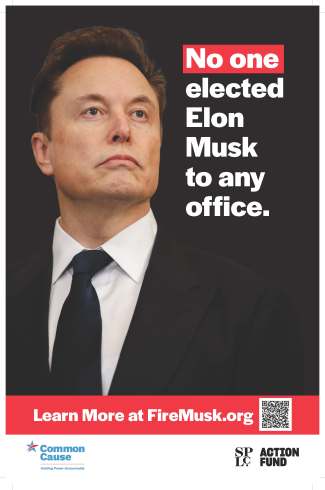
Copies of the ads the Common Cause and Southern Poverty Law Center planned to run in the Post.

THE LEAD: The Washington Post pulled an ad set to run Tuesday that called for President Donald Trump to Fire Elon Musk. Several organizations chipped in to run a wrap-around, a specialized ad approach that tends to draw a lot of attention in print publications.

Common Cause said it was told by the newspaper on Friday that the ad was being pulled. The full-page ad, known as a wraparound, would have covered the front and back pages of editions delivered to the White House, the Pentagon and Congress, and was planned in collaboration with the Southern Poverty Law Center Action Fund.

A separate, full-page ad with the same themes would have been allowed to run inside the newspaper, but the two groups chose to cancel the internal ad as well. Both ads would have cost the groups $115,000.

“We asked why they wouldn’t run the wrap when we clearly met the guidelines if they were allowing the internal ad,” said Virginia Kase Solomón, the president and chief executive of Common Cause. “They said they were not at liberty to give us a reason.”

Jeff Bezos, the owner of the Post and reason why you could drunk-order a pimple-popping ear toy online, has made several moves that indicate a general sense of deference to the Trump administration. Prior to the presidential election, Bezos ended the paper’s tradition of running an editorial endorsement of one candidate. (The unspoken but obvious reason was that the newspaper folks weren’t picking Trump.)

Bezos also was in the “tech bros row” for Trump’s inauguration, along with Mark Zuckerberg and Sam Altman. A key factor in his preferred seating was likely that Amazon had donated $1 million to Trump’s inauguration fund.

Although Bezos was not interviewed or quoted for the “ad kill story,” the Post’s PR division offered a bland response in his stead:

A Washington Post spokeswoman said in an emailed statement that the newspaper did not comment on internal decisions related to specific advertising campaigns and pointed to its publicly available general guidelines for advertising.

(If you don’t feel like downloading the Post’s ad brochure, let me just say it’s the most pedestrian thing on Earth. It also does stipulate that the Post “reserves the right to position, revise, or refuse to publish any advertisement for failure to comply with the guidelines set forth below, or for any other reason.”)


UNDERSTANDING THE LAW AND THE AD GAME: Advertising falls under the umbrella of what the government calls commercial speech, meaning it’s meant to sponsor or promote the purchase of goods and services. It hasn’t always been protected speech, and as recently as the 1940s, courts had ruled that purely commercial advertising is not protected by the First Amendment.

Court rulings since then have either eroded or eliminated that stance and have led to some basic rules in regard to how advertising can or can’t be censored. In short, if someone is trying to get you to buy something or sell something, it’s probably going to fall into the realm of advertising and the courts will engage in strict scrutiny while examining the regulation of it.

Strict scrutiny in this case basically boils down to this: the state has to prove it has a good reason to regulate the ad and that the regulation will actually accomplish the outcome the government says it will and it will do so in a reasonable, not overreaching way.


PUBLIC VERSUS PRIVATE REGULATION: The key thing to understand here is that none of that stuff applies to what the Post did. Those laws basically apply to governmental action. So, if Trump had heard about the ad and decided to force the Post NOT to run it, that’s where the legal stuff on strict scrutiny etc. would come into play. The Post is a private media entity and it has the ability to accept or deny ads for any number of reasons.

Most newspapers (and I’m assuming other media outlets I haven’t dealt with the ad end of) have basic rules about what they will or won’t accept for ads, based on what they think is important to their readers.

Obvious things that get rejected are ads for illegal products. If I wanted to run an ad in the Advance-Titan, our student newspaper at UWO, for “Dr. Vinnie’s House Of Crystal Meth and Cocaine,” I’m guessing I’d get a pretty strong rejection. Back in the day, we rejected ads for off-shored internet casinos because they had all sorts of legal problems. (That almost seems quaint now that we’ve got ESPN’s “journalists” stepping up for gambling apps and pitching parlays to their audiences.)

Other things that get rejected can be based on how the audience is likely to feel about a product or any special stipulations between the media outlet and any intervening organization. For example, a friend who used to advise the student newspaper at the University of Notre Dame once told me that the paper was forbidden from accepting alcohol ads, due to its status as the official paper of the university. I know that some publications accept ads for strip clubs, abortion services and marijuana dispensaries, regardless of the legality associated with those enterprises.

Newspapers also often have a basic “because we said so” stipulation, just like the Post did. As I was fond of saying to my staff, we could institute “Screw You Tuesday,” in which we rejected any ads that people tried to place on a Tuesday, because, well, “Screw you, that’s why.” It’s not a great way to do business, clearly, but it is legal.

DOCTOR OF PAPER HOT TAKE: First, I’d love to be in a financial position to turn down $115,000 “just because.” Have you ever seen how excited people get when they get close to that on “Wheel of Fortune?”

Second, and I can speak from experience on this, it sucks to be pinned in a corner on an ad buy like this. This group could have chosen one of a dozen major metros, but they picked the Post for a pretty good reason and it wasn’t necessarily that Trump reads it.

When I was advising the Advance-Titan, we got an offer to include a 12-page pro-life insert into our paper for about twice what we would normally charge. Like most student newspapers, we were struggling financially, so the money would have been welcome. That said, in digging into how this insert played elsewhere, we found that researchers had found legitimate concerns regarding the factual accuracy of some of the claims in the insert. Furthermore, it would put the paper in the middle of a debate we had no real interest in entering.

After the staff debated and discussed this a bit, the editor came to me and said, “How do we deal with this and not be screwed?”

“You’re screwed either way,” I told him. “If you run it, you’ll have people on the other side of the issue up in arms about it and you’ll catch the same grief as other places that ran it for the accuracy issues.”

He interrupted me. “OK, so then I won’t run it and we’re fine…”

“No,” I explained. “If you don’t run it, this organization is going to put out the Bat Signal to every media outlet that will pay attention saying that you’re pro-abortion and that you’re suppressing their speech. There will be news articles and comments and blog posts and everything else coming at you for this.”

“Like I said, you’re screwed either way. So do what you think is best, stick with it and don’t get into a war of words over it.”

He decided not to run the ad, and pretty much everything I noted above happened, but somehow worse. A press release went out, newspapers ran stories, a local talk radio guy in Milwaukee did about a half-hour on how criminal we were and all that. It eventually went away, but I think the editor doubled his smoking habit until it did.

In the Post case, Bezos clearly doesn’t need the money and he’s clearly dealing with someone who has no compunction about being vengeful when someone is perceived as disloyal, so not running this ad does make sense in that regard. The paper has that right and it can (and has) exercised it.

That said, the optics are really terrible, especially when coupled with the previous actions in regard to Trump. The Post itself will likely suffer credibility issues in general as a result of this.

When Bezos bought the Post, the prevailing thought was, “This is great, because he doesn’t need anyone’s money. He can do whatever he wants and not have to bow to the whims of the rich and powerful.”

Well, we were about half right on all of that.

DISCUSSION STARTER: If you ran the Post, what would you do with this ad? Also, what kinds of ads would you be willing to take (or reject) based on what you think about the publication, its audience and your own sense of what is fair?

Time to Dissect the Super Bowl Ads for Audience-Centricity and Interest Elements

One major tradition surrounding the Super Bowl, other than complaining that whatever it was was the worst half-time show ever, is a deep dive into the commercials. Countless ad orgs, commentators, marketing pros and other folks will spend hours upon hours making bests and worsts lists. In any given year, there will be the ads that tug on heart strings, ads that are flat out ridiculous, ads that insult at least three demographic groups and ads that leave us wondering, “OK, what the heck was that?”

Rather than go the traditional way here, let’s make some sense of the ads from the perspective of how media content is supposed to work.

  1. Define and understand your audience well enough to provide content that caters to the people in it.
  2. Use specific interest elements to pique and hold the audience members’ attention.

Here is a link to a pretty good running tally of all the ads:


Go through the ads and find the one that you like (or hate) the most and start to analyze based on the key points above:

Audience: Break down the demographics based on who tends to watch the Super Bowl, according to a reliable source you can find online. Then, see what segment of that broader chunk is most likely the target of this ad from that perspective. Then, move into the psychographic elements that you think are at the core of what the target audience members most likely ascribe to in their lives. In short, what values, feelings, connections and more is the ad you picked trying to tap into.

(As for the third element we outline in the book, it’s highly unlikely the geographic element will play a role here, but if you find something, go for it.)

Then, move into the next phase by assessing the interest elements that draw the attention of audience members:

  • Fame
  • Oddity
  • Conflict
  • Immediacy
  • Impact

As we often note, you won’t be able to catch all five of these in most cases. At least one should be present in any media content. See how many you can find and then assess if those elements are being successfully tapped.

Some of the goals of the ads will work or won’t work because the people making the ads didn’t correctly match elements like “fame” or “impact” with what the target audience knows or understands. (I bring this up, as Amy and I were watching part of the half-time show and when someone came out to sing with Kendrick Lamar, we both asked, “OK, who the heck is that?” We eventually asked our cooler, hipper sister-in-law, who was nice enough not to shame us as part of the process…)

See what you can come up with as part of this analysis, particularly if you thought any given ad really worked or really flopped.

At the very least, it’s a good excuse to watch some videos in class today.


CustomInk-Credible: A textbook way of dealing with a screw-up

Those of you who ordered a “Filak Furlough” T-shirt should be getting a surprise in the mail just before Christmas:

Another T-shirt.

Here’s a look at the back of the one you have, so let’s see if you can figure out why this is happening:

In case you missed it, as I did the first time, I’m not on a “Furlongh.” Here’s the back story on how this happened and a perfect example of how a company, PR organization or news outlet can gain a lot of credibility in the eyes of the public.

As we discussed in an earlier post, CustomInk reached out just before production to tell me I couldn’t include the names of the schools on the shirt without permission. (I’ve since heard from at least two legal experts who remain befuddled by this, but that’s for a different post…)

To make sure that these things got done before I headed out for a conference where several people were expecting them, I had to do a quick fix and get a new version sent back to them that day. I cut the school names, went with the cities, gave everything a once-over and sent it along.

A rep from CustomInk hit me back with a link to the proof, which I scoured for any hint of school stuff I missed and to make sure I didn’t misspell a city or place it in the wrong state. Everything I touched was good, so I green-lit the shirt.

Fast-forward to the day before I’m heading out for this trip and I’m ironing one of the tour shirts when I notice the error. (Yes, I iron my T-shirts. I’m socially inept and fashionologically stunted, but I will not be rumpled.) Immediately, I figure it’s all my fault, so I go back to the proof I sent, wondering how the hell this happened.

It turned out, what I sent was right.

I then looked at the proof and found that was where the error came into play, as the folks at CustomInk infused the misspelling into the mix. I sent an email to them, explaining that this was a mistake that I didn’t create, that somehow got through and it looked doubly stupid because it was a shirt from a journalist. I asked what they’d do to fix it.

My expectations ranged from bad to passable:

BAD: They would come back with something like, “Look, this is why we have you proof the thing before we put it on the shirt. It was there on the proof and you missed it, so c’est la vie. If you want a reprint, you’ll pay for the whole thing.”

COULD BE WORSE: They would come back with something like, “Yeah, it’s kind of our fault but kind of yours as well. We’re willing to do the shirts at a discounted price and you pay for shipping.”

PASSABLE: They would come back with something like, “We’re sorry this happened and we’ll redo the shirts for free, but you’ll need to cover shipping. Next time, though, we have to hold you to what you approved with the proof.”

Never in my wildest dreams did I expect this:

In short, it’s on us.

I agreed and they redid the proof, sending it to me for a review. (And you damned well better believe I studied that thing like it was the Zapruder Film before I hit “send.”)

They then promised to make sure everyone had them before Christmas (as I’m sure many of you were planning to make it a Festive Filak Furlough Holiday Season…).

Aside from essentially guaranteeing my business for every other shirt I’ll ever do, the folks at CustomInk gave us a textbook example of how to deal with a foul-up in any field, regardless of if it’s a newspaper correction or a marketing mistake:

ACKNOWLEDGE IT: The people at CustomInk got back to me right away and said, “We see the issue here.” In doing so, it sets the stage for the rest of the process. If they’re like, “What’s the big deal?” or “Don’t be so petty,” we’re off to a bad start.

Admitting that a mistake happened is really tough in our field, particularly when we pride ourselves on always being accurate and helpful. I know a lot of newspaper folks used to fight tooth and nail to bend reality in a way that made potential errors not worthy of corrections. The idea there was that by fessing up, we somehow undercut our credibility with the readers. In reality, the opposite was true.

EXPLAIN IT: One of the questions I had was how the mistake happened, as I was initially sure it was my fault. Then, when it wasn’t, I had a hard time figuring out how a PDF got screwed up, as that’s not supposed to happen. In this email, CustomInk gave me the basic explanation of what it does and how the error occurred.

In some cases, the errors are your fault and explaining how you screwed that up can be helpful. An amazing reporter I worked with back at the State Journal once covered a bank robbery that a regular citizen foiled by tackling the robber outside the bank. However, she managed to invert the names, thus calling the hero by the name of the robber and the robber by the name of the hero. Clearly, that caused some problems.

Another case we discussed on the blog earlier explained how an award-winning sports journalist accidentally put a former Beatles drummer on the Green Bay Packers of the 1960s.

In both cases, the reporter explained how those mistakes had occurred, with the idea that in figuring this out and talking about it, the reporter would be less likely to have the same thing happen again.

Also, in some cases, it ISN’T your fault: A press release has the wrong information, a source misspoke or one of a dozen other things happened. In explaining those issues, you can also save face in the eyes of your audience.

FIX IT: Not every mistake can be undone, as was the case with our look at the “filthiest” paragraph error. The paper there ran a correction, an apology, a letter from the writer and more, but it still wasn’t enough to make things better for Bubba Dixon.

However, whenever a mistake can be fixed, do so to the best of your ability. It might not be fun and it might not be easy, but do everything you can to restore faith in you and your organization.

Sure, CustomInk could have told me to go pound sand, and from a legal standpoint, I’m sure that would have been OK. However, the folks there realized that a ticked-off customer is not something they want roaming the internet. Even more, I’d had so many good experiences with them, I’m sure they didn’t want the last one to be terrible.

Therefore, they realized the juice wasn’t worth the squeeze here and they decided to fix it in the best way possible, knowing they probably lost some money on the deal, but also knowing that they kept a customer happy.

Filak Furlough Tour Update: Hanging out at Iowa State University (Part I)

I think I only own one or two shirts. Also, I do not like my “Alfred Hitchcock Presents” profile…

The Filak Furlough Tour actually hit the road a few weeks back to drive out and visit a campus. Most people were fine with the “Vince on Zoom” experience, as it allowed them to shut me off and mute me when I got annoying. The good folks at Iowa State University knew me and decided that a couple days of me would be, at the very least, interesting.

Of all the campuses I’ve been on as a student, parent, faculty member and more, I found Iowa State to be among the best in terms of just feeling like it fit my personality. (I mean that as a compliment, not as a potentially libelous statement…) Nice people, smart kids, good questions and more. Totally worth the 4 a.m. car ride…


IOWA STATE UNIVERSITY – AMES, IOWA

THE TOPIC: I did one class on finding stories and trying to come up with the best ways to tell those stories and one on sports journalism, sports marketing and DEI. Since I’ve done a lot on the issue of finding stories, we’ll go after the second one.

THE BASICS: This had to be one of the more interesting experiences I’ve had, in that the class was set up like a press conference, with the students driving the discussion on the topic and then live-tweeting the entire thing as they saw fit. The professor gave me the option of asking them not to record or put me on social media.

“Nah,” I said. “Let them do it. If I say something pathologically stupid, that’s my fault.”

Thus began my life on a tightrope for an hour or so…

One of the key things we discussed was the way in which race, gender and other similar issues get covered in the media. We talked a lot about how the “oddity” interest element tends to get played up when it comes to those topics. It’s often stories about “The first (fill in the blank) to do (job white guys have done for forever)” instead of “Here is a person who brings XYZ skills and valuable elements to the (job).”

I apparently made this case about not being at a point of equity yet in a truly “me” way:


A student asked me how we could get closer to that kind of thing, both in terms of news/sports coverage and in terms of sports marketing. I think the key is to look at the person first and what it is that makes the person worthy of focus. It could be an athletic skill set or their personality or a dozen other things. Then, help that person tell the story they want to tell about themselves, rather than focusing on whatever quick and easy distinction we can make, whether it’s race, gender, sexual orientation or whatever:

The important thing to understand is that nothing gets done in an instant. That doesn’t mean we should accept mediocrity when it comes to making progress, nor should we say, “Well, that’s good enough for now.” However to fail to see that things have come a decent distance over a protracted period of time is to diminish the value of the people who worked and fought to get as much improvement as we have gotten to this point.


BEST QUESTION OF THE DAY: What did you think of how Coach Prime dealt with the media and how the media was dealing with Coach Prime?

BEST ANSWER I HAD AT THE TIME: Deion Sanders has always been very much his own person and has not really given a damn what other people thought of him the sense of if he was being “too much.” (Whatever the heck that means.) He was never going to come to college coaching and suddenly turn into a “We gotta play them one day at a time… I’m just glad to be here…” kind of person. He is who he is and he’s comfortable in his own skin, which I think is fantastic.

The person that I most thought of when I saw his situation in Colorado was Muhammad Ali: He was brash, confident and not afraid of telling people what he thought. In doing so, he ruffled a lot of feathers of people who didn’t like his approach. It was like the media was waiting for him to fail so they could say, “See? You’re not all that. Now sit down and shut up.”

That’s never going to happen. He will continue to be who he is throughout the process. Even if you don’t like him as a person or find him to be annoying on those Duck commercials, you gotta respect the sense of self he has and the way it can inspire and raise up his players.


ONE LAST THING: I saw these advertised in the campus bookstore.

Despite my best efforts, Amy wouldn’t let me come home with a pair of these.

Tired of political ads on TV? Three reasons they’re not going away

(“I just want to warn you that when I wrote this song, I was watching TV during the 2022 midterm campaigns so…”)

Avoiding political advertising this time of year is like trying to stay dry in a hurricane: Despite your best efforts, it isn’t going to happen. Candidates, political action committees, outside organizations, issue-oriented groups and anyone else who has a bone to pick will flood your mailboxes, newspapers, inbox, digital devices, fax machines, billboards and more with a torrent of advertising geared toward shifting the vote total just a smidge more in favor of their candidate.

If you think this year is worse than most, you’re probably right. This piece from NPR outlines the way in which both major parties are pounding the heck out of us with paid speech at a cost and speed unlike any previous midterm election. It has gotten so bad that I’m practically begging my TV to show me Tom Selleck hawking a reverse mortgage or out-of-control Xentrex ads.

Anything but another frickin’ ad about the radical, unhinged, wrong-for-us, out-of-touch, elitist, self-serving, corrupt candidate that will ruin my life, destroy our country and probably get me hooked on Xentrex…

Despite a seemingly universal disdain for deluge of political ads (especially negative ones), they’re not going away for three simple reasons:

In some cases, the law says the ads must run

We might not want to see U.S. senate candidates and individuals seeking office in the U.S. House of Representatives on our TV every 16 seconds, but federal law sure does. Section 312(a)(7)  of the Federal Communications Act states that a broadcast license can be revoked if a station does not provide legally qualified candidates for federal office with access to the airwaves. The stations are required to “permit the purchase of reasonable amounts of time for use of a broadcasting  station” to reach the public.

This only covers the federal offices, which means that this only applies to people running for the positions of president, vice president, U.S. senator and U.S. representative. It also doesn’t state what accounts for a “reasonable amount” of advertising time, thereby allowing candidates to stretch the bounds of reasonability like it’s a Stretch Armstrong doll on speed…

Beyond that, Section 315 of the communications act provides what are known as equal time rules or equal time doctrine. This simply means that if a station allows one legally qualified candidate for an office access to its facilities, it must provide an equal opportunity for the other candidates for that office. So, if I’m running for Waushara County Dog Catcher and I am allowed to buy a 30-second spot on the local ABC affiliate for $500, any other legally qualified candidate for that office must be able to get the same amount of time for the same price on that station.

Now, the station can decide it doesn’t want to get involved in this nonsense, and thus make the statement that it won’t allow me, or any other candidate for that office to run ads. That’s fine. Also, the station that allowed me to run that ad doesn’t have to go looking for all the other candidates and tell them they have this opportunity. However, if one of my many fine opponents comes to ABC and wants to run a 30-second ad for $500, that station is duty-bound to do it.

Here in Wisconsin, and I’m sure we’re not alone, the broadcast outlets have been stepping forward to make the case as to why they HAVE TO run these ads. They are also explaining why they can’t censor the political ads to eliminate all the nastiness that goes into them:

Can television stations not air an ad because it is violent or has harsh language in it?

Matt Rothschild: “The Federal Communications Act of 1934 was so worried that stations were going to be censoring political candidates that they said essentially, you can’t do anything about the content except run it.”

Technically, the stations could sit out everything except for the federal races, although they often pitch the advertising for those non-federal offices as being tied to the “general public interest standards” that govern their license. Still, that’s not the main reason why broadcast stations run these things…


Political ads make serious money for the stations:

As much as the public tends to hate election season, it’s practically a lottery win for broadcasters. The law dictates that stations must charge candidates equal amounts for equal time, so they can’t charge me $500 for my Dog Catcher campaign ad and then charge my opponent $20,000 for the same type of ad. The law also dictates that political candidates must be charged the lowest rate available for advertising.

That said, they more than make up for it in total volume. Experts expect total election ad spending to hit almost $10 billion this cycle, with advertising experts foresee serious financial windfalls for broadcasters this election cycle:

Kantar Media Intelligences Inc. expects TV stations to realize some $4.2 billion in political ad revenue, though cable, digital and connected TV will also benefit from increased political outlays, according to Steve Passwaiter, Kantar’s vice president and general manager for North America.

It’s actually tough to figure out how much money actually will go into this election until everything is said and done. If you have ever bid on something through eBay, you know why: The pace can be stable and normal for the majority of the auction time, but when the last few seconds come around, everyone who is desperate to win will jump in with insane final bids and jack the total expenditure through the roof. The estimated amount spent on ads of all kinds, or even just in broadcasting ads, for this campaign season might vary widely based on who is counting, what they’re counting and when they did their projections, but they all say the same thing: People are pouring money into this like they’re trying to drown democracy with buckets full of cash.

And TV folks are bemoaning the loss of accuracy and integrity among advertisers all the way to the bank.

Still, people wouldn’t be offloading cargo ships full of Benjamins if it weren’t for the final reason the ads aren’t going away…


Political advertising works in many distinct ways:

So many people say they hate political advertising that it’s a wonder it actually exists. Then again, to be fair, so many people say that pornography is abhorrent, terrible and should never be viewed, but PornHub is in the top 10 most visited websites, with an average of almost 3 billion views a month…

In short, what we say and what we experience are usually two different things.

Researchers have found that political advertising has the ability to shape turnout, with positive ads driving higher rates of it and negative ads suppressing it. Negative advertising tends to “stick” more with potential voters, other scholars have noted, with additional researchers finding that negative framing of issues tends to motivate people.

Some analyses across multiple election cycles have found mixed overall results in terms of how much ALL ads impact voting and to what degree positive or negative ads creates specific outcomes. However, a vast swath of research shows that the more politicians beat on us with their ads, the more likely we are to do SOMETHING in relation to that race, whether we like it or not.

The one saving grace? Election Day is just two weeks away…


Maybe do a Google search before trying to sell me something? (A Throwback Thursday look at bad booksellers)

Today’s Throwback Thursday comes courtesy of an experience I had with a book rep this week. As noted earlier, I kind of got thrown into teaching Mass Com Law at the last minute, so I was working off of someone else’s book choices, class structure and so forth. About two days in, a student reached out to me with a panicked email about the e-code not working for her textbook.

I had no idea what she meant, so after about six false starts, I found out that the company who produced the book required me to set up an account with them and thus allow students to “attach” to me so they could read the book. The rep who got this done for me after a few of my own panicked emails was a nice enough guy, and he stopped by Tuesday to see how I was liking the book.

We chatted a bit about the text, the e-system and other items before the inevitable “sales question” hit for him:

Him: “So what else do you teach?”

Me: “Oh, a bunch of stuff. Writing for the media, reporting, editing, blogging…”

Him: “Hey, what book do you use for your reporting class? We’ve got a great one…”

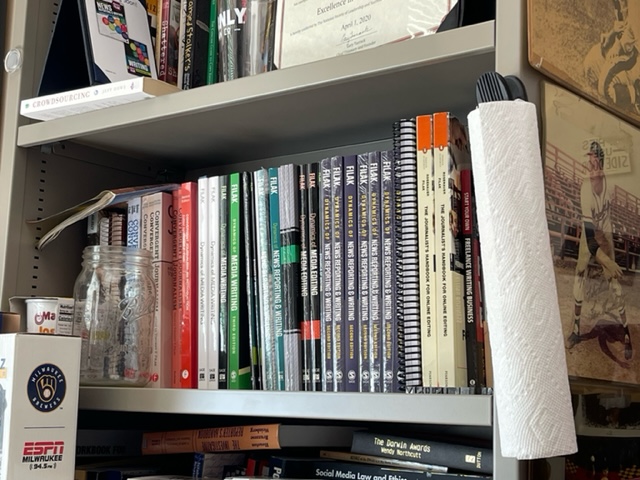
He then went on to sing the praises of his company’s reporting book for a bit, while sitting directly across from this:

As we talked more about me needing a blogging book than a reporting book, he told me, “Oh, we don’t do stuff like that…” explaining that it doesn’t have a big enough niche to make it worthwhile.

That led to this:

Me: “Yeah, it takes a lot to make sure things are up to date for books.”

Him: “Uh huh… Books take a lot of work.”

Really?  Y’don’t say… as you are staring directly at this:

I’m not trying to pick on the guy for lack of situational awareness, but he did manage to notice at least a dozen specific bobbleheads in my collection that were RIGHT ON TOP of the things he failed to notice in those photos. Also, I’m not arrogant enough to think someone should know about me like I’m important or famous, but a simple Google search is the least you can do if you’re going somewhere to try to sell someone something.

In any case, here’s the look at the last time stuff got this socially awkward over my quest to write a textbook about everything on Earth…


So… No, then? (or why it’s important to research your readers before you pitch to them)

I understand this blog tends to skew more toward news than some folks might appreciate, given that my entire pitch for the “Dynamics of Media Writing” is that ALL disciplines of media (news, PR, Ad, marketing etc.) can get something of value out of it. The skew is due to trying to cover both the media-writing text and the news reporting and writing text in one spot. It also also comes from the idea that a lot of things people perceive as “news” things are actually valuable for all media, including skills like interviewing, research, inverted-pyramid writing and so forth. Finally, it seems that news folks tend to make more public mistakes than do some of the other disciplines, so I get more content there. (If you want me to hit on more topics in the PR/Ad/Marketing stuff, feel free to pitch me some thoughts. I’d love to do it.)

That said, occasionally there is a specific foul up in a specific part of the field that bears some analysis. Consider that when you look at this email I got the other day. I redacted the identifiers as best I could:

Dear Professor Filak,

​Greetings from (COMPANY NAME)! ​I hope this finds you well. In the coming months, (AUTHOR NAMES) will begin to revise the twelfth edition of their introductory journalism text, (REPORTING BOOK NAME). ​This text strives to give students the knowledge and skills they need to master the nuts and bolts of news stories, as well as guidance for landing a job in an evolving journalism industry.
Right now we are seeking instructors to review the twelfth edition of (REPORTING BOOK NAME) ​a​nd provide feedback. This input is invaluable to us, ​as it ​giv​es​ us a greater sense of how to best address both instructor and student needs. ​If you are currently teaching the introductory news reporting and writing course or will be teaching the course soon, would you be interested in offering your feedback?
If you would like to review, please respond to this email and let me know if you will need a copy of the printed text. You should plan to submit your comments via TextReviews by 2/6/18. In return for your help, we would like to offer you (MONEY).
At your earliest convenience, kindly respond to this e-mail to let me know if you are available and interested in participating. ​Again, please let me know if you will need a copy of (REPORTING BOOK NAME)
I’m always happy to help people and I’m not averse to making a buck by pretending to know what I’m talking about, but this felt both awkward and ridiculous. One of the things both “Dynamics” books push a lot is the idea of making sure you know what you’re talking about before you ask a question. The books also push the idea of researching your audience members so you know how best to approach them. Either the person writing this email didn’t do that or just didn’t care.
Here’s how I know that: It’s called “Google.”
Had this person done even a basic search on me she would have learned several things:
  • I am teaching the courses they associate with this book. I teach nothing but these courses, as you can find on the UWO journalism department website. The line of “If you are currently teaching the introductory news reporting and writing course or will be teaching the course soon…” tells me I’m on a list somewhere and this is a form email at best.


  • I wrote several books, including one that is likely to be some form of competition for this book. (I’m not saying it will be as good or better or anything, but my title includes words like “news,” “reporting” and “writing,” so it’s a pretty safe bet we’re vying for the same students.) This was literally one of the top five items on the first page of my Google search. She also sent her message the same day I got this alert from Amazon:
  • NumberOne
(I have no idea how Amazon quantifies “#1 New Release in Journalism” but I’ll take it.)

The point is, it wasn’t a secret, so it appeared that she didn’t look me up and was like the guy at the bar telling me, “Hey, see that babe over there? I’m totally going to score with her!” and I’m like, “Uh, dude, that’s my wife…”
On the other hand, maybe she did look me up, found the book and asked anyway, which is like the even-worse guy at the bar who’s saying, “Hey man, your wife is pretty hot. Any chance you can give me some tips on how to score with her?”

Thinking about all of that for a moment, I did the polite thing and emailed back, explaining how I felt this would be a conflict of interest (it is), and that any advice I gave her would be likely be somewhat problematic as the author of a competing book (it is).  I also noted that I know the book she is pitching well (I do) and I know the authors well (I do), so this would also be a bit awkward for me (it really is). Here was her email back to me, which again made me think she wasn’t actually reading this:

Hi Professor Filak,

Thanks so much for letting me know. We will certainly keep you in mind for future projects!

So, again, the point of the blog isn’t to beat people up for doing things poorly but rather to offer advice on how to do things better. Here are a few basic tips:

  • Research first, then write: You don’t have to do an Ancestry.com profile on every person to whom you market or with whom you engage in outreach, but it’s not hard to Google someone. Most people put more social-media stalking effort into learning about the “new kid” at school than this person put into finding out about me. In marketing, you often have access to proprietary data as well, so you can find out if this person had any previous engagement with your organization. In my case, I used that book for more than a decade and still keep up with it, so that might have been something she could have found.
  • Personalize when possible: If you are sending out 100,000 requests for something like a survey and you are expecting a 10 percent response, you will not have the ability to personalize all of the information on everyone’s card or email. That makes sense. However, when you are microtargeting a group of people with a specific set of skills or interests and that group isn’t going to overwhelm a data center, work on personalizing your content. That line about “If you are currently teaching the introductory news reporting and writing course or will be teaching the course soon…” could have easily been tweaked to say something like, “I see you have taught writing and reporting courses at UW-Oshkosh…” and it wouldn’t have taken much. Making these minor tweaks shows that you have done your research. Engaging in some personalized communication shows your readers you care enough to see them as individuals as opposed to a wad of names on a spreadsheet.
  • Try not to screw up, but if you do, don’t ignore it: The one thing that stuck with me when I got that response email from her was that I didn’t think she figured out what she was actually asking me or why it was weird. I had that feeling that if I had written her back and said, “I’m sorry I can’t do this because I’ve just been placed in an intergalactic prison for the rest of my life for murdering a flock of Tribbles with a phaser I set to ‘kill’ instead of ‘stun,’” I would have gotten the exact same email back. The whole exchange really reminded me of this scene:
 The thing that is important to realize is that you are going into a field that has two important and scary things going for it:
  1. It’s small enough that you’re really about two degrees of separation from everyone else, so people know other people.
  2. People in the field love to talk.

If you end up screwing up because you didn’t do the first two things suggested above, don’t compound the problem.

I have no idea if I’ll ever get approached by this publisher to review anything, but I know I will always carry with me the memory of this interaction. Had it been a great interaction, that would have been good for the publisher. Unfortunately, that wasn’t the case.

Advice, reflections and things to consider for students: Transitioning Careers from News to PR, Part IV

(Editor’s Note: This is the final part of a series that looks at journalism folks who have transitioned from jobs on the news side of the field to public relations and marketing over the course of their careers. I promised the folks anonymity before I got their answers, so they could be honest and also because I didn’t know how many folks I would get. Turns out, we have a lot of people who made the move for a lot of reasons, so I’ll do my best to keep the sources clear for you as we discuss their experiences. -VFF)

If you missed them, here are the first three pieces:

To close up this look at the news-to-PR transition, I wanted the folks to give the students some advice or some observations they had regarding where their journeys took them in the field. The line of “Life is what happens when you’re busy making other plans,” seemed apropos, so I wanted to hear what these folks learned between knowing what they were SURE they were going to do when they left college and what life actually brought them:


A 25-year marketing vet who spent 10 years in news before making the shift had a broad sense of what was in the field and what students should know:

“One thing I’d tell current students in the Journalism field is that the field is ever-evolving. It’s important to remain adaptable with your skills and your mindset. The thing you start doing right out of college will likely be very different from what you retire from, but the storytelling will always remain. Storytelling has been the one constant in all of Journalism and its various offshoots.”


A content manager for a firm that specializes in thought leadership looked at this from both ends of the discussion:

To news kids: Don’t be snobby about an entire profession. Careers are long and you might end up doing PR for a while because the skills you’re learning are transferable. Oh, and the talk about PR people not working hard – complete and utter nonsense. If you want to stay in news, pick an area or specialty (either topical or in approach) and stick with. GA reporters are a dime a dozen. Not picking an area of focus is probably my biggest regret. I was so focused on the basic skills of journalism that I didn’t really get to know topics.

To PR kids: The value of journalism goes well beyond advancing the interests of whomever you represent. PR and journalism shouldn’t be symbiotic, but they CAN help each other. The news media serves a vital purpose and is getting attacked by people who seem to think authoritarianism is better than democracy. PR people should understand the importance of good reporters and editors in a free society and do what they can to help.


A California-based marketing manager for a tech company said the things she learned in a newsroom made her a better practitioner in her current job:

“Working in newspapers gave me a unique set of skills and experiences I wouldn’t have been able to get anywhere else.

“Content marketing is filled with bullshit artists. Having newsroom experience on my resume gives me credibility that would’ve taken much longer to earn, had I started my career in marketing.”


A VP who serves as a content strategist at a major financial firm had the most amazingly honest and totally straightforward advice:

“Media is an incredibly small world. You’re going to run into people over and over again throughout your career. So don’t be a dick.

“That obnoxious PR person who wants you to cover their brand? They may be the mayor’s PR person 5 years from now. So be friendly. And honestly? Cover the dumb stories from time to time. If your audience finds it interesting, you did your job, and you probably made a solid PR relationship along the way.”


A marketing and PR practitioner who graduated during the 2010s planned to spend her whole life in news. When it didn’t happen, she realized a few things:

“When I was in college, I was 100% sure I was going to be in print journalism forever. If you would’ve told me I’d be working in marketing, I probably would’ve laughed. Little did I know, that was just the first stepping stone of my career. That being said, here’s what I’d tell students today:

  • Get involved in student media and extracurriculars. I learned more from those “in the trenches” experiences alongside my peers in the newsroom than I did in a classroom. It gave me a chance to try new things and put my skills into action. Plus, the people I worked with there are still friends, colleagues, and references.
  • Just because your major is “journalism” doesn’t mean that’s your only option. I used to think that if I was a journalism major, I would only be qualified to be a reporter. Professors aren’t lying when they say the skills are transferable.
  • Journalism isn’t dying. It’s actually a really exciting time to pursue a journalism or journalism-adjacent career, in my opinion. There are new platforms emerging and new stories to tell every day. We will always need people with the ability to tell those stories — and that’s what the skills you’re learning allow you to do. “

Did college help get people ready for all media careers or was it “silo city?” Transitioning Careers From News to PR, Part II

(Editor’s Note: This is part of a series that looks at journalism folks who have transitioned from jobs on the news side of the field to public relations and marketing over the course of their careers. I promised the folks anonymity before I got their answers, so they could be honest and also because I didn’t know how many folks I would get. Turns out, we have a lot of people who made the move for a lot of reasons, so I’ll do my best to keep the sources clear for you as we discuss their experiences. -VFF)

In case you missed it, here’s part I.

When I went to school about 30 years ago (good God… My soul is starting to shrivel…), all of journalism was taught in a siloed approach: If you wanted to do newspapers, you took those classes and never saw anyone but newspaper people again, until you took the law or ethics capstone. If you did broadcast, the same thing was true, although we had a little more overlap with each other than with the kids in the strat com courses.

The PR and Ad kids seemed to be swept away right after the intro class and moved into some parallel universe where we never got to see them again. They showed up at graduation like they had been with us the whole time and we all were like, “Who the hell is that?”

My first couple teaching gigs, things were not only siloed in terms of news vs. integrated marketing communicators, but in some cases openly hostile. I remember hearing “F—ing PR kid” so often, I started wondering if the field had a branch in adult entertainment.

Professors of these varied disciplines often didn’t talk unless forced onto a committee. In student-reporter newsrooms, the students and the faculty members had an almost pathological disdain for anything involving PR. The old news theory of the “separation of church and state” when it came to ad folks and editorial folks reinforced the siloed approach we took in teaching them.

As digital publishing and social media started becoming more important than dead trees, airwaves and fax machines, it became vital for us as professors to bridge the gaps and find common ground for our students. Given the way in which academia moves at a snail’s pace and professors tend to think a great deal of their own sense of self, it’s probably a safe bet that silos remained the norm.

The folks who were nice enough to talk about life in news and PR told me that their experiences in this regard depended on a couple things: where they went to school, when they were there and how interested they were in getting a well-rounded education in the field.

For example, a VP in content strategy who attended a major journalism program said the school operated in silos, but made a few efforts to round out her experience:

“There was an attempt to ensure we got a well-rounded education in all areas of comms. So I took courses on photography for non-majors, design, branding, strategic communications, advertising, etc. although I don’t remember anything really deep into PR while in school.

“It did feel a bit siloed, and some of the courses I was required to take felt like I was checking the box because I wasn’t interested in them. Looking back, I wish I had been more invested in strategic communications, marketing (I have no memory of marketing classes being offered, but it was a while ago!), branding, etc. since that’s more of the stuff I do now.

“Also, although we were required to take statistics, the course wasn’t really applicable to marketing/comms work. Nowadays, I use consumer data all the time, so learning more about how to read that info and apply it to building marketing personas would have been super valuable.”

A practitioner who works in the field of thought leadership for professional organizations said his experience was not only more siloed, but also more hostile when it came to the news/PR divide:

“Other than being in courses with PR majors, it was silo city. The journalism professors were respectful toward PR in the classroom, but the newsroom was another matter.

“The editors/professors there had a clear disdain for the PR folks they dealt with. I think they had a right to feel that way – many of the PR folks in the city and at the university weren’t worth much.”

For a marketing manager who attended a smaller school around the same time as the VP, the siloing was a bit stronger and shaped her ideologies about the disciplines a bit more:

“It was fairly siloed. There were a few Ad/PR people in my freshman/sophomore year journalism classes, but by the time I got to the junior/senior level it was pretty much all news/editorial folks in my journalism classes. To be fair, I also did not really take any classes with an advertising or PR focus at that time.

“I don’t recall professors trashing the other side. But PR was definitely discussed through the lens of how a reporter might deal with them (ex: you can’t rely on a PR person for 100% accurate information. Get several perspectives for your story.) I remember having the perception that advertising/PR/marketing was “the dark side” and they were all sell-outs, but I think that came more from my peers.

“As far as how it aligns with my life experiences today, I guess I did sell out and join the dark side. Journalists have a much more negative view of marketers, while marketers have a pretty positive view of journalists (at least those who eventually join the dark side).”

A marketing professional in the manufacturing field who attended the same medium-sized university about 20 years earlier found stronger demarcations in how she was taught. Those silos made the transition more difficult:

“The subject was taught in a very siloed approach. You could major in Journalism, but with a News emphasis or PR/Advertising emphasis. Marketing was thrown into the PR/Advertising genre, but wasn’t its own entity.

In fact, I took a few PR/Advertising classes and the closest I saw to marketing was when we created an advertisement. We were to create an ad that could be pitched for print, radio and television. This was my first taste of marketing, though it wasn’t called that.

“As teams of 3-4 students, we created story boards (with actual drawings and cutting and pasting with scissors and glue) for a product and had to pitch it to made-up executives who were students in the same class. That experience alone was enough for me to say that I’d rather not be in advertising. It didn’t seem right for me since I was intent on writing. I followed my passion.

“The rest of my Journalism degree was focused on news writing for newspapers. It was very straightforward in its message: Write a story, include all sides, but give it an angle, create a strong lead, build the story through others and put the fluff at the end in case there are space issues on the page. I had a knack for that.

“While I’m very thankful for my training in college, it doesn’t mirror what I do today, except for the fact that newswriting and marketing are both storytelling, just in different forms.”

A few other folks mentioned that even when journalism departments tried to get them to see the field in broader terms, it had little impact. A former news reporter who now does marketing for a well-known private university said he had a focus on news and nothing else really mattered:

“I was 100% focused on news/ed and newspapers. I was guilted into taking one online-focused class and dropped my only magazine class after like two weeks. I remember nothing about PR from J-School but I would have completely ignored any discussion of it.”

The one thing that gave me hope that maybe things are changing came from the most recent grad (within the past six years) who went through a program that is actively trying to change the silos. She works as a content marketing manager for a business-to-business organization, and noted that her experiences in school spanned the field:

“It was definitely not siloed. I was a journalism major with a writing and editing emphasis. Within the journalism department, we had some core classes that included students with other areas of emphasis in the program (such as PR or visual/photojournalism) as well as journalism minors. This was great because it built my skills in a variety of different areas and introduced me to people with similar interests who would go on to be great connections throughout the “media” industry at large.

“It was definitely the start of my professional network. It was also encouraged to pursue a minor and participate in extracurriculars, such as student media, to help you broaden your skills even further. I knew quite a few people with art/graphic design minors who were interested in a more visual-focused kind of career, people with English minors for a different perspective on writing and editing, radio-tv-film for a broadcast focus, and so on.

“Within those classes and extracurriculars, professors and advisers pretty clearly shared how the skills you were learning about applied across the board. In almost every class we talked about the importance of good writing, editing, and storytelling. Those skills apply whether you’re a PR pro writing press releases, a reporter covering breaking news, or a marketing guru writing website copy and blog posts.”

Transitioning Careers from News To Public Relations, Part I

(Editor’s Note: This is part of a series that looks at journalism folks who have transitioned from jobs on the news side of the field to public relations and marketing over the course of their careers. I promised the folks anonymity before I got their answers, so they could be honest and also because I didn’t know how many folks I would get. Turns out, we have a lot of people who made the move for a lot of reasons, so I’ll do my best to keep the sources clear for you as we discuss their experiences. -VFF)

I got a text from a former student recently that helped launch this series:

Hey Vince,

I am currently applying for a communications and marketing manager position at the school district I currently cover. Would you be willing to write a letter of recommendation for me?

This guy was probably the best reporter I’ve taught in the past 10 years, simply by the dint of being a persistent little cuss. He would dig into stuff that nobody else had the patience to go get. He wouldn’t stop poking people who had records, refused to comment or otherwise dodged him until he could get the story that needed to be told. He also tended to be the person who other people told stories that often began with, “You didn’t hear this from me, but…”

The idea that he was considering a move from news into the public relations and marketing portion of the field told me two things that I pretty much already knew: The skills we teach in our journalism-based writing courses need to transfer among the disciplines of the field and that reporters were actively looking to get out of the crumbling mess that is news.

Public relations is a booming field, as there are approximately six practitioners for every one news reporter, according to a recent study. That number is up from a 2-to-1 ratio just 20 years ago. As newspapers continue to “shed” jobs (a term that should be replaced with “axe murder jobs for the sake of corporate greed,” but I digress…) and public relations continues to grow, I have no doubt that more news journalists will be taking their talents to PR.

Thus, I wanted to know what people who had made that transition saw and thought as they decided to make it and how they think we are doing to prepare them for life beyond college in a rapidly changing field.

What follows is a series of thoughts, comments and suggestions from an array of people who were nice enough to share their experiences. They come from various universities, work in different states and serve a mix of roles in the field.

Let’s start by looking at what they’re doing and how/why they made the move.

The continued downward spiral of few good newsroom opportunities, organizations cutting jobs and the general degrading of news jobs was a common theme for a number of people who made a quick switch to the other side of the field.  A California-based marketing manager for a tech company said she made the switch from news to social media promotional work after years of job fatigue:

“To be blunt, I left journalism because I got exhausted with the low pay and yearly layoffs that often felt like the Hunger Games.

“In the year before I left, the company I was working for did an extensive reorganization where everyone in the newsroom had to reapply for ‘new’ jobs, complete with resumes and interviews with editors from other papers in the chain. Of course, there were fewer positions on the other side of the re-org. The process took 6 months and was so psychologically exhausting that it felt like a type of PTSD. And I was one one of the “lucky” ones to get a job that was basically the same as the one I had. I can think of at least one person at that paper who got a job they didn’t apply for (and probably didn’t really want).

“Marketing was the easiest field to transition to. I was the social media and engagement editor for my paper, so I was able to land a social media manager job without much hassle.”

For many people, the move wasn’t a hard break, but rather a series of small moves that had them using their skills in different ways.

A marketing manager for a manufacturing company in Wisconsin has worked as a marketing professional for the past 15 years at various institutions. Prior to that, she spent the 10 years after her college graduation as a news journalist:

“My move to the PR/Marketing side of things occurred somewhat naturally through my various places of employment. I went from writing hard news stories at newspapers to writing news stories in magazines and newsletters for non-profit organizations and then for corporate jobs.

“As the industry morphed into the digital thing it is today, the shift was made somewhat naturally as society and our culture became more interested in short stories than long stories. Ultimately, the storytelling part of my training has remained constant through my career, no matter what kind of story I was telling or for what kind of media.”

A VP at a major financial institution, who serves as a content strategist, also noted the gradual movement over time from news to marketing:

“It was sort of a gradual transition driven partially by necessity. I started out as a newspaper reporter (2003), and then over a 5-year period, I went from news to B2B magazine publishing (2005), then custom publishing (2007), which morphed into content marketing (2008ish).

“Over time, I became more of an agency person than a journalist. I got out of news initially because I was a magazine major and really wanted to break into magazine publishing. When I moved to the custom publisher in 2007, the company primarily created magazines for brands, so that was my entry into agency-land. That also happened to be when social media became ‘a thing,’ so the whole industry changed, and the company I was with adapted as needed along with it.

“By the time I left in 2014, it was a full-on marketing agency and I was a content strategist more so than an editor or writer.”


In some cases, the small moves were less linear, as was the case for a PR professional who works for a firm that represents professional organizations, like law firms and management consultants, in the realm of thought leadership:

“I got out of newspapering right before the economy crashed in 2008 — and when I wanted to get back in, there were fewer good opportunities (I faced some geographic constraints, too). I actually did sales/tech stuff for a few years and then some freelance writing and editing. I decided writing and editing was more for me, so I signed on with the PR firm to do that kind of work.”

Many people mentioned the issue of needing a job but being limited to a certain geographic area, such as this former broadcast journalist who also taught college courses and advised student media:

“So I was a broadcast news producer before grad school. Then taught for years and ended up making a move to DC due to my husband’s work, and PR jobs here are everywhere. I am a director at a large consulting firm serving government clients.”

The same thing rang true for a former copy editor and writer for major media outlets, who shifted to PR after more than a decade in news:

“I made the move to PR because my commute was untenable and neither my job nor my family was going to move. I looked at good employers within a reasonable distance of my house and started applying.

“Much to my own surprise, I haven’t missed journalism for a moment since I left nearly nine years ago. I don’t even miss election night pizza.”

Next time: The pros discuss the things their education did (or didn’t do) for them in terms of preparing them for life beyond the newsroom.