The stuff you wished someone had told you about looking for life after college (A Throwback Post)

YARN | Christ, 7 years of college down the drain | Animal House (1978) |  Video clips by quotes | 8468e662 | 紗

And this guy didn’t even have student loan debt…

Students have been stopping by the office lately with one of two declarations:

  1. “I got a job! The world is full of rainbows and kittens and sunshine!”
  2. “I can’t find a job. Is there any chance you could back your truck over me a few times in the faculty parking lot so I don’t have to go live in my mom’s basement for the rest of my life?”

The highest of the highs and the lowest of the lows are both likely to find things are significantly different than they expect them to be after the cap and gown goes to Goodwill and they begin the next stage of their lives.

Today’s throwback post is a look at something I deemed “Life 101” a few years back. A group of really smart folks I’ve had the honor of knowing (and in some cases teaching) were willing to chip in words of advice for the soon-to-be graduates. Seemed like a good time to bring this back.

As the post notes, this was part one of two, so I’ve linked the original part two at the bottom if you are so inclined.

Enjoy!


Life 101 (Part I): Everything you wished you’d known before you graduated but nobody told you

life depressing funny college - 8102692096

(It’s not really that bad. You just need a few hacks here and there to soften the situation.)

A student showed up in my office a few weeks back with a big smile on her face and the peptic energy that only comes from wanting to tell someone else the best news in the world.

“Dr. Filak! I got a job!” she said, a mix of glee, elation and relief pouring out of her as she explained what she did and how this worked and where she was going to be employed.

I listened and congratulated her multiple times before I asked the inevitable question: “You don’t have to tell me if you don’t want to, but what was the offer?”

She proudly told me how much she was making, which was a decent amount. She wouldn’t have to steal Splenda packets from local diners or live on Ramen for every meal, that’s for sure.

When I asked how the negotiation for that amount went, she said, “Oh. They just gave me the salary they were going to pay me. I asked my parents if that was good money and they said it was, so I took it.”

She noticed the look on my face. “Oh no!” she said. “Did I do bad?”

“No,” I said. “But you could have done better…”

I then explained the whole process of salary negotiations to her and she realized something nobody at this institution had ever taught her: Salaries ARE negotiable. So are so many other things.

If universities are good at training students to develop skills that will help them get their first career jobs and put them on the path to a fully adult life, they absolutely suck at helping students make the transition from college to that life. I know this from my own experience, as well as that of colleagues and former students, so I thought a good wrap up for the semester would be one final lesson for the group: Life 101.

I asked the hivemind of folks I trust through various social media outlets and connections to tell me one thing they wished they’d known before they left school that they found out the hard way once they got into the “real world.”

Today’s post is the first of two that look at issues beyond graduation, focusing mainly on getting a job and the reality of that first job.

Tomorrow’s post will look at the life issues you face once you get out and become “a grown up” that you probably won’t see coming.

I hope this helps:

THE JOB SEARCH

There are few things more anxiety-provoking and terrifying than looking for a first career job out of college. You have put in the time and energy to pass the classes. You got the grades they said were going to propel you forward. You got involved in every activity someone said would “look great on a resume” and you worked at student media, internships and part-time gigs to fatten up your experience.

You put yourself out there and… crickets…

As a college student, I feared my parents’ basement. I constantly heard of students who did “all the right things” but ended up living back with their parents in a basement because they couldn’t get a job. I mentioned that to several students and several currently employed former students and the vibe was the same:

“I was scared to death that I’d done all this work and I’d be living back home in the basement. I never had a problem with my family, but I damned sure didn’t want to be back there as ‘that kid.’”

“I knew I could go home. I just didn’t want to. I wanted to be a grownup.”

I have said this before and the people who have experienced it have told me I am dead on with this analogy. Those who haven’t tell me I’m crazy. Then, they experience this and they convert to my way of thinking:

Your first job search is a lot like a bad dating experience: You are ready to go, so you put yourself out there. People are ignoring you and it feels awkward. You don’t know what’s wrong with you, so you get really worried.

Then, someone shows an interest and you have that kind of, “Cool. We should hang out. Let’s exchange info” moment and you get really excited. You start imagining how nice it’ll be and your mind takes you on flights of fancy regarding this relationship.

Then, you don’t hear from them for a while and you start wondering what you did wrong and why they aren’t calling. You start questioning everything you’ve done to this point. You wonder if you should reach out, but you don’t want to look needy.

Eventually, you’ll start to get angry with the, “OK, screw you. I don’t need you thing.” You give up, only to hear from that person shortly after that, with the person giving you a true and great reason why it took so long to reach out and that they really want to see you in a day or two, so let’s set this up…

And then you’re like, “OHMERGERD! I LOVE YOU SO MUCH RIGHT NOW!” but you play it cool and the cycle begins again…

As I’ve told more than a few sobbing students over the years, “It’s not you. You are good. The right people just haven’t figured that out yet. It’ll happen. Trust me.”

(In completing the analogy, that’s what my mother used to try to tell me each time I got dumped in high school… She wasn’t wrong, but the situation still sucked.)


THE JOB OFFER:

The first career job offer is something most people never forget, and I certainly remember getting my job offer from Mizzou.

Well, I remember most of it.

At one point when I was being offered the job and told about what this involved, I think I passed out on the phone. Blood was pounding in my ears, my chest felt like it was going to explode with joy like a frickin’ Care Bear and I couldn’t believe how lucky I was.

giphy-downsized.gif?cid=549b592d5ab2ba3b6270323273a5dcae

When the first offer came, I took it. No questions asked. I was so happy to be getting that job.

About two years later, my boss called me into his office and told me, “I need to let you know something. I totally screwed you.”

He explained that when he hired me, he gave me the lowest lowball offer he could, figuring I’d negotiate my way up to something more reasonable. When I didn’t, he was over a barrel. He couldn’t just give me more money, but he also knew I didn’t know any better.

(To be fair, he then told me he was getting me connected with the grad program so I could go after a Ph.D. It was a fair trade in the long run.)

He was a good guy and it never occurred to me that he had lowballed me. He then gave me the best advice I share on a regular basis, “Never take the first offer. Always negotiate for your worth.”

Of all the things people mentioned in their responses to me, salary negotiations were the most important:

“Journalism is not a ‘calling.’ It’s a business. Negotiate your pay. Don’t work for less than you’re worth. Think 5-10 years down the road.”


“Don’t count on the editor who hires you to have your economic interests at heart. You should be prepared to negotiate for the pay you need to live, and expect them to expect you to negotiate because it may be a LONG TIME before you have as much leverage to get yourself more money than when you have the initial job offer.”


“Know your worth and don’t settle just to get hired and have a job. A LOT of companies are hiring, so test the waters and see where you feel valued.”


“Agreed with everybody who said negotiate your starting salary. Do some research of similar roles in the area and don’t just take the first offer that comes because you’re scared/excited just to get one, which is what I did.”

In addition to negotiating salaries, people noted that they wished they’d negotiated for extra vacation time, an earlier start for health insurance, improved hours/requirements and other bennies that they thought were just written in stone.

Another person noted this “look forward” in life as crucial:

Take whatever 401k match is offered, even if you can’t contribute anything else right away.


WELCOME TO THE FIRST DAY OF THE REST OF YOUR LIFE (OR NOT)

When I went to my college orientation session about 30 years ago, the people there told us that we would likely change jobs about six or seven times in our lifetime. At that point, they meant that we would likely climb the corporate ladder, maybe switching companies within our field, but essentially staying put.

According to recent data, Millennials will change CAREERS almost six times in their lives. People now tend to stay with an employer for an average of three or four years, even with opportunities for advancement. This shifts the entire paradigm of how to look at your first job. Here are some thoughts from the hivemind:

“Paying your dues” is an outdated concept. Don’t let your parents, employers or friends convince you otherwise.


The quality of the job and the people you work with are far more important than the location.


Having a different approach to teaching and research is a GOOD thing!… Students need to know there’s many paths towards your goals in life. Do what works for you.


You don’t have to stay in the first job you get after college forever. It’s okay to change your mind or realize it’s not something you enjoy.


(I wish someone taught me how to deal with) not starting exactly in the position you want and how to be content with the growth process. Your degree does not always land you your dream job immediately.

This last point leads us to the unfortunate truth associated with taking that first job…


YOUR JOB MIGHT SUCK

As much as the dream job might be just a dream, it doesn’t mean suffering and pain should be your daily life at work. Everything from toxic workplace environments and weird bosses to feeling lost and becoming undervalued can make that first job you were so excited about feel like an abusive relationship.

I’ve worked for bosses that I would step in front of a bus for, because they were so helpful, supportive and just entirely amazing. I have also worked for bosses I wouldn’t feel bad about nudging into path of oncoming freeway traffic.

The folks who chimed in on this had similar experiences:

Your boss makes all the difference for how well you do in your first few jobs. Take your first job based on how well you vibe with the boss.


I once told my son that if he ever has a job where the manager/supervisor/head honcho etc, comes over and parks his butt on your desk, smiles and says, “we’re all like family here”…….Leave.


Also that just because things aren’t perfect, it isn’t necessarily your fault:


Your first job isn’t your only job. Sometimes it legitimately sucks and that’s OK. It’s not an indictment on you or your work.


Always work toward aligning what you want to do with what your job/career actually is, while still getting your current job’s work done of course. But always keep working toward doing what you want to do, even if your first job out of school isn’t your dream job (it won’t be).

The one caveat I’ll offer here is the one based on my own sense of paranoia: There’s nothing wrong with leaving a job because it’s not what you want or need. That said, have your next move already to go upon your decision to quit.

I equate it to the old “Tarzan” movies when he’s swinging from vine to vine across the jungle. Don’t let go of one vine until you have the other in hand.

TOMORROW: Life, or something like it, after college.

Filak Furlough Tour Update: Hanging out with Colorado State

The final stop on the fall version of the Filak Furlough Tour took place at Colorado State University, where we decided to kind of go with a broader Q and A approach.

Like every pit class I’ve ever taught or attended, I had a couple in the front row, a couple in the middle of the auditorium and a back row that would probably gone further back if they could have.

It’s nice to know that some things in life are eternal…

Students line up before class to make damned sure they sign in and get credit for putting up with me…

COLORADO STATE UNIVERSITY — FORT COLLINS, CO

THE TOPIC: Pretty much anything they wanted to talk about. The one key area students hit on a couple times was the issue of how to get ready for life beyond school, either through internships or through finding something that matters to you.

THE BASICS: In terms of finding an internship, it’s not what you know. It’s whom you know. My best advice is to get to know the people teaching your professionally oriented media classes, as they are the ones with connections in the field.

The reasons they have these connections can vary based on if they’re still working the field or if they’ve been retired to academia, but the one thing that is a universal is their connections. I explained to the students that in most cases, there was someone five or six years ago who was sitting in the same seat you are and was desperate to get an internship. Now, those people are the ones looking for interns, and they’re probably going to reach out to that professor and ask, “You got anyone good?”

I don’t know how many times I’ve played matchmaker over the. years, but what I do know is that I have a lot of former students who have hired a lot of interns from my classes. I also know a lot of former students who work with other former students, as birds of a feather tend to flock together. Also, the students who tended to like the way I taught them and the skills I helped them hone will likely want similarly taught and honed students.

That’s not to say that being an alumni-based nepo-baby is all it takes. You still need to be skilled in the field in which you want to work, have work product to show potential hiring folks and basically be a worthwhile human being. However, there seems to be an abundance of folks who are all relatively similar in the minds of hiring professionals  in regard to each of these areas. Therefore, to separate yourself, that’s where the connections come in because these people can vouch for you in a way that has real meaning to potential hiring folks.


BEST QUESTION OF THE DAY (PART I): In your experience, how much of a problem is it if a student doesn’t really have a full sense of where they want to go or what they want to do with their degree upon graduation?

BEST ANSWER I HAD AT THE TIME (PART I): The truth of the matter is that nobody has it all figured out in college. The people who say they have always known they want to do X and are working on a degree to put them on a path to achieving X are most likely going to change majors four times, change colleges at least twice and end up wandering the earth like Caine in “Kung Fu” trying to find something or other.

What tends to put you on the best path is when you go into something with a desire to learn something of value. In media classes in particular, I like to talk about putting tools into your toolbox. Each skill you pick up will make you more useful down the road, wherever that road takes you.

I recommend trying out things through student media and student orgs to see what appeals to you and what looked better on paper than it did in real life. Internships also give you a peek at what you might like and what you might not.

Either way, look for things that interest you and there’s a strong probability that your media skills will somehow apply and get you where you want to go, even if you don’t know where that is yet.


BEST QUESTION OF THE DAY (PART II): What are the most important things you can have or skills you can develop if you want to be a success in this field?

BEST ANSWER I HAD AT THE TIME (PART II): As much as I know people want to hear things like “Learn THIS social media tool” or “Pivot to THIS platform,” the best answer I have is completely different. I have found these were the things that have made a difference for me and a lot of other people I know who have been successful in this realm:

ENTHUSIASM: Of all the things ever said or written about me, my favorite is in a going-away card that’s about 25 years old. When I left the State Journal, the folks there were nice enough to give me a going-away party, a cake and a card. In that card, were a lot of “Good Luck” messages, but my editor, Teryl Franklin, wrote this: The one thing I’ll always remember about you is that whenever the scanner went off, you always asked, “Can I go?”

Teryl was a lifesaver for me, quite literally, as she came to be my editor at one of the worst points of my career. I was a mess after suffering a terrible editor and then dealing with editor roulette. The former crushed my self-confidence while the latter helped me learn how different people worked, even as I was essentially a reporting orphan. Teryl was the person who helped put me back together, trusted me and got me back on the horse. Praise from her was like manna from heaven.

We talked about that note before I left and she basically said that it was my willingness chase any story, go anywhere and do anything that let her know I was worthwhile as a journalist. As long as I kept up that level of enthusiasm and work ethic, I’d be totally fine, she said.

Decades later, I’m still dedicated to that principle. I often tell people that I was never the smartest, or the fastest or the best at anything, but I made up for that with the desire to just do whatever I could to make something work, regardless of the odds or the enemy.

LIFE-LONG LEARNING: A great bit of advice I picked up over the years was to find out how to do something at my job that no one else knew how to do, thus making myself indispensable. In some of my earlier jobs, it was figuring out how to keep the garbage bags properly tethered to the rim of the cans. In later years, it was knowing how to fix the copy machine or how to run a particular piece of software.

At the core of this was the concept of life-long learning: Always be willing and able to pick up a new set of skills, figure out something else you want to learn and be ready to take on new challenges instead of resting on your laurels.

Over the years, I’ve picked up various skills like furniture restoration, hand caning, pinball machine repair, auto repair and more. When a kid at one of the Furlough Tour stops asked me what I would like to do next, I think he assumed I’d say, “Write another textbook” or “Create Specialty Course X.” The truth surprised him: “I’d love to go back to the Tech out here and learn how to do welding.” Why? I’ve always wanted to do body work on my car and I need that skill to do it.

If you never outgrow a desire to learn, you’ll always have a place somewhere in your career field. And if you get bored, you’ll have a bunch of other skills to fall back on.

PRACTICE: As we’ve discussed on the blog before, there is an inherent difference between a talent and a skill. Talents are given from birth and allow people to excel by the mere dint of who they are. Skills are learned actions that can be developed through repetition and desire for improvement. In short, skills require practice.

A common conversation I have with students in my writing class takes place right about the time we start working on leads. I tell them they will need to write one sentence, but it will take about three class periods. They look at me like I’m daft, until they try it, we edit it, we review it, they try it again and they eventually turn something in.

The frustration is palpable, but I try to put the situation in perspective. I’ll often ask if they played a sport or an instrument. When the kid tells me, “Yeah, basketball” or “I still play the piano” I’ll ask if they were sinking threes the first time they picked up the ball or playing Beethoven right away. They, of course, laugh and tell me how long it took them to get good at that sport or instrument.

My point then becomes clear: Skills take practice to develop, and writing is no different. Why would you expect to be perfect on the first pass on this assignment?

Like most things, the more you practice journalism, the better you get at it. Then, you can challenge yourself to try bigger things or more complex maneuvers. Keep working on it and you’ll be fine. In the mean time, give yourself a break.

NEXT STOP: Winter Break

An open letter to Kathleen McElroy: Forget about Texas A&M. Come to UW-Oshkosh.

Please consider these words of wisdom… If it would bring you here to UWO, Dr. McElroy, I would gladly perform the entirety of any scene from “Cool as Ice” for you every day, simply for your amusement.


Dear Dr. McElroy,

Even though we have never met, I have been following your situation from afar and find it depressingly untenable. I can’t imagine what it would feel like to be recruited, lauded and praised by an institution you love and admire, only to have that place fold up on you like a cheap card table when the wind started blowing in another direction. I also can’t imagine what it’s like now trying to figure out where to go in life: You basically told your previous employer you were leaving, only to now realize you CAN’T leave for this other job.

The interim dean at A&M, who apparently pointed out to you that you are “a Black woman who worked at The New York Times,” (both of which he seemingly considered negatives somehow when he made that statement) has resigned his position in the administration over this cluster-mess.  University President M. Katherine Banks, who professed astonishment and ignorance of all the changes to your position,  has “retired immediately” because the “negative press has become a distraction.” (Right. The PRESS is the problem, not the not-so-thinly-veiled racism, the shameful backpedaling or the generally terrible way the school handled this situation.)

This has to be twice as painful for you, as TAMU is your alma mater and that really seemed to be a driving force for you, based on what I read. (For me, I’d be pretty OK if I went back to one of my degree-granting institutions. The other one? I’d rather you stabbed me in the face with a live cattle prod than send me there for a faculty slot.)

This would be a comedy of errors if it weren’t so sad and tragic.

With that in mind, I’d like to offer you this plea: Drop those zeroes and get with the heroes here at UW-Oshkosh. We would LOVE to have you, and I personally would love to spend as much time learning from you as humanly possible.

Here’s the best case I can offer you for such a career move:

Your governor is treating DEI like it’s an STI, signing a bill that would close all offices at universities that he deemed “anti-white.” He’s also anti-tenure, anti-education and looks like a terrible 1980s televangelist to a really creepy degree.

Our governor is a former state superintendent of schools, who favors public education and improving the lives of school children throughout the state. He also pulled off one of the smoothest line-item veto moves in history, to increase public education spending for the next 400 years.

The person who was going to be your boss at A&M had a history of doing some truly dumb things with student media, including trying to overstep her position and kill the print edition of your amazing student newspaper, The Battalion.  She then rationalized her decision to go against the wishes of pretty much everyone in this situation with the immortal line of “I’m not a professor of journalism, I don’t understand exactly why [print media] is important to the field.”

The person at UWO who would be your boss has been pretty darned good to journalism and student media. When a bunch of little… um… student government people demanded my head as the adviser of the student newspaper, he stepped in and kept the idiots at bay. He was also instrumental in our fundraising drive and even gave money out of his own pocket to help out.

In addition, our offices are in the newest academic building on campus, right down the hall from our African American studies department. “Doc” Simpson is an amazing leader of that department and Dr. Denae Powell is one of the coolest people I know. (If you like to laugh, we enjoy sharing a lot of “guess what a student just said/did” stories as we pass each other’s office on a daily basis.)

We’re a fun, small, collegial bunch and we take care of each other. We don’t silo up into “news” versus “PR” or whatever, and we really do our best to help each other and all of “our kids” that enter the program. Based on what I’ve read, that sounds like it would be right up your alley.

I grant you we aren’t perfect: We get 10 feet of snow every year, it takes a while to learn how to pass  farming equipment on our highways and you can’t breathe within six inches of the Illinois border without being forced to pay a toll. We also have our share of knotheads who treat higher education as if it’s some sort of a Communist plot, which might not sound like much of an improvement over your current situation.

I also grant you that I don’t have fiat power in terms of offering you a job, but I’m a hell of a persistent cuss when it comes to getting important things done, so let’s figure that one out when we get there. I just think you’re too important and valuable to waste on an institution that’s treating you this way.

Feel free to shoot me a note via the contact form here if you’re interested in taking a chance on the Harvard of the Fox Valley.

Sincerely,

Vince (a.k.a. The Doctor of Paper)

If you are panicking about not having a journalism internship, read this. (A Throwback Post)

A couple students were in my office Wednesday, concerned that they couldn’t find an internship yet or that internship folks had turned them down. In one case, the place rejected her and then reposted the internship. This is like being told, “I’m sorry I can’t go to the prom with you” just moments before you hear that same person telling everyone around the lunch room, “I really want to go to prom and I’ll literally go with ANYONE!”

More than a few other folks have been stopping by with crises of confidence, so I made the kids a deal: I’d dig out this post for a Throwback Thursday if they promised to read it. It’s a look back about five years ago, but the core of this is still spot-on.

Here’s a look at me living up to my end of the bargain:

Five helpful thoughts as you panic about not having an internship yet

When March turns to April, summer seems only a few short weeks away. For those of us in Wisconsin, that means the snow might finally finish melting and we can finally put away our shovels and salt spreaders for the year. For journalism students everywhere, however, April means moving from “Hey, I applied for this internship” to “Why haven’t I heard back from the internship?” to “GOD, WHY?!?  WHAT HAVE I DONE IN LIFE THAT IS SO FOUL AS TO NOT GOTTEN AN INTERNSHIP YET?!?!”

I asked some folks I know who hire interns in the field what thoughts they had about this time of year, working through the hiring process and so forth. I also dug through the old file of rejection letters and such to come up with some advice for those of you who are somewhere between moderate concern and psychotic panic.

The Most Basic Advice:


You aren’t doing yourself or anyone else any good freaking out. The process is going to be the process, so don’t get yourself so wired that you’re tied up in knots and likely to send a horribly embarrassing text or email to a potential employer, begging for information. Cooler heads prevail, so YOU MUST CHILL. As one person who has worked for everything from top 20 circulation newspapers to promotions for the UFC explained:

My favorite quote: Patience is not absence of ambition. #EverybodyChill

This Takes Time

I remember working night desk at the State Journal one night when we were looking to hire a swing-shift reporter. My boss, Teryl, was responsible for reviewing the candidates. It was the end of a hellish night and I had just finished the midnight cop calls and settled in near the scanner to keep an ear out for any breaking news. Teryl sat down and pulled this giant stack of folders out of her desk drawer and dropped them on her desk with that clanging THUD that only half-metal, half-Formica desks can emit. There had to be 50 or more folders there, easy. She picked up the first one and with a heavy sigh, she started going through them. I thought it would take longer for her to get through them than it took for Andy Dufresne to make his way to freedom. I’m sure it felt just about as fun for her as it did for him.

Even now, these things take time and there is a ton of work involved. Even if you are the perfect candidate, it’s going to take a while to dig through the pile to find you. Or as one of the pros I talked to who is currently hiring interns said:

I’m at a very small agency and my colleague and I also have SO many of these things to sift through. We received more than 50 resumes for our one internship, and there’s only two of us to read them through. The process of trying to line up schedules and find a time for interviews is an absolute nightmare. Even once we do that, we’ve usually gone through 2-3 rounds of candidate interviews before we find someone we like. We try to put a dedicated effort into finding someone quickly and it still takes us about 3 weeks per hiring cycle.

You need to have reasonable expectations of how long this will take and understand there are actual human beings on the other end of this process who are likely doing their level best. Your best bet is to check in when you submit your material and find out what their general plan is for contacting people and then add about two weeks to that. Once that time has ended, you should give them another week and then contact them. But only do it once and do it in a, “I know you’re insanely busy but I wanted to check in” way. As a guy who works for Facebook explained to me:

Have the students ask what the typical turnaround times are so they have the right expectations and use the time spent waiting for one internship to apply to 3 more.

That said, if you have important updates, it helps to let the people know about that so you stay at the forefront of their minds in a positive way, according to a top PR pro who has worked for major players all across the country:

I also think that continuous follow up always keeps you ahead of the game. If it means thanking them for their time, sharing a story about the news they heard about the company (recent awards or otherwise) or writing a letter about how they are the ideal candidate and list specific strong reasons why… it goes a long way. I’m currently helping hire our interns for Baird and those are just a couple of things that stand out to our Directors/Managers.

Have a Plan B (and C…)

What might be the perfect internship for you might not make you the perfect candidate for the company. With that in mind, it helps to cultivate multiple options. If you are afraid that you might not get THE internship, keep an eye out and toss your hat in the ring for others that come open. One former newspaper editor who hired interns explained why this is a good idea:

I’d also recommend that students not put all their eggs in one basket when it comes to jobs and internships. Take the time to apply for a variety of internships. At best, you have a few great options to choose from. At worst, you got practice with the application process that will help you for years to come.

Another pro, who has worked in news, PR and university marketing, said not only should you be applying for multiple internships, but you should look for every opportunity to get experience if you get one:

Don’t sit tight waiting for one or two opportunities to pan out. Keep searching and keep applying. And be willing to seek and do work that gets you access to watch and learn, not necessarily do the “intern-version” of the “full-time thing.” Be a clerk. Tackle phones and backstage stuff if it gets you a front row seat. Bottom line: apply, apply and apply some more.

Take Advantage of Bad Situation

It helps to keep your ear to the ground for just-posted internships right about now and here’s why:

  1. Media outlets don’t always have their acts together when it comes to an internship program. Some places will get involved late in the game because they finally got permission to hire or because the money was finally available for the position. This means right about now, another wave of internships might be cresting and it could be yours to ride.
  2. Don’t feel bad about this, but it is possible that other candidates out there are viewed as being better than you are. As you sit at home, in a panicking dervish of anxious hope, those “better candidates” are taking internship offers and planning an awesome summer. Yes, this eliminates a few internship possibilities for you, but it also means that several other places that were banking on the Golden God/Goddess candidate are now looking for their Plan B. In some cases, you might be that Plan B. In other cases, they run out of options that are available and they might re-post the position. This gives you another shot to apply for something you might have missed or bypassed on your first salvo of applications.

    (You might not like it if you think your next internship sees you like this, but consider it a chance to prove them wrong.)

I know this all sounds like, “Hey, you might not be all that good, but you might be the best of the really lousy candidates left after all the good kids take the good jobs,” but that’s not the point. Yeah, you can look at this like you’re some kind of damaged goods if you want, but it’s better to think about it this way: You want the internship and the experience that goes with it, so suck it up, check your ego and apply to be someone else’s “good enough” option.

There’s a huge benefit to this: The ceiling on how impressive you can be is really unlimited. You have the ability to prove to them that you are awesome and you probably are better than whoever it was from the Almighty Deity School of Journalism and Perfection that turned them down. Plus, nothing makes someone work harder, stronger and faster than a really big chip on the shoulder.

Don’t Be This Candidate:

You might find yourself wondering “Why?” when it comes to the lack of communication from your potential internship suitors. This is where it helps to go back through your materials. In one case, someone didn’t get the gig because they mis-typed their phone number on their resume and people couldn’t get a hold of her. In another case, the applicant’s package never made it and he was too bashful to check in on the process. Then there are candidates like the ones this pro described:

And for the love of all things holy, please ask them to read their resumes over numerous times for errors, have someone else do it, and then do it again. I just threw out one for calling the Huffington Post the Huntington Post and another for spelling her own school’s name incorrectly.

This is why it pays to edit the hell out of your resume and cover letter before you send it off. (I screwed up and misspelled the name of editor on my cover letter, but he hired me anyway. Conversely, I saw Teryl toss one of the applications away when the person wrote “Dear Mr. Franklin” to her in the salutation. It’s dicey out there.) It also would help to have someone look over it for you, preferably someone whose not just going to say, “Wow! You’re great! Now can we go to the bar?”

If you turned out to be the person who screwed up in one of these ways, it will be in your best interest to figure that out before you have to send stuff out again.

Dear Students, Don’t let the “grownups” make you feel like you suck (A throwback post)

I dug this one out for Throwback Thursday for two reasons:

  1. It’s the end of the semester and I’ve got a lot of kids dragging out there who are operating under the overbearing expectations of some truly stupid professors, bosses and other alleged adults. I’ve heard “I must really suck” more often these days than I would at a vacuum cleaner self-affirmation conference.
  2. My kid just got into the college of her choice.

The first one is pretty obvious: When people like this Everett Piper dude decide to make themselves out to be the second coming of perfection, while simultaneously crapping all over you, all for their own personal benefit, you need to know there are folks out here who want you to know you’re fine. Hang in there. Don’t give up.

The second one needs more context: Last year, Zoe sat down with her high school guidance counselor and talked about what she would like to do after graduation. She listed off several schools she wanted to attend, two of which were pretty heady picks, but not Ivy-League places or schools with a 0.0001 acceptance rate. These out-of-state places had strong accounting programs, an area for which she has a passion that defies explanation.

The counselor told her not to bother. Pick a couple UW branch schools because, “Nobody from Omro ever leaves the state for school.”

There is nothing wrong with a UW branch school. Her first acceptance letter came from a UW branch school and she was totally happy with that opportunity before her dream school came calling. Hell, I’m TEACHING at a UW branch school, despite what the marketing folks here will tell you through their branding.

(The rule in the marketing department, I’m told, is that they use hyphens with all UW schools except for us and the flagship campus because they need to set the tone as being a quality institution, not a second-rate branch. Never once have I met a student who told me, “I was considering UW-Stevens Point, but then I saw that hyphen and thought it had to be a total crap hole.” Then I saw the hyphen-free UW Oshkosh, and realized, “This is the place for me!”)

The point is, why would this person think it’s acceptable to tell a kid, “Look, don’t bother trying for stuff you want. It’s kind of a waste of both of our times.” Who does that?

Quite a few chuckleheads, including the one we’re covering in this post below. Enjoy the burn…

Dear students, Don’t let Everett Piper tell you that you suck.

For reasons past my understanding, this thing is making the rounds again:

The President of Oklahoma Wesleyan University gave a lecture to students they’ll never forget. Recently a student complained about a sermon that made him feel guilty and blamed the school for making students feel uncomfortable. This is not uncommon. Many universities now are so afraid of offending even one student, that political correctness has run amuck.

However, this University is based on religion and so one would expect that discipline, good character and personal accountability would be a big part of the curriculum.

Everett Piper, who is the President of the school, wrote a letter to the students admonishing them that playing the victim, blaming others and not admitting mistakes is not a way to live a productive and meaningful life. Here is the letter titled “This is Not a Day Care. It’s a University!”

Piper’s open letter originally made waves in 2015 when he first posted it and it suddenly went viral, thanks to his leveraging of social media and the talk-show circuit. Every so often, someone finds it again and posts it to a listserv or a Facebook feed and it starts to catch fire again.

Professors often deal with a wide array of students, but it is usually the best and worst ones that make the greatest of impressions. Thus, we tend to recall the kid who skipped seven weeks of class and then showed up for the final or the guy who swears his grandmother died 19 times in the semester to justify his frequent absences. Get about four professors in a room around this time of year and a game of, “I bet you can’t top this” will inevitably happen, as we tell tales about student baffling student behavior.

That said, this letter is total crap for a number of reasons. For students out there reading this, and who are tired of getting dumped on, here are a couple points to ponder before you let a guy like Everett Piper make you feel miserable during finals week:


Recall the Johnny Sain Axiom on Old Timers Day

Johnny Sain, a longtime pitcher and pitching coach, had a disdain for Old Timers Day, when out-of-shape old players would return and tell stories of their glory. He captured the reason perfectly and with a phrase you should always remember:

“The older these guys get, the better they used to be.”

I don’t know Everett Piper personally, but if he’s like every other human adult I ever met, I’m fairly confident he wasn’t perfect at the age of 19. If I had a nickel for every mistake I made, stupid thing I said, dumb question I asked and wrong position I held in my college years, I could buy Earth and evict Piper from it. The point is to learn from those mistakes and help other people who are likely to make those mistakes as well.

I occasionally get a question that goes something like, “Wow, you work with college students? Don’t you ever feel jealous of them for (whatever freedom they supposedly have to drink like a fish, hook up every night or just have a metabolism that doesn’t reflexively add inches to my waistline every day)?”

The answer, “No and HELL no.” I remember living off of buckets of Ramen and those frozen chicken things that were probably part cat, but were 10 for $5 at the local convenience store. I remember having to decide between another beer and laundry money. I remember the anxiety associated with asking people out, trying not to screw up a relationship and having to listen to The Cure for hours on end after each break up.

Would I care for a return to crappy apartments where the heat was controlled in only one unit, brown water that came out of the tap and a basement that smelled of god-knows-what? No thank you. I survived the first time and I’m lucky I got out with 10 fingers and 10 toes. Remembering that is what drives me to help you get better.

Too many people eventually get older and develop selective amnesia, thus allowing them to tell kids, “When I was YOUR AGE, I (never/always) did (whatever)…” and really believe it. I’d bet every dollar in my pocket against whatever Piper has in his that there were times when he whined as a student or groused about something being unfair or complained about how he felt without thinking about how it would sound to other people.

It’s not that we have too many trigger warnings or that too much stuff is gluten free or that we can’t say “Merry Christmas” to anyone without starting a culture war these days. Those are all strawmen, just like Piper’s student at the front of his letter.

The fact is, there have always been good things and bad things that people exalted or wailed about in life. It’s just the people doing it now have forgotten how much they hated hearing about their grandparents explaining how ungrateful “kids in your generation are these days,” which is why they do it to other people.

Keep that in mind if you ever end up the president of a university and you have an urge to yell at a kid for standing on your lawn.


Consider the Source

In journalism, we teach people to look at the source of the information before we consider how much weight to give it. Sure, from the outside, Everett Piper may look like the shining beacon of greatness upon the hill of glory, but consider the following information before you worry what he thinks about you:

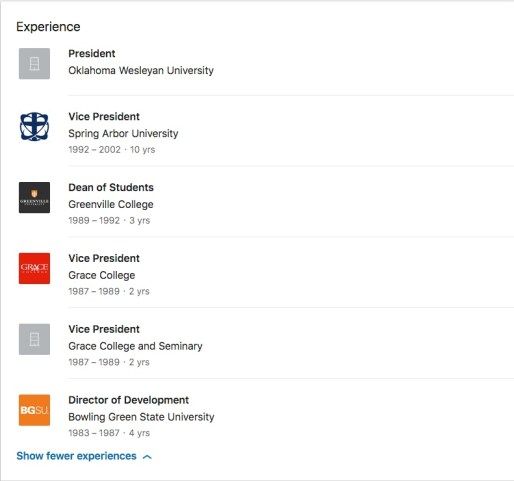
He grew up in a town of about 8,000 people and attended a nearby private school of about 2,000 people in late 1970s/early 1980s, when you weren’t required to hock an internal organ to pay tuition. Upon graduation in 1982, he took off for the work world, as you can see below:

PiperExperience

So he graduated at the age of 22/23, immediately went into academic administration and never left. Not exactly the story his university tells about him:

A native of Hillsdale Michigan, Dr. Piper grew up in a family that valued hard work, a mindset he carried with him as he moved from industry into pursuing a college degree.

Not sure how much “industry” work he did between the ages of 18 and 23 while in school, but he wasn’t a returning student, or a single parent, or a GI Bill kid, or any of those other kinds of folks I see on a daily basis who work their asses off to survive. He might or might not be the prototypical example of a guy who thinks he hit a triple when he was actually born on third base, but he’s also isn’t a latter-day “Rudy,” either.

Piper’s proud defense of his university not being a daycare seems a bit suspect, as he is making money off the deal. He turned his “catchphrase” into a nice cottage industry of castigating the youth and yelling about the snowflakes on his lawn.

The university even promotes the purchase of this stuff on its website. (What was that story about Jesus and the money changers in the temple? Oh, yeah…)

Also, consider this line from his letter to the masses:

If you’re more interested in playing the “hater” card than you are in confessing your own hate; if you want to arrogantly lecture, rather than humbly learn; if you don’t want to feel guilt in your soul when you are guilty of sin; if you want to be enabled rather than confronted, there are many universities across the land (in Missouri and elsewhere) that will give you exactly what you want, but Oklahoma Wesleyan isn’t one of them.

(The emphasis on those two statements is mine.)

If the irony of that first line doesn’t send your hater-ade filled soul into laughing fits, I don’t know what will. It’s easy to “arrogantly lecture” people, as Piper has clearly shown with his letter doing exactly that. Also, instead of dumping all over the kid who came to you with this concern about a Bible passage you likely understood far better than he did, why not help that little snowflake “humbly learn” what it meant instead of using the kid as a strawman to bolster your self-serving position?

(Side note:When someone tells me that something “actually” happened and “I am not making this up” in successive paragraphs at the front of a story, I’d bet money that person is making something up.)


(It’s even more amazing than when you have the ability to monetize your grousing…)

The second line (and any other similar phrase) always annoys me when it comes from people in a position of advantage. When is the last time University President and Almighty Deity of Knowledge Everett Piper was called out for his horsepucky? Probably back when people were rocking popped collars and jamming out to Duran Duran. It’s easy to say that people need to be confronted when you possess the power and position to do so, without fear of retribution.

And if all that hasn’t convinced you, read his Twitter feed. The guy has a transphobic Chuck Norris meme up there (as one of his many anti-LGBTQ tweets), called incoming house Rep. Alexandria Ocasio-Cortez a clueless child and referred to universities (all except for his, I’m guessing) as “bigoted, Intolerant, ill-liberal, inconsistent and closed minded.” Not exactly the bastion of intellectual argumentation I’d expect from a guy who reflexively calls himself “Doctor” more times than you’d hear it on a Thompson Twins’ Greatest Hits album.


Don’t Let These Guys Win

The problem isn’t that Everett Piper exists or that he has created a nice little business out of shaming college students with the tone of a high-strung school marm. The problem is that he isn’t alone.

Each generation likes to blame the one before for its problems and dump all over the one after it for not being perfect. As mentioned earlier, people like to get together and complain about how “a student did something you wouldn’t believe…”

Like any other stereotype, it contains a kernel of truth. Like any other stereotype, you can beat it. And like any other stereotype, you should call it out when you hear it.

Don’t let Piper and his ilk decide that you damned kids and your hippity-hoppity music are ruining this world and that if we could just get “Happy Days” back on the air, life would be good again. Don’t let this guy sell books off of the assumption that you will crumble or melt or whatever the comparative is that Piper or the next chucklehead uses to deride your generation. When someone decides to grump in your general direction, use your finely honed interviewing skills to pick apart their self-serving rubbish and demonstrate your intellectual journalistic superiority.

Sure, there are self-absorbed twerps in college who will claim their goldfish’s death merits a six-week extension on an already late paper. There are also dingleberries out there who misapply triggers and trigger warnings to mean anything they would prefer to avoid, as opposed to the actual medical situation they are.  There are plenty of examples of students that make us shake our heads until we develop neck cramps.

However, when you see something like this, written by someone like Piper, take a moment and smile. Think to yourself, “Gee, it must be so sad to think so little of the people you are supposed to help that your best approach to dealing with ONE QUESTION is to publicly rip AN ENTIRE GENERATION to shreds with a letter and then go write a book to pat yourself on the back for being superior to anyone under the age of 22.”

Then, go back to working hard to be better than this guy is. Commit yourself to being the antithesis of what he purports you to be. In other words:

Life 101 (Part II): Everything you wished you’d known before you graduated but nobody told you

What Am I Doing With My Life?

Monday’s post looked at the Life 101 issue of looking for and getting your first career job out of college. If you missed it, you can see it here.

Today’s post takes a look at things that go beyond the job hunt that recent grads told me they wished someone had told them before they graduated.


WELCOME TO WHEREVER YOU ARE:

I got a note from a former student who asked me about how to deal with “bad things.” She had recently graduated and was about nine months into her first career job. She was living in another state, in a small town in which she had never heard of prior to taking a job she loved.

After a few false starts of me guessing at what she meant, I picked up on a thread in her responses and asked, “Wait a minute. Are you feeling lonely?”

Bingo.

She had been actively involved in clubs, sports and other stuff while building an immaculate GPA at UWO. She was always on the go and always known wherever she went. Now, she was in a completely new place where she knew no one and she didn’t know how she was supposed to feel.

I had fewer friends, fewer interests and fewer people who knew/liked me when I made my first big move, but I felt similar pangs of anxiety. After my dad helped me move in, he spent the night before saying goodbye and leaving the next morning.

After he left, it dawned on me: Nobody here knows me at all.

(Side note thought: I could die in this apartment and nobody would notice until eventually I missed a rent payment or someone caught a whiff of decomp.)

I went from running constantly from 8 a.m. to 3 a.m. every day to working a nine-hour-a-day job and going home to… what? I took a lot of walks, bought groceries at normal times of day and generally looked for a place to fit in. It wasn’t easy, and apparently that was something others faced as well, given some responses I got from my former students:

It takes AWHILE to transition from being a college student to a working adult. Give yourself time and grace when going through this transition and don’t doubt your worth. You’ve got this.


Envision your life outside of work when considering a job – If you’re outdoorsy, does it have great trails? If you dig X, does it have X? The city has to pass the vibe check, or you’ll depend too much on work to bring you all your happiness.

Others noted that life got a little weird for them, living somewhere new, knowing nobody around them and generally losing that entire support structure of friends and family they’d taken for granted.

Friends and family are still there for you, just in a different way. It’s also an opportunity to spread your wings. Think about when you landed on campus four (or five or six) years earlier and how you didn’t know a damned thing about anything. It’s like that again, which sucks. That said, you survived and thrived in that once before, so the precedent is there for you to succeed.


WELCOME TO ROOKIE BALL

One of the hardest transitions people often make is from being the big cheese to the lowest of Limburger.  It hit me hard when I took my first pro gig.

At the student newspaper, I didn’t get much editing. People generally said, “You’re great!” or at the very least, they had bigger problems to fix, so I kind of skated by with the assumption that whatever I was doing was fine.

When I got to the Major Leagues, I got a rude awakening. A lot of my copy was getting hacked and slashed. My source material was being questioned. My use of quotes was second-guessed. My overall ability to do a good job was under constant scrutiny.

At the time, I needed help, guidance and support, but I had a boss who had either no interest or no capability to provide those things:

(This editor can’t be bargained with. She can’t be reasoned with… And she won’t stop until you realize you suck!)

I eventually gained my sea legs, but I never forgot what it felt like to get my ears boxed in on a daily basis. Apparently, neither did some of the folks who responded to my post:


Imposter syndrome is real and it is awful.


Nobody knows what they’re doing… They’ve just been working through it longer than you have. Hang in there.


Being the newest person means everyone else has a leg up in some way… Be ready to work weekends and holidays.


You have to know what the rules are first before you break them.


It’s tempting when you’re new to think folks with more experience have everything figured out. The truth is everyone is making it up as they go along on most things.


In kind of pairing these previous two thoughts, something else a student mentioned resonated with me when it came to being the new kid: You’re often the youngest kid by a stretch.

The student who got me thinking about this issue told me she had this weird age gap thing. She was too old to connect with the people she covered (high school athletes) and yet too young to really connect with the people she spent time with (colleagues and the athletes’ parents). It felt like there was nobody her age to connect with.

For the majority of my career life, I was always the youngest person in the room. I was 21 when I got my first gig in a pro newsroom, 22 when I got my first teaching gig, 24 when I got my first professor/editor gig, 28 when I got my first tenure-track gig and so on…

Those early years were awkward, in that I often had nothing in common with my coworkers. The people at newsroom parties  were talking about kids and soccer games and 401K accounts. Conversely,  I was like, “Hey, uh… is that beer over there free for, like, anyone to take?” I was told rather bluntly that if I was caught “associating” with students, my boss would hide strap my ass to a pine rail and ship me out of town.

It wasn’t the easiest of situations in those early years, but it was even harder because I had nobody to talk to who was going through the same thing. Maybe that’s why still tell my students my door is always open, even after they graduate.

I know it sucks to be the rookie.


KEEPING UP WITH THE JONESES

Of all the advice the hivemind chipped in with, this insight needs to be screamed from the top of every mountain:

Try not to compare yourself to your friends who have seemingly better jobs. Instead of resenting the job you have, see what you can do to make it better – to make yourself better at it so you can easily move onto the next position.

During my doctoral program, I researched in the area of Social Comparison Theory, which examines the way in which people try to figure out how they stack up in a particular area of life by looking at other similar people in their area. I also watched it  play out on a daily basis there as I taught kids at the journalism school.

It was a constant game of keeping up with the Joneses. If Bobby got a front-page article, Suzie needed to get the top article on the front page. If Jane wrote 40 stories in a semester, Carl needed to  write 45.

It got even worse when they went after internship and employment opportunities. If Marco got an internship at a 75,000 circulation daily, Maria had to get an internship at a 100,000 circulation paper. If Nellie got a gig at a top 50 market TV station, Willie had to get one in a top 20 market.

I watched this transpire long after I left, with former students chasing each other up the golden ladder for no real reason other than to prove some level of superiority. I saw students leave perfectly good jobs to take on jobs that didn’t fit them because one of their peers had moved up a rank or got a gig at a larger publication.

In one case, a great student left a job where he was perfectly suited and wonderfully gifted as an editor in a smaller publication to chase other jobs that made no sense. He eventually ended up doing night cops at a paper in Kentucky, working for a mentally unbalanced night editor and feeling miserable.  When I asked why he took the job,  he cited two reasons:

  1. The paper’s circulation was huge, comparatively speaking to his previous job.
  2. One of his former cohorts had gotten a gig at some place “better” than where he was.

This made no sense unless you understand the competitive nature of the school, the kids and the field. I eventually got him to see that “better” is in the eye of the beholder.

I have friends that make more money than I do, but I wouldn’t trade positions with them under threat of death. I have friends with classier titles and bigger offices, but they also have more problems, or at least the types of problems I hate dealing with. I have friends who do a lot of things that, on paper, sound like they’re living a much “better” life than I am. However, I get a lot of stuff that can’t be measured on a spreadsheet and I’m relatively happy with a great portion of my life.

Every day is not an Academy-Award-winning performance,  but it’s what I found works for me. I figured out that chasing someone else’s dream or trying to prove superiority by making myself miserable in my career made no sense.

A few other folks who chimed in on this topic made similar statements, saying they wished someone had told them to just worry about themselves and not chase the dreams of others. They finally figured out that comparing themselves to their former classmates made no sense and it made them miserable.

Once they settled in and just enjoyed being themselves, they found happiness.


THE FINAL ADVICE LIGHTNING ROUND:

Some of the best bits of advice didn’t really fall into a perfect category but it was so worth keeping, I figured this would be a good way to do it. So here comes the lightning round of advice:


Ask questions, ask for feedback, ask for what you need to succeed in a position and know that they hired you for a reason. And if that still isn’t working out, find something else that you love to do.


Know your worth and celebrate your accomplishments, achievements, and recognize the significance of your contributions. Don’t downplay them.


It’s very rare that in reality something is as high stakes as it can feel in the moment. After a fuck-up that felt career-ending for me but in retrospect did not matter in the slightest in the big picture, my boss told me “we’re not curing cancer.” And that’s stayed with me – very little is life or death, at the end of the day.


Your career is not your identity. It’s a reflection of you but it does not define you.

Well, that might not be everything, but I hope it’s a start.

If you have any other questions, comments or concerns, feel free to hit me up on the contact page.

Otherwise, have a great summer and best of luck in all you do.

Vince

(a.k.a. The Doctor of Paper)

Life 101 (Part I): Everything you wished you’d known before you graduated but nobody told you

life depressing funny college - 8102692096

(It’s not really that bad. You just need a few hacks here and there to soften the situation.)

A student showed up in my office a few weeks back with a big smile on her face and the peptic energy that only comes from wanting to tell someone else the best news in the world.

“Dr. Filak! I got a job!” she said, a mix of glee, elation and relief pouring out of her as she explained what she did and how this worked and where she was going to be employed.

I listened and congratulated her multiple times before I asked the inevitable question: “You don’t have to tell me if you don’t want to, but what was the offer?”

She proudly told me how much she was making, which was a decent amount. She wouldn’t have to steal Splenda packets from local diners or live on Ramen for every meal, that’s for sure.

When I asked how the negotiation for that amount went, she said, “Oh. They just gave me the salary they were going to pay me. I asked my parents if that was good money and they said it was, so I took it.”

She noticed the look on my face. “Oh no!” she said. “Did I do bad?”

“No,” I said. “But you could have done better…”

I then explained the whole process of salary negotiations to her and she realized something nobody at this institution had ever taught her: Salaries ARE negotiable. So are so many other things.

If universities are good at training students to develop skills that will help them get their first career jobs and put them on the path to a fully adult life, they absolutely suck at helping students make the transition from college to that life. I know this from my own experience, as well as that of colleagues and former students, so I thought a good wrap up for the semester would be one final lesson for the group: Life 101.

I asked the hivemind of folks I trust through various social media outlets and connections to tell me one thing they wished they’d known before they left school that they found out the hard way once they got into the “real world.”

Today’s post is the first of two that look at issues beyond graduation, focusing mainly on getting a job and the reality of that first job.

Tomorrow’s post will look at the life issues you face once you get out and become “a grown up” that you probably won’t see coming.

I hope this helps:

THE JOB SEARCH

There are few things more anxiety-provoking and terrifying than looking for a first career job out of college. You have put in the time and energy to pass the classes. You got the grades they said were going to propel you forward. You got involved in every activity someone said would “look great on a resume” and you worked at student media, internships and part-time gigs to fatten up your experience.

You put yourself out there and… crickets…

As a college student, I feared my parents’ basement. I constantly heard of students who did “all the right things” but ended up living back with their parents in a basement because they couldn’t get a job. I mentioned that to several students and several currently employed former students and the vibe was the same:

“I was scared to death that I’d done all this work and I’d be living back home in the basement. I never had a problem with my family, but I damned sure didn’t want to be back there as ‘that kid.'”

“I knew I could go home. I just didn’t want to. I wanted to be a grownup.”

I have said this before and the people who have experienced it have told me I am dead on with this analogy. Those who haven’t tell me I’m crazy. Then, they experience this and they convert to my way of thinking:

Your first job search is a lot like a bad dating experience: You are ready to go, so you put yourself out there. People are ignoring you and it feels awkward. You don’t know what’s wrong with you, so you get really worried.

Then, someone shows an interest and you have that kind of, “Cool. We should hang out. Let’s exchange info” moment and you get really excited. You start imagining how nice it’ll be and your mind takes you on flights of fancy regarding this relationship.

Then, you don’t hear from them for a while and you start wondering what you did wrong and why they aren’t calling. You start questioning everything you’ve done to this point. You wonder if you should reach out, but you don’t want to look needy.

Eventually, you’ll start to get angry with the, “OK, screw you. I don’t need you thing.” You give up, only to hear from that person shortly after that, with the person giving you a true and great reason why it took so long to reach out and that they really want to see you in a day or two, so let’s set this up…

And then you’re like, “OHMERGERD! I LOVE YOU SO MUCH RIGHT NOW!” but you play it cool and the cycle begins again…

As I’ve told more than a few sobbing students over the years, “It’s not you. You are good. The right people just haven’t figured that out yet. It’ll happen. Trust me.”

(In completing the analogy, that’s what my mother used to try to tell me each time I got dumped in high school… She wasn’t wrong, but the situation still sucked.)


THE JOB OFFER:

The first career job offer is something most people never forget, and I certainly remember getting my job offer from Mizzou.

Well, I remember most of it.

At one point when I was being offered the job and told about what this involved, I think I passed out on the phone. Blood was pounding in my ears, my chest felt like it was going to explode with joy like a frickin’ Care Bear and I couldn’t believe how lucky I was.

giphy-downsized.gif?cid=549b592d5ab2ba3b6270323273a5dcae

When the first offer came, I took it. No questions asked. I was so happy to be getting that job.

About two years later, my boss called me into his office and told me, “I need to let you know something. I totally screwed you.”

He explained that when he hired me, he gave me the lowest lowball offer he could, figuring I’d negotiate my way up to something more reasonable. When I didn’t, he was over a barrel. He couldn’t just give me more money, but he also knew I didn’t know any better.

(To be fair, he then told me he was getting me connected with the grad program so I could go after a Ph.D. It was a fair trade in the long run.)

He was a good guy and it never occurred to me that he had lowballed me. He then gave me the best advice I share on a regular basis, “Never take the first offer. Always negotiate for your worth.”

Of all the things people mentioned in their responses to me, salary negotiations were the most important:

“Journalism is not a ‘calling.’ It’s a business. Negotiate your pay. Don’t work for less than you’re worth. Think 5-10 years down the road.”


“Don’t count on the editor who hires you to have your economic interests at heart. You should be prepared to negotiate for the pay you need to live, and expect them to expect you to negotiate because it may be a LONG TIME before you have as much leverage to get yourself more money than when you have the initial job offer.”


“Know your worth and don’t settle just to get hired and have a job. A LOT of companies are hiring, so test the waters and see where you feel valued.”


“Agreed with everybody who said negotiate your starting salary. Do some research of similar roles in the area and don’t just take the first offer that comes because you’re scared/excited just to get one, which is what I did.”

In addition to negotiating salaries, people noted that they wished they’d negotiated for extra vacation time, an earlier start for health insurance, improved hours/requirements and other bennies that they thought were just written in stone.

Another person noted this “look forward” in life as crucial:

Take whatever 401k match is offered, even if you can’t contribute anything else right away.


WELCOME TO THE FIRST DAY OF THE REST OF YOUR LIFE (OR NOT)

When I went to my college orientation session about 30 years ago, the people there told us that we would likely change jobs about six or seven times in our lifetime. At that point, they meant that we would likely climb the corporate ladder, maybe switching companies within our field, but essentially staying put.

According to recent data, Millennials will change CAREERS almost six times in their lives. People now tend to stay with an employer for an average of three or four years, even with opportunities for advancement. This shifts the entire paradigm of how to look at your first job. Here are some thoughts from the hivemind:

“Paying your dues” is an outdated concept. Don’t let your parents, employers or friends convince you otherwise.


The quality of the job and the people you work with are far more important than the location.


Having a different approach to teaching and research is a GOOD thing!… Students need to know there’s many paths towards your goals in life. Do what works for you.


You don’t have to stay in the first job you get after college forever. It’s okay to change your mind or realize it’s not something you enjoy.


(I wish someone taught me how to deal with) not starting exactly in the position you want and how to be content with the growth process. Your degree does not always land you your dream job immediately.

This last point leads us to the unfortunate truth associated with taking that first job…


YOUR JOB MIGHT SUCK

As much as the dream job might be just a dream, it doesn’t mean suffering and pain should be your daily life at work. Everything from toxic workplace environments and weird bosses to feeling lost and becoming undervalued can make that first job you were so excited about feel like an abusive relationship.

I’ve worked for bosses that I would step in front of a bus for, because they were so helpful, supportive and just entirely amazing. I have also worked for bosses I wouldn’t feel bad about nudging into path of oncoming freeway traffic.

The folks who chimed in on this had similar experiences:

Your boss makes all the difference for how well you do in your first few jobs. Take your first job based on how well you vibe with the boss.


I once told my son that if he ever has a job where the manager/supervisor/head honcho etc, comes over and parks his butt on your desk, smiles and says, “we’re all like family here”…….Leave.


Also that just because things aren’t perfect, it isn’t necessarily your fault:


Your first job isn’t your only job. Sometimes it legitimately sucks and that’s OK. It’s not an indictment on you or your work.


Always work toward aligning what you want to do with what your job/career actually is, while still getting your current job’s work done of course. But always keep working toward doing what you want to do, even if your first job out of school isn’t your dream job (it won’t be).

The one caveat I’ll offer here is the one based on my own sense of paranoia: There’s nothing wrong with leaving a job because it’s not what you want or need. That said, have your next move already to go upon your decision to quit.

I equate it to the old “Tarzan” movies when he’s swinging from vine to vine across the jungle. Don’t let go of one vine until you have the other in hand.

TOMORROW: Life, or something like it, after college.


Potential solutions for grade debates between students and professors

As the end of the semester draws near, grades tend to become a topic of consternation among students and professors. Students tend to worry about the outcome of their course work as it relates to their ability to graduate, move on or keep that ever-important GPA on the up-slope.

Professors, on the other hand, find themselves buried in grading, often wondering why we didn’t just show movies and mark attendance for 15 weeks. As we slog through the work we brought upon ourselves, students are questioning, begging and cajoling, all in desperate hopes of nudging grades just a little (or in some cases, a lot) higher.

I can’t solve every problem (or most of them) on the blog , but here are a few random ideas I have for making life a bit easier on all of us in regard to the grade debate.

Take them as seriously as they seem…

The “Peace with Honor” grade: I’m sure most students have failed to put in an appropriate amount of time on an assignment at some point in time. I’ve noticed this usually happens on essays or longer-form writing pieces, where the student figures if they pour enough BS into a Word document, the professor will decide to give them at least a few points.

The problem is that professors are often stuck when it comes to grading these papers, even with a quality rubric. We don’t know if you were having difficulty with the assignment, so we need to point out the errors in detail to help you for the next one, or if you just didn’t give a crap, so we’re wasting time telling you things you knew, but just didn’t do.

Thus, I propose a “Peace with Honor” grade approach.

When a student knows they are behind the 8-ball on an assignment, instead of BSing us to high heaven and having us wade through your BS, a student can write something simple like, “I know I should have dealt with this assignment better, but I’m not wasting your time trying to fake it.”

The professor, in gratitude, will fail the student with a specific amount of points (I’m a fan of 40-50%), with the idea that not having to comment on every stupid thing the student could have written will save time and defer carpal tunnel surgery.


The “I’m Better Than This” cease fire: In journalism, we care what you can do, not what your grades are once you graduate. To that end, many professors will encourage students to participate in student media to sharpen their skills and gain experience.

In more than a few cases, this is like encouraging someone to “just try” some cocaine so they can get a bunch of stuff done quickly. The students quickly become addicted to the newsroom and their GPA heads downhill like a stock market graph of the Great Depression.

Professors often start getting weaker work from those students because they’re running the paper or the radio station or the TV station. Suddenly, classes have become something of an fifth or eighth priority in their lives.

For some professors, this can become irritating because we KNOW you can do better at this work. For some students, this can also become irritating because they KNOW they are better than what the grades they get keep reflecting.

A potential solution is this cease-fire approach: I’ve told more than a few students, “Look, I get it. I once skipped six weeks of classes because I was dedicated to the student newspaper. I know why you’re disappearing like a kid running after a red balloon in a Stephen King novel. I also understand I’m not a top priority, so let’s try to make peace with this.

“I will promise not to ride you mercilessly about how crappy your work is in here, if you promise not to piss and moan about your lousy grades. We’ll get you through this alive, and once you end up running a professional newsroom, just make sure you keep your alma mater in mind for potential internship candidates. And don’t make GPA a requirement for successful applications when you’re running the show.”


The “One-Point, Death-Grade, Elevator-Pitch Shimmy” Approach: At the end of a semester in which we grade hundreds of papers across multiple sections and various courses, the computer will eventually spit out a number that correlates to your grade. In more than a few cases, that number will be riding juuuuuuuusssst on the line of a potentially life-altering edge.

For example, if 75 is the demarcation line between a C and a C-, and you need a C or better to continue in your program, you might find yourself sitting at 74.89. The difference between having to start all over with a course or be able to take what you’ve likely scheduled for next semester hangs in the balance of a professor’s attitude regarding rounding, grade-grubbing and the degree to which they want to tolerate you again.

Here’s the best I got for what I would consider “death grades,” the line between pass/fail, advance/retake or B-/C+ (It’s hard to sleep at night knowing you were THAT close to a B of any kind and came up short.): If you’re within a point or two of that death grade, we professors promise to tell you before we file. You have 24 hours to make up a 30-second elevator pitch that would convince us to buy your argument for a better grade.

If you use the words “deserve,” “worked hard,” “need this to graduate,” or any other whiny bull-pucky, you’re done. Gimme at least one or two concrete reasons that I told you were relatively important to this class that you learned or did that make you worthy of me shimmying  up your grade a tad.

My discretion in the end, but I gave you a chance.

And finally…


The “But I Tried Really Hard In This Class” Resolution: When your grade is somewhere in the vicinity of the Mendoza Line and you missed so many classes that I almost called in an Amber Alert on you , it’s kind of ballsy to make the claim of effort.

That said, numerous students do this every year, so here’s the best solution:

Good luck with finals and we’ll see you next time!

How to write cover letters for journalism jobs in the age of digital media

As students have been plugging away at internship packets and job applications, one of the hardest things they’ve had to face is how best to write a cover letter. Of the many requests I get each year, “How do I write a cover letter?” is among the top three when it comes to trying to get hired.

Andrew Seaman of LinkedIn (who was also nice enough to pony up some thoughts for the reporting book) recently published a piece for a more general audience that asked the question, “Should you include a cover letter?” He makes some great points, including the one that people seeking a job need to tattoo to a body part they look at a lot: If someone asks for something in a job ad, GIVE IT TO THEM.

(I can’t tell you how many times I’ve been on the hiring end of a situation in which we asked for something simple three references, and instead I get somewhere between 0-2 or 4-383 references. And these are people with doctorates who want to teach the next generation of critical thinkers and investigative journalists… Good grief.)

I’ve often told students I never met anyone who got a job solely on the merit of their cover letter, but I have met plenty of folks who have been tossed aside because of a lousy one. Even in today’s day and age of digital media, while a cover letter might seem as quaint as a horse and buggy ride to you, it might be a big deal the people you hope will hire you.

To that end, let’s walk through what I consider to be a pretty decent approach that has done at least some good to the students who swear by this process:

OPEN WITH A CONNECTION:

In advertising we talk about engaging an audience to get their attention. In opinion writing, we talk about the need to stimulate interest to hold on to a browsing reader. In all forms of media, we talk about the importance of connecting with the audience. That’s what we want to do right off the blocks with the opening paragraph: Grab the reader by the eyeballs and make a connection.

There are three good ways to connect with people in a situation like this:

  1. Direct connection
  2. Indirect connection
  3. Tangential connection

A direct connection is the best of the bunch and is part of why we all consider networking to be valuable. If you went to a journalism conference and met a recruiter for the Johnson Journal, she might say, “Hey, we have an internship this summer that you might want to consider.” That connection can be helpful in pulling you to the top of the stack, if she remembers you. That’s why you want to start with something like, “It was great to meet you this fall at the ABC Media conference, where we talked about potential internship opportunities. Given what you told me there, I was excited to see you had this internship available and I couldn’t wait to apply.”

An indirect connection tends to be the most common ones we have and usually the ones we tend not to exploit well enough. I’m guessing that any professor in your field gets a goodly number of emails or messages from former students who are now looking to hire an intern or a starting-level employee. The former student trusts the professor and if the professor trusts you, that’s a great “in” you need to tap: “Professor Smith said you were looking for a hard worker to fill your internship position this summer, and he recommended that I send you my résumé.”

A tangential connection is the weakest, but it’s at least showing some level of effort. If you lack any specific “in” with a potential employer, consider telling the employer where you found their advertisement and why you felt compelled to apply for the opening. You could also look for a way to tie your interests to their needs. In doing this you could mention how you covered specific things such as crime or sports and that is what drew you to the company’s open position for a crime reporter or a sports reporter. Look for a way to reach out and explain to the person reviewing résumés, “Hey, I’m interested in you for a good reason!”

PAIR YOUR “HAVES” WITH THEIR “WANTS”

In college, I found myself getting screwed a lot on essay tests because I would “fail to answer the entire question” in my answer. What I realized after getting that scrawled across more than a few blue book tests was that I’d get really into the weeds on one or two parts of the test and manage to skip some mundane element that cost me points.

To prevent this from happening again, I would bring a highlighter into the test and literally go through and highlight every verb and subsequent clause on the test question. When I would answer each one, I’d check it off in pen. It seemed somewhat reductive and maybe even childlike, but then again, so were some of my gen ed courses.

The technique ended up serving me well in developing cover letters over the years because I realized that everyone was writing the same cover letter, in which they just repeated their resume in essay format for every job opening out there. I had accidentally used this method to stumble on the idea that Tim Stephens would explain to me years later: “I don’t care what you have done. I care what you can do for me.”

To make the letters work better for me, I would print out a copy of the job description and start highlighting those verbs again, looking at what these people “wanted” and picking out the ones that I wanted to cover in my letter:

  • Work under deadline pressure
  • Write clean copy
  • Demonstrate proficiency in social media

Then I’d start working on paragraphs that didn’t repeat my resume, but connected my experiences to their requirements in the form of neat little pairs:

“You noted in your position description that you need someone who works well under deadline pressure. As a news reporter at the Campus Crier, I often found myself working on tight deadlines including one case where I got a tip about the university’s president resigning. In less than two hours, I managed to get the story confirmed and written. Even better, I scooped the local paper.”

Not every need will attach itself to one of your great adventures in media, but you should look for those opportunities to show people what you did and how it can be of benefit to them.

At this point, I usually have a student ask, “Wait, you mean I need to write a different cover letter for each job I want? That’s a lot of work!”

True, but consider the following things:

TWEAKING, NOT REBUILDING: You are likely going to be applying for more than one job at a time, but I’m guessing that you’ll be applying in generally the same area, so there will be some kinds of overlap among the job requirements. It’s not like one thing you’ll be looking for will require experience covering criminal justice and the other will require six months as a certified fry cook. It’s more tweaking than rewriting from scratch.

QUALITY OVER QUANTITY: Exactly how many job applications are you sending out at one point in time that would make this an arduous task? If you’re literally just throwing a resume at everything that pops up on LinkedIn one day, you might really want to reconsider your application strategy. Also, I’m not sure that your patented “I’m a hard worker line” is going to resonate in a letter that you were literally too lazy to change in order to make it unique to a particular job.

THAT SPECIAL FEELING: You should actually WANT the job you’re going to apply for, which means you’ll want to take the time to make these people feel like you WANT the job. Treating each one of these things like it’s at least a little special will go a long way and show that you actually aren’t just machine-gunning applications out there like Rambo trying to take out an entire platoon.

Think about it this way: Did you ever get or give a “prom-posal?” I had never heard of these things before I had a kid who was in high school and got one. The idea is to make some sort of public showing of your interest in a significant other in hopes of getting that person to go with you to a school dance or other event. (I know. I make it sound so hot…)

If you’re old like me and don’t know what this is, here’s a compilation of ones that apparently worked:

(I prefer these when things went wrong, but hey, I covered the crime beat most of my life. I’m a huge fan of entropy…)

In the ones that worked, it was pitched to one person, with a clear connection to that person, in a very personal way. (The baseball player and the “strike out” theme was nice, as was the dog thing, I must say…)

Now imagine instead if it was just some random dude in school running up to every girl he saw in the hall with a sign that just said, “PROM? yes or no!” Exactly how far do you think that “prom-posal” was going to get? At best, he’s going alone to prom. At worst, he’s now on a registry of some kind.

The point is, you want the letter to work. Doing it faster just to get it done, showing no sense that you value the places to which you are applying and not caring about the results will likely land you in the reject pile.

THE MONEY PARAGRAPH:

After you outline your skills and traits but before you thank the person for considering your application sits the most important couple of sentences in your letter: the money paragraph. At this point, you should have made a good impression and have the person on the other end of the letter thinking that you might be a good fit. It is right here that you want to seal the deal and give the employer something to remember.

Each of us has that “one thing” that we think we’re better at that most of the rest of the people in our field. We pride ourselves on our ability to work through problems, to constantly look for positives in every situation or to smooth over personnel concerns. Whatever that “one thing” is for you, hit it here with some emphasis. The goal is to say to an employer that if she is looking through your application and Candidate X’s application and everything is completely equal to this point, here’s the big reason why you should get the job over that other person:

“Above all else, I constantly look for new ways to reach the audience. I was one of the first reporters on our staff to integrate digital tools like TikTok and Instagram into my work. I knew this was how most people in our audience got the news and now everyone else at our publication uses these tools as well. I will always look for the next best way to connect with the readers and viewers and I think this approach could really boost readership for your organization.”

CLOSING TIME

Finish the letter with a standard closing paragraph, thanking them for their consideration, providing contact information once again (hey, if they’re interested, let’s not waste any time) and signing off.

A nice personal touch is to build a signature into the file. Take a piece of paper and practice your signature until you’re happy with it. Then, get a big blue Sharpie and sign it on a clean sheet of paper. Scan it in (or shoot it if you have the skills) and save it as an image file. You can always embed that into the end of the file in the place of a hand-written signature for digital applications, without losing that nice touch a personal signature provides.

Check it over one more time for spelling and grammar errors. (Always check the name of the person to whom you are sending it, because nothing says, “I’m your best candidate” like misspelling a name right off the bat.) Then, send it off and hope for the best.

THROWBACK THURSDAY: Your parents’ generation sucked at this, too: 4 helpful thoughts on finding your way through life

I think I set a record this week for “number of students breaking into tears in my office for reasons that have nothing to do with their grades.” The sheer volume of terrible things befalling my students would stun a team of oxen in its tracks and has me wondering if I’m somehow radioactive.

The one kid that really got to me was the best of the bunch: She’s six weeks from graduation, has worked in student media for quite some time, has a great resume and would be a great hire anywhere she chooses. Her problem is that the places that are hiring for things she’s good at are either just out of her educational or experiential range in many cases. In other cases, they’re not getting back to her or hiring other people.

The frustration for her was palpable, even as she started to cry, because she told me, “I swore to myself I wasn’t going to cry in your office. Dammit…” Once we got past that, it turned out she was not only facing all of these pressures, but also the pressure that comes with being the first in her family to go into this educational level and field. Her parents are in the “You got a job yet?” mode, which only makes sense if you’ve never gotten a job in this field at a point like this.

For her and all the other people who are dealing with anxiety, self-doubt and possibly antsy relatives, here’s a throwback post that I hope provides some solace.

—-

Your parents’ generation sucked at this, too: 4 helpful thoughts on finding your way through life

Scott Cunning, an associate professor of economics at Baylor University, recently laid out his life path and his feelings regarding jumping into grad school right after college as part of a Twitter thread.  He makes a number of points that are good, including the idea that grad school shouldn’t be about inertia or self-doubt, but rather when you know what you want (and that you want grad school). He talks about job choices and the benefits to getting one as well here, and I highly recommend giving the whole thing a read.

The nexus of his thesis is something students should keep in mind: You won’t know what you want to do until you end up running into it. That can make for some pretty high levels of anxiety for students and parents, as well as some really awkward family gatherings where random relatives feel it is their duty in life to say, “So you STILL don’t know what you’re doing yet?” instead of “Nice to see you. Pass the potatoes.”

In hopes of helping you defend your psyche from the chaotic panic and shutting down the naysayers who keep blaming your generation’s downfall on “FaceSpace and those iText things,” here are four things to keep in mind:


Everyone in college is lost and that’s just fine: At the beginning of each semester, I ask the students in each of my classes what they want to do with themselves once they get out of school. Some of them have a vague notion, half of an idea or a general sense, and that is about the BEST it gets. Only once in all my time teaching did I ever really have a kid tell me something straight-up honest and it was last semester:

Me: So what do you want to do with your IWM (Interactive Web Management) degree?
Him: Make a ton of money.
Me: How will that work?
Him: I don’t know. I’m gonna figure that out when I graduate.

For the rest of the people in my class, it’s like this: “I want to graduate, get a job, not move into my parents’ basement and not have to answer stupid questions like this one from every relative who runs a business selling wiener dogs out of a mobile home and somehow thinks they’re better than me.” Spoiler alert: That’s the American dream of this generation.

Cunning is right, though, in that you won’t know what you want to do until you do it, which is why they force you to take a boatload of general education requirements in college: They figure you don’t know what you want, so they give you a taste of a bunch of stuff.

Instead of taking those classes with only the edict of “Please, God, not another 8 a.m. on Fridays,” look at classes that might interest you and see where they take you. That’s how you bump into things you might like to do for the rest of your life and find some direction. In the mean time, it’s not a problem to not know.


Being good at something doesn’t mean you should do it: The longest-running argument in my life is between my mom and me about what I should have done right out of college. She still believes that I would have made a great speechwriter for politicians, based on my various skill sets. I liked to write and had the ability to turn a phrase fairly easily. I did well in public speaking courses and extracurricular activities, such as debate and forensics. I worked well under pressure and could logically process information quickly. It seemed like a perfect fit for me.

Here’s the counterargument I had for mom: I hate politics.

I spent a lot of time with political figures during college, ranging from student government folks on up through the city and county leaders and found I disliked the majority of them and their attitudes. I never understood the wrangling and the gamesmanship they used to carve up their little portion of the world just a little bit finer. I also hated the arrogance and ego associated with the jobs. Why on Earth would I want to write things for people like this so they could snow under a whole bunch of voters in hopes of furthering their own petty agendas?

The point is, Mom and I were both right in some way. She was right that I had the talent and skill set to do this as a job, and I was right that I’d rather gargle with raw sewage than subject myself to that career path. Thus, the maxim outlined above.

You might have a talent, a skill or some general proclivities that push you into a realm of study or onto a career path, but keep in mind that just because you can do something, it doesn’t necessarily follow that you should. If you don’t like something, don’t put yourself in a position where you dedicate your life to it.

In this regard, Dad had the better take on this topic: Find something you like doing and you’ll never work a day in your life.


You are not a fraud, even though you will feel like one: During my doctoral program, we had a class in which every faculty member in the school could come in and discuss his or her research or offer us advice. Of all the advice I got at that point, a couple stuck with me, including this one from Dr. Stephanie Craft:

A few years into your career, you are going to look around and panic because you think that you are a fraud. You will worry that you aren’t good enough or smart enough or whatever and you figure that it’s only a matter of time before everyone else figures this out, too. You then start counting the days until the entire illusion you’ve built will shatter and you won’t know what to do.

Don’t worry. It’s not true. You are not a fraud. You will be able to push past this.

A few years ago, I read about this concept called “imposter syndrome” that essentially captures this whole notion perfectly. It happens to a lot of people and it’s not something you can necessarily dodge in advance of its arrival. When it hit me, it didn’t matter how much work I had done, how well I had done at that work or what everyone else thought about how awesome I was. All that mattered was that I figured I’d eventually get caught short and revealed as something between a carnival huckster and a guy selling snake oil out of the back of a covered wagon.

The one thing that made the difference was remembering what Dr. Craft told me and realizing her prescience on this fraud fear arriving also made it likely that she was right that I could beat it.


Your parents’ generation sucked at this, too: If your parents tell you that they knew everything when they were your age or that they had a job or that they knew their destiny, I’ve got two words for you: “Reality Bites.” This movie came out 25 years ago, or roughly around the time many of your parents were finishing up their college careers and looking around for whatever that next stage of life would provide. This movie really captured the post-collegiate zeitgeist better than almost anything else at the time, and it provides you with the perfect time capsule to look at what your parents dealt with.

You have Lelaina, Winona Ryder’s character, who was working as a young assistant producer for a cheesy morning show where the host (John Mahoney) treated her like crap.  When she got fired for perhaps the best on-air prank possible, she tried to find a job in her field, only to realize that she couldn’t get hired anywhere. Her father thought her generation had no work ethic. She craps all over her friend Vickie for offering her a job at The Gap, and falls into the bell jar of trying to find meaning in life via a “psychic partner” phone line. It only gets weirder from there (although the final love connection she makes is really too Hollywood for its own good).

If you strip away that last part, you realize that this generation didn’t know anything either, and I say that as PART OF IT. Sure, she fell in love at the end, which is pretty much what the film industry was selling at that point, but she didn’t have a job, was dead broke, had to use her father’s gas card to pay bills and there was no sense she was figuring it out. (And yes, that’s why reality really does bite.) Still, that generation eventually dug in, figured something out and managed to build a life that produced you.

Whatever they tell you about their origin story, view it through the prism of “Reality Bites” and you’ll probably be closer to reality.

Advice, reflections and things to consider for students: Transitioning Careers from News to PR, Part IV

(Editor’s Note: This is the final part of a series that looks at journalism folks who have transitioned from jobs on the news side of the field to public relations and marketing over the course of their careers. I promised the folks anonymity before I got their answers, so they could be honest and also because I didn’t know how many folks I would get. Turns out, we have a lot of people who made the move for a lot of reasons, so I’ll do my best to keep the sources clear for you as we discuss their experiences. -VFF)

If you missed them, here are the first three pieces:

To close up this look at the news-to-PR transition, I wanted the folks to give the students some advice or some observations they had regarding where their journeys took them in the field. The line of “Life is what happens when you’re busy making other plans,” seemed apropos, so I wanted to hear what these folks learned between knowing what they were SURE they were going to do when they left college and what life actually brought them:


A 25-year marketing vet who spent 10 years in news before making the shift had a broad sense of what was in the field and what students should know:

“One thing I’d tell current students in the Journalism field is that the field is ever-evolving. It’s important to remain adaptable with your skills and your mindset. The thing you start doing right out of college will likely be very different from what you retire from, but the storytelling will always remain. Storytelling has been the one constant in all of Journalism and its various offshoots.”


A content manager for a firm that specializes in thought leadership looked at this from both ends of the discussion:

To news kids: Don’t be snobby about an entire profession. Careers are long and you might end up doing PR for a while because the skills you’re learning are transferable. Oh, and the talk about PR people not working hard – complete and utter nonsense. If you want to stay in news, pick an area or specialty (either topical or in approach) and stick with. GA reporters are a dime a dozen. Not picking an area of focus is probably my biggest regret. I was so focused on the basic skills of journalism that I didn’t really get to know topics.

To PR kids: The value of journalism goes well beyond advancing the interests of whomever you represent. PR and journalism shouldn’t be symbiotic, but they CAN help each other. The news media serves a vital purpose and is getting attacked by people who seem to think authoritarianism is better than democracy. PR people should understand the importance of good reporters and editors in a free society and do what they can to help.


A California-based marketing manager for a tech company said the things she learned in a newsroom made her a better practitioner in her current job:

“Working in newspapers gave me a unique set of skills and experiences I wouldn’t have been able to get anywhere else.

“Content marketing is filled with bullshit artists. Having newsroom experience on my resume gives me credibility that would’ve taken much longer to earn, had I started my career in marketing.”


A VP who serves as a content strategist at a major financial firm had the most amazingly honest and totally straightforward advice:

“Media is an incredibly small world. You’re going to run into people over and over again throughout your career. So don’t be a dick.

“That obnoxious PR person who wants you to cover their brand? They may be the mayor’s PR person 5 years from now. So be friendly. And honestly? Cover the dumb stories from time to time. If your audience finds it interesting, you did your job, and you probably made a solid PR relationship along the way.”


A marketing and PR practitioner who graduated during the 2010s planned to spend her whole life in news. When it didn’t happen, she realized a few things:

“When I was in college, I was 100% sure I was going to be in print journalism forever. If you would’ve told me I’d be working in marketing, I probably would’ve laughed. Little did I know, that was just the first stepping stone of my career. That being said, here’s what I’d tell students today:

  • Get involved in student media and extracurriculars. I learned more from those “in the trenches” experiences alongside my peers in the newsroom than I did in a classroom. It gave me a chance to try new things and put my skills into action. Plus, the people I worked with there are still friends, colleagues, and references.
  • Just because your major is “journalism” doesn’t mean that’s your only option. I used to think that if I was a journalism major, I would only be qualified to be a reporter. Professors aren’t lying when they say the skills are transferable.
  • Journalism isn’t dying. It’s actually a really exciting time to pursue a journalism or journalism-adjacent career, in my opinion. There are new platforms emerging and new stories to tell every day. We will always need people with the ability to tell those stories — and that’s what the skills you’re learning allow you to do. “