Bid on these old-school type kits to help support the future of college journalism

I have said this at least 1,001 times, but it’s always true: Without student media opportunities, I don’t come close to having anything resembling the life I have now. I know that I’m not alone in this situation, given the thousands of students I’ve met throughout my time in the collegiate environment and the many college media advisers I consider my friends.

I also know that student media outlets are dealing with shrinking budgets, diminishing support and falling advertising sales. I’ve covered this situation here on the blog with Wichita State and I’m planning to write up something later this week on the situation at the University of North Texas, where the paper has been told to “wean” itself off of university support. I also dealt with financial disasters twice, once at the Daily Cardinal, where my work there landed me in a great book and once at the Advance-Titan, where I had a bunch of little… um… student government people coming after me. (Spoiler alert: Both papers survived and continue to prosper.)

No matter how far away I get from my college experience, The Daily Cardinal will always hold a special place in my heart. The students there get no financial support from the university and receive no pay for their editorial work. The paper survives on advertising revenue and money raised through the Daily Cardinal Alumni Association. I’ve given to the paper and the DCAA over the years, but this time I wanted to do something special, so here it is:

I came across a giant trove of old lead type kits that have to be somewhere in the neighborhood of 100 years old. Each was boxed in a wooden case and labeled based on the point size, the typeface and the specs on the letters (uppercase, lowercase, both, bold etc.). These things go for a couple hundred bucks apiece in some cases, because people didn’t keep the small letters like 6 or 8 point fonts. (Larger point sizes survived in headline drawers or as part of artwork.)

For those of you too young to know what lead type is, here are some pictures of the kits and here is some background.

I have donated five sets of type to the DCAA that the folks there are auctioning off. All the proceeds will go to the Daily Cardinal through the DCAA for whatever the students there deem valuable and important. It could be a conference. It could be new equipment. It could be anything. The important thing is that they have a chance to get something or do something they otherwise might not have had.

The typesets are listed for auction here if you are interested in bidding or you know someone who is.

Please take a look if you are interested and able to bid or pass this info along to anyone you think might want to bid on them. Not only will these sets look great in any office or home, but the money does go to help the next generation of journalists who will keep us all informed.


Goodnight, Susie Brandscheid

Had it not been for Susie Brandscheid, I probably would have been a pretty decent reporter for the Baraboo News Republic.

That thought kept rolling around in my head when I found out she died Wednesday at the age of 70.

Susie was the assistant to the director for UW-Madison’s School of Journalism as well as the graduate student adviser there for decades before retiring a few years back. She also was the keeper of knowledge, the fixer of foul-ups and the soother of students’ battered souls during her decades of service in and around Vilas Hall. Faculty, staff and students sought her advice, her insight and her help each and every day.

She always had the answers we all needed and she seemed to be effortless in her ability to get them for us. It was like having a computer crammed with every conceivable solution to any potential problem mixed with a treasure trove of institutional knowledge.

And she was damned funny, to boot.

She had a special sense of humor that defies explanation. I would camp out in her office whenever possible and trade amusing anecdotes. She would tell me stories about her husband, Pete, a man I never met but whose Quixotic endeavors had me laughing until I cried some days. I would tell her about the weird police-beat stuff I had to cover for the State Journal and she’d turn those dark moments into even darker humor.

There was always something bitingly humorous when it came to Susie. I can still remember one “sympathy” card she had pinned to the cork board on the wall behind her desk. It was black with red lettering that read, “Sorry to hear you’ve been depressed…”

Taped to the inside of the card was a razor blade.

Of all the people who worked in School of Journalism during my six years there, she was the only one I invited to my wedding. She came and it turned out to be another funny story we shared.

About six months after the wedding, I get a call out of the blue from Susie.

“I wanted to tell you I’m sorry,” she said.

I had no idea what she was talking about. It turns out, she had spent the previous few months wondering why she never got a “thank you” card or a note or anything for the card and the check she gave us. I never expected a gift from her, as her showing up was more than enough for us. Also, we were moving, I was finishing my doctorate and we must have sent off a jillion cards, so it never really dawned on me that I hadn’t sent one to her.

A day or two before she called me, she went to put on the outfit she wore to the wedding and she realized she had stuck the card in her jacket pocket instead of dropping it on the gift table. She asked for our address so she could send it out in the next day’s mail.

We had a long laugh about that one.

Any time spent with Susie was like going to confession, visiting a psychiatrist and getting a mental reboot. She kept me sane. She kept me focused. She kept me happy.

She also kept me out of Baraboo.

I was in the first six weeks of my master’s program, and things were not going well. I was working multiple part-time jobs to keep my head above water financially. I was living in a one-room hovel on the end of Bassett Street that was essentially one giant building-code violation. A chunk of the ceiling fell into my bed during a rain storm one night, and the plumbing turned my water so brown that I begged for a Brita pitcher for Christmas.

I also didn’t understand any of my coursework. Each day, I entered a certain professor’s class, swearing up and down that I was going to comprehend him and his theories on the media. Each day, he lost me in the first three minutes and I spent the next hour or so doing the crossword in the student newspaper.

Out of frustration, I applied for a job at the Baraboo News Republic, a daily paper for the hometown of the Circus World Museum (among other things). The editors met with me on a Saturday and the offered me a full-time gig with benefits and a salary that would get me off the “Ramen and such diet.” All I had to do was drop this pointless degree and go to work.

That Monday, I went to tell Susie that I needed to drop my classes and see what I could do about getting some of my tuition money back. Instead, we started talking about why I was going to Baraboo and why I even got into the grad program in the first place.

“I did this so I could teach,” I told her in frustration. “I wanted to see what it would be like to run a classroom and I know I can’t do that without a master’s.”

She paused for a moment and then said, “What if I could give you your own 205 class to teach next semester? Would you stay with the program?”

J-205 was news writing and reporting class of about 15 students, taught in one of the school’s computer labs. Teaching gigs like that were impossibly difficult to get. They went to doctoral students for the most part. Even more, most TA jobs were essentially indentured servitude for professors who taught giant pit classes. A boatload of grading coupled with no actual teaching was basically the gig. Handing a J-205 class to a first-years master’s student wouldn’t just ruffle feathers; it would be like putting an ostrich in a blender.

“I would do anything for that kind of chance,” I told her. “Can you really do that?”

She told me she would make it happen somehow. I believed her. Later that day, I called Baraboo and turned down the job.

It is a rare moment when a person can say with absolute certainty that someone completely changed his or her life without even a hint of hyperbole. That’s what Susie did for me at that point.

Without her, I’m not a college instructor at the age of 22.

Without that experience, I don’t get the job at Mizzou or the doctorate the followed.

Without those two things, I don’t get a tenure-track job at Ball State and my first newsroom advising gig.

I sure as hell don’t end up a tenured professor, a textbook author or an award-winning anything.

Instead, I get to be the most popular cops reporter in Baraboo, Wisconsin.

I have a really hard time trying to quantify how monumental Susie was in giving me the life I have today. I also can’t even begin to imagine how many thousands of other people have a “Susie saved my life” story just like that.

Maybe that’s the thing that made her so special: Even though I was one of 100 things she had to deal with on any given day, she had this knack of making me feel like I was the most important one. I never felt like a bother or that I was just filling time for her until something more important came along.

My life and where it went mattered to her. I hope she always knew how much her life mattered to me.

So, goodnight, Susie. The world is a lesser place without you.

But everything you gave us will continue to help us better it.


5 simple things Bob Woodward does in his interviewing that you can do, too

Few hard and fast rules exist in journalism, but one I would bet the house on is this: If Bob Woodward says something works, it probably does.

Woodward first came to national prominence in 1972 when he and fellow Washington Post reporter Carl Bernstein dug deep into the Watergate scandal. Historians and journalists largely attribute much of President Richard Nixon’s downfall to the reporting of Woodward and Bernstein.

(Here’s a neat fact: Woodward only had about two years of professional journalism experience when he caught this story of a lifetime, working first at the Montgomery Sentinel before getting a job at the Post in 1971.)

In 40-plus years that followed, Woodward became the consummate political reporter, digging into daily work and writing books that profiled presidents. He was the standard for all other reporters, even as his name became less of a cultural touchstone for younger generations.

Woodward is back in the news these days for his book, “Fear,” which looks at the presidency of Donald Trump. As Post releases excerpts of it, Woodward is making the talk-show rounds to talk about his book and his experiences writing it. Last night, he sat down with Stephen Colbert on “The Late Show,” to talk about what he found and how he found it.


Normally, these interviews between authors and talk-show hosts center on humorous anecdotes, some vapid chatter and a hard plug for the book. Woodward, however, gave all of us a beautiful look at how he goes about his job, especially when it comes to conducting interviews. Within his conversation with Colbert, Woodward provided beginning journalists with at least five solid interviewing tips that anyone can use:

Conduct deep research on your interviewee: One of the tenets outlined in both textbooks is to research your subject before you interview him or her. The idea of entering an interview without a full grasp of who the person is and what that person might have to say should scare the heck out of you as an interviewer. Woodward explains that he researches his subjects so well that he can even surprise them with information he found:

“Let’s say your an assistant secretary of defense and I come to interview you… and I say, ‘Oh, you wrote this article in 1986,’ and you’re going to think, ‘Oh, only my mother read that article!’ … You don’t just Google them.”

His point was that the more you know, the more you feel like you are ready to do the job and the more your source will respect you. If you walk in looking like a kid who lost his mom at Walmart, you’re not going to get very far.


Enter the lion’s den: One of the biggest mistakes young journalists make in conducting interviews is to avoid contact with the sources. Text interviews, email interviews and phone interviews have replaced the face-to-face encounter. Woodward talked about how he would go to his sources’ homes and knock on their door, even when he felt uneasy about the potential outcome:

“I remember going to one general’s house, and he opened the door. We didn’t have an appointment. I was afraid I might get shot and he looked at me and said, ‘Are you still doing this (expletive)?’

Woodward hits on three key things there:

  1. He went to conduct a face-to-face interview. Eventually the general let Woodward in and they talked, but if he had called or emailed the general, he could have much more easily ignored Woodward. If you are present, it’s hard to ignore you.
  2. He went into the lion’s den. Many beginning journalists will attempt to meet a source at a neutral location, such as a coffee shop or a restaurant. Even worse, the writer might ask the source to come to the newsroom. If you are willing to go where the source is, you show strength and conviction. You also put the source in a familiar environment where he or she will feel more comfortable and thus will be more likely to be open to speaking.
  3. He was afraid. Bob Woodward is 75 years old, has written 19 books, covered every president from Richard Nixon to Donald Trump, was instrumental in bringing down Nixon’s White House, contributed to two Pulitzer-winning journalistic efforts and won nearly every conceivable journalism award available. Still, he was afraid when he went knocked on the general’s door. He didn’t hide it or bluster past it in the Colbert interview. He was honest. Fear (the emotion, not the book) happens, and if it can happen to a journalist like this, it’s perfectly acceptable that it would happen to a college-age, cub reporter. You need to do what he did: Accept the fear and push past it to get the story you want.


Silence is golden: I always tell students that silence is a vacuum and nature abhors a vacuum. When both the interviewer and the subject are silent, it gets awkward and there exists a desperate need to break that silence. You need to use silence to your advantage in an interview by staying quiet once a source completes an answer or offers only a little information at first.

The longer the quiet lingers, the more likely your source is going to want to jump in and add something. I never knew what Woodward explained was the source of this “silence as a tool” approach to interviewing:

“In the CIA they teach people let the silence suck out the truth, so just be quiet and people want to talk.”

If you can feel confident enough to let the silence do the heavy lifting for you, the source will usually come around a bit and give you a little more than you got at first.


Explain why the source matters: Woodward explains his ability to get people to talk comes from his ability to help them understand why they matter to him. In many cases, sources will view themselves as inconsequential or having “nothing really to say.” Thus, they turn down interviews, seeing no benefit in putting themselves in a position where they can see nothing good coming from talking to the journalist. Woodward noted that he never tells people that he’s going to write the story anyway, so they might as well talk. Instead, he tries to show how he’s taking them seriously and how they matter to his work.

As a writer, you will run into sources who feel like they are way too important to waste time talking to you. On the other hand, you will run into people who think they have nothing to contribute. Neither extreme is true, so a big part of trying to get sources to talk to you is to have them see why you chose them for an interview and what it is you think they can contribute to the bigger picture.


Get documents and support: The sheer volume of people who have lied to Bob Woodward throughout his career must be large enough to populate the state of New Jersey at this point. In addition, I’m guessing more than a few people remembered things inaccurately or got confused while sharing information with him. To that extent, the ability to find documents and notes matters a great deal to him and it should matter to you as a writer:

“What you want to do is say do you have any documents or notes… and they say no, no and about the third visit, they say, ‘Oh yeah maybe I have something upstairs,’ and then they come down with three boxes of documents. And documents and notes make it authentic.”

People have an uncanny ability to shift reality while documents codify what really happened. If you can get notes people took at the time or documents that support their memories, you can write a much better piece. In addition, you can use that data to question other sources later from a much stronger position.

Woodward also noted that he often has to go back multiple times to get the goods from people who might have been initially reticent to share things. Although he said daily reporters often can’t do the “ninth interview” with a source, nothing says that reporters can’t go back at least one more time. A “no” now might become a “sure, why not?” later.

Guest Blogging: Reflections on covering “The Pizza Bomber case” 15 years later

To help provide a broad array of perspectives on the blog, we strive to post content frequently from guest bloggers, each of whom has an expertise in an area of the field. This week, we are fortunate to have  Brian R. Sheridan, who is the chairman of the communication department at Mercyhurst University in Erie, Pennsylvania. He formerly worked as an award-winning anchor and reporter at WJET/WFXP-TV.

Brian1.jpeg

SheridanBrianToday, Sheridan recalls a famous story he covered during his time as a broadcast journalist: The Pizza Bomber case. What began as a bank robbery turned into a bizarre tale that garnered international interest and led to a recent NetFlix series. Sheridan walks through what he experienced 15 years ago and some of the bigger things he learned during his coverage of this case. Interested in being our next guest blogger? Contact us here.

—

Fifteen years ago, I watched a bomb kill a man right in front of me. It wasn’t a war or terrorist attack but a bomb that had been strapped around the neck of pizza deliveryman Brian Wells in Erie, Pennsylvania.  He had been stopped by police after he had robbed a bank. The story – the biggest of my career – became known the world over as “the Pizza Bomber case” and this year was serialized as the documentary “Evil Genius,” on Netflix. And I was the only journalist there to watch it happen live.


I had been working as anchor and reporter for Erie’s ABC/FOX affiliate, WJET-TV & WFXP-TV. My job was anchoring the 10 p.m. newscast. That day, I had just begun my shift at 3 p.m. when our assignment desk sent me down the street with a photog to cover a reported bank robbery. No big deal. They happen all of the time. You show up – shoot some video – grab a soundbite and return to the station. The FBI wouldn’t have much to say until hours after clearing the scene.

When we arrived, we could tell something was off. Peach Street, one of the city’s busiest, had been completely shut down to traffic. We snuck around the back and when I poked my head over a grassy ridge, I came in direct line of fire of two Pennsylvania State Troopers who held their weapons trained at a suspect seated on the pavement in front of his car.  I knew this was no ordinary bank robbery.

The assignment desk rolled the live truck and we set up across the road as police attempted to move people away from the scene. We were told the man had a bomb strapped to him. Yet, the man later identified as Brian Wells, remained calm and politely chatted with troopers.

We readied the live shot but a technical problem with an audio cable kept us from going live. While my cameraman worked on replacing it, I looked at the man and thought about what I could tell the audience. Then, without warning, the bomb went off with a loud bang followed by tinkling sounds of wire shrapnel falling near us. Wells flopped onto his back. My first words to my photog were, “Did you get that?” meaning were we recording? Bomb or not – we had a job to do. He had been recording as well as feeding the live signal back to the TV station. Audio problem fixed. Time to go live.

As I waited for my intro from the anchor, thoughts of the 1995 federal building bombing in Oklahoma City passed through my mind. I remembered watching TV reporters making assumptions on-air about what had happened that turned out to be wrong.

What I thought I needed to do was do what journalists are supposed to do – be calm, rational, tell the people what you know and don’t speculate.  I remember thinking that I shouldn’t make this more dramatic than it already was – a man was killed by a bomb because someone had placed it around his neck. I didn’t need to pump up the drama.  The tech problem also was a godsend. Without a delay button back at the station, we would have broadcast a man’s murder live to our after-school audience.

What we didn’t know at the time was all of complex and crazy twists the “Pizza Bomber” story would take over the coming months and years. As I look back, it is fascinating to think how news dissemination has changed over the ensuing decade and a half.  Social media wasn’t as ubiquitous in 2003. Subsequently, it took about three days for the rest of the world to hear the bizarre tale.  Today, that story would have been immediately trending on social media.  Cell phone video would have been everywhere. The whole world would have heard and seen the story in real time.

When media attention focused on the story, I became a guest via telephone on newscasts in the UK, Ireland and Australia. CNN and Fox News had me live from Erie. Film crews came from Europe and Asia to shoot documentaries. Japanese TV did a crazy reenactment for a news/game show hybrid.  National news outlets sent news crews to Erie. The story became a worldwide phenomenon despite a lack of arrests or a conclusion.  The television drama, CSI, even did a “collar bomber”-based episode. A movie called “30 Minutes or Less” tried unsuccessfully – and in many people’s opinion’s tastelessly – to spoof the story.

Federal charges would come in 2007, after I left the news business for a career higher education. When law enforcement released the whole story, I always felt that despite the interesting characters involved, and the complexity and ridiculousness of the plot, the end seemed unsatisfying. With such a dramatic start to the story, there wasn’t any death-bed confessions. No one arrested and convicted ever admitted to their role in the crime, despite the amount of evidence the government presented against them. Wells’ family vehemently argued that he had been an innocent dupe, despite what law enforcement said. Those suspected or charged with the crime didn’t even turn on each other even when faced with their own deaths from natural causes.

Is that really any way to write a crime story as big as “The Pizza Bomber?” If you were a novelist, you’d say, “Of course not!” I tell my students that as a real-life journalist doesn’t deliver big stories like this one, neatly bundled with a drawing room denouement, like an Agatha Christie mystery (with no offense to Dame Christie). Sometimes the stories or the crimes barely make sense, but it is our job to report all of it, using our best skills as an interviewer, researcher and writer.

Real-life also doesn’t operate on a time-table that’s convenient. When I left my news job, the “Pizza Bomber” became someone else’s story. Fifteen years later, I’m just proud to have been a part of it.

Student media matters, even long after you’re a student: A look at Chip Stewart’s “failed efforts to rescue” his college paper

Trying to explain the allure of student media for some people is like trying to explain why you love your dog: It’s less logic than feeling and it’s a feeling few things can replicate.

And in some cases, it lasts a lifetime.

My student newspaper was The Daily Cardinal, the sixth-oldest student daily in the country and one of two papers at the University of Wisconsin’s flagship campus. I remember getting my first column published and grabbing a stack of the papers, handing them out to everyone I knew and mailing copies home to my family members. Grandma clipped it out and stuck it up on her refrigerator. Dad took a copy of the paper to work and practically badgered every guy he saw at the factory that week into reading it while he waited.

Despite the column being exactly the kind of thing I tell students to avoid writing now, that memory still counts as a happy one for me, many, many years later. An even better Cardinal-related memory came from one of our paper’s alumni reunions. Staffs from decades earlier arrived to see the office, talk shop and share stories of their days at the paper. Two elderly gentlemen, who looked like Statler and Waldorf from “The Muppet Show,” slowly walked toward each other and had that, “HEY! It’s YOU!” moment in the hall.

They asked if The Cardinal still had the old bound volumes of newspapers from eons ago, so a staffer led them to the back shop, scaled a ladder toward some of the most ancient tomes and brought down the papers these men had sweated over decades earlier. Somewhere around the third page of nostalgia, one of them jabbed his finger at a dusty book and turned to his friend, saying, “See? That headline is STILL horseshit!” And off the went, debating a moment that predated everyone else in the room.

The reason I touched on this today was that Chip Stewart, a former colleague, a good friend and a constant source of legal help, wrote a post about his experiences with The Daily Campus at SMU. The paper hit financial trouble recently, something almost ALL papers face these days, and Stewart had worked with some other DC alums to try to save the place. For some reason, the post popped up yesterday in my feed, even though he wrote it more than a month ago. However, it’s a good read and a good endorsement for student media, even though that’s not the point he’s trying to make.

I can’t think of another endeavor I undertook in college that still has a hold on me to this day. In talking to several other colleagues and former students, I get the sense that this is more of a truism than a rarity. So, if you’re thinking about joining the student TV station, radio station, newspaper, magazine, yearbook or whatever else is out there at your institution, give it a shot. You (probably) won’t regret it.

Either way, here’s Chip and his look at “My failed efforts to rescue The Daily Campus at SMU.”

The “Do We Need J-Schools?” Debate, Part II: Solutions based on the World’s Ugliest Mini-Fridge and 1970s self-esteem commercials

In the last post, where I dug into the special report from Columbia Journalism Review on if we need J-schools, I promised that all was not lost if you chose this path in life. I doubt you all have waited with bated breath for the answer, but I hope this post will give you a sense that having two dudes with a myopic view of journalism education that starts and stops on the corner of 116th and Broadway argue about your future shouldn’t scare you.

Consider these points when you look at what you’re getting out of your J-school experience and see if this helps you feel a bit better:

What do you want to get out of this? Let’s call this “The World’s Ugliest Mini-Fridge” argument.

At one point, I owned a really nice mini-fridge to keep soda and beer cold in my basement. It was clean, new-looking and jet black and I really liked it. However, when my mother-in-law was put into assisted living, she needed one of these things and she didn’t have a lot of money, so I gave it to her. I then needed to replace it, as there’s no way I’m running up and down a flight of stairs every time I need a Diet Coke. If I did, I’d have thighs like Eric Heiden…

In any case, I ran into a lady at a rummage sale who told me she had one for $10. “It’s not that pretty, but it keeps stuff cold,” she told me. I bought it on the spot, even though the “it’s not that pretty” part was a drastic understatement:

Fridge.jpg

Here’s the point: All I wanted out of this thing was to keep soda (and beer) cold. It did that. I could care less what it looked like. So why didn’t I just give my mother-in-law this one and keep the nice one? Because she has OCD (really) and she would rather die than have this Rorschach Test of an appliance within 20 feet of her. I got what I wanted (cold beverages) and she got what she wanted (a nice appliance that didn’t embarrass her) so it all worked out.

The point is, you have to start with an understanding of what you want out of your journalism educational experience because this makes the difference in terms of which side of this argument you want to be on:

The assumption both authors in the “Do We Need J-Schools?” debate make is equating journalism school to Columbia’s God Almighty School of Journalism and Deification. As we talked about last time, there are a ton of other journalism schools out there that will provide you with opportunities to get a great education, good opportunities and a fine life without having to hock a kidney at your local pawn shop. You will also have the opportunity to gain a strong sense of media literacy, something a colleague told me I shouldn’t forget when talking about J-school. (She was totally right. You get to be wicked smart on how media works in this world and why it matters if you go to J-school.)

What you want out of the experience is really where the rubber meets the road in this discussion. As I mentioned earlier, I had students who wanted to go home and run a local newspaper, so coming to us at UWO, getting a good degree they could afford and going home worked for them. I always push students to be as good as they can be, but I would never slight a student whose goal wasn’t to be the next Jake Tapper or Bob Woodward. Even more, I have had plenty of good students who came through this program and landed jobs at Facebook, ESPN and more. They set some goals, met some good instructors and got what they wanted.

If you feel that having the ability to say you went to Columbia or Northwestern or any other “name” school is the end-all and be-all, then by all means, go that route. The degree and its cache matter if they matter to you. I equate it to the guy next door to me at work who loves designer clothing. If I ever say, “Hey, nice shirt,” he’ll tell me, “Yeah, it’s a Ralph Lauren…” or whatever. (Every piece of clothing he owns has a name to it.) The niceness and the label matters to him. If you say to me, “Hey, nice shirt,” I’m more likely to say, “Thanks. I think Amy bought it for me for Christmas about five years ago…” For him, it’s the label. For me, it’s about not spending $200 on a piece of clothing I’m going to ruin by dropping my lunch on it.

If where you are is getting the job done in the way you want, J-school is worth it.

Weigh cost versus value: This goes along with the first point, namely that you’re trying to figure out what you’re getting and what you’re giving in this kind of relationship with your school. There is no doubt that student loan debt is scary, so treat it like the food trade off in “The Hunger Games” where you got extra eats if you put your name in the reaping more often: Keep this approach to a minimum as best you can and avoid it whenever you can.

With that in mind, and acknowledging that student loans are as much a part of life now as professors who think they’re funny and assignments you blow off until the last second, the best way to keep the loans low is to go places where you pay less and get more. I’m sure Columbia University is a fine institution, but that nearly $216,000 price tag seems to have the cost/value balance way out of whack. That costs more than TWICE what I paid for a really nice four-bedroom, two-bath house in Muncie, Indiana about 15 years ago. And this leads to the point: I’d rather have two of those houses in my really nice neighborhood back there than two years in Columbia, preparing me for a job where I’m making about $32,000 a year.

Journalism has a strong element of meritocracy to it. The people who hire you care what you can do for them, not where you went to school or what your GPA was in college. I have had more “C” students get great jobs because they got published, took good internships and showed skills than “A” students who could recite the meaning behind Times v. Sullivan. Are you getting good value for what you are spending? If so, you need the school and the school needs you. There is balance in the force.

All of which leads to the next point…

The “Mizzou Brain” discussion: I spent five years at the University of Missouri working on the Columbia Missourian and finishing my Ph.D., so I spent a lot of time at a place that calls itself “The World’s Journalism School.” My first job after that was at Ball State University in Muncie, Indiana, where the kids there were mostly state students who had a strong interest in journalism. One of the big questions they had for me was, “Are we as good as the Mizzou students you taught?” The assumption there was what I call the “Mizzou Brain Theory.”

The Muncie students seemed to think that going to Mizzou was like opening the Wonka Bar with the Golden Ticket inside: You get lucky enough to go there and you get this magical experience that transforms you. I had to explain that the kids at Mizzou start off at the same point they all do (as in they can’t find a decent lead with two hands and a flashlight), but they get better through taking advantage of the experiences they have over the years (and there are many unique ones) that make them who they become.

Yes, the degree is a little shinier and the experiences are a bit broader and more available, but the students there don’t show up, hang out for four years and get a “Mizzou Brain” at graduation that has all the answers. In other words, the smartest kid I ever would get at Ball State wasn’t going to be dumber than the dumbest kid I ever got at Mizzou, simply as a result of their presence at that institution of higher learning.

And I was right about that: Many of the students I had back at Ball State went on to incredible careers as head editors of major news outlets, reporters for big city newspapers, graphics experts for international TV outlets like CNN and marketing professionals from everything from casinos to the UFC. They got a ton of experience at student media outlets, parlayed that into great internships and then leveraged that into great jobs. All for quite a bit less than what Columbia University charges.

In short, it’s not where you go, but rather what you do when you get there. Finally…

It’s all about you: I spent the last three-to-five books telling readers that they need to write for an audience, not for themselves. In short, “It’s not about you” should have been translated into Latin and emblazoned on my family crest. However, this is a case where it is ENTIRELY all about you.

With that in mind, look at the following things when you consider where you are and what you’re getting:

  • Professors:Are these people truly invested in you or not? This doesn’t mean you should approach this like you’re a customer at a restaurant and you expect the professor to be the waitstaff. I mean it more in terms of where the professors priorities sit. A lot of the “name” programs reside at what are known as “R-1” institutions, where professors are judged heavily on how much research they do and how many journal articles they publish. This “publish or perish” approach means less time spent helping you and more time figuring out the difference in uses and gratifications for media use by left-handed guys named Ted. A lot of institutions like this will have instruction completed by teaching assistants and graduate assistants. There’s not necessarily anything wrong with that, as two of my best teachers in college were TAs. Are you getting meaningful connections with quality educators who can help you reach your goals, whatever they are? If so, you’re fine. If not, see if that can change. If it can’t, look elsewhere.
  • Learning type:You know how well you learn, even if you can’t explain it to anyone else. For some people, it’s the small lab setting or bust. For others, they can learn in 900-person lecture halls just fine. Some folks need a lot of one-on-one time while others are completely fine being left alone. This goes back to the first point in this list, which is that if you feel you need to spend a lot of time with an active and engaged professor to succeed, you want to make sure those people exist where you are. If you go to a smaller school with classes that meet your needs, you’re fine. Don’t worry so much about how everyone else does things or how the God Almighty School of Journalism and Deification does things. Worry about how YOU need to get stuff done to be the best you can be. Take inspiration from the Jamaican Bobsled Team on this one:

https://www.youtube.com/watch?v=askJo-rtUFE

  • Experiences:You get a job in this field based on the number of opportunities you have to improve your craft and publicly showcase your wares. In other words, you will live your own version of “publish or perish,” so you need to know if you can publish so you don’t perish. Does the institution have student media outlets where you can get cracking on building a skill set? How hard is it to get involved? What forms of student media are there? Newspaper? TV? Radio? Magazine? More?
    Also, does the place have an internship coordinator for journalism students, a strong alumni network of people who want to hire you and other ways to get you into the field? If you want to know the real “wizard behind the curtain” thing that makes Mizzou amazing, it’s all of this. The place owns the city a.m. daily newspaper, an NBC affiliate and a magazine. And that’s just the start. Add in the national and international program options for journalism students and massive network of “Mizzou Mafia,” you now know why it is that place pumps out J-grads like Alabama produced first-round NFL draft picks. Some places with a killer rep don’t have this while other places you wouldn’t think twice about have quietly built an amazing network of these opportunities.

I don’t know if this makes you feel better or worse about your journalism school choices, but I hope it helps somewhat. Either way, you’re always welcome to swing by and have a cold beverage of your choice here in Omro, courtesy of the ugliest mini-fridge ever.

“He’s dying anyway.” (A primer on how not to do PR)

If I had a nickel for every stupid thing I ever said, I’d wouldn’t need to work anymore and I could probably eradicate world hunger. This is one of the many reasons I have a lot of respect for good public relations practitioners: They manage to keep on message, make key points clear and connect with an audience in some of the more difficult situations out there.

In discussing public relations with my buddy Pritch (a member of the College of Fellows and a decades-long PR professional and instructor) a number of years ago, he told me that one of the more underrated elements of PR is honest empathy. It’s hard to get across a message while still realizing that there are other forces at play, many of which can be painful for others. I translated this into “be humane” in one of the books and several lectures, and I think it sticks well.

I thought about this when this story broke about a White House staffer’s reaction to Sen. John McCain’s stand against confirming CIA nominee Gina Haspel:

“It doesn’t matter, he’s dying anyway,” press aide Kelly Sadler said about McCain’s opposition to CIA nominee Gina Haspel at a meeting of White House communications staffers, according to an unnamed source cited by The Hill’s Jordan Fabian.

McCain is battling brain cancer and is unlikely to win that fight, according to all available information. As we noted in the book, the accuracy of a statement like “He’s dying anyway” isn’t the issue, but rather the fact it makes Sadler sound cold and calloused. Even worse from a PR perspective, she has now become the news and that news is clearly negative.

Consider the following thoughts as a short primer on the idea of keeping yourself out of trouble:


You are like plumbing: We talk in most of my classes about good media professionals being conduits of information, moving content from valuable sources to interested audiences. I often equate this to being like plumbing: The water exists at Point A and you want to drink it at Point B. You don’t really know how every single thing works, but you just want it to work.

Perhaps more to the point, the only time people notice plumbing any more is when something goes wrong. If the water in your tap comes out in a lovely shade of beige, like mine did in my first college apartment, you notice it. When a pipe breaks under the house and starts spraying water all over the crawl space, like it did when we lived in Indiana, you notice it. When it’s running fine? I don’t think, “Man, that toilet can FLUSH! So awesome!”

Get the information that matters from Point A to Point B in its best possible form and you’re doing the job well.


You aren’t the news: The 1980s show “The Fall Guy” follows the adventures of a TV and movie stuntman who moonlights as a bounty hunter, thus getting into all sorts of danger and wacky mishaps.

Perhaps the only enduring thing about this program was the theme song, in which the show’s star, Lee Majors, sings about life as an “Unknown Stuntman” with lyrics like:

I might fall from a tall building,
I might roll a brand new car.
‘Cause I’m the unknown stuntman that made Redford such a star.

If you do your job well, people behind the scenes will know your name, appreciate your professionalism and use the information you provide to them. However, you will never BE the news. Your clients may bask in the spotlight thanks to your hard work. Your organization might succeed because you did the dirty work. Your company may have a sterling image that you built, brick by brick. However, you are the unknown stuntperson who needs to make them look so fine.


Stop. Think. Then Speak: One of the hardest things in the 24/7 news cycle and the constant demand for information is the ability to pause before communicating without looking like a weasel. It often feels like if we don’t have an answer RIGHT NOW, we are clearly scrambling for some well-worn cliche or a bit of BS. However, once you open your mouth or send a release or do anything else, you can’t get it back, so it pays to be on top of your game.

Collect yourself before you speak on something. Think about who might hear what you have to say or share what you publish. Some PR professionals have told me when they have something they have to say, they imagine their grandmother was in the audience. I often tell students that there is no crime in not knowing something, so instead of going rogue, tell the people, “I don’t know the answer, but I will find it out for you.” As long as you live up to that promise (and it isn’t the answer to every question), you should be OK.


Stupid is eternal: Mardela Springs, Maryland is town of about 350 people in the western part of the state and the only reason I remember it is because of Norman Christopher, who was a town official in the early 1990s. Christopher famously brought attention to this tiny hamlet with his explanation as to why he couldn’t reach county officials on Martin Luther King Day:

He reportedly was explaining to other commission members why he could not reach county workers by telephone Jan. 20, the King holiday. “I forgot no one was working. Everyone had Buckwheat’s birthday off,” he was quoted as saying in the Daily Times in Salisbury. Buckwheat was the stage name of a black child who starred in the “Our Gang” comedy films of the 1930s and 1940s.

It’s been more than a quarter century since he made that comment and I still remember it as a “What the hell was THAT?” moment when it became news. In a similar way, I will never forget Justine Sacco and her “hope I don’t get AIDS” tweet, that we feature in the book.

Sacco has managed to find work recently, as IAC brought her back on board for a separate venture. In looking back at all of this, she had a pretty decent observation for anyone involved in any form of media:

“Unfortunately, I am not a character on ‘South Park’ or a comedian, so I had no business commenting on the epidemic in such a politically incorrect manner on a public platform,” she wrote. “To put it simply, I wasn’t trying to raise awareness of AIDS or piss off the world or ruin my life.”

Kelly Sadler worked on a number of projects before and will likely have many more years of professional work in the future, but this might hang around her neck like an albatross for a while. If you think about anything stupid you have ever said, imagine that being the one thing people remember about you and then act accordingly.


Thanks, Mrs. Shebesta. (An ode to teachers for Teacher Appreciation Week.)

If you can read this, thank a teacher.

If you’re being forced to read this, blame Mrs. Shebesta.

Cheryl Shebesta taught typing at my high school, back when you learned how to type on top-of-the-line IBM Selectric typewriters that required you to use correction film when you made a mistake and pull out the “ball” of text when you wanted to change fonts. My freshman year, students were given an elective option for their schedule and my parents figured that, given my atrocious handwriting, typing might be beneficial to me.

(Yes, these things really existed, and they taught me to appreciate computers…)

I learned how to type by banging out pages of a’s and s’s and d’s and f’s on those old clunky machines as Mrs. Shebesta cranked up the latest Duran Duran songs, so we learned how to type in rhythm. When she would time us, I could bang out upwards of 55 words per minute without an error. I learned how to keep my eyes off my fingers, as looking at your hands was an unforgivable sin.

Over the years, I became like a lapsed Catholic of typing. Without Mrs. Shebesta’s watchful eye, I often would peek at my fingers or make more errors than I cared to. My speed lapsed a bit, as I was more often typing from my own thoughts than I was copying from a book page or a letter I needed to replicate. Still, without her, there is no way I’d be anywhere in life and I sure as heck wouldn’t be a journalist, a blogger, a teacher and an author. Typing is a skill I use every day and it’s one with which I could not live without.

I thought about the most influential teachers I ever had today because this is National Teacher Appreciation Week. I often refer to Steve Lorenzo, who taught my first journalism class in college and was a man whom I desperately wanted to impress. I also think back on people like Esther Thorson, who advised me throughout my doctorate and would constantly beat the heck out of my work for my own good. Many others provided me with “a moment” at a time I needed it to move forward and eventually get where I am today.

My mom taught grades 3 through 8 for 45 years at a school that often served the kids of factory workers, immigrants and the working poor. Teachers at other, richer schools often talked about their lavish Christmas or end-of-the-year gifts, while mom taught more than a few kids who wore the same clothes to school every day and at least one who slept on the couch of a drug house. Still, the times a student would stop by and thank her or provide her with a tiny token of appreciation meant the world to her. I still remember how she treasured a box of candy canes a young Hmong girl bought from a dollar store and gave to Mom for Christmas one year. It literally was the thought that counted and it counted a lot.

I know it can seem self-serving here to say, “Thank a teacher this week,” but the truth of the matter is that most of us do this job because we believe in it and we hope we helped you in some way. For the longest time, two of my diplomas were stuffed under my bed next to some old football cards and my doctoral “sheepskin” was stuck on a bookshelf under some old Sports Illustrateds. However, the thank you notes I got from students were pinned to my walls, covering every inch of wall I could give them.

This week, as our students are getting ready for the summer or to graduate, a number of them have stopped by to say goodbye. The kids I thought I had little more than a tangential affect on have told me how much the writing class they took with me helped them. The students who groused about me CONSTANTLY have said things like, “I really hated your grading, but you REALLY made me better at this.” You don’t have to turn in an Academy Award performance when you say “thanks.” Just be honest and let the teachers who mattered know they did so.

I honestly don’t know where Mrs. Shebesta is right now. Last I heard was Florida, but that might be wrong. However, as I type this up, I can still hear this song playing in my head, so I learned to type on rhythm, even though I literally have none of my own to speak of. Also, every time I make a mistake typing, I think back to that wretched correction film we had to use, thus spurring me on to think before I type (another maxim of Mrs. Shebesta).

So thanks, Mrs. Shebesta. I appreciate you more than you know. And so do all the teachers after you who could read my papers, thanks to your hard work with me in typing class.

Diet Coke, Fear of Failure and Living Urgently: The “special sauce” of getting stuff done.

(Editor’s Note: I do my best to follow the 70-20-10 rule for social media, in which only 10 percent is about some form of self-promotion. Today is one of those 10 percent days, so feel free to skip it if you feel I’ve already used up your willingness to tolerate me in promotion mode. -VFF)

Kelli Bloomquist, who was nice enough to do a guest blog for us, tagged me in a post a little while ago that had me feeling a bit awkward:

SecretSauce

The people who liked this (and especially Kelli) aren’t slackers by any stretch of the imagination. Also, I don’t tend to like to reflect on the stuff I’ve done because I feel like I’m always one bad move away from becoming like every band VH-1 ever covered in a the “Behind the Music” episode. (Another way of looking at it is the way Satchel Paige did: “Don’t look back. Something might be gaining on you.”) That said, there are times (usually when we have to fill out annual reports) that I look back and think, “Good God… That’s a lot of stuff.”

I once posted this photo of what my office looks like when I’m working on my books. It looks like an art museum for people with an organizational-chart fetish:
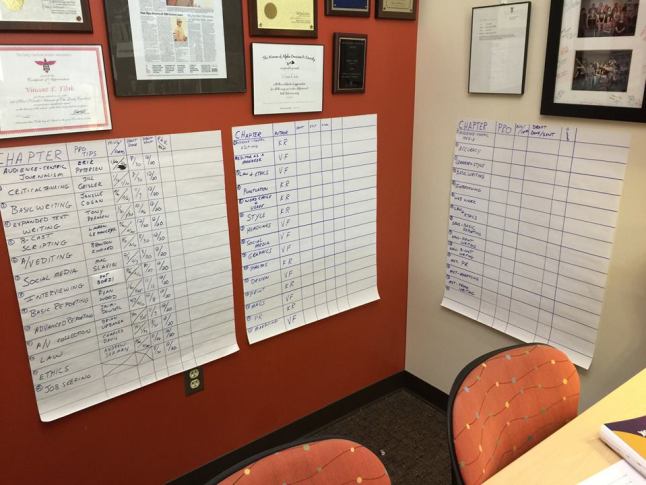
Wall

I don’t really think I have the “secret sauce” and I’m sure at least half of these things won’t be things everyone can do. Still, I promised that whenever someone asked me for something in relationship to education, media or the blog I’d do my best to deliver, here is the best answer I have in (more than) a few bullet points:

Amy Is Awesome

This is my wife, Amy. She rules.
amy-1339991159-1522284644102.jpg
If it weren’t for her, I’d never be able to do anything close to the amount of stuff I do. She’s the person who has to put up with me 24/7, make excuses for me when I’m on a deadline instead of at a gathering of friends, listen to me ponder whatever the heck it is I’m pondering and more. Above all of that, she’s the person who tells me, “Go do your work. It’s totally fine” and means it. Knowing I can do what I need to do without any more guilt than normally accompanies someone who spent 12 years in Catholic school is a real life-saver. She makes all this possible.
And to answer your question, yes, that is alcohol in her hand and yes, she needs an ungodly supply of it to deal with me, I’m sure.


Diet Coke

If you ever see me without one of these, call the authorities. Something is clearly wrong. I would not recommend my Diet Coke lifestyle to anyone, given that I have no idea how many I drink in a day or a week, but I am constantly surrounded by empty 12-and-24-pack cardboard boxes.

I am often accused of surviving on Diet Coke and snark. I plead the Fifth.


Fear of failure

I once read a paragraph about Olympic hockey coach Herb Brooks and it made total sense to me:

“He grew up on the east side of St. Paul, the son of an insurance underwriter, and the only thing he ever feared was failure.”

I understand that failure happens and believe me, I’ve failed a lot. When I do, I try to learn from that failure to make sure I don’t end up repeating it. However, above all else, I make absolutely sure that I always put myself in the best possible position to not disappoint other people. That often means putting off stuff I’d rather do so I can meet a deadline or changing plans at the last minute to help someone in desperate need.

The downside of this is that I always feel like instead of succeeding, I’m avoiding failure. It’s an unfortunate byproduct of this approach to life, but like I said, it does help me get a lot of stuff done.


I’m not chasing someone else’s dream

What is good for other people isn’t necessarily good for you and vice versa. This was a big problem around a couple schools where I taught: If your classmate got an internship at a 50,000 circulation paper, you HAD to get one at a 100,000 circulation paper. If your roommate got a job doing TV in a top 50 market, you HAD to find one in a top 25 market. And on and on it went.

This happened in grad school for me as well: If someone got a conference paper accepted, you had to get two. If that person got published in a top-tier journal, you needed to get an article somewhere even more exclusive, even if the “publish or perish” lifestyle wasn’t what you wanted.

For a long time, I got caught up in that and I couldn’t see what it was doing to me as I tried to out-do other people. On the other hand, as I watched my former students chase each other up a never-ending staircase of glory, I saw several of them become more and more miserable.

It finally crystallized for me when a great kid who had been a business reporter and and had been happy at it, ended up in Kentucky, covering the night-cops beat because, “Well, everyone ELSE was going some place bigger, so…”

Eventually, I settled in here at UWO. It’s a great school and I love my students, but it’s not a “name” institution and I don’t care. I also have no interest in being in administration, even as my former doctoral cohorts and good friends become chairs and deans. I’m glad that’s what they like and if they’re happy, God love them for it. However, for me, that would be like getting a root canal with a meat cleaver.

Which is the point: I get stuff done because I like the stuff I’m getting done and I’m not worried that I’m not doing it at the Lord Almighty School of Journalism and Deification. I’ve turned down jobs elsewhere because I wouldn’t get to teach as much or I’d have to trade the newsroom for a suit coat and a gig shaking hands with rich donors.
If you like that stuff, that’s great. I’m just not going to be chasing you up that ladder.


“The Human Twitch”

I come from a long line of people who have difficulty sitting still. My father can’t watch a whole movie or ballgame without getting up and doing about nine other things during the process. If I ever see him laying still on the couch for more than 20 minutes and not snoring, I need to see if he can still fog a mirror.

My mother spent 45 years teaching grade school and middle school. She also directed plays, ran special programs and coached track well into her 60s. She retired a couple years ago, but does substitute teaching several times per week. Put those two individuals together and you have me, the person once dubbed, “The Human Twitch.” I have a hard time sitting still and an even harder time doing nothing. If I’m watching TV, I’m also trying to write a blog post while waiting for the stain to dry on the furniture I’m refinishing in the next room.

I also like to tinker, in the sense that I want things to work. I will often pull over to grab a broken lawnmower or vacuum cleaner someone left on the side of the road. I don’t need it, but I need to see if I can fix it. One year during a blizzard, a friend dropped off his dead snowblower to see if I could eventually get it to start. I stopped blowing my own snow, rebuilt his carburetor in sub-zero weather and got the thing running. I then used his snowblower to clean my driveway, just to make sure it would stay running.

Another time, shortly after I bought the Mustang, I discovered its heating system wouldn’t work. Was I ever going to drive this car in the cold? No. Did the car run just fine without heat? Yes. Thus, it made no sense for me to pursue this problem with the fervor of Captain Ahab chasing Moby Dick. However, that’s exactly what I did and when I got it working after three days of effort, I drove around with the heat on full blast, giggling like a demented clown.

It was about 90 degrees outside at the time.


Living Urgently

Amy and I had this conversation recently:

Me: I wish I knew exactly how much life I had left to live. I mean, like a cyclops does. It’d be great to know how much time I have so I could plan life better.
Her: You wouldn’t plan better. You’d obsess about the date to the point that you’d get nothing done. It would drive you crazy.
Me: No, I mean if I knew I’d be gone next year at this time, I’d panic less about getting another book done or meeting a deadline or something.
Her: Bull#%@%. You’d work twice as hard to make the deadline.
(Pause)
Me: Yeah, I bet I could squeeze in one more book…

I believe that there is an uncertain brevity to life. I have no idea if I’ll be around tomorrow or next week or next month or whatever. Then again, maybe I’ll be like my great-grandfather and live an active, independent life until I turn 100 and then die peacefully in my bed after a glass of nice top-shelf booze. (True story.)

The goal of some people is to leave behind a legacy or a monument to what they have done. My goal is to make sure I didn’t waste what I was lucky enough to get and to make sure I share it with whoever wants it.

The point is, because of that, I have this overwhelming desire to live urgently, to complete as much as I can while I’m here, to make other people glad they knew me, to help out in every way I can.

—

So that’s what I got. I don’t know if it’s the formula to success or a “secret sauce” to getting this stuff done, but it works for me.

Oy vey: How to avoid being a shmendrik or a schmo when working with Jewish terms and topics

I often joke that one of the best Easters I ever had was the time I celebrated Passover.

It was one of my first years living alone in Missouri when my friend Adam asked if I’d be interested in coming over for Passover Seder, a traditional meal with family and friends often held on the first night of Passover.

I spent half the night asking two basic questions: “What does X thing we’re doing now mean?” and “Is there meat in this?” (The Seder took place on Good Friday, so I had that no-meat thing happening as a Catholic kid.) Adam, Lee and all the folks who had done this before were more than happy to help me figure things out. My only regret is that they let me eat too much matzoh, which felt like it was expanding in my stomach and making me want to die.

This week marks the end of Passover for this year, so in honor of the timing of this event, I thought I’d roll out some of the worst media errors tied to misunderstanding, misinterpreting or just just screwing up things associated with Judaism and a couple basic rules to prevent making these mistakes in the first place.


If it doesn’t make sense, ask again

A lot of people will have trouble capturing quotes from sources who use terms that are unfamiliar to them. This is why it’s always important to ask the person to either repeat the quote or clarify it. If you don’t know something for sure or it’s not making sense, don’t use the quote. That will help you avoid a correction like this one:

SittingShiva.jpeg

The term “sitting shiva” refers to a week-long period of mourning in the Jewish faith. Close relatives of a person who died stay at home and greet family and friends. According to Forward.com, the New York Times similarly screwed up a shiva-related item in its coverage of “JSwipe,” an app for Jewish singles that is akin to Tinder. (The paper also misused another Jewish term, yentas.) If the reporter didn’t know that was what the sheriff was referring to, that might be fine. However, I have no idea who thought people would “sit and shiver.”

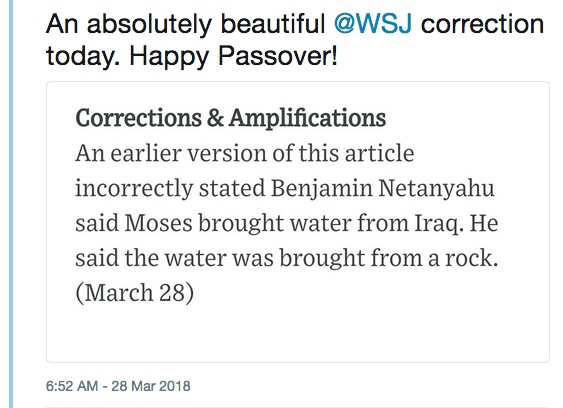
The Wall Street Journal made a similar gaffe in quoting someone, who was discussing a story from the Old Testament:

IraqARock

The story at issue came from the Book of Numbers, in which the Israelites had become angry with Moses for bringing them out of Egypt to a place with no food or water. God instructed Moses to strike a rock with his staff and when Moses did, water flowed from it. (I’m paraphrasing a bit here.) However, the Journal reporter referenced a country that didn’t get any version of that name until the third century (at the earliest) and wasn’t modernly defined until the 20th century. Even if it had been around, it’s unclear why the reporter thought Moses decided to undertake a 500-mile irrigation plan.

Basic rule: If you’re not sure, ask again. If it still makes no sense, don’t use it.


“Like a Christmas tree to celebrate Easter”

Just because something is associated with a group, it doesn’t necessarily follow that you can just slap it on anything you’re doing about that group and call it good. One of my friends pointed me to this photo that was used in a tweet by a political organization in Canada to wish people a “Happy Passover:”

ndp_passover_tweet_cropweb.jpg.size-custom-crop.1086x0.jpg

As news reports on the issue pointed out, the two people here are making challah, a braided egg-bread that is eaten on almost every Jewish holiday. The problem? Passover is one of those outside of the “almost every” holiday list, as leavened items are banned. It took several hours for this tweet and image to come down, as the one person who had access to the group’s social media account couldn’t be reached.

A fellow educator pointed out a similar problem when it comes to the use of menorah photos in ads or with news stories:

(This is like) using the wrong menorah for Chanukah on the promo. There are two kinds of menorahs: the Chanukah one has 9 candles and the weekly one has 7.

Basic rule: Not all symbols are created equal, so don’t try to “spruce up” your coverage of something based on a limited understanding of the topic. It’s akin to having someone who doesn’t understand Christianity say, “Happy Easter! I brought you a pine tree!”


Look it up

The initial title for this post involved the word “putz.” I looked it up and found out that, although the colloquial version of this word roughly translates to dummy, twerp or idiot, it literally means “penis.” I then moved on to shmuck (or schmuck in some cases), only to find that this word, too, literally means “penis.” In short, I learned two things:

  1. My knowledge of Jewish insults isn’t as great as I thought it was.
  2. It seems most of the insults I knew had something to do with male genitalia.

The point is that I looked these things up before assuming I knew what it meant so I didn’t embarrass myself when I misused the word. I also found that there are multiple spellings and some difficult pronunciations to some words. (The Jewish-English Lexicon was a real lifesaver.)

This revelation could be helpful for people who are in broadcast and might not be able to sound out the words they want to use:

Chutzpah refers to things like nerve, gall and shamelessness. I would argue it takes some serious chutzpah to try to fake your way through a pronunciation on live TV.

Or to just “guess” at a word because it sounds close, as Wisconsin Gov. Scott Walker did in a letter to a Jewish constituent. Walker signed off the letter with the line, “Thank you again and Molotov!”

Walker was trying to come up with “mazel tov,” a term that means “congratulations” or “good fortune.”

On the other hand, Molotov is generally used as a shortened reference to a “Molotov cocktail,” which is a bottle-and-wick fire bomb:


Molotov-cocktail-design

Basic rule: The dictionary never hurt anyone, so don’t be afraid to use it.

In picking through these various levels of disaster-bacles, I hit up a bunch of people I know who have a better overall understanding of the faith, the traditions and more to see what they thought when they saw this. Adam, who ended up being the best man at my wedding years later, chipped in to the conversation with some good advice that I thought would bring this post full circle:

To me this just gets back to fact-checking 101. If you don’t understand a court hearing you went to, ask a veteran lawyer or judge or even a reporting colleague to explain what just happened. Don’t understand a Jewish ritual? Same deal. Ask a rabbi, or somebody at your local campus Hillel, or a Jewish colleague, etc.

When I covered Roman Catholic services or other news events, I double- and triple-checked every dang detail, even the ones I thought I was pretty sure about. And nobody with the diocese, or my Catholic colleagues, minded that I asked and asked and asked again. They were happy I was trying to be accurate.

In my view, there’s no more or less of an excuse for screwing up a Jewish fact as any other fact.


“This cut is tied to our coverage.” Wichita State University moves one step closer to gutting its student newspaper

(Editor’s note: The situation at Wichita State University, in which the student government is cutting funding to the student newspaper, The Sunflower, continues to get worse. After a student senate vote last week, there is only one thing standing between The Sunflower and draconian budget cuts: The president of the university, John Bardo.

EIC Chance Swaim said that sharing the message made sure that, “If a tree falls in the forest, I want everyone to hear.” Make sure people hear it loud and clear.)

—

The student senate voted last week to approve the fee committee’s proposed budget, meaning The Sunflower will see its university support sink from $158,000 a few years back to $80,000 next year. The vote was 21-18, with the winning side needing exactly 21 votes or more to move forward. The university continues to insist this has “nothing to do” with the coverage the newspaper has done over the years regarding shady dealings at WSU.

EIC Chance Swaim doesn’t quite see it that way:

“Let’s put aside all of the reasons this cut is tied to our coverage of back-door dealings between the administration and private industry, suspicious resignations of university officials with massive payoffs attached to non-disclosure agreements, inflated enrollment numbers used to make the Innovation Campus concept appear like it’s working — not to mention the dysfunction in SGA,” he said in an email late last week. “The decision to make The Sunflower more reliant on advertising money is absolutely a content decision being imposed on The Sunflower.

(You should really, really read this piece, which is basically a running timeline of the incredible coverage The Sunflower provided on the school’s false-front projects and the attempts the U made to smack the paper around as a result of it.)

Sunflower adviser Amy DeVault, who also teaches journalism at WSU, stated in a letter to the editor that she was “beyond disheartened” at student government’s decision to cut the funding. However, it’s clear from everything her paper has published that this was a done deal, complete with window dressing.

The staff was so confident the paper was about to get screwed over, that it had built a special “look at how screwed up this is” edition of The Sunflower. It was a four-page paper, with almost no content and a giant collection of advertising. Here’s the front page:

Sunflower Front

“Thursday’s print paper was meant to illustrate the absurdity of expecting The Sunflower to rely on advertisements as the primary source of funding for the student newspaper,”  Swaim wrote. “Wichita State is a commuter school. It doesn’t make business sense to report on Wichita State if we’re trying to appeal to advertisers in Wichita’s market. We would necessarily move our reporting away from Wichita State and its community.”

Swaim said he believes this is precisely what a lot of administrators want, from SGA President Paige Hungate, who has been at this middle of this budget cut, to Vice Chancellor Teri Hall, who saw her area’s budget swell by thousands of dollars in the new budget the SGA passed.

Even WSU President John Bardo, who came out in favor of a second, public edition of the fee committee meeting, has been resolutely silent about his opinion on the cuts.

“There’s been a lot of nonsense said throughout this entire ordeal by Hall and Hungate and stony silence from the prime movers of this whole thing,” Swaim wrote. “Militarizing our lack of advertising revenue against us started in my interview about conflicts of interest on Innovation Campus with Lou Heldman, a former publisher of The Wichita Eagle who should know better and who later called me ‘damaged goods’ in front of two young reporters, Andy Schlapp, and David Moses, who said in a different meeting that ‘in an ideal world, we would have a student newspaper that didn’t receive any funding, support, or any type of contribution from the institution. It would all be from private sources, in an ideal world.’ I hope people don’t lose sight of that. Hungate and Hall have been the public faces of these cuts, but they didn’t cook this up themselves.”

If you look at the breakout box of what was funded and at what level, it is extremely difficult to justify the cut The Sunflower took. If everyone took a whack, you think, “Well, we need to take our whack as well.” However, funding went up in some cases or was within a single percentage point of what certain groups requested. This is not to disparage any of the groups that got money, but I have a hard time imagining that they’re more valuable on a campus than a student newspaper would be.

“The Sunflower provides a vital service to Wichita State’s campus,” Swaim said in his email. “It is completely reasonable to expect students to pay around $10 a year for that service. When you look at what student fees have been asked to cover in recent years — a move to a slightly more competitive athletic conference ($340 a student this year), a mandatory membership to the YMCA ($190 a student this year), renovations to the student center (around $5 million in student fees this year), even replacing the turf on the baseball field ($165,000 last year) — it’s dishonest to pretend we don’t have the money to fund the student newspaper. ”